
A complete issue · 32 pages · 1921
Judge — April 9, 1921
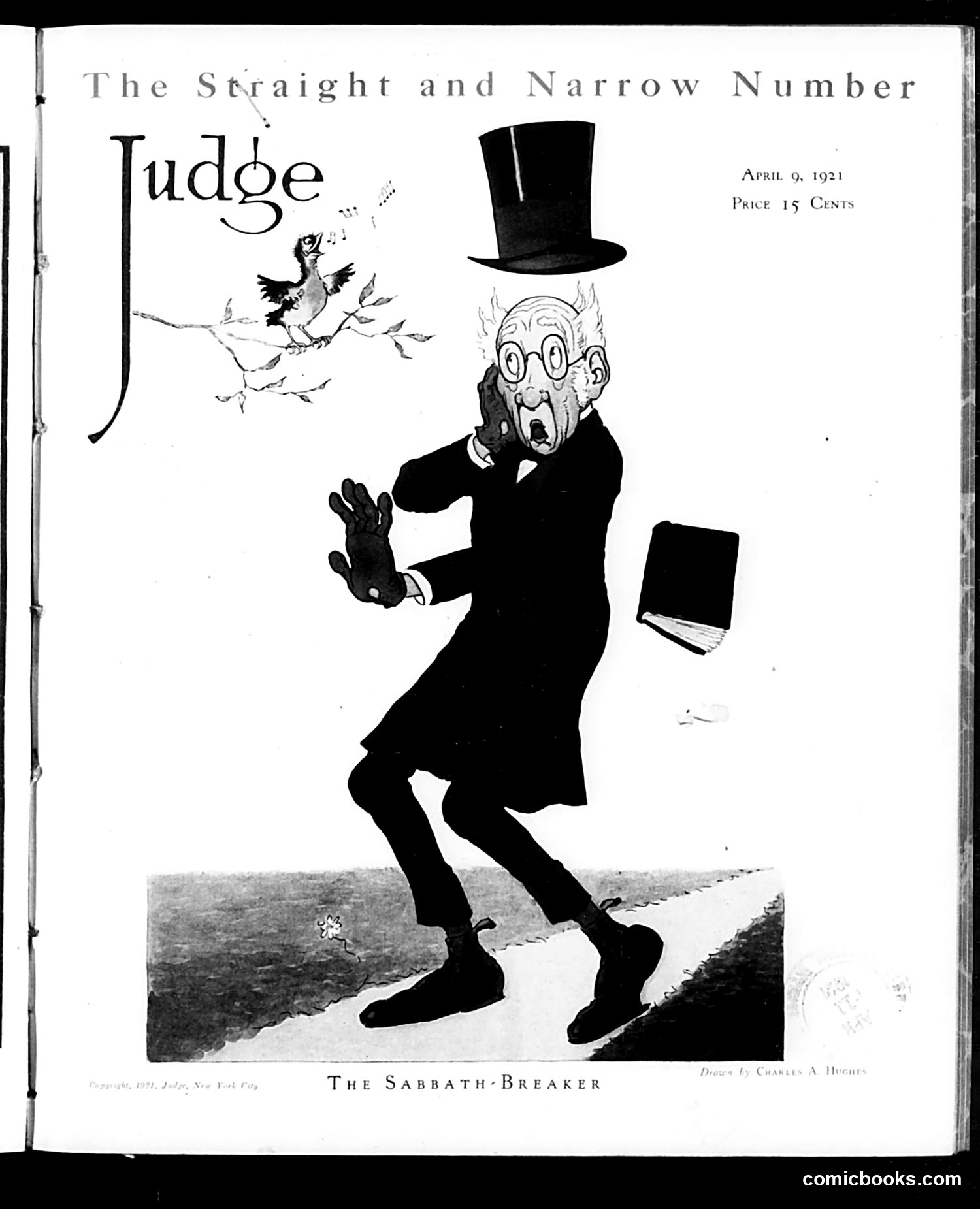
This cartoon depicts an elderly man in formal dress fleeing in panic, his top hat flying off. He appears to be running along a narrow path over water, dropping a book behind him. A bird perches above, seemingly observing his distress. The title "The Sabbath-Breaker" references religious observance of the Christian Sabbath (Sunday). The cartoon likely satirizes someone who violated traditional Sunday restrictions—possibly through work, commerce, or secular activity—and faces divine or social punishment as consequence. The man's exaggerated fear and undignified flight suggest ridicule of either rigid religious enforcement or the man's own guilty conscience. Without additional context from Judge's editorial stance that week, the precise target remains unclear.
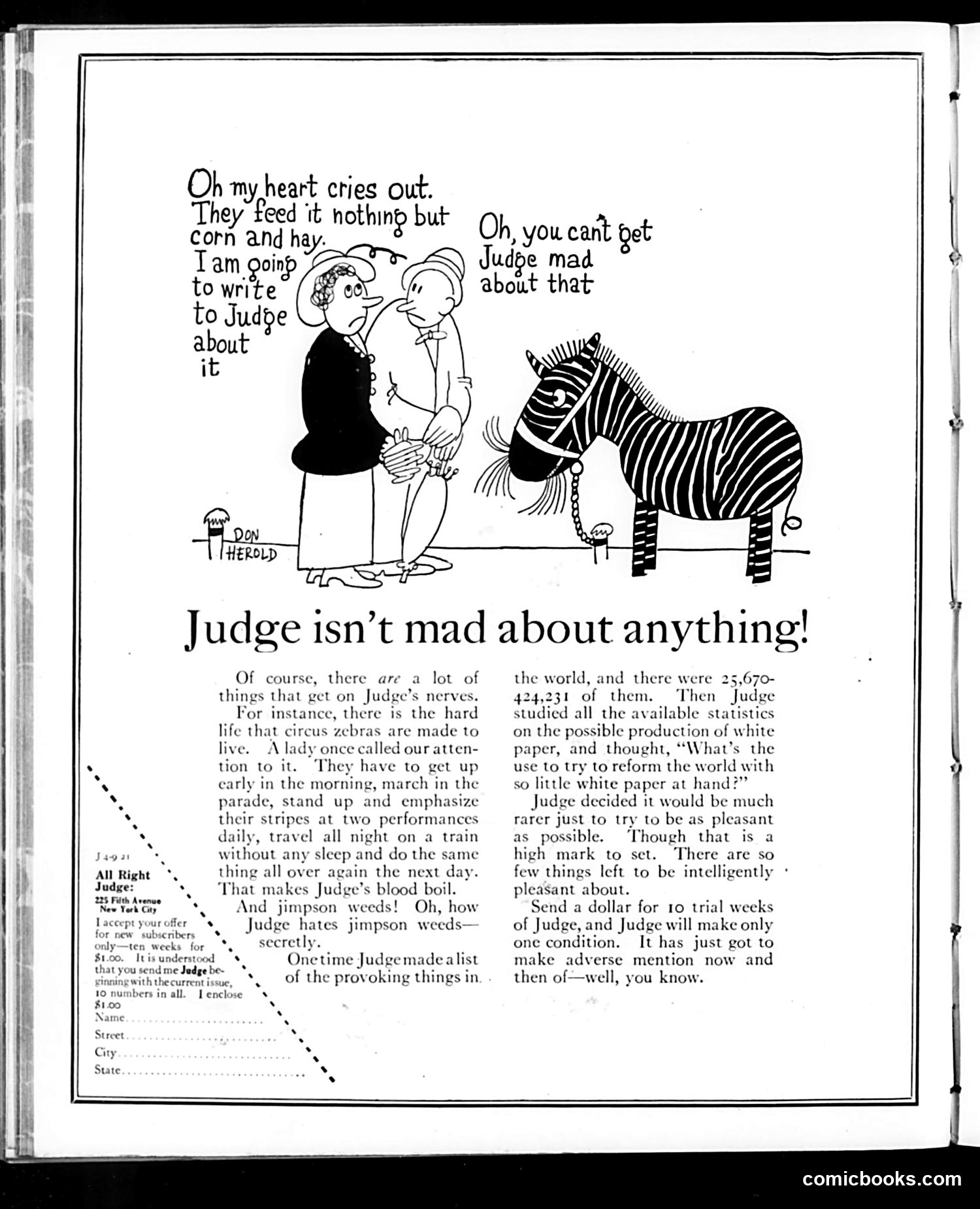
This 1920s cartoon by Don Herold satirizes "Judge," the magazine itself. A woman complains that circus zebras are fed only corn and hay, threatening to write Judge about this animal welfare issue. A man responds that Judge won't get upset about such matters. The humor plays on Judge magazine's reputation for being deliberately unbothered by complaints and controversies. The accompanying text reinforces this: Judge prides itself on remaining pleasant and avoiding taking offense at anything, even when readers submit grievances. The zebra represents an absurdly trivial complaint—the joke being that Judge's philosophy is to maintain cheerful indifference toward virtually all criticism or social problems, no matter how earnestly presented.
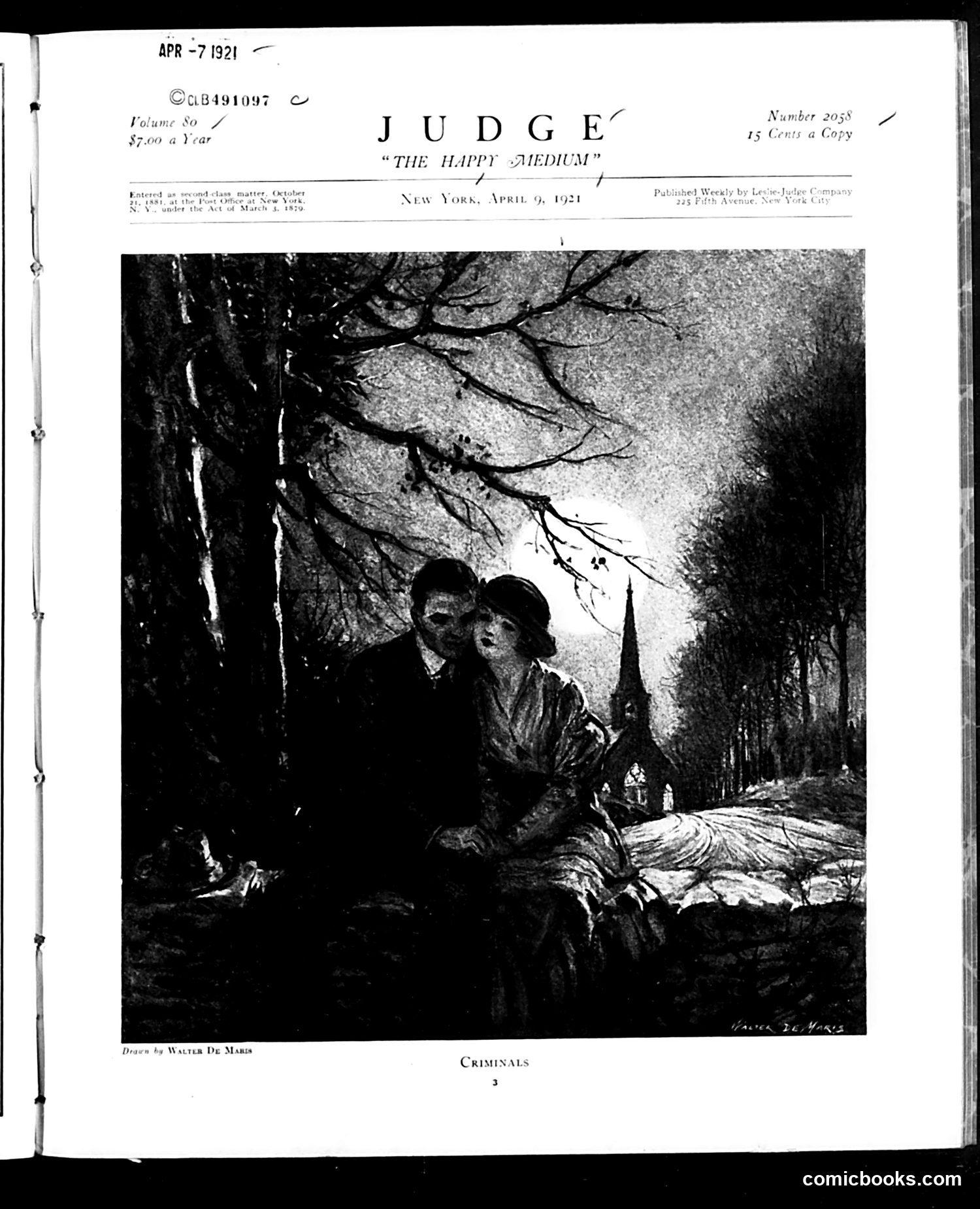
This illustration by Walter De Maris depicts two figures in a dark, foreboding nighttime scene—a bare tree, church spire visible in the distance. The caption simply reads "Criminals." Without additional context identifying the specific figures, the image appears to be a general commentary on criminality rather than a topical satire of particular 1921 events or individuals. The shadowy, expressionistic style emphasizes moral darkness and danger. The nighttime setting, gnarled tree, and isolated church create an atmosphere of sin and transgression. The work may reference contemporary crime concerns of the era, but the page provides insufficient information to identify whether these are specific criminals, social types, or allegorical figures meant to represent crime generally.
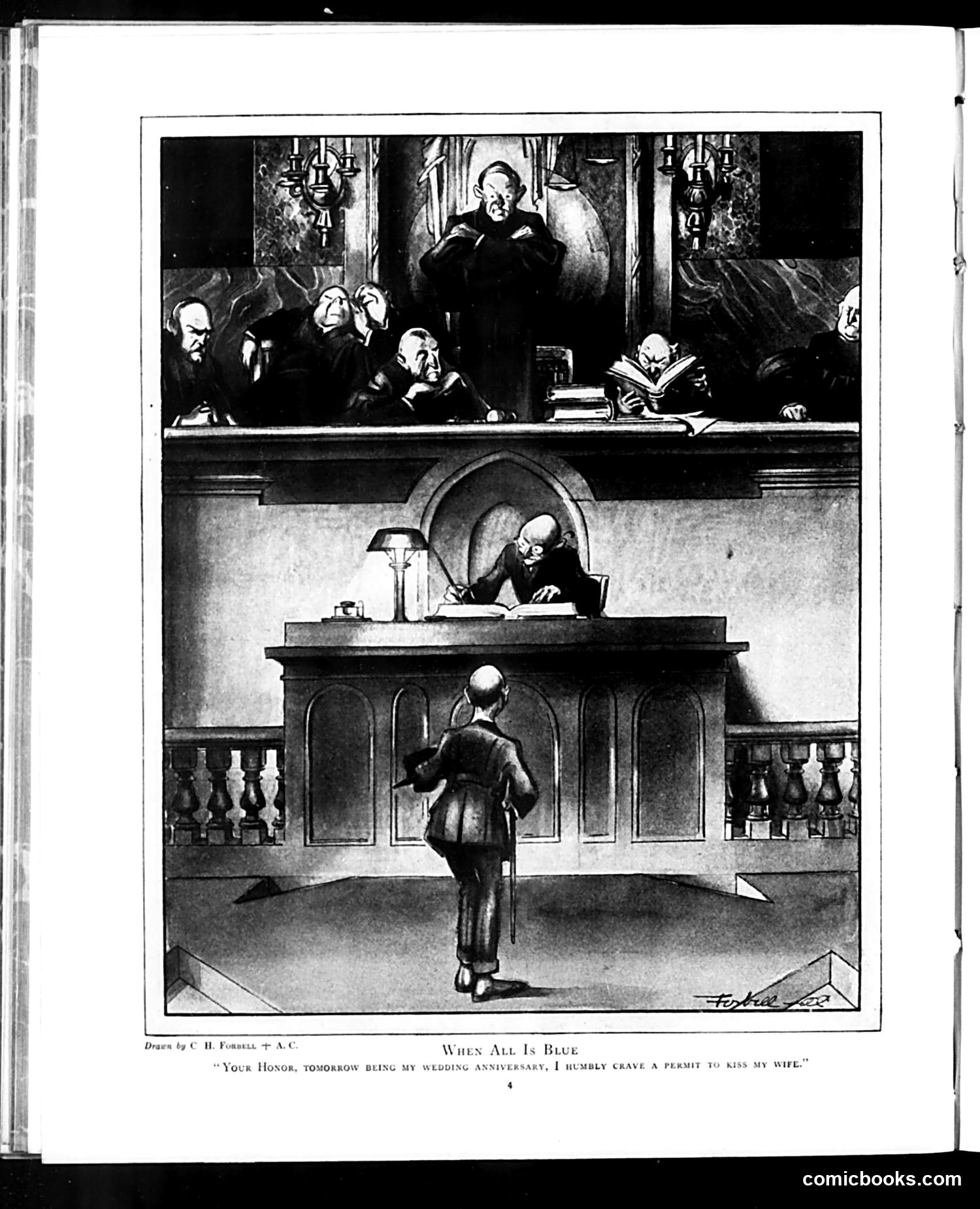
This cartoon by C.H. Fourbell depicts a man standing before a judge, requesting permission to kiss his wife on their wedding anniversary—a request absurd enough to require judicial approval. The title "When All Is Blue" (meaning depressed or melancholy) suggests the satirical target: overly restrictive laws or social conventions that have become so oppressive they make ordinary marital affection illegal or require court permission. The upper gallery shows observers watching the proceeding, emphasizing how public and bureaucratic even intimate moments have become. The satire mocks excessive legal regulation of private life—a common Judge magazine theme critiquing government overreach or absurdly puritanical social restrictions prevalent in early 20th-century America.
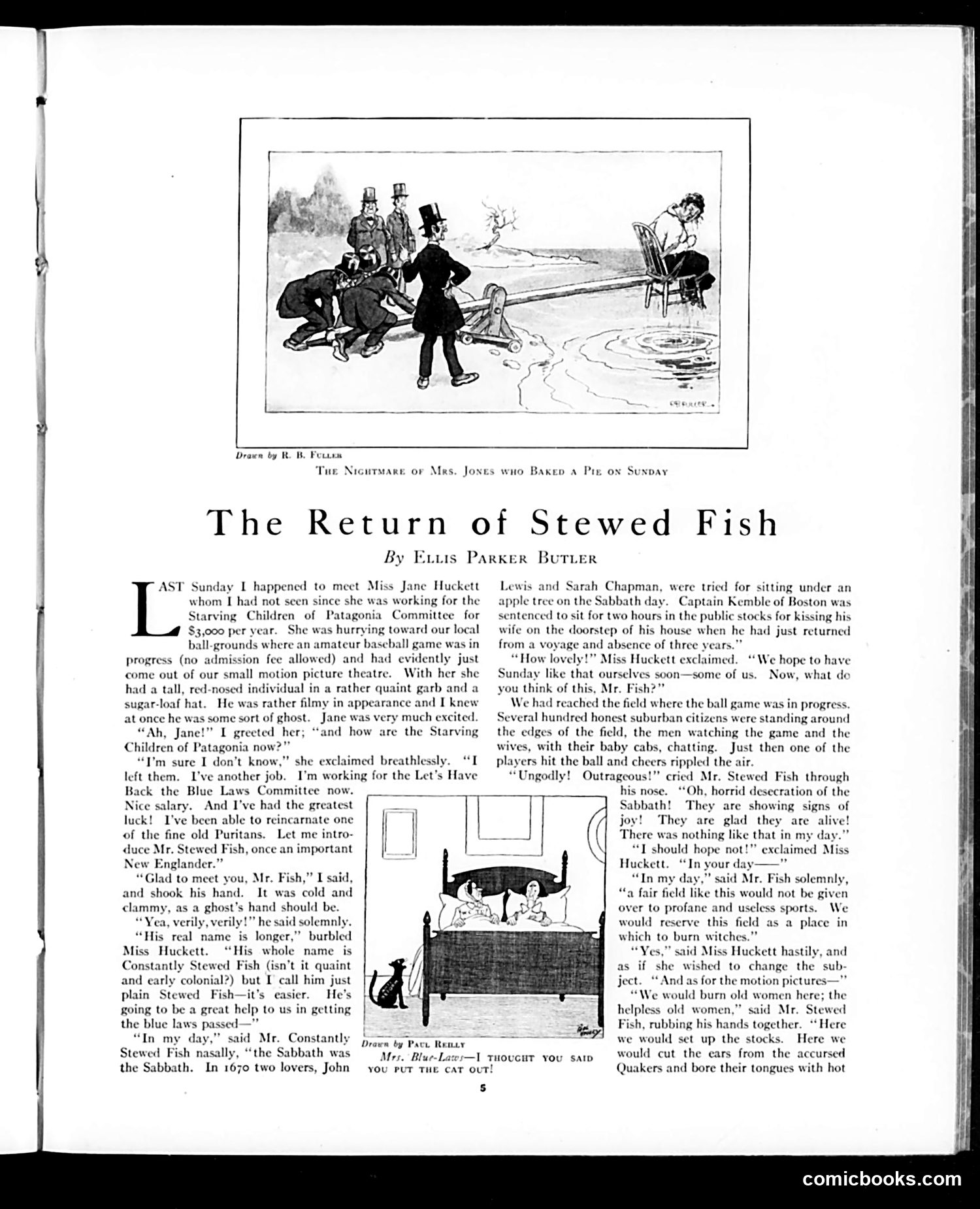
This is a satirical short story by Ellis Parker Butler, not a political cartoon. The narrative mocks social hypocrisy regarding Sunday observance and religious propriety in early 20th-century America. The story centers on Mr. Constantly Stewed Fish, a man who was imprisoned for Sabbath-breaking (working on Sunday). The irony: while Fish served his sentence, respectable citizens—including a woman who baked a pie on Sunday—faced no consequences. The illustrations show the baseball game and social gathering on the holy day that prompted Fish's arrest. The satire critiques arbitrary enforcement of religious laws and the selective moral judgment applied to working-class versus upper-class citizens regarding Sabbath violations.
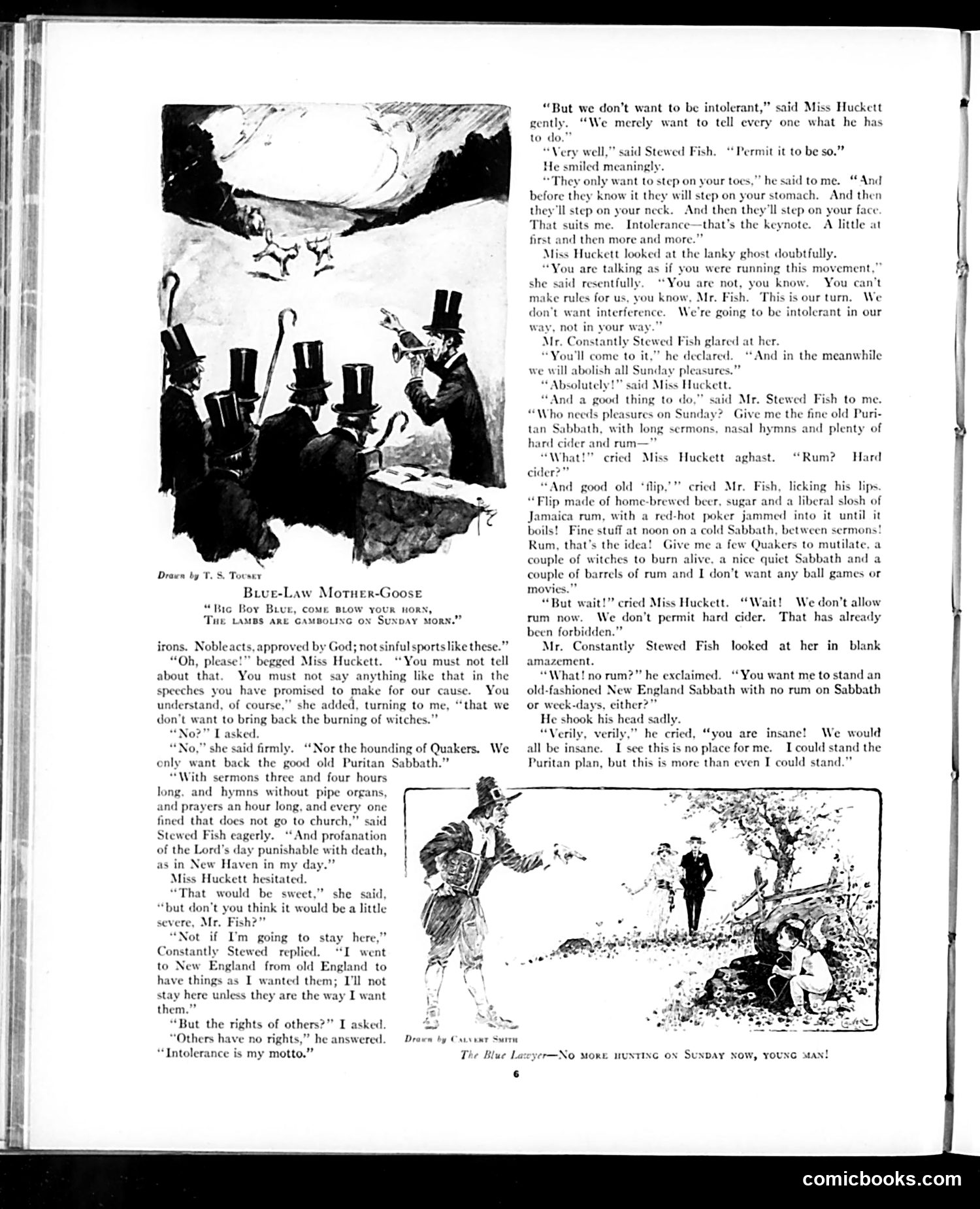
This page satirizes conflicts between religious puritanism and personal liberty in early 20th-century America. The dialogue features "Miss Huckett" (representing strict Puritan values) debating "Mr. Constantly Stewed Fish" (a caricature of an intemperate man) over Sunday restrictions. The satire targets Puritan blue laws—regulations prohibiting alcohol, hunting, and entertainment on Sundays. Miss Huckett advocates abolishing "all Sunday pleasures," while Mr. Fish defends rum, hunting, and "hard cider." The cartoons mock both extremes: rigid religious moralism versus hedonistic excess. The "Blue-Law Mother-Goose" illustration at top-left depicts this tension visually. The bottom illustration shows a hunting scene, reinforcing the Sunday recreation debate. The satire reflects Progressive-era conflicts between traditional religious authority and modern secular desires.
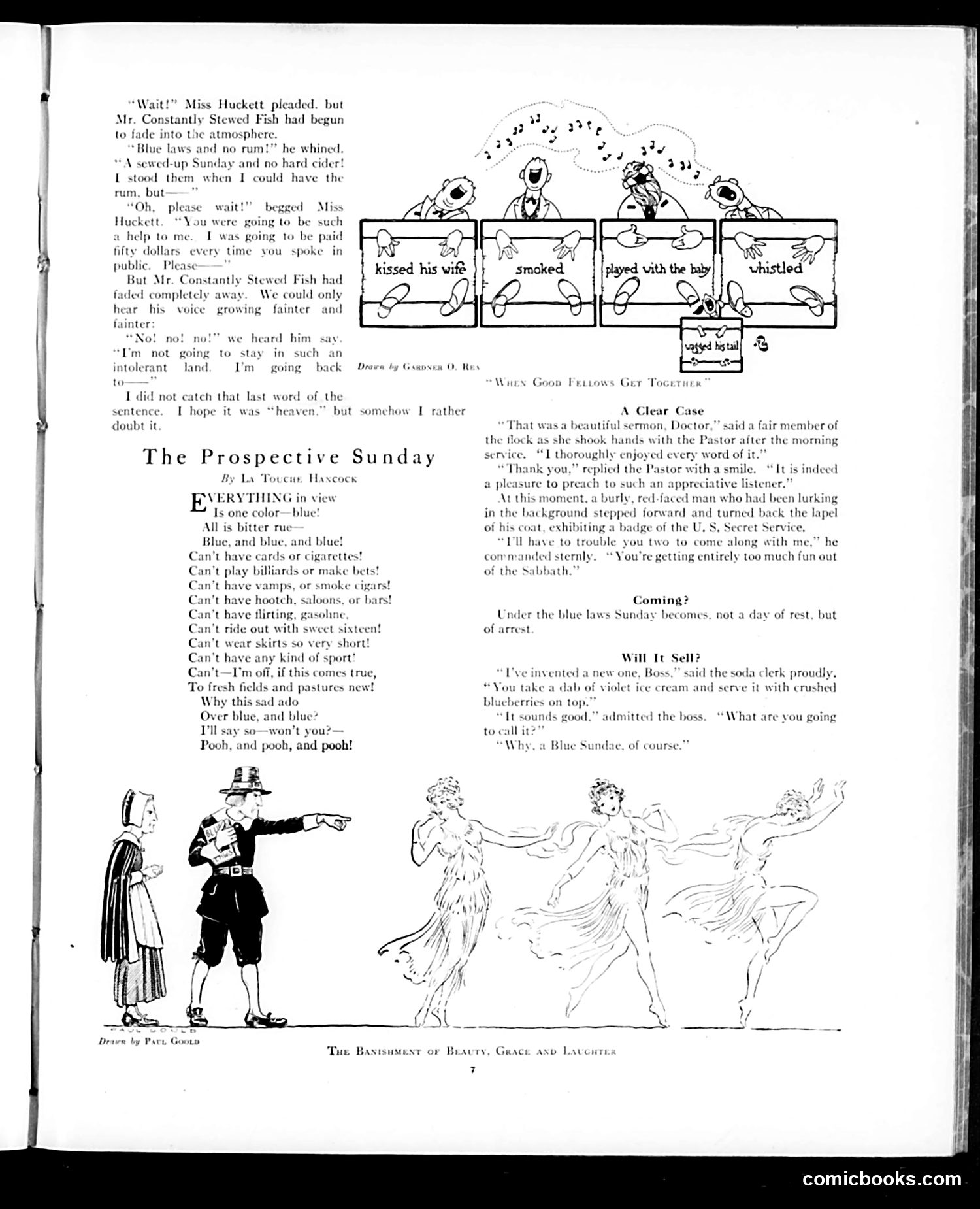
This page satirizes **Prohibition-era "Blue Laws"**—strict Sunday regulations that banned alcohol, gambling, entertainment, and various leisure activities. The content attacks these laws as puritanical and oppressive. **Key elements:** - **"The Prospective Sunday"** poem mocks the restrictions: no cards, cigarettes, billiards, alcohol, vamps, short skirts, or sports—all presented as absurdly excessive constraints on personal freedom. - **"Mr. Constantly Stewed Fish"** character represents the drinker/bon vivant fleeing an "intolerant land," disapproving of such restrictions. - **The Secret Service agent cartoon** depicts a federal official literally arresting parishioners for "getting entirely too much fun" on Sunday—illustrating how invasively the laws were enforced. - **"Blue Sundae" joke** plays on the color "blue" connecting to both the laws and a new ice cream flavor, suggesting commercial innovation despite restrictions. The satire presents Blue Laws as joyless, freedom-crushing, and absurdly enforced—reflecting widespread public frustration with Prohibition-era moral legislation.
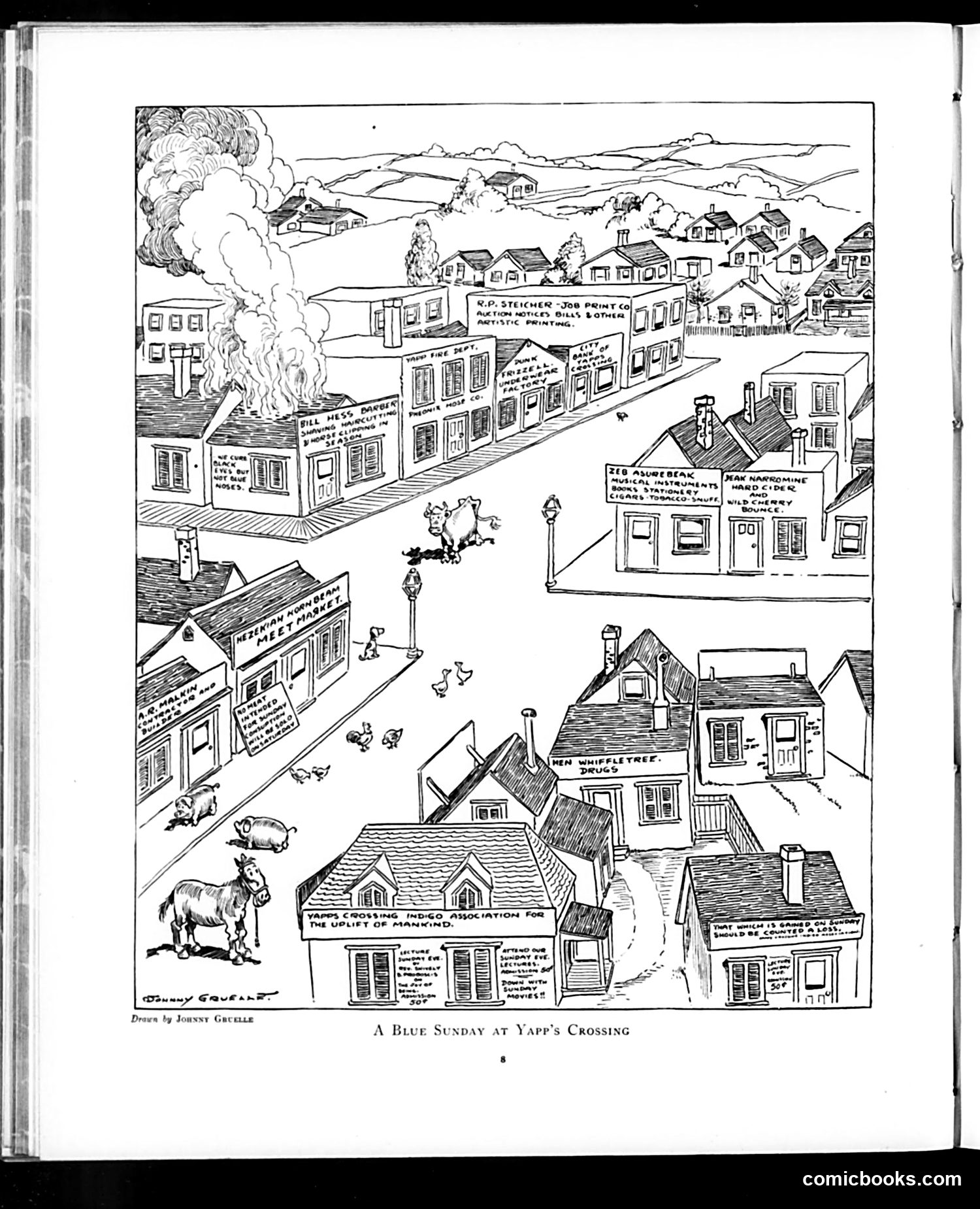
This is a satirical town map drawn by Johnny Gruelle showing various establishments and their purposes. The cartoon appears to be social satire about American small-town hypocrisy, particularly regarding Prohibition-era morality. The labeled buildings include churches, a fire department, and various businesses. The title "Blue Sunday" likely refers to strict religious observance laws that restricted activities on Sundays. The satire seems to mock the contradiction between the town's outward piety (multiple churches visible) and implied actual behavior—though specific building labels are difficult to read clearly in this reproduction. The goats and people in the street suggest everyday activity in this rural American setting being scrutinized for moral inconsistencies typical of Judge magazine's social commentary.
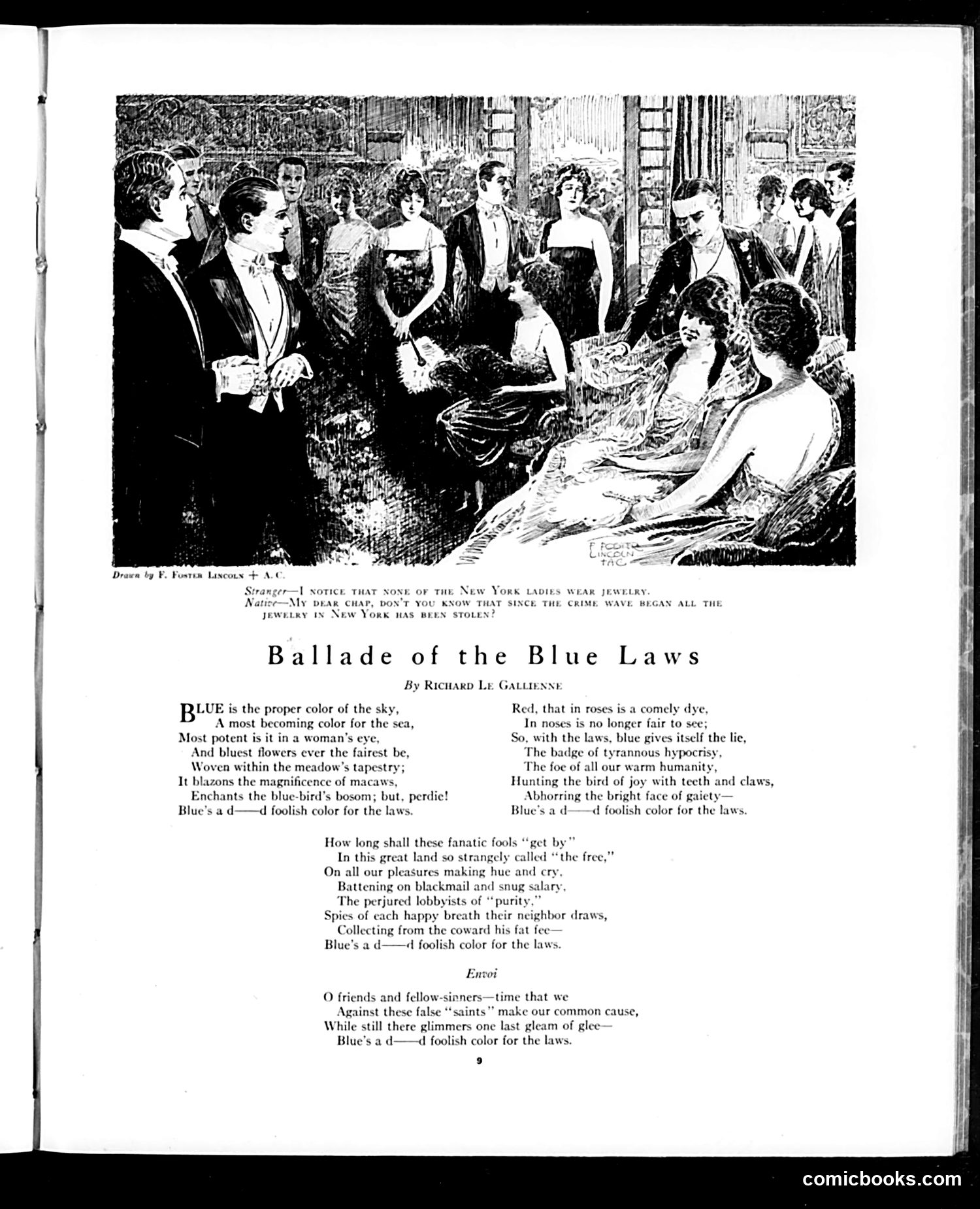
This page combines a cartoon joke with a satirical poem criticizing American "Blue Laws"—restrictive moral legislation. **The Cartoon:** A society scene shows well-dressed New York ladies at what appears to be a social gathering. A stranger remarks that he notices none wear jewelry. A gentleman responds that this is because of recent crime waves and theft in New York. **The Poem's Satire:** Richard Le Gallienne's "Ballade of the Blue Laws" mocks puritanical legislation that restricted personal freedoms (drinking, entertainment, etc.). The repeated refrain "Blue's a d——d foolish color for the laws" condemns these moral restrictions as hypocritical and anti-joy. He attacks "fanatic fools," corrupt "lobbyists of 'purity,'" and calls for resistance against these false moralists who spy on citizens' pleasures. **The Connection:** Both pieces critique restrictions on personal liberty—the cartoon shows visible consequences (stolen luxury goods) while the poem attacks the moral framework behind such laws as tyrannical and joyless.
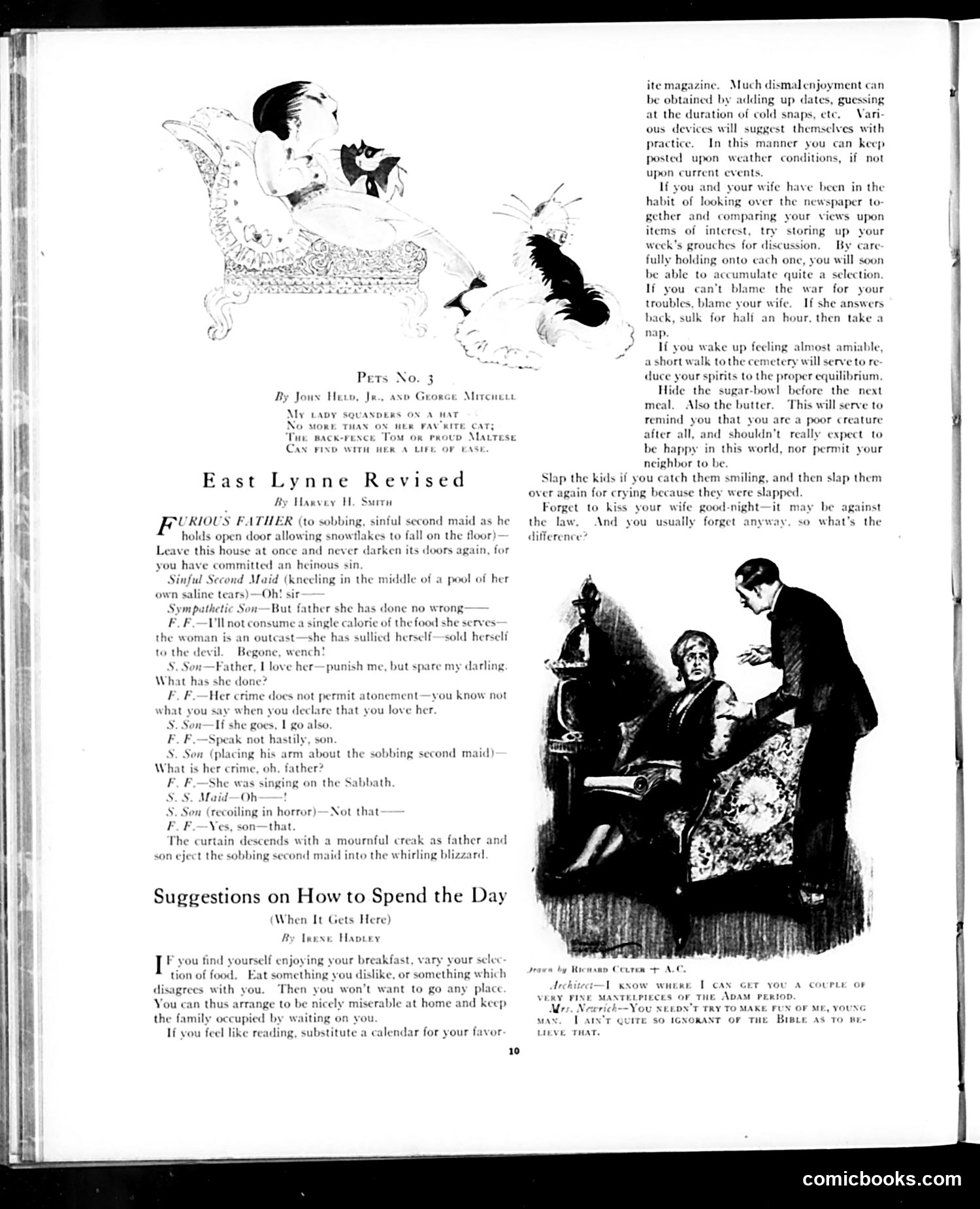
This page contains three satirical pieces mocking Victorian sentimentality and domestic hypocrisy: **"Pets No. 3"** is a brief humorous verse about a lady who spends as much on her favorite cat as on fashionable hats, with the cat living "a life of ease." **"East Lynne Revised"** parodies the melodramatic Victorian play *East Lynne* by exaggerating its moral extremism. A father violently ejects his second maid into a blizzard—not for pregnancy or seduction, but because she sang on the Sabbath. The satire mocks rigid religious hypocrisy and the play's overwrought tragedy. **"Suggestions on How to Spend the Day"** offers darkly comic domestic advice: eat foods you dislike, accumulate marital grievances, blame your wife, hide butter and sugar, slap children, and neglect affection. It's satirizing joyless, petty married life and suggests people deliberately make themselves miserable. The final cartoon shows a nouveau-riche woman (Mrs. Newrich) rejecting an architect's offer of "Adam period" mantlepieces, apparently confusing architectural style with Biblical references. It mocks nouveau-riche pretension and ignorance.
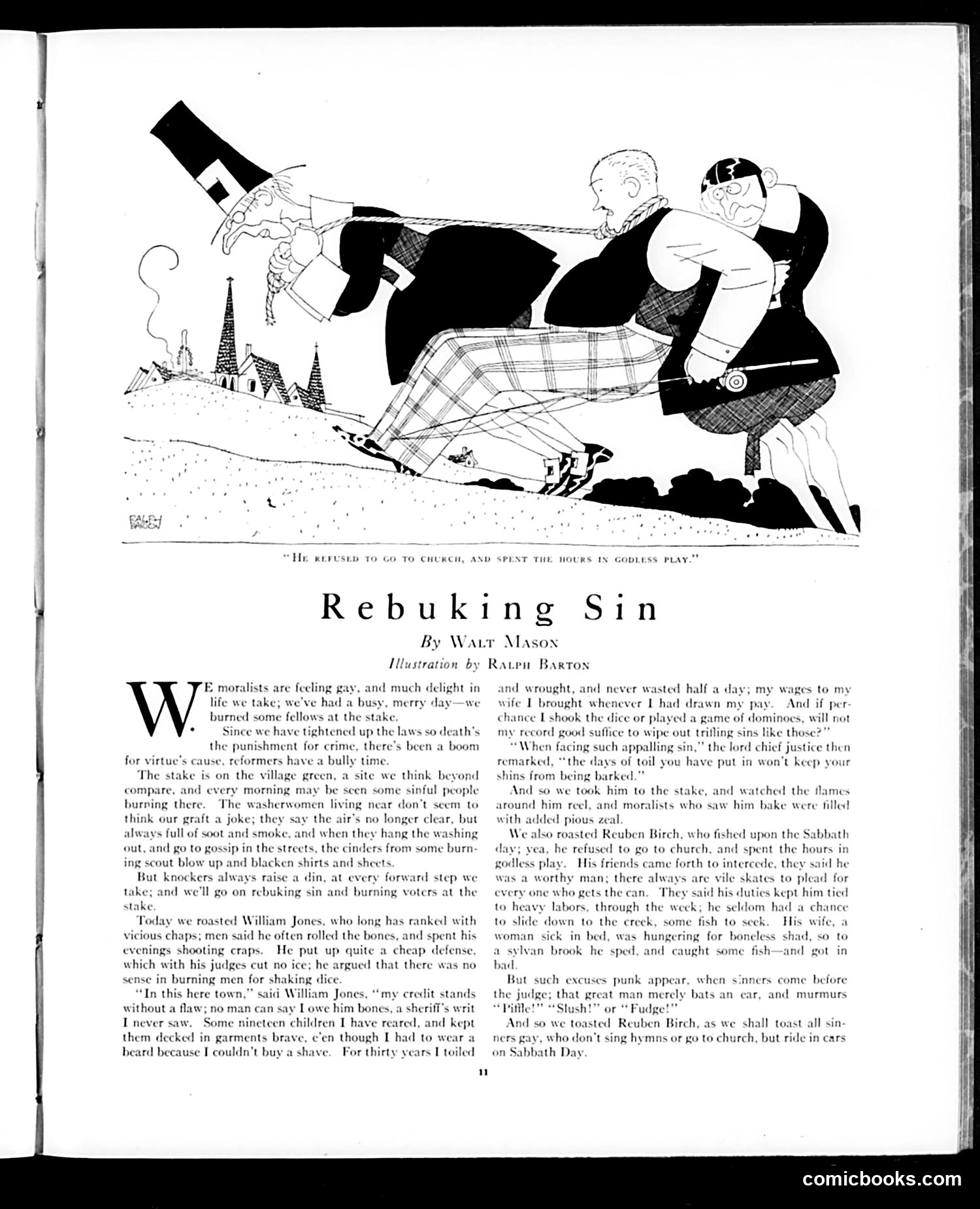
This satirical story by Walt Mason, illustrated by Ralph Barton, mocks religious extremism and overzealous moral crusades. The cartoon depicts self-righteous reformers burning people at the stake for minor infractions—gambling, fishing on Sunday, refusing church attendance. The satire targets the hypocrisy of "moralists" who celebrate punishment in the name of virtue while ignoring practical harm (cinders from executions blacken laundry). The accused men—William Jones and Reuben Birch—are portrayed as decent, hardworking citizens whose supposed "sins" are trivial or justified by circumstance, yet the self-satisfied judge dismisses their pleas with contempt ("Piffle!" "Slush!"). Mason's critique appears directed at Prohibition-era reformers and religious fundamentalists who wielded increasing legal power to enforce moral codes. The exaggerated stake-burning imagery suggests that such zealous policing of personal behavior represents a dangerous, destructive form of tyranny—one that harms ordinary people while feeding the reformers' self-righteousness.
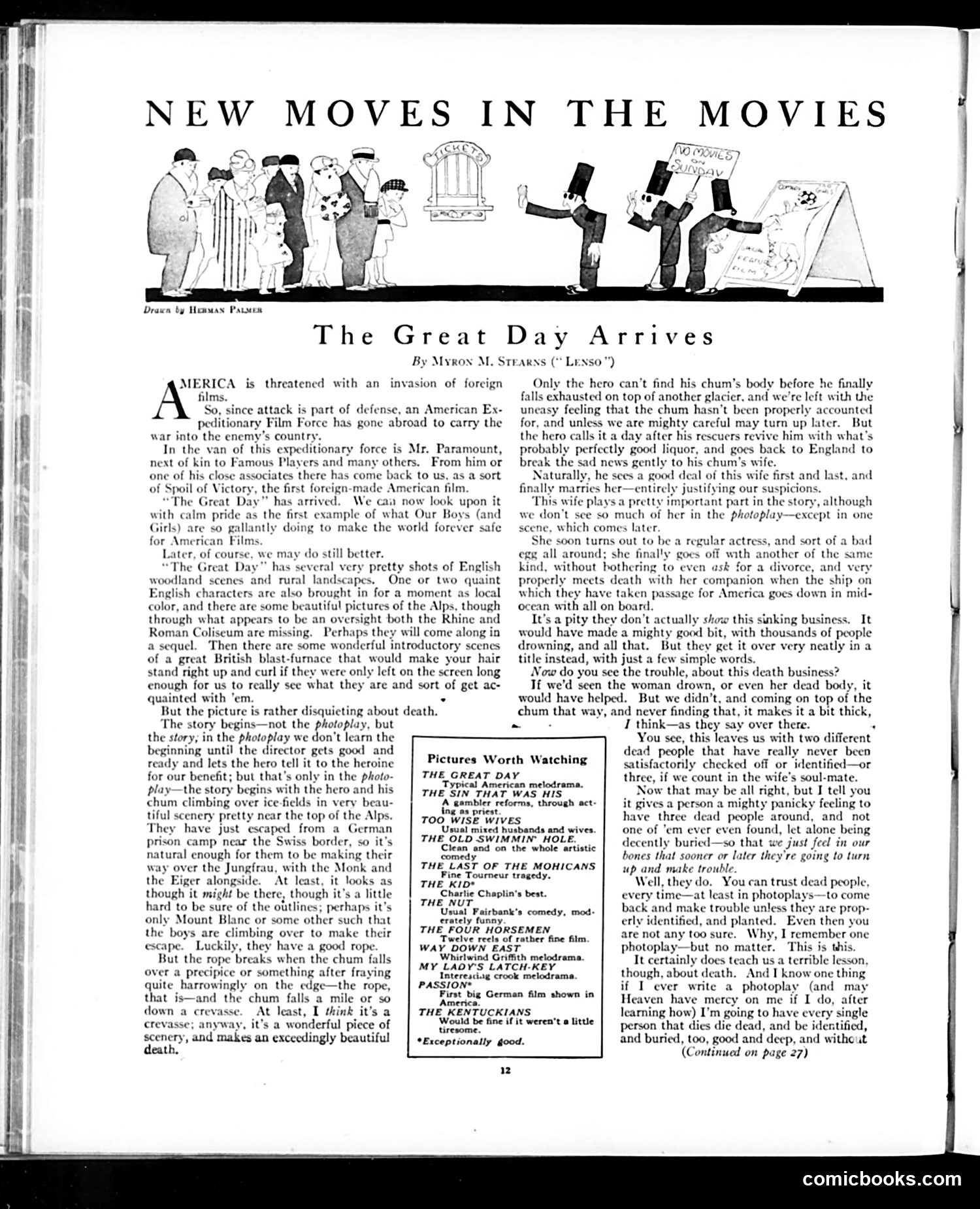
This is a film review by Myron M. Stearns satirizing American cinema's competitive anxiety toward foreign films. The cartoon's header shows Paramount and industry figures attacking "invading" foreign films with weapons and propaganda. The satire criticizes "The Great Day," apparently the first American film shot abroad (likely in Europe, given references to Alps and British locations). Stearns mocks how the film awkwardly showcases European scenery—including oddly missing famous landmarks like the Rhine and Roman Coliseum—as if Americans needed proof they could make "foreign" films too. The deeper joke: the film's melodramatic plot is absurdly contrived (missing bodies, convenient deaths described only via title cards rather than shown), yet the industry celebrates it as a patriotic victory. Stearns argues American filmmakers should compete through quality storytelling, not jingoistic flag-waving about "making the world safe for American Film." The satire exposes post-WWI Hollywood's insecurity and propagandistic impulses.
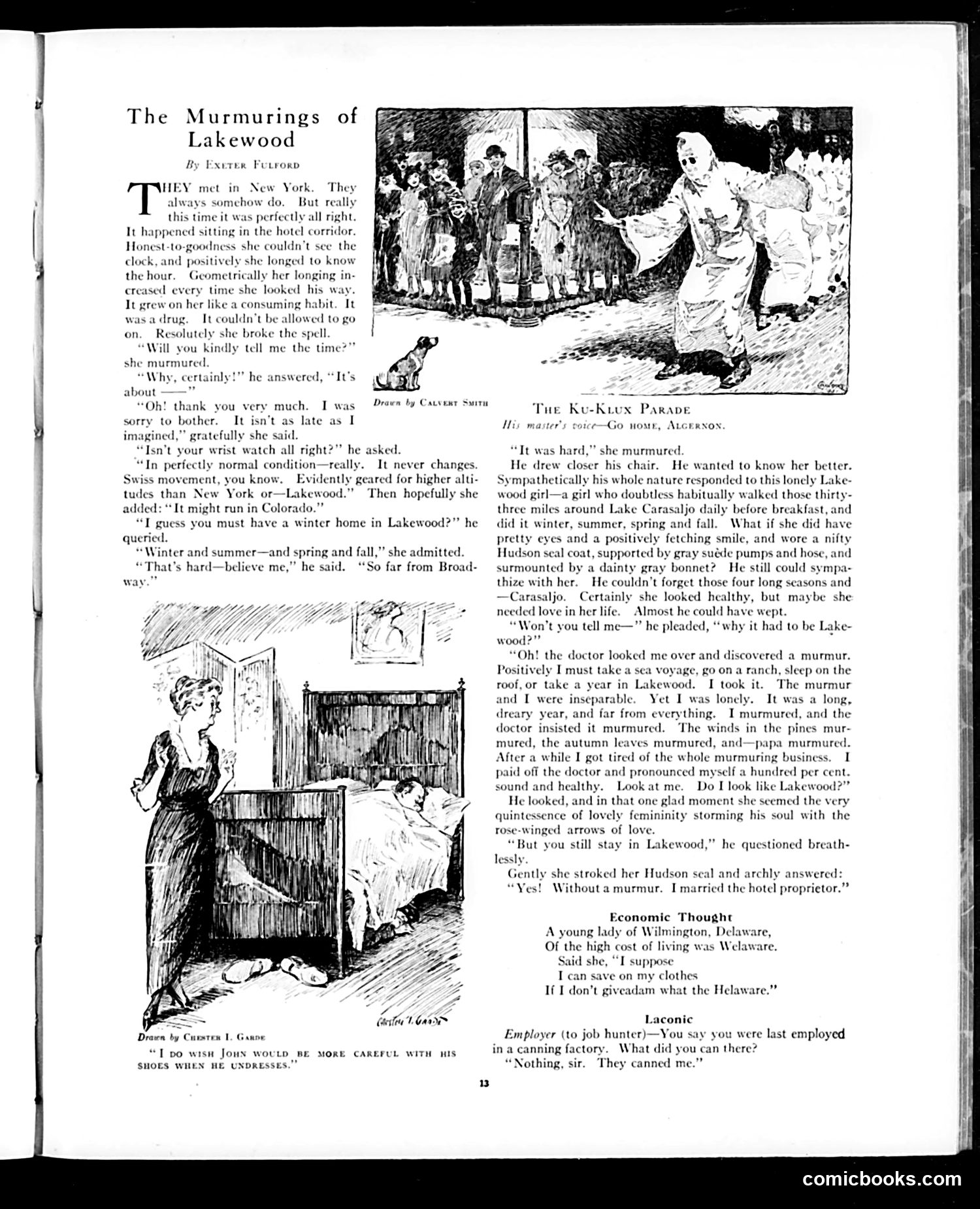
This page contains a romantic short story with period illustrations satirizing Gilded Age courtship conventions and health fads. **The Main Story:** A woman meets a man in a New York hotel and explains why she lives year-round in Lakewood (New Jersey). A doctor prescribed the resort town as a cure for her heart murmur. She dutifully spent a lonely year there—until she married the hotel proprietor, solving both her romantic and health problems "without a murmur." **The Satire:** The piece gently mocks the era's obsession with spa towns and resort living as medical treatments, plus the romantic plotting that naturally occurs in such settings. The ironic ending—she stays in Lakewood not for health but marriage—undercuts the health-cure premise. **Additional Humor:** The page includes two brief jokes: one mocking the high cost of living in Delaware, another about a job applicant fired from a canning factory. The illustration shows domestic life commentary.
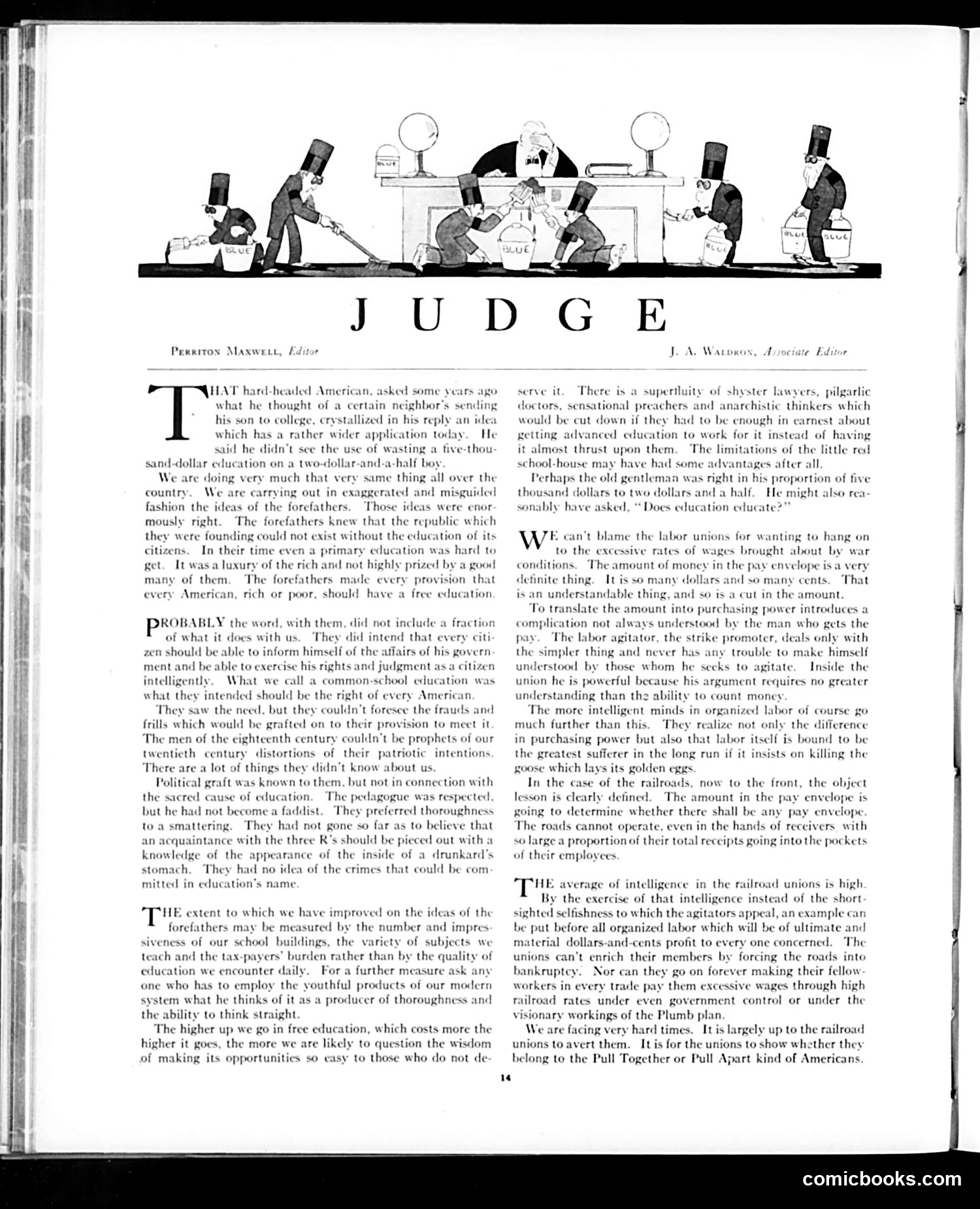
This page presents a satirical editorial titled "Judge" attacking progressive educational expansion in early 20th-century America. **The Cartoon**: The masthead illustration shows figures with bucket-heads operating at a desk labeled "JUDGE," satirizing how the publication dispenses verdicts on national issues. **Main Argument**: The editorial mocks the idea of providing extensive free education to all Americans, claiming the founders only intended basic literacy ("three R's"), not the elaborate modern curriculum. It uses the anecdote of a man refusing to waste a "$5,000 education on a $2.50 boy" to argue education is being wasted on students incapable of benefiting. **Social Targets**: The piece criticizes: - "Faddist" pedagogy and educational graft - Overly-impressive school buildings - Production of "shyster lawyers" and "anarchistic thinkers" - Labor unions demanding high wages **The Satire**: Judge argues American education has become corrupt, wasteful excess rather than practical necessity—betraying the founders' sensible original vision.
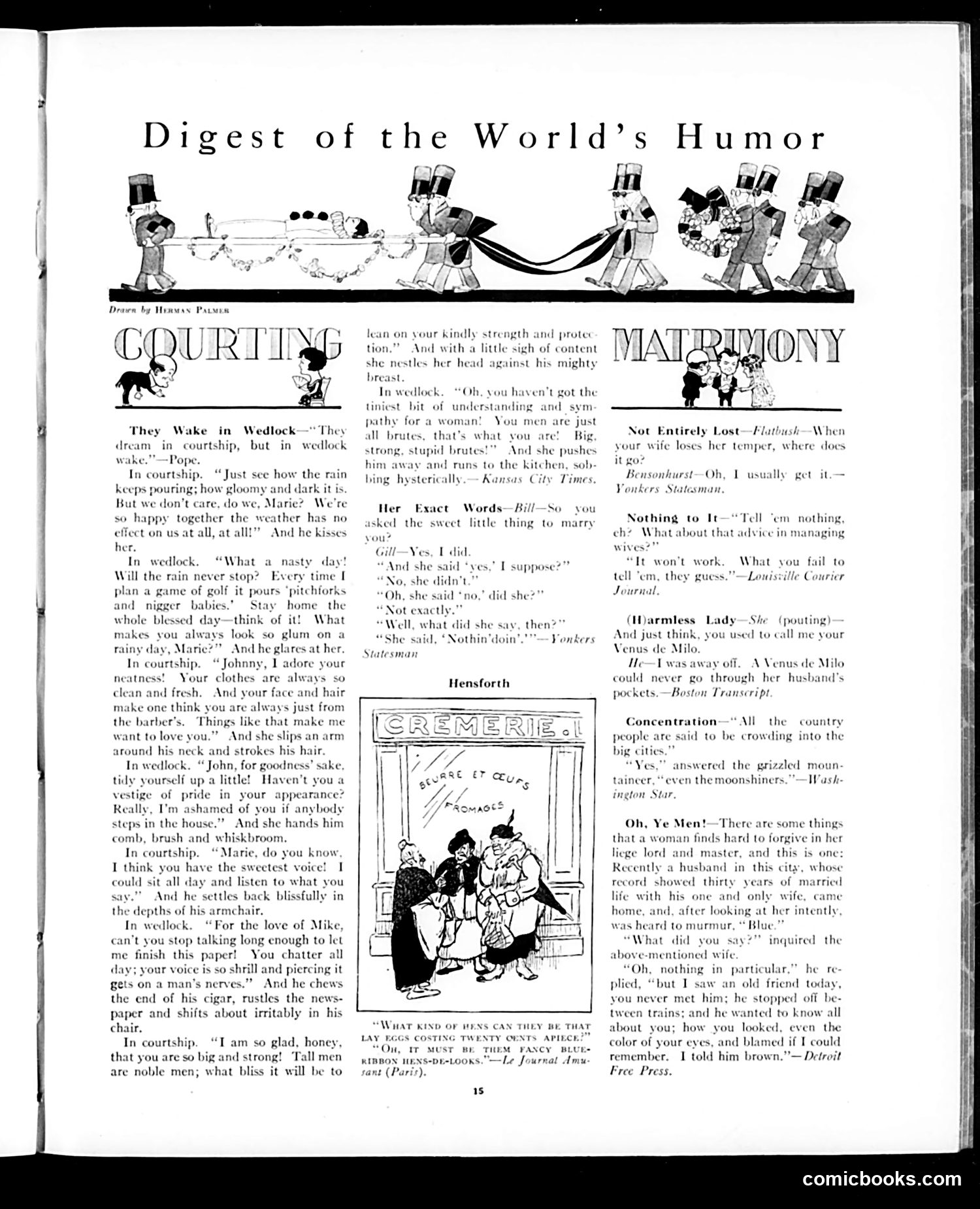
This page from *Judge* magazine presents a popular early-20th-century humor format: contrasting courtship romance with married reality. The main cartoon compares how couples behave before and after marriage across five scenarios—weather, appearance, voice, strength—showing the stark shift from adoration to irritation and complaint. The satire targets the disillusionment of marriage itself: lovers who find rain charming become golf-frustrated spouses; attentive listeners become newspaper-rustling complainers. The woman transforms from admiring and nestled to hysterical and critical; the man from affectionate to glaring and dismissive. Other brief jokes on the page continue this theme of marital disappointment and miscommunication, using common tropes of the era—nagging wives, inattentive husbands, and the gap between courtship promises and married reality. The humor reflects contemporary anxieties about matrimony's failures.
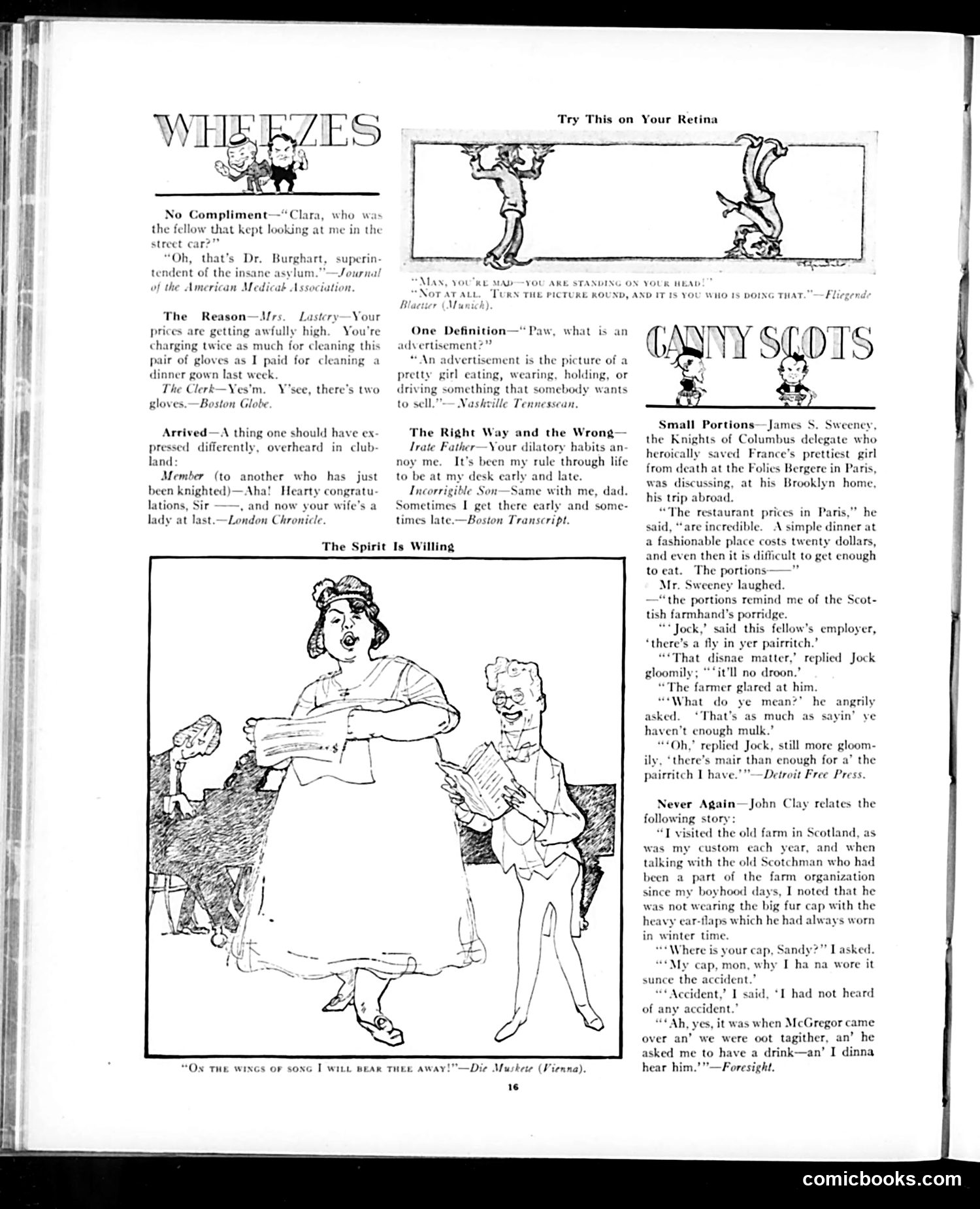
This page contains several short humorous anecdotes and jokes typical of early 20th-century American humor magazines: **"No Compliment"** mocks a woman by noting a stranger staring at her was a doctor from an insane asylum—implying she appears unstable. **"The Reason"** jokes about pricing: a cleaner charges more for gloves than a dinner gown because gloves are two separate items, playing on literal-minded logic. **"Arrived"** punches up: congratulating a newly knighted man by saying "now your wife's a lady" is tactless, since she automatically gains status through *his* knighthood, not vice versa. **"The Spirit Is Willing"** cartoon shows women offering to bear a man away "on wings of song" (operatic reference)—he's depicted standing on his head. **"Small Portions"** uses Scottish dialect humor: a farmhand's porridge is so thin a fly won't drown in it, and there's barely enough milk to accompany the meager portion. **"Never Again"** presents similar Scottish-dialect humor about a man who hasn't worn his winter cap since an accident when he couldn't hear a drinking invitation. The page emphasizes wordplay, mild social observation, and ethnic/regional stereotyping common to the era.
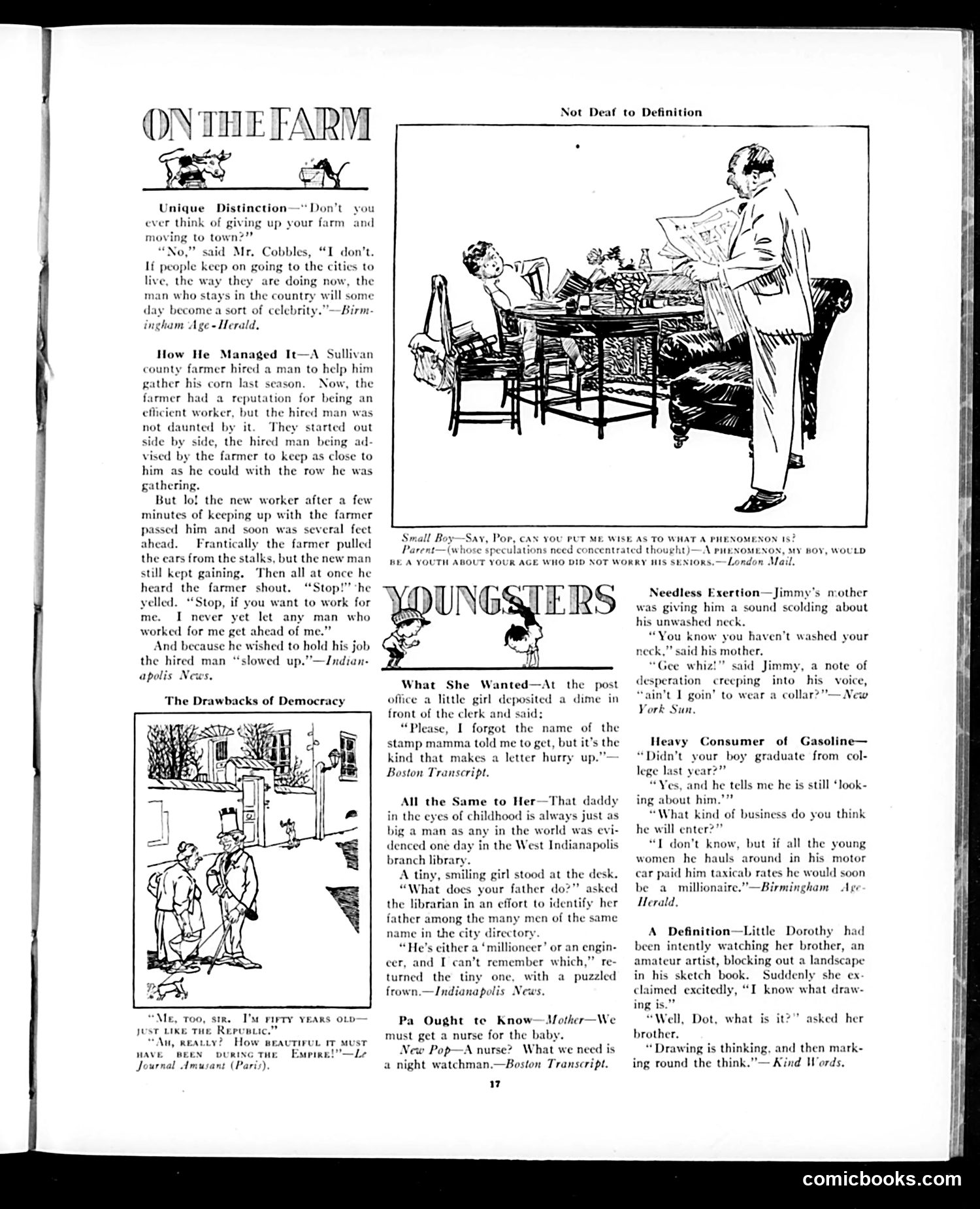
This page contains humorous anecdotes rather than political cartoons. The content reflects early 20th-century American rural and domestic life. **"On the Farm" section** satirizes rural pride: a farmer boasts he'll never leave for the city because staying put will make him a "celebrity" as urbanization accelerates. A second anecdote mocks a farmer so obsessed with efficiency that he forbids his hired worker from outpacing him—valuing ego over productivity. **"The Drawbacks of Democracy"** cartoon (bottom left) appears to critique democratic ideals through an exchange about republican values, though the exact reference is unclear without more context. **"Youngsters" section** collects family humor: a child confuses "phenomena" with someone worry-free; a girl seeks "hurry-up" stamps; a child cannot distinguish between her father's occupations. The final anecdote defines drawing as "thinking, then marking round the think." **Overall theme**: gentle mockery of rural mentality, parental anxiety, and childhood innocence. The humor relies on wordplay and observational comedy about ordinary Americans, typical of Judge's satirical but family-friendly approach.
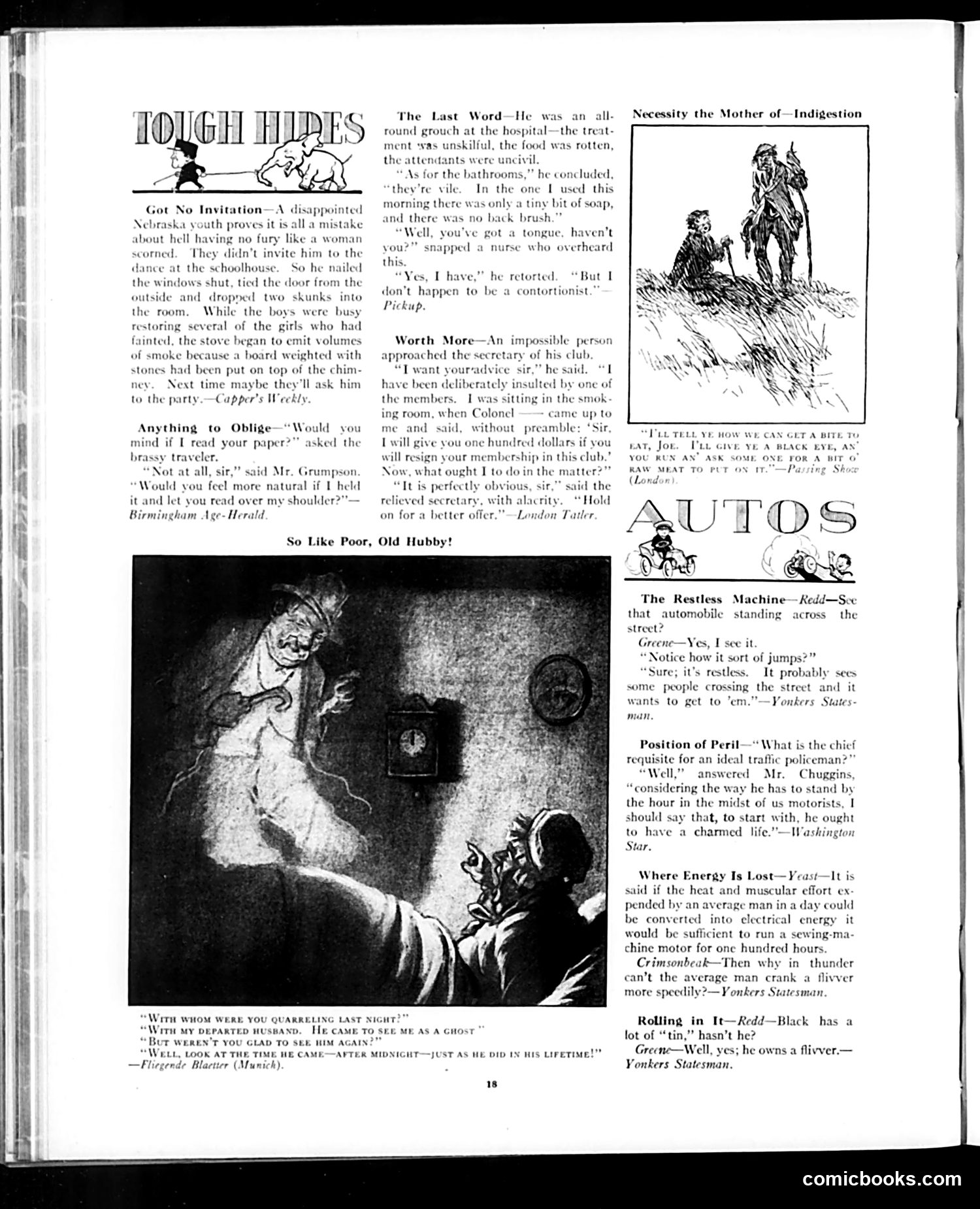
This page collects brief humorous anecdotes and jokes typical of Judge's satirical format. Key content: **"Got No Invitation"** mocks a spurned Nebraska youth who, denied entry to a school dance, releases skunks into the building—a revenge fantasy presented as darkly comedic. **"The Last Word"** jokes about a perpetually complaining hospital patient who, when a nurse asks why he doesn't use his tongue to brush the bathroom, retorts he's no contortionist—humor from physical impossibility. **"So Like Poor, Old Hubby!"** features a widow visited by her husband's ghost, disappointed he arrived after midnight as he did in life—marital discord comedy. **The automobile and traffic jokes** satirize early 1900s motorist culture: restless cars, traffic police hazards, and references to "tin" (flivvers—cheap cars, particularly Model Ts). The page reflects period concerns: early automobile dangers, hospital conditions, class tensions, and gender dynamics. The humor assumes familiarity with contemporary urban life and automobile anxiety typical of the motorcar's novelty era.
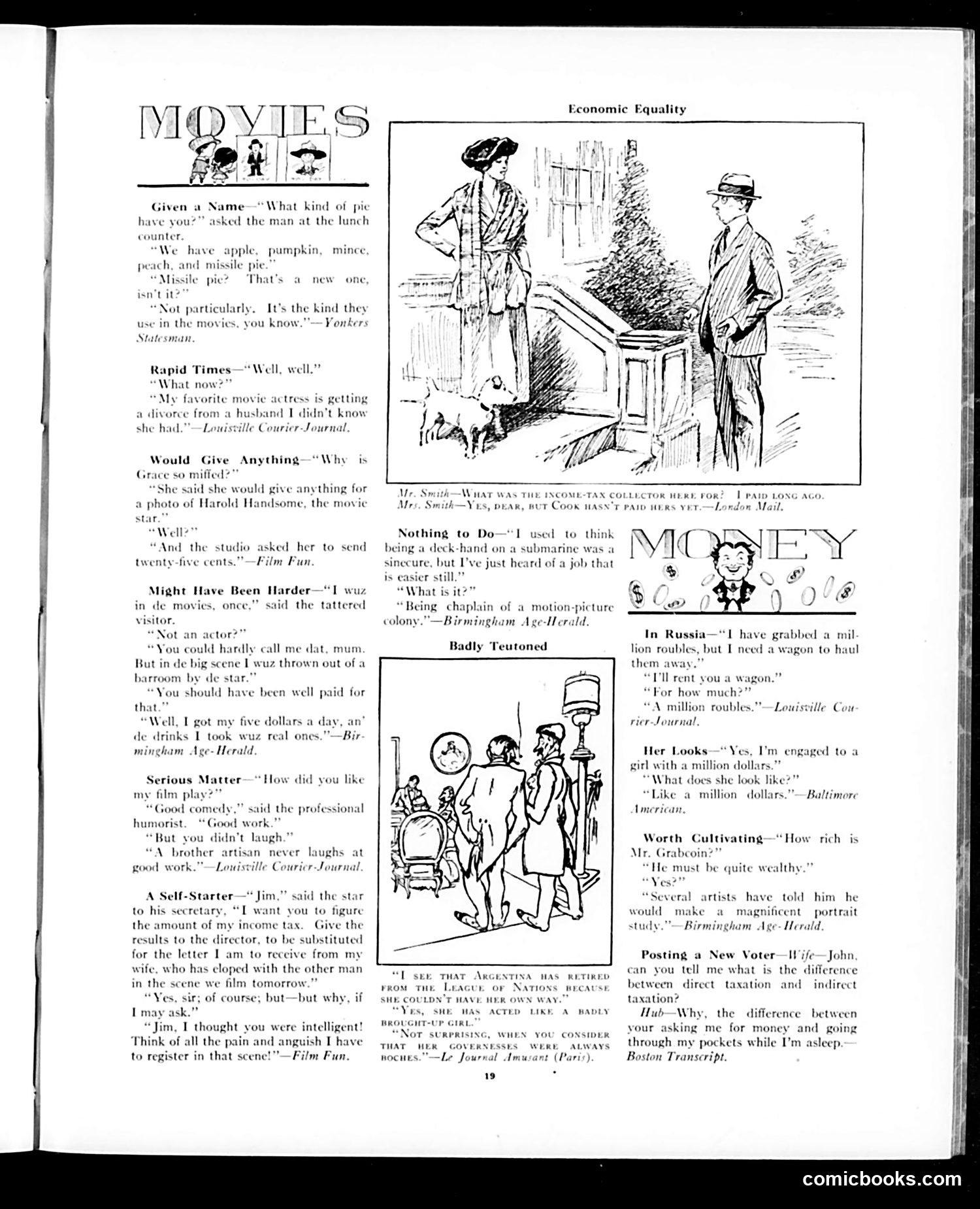
This page collects humorous anecdotes about wealth and taxation, satirizing economic inequality during the early 20th century. The main cartoon depicts a well-dressed woman confronting an income-tax collector about unpaid taxes—the joke being that even wealthy households avoid payment (the cook hasn't paid "hers yet"). The surrounding jokes mock the absurdity of extreme wealth disparity: a Russian with "a million roubles" needs a wagon to transport them; a man engaged to a millionaire's daughter only values her for her money; wealthy individuals seek portrait artists to immortalize their status. The final "Posting a New Voter" exchange offers sharp political commentary: taxation is reframed as government "theft"—the difference between asking permission (direct taxation) versus taking without consent (indirect taxation through the pockets while sleeping). This reflects contemporary debates about tax burden distribution and government revenue methods during the Progressive Era.
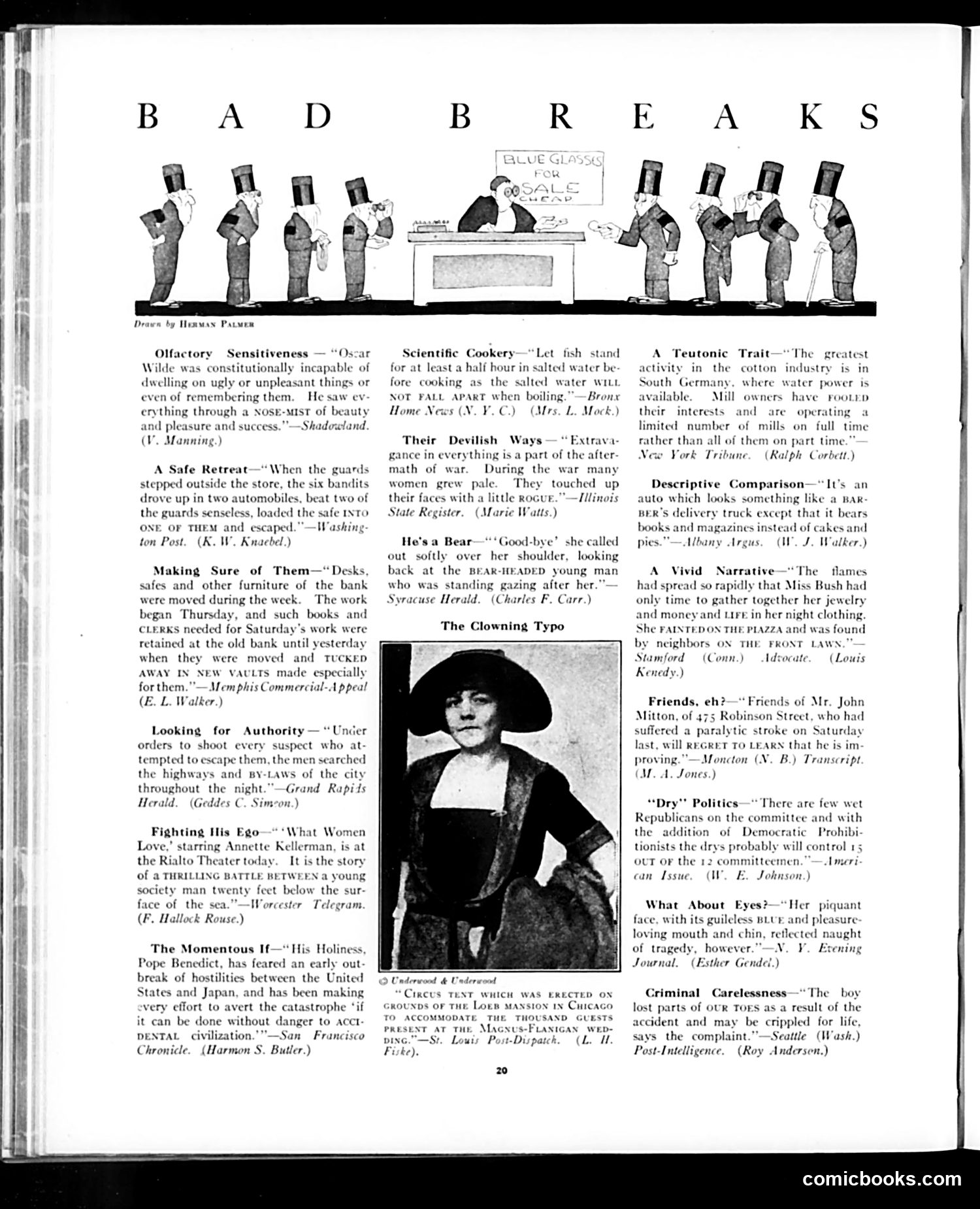
This is a humor page from *Judge* magazine featuring "The Clowning Typo"—a recurring section that mocks absurd newspaper typographical errors and awkward phrasings. The top cartoon by Herman Palmer depicts a bartender surrounded by customers holding bottles, illustrating humorous misreadings of news headlines. The page then collects genuine newspaper errors, presented as comedy: **Key examples of the satire:** - A bank story where safes are "loaded...INTO" a vehicle (incomplete sentence) - Describing a shark attack as occurring "TWENTY FEET BELOW THE SURFACE" of the sea - A "BEAR-HEADED" young man (likely "bare-headed") - Fish that won't "FALL APART" when boiling (nonsensical cooking advice) - Women using "RoGuE" (rouge/makeup) during wartime **The satire's point:** These aren't invented jokes—they're real newspaper errors that create unintentionally funny meanings. The humor mocks both careless editing and the absurd results when words get garbled. This was a popular recurring feature showing readers how poor proofreading could transform serious news into comedy.
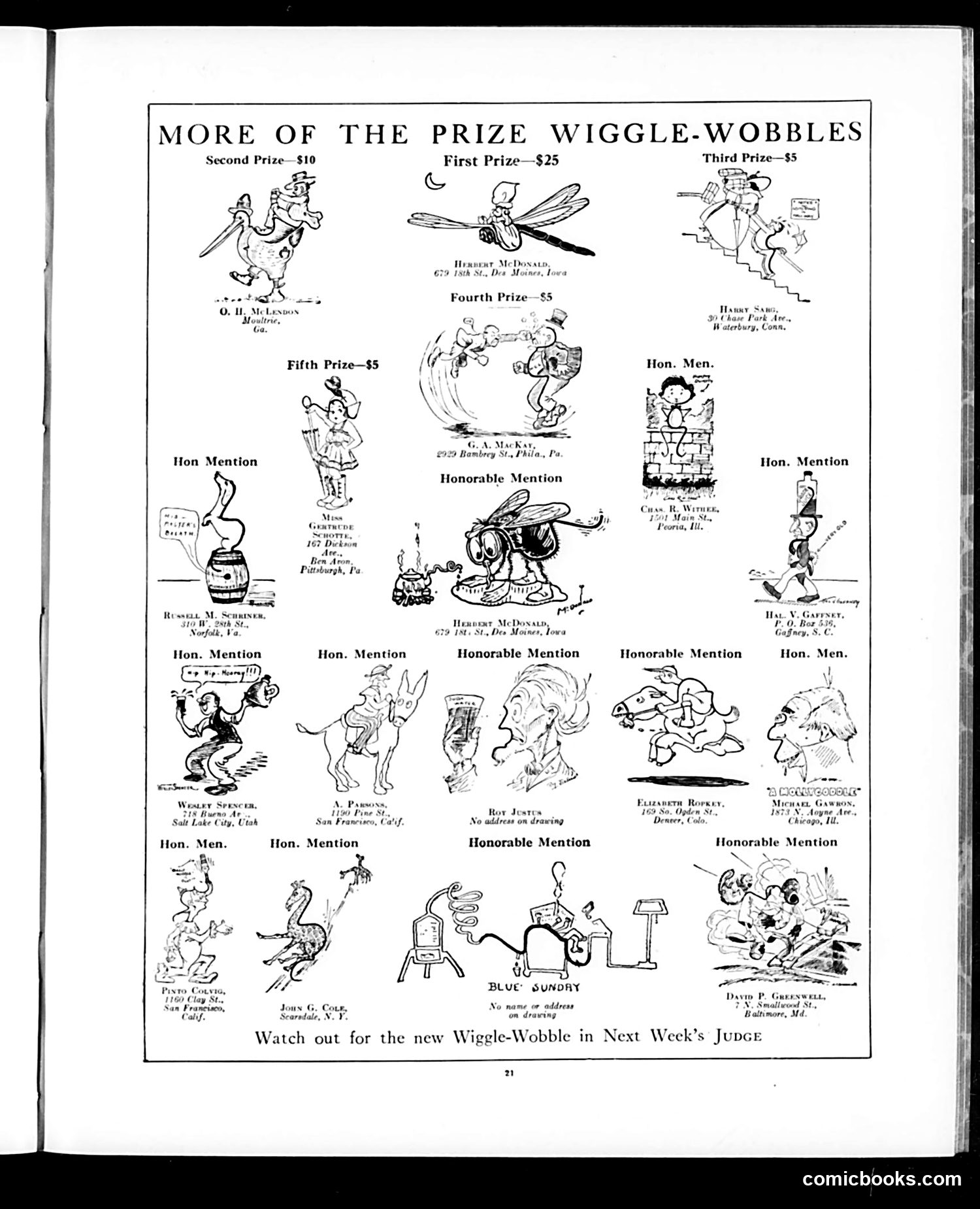
This page showcases winning entries from a Judge magazine contest inviting readers to submit humorous drawings titled "Wiggle-Wobbles"—whimsical, exaggerated cartoon characters and scenarios. The contest awarded monetary prizes ($25 first prize down to $5 for third) across honorable mentions. The drawings themselves depict absurdist figures: people in ridiculous poses, fantastical situations (a person riding a giant insect, anthropomorphic animals), and slapstick scenarios. The appeal was participatory—Judge invited amateur cartoonists nationwide to submit silly artwork, making the magazine interactive and encouraging reader engagement during an era before modern social media. This represents early-20th-century popular entertainment: lighthearted, accessible humor for mass audiences. The "Wiggle-Wobble" appears to have been an ongoing feature, as the page teases "Watch out for the new Wiggle-Wobble in Next Week's Judge."
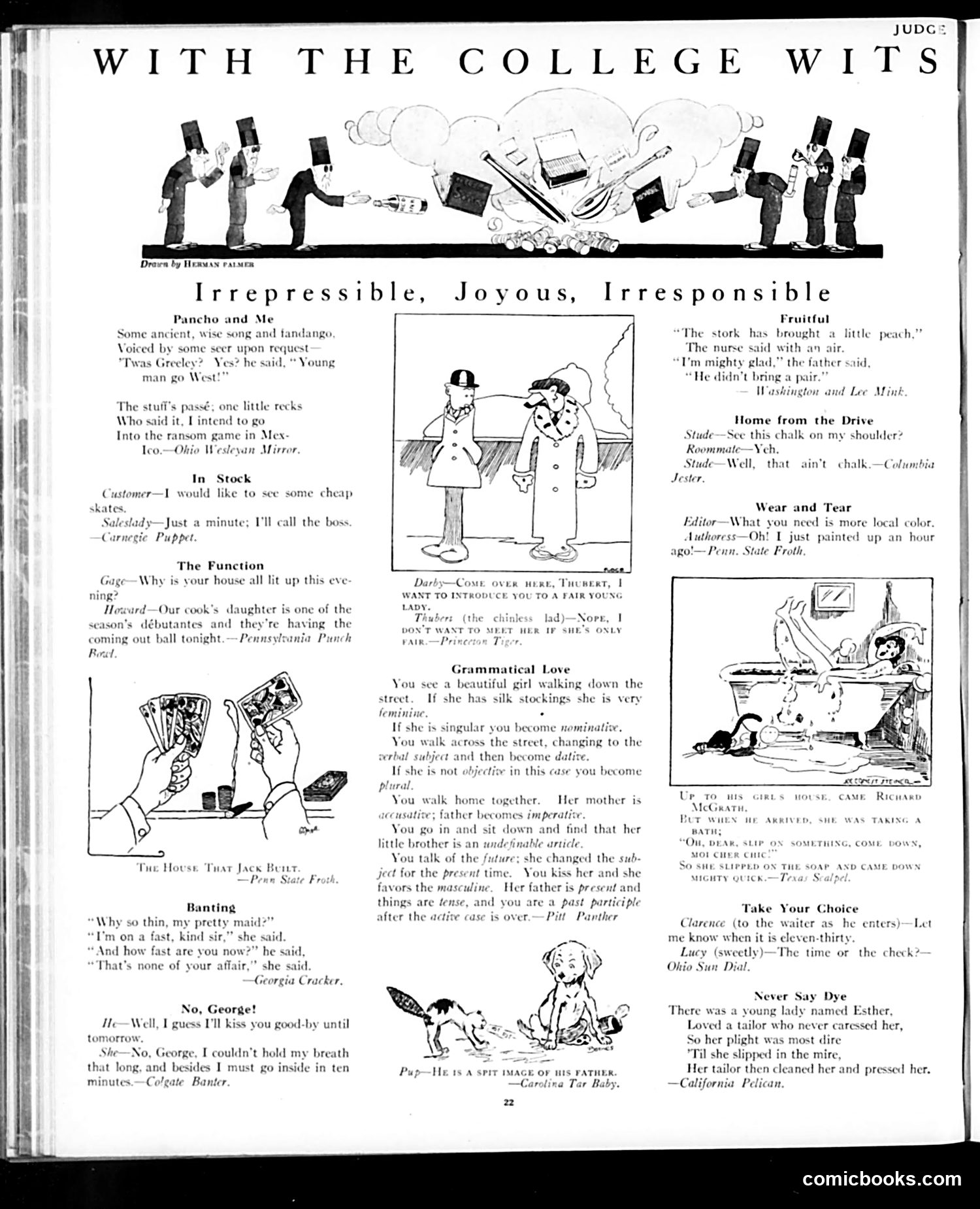
This page collects humorous quips and short jokes supposedly from college newspapers, a common Judge feature. The cartoons and jokes target college-age social behavior and romantic conventions of the era. Key themes include: young men pursuing romantic adventures (the "Pancho and Me" reference to Mexican adventures); courtship rituals and flirtation ("Grammatical Love" uses grammar terms as metaphor for romantic progression); and physical comedy around dating ("Banting" references the weight-loss diet craze; the bath scene plays on Victorian propriety). The satirical point is gentle mockery of college students' pretentiousness, romantic inexperience, and how they adopt fashionable trends (dieting, slang, adventure fantasies). The "Grammatical Love" piece is the most elaborate joke, treating seduction as a grammar lesson to mock overwrought literary sensibilities. Overall, this represents Judge's demographic appeal to educated, middle-class readers amused by college culture and youthful affectation—not sharp political satire.
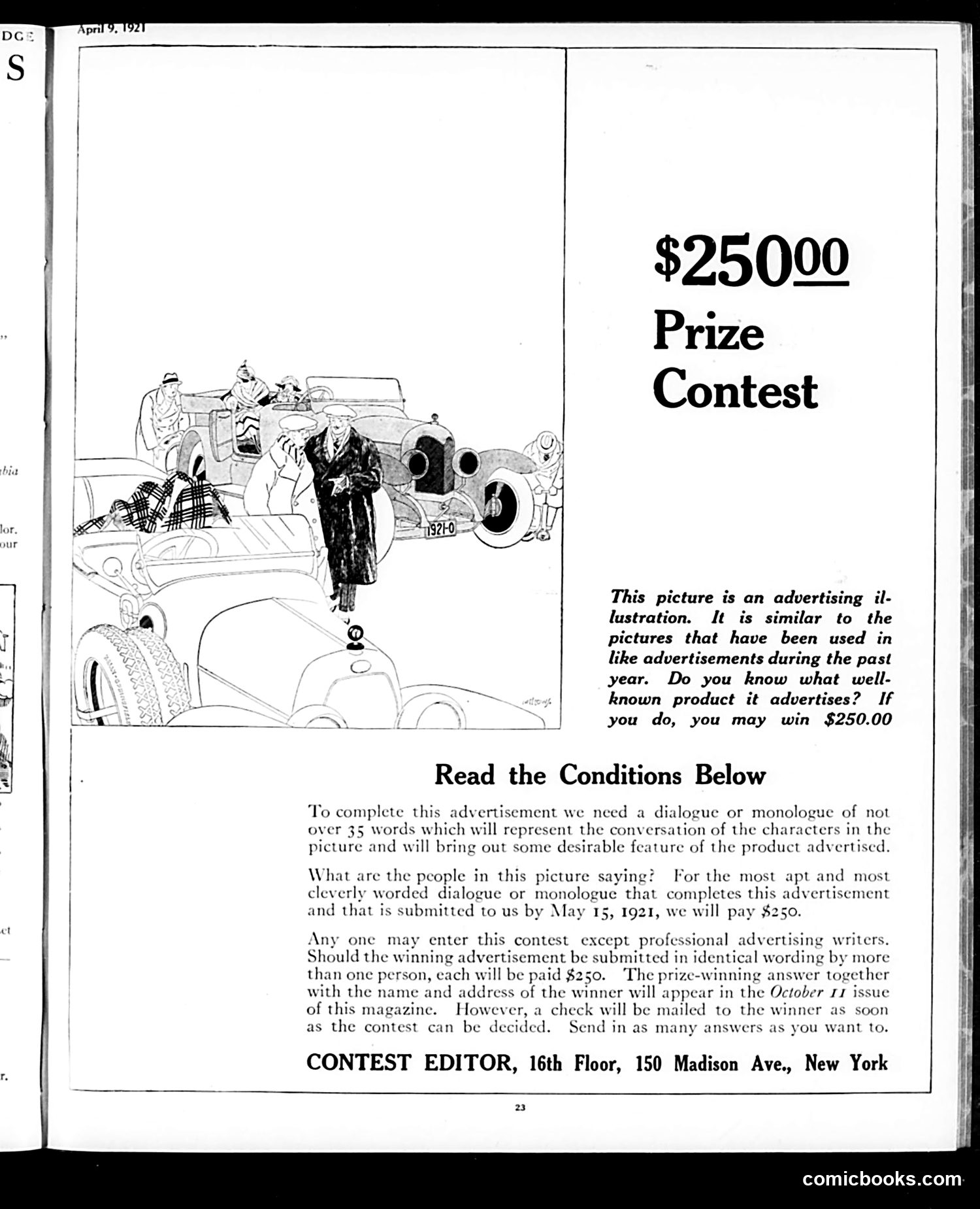
This is not a political cartoon but an **advertising contest page**. The illustration shows well-dressed people examining racing or sports cars, with visible license plates and period automobiles. The contest invites readers to identify which product the advertisement promotes and write a 35-word dialogue completing the ad. The $250 prize (substantial for 1921) incentivizes reader participation while serving as free advertising copy—contestants essentially write ads for the unnamed product. The illustration's style and subject matter (automobiles, racing, luxury) suggest an automotive advertisement, likely promoting a car brand popular during the post-WWI era. This represents an early **interactive marketing strategy**: leveraging a magazine's audience to generate advertising content while building engagement through prize competitions.
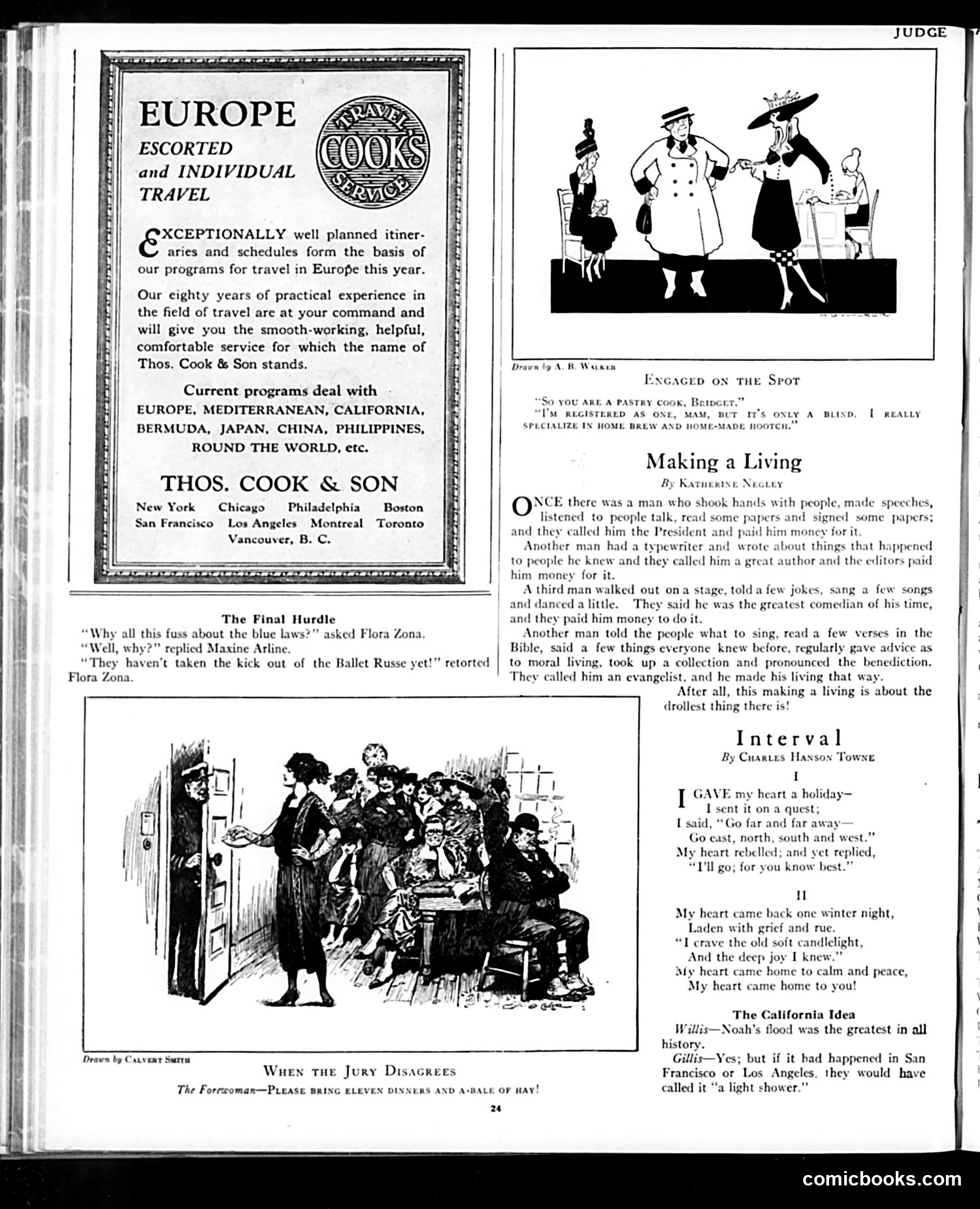
This page from Judge (a satirical American magazine) contains multiple unrelated humor pieces: **"The Final Hurdle"** joke mocks Prohibition-era "blue laws" (moral restrictions). Flora Zona asks why people fuss about such laws; Maxine Arline quips that at least Prohibition hasn't stopped the Ballet Russe from being exciting—suggesting the laws are ineffective at controlling pleasure-seeking. **"Making a Living"** by Katherine Negley satirizes various professions by listing people paid for minimal or dubious contributions: a president who "shakes hands," a pastor who reads the Bible, an evangelist collecting money. The implied critique is that many professions are essentially con jobs or require little actual skill. **"When the Jury Disagrees"** cartoon shows a foreman requesting "eleven dinners and a bale of hay"—absurdist humor about jury deliberations, likely mocking lengthy jury sequestrations or the stereotype of jurors primarily motivated by food. The **Thos. Cook & Son travel advertisement** promotes escorted European tours, and the **"Engaged on the Spot"** cartoon features a woman claiming to be a pastry cook but actually specializing in "home brew and home-made hootch"—mocking Prohibition-era speakeasies disguised as legitimate businesses.
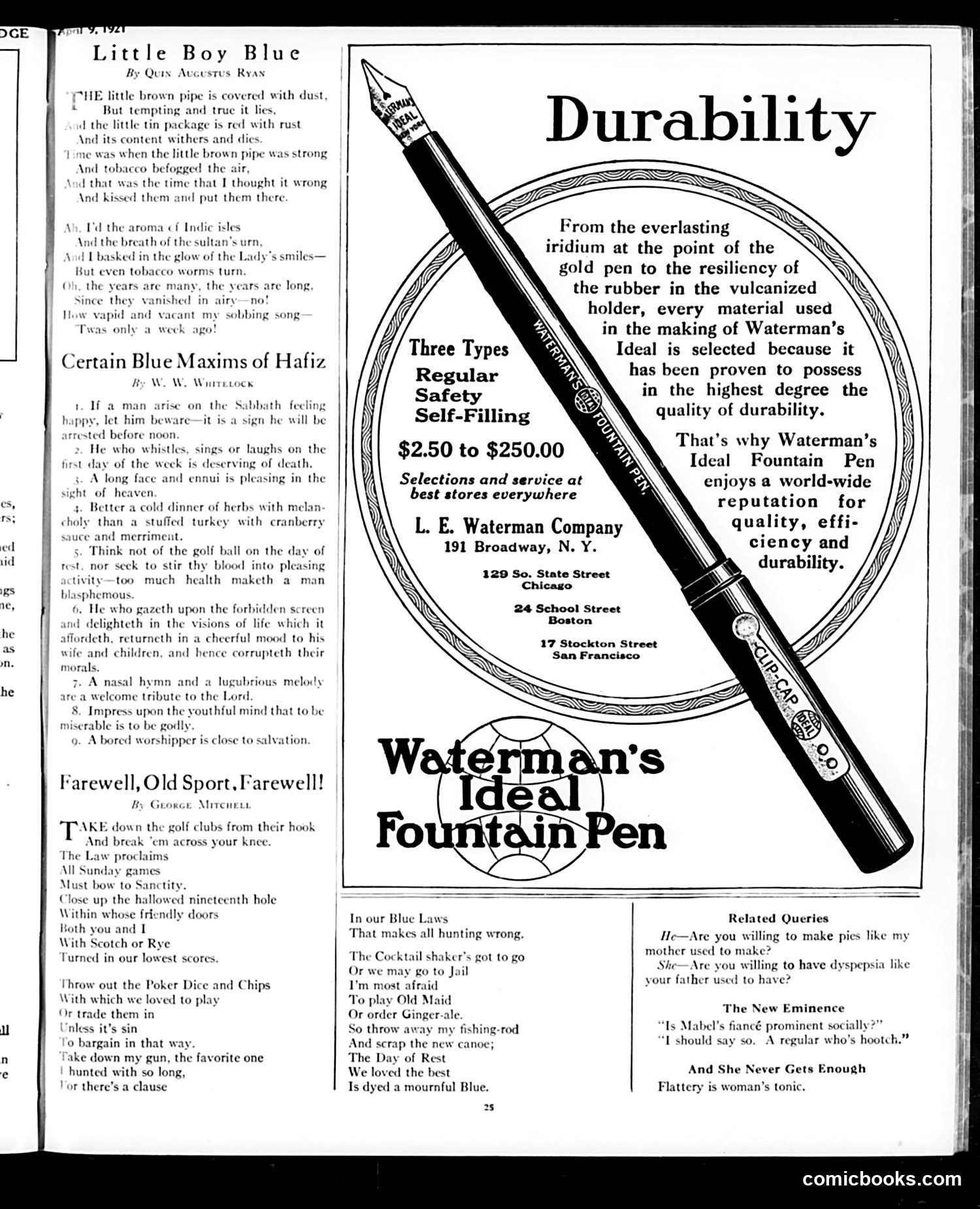
This page contains satirical poetry and prose mocking Prohibition-era restrictions on American leisure activities. **"Little Boy Blue"** is nostalgic verse lamenting lost tobacco pleasures, treating smoking's decline with mock-tragic sentimentality. **"Certain Blue Maxims of Hafiz"** parodies puritanical moral codes through fake wisdom attributed to the Persian poet Hafiz, satirizing religious hypocrisy. References to avoiding happiness on the Sabbath, condemning laughter, and opposing golf and movies mock the strict behavioral codes enforced during Prohibition. **"Farewell, Old Sport, Farewell!"** directly attacks Prohibition's expansion beyond alcohol into Sunday sports bans, golf restrictions, and general pleasure-seeking. Lines like "throw away my fishing-rod" and "close up the hallowed nineteenth hole" mock the era's increasingly intrusive moral legislation. The **Waterman's Ideal Fountain Pen advertisement** is standard product marketing, unrelated to the satire. Overall, the page expresses Judge magazine's skepticism toward Prohibition and expanding government regulation of private recreation and leisure.
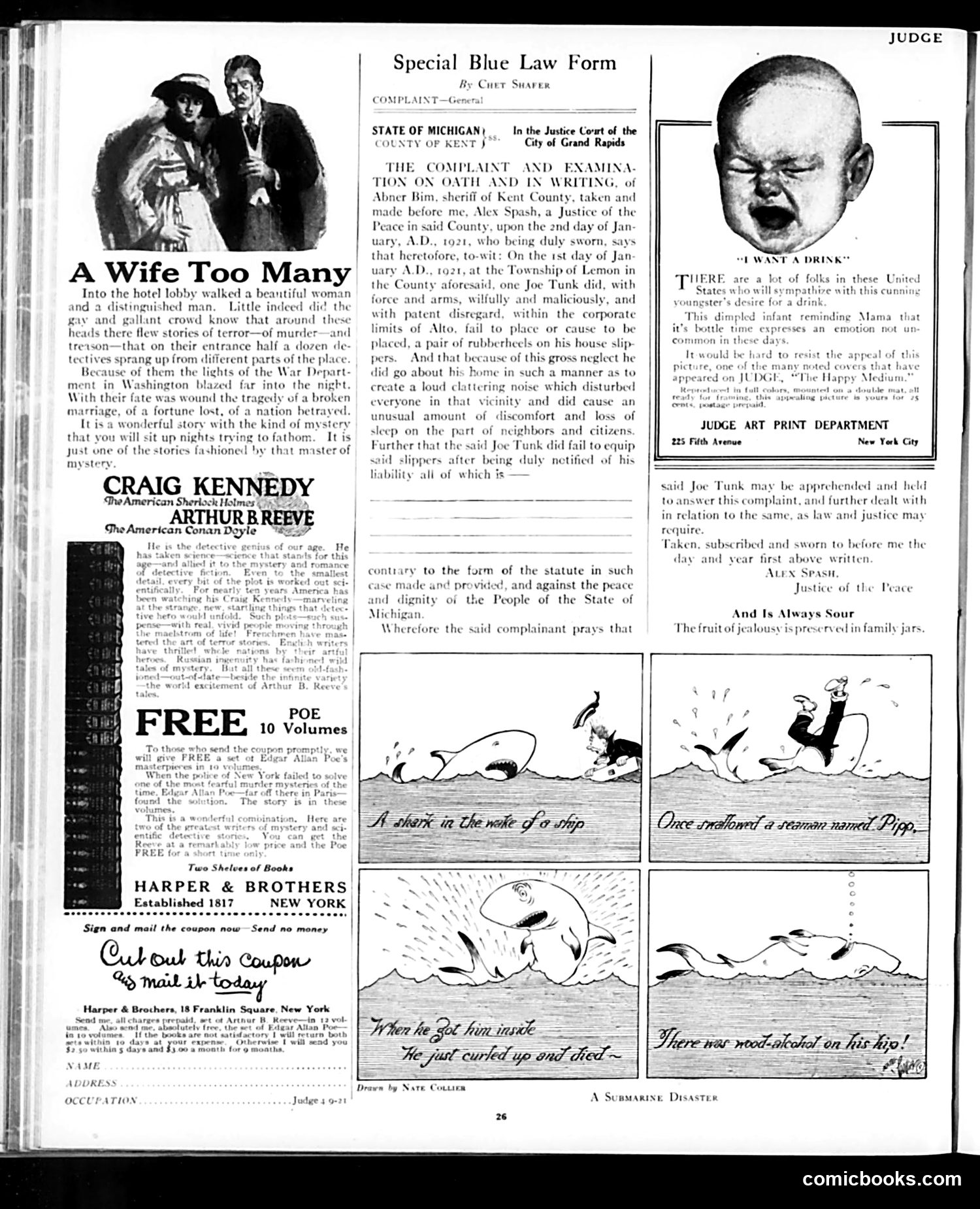
This page mixes fiction and legal satire. The main story "A Wife Too Many" (left) advertises a film about marital intrigue during WWI—typical melodrama for the era. The central content is a mock "Special Blue Law Form" satirizing Prohibition-era enforcement. It presents a complaint against "Joe Tunk" for violating local ordinances by failing to wear rubber heels on his house slippers, creating noise disturbance. This is absurdist satire: the document mimics official legal language to mock the *actual* petty, intrusive enforcement of "blue laws"—moral regulations common in early 1920s America. The joke is that authorities were prosecuting trivial domestic matters with the same gravitas as serious crimes, reflecting public frustration with overzealous Prohibition and blue law policing. The submarine cartoon strip below appears unrelated to the legal satire, depicting a shark attack at sea.
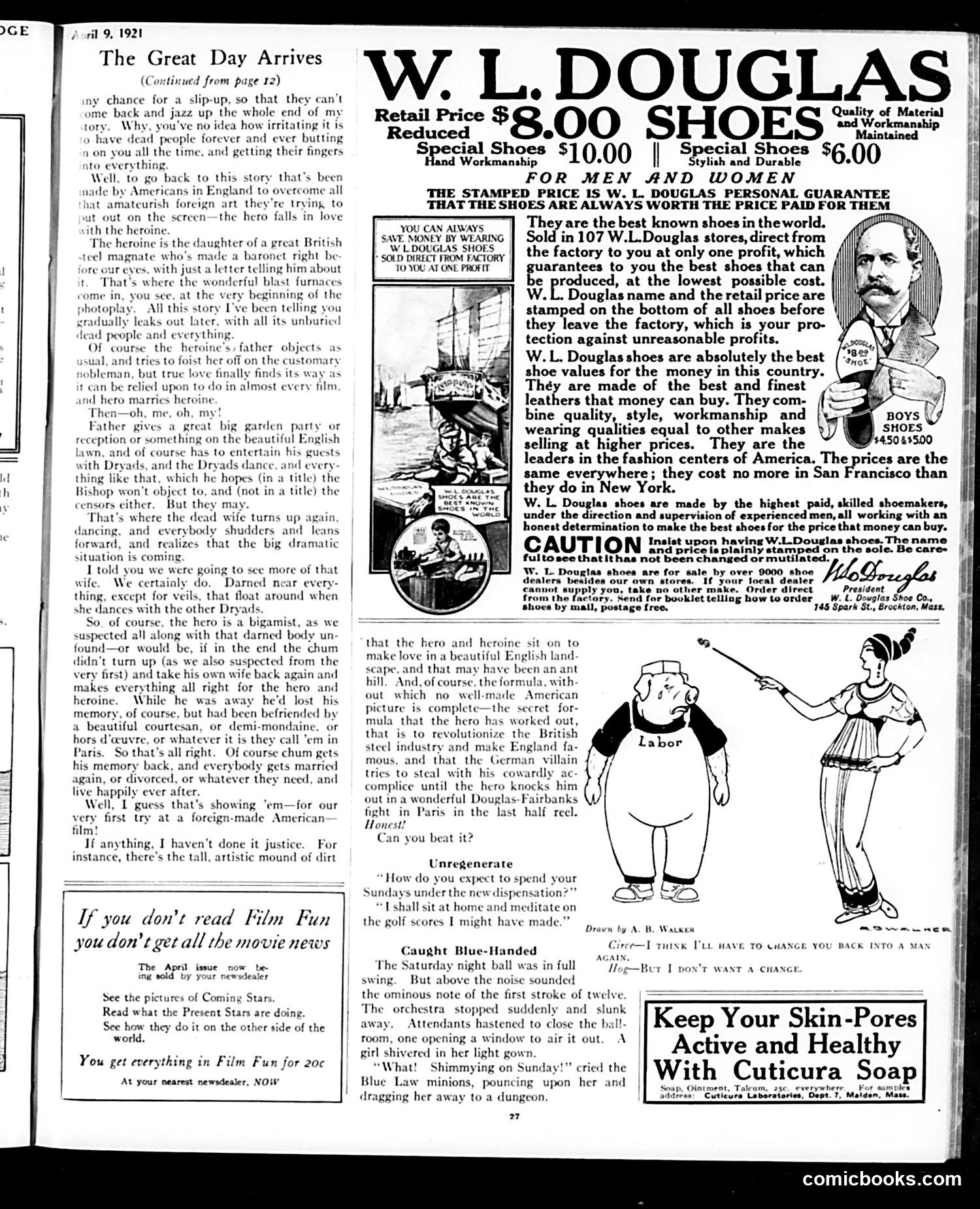
This page from Judge (April 9, 1921) contains minimal political cartoon content. The main satirical element is a small cartoon at bottom right, credited to A. B. Walker, depicting a figure labeled "Labor" being struck by a club wielded by a smaller figure. The accompanying caption reads: "I'VE HAD TO CHANGE YOU BACK INTO A MAN AGAIN—BUT I DON'T WANT A CHANGE." This appears to reference post-WWI labor unrest and management's resistance to worker demands. The inversion (small figure dominating large "Labor") likely satirizes capitalist power over organized labor despite labor's apparent strength. The page is dominated by W.L. Douglas shoe advertising and a serialized film story ("The Great Day Arrives"), making actual satirical content minimal. The magazine's typical political commentary is largely absent from this particular issue.
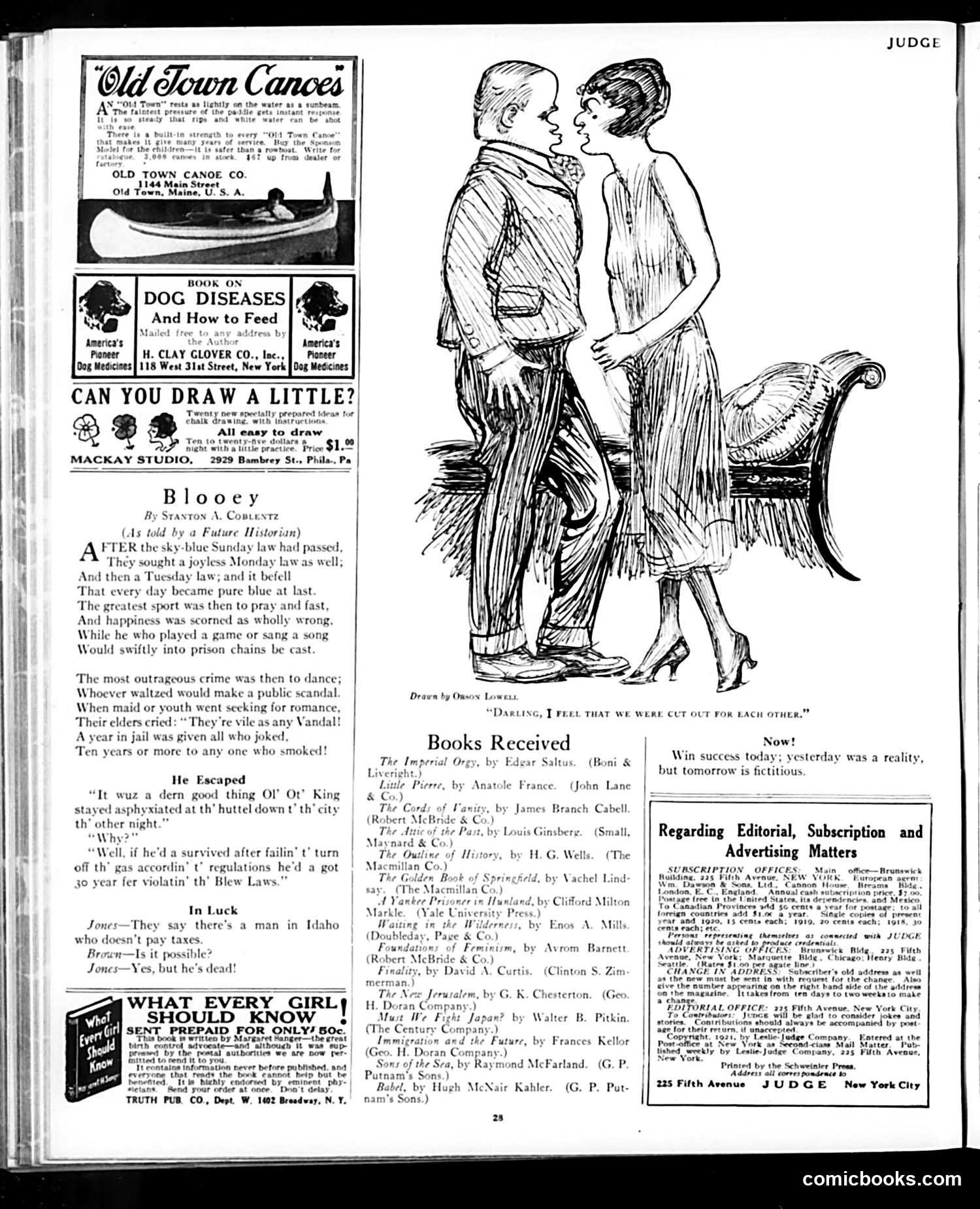
This page features **"Blooey,"** a satirical poem by Staxton A. Coblentz imagining a dystopian future where puritanical "blue laws" have progressively banned all forms of enjoyment—dancing, romance, joking, and smoking. The poem mocks extreme moral legislation by depicting an absurd society where people face decades of imprisonment for minor infractions like dancing or smoking. The accompanying cartoon shows a couple in an intimate moment, with the caption "Darling, I feel that we were cut out for each other"—a gentle romantic joke juxtaposed against the poem's warnings about criminalizing courtship. The page also advertises Margaret Sanger's birth control guide, pitched as practical information despite postal censorship concerns—reflecting real contemporary debates about reproductive education. The overall message: Judge satirizes moral extremism and excessive legal restrictions on personal freedom, advocating for rational limits on government interference in private life.
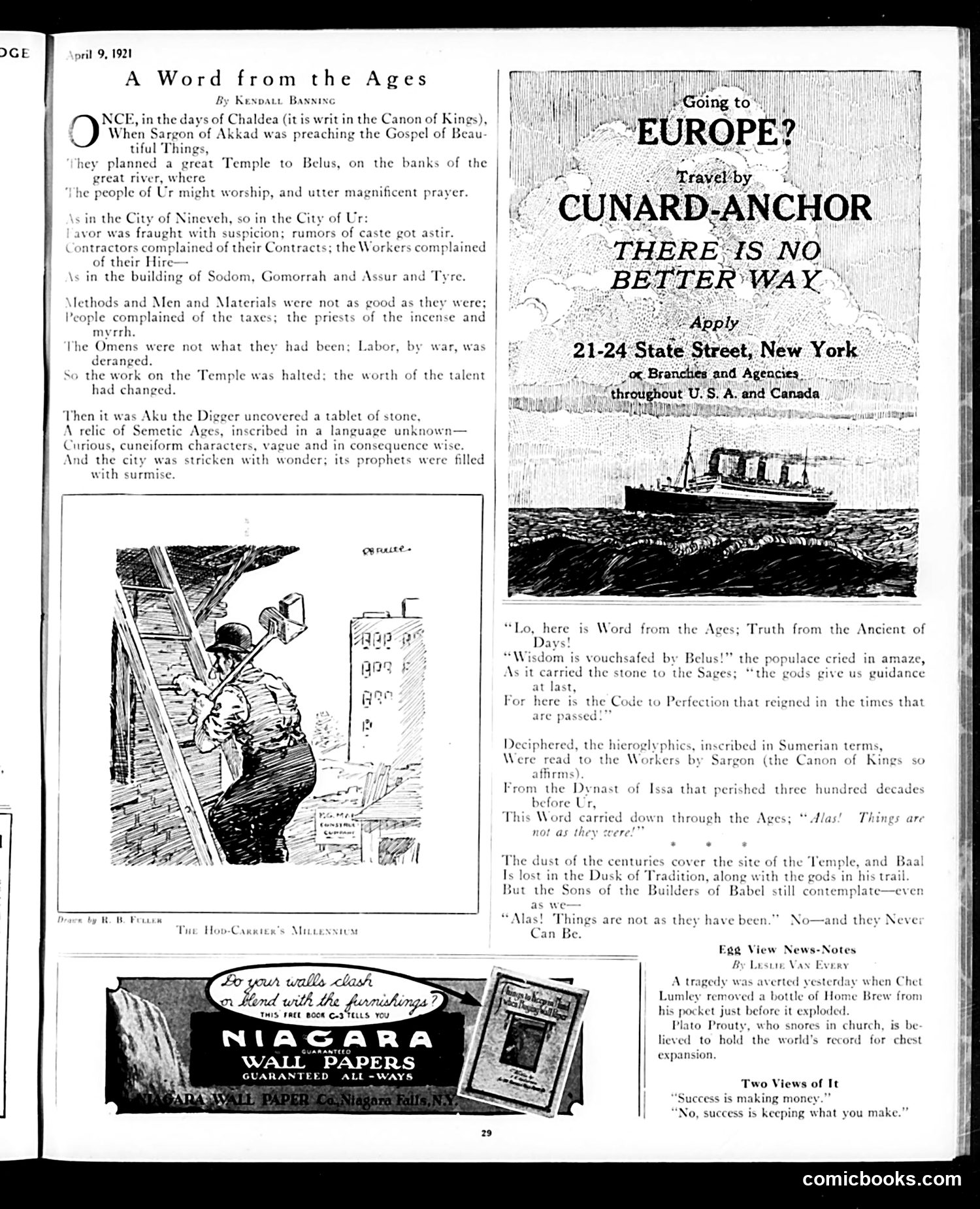
This satirical piece uses ancient Mesopotamian history as a thinly veiled commentary on contemporary labor disputes and social unrest in 1920s America. The narrative describes workers in ancient Ur complaining about contracts, wages, and taxes during construction of a temple—mirroring real industrial conflicts of the post-WWI era. The "ancient tablet" discovery serves as the satire's mechanism: the "timeless wisdom" discovered is simply that conditions were always bad ("Things are not as they have been"). The piece mocks both workers' grievances and nostalgic claims that the past was better, suggesting complaints about labor conditions are eternally futile. The accompanying advertisement for Cunard-Anchor steamships and brief humor items ("Home Brew," snoringchurch-goers) fill the page with era-appropriate commercial and social content typical of Judge magazine's format.
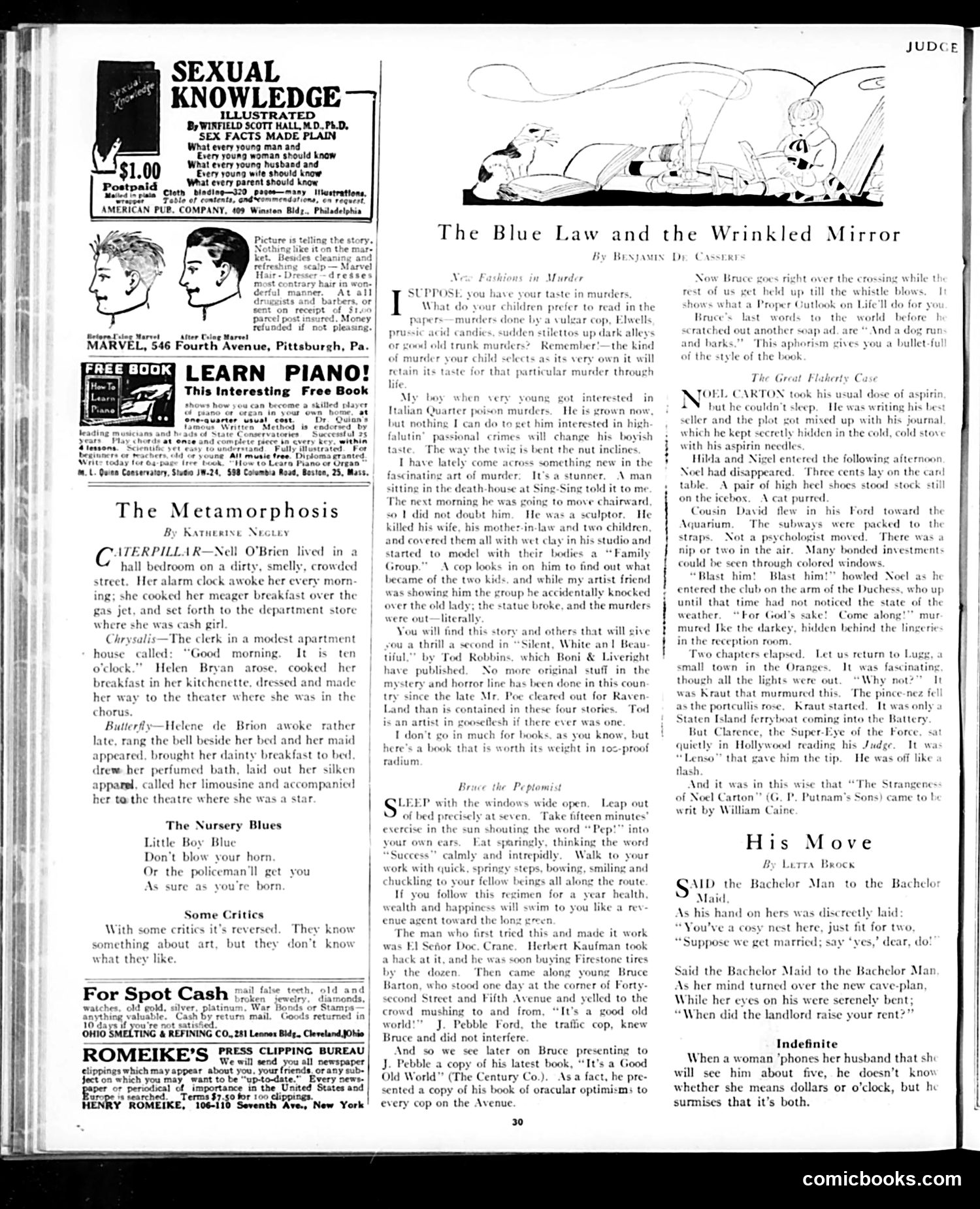
This Judge magazine page (circa 1920s) mixes advertisements with short fiction. The key satirical content: **"The Metamorphosis"** traces a woman's social ascent through three stages—working-class "caterpillar" (sleeping in a dingy hall bedroom), middle-class "chrysalis" (modest apartment), and wealthy "butterfly" (attended by servants). The satire mocks American social mobility fantasy: the narrative pretends upward movement is natural transformation, but really it's just accumulating money and leisure. **The advertising** for "Sexual Knowledge" and "Learn Piano!" reflects contemporary self-improvement culture aimed at young people. **Brief story excerpts** ("The Blue Law and the Wrinkled Mirror," "His Move") appear designed as light entertainment for Judge's educated, middle-class readers. The page overall reflects 1920s anxieties about class, gender, and rapid social change during America's post-war prosperity—with gentle satire rather than sharp critique.
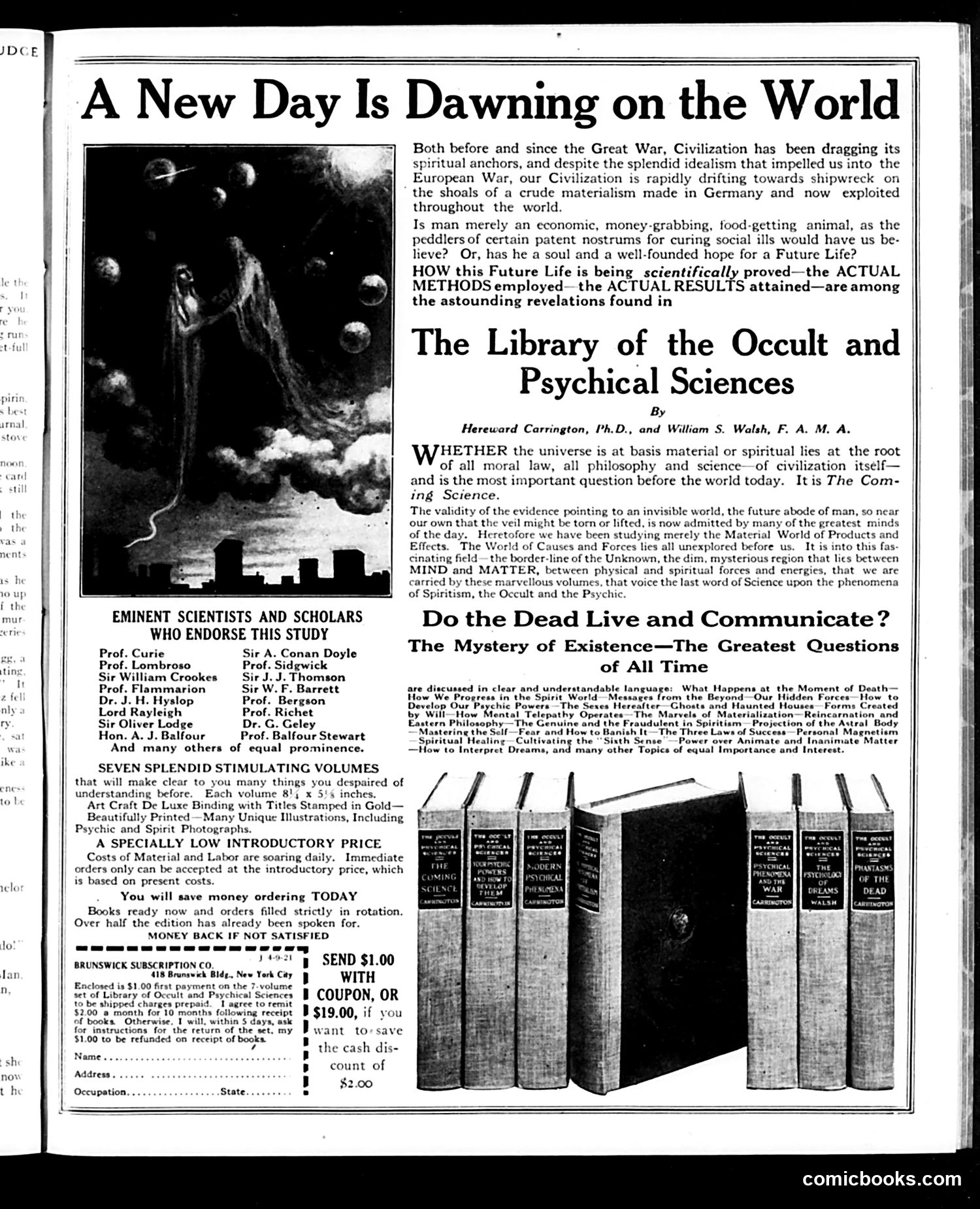
This page is **primarily an advertisement**, not political satire. It promotes "The Library of the Occult and Psychical Sciences" — a seven-volume set about spiritualism and communicating with the dead. The framing text above the ad uses post-WWI anxiety as a sales hook: civilization is drifting toward "crude materialism made in Germany," so readers should explore spiritualism as proof of the soul and afterlife. This was genuinely popular in the 1920s, especially after the war killed millions. The left side lists endorsers including real scientists (Marie Curie, Sir Arthur Conan Doyle, Oliver Lodge) whose actual interest in spiritualism lent credibility to occult claims. The ad promises to answer "Do the Dead Live and Communicate?" — a question that resonated with grief-stricken families. **The satire, if any, is subtle**: *Judge* magazine may be gently mocking how post-war despair made people vulnerable to spiritualist hucksterism. But the page reads as a straightforward period advertisement exploiting genuine trauma and existential fear.
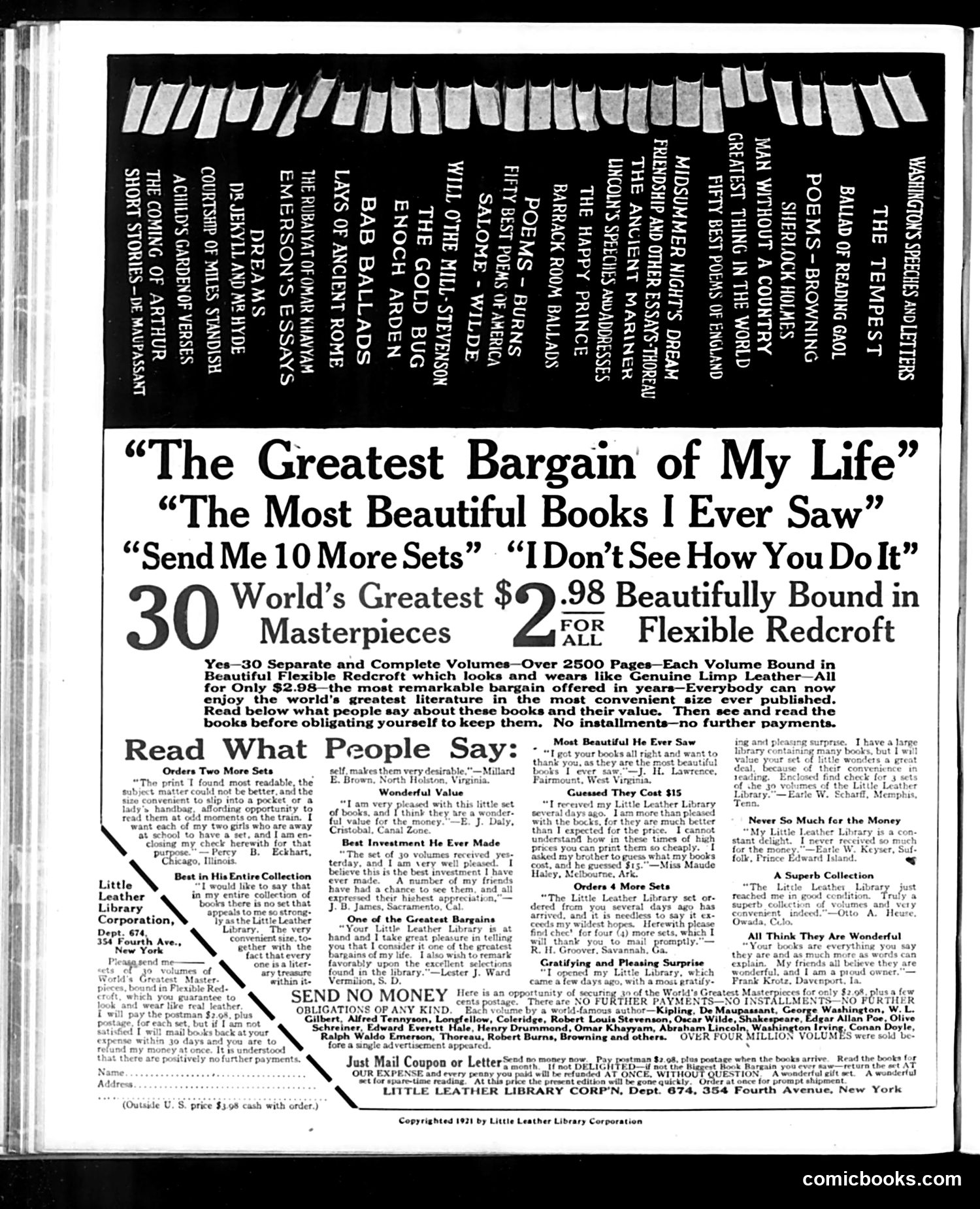
This page is **primarily advertising**, not editorial cartoon content. It's a full-page advertisement for the "Little Leather Library Corporation," promoting a 30-volume book set of "World's Greatest Masterpieces" selling for $2.98. The ad uses testimonial quotes ("The Greatest Bargain of My Life," "The Most Beautiful Books I Ever Saw") to build credibility. It includes customer endorsements praising the set's value and appearance, claiming the flexible Redcroft binding resembles genuine leather. The marketing emphasizes affordability and accessibility—making classic literature available to ordinary people at an unprecedented price point. This reflects early 20th-century mass-market publishing strategies targeting middle-class consumers. The OCR text at top appears corrupted/unreadable, likely due to the page's condition or scanning issues. There is **no political satire or cartoon** visible—this is straightforward commercial advertising typical of Judge magazine's revenue model.