
Judge, 1921-04-09 · page 14 of 32
Judge — April 9, 1921 — page 14: what you’re looking at
What you’re looking at
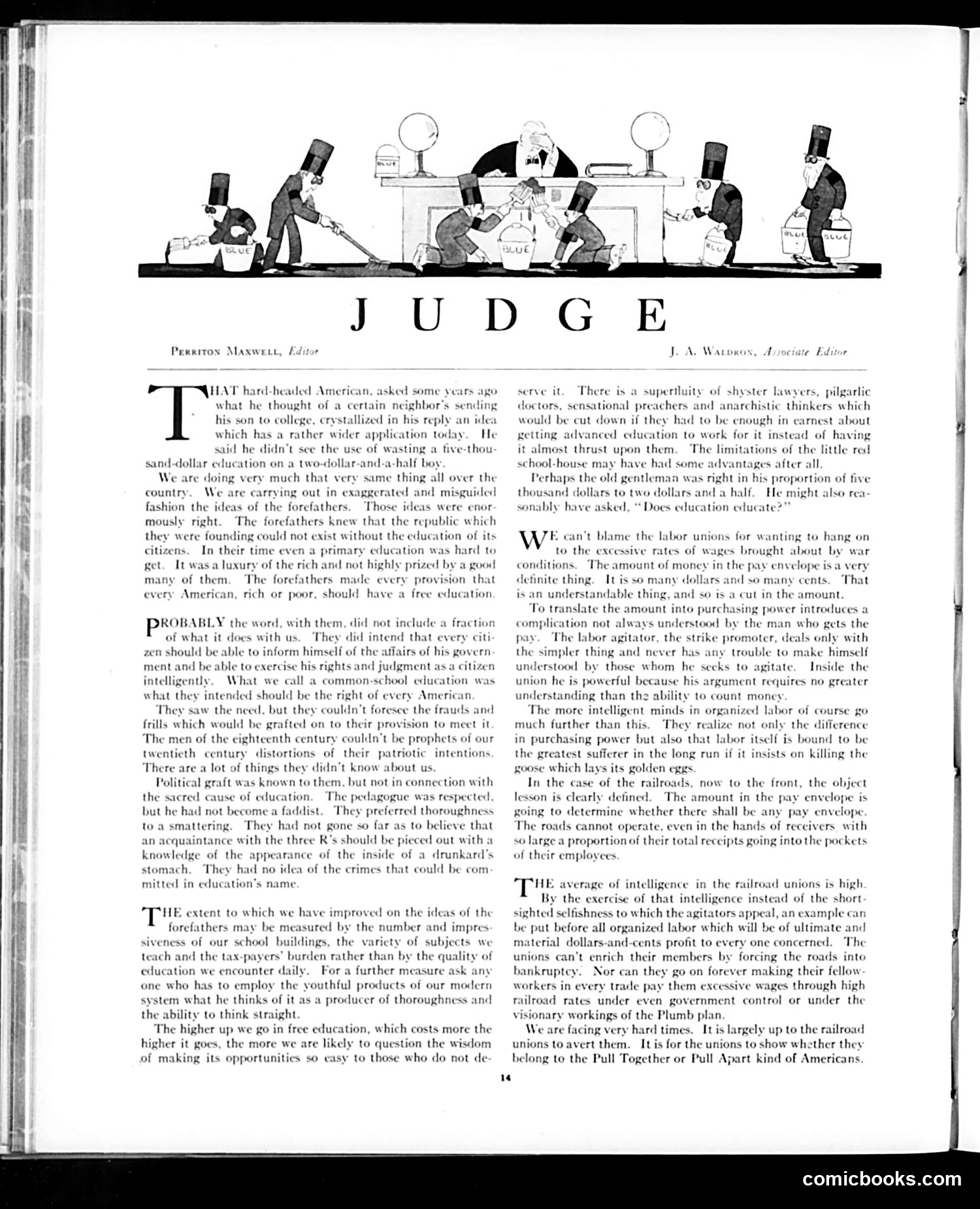
This page presents a satirical editorial titled "Judge" attacking progressive educational expansion in early 20th-century America. **The Cartoon**: The masthead illustration shows figures with bucket-heads operating at a desk labeled "JUDGE," satirizing how the publication dispenses verdicts on national issues. **Main Argument**: The editorial mocks the idea of providing extensive free education to all Americans, claiming the founders only intended basic literacy ("three R's"), not the elaborate modern curriculum. It uses the anecdote of a man refusing to waste a "$5,000 education on a $2.50 boy" to argue education is being wasted on students incapable of benefiting. **Social Targets**: The piece criticizes: - "Faddist" pedagogy and educational graft - Overly-impressive school buildings - Production of "shyster lawyers" and "anarchistic thinkers" - Labor unions demanding high wages **The Satire**: Judge argues American education has become corrupt, wasteful excess rather than practical necessity—betraying the founders' sensible original vision.
📄 Transcribed text from this page (OCR, searchable)
Machine-transcribed from the original scan — historical spelling and the odd misread are preserved.
t | ' Peeetron Maxweut, Editor HAT hard-headed American, asked some years ago what he thought of a certain neighbor's sending his son to college, crystallized in his reply an idea which has a rather wider application today. He said he didn’t see the use of wasting a five-thou sand-dollar education on a two-dollar-and-a-half boy We are doing very much that very same thing all over the country. We are carrying out in exaggerated and misguide fashion the ideas of the forefathers. Those ideas were enor mously right. The forefathers knew that the republic which they were founding could not exist without the education of its citizens. In their time even a primary education was hard to get. It wasa luxury of the rich and not highly prized by a good many of them. The athers made every provision that every American, rich or poor, should have a free education PROBABLY the word, with them, did not include a fractic of what it does with us. They did intend that every citi zen should be able to inform himself of the affairs of his govern exercise his rights and judgment as a citizen ion was ment and be able t intelligently. What we call a common-school educa uld be the right of every American They saw the need, but they couldn't foresee the frauds and frills which would be grafted on to their provision to meet it The men of the eighteenth century couldn't be prophets of our twentieth century distortions of their patriotic intentions There are a lot of things they didn’t know about us Political graft was known to them, but not in connection with the sacred cause of education. The pedagogue was respected, but he had not become a faddist. They preferred thoroughness to a smattering. They had not gone so far as to believe that an acquaintance with the three R's should be pieced out with knowledge of the appearance of the inside of a drunkard stomach, They had no idea of the crimes that could be com mitted in education’s name what they intended sh HE extent to which we have improved on the ideas of the forefathers may be measured by the number and impres siveness of our school buildings, the variety of subjects we teach and the tax-payers’ burden rather than by the quality of education we encounter daily. For a further measure ask any one who has to employ the youthful products of our modern system what he thinks of it as a producer of thoroughness and the ability to think straight The higher up we go in free higher it goes, the more we are likely to question the wisdom of making its opportunities so easy to those who do not de lucation, which costs more the “4 J. A. Watpros, 4. serve it. There is a supertluity of shyster lawyers, pilgarlic doctors, sensational preachers and anarchistic thinkers which would be cut down if they had to be enough in earnest about getting advanced education to work for it instead of having it almost thrust upon them. The limitations of the little red school-house may have had some advantages after all. Perhaps the old gentleman was right in his proporti thousand dollars to two dollars and a half. He might also rea n of five sonably have asked, “ Does education educate WE can't blame the labor unions for wanting to hang on to the excessive rates of wages brought about by war ns. The am conditic unt of money in the pay envelope is a very definite thing. It is so many dollars and so many cents. That is an understandable thing, and so is a cut in the amount. Vo translate the amount into purchasing power introduces a complication not always understood by the man who gets the pay. The labor agitator, the strike promoter, deals only with the simpler thing and never has any trouble to make himself m he secks to agitate. Inside the greater understood by those w union he is powerful because his argument requires 1 understanding than the ability to count money The more intelligent minds in organized labor of course go much further than this. They realize not only the difference in purchasing power but also that labor itself is bound to be the greatest sufferer in the long run if it insists on killing the goose which lays its golden eggs. In the case of the railroads, now to the front, the object lesson is clearly defined. The amount in the pay envelope is going to determine whether there shall be any pay envelope The roads cannot operate, even in the hands of receivers: with nof their total receipts going into the pockets so large a proporti of their employees. HE average of intelligence in the railroad unions is high By the exercise of that intelligence instead of the short sighted selfishness to which the agitators appeal, an example can be put before all organized labor which will be of ultimate and material dollars-and-cents profit to every one concerned. The unions can’t enrich their members by forcing the roads into bankruptcy. Nor can they go on forever making their fellow workers in every trade pay them excessive wages through high railroad rates under even government control or under the visionary workings of the Plumb plan We are facing very hard times. It is largely up to the railroad unions to avert them. It is for the unions to show whether they belong to the Pull Together or Pull Apart kind of Americans comicbooks.com