
Judge, 1921-04-09 · page 12 of 32
Judge — April 9, 1921 — page 12: what you’re looking at
What you’re looking at
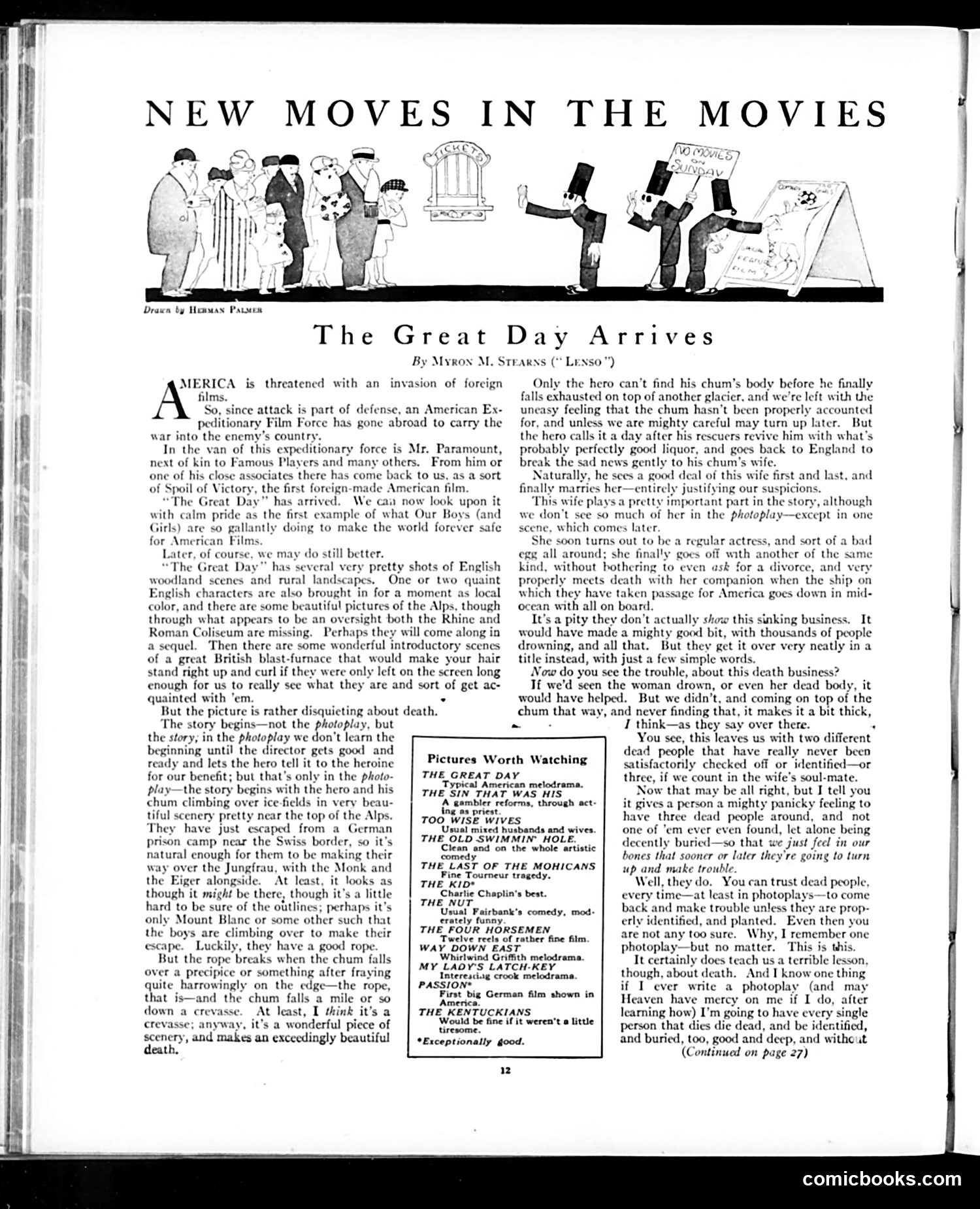
This is a film review by Myron M. Stearns satirizing American cinema's competitive anxiety toward foreign films. The cartoon's header shows Paramount and industry figures attacking "invading" foreign films with weapons and propaganda. The satire criticizes "The Great Day," apparently the first American film shot abroad (likely in Europe, given references to Alps and British locations). Stearns mocks how the film awkwardly showcases European scenery—including oddly missing famous landmarks like the Rhine and Roman Coliseum—as if Americans needed proof they could make "foreign" films too. The deeper joke: the film's melodramatic plot is absurdly contrived (missing bodies, convenient deaths described only via title cards rather than shown), yet the industry celebrates it as a patriotic victory. Stearns argues American filmmakers should compete through quality storytelling, not jingoistic flag-waving about "making the world safe for American Film." The satire exposes post-WWI Hollywood's insecurity and propagandistic impulses.
📄 Transcribed text from this page (OCR, searchable)
Machine-transcribed from the original scan — historical spelling and the odd misread are preserved.
" ee } t h i u Drawn by Hemwas Patsen The Great Day Arrives By Myron M. Stearns (* Lenso”) MERICA is threatened with an invasion of foreign film: So, since attack is part of defense, an Ame: Ex- peditionary Film Force has gone abroad to carry the war into the enemy's country In the van of this expeditionary force is Mr. Paramount, next of kin to Famous Players and many others. From him or ‘one of his close associates there has come back to us, as a sort of Spoil of Victory, the first foreign-made American film. ‘The Great Day” has arrived. We cain now look upon it with calm pride as the first example of what Our Boys (and Girls) are so gallantly doing to make the world forever safe for American Film Later, of course, we may do still better. The Great Day” has several very pretty shots of English woodland scenes and rural landscapes. One or two quaint glish characters are also brought in for a moment as local color, and there are some beautiful pictures of the Alps, though through what appears to be an oversight both the Rhine and Roman Coliseum are missing. Perhaps they will come along in a sequel. Then there are some wonderful introductory scenes of a great British blast-furnace that would make your hair stand right up and curl if they were only left on the screen long enough for us to really see what they are and sort of get ac- quainted with ‘em. - But the picture is rather disquieting about death. The story begins—not the photoplay, but Only the hero can’t find his chum’s body before he finally falls exhausted on top of another glacier, and we're left with the une: fecling that the chum hasn’t been properly accounted for, and unless we are mighty careful may turn up later. But the hero calls it a day after his rescuers revive him with what's probably perfectly good liquor, and goes back to England to break the sad news gently to his chum’s wif Naturally, he sees a good deal of this wife first and last, and finally marries her—entirely justifying our suspicions. This wife plays a pretty important part in the story, although we don’t sce so much of her in the photoplay—except in one scene, which comes later. She soon turns out to be a regular actress, and sort of a bad egg all around; she final'y goes off with another of the same kind, without bothering to even ask for a divorce, and very properly meets death with her companion when the ship on which they have taken passage for America goes down in mid- an with all on board. It’s a pity they don’t actually show this sinking business. It would have made a mighty good bit, with thousands of people drowning, and all that. But they get it over very neatly in a title instead, with just a few simple words Now do you sce the trouble, about this death business? Tf we'd seen the woman drown, or even her dead body, it would have helped. But we didn’t, and coming on top of the chum that way, and never finding that, it makes it a bit thick, ~ : I think—as they say over there. the story, in the photoplay we don’t learn the You see, this leaves us with two different beginning until the director gets good and dead people that have really never been i : Pictures Worth Watching satisfactorily checked off or identified—or ready and lets the hero tell it to the heroine for our benefit; but that’s only in the photo- THE GREAT DAY Typical American melodrama. three, if we count in the wife’s soul-mate. Now that may be all right, but I tell you play—the story begins with the hero and his THE SIN THAT WAS HIS chum climbing over ice-fields in very beau- A gambler reforms, through act- it gives a person a mighty panicky feeling to tiful scenery pretty near the top of the Alps. | zog"Wise Wives have three dead people around, and not They have just escaped from a German ‘Usual mixed husbands and wives. | one of ‘em ever even found, let alone being prison camp near the Swiss border, so it’s THE OLD SWIMMIN’ HOLE. Clean and on the whole artistic decently buried—so that we just feel in our natural enough for them to be making their comedy bones that sooner or later they're going to turn way over the Jungfrau, with the Monk and | THE LAST OF THE MOHICANS | up and make trouble. the Eiger alongside. At least, it looks as THE KID* ee Well, they do. You can trust dead people, though it might be there, though it’s a little hard to be sure of the outlines; perhaps it’s THE NUT the boys are climbing over to make their escape. Luckily, they hav But the rope breaks when the chum falls ‘Charlie Chaplin's best. Usual Fairbank’s comedy, mod- only Mount Blanc or some other such that erately funny. THE FOUR HORSEMEN Twelve reels of rather fine film. a good rope. WAY DOWN EAST Whirlwind Griffith melodrama. MY LADY'S LATCH-KEY every time—at least in photoplays—to come back and make trouble unless they are prop- erly identified, and planted. Even then you are not any too sure. Why, I remember one photoplay—but no matter. This is this. It certainly does teach us a terrible lesson, over a precipice or something after fraying Intereaciag crook melodrams. though, about death. And I know one thing quite harrowingly on the edge—the rope, PASSION* . if I ever write a photo, (and may that is—and the chum falls a mile or so First big German film shown in | Heaven have mercy on me if I do, a down a crevasse. At least, I think it’s a THE KENTUCKIANS learning how) I’m going to have ¢ ii crevasse; anyway, it’s a wonderful piece of Would be fine if it weren't atte | person that dies die dead, and be identified, scenery, and makes an exceedingly beautiful *Exceptionally good. death, and buried, too, good and deep, and without (Continued on page 27) comicbooks.com tl