
A complete issue · 32 pages · 1921
Judge — February 5, 1921
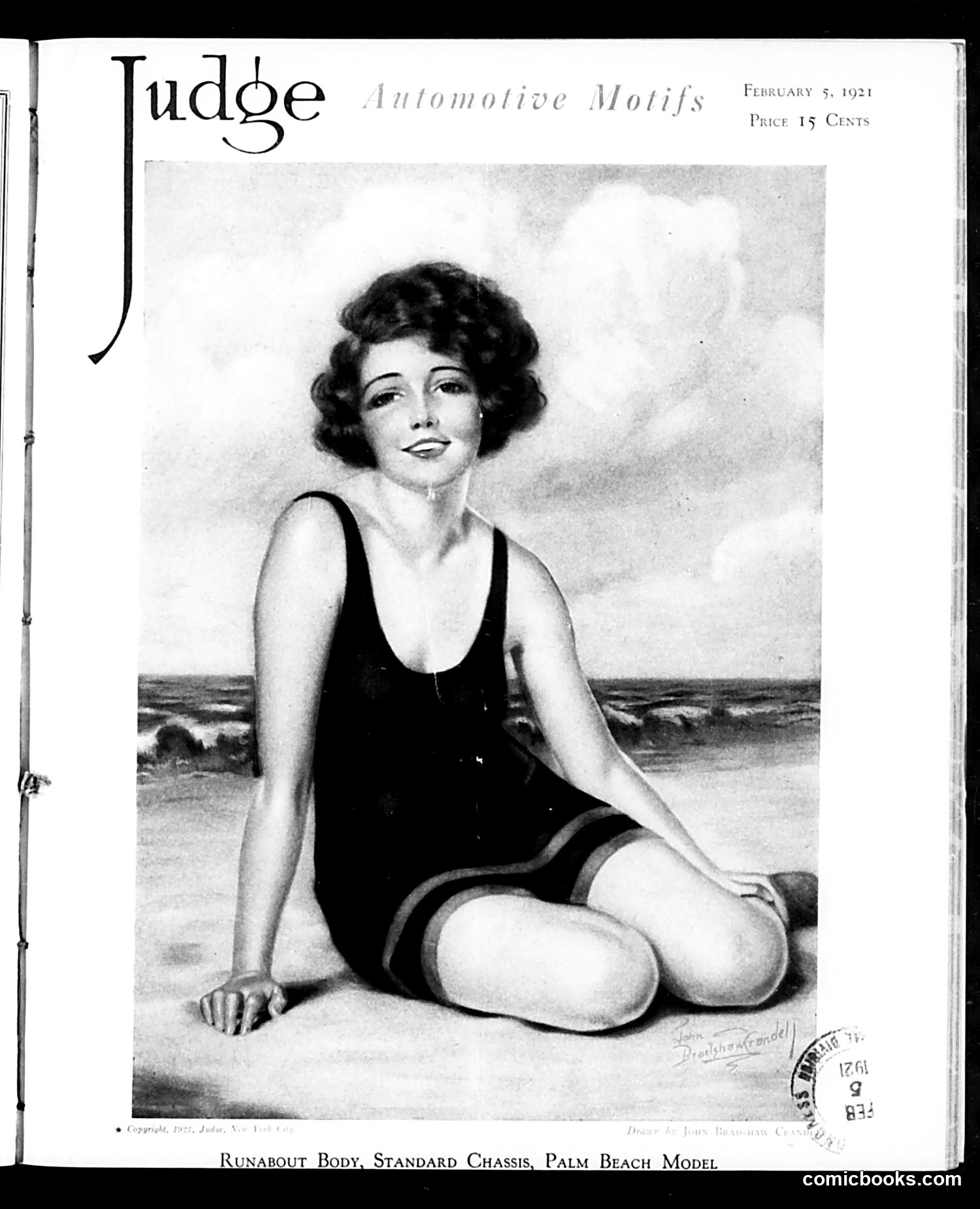
This page is primarily **advertising content**, not political satire. It features a beach photograph of a woman in a 1920s bathing suit, positioned to showcase the "Runabout Body, Standard Chassis, Palm Beach Model"—terminology that conflates automobile manufacturing with the female form. The humor derives from treating a woman's body as if it were a car model with interchangeable parts. This reflects 1920s consumer culture and the era's casual objectification of women. The "Palm Beach Model" likely references the fashionable Florida destination popular with wealthy Americans during the Roaring Twenties. The image exemplifies how early 20th-century advertising normalized viewing women's bodies as commodities or products, a practice modern readers would recognize as sexist marketing.
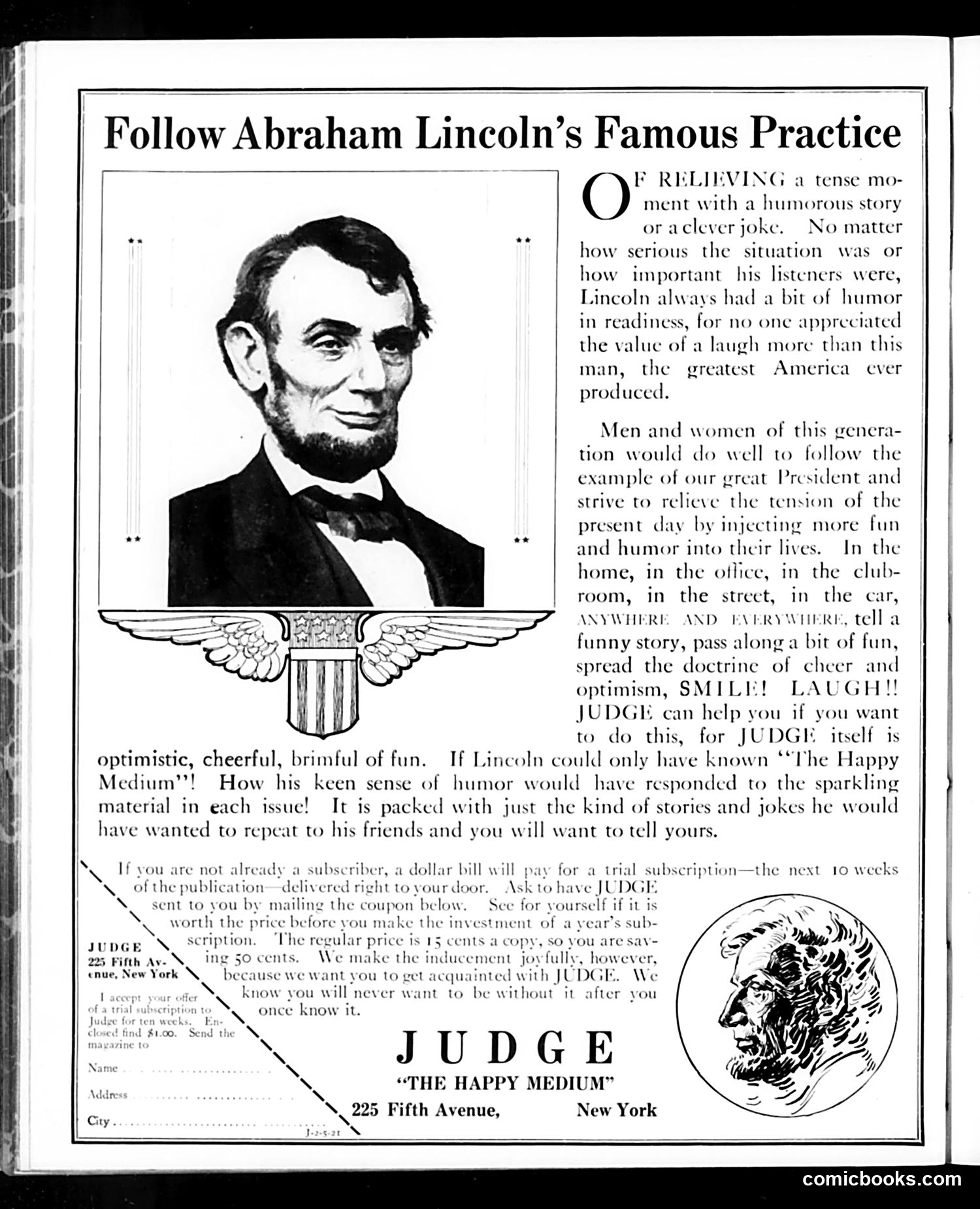
This page is primarily **advertising for Judge magazine** ("The Happy Medium"), not political satire. The advertisement uses Abraham Lincoln as a celebrity endorsement to promote the publication. The ad argues that Lincoln exemplified humor as a coping mechanism—relieving tension through jokes regardless of circumstances. It encourages modern readers (1920s era) to emulate Lincoln's practice of injecting "fun and humor" into daily life "anywhere and everywhere." The imagery shows a formal Lincoln portrait above an eagle shield, presenting him as an authority figure on American values. The circular profile sketch (lower right) reinforces his iconic status. This reflects Judge's positioning as a humor magazine offering relief from contemporary tensions, while exploiting Lincoln's cultural prestige to legitimize leisure reading and laughter as worthwhile pursuits.
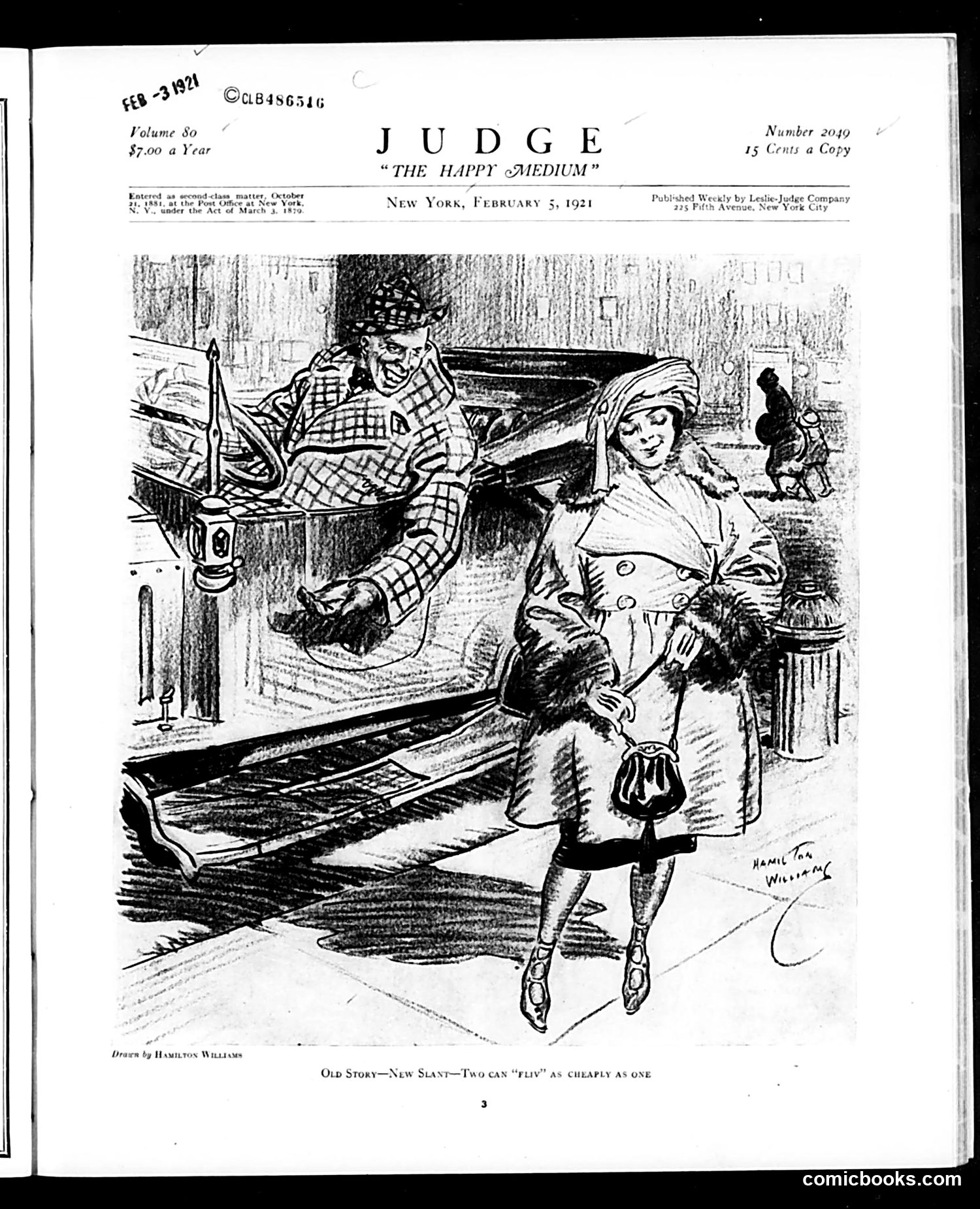
**The Cartoon:** This illustration by Hamilton Williams shows two women ice-skating. The caption reads "Old Story—New Slant: Two can 'fly' as cheaply as one." **The Satire:** This is a play on the common saying that "two can live as cheaply as one"—typically used to justify marriage. Here, the joke subverts that logic to ice-skating: two people can skate together "as cheaply" (or as easily/effortlessly) as a single person. The humor derives from applying domestic economic reasoning to recreational activity, creating an absurdist non-sequitur. The fashionably-dressed woman and jaunty man suggest the leisure pursuits of the 1920s, when ice-skating was a popular social activity and dating custom among young people.
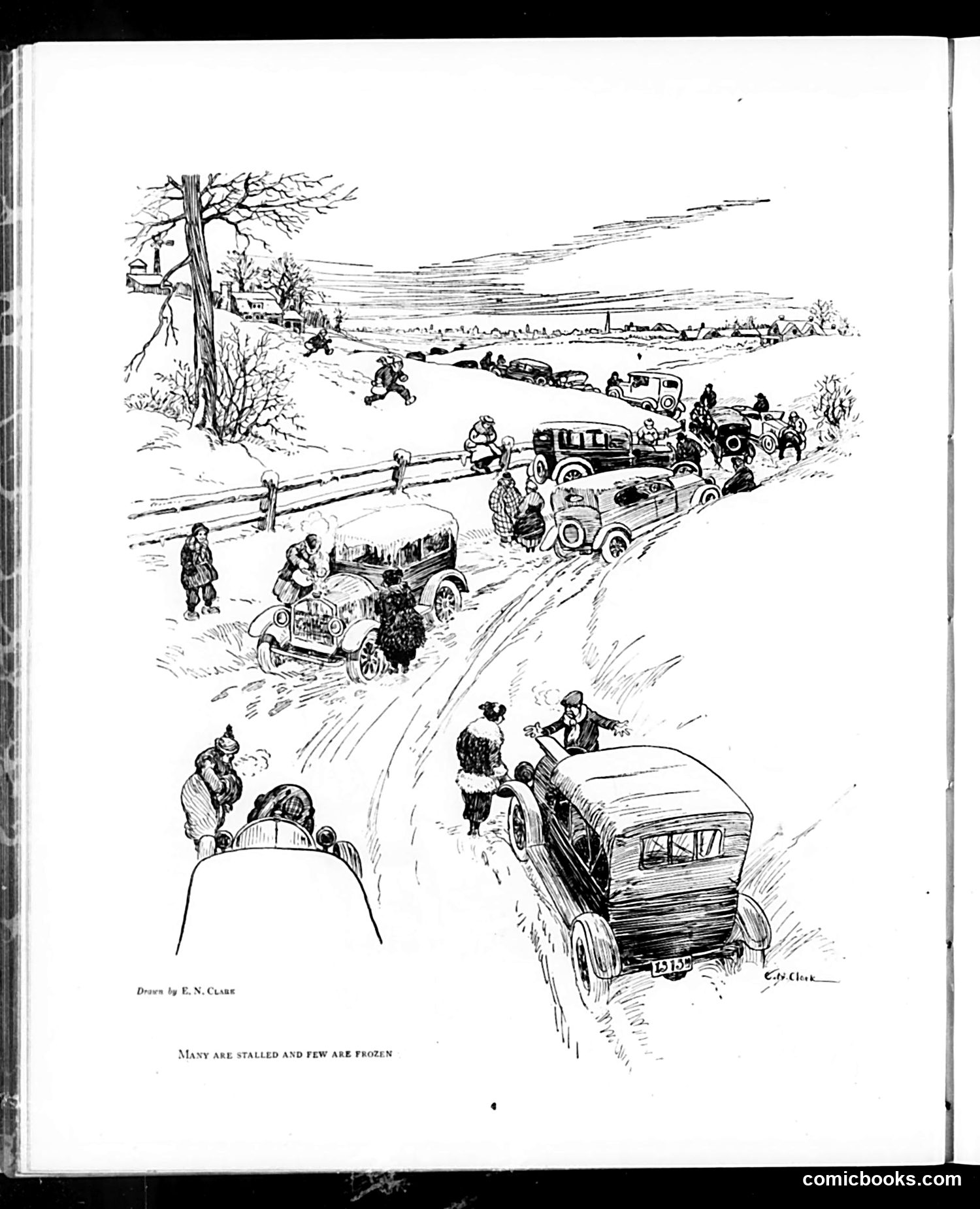
This illustration by E.N. Clark depicts a traffic jam during winter conditions. The caption reads "Many are stalled and few are frozen," a dark joke about vehicles stuck on an icy or snow-covered road. The cartoon satirizes the early automobile era's vulnerability to weather. Multiple cars are stranded on a hillside road, with people standing around them in various states of distress or resignation. Some figures appear to be pushing or attempting to free their vehicles, while others have abandoned theirs. The humor is grim: while many cars are immobilized by ice, at least nobody has literally frozen to death—yet. It mocks both the unreliability of early automobiles in winter and the optimism (or foolishness) of drivers attempting travel in harsh conditions. This likely dates from the 1920s-30s, when cars were becoming common but winter driving remained genuinely hazardous.
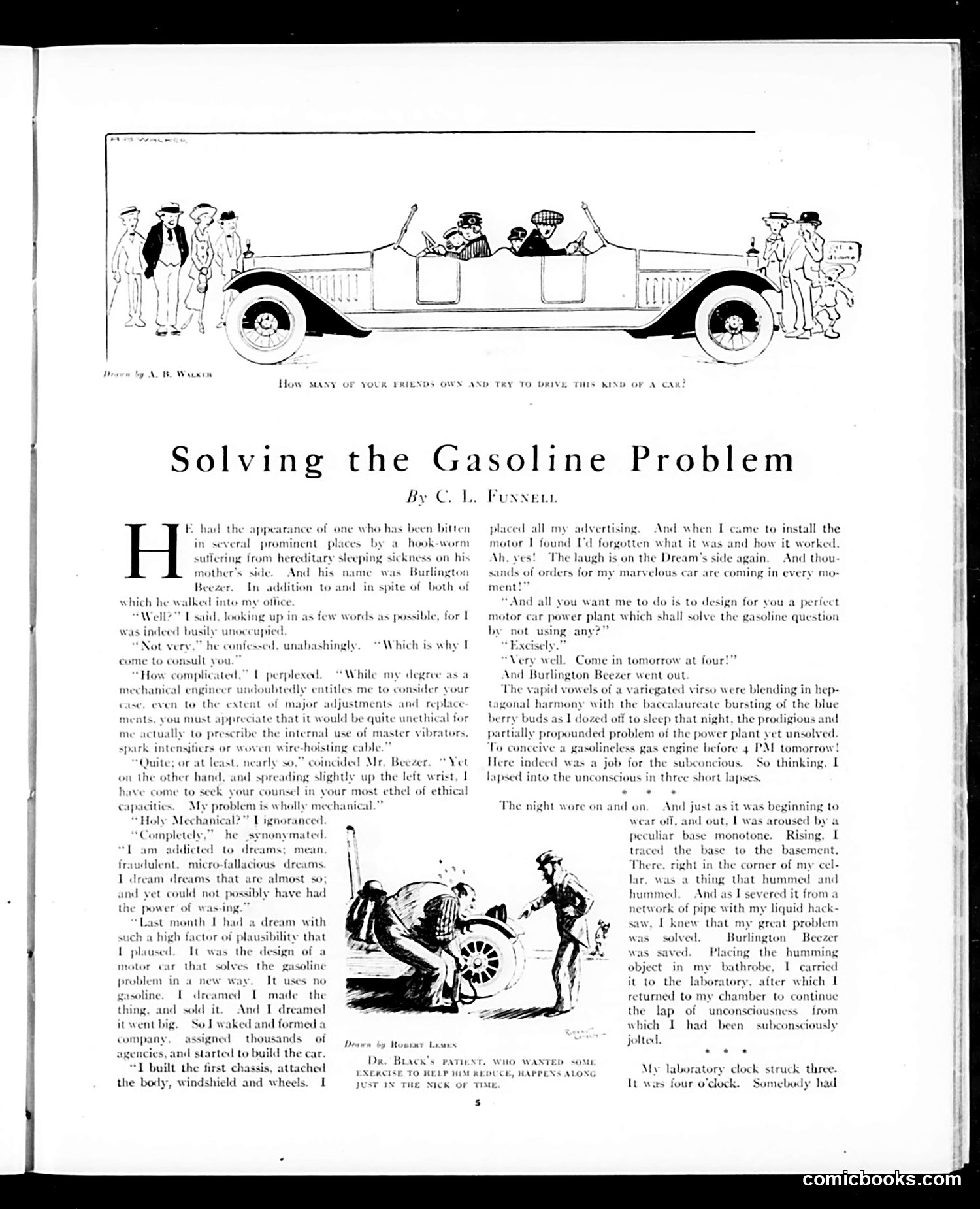
**Top Cartoon:** This is a humorous advertisement asking "How many of your friends own and try to drive this kind of a car?" The elongated vehicle with multiple passengers suggests a joke about oversized or unwieldy automobiles—likely poking fun at early luxury cars that were difficult to operate and required multiple people to manage. **Main Article:** "Solving the Gasoline Problem" by C.L. Funnell is a satirical fictional piece. The narrator (Burlington Beezer) claims to have solved fuel inefficiency through dreams and absurd mechanical solutions, eventually placing a "humming object" in his bathroom. The satire targets early 1900s automobile industry hype and impractical "miracle" solutions to genuine mechanical problems—mocking both inventors' grandiose claims and consumers' gullibility about automotive technology.
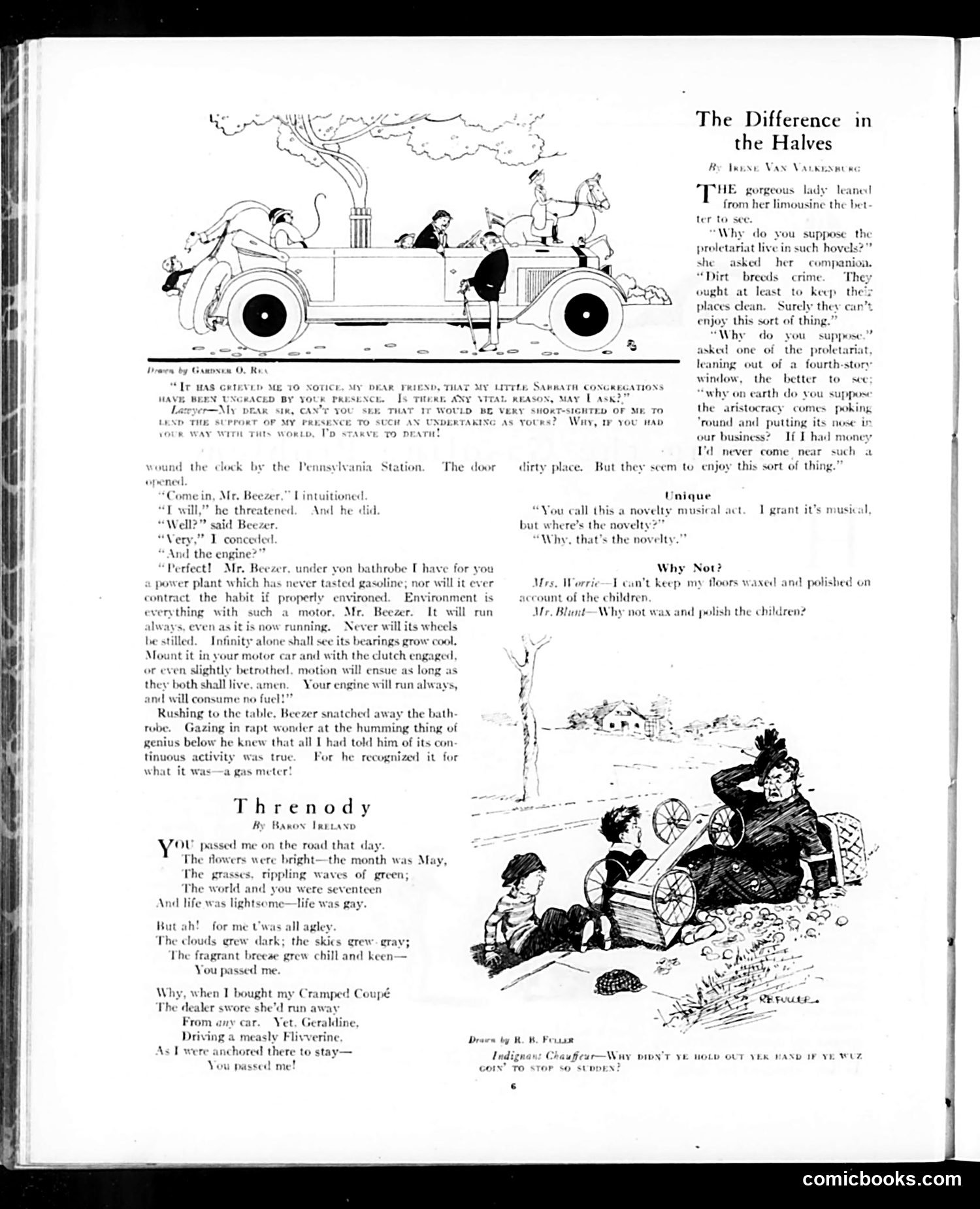
This page contains three separate pieces of humor: 1. **"The Difference in the Halves"** (top): A cartoon showing a wealthy woman in a limousine questioning why working-class people would want to live in tenements. The satire critiques class obliviousness—the rich woman's incomprehension that poverty lacks basic amenities (cleanliness, space) reveals her disconnect from working-class realities. 2. **"Threnody"** (bottom left): A nostalgic poem about May and youth, followed by the speaker's complaint about owning a cramped car that women avoid. The satire mocks automobiles as unreliable and unattractive. 3. **"Why Not?"** (bottom right): A cartoon of a chauffeur and children with a bicycle accident. The humor appears to satirize class assumptions about who should operate vehicles or maintain property. The page reflects early 20th-century American anxieties about class, automobiles, and social mobility.
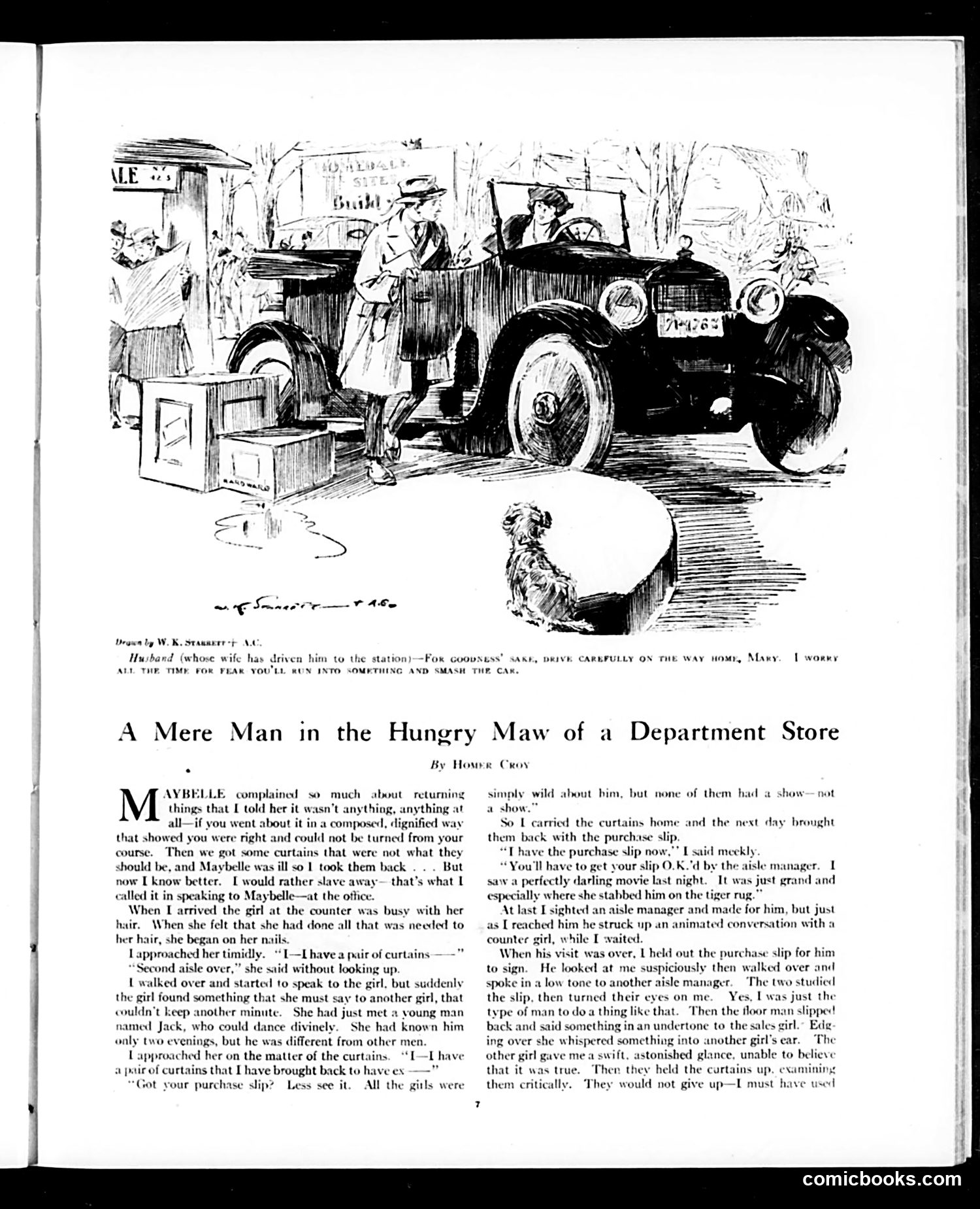
This 1920s-era satirical piece critiques the experience of returning merchandise to department stores—specifically the bureaucratic frustration and dismissive treatment male customers received. **The Setup:** A husband attempts to return defective curtains to a department store, expecting a straightforward transaction. **The Satire:** The story mocks how department store employees—portrayed as preoccupied, gossipy, and indifferent—create obstacles. Staff ignore him to chat about dates, redirect him between departments, and ultimately treat him with suspicion, implying he's dishonest rather than accepting his legitimate complaint. **Social Context:** This reflects early 20th-century retail dynamics where department stores were becoming major institutions, and the friction between customers and staff hierarchies. The "hungry maw" title suggests customers were consumed by bureaucratic indifference. **The Joke:** The powerless male protagonist is trapped in a system designed to wear him down until he abandons his complaint—the opposite of the composed, dignified approach he'd planned. The cartoon at top reinforces this: a wife warns her husband to drive carefully, but he worries *he'll* cause damage—inverting who's actually the cautious one.
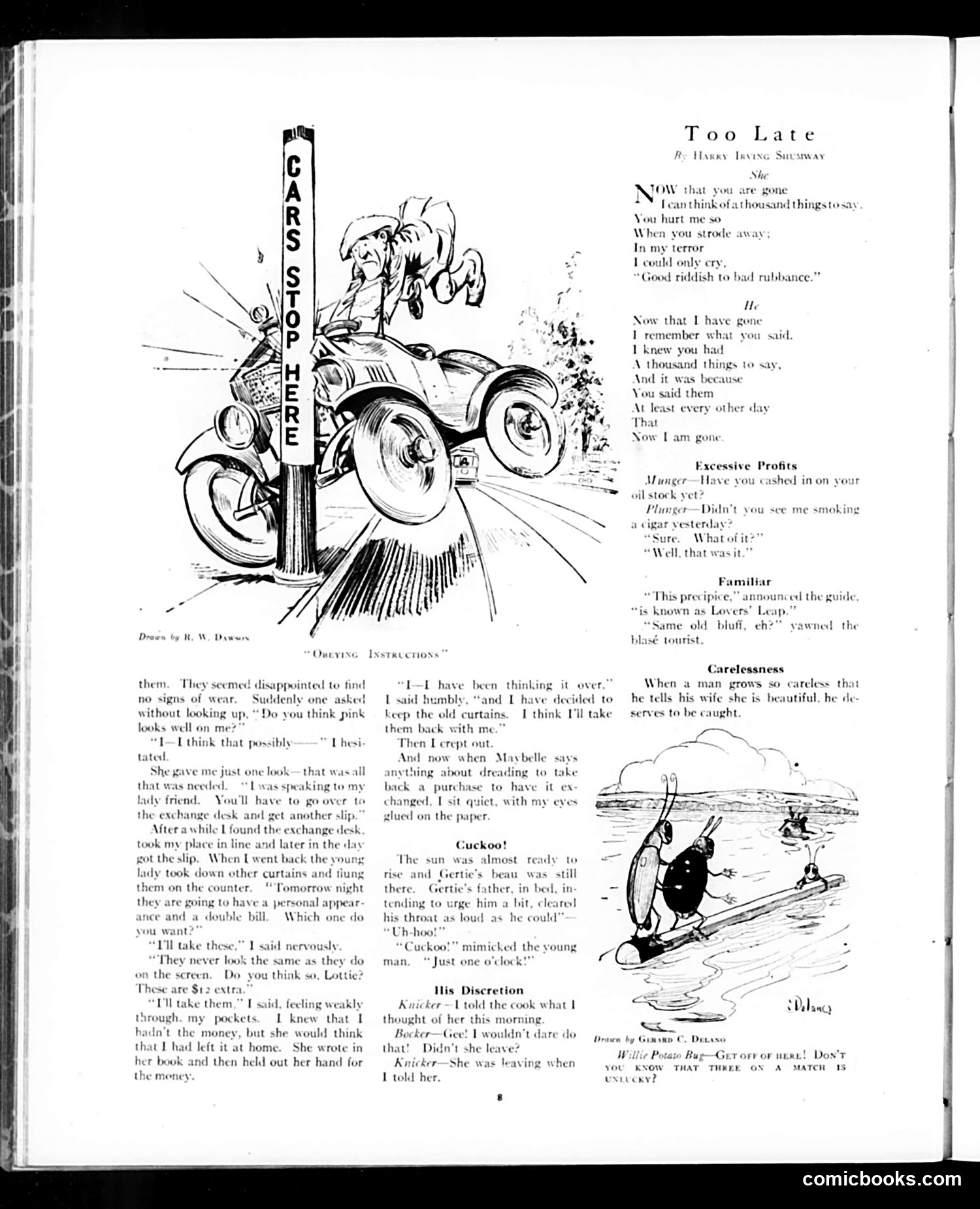
This page contains multiple short satirical pieces typical of Judge magazine's humor: **"Too Late"** (poem): A sentimental piece about regret—a lover realizes too late all the things they should have said after their departure. The satire targets romantic melodrama and the irony of silence followed by regret. **"Carriage Shop Here"** (narrative): Satirizes retail customer service and female consumer anxiety. A woman exchanges curtains but feels financially embarrassed, unable to afford the $12 extra charge. The humor mocks the social performance required in shopping and women's financial dependence. **"Cuckoo!"** and **"His Discretion"**: Brief jokes about domestic situations—an overstaying suitor and a servant's prudent silence toward her employer. **Bottom cartoon**: A potato bug warns others about the "unlucky" superstition of three people lighting cigarettes from one match—period folk superstition. These pieces collectively satirize American middle-class social conventions, consumer culture, courtship rituals, and domestic anxieties. The magazine's humor relies on relatability to contemporary readers' experiences.
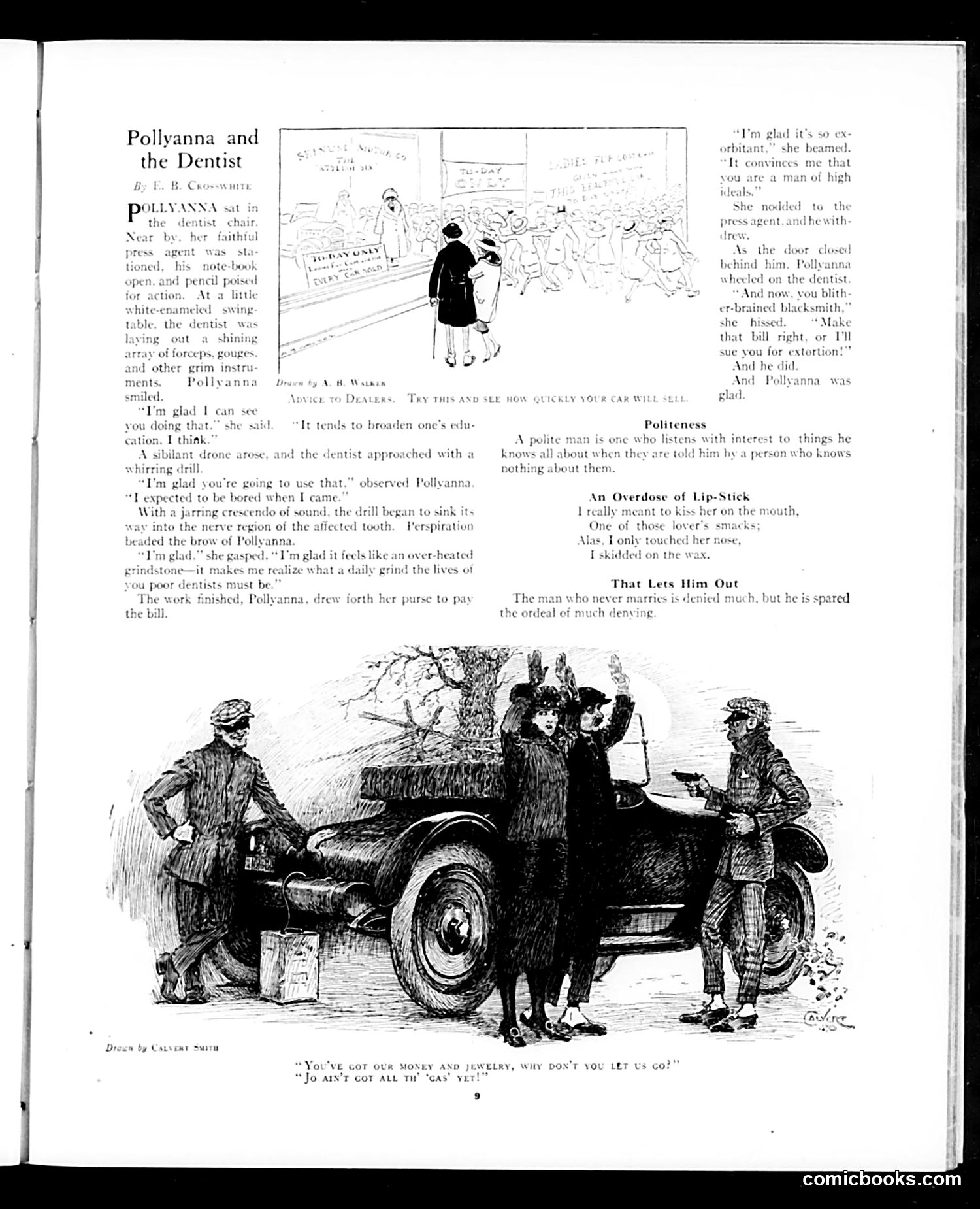
The top story satirizes the optimistic literary character Pollyanna, who famously finds silver linings in every situation. Here, even during painful dental work, she remains cheerful—until the bill arrives. Her sudden fury at the dentist's charges (threatening to sue for "extortion") mocks the gap between her relentless positivity and harsh financial reality. The joke is that even Pollyanna's famous optimism has limits when money is involved. The lower cartoon depicts a robbery or carjacking. Bandits demand victims surrender "money and jewelry," but one robber protests they haven't gotten "all the 'gas'"—implying the victims haven't emptied the car's fuel tank. This jokes about criminals' petty greed during theft, wanting every last resource, no matter how minor.
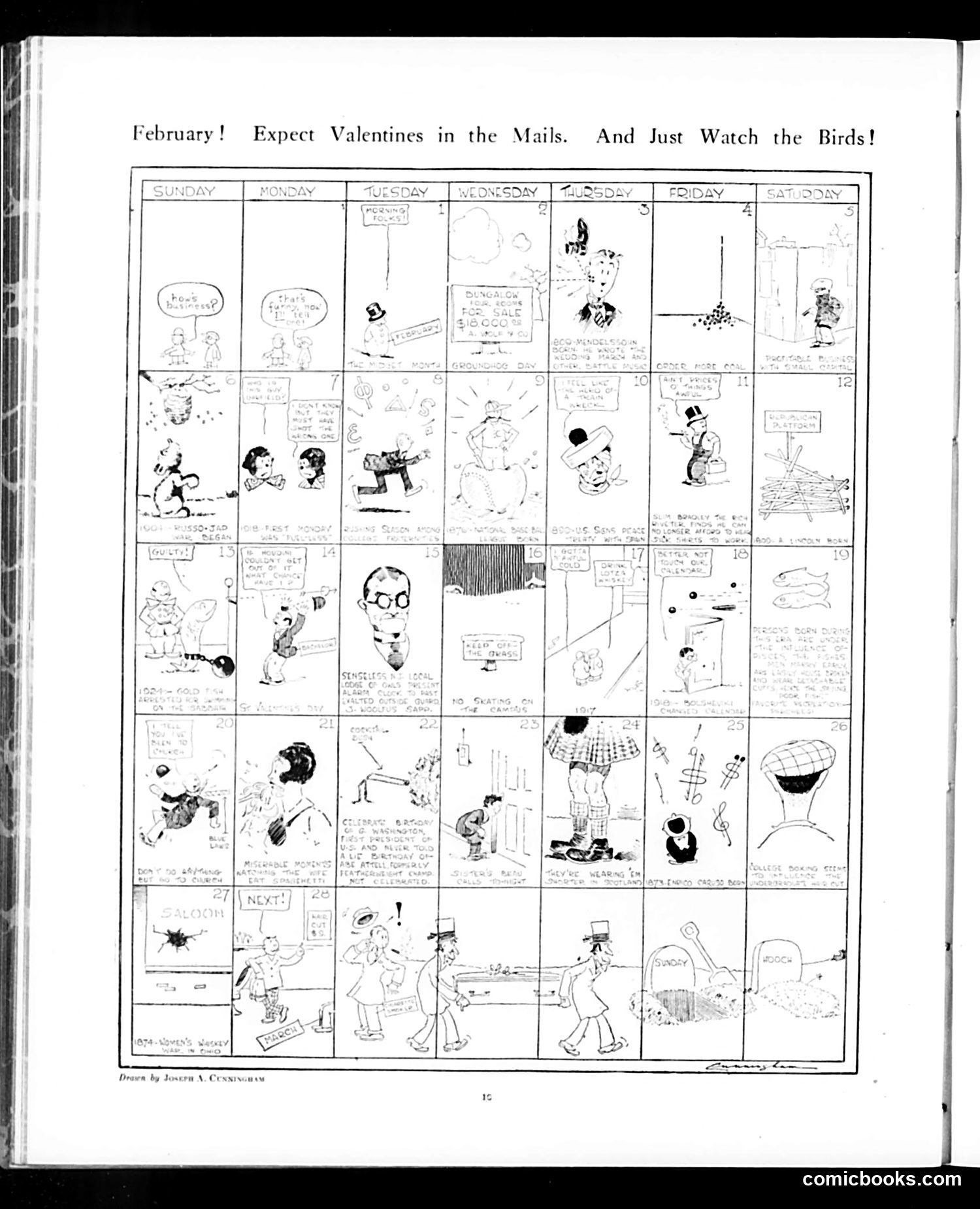
This is a daily comic strip calendar for February by Joseph A. Cunningham, presenting humorous scenarios tied to the month's themes: Valentine's Day and bird behavior. The strip depicts various domestic and social situations—couples exchanging valentines, people receiving mail, and scenes involving birds—playing on the double meaning of "watching the birds" as both literal bird observation and period slang for noticing romantic couples ("love birds"). The jokes appear to center on Valentine's Day mishaps, romantic embarrassments, and the contrast between human courtship rituals and natural bird behavior during mating season. Without clearer panel details, specific references remain unclear, but the overall theme uses February's traditional associations (romance and nature) for comedic effect.
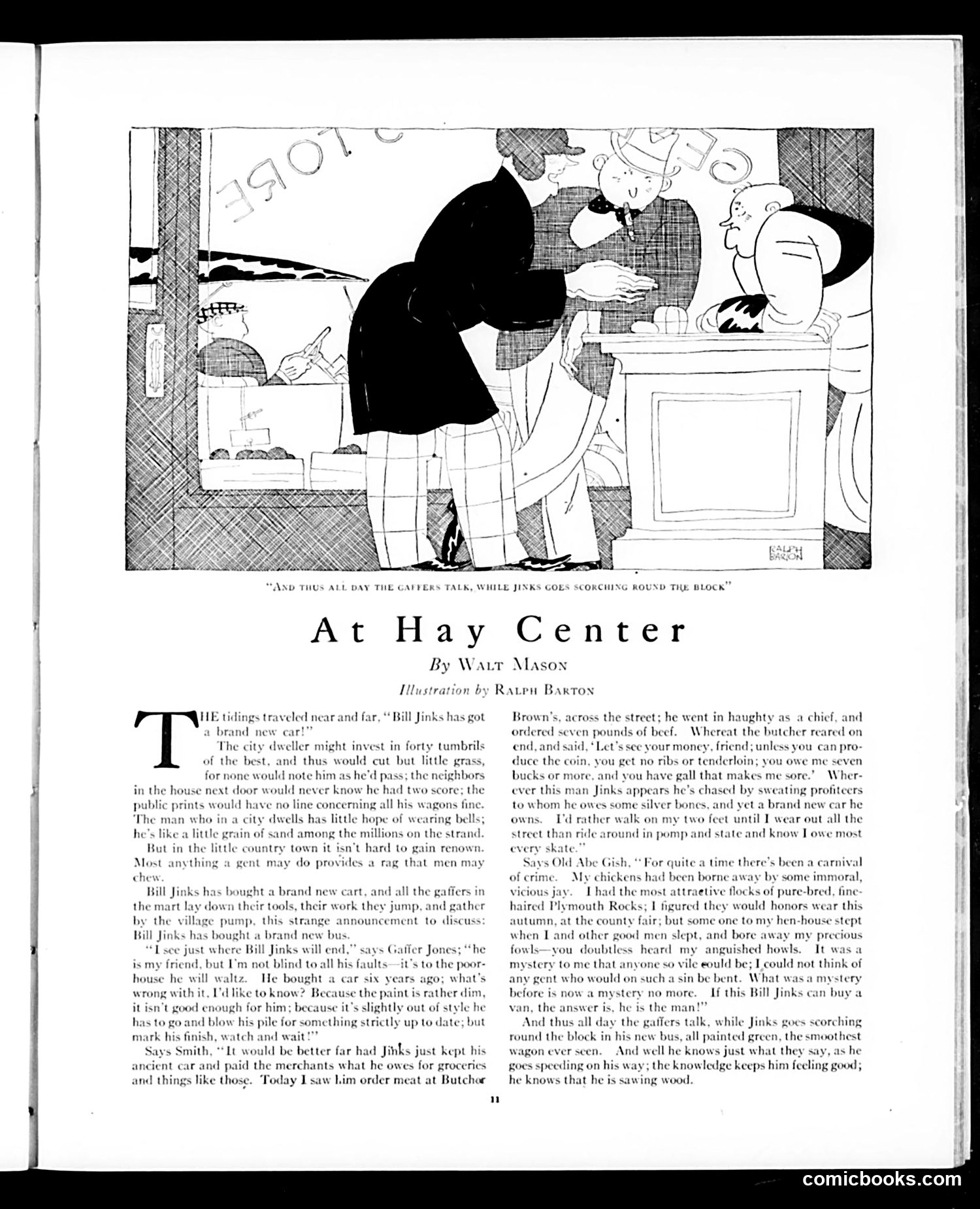
This story-illustration satirizes small-town gossip and envy centered on one man's new automobile purchase. Bill Jinks has bought a car, and the entire community obsesses over it. The satire targets multiple hypocrisies: townspeople spend all day discussing Jinks's extravagance while he ignores their judgment, speeding around contentedly. Meanwhile, Jinks owes money to local merchants (the butcher demands payment; grocers are unpaid), yet flaunts wealth with his new vehicle. The various gossipers—Jones, Smith, Abe Gish—represent ordinary townspeople who simultaneously criticize his irresponsibility and envy his status. The cartoon mocks how rural communities transform minor events into major drama, how debt doesn't prevent status-seeking, and the gap between appearance and actual financial solvency. Jinks represents the new consumer culture: prioritizing a showy automobile over paying debts—a recognizable tension in early 20th-century American society.
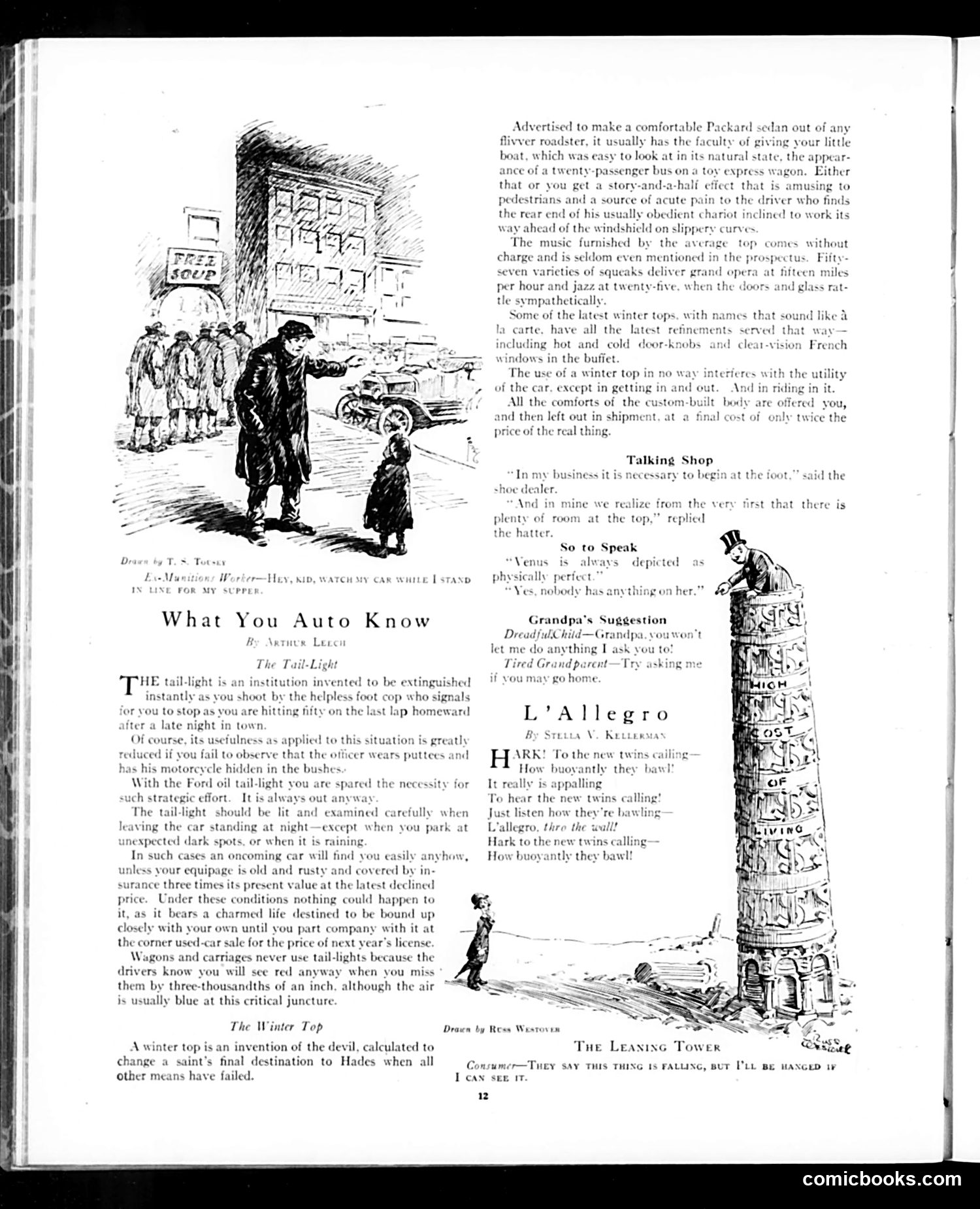
This page contains satirical automotive and domestic humor typical of early 20th-century Judge magazine. The main content includes: **"What You Auto Know"** discusses car tail-lights—an emerging safety concern. The satire mocks drivers who don't maintain or use them properly, suggesting only old, rusty cars get away with it because observers see "red" anyway (a pun on anger and brake lights). **"The Winter Top"** humorously calls convertible tops "an invention of the devil," exaggerating their frustrating complexity for drivers of the era. The illustrated comics are lighter domestic humor: a shoe dealer and hatter exchange about starting "at the foot" versus "at the top"; "Grandpa's Suggestion" involves a child's negotiation; "L'Allegro" celebrates newborn twins' cries; and **"The Leaning Tower"** shows a consumer complaint about a faulty product—likely a poorly constructed automobile part. The satire reflects early automotive frustrations: unreliable technology, safety issues, and manufacturing quality problems common when cars were relatively new consumer goods.
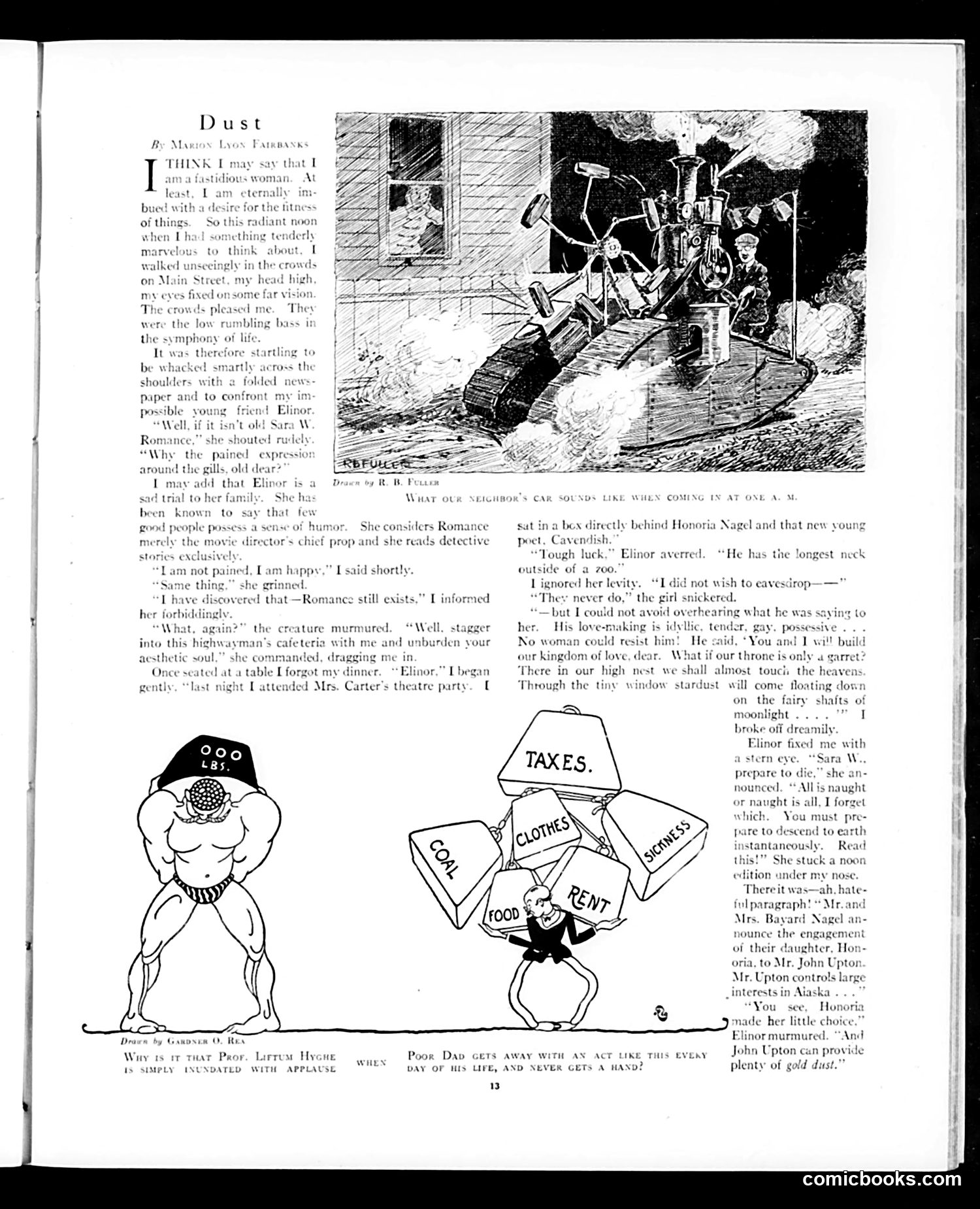
This page contains a short story titled "Dust" by Marion Lyon Fairbanks and two political cartoons below. **The cartoons:** The left cartoon depicts a rotund figure labeled with "LBS" (pounds), apparently representing obesity or excess, being applauded. The caption asks why "Prof. Littum Hygene is simply inundated with applause"—a sarcastic jab at society's hypocrisy in praising something (likely a public figure or trend) that contradicts health principles. The right cartoon shows a small figure struggling beneath a massive burden of labeled sacks: "Taxes," "Rent," "Clothes," "Food," "Coal," and "Sickness." The caption sarcastically notes that "Poor Dad gets away with an act like this every day of his life, and never gets a hand?"—satirizing how the working poor juggle impossible financial burdens without recognition or relief, while acrobatic performers receive applause for far less. Both cartoons critique social injustice: rewarding the wrong behaviors while ignoring the genuine struggles of ordinary people.
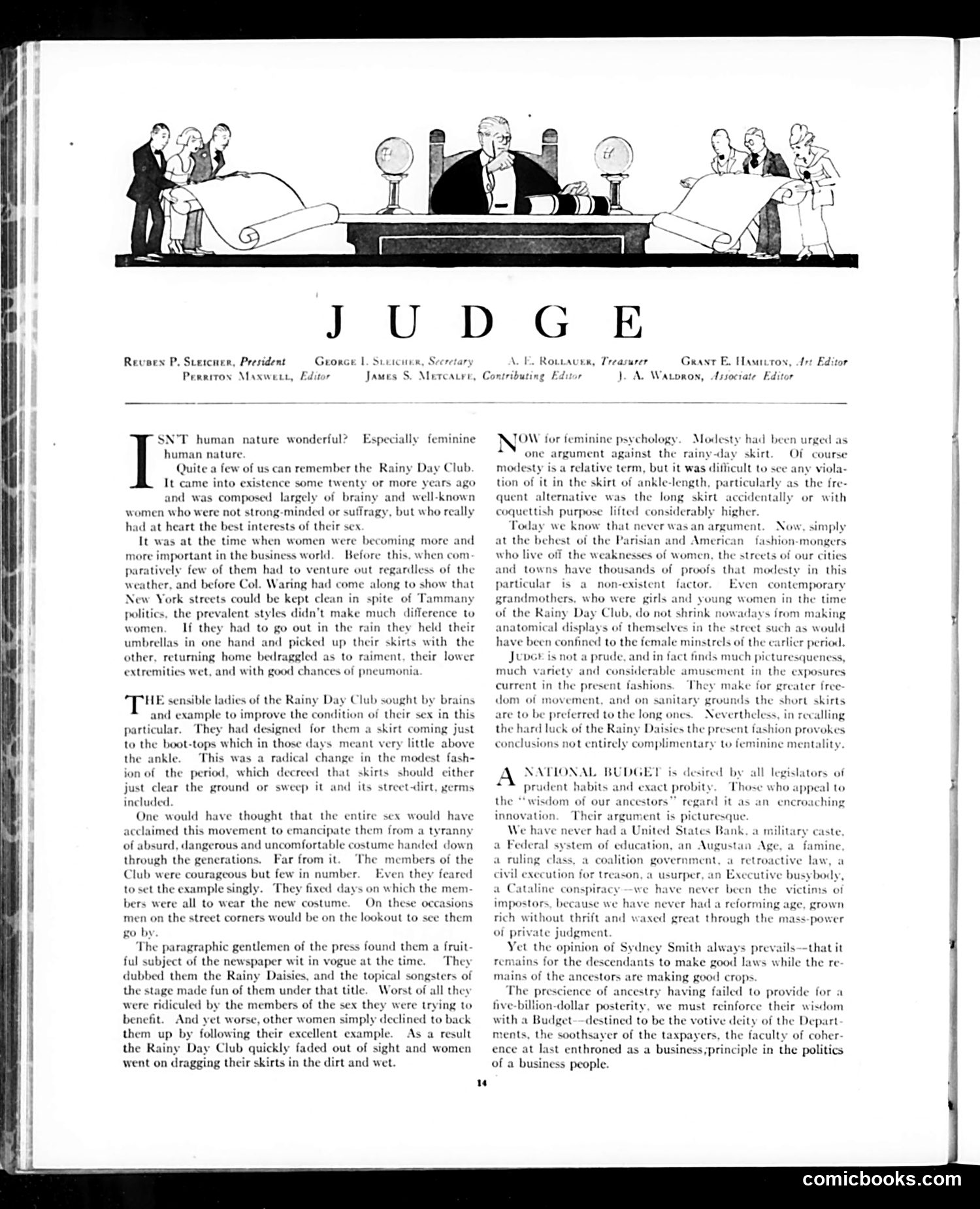
This page from Judge magazine satirizes the "Rainy Day Club," a women's reform movement from approximately 20 years prior (likely 1890s). The club consisted of intelligent, respectable women—notably *not* suffragettes—who advocated for practical dress reform: shorter skirts reaching the boot-tops rather than dragging in street dirt and germs. The satire targets the **hypocrisy of feminine modesty claims**. The article notes that shorter skirts were denounced as immodest, yet women had long lifted skirts higher through coquetry. Judge mocks how the movement failed because women themselves ridiculed it and refused to participate—despite it serving their health interests. The accompanying illustration (judge at bench) likely reinforces this judgment on female inconsistency. The piece uses the failed Rainy Day Club as a historical example to comment on modern (1910s) fashion trends, where women now openly display themselves far more than the modest reformers ever proposed. The satire highlights contradiction: women rejected practical reform citing modesty, only to later embrace far more revealing fashion dictated by commercial fashion industries.
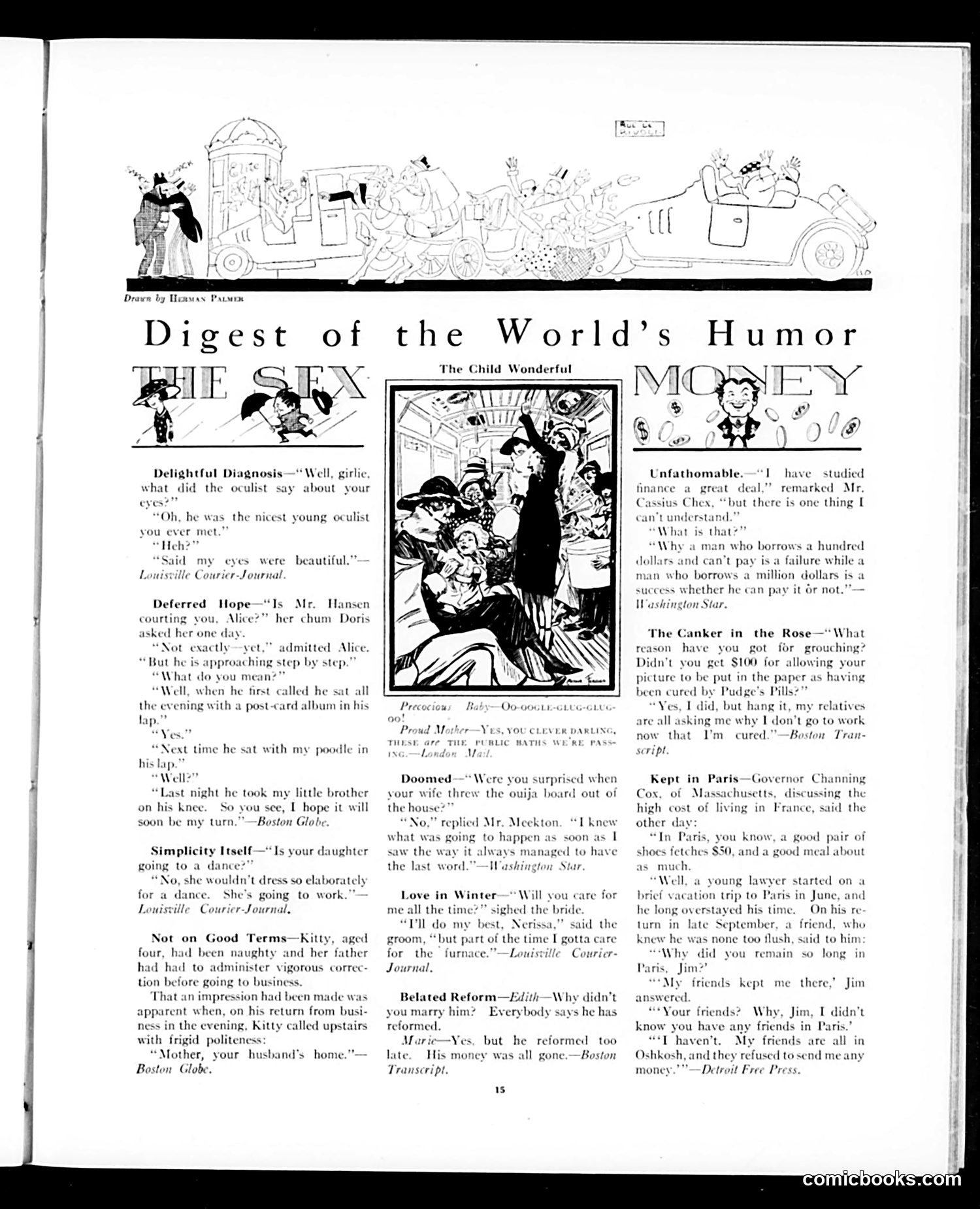
This page collects brief humorous anecdotes satirizing early 20th-century social conventions and human nature. Key targets include: **Dating/Courtship**: "Deferred Hope" mocks the slow, cautious progression of courtship—a suitor gradually moves from post-card albums to sitting with the woman's poodle, then her brother, suggesting painfully incremental romantic progress. **Gender roles**: "Simplicity Itself" jokes that a daughter dresses elaborately only for work, not social events—inverting expected priorities about dressing up for romance versus labor. **Class commentary**: "Unfathomable" satirizes the paradox that small debtors are deemed failures while millionaire borrowers are celebrated as successes—exposing economic hypocrisy. **Marriage realities**: "Love in Winter" reduces romantic devotion to practical concerns—the groom must balance caring for his bride with furnace maintenance, deflating romantic idealism. The humor relies on observational comedy about courtship delays, marital mundanity, and social absurdities—typical Judge magazine fare targeting middle-class American readers' recognition of life's everyday ironies.
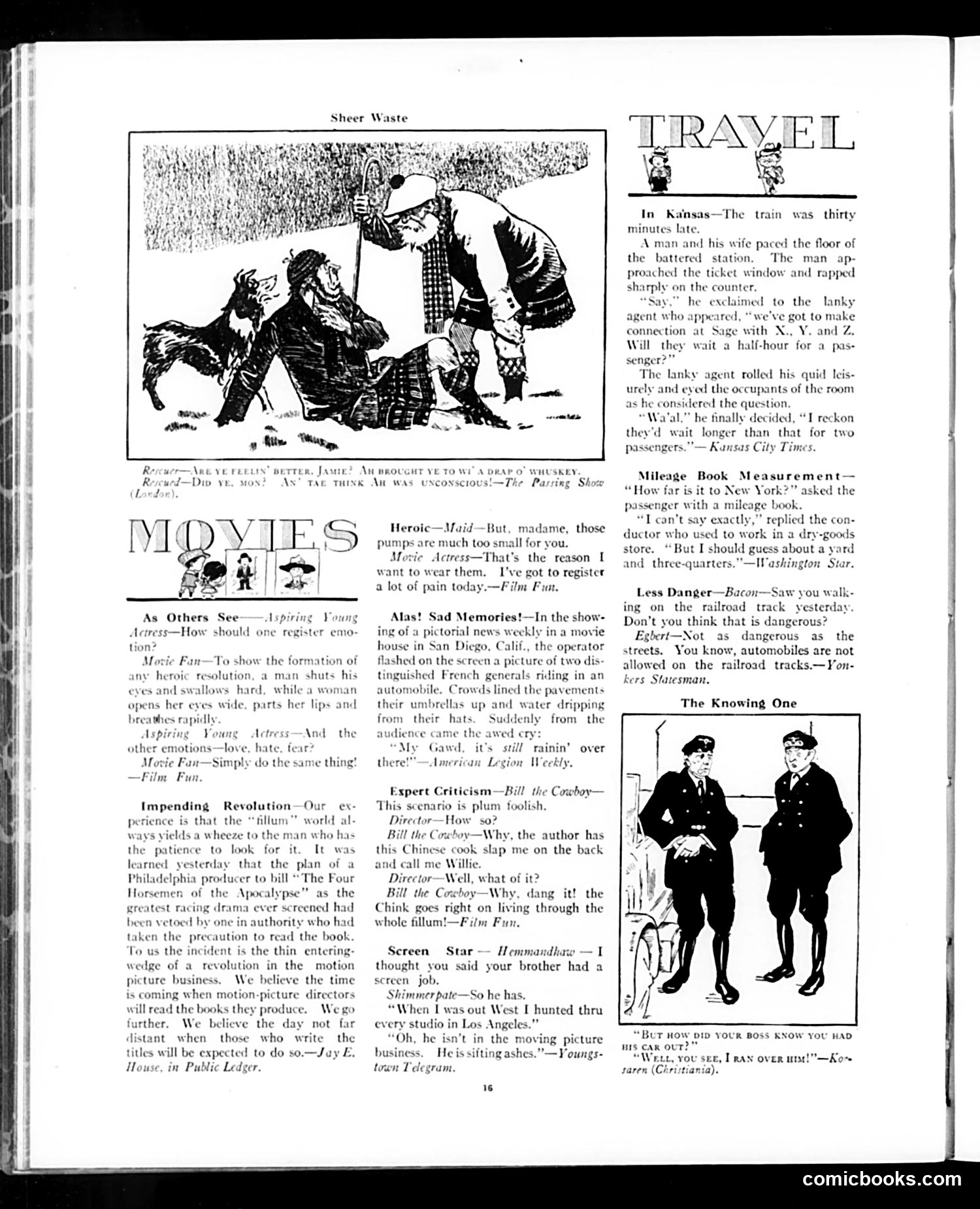
This page from *Judge* magazine contains several short humorous pieces satirizing early cinema and travel experiences. **"Sheer Waste"** (top cartoon): Shows a drunk man being helped by others. The caption jokes about registering emotions for silent film acting—the drunk's exaggerated physical comedy demonstrates how actors conveyed feeling without dialogue. **"Movies" section**: Multiple brief jokes mock the film industry's superficiality. One piece sarcastically suggests producers should actually *read* the books they adapt (referencing *The Four Horsemen of the Apocalypse*). Another mocks a cowboy character who survives when a Chinese cook dies—criticizing the implausible, clichéd writing. A third jokes that an actor's brother lost his studio job and now works as an ash-sifter, suggesting Hollywood's instability. **"Travel" section**: Anecdotes about train travel humorously capture rural dialect and logic—a Kansas ticket agent's deadpan response to missing a connection, and a conductor's inability to estimate distance after leaving dry-goods retail. The satire targets Hollywood's artistic pretensions and the era's emerging entertainment industry with gentle mockery of its absurdities.
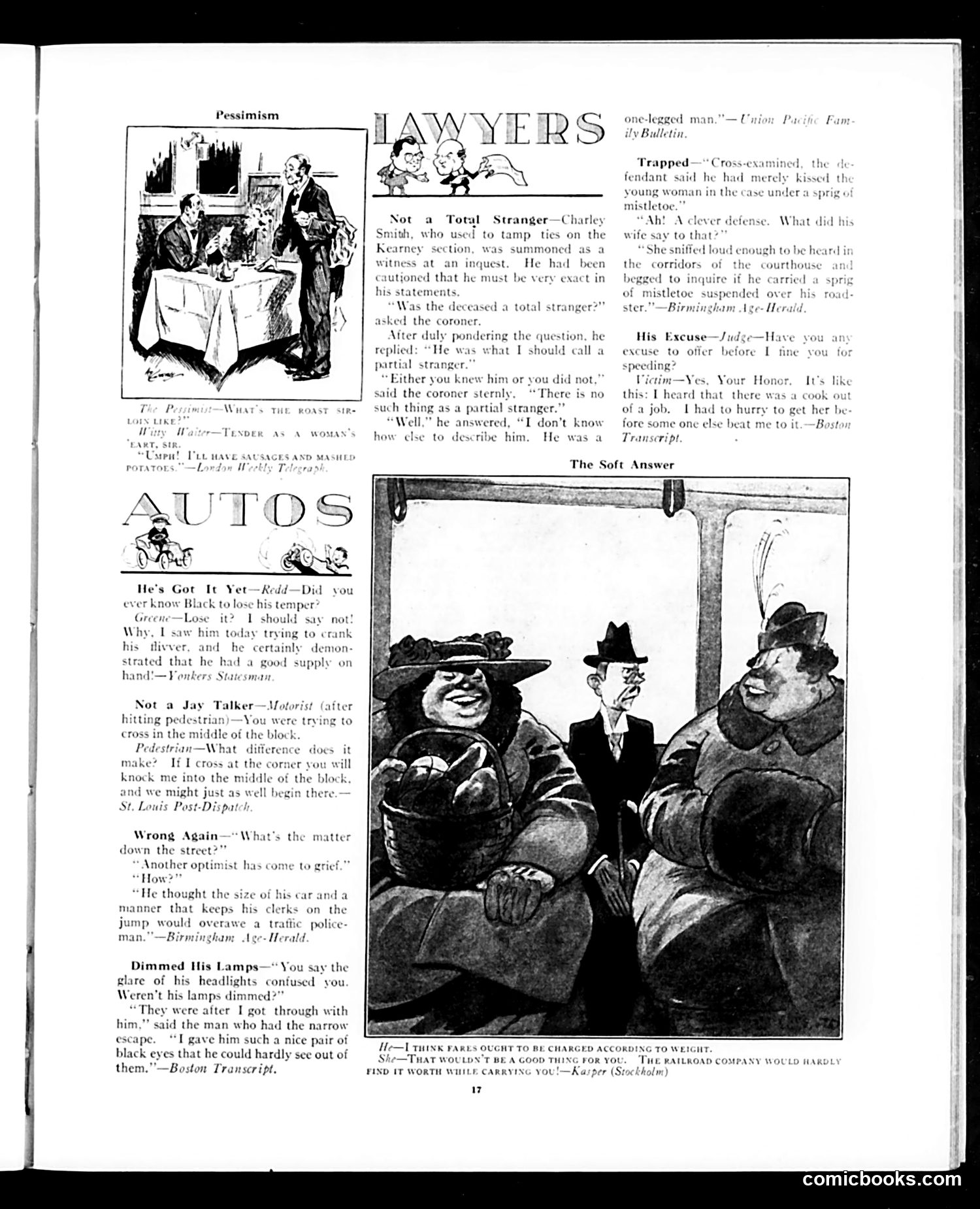
This page from *Judge* contains humorous anecdotes rather than political cartoons. The jokes satirize early 20th-century American life, particularly automobiles and legal proceedings. **"Pessimism"** depicts a restaurant scene mocking pessimistic patrons complaining about food quality. **The "Autos" section** ridicules early motorists and traffic incidents: - "He's Got It Yet" jokes about a driver's bad temper - "Not a Jay Talker" mocks pedestrians and traffic confusion - "Wrong Again" satirizes an overconfident motorist assuming his car's size intimidates a traffic policeman - "Dimmed His Lamps" humorously describes retaliatory violence from a pedestrian hit by headlights **The "Lawyers" section** satirizes legal testimony: - A witness struggles with the concept of a "partial stranger" - A defendant caught kissing someone offers absurd excuses **"The Soft Answer"** cartoon shows two figures debating railroad fares by weight—likely commentary on pricing fairness, with the woman making a double entendre about the man's weight. The humor reflects contemporary anxieties about automobiles, legal absurdities, and gender relations.
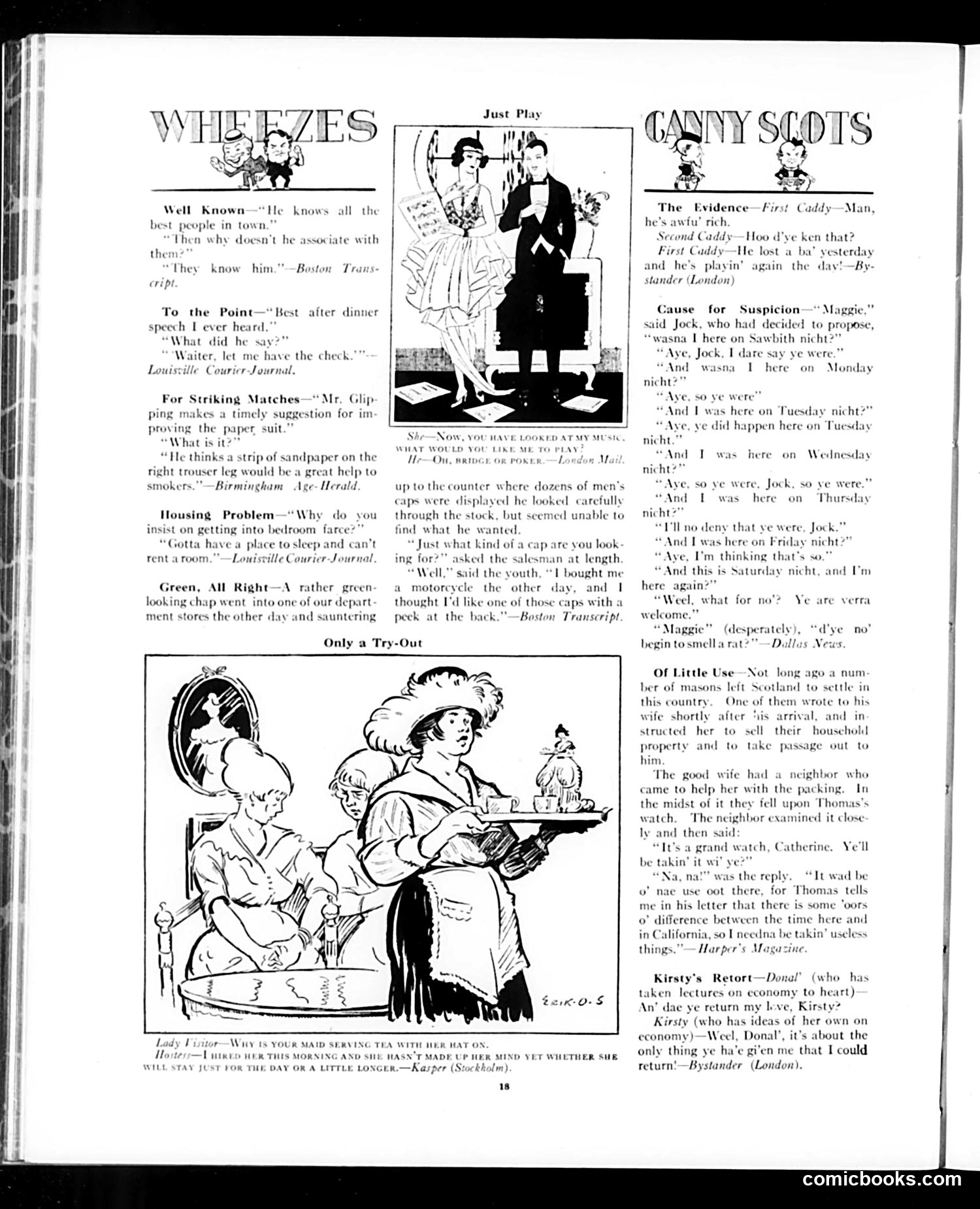
This page from *Judge* contains several short humorous anecdotes and one cartoon, typical of early 20th-century satirical magazines. **"Only a Try-Out" (main cartoon):** A maid serves tea while wearing her hat, prompting a question about whether she plans to stay or leave—poking fun at domestic service customs and worker turnover. **The text sections** are brief jokes about everyday absurdities: a man seeking a motorcycle cap with a back peek; someone claiming to know "all the best people" but not associating with them; a suggestion to use sandpaper on trousers to help light matches. **"Cause for Suspicion"** features a Scottish courtship dialogue where a man (Jock) attempts to prove his devotion by establishing he's visited his beloved every night of the week—the humor lies in the woman's deadpan responses and the absurd logic of the "proof." **"Of Little Use"** presents an immigrant's wife selling his valuable pocket watch because he wrote that California time differs from Scotland's, so the watch would be "useless"—satirizing literal-mindedness and miscommunication. The humor relies on period-specific domestic situations and working-class Scottish dialect.
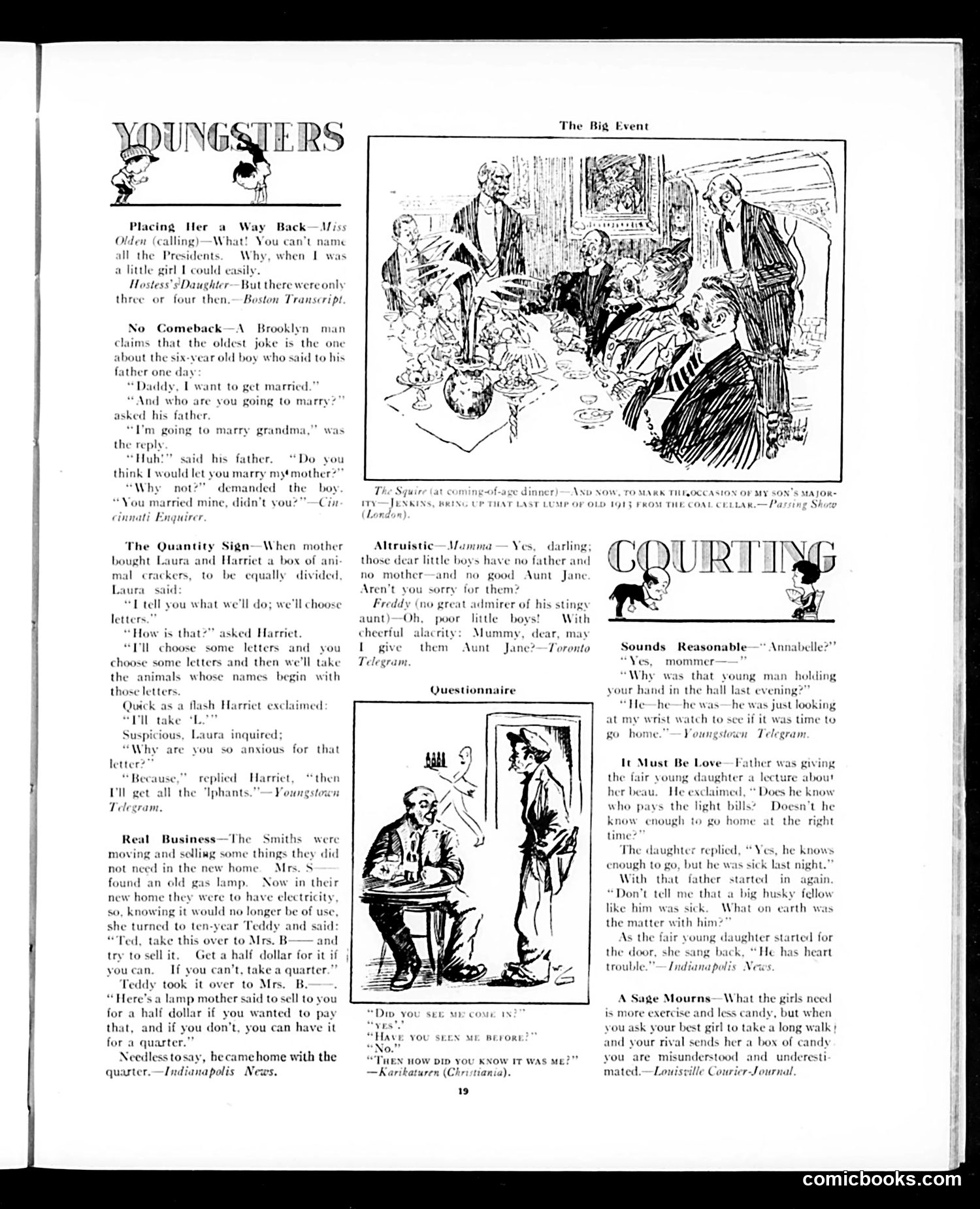
This page from Judge contains humorous anecdotes and satirical commentary typical of early 20th-century American humor. **"Placing Her a Way Back"** jokes about a young woman who can't name all U.S. Presidents, contrasting her to an older generation. The satire targets modern educational decline or women's education specifically—a common concern of the era. **"The Big Event"** cartoon depicts a coming-of-age dinner where someone retrieves "the last lump of old 1913 from the coal cellar"—likely satirizing post-WWI scarcity or rationing, making old fuel sources laughably precious. **"Real Business"** humorously portrays a boy successfully pawning a useless gas lamp to a neighbor, suggesting shrewd child entrepreneurship or the gullibility of adults. The remaining anecdotes—about animal crackers, a boy wanting to marry his grandmother, and courting behavior—offer domestic humor typical of Judge's "Youngsters" and "Courting" sections, targeting family dynamics and dating customs without specific political commentary. The page is primarily lighthearted social satire rather than political critique.
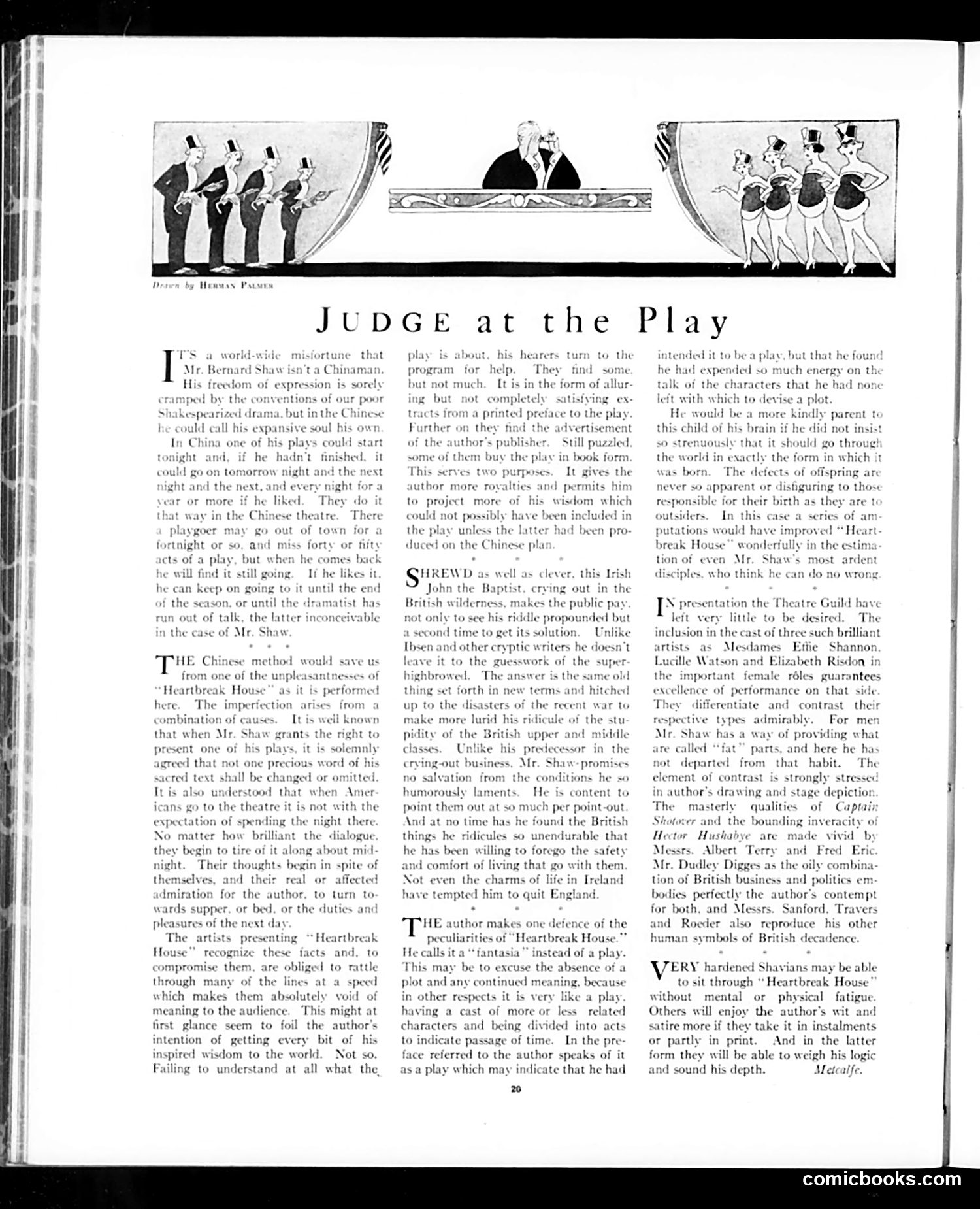
This theater review critiques Bernard Shaw's play "Heartbreak House," written by someone identified as "Metcalfe." The article discusses Shaw's unconventional dramatic structure—he calls it a "fantasia" rather than a traditional play, lacking a coherent plot. The illustrated header (drawn by Herman Palmer) shows four men in top hats on the left and four women in theatrical costume on the right, with a judge figure in the center—visually representing the tension between artistic pretension and popular entertainment. The review suggests Shaw sacrificed clarity and audience enjoyment for philosophical ambition. It praises the cast (including Lucille Watson and Elizabeth Risdon) for differentiating their roles, but notes that Shaw's cryptic dialogue and structural choices make the play difficult to follow—audiences struggle to understand his "inspired wisdom." The satire targets modernist drama's opacity when viewed by mainstream theatergoers.
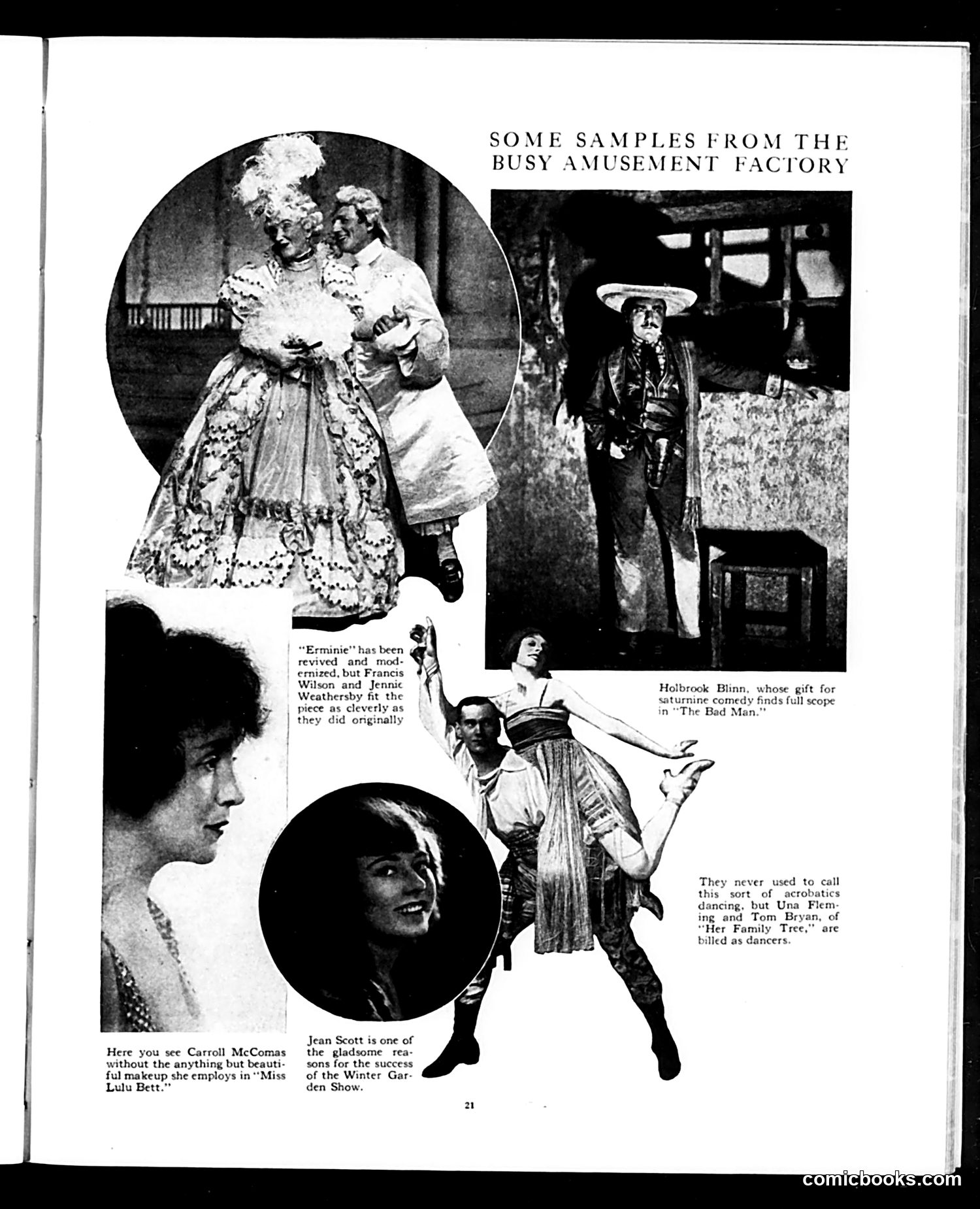
This page showcases theatrical productions, likely from the 1920s. It features photographs of actors and actresses appearing in current Broadway or touring shows, with brief critiques beneath each image. The content includes: - **"Erminie"** revival with Francis Wilson and Jennie Weathersby - **Carroll McComas** in "Miss Lulu Bett," noted for her natural beauty without makeup - **Jean Scott** praised as a reason for the "Winter Garden Show's" success - **Holbrook Blinn** in "The Bad Man," credited with satirical comedy talent - **Una Fleming and Tom Bryan** in "Her Family Tree," billed as dancers despite performing acrobatic moves The satire appears gentle—mostly complimenting performers while making light observations about theatrical trends (like calling acrobatics "dancing"). This is essentially an entertainment column with photographs, typical of Judge's coverage of popular amusement and stage productions of the era.
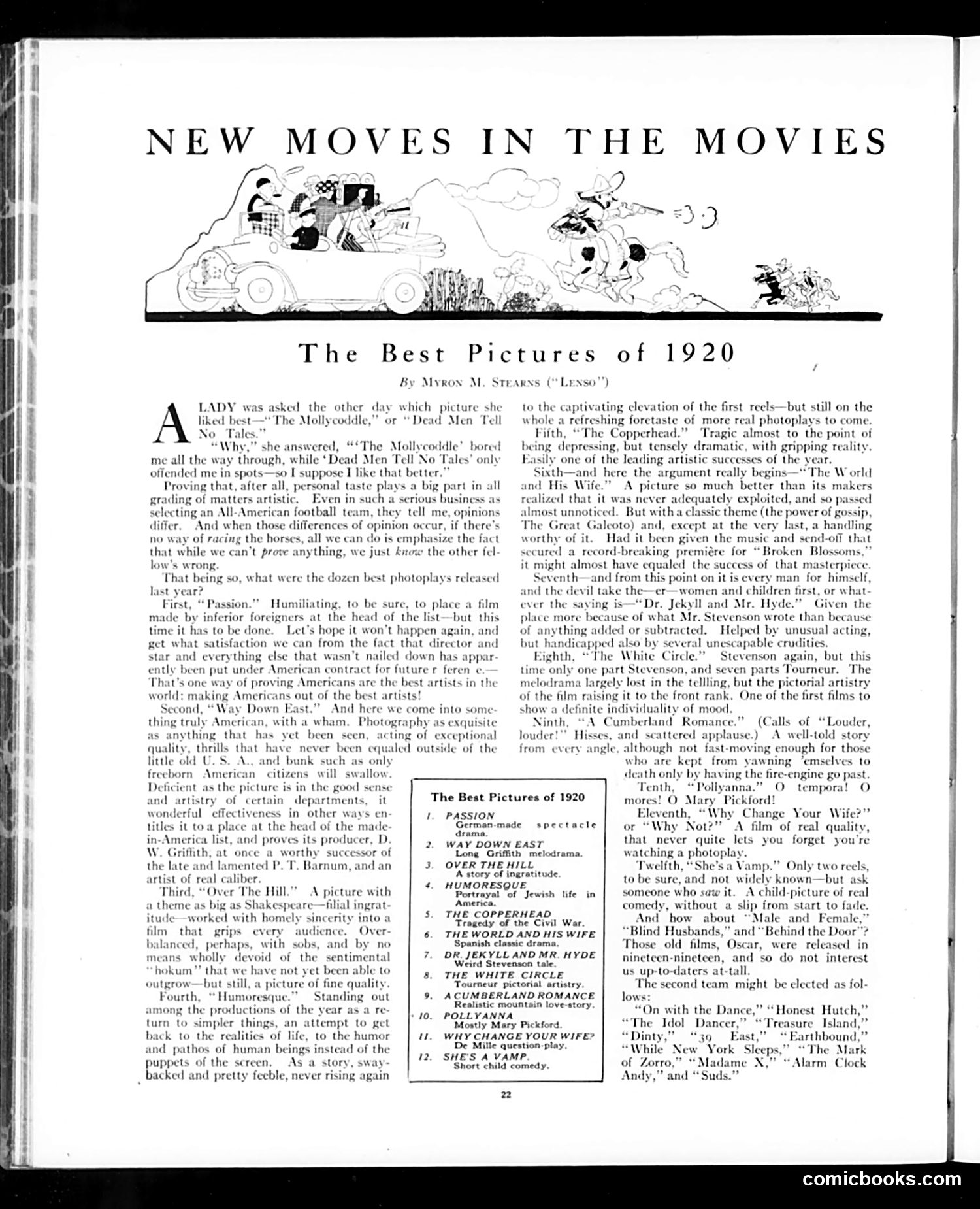
This is a film criticism article by Myron M. Stearns ("Lenso") evaluating 1920's best movies. Rather than a political cartoon, it's an entertainment column with an illustrative header showing cars and characters in comedic motion. The article ranks twelve films, opening with self-aware humor about subjective taste—a lady prefers "Dead Men Tell No Tales" because it merely "offended" her rather than bored her. Stearns praises D.W. Griffith's "Way Down East" (calling him a successor to P.T. Barnum), celebrates "Over the Hill" for its Shakespearean theme of filial ingratitude, and notes "Humoresque" returns cinema to realistic human stories rather than "puppets." Key context: The list includes foreign films ("Passion," German-made) but emphasizes American productions, reflecting post-WWI American cultural assertiveness. Mary Pickford appears prominently ("Pollyanna"). The tone is earnest film criticism for Judge's educated readership, not satire.
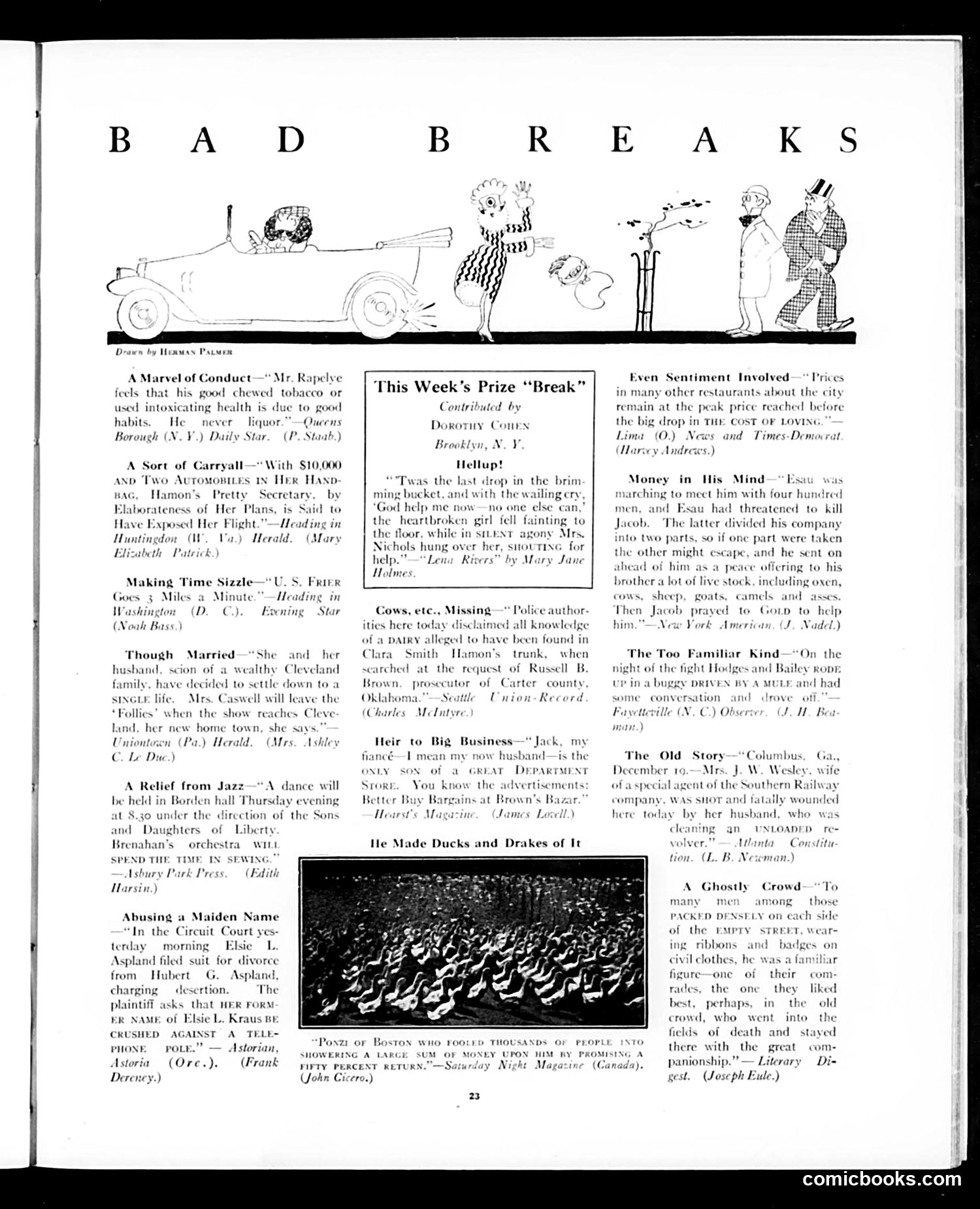
This is a miscellaneous humor column from *Judge* magazine, not a single unified cartoon. The page collects brief anecdotal jokes and social commentary snippets from newspapers across America, each credited to different sources. The content reflects early 20th-century domestic and social anxieties: marital discord (women leaving husbands), accidents (people crushed by objects), crime (theft and fraud), and financial strain ("cost of living" concerns). One recurring theme involves women's independence—a woman fleeing her husband with money and automobiles; another being a department store heir's fiancée. The large photograph at bottom shows "Ponzi of Boston" swindling thousands through fraudulent investment schemes, a reference to Charles Ponzi's famous 1920 pyramid scheme that defrauded Boston investors. The overall tone is satirical commentary on American life's absurdities and misfortunes, collected for middle-class readers' amusement at others' misadventures.
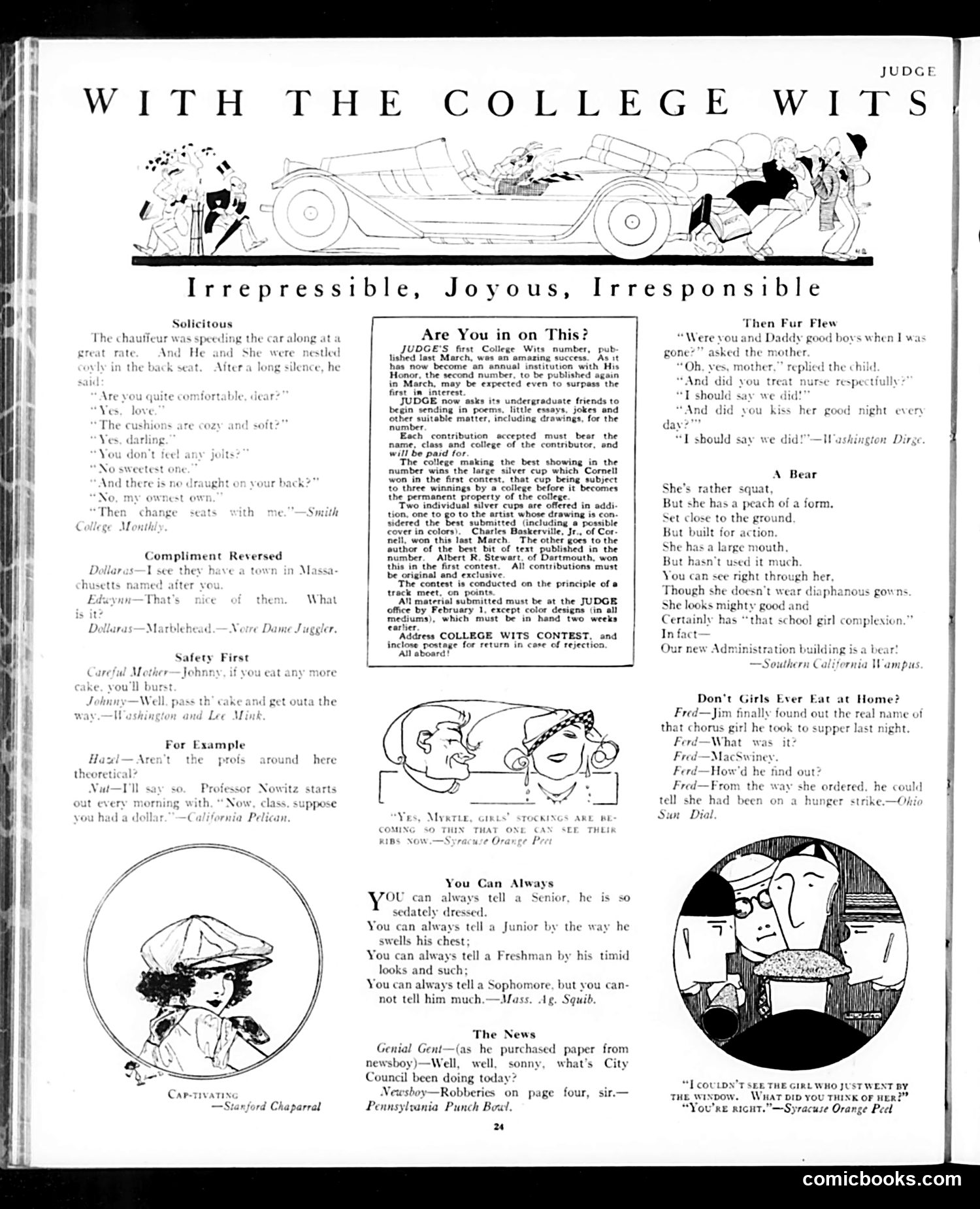
This page showcases **Judge's annual College Wits competition**, a nationwide collegiate humor contest. The main feature announces submission guidelines for poems, essays, jokes, and drawings from undergraduate contributors, with prizes including a silver cup for the winning college. The scattered humorous items illustrate typical college-life jokes of the era: - **"Safety First"** and **"Solicitous"** are brief dialogue jokes about dating etiquette and car rides - **"You Can Always"** satirizes class distinctions among students (Seniors appear sophisticated, Juniors boastful, Freshmen timid, Sophomores incomprehensible) - **"Don't Girls Ever Eat at Home?"** jokes about chorus girls—a contemporary reference to theatrical performers of questionable reputation - Other items poke fun at student behavior and social pretension The cartoons feature simple line drawings typical of 1920s collegiate humor. The overall tone mocks undergraduate social climbing, romantic mishaps, and gender relations—standard satirical fare for Judge's educated, college-oriented readership.
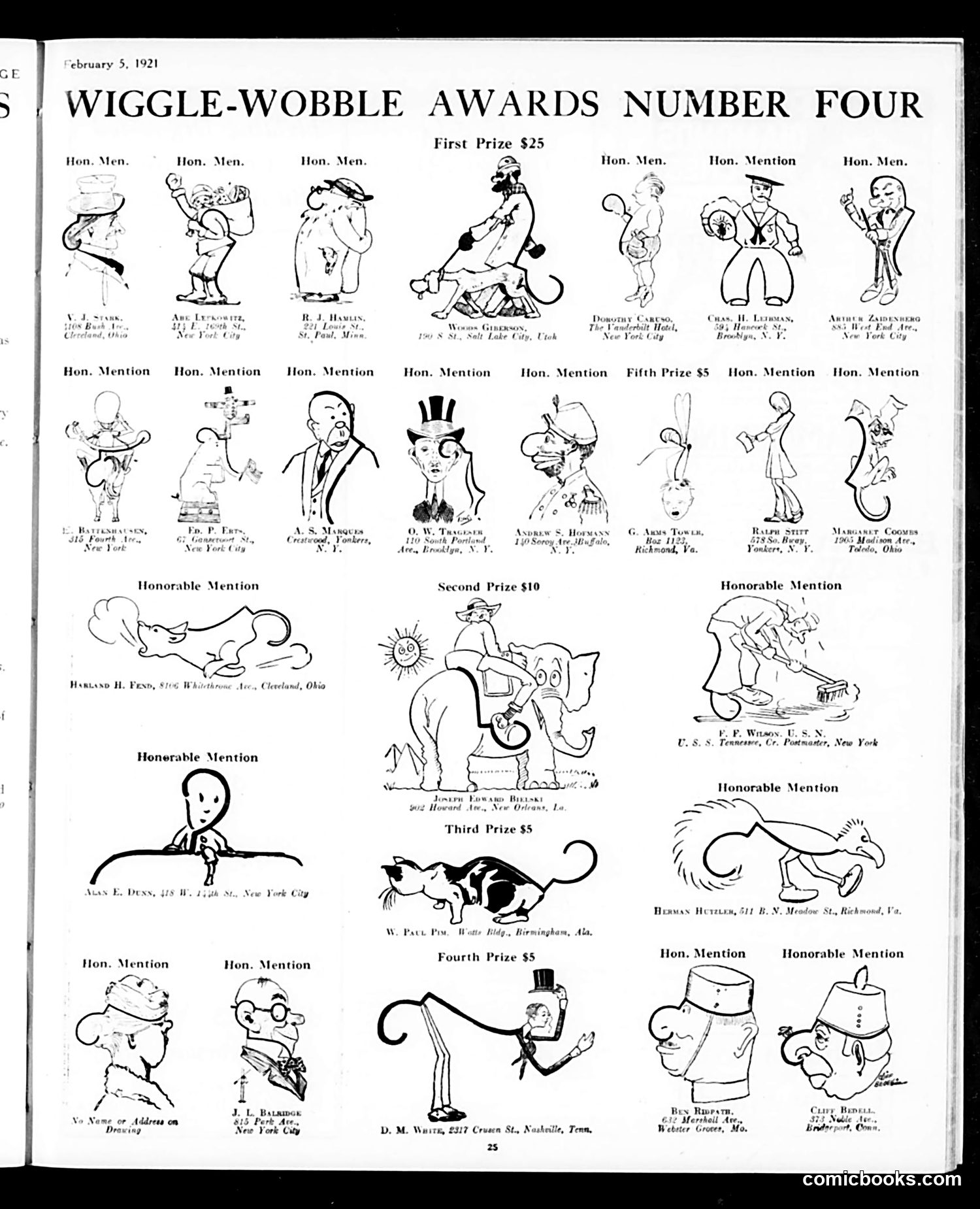
This page showcases a Judge magazine cartooning contest from February 5, 1921. The "Wiggle-Wobble Awards" appears to be a recurring humor competition featuring exaggerated caricatures and satirical drawings submitted by readers nationwide. The page displays prize-winning and honorable-mention cartoons organized by prize tier (First Prize $25 down to Fifth Prize $5). The drawings themselves feature distorted human and animal figures—characteristic of 1920s caricature style—but without visible political content or identifiable public figures, these appear to be general humorous submissions rather than topical satire. The contest format suggests Judge invited amateur cartoonists to contribute works, with winners receiving monetary prizes. This represents the magazine's interactive relationship with its readership during the Jazz Age.
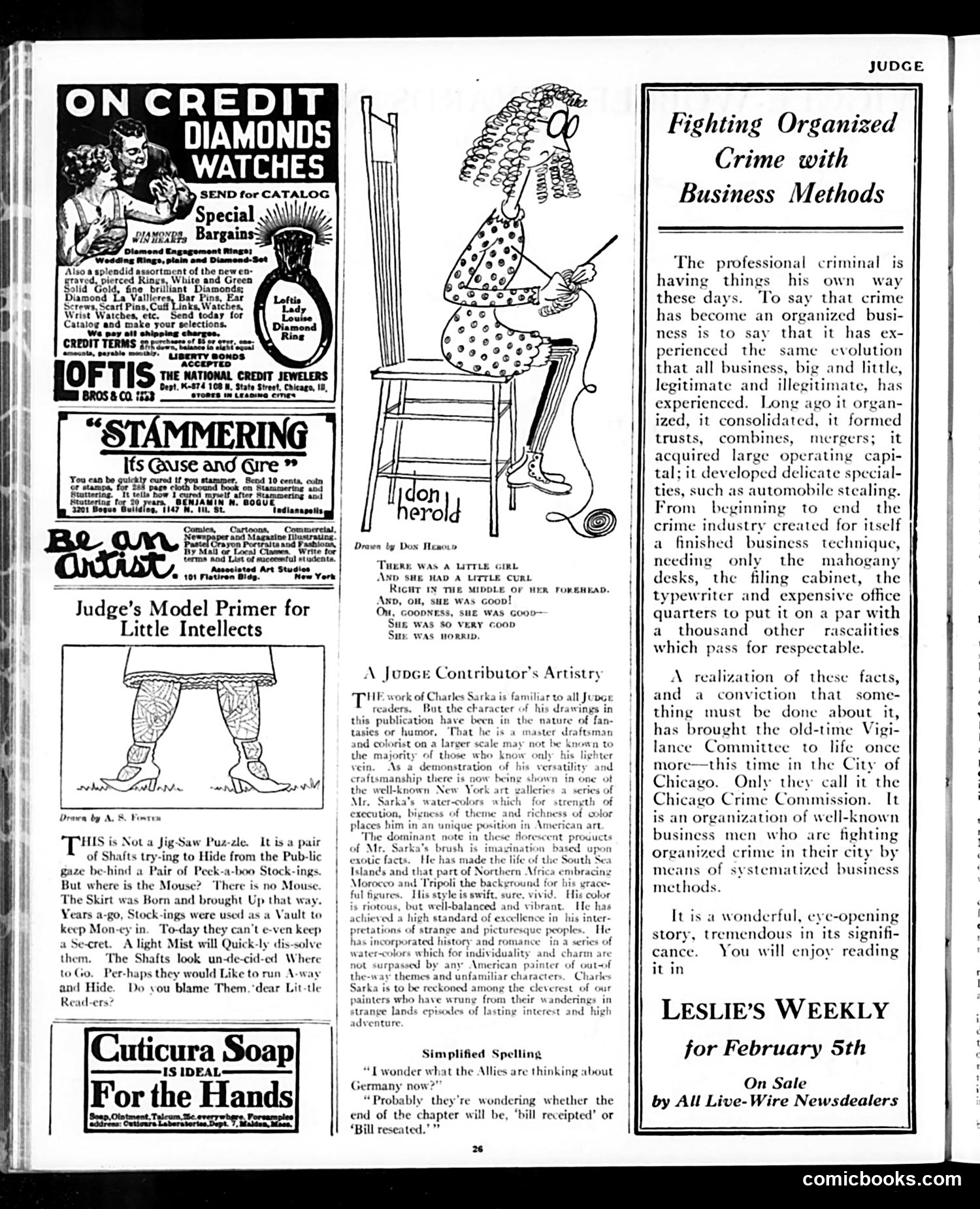
This is primarily an **advertising and editorial page** from Judge magazine, likely from early 1918 (references to WWI Allies vs. Germany dating). The main content of note: **"Fighting Organized Crime with Business Methods"** essay (right column) discusses Chicago's newly formed Crime Commission, which applies corporate management techniques to combat organized crime. The piece treats criminal enterprises as legitimate businesses that have consolidated and professionalized—requiring equally systematic, businesslike responses. **"Simplified Spelling" joke** (bottom) is WWI-era political humor: two people debate whether Germany's fate will be "bill receipted" (paid) or "bill reseated" (reseated in power)—reflecting uncertainty about the war's outcome and peace terms. **Other content** includes lighthearted instructional cartoons ("Judge's Model Primer for Little Intellects") and an appreciation of artist Charles Sarka's work. The remainder consists of typical period advertisements (diamonds, watches, soap). The page reflects Progressive Era concerns about crime organization and contemporary WWI anxieties.
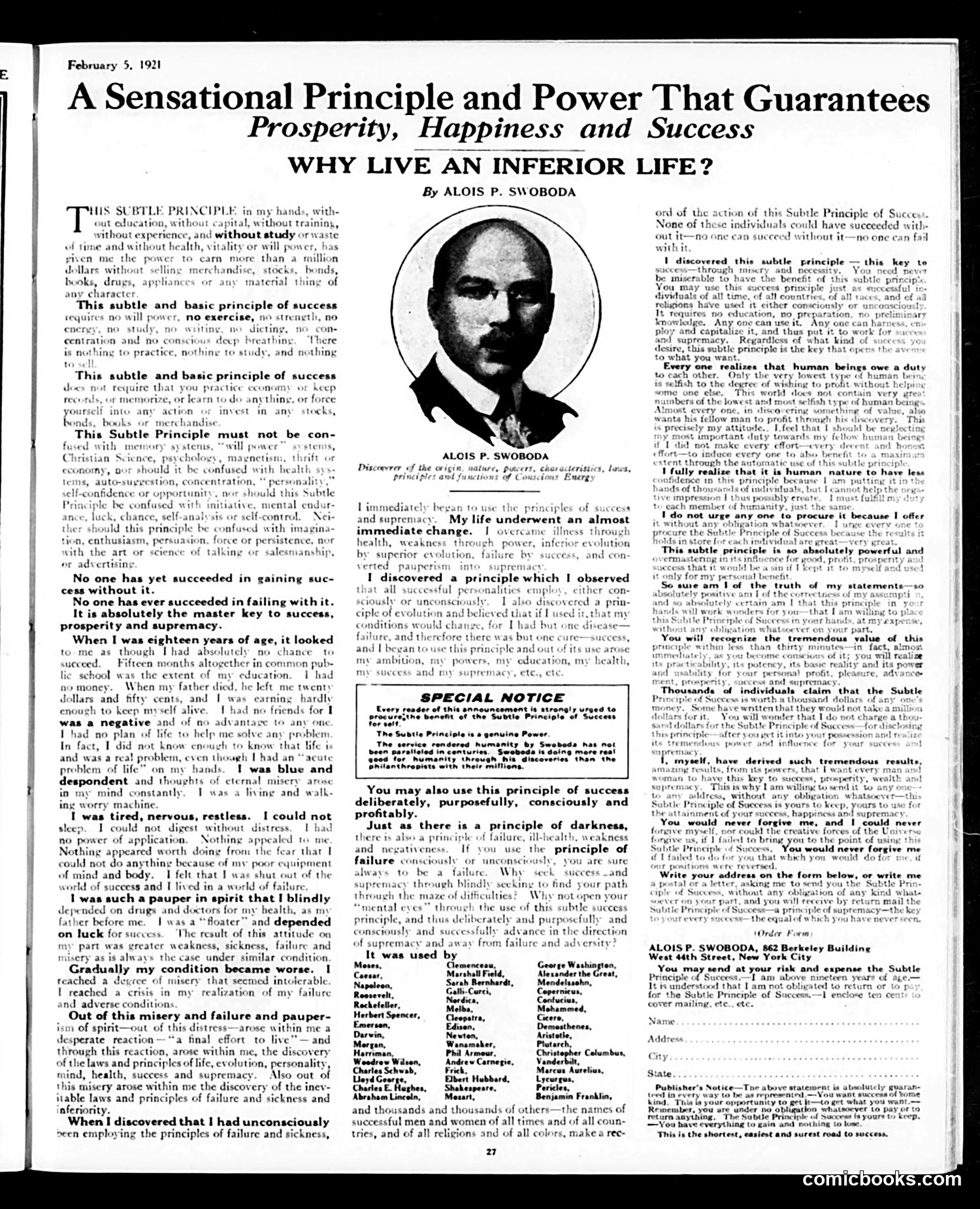
This is not a political cartoon but rather a **self-help advertisement** by Alois P. Swoboda, appearing in Judge magazine on February 5, 1921. Swoboda was promoting his "Subtle Principle of Success"—a motivational system claiming to guarantee prosperity and happiness without traditional education, hard work, or willpower. The ad features his portrait and autobiographical narrative: a poor, sickly teenager who discovered mysterious "laws and principles of life" that transformed him into a millionaire. For modern readers, this exemplifies the **early 20th-century self-improvement industry's pseudoscience**—precursor to modern success gurus. The vague promises ("no study required," "no will power needed") combined with personal testimony represent marketing tactics still used today. The placement in Judge, a satirical magazine, is noteworthy: it's unclear whether Judge editors endorsed this as legitimate opportunity or printed it ironically for paying advertisers.
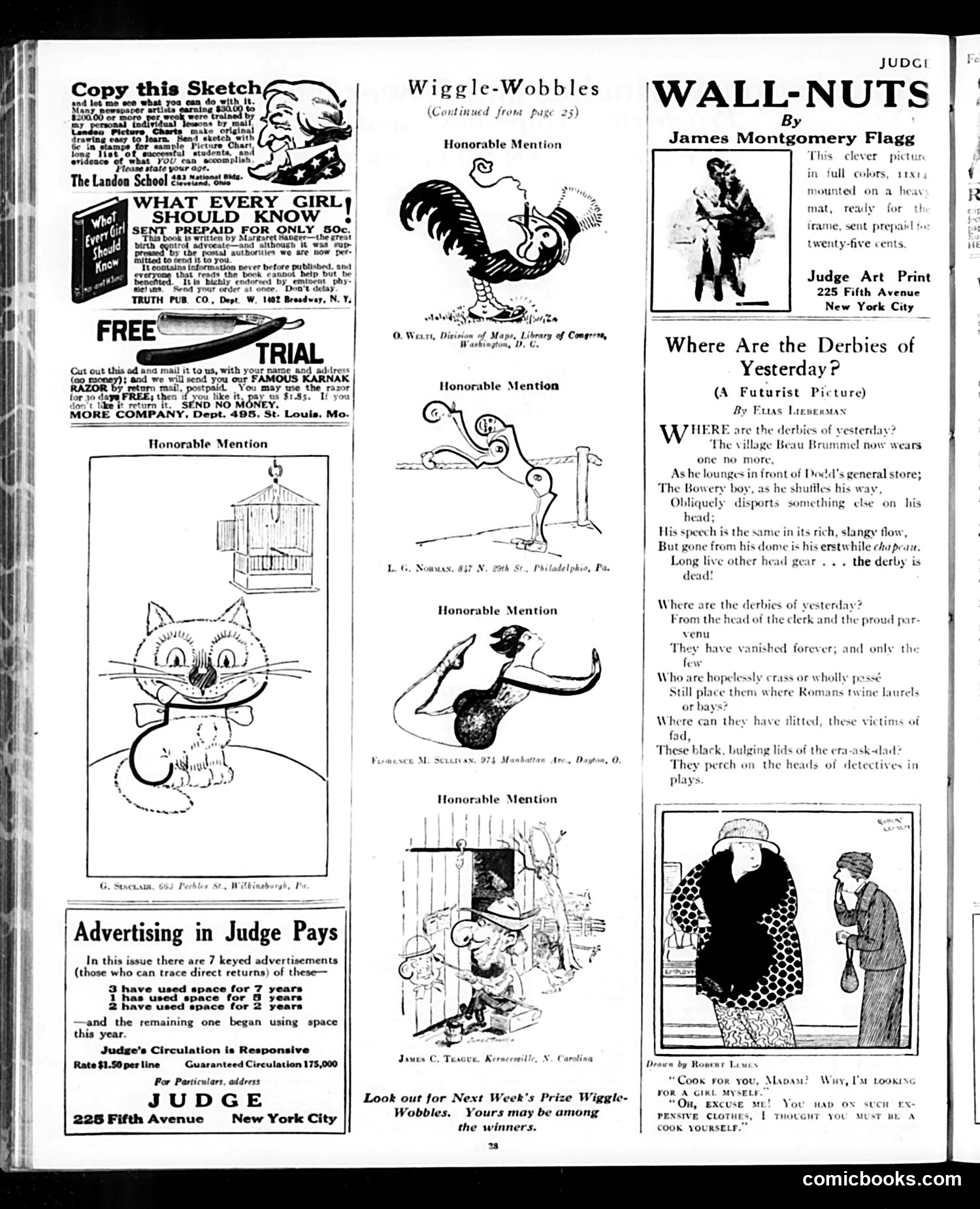
This page features a poem-based cartoon by Elias Liesendahl satirizing the decline of the derby hat as a symbol of respectability and social status. The piece laments that working-class men—the "village Beau Brummel," bowery boys, and clerks—no longer wear derbies, which were once markers of gentility. The cartoon's humor lies in its exaggerated mourning: derbies have "vanished forever" from respectable society and now appear only on "hopelessly crass" people and stage detectives in plays. The accompanying illustration shows a fashionably dressed woman dismissing a poorly-dressed man seeking cooking work, highlighting class anxieties about changing fashion and social mobility during the early 20th century. The "Futurist" subtitle suggests this reflects contemporary anxiety about modernism disrupting traditional social hierarchies.
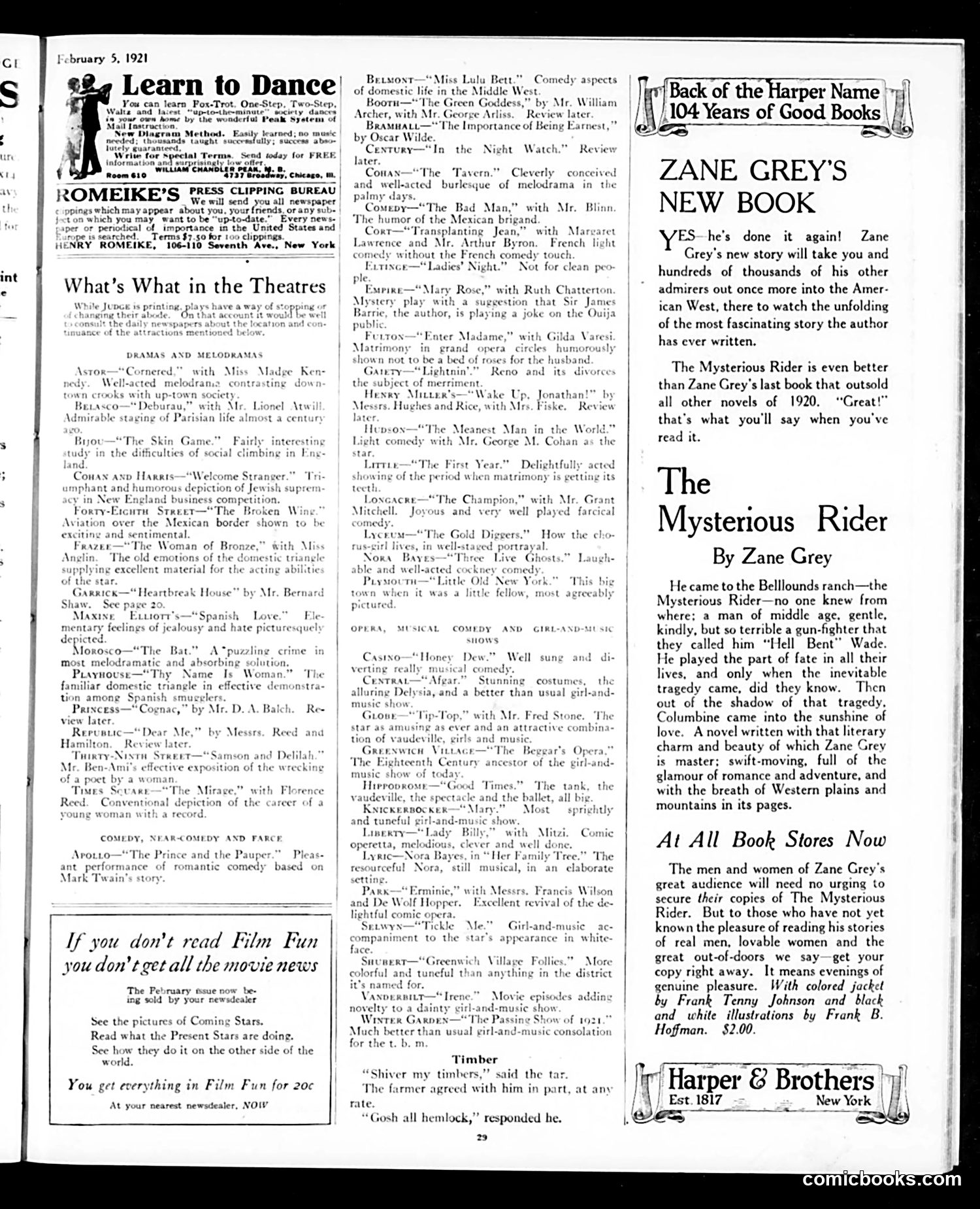
This page is primarily **advertising and entertainment listings**, not political satire. It contains: **Left Column:** A "Learn to Dance" advertisement and a press clipping service ad from Henry Romeike's bureau. **Center:** Extensive theater reviews listing Broadway productions from February 5, 1921—dramas, comedies, operas, and musicals. Notable plays mentioned include Oscar Wilde's "The Importance of Being Earnest" and Cohan's "The Meanest Man in the World." **Right Column:** An advertisement for Zane Grey's new Western novel *The Mysterious Rider*, emphasizing it outsold all other 1920 novels. **Bottom:** A brief "Timber" section—apparently a joke or anecdote about a tar and farmer. **Bottom Left:** An advertisement for *Film Fun* magazine promoting movie news and celebrity coverage. The page reflects 1921 entertainment interests: live theater dominated advertising, Western fiction was hugely popular, and movie culture was emerging as a significant cultural force. There is **no visible political cartoon or satire** on this page.
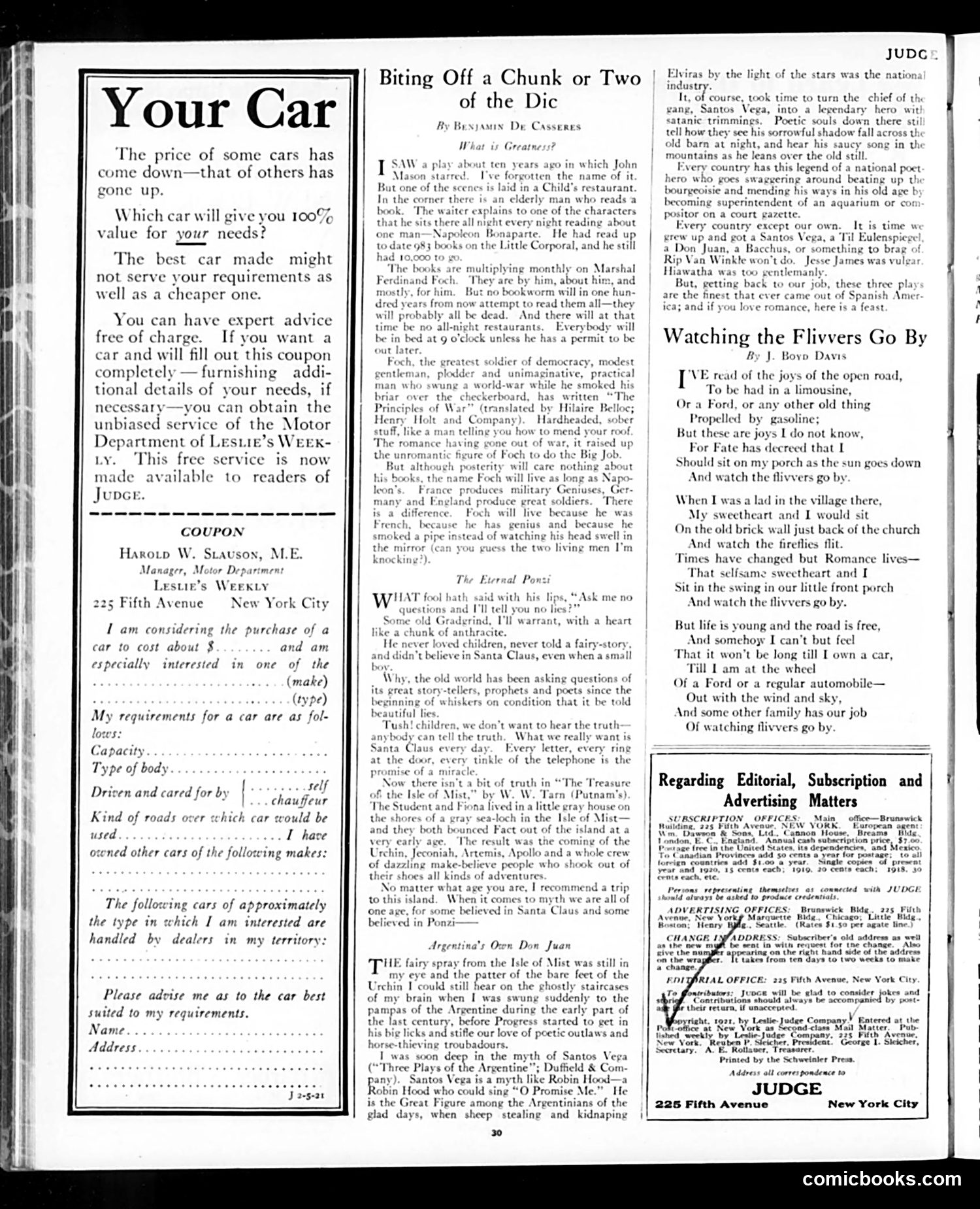
This page combines automotive advertising with literary satire. The left side features a **"Your Car" service coupon** from Leslie's Weekly's Motor Department, offering free expert advice to Judge readers considering a car purchase—reflecting 1920s consumer culture and the emerging auto industry. The right side contains **"Biting Off a Chunk or Two of the Dic"** by Benjamin De Casseres, a satirical essay about greatness and human nature. De Casseres critiques how people prefer comfortable lies to truth, using examples like Napoleon, Marshal Foch (WWI military figure), and children's stories. He argues that society demands beautiful falsehoods—from Santa Claus to Ponzi schemes—over harsh reality. The essay concludes by praising *"The Treasure of the Isle of Mist"* and Argentine folklore, suggesting literature's value lies in its escapism rather than veracity. The satire mocks modern society's appetite for myth-making over authentic truth-telling.
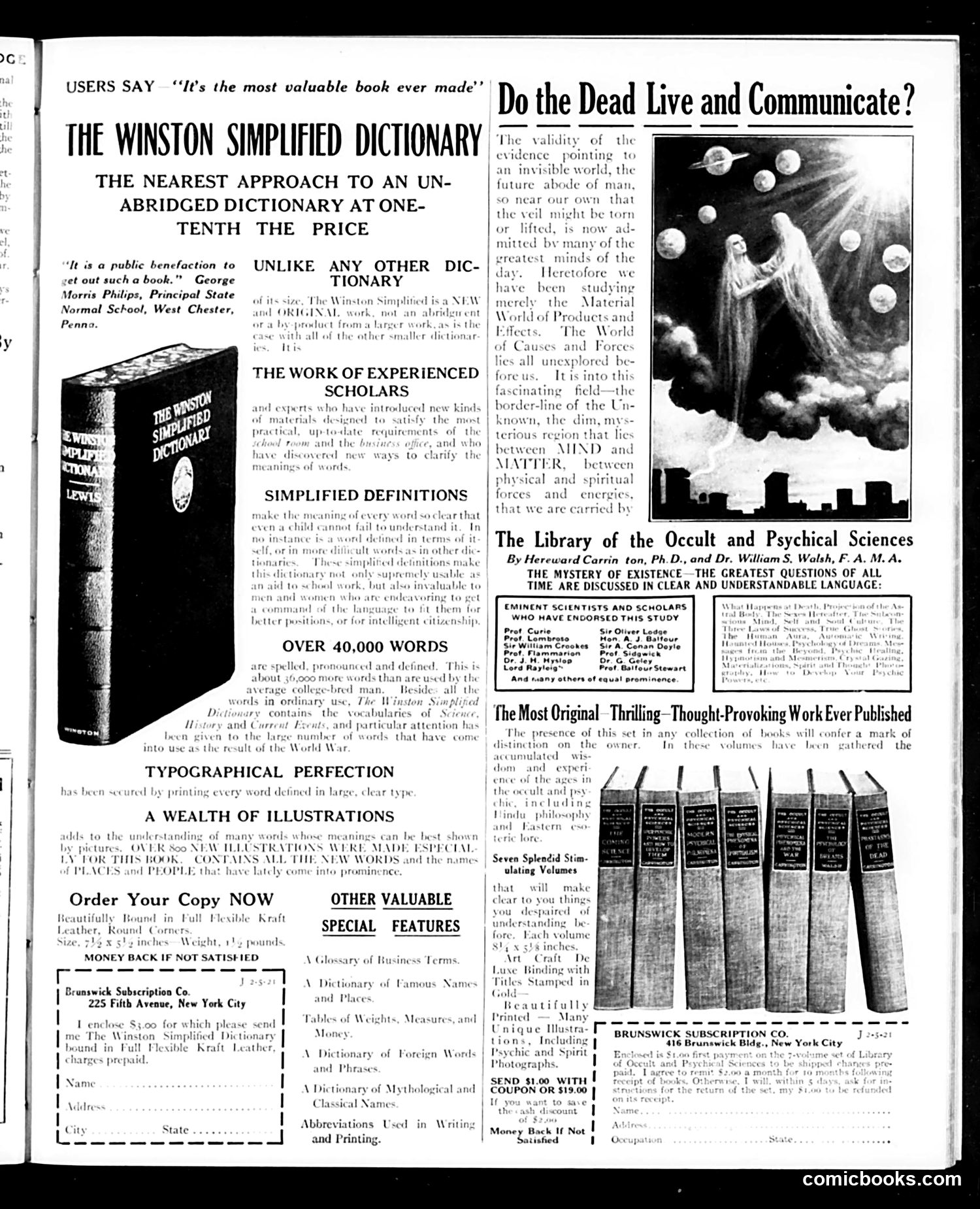
This page is primarily **advertising, not satire or political commentary**. It contains two major book advertisements: 1. **The Winston Simplified Dictionary** (left side) — marketed as an affordable, comprehensive dictionary with 40,000 words, simplified definitions, and 500+ illustrations. Endorsements from educators emphasize its value as a "public benefaction." 2. **The Library of the Occult and Psychical Sciences** (right side) — a seven-volume set by Hereward Carrington and William S. Walsh exploring spiritualism and the afterlife. The image shows a ghostly figure with spheres (likely representing spirits or supernatural phenomena). The top headline "Do the Dead Live and Communicate?" reflects early 20th-century fascination with spiritualism and séances—then considered a serious intellectual pursuit endorsed by "eminent scientists and scholars." The page reflects the era's dual interests: practical education (the dictionary) and pseudoscientific mysticism (the occult library). Both emphasize accessibility and expert credibility to persuade readers to purchase.

This is a **full-page advertisement**, not political satire. It promotes Murad cigarettes, priced at 20 cents, emphasizing they use "the world's most famous varieties of Turkish tobacco." The image shows tobacco leaves held in hands against a dark background, visually demonstrating the product's ingredient quality. The tagline "Judge for Yourself—!" encourages consumers to try the product and form their own opinion. This appears in *Judge* magazine, which while satirical, regularly carried advertisements. The ad uses straightforward product claims typical of early 20th-century cigarette marketing, before tobacco health risks were widely acknowledged. There is no political commentary or caricature present on this page.