
Judge, 1921-02-05 · page 14 of 32
Judge — February 5, 1921 — page 14: what you’re looking at
What you’re looking at
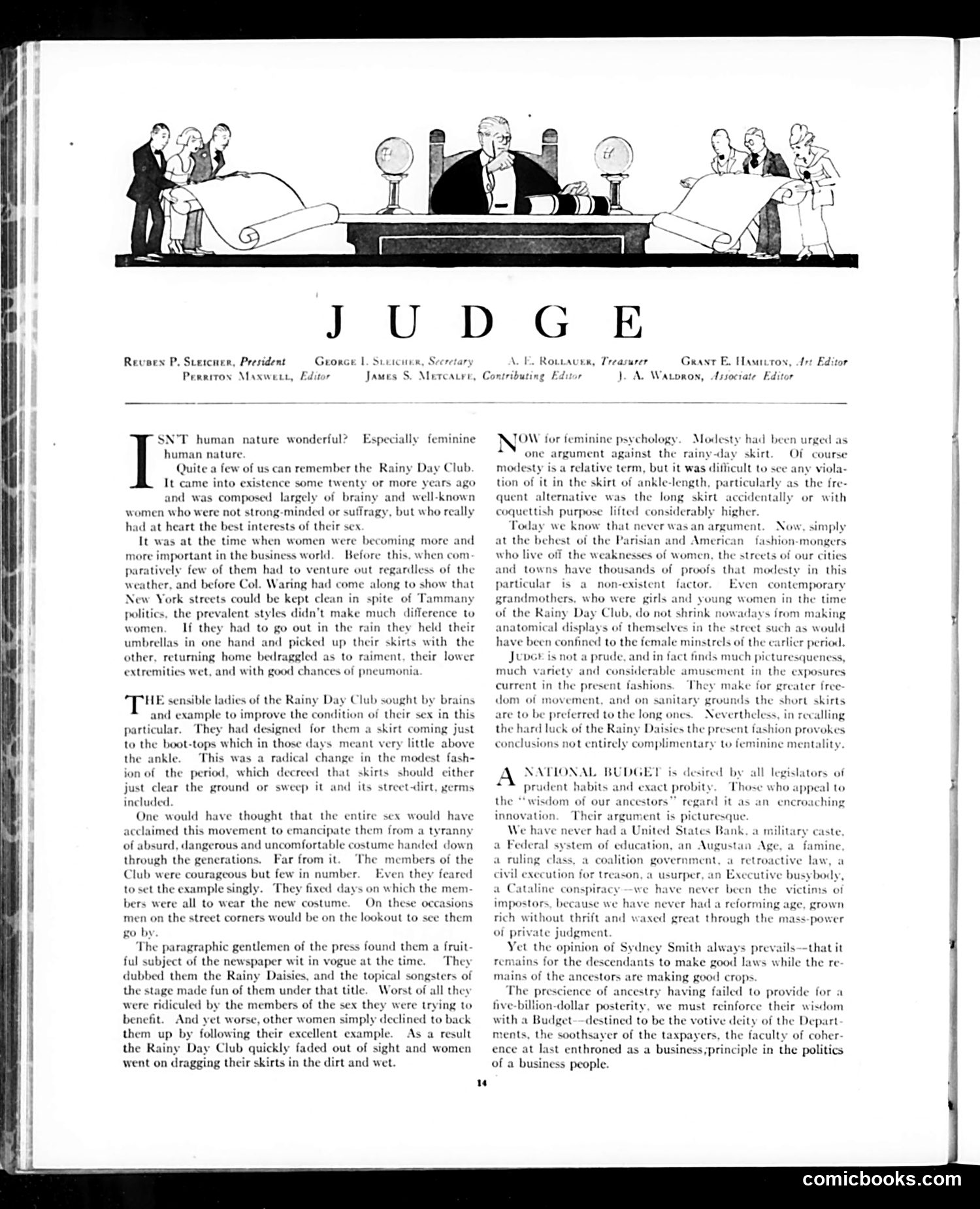
This page from Judge magazine satirizes the "Rainy Day Club," a women's reform movement from approximately 20 years prior (likely 1890s). The club consisted of intelligent, respectable women—notably *not* suffragettes—who advocated for practical dress reform: shorter skirts reaching the boot-tops rather than dragging in street dirt and germs. The satire targets the **hypocrisy of feminine modesty claims**. The article notes that shorter skirts were denounced as immodest, yet women had long lifted skirts higher through coquetry. Judge mocks how the movement failed because women themselves ridiculed it and refused to participate—despite it serving their health interests. The accompanying illustration (judge at bench) likely reinforces this judgment on female inconsistency. The piece uses the failed Rainy Day Club as a historical example to comment on modern (1910s) fashion trends, where women now openly display themselves far more than the modest reformers ever proposed. The satire highlights contradiction: women rejected practical reform citing modesty, only to later embrace far more revealing fashion dictated by commercial fashion industries.
📄 Transcribed text from this page (OCR, searchable)
Machine-transcribed from the original scan — historical spelling and the odd misread are preserved.
Georce 1. Sicicunn, Scere James S. Mercacre, Revoes P. Stetcner, President Perrrros Maxwett, Editor SN’T human nature wonderful? Especially feminine human nature. Quite a few of us can remember the Rainy Day Club. It came into existence some twenty or more years ago and was composed largely of brainy and well-known women who were not strong-minded or suffragy, but who really had at heart the best interests of their sex It was at the time when women were becoming more and more important in the business world. Before this, when com paratively few of them had to venture weather, and before Col. Waring had come along to show that New York streets could be kept clean in spite of Tammany politics, the prevalent styles didn’t make much difference to women. If they had to go out in the rain they held their umbrellas in one hand and picked up their skirts with the other, returning home bedraggled as to raiment, their lower extremities wet, and with good chances of pneumonia. yut regardless of the HE sensible ladies of the Rainy Day Club sought by brains and example to improve the condition of their sex in this particular. They had designed for them a skirt coming just to the boot-tops which in those days meant very little abe the ankle. This was a radical change in the modest fash- ion of the period, which decreed that skirts should either just clear the ground or sweep it and its street-dirt, germs included. One would have thought that the entire sex would have acclaimed this movement to emancipate them from a tyranny of absurd, dangerous and uncomfortable costume handed down through the generations. Far from it. The members of the Club were courageous but few in number. Even they feared to set the example singly. They fixed days on which the mem bers were all to wear the new costume. On these occasions men on the street corners would be on the lookout to see them go by The paragraphic gentlemen of the press found them a fruit ful subject of the newspaper wit in vogue at the time. They dubbed them the Rainy Daisies, and the topical songsters of the stage made fun of them under that title. Worst of all they were ridiculed by the members of the sex they were trying to benefit. And yet worse, other women simply declined to back them up by following their excellent example. As a result the Rainy Day Club quickly faded out of sight and women went on dragging their skirts in the dirt and wet. re Editor Grant E. Hastturos, ontributing Editor J. AL Watprox, Associate Editor \. FE. Rottavuen, Treasurer TOW for feminine psycho! Modesty had been urged as one argument against the rainy-day skirt. Of cours modesty is a relative term, but it was difficult to see any viol. tion of it in the skirt of ankle-length, particularly as the fre quent alternative was the long skirt accidentally or with coquettish purpose lifted considerably higher. Today we know that never wasan argument. Now, simply at the behest of the Parisian and American fashion-mongers who live off the weaknesses of women, the streets and towns have thousands of our cit proofs that modesty in. this particular is a non-existent factor. Even contemporary andmothers, who were girls and young women in the time of the Rainy Day Club, do not shrink nowadays from making anatomical displays of themselves in the street such as would have been confined to the female minstrels of the earlier period. Jvper is not a prude, and in fact finds much picturesqueness, much variety and considerable amusement in the exposures current in the present fashions. They make for greater {ree- dom of movement, and on sanitary grounds the short skirts are to be preferred to the long ones. Nevertheless, in recalling the hard luck of the Rainy Daisies the present fashion provokes conclusions not entirely complimentary to feminine mentality. NATIONAL BUDGET is desired by all le prudent habits and exact probity. Those who appeal to the “wisdom of our ancestors” regard it as an encroaching innovation. Their argument is picturesque. We have never had a United States Bank, a military caste a Fed aru slators of 1 system of education, an Augustan Age, a famine ng class, a coalition government, a retroactive law, a civil execution for treason, a usurper, an E Sxecutive busybe a Cataline conspiracy -we have never been the victims of impostors, because we have never had a reforming age, g1 rich without thrift and waxed great through the mass-power of private judgment Yet the opinion of Sydney Smith always prevails—that it remains for the descendants to make good laws while the re mains of the ancestors are making good crops The prescience of ancestry having failed to provide for five-billion-dollar posterity, we must reinforce their wisd with a Budget-—destined to be the votive deity of the Depart ments, the soothsayer of the taxpayers, the faculty of coher- ence at last enthroned as a business;principle in the politics of a business people. wn a os comicbooks.com