
Judge, 1921-02-05 · page 22 of 32
Judge — February 5, 1921 — page 22: what you’re looking at
What you’re looking at
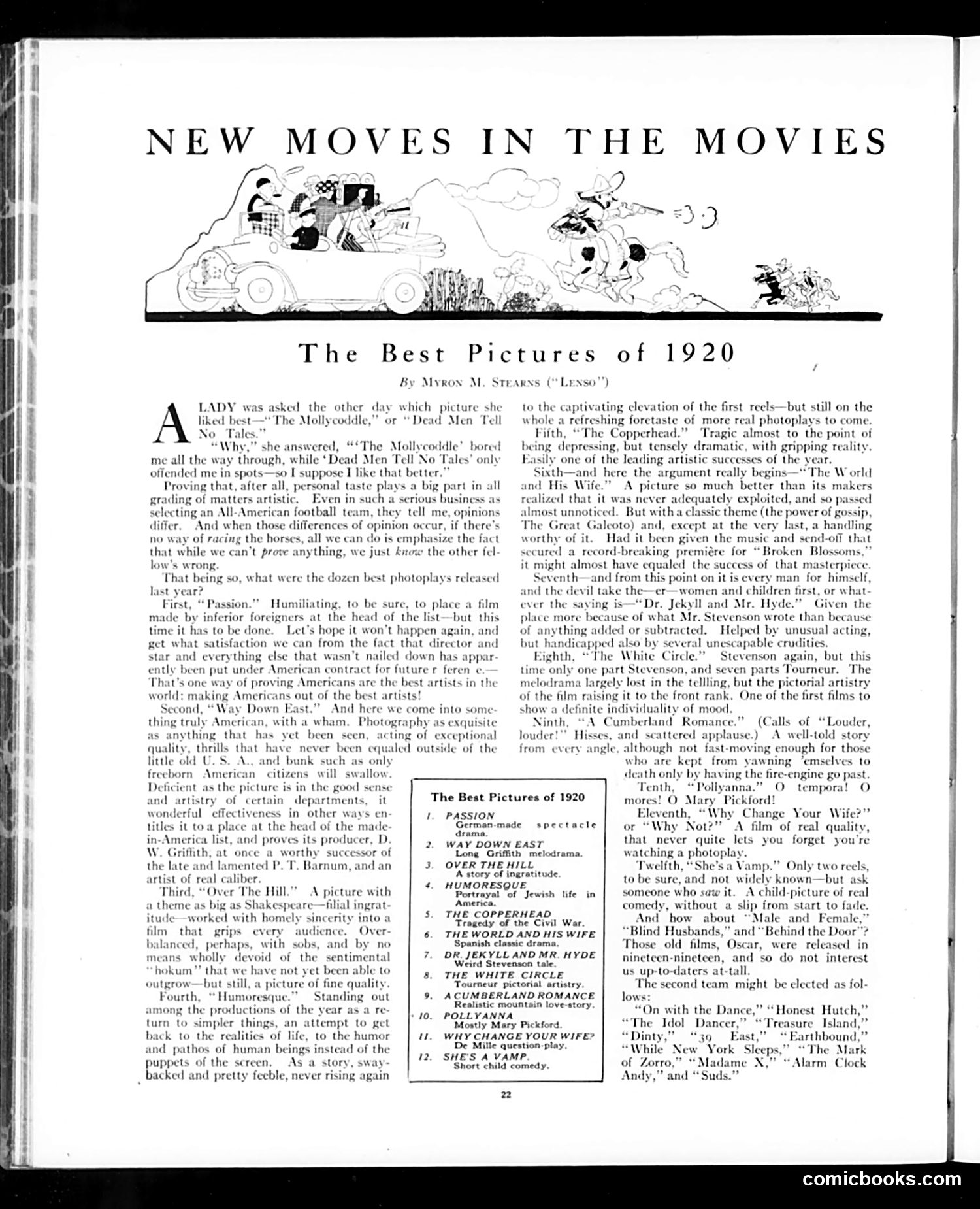
This is a film criticism article by Myron M. Stearns ("Lenso") evaluating 1920's best movies. Rather than a political cartoon, it's an entertainment column with an illustrative header showing cars and characters in comedic motion. The article ranks twelve films, opening with self-aware humor about subjective taste—a lady prefers "Dead Men Tell No Tales" because it merely "offended" her rather than bored her. Stearns praises D.W. Griffith's "Way Down East" (calling him a successor to P.T. Barnum), celebrates "Over the Hill" for its Shakespearean theme of filial ingratitude, and notes "Humoresque" returns cinema to realistic human stories rather than "puppets." Key context: The list includes foreign films ("Passion," German-made) but emphasizes American productions, reflecting post-WWI American cultural assertiveness. Mary Pickford appears prominently ("Pollyanna"). The tone is earnest film criticism for Judge's educated readership, not satire.
📄 Transcribed text from this page (OCR, searchable)
Machine-transcribed from the original scan — historical spelling and the odd misread are preserved.
NEW MOVES IN THE MOVIES \¢ : , The Best By Myron M LADY was asked the other day which picture she liked best The Mollycoddle,”” or “Dead Men Tell No Tales.” “Why,” she answered, “‘The Mollycoddle’ bored me all the way through, while ‘Dead Men Tell No Tales’ only offended me in spots—so I suppose I like that better. Proving that, after all, personal taste plays a big part in all grading of matters artistic. Even in such a serious business as selecting an All-American football team, they tell me, opinions differ. And when those differences of opinion occur, if there's no way of racing the horses, all we can do is emphasize the fact that while we can’t prove anything, we just & the other fel low’s wrong. That being last year? First, “Passion.” Humiliating, to be sure, made by inferior foreigners at the head of the list—but this time it has to be done. Let’s hope it won't happen again, and get what satisfaction we can from the fact that director and star and everything else that wasn’t nailed down has appar ently been put under American contract for future r feren ¢ That’s one way of proving Americans are the best artists in the world: making Americans out of the best artists! Second, “Way Down East.” And here we come into some thing truly American, with a wham. Photography as exquisite as anything that has yet been seen, acting of exceptional quality, thrills that have never been equaled outside of the little old U.S. A., and bunk such as only freeborn American citizens will swallow Deficient as the picture is in the good sense and artistry of certain departments, it wonderful effectiveness in other ways en titles it toa place at the head of the made in-America list, and proves its producer, D. W. Griffith, at once a worthy successor ¢ the late and lamented P. T. Barnum, and an artist of real caliber. Third, “Over The Hill.” A picture with a theme as big as Shakespeare—filial ingrat itude—worked with homely’ sincerity into a film that grips every audience. Over balanced, perhaps, with sobs, and by no ns wholly devoid of the sentimental hokum” that we have not yet been able to out but still, a picture of fine quality Fourth, “Humoresque.” Standing out g the productions of the year as a re turn to simpler things, an attempt to get back to the realities of life, to the humor and pathos of human beings instead of the puppets of the screen. As a story, sway- _ backed and pretty feeble, never rising again so, what were the dozen best photoplays released to place a film PASSION drama. Port America. me oy am +10. POLLYANNA uw 12. 2 STEARNS ( The Best Pictures of 1920 German-made WAY DOWN EAST Long Griffith melodrama. OVER THE HILL A story of ingratitude HUMORESQUE ‘of Jewish THE COPPERHEAD Tragedy of the Civil War THE WORLD AND HIS WIFE Spanish classic drama. DR. JEKYLL AND MR. HYDE Weird Stevenson tale THE WHITE CIRCLE Tourneur pictorial artistry A CUMBERLAND ROMANCE Realistic mountain love-story. Mostly Mary Pickford WHY CHANGE YOUR WIFE? De Mille question-play. SHES A VAMP. Short child comedy. Pictures Lexso” to the captivating clevation of the first reels—but still on the whole a refreshing foretaste of more real photoplays to come. Fifth, “The Copperhead.” Tragic almost to the point of being depressing, but tensely dramatic, with gripping reality. Easily one of the leading artistic successes of the year. Sixth—and here the argument really begins—* The W orld and His Wife.’” A picture so much better than its makers realized that it was never adequately exploited, and so passed almost unnoticed. But with a classic theme (the power of gossip, The Great Galcoto) and, except at the very last, a handling worthy of it. Had it been given the music and send-off tha secured a record-breaking premiére for “Broken Blossom: it might almost have equaled the success of that masterpiece Seventh—and from this point on it is every man for himself, and the devil take the—er—women and children first, or what ever the saying is—“Dr. Jekyll and Mr. Hyde.” Given the place more because of what Mr. Stevenson wrote than because { anything added or subtracted. Helped by unusual acting, but handicapped also by several unescapable crudities. Eighth, “The White Circle.” Stevenson again, but this time only one part Stevenson, and seven parts Tourneur. The melodrama largely lost in the tellling, but the pictorial artistry of the film raising it to the front rank. One of the first films to show a definite individuality of mood. Ninth, “A Cumberland Romance. (Calls of “Louder, louder!” His: ind scattered applause.) A well-told story from every angle, although not fast-moving enough for those who are kept from yawning ’emselves to death only by having the fire-engine go past. Tenth, “Pollyanna O temporal! O mores! O Mary Pickford! Eleventh, “Why Change Your Wife?’ or “Why Not?” A film of real quality, that never quite lets you forget you're watching a photoplay. Twelfth, “She's a Vamp.” Only two reels, to be sure, and not widely known—but ask someone who saw it. A child-picture of real comedy, without a slip from start to fade. And how about “Male and Female,” “Blind Husbands,” and “Behind the Door"? Those old films, Oscar, were released in ninetcen-nineteen, and so do not interest us up-to-daters at-tall The second team might be elected as fol- lows: “On with the Dance,” “The Idol Dancer,” “Dinty,” 39. East,” “While New York Sleeps,” of Zorro,” Madame X,” “ Andy,” and “Suds. spectacle life in Honest Hutch,” Island,” carthbound,”” ‘The Mark Marm Clock comicbooks.com