
Judge, 1921-02-05 · page 6 of 32
Judge — February 5, 1921 — page 6: what you’re looking at
What you’re looking at
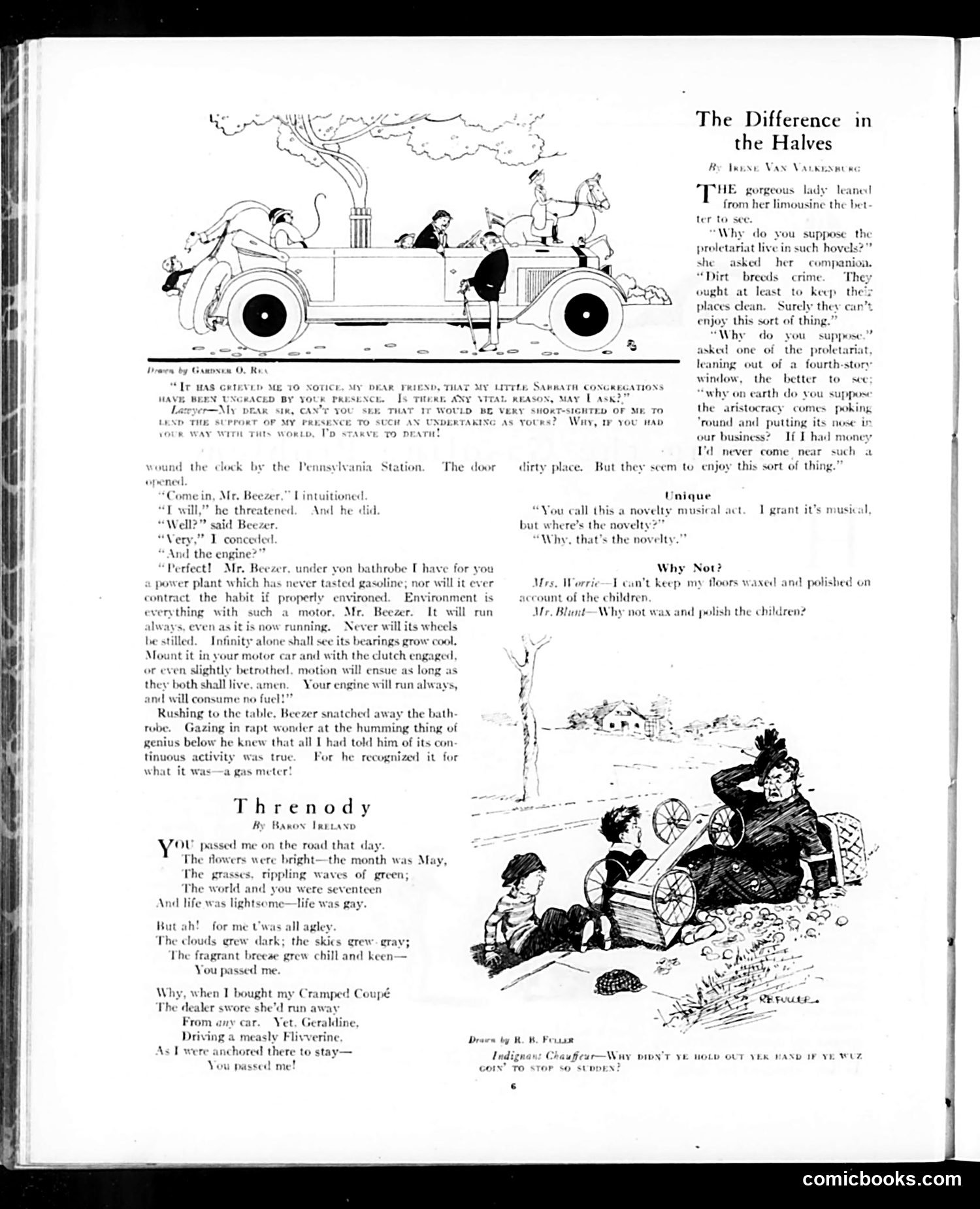
This page contains three separate pieces of humor: 1. **"The Difference in the Halves"** (top): A cartoon showing a wealthy woman in a limousine questioning why working-class people would want to live in tenements. The satire critiques class obliviousness—the rich woman's incomprehension that poverty lacks basic amenities (cleanliness, space) reveals her disconnect from working-class realities. 2. **"Threnody"** (bottom left): A nostalgic poem about May and youth, followed by the speaker's complaint about owning a cramped car that women avoid. The satire mocks automobiles as unreliable and unattractive. 3. **"Why Not?"** (bottom right): A cartoon of a chauffeur and children with a bicycle accident. The humor appears to satirize class assumptions about who should operate vehicles or maintain property. The page reflects early 20th-century American anxieties about class, automobiles, and social mobility.
📄 Transcribed text from this page (OCR, searchable)
Machine-transcribed from the original scan — historical spelling and the odd misread are preserved.
The Difference in the Halves Ry Tense Van Varxnanene THe gorgeous lady leaned from her limousine the bet ter to see. Why do you suppose the proletariat live in such hovels?” she asked her companion. “Dirt breeds crime They ought at least to keep the places dean. Surely they ca enjoy this sort of thin, “Why do you suppose.” | | } ] ] asked one of the proletariat leaning out of a fourth-story Dirwen by Gannsen O. Res window, the better to sce “Lr HAS GRIEVED ME 10 NOTICE, MY DEAR FRIEND, THAT MY LTrtie Sammatn CONGR NAVE BEEN UNCRACED BY YOUR PRESENCE. I$ THERE ANY VITAL REASON, MAY L ASk: D r—My DEAK sik, CAN'T YOU SEE Ir WotLD BE VERY soxt-stenrry oF se to the aristocracy comes TONS “why on earth do vou suppose i LUND THE SUPPORT OF MY PRESENCE TO SUCH AN UNDERTAKING AS Yours? Way, IF you HAD ‘round and putting its nose in { ve worto, T'p stave to pear! our business? If I had money 4 Vd never come, near such ind the clock by the Pennsylvania Station. The door — dirty place. But they scem to. enjoy this sort of thir “Come in, Mr. Beezer.” I intuitioned Unique “Twill,” he threatened. And he did “You call this a novelty musical act. T grant it's musical “Well?” said Beezer. but where’s the novelty?” “Very,” 1 conceded “Why, that’s the novelty.” “And the engin { Perfect! Mr. Beezer, under yon bathrobe have for you Why Not? | power plant which has never tasted gasoline; nor will it ever Mrs. Worrie—T can't keep my floors waxed and polished on ] | contract the habit if properly environed vironment is account of the children | | everything with such a motor. Mr. Beezer. It will run Mr. Blinnt—Why not wax and polish the children? ¥ always, even as it is n ning. Never will its wheels i he stilled. Infinity alone shall see its bearings grow cool. | Mount it in your motor car and with the clutch engaged, ¢ or even slightly betrothed. motion will ensue as long as | they both shall live Your engine will run alway and will consume no fuel!” | Rushing to the table, Beezer snatched away the bath robe. Gazing in rapt wonder at the humming thing of i genius below he knew that all I had told him of its con | f tinuous activity was true or he recognized it for j 4 Threnody By Banos Inetaxn ZOU passed me on the road that day. The flowers were bright—the month was May, The grasses, rippling waves of green; The world and And life was lightsome—life was 2 ‘ou were seventeen But ah! for me Uwas all agley The clouds grew dark; the skics grew. gray; The fragrant breeae grew chill and keen— You passed me. », when T bought my Cramped Coupé dealer swore she'd run away From any car. Yet. Geraldine, Driving a measly Flivverine Droce by ROB. Pou PSO SUDDEN? assed! me cow” comicbooks.com