
A complete issue · 32 pages · 1921
Judge — January 15, 1921
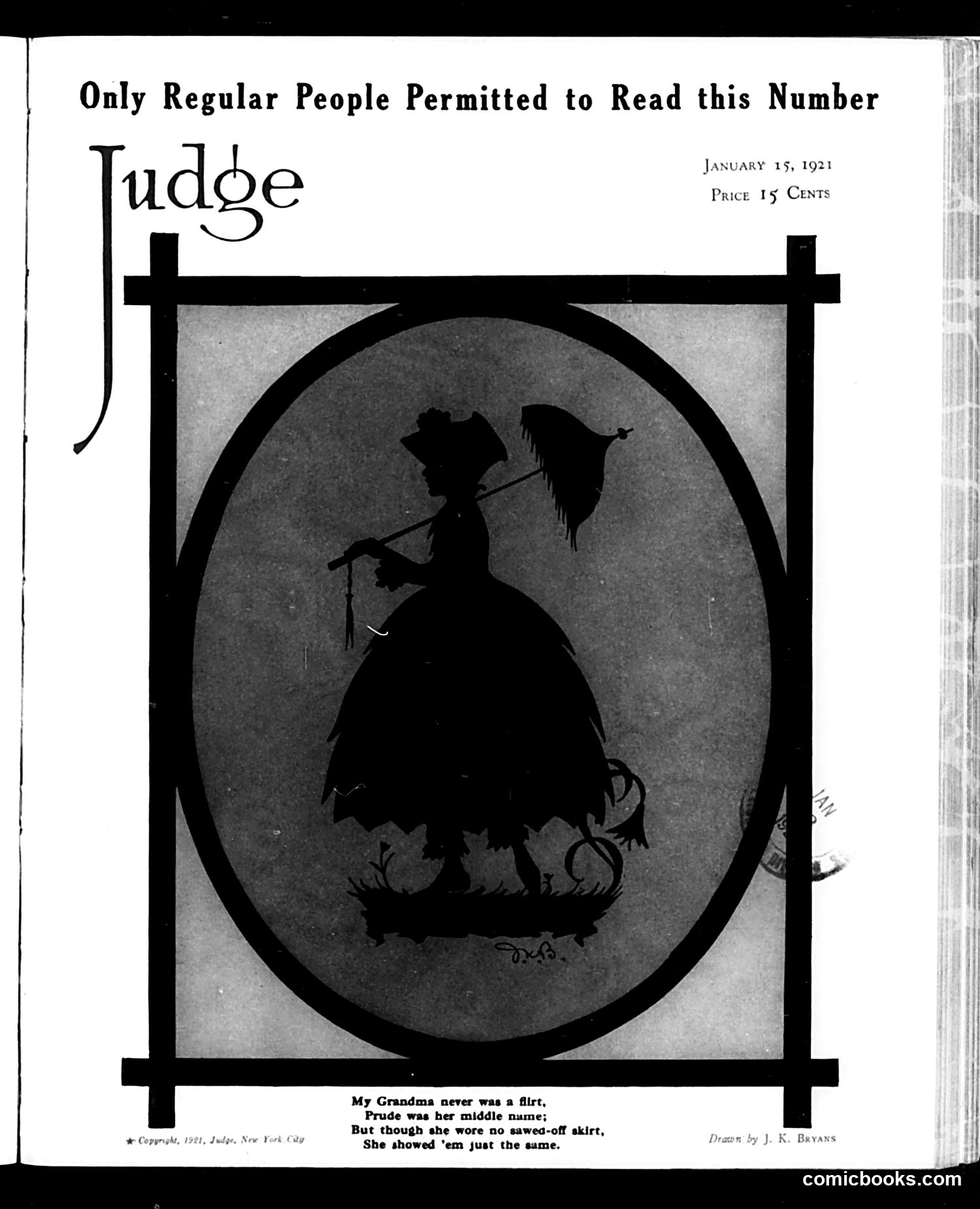
This silhouette illustration by J.K. Beyans depicts a woman in a tattered, ragged skirt with a bird perched on her hat. The accompanying verse references "Grandma" who "never was a flirt" and wore no "saved-off skirt," yet "showed 'em just the same." The satire appears to comment on **changing women's fashion and morality** in the early 1920s. The contrast between the grandmother's modest dress and the contemporary woman's scandalously short, torn skirt suggests anxiety about rapidly evolving female dress codes and social behavior during the post-WWI era. The verse implies hypocrisy: older generations judged women by clothing while modern women ignored such standards. This reflects widespread cultural debates about flapper fashion and women's liberation during this period.
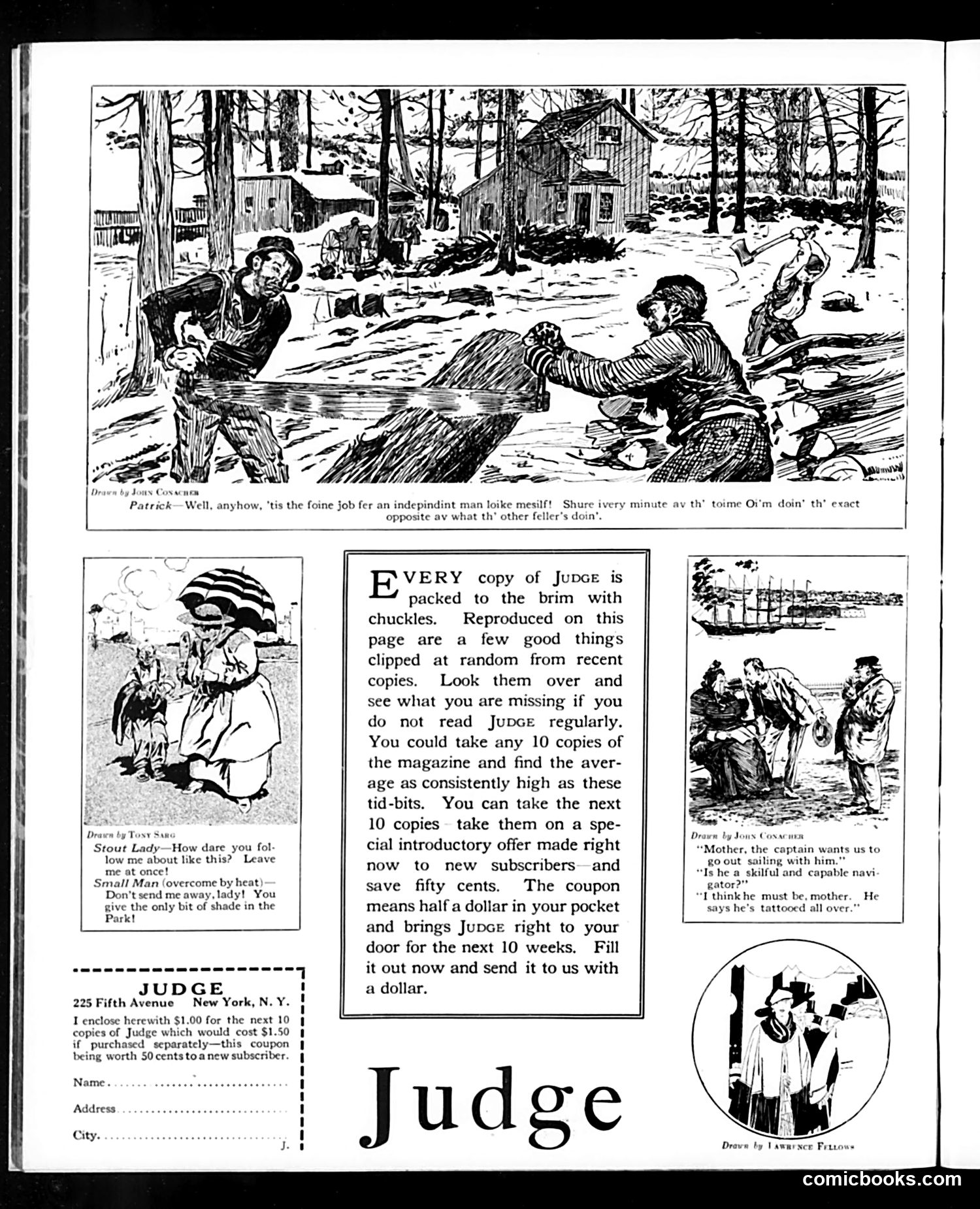
This page is primarily **advertising for Judge magazine itself** rather than political satire. The top cartoon depicts working men (appears to be laborers or farmers) engaged in casual conversation, with dialogue about independence and doing one's own work—likely reflecting early 20th-century American themes of self-reliance. The remaining illustrations are promotional "tid-bits" showcasing humorous content from recent issues. They feature comedic domestic and social scenarios: a woman confronting someone about flirtation, a nautical exchange about sailing, and what appears to be a portrait. The central text encourages readers to subscribe or purchase multiple copies at a discounted rate (10 copies for $1, normally worth more). This is a straightforward promotional strategy, not political commentary.
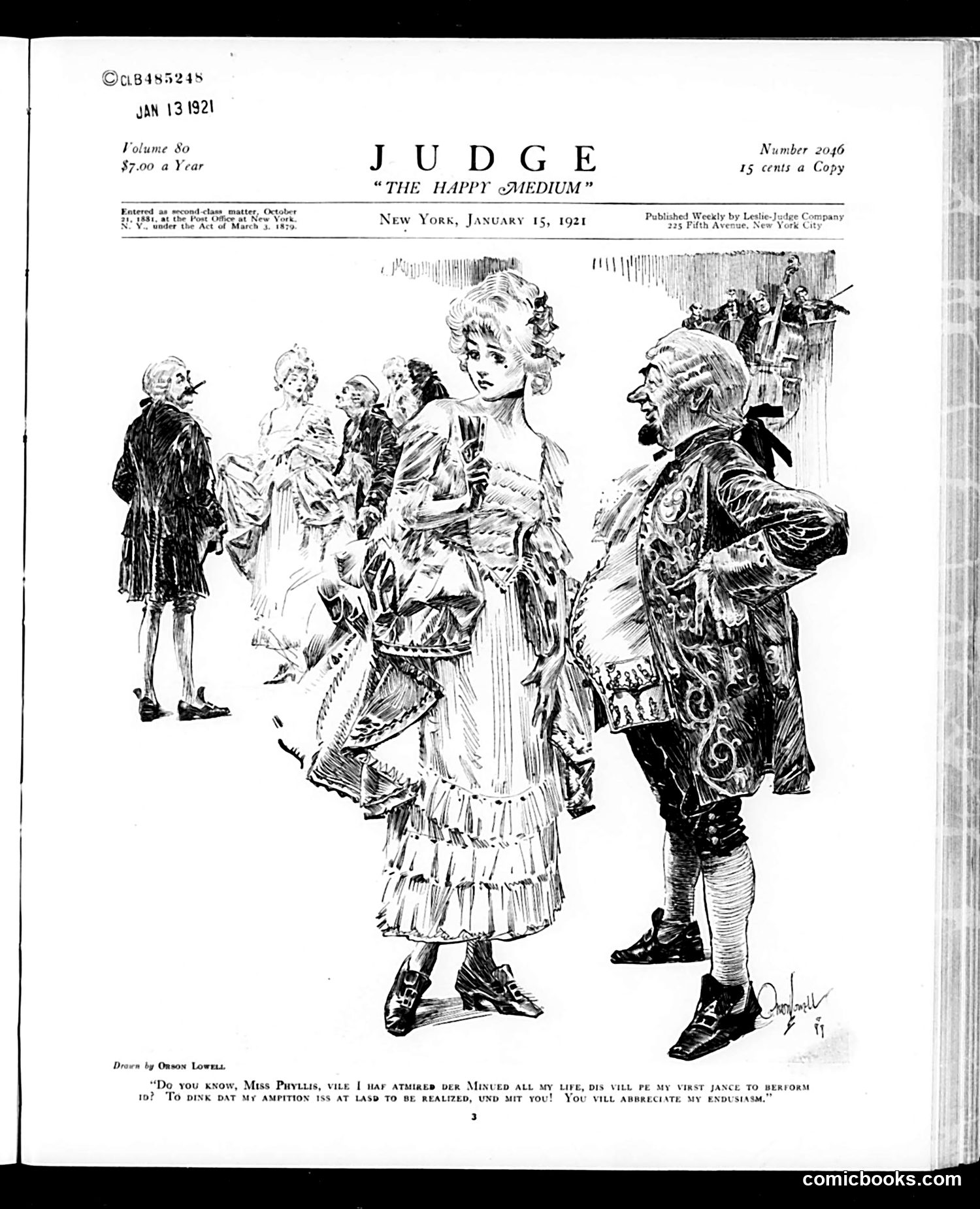
This satirical illustration by Orson Lowell depicts a formal social scene with aristocratic figures in 18th-century costume. The central female figure (Miss Phyllis) addresses a man in elaborate period dress, saying she has "hitherto mixed all my life" and desires her "first jance to perform" her "ambition," asking him to appreciate her "enthusiasm." The satire appears to mock either social pretension or the emerging women's rights movement of the early 1920s—the woman's earnest plea for recognition and opportunity amid formal social constraints. The period costumes suggest ironic commentary on old-fashioned aristocratic values clashing with modern aspirations. The specific social context remains somewhat unclear without additional documentation.
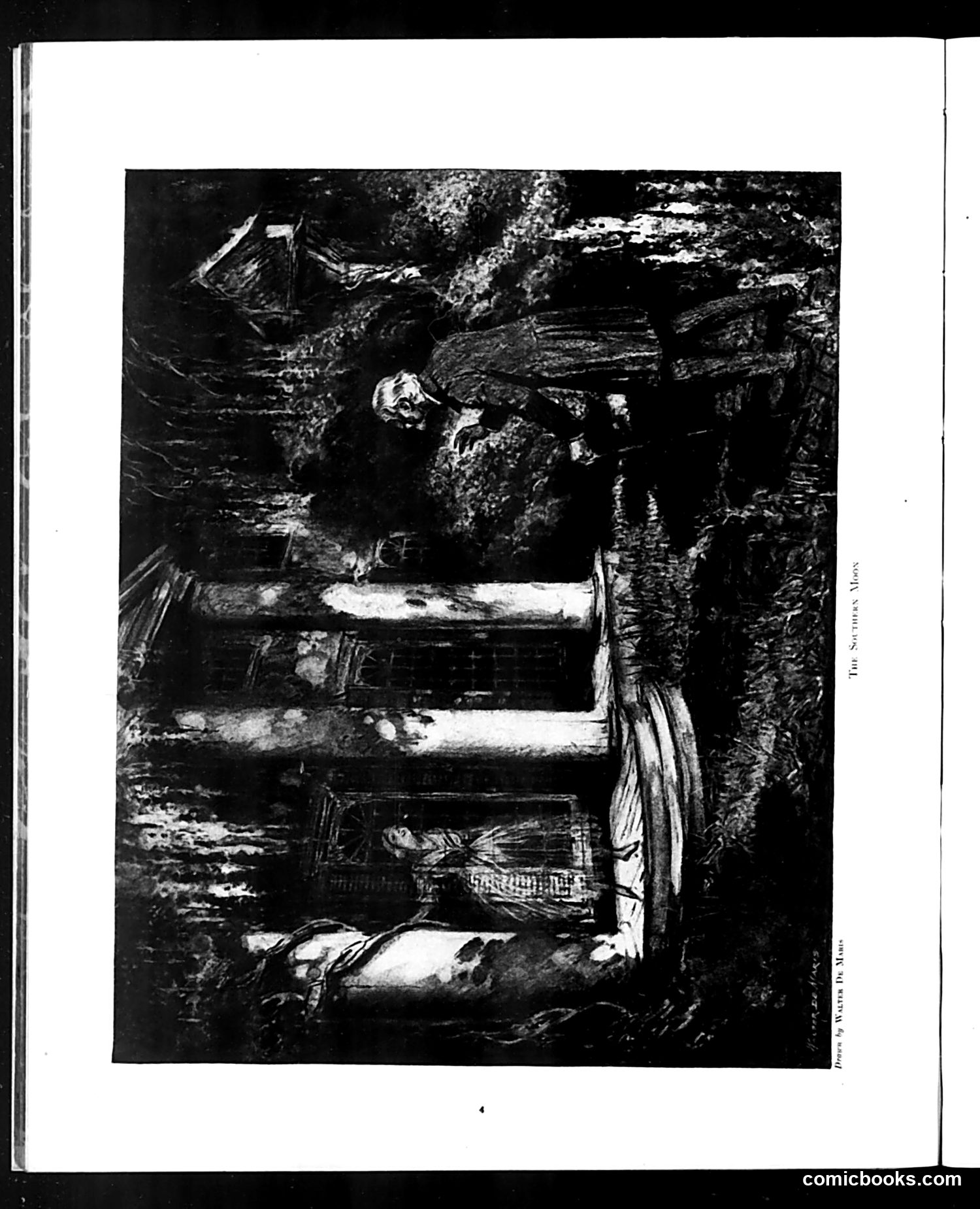
I can see this is a black and white illustration from Judge magazine, but the image quality and contrast make it difficult to read specific details with confidence. The scene appears to depict an interior space with wooden structural elements and what looks like industrial or mechanical equipment. There's a figure visible in the composition. However, without being able to clearly read the caption text or identify specific figures, I cannot reliably explain what political or social commentary this cartoon is making. The OCR text provided appears incomplete or corrupted, containing only fragments that don't convey meaning. To accurately explain this satire's references and intent—as the rules require—I would need either clearer text or more legible visual elements. I cannot responsibly guess at the cartoon's meaning without adequate supporting evidence.
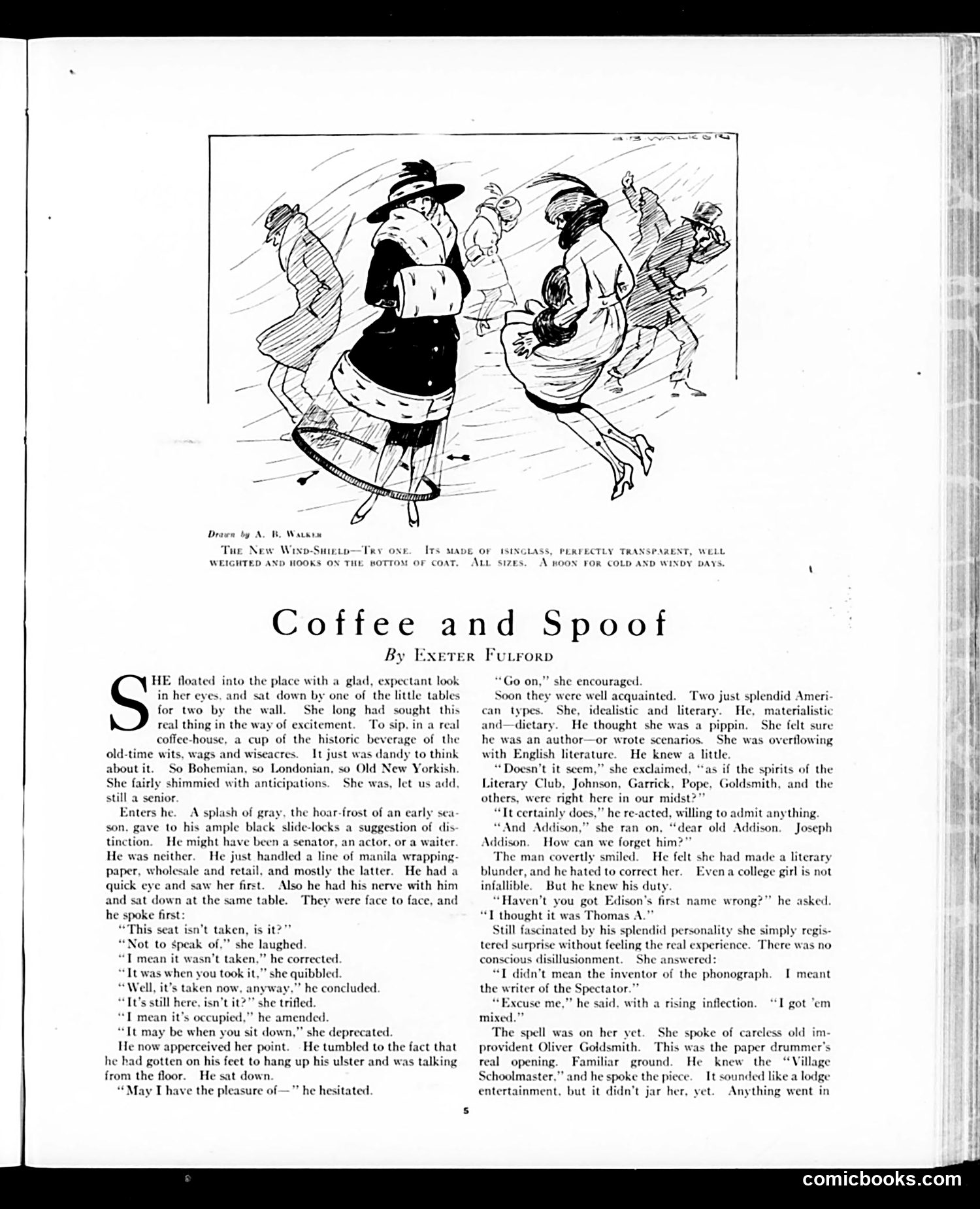
This page contains a short story by Exeter Fulford rather than political satire. The cartoon at top illustrates a comedic social scene at a coffee house where a man encounters a woman he knows. The story satirizes pretentious literary circles and name-dropping. A man meets an acquaintance at a café and discovers she's become involved with a self-important literary crowd claiming connections to famous writers (Johnson, Garrick, Addison, Goldsmith). The humor centers on her affected pretensions—she claims association with these historical literary figures while the man gently deflates her pretense by catching factual errors (misidentifying "Edison" as a writer). The satire targets social climbing and intellectual posturing in early-20th-century café culture.
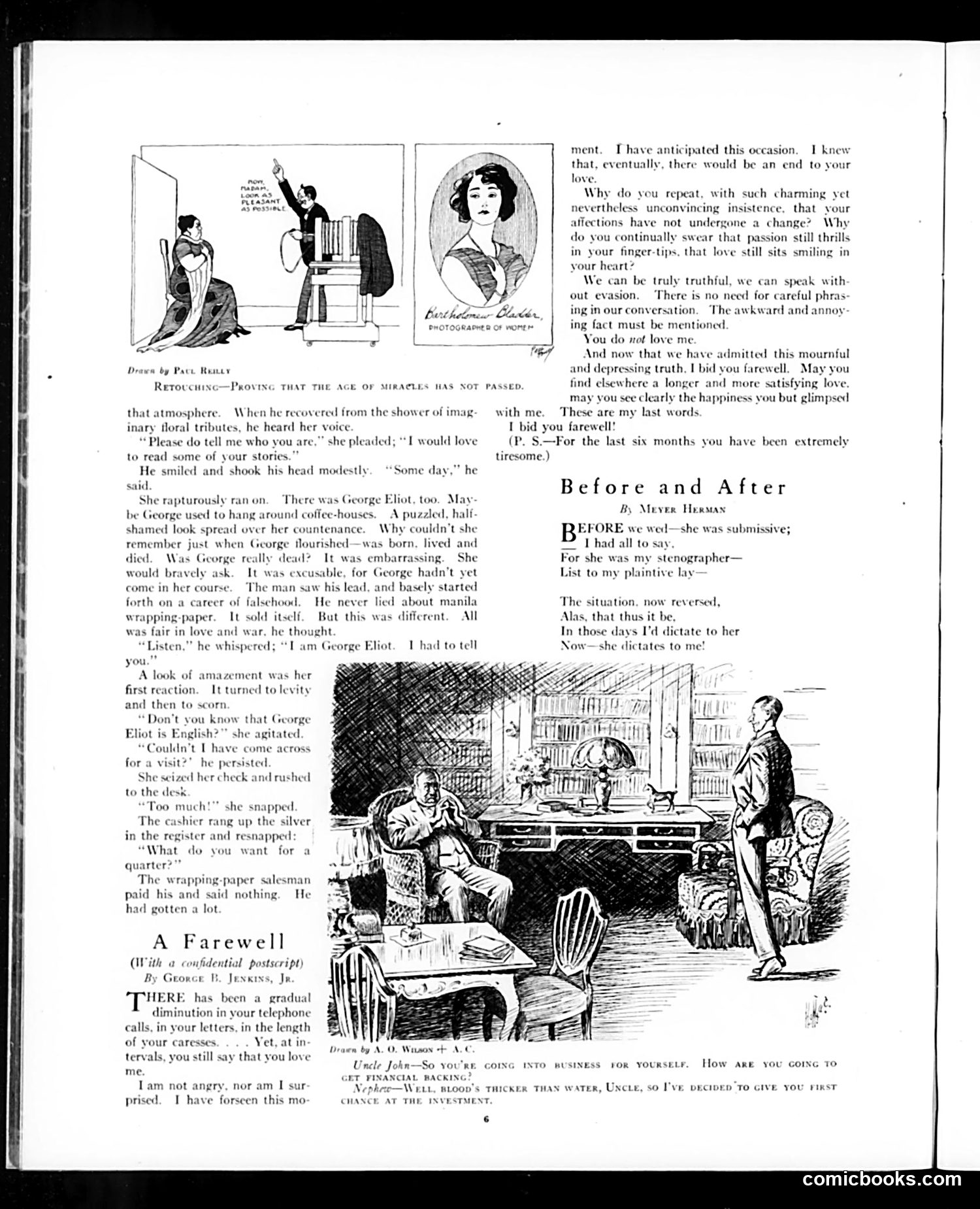
This page contains three fictional short stories rather than political cartoons: 1. **"A Farewell (With a confidential postscript)"** by George B. Jenks, Jr. — a romantic narrative about a man ending a relationship with a woman who was his stenographer, featuring ironic dialogue about love fading. 2. **"Before and After"** by Meyer Herman — a poem contrasting role reversals in a romantic relationship, where the woman previously took dictation but now dictates to the man. 3. An accompanying illustration showing two men in what appears to be a business office setting, likely depicting the power dynamic shift referenced in the poem. The content satirizes workplace romance and changing gender dynamics in professional settings, using humor about secretarial relationships and shifting authority—social commentary typical of early 20th-century magazine humor.
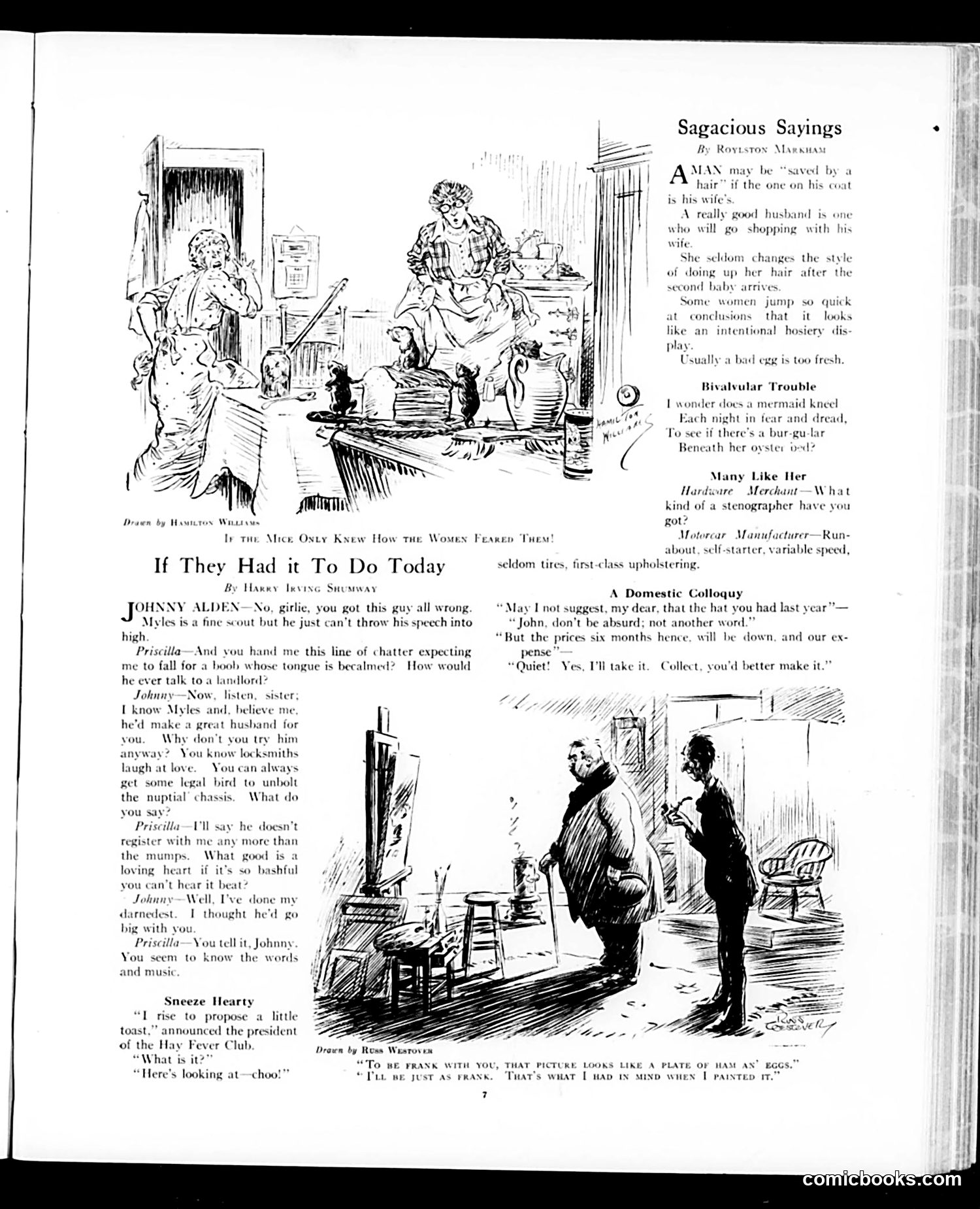
This page contains several humorous pieces typical of early 20th-century American satire: **"If They Had it To Do Today"** depicts a romantic disagreement where Johnny tries to convince Priscilla that his friend Myles would make a good husband, despite Myles's poor public speaking. The humor relies on exaggerated romantic expectations and gender dynamics of the era. **"Sneeze Hearty"** is a brief pun about a Hay Fever Club president toasting with a sneeze—simple wordplay. **"Sagacious Sayings"** offers mock-wise observations about marriage, women's behavior, and domesticity, reflecting contemporary attitudes about wives and household management. **"A Domestic Colloquy"** satirizes a couple negotiating clothing purchases, where the wife's impulse buying contradicts the husband's economic concerns—commenting on perceived female spending habits. **"Bivalvular Trouble"** makes a pun about mermaids and oyster beds. The overall theme appears to be marital relationships and gender roles, with satire targeting both male and female stereotypes of the period.
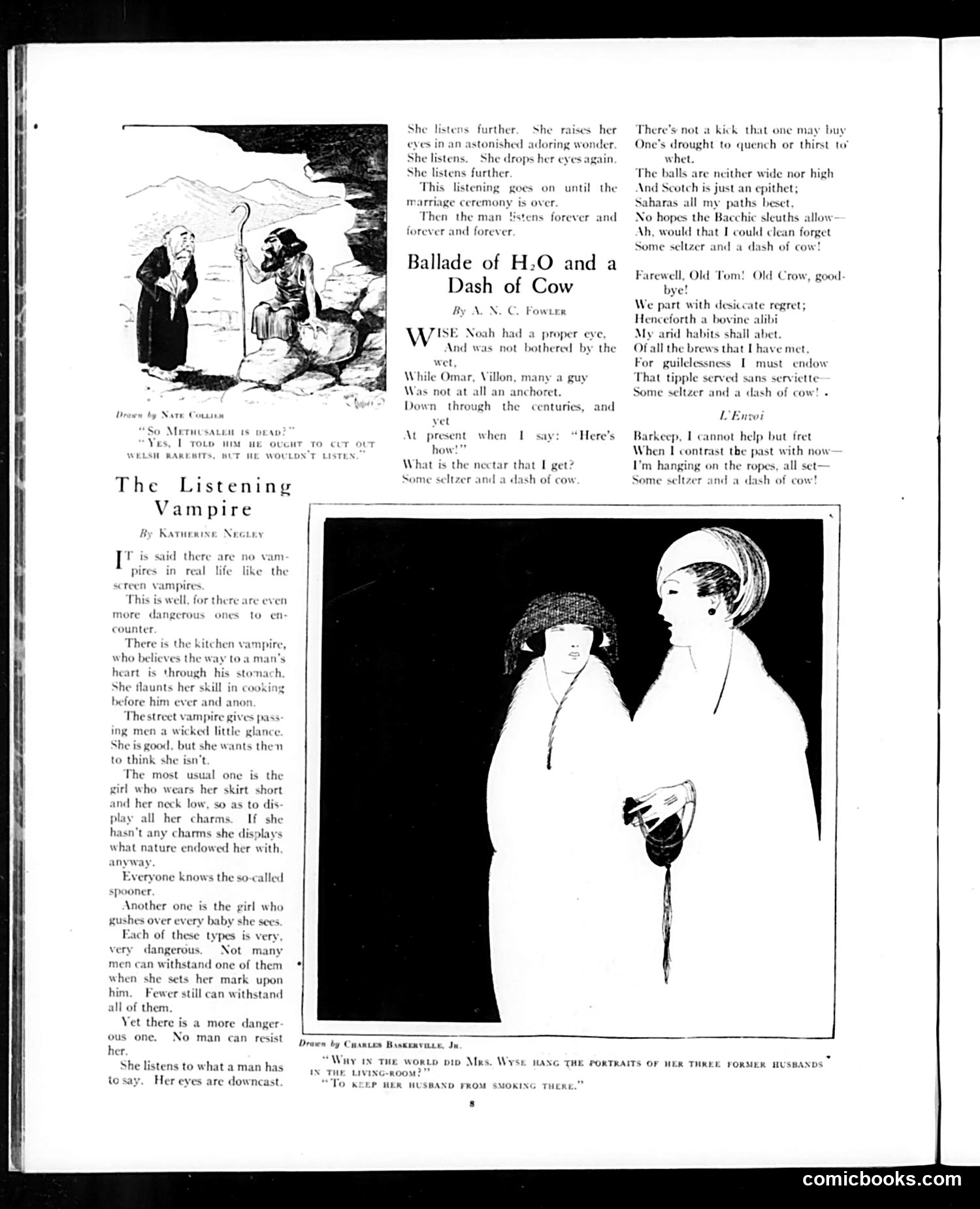
This page contains two satirical pieces about courtship and relationships, reflecting early 20th-century gender anxieties. **"The Listening Vampire"** by Katherine Negley identifies various types of women as predatory seductresses—the kitchen-skilled woman, the scantily-dressed attention-seeker, the baby-obsessed gusher. But the most dangerous is "the listener": a woman who flatters men by appearing rapt with attention and admiration, only to trap them into marriage. Once wed, the man "listens forever and forever"—implying marital servitude. **"Ballade of H₂O and a Dash of Cow"** is a humorous poem lamenting Prohibition. The speaker cannot get alcoholic drinks—only seltzer with a milk ("cow") chaser. References to "Old Tom" (whiskey), Omar (Khayyam's wine poetry), and "Bacchie" (Bacchus) emphasize lost pleasures under alcohol restrictions. The cartoon caption suggests the woman keeps her former husbands' portraits to remind her current husband not to smoke—implying she eliminates inconvenient husbands. Both pieces use humor to express period anxieties about female power and modern restraints (Prohibition, matrimony).
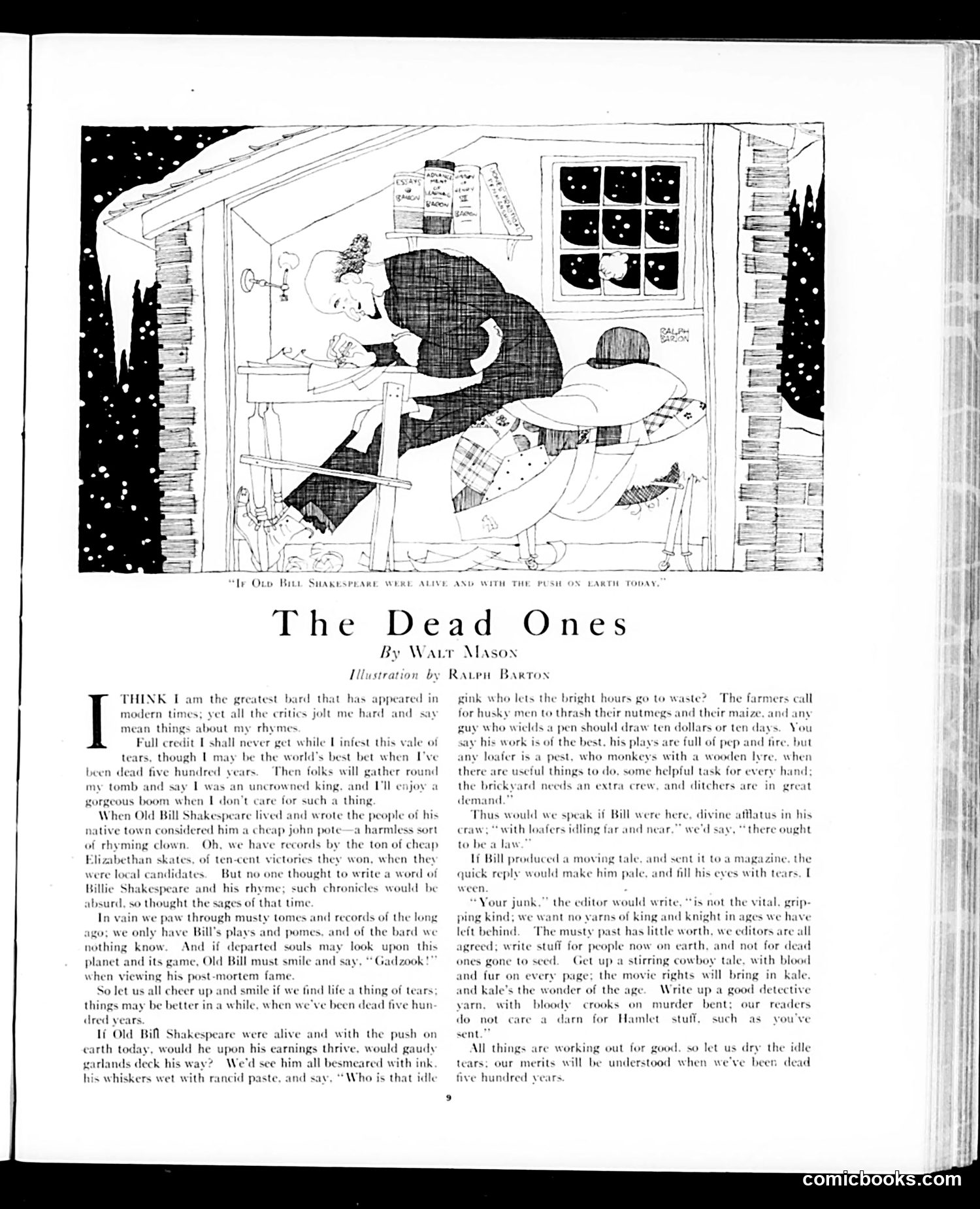
This piece satirizes the paradox of artistic merit and commercial success. Mason argues that great writers like Shakespeare were unappreciated during their lifetimes—dismissed as cheap entertainers by contemporaries—yet gain recognition only after death. The illustration depicts a modern editor rejecting a manuscript, embodying Mason's critique: contemporary publishers demand profitable "cowboy tales" and "detective yarns" with commercial appeal, dismissing serious literary work as worthless "Hamlet stuff." The contrast between Shakespeare's eventual canonization and current editorial indifference suggests that today's rejected artists may become tomorrow's classics. Mason's point: society systematically devalues serious art in favor of commercial entertainment, leaving true merit recognized only posthumously. The satire targets both the literary establishment's short-sightedness and the tension between artistic integrity and market demands—issues that remain relevant today.
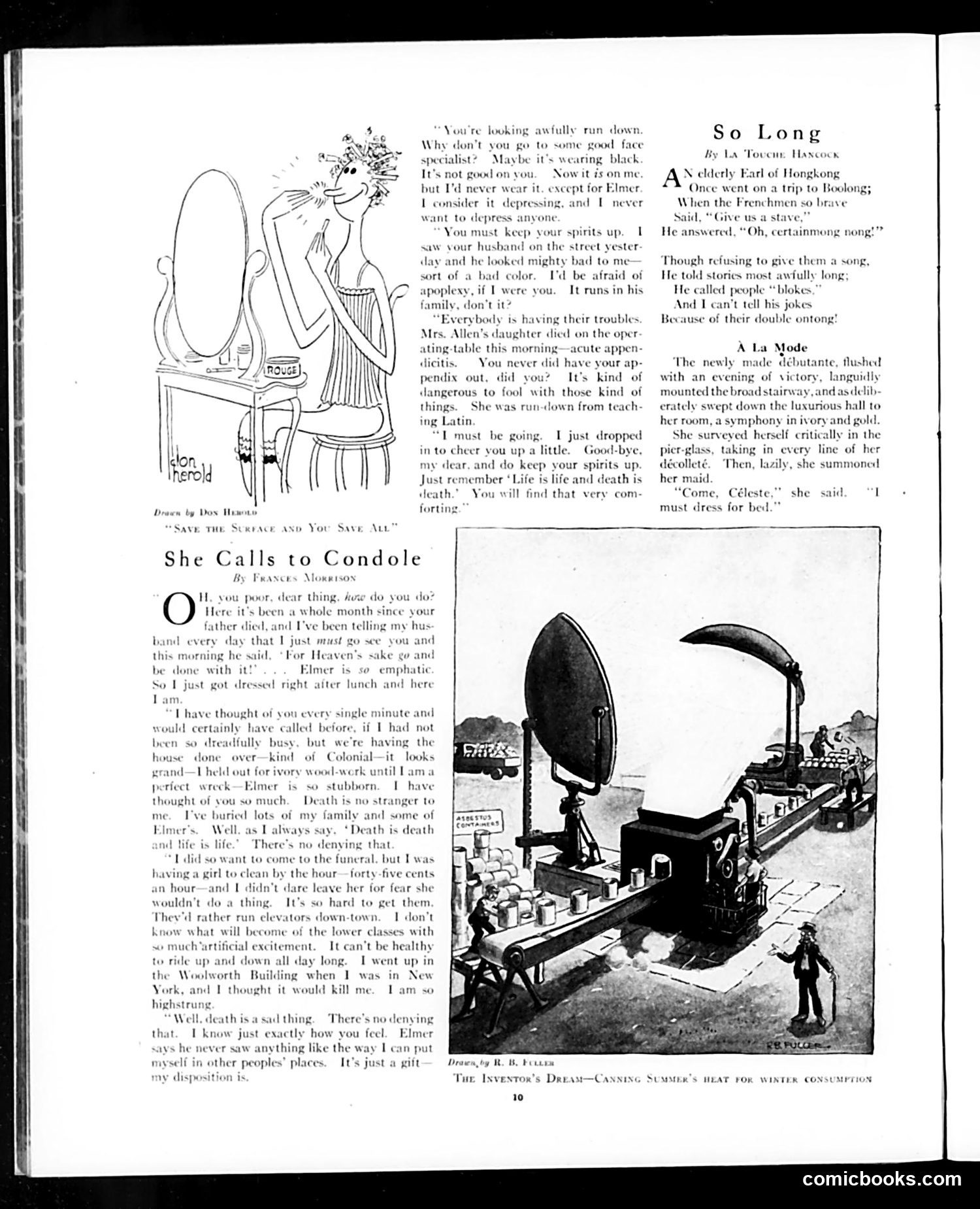
This page contains three separate stories/cartoons: 1. **"Save the Surface and You Save All"** - A cartoon showing a woman at a mirror looking disheveled, likely satirizing vanity and makeup culture. 2. **"She Calls to Condole"** - A narrative piece about a woman visiting someone in mourning (Elmer), touching on attitudes toward death and social obligations of the era. 3. **"So Long"** and **"A La Mode"** - Brief fictional pieces about social interactions and fashion. The bottom illustration shows what appears to be an industrial or mechanical invention, captioned as "The Inventor's Dream—Canning Summer's Heat for Winter Consumption," suggesting early 20th-century optimism about technological solutions to preserve natural resources or comfort. The page reflects typical Judge magazine content: satirical humor about contemporary social manners, fashion, and technology.
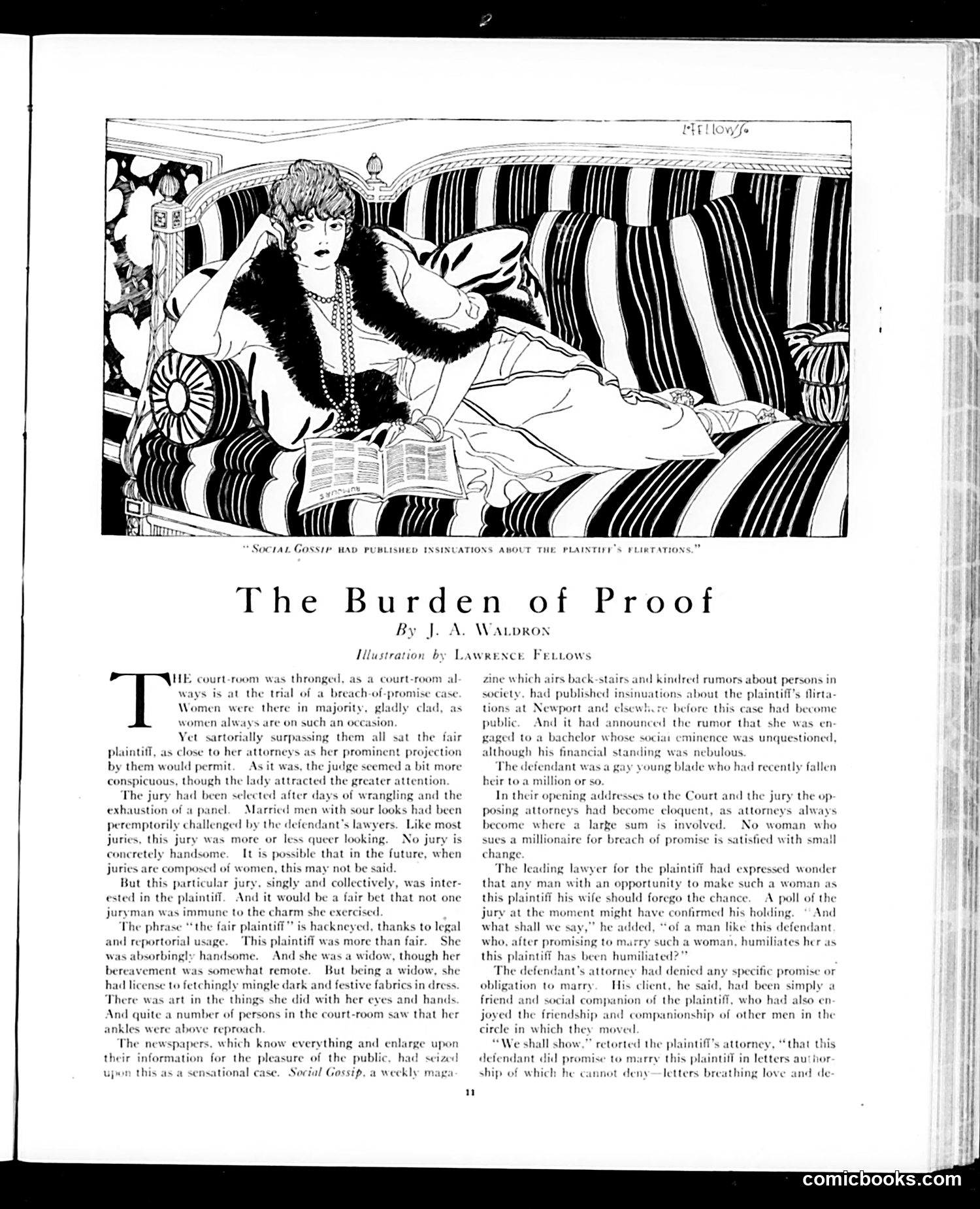
This story satirizes the sensationalism surrounding **breach of promise** litigation—lawsuits common in the early 20th century where women sued men for failing to marry them after alleged promises. The satire targets: 1. **The "fair plaintiff"**: A widow (above reproach socially, dressed fashionably) suing a wealthy "gay young blade" for breaking an engagement promise, seeking financial damages. 2. **Social hypocrisy**: The magazine *Social Gossip* had published rumors about her flirtations at Newport, yet she now presents herself as wronged. The irony is that gossip columns—which thrive on such scandalous talk—helped publicize the very "insinuations" she claims damage her. 3. **Jury manipulation**: The illustration shows her strategically positioned to charm jurors. The text notes jurors are obviously susceptible to her appeal, undermining the legal process. 4. **The absurd burden of proof**: Attorneys grandstand about love letters and broken promises to a millionaire, reducing marriage to a commercial transaction. The satire mocks how such cases became public spectacles driven by newspapers and jury emotion rather than legal merit.
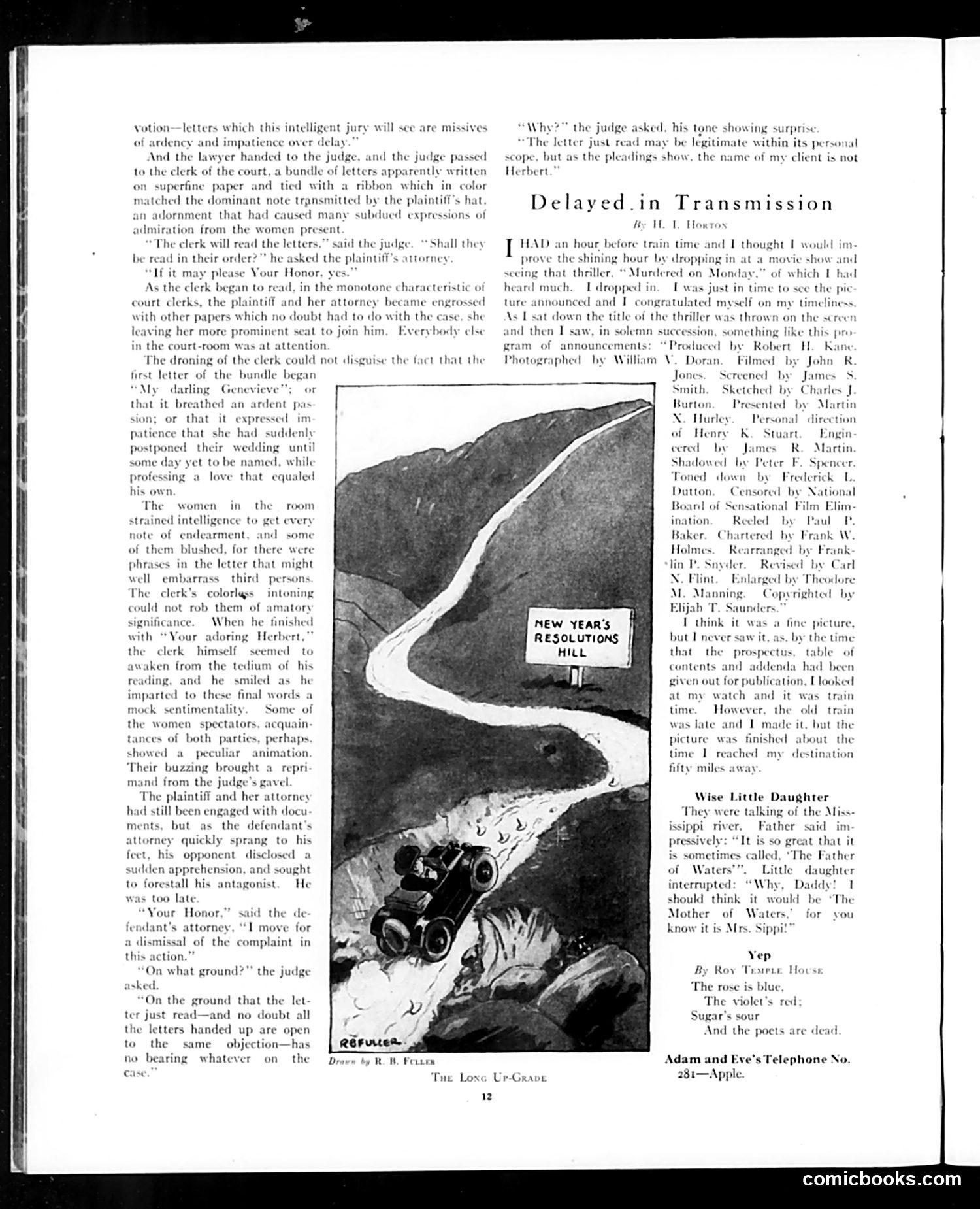
This page contains two unrelated satirical pieces. The main cartoon (bottom half) mocks the excessive credits typical of 1920s film production. The artist illustrates a car on a winding road labeled "New Year's Resolutions Hill," but the joke's real target appears in the accompanying text: a lengthy, absurdist list of fabricated film credits crediting dozens of people for trivial tasks ("Toned down by Frederick L. Dutton," "Censored by National Board of Sensational Film Elimination"). The satire suggests that Hollywood films had become bloated with unnecessary personnel and credits, reflecting either industry excess or the author's skepticism about actual creative contributions. The text above describes a courtroom scene where love letters become evidence, possibly satirizing melodramatic film plots. The piece targets early cinema's pretentiousness and overcomplicated production apparatus.
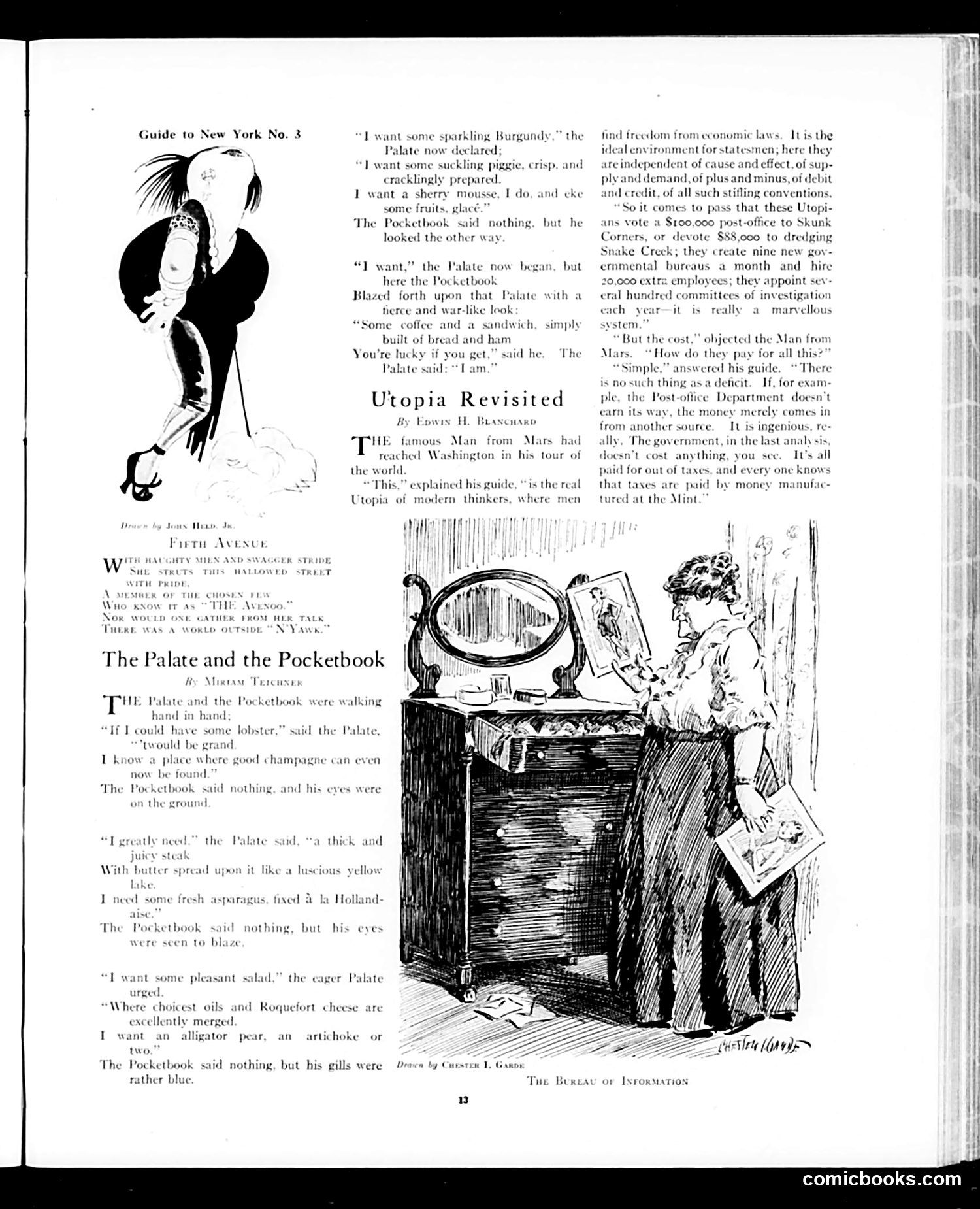
**The Palate and the Pocketbook** is a personified allegory about spending versus affordability. The Palate (desire for luxury foods) makes increasingly extravagant demands—lobster, steak, asparagus, alligator pear—while the Pocketbook (financial reality) remains silent, his "gills turning blue" with distress. Finally, the Pocketbook explodes, offering only coffee and a sandwich. The joke: unchecked appetite meets harsh economic reality. **Utopia Revisited** satirizes Washington government spending. A visitor from Mars observes politicians creating wasteful projects—a $100,000 post office for a tiny town, $88,000 to dredge a creek, nine new bureaus monthly, 20,000 employees—claiming there's "no deficit" because "taxes pay for it." The satire exposes the circular logic: government spending appears free because citizens don't see where money actually originates. The guide's "ingenious" system reveals political dishonesty about public finance.
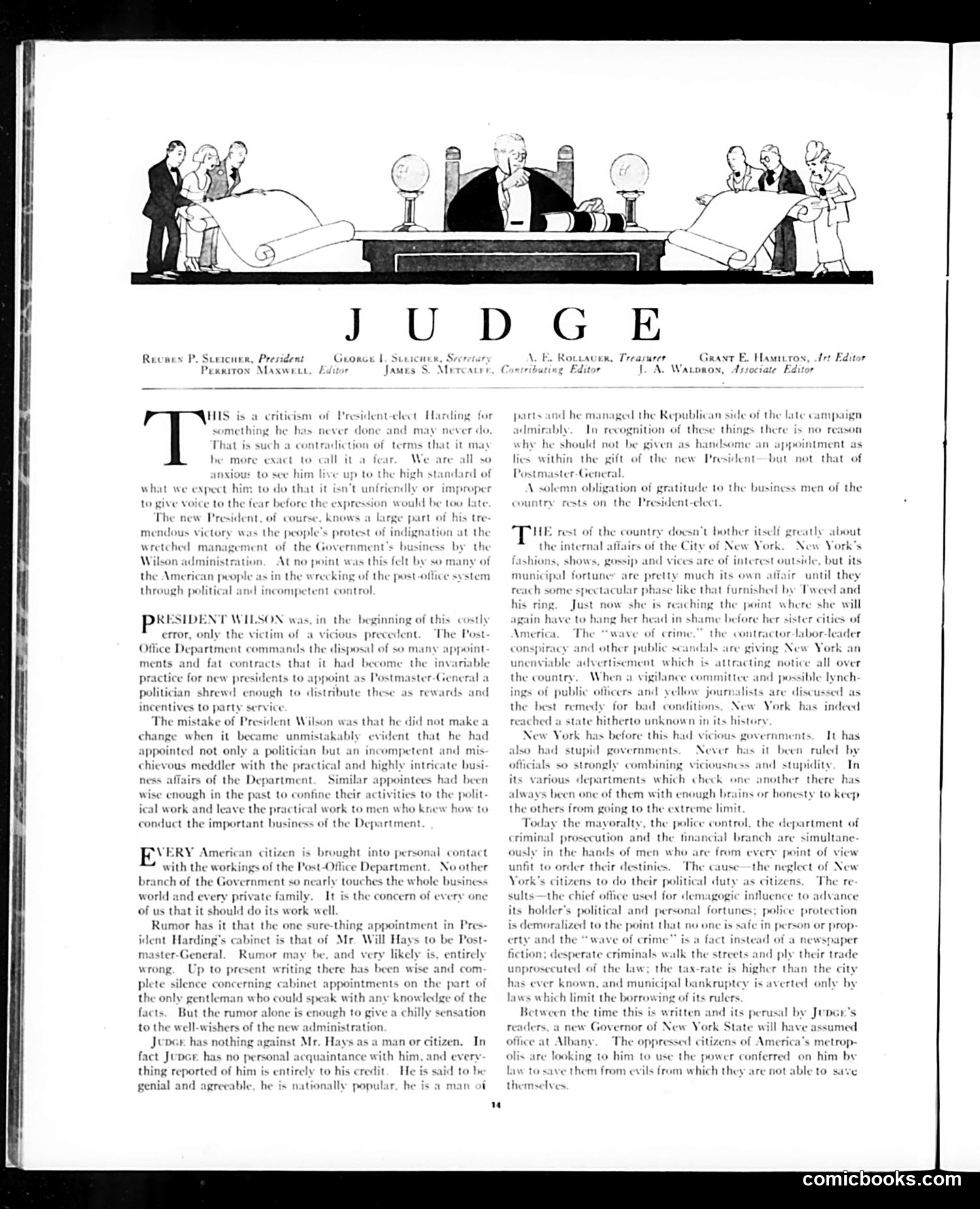
This page critiques President-elect Warren G. Harding's upcoming cabinet appointments, particularly regarding the Postmaster-General position. **The Cartoon Header** depicts a judge presiding over judicial proceedings, establishing the magazine's editorial authority on the matter. **Main Targets:** - **President Wilson** is criticized for appointing Albert Burleson as Postmaster-General and failing to remove him despite his incompetence and meddling in Post-Office affairs - **Will Hays** is rumored for the same position under Harding; while the magazine acknowledges Hays's personal merit, it warns against perpetuating the tradition of giving this powerful patronage position to political operatives rather than administrators **The Core Issue:** The Post-Office Department controlled enormous patronage and contracts. The satire argues that appointing politicians rather than skilled managers wasted resources and corrupted government efficiency—a classic Progressive Era complaint about the spoils system. **New York reference:** The final section pivots to city corruption, invoking the Tweed Ring scandal to illustrate how mismanagement ruins reputations. The piece advocates for merit-based appointments over political loyalty rewards.
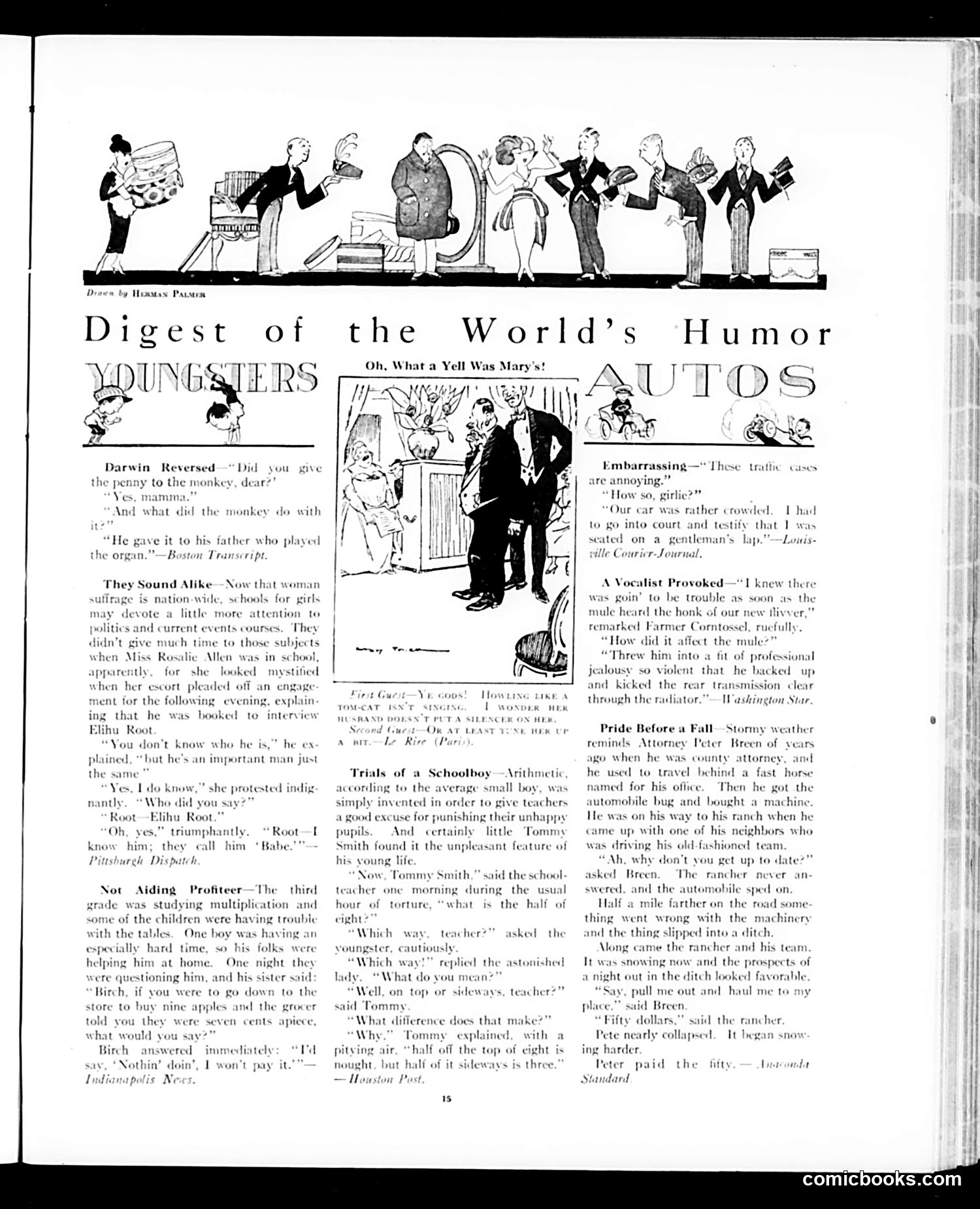
This page collects brief humorous anecdotes rather than political cartoons. The jokes reflect early 20th-century social anxieties: **"Darwin Reversed"**: Mock-Darwinian humor about human evolution, suggesting parents behave like animals. **"They Sound Alike"**: Satirizes women's suffrage and expanding female education. A woman confuses the statesman Elihu Root with "Root"—the children's game—mocking claims that women voters need political knowledge. **"Not Aiding Profiteer"**: Wartime-era humor about inflation. A grocer charges exorbitant prices for apples; a boy's father refuses to help him with arithmetic homework to avoid "aiding" war profiteering. **"Trials of a Schoolboy"**: Standard schoolroom humor about a child's literal-minded misinterpretation of "half of eight." **"Pride Before a Fall"**: An attorney mocks an old-fashioned rancher for using horses instead of automobiles, then breaks down and needs rescue—a comeuppance joke about technological arrogance. These reflect period anxieties about gender roles, inflation, and modernity.
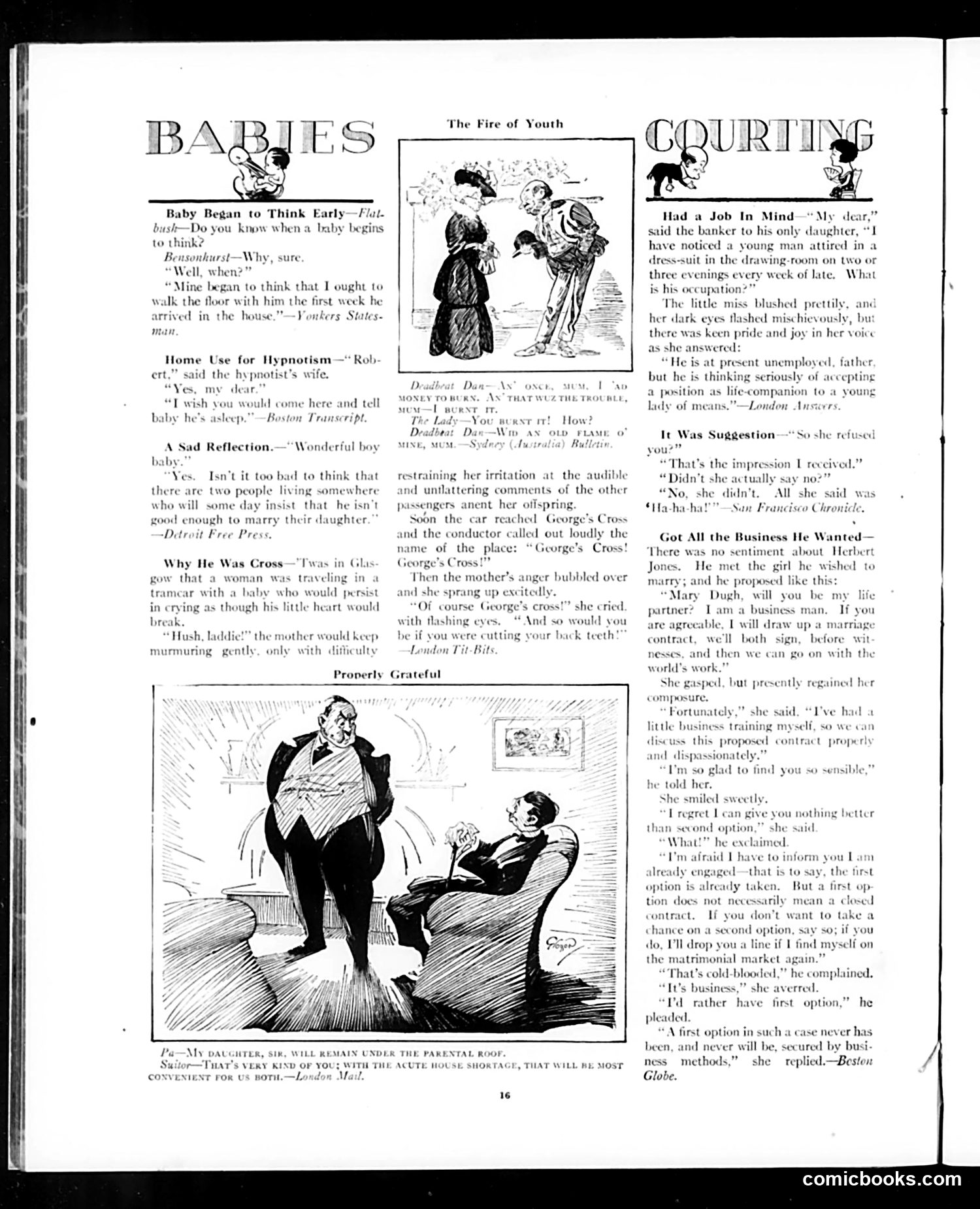
This page contains humorous short anecdotes about courting, marriage, and young love—typical Judge magazine fare satirizing social customs of the era. **Key satirical points:** The "Properly Grateful" cartoon mocks post-WWI housing shortages, showing a suitor relieved he can keep his girlfriend at her parents' house rather than afford separate lodging—presenting the crisis as convenient for poor young men. The marriage-proposal story ("Got All the Business He Wanted") satirizes modern business logic applied to romance: a man proposes marriage as a contractual arrangement with "options," treating courtship like a commercial deal. The woman's witty response—she's already engaged but offers him a "second option"—mocks his cynical transactionalism by applying his own businesslike logic back at him. Other bits joke about babies keeping new fathers awake and a woman's frustrated outburst when her crying child shares a train compartment. The overall theme: young people, modern commerce, and social awkwardness colliding with traditional expectations.
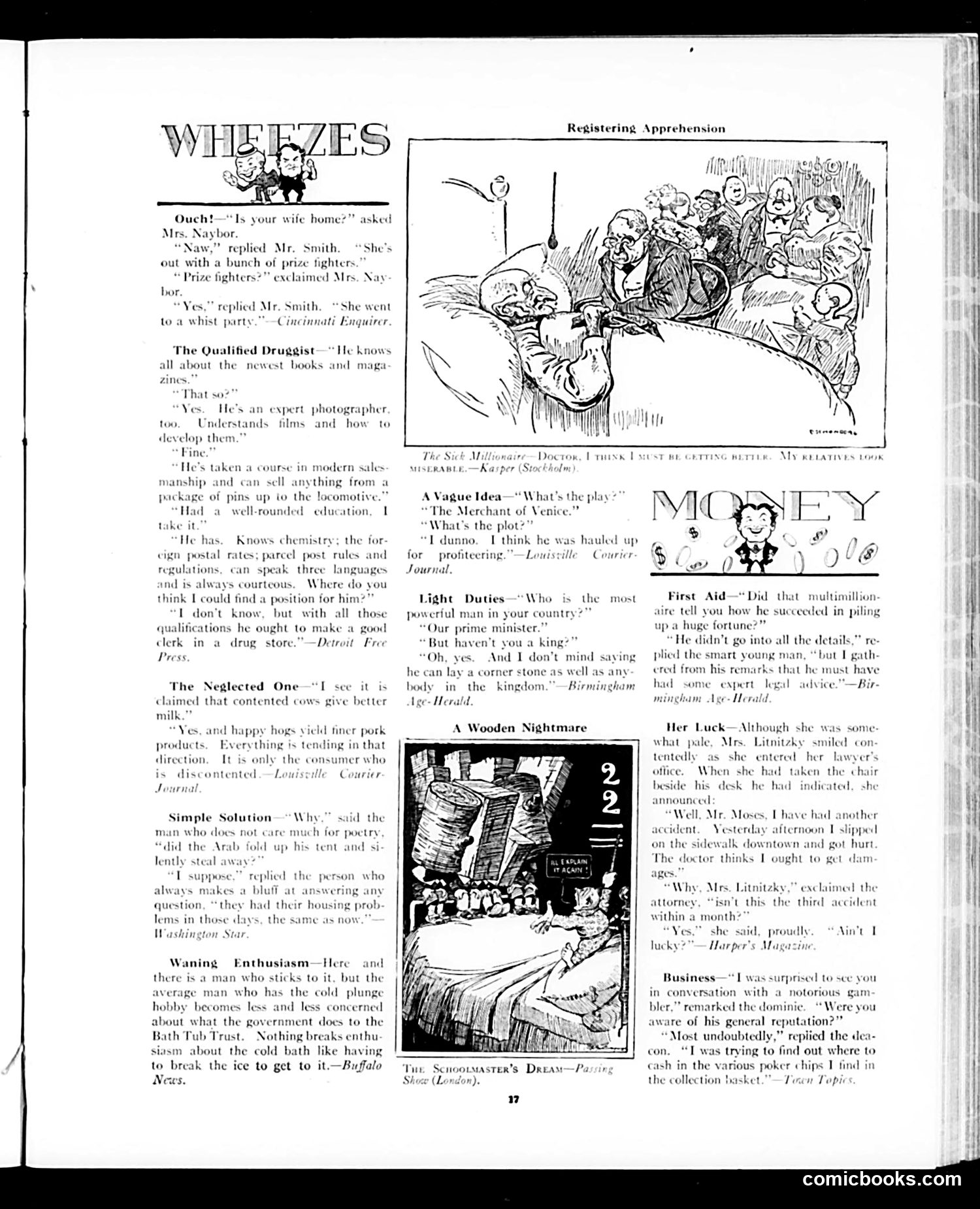
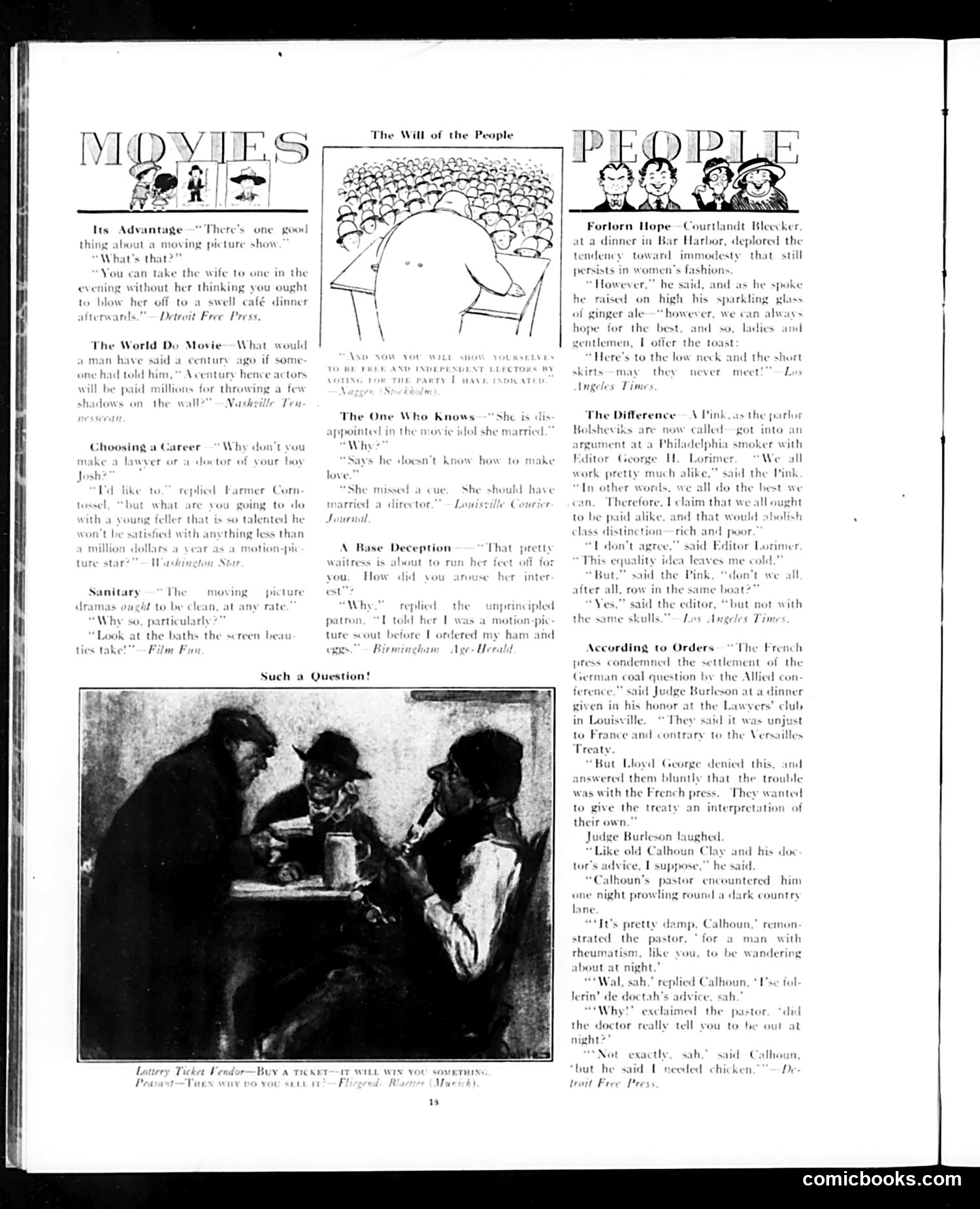
This page contains satirical commentary on 1920s American culture and politics, presented through brief jokes and anecdotes rather than visual cartoons (except for one photograph captioned "Such a Question!"). **Key Content:** The "Movies" section mocks silent film industry trends—critiquing actors' pretensions, ridiculous plot devices, and the contrast between lavish on-screen bathrooms and audiences' ordinary lives. **"The Will of the People"** section includes political commentary: "According to Orders" references Judge Burleson (Postmaster General under Wilson) discussing French press criticism of the post-WWI German coal settlement, with Lloyd George allegedly dismissing French objections. This satirizes Allied disagreement over Treaty of Versailles implementation. The anecdotes mock social hypocrisy: a man toasting "short skirts may they never meet low necklines" (attacking women's fashion changes), and a story about Calhoun ignoring his doctor's nighttime wandering advice. **Target audience:** Educated, upper-class readers following contemporary politics and social debates circa 1920-1921.
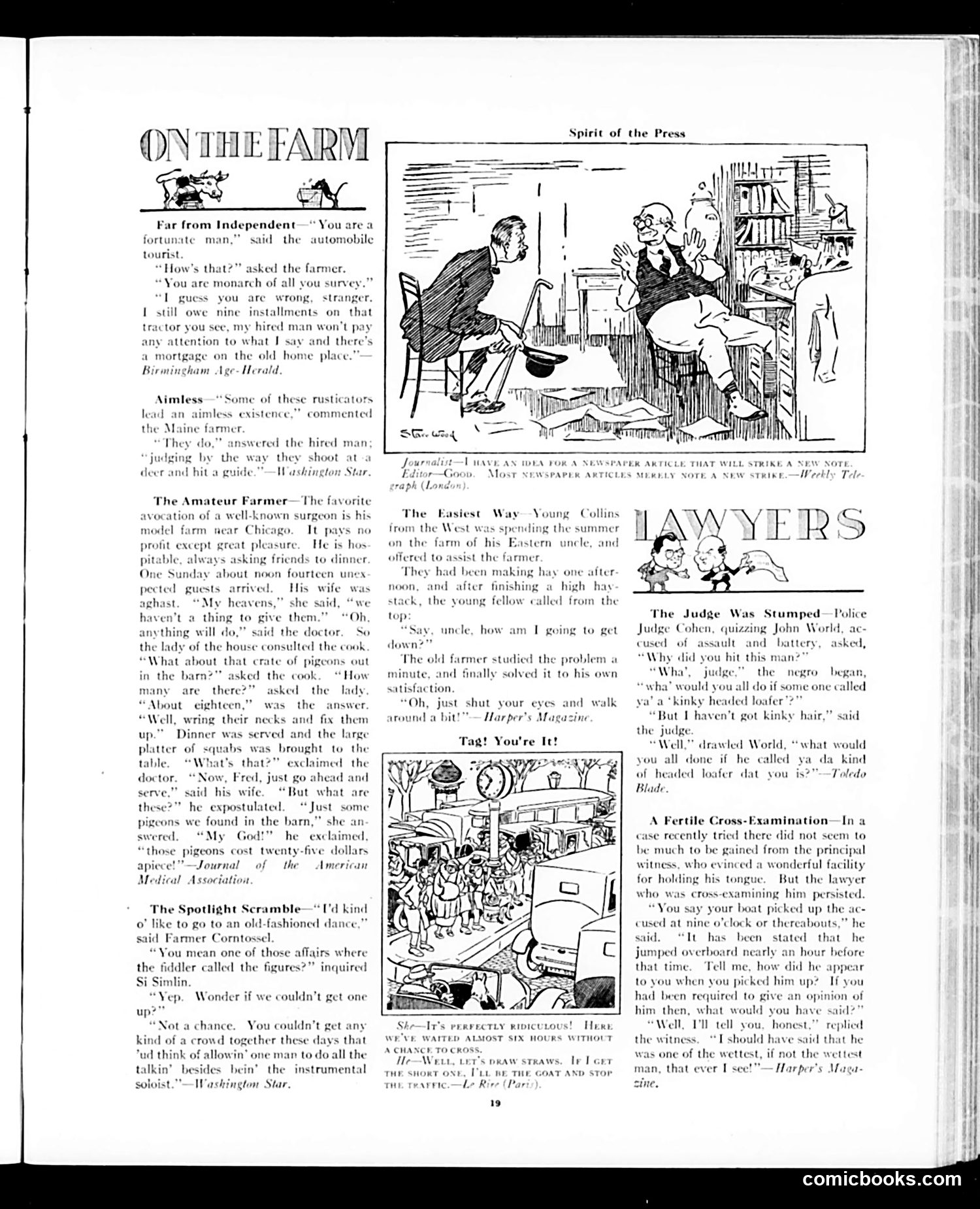
This page from *Judge* magazine contains rural humor anecdotes satirizing American farm life and legal proceedings, circa early 20th century. **"On the Farm" section** mocks the illusion of farmer independence—a supposedly self-reliant agriculturalist is actually bound by debt (tractor installments, mortgage) and cannot command respect from hired laborers. **The cartoons and jokes** ridicule: - City tourists' naïveté about rural life - An amateur surgeon hosting dinner who unknowingly serves his guests pigeons (squabs) worth $25 each—mocking class pretension - A young city visitor asking obvious questions (how to descend from a haystack) - Racist anecdotes featuring dialect humor and a Black defendant in court **"Spirit of the Press"** reprints witty observations from other publications, including workplace frustration over traffic delays. The overall tone reflects turn-of-the-century American middle-class attitudes: rural life as quaint but foolish, city professionals as educated yet absurd, and deeply embedded racial stereotyping presented as comedy.
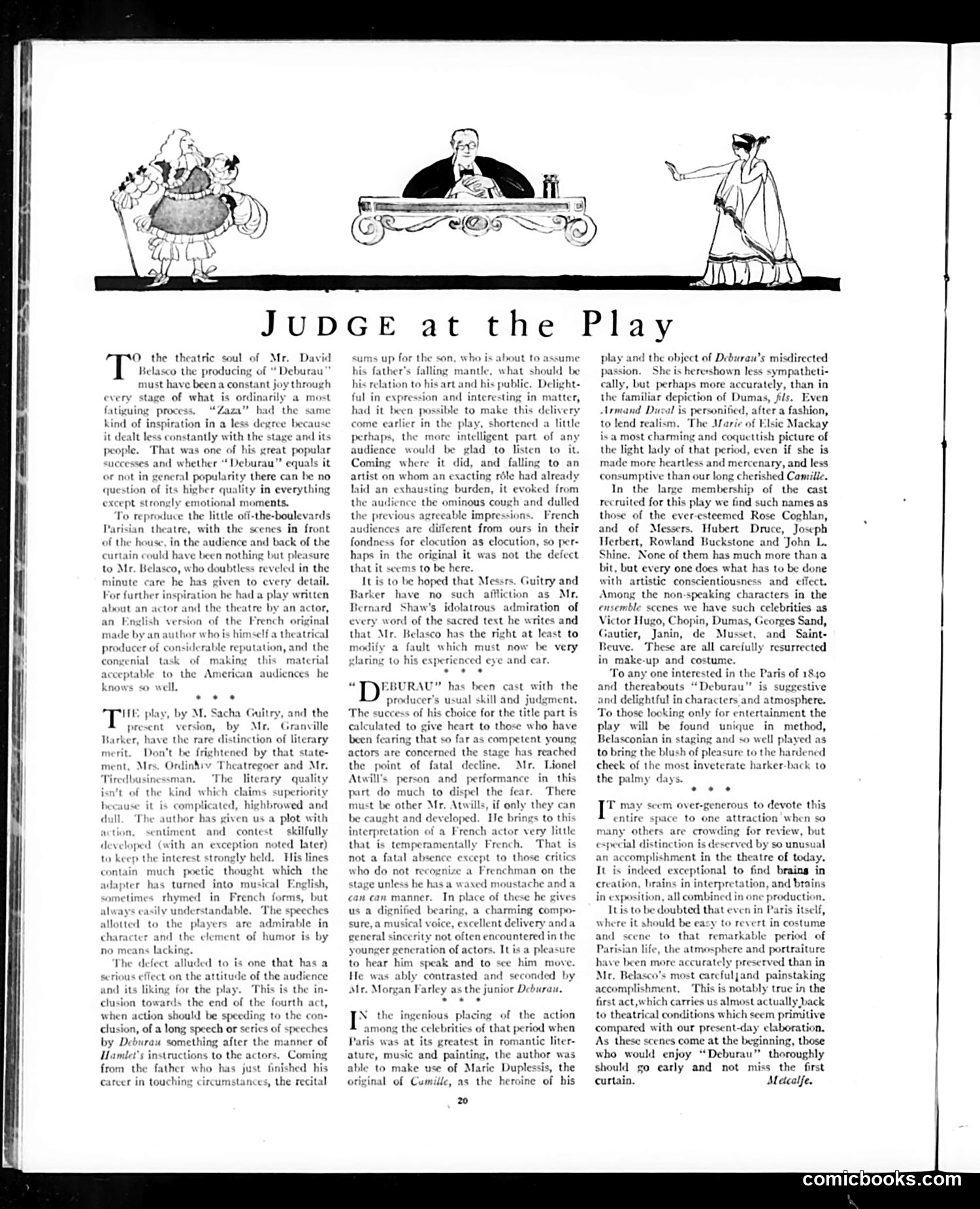
This is a theater review of David Belasco's production of the play "Deburau," not a political cartoon. The illustrated header shows a judge observing a theatrical scene—a visual pun on "Judge at the Play." The critic praises the production's literary quality and faithful recreation of 1820s Paris bohemian theater. However, the review identifies a structural flaw: a lengthy speech by the father character (delivered by an exhausted actor) in Act IV disrupts the dramatic momentum. The critic notes this long monologue—reminiscent of Hamlet's instructions to actors—works better for French audiences who appreciate oratory, but American audiences grew restless, signaled by "ominous cough." The review commends actor Lionel Atwill's performance in the title role, suggesting genuine theatrical talent still exists despite fears of decline. Overall, it's a sophisticated theater critique, not satire.
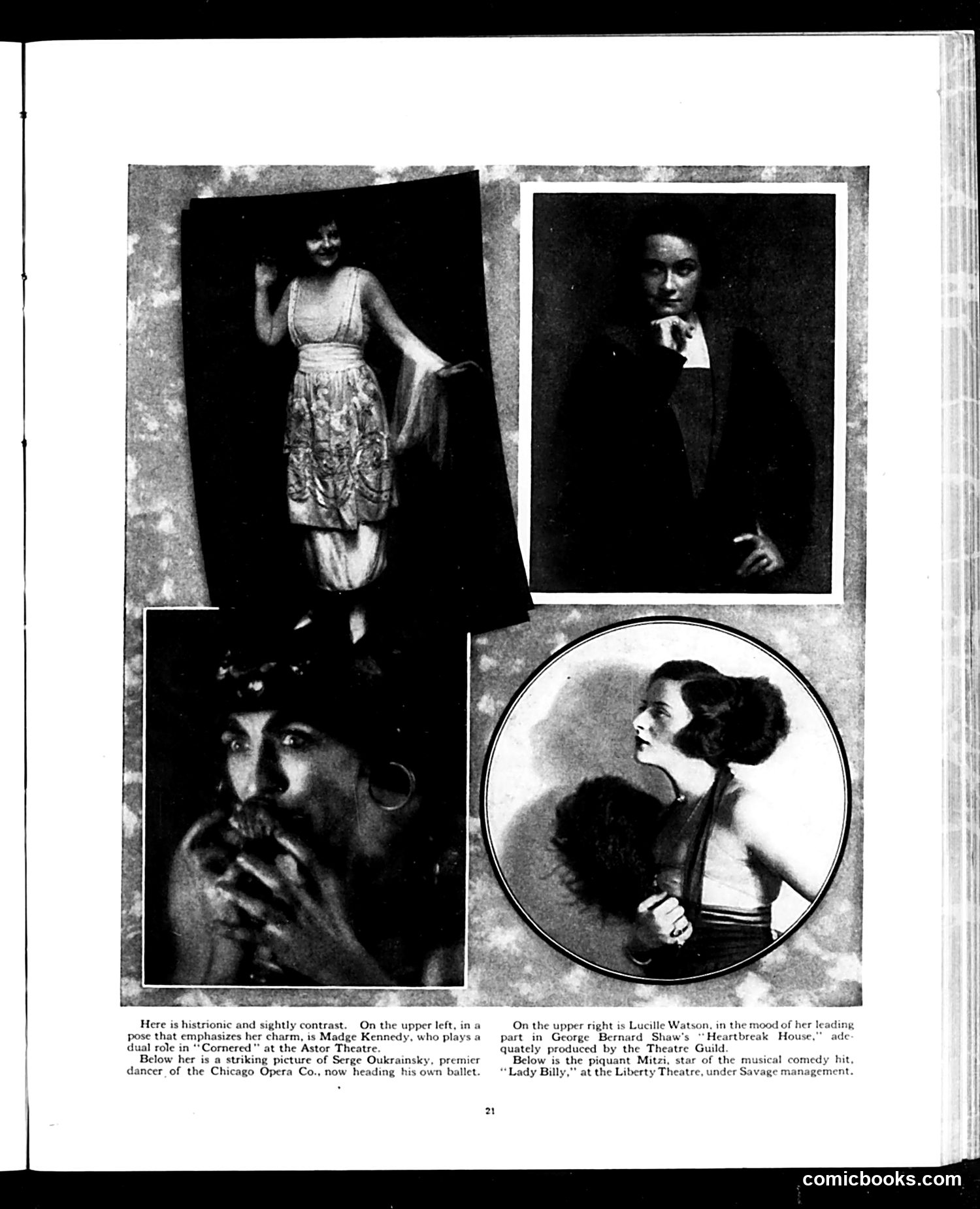
This is a theatrical showcase page featuring four prominent performers of the era. The text presents "histrionic and sightly contrast"—comparing different acting styles and performance types. **Identified figures:** - **Madge Kennedy** (upper left): actress in the dual role production "Cornered" at the Astor Theatre, posed to emphasize charm - **Lucille Watson** (upper right): in George Bernard Shaw's "Heartbreak House," produced by the Theatre Guild - **Serge Oukrainsky** (lower left): premier dancer of the Chicago Opera Company, now leading his own ballet - **Mitzi** (lower right, circular frame): star of the musical comedy "Lady Billy" at the Liberty Theatre The page contrasts dramatic/serious theatrical work (Shaw's play, dramatic roles) with musical comedy entertainment, illustrating the range of Broadway performance available to audiences. This appears to be promotional/review content typical of Judge magazine's coverage of popular entertainment.
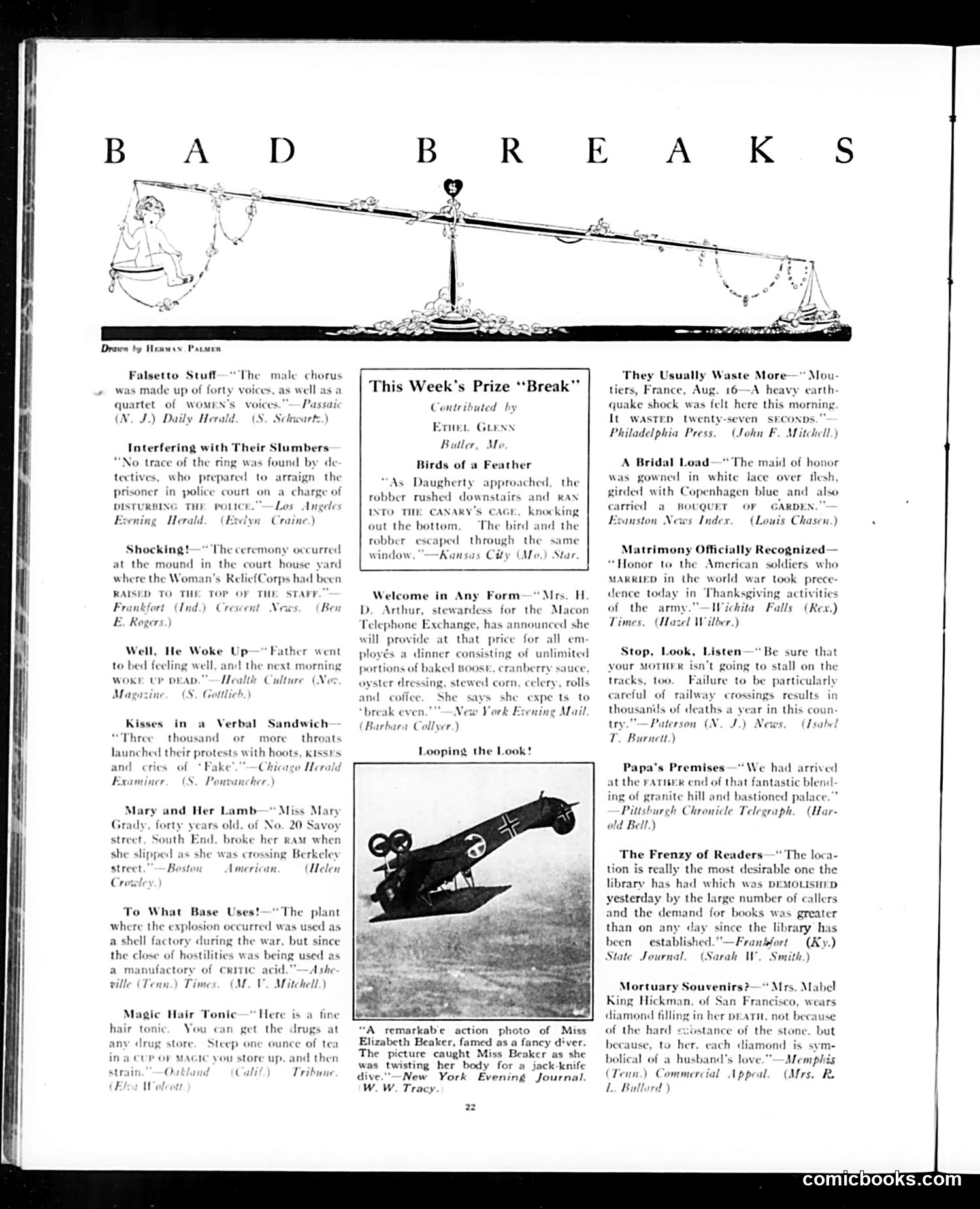
This is a humor page from *Judge* magazine featuring short comedic items contributed by readers. The central cartoon shows a fancy diver (Miss Elizabeth Beaker) performing a jackknife dive—a striking action photograph that illustrates the page's title "Looping the Look!" The surrounding text consists of brief, punchy jokes based on newspaper clippings with unintentional double meanings or absurd situations. Examples include: - A robber escaping through a canary's cage after knocking "out the bottom" - A woman providing "unlimited" dinner portions while expecting to "break even" - A maid of honor carrying a "bouquet of garden" - Soldiers who "marked in the world war" (likely a typo for "fought") - A library that was "demolished" yet somehow remains popular These rely on literal misreadings of headlines or deadpan absurdism typical of early-20th-century comic magazines. The humor is gentle, situational rather than political, and depends on readers finding amusement in linguistic slip-ups and incongruities in everyday newspaper reporting.
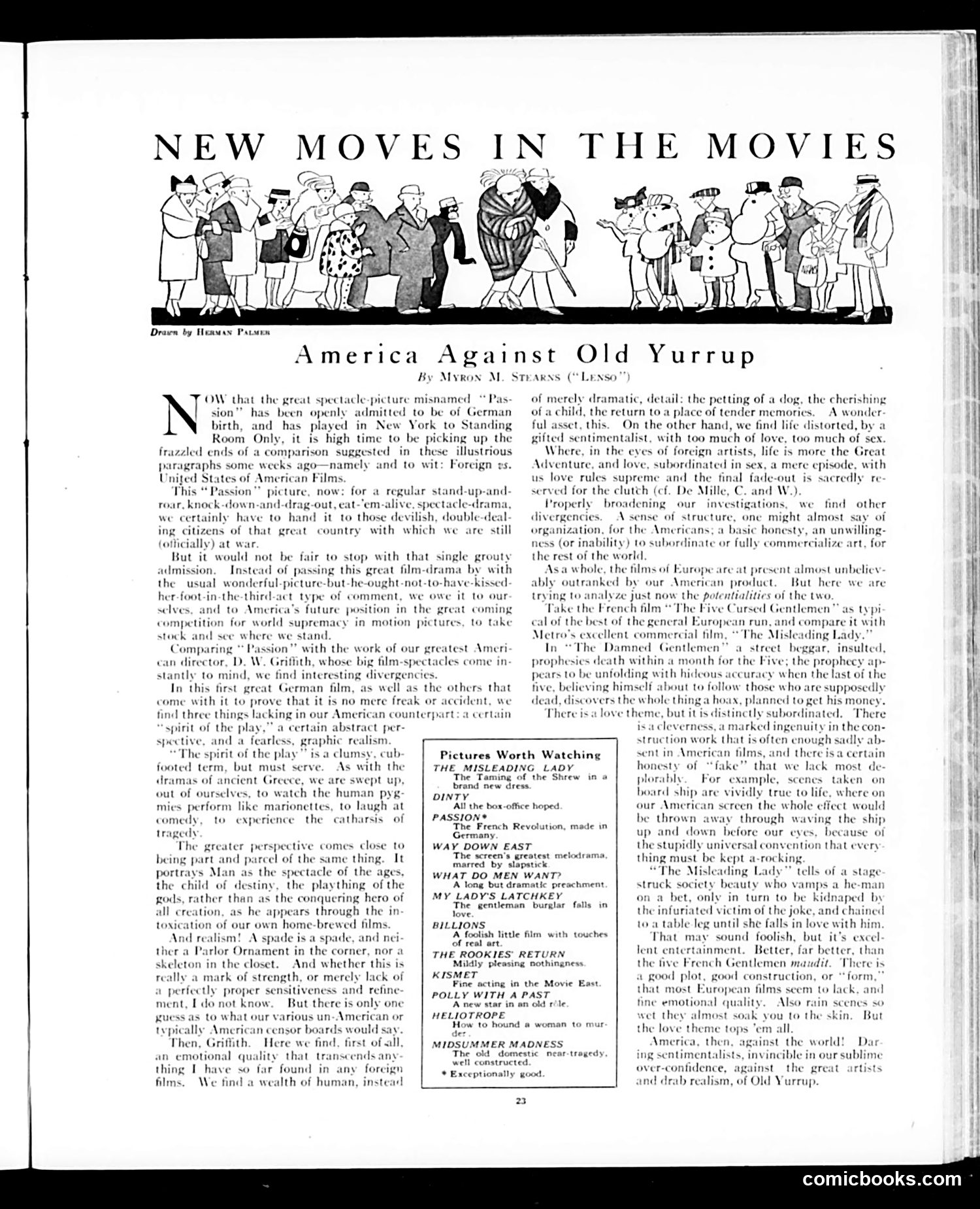
This article by Myron M. Stearns critiques the German film *Passion* (about the French Revolution), which played in New York despite Germany being America's WWI enemy. The satire targets American sentimentality in cinema. Stearns argues that European films—particularly German director work—excel in three areas where American films (notably D.W. Griffith's) fall short: abstract perspective on human destiny, fearless graphic realism, and emotional authenticity. He contrasts European cinema's willingness to depict life unflinchingly (portraying "a spade as a spade") against American films' cloying sentimentality—their obsession with minor details like "petting a dog" or "cherishing a child." The title's tone is ironic: while Americans boast superiority, they're actually artistically inferior to "Old Yurrup" (Europe). The accompanying illustration shows various film industry figures, likely representing different national approaches to cinema. The sidebar lists contemporary films being reviewed, establishing the magazine's film criticism context.
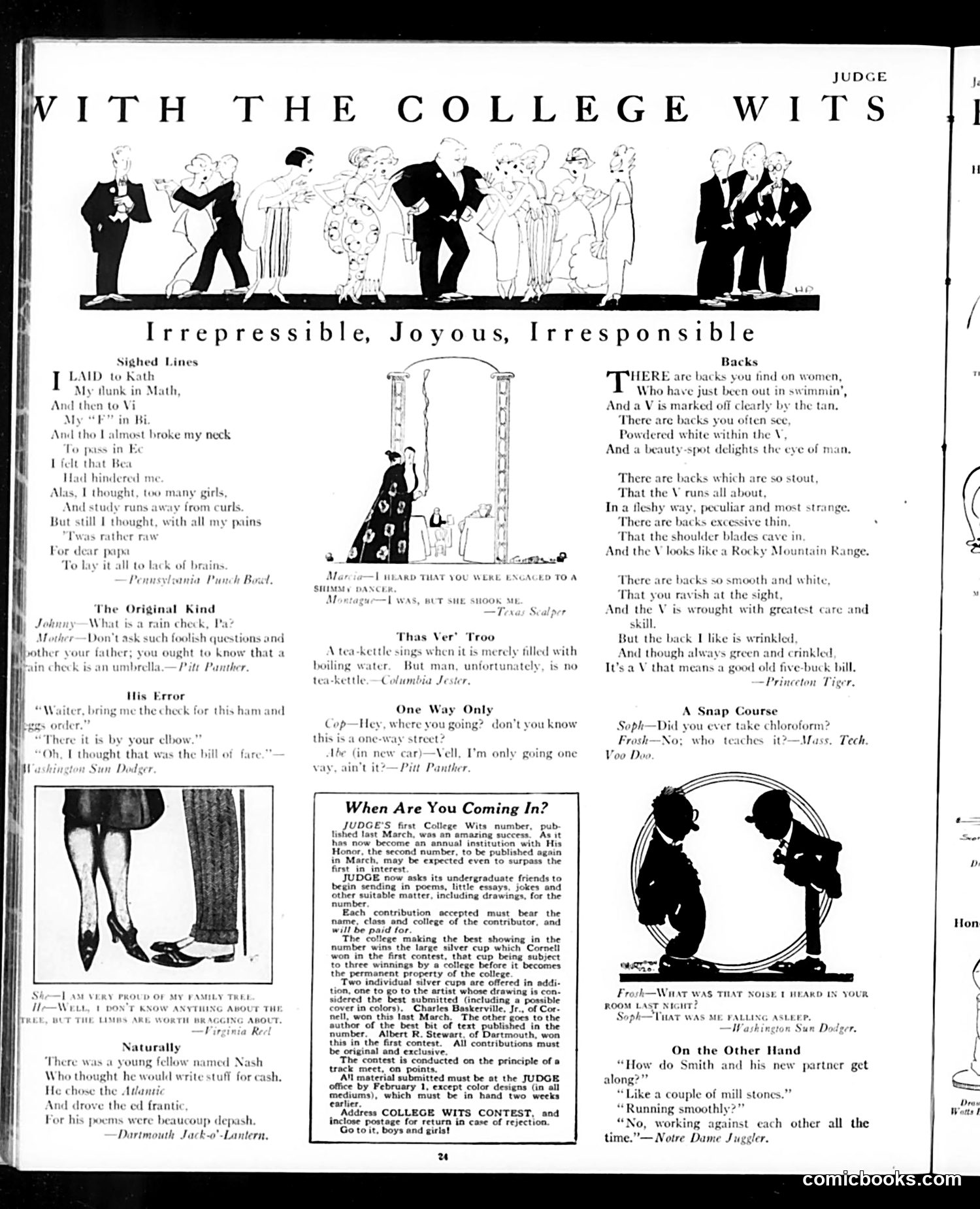
This page showcases Judge's annual college humor contest, featuring undergraduate contributions from various universities. The content reflects early 20th-century collegiate culture through comedic poems, quips, and drawings submitted by students. The satirical pieces mock typical college experiences: academic struggles ("I flunk in Math"), social hierarchies, and romantic pursuits. Notable sections include humorous takes on "rain checks," one-way streets, and flirtation. Several poems employ descriptive humor about women's physical appearance, reflecting period attitudes. The page announces Judge's second annual "College Wits" competition, offering cash prizes and silver cups to winning contributors and their institutions. This transformed undergraduate satire into a prestigious, competitive national event. The contest's competitive framing between colleges—with Cornell having "won" the previous year—added prestige to student humor writing during the era. Overall, this represents Judge leveraging collegiate comedy as both entertainment and a platform for emerging young writers.
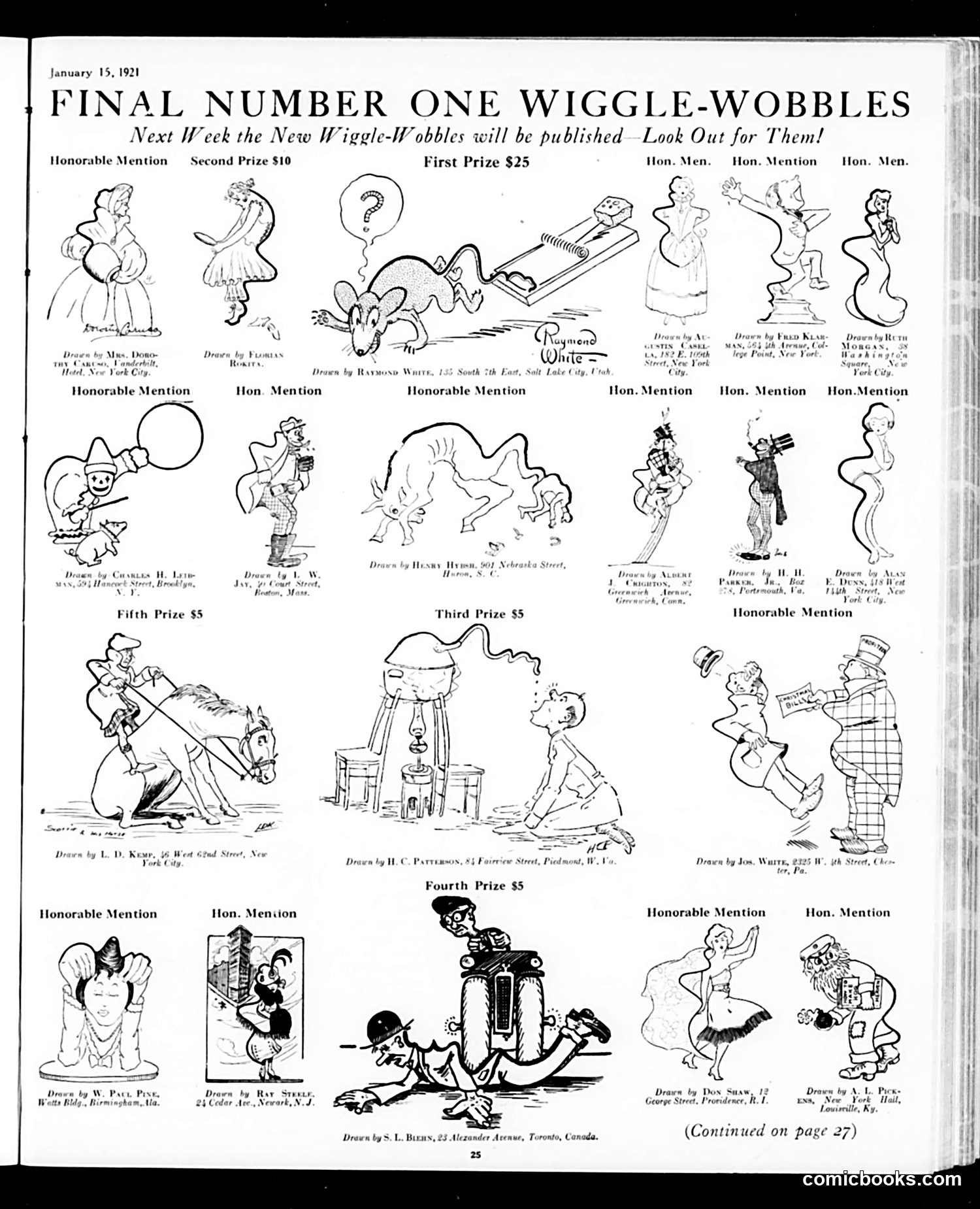
This page from Judge magazine (January 15, 1921) announces the **final issue of a cartoon contest called "Wiggle-Wobbles,"** with prizes totaling $25 for the top entries. The page displays winning and honorable-mention cartoons submitted by readers nationwide. The cartoons themselves are simple humorous drawings—mostly depicting exaggerated human or animal figures in absurd situations (a woman with a large head, a character riding an oversized motorcycle, whimsical creatures). They lack sophisticated political commentary; instead, they represent amateur comic submissions showcasing early 20th-century American cartooning styles. The "Wiggle-Wobbles" contest appears to be a lighthearted reader-participation feature, with the magazine promoting a new cartoon series launching the following week. This was typical of Judge's interactive content during the 1920s, offering ordinary Americans an outlet for amateur artistic expression and modest cash prizes—making this essentially a historical precursor to modern online art contests.
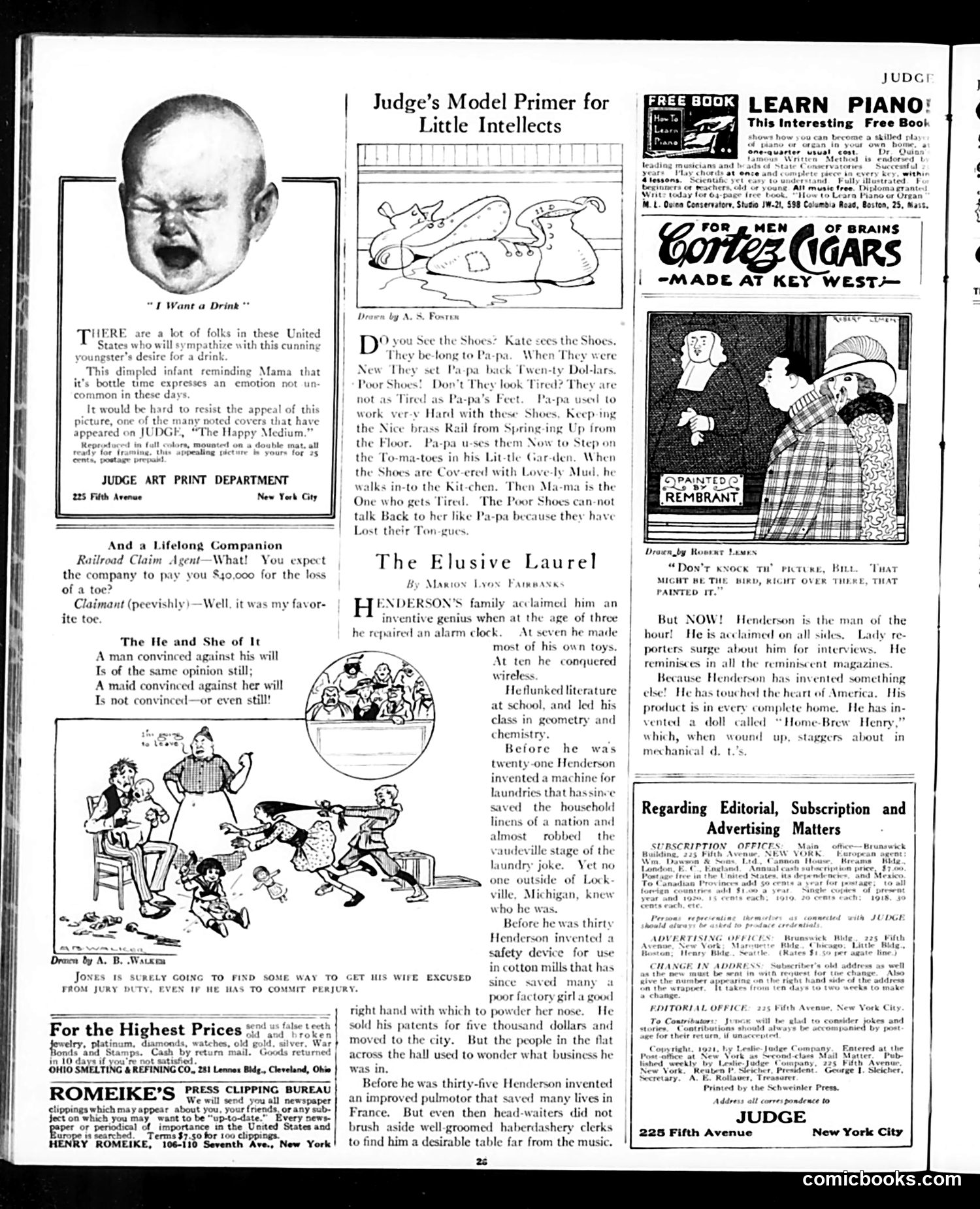
This page combines satirical commentary with humor about American inventors and domestic life, circa early 20th century. **"Judge's Model Primer"** parodies children's educational primers through a cynical domestic narrative: a worn-out shoe that once cost twenty dollars now serves for stepping on tomatoes and muddy garden work—a joke about marital frustration and the wife's exasperation when her husband tracks filth indoors. **"The Elusive Laurel"** satirizes Henderson, an apparently prolific inventor (alarm clocks, wireless, laundry machines, safety devices, pulmotors) whose innovations save lives and labor—yet society ignores him. Head-waiters don't recognize him; he remains unknown outside his hometown. The satire targets America's failure to honor genuine innovators while celebrating fame and status. The story concludes that his *real* breakthrough is inventing "Home-Brew Henry," a mechanical doll—suggesting ironic social values that prize novelty over substantive achievement. The page's other cartoons mock marriage dynamics and jury duty excuses.
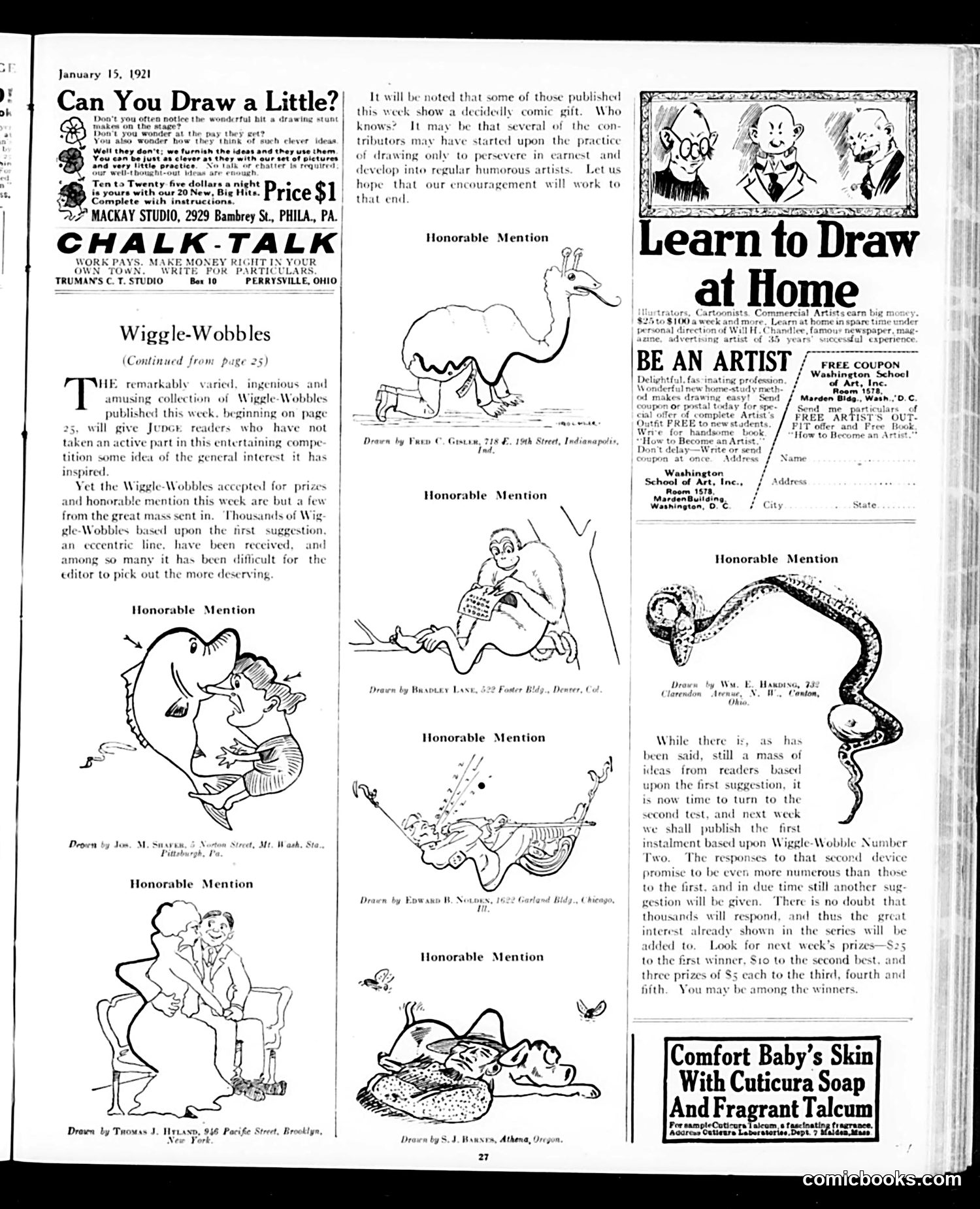
This page documents an ongoing **drawing competition** called "Wiggle-Wobbles" in Judge magazine. The contest invites readers to create finished cartoons from eccentric starter lines, with cash prizes ($25, $10, and multiple $5 awards). The page shows **honorable mention entries**—amateur and semi-professional submissions depicting various humorous scenarios: a large figure with a small child, someone climbing, a snake, a woman with a baby, and a person in bed. The accompanying text notes thousands of entries were received from the first "test," and announces a second test coming next week based on a new eccentric line. This reflects Judge's role in **cultivating amateur cartoonists** and humor contributors during the 1920s. The contest served dual purposes: generating content, engaging readers, and potentially discovering new professional talent. The emphasis on "encouragement" suggests Judge hoped contest participants might develop into "regular humorous artists."
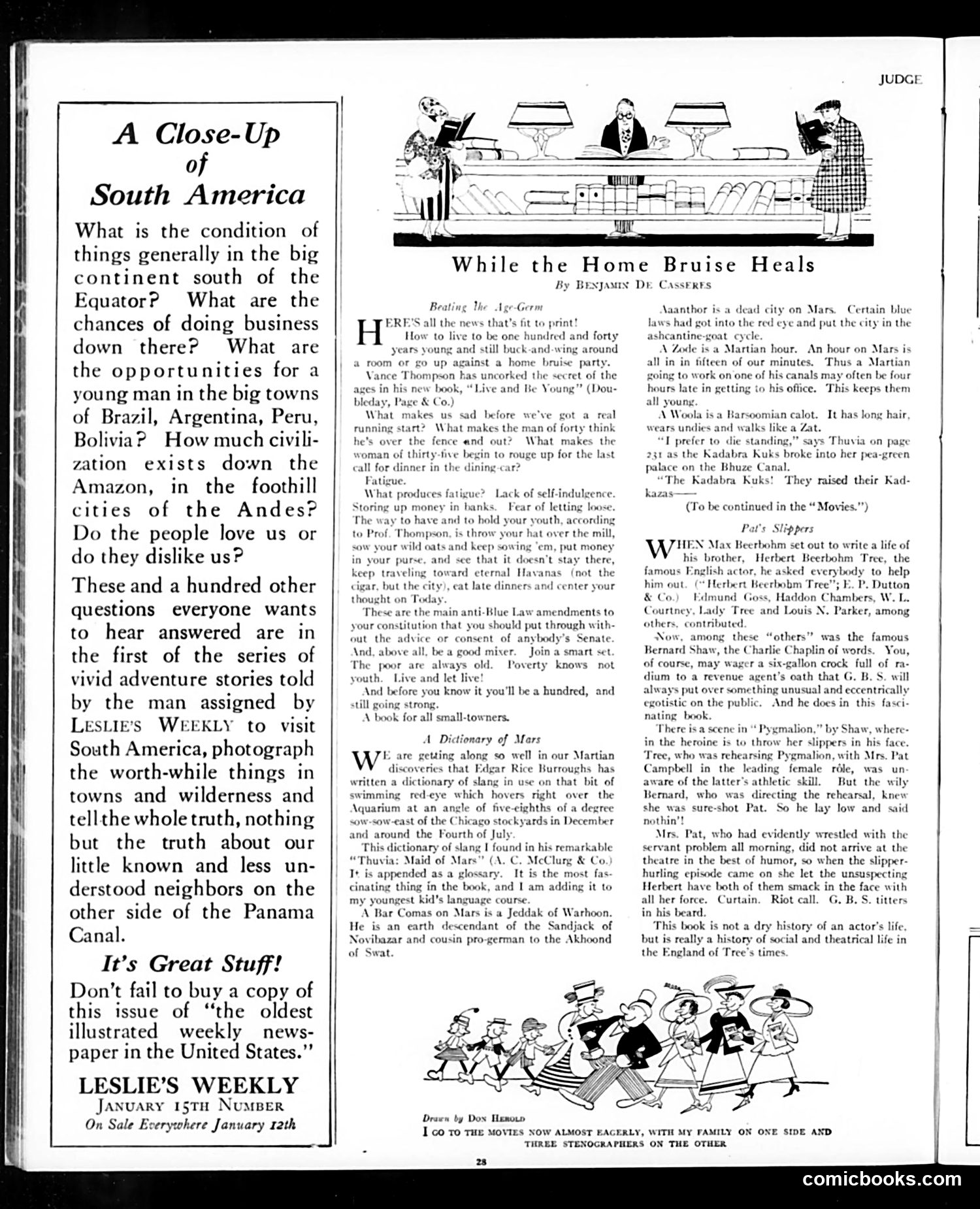
This page is primarily **advertising and promotion** rather than political satire. The main content announces Leslie's Weekly magazine's upcoming series on South America—promising firsthand reporting on business opportunities, civilization, and American relations with South American nations. The left column uses rhetorical questions to market the series: conditions for commerce, opportunities for young men, and whether South Americans "love or dislike us"—reflecting early 20th-century American commercial and diplomatic interests in the region. The right side contains **book reviews** of popular fiction (works on Mars by Edgar Rice Burroughs, a biography of actor Herbert Beerbohm Tree) and lifestyle advice, unrelated to the South America promotion. The small cartoon at bottom appears to show people at a movie theater—likely promoting motion pictures as entertainment. This is essentially a **magazine table of contents/advertising page**, not political commentary.
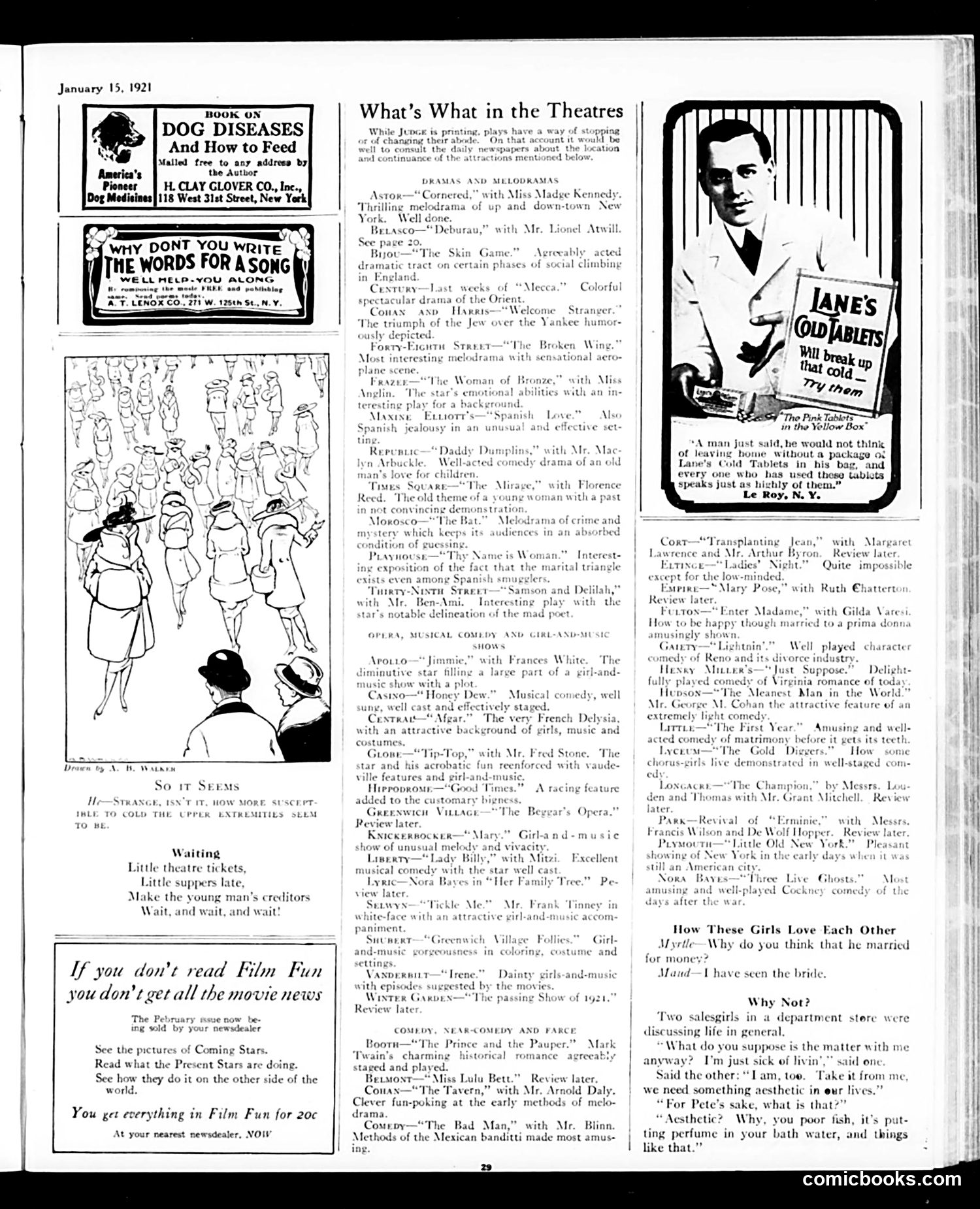
This January 1921 Judge page is primarily **advertising and theatrical listings**, not political satire. The main cartoon "So It Seems" (top left) depicts a courtship scene where a young man waits for a woman, illustrating the caption's joke about how romance involves tedious waiting—likely satirizing modern courtship rituals where men must patiently court women, who hold the social power. The bottom joke "How These Girls Love Each Other" presents two working-class salesgirls discussing their misery and the concept of "aesthetic" living. The humor lies in the absurdity: one suggests that adding perfume to bathwater constitutes living aesthetically—mocking working-class women's attempts at sophistication or refinement they cannot truly afford. It's gentle class satire typical of 1921 humor. The rest of the page comprises theater reviews and ads (dog medicine, songwriting), reflecting Judge's mixed entertainment-publication format.
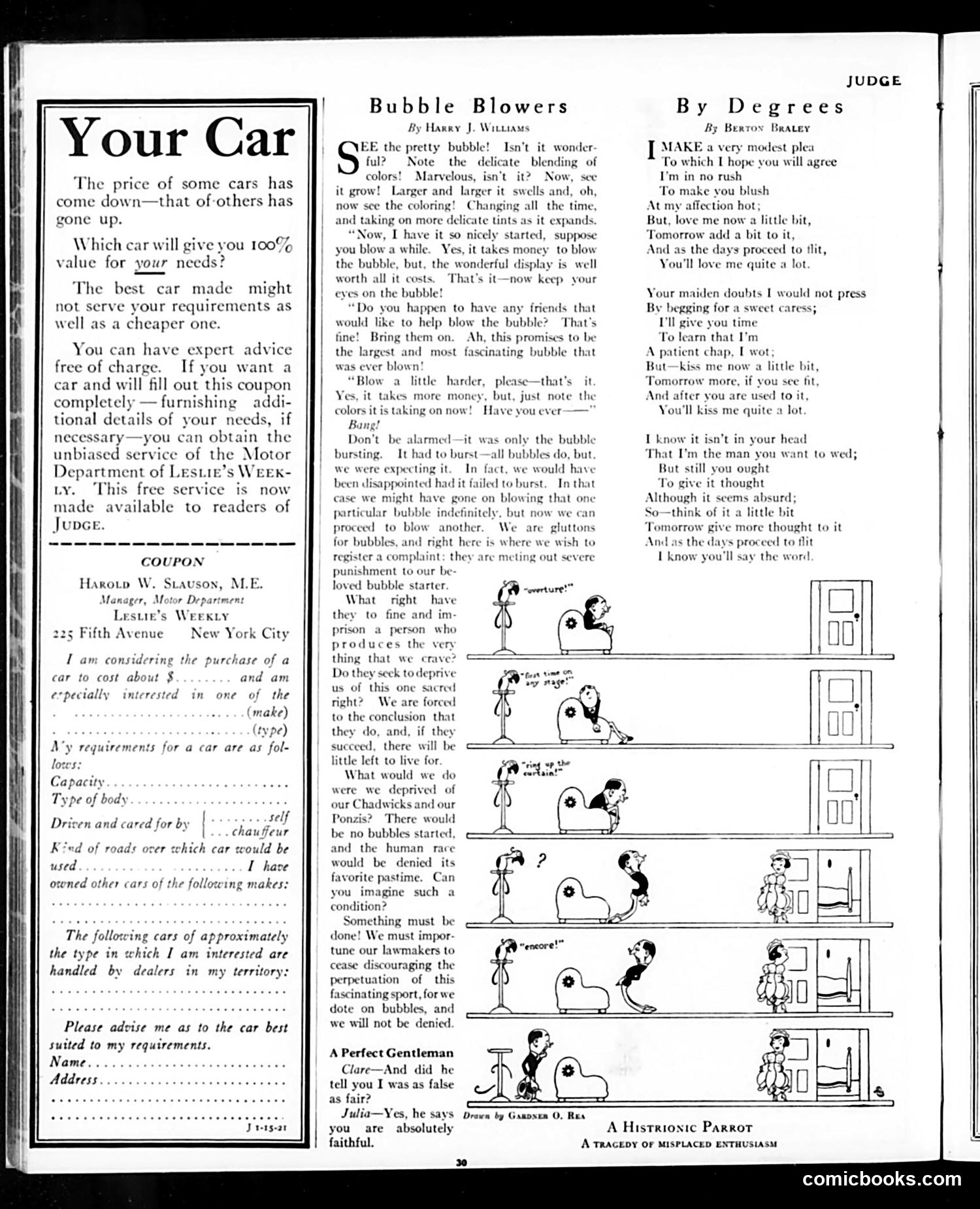
This page from Judge contains satirical commentary on early 20th-century American life through three distinct pieces: **"Bubble Blowers"** (center) is an allegory for financial speculation and fraud. The "bubble" represents speculative investments that inevitably burst. The narrator enthusiastically encourages others to invest money into increasingly inflated schemes, celebrating each expansion until inevitable collapse. The final plea questions why "bubble starters" (promoters of fraudulent schemes) face legal punishment when they produce "the very thing that we crave." The references to "Chadwicks and Ponzis" allude to famous con artists/schemes of that era. The satire mocks both the fraudsters and the public's willing participation in schemes they know will fail. **"By Degrees"** (right) is a lighthearted romantic poem about gradually winning a woman's affection through persistent, incremental gestures—asking for small favors initially, then building toward love and marriage. **"Your Car"** (left) is an advertisement/service offering for Leslie's Weekly's motor department, providing free expert advice on car purchases. The page reflects early 20th-century concerns about financial fraud and market manipulation.
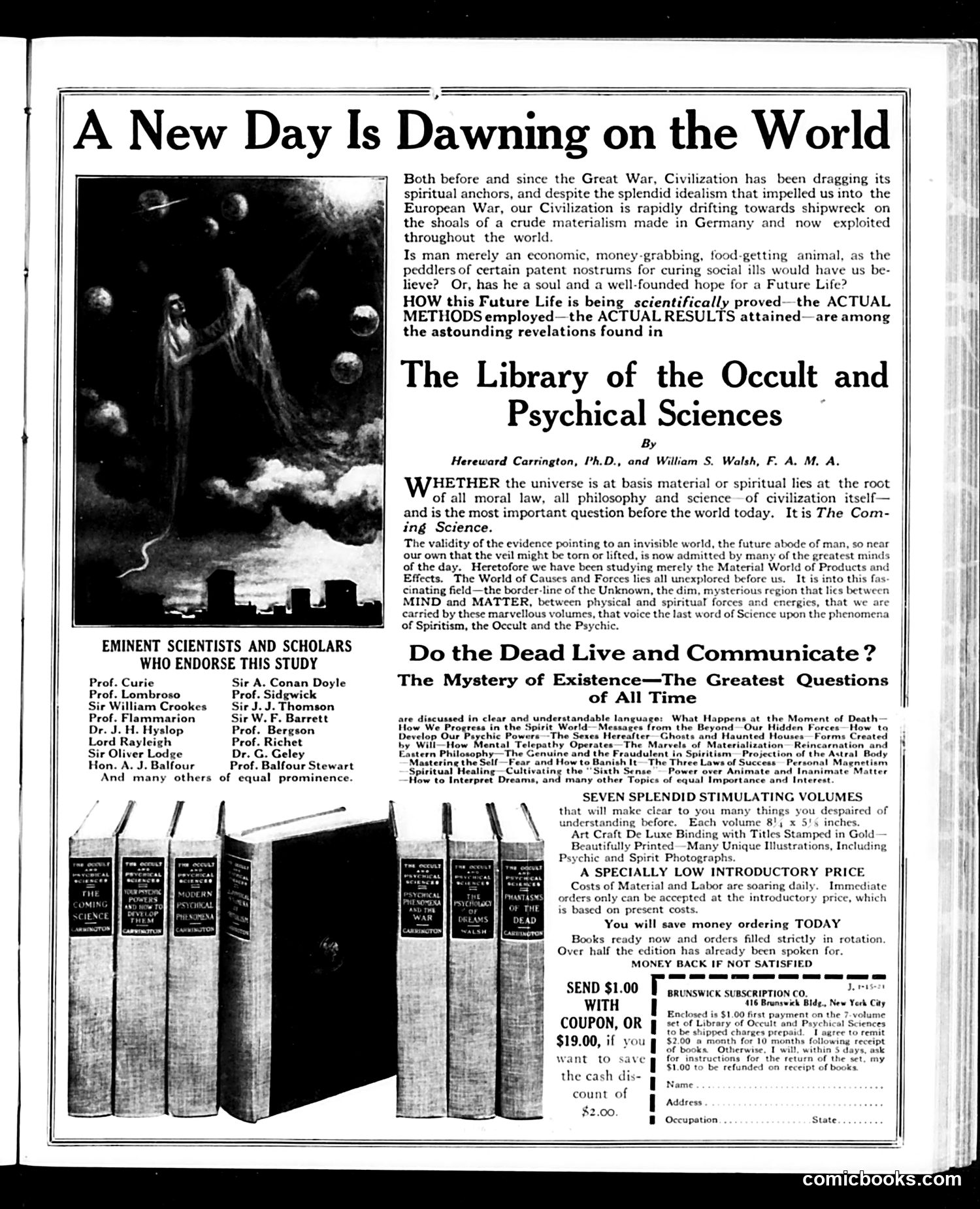
This is primarily **advertising, not satire**—a full-page promotion for "The Library of the Occult and Psychical Sciences," a seven-volume set by Hereward Carrington and William S. Walsh. The ad exploits post-WWI anxieties: it frames materialism (blamed on "Germany") as spiritually corrosive, then positions the book series as scientifically validating spiritualism and afterlife communication. The list of "eminent scientists and scholars" (Curie, Doyle, Thomson, etc.) lends credibility—though notably, many of these figures were genuinely interested in psychical research during this era. The rhetorical move is characteristic of 1920s occult marketing: positioning spiritualism as "science" addressing modern civilization's moral crisis. The "Money Back if Not Satisfied" clause attempts to overcome reader skepticism about such claims. This reflects real historical interest in spiritualism among educated classes post-WWI, not satirical critique of it. The page demonstrates how occultism was commercially packaged and legitimized in early 20th-century America.
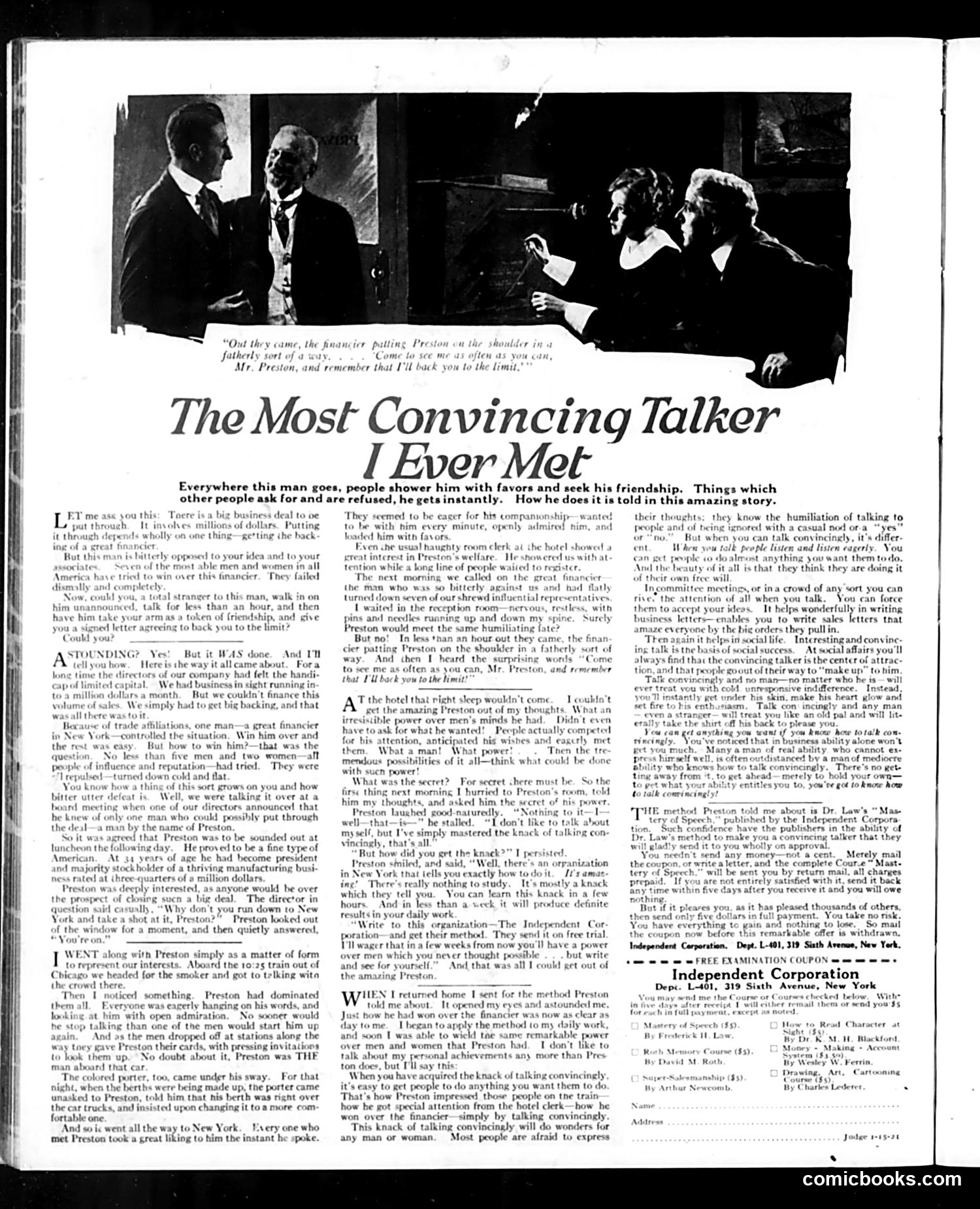
This appears to be a 1910s-era advertorial (advertisement disguised as editorial content) in *Judge* magazine, not a political cartoon. It tells a fictionalized story promoting a correspondence course in persuasion and salesmanship. The narrative follows a mysterious figure named Preston, who possesses an almost magical ability to convince anyone—businessmen, porters, railway passengers—to do his bidding simply through conversation. The text frames this as an achievable skill rather than innate talent, claiming Preston learned a specific "method" or "knack." The satire targets the era's widespread faith in self-improvement schemes and the emerging "success literature" industry. By presenting an impossibly charming protagonist who effortlessly manipulates everyone he meets, the piece both mocks and exploits readers' desires for social and professional advancement. The final call-to-action directs readers to write for the "Free Examination Coupon," revealing the page's true commercial purpose: selling a mail-order course promising similar persuasive powers.