
A complete issue · 32 pages · 1921
Judge — January 8, 1921
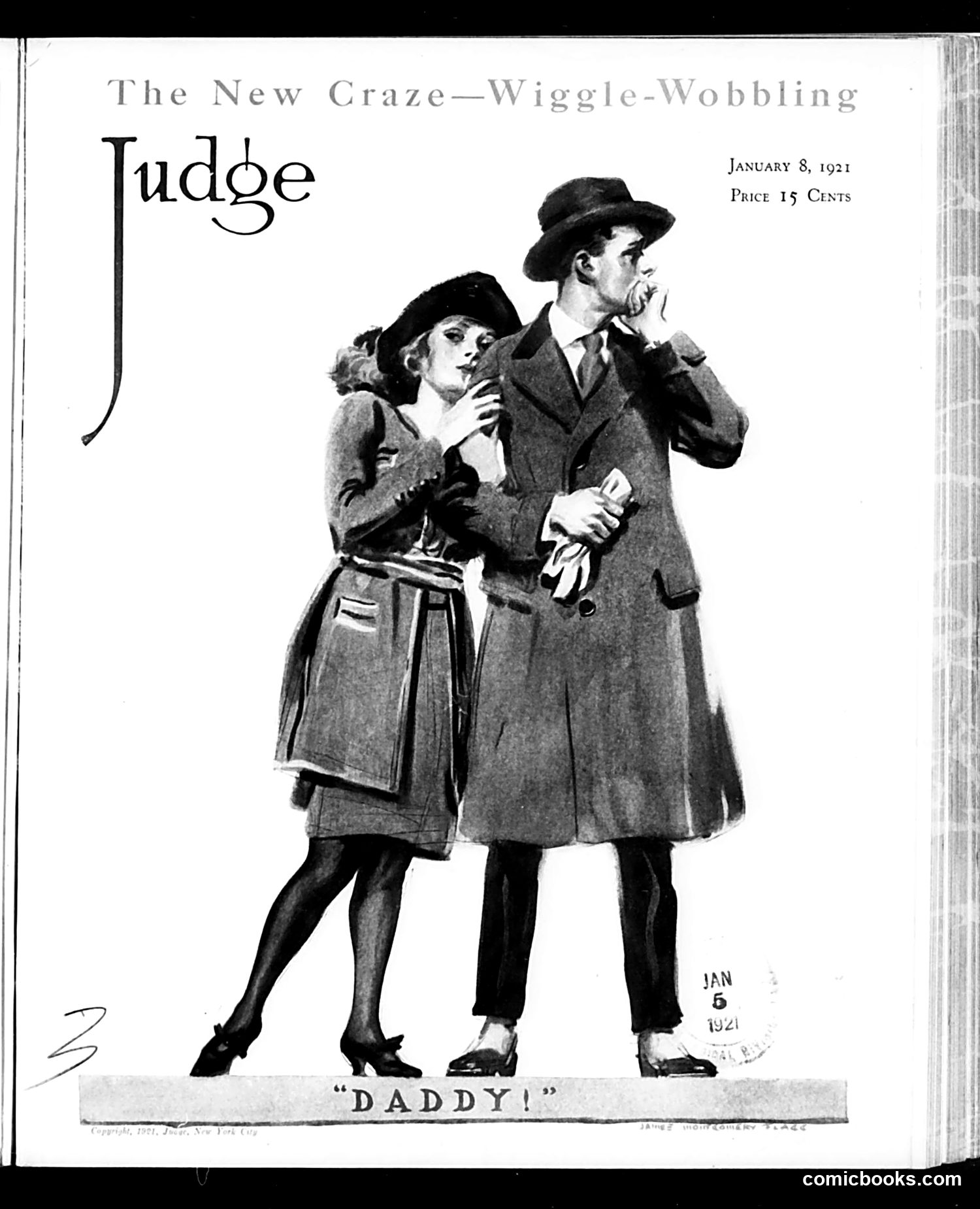
This cover satirizes the "Wiggle-Wobbling" dance craze of the early 1920s. The illustration shows a young couple dancing—the woman in a short skirt with a decorative belt, the man in a suit and bowler hat, both appearing to move in exaggerated, uncoordinated motions. The caption reads "DADDY!" suggesting a parent's shocked reaction to this new dance style. The satire targets generational anxiety about modern youth culture. The "wiggle-wobble" was considered scandalous by older Americans due to its suggestive hip movements and the woman's exposed legs—violations of Victorian propriety. Judge magazine, aimed at middle-class readers, humorously mocks both the absurd appearance of the dance and presumably the parental disapproval it provoked during the Jazz Age.
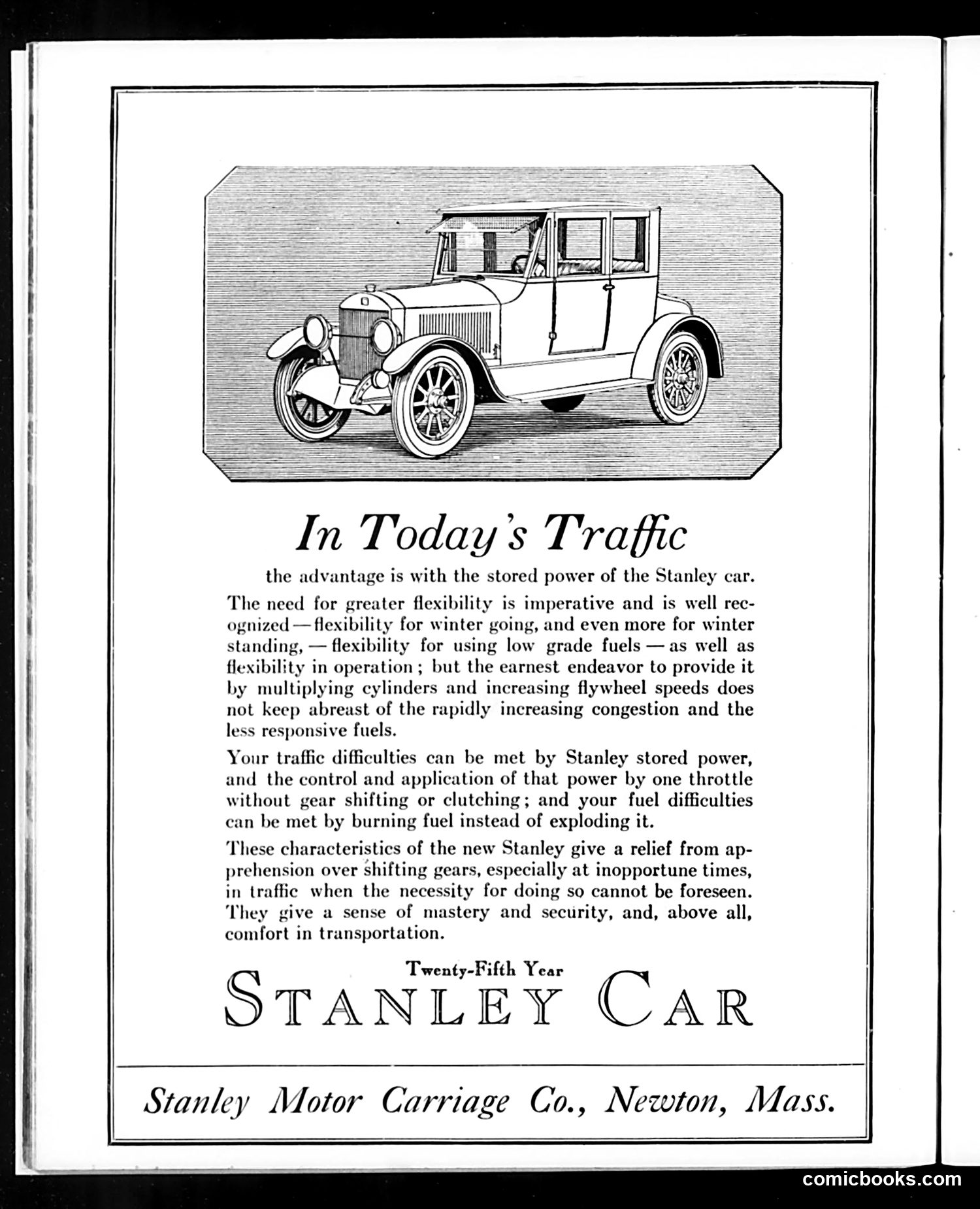
This page is **not a satirical cartoon but a straightforward advertisement** for the Stanley Motor Carriage Company of Newton, Massachusetts. It promotes their "Twenty-Fifth Year" steam-powered automobile. The ad emphasizes the Stanley car's advantages over gasoline vehicles: stored steam power provides flexibility for winter operation, ability to use low-grade fuels, and smooth throttle control without gear shifting—practical benefits for early 1900s urban traffic congestion. The pitch addresses contemporary concerns: difficulty operating gasoline cars in cold weather, unreliable fuel quality, and the challenge of manual gear shifting in congested city driving. The Stanley's steam engine promised simpler, more responsive operation. This represents legitimate competition in the pre-dominance of internal combustion engines—steam cars were viable alternatives until circa 1910-1920.
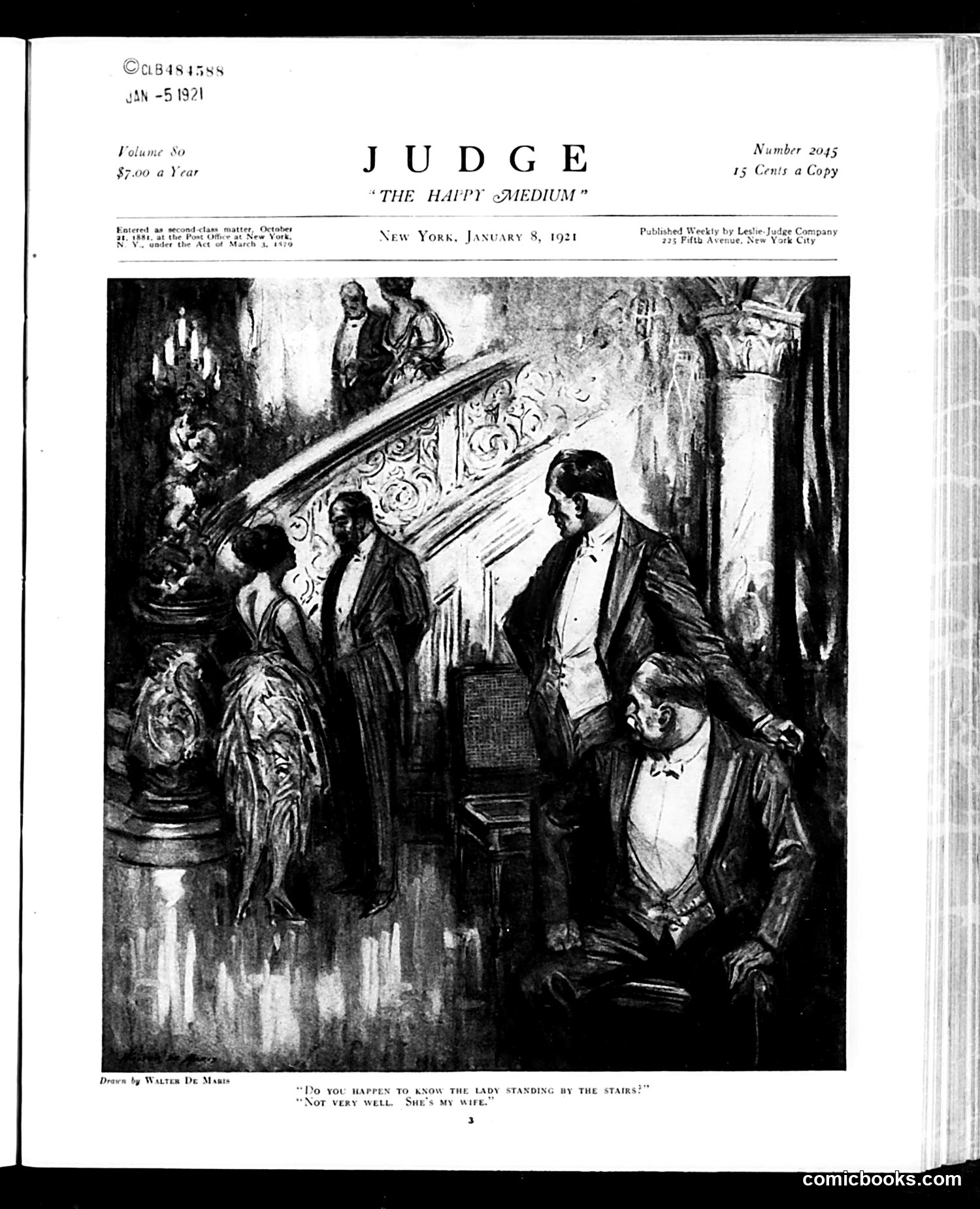
This illustration by Walter De Maris depicts a formal social scene—likely an upscale party or gathering—where a man is introducing or presenting a woman to others. The caption reads: "Do you happen to know the lady standing by the stairs?" / "Not very well. She's my wife." The joke relies on a common satirical theme of the era: the emotional distance in upper-class marriages. The humor suggests the man is so disconnected from his wife that he barely "knows" her, despite their marital bond. This reflects 1920s anxieties about wealth, social climbing, and the superficiality of high society—where people present themselves as strangers despite intimate relationships. The elaborate setting emphasizes the formal, performative nature of such social interactions.
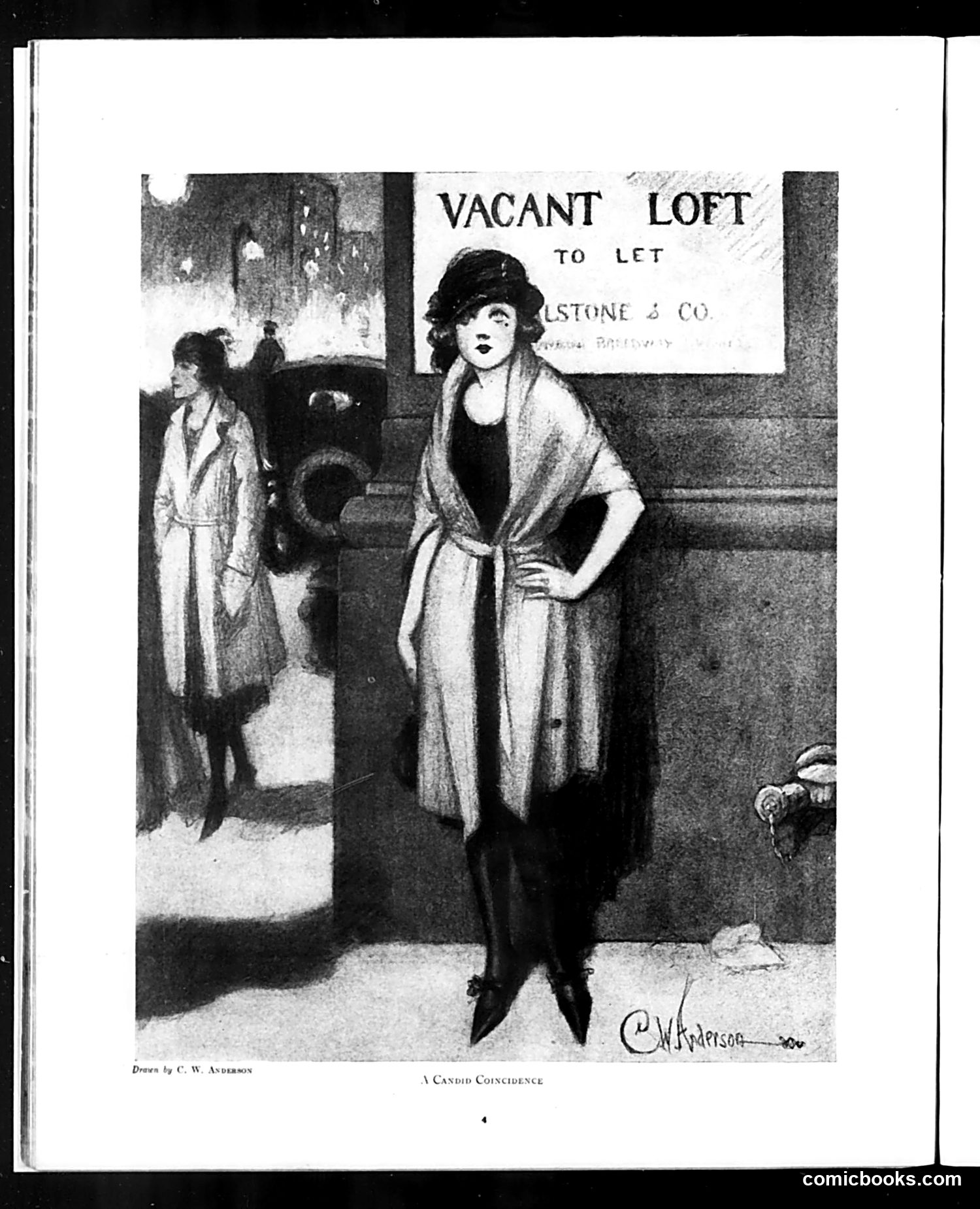
This cartoon, drawn by C.W. Anderson for *Judge* magazine, satirizes housing shortages and homelessness, likely from the 1920s-1930s era. The sign advertises a "Vacant Loft to Let" through Stone & Co., yet a well-dressed woman stands prominently in front of it, apparently homeless or without housing despite available space. The title "A Candid Coincidence" suggests ironic commentary: there's housing available, yet people remain without homes. The woman's fashionable appearance and posture contrast sharply with her apparent housing crisis, heightening the satire about economic inequality and the disconnect between available resources and actual access to them—a common *Judge* theme criticizing social and economic dysfunction.
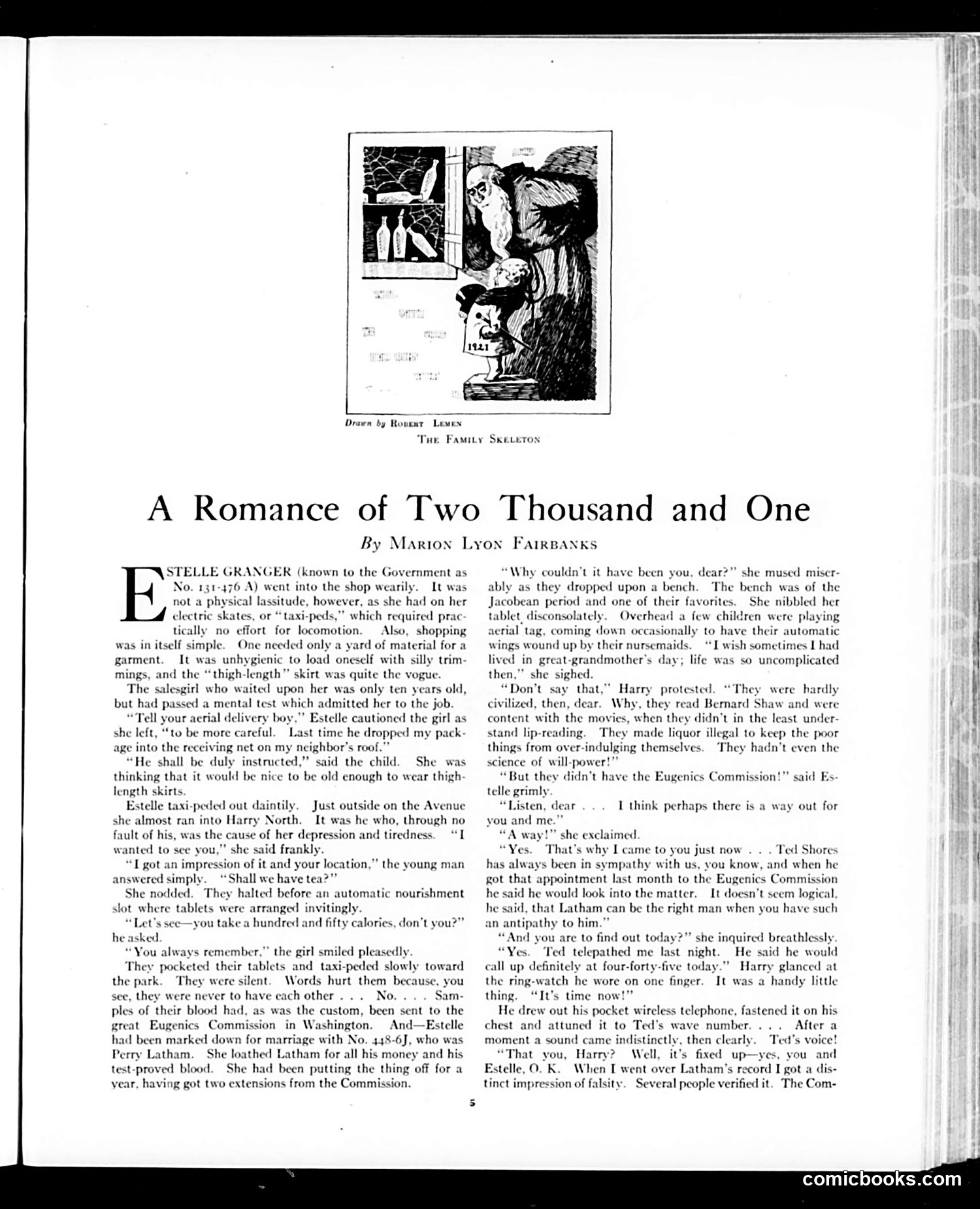
This woodcut illustration by Robert Lemes titled "The Family Skeleton" appears above a short story by Marion Lyon Fairbanks titled "A Romance of Two Thousand and One." The cartoon depicts a skeletal figure emerging from or hidden within what appears to be a domestic interior, with smaller vignette panels above showing additional scenes. The imagery plays on the common idiom "skeleton in the closet"—a family secret or shameful history that people hide from public view. The cartoon's placement above a romantic story suggests it may satirize middle-class pretensions or hypocrisy: families presenting respectable facades while harboring embarrassing truths. The grotesque skeleton contrasts with the apparently civilized domestic setting, reinforcing the satirical point about hidden scandals beneath proper appearances—a recurring theme in Judge magazine's social commentary.
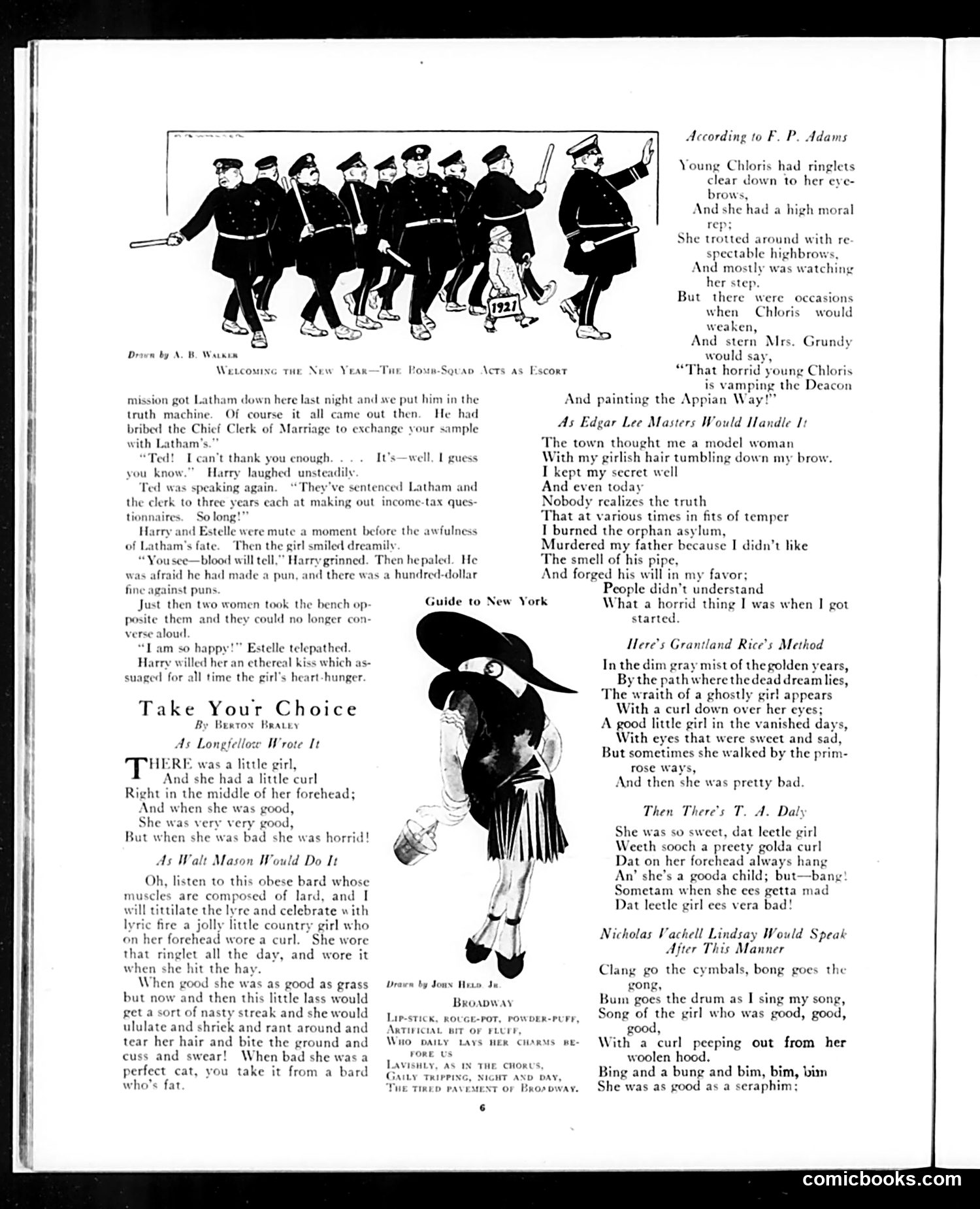
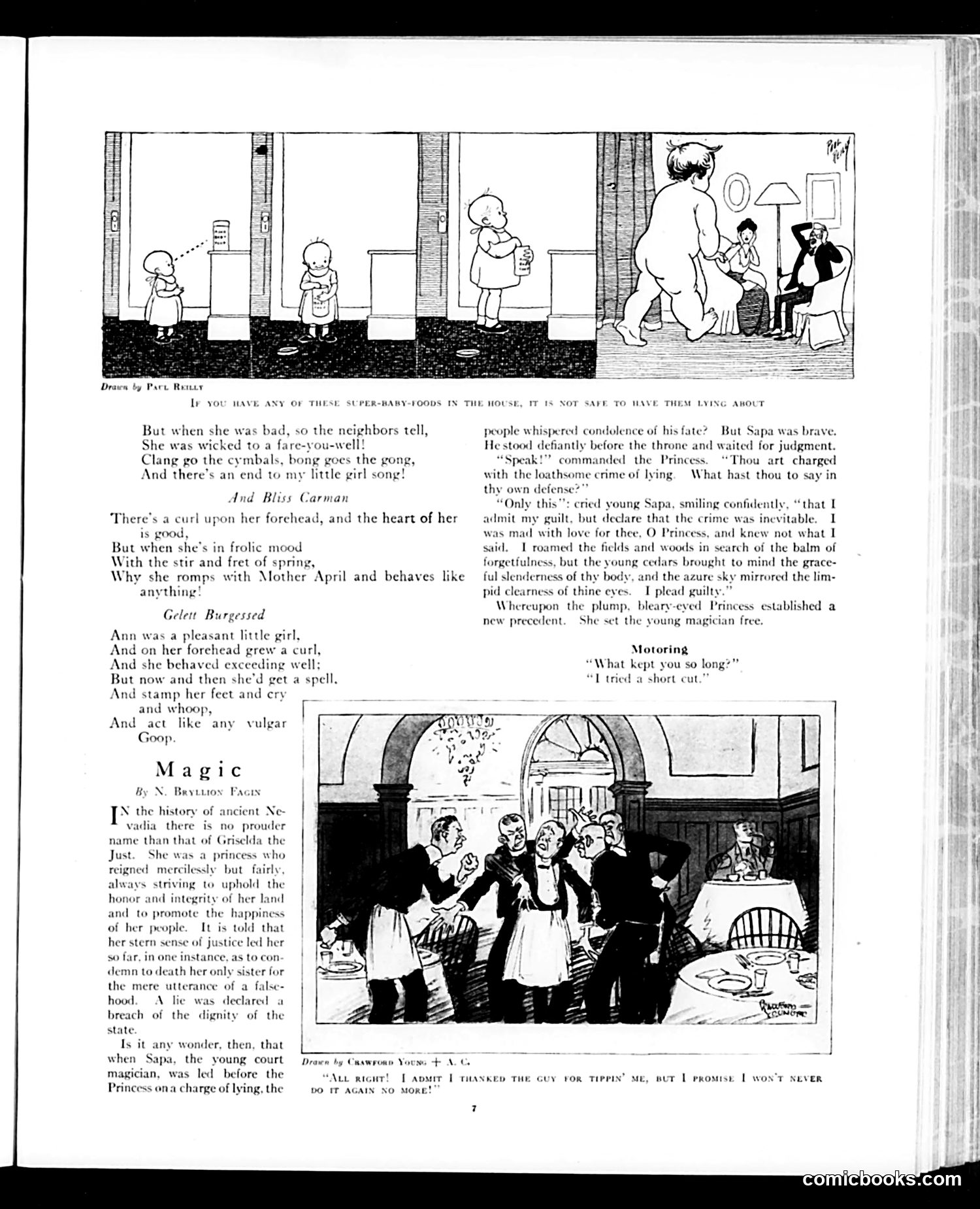
This page contains three unrelated pieces typical of early 20th-century Judge magazine: **Top section:** Poems about misbehaving girls (credited to Bliss Carman and Gelett Burgess), illustrated with a comic strip about children's behavior. The "super-baby-foods" caption suggests satirizing commercial products marketed to parents. **"Magic" story:** A fairy tale parody about Princess Griselda of ancient Nevania. A young court magician named Sapa is condemned for lying. He escapes execution by charming the "plump, bleary-eyed Princess" with romantic flattery about nature reminding him of her body. The satire mocks both rigid legal systems and women's susceptibility to manipulation. **"Motoring" caption:** A brief joke about someone taking a wrong turn while driving—typical humor about automobiles, then still relatively novel. The page reflects early-1900s American satirical humor: poking fun at parenting anxieties, legal rigidity, gender stereotypes, and modern technology.
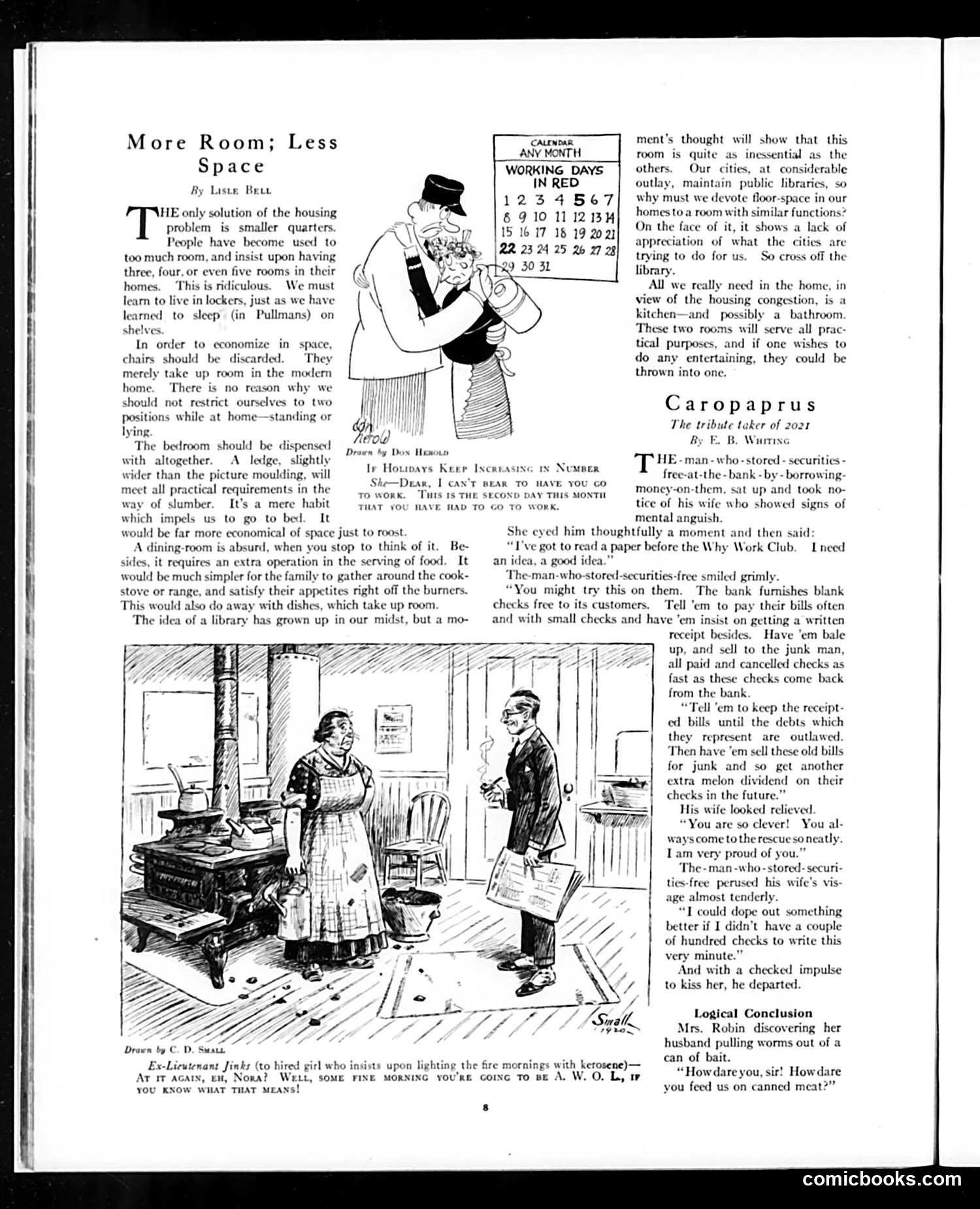
This Judge magazine page satirizes early 20th-century housing scarcity through absurdist humor. The main article "More Room; Less Space" mocks proposals to solve the housing crisis by eliminating furniture and rooms entirely—suggesting people discard chairs, sleep on ledges instead of beds, eliminate dining rooms, and remove libraries from homes. The satire critiques the era's severe housing shortage by showing how far such "economizing" logic could extend. The secondary story "Caropaprus" depicts a financially struggling man who discovered a scheme: accumulating small canceled checks to sell as scrap metal, generating profit. His wife admires his cleverness while he ironically considers abandoning the scheme—not from principle, but because writing hundreds of checks is tedious. Both pieces target urban housing congestion and working-class financial desperation of the period, using exaggeration and dark humor to expose the absurdity of proposed solutions and the desperation driving ordinary people toward questionable schemes.
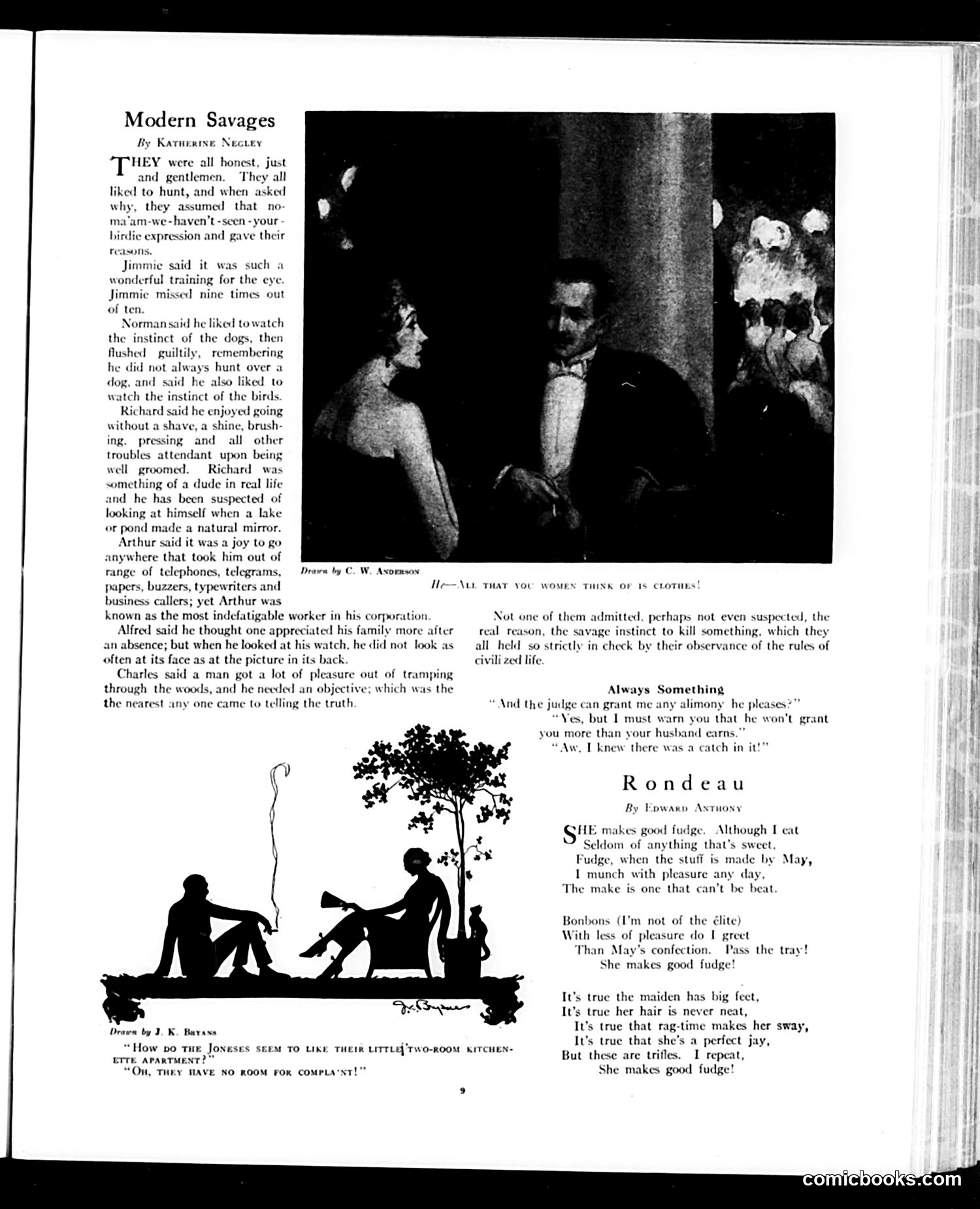
**"Modern Savages"** satirizes wealthy businessmen who rationalize their hunting trips through self-deceptive excuses. Each man claims noble reasons—training, observation, escape from grooming—but the story's point (stated plainly by Charles) is that they simply enjoy the primal urge to kill, which "civilized" society forbids them to admit. The irony: these respectable professionals are driven by savage instincts they won't acknowledge. **The cartoon** (by C.W. Axelson) shows a woman confronting men holding a dead bird, captioning "All that you women think of is clothes!"—suggesting men dismiss female concerns as trivial while hiding their own brutish hunting compulsions. **"Always Something"** jokes about divorce alimony: a woman seeks maximum payment until warned the judge won't grant more than her husband earns—the "catch" being financial reality limits her settlement. **"Rondeau"** praises a woman's fudge-making despite her physical flaws (big feet, messy hair, poor taste in music), suggesting character outweighs appearance—a gentler satirical comment on male priorities.
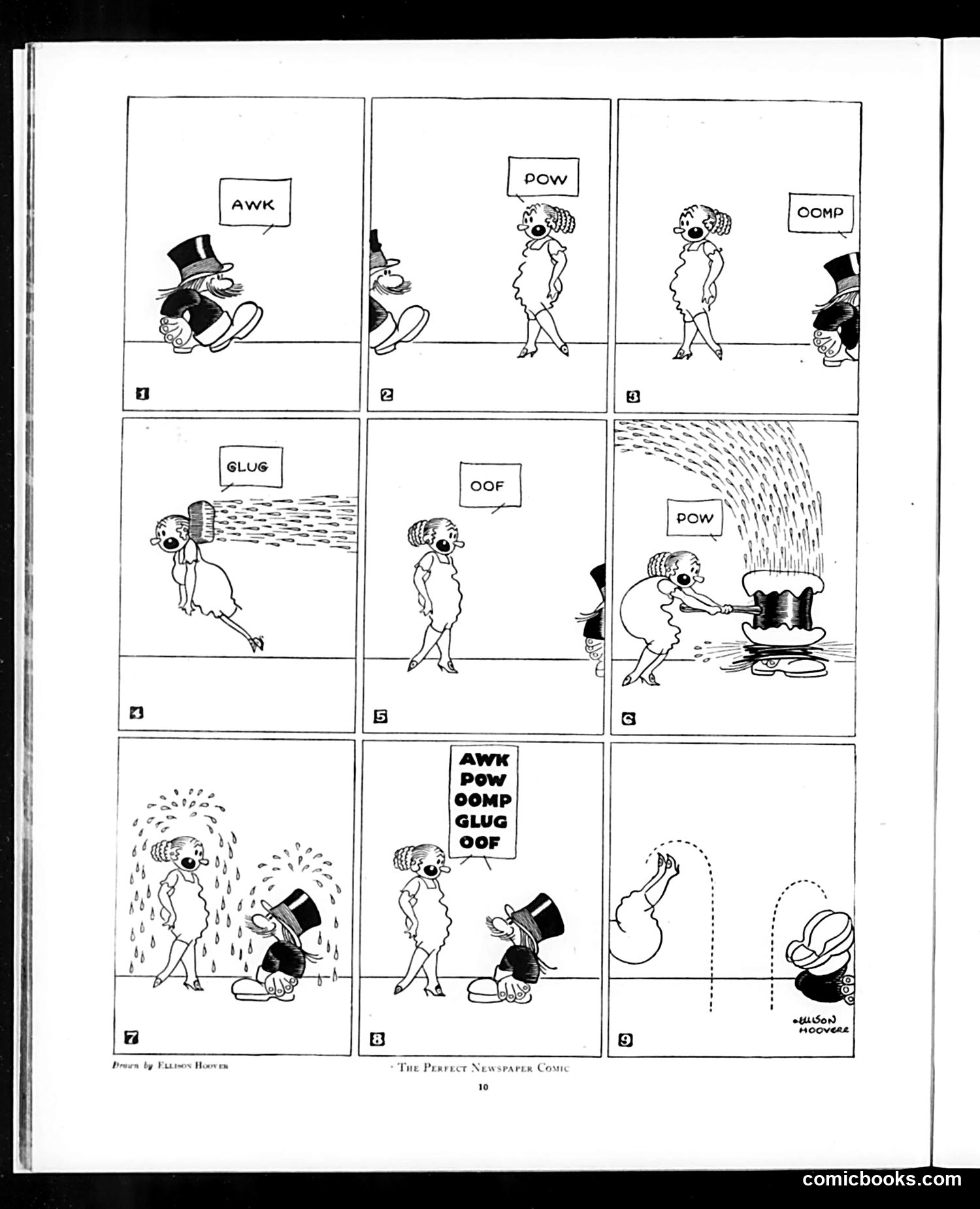
This is a single-panel comic strip by Ellison Hoover satirizing newspaper comics' reliance on sound effects and onomatopoeia. The strip shows a woman repeatedly performing exaggerated actions while a man in a top hat responds with increasingly absurd sound-effect words: "AWK," "POW," "OOMP," "GLUG," "OOF," and finally listing them all together ("AWK POW OOMP GLUG OOF"). The satire targets how some comic strips prioritize loud, attention-grabbing noises and physical comedy over actual plot or dialogue. The woman's meaningless gestures paired with the man's collection of exclamations mock comics that substitute genuine humor for crude sound effects meant to entertain readers. It's a critique of what Hoover considers "perfect" newspaper comics—ones driven purely by noise rather than wit or storytelling.
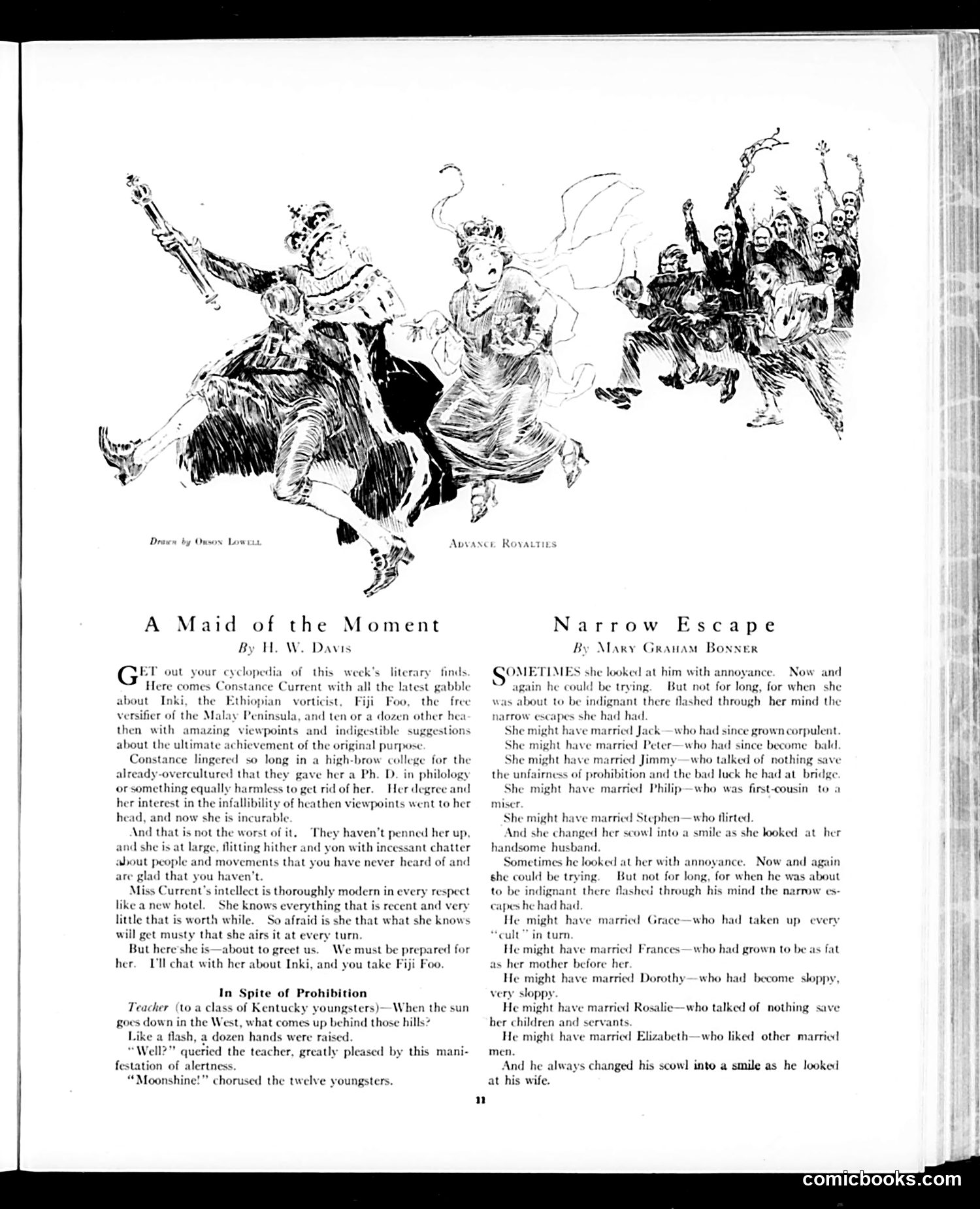
This page contains three satirical pieces typical of early 20th-century American humor: **"A Maid of the Moment"** mocks intellectual pretension. "Constance Current" represents over-educated women obsessed with obscure literary trends (Ethiopian vorticists, Fiji poets). The satire targets her Ph.D. in philology as useless knowledge that makes her insufferable at social gatherings, chattering about obscure movements no one cares about. She embodies the "thoroughly modern" intellectual who knows only current fads, nothing of lasting worth. **"In Spite of Prohibition"** is a Kentucky whiskey joke. Teachers ask what rises behind western hills at sunset; students immediately shout "moonshine"—revealing that illegal liquor production was so prevalent in Kentucky that children knew the term intimately. This mocks Prohibition's obvious failure. **"Narrow Escape"** presents a couple grateful for their marriage, each reflecting on worse alternatives—fat exes, fortune-hunters, cult-followers. The humor relies on mild domestic cynicism about marriage. The cartoon at top illustrates royalty celebrating, likely accompanying these pieces thematically.
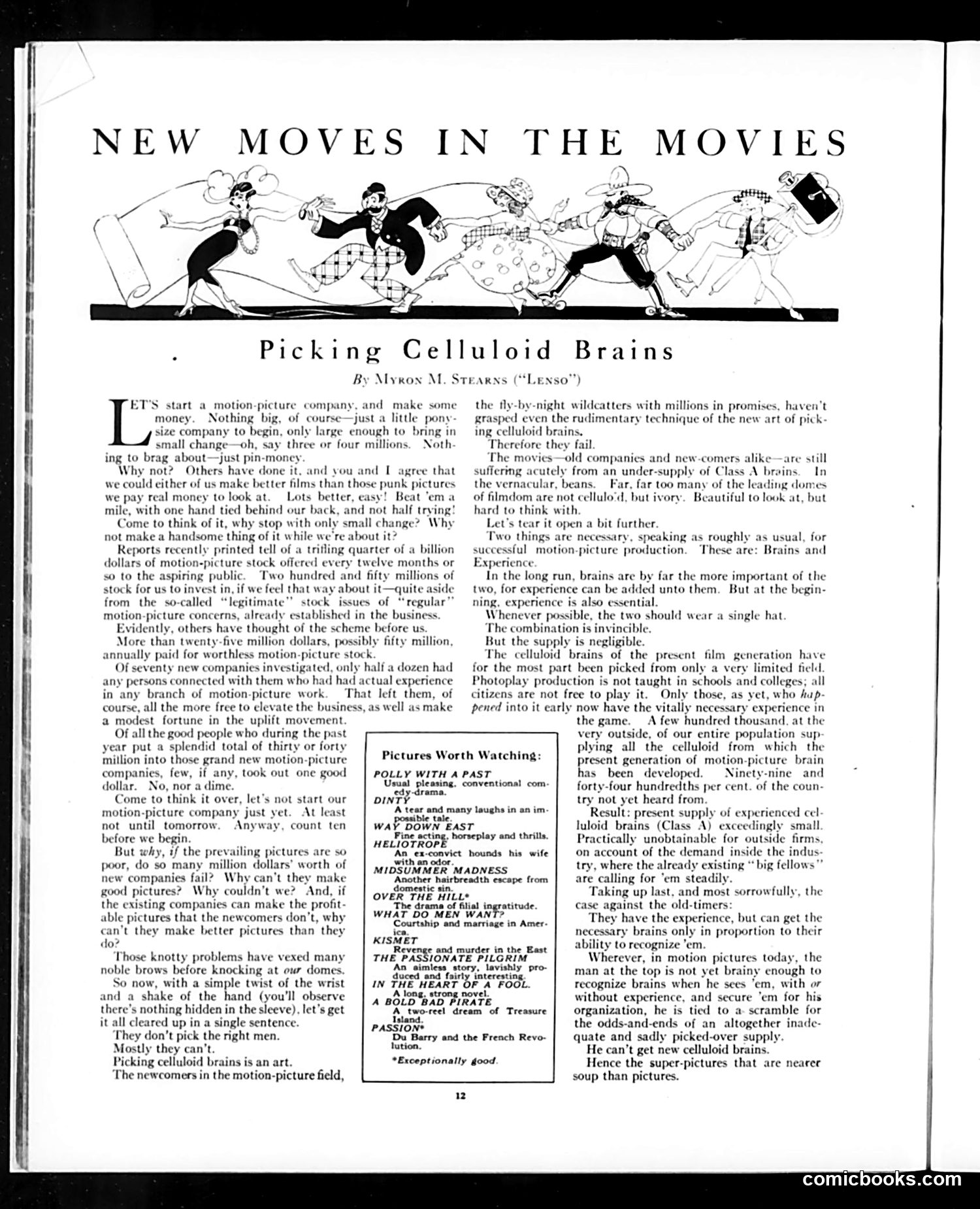
This article by Myron M. Stearns satirizes the early 1920s motion-picture industry's explosive growth and rampant stock fraud. The piece mocks get-rich-quick schemes: would-be filmmakers confidently claim they could make better movies than existing studios while knowing nothing about production. Stearns exposes that of newly investigated film companies, only half had any actual industry experience, yet investors poured "$25-50 million annually" into worthless stock. The satire's central joke: these inexperienced operators lack "celluloid brains"—expertise—yet proceed anyway. The article argues that successful filmmaking requires both brains (intelligence/creativity) and experience, preferably combined in one person. However, only a tiny fraction of America's population possessed actual film production knowledge, creating chronic shortages of qualified talent. The accompanying sidebar lists films "worth watching," suggesting legitimate alternatives to speculative investments in fly-by-night production companies preying on eager investors.
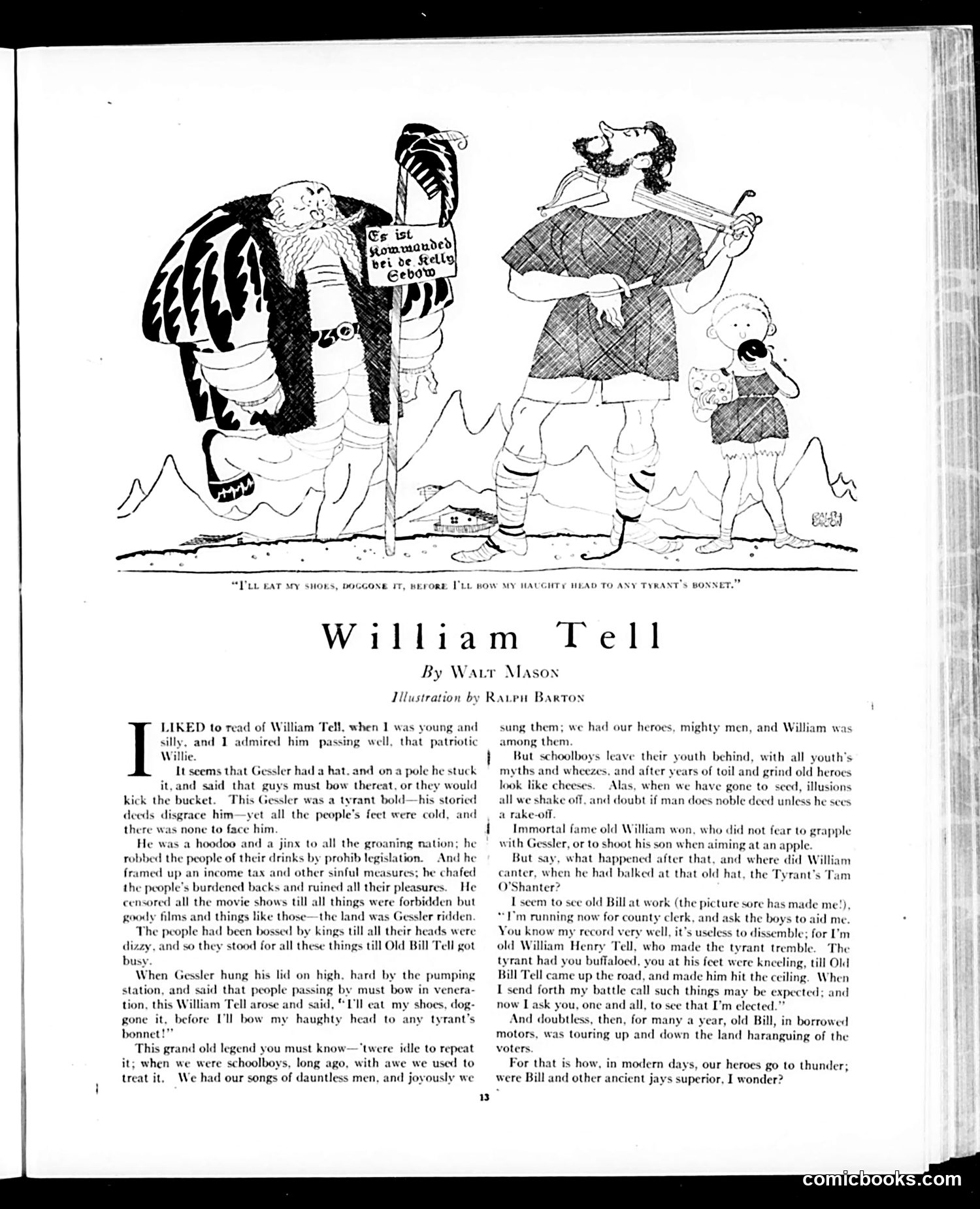
This piece satirizes how historical heroes lose their luster in modern politics. The text draws a parallel between the legendary William Tell—who resisted tyranny—and a contemporary politician exploiting that same heroic narrative for electoral gain. The cartoon illustrates Tell as a folkloric rebel defying an oppressive ruler. But the accompanying essay subverts this: it notes that once Tell "balanced at that old hat, the Tyrant's O'Shanter," he immediately transforms into a cynical candidate running for county clerk, borrowing cars to campaign and asking constituents to vote for him. The satire's point: American politicians invoke patriotic legend and resistance to tyranny while actually pursuing personal power through the same corrupt machinery (patronage, borrowed resources, self-promotion). The heroes of youth become indistinguishable from the tyrants they supposedly opposed—proving that principle yields to practical ambition in modern politics.
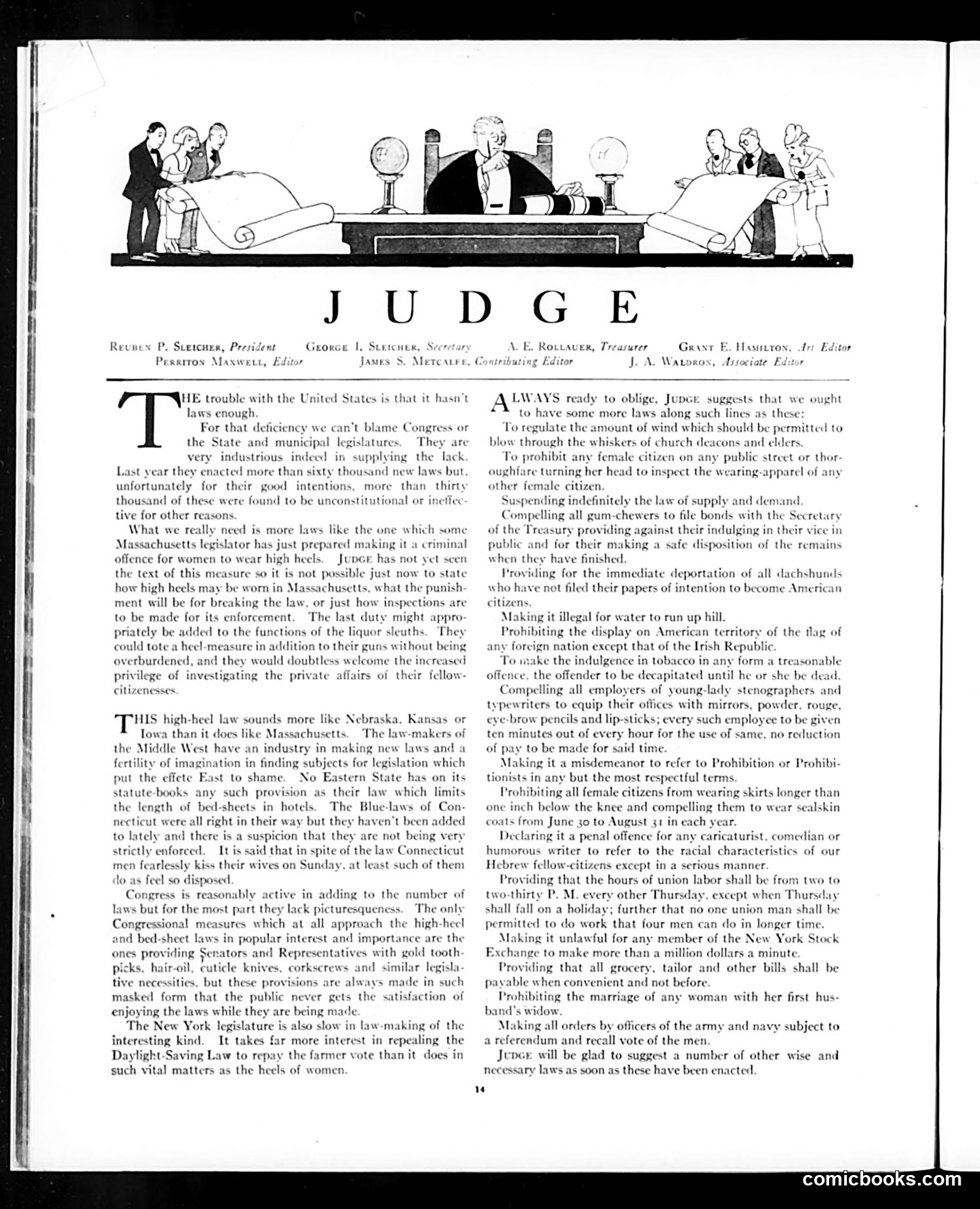
This editorial cartoon satirizes America's obsession with passing laws—particularly absurd ones. The illustration shows a judge presiding over a legislative bench, representing the judiciary's role reviewing unconstitutional laws. The article mocks recent legislative excess: Massachusetts proposed criminalizing women wearing high heels, while the Midwest passed equally bizarre statutes (like limiting bed-sheet length in hotels). Judge argues these laws reveal legislators' "fertility of imagination" applied to trivial matters rather than genuine governance. The satire peaks in suggested "laws along such lines as these": regulating wind through clergymen's beards, prohibiting women from examining each other's clothing, deporting dachshunds lacking citizenship papers, and forcing gum-chewers to file bonds. The message: legislators produce 60,000 new laws annually—most unconstitutional—while focusing on ridiculous personal regulations rather than substantive governance. This critiques governmental overreach into private behavior disguised as "reform."
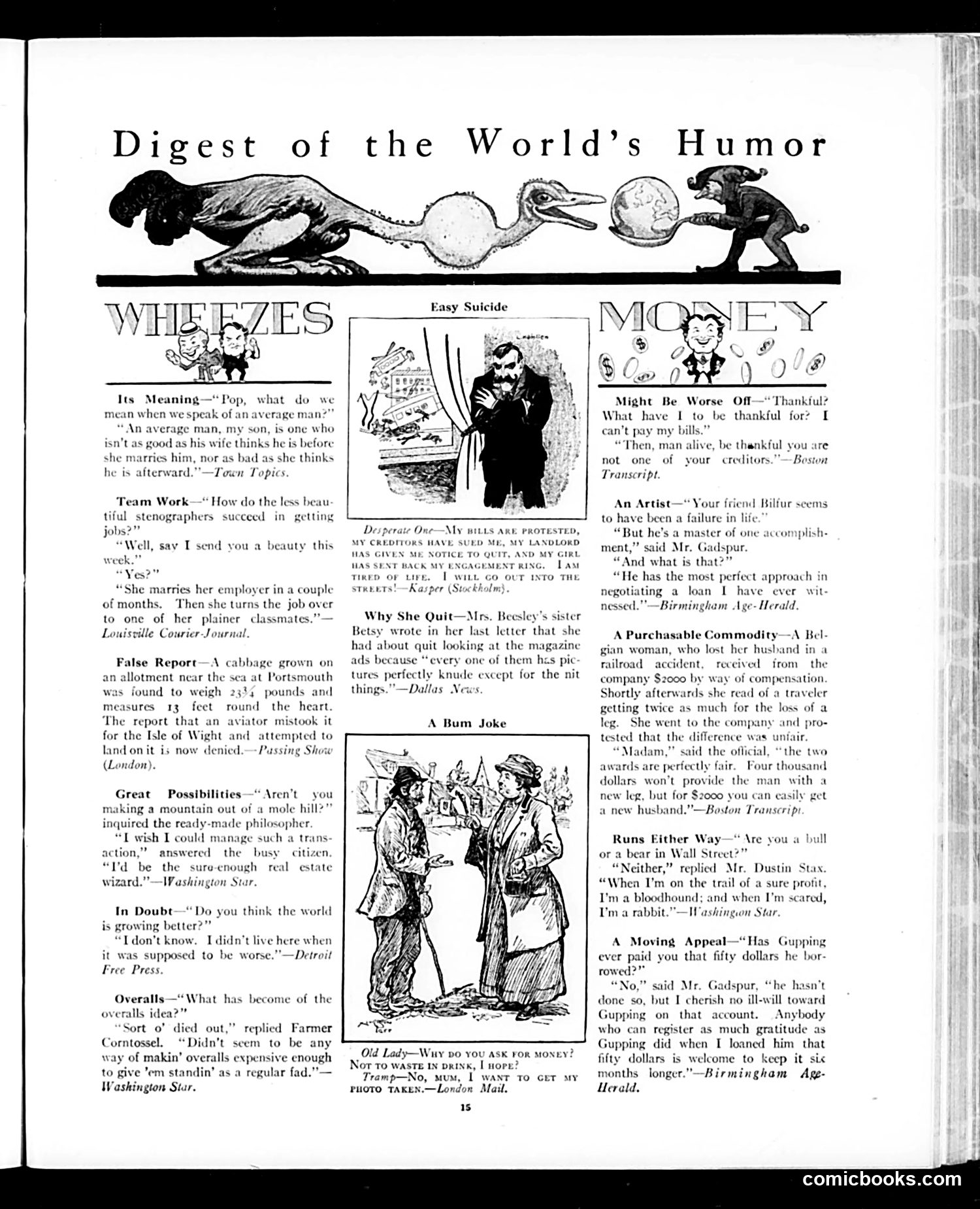
This page collects brief humorous anecdotes and jokes organized under topic headings like "Wheezes" and "Money." The cartoons and text satirize everyday social anxieties of the era: marriage disillusionment (husbands seeming worse after marriage), workplace dynamics (stenographers marrying bosses), financial desperation (the "Easy Suicide" cartoon shows a man contemplating drowning after creditors sue him), and class differences. The jokes target common frustrations: unpaid bills, ungrateful borrowers, women's magazine advertisements, and false claims (the Portsmouth cabbage hoax). "A Purchasable Commodity" sardonically compares the monetary value placed on human loss—a widow's compensation versus a man's lost leg—exposing the era's callous calculation of human worth. The overall tone reflects pre-WWI anxieties about financial instability, relationship strain, and social mobility, using dark humor to process these stresses.
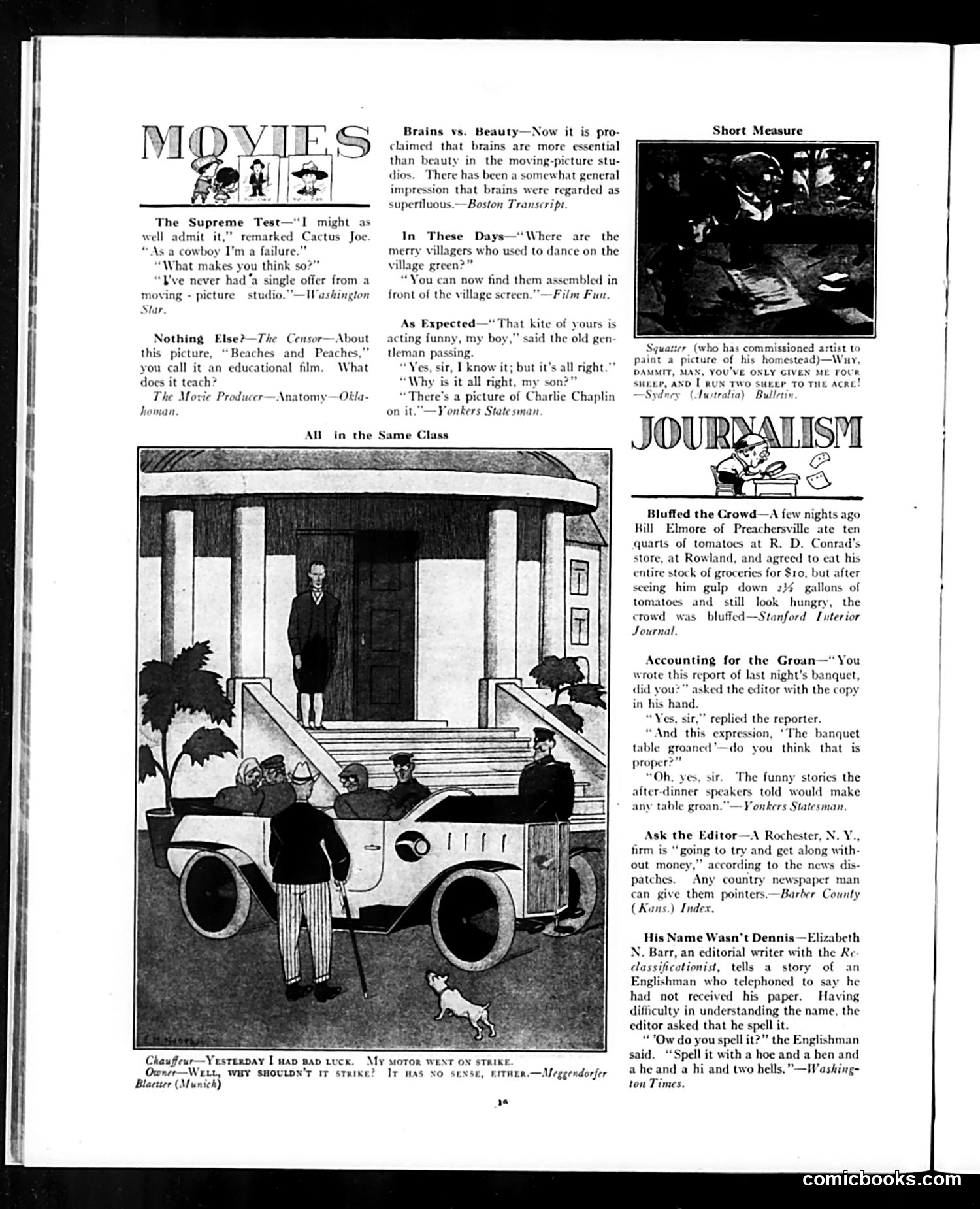
This page collects brief satirical jokes about early 1920s American life, with one main cartoon. **The Central Cartoon** depicts a chauffeur and car owner debating whether a motor that "went on strike" makes sense. The joke equates labor strikes (then a major social issue) with mechanical failure—suggesting strikes are as nonsensical as a machine rebelling. It's a conservative jab at worker activism. **The Sidebar Jokes** mock: - **Silent film industry**: Cowboys hoping studios will hire them; censors approving "educational" anatomy films; Charlie Chaplin's ubiquity - **Rural/regional humor**: A farmer complaining a painter undersupplied his homestead portrait; tomato-eating contests; a reporter explaining why a banquet table "groaned" - **Class dynamics**: A newspaper struggling without money; an Englishman's comically spelled name over the phone The page reflects Judge's upper-class perspective—mocking labor activism, rural simplicity, and emerging mass media while celebrating wit and propriety. All jokes assume readers share contempt for strikes, unsophisticated people, and modern absurdities.
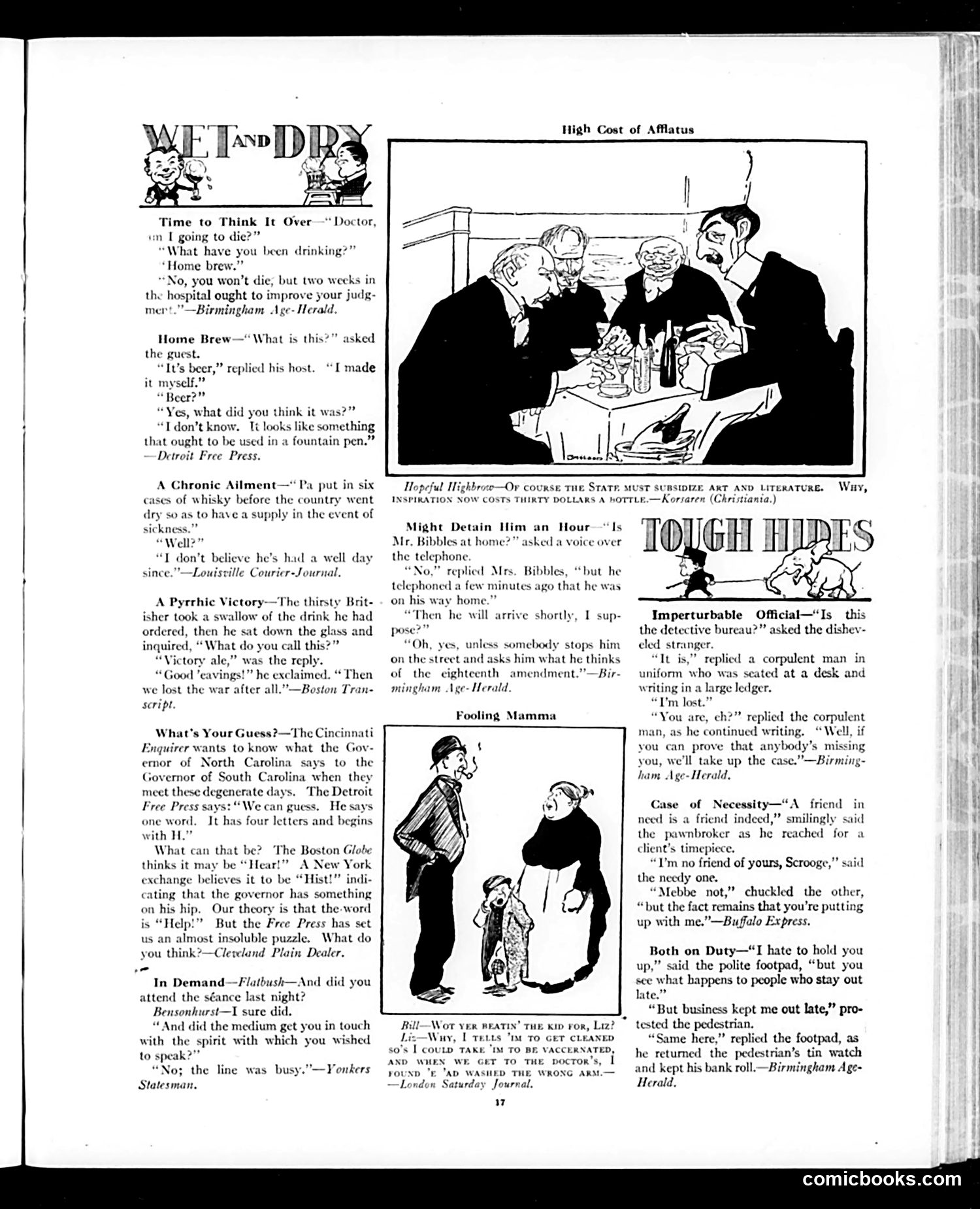
This page satirizes American life during Prohibition (1920-1933), when alcohol was illegal but widely produced at home. The repeated jokes about "home brew" mock both its terrible quality and the public health risks it posed. The cartoons ridicule: 1. **Home brew's awful taste** — one joke compares it to fountain pen ink; another describes a British drinker's disappointment, calling it "Victory" (implying Britain lost WWI by drinking this). 2. **Prohibition's social effects** — people being detained on streets and asked their opinion on the "eighteenth amendment" (which mandated Prohibition); someone can't get home without being stopped for commentary. 3. **Widespread illegal drinking** — despite legal prohibition, alcohol remains culturally omnipresent and constantly discussed. The satire targets both the failed policy itself and Americans' defiant, humorous resistance to it through bootlegging and home production.
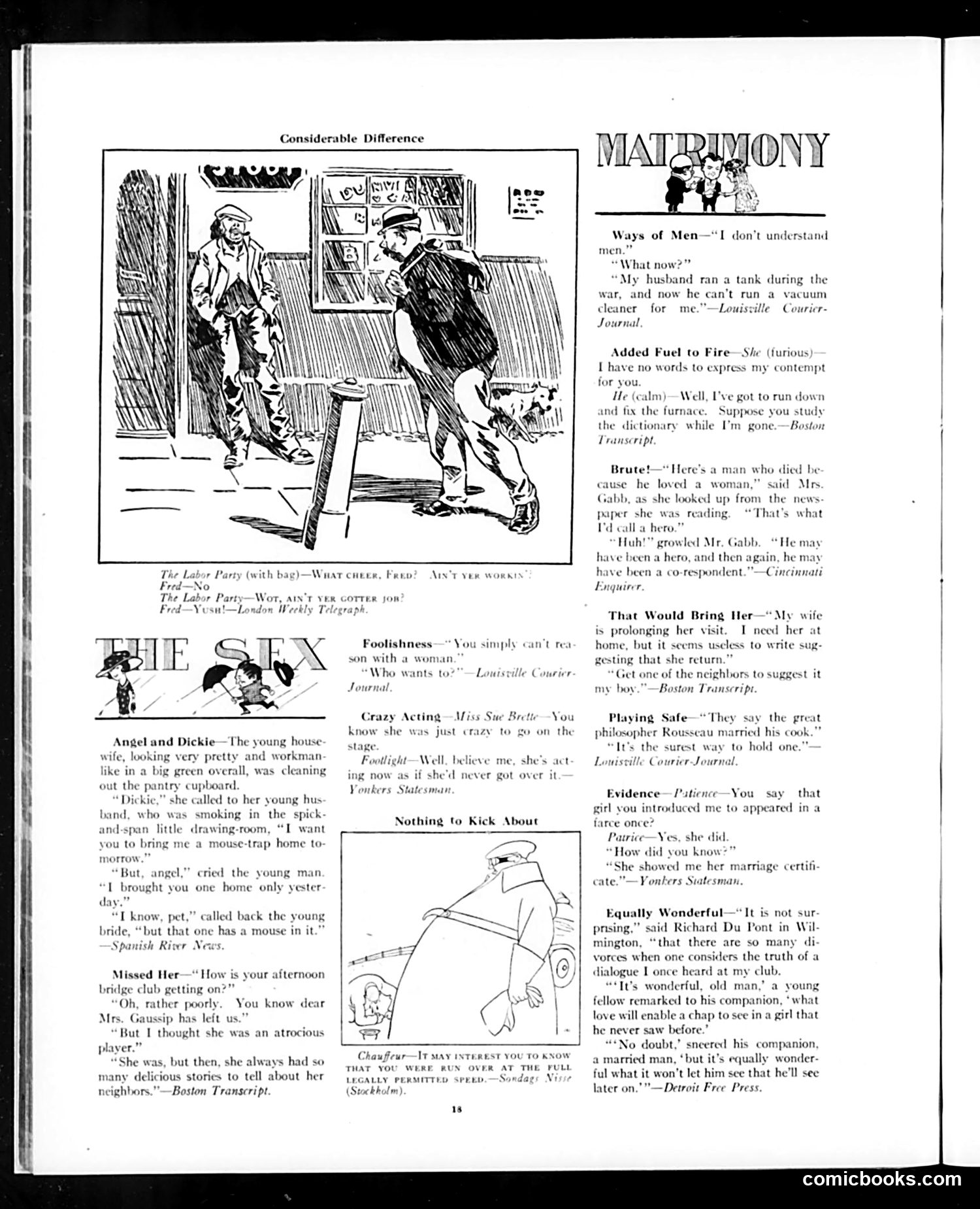
This page from *Judge* contains multiple short humorous anecdotes and one cartoon about post-WWI domestic life and marriage. **The main cartoon** ("Considerable Difference") depicts a working-class interaction, likely contrasting labor and class divisions—the caption references "The Labor Party," suggesting commentary on labor politics of the era. **The humor pieces** satirize early 20th-century marriage and gender dynamics: - A newlywed wife's absurd request (mousetrap with mouse still in it) mocks female domesticity - A husband who operated a tank in WWI can't use a vacuum cleaner—satirizing male incompetence at domestic tasks - A woman prolonging her visit; neighbors must convince her to return home - Multiple jokes about divorce and marriage deception The consistent theme: **marriage as mutually bewildering**, with wives portrayed as illogical and husbands as incompetent or dishonest. These reflect 1920s assumptions about gender roles while gently mocking both sexes' confusion about the opposite gender.
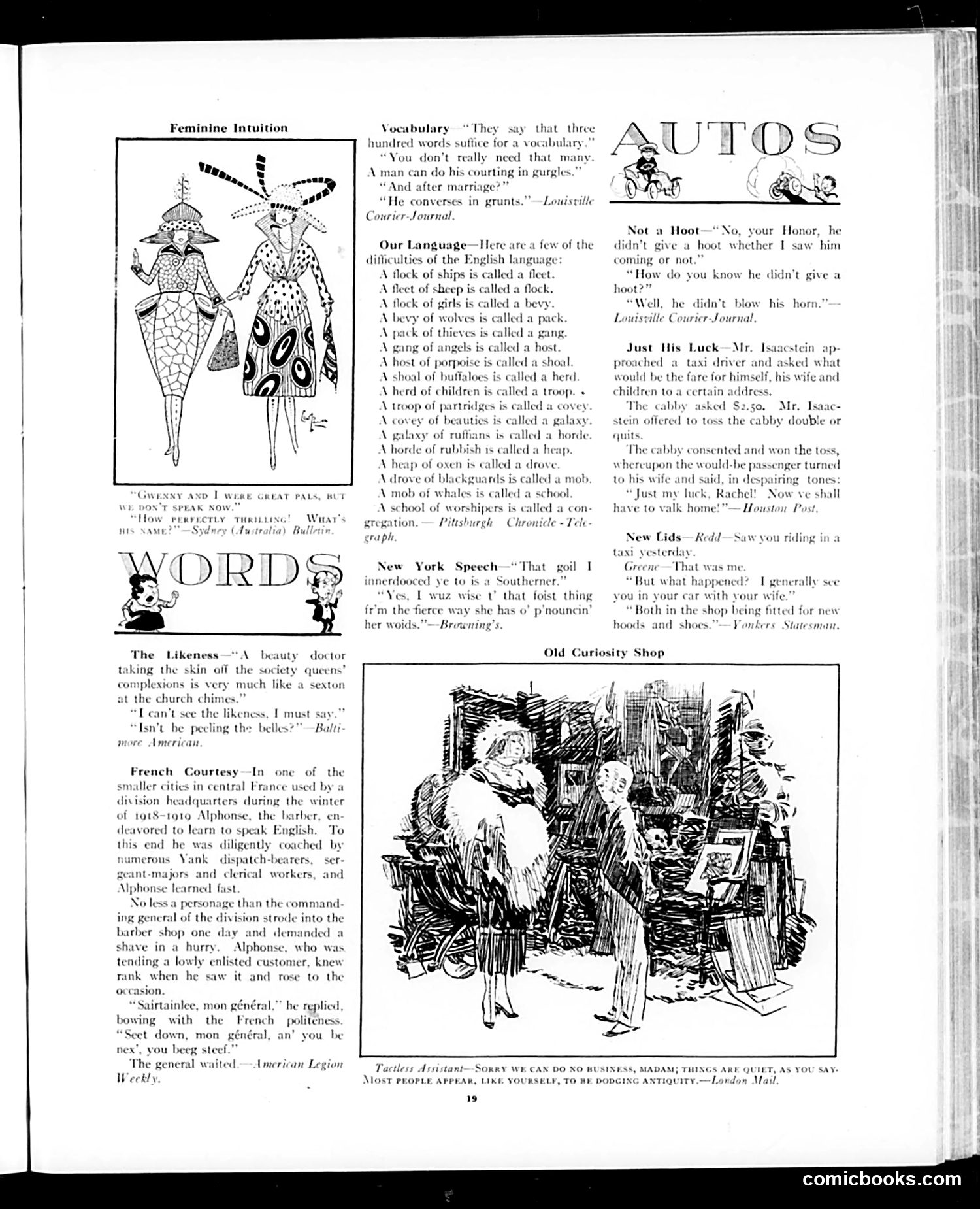
This page contains humor pieces typical of early 20th-century American satirical magazines. The main sections include: **"Feminine Intuition"**: A cartoon showing two fashionably dressed women, illustrating a joke about women remaining friends despite not speaking—playing on stereotypes of female social dynamics. **"Vocabulary" and "Our Language"**: Humorous observations about English language quirks and colloquialisms, including the distinction between collective nouns (flock of ships vs. fleet of sheep). **"French Courtesy"**: A WWI-era anecdote about an American general encountering a French barber learning English, poking fun at language barriers and military rank dynamics. **"Old Curiosity Shop"**: A cartoon showing an antique dealer's shop, with a joke about a woman customer being told business is slow because people "like yourself" avoid antiquity—a gentle jab at aging. The humor relies on wordplay, regional dialects, and social observations rather than political commentary. These pieces reflect post-WWI American popular culture and contemporary speech patterns.
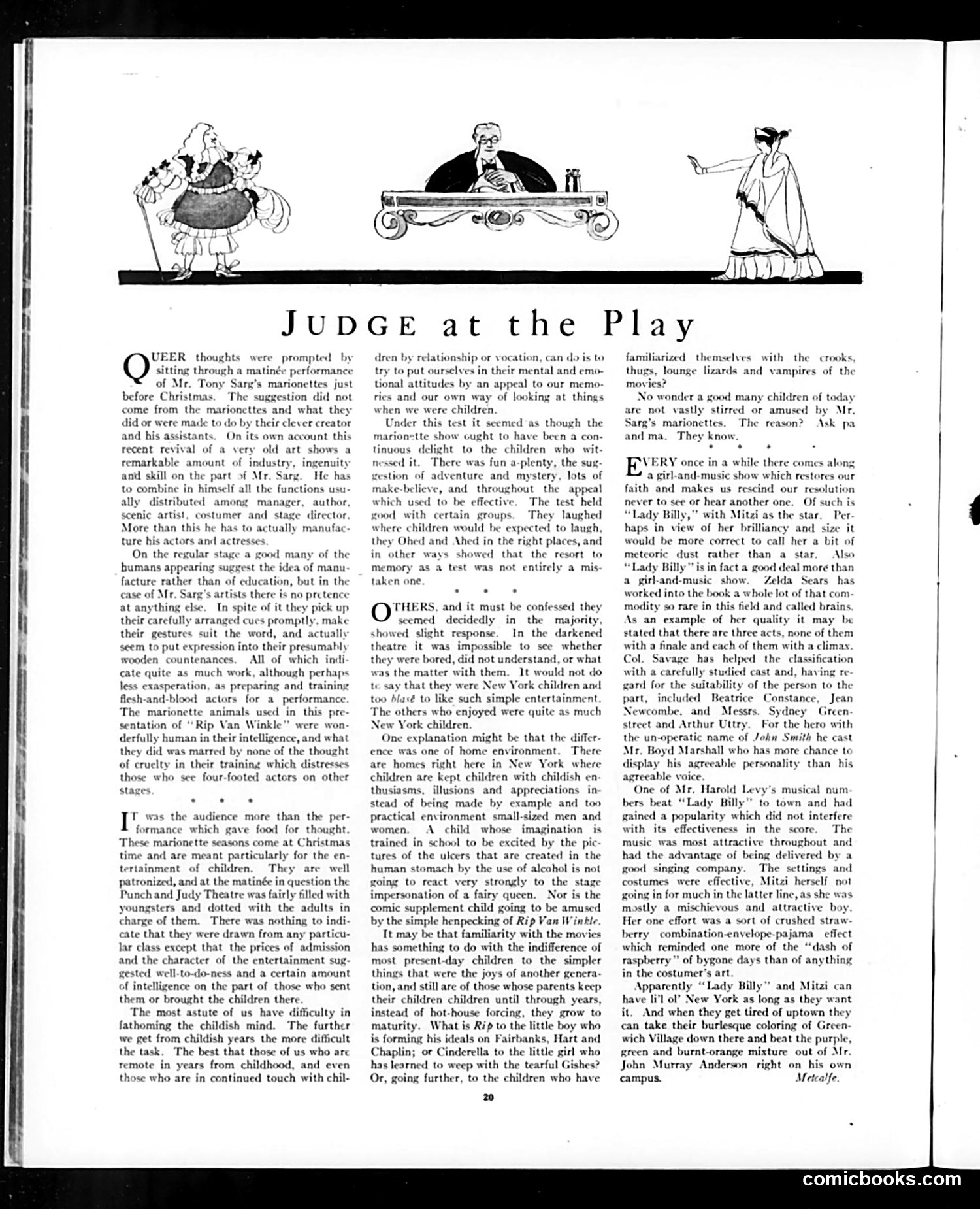
This is a theater review by an unnamed critic evaluating Tony Sarg's marionette production of "Rip Van Winkle," performed at Christmas for children. The illustration shows a judge presiding over a theatrical performance, with a puppet-master on the left and an actor on the right—visually comparing human actors to marionettes. The satire critiques **audience reception disparities**: while some children responded enthusiastically (laughing and expressing wonder appropriately), others sat unmoved. The critic explores whether this reflected boredom, incomprehension, or social class differences. He notes that even New York children of similar economic backgrounds showed wildly different responses, suggesting **home environment and imaginative development**—not wealth—determined who could appreciate the show's simple pleasures. The piece implicitly judges modern parenting: children raised on movies and commercial entertainment had lost the capacity for wonder that simpler theatrical arts once inspired. It's a nostalgic critique of childhood's changing relationship with imagination in the modern era.
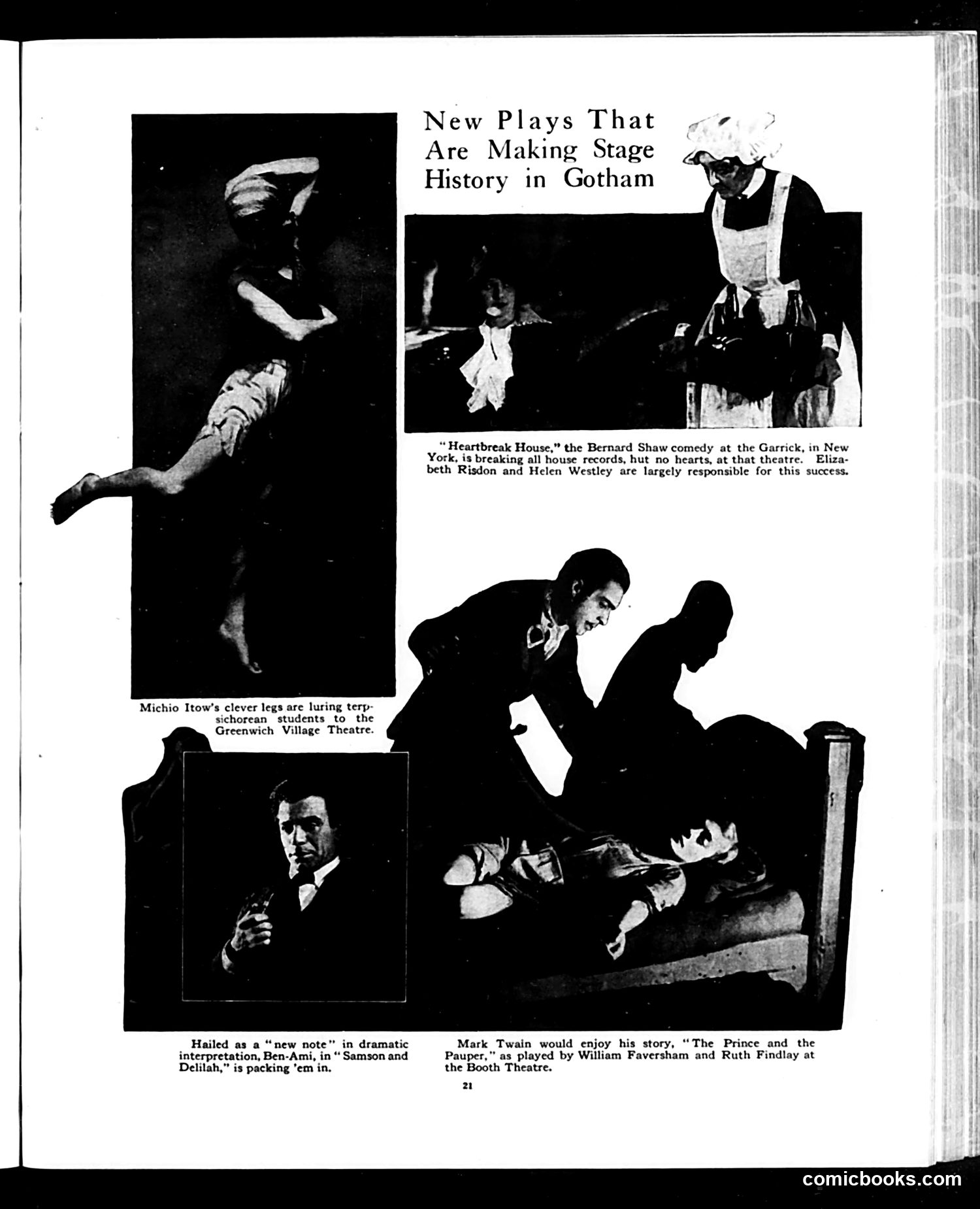
This is a theater review page showcasing successful Broadway productions circa the 1920s. The content celebrates four plays: 1. **"Heartbreak House"** (Bernard Shaw) at the Garrick—praised for breaking box office records despite the ironic note that it breaks "no hearts," crediting actresses Elizabeth Risdon and Helen Westley. 2. **A dance production** featuring Michio Itow, whose "clever legs" attract students to Greenwich Village Theatre—a reference to the bohemian theater district. 3. **"Samson and Delilah"** with Ben-Ami, described as a "new note" in dramatic interpretation that's "packing 'em in." 4. **"The Prince and the Pauper"** (Mark Twain adaptation) at the Booth Theatre with William Faversham and Ruth Findlay. The page uses photographs to illustrate each production. There's no satire here—it's straightforward theater promotion, typical of Judge's entertainment coverage during the Jazz Age theater boom.
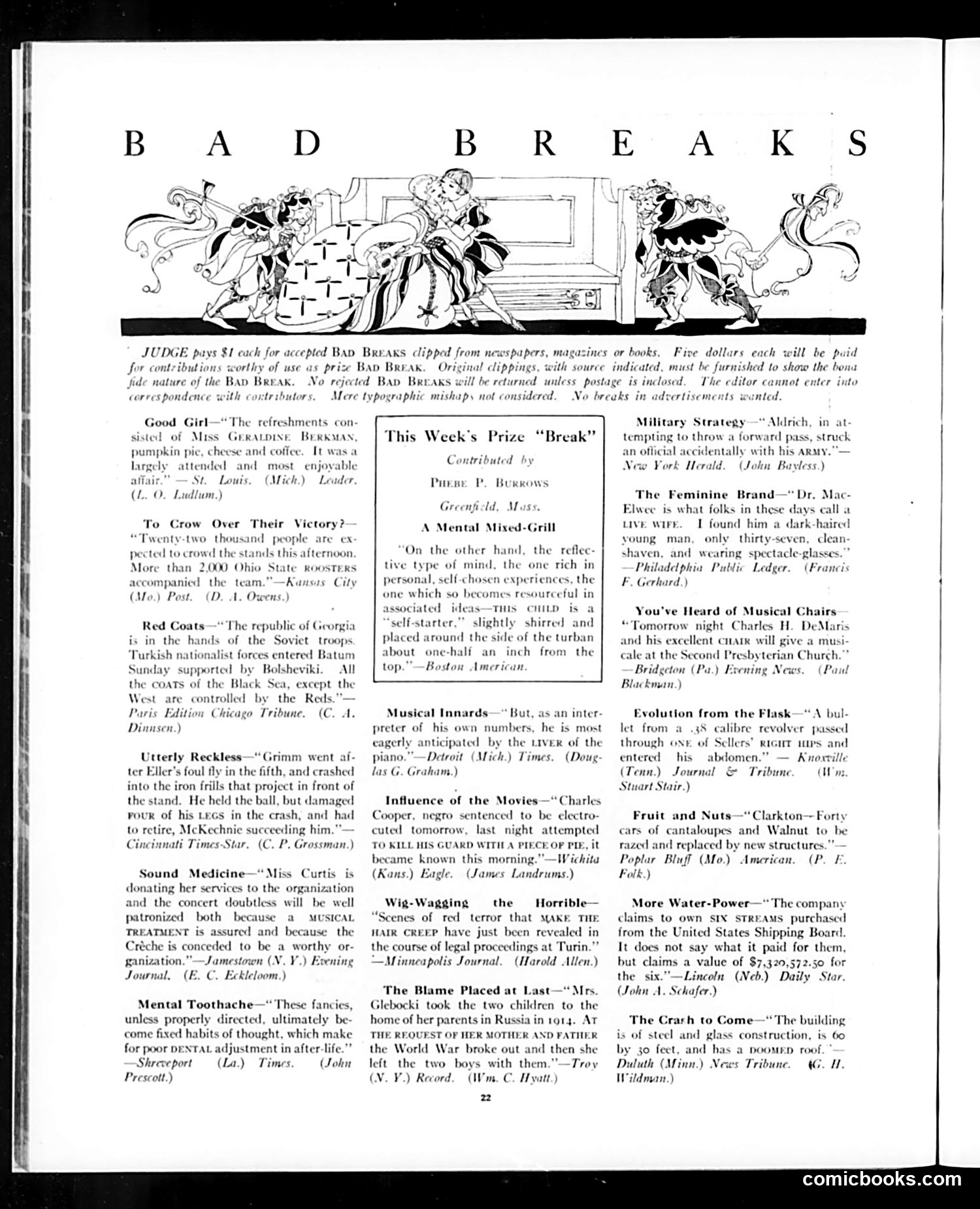
This page from *Judge* magazine features a "Bad Breaks" column—a humor section paying readers to submit amusing typographical or editorial errors ("breaks") clipped from newspapers. The cartoon header shows characters with exaggerated expressions finding comedy in these mishaps. The "breaks" themselves are humorous malapropisms or awkward phrasings. For example: "Miss Curtis is donating her services...a MUSICAL TREATMENT is assured" (poor phrasing about a concert), or a passage about attempting to throw a football that accidentally struck "an official...with his army" (likely meant "arm"). The satire works through unintentional double meanings and absurd literal readings. These errors reveal careless editing by journalists. The page mocks newspapers' quality control while creating lighthearted entertainment from their mistakes. The "$1 each" prize incentivized readers to hunt for such errors, making it an early crowdsourced comedy feature.
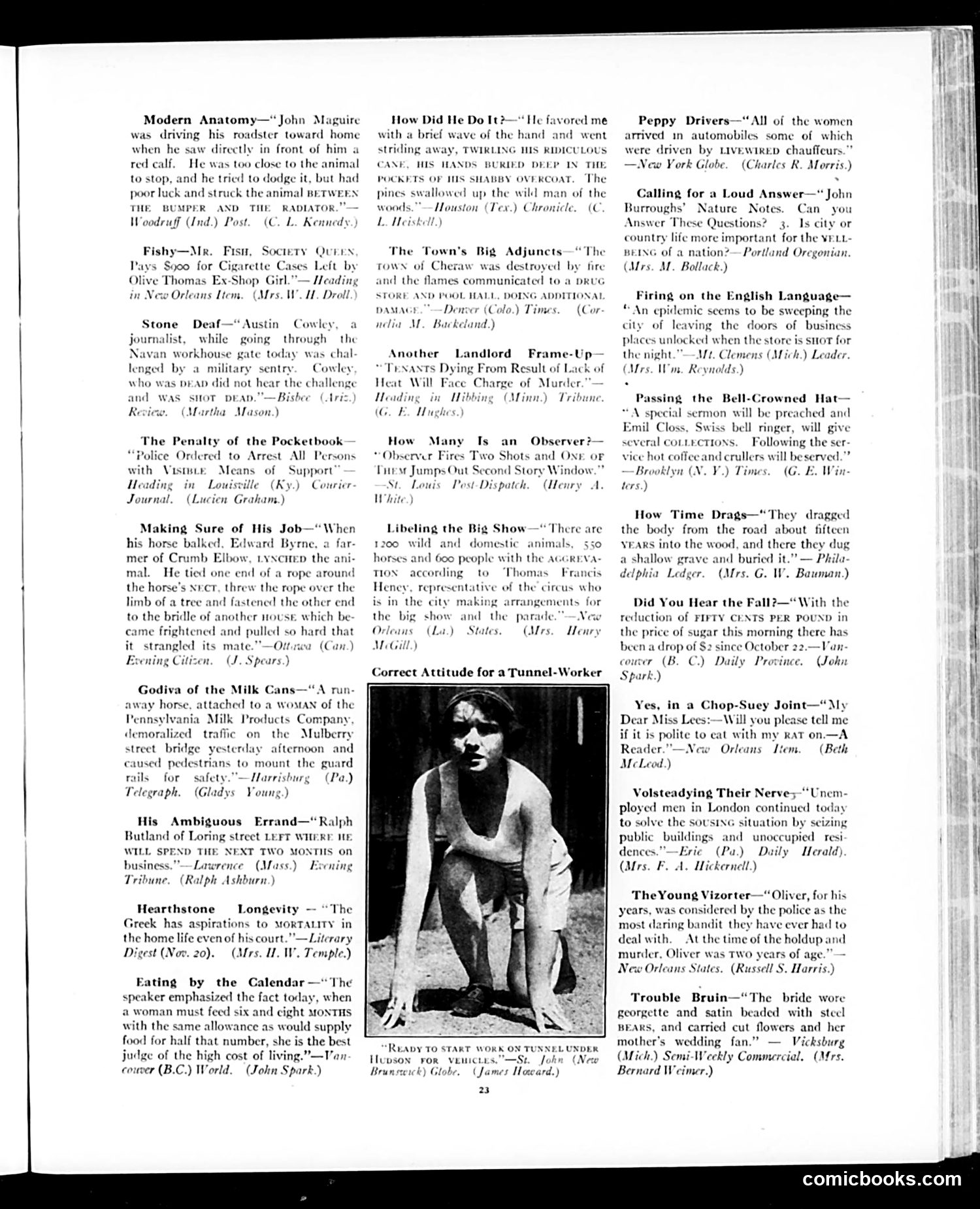
This page from *Judge* magazine collects humorous newspaper headlines and snippets under the heading "Modern Anatomy." The format appears to be satirizing absurd or poorly-written news stories from regional American papers. The single photograph shows a tunnel worker in proper safety stance—crouching defensively with hands positioned protectively—captioned "Correct Attitude for a Tunnel-Worker." This appears to be satirizing workplace safety concerns during the early industrial era. The text snippets mock sensational or confusing journalism: stories about vehicular accidents with livestock, a runaway milk wagon causing chaos, a farmer accidentally strangling his horse, and a woman's violent fate during a circus incident. The humor derives from the deadpan presentation of absurd situations and the awkward phrasing of the original newspaper headlines. The page also includes brief advice columns (like etiquette questions about eating with one's hat on), reflecting *Judge*'s role as both satirical publication and social commentary on contemporary American life and manners.
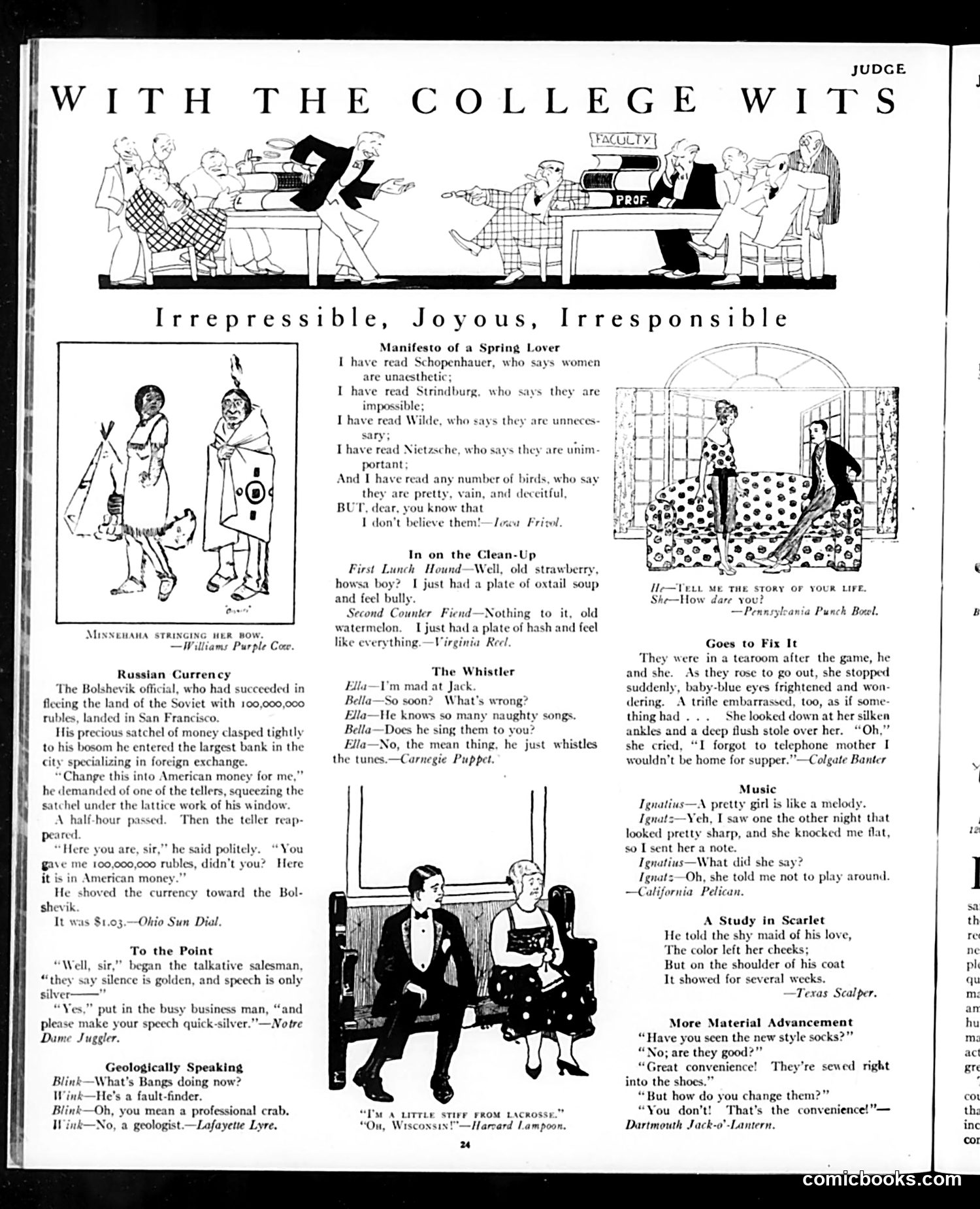
This page from *Judge* magazine contains multiple short humorous pieces typical of early 20th-century college and satirical publications. **"Russian Currency"** mocks Bolshevik refugees fleeing Soviet Russia after the Revolution. The joke: a Bolshevik official flees with 100 million rubles, only to learn from a San Francisco banker that this vast sum converts to just $1.03—satirizing both the worthlessness of Soviet currency and American financial superiority during the post-Revolution period. Other pieces are lightweight campus humor: puns about geologists being "fault-finders," jokes about spring romance dismissing philosophers' criticisms of women, and romantic misadventures. "The Whistler" plays on a suitor annoying his girlfriend by whistling rather than singing naughty songs. The illustrations show 1920s fashion and social scenarios—flappers, tearoom dating culture, young couples. This was aspirational lifestyle humor for college readers, mixing mild satire of Soviet communism with gentle mockery of dating customs and modern inconveniences.
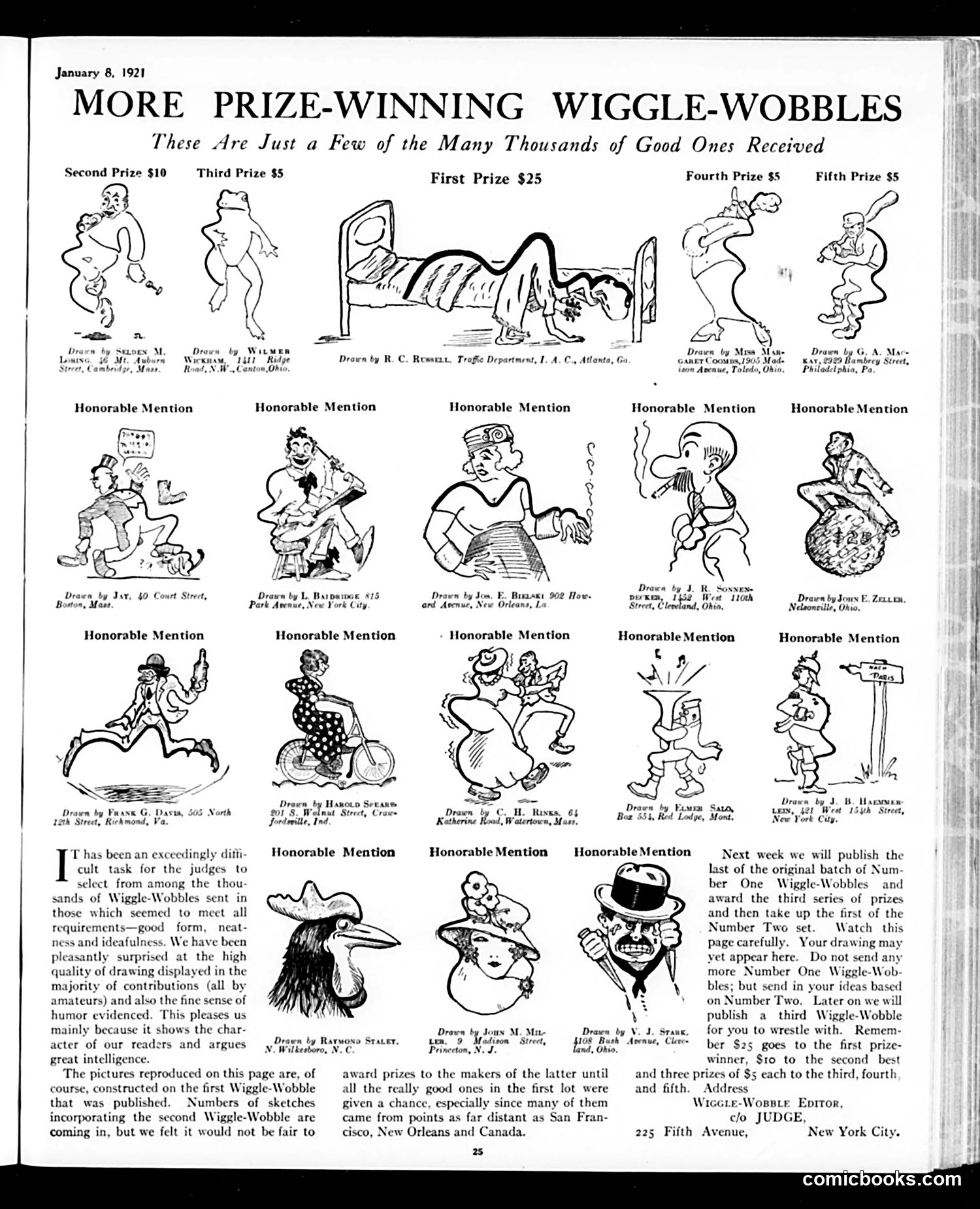
This page showcases prize-winning entries from *Judge* magazine's "Wiggle-Wobbles" drawing contest. The publication invited amateur artists to submit humorous cartoon sketches based on specific prompt images, awarding cash prizes ($25 first prize down to $5 for honorable mentions). The cartoons themselves depict exaggerated, comedic human figures in absurd situations—people contorting in beds, riding bicycles, juggling, dancing on balls—typical of early 1920s lowbrow humor emphasizing physical comedy and slapstick. The editors note they were "pleasantly surprised" by the amateur submissions' quality, suggesting this was a popular, participatory form of entertainment. The contest ran in multiple rounds, with the editors managing entries from across America (San Francisco, New Orleans, Canada noted). This demonstrates how *Judge* engaged its readership through interactive contests, making it a community publication rather than passive consumption medium—a significant marketing strategy in that era.
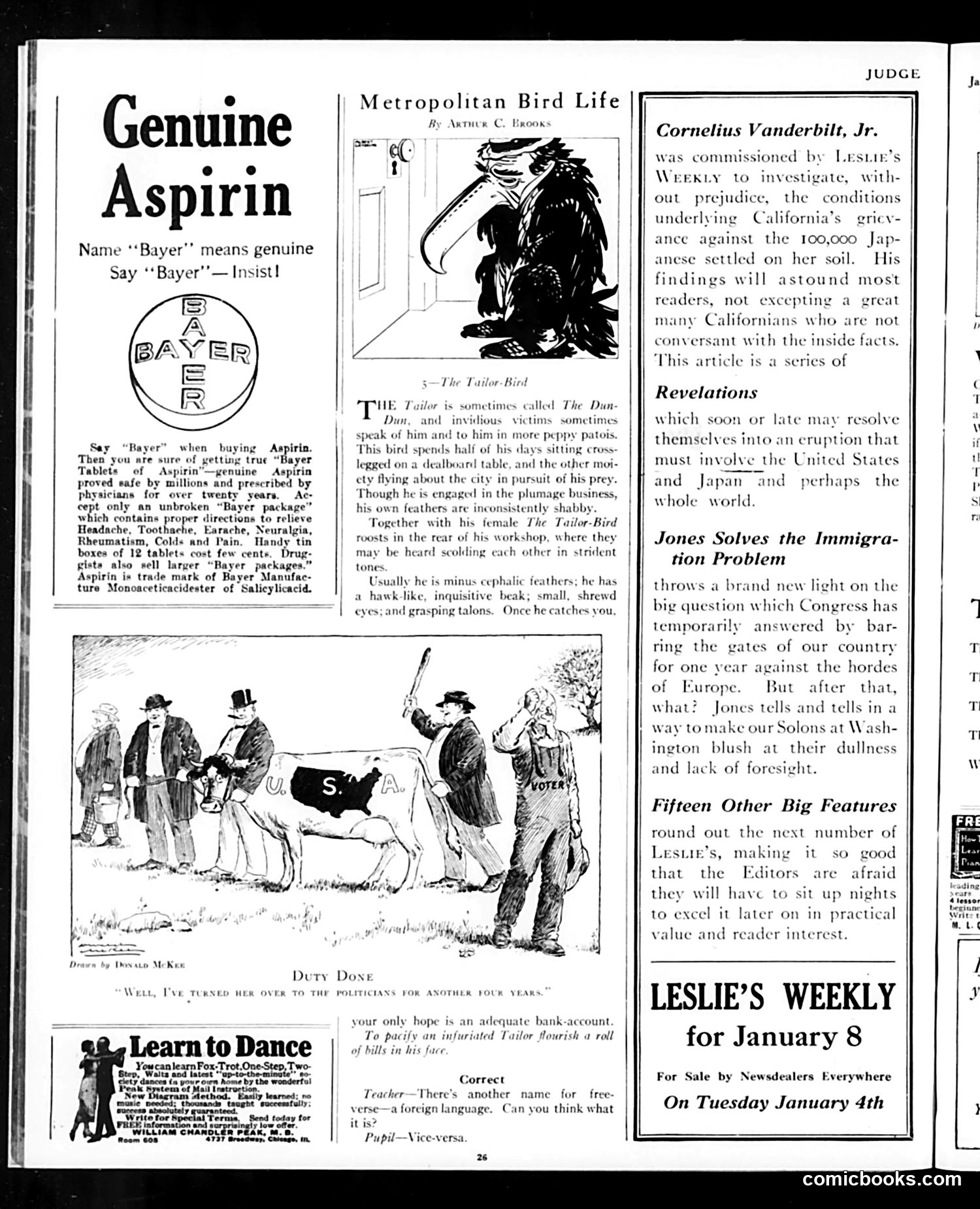
This page mixes advertising with political satire. The main cartoon depicts a cow labeled "S." (likely representing the State or American government) being examined by well-dressed men, one wielding a club. The caption reads: "Well, I've turned her over to the politicians for another four years." **The satire:** This is a cynical commentary on American governance—the cow represents the nation or electorate, now "handed over" to politicians for their exploitation. The club suggests coercive or corrupt practices. The page also advertises Bayer Aspirin (emphasizing the genuine "Bayer" trademark) and previews Leslie's Weekly articles, including one by Cornelius Vanderbilt Jr. investigating Japanese immigration to California—a contemporary controversy. A brief joke about free verse being "a foreign language" reflects early-20th-century skepticism of modernist poetry. The overall tone is satirical commentary on politics, commerce, and cultural anxieties of the era.
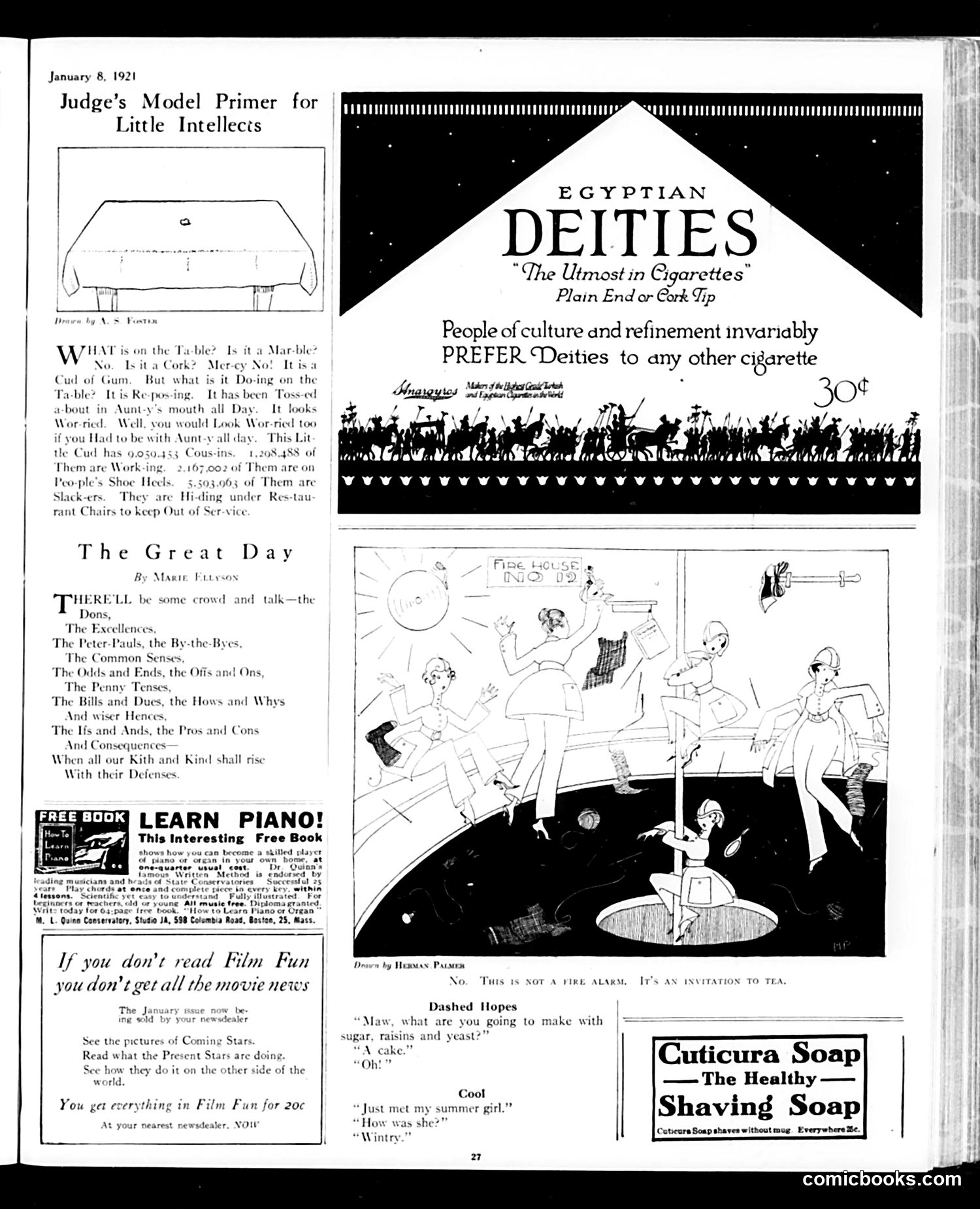
This page contains primarily **advertisements and filler content** rather than political satire. **"Judge's Model Primer for Little Intellects"** is a humorous piece mocking children's educational primers by describing a wad of chewing gum found on an aunt's table. The joke satirizes the tedious, overly-detailed nature of instructional texts by treating mundane objects seriously—listing precise numbers of the gum's "relatives" (shoe heels, slack-ers hiding under restaurant chairs). This gentle mockery targets educational publishing conventions. **"The Great Day"** by Marie Fittyson appears to be poetry listing various abstract concepts and grammatical terms ("Dons," "The Ifs and Ands," "Pros and Cons"). The page is dominated by **period advertisements**: Egyptian Deities cigarettes (appealing to "culture and refinement"), a piano instruction offer, Film Fun magazine promotion, Cuticura Soap, and a brief joke exchange labeled "Dashed Hopes" and "Cool." The cartoonish illustration shows a fire-house scene with figures, captioned as an "invitation to tea" rather than an actual alarm. Overall, this is a typical **humor magazine issue page mixing light satire with commercial advertising**.
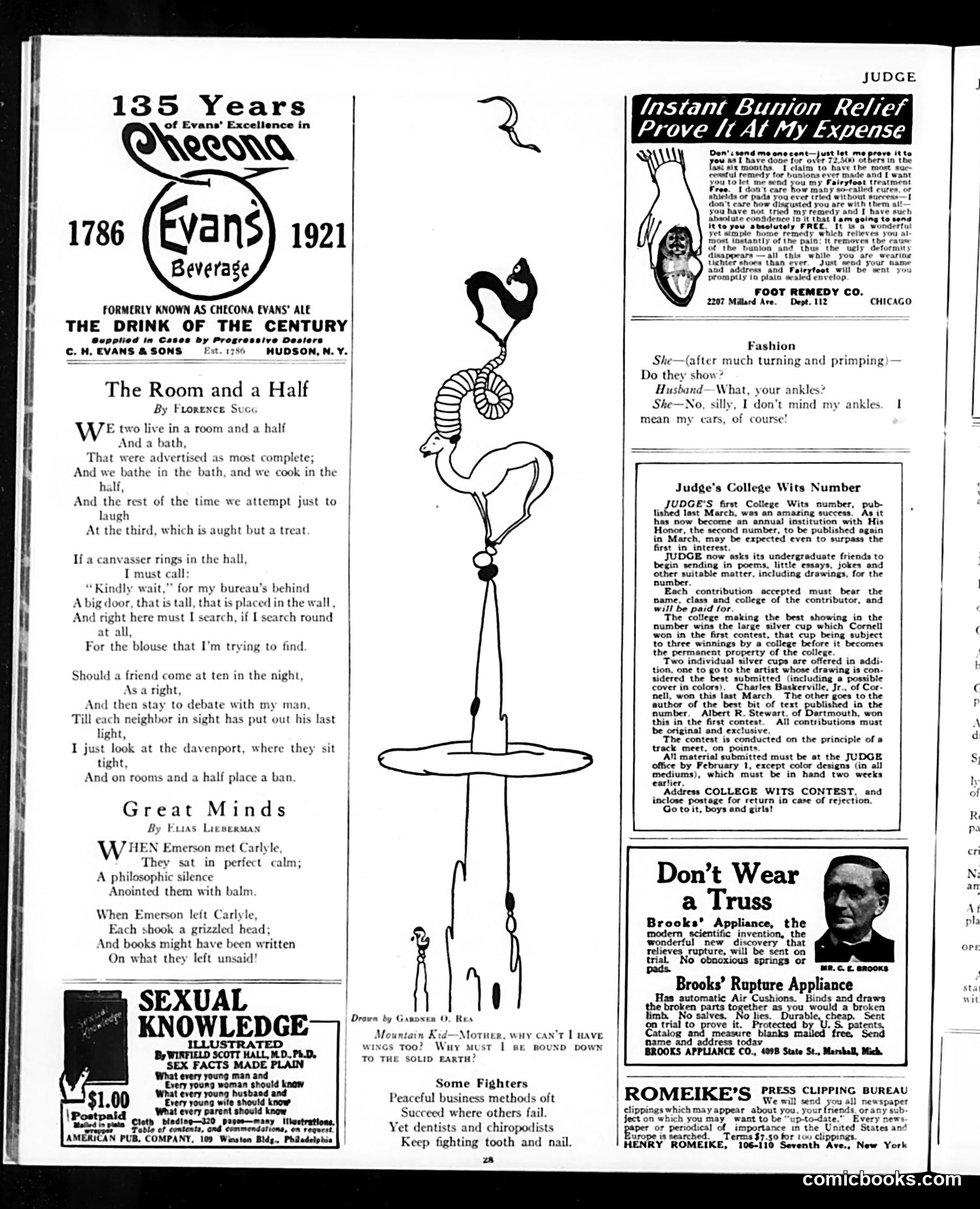
This page from Judge (likely early 1920s) contains mostly **poetry, advertisements, and humor pieces** rather than political cartoons. The main content includes: **"The Room and a Half"** — domestic satire about cramped apartment living, poking fun at advertised "complete" housing that forces residents to cook in a hallway and search for belongings squeezed behind doors. **"Great Minds"** — a literary joke about philosopher Ralph Waldo Emerson meeting Scottish writer Thomas Carlyle, suggesting their silence together was so profound that "books might have been written / On what they left unsaid." **Advertisements** dominate the right side, including the "Foot Remedy Co." and "Brooks' Rupture Appliance" — typical early 20th-century patent medicine marketing. **Fashion humor** mocks women's vanity about hidden body parts (ears, not ankles). The **"College Wits" contest** announcement promotes Judge's annual collegiate humor competition. No significant political satire is evident here; the page reflects period concerns about housing, propriety, and commercial remedies.
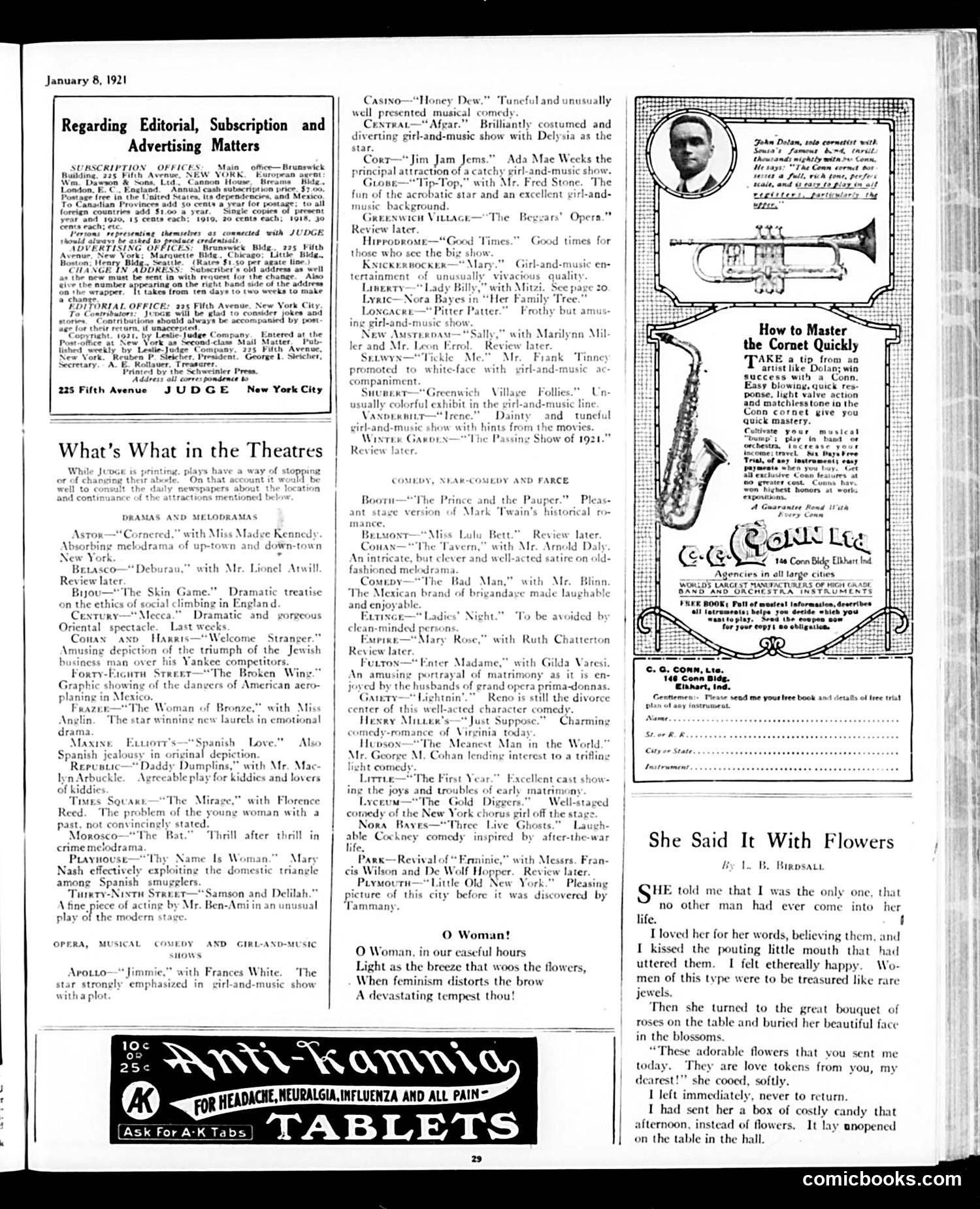
This page is primarily **theatre listings and editorial matter**, not political cartoons. It contains: **Main Content:** - Theatre reviews and synopses covering dramas, musicals, comedies, and farces currently playing in New York - Brief editorial notes about subscription and advertising **Key Contextual Elements:** - The listings reflect post-WWI American entertainment (1921) - Shows include adaptations of literary works (Mark Twain's "Prince and Pauper") - Notable performers mentioned: Frances White, Mitzi, Leon Errol, Arnold Daly - The "girl-and-music show" was a popular entertainment format of the era **Sidebar Content:** - Advertisement for A-K Tablets (headache/pain relief) - Poem titled "She Said It With Flowers" by H. Birdsall about romantic rejection **No significant political satire is visible** on this page—it's a standard theatre guide typical of Judge magazine's format during this period.
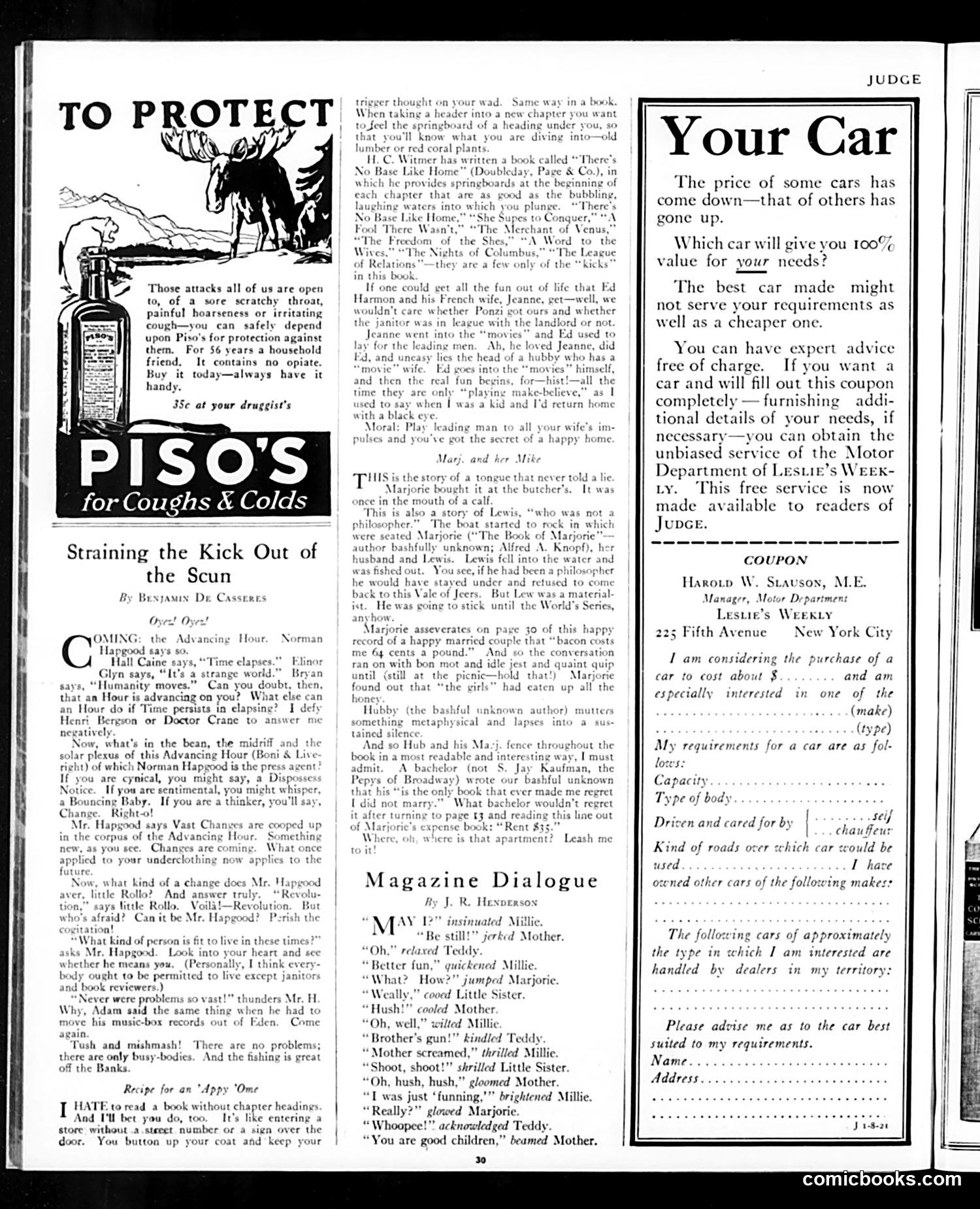
This page mixes advertising and light satirical content typical of early 20th-century Judge magazine. **The main cartoon/article** is "Straining the Kick Out of the Scum" by Benjamin De Casseres—a philosophical satire mocking contemporary intellectuals. It ridicules figures like Norman Hapgood (editor and social commentator) and references real thinkers (Henri Bergson, Bryan, Hall Caine, Elinor Glyn) who were debating concepts like "Time" and "Progress." The piece satirizes pretentious philosophizing about abstract modern problems, dismissing such discourse as "busy-bodies" creating fake problems when none truly exist. **"Magazine Dialogue"** is a humorous sketch showing children's mischief escalating from asking permission to play with a gun, ironically ending with the mother praising their "goodness"—satirizing either parental obliviousness or loose gun safety attitudes of the era. The remainder consists of **advertisements** (Piso's cough remedy) and a **service coupon** for Judge's Motor Department offering free car-buying advice to readers—standard early automotive advertising before modern consumer reports existed.
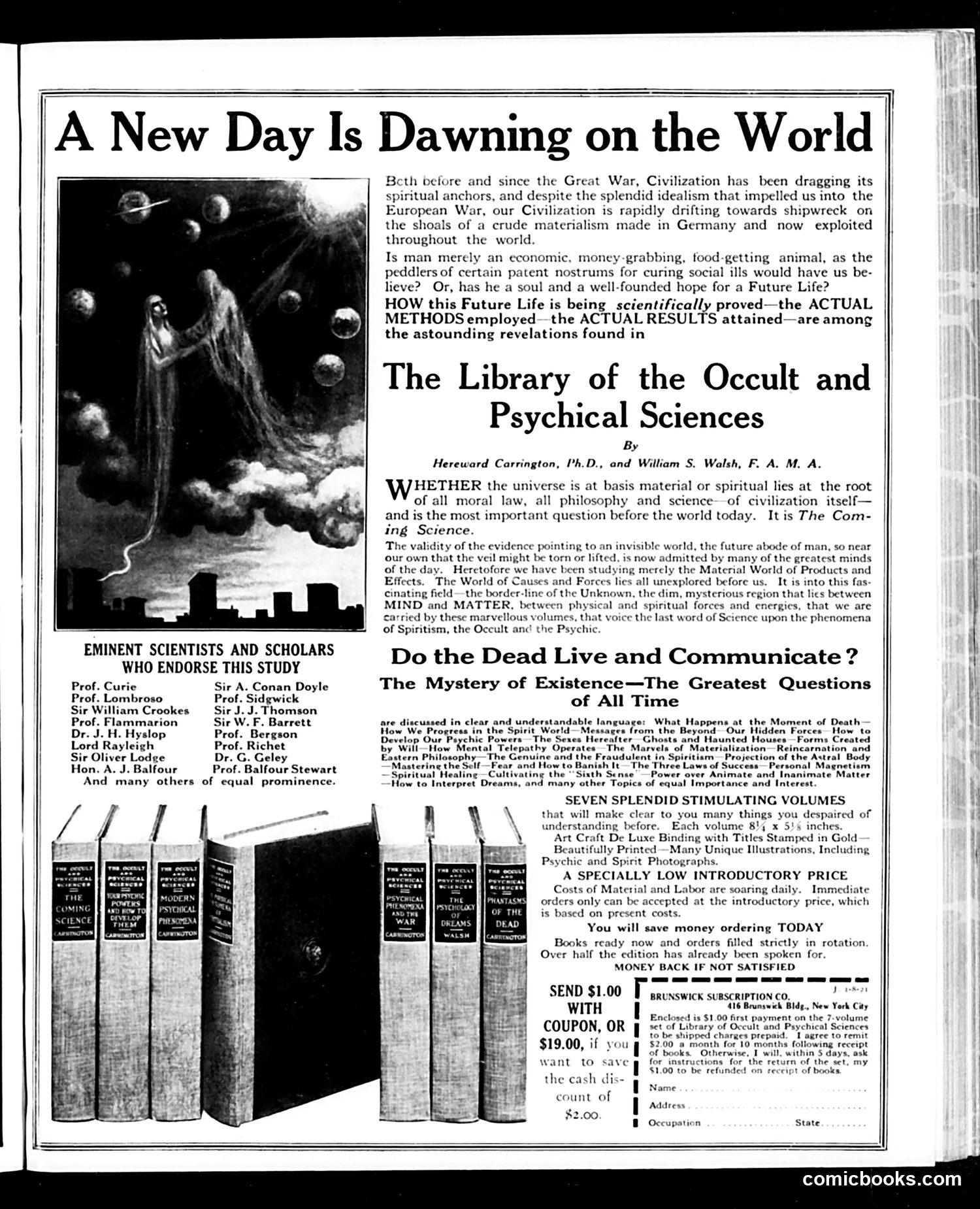
This is primarily a **full-page advertisement**, not a satirical cartoon. It promotes "The Library of the Occult and Psychical Sciences," a seven-volume set claiming to scientifically prove the afterlife and spiritual phenomena. The ad leverages **credibility through endorsement**, listing prominent early 20th-century figures (Sir Arthur Conan Doyle, Marie Curie, Sir Oliver Lodge—all real people) to lend scientific authority to occult claims. This reflects the **post-WWI spiritual crisis**: the text frames materialism as a German corruption threatening civilization, positioning spiritualism as salvation. The ad's core pitch exploits **post-war anxiety**—promising answers to death, communication with the deceased, and hidden psychic powers. The urgent language ("order TODAY," "over half edition spoken for") uses sales pressure tactics. For modern readers, this reveals how **pseudoscience marketed itself as legitimate science** in the 1920s, and how grief and cultural upheaval made people receptive to supernatural claims packaged with famous names.
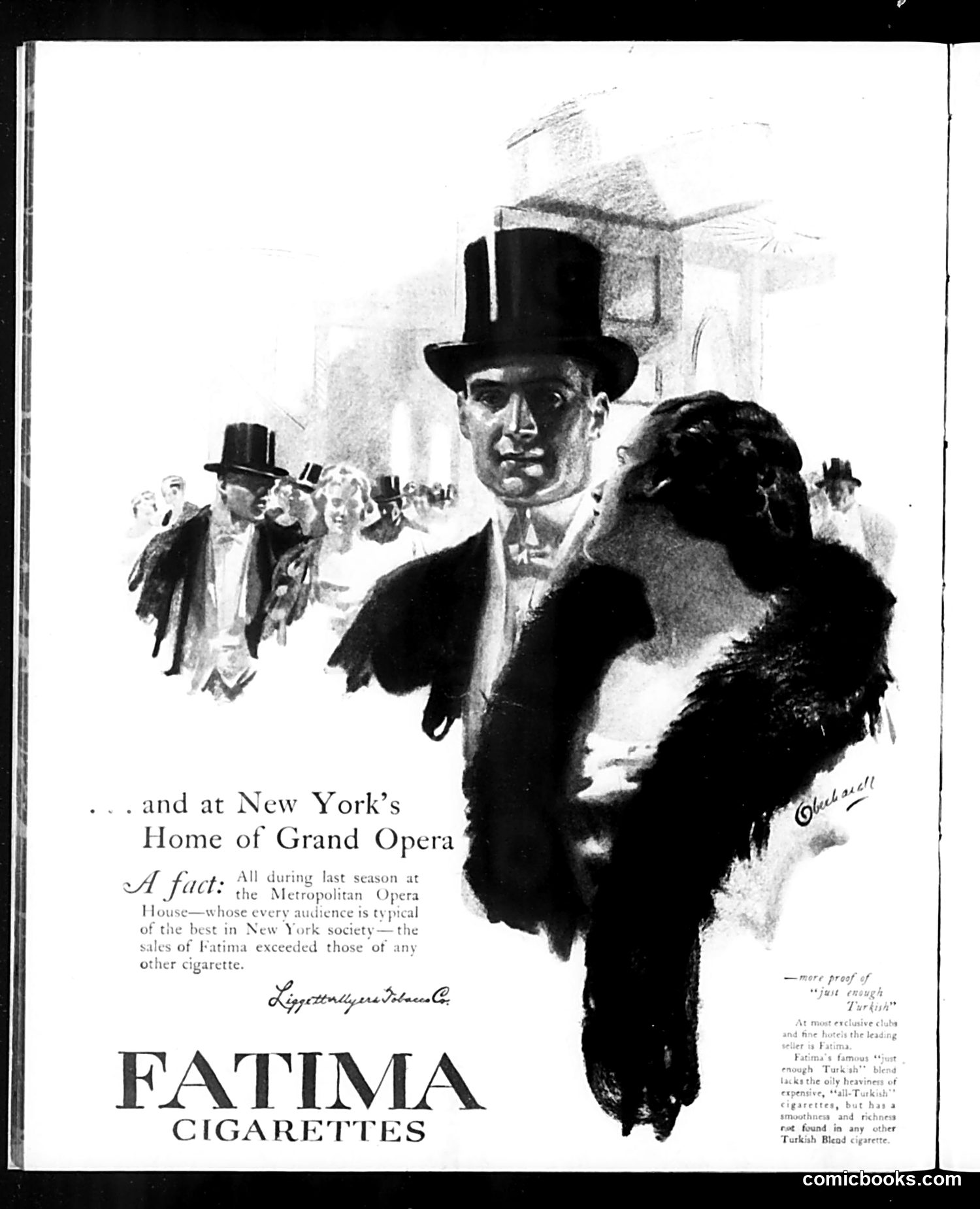
This is primarily a **cigarette advertisement**, not political satire. The ad for Fatima cigarettes uses the Metropolitan Opera House as aspirational branding, claiming that cigarette sales there exceeded all competitors during the previous season. The illustration depicts elegantly dressed opera-goers in top hats and formal wear, establishing a connection between smoking Fatima cigarettes and high-society cultural refinement. The text emphasizes the "best in New York society" frequenting the Met, implying that sophisticated people choose this brand. The right side contains partially legible text about Fatima's "Turkish blend," a common marketing claim for cigarettes of this era. This appears to be early 20th-century advertising exploiting class aspirations and Orientalist appeal rather than containing satirical commentary.