
Judge, 1921-01-08 · page 12 of 32
Judge — January 8, 1921 — page 12: what you’re looking at
What you’re looking at
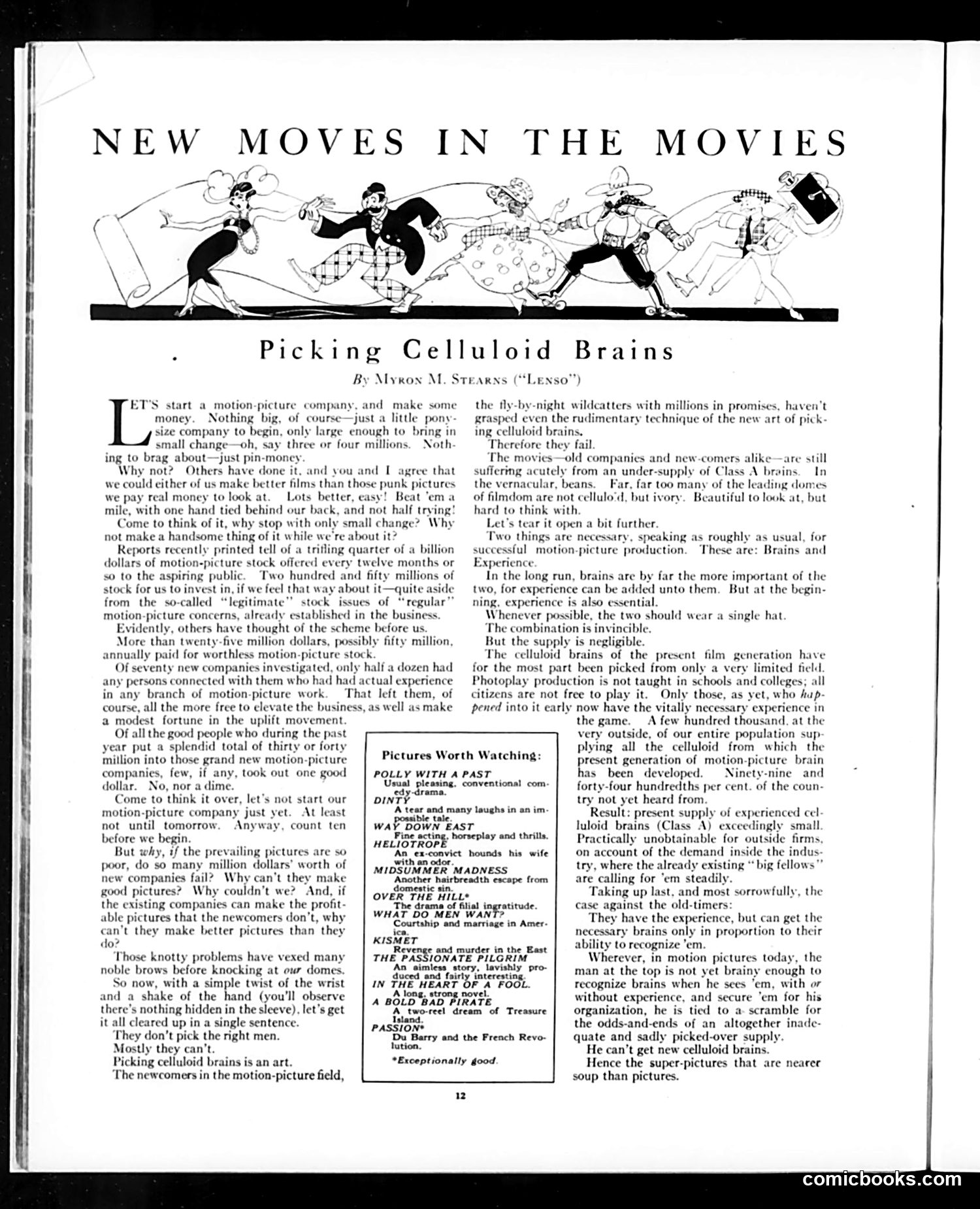
This article by Myron M. Stearns satirizes the early 1920s motion-picture industry's explosive growth and rampant stock fraud. The piece mocks get-rich-quick schemes: would-be filmmakers confidently claim they could make better movies than existing studios while knowing nothing about production. Stearns exposes that of newly investigated film companies, only half had any actual industry experience, yet investors poured "$25-50 million annually" into worthless stock. The satire's central joke: these inexperienced operators lack "celluloid brains"—expertise—yet proceed anyway. The article argues that successful filmmaking requires both brains (intelligence/creativity) and experience, preferably combined in one person. However, only a tiny fraction of America's population possessed actual film production knowledge, creating chronic shortages of qualified talent. The accompanying sidebar lists films "worth watching," suggesting legitimate alternatives to speculative investments in fly-by-night production companies preying on eager investors.
📄 Transcribed text from this page (OCR, searchable)
Machine-transcribed from the original scan — historical spelling and the odd misread are preserved.
‘a By Myrox M ‘S start a motion-picture company, and make some money. Nothing big, of course—just a litle pony size company to begin, only large enough to bring in small change—oh, say three or four millions. Noth ing to brag about—just pin-moncy Why not? Others have done it, and vou and [ agree that we could either of us make better films than those punk pictures we pay real money to look at. Lots better, easy! Beat ‘em a mile, with one hand tied behind our back, and not half trying! Come to think of it, why stop with only small change? Why not make a handsome thing of it while we're about it? Reports recently printed tell of a trifling quarter of a billion dollars of motion-picture stock offered every twelve months or so to the aspiring public. Two hundred and fifty millions of stock for us to invest in, if we feel that way about it—quite aside from the so-called “legitimate” stock issues of “regular” motion-picture concerns, already established in the business Evidently, others have thought of the scheme before us. More than twenty-five million dollars, possibly fifty million, annually paid for worthless motion-picture stock. Of seventy new companies investigated, only half a dozen had any persons connected with them who had had actual experience in any branch of motion-picture work. That left them, of course, all the more free to clevate the business, as well as make a modest fortune in the uplift movement Picking Celluloid Brains Stearns ( NEW MOVES IN THE MOVIES Lexso”) the fly-by-night wildcatters with millions in promises, haven't grasped even the rudimentary technique of the new art of pick- ing celluloid brains, Therefore they fail The movies—old companies and new-comers alike—are still suffering acutely from an under-supply of Class A brains. In the vernacular, beans. Far, far too many of the leading domes of filmdom are not cellulo‘d, but ivory. Beautiful to look at, but hard to think with. Let's tear it open a bit further. Two things are necessary, speaking as roughly as usual, for successful motion-picture production. These are: Brains and Experience In the long run, brains are by far the more important of the two, for experience can be added unto them. But at the begin- ning. experience is also essential. Whenever possible, the two should wear a single hat The combination is invincible. But the supply is negligible. The celluloid brains of the present film generation have for the most part been picked from only a very limited field. Photoplay production is not taught in schools and colleges; all citizens are not free to play it. Only those, as yet, who hup- pened into it early now have the vitally necessary experience in the game. _ A few hundred thousand, at the Of all the good people who during the past very outside, of our entire population sup year put a splendid total of thirty or forty , plying all the celluloid from which the million into those grand new motion-picture Pictures Worth Watching: present generation of motion-picture brain companies, few, if any, took out one good POLLY WITH A PAST has been developed. Ninety-nine and dollar. No, nor a dime. coaventional com: forty-four hundredths per cent. of the coun- Come to think it over, let’s not start our try not yet heard from motion-picture company just yet. At least 0 see eel saeey, a 1 ta Result: present supply of experienced cel not until tomorrow. Anyway, count ten before we begin. But why, if the prevailing pictures are so poor, do 0 many million dollars’ worth of new companies fail? Why can’t they make good pictures? Why couldn’t we? And, the existing companies can make the profit- able pictures that the newcomers don’t, why can't they make better pictures than th do? Those knotty problems have vexed man) noble brows before knocking at owr domes. So now, with a simple twist of the wrist and a shake of the hand (you'll observe there's nothing hidden in the sleeve). let’s get it all cleared up in a single sentence. They don’t pick the right men. Mostly they can’t. Picking celluloid brains is an art. The newcomers in the motion-picture field, possil WAY DOWN EAST Fine acting, horeeplay and thrills HELIOTROP! ‘An ex-convict hounds his wife with an odor MIDSUMMER MADNESS Another hairbreadth escape from domestic sin. OVER THE HILL* The drama of filial ingratitude. WHAT DO MEN WANT? Courtship and marriage in Amer- ica. KISMET Revenge and murder in the East THE PASSIONATE PILGRIM ‘An aimless story, lavishly pro- duced and fairly interesting IN THE HEART OF A FOOL. A long, strong novel. A BOLD BAD PIRATE A tworeel dream of Treasure Du Barry and the French Revo- tution, *Exceptionally good. EEE luloid brains (Class A) exceedingly small Practically unobtainable for outside firms. on account of the demand inside the indus. , where the already existing “ big fellows” calling for ‘em steadily. Taking up last, and most sorrowfully, the ainst the old-timers: They have the experience, but can get the necessary brains only in proportion to their ability to recognize 'em. Wherever, in motion pictures today, the man at the top is not yet brainy enough to recognize brains when he sees ‘em, with or without experience, and secure ‘em for his organization, he is tied to a. scramble for the odds-and-ends of an altogether inade- quate and sadly picked-over supply He can’t get new celluloid brains. Hence the super-pictures t are nearer soup than pictures. comicbooks.com