
Judge, 1921-01-08 · page 13 of 32
Judge — January 8, 1921 — page 13: what you’re looking at
What you’re looking at
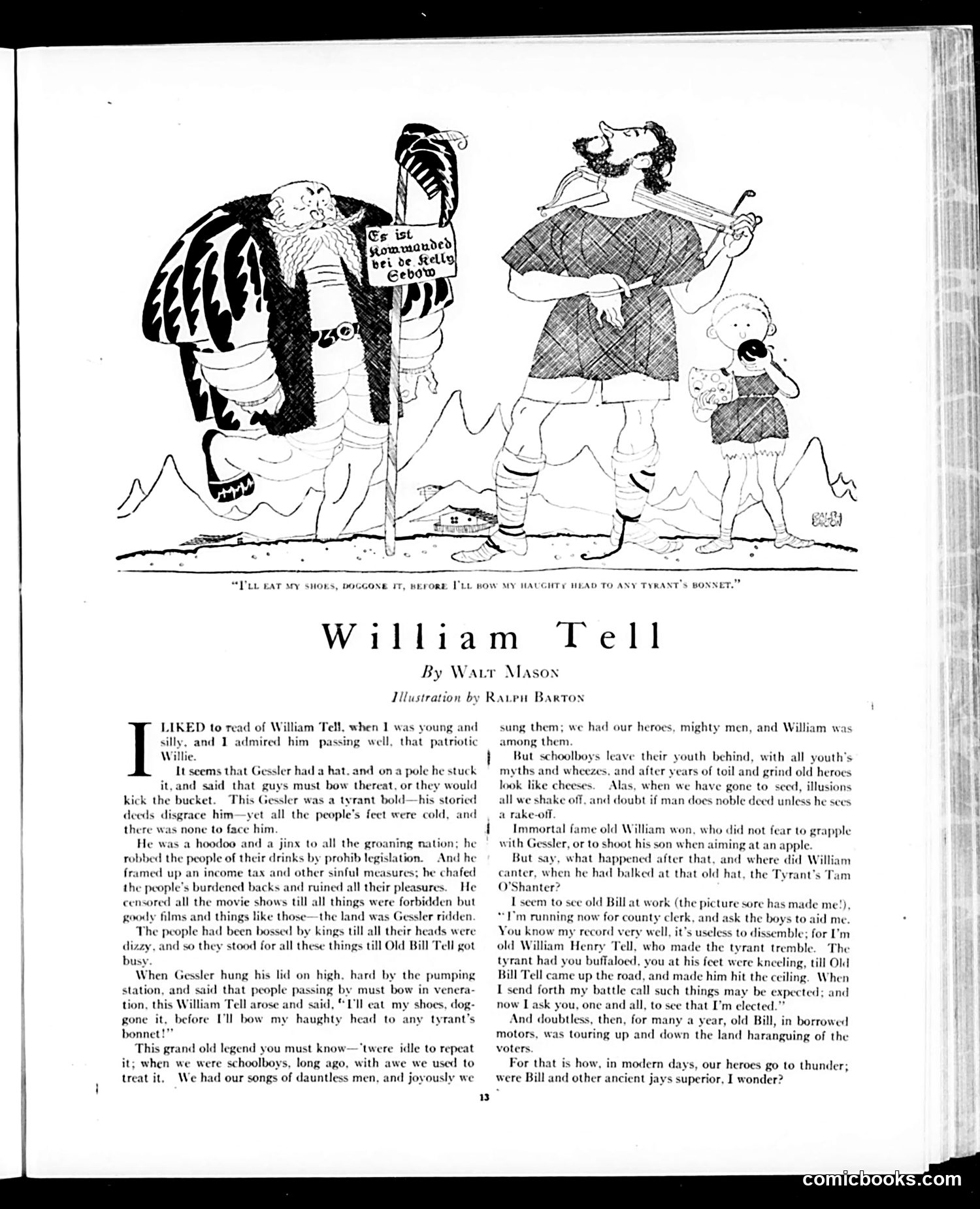
This piece satirizes how historical heroes lose their luster in modern politics. The text draws a parallel between the legendary William Tell—who resisted tyranny—and a contemporary politician exploiting that same heroic narrative for electoral gain. The cartoon illustrates Tell as a folkloric rebel defying an oppressive ruler. But the accompanying essay subverts this: it notes that once Tell "balanced at that old hat, the Tyrant's O'Shanter," he immediately transforms into a cynical candidate running for county clerk, borrowing cars to campaign and asking constituents to vote for him. The satire's point: American politicians invoke patriotic legend and resistance to tyranny while actually pursuing personal power through the same corrupt machinery (patronage, borrowed resources, self-promotion). The heroes of youth become indistinguishable from the tyrants they supposedly opposed—proving that principle yields to practical ambition in modern politics.
📄 Transcribed text from this page (OCR, searchable)
Machine-transcribed from the original scan — historical spelling and the odd misread are preserved.
“DLL EAT APY SHOES, DOGGONE IT, KEFORE PLL HOW MY HAUGHTY HEAD TO ANY TYRANTS BONNET.” William Tell By Waur Mason Illustration by Rateu Barton LIKED to read of William Tell, when 1 was young and silly, and 1 admired him passing well, that patriotic Willie. It seems that Gessler had a hat. and on a pole he stuck it,and said that guys must bow thereat, or they would kick the bucket. This Gessler was a tyrant bold—his storied deeds disgrace him—yet all the people’s feet were cold, and there was none to face him. He was a hoodoo and a jinx to all the groaning nation; he robbed the people of their drinks by prohib legislation. And he framed up an income and other sinful measures; he chafed the people's burdened backs and ruined all their pleasures. He censored all the movie shows till all things were forbidden but xly films and things like those—the land was Gessler ridden: The people had been bossed by kings till all their heads were and so they stood for all these things till Old Bill Tell got dizzy busy When Gessler hung his lid on high, hard by the pumping station, and that people passing by must bow in venera- tion, this William Tell arose and said, “Ul eat: my shoes, dog- gone it, before [ll bow my haughty head to any tyrant’s bonnet! This grand old legend you must know—‘twere idle to repeat it; when we were schoolboys, long ago, with awe we used to treat it, We had our songs of dauntless men, and joyously we Bb sung them; we had our heroes, mighty men, and William was among them But schoolboys leave their youth behind, with all youth's myths and wheezes, and after years of toil and grind old heroes look like cheeses. Alas, when we have gone to seed, illusions all we shake off, and doubt if man does noble deed unless he sees a rake-off Immortal fame old William won, who did not fear to grapple with Gessler, or to shoot his son when aiming at an apple. But say, what »ypened after that, and where did V canter, when he had balked at that old hat, the Tyrant’s O'Shanter? I seem to see old Bill at work (the picture sore has made me!), “I'm running now for county clerk, and ask the boys to aid me. You know my record very well, it’s useless to dissemble; for I'm old William Henry Tell, who made the tyrant tremble. The tyrant had you buffaloed, you at his feet were kneeling, till Old Bill Tell came up the road, and made him hit the ceiling. When I send forth my battle call such things may be expected; and now L ask you, onc and all, to sce that I’m elected.” And doubtless, then, for many a year, old Bill, in borrowed motors, was touring up and down the land haranguing of the voters. For that is how, in modern days, our heroes go to thunder; were Bill and other ancient jays superior, I wonder? iam ram