
Judge, 1921-01-08 · page 20 of 32
Judge — January 8, 1921 — page 20: what you’re looking at
What you’re looking at
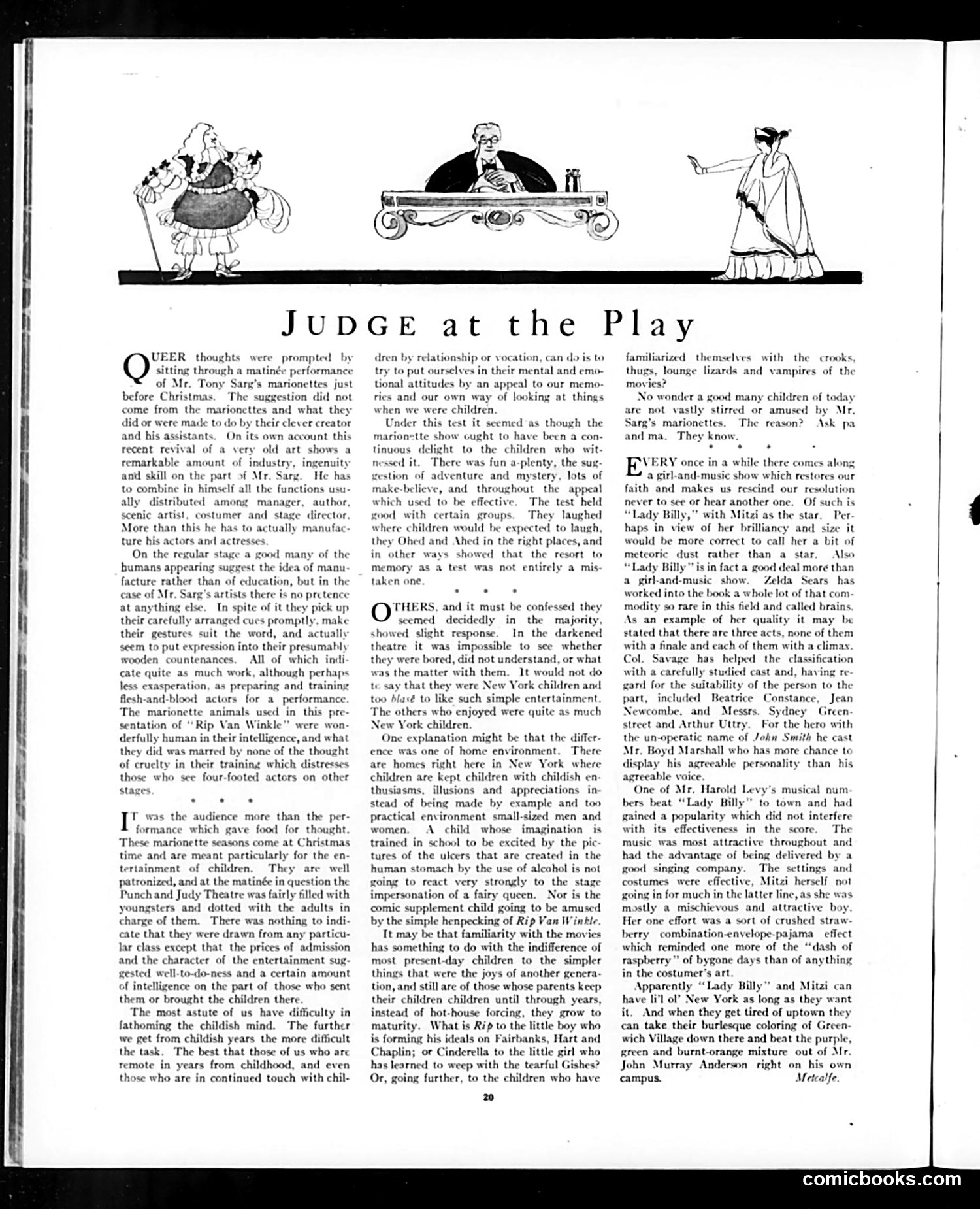
This is a theater review by an unnamed critic evaluating Tony Sarg's marionette production of "Rip Van Winkle," performed at Christmas for children. The illustration shows a judge presiding over a theatrical performance, with a puppet-master on the left and an actor on the right—visually comparing human actors to marionettes. The satire critiques **audience reception disparities**: while some children responded enthusiastically (laughing and expressing wonder appropriately), others sat unmoved. The critic explores whether this reflected boredom, incomprehension, or social class differences. He notes that even New York children of similar economic backgrounds showed wildly different responses, suggesting **home environment and imaginative development**—not wealth—determined who could appreciate the show's simple pleasures. The piece implicitly judges modern parenting: children raised on movies and commercial entertainment had lost the capacity for wonder that simpler theatrical arts once inspired. It's a nostalgic critique of childhood's changing relationship with imagination in the modern era.
📄 Transcribed text from this page (OCR, searchable)
Machine-transcribed from the original scan — historical spelling and the odd misread are preserved.
EER thoughts were prompted by Q sitting through a matinée performance of Mr. Tony Sarg’s marionettes just before Christmas. The suggestion did not come from the marionettes and what they did or were made to do by their clever creator and his assistants. On its own account this recent revival of a very old art remarkable amount of industry, ingenuity and skill on the part of Mr. Sarg. He has to combine in himself all the functions usu- ally distributed among manager, author, scenic artist, costumer and stage director. More than this he has to actually manufac- ture his actors and actresses. On the regular stage a good many of the bumans appearing suggest the idea of manu- facture rather than of education, but in the case of Mr. Sarg’s artists there is no pretence at anything else. [n spite of it they pick up their carefully arranged cues promptly, make their gestures suit the word, and actua seem to put expression into their presumably wooden countenances. All of which indi cate quite as much work, although perhaps less exasperation, as preparing and trainin flesh-and-blood actors for a performance. The marionette animals used in this pre- sentation of “Rip Van Winkle” were won- derfully human in their intelligence, and what they did was marred by none of the thought of cruelty in their training which distresses those who see four-footed actors on other stages shows a I was the audience more than the per- formance which gave food for thought. These marionette seasons come at Christmas time and are meant particularly for the en- tertainment of children. They are well patronized, and at the matinée in question the Punch and Judy Theatre was fairly filled with youngsters and dotted with the adults in charge of them. There was nothing to indi- cate that they were drawn from any part lar class except that the prices of admission and the character of the entertainment sug- gested well-to-do-ness and a certain amount intelligence on the part of those who sent them or brought the children there. The most astute of us have difficulty in fathoming the childish mind. The further we get from childish years the more difficult the task, The best that those of us who arc remote in years from childhood, and even those who are in continued touch with chil- JUDGE at the Play dren by relationship or vocation, can ¢ try to put ourselves in their mental and emo- tional attitudes by an appeal to our mem ries and our own way of looking at things when we were children. Under this test it seemed as though the marionette show ought to have been a con- tinuous delight to the children who wit- ssed it. There was fun a-plenty, the sug- gestion of adventure and mystery, lots of make-believe, and throughout the appeal which used to be effec The test held with certain groups. They laughed where children would be expected to laugh, they Ohed and Ahed in the right places, and in other showed that the resort to memory as a test was not entirely a mis. taken one. good THERS, and it must be confessed the seemed decidedly in the ma, showed slight response. In the darkene theatre it was impossible to see whether they were bored, did not understand, or what was the matter with them. It would not do te say that they were New York children and too hlasé to like such simple entertainment The others who enjoyed were quite as much New York children One explanation might be that the differ- ence was one of home environment. There are homes right here in New York where children are kept children with childish en thusiasms, illusions and appreciations in stead of being made by example and too practical environment small-sized men and women. A child whose imagination is trained in school to be excited by the pic- tures of the ulcers that are created in the human stomach by the use of alcohol is not going to react very strongly to the stage impersonation of a fairy queen. Nor is the comic supplement child going to be amused by the simple henpecking of Rip Van Winkle It may be that familiarity with the movies has something to do with the indifference of most present-day children to the simpler things that were the joys of another genera- tion, and still are of those whose parents keep their children children until through years, instead of hot-house forcing, they grow to maturity. What is Rip to the little boy who is forming his ideals on Fairbanks, Hart and Chaplin; or Cinderella to the little girl who has learned to weep with the tearful Gishes? Or, going further, to the children who have familiarized themselves with the crooks, thugs, lounge lizards and vampires of the movies? No wonder a good many children of today are not vastly stirred or amused by Mr. Sarg’s marionettes. The reason? Ask pa and ma, They know. VERY once in a while there c s along a girl-and-music show which restores our faith and makes us rescind our resolution never to see or hear another one. Of such is “Lady Billy,” with Mitzi as the star. Py haps in view of her brilliancy and size it would be more correct to call her a bit of meteoric dust rather than a star, Also “Lady Billy ” is in fact a good deal more than a girl-and-music show. Zelda Sears has worked into the book a whole lot of that com- modity so rare in this field and called brains. As an example of her quality it may be stated that there are three acts, none of them with a finale and each of them with a climax. Col. Savage has helped the classification with a carefully studied cast and, having re. gard for the suitability of the person to the part, included Beatrice Constance, Jean Newcombe, and Messrs. Sydney Green street and Arthur Uttry. For the hero with the un-operatic name of John Smith he cast Mr. Boyd Marshall who has more chanc display his agreeable personality than his agreeable voice. One of Mr. Harold Levy's musical num bers beat “Lady Bill. to town and had ined a popularity which did not interfere with its effectiveness in the score. The music was most attractive throughout and had the advantage of being delivered by a good singing company. The settings and costumes were effective, Mitzi herself not going in for much in the latter line, as she was mostly a mischievous and attractive boy. Her one effort was a sort of crushed straw- berry combination-envelope-pajama effect which reminded one more of the ‘dash of raspberry’ of bygone days than of anything in the costumer’s art Apparently “Lady Billy” and Mitzi can have li'l ol’ New York as long as they want it. And when they get tired of uptown they can take their burlesque coloring of Green- wich Village down there and beat the purple, green and burnt-orange mixture out of Mr. John Murray Anderson right on his own campus. Metcalfe. comicbooks.com