
Judge, 1921-01-08 · page 5 of 32
Judge — January 8, 1921 — page 5: what you’re looking at
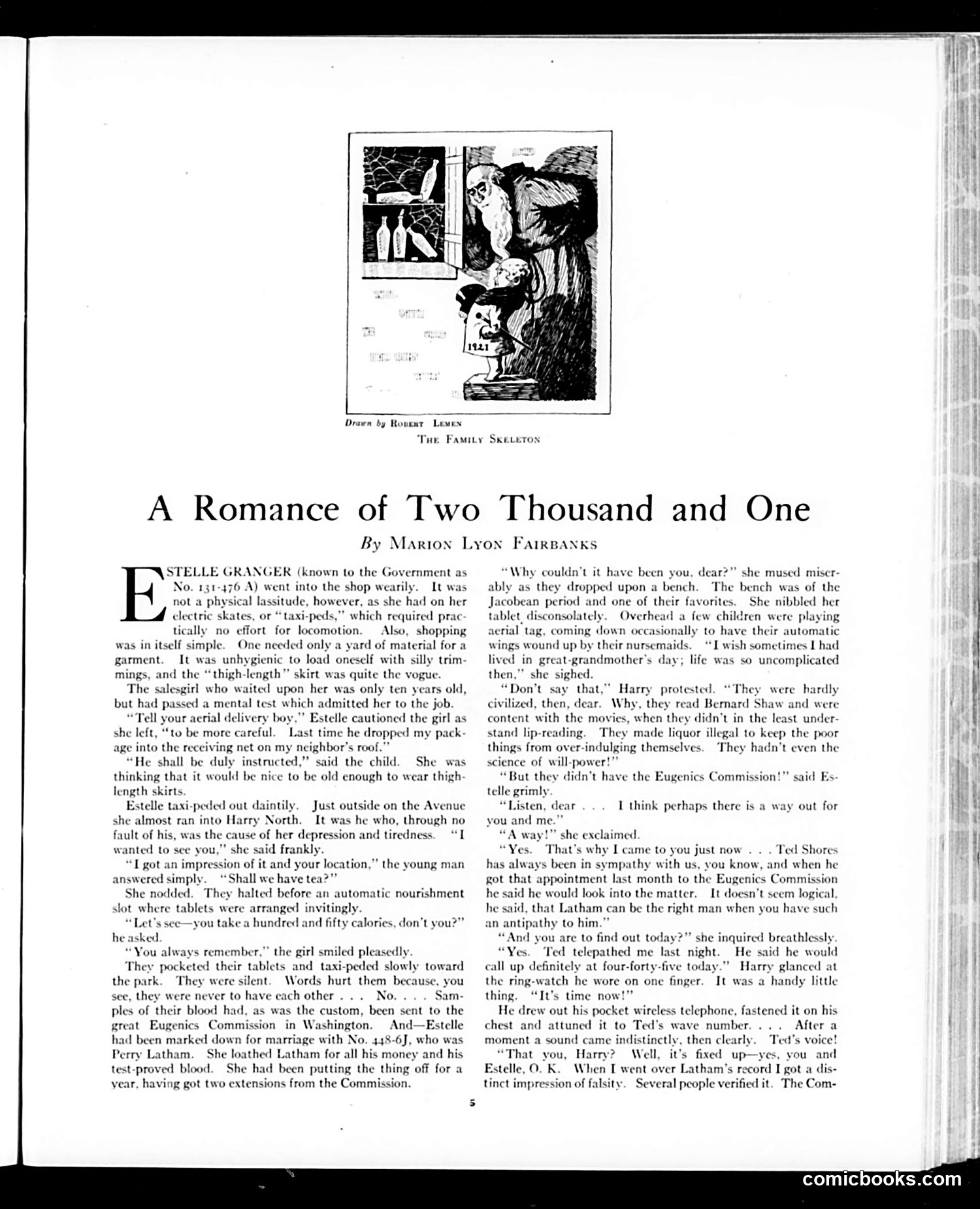
What you’re looking at
This woodcut illustration by Robert Lemes titled "The Family Skeleton" appears above a short story by Marion Lyon Fairbanks titled "A Romance of Two Thousand and One." The cartoon depicts a skeletal figure emerging from or hidden within what appears to be a domestic interior, with smaller vignette panels above showing additional scenes. The imagery plays on the common idiom "skeleton in the closet"—a family secret or shameful history that people hide from public view. The cartoon's placement above a romantic story suggests it may satirize middle-class pretensions or hypocrisy: families presenting respectable facades while harboring embarrassing truths. The grotesque skeleton contrasts with the apparently civilized domestic setting, reinforcing the satirical point about hidden scandals beneath proper appearances—a recurring theme in Judge magazine's social commentary.
📄 Transcribed text from this page (OCR, searchable)
Machine-transcribed from the original scan — historical spelling and the odd misread are preserved.
Draen by Rovrnt Lewex Tue Famity Skevetox A Romance of Two Thousand and One By Marion Lyon FairBanks STELLE GRANGER (known to the Government as No. 131-476 A) went into the shop wearily. It was not a physical lassitude, however, as she had on her electric skates, or “taxi-peds,” which required prac tically no effort for locomotion. Also, shopping was in itself simple. One needed only a yard of material for a garment. It was unhygienic to load oneself with silly trim mings, and the “thigh-length”’ skirt was quite the vogue. The salesgirl who waited upon her was only ten years old, but had passed a mental test which admitted her to the job. “Tell your aerial delivery boy.”’ Estelle cautioned the girl as she left, “to be more careful. Last time he dropped my pack- age into the receiving net on my neighbor's roof.” “He shall be duly instructed,” said the child. She was thinking that it would be nice to be old enough to wear thigh length skirts Estelle taxi-peded out daintily. Just outside on the Avenue she almost ran into Harry North. It was he who, through no fault of his, was the cause of her depression and tiredness. “I wanted to see you,” she said frankly. “T got an impression of it and your location,” the young man answered simply. “Shall we have tea?” She nodded. They halted before an automatic nourishment slot where tablets were arranged invitingly. “Let's see—you take a hundred and fifty calories, don’t you?” he asked u always remember,” the girl smiled pleasedly They pocketed their tablets and taxi-peded slowly toward the park. They were silent. Words hurt them because, you see, they were never to have cach other... No. . Sam- ples of their blood had, as was the custom, been sent to the great Eugenics Commission in Washington. And—Estelle had been marked down for marriage with No. 448-6J, who was Perry Latham. She loathed Latham for all his money and his test-proved blood. She had been putting the thing off for a year, having got two extensions from the Commission. “Why couldn't it have been you, dear?" she mused miser- ably as they dropped upon a bench. The bench was of the Jacobean period and one of their favorites. She nibbled her tablet, disconsolately. Overhead a few children were playing aerial tag, coming down occasionally to have their automatic wings wound up by their nursemaids. “I wish sometimes I had lived in great-grandmother’s day; life was so uncomplicated then,” she sighed. Don’t say that,” Harry. protested hey were hardly civilized, then, dear. Why, they read Bernard Shaw and were content with the movies, when they didn’t in the least under- stand lip-reading. They made liquor illegal to keep the poor things from over-indulging themselves. They hadn't even the science of will-power!” “But they didn’t have the telle grimly. “Listen, dear you and me.” “A way!” she exclaimed “Yes. That's why I came to you just now Ted Shores has always been in sympathy with us, you know, and when he got that appointment last month to the Eugenics Commission he said he would look into the matter. It doesn’t scem logical, he said, that Latham can be the right man when you have such an antipathy to him.” “And you are to find out today?” she inquired breathlessly: “Yes, Ted telepathed me last night. He said he would call up definitely at four-forty-five today.” Harry glanced at the ring-watch he wore on one finger. It was a handy little thing. “It’s time now!” He drew out his pocket wireless telephone, fastened it on his chest and attuned it to Ted’s wave number... . After a moment a sound came indistinctly, then clearly. Ted's voice! “That you, Harry? Well, it’s fixed up—yes, you and elle, O. K. When I went over Latham’s record I got a dis- tinct impression of falsity. Several people verified it. The Com- Eugenics Commission!” said Es- 1 think perhaps there is a way out for comicbooks.com