
A complete issue · 32 pages · 1920
Judge — September 18, 1920
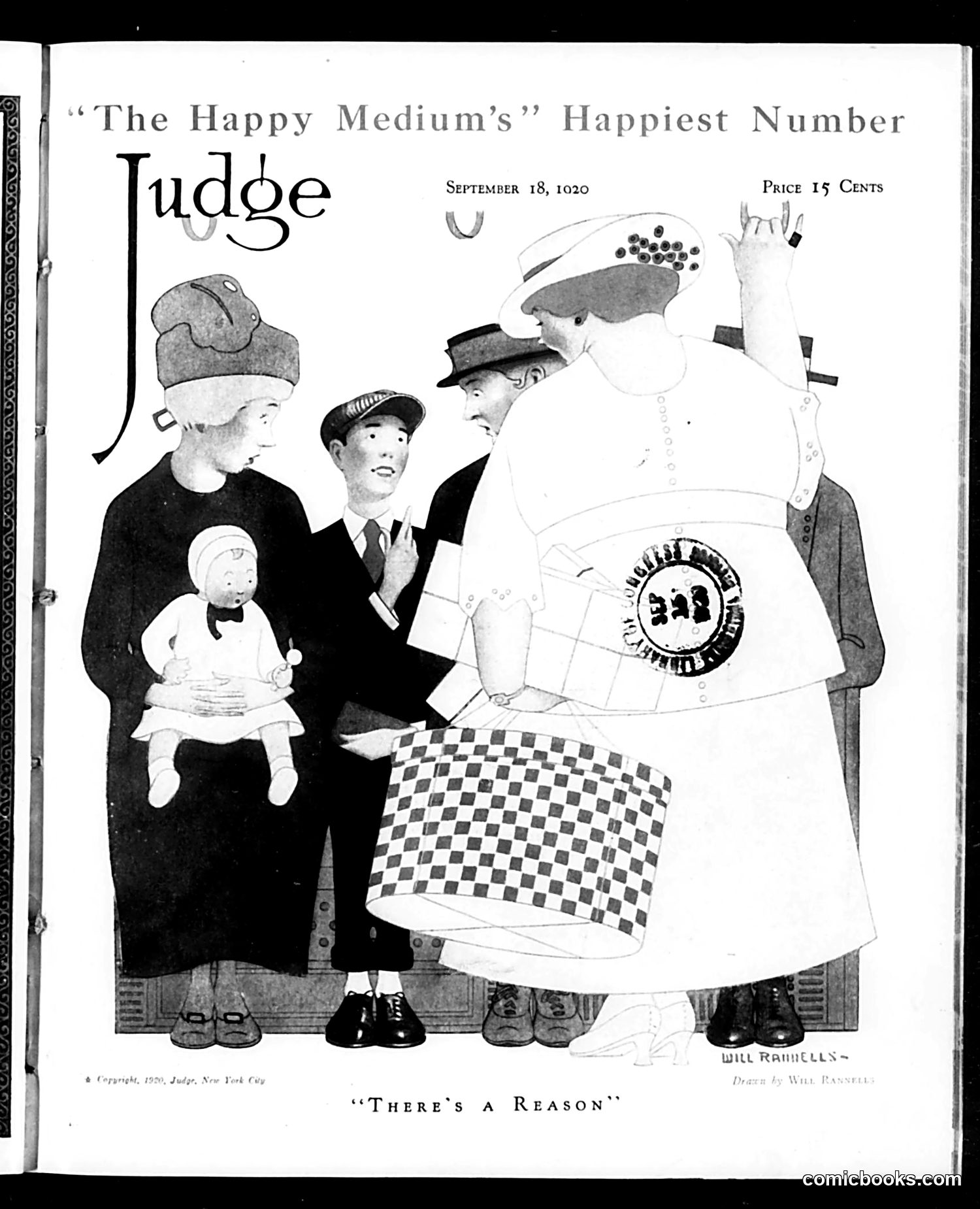
This satirical cover depicts a large woman representing "The Happy Medium"—likely a reference to spiritualism or moderation, popular topics in 1920s America. The woman displays the number "333" on her dress, suggesting a lottery or fortune-telling number. The smaller figures—a woman with an elaborate hat, a man in formal wear, and a couple—appear to be supplicants seeking her guidance. The checkered pattern below suggests gambling or chance. The caption "There's a Reason" is ironic commentary. The satire likely mocks the era's obsession with spiritualism, numerology, and gambling, particularly following World War I when such practices gained cultural prominence. The "happy medium" may also reference attempts to find middle ground on contentious post-war issues.
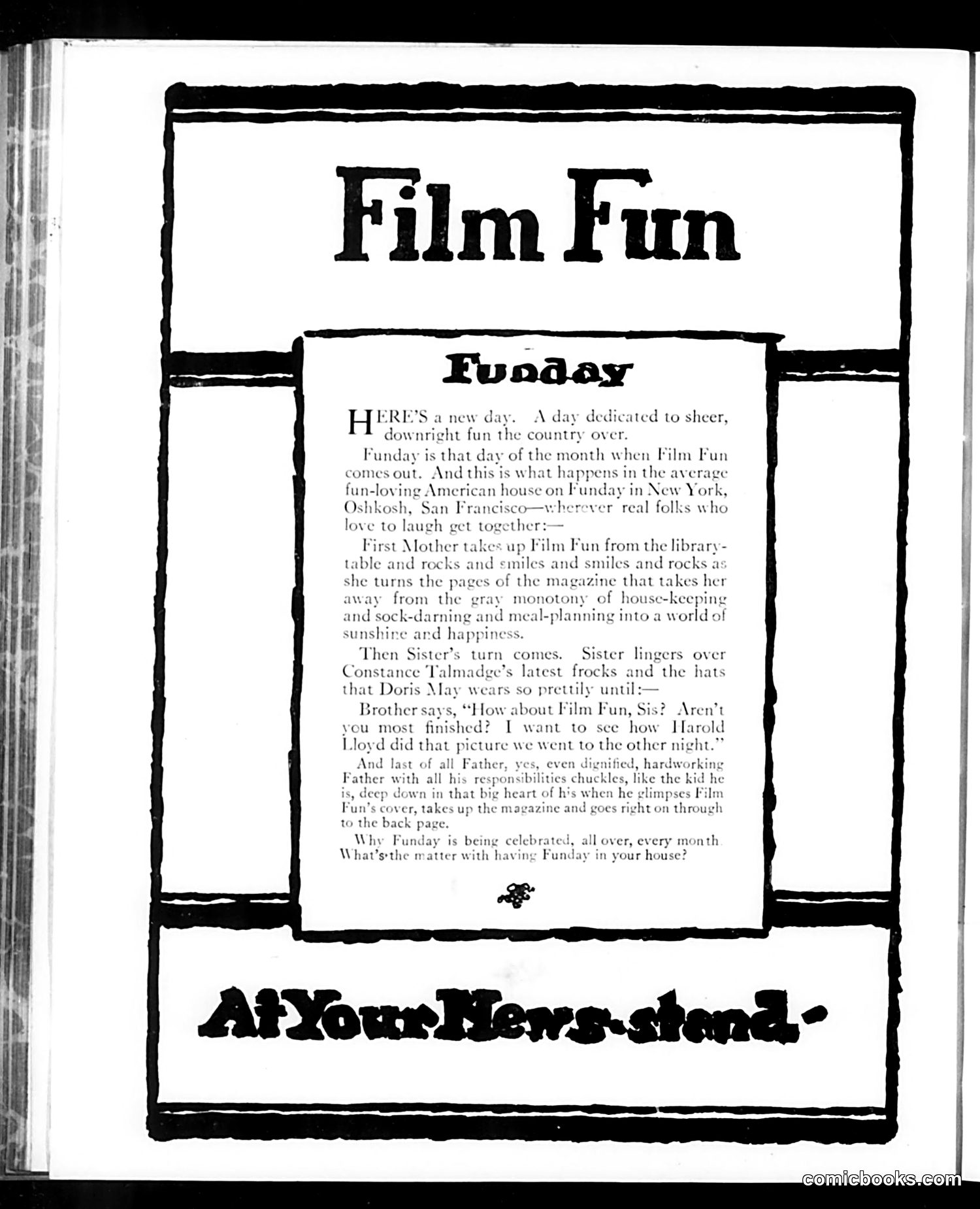
This page celebrates "Funday"—a monthly tradition where families gathered around *Film Fun* magazine for entertainment. The satire gently mocks typical American domestic life by showing how different family members react to the magazine: - **Mother** escapes household drudgery (housekeeping, sock-darning, meal-planning) - **Sister** lingers over celebrity fashion (Constance Talmadge, Doris May) - **Brother** wants action-picture updates (Harold Lloyd) - **Father** secretly enjoys it despite his dignified demeanor The humor lies in depicting *Film Fun* as a unifying escape from the monotony of ordinary life—cinema's power to captivate all social classes and age groups. The piece celebrates this monthly ritual as a cherished American household tradition, highlighting entertainment's cultural importance in the 1920s.
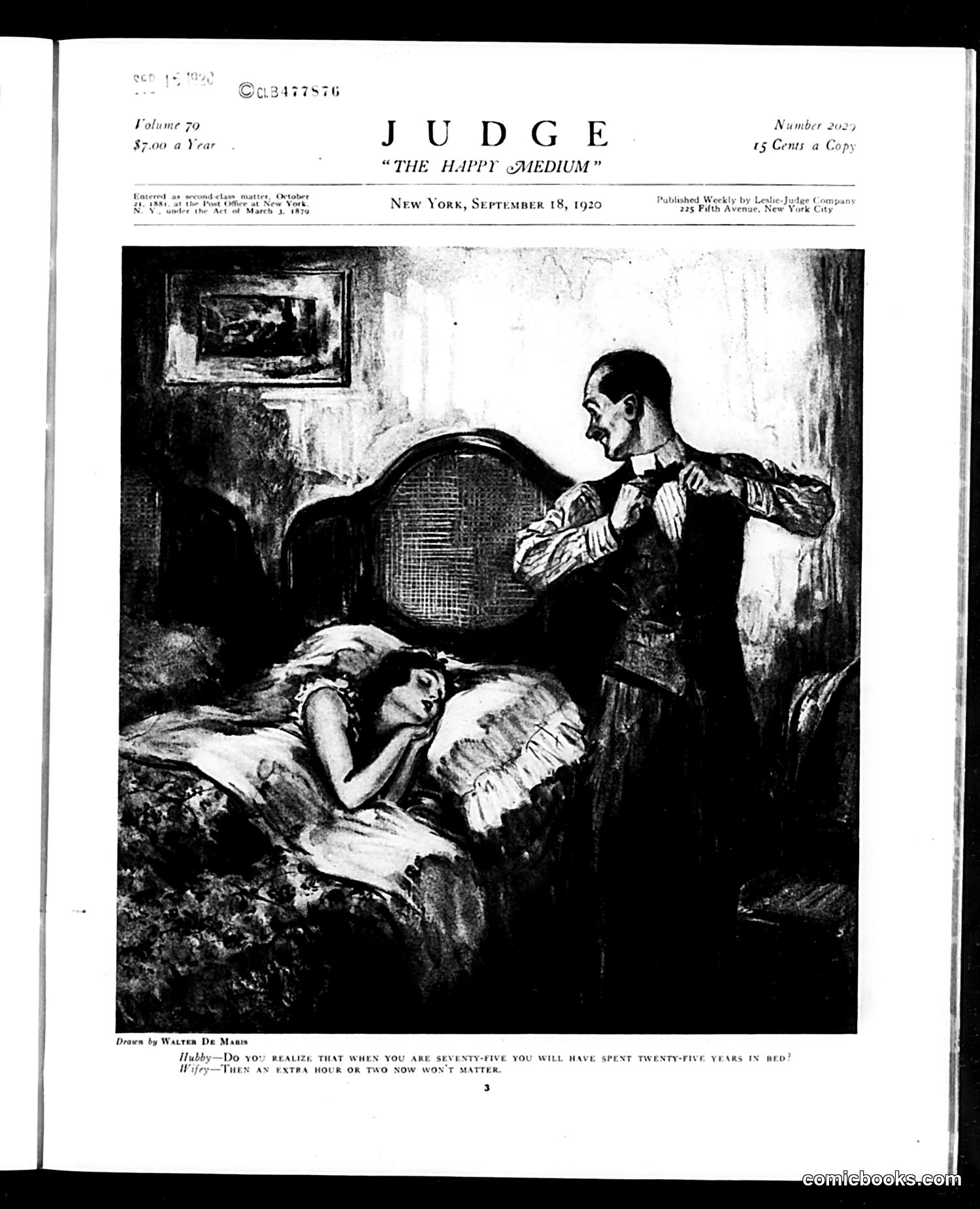
This illustration by Walter De Mars depicts a domestic scene playing on anxieties about aging and mortality. A man in formal military dress stands over a bedridden woman, holding what appears to be a large magnifying glass or monocle. The caption reads: "Hobby—Do you realize that when you are seventy-five you will have spent twenty-five years in bed? If so—Then an extra hour or two now won't matter." The joke targets hypochondriacs or people overly concerned with health habits. The "hobby" is obsessing about sleep and time spent in bed. The satire suggests that worrying excessively about rest duration is absurd given the inevitability of aging and prolonged bedrest in old age—so one might as well indulge now.
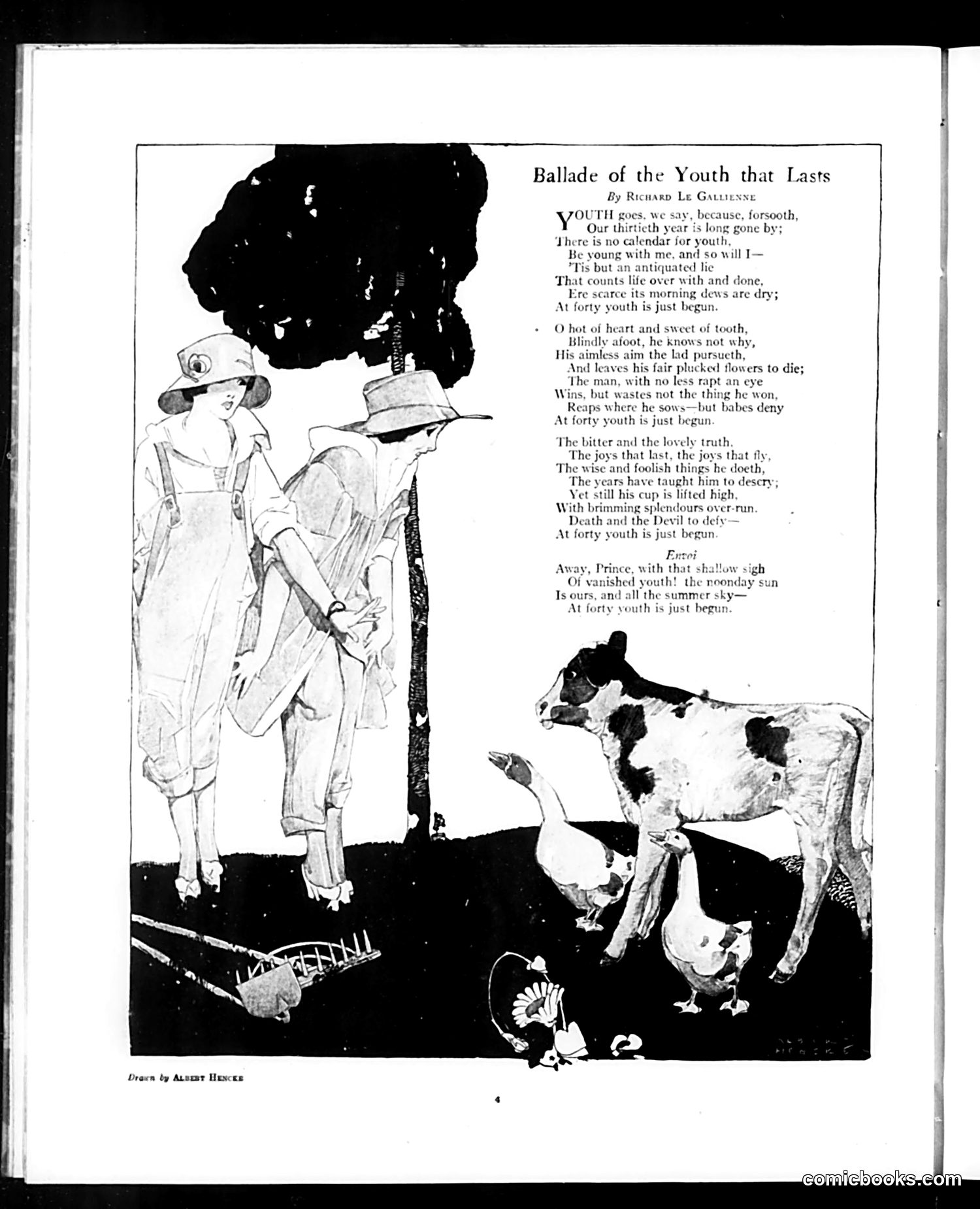
This page features a poem with an illustration by Albert Herkerr. The artwork depicts two young people in fashionable dress standing beside a cow, with silhouetted figures in the background. The poem is a satirical commentary on youth and aging. It addresses vanity and the fleeting nature of youthful beauty and achievement—themes common to Judge magazine's social commentary. The refrain "At forty youth is just begun" appears ironic, suggesting either that people foolishly cling to youthful pretenses into middle age, or sardonically commenting on society's obsession with youth. The illustration's inclusion of a cow is unclear but may represent rural simplicity or rusticity contrasted with the fashionably-dressed figures, though the exact satirical point requires additional context.
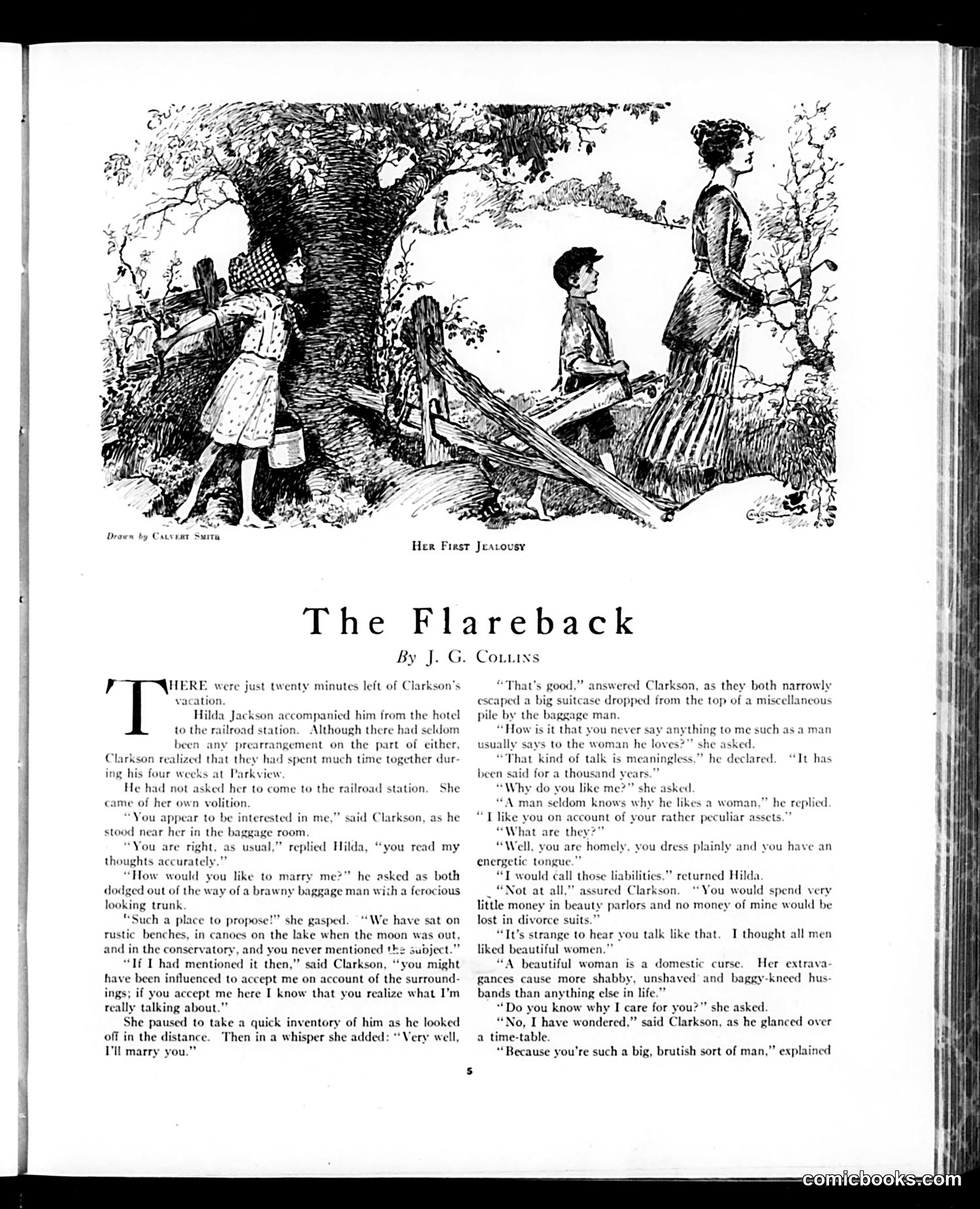
This page contains an illustrated short story rather than political satire. The drawing by Calvert Smith shows a Victorian-era romantic scene: a woman and man near a large tree, with the caption "Her First Jealousy." The story depicts a courtship dialogue between Clarkson and Hilda. Clarkson proposes marriage during a lakeside vacation, but Hilda expresses skepticism about his feelings, questioning why he likes her. Their exchange satirizes conventional romantic rhetoric—she dismisses his compliments as insincere flattery, while he defensively characterizes beautiful women as domestic liabilities prone to vanity. The humor derives from the tension between romantic idealism and practical skepticism about marriage, a common theme in period literature and Judge magazine's satirical treatment of courtship customs.
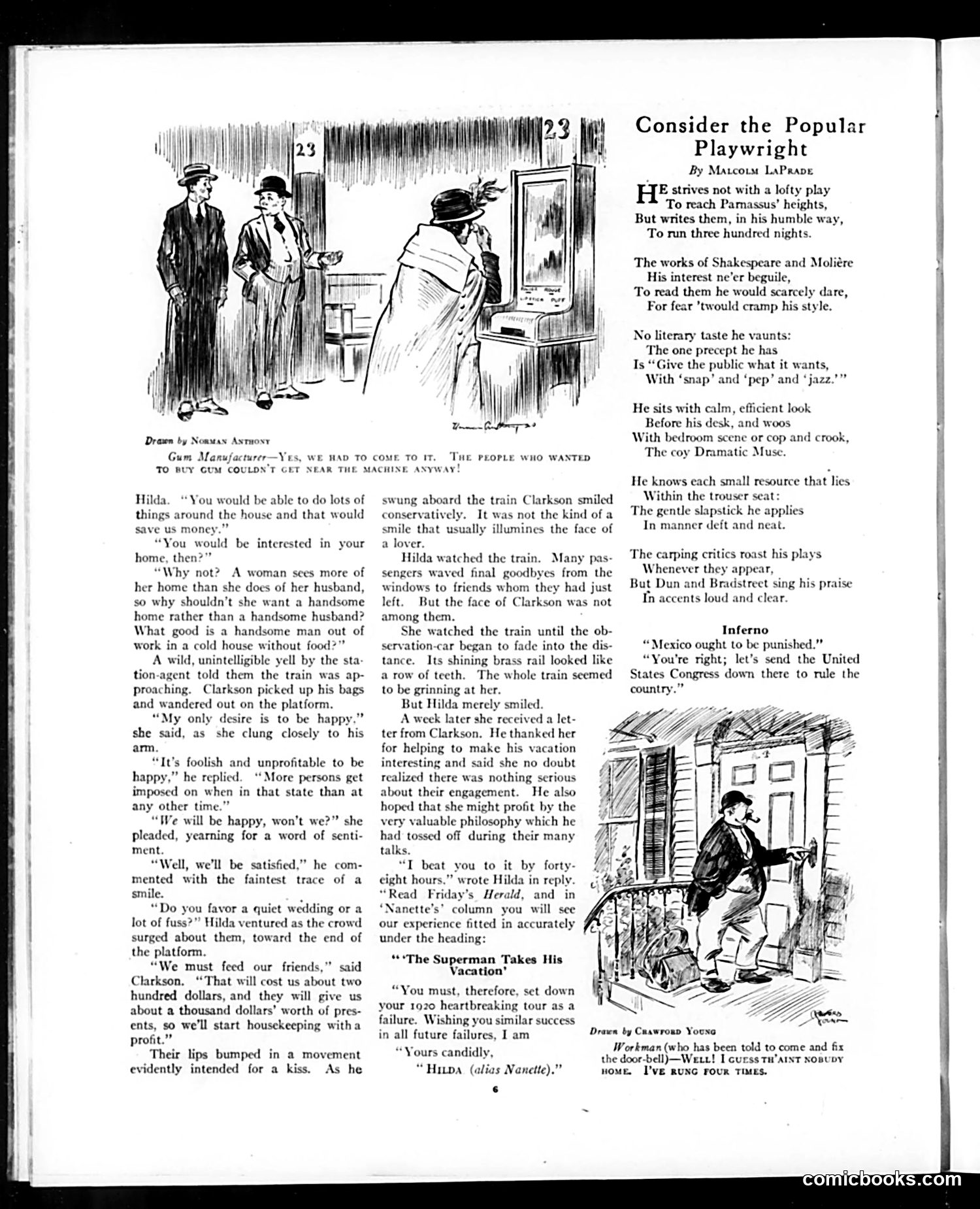
This page contains two separate pieces: **Top: "Consider the Popular Playwright"** by Malcolm LaFrade is a satirical poem mocking commercially successful playwrights who prioritize box-office appeal over artistic merit. The poem criticizes writers who avoid challenging literature (Shakespeare, Molière) and instead provide audiences "snap," "pep," and "jazz"—using popular entertainments as shorthand for lowbrow taste. The playwright relies on "bedroom scene or cop and crook" melodrama and flatters critics to boost sales. **Bottom: A short story excerpt** about characters Hilda and Clarkson discussing vacation plans and an engagement, featuring two accompanying illustrations by Norman Anthony and Crawford Young showing domestic/office scenes. The satire targets the commercialization of theater and argues that profitable plays sacrifice artistic integrity for mass appeal.
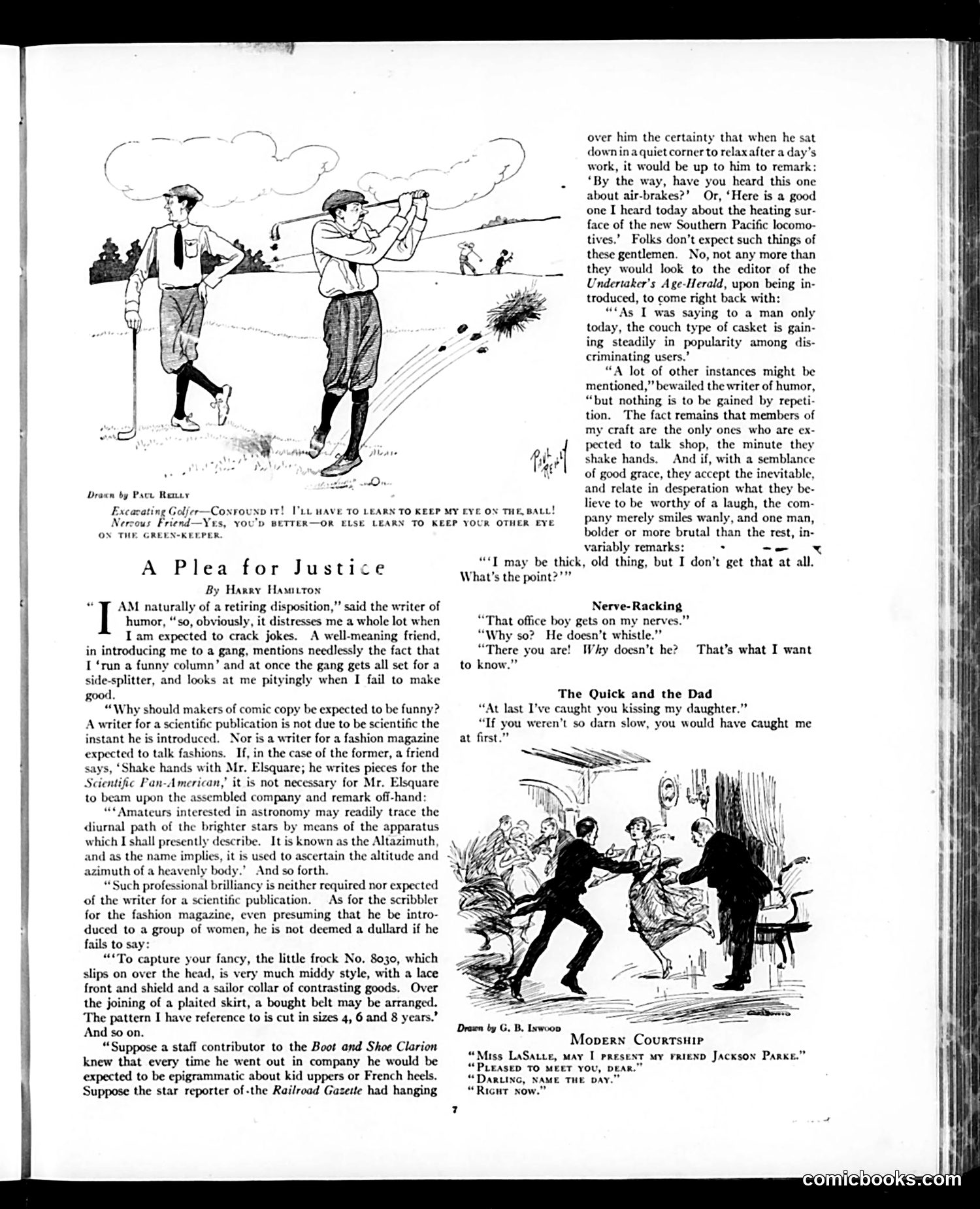
This page contains three humorous pieces from Judge magazine: **Top cartoon**: A golfer and friend joke about keeping eyes focused—one on the ball, the other on the groundskeeper, implying the golfer digs up the green while playing badly. **"A Plea for Justice"**: Humorist Harry Hamilton argues that humor writers shouldn't be expected to perform comedy on demand at social gatherings. He compares this unfair pressure to not expecting a fashion magazine writer to discuss clothing specs or a railroad reporter to crack jokes about locomotives. The essay satirizes society's assumption that professionals in their field must constantly demonstrate expertise in their specialty—a relatable complaint about workplace social dynamics. **"Nerve-Racking"**: A short joke where someone finds an office boy annoying precisely *because* he doesn't whistle, subverting the expected complaint. **"The Quick and the Dad"**: A partially visible cartoon about a father catching his daughter kissing, with dialogue about being too slow to catch them earlier. The page mixes social commentary with light comedy typical of Judge's satirical approach to American life.
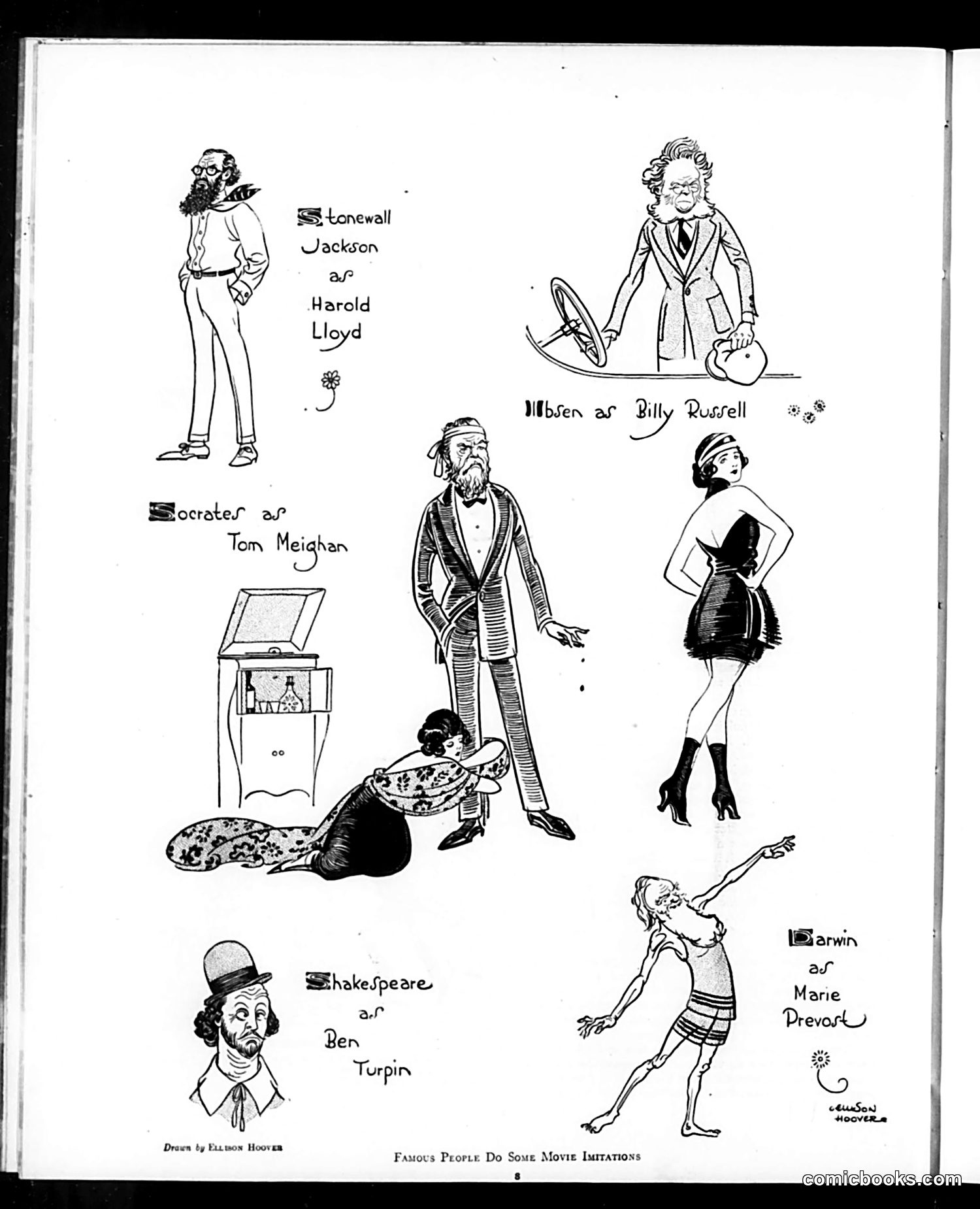
This Judge magazine page satirizes famous historical and literary figures through movie actor impersonations. The title "Famous People Do Some Movie Imitations" indicates these are caricatures of actors mimicking iconic figures. Labeled subjects include: - **Stonewall Jackson** (Harold Lloyd) - Civil War general - **Socrates** (Tom Meighan) - Greek philosopher, shown with a poison cup reference - **Shakespeare** (Ben Turpin) - English playwright - **Ibsen** (Billy Russell) - Norwegian dramatist - **Darwin** (Marie Dressler) - Naturalist The satire mocks both the serious historical figures and the actors' presumed overacting in their film portrayals. The exaggerated poses and costumes emphasize how cinema trivializes serious history. This reflects 1920s-era concern that popular movies were reducing great cultural figures to mere entertainment spectacle.
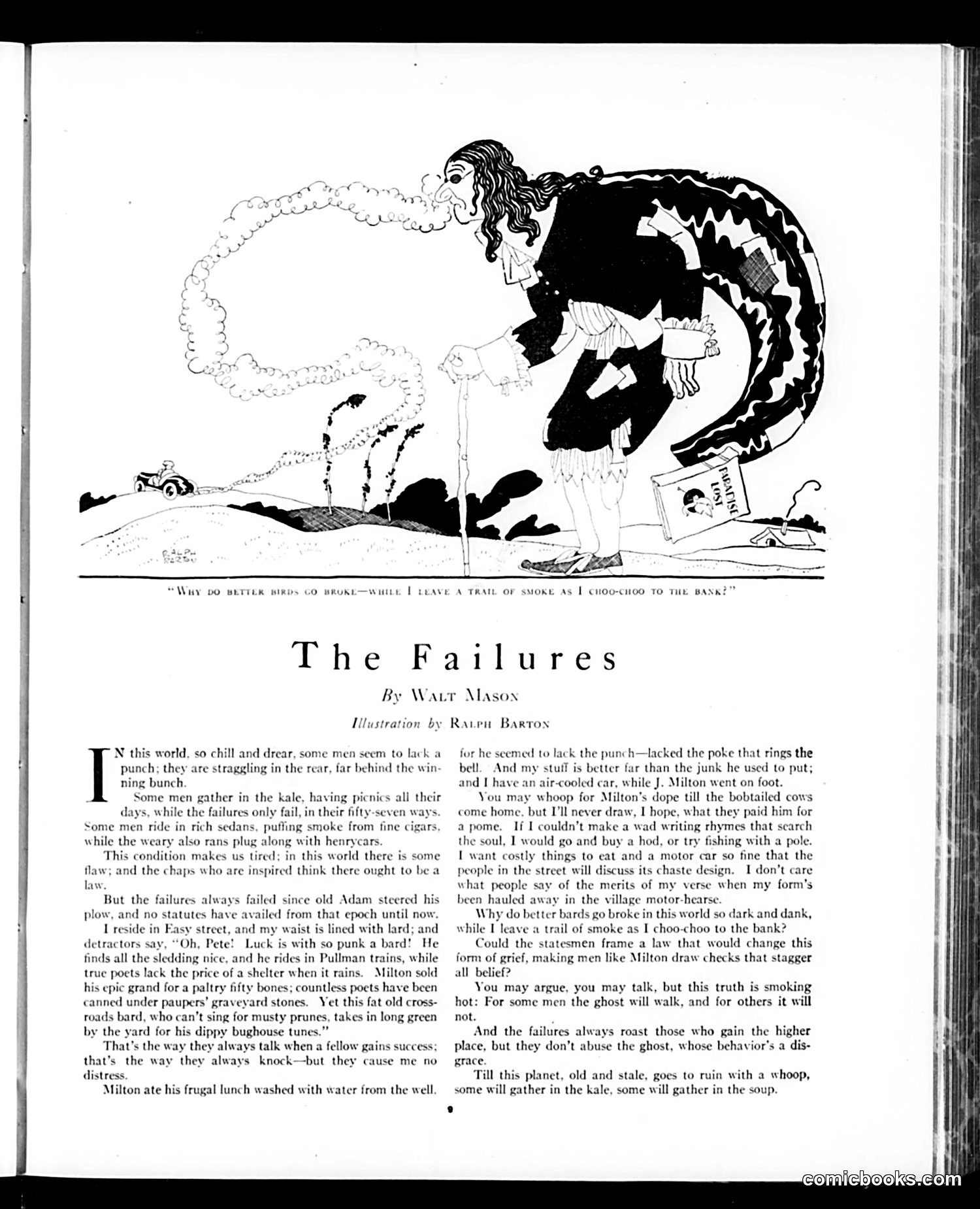
This page contains Walt Mason's poem illustrated by Ralph Barton, satirizing the disconnect between literary/artistic merit and financial success in early 20th-century America. **The Setup:** The cartoon depicts a prosperous, well-fed man driving a fancy car while leaving a trail of smoke—he's heading "to the bank." The poem's speaker boasts of wealth and comfort despite admitting his work is mediocre ("dippy bughouse tunes"). **The Satire:** Mason contrasts this successful charlatan with serious poets like Milton, who starved despite superior talent. The speaker arrogantly celebrates his own prosperity while mocking struggling artists. The joke is the speaker's oblivious hypocrisy: he proves that success rewards commercial appeal and luck, not quality—undermining any claim to merit. **Social Context:** This reflects real anxieties about commercialization and "dumbing down" culture in the Jazz Age. The poem sarcastically asks whether laws could help failures—answering "no," suggesting that unfairness is simply human nature and unchangeable.
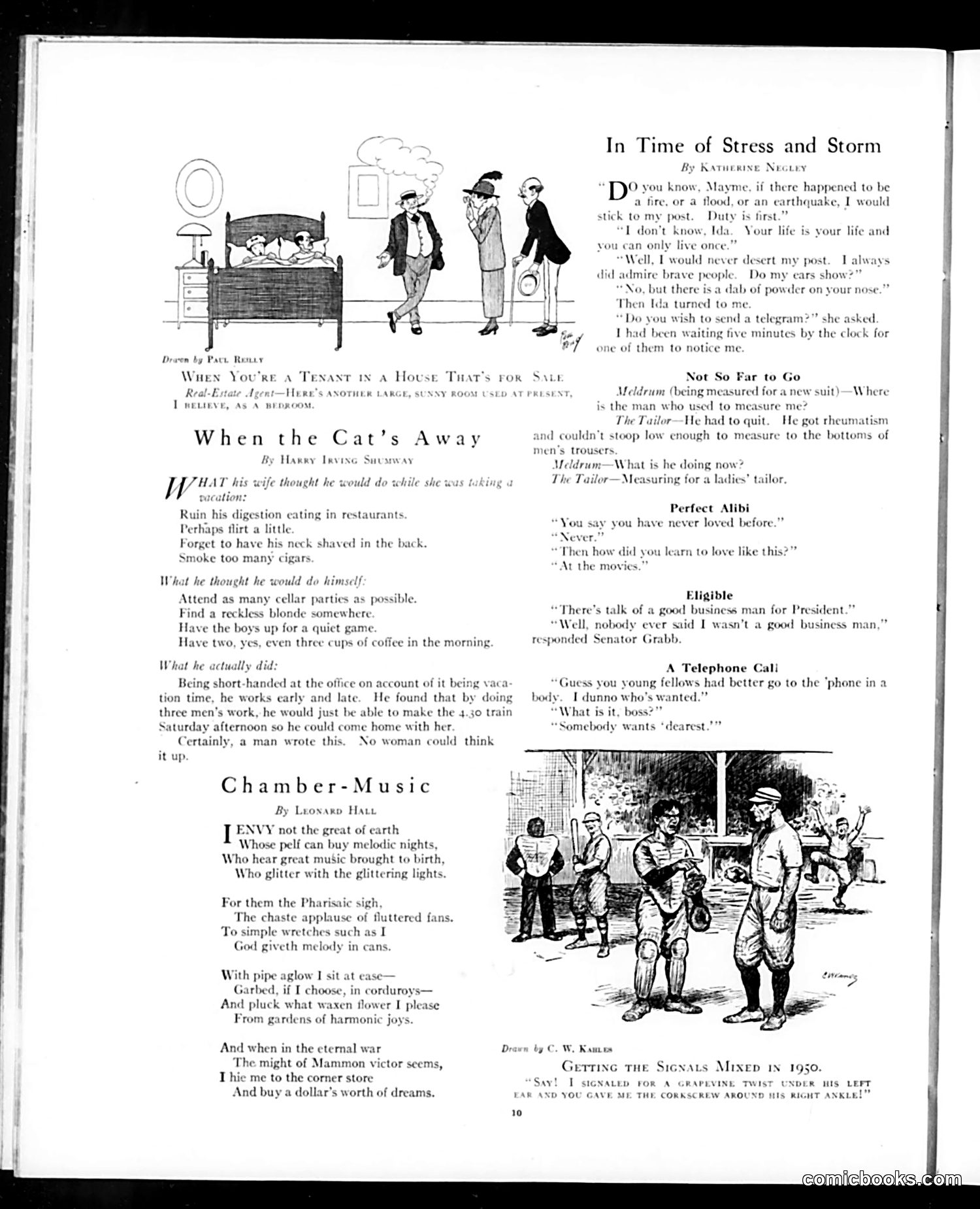
This page from Judge magazine contains several satirical pieces targeting early 20th-century social conventions and gender dynamics. **"When the Cat's Away"** mocks husbands' supposed secret desires versus reality. It contrasts what a husband *thinks* he'll do without his wife (attend parties, smoke, pursue women) against what he *actually* does (work overtime to catch the 4:30 train home). The final line—"No woman could think it up"—is self-aware satire: the author acknowledges a man wrote this fantasy, gently mocking male wishful thinking about bachelor freedom while depicting actual domestic obligation. **"Chamber-Music"** is poetic satire about the working poor finding cheap entertainment in phonograph records ("melody in cans") rather than expensive concert halls available to the wealthy. It celebrates modest dignity against class inequality. The short joke pieces mock contemporary absurdities: a tailor measuring a customer's growing waistline; learning to love at movies; a senator's hypocrisy about business qualifications. **"Getting the Signals Mixed in 1950"** (bottom illustration) depicts confusion about romantic gestures, likely mocking modern courtship's complexity. The page satirizes class divisions, gender expectations, and consumer culture through humor rather than overt politics.
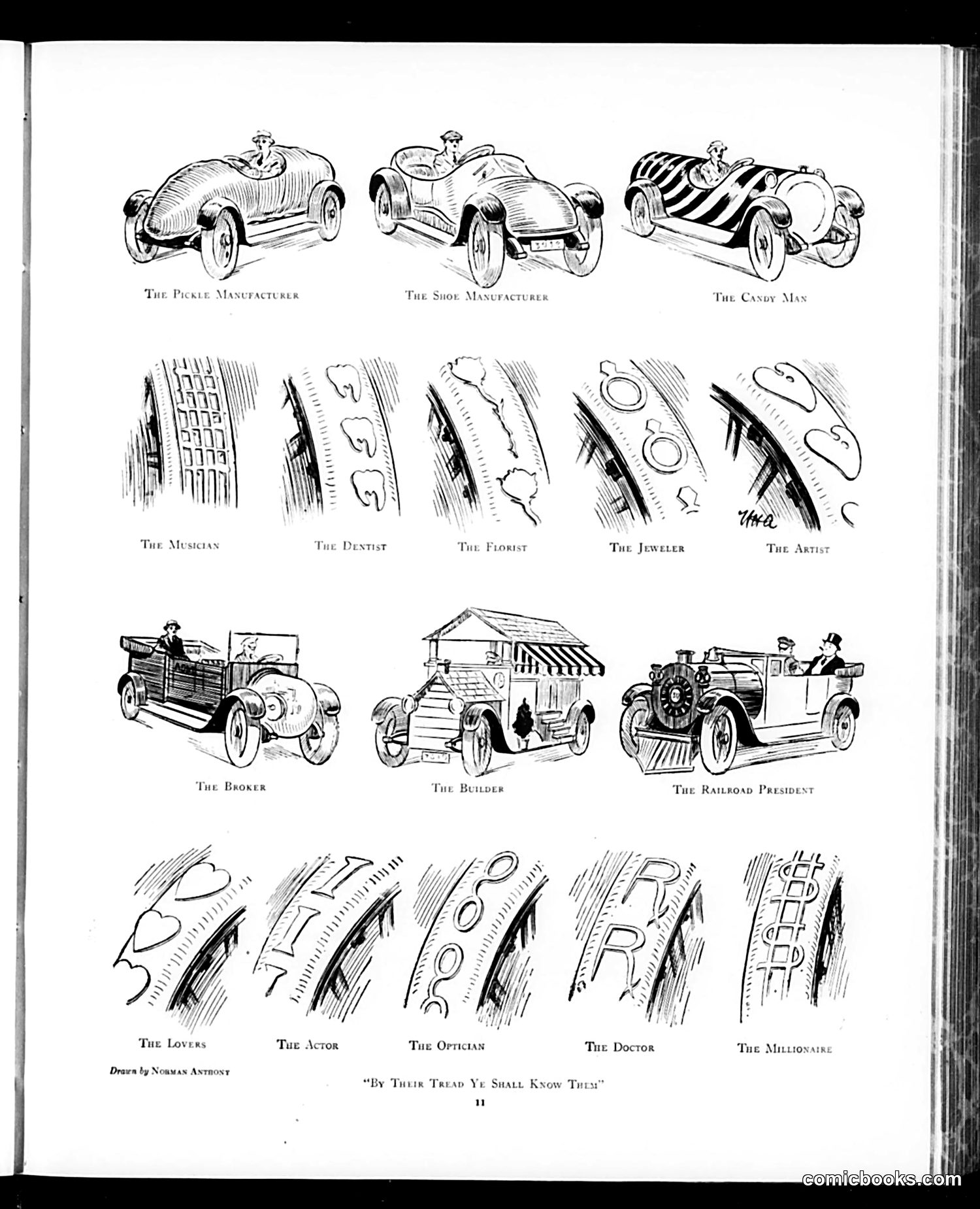
This satirical page illustrates different professions and social types through the distinctive tread marks their automobile tires leave. Each figure's tire pattern humorously reflects their occupation or character: - Top row: luxury/leisure professions (Pickle Manufacturer, Shoe Manufacturer, Candy Man) - Middle rows: various skilled trades and professions (Musician, Dentist, Florist, Jeweler, Artist, Broker, Builder, Railroad President) - Bottom row: social archetypes (Lovers, Actor, Optician, Doctor, Millionaire) The satire suggests that one's profession leaves a metaphorical "mark"—implying that your work literally shapes who you are. It's a visual pun about professional identity and social class, drawn by Norman Armsby, reflecting Judge magazine's characteristic humor about American commerce and society.
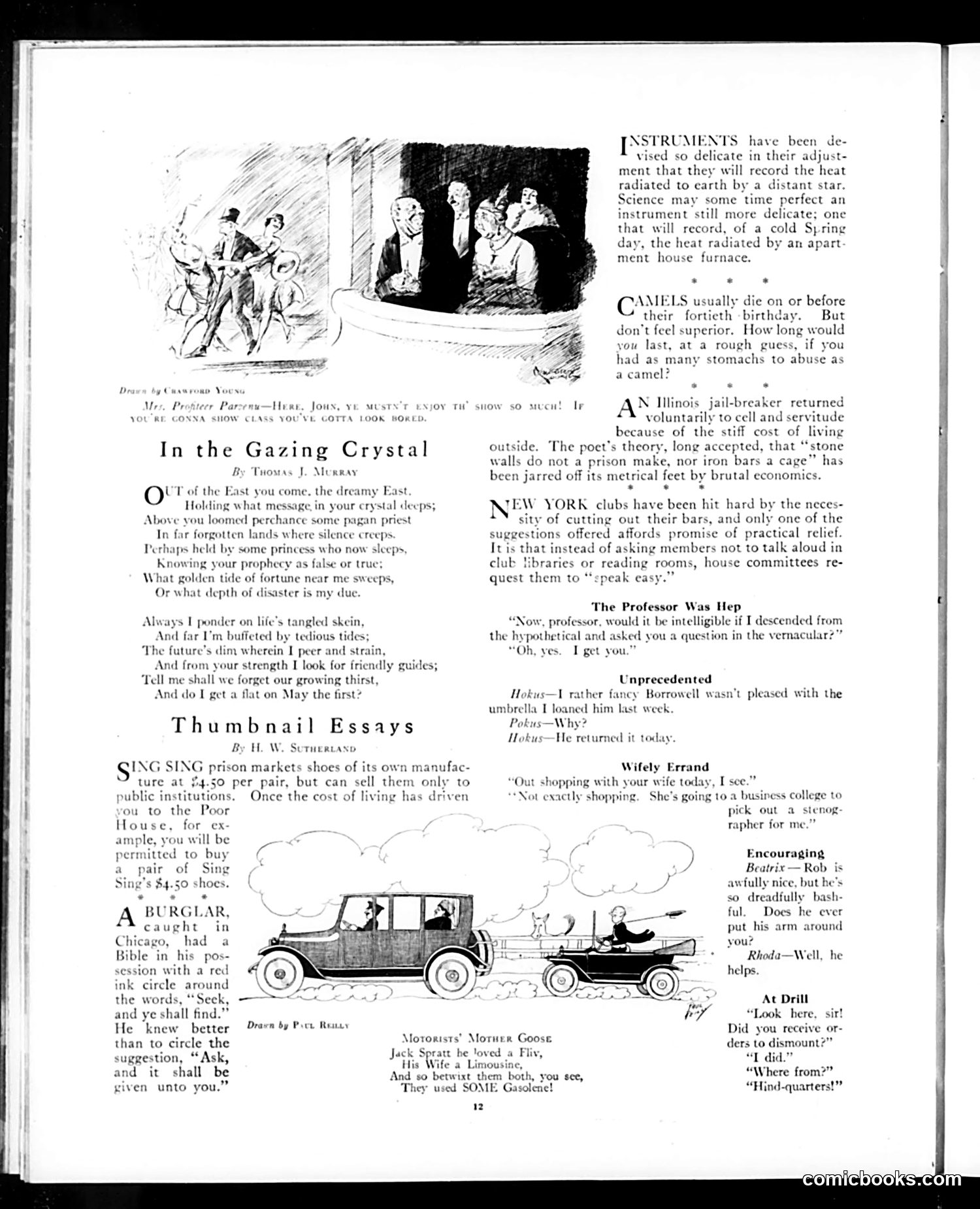
This page contains several satirical pieces targeting early 20th-century American social issues: **"In the Gazing Crystal"** is a poem mocking pseudo-scientific fortune-telling and Eastern mysticism—common targets of American satire during the spiritualism craze. **"Thumbnail Essays"** includes brief social commentary: Sing Sing prison's shoe manufacturing (highlighting prison labor economics), a burglar's misuse of Biblical rhetoric, and an Illinois jail-breaker voluntarily returning due to poverty—all satirizing the harsh realities of crime and incarceration. The **cartoon** showing a car with multiple trailers appears to mock motorists' or wealthy people's conspicuous consumption and traffic dangers. Brief **joke sections** ("The Professor Was Hep," "Wifely Errand," etc.) offer domestic and social humor typical of the era—poking fun at marital dynamics, academia, and class aspirations. The page's overall tone targets economic hardship, pretension, and social hypocrisy common in 1920s American life.
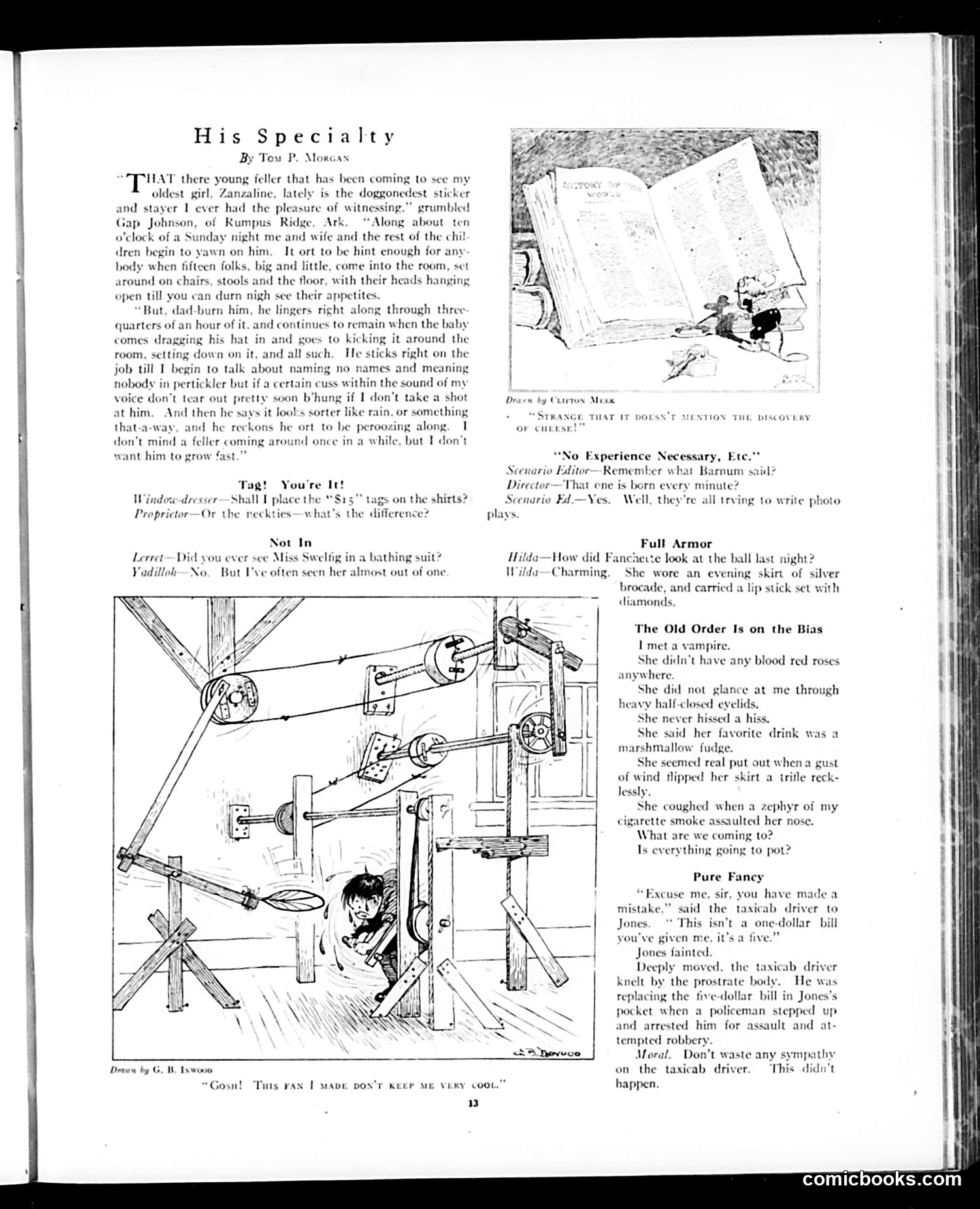
This page contains several brief humorous sketches typical of early-20th-century American humor magazines. **"His Specialty"** satirizes persistent suitors. A rural father (Gap Johnson) complains that a young man courting his daughter won't leave despite obvious social cues—yawning family members, a baby disrupting the room, even hints about rain. The joke mocks both the oblivious suitor's lack of social awareness and the father's inability to directly ask him to leave. **The other sketches** are brief joke exchanges: "Tag! You're It!" plays on word confusion between price tags and neckties; "Not In" contrasts seeing a woman fully clothed versus nearly naked; "No Experience Necessary" mocks unqualified people entering the film industry; "Full Armor" makes light of excessive evening wear; "The Old Order Is on the Bias" ironically laments that modern women lack the exaggerated "vampire" mannerisms of earlier fashions; and "Pure Fancy" presents an absurd scenario where honesty from a taxi driver leads to his arrest. The humor reflects period attitudes about courtship, fashion, and emerging film industry mediocrity.
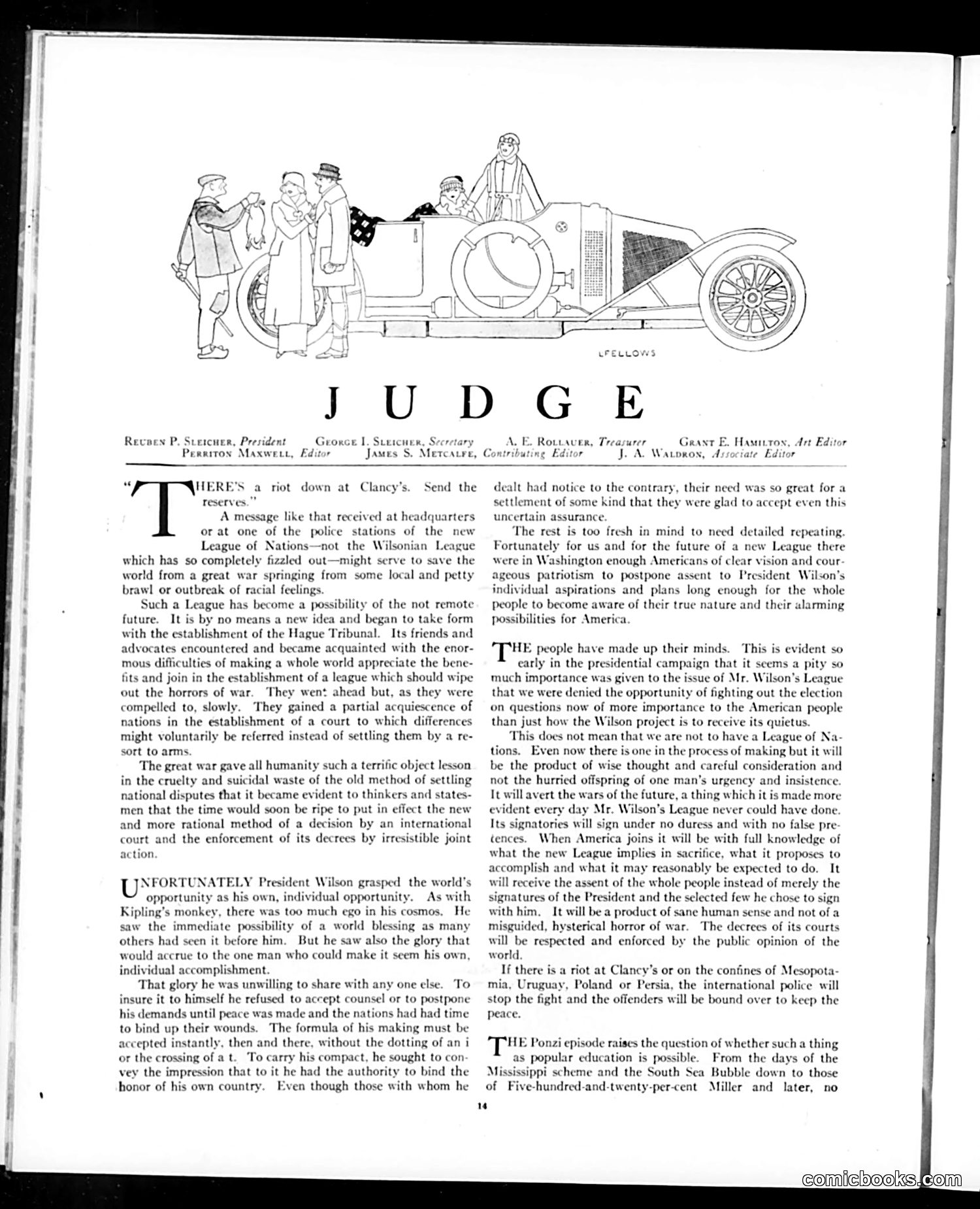
This page critiques President Wilson's handling of the League of Nations after World War I. The illustration shows an elaborate mechanical contraption labeled "JUDGE"—likely representing the magazine itself or the concept of justice—with figures in period dress observing it. The text argues that Wilson selfishly pursued his League as a personal political achievement rather than allowing time for democratic deliberation. The author contrasts Wilson's rushed, ego-driven approach with the slower, more consensus-based establishment of earlier international bodies like the Hague Tribunal. The satire's point: Wilson forced an imperfect League upon nations desperate for peace, prioritizing his individual glory over genuine international cooperation. The article suggests Americans wisely rejected Wilson's specific League proposal, but that a *better* League of Nations could emerge from thoughtful consideration rather than one man's ambition. This reflects post-WWI American skepticism about both Wilson and international entanglement.
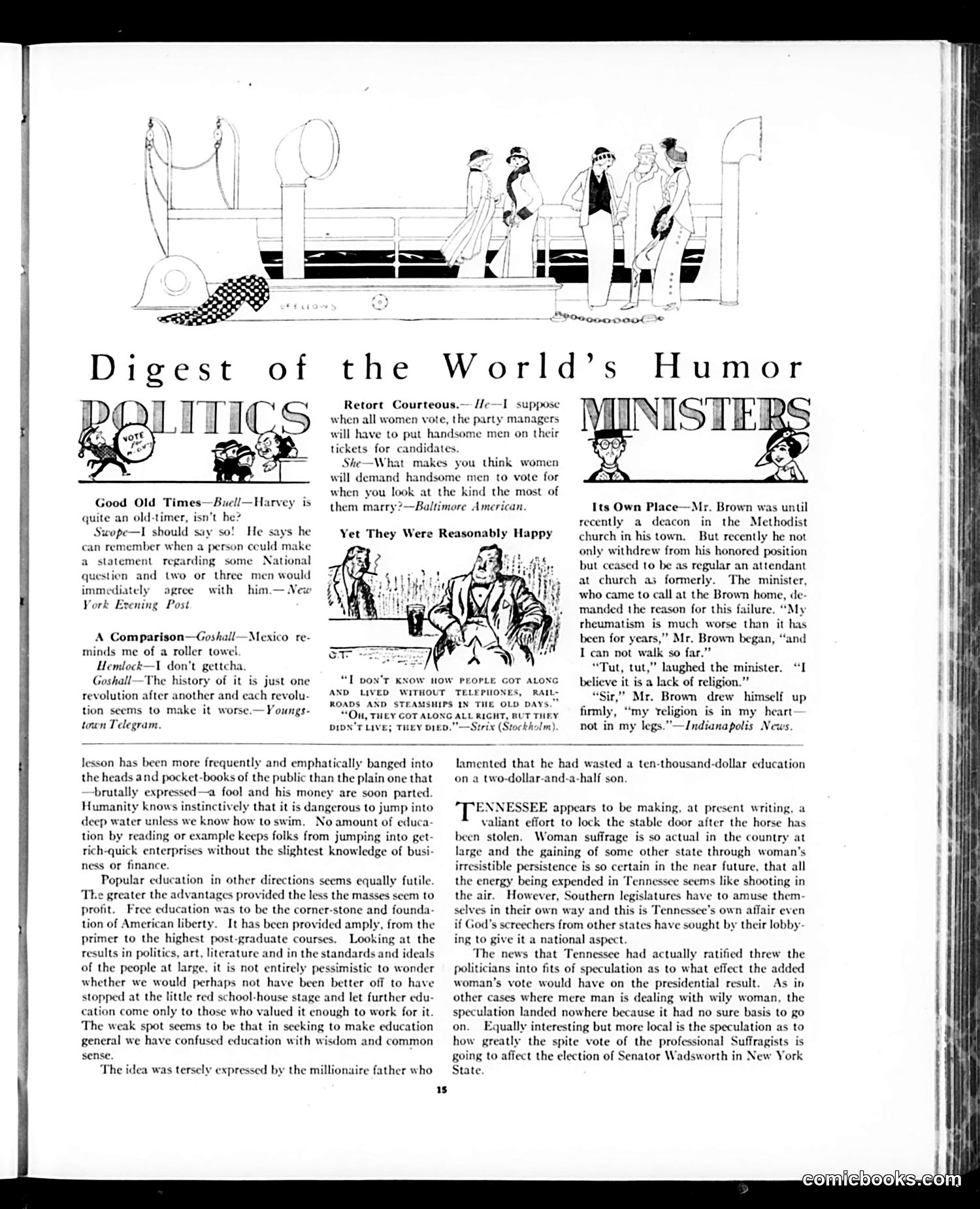
This page collects satirical jokes and commentary on contemporary issues circa the 1920s women's suffrage era. **Key content:** The **"Retort Courteous"** joke mocks men's assumptions that women voters will prefer handsome candidates—a woman counters that men already marry unattractive partners, so this logic fails. **"Good Old Times"** jokes about how people once could express political opinions without immediate agreement, and compares Mexico to a "roller towel"—constantly cycling through the same motions (revolutions). **"Its Own Place"** depicts a Methodist deacon claiming rheumatism prevents church attendance; the minister attributes this to lack of faith, but the deacon insists his religion is "in my heart, not in my legs"—mocking religious hypocrisy. The longer editorial commentary criticizes education's failure to produce wisdom or good judgment, using a millionaire's lament about wasting $10,000 educating his worthless son as an example. **Tennessee passage** discusses women's suffrage efforts in that state, treating the political struggle as inevitable and somewhat amusing.
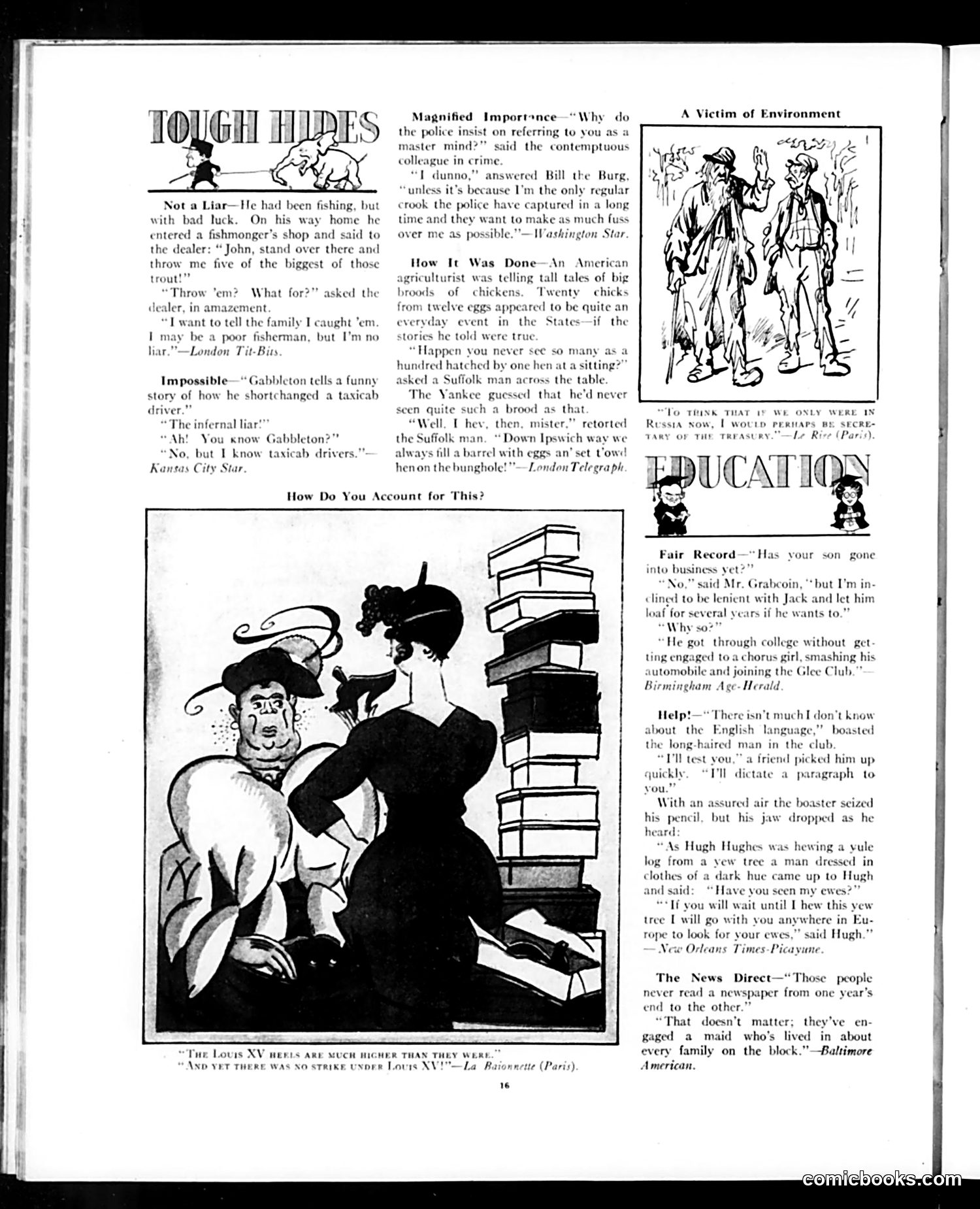
This page from the satirical magazine **Judge** contains several humor columns mocking human nature and social pretense: **"Tough Hides" section** presents brief jokes about dishonesty: - A poor fisherman buys trout to claim he caught them (avoiding outright lying by staging the story) - A character known for cheating taxi drivers is called a "liar" because his dishonesty is predictable - A criminal celebrates being called a "master mind" by police, inflating his importance **"How Do You Account for This?"** contrasts French and American economics—Louis XV-era furniture is more expensive now despite no labor strike, satirizing inflation or market illogic. **Other sections** mock pretension: a father proud his son avoided scandal; a boaster humiliated by a tongue-twister test; gossip spreading through hired help rather than newspapers. The overall theme targets human vanity, self-deception, and society's acceptance of minor dishonesty—common Judge targets circa early 1900s.
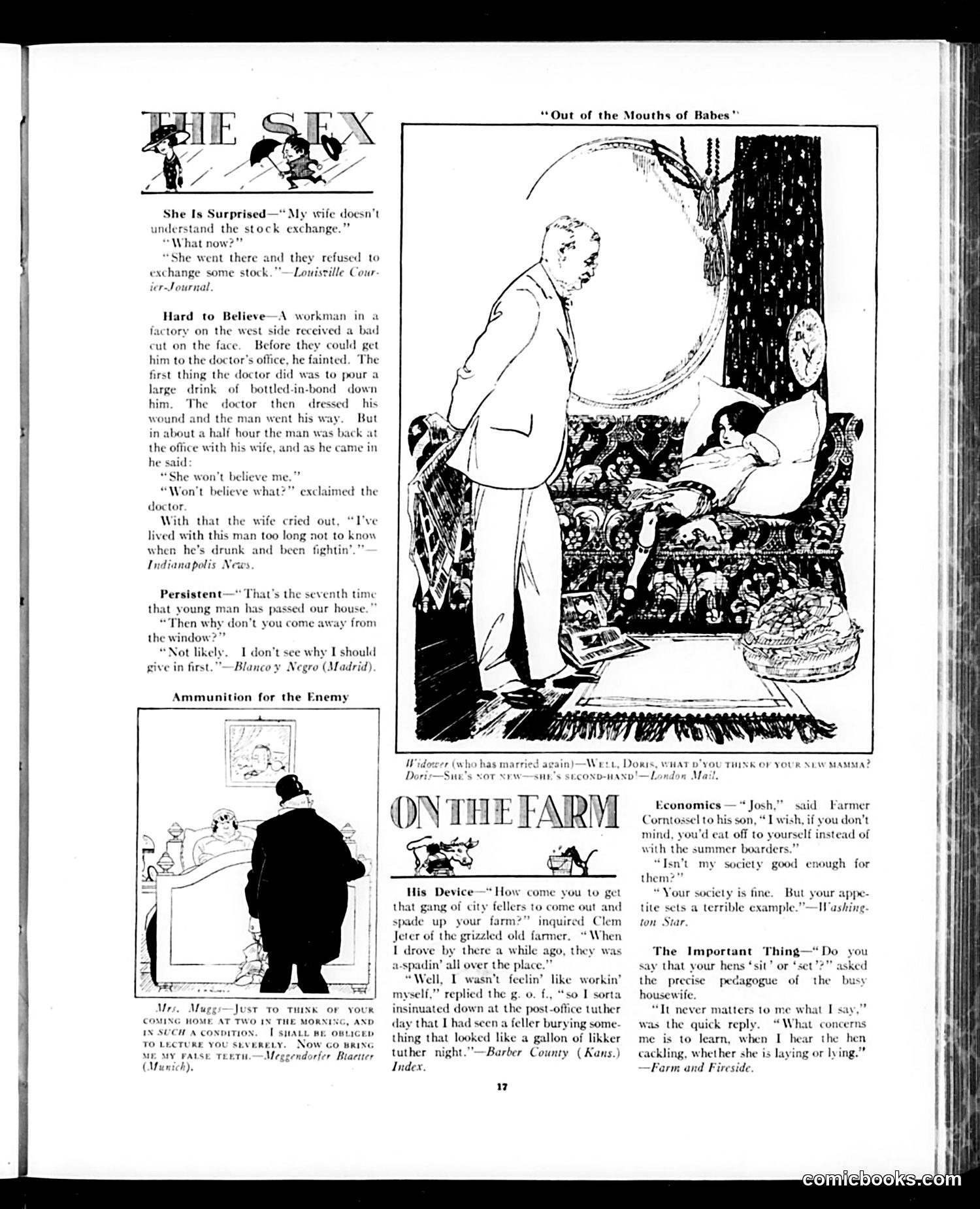
This page collects brief humorous anecdotes typical of early 20th-century American humor magazines. The jokes play on domestic misunderstandings and rural/urban contrasts: **"She Is Surprised"** mocks a wife's literal interpretation of "stock exchange"—she expected to physically swap stocks like merchandise. **"Hard to Believe"** uses a drunk man's denials as setup: his wife, knowing him well, recognizes intoxication despite his claims of injury-induced fainting. **"Persistent"** depicts courting persistence—a young man repeatedly passes a house; the woman won't yield by leaving the window first. **"Ammunition for the Enemy"** shows a wife threatening her drunk husband with lectures while demanding his false teeth as leverage. **"On the Farm"** section includes a farmer's trick: he spreads rumors about buried liquor at the post-office to attract city workers willing to dig his farm for free. **"Out of the Mouths of Babes"** features a remarried widower's child asking bluntly about the new stepmother. The humor relies on period assumptions about gender relations, rural cunning, and class differences between city and country folk.
This page presents three literary essays by Benjamin De Casseres reviewing recent books: **"The Eternal Vamp"** discusses Romain Rolland's satirical play *Liluli*, written after Rolland—author of the idealistic novel *Jean Christophe*—became a pacifist during WWI. De Casseres analyzes how Rolland's "Liluli" (the Goddess of Illusion) manipulates everyone from diplomats to "Billy Sunday" (the famous evangelist), except the cynical character Polichinello, who represents mocking intelligence. **"The Manna of Barytones"** humorously "explains" how opera singer David Bispham developed his legendary voice: by eating red-headed sulphur matches as a toddler in 1839 Philadelphia. De Casseres playfully credits this sulfur diet with producing Bispham's extraordinary vocal power. The page is a book review section, not political satire. It showcases Judge magazine's literary criticism through witty, irreverent commentary on contemporary authors and performers.
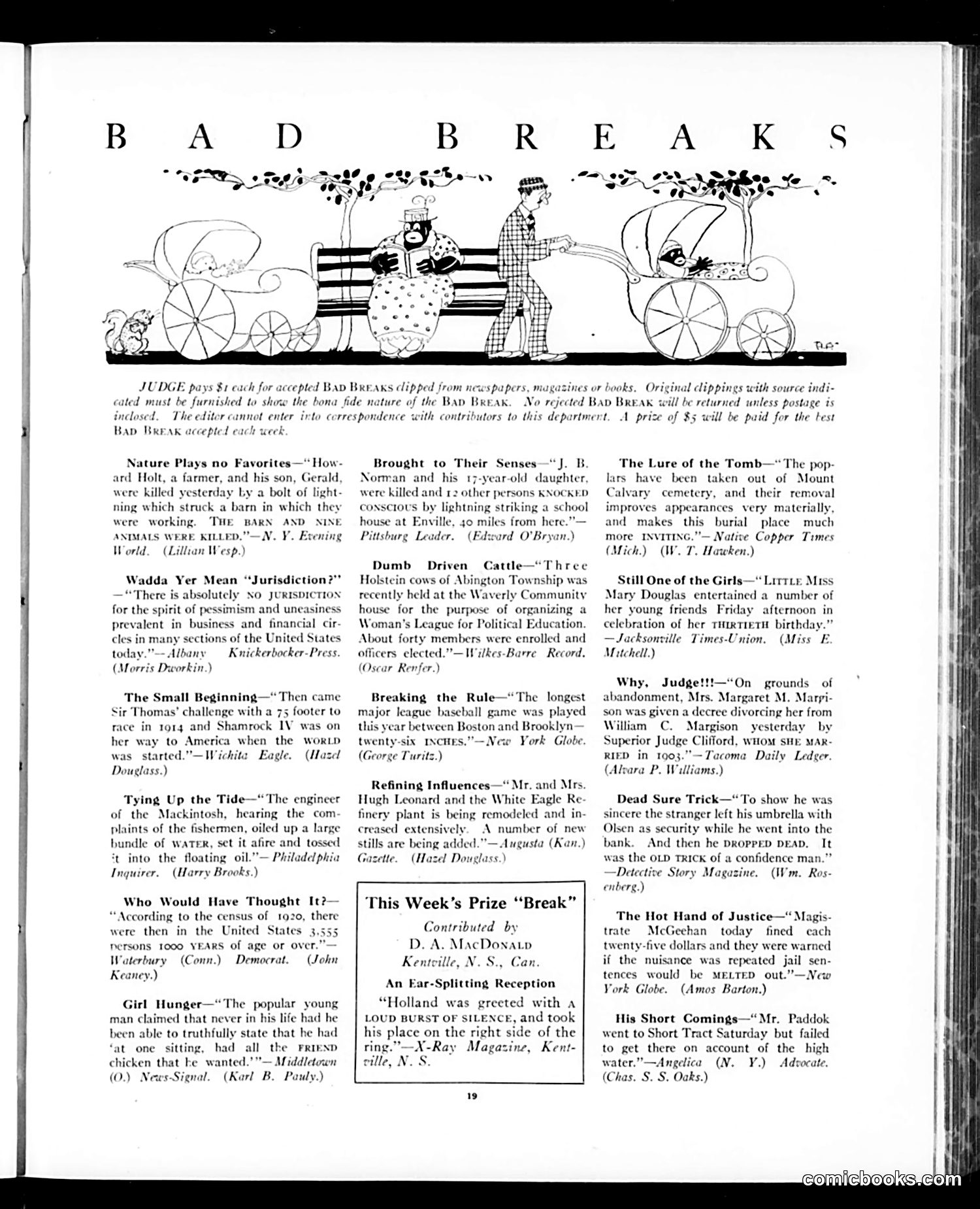
This page's header cartoon depicts a satirical scene of people with baby carriages under a tree, labeled "BAD BREAKS." The illustration appears to comment on misfortune or mishap—likely playing on the phrase "bad break" (meaning bad luck). The page itself is a humor/anecdote column featuring brief satirical items from various sources. These "bad breaks" are short, witty observations about everyday absurdities: a farmer struck by lightning while building a barn, a baseball game's length, someone's umbrella abandonment, etc. The recurring theme mocks human folly and life's petty ironies. The cartoon's whimsical, crowded composition with multiple figures suggests chaos—visual metaphor for life's unexpected troubles. This type of satirical humor was Judge magazine's signature style: documenting social awkwardness and minor catastrophes for comedic effect.
This is an article (not a cartoon) by J.A. Waldron analyzing why audiences are fascinated by vagabond characters in theater. The illustration above shows dancers and comedians in performance poses, representing the theatrical "show." Waldron argues that the vagrant—socially irresponsible and unmoored from civilization—has always captivated audiences and appeared in literature and drama. He cites historical and literary examples: Shakespeare's Falstaff and Sir Toby Belch, Dickens characters, and contemporary stage figures like Joseph Jefferson's *Rip Van Winkle*. The immediate reference is to P.O. Heggie's performance in the current Broadway play *"Happy-Go-Lucky"* (based on Ian Hay's *"A Bloomsbury Romance"*), where Heggie plays a vagabond character named Samuel Stillbottle. Waldron argues Heggie's portrayal exemplifies why audiences love such roles—the actor's skill in portraying irresponsible, eccentric charm makes the character compelling theater. The broader point: society is drawn to characters freed from respectability's constraints.
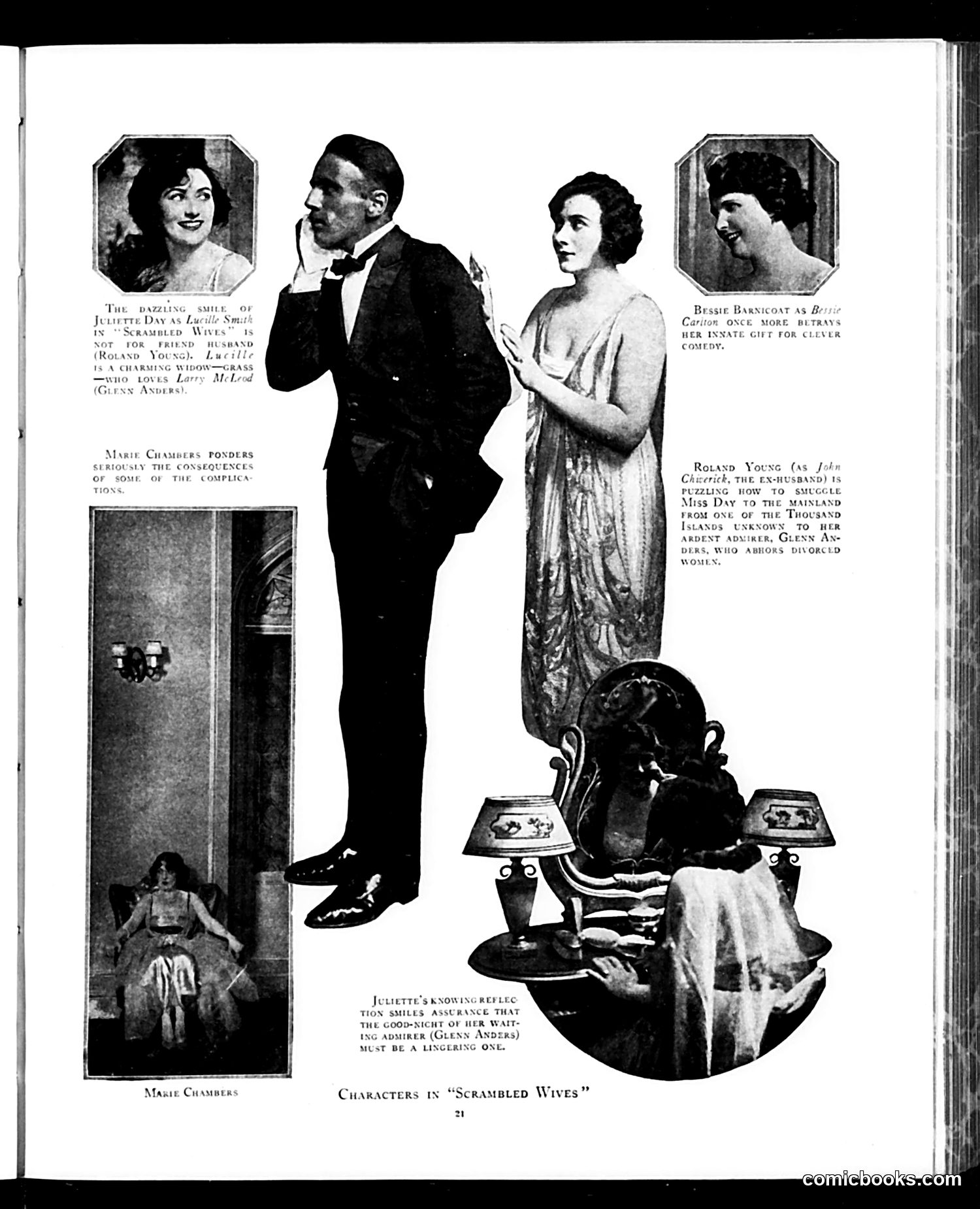
This page showcases characters from the film "Scrambled Wives," featuring promotional photos and plot descriptions typical of Judge magazine's entertainment coverage. The satire centers on marital complications: Juliette Day plays a wife whose "dazzling smile" conceals infidelity with a "charming widow." Roland Young portrays her ex-husband attempting to smuggle her away from tropical islands. Bessie Barriscale plays a rival character exploiting her "gift for clever comedy." The humor derives from the tangled romantic entanglements—divorces, secret admirers (Glenn Anders), and suspicious spouses. For modern readers: this reflects 1920s silent-film comedy's obsession with divorce scandals and sexual intrigue as entertainment. The "scrambled" title puns on confused domestic arrangements. Marie Chambers provides supporting comic relief. The page essentially advertises the film while mocking its melodramatic plot mechanics.
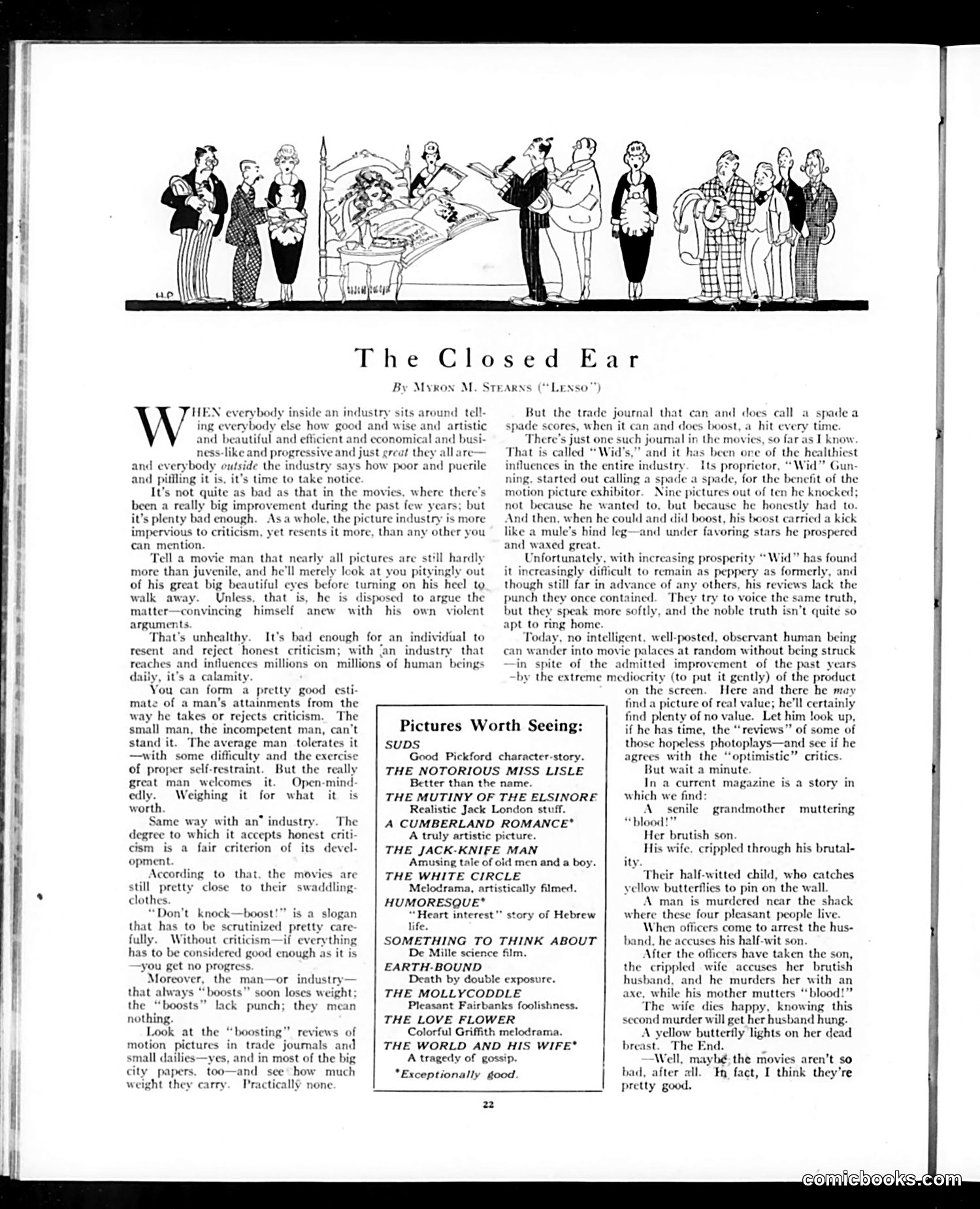
This is an editorial critique of the film industry's resistance to honest criticism. The article argues that movies remain creatively immature because studio executives and producers reject critical feedback, preferring constant "boosting" (promotional praise) instead. The author contrasts this unhealthy defensiveness with a trade journal called "Wid's" (likely *Variety* or similar industry publication), which earned respect by calling out bad films directly. That honest criticism carried weight and influence. The satire targets industry insularity: movie people dismiss criticism while simultaneously resenting it—a sign of immaturity. The piece argues that real progress requires accepting honest assessment, not surrounding oneself with sycophants. Without this willingness to be critiqued, the industry will stagnate, producing mediocre films despite technical improvements. The accompanying film reviews list contemporary releases as examples of quality worth seeking out.
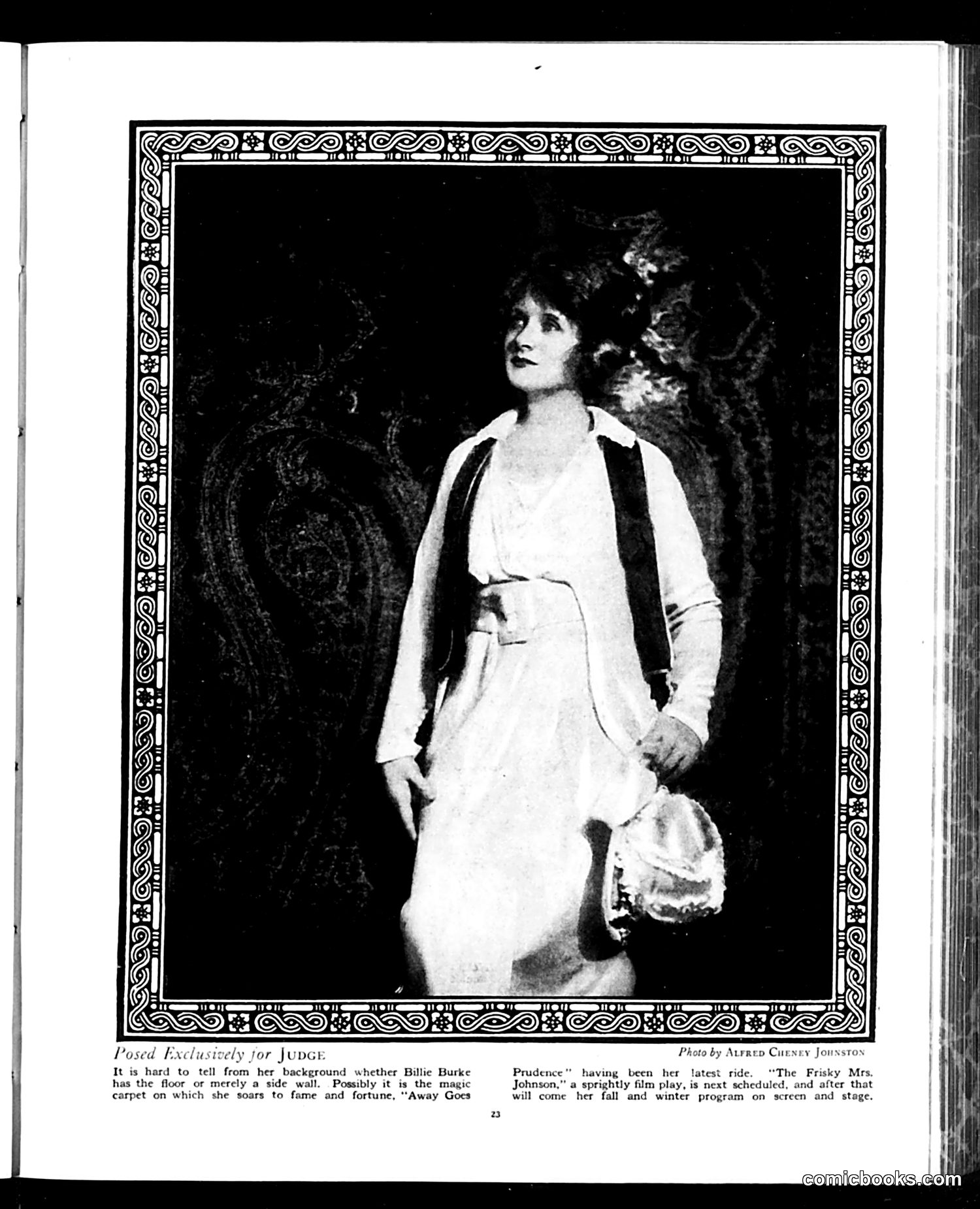
This page features a photograph by Alfred Cheney Johnston of actress Billie Burke, posed exclusively for Judge magazine. The caption indicates Burke was famous enough to warrant such coverage. The text mentions her "background" in theater and references her films "Away Goes Prudence" and "The Frisky Mrs. Johnson," suggesting she was an active performer of that era. The caption's somewhat whimsical tone—discussing whether her success comes from "magic carpet" or theatrical talent—reflects the lighthearted, celebrity-focused content Judge sometimes published alongside its political satire. This is a glamour photograph rather than political commentary, representing the magazine's broader entertainment coverage.
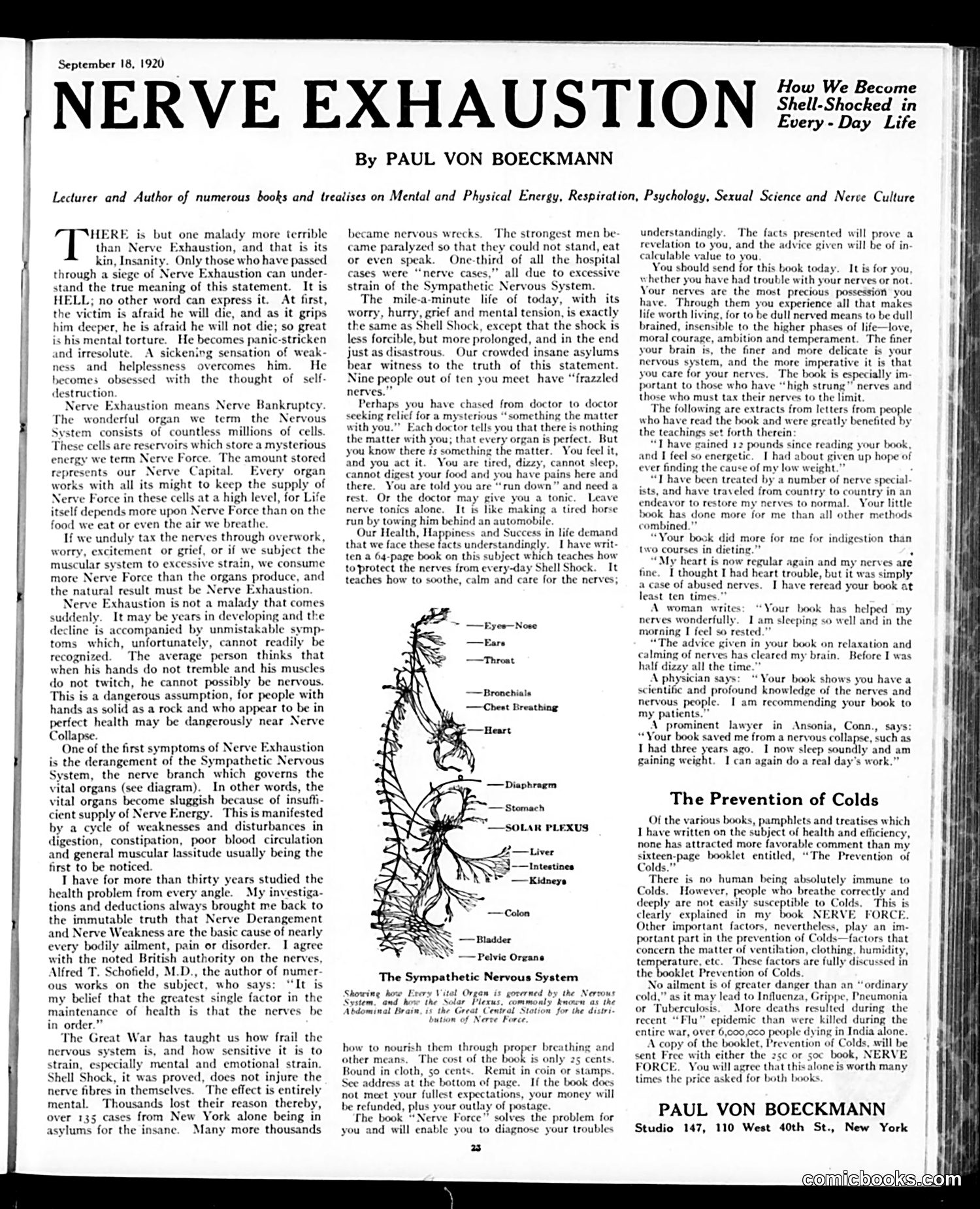
This is not a cartoon but a medical/wellness advertisement disguised as editorial content. Paul von Boeckmann was a pseudoscientific health entrepreneur promoting his book on "nerve force." The piece exploits post-WWI anxiety by invoking "Shell Shock"—the newly recognized psychological trauma affecting returning soldiers. Boeckmann claims nervous exhaustion causes most ailments and that his teachings on "nerve energy" provide cure. The included anatomical diagram shows the nervous system's connection to organs, lending false scientific credibility. The article conflates shell shock with everyday stress, suggesting ordinary people suffer the same nervous collapse as traumatized soldiers. This was a common early-20th-century marketing tactic: medicalize normal fatigue and worry as serious illness, then sell the solution. The accompanying "Prevention of Colds" section continues this pattern, promoting Boeckmann's book through testimonial quotes.
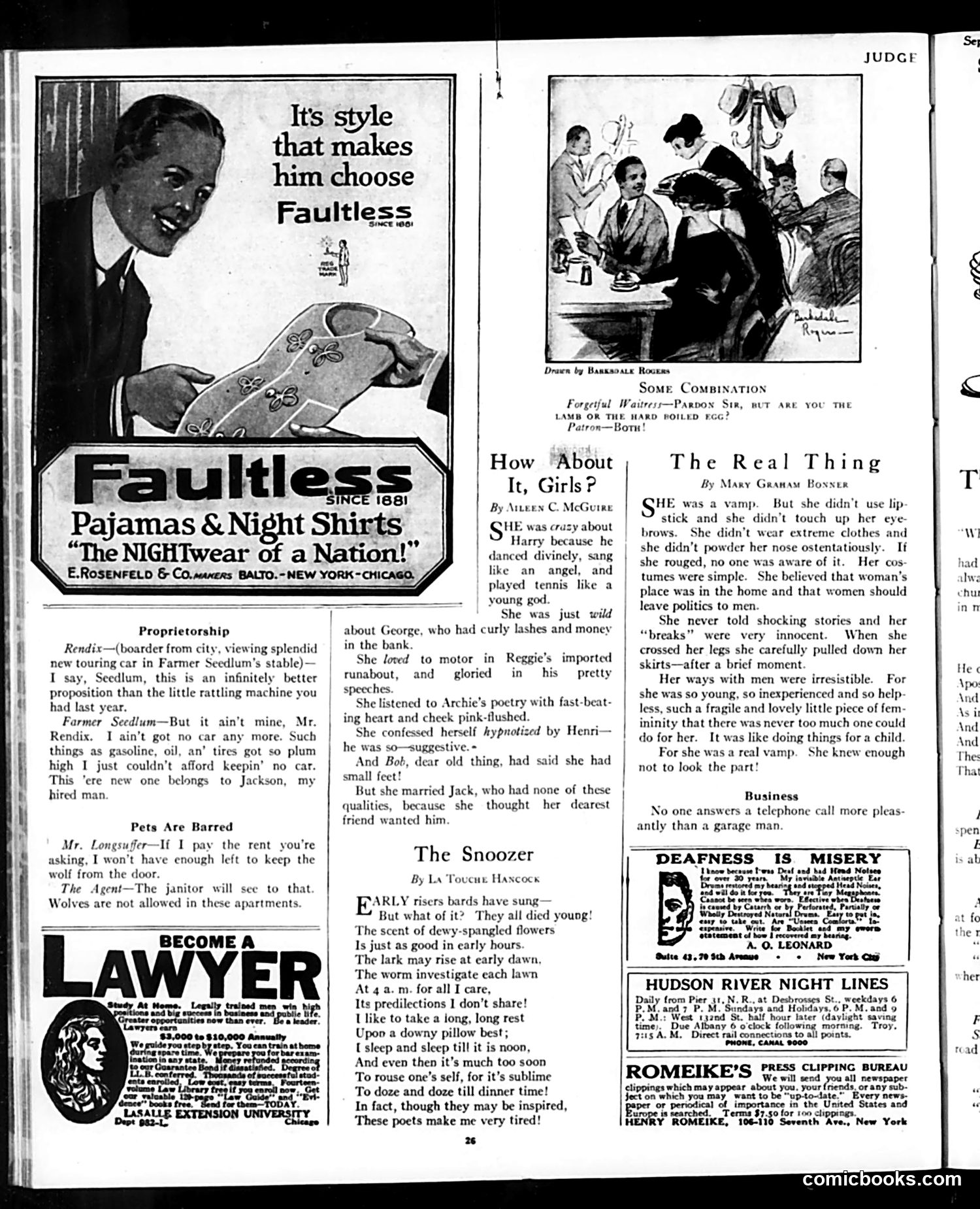
This page from *Judge* contains mostly **short humorous fiction pieces and advertisements** rather than political cartoons. The main content includes: 1. **"How About It, Girls?"** - A satirical story about a woman who is attracted to multiple men (Harry, Reggie, Archie, Henri, Bob) for superficial reasons, but marries Jack because she thinks her friend wants him—illustrating female fickleness. 2. **"The Real Thing"** - A story subverting the "vamp" stereotype: a woman who appears modest and domesticated (simple clothes, no makeup, believing women belong in the home) is actually manipulative because men underestimate her. 3. **"The Snoozer"** - A humorous poem mocking poets who celebrate early rising, defending the pleasure of sleeping late. 4. **Miscellaneous jokes** about landlords, renters, and social situations. The **Faultless pajama advertisement** dominates the left side, showing a well-dressed man's styled appearance as reason to choose the brand. The page reflects early 20th-century attitudes toward gender roles, consumerism, and domestic life—presented through lighthearted satire rather than political commentary.
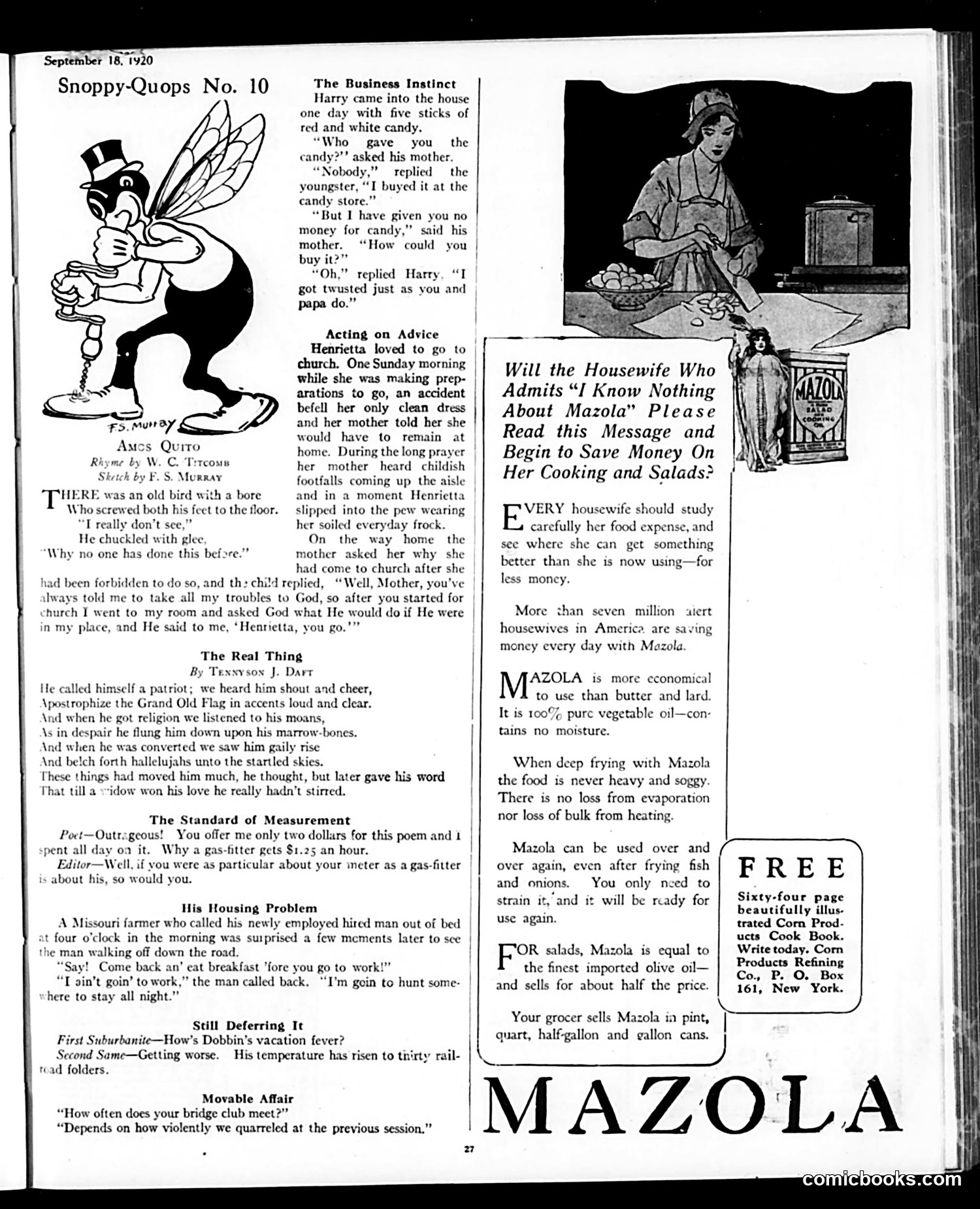
This page mixes humor columns with advertising. The left side contains several brief satirical pieces: **"Snoppy-Quops No. 10"** is a light cartoon joke about someone who literally screwed his feet to the floor—the satire appears to mock stubborn or immovable people. **"The Business Instinct"** mocks a child who claims he "got trusted" (on credit) at a candy store—mimicking how adults buy on credit without cash, suggesting the practice had become absurdly common. **"Acting on Advice"** humorously shows a child misinterpreting parental guidance about taking troubles to God, literally attending church in dirty clothes after asking God's permission. **"The Real Thing"** satirizes performative patriotism—a man who loudly displays patriotism and religious devotion only finally showing genuine emotion when falling in love. The **right side is a Mazola cooking oil advertisement** claiming it saves housewives money compared to butter or lard. This represents early-20th-century promotion of vegetable oil as a modern, economical cooking alternative.
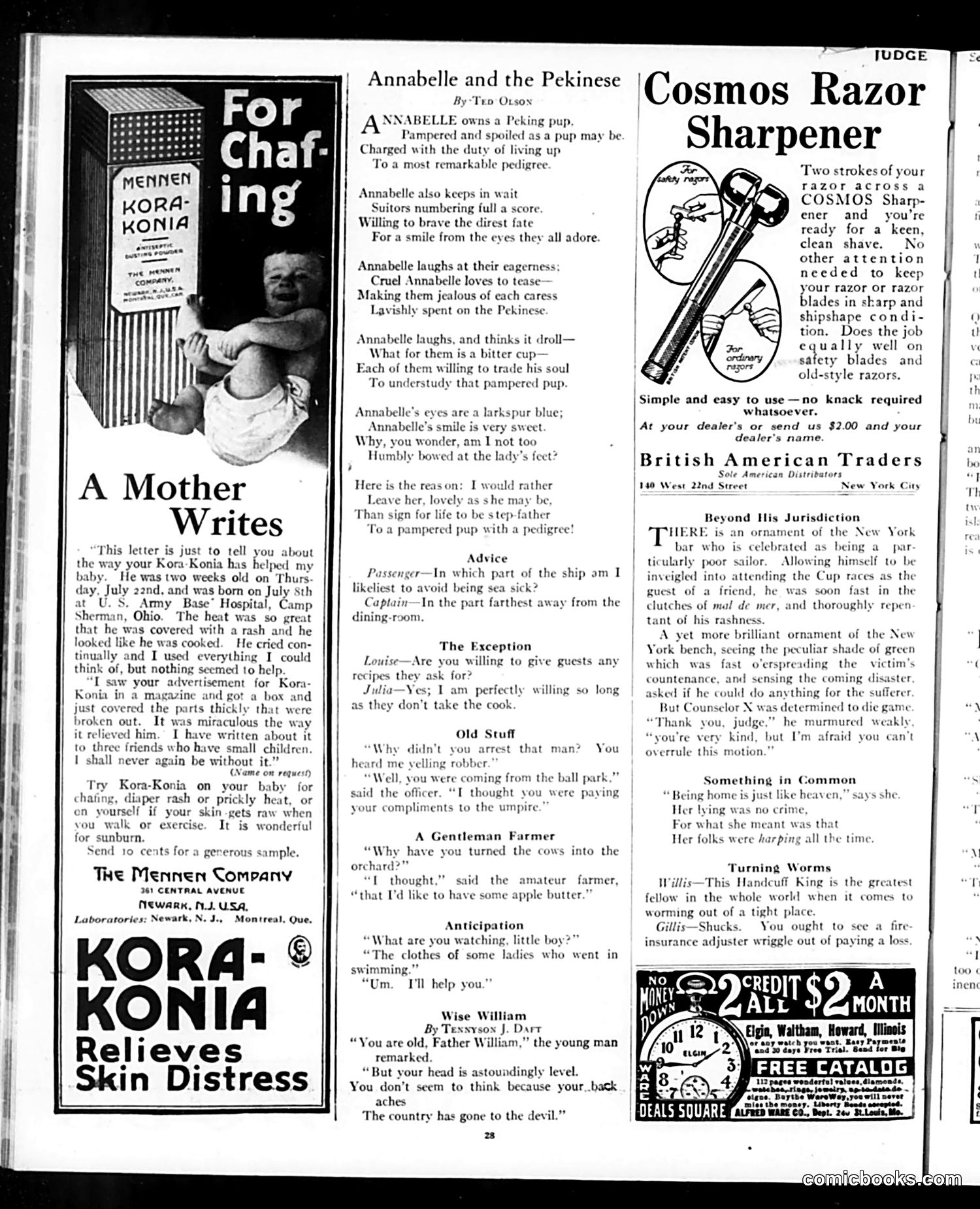
This page from the satirical magazine **Judge** contains primarily **light humor and advertisements** rather than political satire. The main content includes: **"Annabelle and the Pekinese"** — a humorous poem about a wealthy woman who pampers her Peking pup (fashionable lapdog) while keeping numerous suitors interested. The joke is that the author prefers the dog to Annabelle herself, mocking both the vanity of wealthy women and the absurdity of men competing for romantic attention. **Short comic anecdotes** follow, using typical early-20th-century joke structures: a sea captain's quip about seasickness, a farmer's naïve mistake, and observations about human behavior. **"Wise William"** adapts Lewis Carroll's "Father William," playing on the theme of aging. The page is **dominated by advertisements** for Kora-Konia (a rash relief product), Cosmos Razor Sharpener, and other goods — typical commercial content for Judge magazine. The "Mother Writes" testimonial reflects early-1900s marketing practices using personal endorsements. The satire is gentle and domestic rather than political.
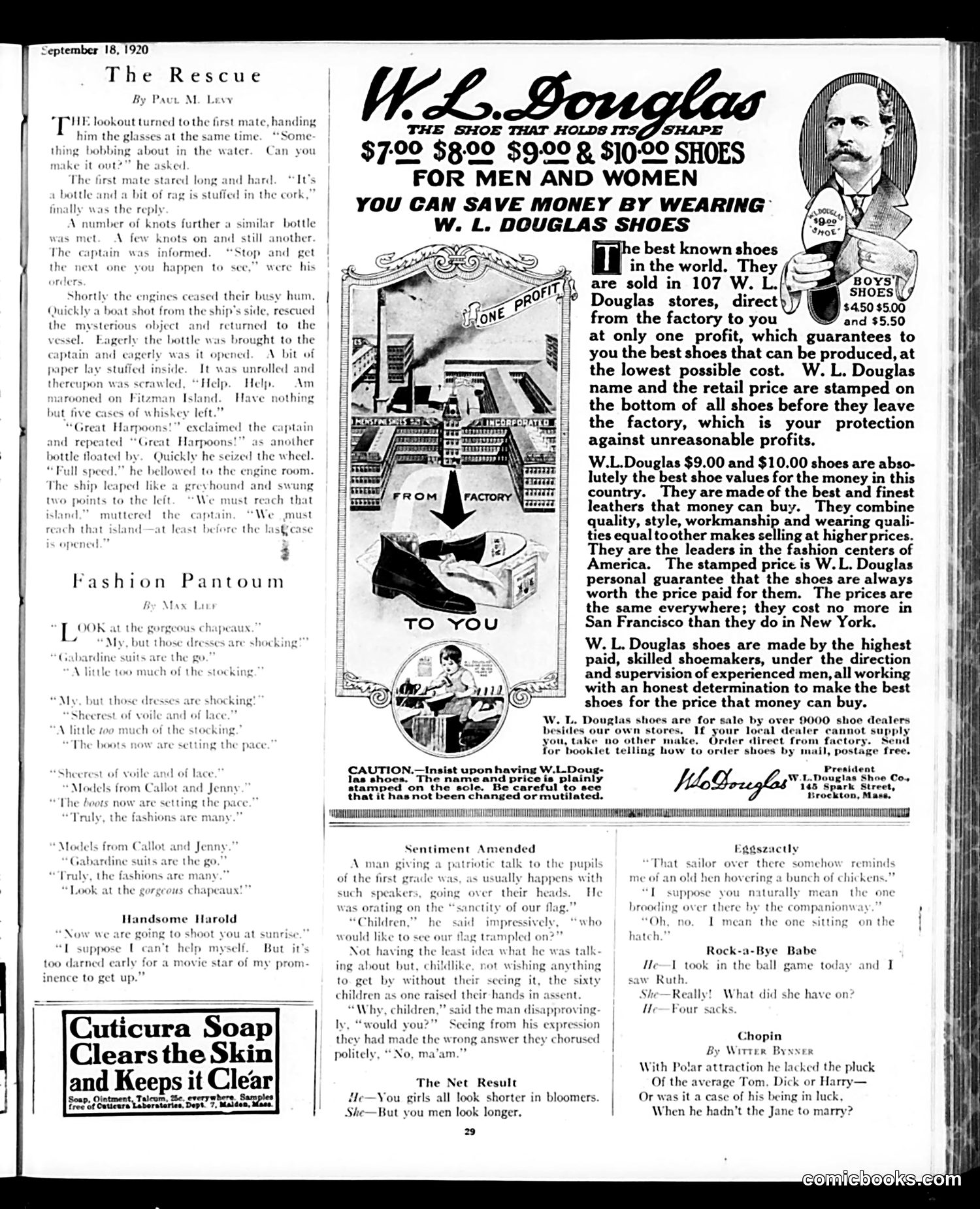
This page is primarily **advertising-driven**, dominated by a large W.L. Douglas shoes advertisement. The ad emphasizes direct factory-to-consumer sales, eliminating middlemen profits—a significant marketing angle during the post-WWI period when consumers sought value. The page contains **three short fictional pieces**: "The Rescue" depicts a ship captain retrieving messages in bottles from a deserted island (a conventional adventure narrative); "Fashion Pantoum" satirizes women's fashion through repetitive dialogue about exaggerated clothing elements; and brief comedy sketches like "Handsome Harold" and "Rock-a-Bye Babe" offer light humor. There is **no significant political content** or social satire on this page. The Cuticura Soap advertisement for skin clarity represents typical product marketing of the era. Overall, this appears to be a standard issue from Judge's mixed content of light entertainment and advertising, rather than a page emphasizing the magazine's satirical purpose.
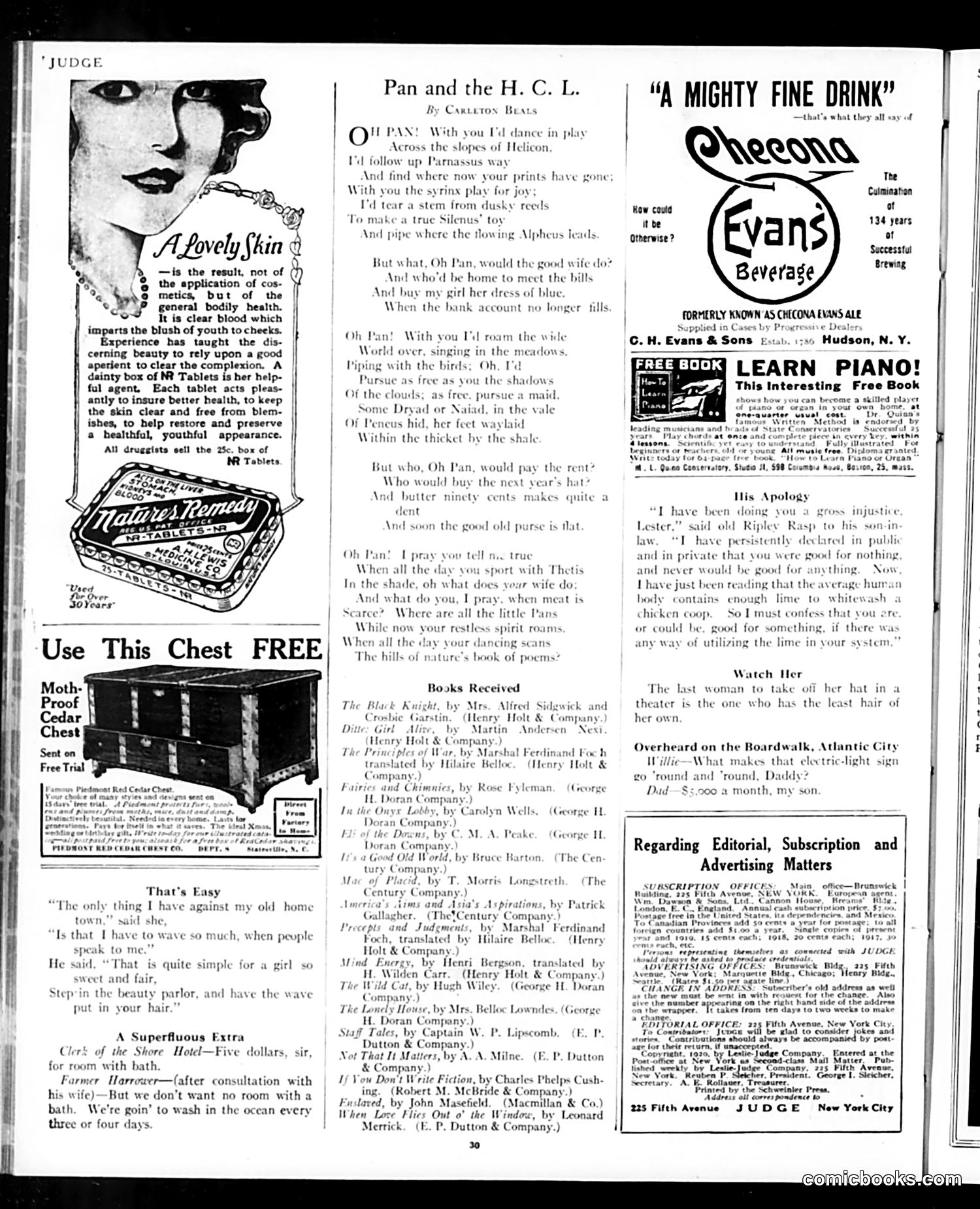
This satirical poem by Carlton Beals contrasts classical mythology with modern economic hardship. "Pan" represents the mythological god of nature and pastoral life; "H.C.L." stands for "High Cost of Living." The poem's central irony: Pan invites the speaker to abandon reality and join him in carefree artistic pursuits across classical landscapes. The speaker repeatedly refuses, grounded in practical concerns—bills, rent, his daughter's dress, meat prices, and supporting his family. The satire targets the post-WWI inflation crisis (likely early 1920s) that made basic necessities unaffordable for working people. While intellectuals and romantics might fantasize about escaping to artistic ideals, ordinary people are trapped by economic necessity. The poem mocks this gap between romantic aspiration and the grinding reality of feeding oneself and one's family during inflationary times. The message: economic hardship crushes even the desire for beauty and transcendence.
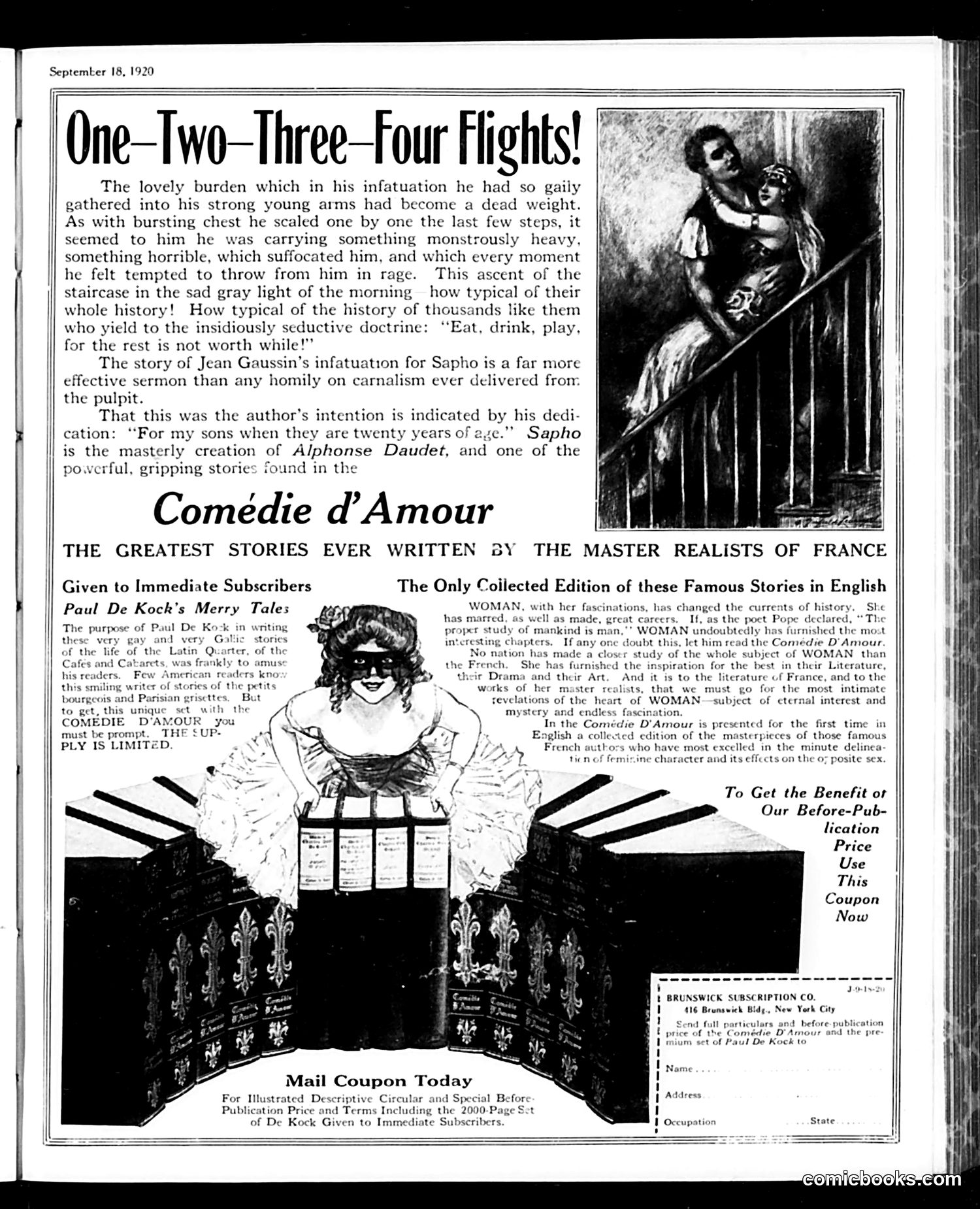
This is primarily a **book advertisement**, not a political cartoon. It promotes a subscription collection called *Comédie d'Amour*, featuring classic French literature by authors like Alphonse Daudet and Paul de Kock. The upper illustration depicts a scene from Daudet's *Sapho*—a man struggling up stairs while carrying a woman, representing the burden of romantic entanglement. The accompanying text frames this as a moral lesson about the dangers of hedonism ("Eat, drink, play, for the rest is not worth while"). The lower illustration shows a woman displaying the book set, promoting the collection as "the greatest stories ever written by the master realists of France." The ad emphasizes these works' sophisticated treatment of female psychology and "the heart of WOMAN"—positioning them as serious literature while capitalizing on their reputation for depicting romantic and sexual themes. This reflects early 1920s American attitudes: importing European literary sophistication while maintaining moral respectability through didactic framing.
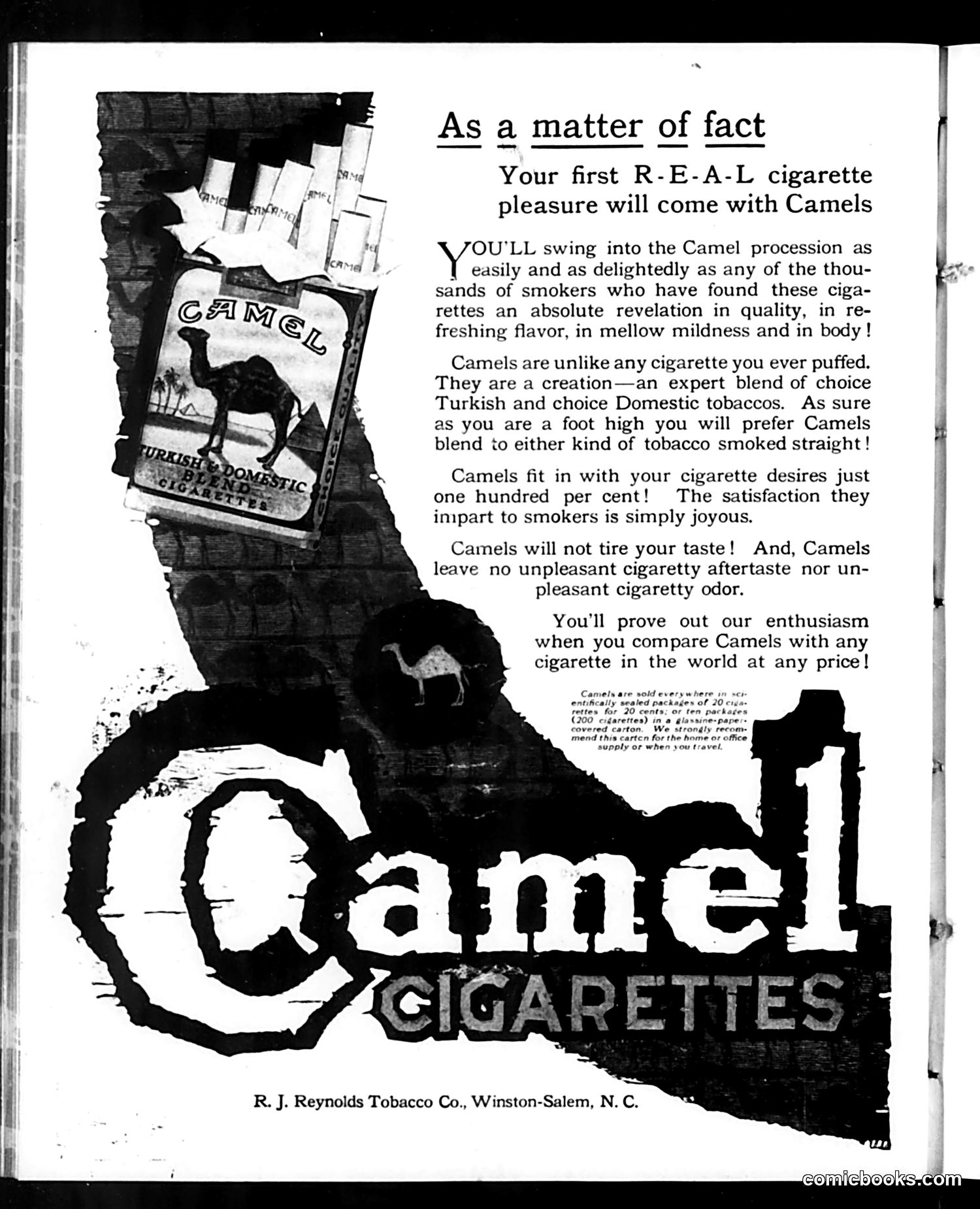
This is a **cigarette advertisement**, not political satire. It appeared in *Judge*, a satirical magazine, but this particular page is a commercial ad for Camels by R.J. Reynolds Tobacco Co. The ad uses the silhouette of California as a visual device, with a camel and Camel cigarette package integrated into the state's shape. The text employs exaggerated marketing language typical of early-20th-century tobacco advertising, making inflated claims: Camels deliver "R-E-A-L" pleasure, won't tire your taste, leave no aftertaste or smell, and supposedly beat any competing cigarette. The ad targets first-time smokers, emphasizing the product's blend of Turkish and domestic tobacco. By modern standards, the health claims and casual cigarette promotion are strikingly irresponsible—this predates widespread understanding of smoking's health dangers and government regulation of tobacco advertising.