
Judge, 1920-09-18 · page 5 of 32
Judge — September 18, 1920 — page 5: what you’re looking at
What you’re looking at
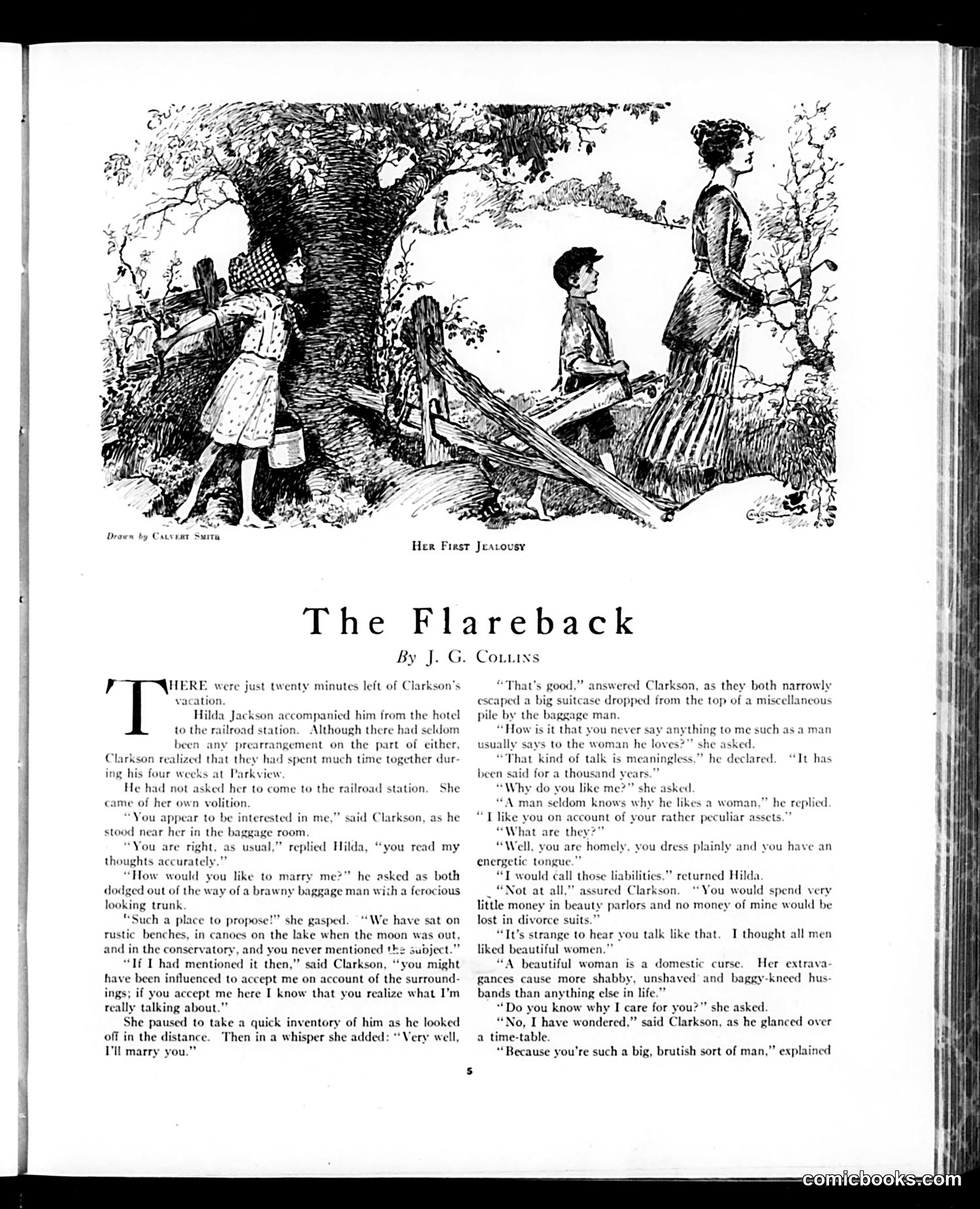
This page contains an illustrated short story rather than political satire. The drawing by Calvert Smith shows a Victorian-era romantic scene: a woman and man near a large tree, with the caption "Her First Jealousy." The story depicts a courtship dialogue between Clarkson and Hilda. Clarkson proposes marriage during a lakeside vacation, but Hilda expresses skepticism about his feelings, questioning why he likes her. Their exchange satirizes conventional romantic rhetoric—she dismisses his compliments as insincere flattery, while he defensively characterizes beautiful women as domestic liabilities prone to vanity. The humor derives from the tension between romantic idealism and practical skepticism about marriage, a common theme in period literature and Judge magazine's satirical treatment of courtship customs.
📄 Transcribed text from this page (OCR, searchable)
Machine-transcribed from the original scan — historical spelling and the odd misread are preserved.
| | Drown by Cauvnme Sarre Her First Jearousy The Flareback By J. G. , HERE were just twenty minutes left of Clarkson's vacation. Hilda Jackson accompanied him from the hotel to the railroad station. Although there had seldom been any prearrangement on the part of either. Clarkson realized that they had spent much time together dur ing his four weeks at Parkview He had not asked her to come to the railroad station. She came of her own volition. “You appear to be interested in me,” said Clarkson, as he stood near her in the bagga; “You are right, as usu thoughts accurately.”” “How would you like to marry me?” he asked as both dodged out of the way of a brawny baggage man with a ferocious looking trunk "Such a place to propose!” she gasped. ‘We have sat on rustic benches, in canoes on the lake when the moon was out, and in the conservatory, and you never mentioned the subject.” “If I had mentioned it then,” said Clarkson, “you might have been influenced to accept me on account of the surround- ings; if you accept me here I know that you realize what I’m really talking about.”” She paused to take a quick inventory of him as he looked off in the distance. Then in a whisper she added: “Very well, V'll marry you.” ‘oom replied Hilda, “you read my Co.Liins “That's good,” answered Clarkson, as they both narrowly escaped a big suitcase dropped from the top of a miscellaneous pile by the baggage man. “How is it that you never say anything to me such as a man usually says to the woman he loves?” she asked “That kind of talk is meaningless.” he declared. “It has been said for a thousand years. “Why do you like me?” she asked “A man seldom knows why he likes a woman,” he replied “T like you on account of your rather peculiar assets.” “What are they?” “Well, you are homely, you dress plainly and you have an energetic tongue.” “T would call those liabilities.” returned Hilda _ “Not at all,” assured Clarkson. “You would spend very little money in beauty parlors and no money of mine would be lost in divorce suits.” “It’s strange to hear you talk like that. I thought all men liked beautiful women.” “A beautiful woman is a domestic curse. Her extrava- gances cause more shabby, unshaved and baggy-kneed hus- bands than anything else in life.” “Do you know why I care for you?” s “No, I have wondered,” said Clarkson, as he glanced over a time-table. “Because you're such a big, brutish sort of man,” explained