
Judge, 1920-09-18 · page 7 of 32
Judge — September 18, 1920 — page 7: what you’re looking at
What you’re looking at
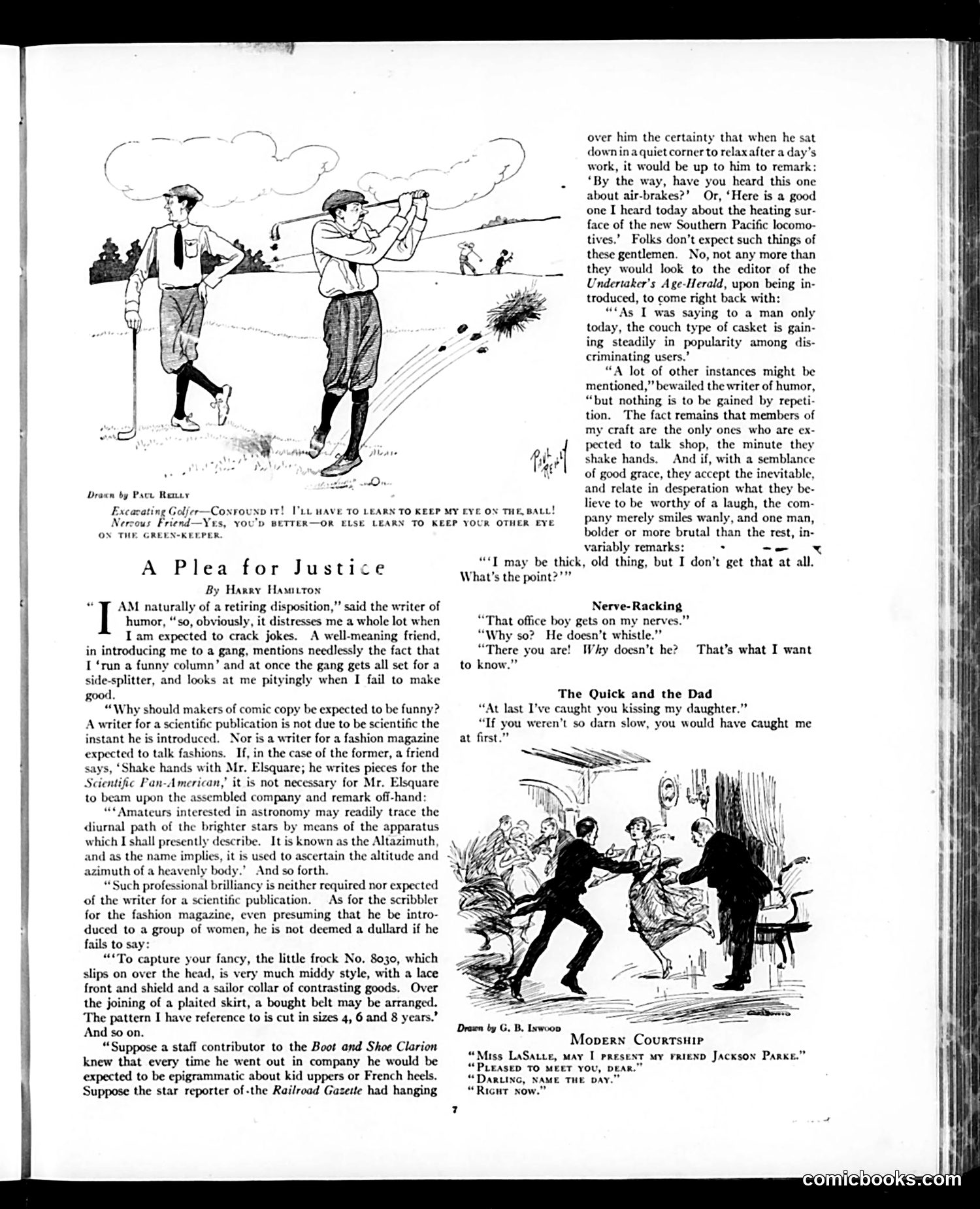
This page contains three humorous pieces from Judge magazine: **Top cartoon**: A golfer and friend joke about keeping eyes focused—one on the ball, the other on the groundskeeper, implying the golfer digs up the green while playing badly. **"A Plea for Justice"**: Humorist Harry Hamilton argues that humor writers shouldn't be expected to perform comedy on demand at social gatherings. He compares this unfair pressure to not expecting a fashion magazine writer to discuss clothing specs or a railroad reporter to crack jokes about locomotives. The essay satirizes society's assumption that professionals in their field must constantly demonstrate expertise in their specialty—a relatable complaint about workplace social dynamics. **"Nerve-Racking"**: A short joke where someone finds an office boy annoying precisely *because* he doesn't whistle, subverting the expected complaint. **"The Quick and the Dad"**: A partially visible cartoon about a father catching his daughter kissing, with dialogue about being too slow to catch them earlier. The page mixes social commentary with light comedy typical of Judge's satirical approach to American life.
📄 Transcribed text from this page (OCR, searchable)
Machine-transcribed from the original scan — historical spelling and the odd misread are preserved.
| i Drawn by Pact Renty Excavating Golfer—CoNrounp 11! I'LL MAVE TO LEARN TO KEEP AfY EYE ON THE, BALL! Nercous Friend—Yes, YOU'D BETTER—OR ELSE LEARN TO KEEP YOUR OTHER EYE ON THE GREEN-KEEPER, A Plea for Justic By Harry Hasitton “FT AM naturally of a retiring disposition,” said the writer of I humor, “so, obviously, it distresses me a whole lot when I am expected to crack jokes. A well-meaning friend, in introducing me to a gang, mentions needlessly the fact that I ‘run a funny column’ and at once the gang gets all set for a side-splitter, and looks at me pityingly when I fail to make good. “Why should makers of comic copy be expected to be funny? A writer for a scientific publication is not due to be scientific the instant he is introduced. Nor is a writer for a fashion magazine expected to talk fashions. If, in the case of the former, a friend says, ‘Shake hands with Mr. Elsquare; he writes pieces for the Scientific Pan-American,’ it is not necessary for Mr. Elsquare to beam upon the assembled company and remark off-hand: “*Amateurs interested in astronomy may readily trace the diurnal path of the brighter stars by means of the apparatus which I shall presently describe. It is known as the Altazimuth, and as the name implies, it is used to ascertain the altitude and azimuth of a heavenly body.’ And so forth. “Such professional brilliancy is neither required nor expected of the writer for a scientific publication. As for the scribbler for the fashion magazine, even presuming that he be intro- duced to a group of women, he is not deemed a dullard if he fails to say: “*To capture your fancy, the little frock No, 8030, which slips on over the head, is very much middy style, with a lace front and shield and a sailor collar of contrasting goods. Over the joining of a plaited skirt, a bought belt may be arranged. The pattern I have reference to is cut in sizes 4, 6 and 8 years.’ And so on. “Suppose a staff contributor to the Boot and Shoe Clarion knew that every time he went out in company he would be expected to be epigrammatic about kid uppers or French heels. Suppose the star reporter of -the Railroad Gazeite had hanging over him the certainty that when he sat down ina quiet corner to relax after a day’s work, it would be up to him to remark: ‘By the way, have you heard this one about air-brakes?’ Or, ‘Here is a good one I heard today about the heating sur- face of the new Southern Pacific locomo- tives.’ Folks don’t expect such things of these gentlemen. No, not any more than they would look to the editor of the Undertaker's Age-Herald, upon being in- troduced, to come right back with: “*As I was saying to a man only today, the couch type of casket is gain- ing steadily in popularity among dis- criminating users.’ “A lot of other instances might be mentioned,” bewailed the writer of humor, “but nothing is to be gained by repeti- tion. The fact remains that members of my craft are the only ones who are ex- pected to talk shop, the minute they shake hands. And if, with a semblance of good grace, they accept the inevitable, and relate in desperation what they be- lieve to be worthy of a laugh, the com- pany merely smiles wanly, and one man, bolder or more brutal than the Er! =n variably remarks: . “*T may be thick, old thing, but I don’t get that it a What'’s the point?’”” Nerve-Racking “That office boy gets on my nerves.”” “Why so? He doesn’t whistle.” “There you are! Why doesn’t he? That’s what I want to know.” The Quick and the Dad “At last I've caught you kissing my daughter.” “If you weren’t so darn slow, you would have caught me at first.” Drazn by G. B. Lxwooo Mopern CourtsuiP “Miss LaSatte, may I present my rrtenp Jackson Parke.” PLEASED TO MEET You, DEAR.” “DARLING, NAME THE DAY.” “Ricut sow.”