
Judge, 1920-09-18 · page 9 of 32
Judge — September 18, 1920 — page 9: what you’re looking at
What you’re looking at
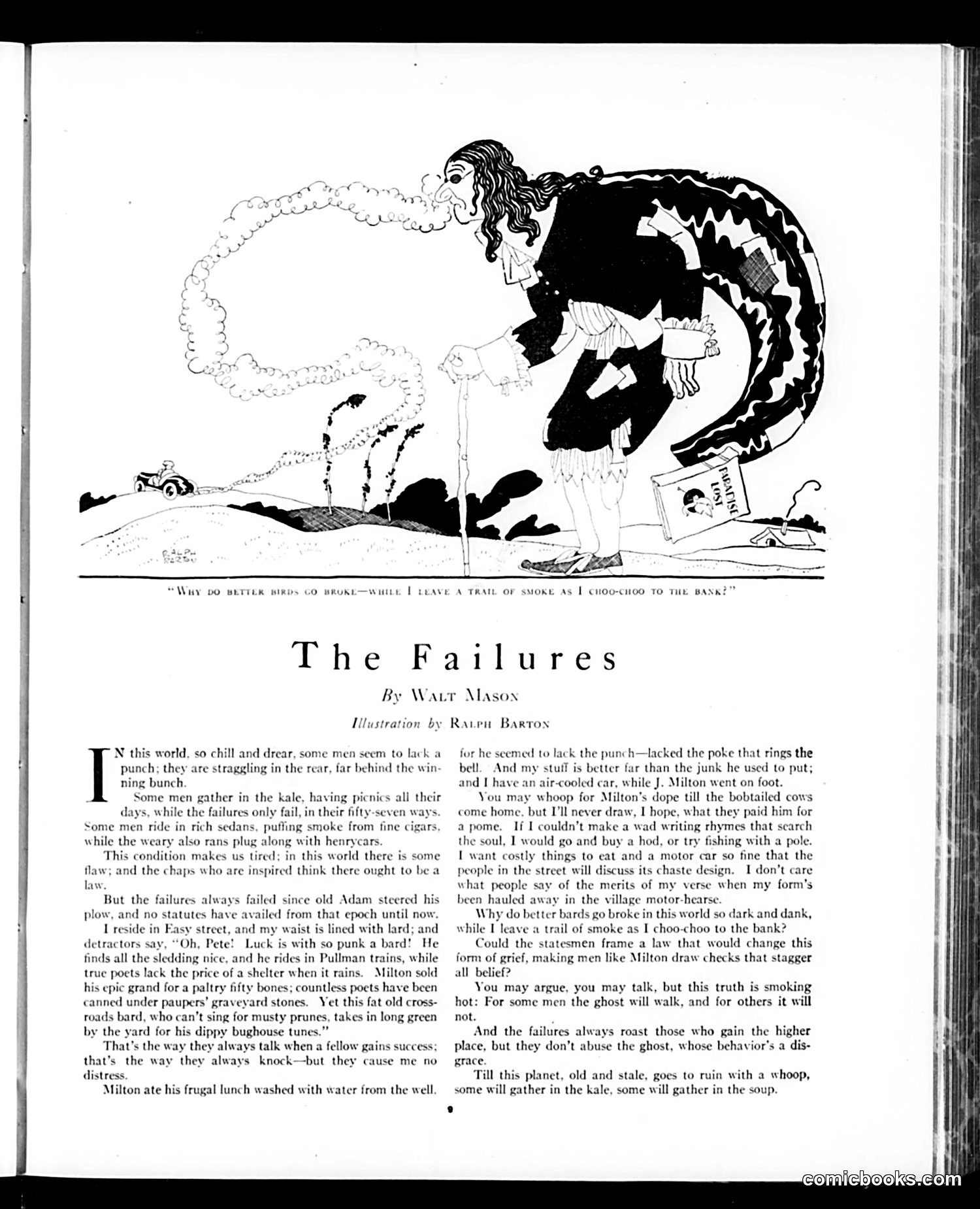
This page contains Walt Mason's poem illustrated by Ralph Barton, satirizing the disconnect between literary/artistic merit and financial success in early 20th-century America. **The Setup:** The cartoon depicts a prosperous, well-fed man driving a fancy car while leaving a trail of smoke—he's heading "to the bank." The poem's speaker boasts of wealth and comfort despite admitting his work is mediocre ("dippy bughouse tunes"). **The Satire:** Mason contrasts this successful charlatan with serious poets like Milton, who starved despite superior talent. The speaker arrogantly celebrates his own prosperity while mocking struggling artists. The joke is the speaker's oblivious hypocrisy: he proves that success rewards commercial appeal and luck, not quality—undermining any claim to merit. **Social Context:** This reflects real anxieties about commercialization and "dumbing down" culture in the Jazz Age. The poem sarcastically asks whether laws could help failures—answering "no," suggesting that unfairness is simply human nature and unchangeable.
📄 Transcribed text from this page (OCR, searchable)
Machine-transcribed from the original scan — historical spelling and the odd misread are preserved.
6O BRUKE— AVE “Way pO BETTER BIRDS A TRAIL OF SMOKE AS 1 CHOO-CHOO TO THE BANK The Failures By Watt Masox Illustration by N this world, so chill and drear, some men seem to lack a punch; they are straggling in the rear, far behind the win ning bunch Some men gather in the kale, having picnics all their days, while the failures only fail, in their fifty-seven ways. Some men ride in rich sedans, puffing smoke from fine ¢ while the weary also rans plug along with henrycars This condition makes us tired; in this world there is some flaw; and the chaps who are inspired think there ought to be a law. But the failures always failed since old Adam steered his plow, and no statutes have availed from that epoch until now. I reside in Easy street, and my waist is lined with lard; and detractors say, “Oh, Pete! Luck is with so punk a bard! He finds all the sledding nice, and he rides in Pullman trains, while true poets lack the price of a shelter when it rains. Milton sold his epic grand for a paltry fifty bones; countless poets have been canned under paupers’ graveyard stones. Yet this fat old cross- roads bard, who can’t sing for musty prunes, takes in long green by the yard for his dippy bughouse tunes.” That’s the way they alw talk when a fellow gains success; that’s the way they always knock—but they cause me no distress. Milton ate his frugal lunch washed with water from the well Rauen Bartox for he seemed to lack the punch—lacked the poke that rings the bell. And my stuff is better far than the junk he used to put; and I have an air-cooled car, while J. Milton went on foot. You may whoop for Milton’s dope till the bobtailed cows come home. but I'll never draw, I hope, what they paid him for a pome. If I couldn’t make a wad writing rhymes that scarch the soul, I would go and buy a hod, or try fishing with a pole. I want costly things to eat and a motor car so fine that the people in the street will discuss its chaste design. I don’t care what people say of the merits of my verse when my form's been hauled away in the village motor-hearse: Why do better bards go broke in this world so dark and dank, while I leave a trail of smoke as I choo-choo to the bank? Could the statesmen frame a law that would change this form of grief, making men like Milton draw checks that stagger all belief? You may argue, you may talk, but this truth is smoking hot: For some men the ghost will walk, and for others it will not. And the failures alw: roast those who gain the higher place, but they don’t abuse the ghost, whose behavior’s a dis- grace, Till this planet, old and stale, goes to ruin with a whoop, some will gather in the kale, some will gather in the soup.