
Judge, 1920-09-18 · page 20 of 32
Judge — September 18, 1920 — page 20: what you’re looking at
What you’re looking at
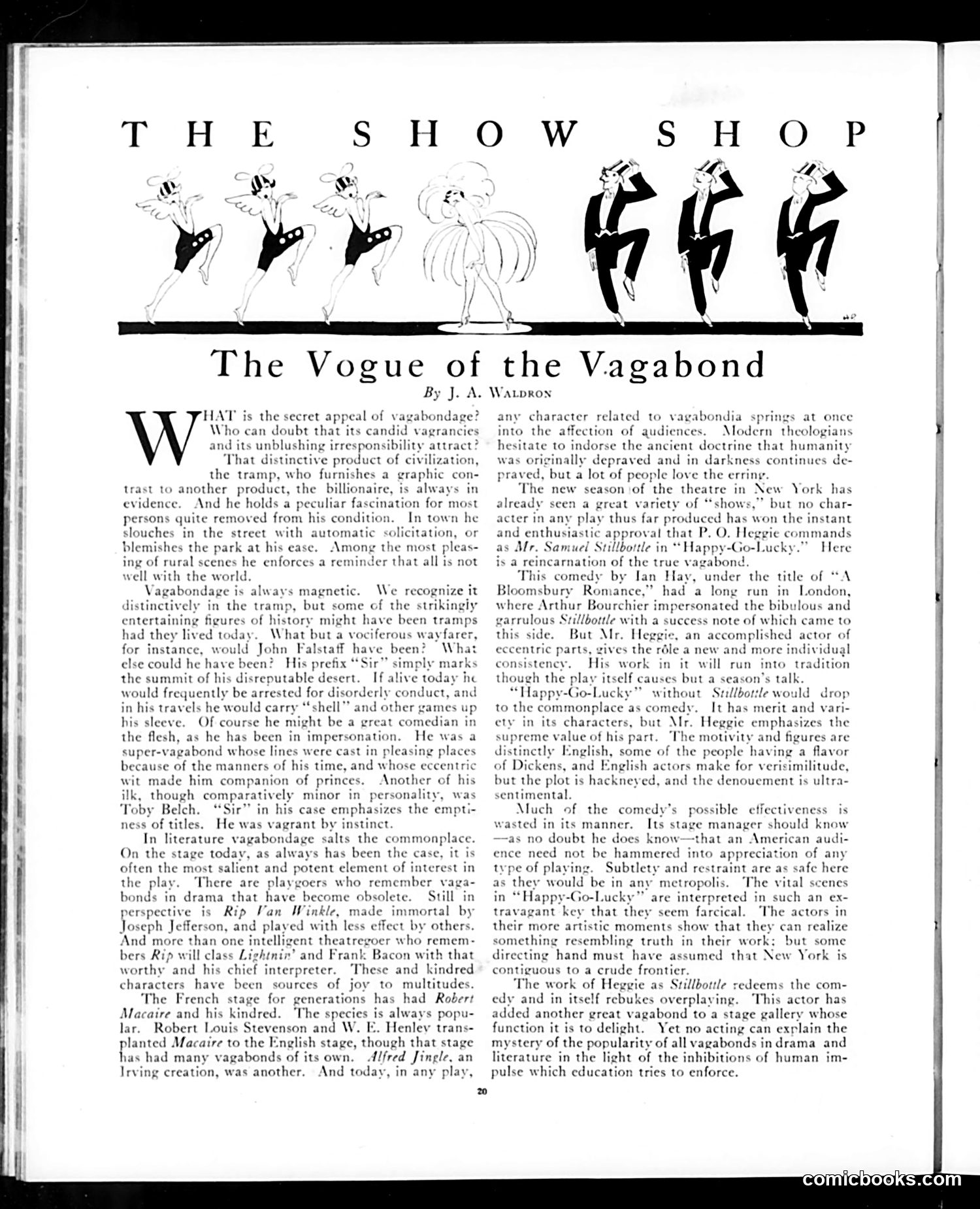
This is an article (not a cartoon) by J.A. Waldron analyzing why audiences are fascinated by vagabond characters in theater. The illustration above shows dancers and comedians in performance poses, representing the theatrical "show." Waldron argues that the vagrant—socially irresponsible and unmoored from civilization—has always captivated audiences and appeared in literature and drama. He cites historical and literary examples: Shakespeare's Falstaff and Sir Toby Belch, Dickens characters, and contemporary stage figures like Joseph Jefferson's *Rip Van Winkle*. The immediate reference is to P.O. Heggie's performance in the current Broadway play *"Happy-Go-Lucky"* (based on Ian Hay's *"A Bloomsbury Romance"*), where Heggie plays a vagabond character named Samuel Stillbottle. Waldron argues Heggie's portrayal exemplifies why audiences love such roles—the actor's skill in portraying irresponsible, eccentric charm makes the character compelling theater. The broader point: society is drawn to characters freed from respectability's constraints.
📄 Transcribed text from this page (OCR, searchable)
Machine-transcribed from the original scan — historical spelling and the odd misread are preserved.
The Vogue of By J. A. HAT is the secret appeal of vagabondage? Who can doubt that its candid vagrancies and its unblushing irresponsibility attract? That distinctive product of civilization, the tramp, who furnishes a graphic con- trast to another product, the billionaire, is always in And he holds a peculiar fascination for most In town he slouches in the street with automatic solicitation, blemishes the park at his ease. Among the most pleas- ing of rural scenes he enforces a reminder that all is not well with the world. Vagabondage is always magnetic. We recognize it distinctively in the tramp, but some of the strikingly entertaining figures of history might have been tramps had they lived today. What but a vociferous wayfarer, for instance, would John Falstaff have been? W hat else could he have been? His prefix “Sir” simply marks the summit of his disreputable desert. If alive today he would frequently be arrested for disorderly conduct, an in his travels he would carry “shell” and other games up his sleeve. Of course he might be a great comedian in the flesh, as he has been in impersonation. He was a super-vagabond whose lines were cast in pleasi because of the manners of his time, and whose eccentric wit made him companion of princes. Another of his ilk, though comparatively minor in personality, was ‘oby Belch. “Sir” in his case emphasizes the empti- ness of titles. He was vagrant by instinct In literature vagabondage salts the commonplace. On the stage today, as always has been the case, it is often the most salient and potent element of interest in the play. There are playgoers who remember vaga- bonds in drama that have become obsolete. Still in perspective is Rip Van Winkle, made immortal by Joseph Jefferson, and played with less effect by others. And more than one intelligent theatregoer who remem- bers Rip will class Lightnin’ and Frank Bacon with that worthy and his chief interpreter. ‘These and kindred characters have been sources of joy to multitudes. The French stage for generations has had Robert Macaire and his kindred. The species is always popu- lar. Robert Louis Stevenson and W. E. Henley trans- planted Macaire to the English stage, though that stage has had many vagabonds of its own. Alfred Jingle, an Irving creation, was another. And today, in any p evidence. persons quite removed from his condition. g places the Vagabond Watpron related to vagabondia springs at once Modern theologi t humanity any character into the affection of audiences. hesitate to indorse the ancient doctrine th was originally depraved and in darkness continues de- but a lot of people love the erring. The new season of the theatre in New York has already seen a great variety of “shows,” but no char- acter in any play thus far produced has won the instant and enthusiastic approval that P. O. Heggie commands as Mr. Samuel Stillbottle in “ Happy-Go-Lucky.” Here is a reincarnation of the true vagabond This comedy by Ian Hay, under the title of Bloomsbury Romance,” had a long run in London, where Arthur Bourchier impersonated the bibulous and ilbottle with a success note of which came to But Mr. Heggie, an accomplished actor of eccentric parts, gives the réle a new and more individual His work in it will run into tradition though the play itself causes but a season’s talk. “Happy-Go-Lucky” without Stllbotile would to the commonplace as comedy, It has merit and vari- ety in its characters, but Mr. Heggic emphasizes the supreme value of his part. The motivity and figures are distinctly English, some of the people having a flavor of Dickens, and English actors make for verisimilitude, but the plot is hackneyed, and the denouement is ultra- sentimental. Much of the comedy’s possible effectiveness is asted in its manner. Its stage manager should know -as no doubt he does know hat an American audi- ence need not be hammered into apprecia of any type of playing. Subtlety and restraint are as safe here as they would be in any metropolis. The vital scenes in “Happy-Go-Lucky” are interprete such an ex- travagant key that they seem farcical. ‘The actors in their more artistic moments show that they can realize something resembling truth in their work; but some directing hand must have assumed that New York is contiguous to a crude frontier. The work of Heggie as Stillbottle redeems the com- edy and in itself rebukes overplaying. This actor has added another great vagabond to a stage gallery whose function it is to delight. Yet no acting can explain the mystery of the popularity of all vagabonds in drama and literature in the light of the inhibitions of human im- pulse which education tries to enforce. praved garrulous § this sid consistency. } drop