
A complete issue · 36 pages · 1920
Judge — May 22, 1920
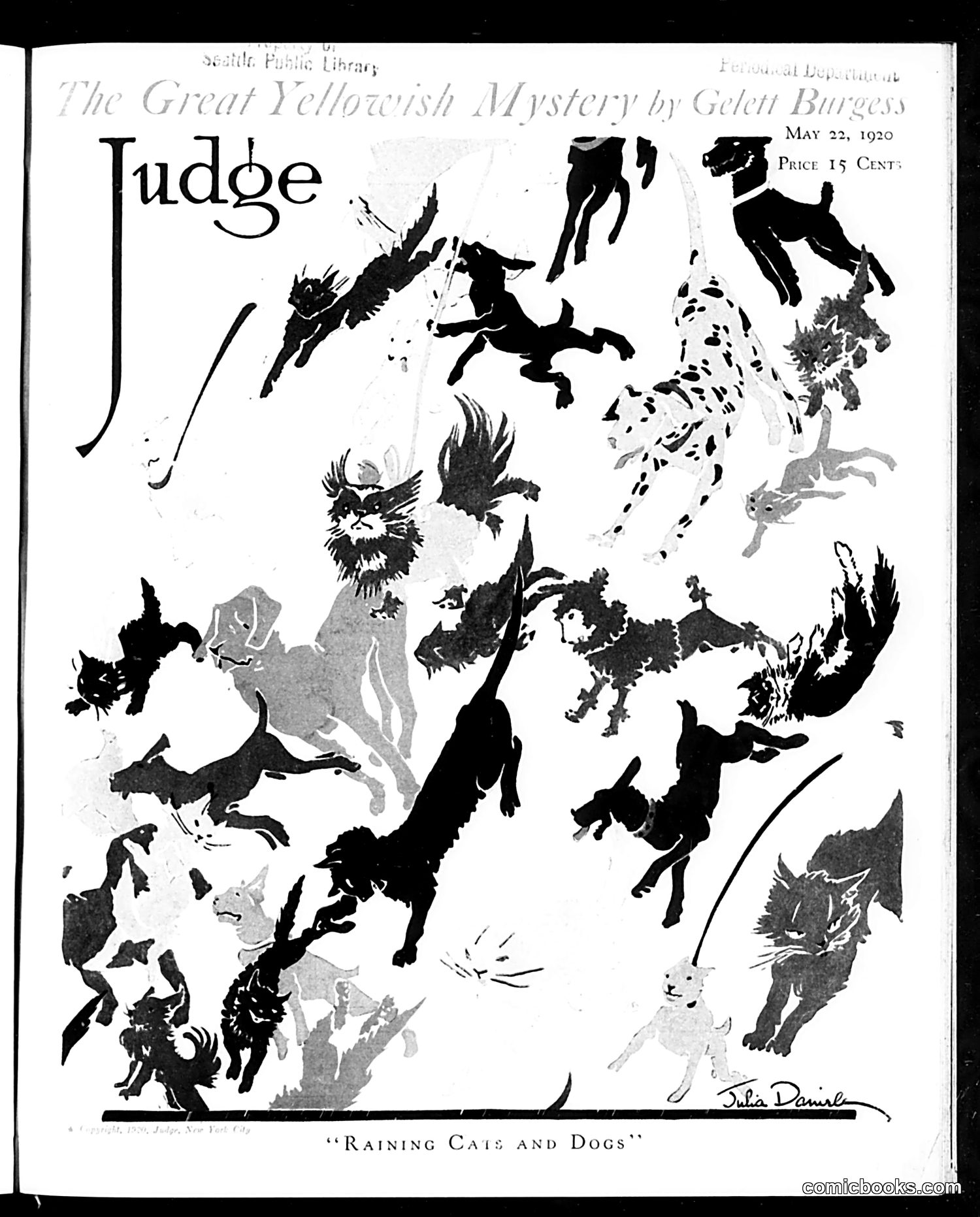
This May 23, 1920 Judge cover satirizes the phrase "raining cats and dogs" literally. The cartoon depicts dozens of cats and dogs falling from above in various mid-air poses and landing positions—a visual pun on the common weather expression. The illustration by John Daniel (signed lower right) is straightforward visual humor rather than political satire. It plays on the absurdity of taking an idiom literally, showing chaotic chaos of tumbling animals rather than actual rainfall. This represents Judge's tradition of whimsical, image-based comedy alongside its political content. The 15-cent price and "The Great Yellowish Mystery" story reference indicate this was entertainment-focused magazine content for a general audience seeking lighthearted wartime (post-WWI) humor.
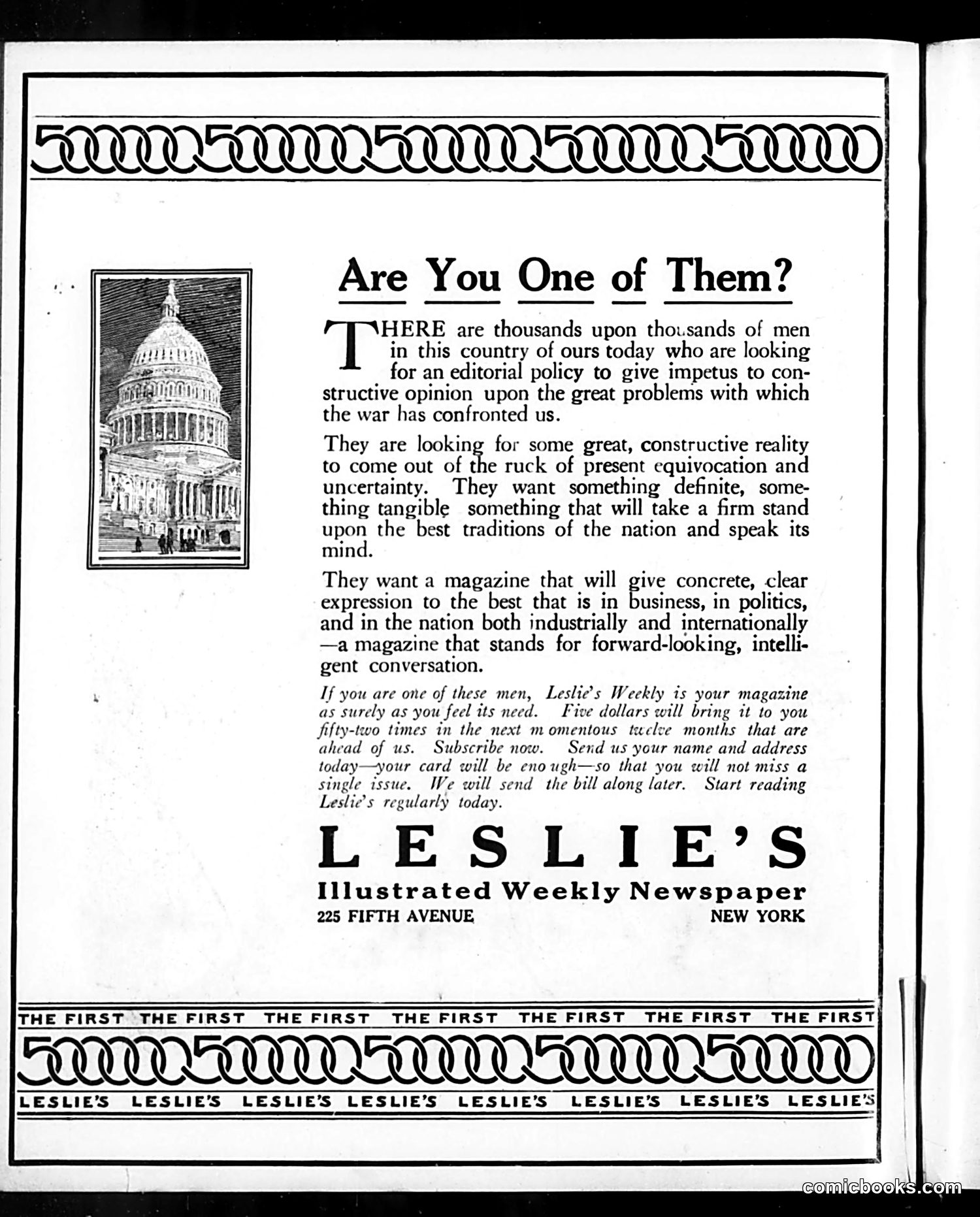
This is **not a cartoon or satire page**, but rather a **subscription advertisement** for Leslie's Illustrated Weekly Newspaper. The ad targets post-WWI readers seeking clarity on national policy. It appeals to men wanting "constructive reality" and "something definite" regarding war-related problems and postwar uncertainty. The Capitol building image symbolizes authoritative American governance. The pitch offers Leslie's as a source of "forward-looking, intelligent conversation" on business, politics, and international affairs. The promotional offer—five dollars for 52 weekly issues—emphasizes accessibility and immediacy ("your card will be enough"). This reflects the early 20th-century magazine industry's competitive positioning: establishing credibility as a trusted source during a period of national anxiety and policy debate.
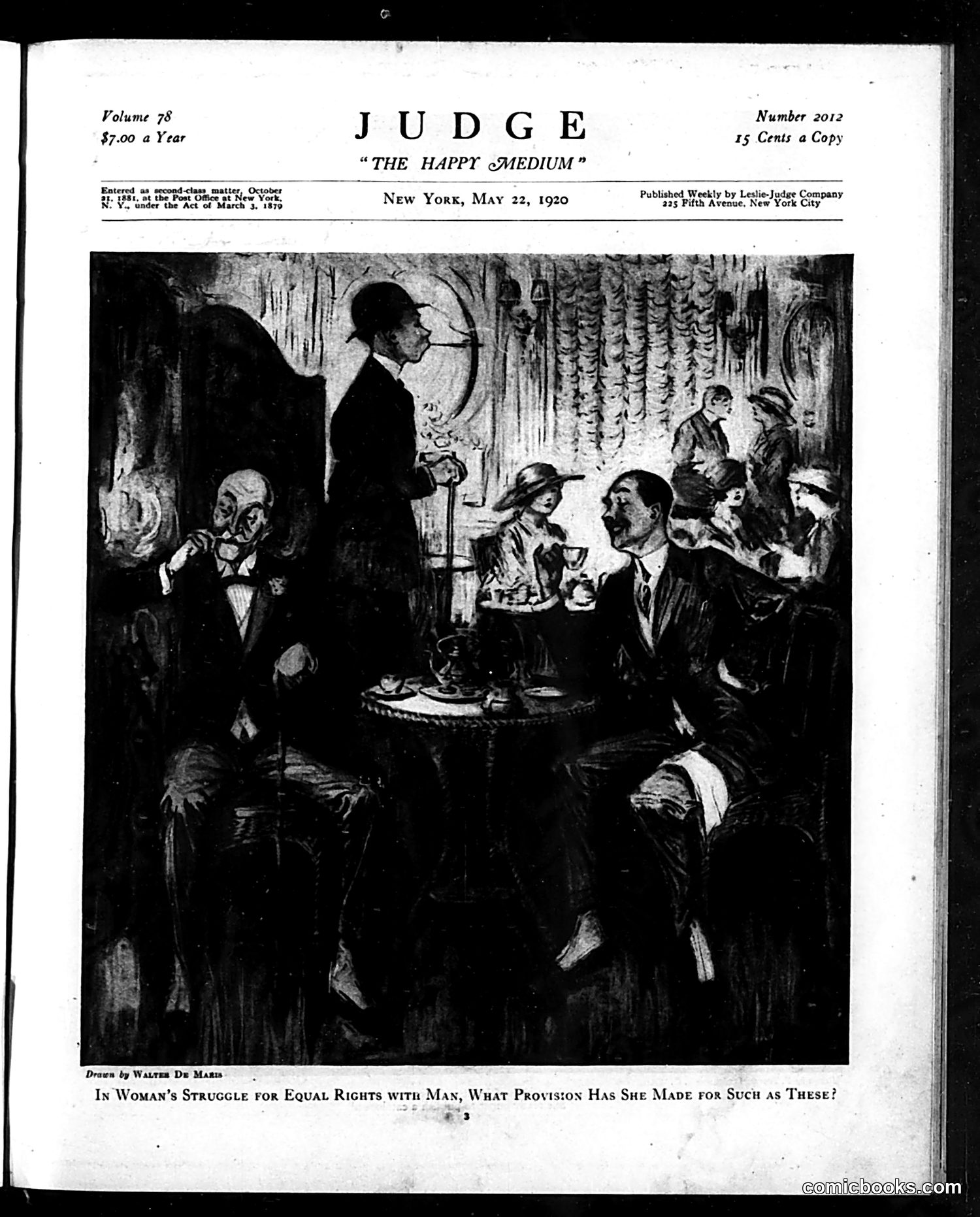
This cartoon by Walter De Maris depicts a salon or social gathering with the caption: "In Woman's Struggle for Equal Rights with Man, What Provision Has She Made for Such as These?" The drawing appears to satirize the women's suffrage movement (women gained the vote in 1920). The cartoon shows well-dressed, able-bodied women in a fashionable interior while suggesting the movement has neglected society's most vulnerable—likely the elderly, infirm, or poor visible in the composition. The satire questions whether women's equality advocacy addresses practical concerns for disadvantaged members of society, or focuses only on middle/upper-class women's rights. This reflects conservative criticism of suffragism as self-interested rather than broadly humanitarian.
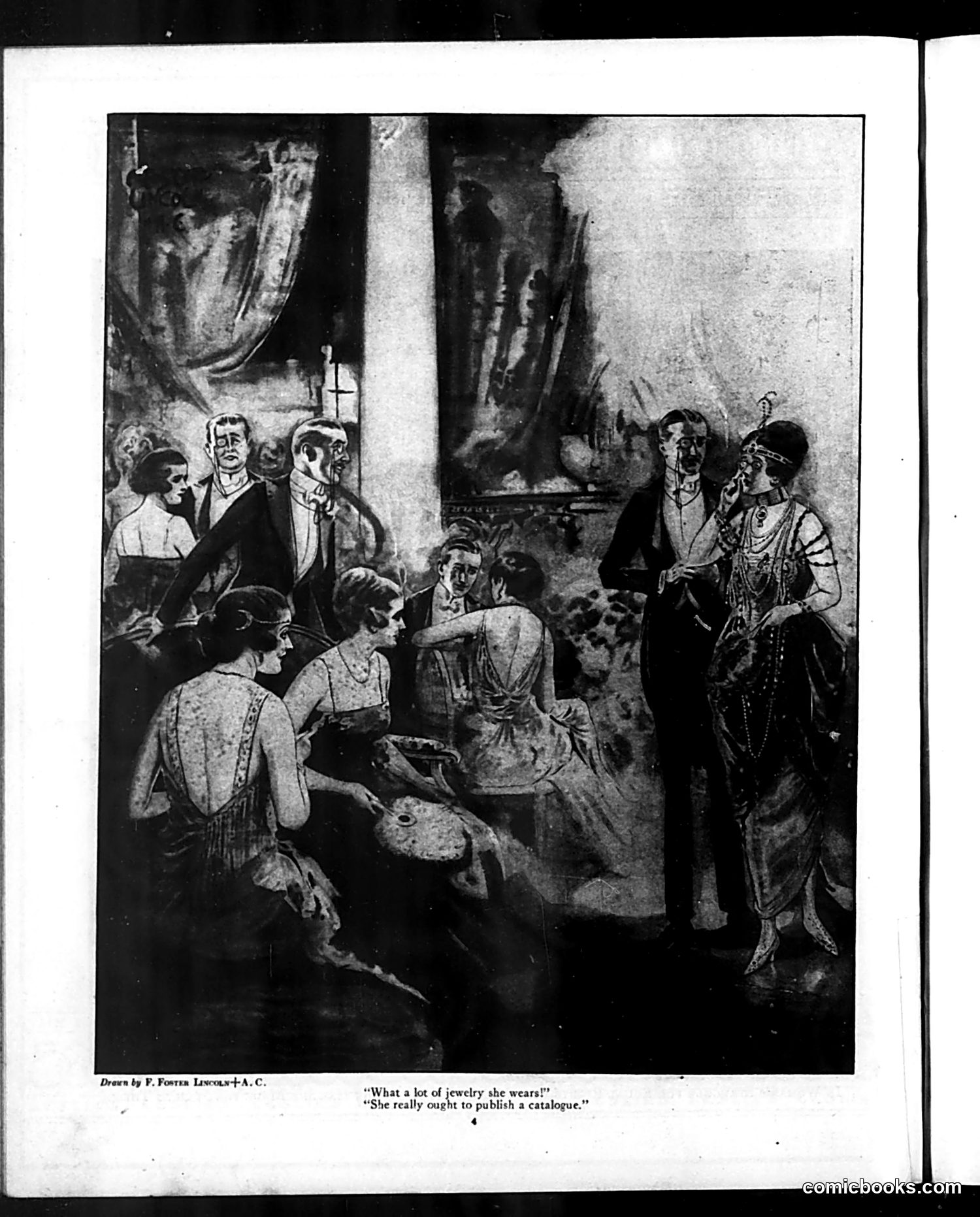
This cartoon satirizes wealthy women's ostentatious jewelry displays in high society. The scene depicts an elegant interior gathering where a woman (likely a nouveau riche socialite or wealthy wife) is being remarked upon for her extensive jewelry collection. The joke, captured in the caption—"What a lot of jewelry she wears!" / "She really ought to publish a catalogue"—mocks how excessive her adornments are, suggesting they're so numerous they'd require cataloging like merchandise. This reflects early 20th-century social commentary on conspicuous consumption and the nouveaux riches flaunting wealth through jewelry rather than demonstrating refined taste. The drawing is credited to F. Forster Lincoln.
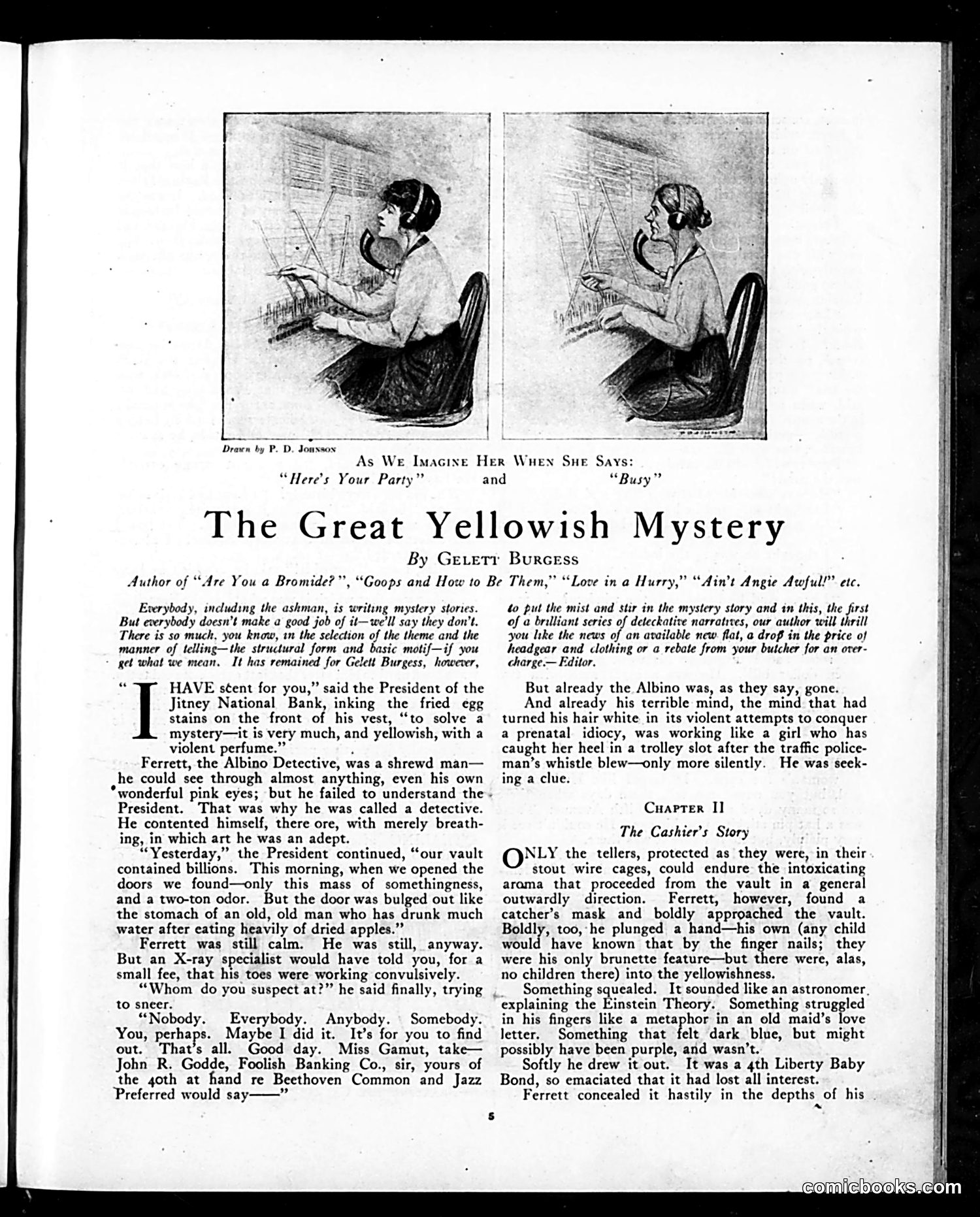
This page features a serialized mystery story by Geleti Burgess rather than political satire. The two illustrations at top, drawn by P.D. Johnson, show a woman at a desk in two poses—labeled "As We Imagine Her When She Says: 'Here's Your Party'" and "'Bury'"—depicting her shifting expressions while speaking. The story itself concerns detective Ferrett investigating mysterious stains at the Jitney National Bank. The narrative emphasizes the detective's superior deductive abilities compared to the bumbling bank President. This appears to be entertainment fiction satirizing incompetent authority figures through mystery-story conventions rather than targeting specific political events or real individuals. The focus is purely comedic storytelling.
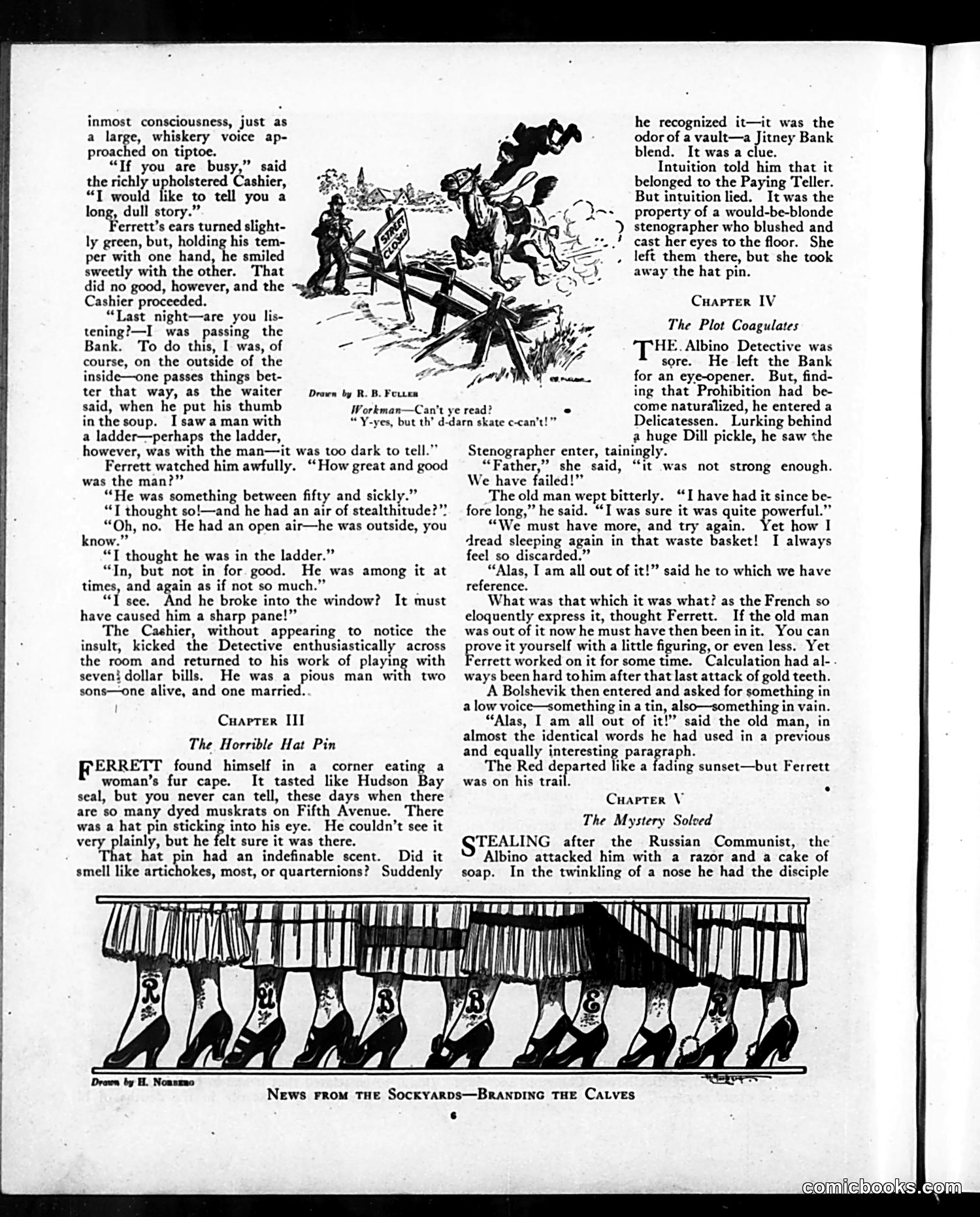
This page appears to be from a serialized detective fiction story rather than political satire. The narrative follows "Ferrett" investigating a mystery involving a Jitney Bank, with chapters titled "The Horrible Hat Pin," "The Plot Coagulates," and "The Mystery Solved." The two illustrations show comedic scenes: the upper depicts characters in chaotic action (possibly a bank robbery or altercation), while the lower illustration titled "News from the Sockyards—Branding the Calves" shows a row of legs/feet under a decorative border, likely a satirical commentary on meatpacking industry labor practices. The page blends fiction storytelling with social commentary, though the primary content is the ongoing mystery narrative rather than direct political commentary.
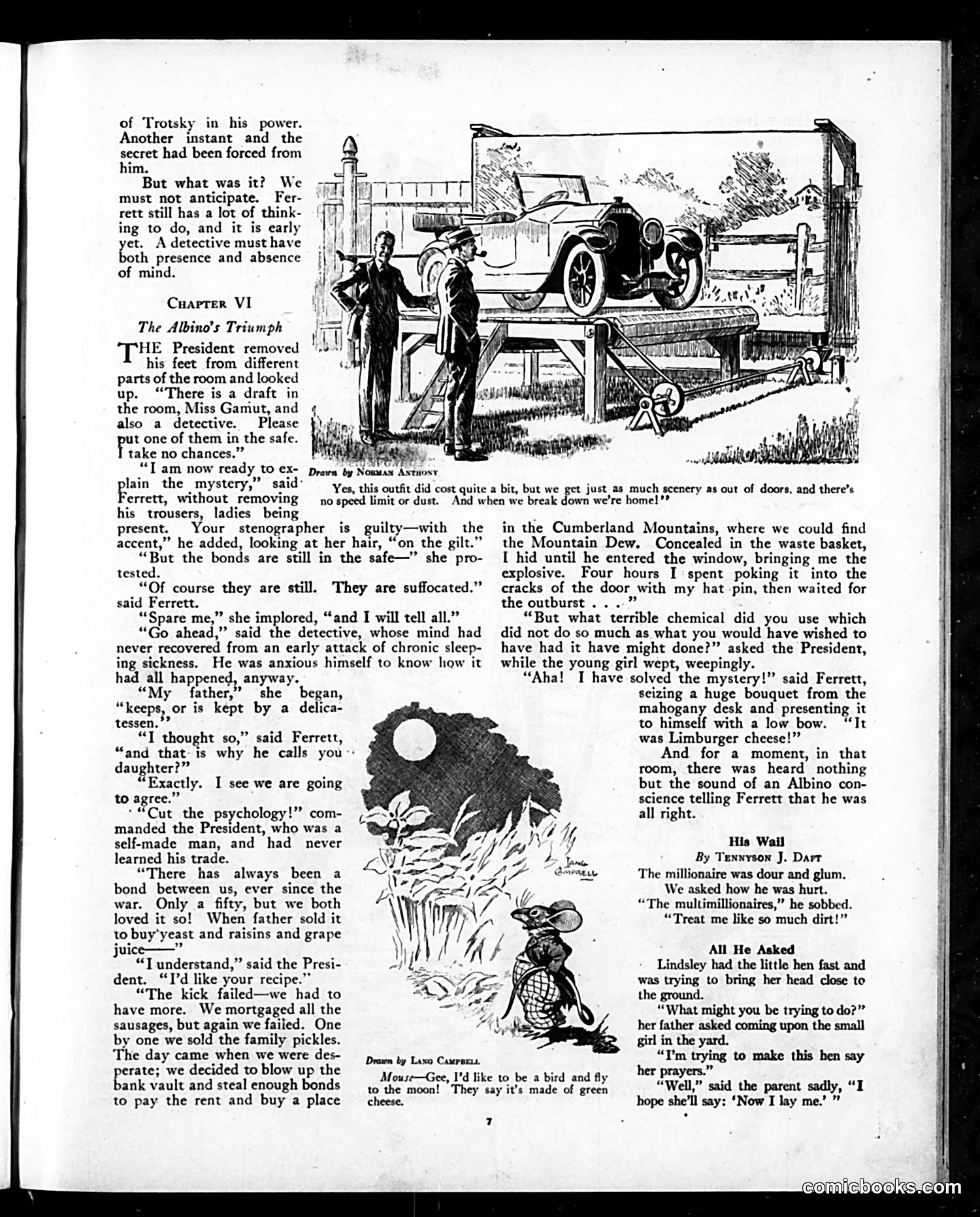
This page contains a serialized satirical mystery story ("Chapter VI: The Albino's Triumph") parodying detective fiction. The humor relies on absurdist logic: Detective Ferrett "solves" a bank robbery mystery by deducing the stenographer is guilty because of her hair's "accent" on the gilt, and ultimately reveals the explosive used was *Limburger cheese*—a punchline playing on the cheese's notoriously pungent smell. The accompanying illustrations and brief pieces ("His Wail," "All He Asked") are lighter satirical vignettes. References to Trotsky suggest Cold War-era anxieties, while the millionaire's complaint about multimillionaires reflects wealth-gap social commentary. The page's primary purpose is entertainment through absurdist humor and parody of popular mystery narratives—typical of Judge's satirical approach to contemporary culture.
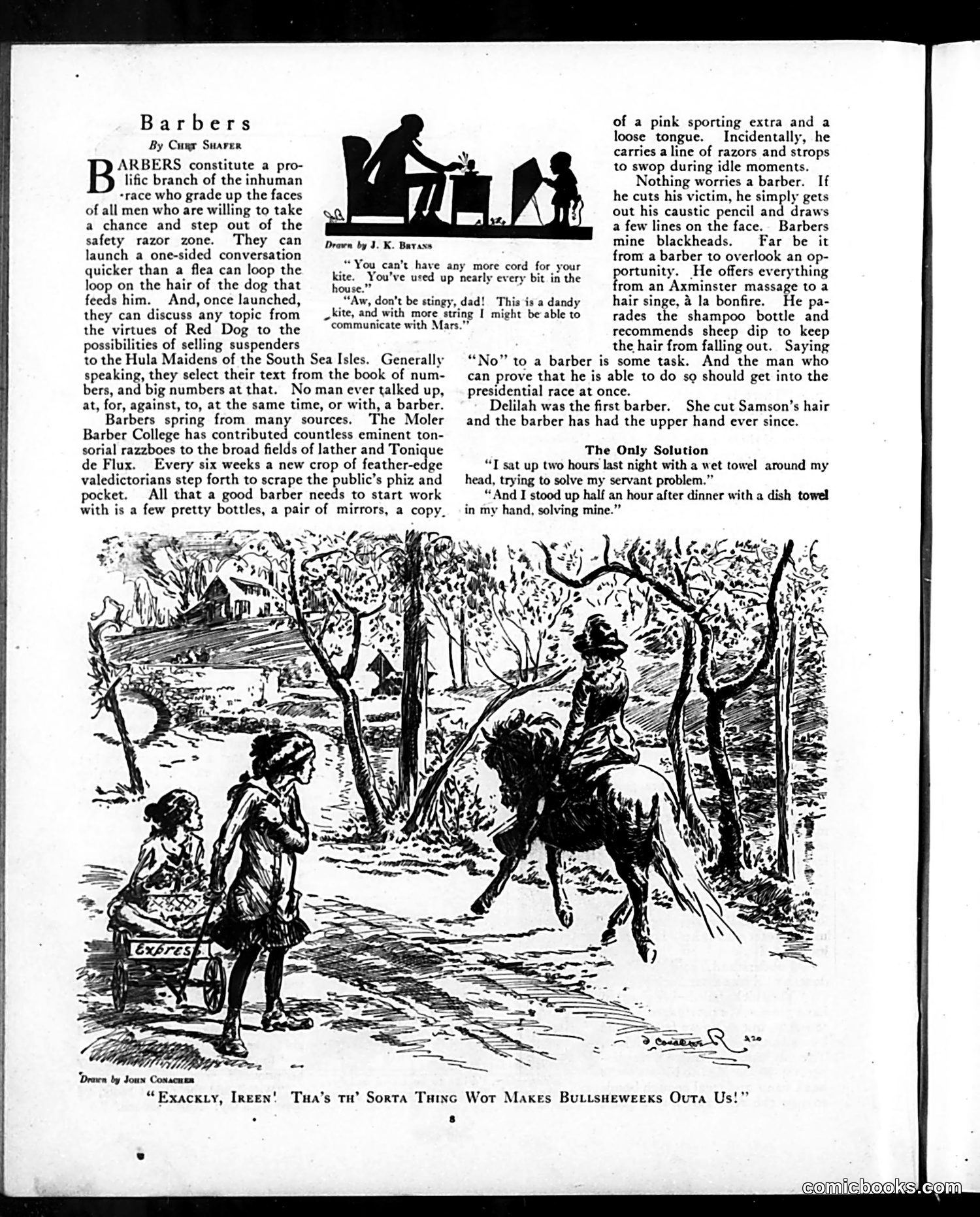
This page contains a satirical essay by Omar Shapfer mocking barbers as talkative, opportunistic professionals who exploit customers while providing minimal actual skill. **The Main Article's Satire:** Shapfer characterizes barbers as garrulous hustlers who launch endless monologues, upsell unnecessary services (massages, hair treatments), and charge exorbitant prices. The reference to Delilah cutting Samson's hair suggests barbers have historically held power over their clients. The piece ridicules barber college graduates as mass-produced, mediocre practitioners requiring only "pretty bottles" and mirrors to start businesses. **The Two Cartoons:** 1. **Top illustration** (by J.K. Baas): Shows a barber with a customer, illustrating the essay's themes. 2. **Bottom illustration** (by John Conselman): Depicts children with a kite, captioned about making "bullsheeweeks outa us"—likely satirizing servants/employees who waste time or resources, paralleling the barber theme of being exploited by unreliable service providers. **Context:** This reflects early 20th-century class anxieties about service workers and consumer culture.
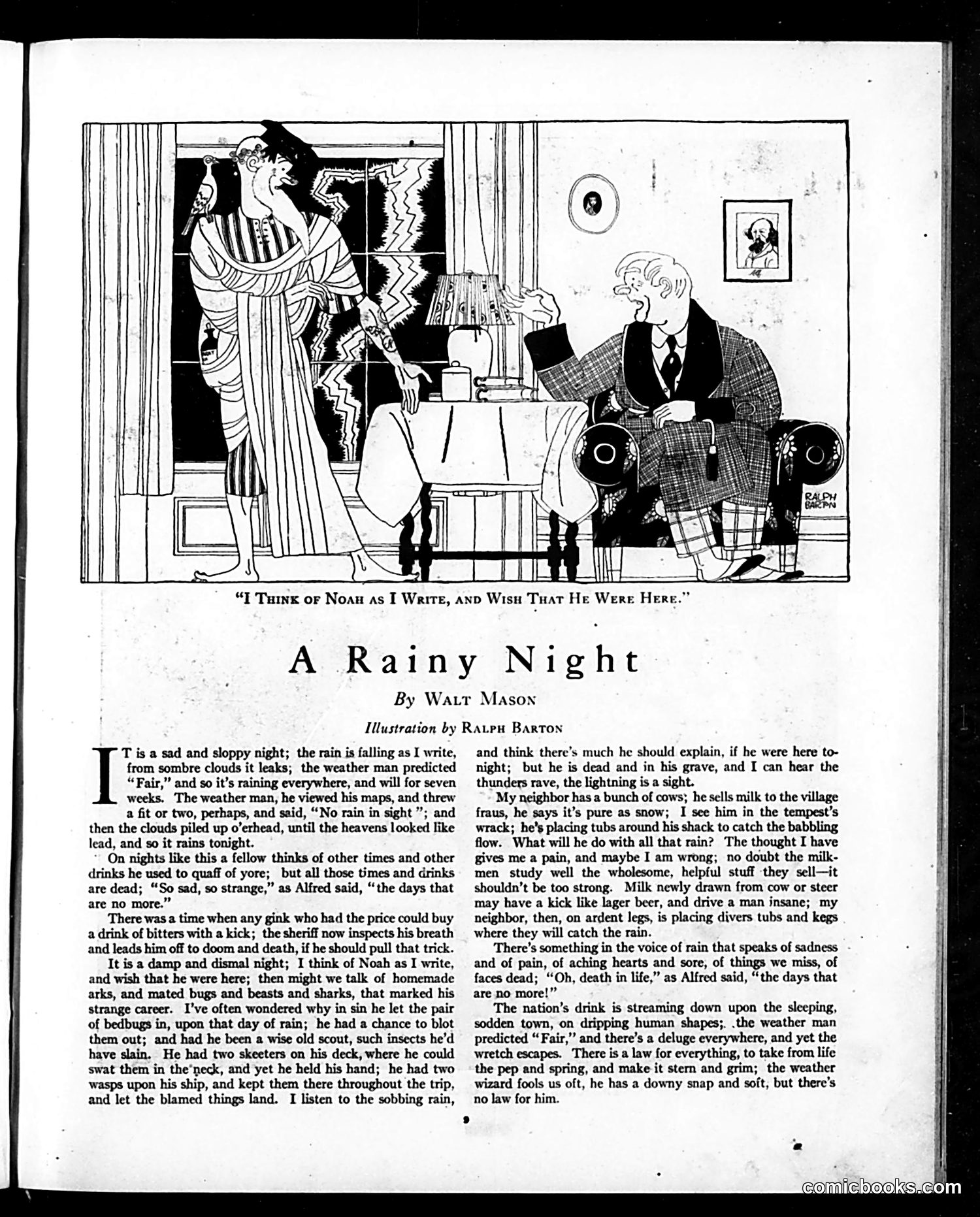
This is a humorous short story by Walt Mason (illustrated by Ralph Barton) that uses a rainy night as a springboard for social commentary, particularly about **Prohibition**. The narrator, stuck indoors during rain, reflects nostalgically on drinking ("drinks he used to quaff of yore"), noting that those days are gone. He mentions that sheriffs now inspect people's breath and arrest them for drinking—a direct reference to Prohibition enforcement. The satirical point: the weather forecaster predicted "Fair" but it rains anyway, mirroring how Prohibition promised to improve society but failed. The joke extends to the neighbor collecting rainwater in buckets—possibly implying he'll use it for illicit alcohol production, or simply that he's foolishly collecting useless water. The cartoon's caption references Noah, wishing he were present—likely suggesting Noah's experience with water parallels modern Americans' relationship with drink under Prohibition. The overall tone is wistful complaint about lost freedoms and broken promises.
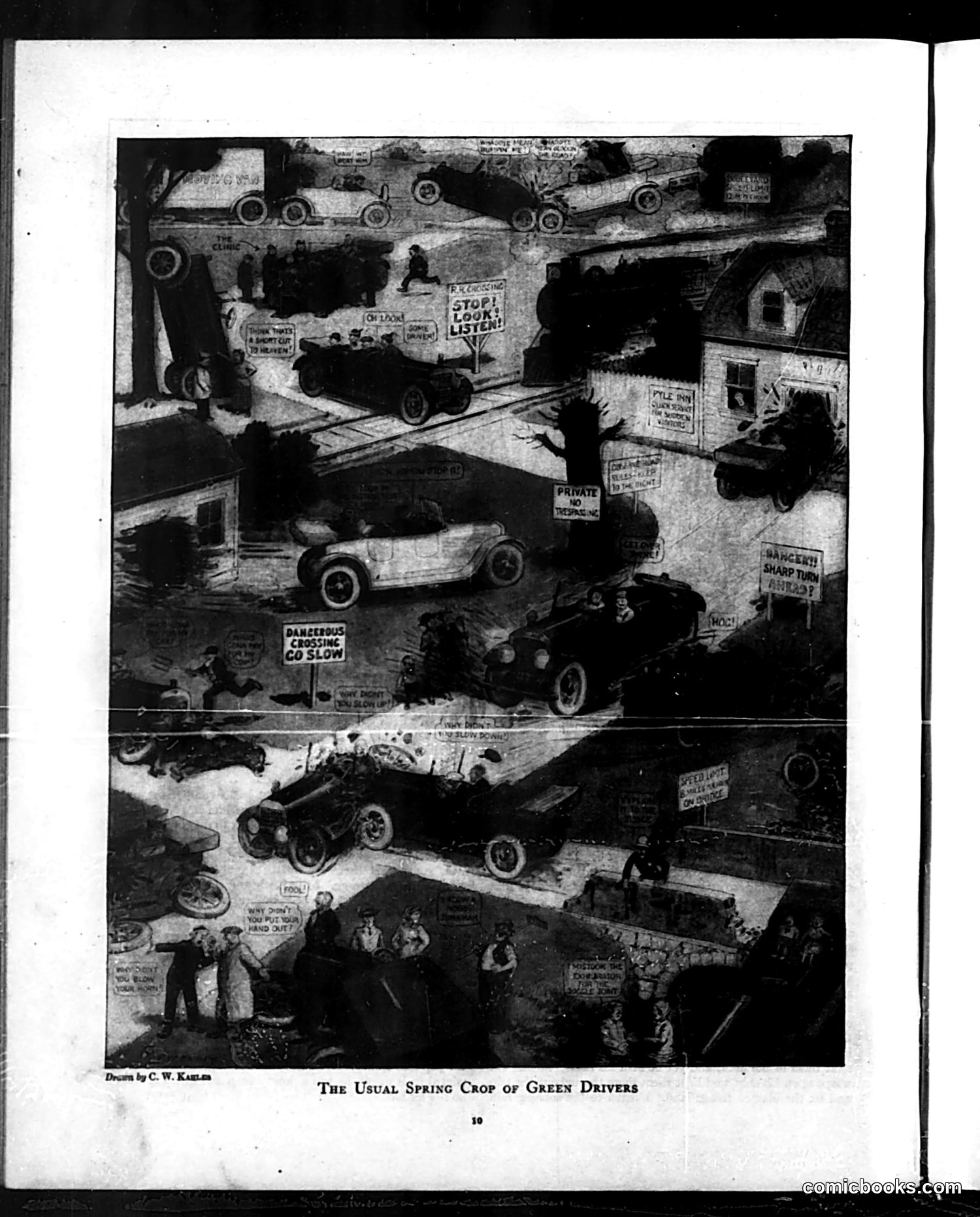
This satirical cartoon depicts the annual phenomenon of inexperienced drivers appearing on roads each spring. The overhead view shows a chaotic traffic scene with numerous cars, pedestrians, and warning signs ("STOP! LOOK! LISTEN!", "DANGEROUS—GO SLOW", "PRIVATE—NO TRESPASSING"). The satire targets "green drivers"—novice motorists, likely new car owners or teenage drivers who emerge seasonally. The cartoon humorously presents their unpredictability and recklessness as an inevitable seasonal occurrence, comparable to agricultural crops. The multiple warning signs and crowded, disorderly scene emphasize the danger and confusion created by these inexperienced operators on public roads. This reflects early 20th-century concerns about automobile safety as car ownership expanded.
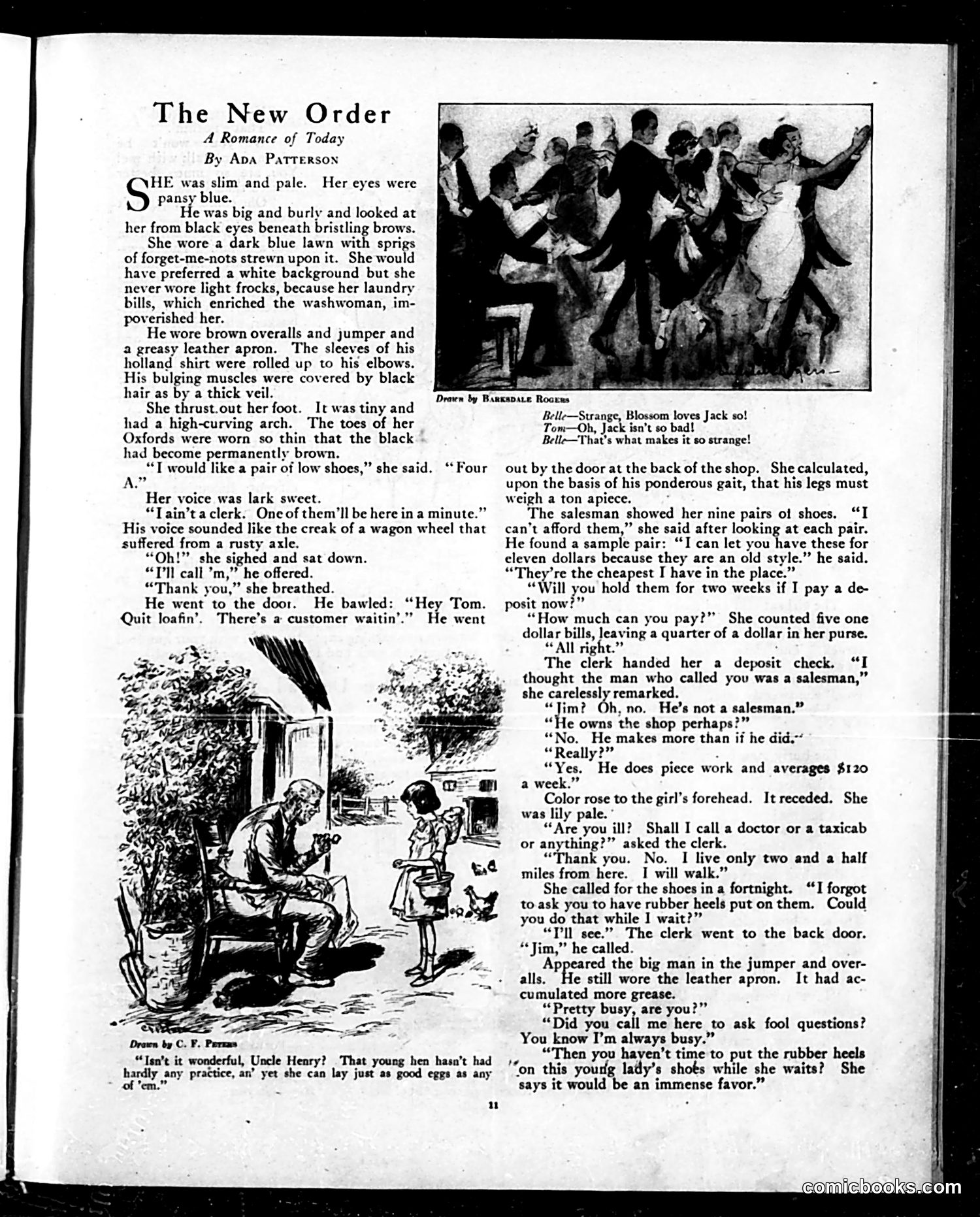
This page contains a serialized romance story by Ada Patterson titled "The New Order: A Romance of Today." The narrative describes a working-class woman in worn clothing visiting a shoe shop, where she negotiates to buy nine pairs of shoes on a two-week payment plan for five dollars down. The two illustrations by C.F. Parrish and Blaksdale Rogers depict rural/working-class scenes consistent with the story's setting. The dialogue emphasizes economic struggle and the woman's resourcefulness in managing limited finances. The page appears to be straightforward serialized fiction rather than political satire, reflecting early 20th-century concerns about working-class financial hardship and the emerging consumer credit system.
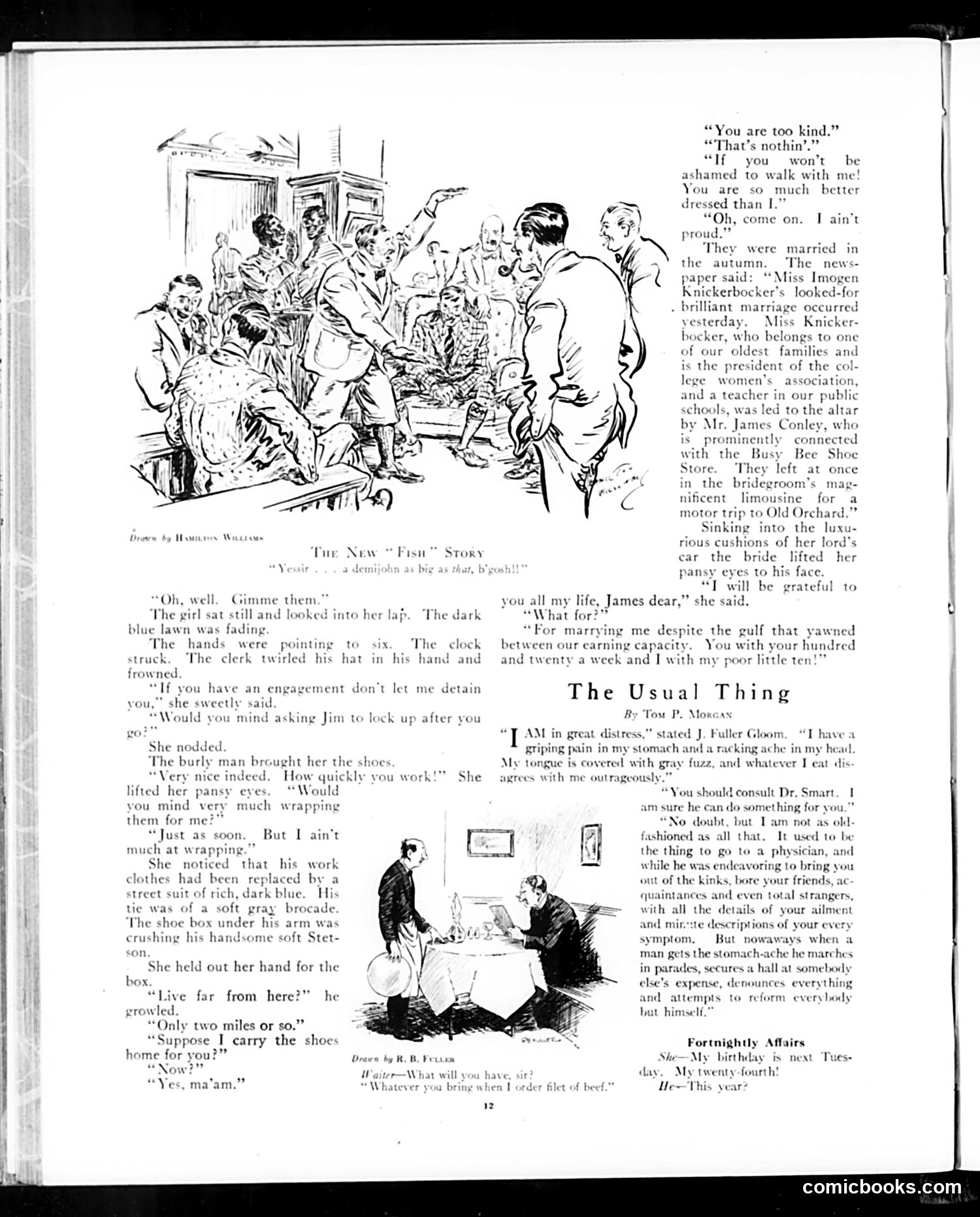
This page contains two satirical stories reflecting early 20th-century social attitudes: **"The New 'Fish' Story"** (top): A working-class shoe clerk in worn clothes asks a well-dressed woman of high social standing to carry her shoes home. She accepts, and they marry. The satire mocks the era's obsession with class distinction—the newspaper announcement emphasizes her family's "oldest families" pedigree while reducing him to his employment at the "Busy Bee Shoe Store." Their honeymoon dialogue reveals the real joke: she's grateful he married *down* to her, while he resents the financial gap between her wealth and his meager ten-dollar weekly wage. The satire critiques both rigid class consciousness and the awkwardness of cross-class marriages. **"The Usual Thing"** (bottom): A man complains of illness to a friend, who suggests seeing a doctor. He refuses, claiming it's old-fashioned to bore people with health complaints—now men simply "march in parades" and demand reform instead. This satirizes contemporary progressive activism, suggesting reformers exploit personal grievances for public causes rather than addressing them privately.
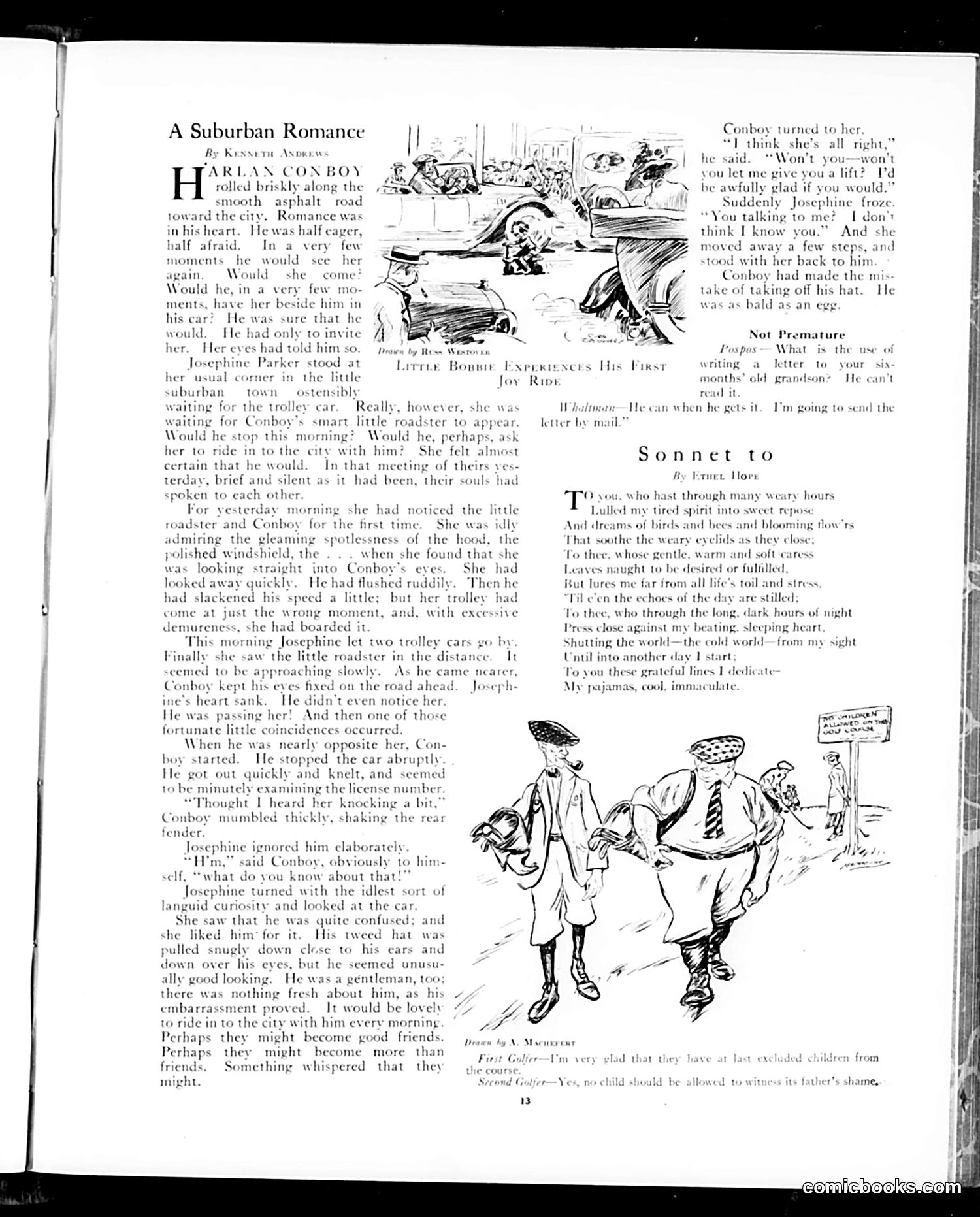
This page contains a short romantic story illustrated with line drawings. A man named Harlan Conboy drives a roadster and spots Josephine Parker waiting at a suburban trolley stop. He's nervous about approaching her, but when he finally stops to offer her a ride, she rebuffs him coldly—he's removed his hat, revealing he's bald. The twist: moments later, when his car breaks down and he kneels to examine it, he wears his hat. Josephine sees him again, now finding him attractive and "a gentleman" for his embarrassed politeness. The satire mocks suburban romance and shallow attraction: a man's entire romantic prospects hinge on whether he's wearing a hat. It's gentle humor about vanity and the arbitrary nature of first impressions in courtship, specifically targeting early 20th-century suburban dating culture where appearance and proper decorum were paramount.
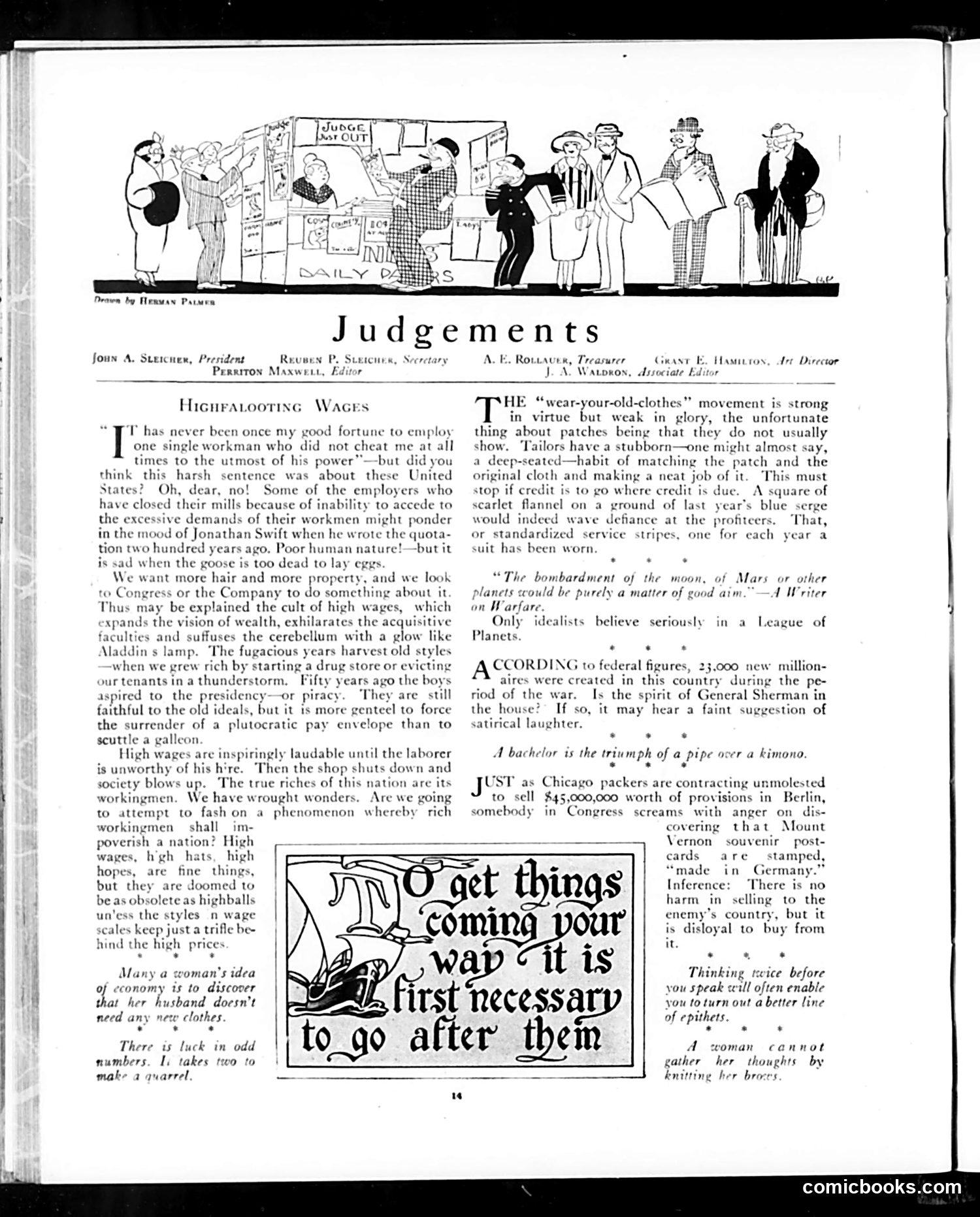
This page from Judge magazine contains several satirical commentaries on post-WWI American economic and social issues: **"Highfaluoting Wages"** argues that workers' demands for higher pay are inflating their ambitions unreasonably, comparing them unfavorably to earlier generations who aspired to honest work or even piracy. The piece critiques labor militancy while paradoxically acknowledging workers as "the true riches of this nation." **"Wear-Your-Old-Clothes Movement"** mocks wartime/postwar conservation efforts, joking that patched clothing should be visibly shabby to demonstrate sacrifice—tailors' neatness defeats the moral purpose. **Other brief satirical items** reference: the absurdity of "Leagues of Planets," the sudden creation of 23,000 new millionaires during WWI (suggesting war profiteering), and the hypocrisy of selling American goods to Germany while condemning German-made souvenirs as disloyal. The overall tone reflects upper-class anxiety about labor unrest, wartime profiteering, and changing social values in the immediate postwar period.
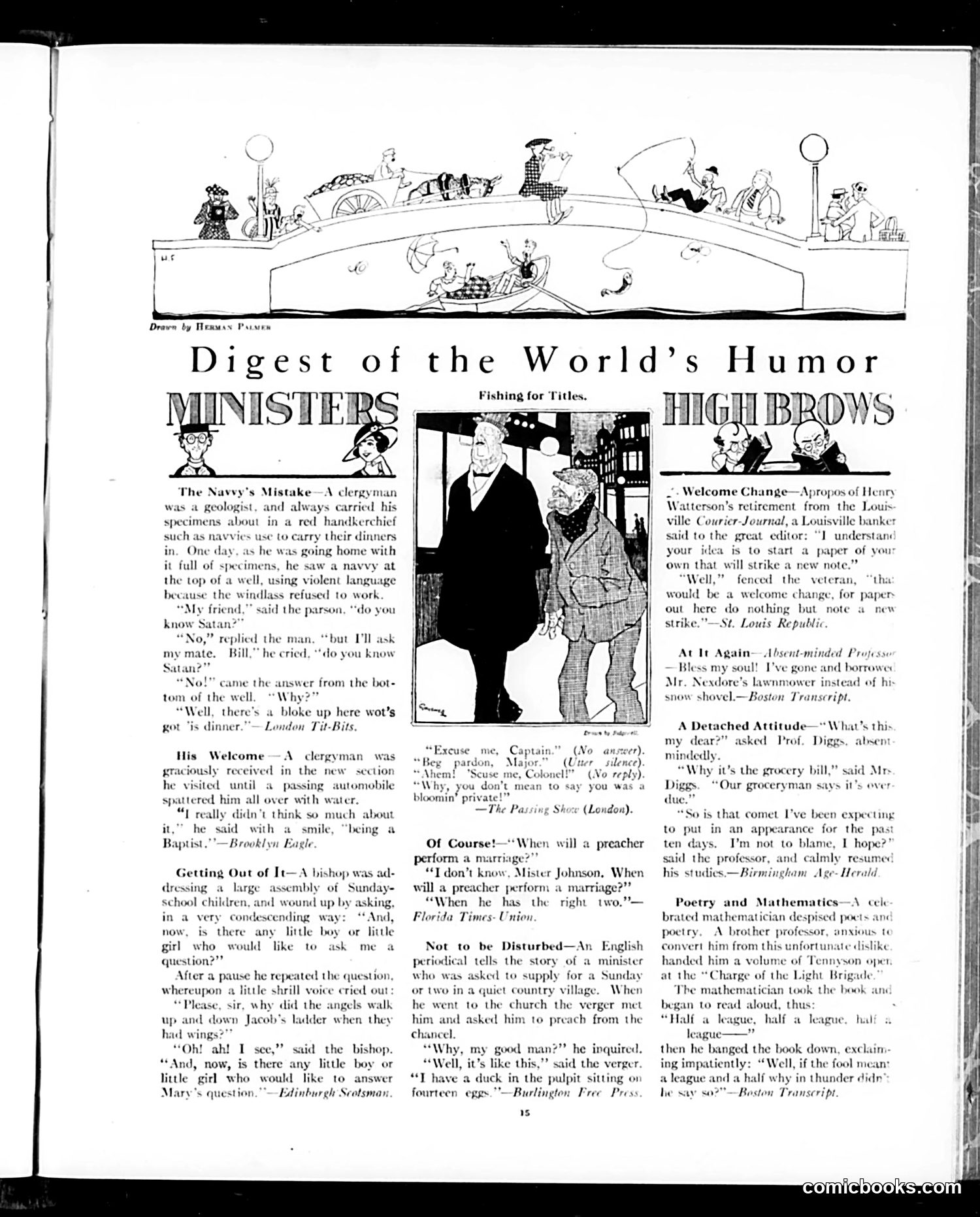
This page collects short humorous anecdotes from various sources, typical of Judge's "Digest" feature. The cartoons and jokes rely on class and professional stereotypes common to early 20th-century humor: **Key pieces:** "The Navy's Mistake" plays on a working-class laborer's confusion—a clergyman carrying geological specimens in a handkerchief is mistaken for a navvy (manual laborer) with his dinner. "Getting Out of It" depicts a bishop embarrassed when a child asks a theological question he cannot answer. "Not to be Disturbed" jokes about rural clergy indifference to unusual circumstances (a duck nesting in the pulpit). The humor consistently targets educated professionals (clergy, professors, editors) who are portrayed as absent-minded, pretentious, or socially awkward. Working-class figures appear as simple but shrewd. The satire gently mocks institutional authority and the gap between intellectual life and practical reality—themes central to Judge's satirical mission.
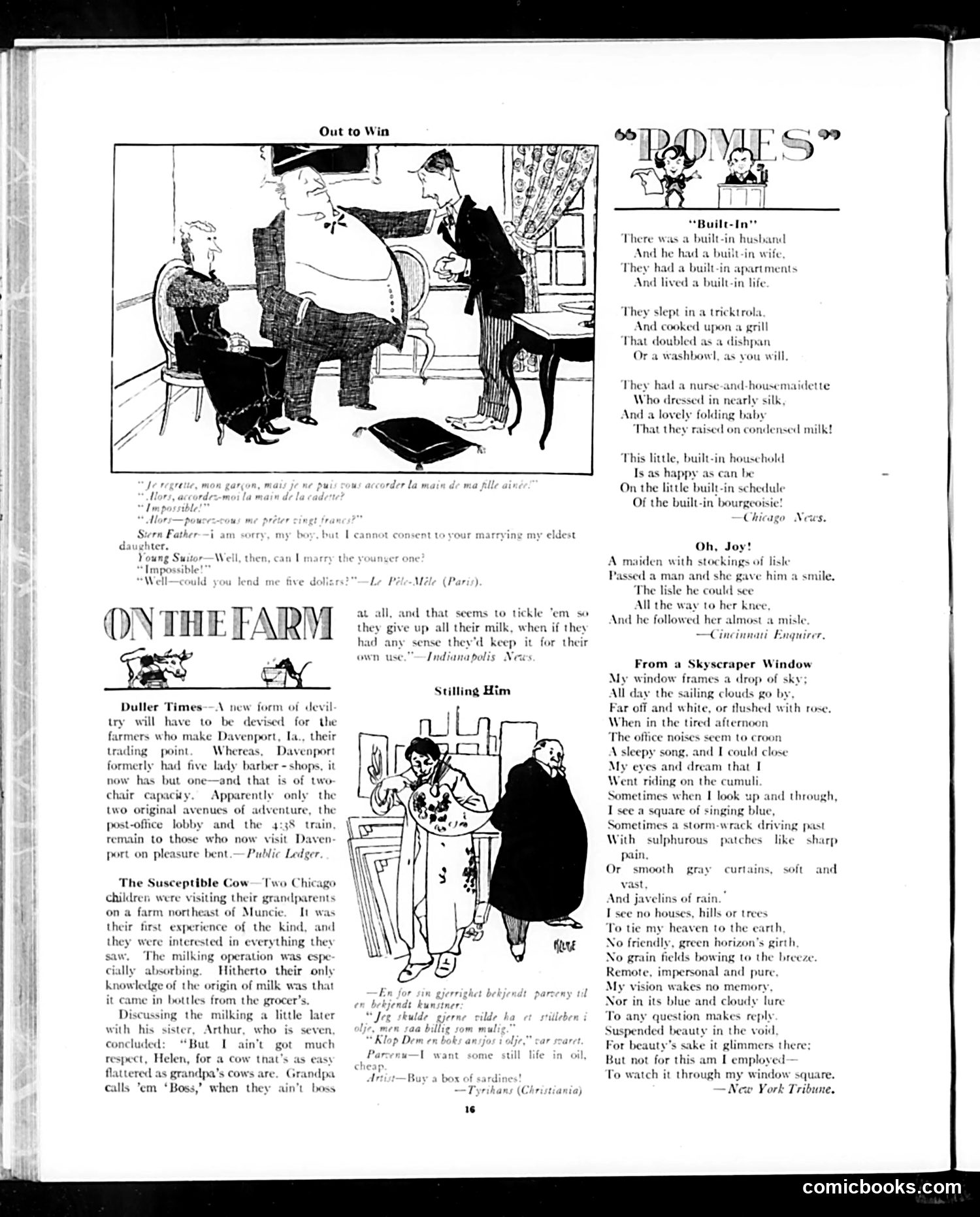
**"Out to Win"** (top cartoon): A father refuses to lend money to a suitor seeking to marry his daughter, saying he "cannot consent to your marrying my eldest daughter" but offering to let him marry the younger one instead—a joke about the father wanting to unload an unmarriageable or less desirable daughter. **"On the Farm"** section: A satirical anecdote where a seven-year-old boy expresses contempt for cows that are too easily flattered by the grandfather's praise, arguing they lack self-respect because they'll give up all their milk when praised. The satire targets human susceptibility to flattery by projecting it absurdly onto cattle. **"Built-In"** and other poems: Light verse about modern domestic life, including humor about a mechanized "built-in" household and risqué observations about women's fashion (visible stockings). These reflect early 20th-century attitudes toward technology and gender. The page mixes humor, social observation, and poetry typical of *Judge* magazine's satirical approach to American life.
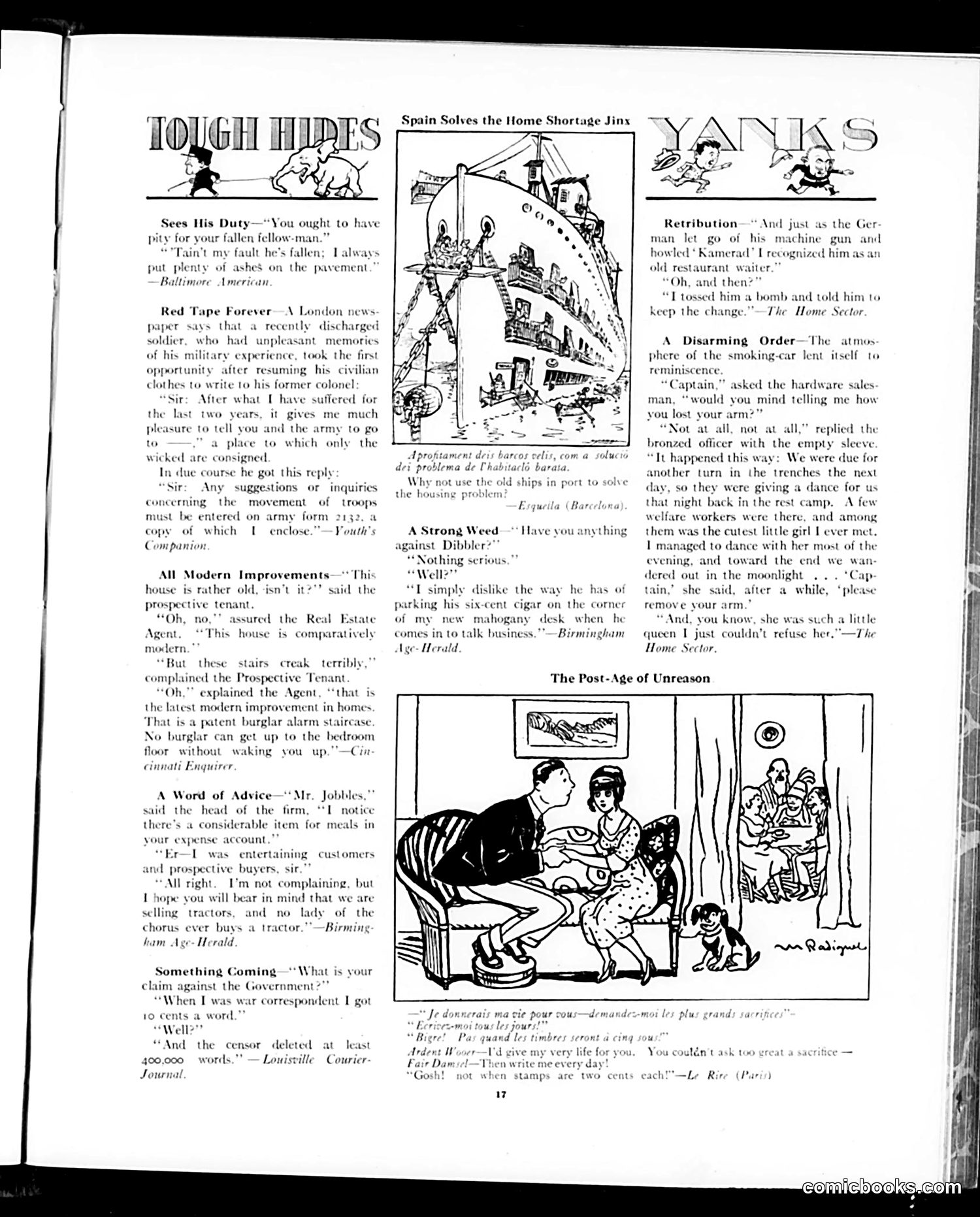
This page contains several brief humorous anecdotes satirizing post-WWI social attitudes and bureaucratic absurdity: **"Red Tape Forever"** mocks military bureaucracy: a discharged soldier's complaint about his service receives an unhelpful response demanding he file proper forms rather than addressing his grievance directly. **"All Modern Improvements"** jokes about creative real estate marketing—a landlord describes noisy, creaky stairs as a "burglar alarm" feature, satirizing how agents disguise flaws as benefits. **"A Strong Weed"** ridicules a minor workplace annoyance (someone's cigar on a desk) being treated as a serious complaint. **"Retribution"** presents dark WWI humor: recognizing an old waiter among enemy soldiers and "repaying" his poor service with violence. **"A Disarming Order"** uses sexual innuendo in a war story where a woman asks an officer to "remove your arm"—he complies, implying amputation rather than understanding her flirtation. The overall tone reflects post-war disillusionment with authority, bureaucracy, and social conventions through absurdist humor typical of 1920s satirical magazines.
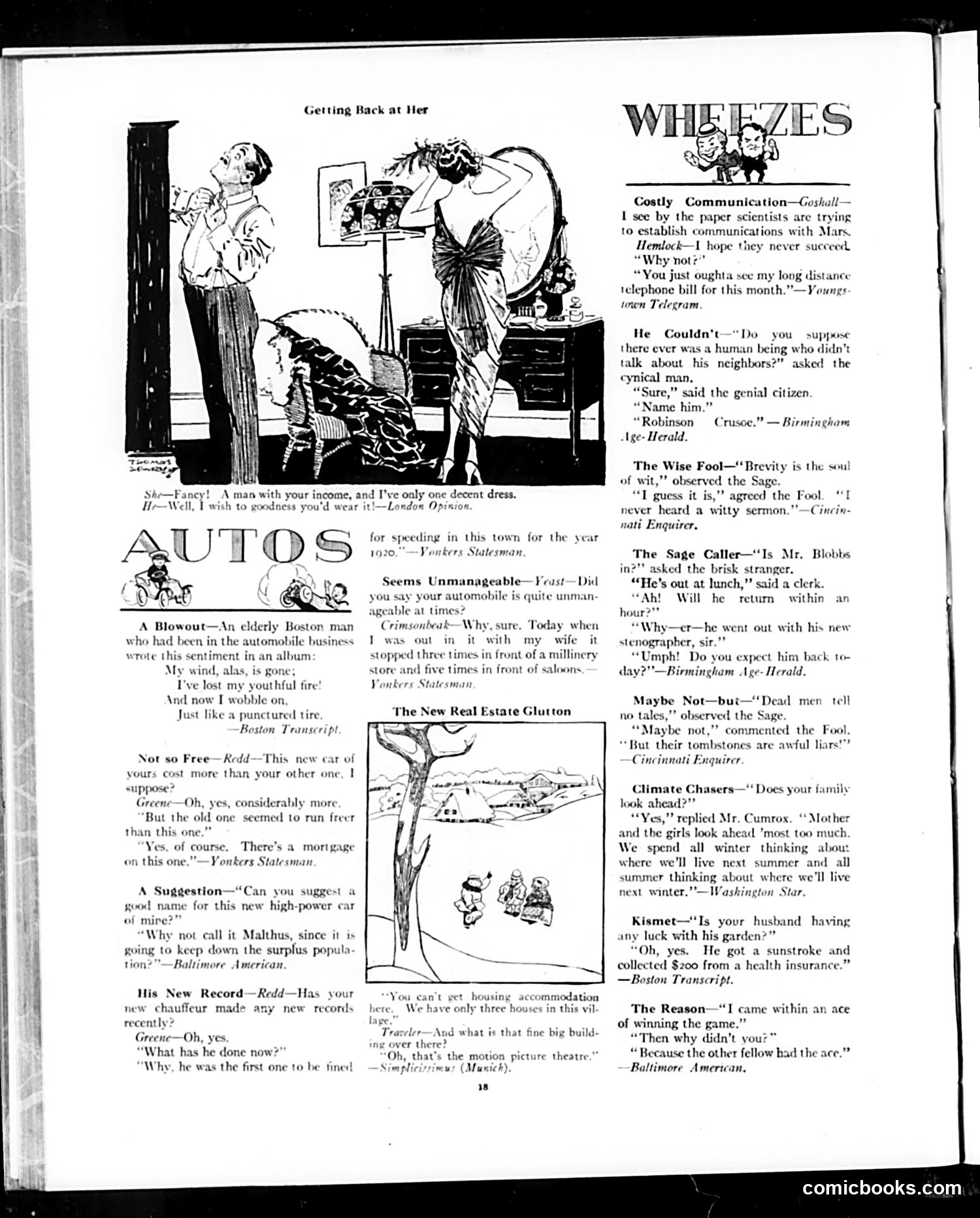
This page contains **short humorous anecdotes** rather than political cartoons—typical of Judge's satirical humor format. The jokes mock everyday early 20th-century American anxieties: **Key themes:** - **Long-distance telephone costs**: "Costly Communication" mocks expensive phone bills, a luxury concern for the period. - **Automobile problems**: Multiple jokes about unreliable cars ("Seems Unmanageable," "A Blowout") reflect widespread frustration with early automobiles' poor reliability. - **Marriage/gender dynamics**: "She—Fancy!" depicts a wife criticizing her husband's modest income and wardrobe—satirizing class consciousness and marital tension. - **Real estate speculation**: "The New Real Estate Glutton" cartoon shows families obsessively planning where to live each season. The humor targets middle-class anxieties: technology failures, financial strain, domestic complaints, and social climbing. The tone is gently cynical rather than sharply political—representing Judge's focus on domestic satire over hard-hitting commentary.
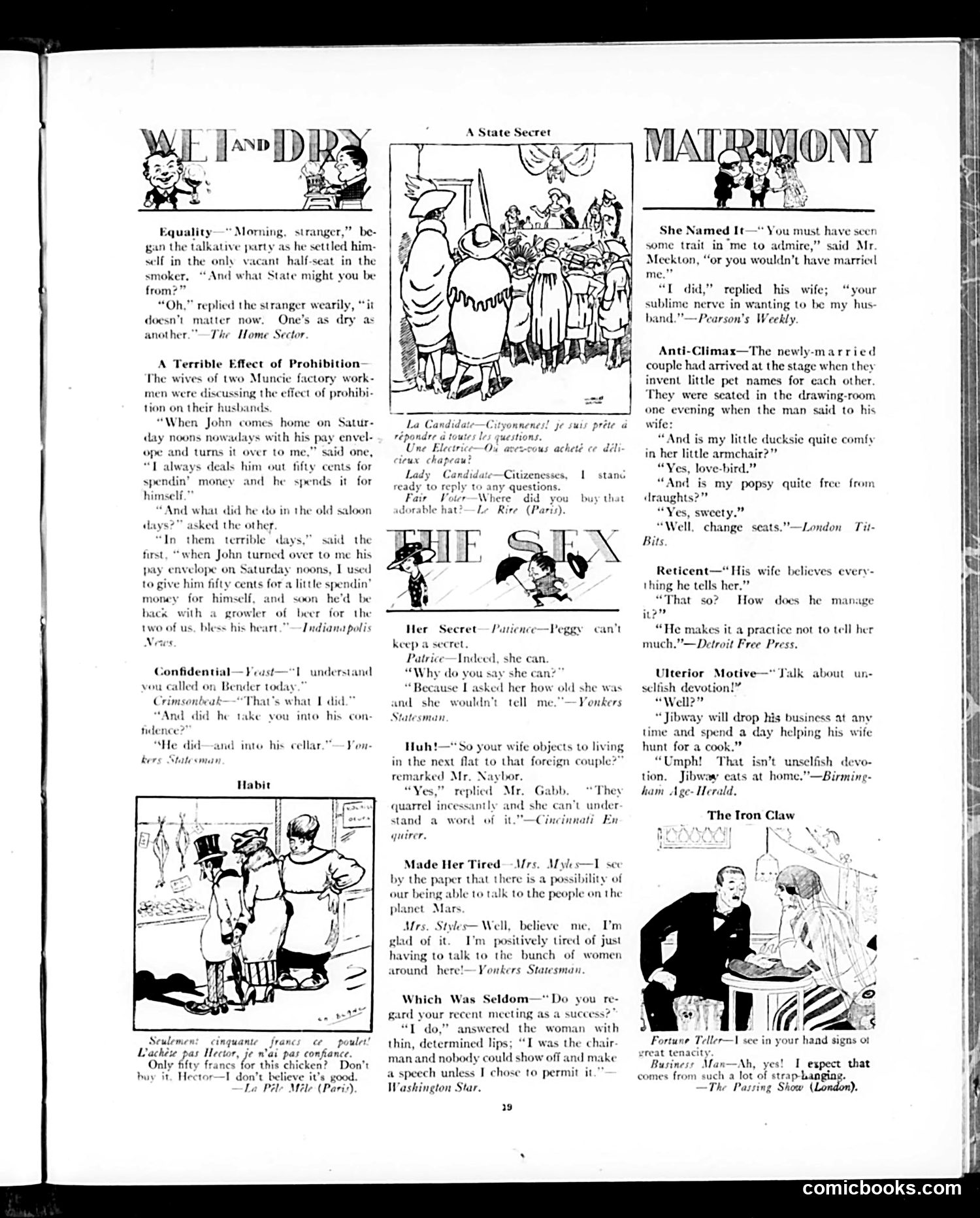
This page from Judge magazine collects brief satirical humor pieces about marriage, prohibition, and social habits circa the 1920s. **Main Themes:** The cartoons mock **Prohibition's effects on working-class men**—one piece notes husbands now give wives their full pay envelopes, depriving themselves of saloon visits. Others ridicule **marital dynamics**: wives who believe everything their husbands tell them, newly married couples with saccharine pet names ("ducksie," "popsy"), and women tired of domestic conversation. **Notable pieces include:** - A complaint about living near a quarrelsome foreign couple (xenophobic humor typical of the era) - A woman who finally achieved power chairing a meeting where "nobody could show off" - A husband claiming unselfishness while actually just wanting home-cooked meals **The humor targets** both spouses equally—nagging wives, deceptive husbands, and the mundane frustrations of marriage. The central cartoon "A State Secret" shows a woman successfully keeping a secret by refusing to answer questions. The overall tone reflects upper-middle-class anxieties about changing social customs, women's roles, and working-class behavior.
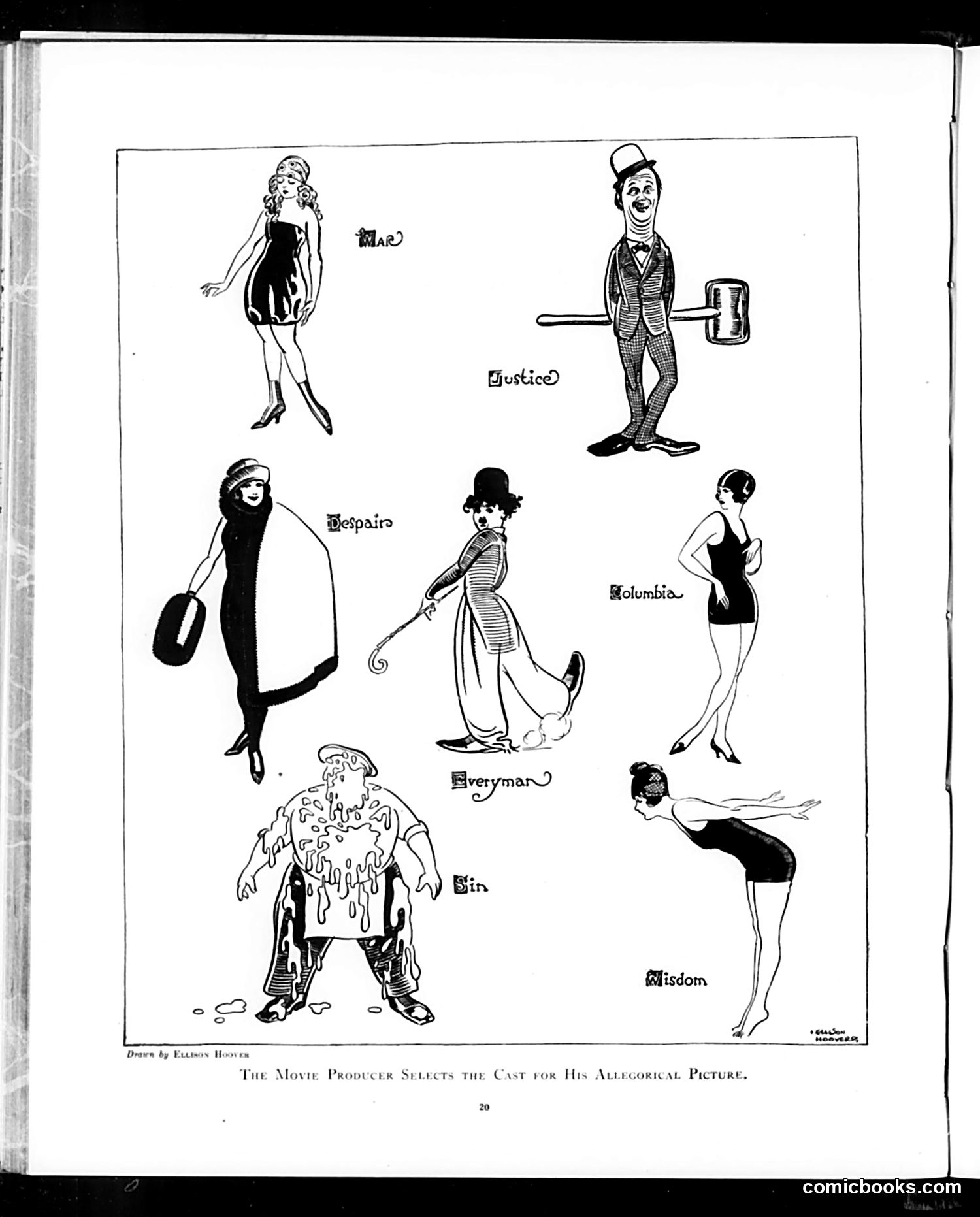
This satirical cartoon from *Judge* magazine depicts a film producer casting characters for an "allegorical picture"—a movie using symbolic figures to represent abstract concepts. The labeled characters represent: - **Mars** (goddess of war) - **Justice** (man with hammer) - **Despair** (woman with hat) - **Everyman** (common figure) - **Columbia** (allegorical representation of America) - **Bin** (a rotund, dripping figure—likely representing filth or corruption) - **Wisdom** (woman in ballet pose) The cartoon satirizes how filmmakers select actors to embody these ideals. The crude caricature of "Bin" suggests ironic commentary: that even negative forces like corruption or waste were being incorporated into Hollywood's moral narratives. This reflects early 20th-century anxieties about cinema's role in promoting (or failing to promote) American values. The drawing style and subject matter suggest this is satirizing contemporary film industry practices.
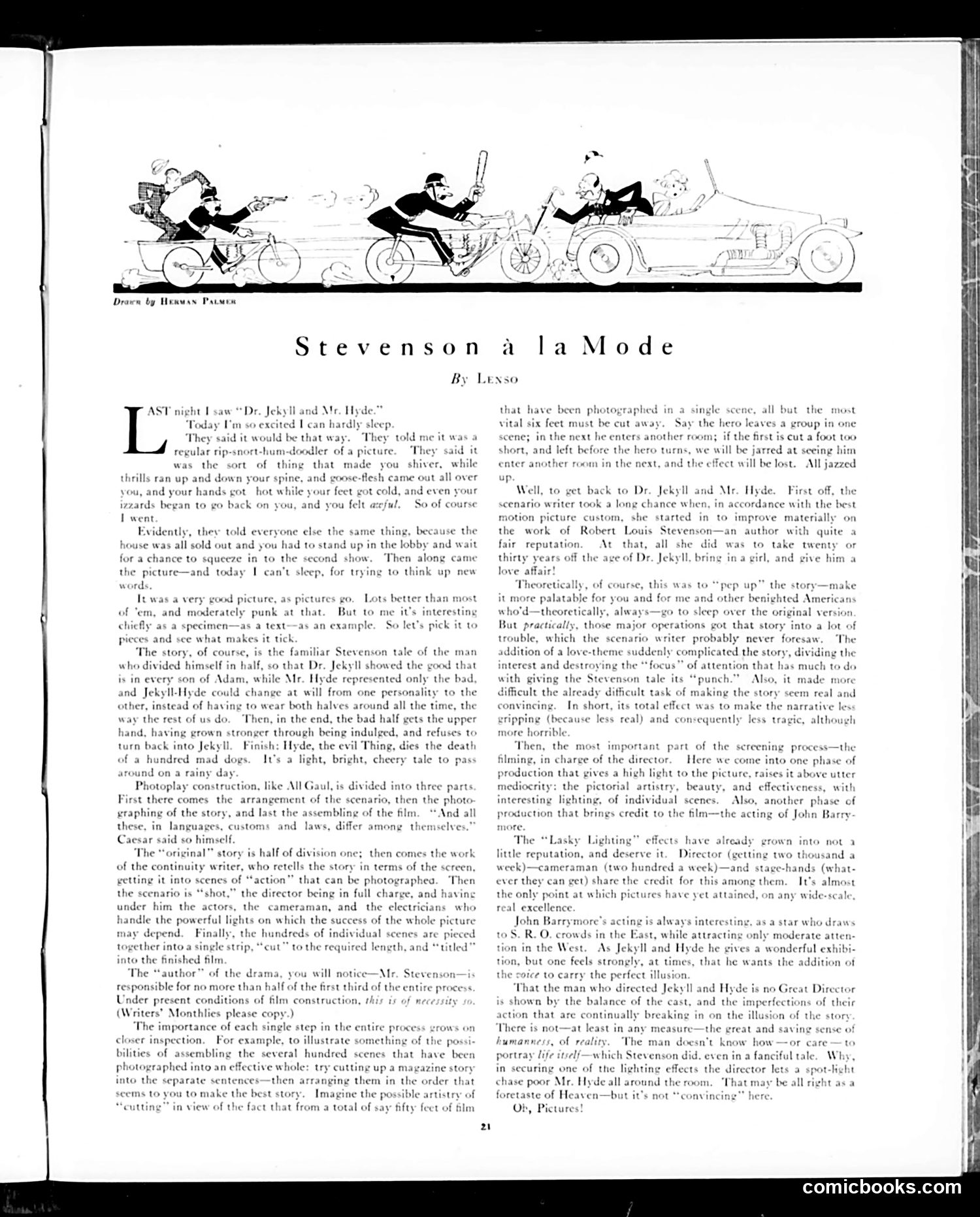
This is not primarily a political cartoon but rather an **article about filmmaking**, illustrated by a decorative header showing figures in various vehicles (bicycle, motorcycle, car) in a comedic style. The piece, by "Lusso," discusses the 1920 film adaptation of Robert Louis Stevenson's *Dr. Jekyll and Mr. Hyde*. The author critiques how scenario writers "improved" the classic novella by adding a love-plot subplot—a common practice in silent-film adaptations that the author finds overcomplicated the original story. The article explains **motion-picture construction** to readers: how scenes are filmed, edited, and assembled into final films. It notes that directors deserve credit for the technical and artistic achievements that bring stories to screen, despite screenwriters and actors receiving prominent attention. The tone is lighthearted commentary on early Hollywood's habit of sensationalizing literary classics for mass entertainment.
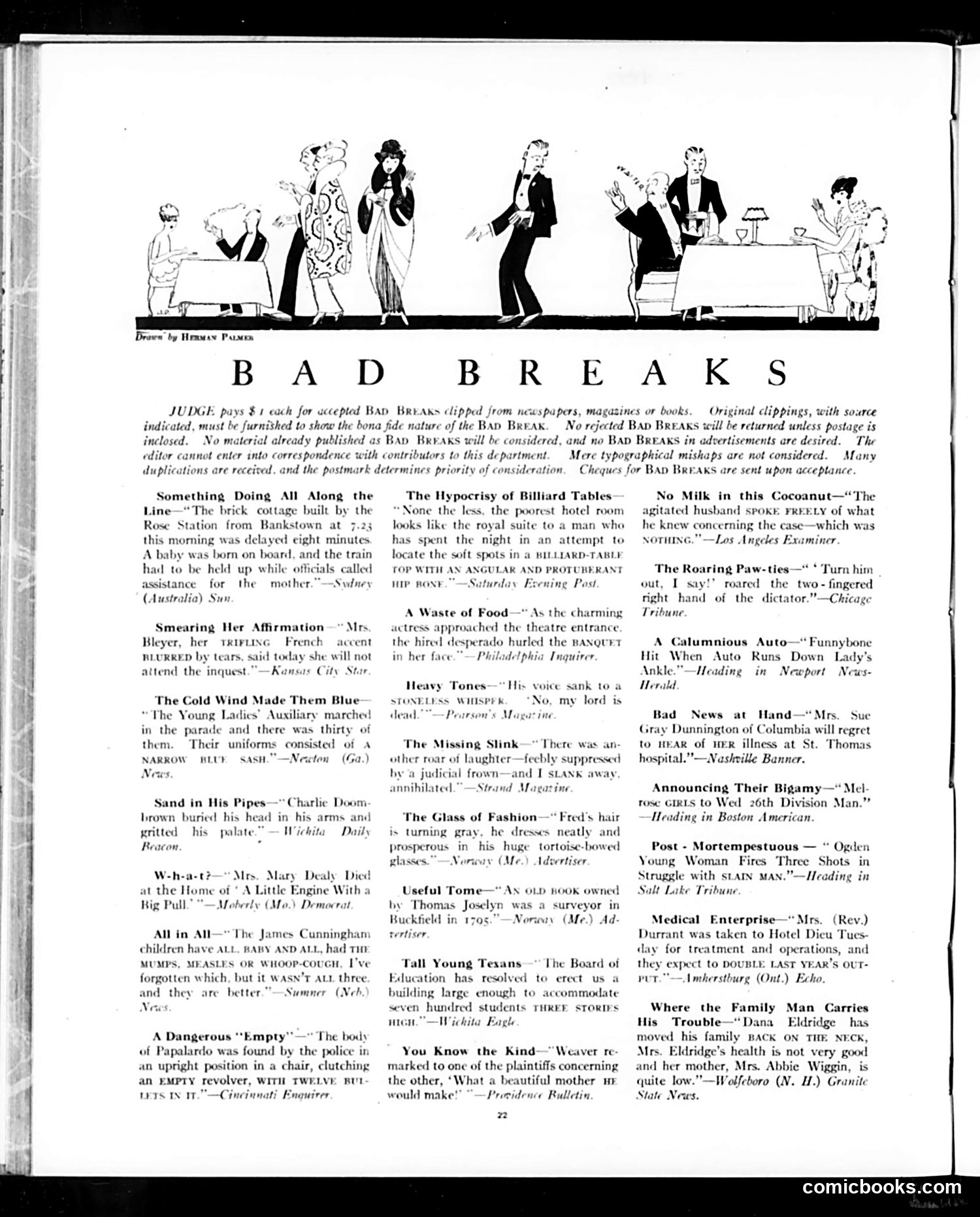
This is the header page for **Judge magazine's "Bad Breaks" humor column**, which paid readers $1 for newspaper clippings containing unintentional comedy—typically malapropisms, absurd word choices, or contradictory statements. The illustration shows a social gathering where miscommunication creates awkward moments. The column featured real newspaper excerpts highlighting humorous word accidents, not intentional satire. Examples include: a birth delaying a train, someone speaking "FREELY OF NOTHING," someone with an "EMPTY revolver" containing twelve bullets, and a woman with "no milk in cocoanut" (meaning worthless gossip). This was popular early-20th-century **participatory humor**—readers enjoyed submitting and reading genuine newspaper gaffes. The satire was unintentional, making the original publications rather than Judge itself the targets. This format anticipated modern "newspaper fail" collections.
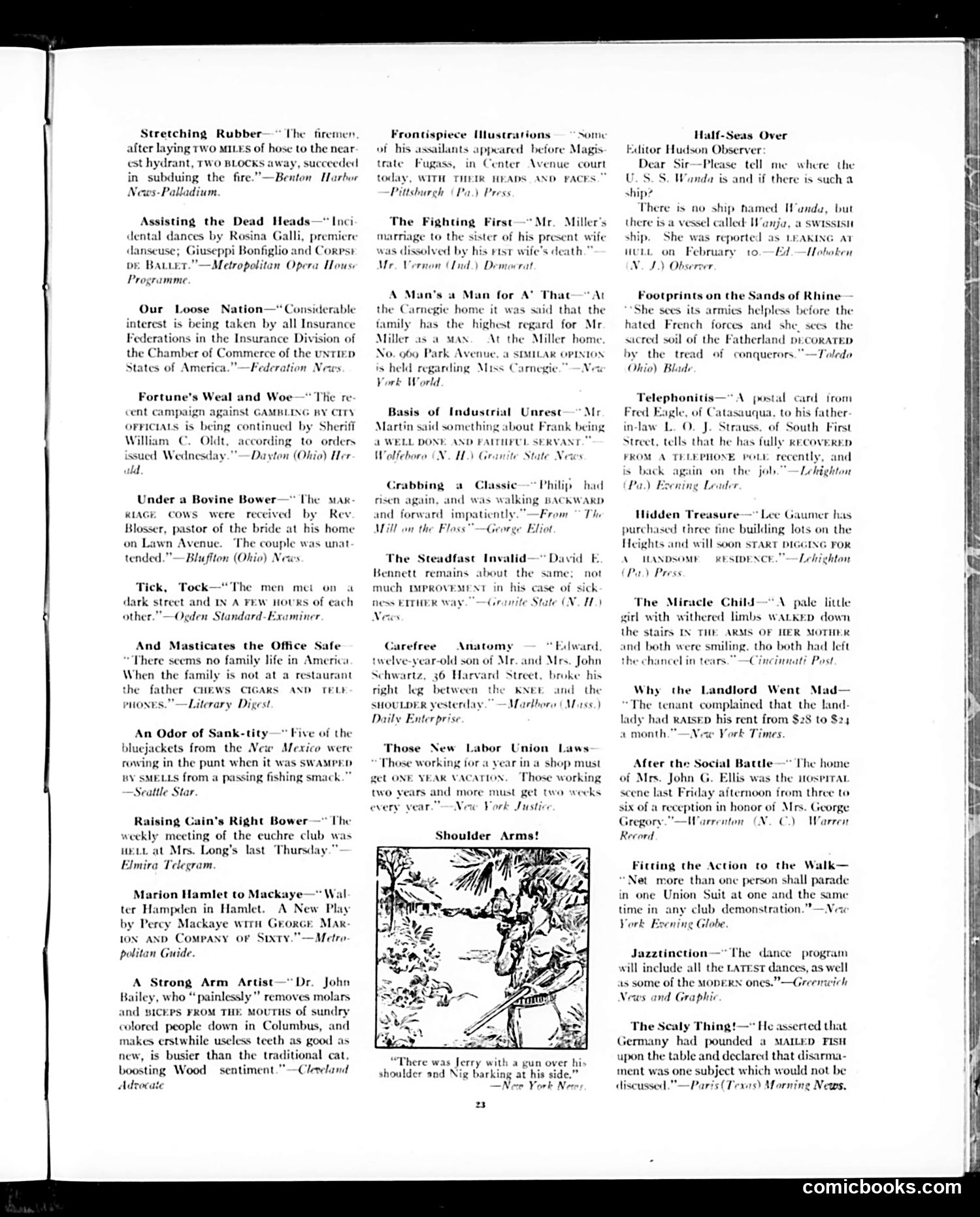
This page from *Judge* collects humorous newspaper clippings—called "Frontispiece Illustrations"—that showcase absurd typographical errors and ambiguous phrasing from real papers. The satire works by reproducing these mistakes in SMALL CAPS, allowing readers to spot the unintended humor. Examples include: a news item about "STRETCHING RUBBER" (reporting on firefighters laying hose), "DEAD HEADS" (an opera program with dancers), and a marriage notice where "COWS" were apparently the guests. The recurring joke is that careless newspaper writing creates ridiculous alternative meanings. One editor humorously corrects a reader asking about the "S.S. Wanda"—no such ship exists, though there is a "Wanja" that was leaking. This represents early-20th-century media criticism through comedy: *Judge* used reader submissions to mock journalistic incompetence and typographical carelessness in provincial American newspapers. The cartoon of shoulder-armed figures adds visual satire to the textual examples.
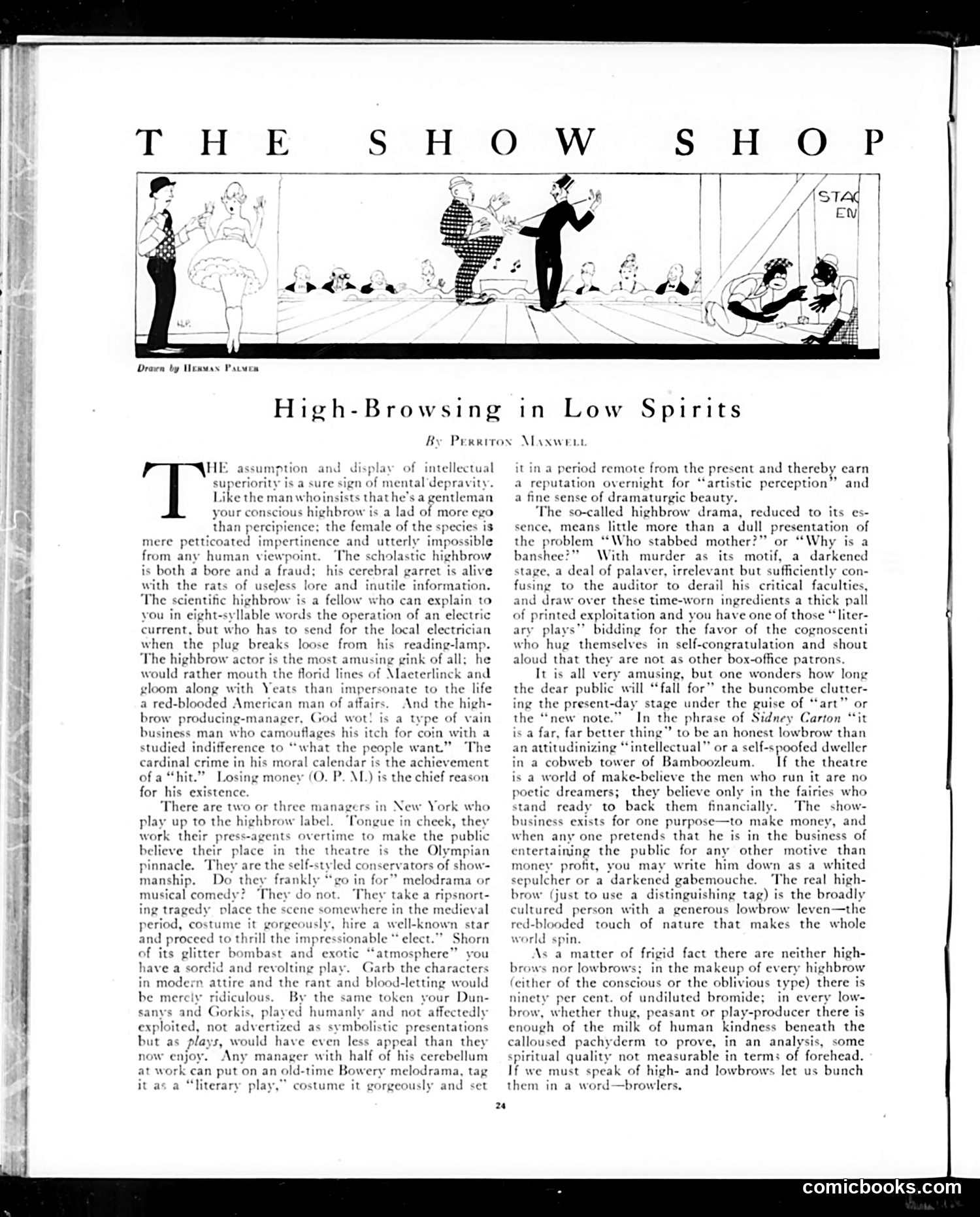
This page satirizes theatrical "highbrows"—producers and actors who adopt pretentious artistic airs to appear sophisticated while often producing shallow work. The cartoon (drawn by Herman Palmer) depicts a stage scene where performers engage in exaggerated, affected behavior typical of avant-garde theater. Perriton Maxwell's essay ridicules various types of highbrows: the actor who prefers obscure symbolist drama to genuine American character; the producer who dresses up cheap melodrama in exotic costumes and medieval settings to claim "artistic perception"; and the audiences who congratulate themselves for appreciating such obvious frauds. Maxwell argues these "literary plays" are fundamentally dishonest—strip away the atmospheric padding, dim lighting, and "printed exploitation," and they're just cheap murder mysteries. He suggests honest lowbrow entertainment is preferable to self-deluding intellectualism. The real motive of theater managers, he concludes cynically, is money, not art. This reflects early 20th-century cultural anxiety about modernism and the clash between commercial entertainment and claims to artistic legitimacy.
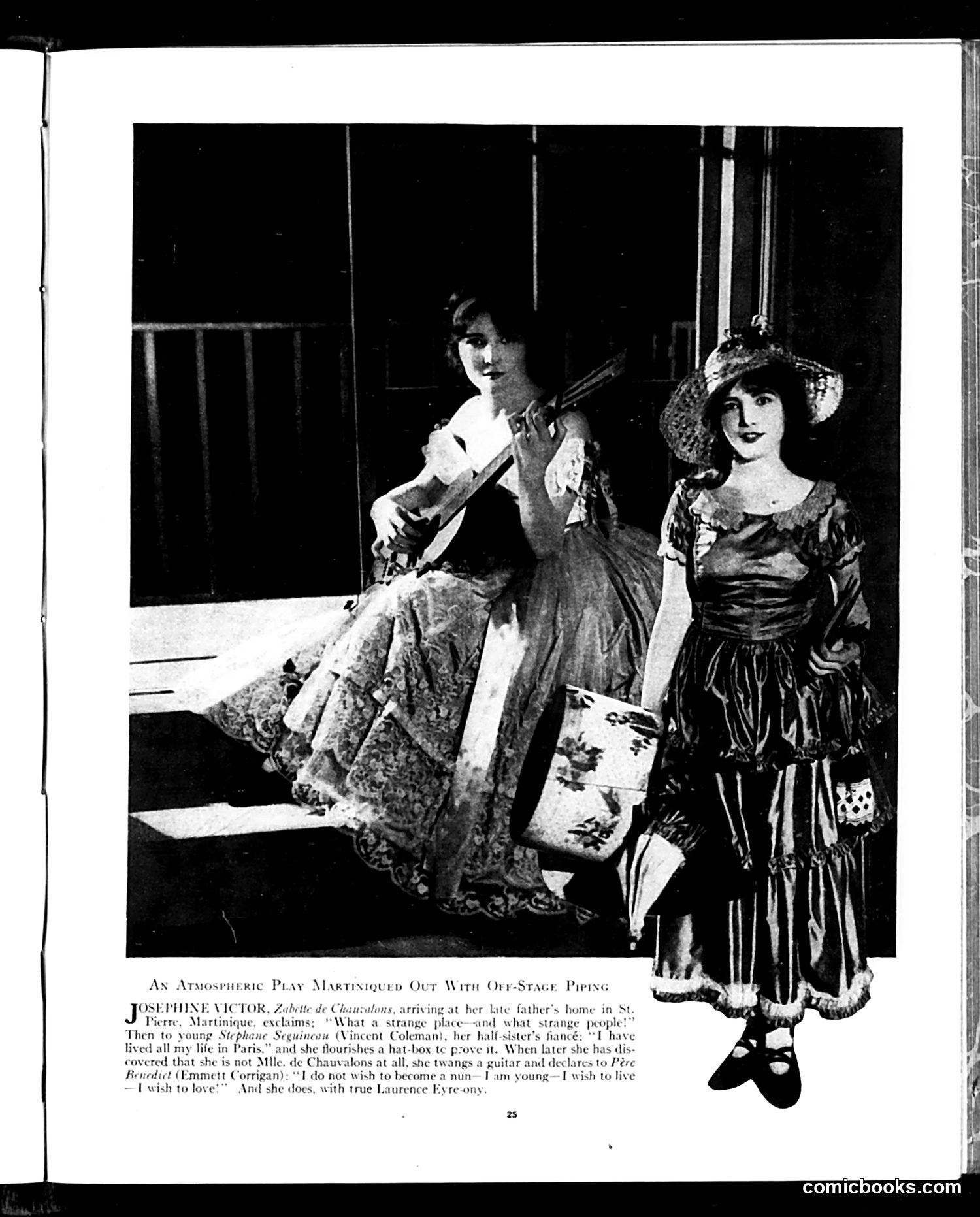
This page features a theatrical scene promotion rather than a political cartoon. It depicts a scene from what appears to be a stage play, with three elaborately costumed female performers in early 20th-century dress. The caption identifies **Josephine Victor** as "Zabel de Chauvalons," arriving at her father's home in Martinique. The scene satirizes theatrical melodrama conventions: a young woman arriving from Paris, discovering unexpected family complications, and making passionate declarations ("I am young—I wish to live! I wish to love!"). The humor targets the overwrought emotionalism of stage plays popular at the time—the exaggerated costumes, dramatic poses with guitar, and breathless dialogue about love and identity. The reference to "Laurence Eyre-only" (likely Laurence Eyre or a similar performer) suggests this promoted an actual theatrical production. This is essentially **theatrical advertising disguised as satire**—poking gentle fun at melodramatic stage conventions while promoting the show to Judge's readers.
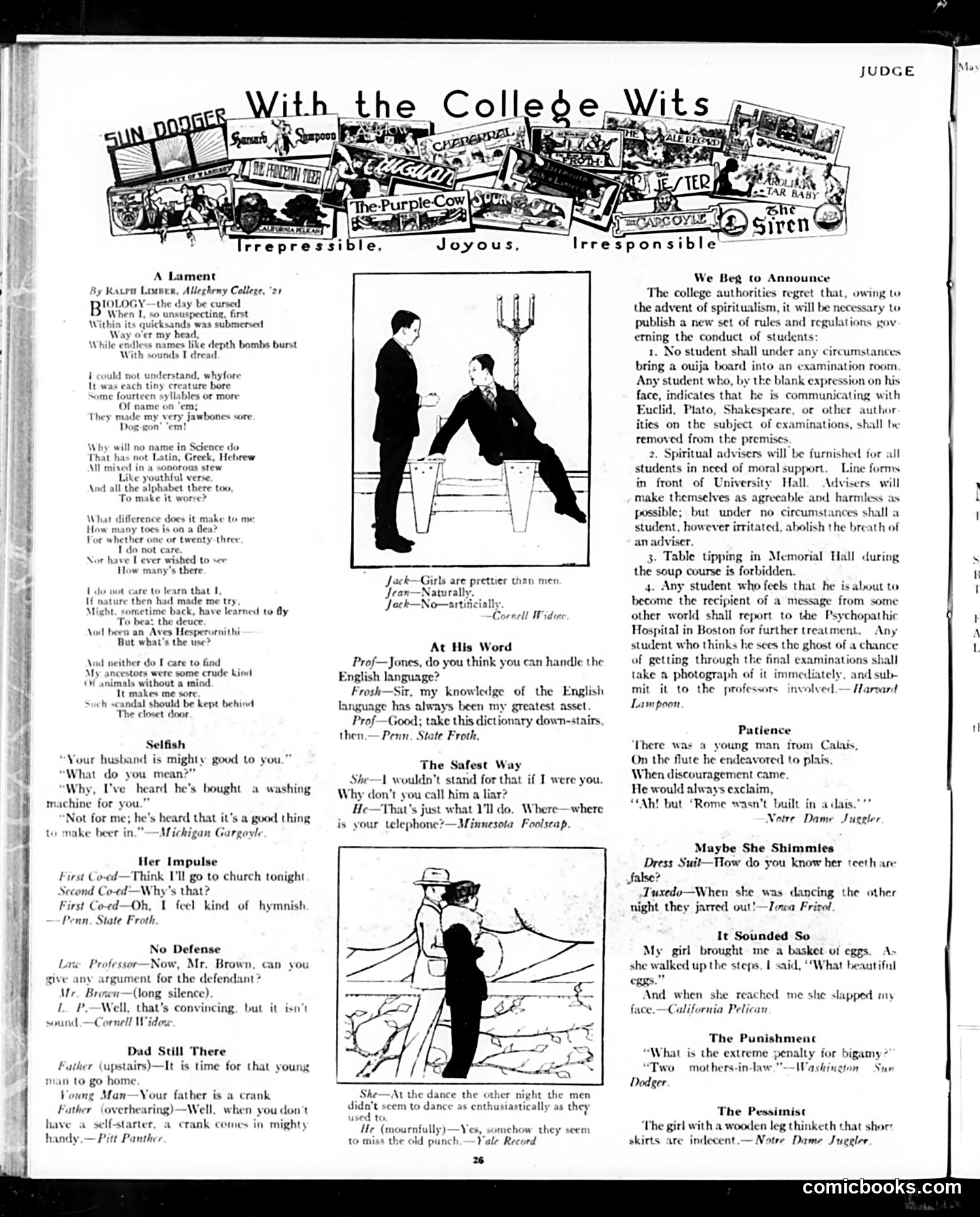
This page collects humorous contributions from college humor magazines (Penn State Froth, Cornell Widow, Yale Record, etc.). The content satirizes college life and student experiences circa early 1920s. **Main Features:** The two illustrated cartoons show: (1) two male students at a table with what appears to be a ouija board, and (2) a fisherman at night. **Key Satire:** The centerpiece mock announcement "We Beg to Announce" humorously addresses "spiritualism" at colleges—likely referencing the 1920s spiritualism craze. It satirizes college authorities by proposing absurd new rules: prohibiting ouija boards in exams, assigning "spiritual advisers," forbidding table-tipping during meals, and requiring students seeking supernatural help to report to psychiatric hospitals. **Humor:** The joke mocks both student gullibility toward spiritualism and institutional over-regulation. Other jokes target college life: difficult biology nomenclature, dating, lazy students, and exam anxiety.
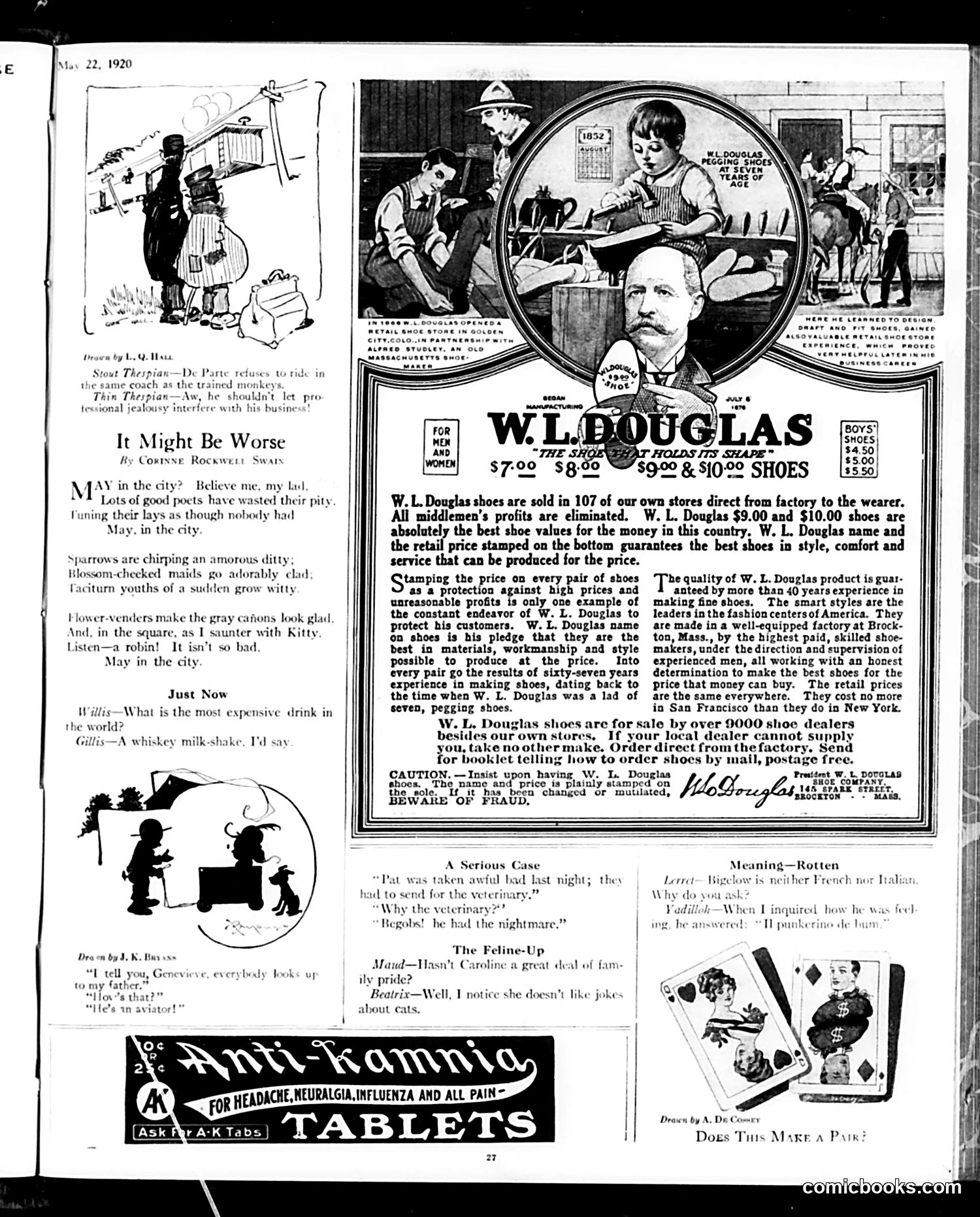
This page is primarily **advertising-driven**, dominated by a large W.L. Douglas shoe company advertisement featuring the company's founder and his credentials. The cartoons and short jokes are minor content: - **"It Might Be Worse"** by Corinne Rockwell Swain celebrates spring in the city despite urban grayness—a sentimental poem with accompanying illustration about urban romanticism. - **"Just Now"** presents a brief joke: the "most expensive drink" is a whiskey milk-shake, likely referencing Prohibition (enacted January 1920), making alcohol-mixed drinks costly or illicit. - Small gag comics include wordplay about a sick pet requiring a veterinarian ("the nightmare") and ethnic humor about a French-Italian character's broken English. - **"Does This Make a Pair?"** shows playing cards, implying a poker joke (unclear meaning today). The Anmi-Kamnia tablet advertisement addresses post-WWI ailments. Overall, this appears to be a light humor magazine filled largely with advertising, reflecting 1920s consumer culture and early Prohibition-era references.
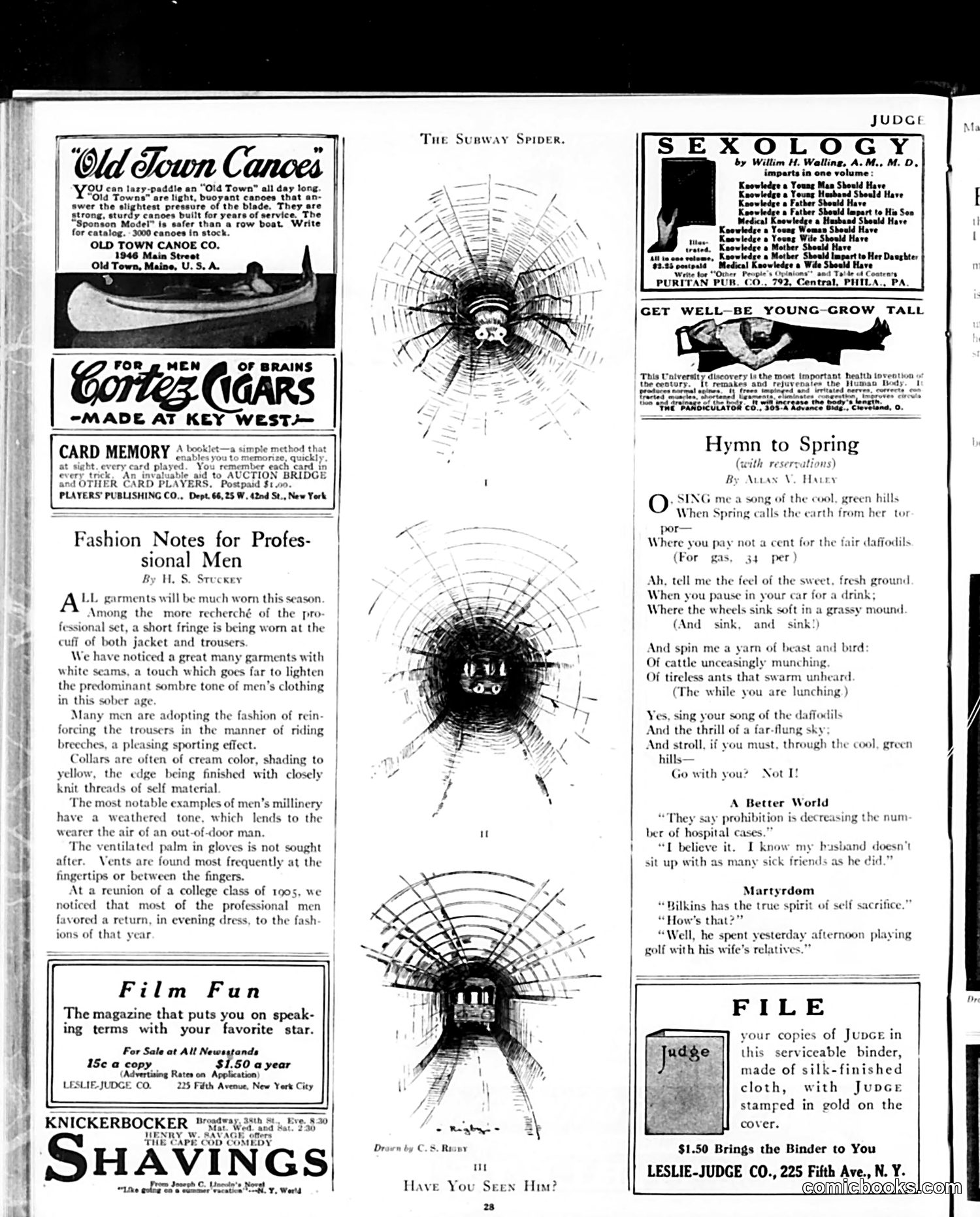
This page consists primarily of **advertisements and light humor pieces**, not political satire. The main elements include: **"The Subway Spider"** (center): Technical drawings by C.S. Riser showing cross-sections of a subway tunnel. The caption "Have You Seen Him?" suggests this is a humorous visual puzzle or illustration feature, likely playing on anxiety about vermin in public transportation—a relatable concern for urban readers of this era. **"Hymn to Spring"** (right): A satirical poem mocking spring tourism and automobile culture. It ironically celebrates nature ("cool, green hills," "daffodils") while acknowledging modern commercialization—you pay for gas instead of enjoying free flowers, and leisure means car trips rather than genuine pastoral experience. The final "Not!" rejection suggests the poet rejects this shallow modern version of spring. **Remaining content**: Fashion advice, advertising (cigars, canoes, card games, shaving products), and humor snippets like "A Better World" and "Martyrdom"—light social commentary typical of Judge's satirical approach. The page targets educated, urban, middle-class readers with gentle humor about modern life's contradictions.
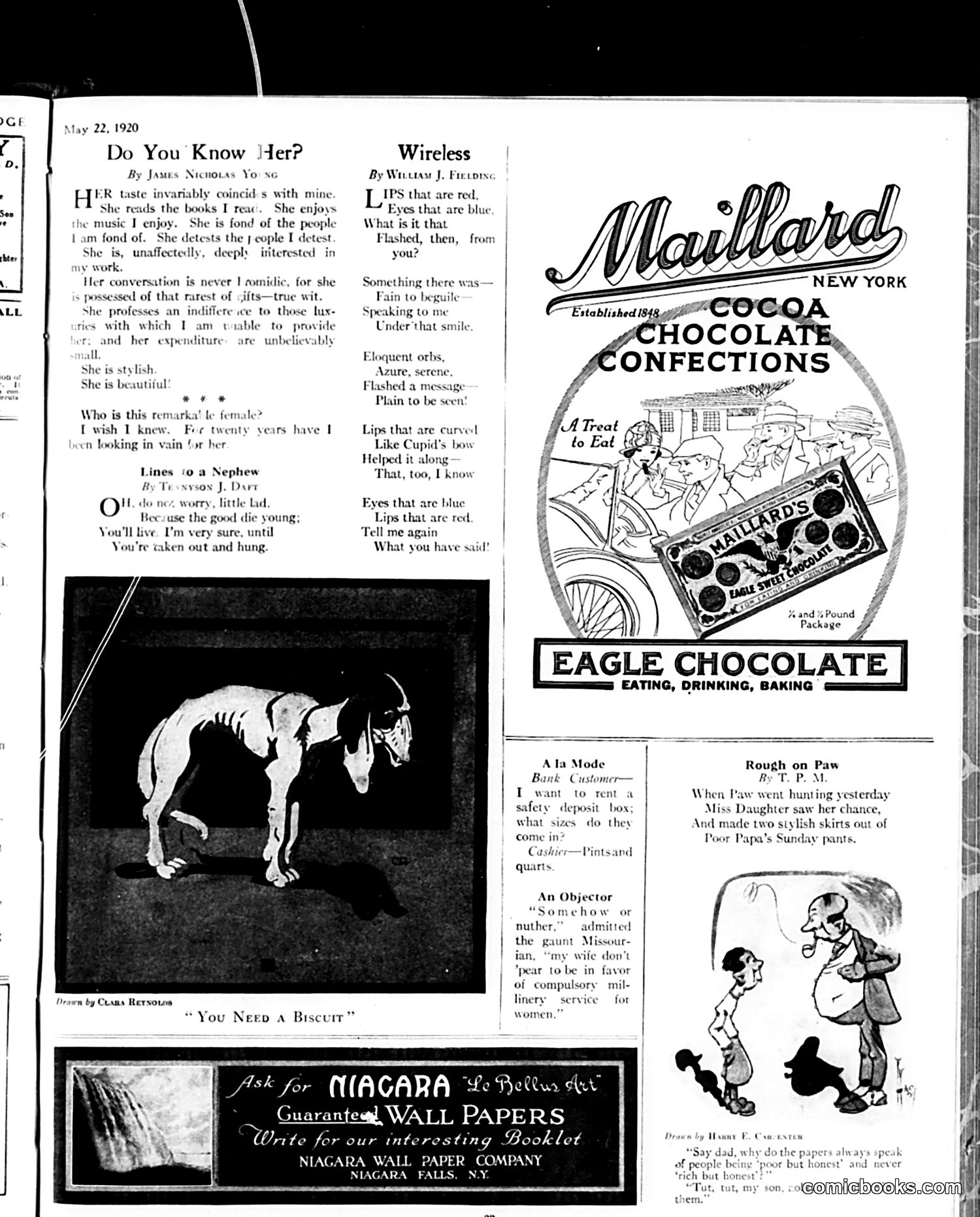
This page contains poetry, light humor, and advertisements typical of Judge's satirical content. **"Do You Know Her?"** is a romantic poem idealizing an impossibly perfect woman—tasteful, witty, beautiful, well-read, and frugal. The joke: the author has "looked in vain for her" for twenty years, suggesting no such woman exists. It's gentle satire on male romantic fantasies. **"Lines to a Nephew"** is dark humor: an uncle tells a worried young man not to fret because "the good die young"—implying the nephew will live long because he's not good. A cynical joke about morality. **"Wireless"** is romantic poetry about a woman's physical features (lips, eyes, orbs) triggering mysterious attraction—"wireless" communication without words. **"Rough on Paw"** cartoon shows a child taking advantage while "Paw" hunts, fashioning stylish skirts from his Sunday pants—children's mischief humor. The remaining sections are advertisements for chocolate and wallpaper, common in period magazines.
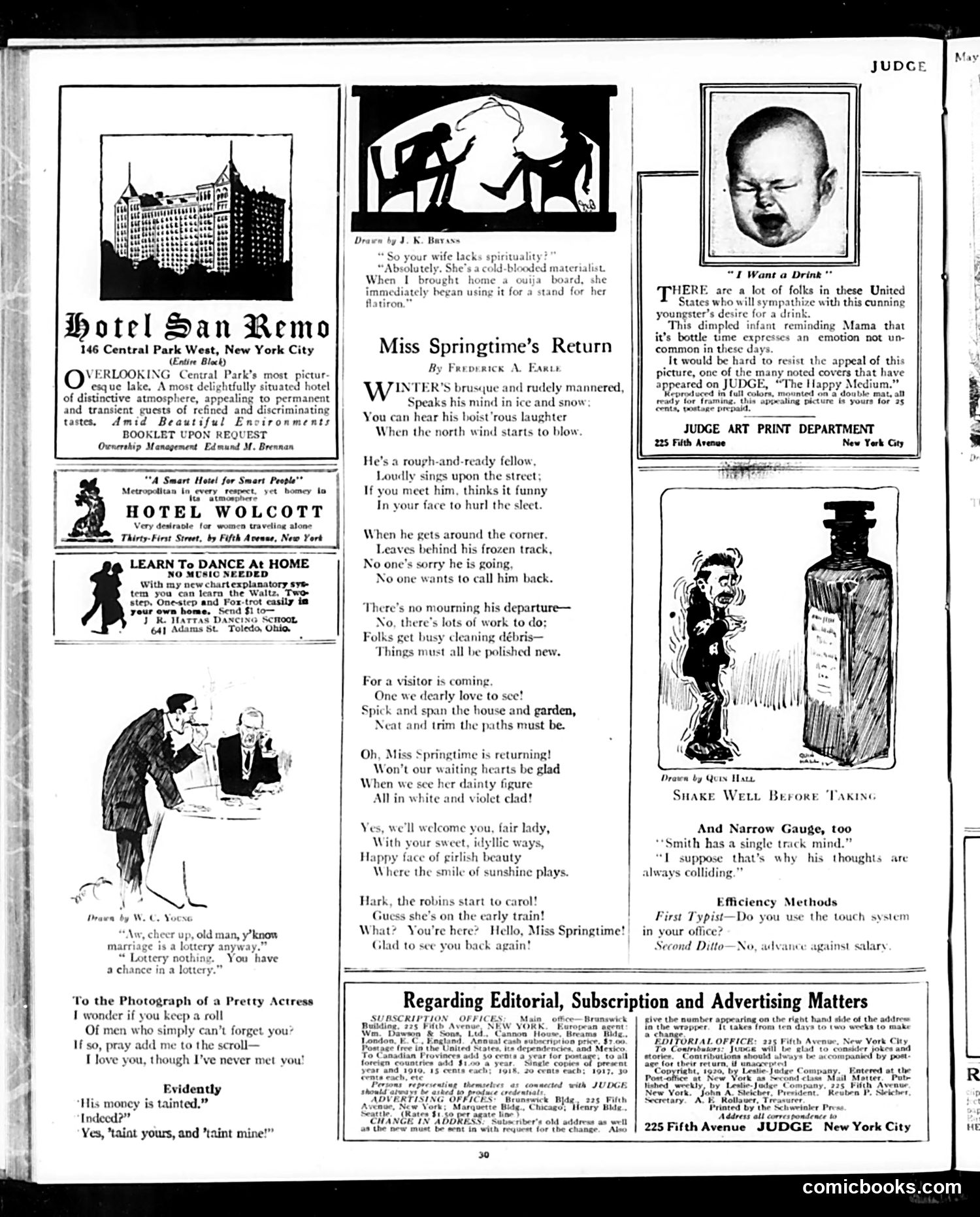
This page from *Judge* magazine contains several distinct pieces: **"Miss Springtime's Return"** is a sentimental poem celebrating spring's arrival after winter—depicted as a rough, boisterous character who tracks mud through homes. The poem contrasts winter's mess with spring's beauty, welcoming the season's return. It's lighthearted seasonal verse. **"I Want a Drink"** features a cartoon of a small child demanding a bottle, with commentary that this desire "expresses an emotion not uncommon in these days." This appears to reference Prohibition-era sentiment—the joke being that even babies want alcohol, and many adults sympathize. The irony is that alcohol was illegal at the time this was published. **The remaining cartoons** ("Shake Well Before Taking," "And Narrow Gauge," "Efficiency Methods") are brief joke illustrations with puns and one-liners about relationships and workplace behavior—typical magazine filler humor. The rest of the page comprises hotel and dance lesson advertisements.
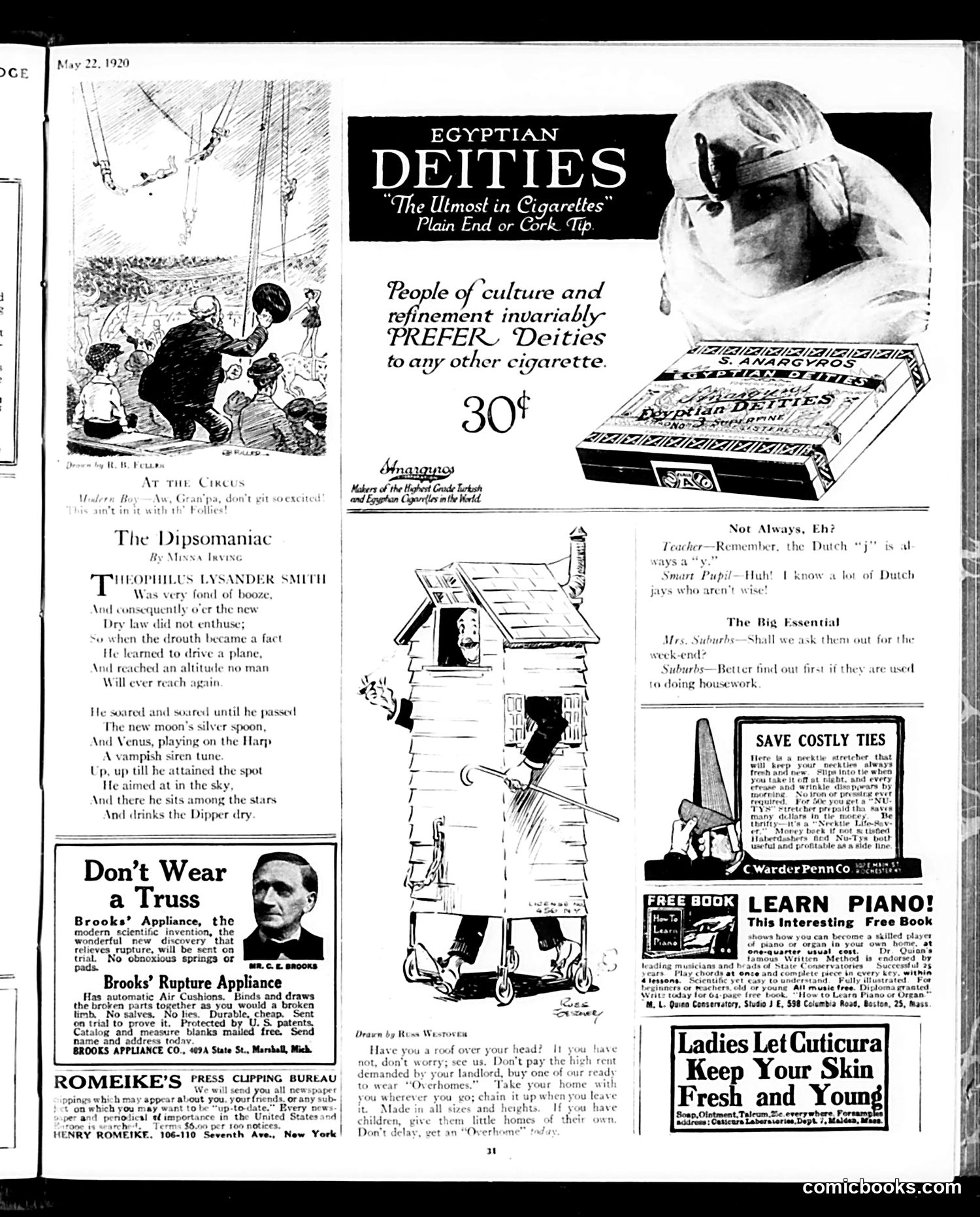
This is primarily an **advertising page** from Judge magazine (May 22, 1920), not political satire. The main content consists of commercial ads for cigarettes, medical devices, and consumer products typical of the era. The one notable satirical piece is **"The Dipsomaniac"** by Minna Levine—a poem mocking Prohibition (which began in January 1920). The protagonist, Theophilus Lysander Smith, was a heavy drinker who resented the new "Dry law." The dark humor: unable to drink on earth, he flies a plane so high he reaches the stars and drinks "the Dipper dry"—a celestial escape from sobriety laws. The page also includes light humor in the dialogue snippets ("Not Always, Eh?") about Dutch people and practical domestic matters. The remaining content—medical appliances, piano lessons, skin care—represents typical Judge advertising rather than editorial commentary.
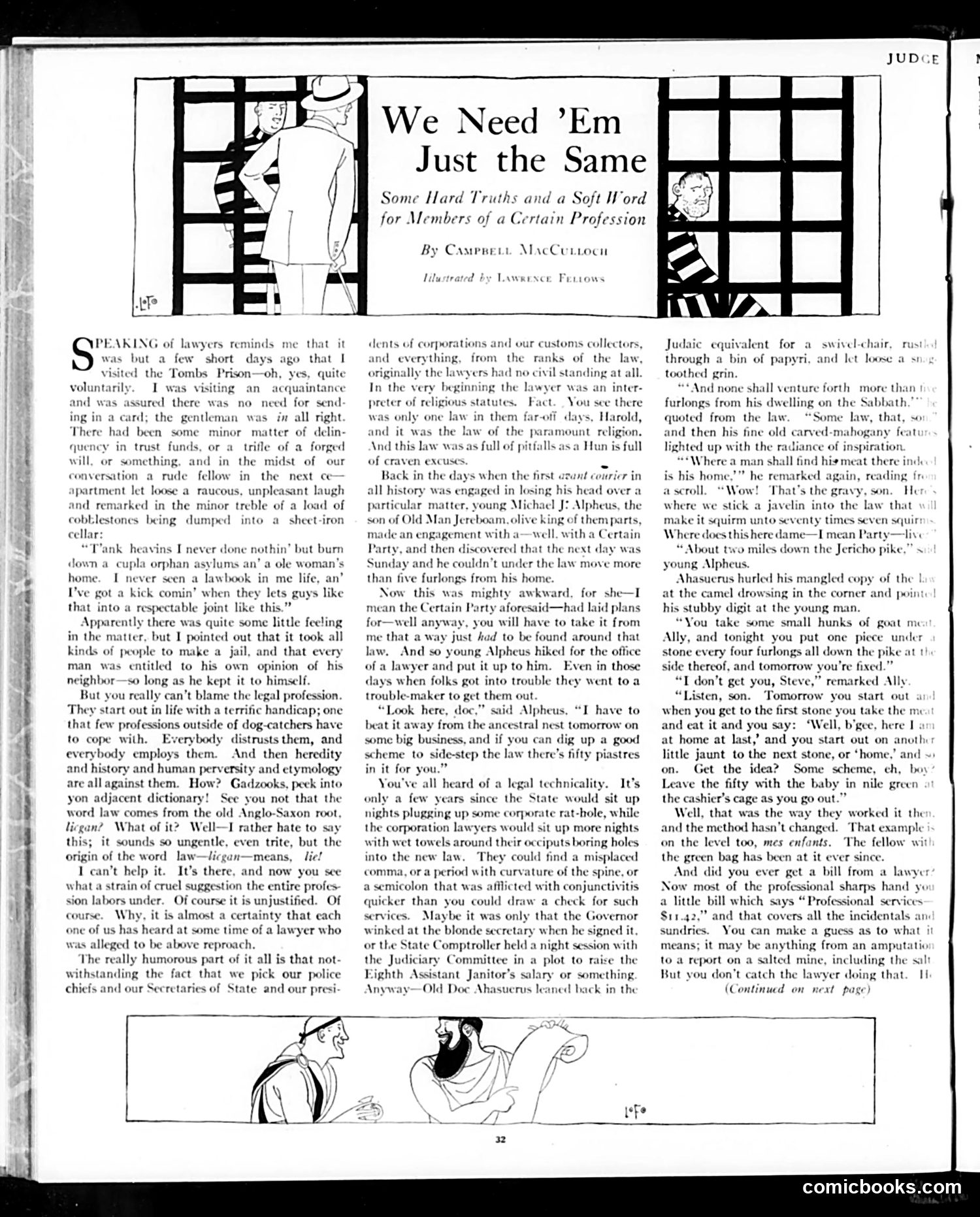
This article by Campbell McCulloch satirizes lawyers by tracing their profession's disreputable origins and public distrust. The author visits a prison (the Tombs) where an inmate mocks prisoners who lack legal knowledge, prompting McCulloch's reflection on lawyers' paradoxical status. The satire works through etymology: "law" derives from Anglo-Saxon "licgan," meaning "lie"—a cruel etymological coincidence that symbolically burdens the entire profession. McCulloch notes that despite lawyers being distrusted by everyone, they're universally employed and socially indispensable. Historically, lawyers had no civil standing and served as intermediaries interpreting religious law. The anecdote about young Michael J. Alpheus illustrates the point: even in ancient times, people needed lawyers to circumvent laws through "legal technicalities"—exposing how lawyers enable clients to exploit loopholes rather than uphold justice. The cartoon's gentle tone acknowledges lawyers are necessary evils: society needs them despite—or because of—their reputation for finding ways around rules.
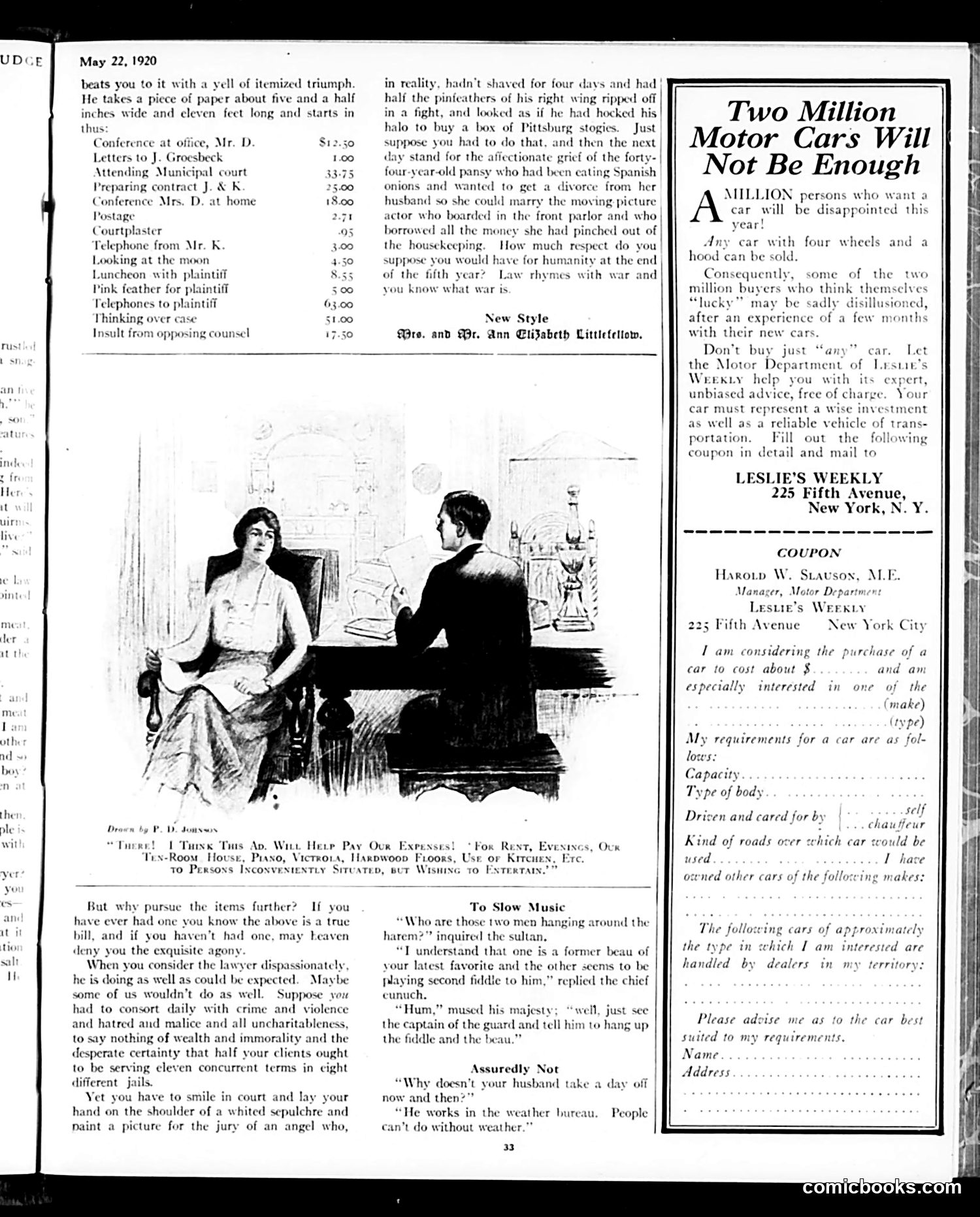
## Main Cartoon The illustrated scene depicts a lawyer and female client in an office. The accompanying text satirizes the legal profession by listing absurdly itemized billing charges (conference fees, postage, even "pink feather for plaintiff" and "insult from opposing counsel"). The satire critiques lawyers' practice of billing for trivial services, suggesting they profit from clients' misery. The text argues lawyers deserve sympathy—forced daily to consort with humanity's worst traits—yet exploit vulnerable people (like the "forty-year-old pansy" seeking divorce) who cannot afford their fees. ## Secondary Cartoons Two brief jokes about marital discord appear below, involving a sultan's harem and a wife's complaint about her husband's work schedule, offering light relief from the main critique. ## Context This reflects post-WWI American skepticism toward the legal profession and concerns about professional exploitation during an economically uncertain period.
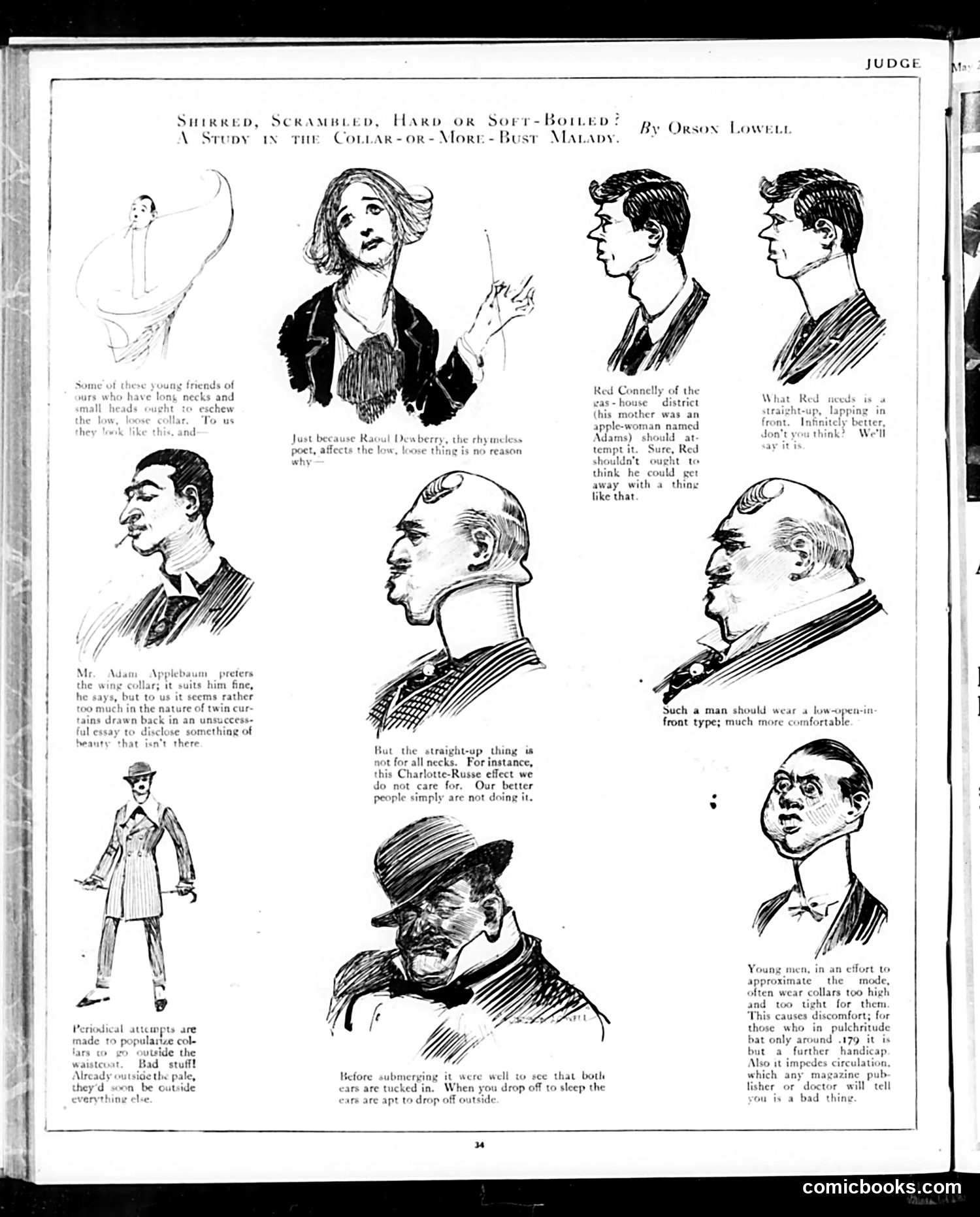
By Orson Lowell, this satire mocks the fashion obsession with high, tight collars among young men of the era. The page features various male profile sketches and a woman demonstrating different collar styles and neck positions. The joke targets vanity: young men are adopting uncomfortable, restrictive collars to appear fashionable, following poets like Rupert Deane's (or similar) loose-necked style. The satirist argues this affectation is ridiculous—these collars cause physical discomfort and restrict circulation, yet fashionable society persists in wearing them. The commentary contrasts "better people" who reject the "Charlotte-Russe effect" (an exaggerated style) with the foolish masses who damage their health pursuing trends. A full-figure sketch shows the absurdity of the fashion itself. The metaphorical title references egg preparations, humorously equating the twisted necks to different cooking methods—the ultimate insult to pretentious fashion victims.
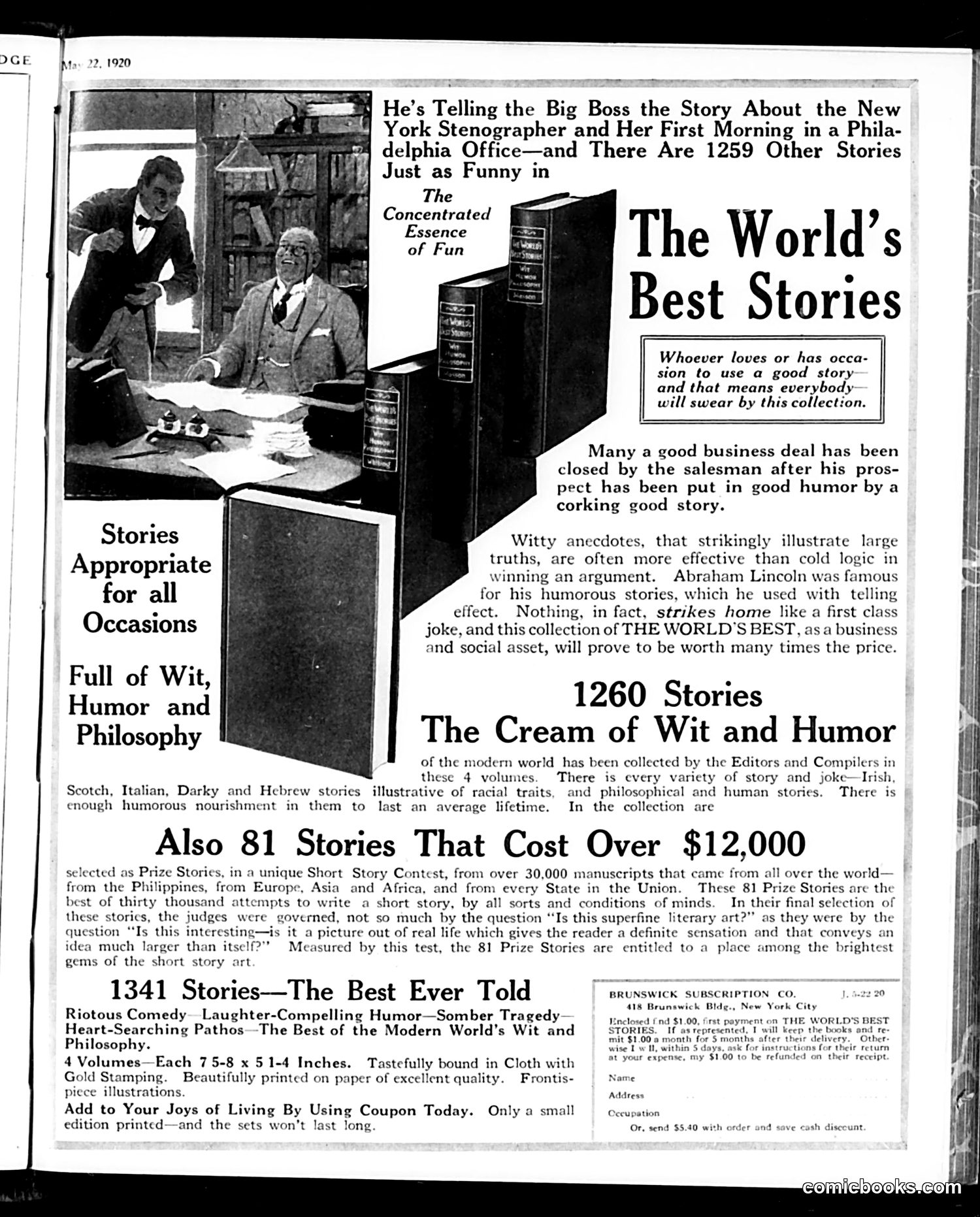
This is primarily a **full-page advertisement**, not political satire. It promotes a four-volume story collection marketed as essential for business and social success. The small illustration depicts a **office scene** where a man tells his boss a humorous story—specifically about "a New York Stenographer and Her First Morning in a Philadelphia Office." This visual demonstrates the ad's central pitch: that good stories are valuable **business tools** that close deals and smooth negotiations. The collection emphasizes diversity of humor types, explicitly listing **"Irish, Scotch, Italian, Darky and Hebrew stories"** as racial humor categories. While this language reflects period attitudes, the ad treats these ethnic jokes as legitimate literary entertainment. The pitch appeals to 1920s business culture—framing storytelling as professional capital. The ad references **Abraham Lincoln's famous use of humor**, positioning well-chosen anecdotes as rhetorical weapons equal to logic. **No specific political figures or events** are referenced. This is straightforward commercial messaging exploiting contemporary business values.
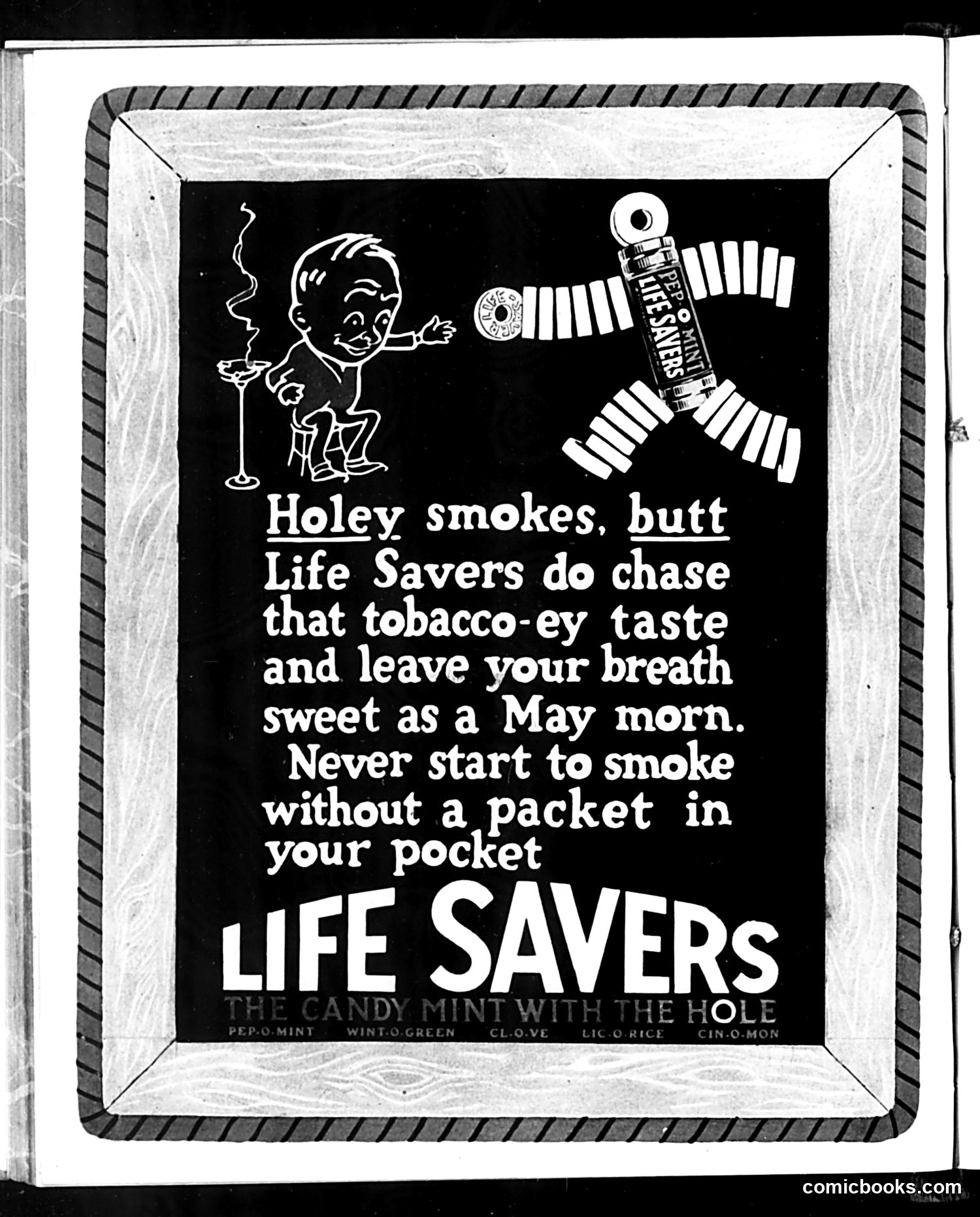
This is a Life Savers candy advertisement, not political satire. The ad plays on the brand name "Life Savers" with a pun: the candy allegedly "saves" smokers from tobacco breath by freshening their breath afterward. The cartoon shows a cheerful child-like figure smoking a cigarette while holding a Life Savers candy, with a robotic character made of Life Savers candies to the right. The text advises never smoking without Life Savers candy on hand. This reflects early-to-mid 20th-century advertising that casually promoted smoking while simultaneously marketing products to mask its unpleasant effects. The ad normalizes childhood awareness of cigarettes, which would be shocking by modern standards.