
A complete issue · 36 pages · 1919
Judge — June 7, 1919
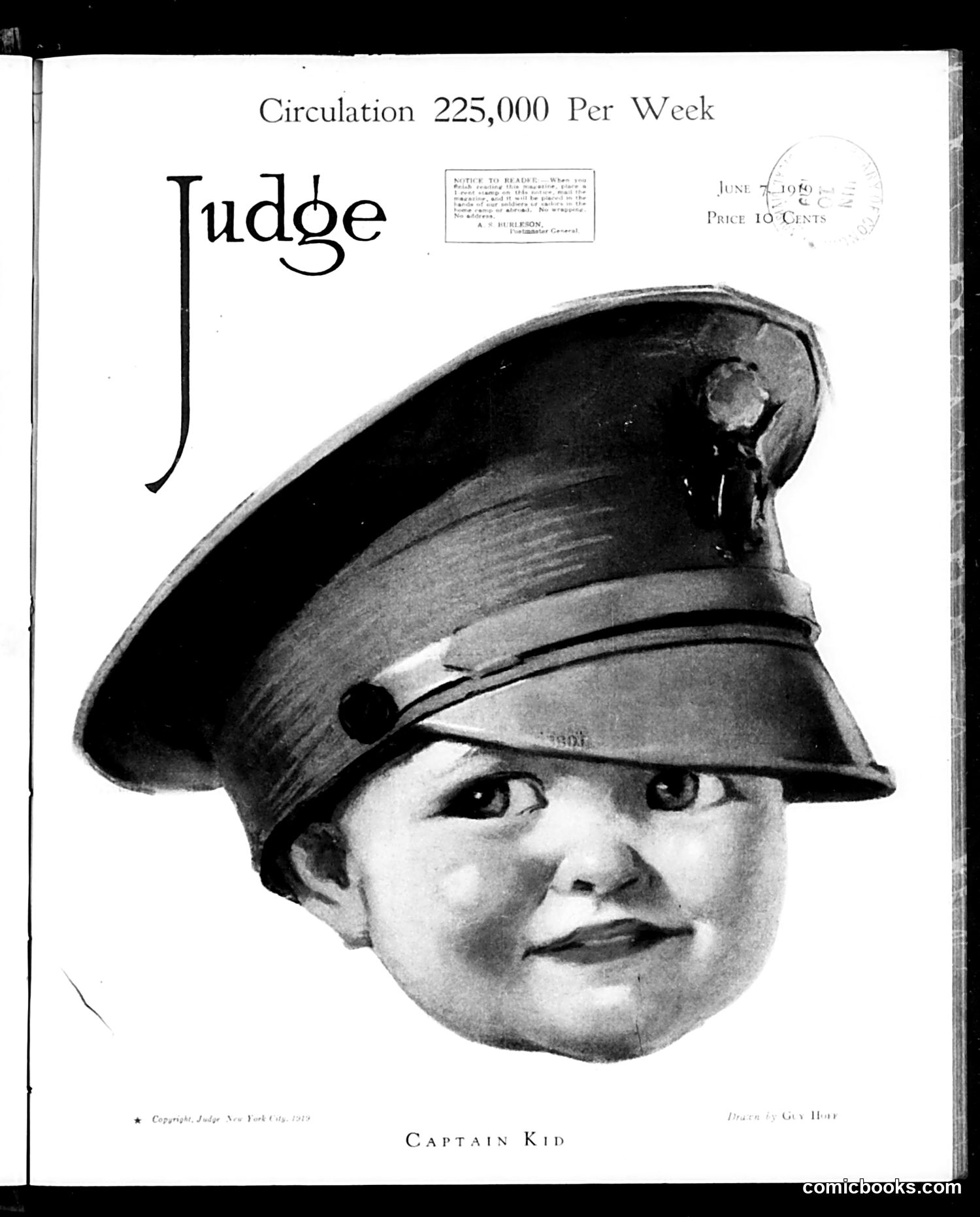
This Judge magazine cover from June 1919 features a caricatured face labeled "Captain Kid," drawn by Guy Horne. The figure wears a military captain's cap with an exaggerated expression—round face, prominent features suggesting mockery or derision. The "Captain Kid" reference likely alludes to the historical pirate Captain Kidd, though the specific satirical target remains unclear without additional context. Given the June 1919 date (post-WWI), this could reference a contemporary military or political figure, possibly someone involved in military scandals or questionable leadership. The deliberate caricature style was typical of Judge's satirical approach, exaggerating physical features to ridicule the subject. Without more documentary context, the exact person and incident being mocked cannot be definitively identified.
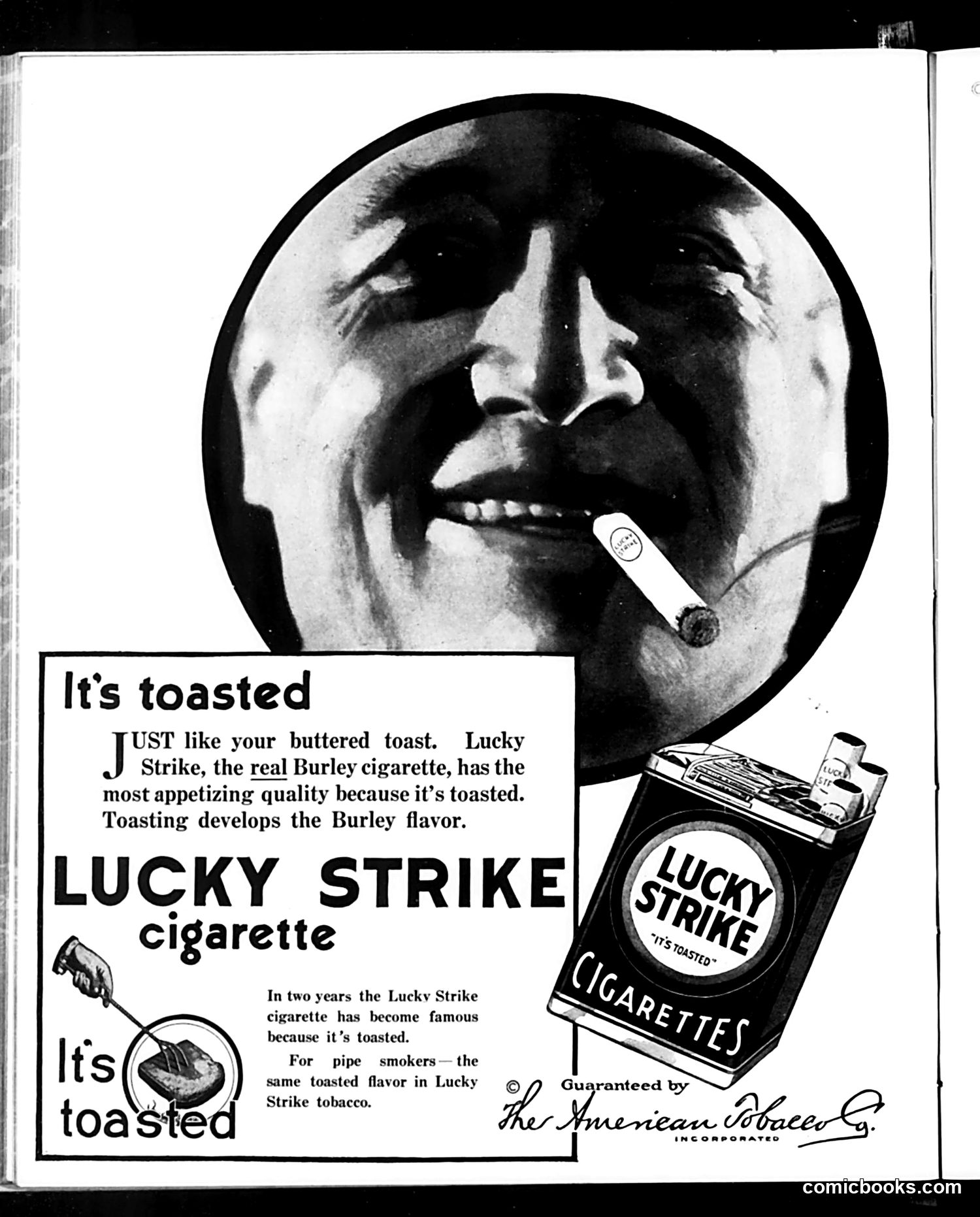
This page is primarily a **Lucky Strike cigarette advertisement**, not satire or political commentary. The ad uses a large circular portrait of a man smoking a cigarette to promote the brand's "toasted" tobacco process. The advertisement emphasizes that Lucky Strike cigarettes are "toasted" to develop flavor, comparing this to buttered toast. It claims the toasting process creates an "appetizing quality" and notes that pipe smokers can enjoy the same toasted flavor in Lucky Strike tobacco. The only visual elements are the product packaging and the promotional portrait. There is no discernible political satire or social commentary—this is straightforward commercial advertising from the American Tobacco Company, designed to convince consumers that the toasting method makes their product superior.
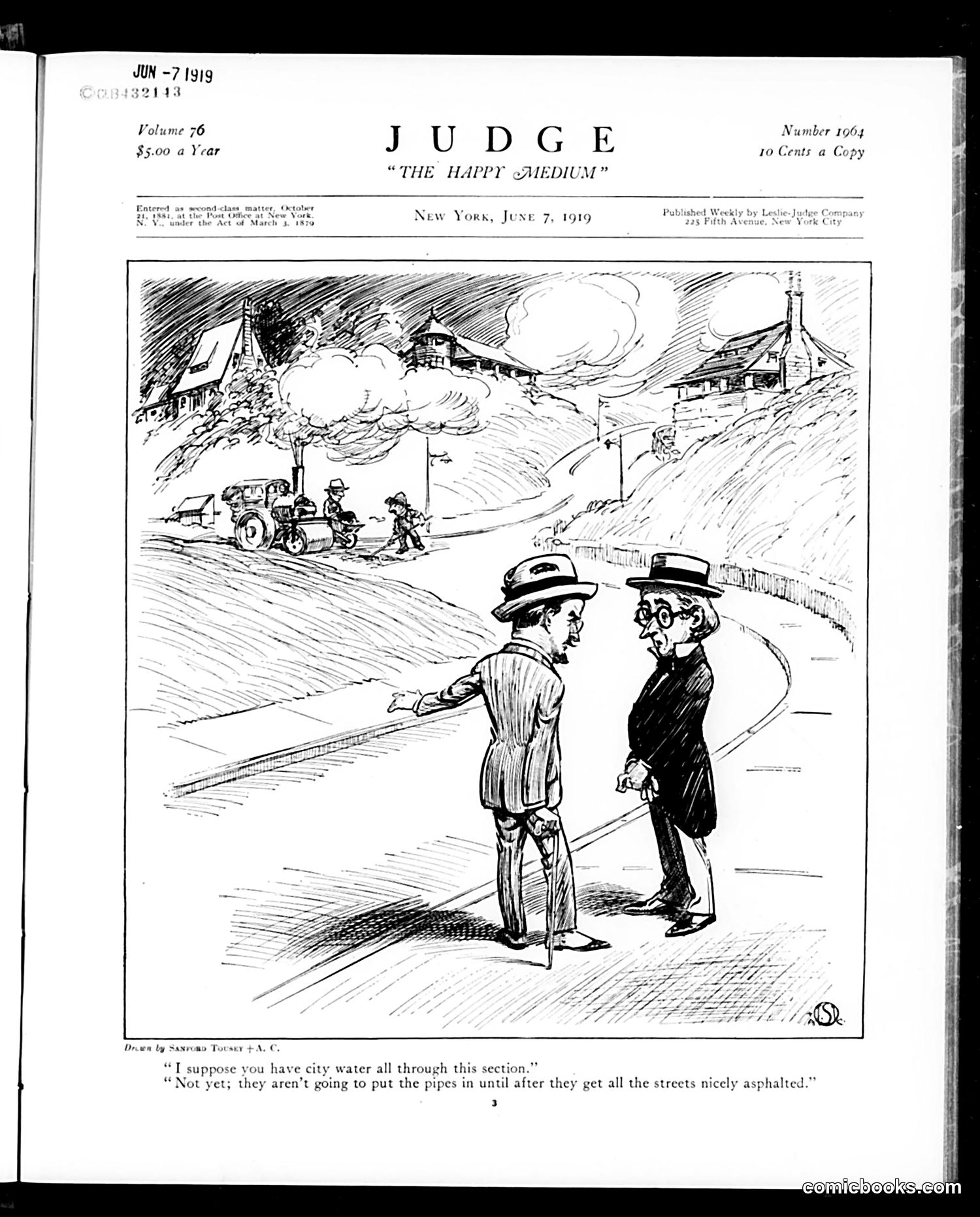
This cartoon satirizes rural infrastructure development in post-WWI America. Two men in hats discuss city water systems being installed in a rural section. The first man assumes pipes mean immediate water access; the second explains the reality: infrastructure work prioritizes asphalt street paving *before* completing water lines—a typical bureaucratic delay frustrating rural communities. The background shows a steam roller and construction equipment on hillside terrain, emphasizing the visible (paving) over the invisible (pipes). The joke critiques government inefficiency and misplaced priorities in public works projects, where cosmetic improvements proceed faster than essential utilities. This reflects broader 1919 tensions between modernizing rural America and actual implementation timelines.
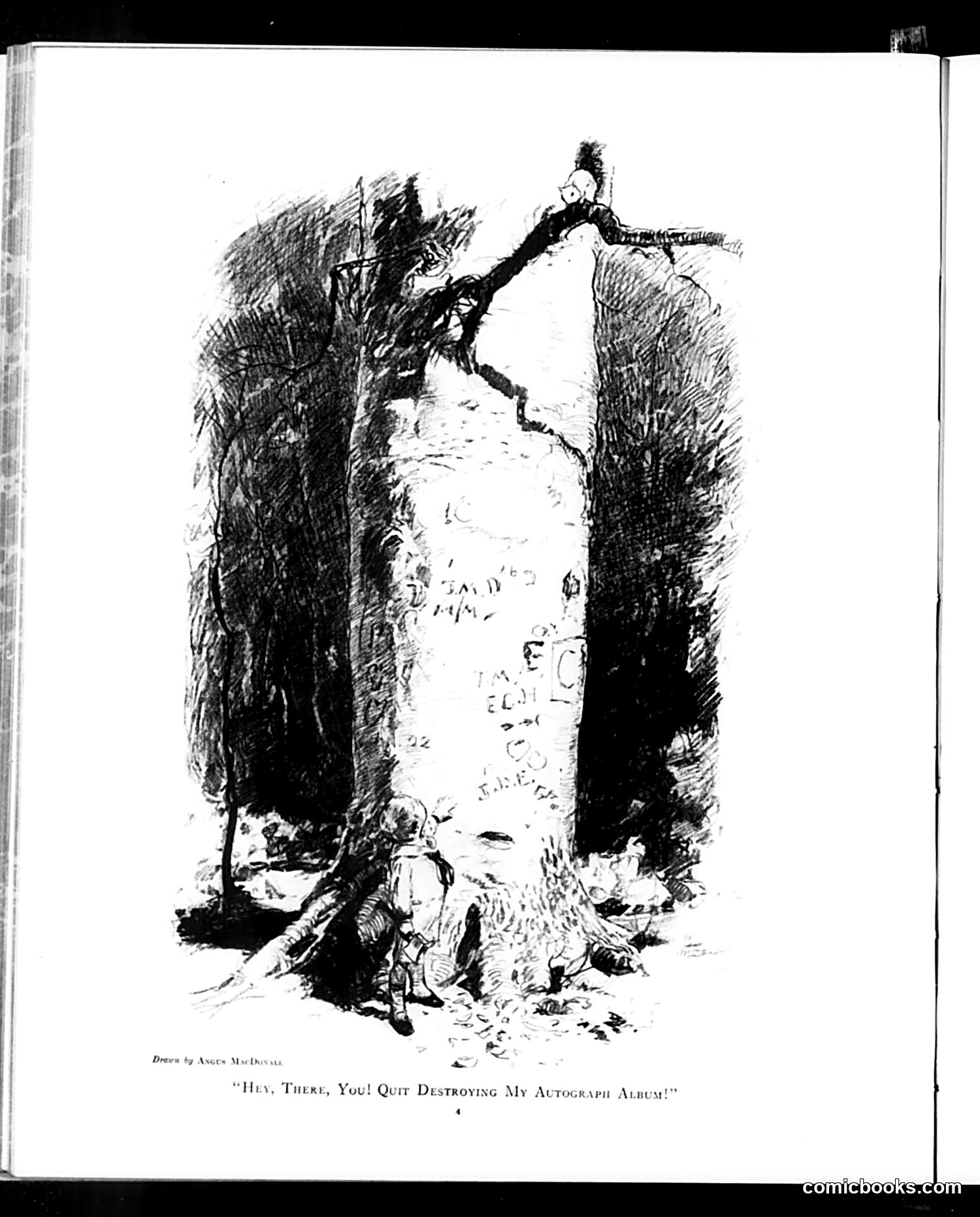
This cartoon, drawn by Ange MacDonald, depicts a figure climbing a large tree trunk (apparently meant to represent a notable public figure or celebrity), while smaller figures below protest. The caption suggests someone is "destroying" an autograph album—likely a satirical commentary on a public figure's reputation or legacy being damaged. The exact historical reference is unclear without additional context, but the humor relies on the autograph album as a metaphor for public image or legacy. The climbing figure seems to be damaging or defacing this symbolic "album." This type of satire was common in *Judge* magazine, which frequently mocked public figures and social behavior through exaggerated visual metaphors.
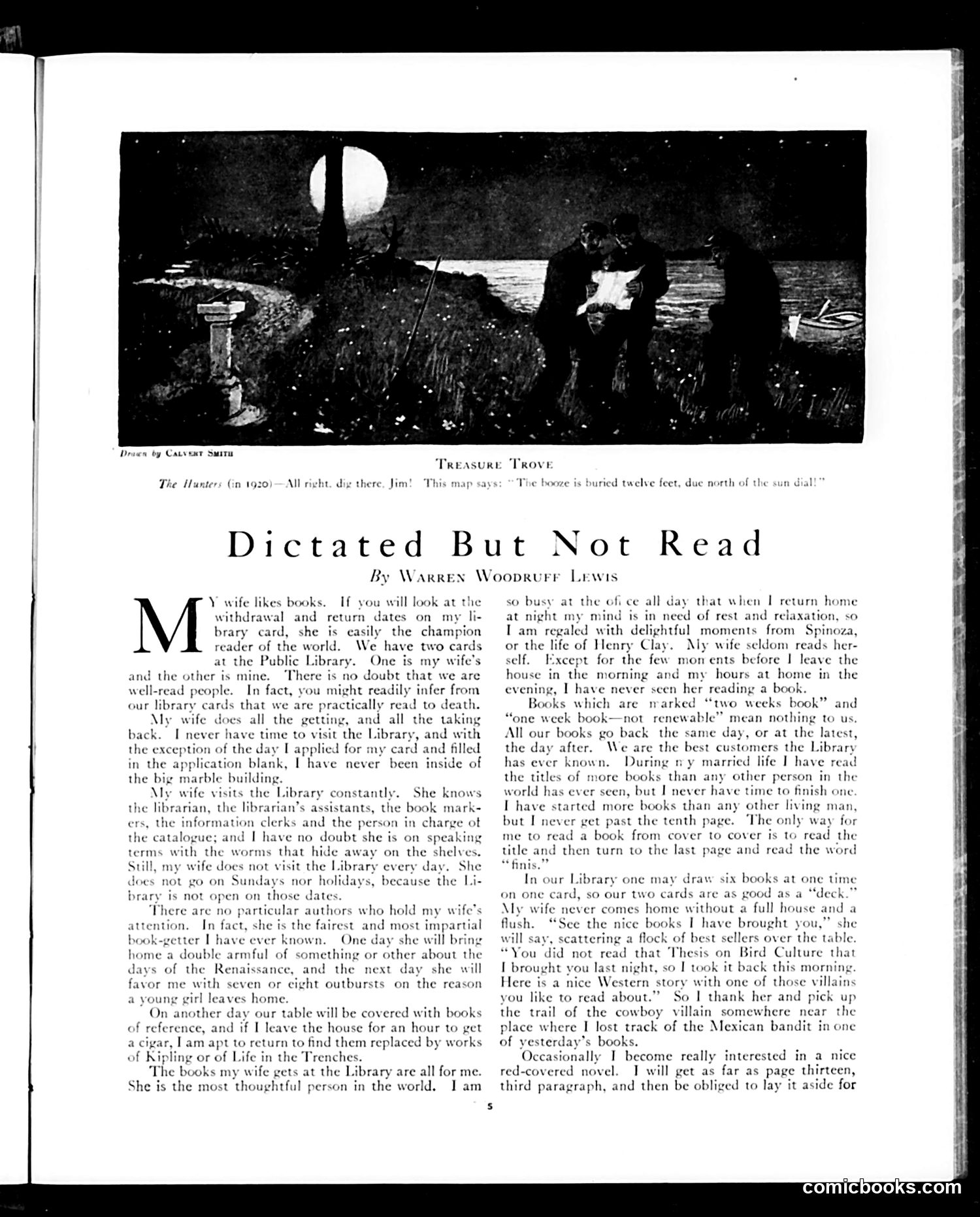
The page contains a literary essay titled "Dictated But Not Read" by Warren Woodruff Lewis, not a political cartoon. The small illustration at top labeled "Treasure Trove" (drawn by Calvert Smith, referencing "The Hatters" from 1920) depicts a nighttime scene with figures and a full moon—likely illustrating a literary or theatrical moment. The essay humorously critiques the author's wife's voracious library habits. Lewis complains that while he never visits the library himself, his wife constantly borrows books they never finish reading. He satirizes the futility: they request books, return them unread, and repeat endlessly. The humor lies in depicting marital discord over intellectual pretension—the couple maintains library cards suggesting cultured readers while actually being too busy or lazy to complete any books.
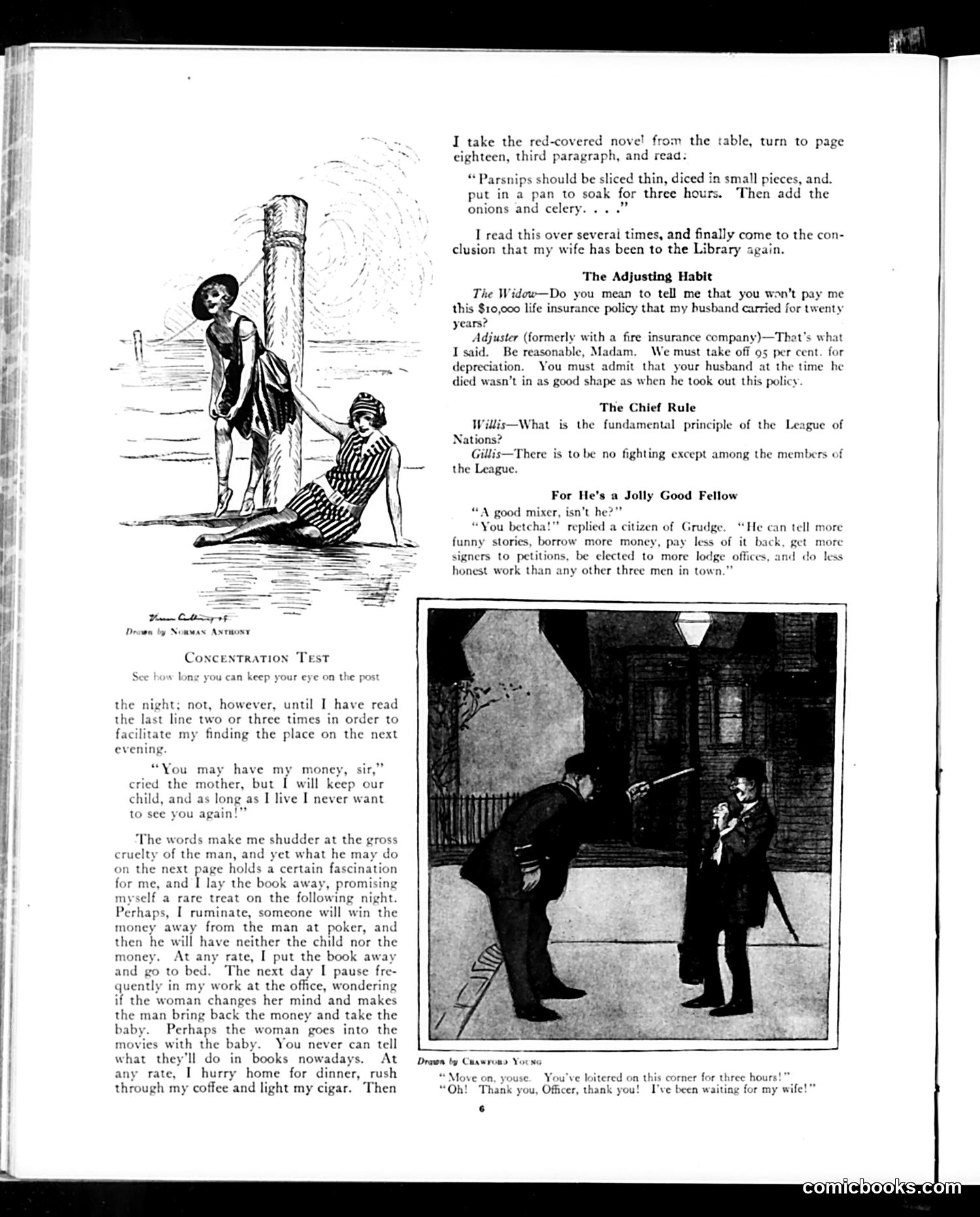
This page contains several distinct satirical pieces: **Top Section ("Adjusting Habit"):** A widow disputes an insurance adjuster's claim that her late husband wasn't in good health when the policy was issued. The satire mocks both insurance company evasions and widows' persistence in collecting claims. **"The Chief Rule":** A brief dialogue satirizing the League of Nations by reducing its stated purpose (no fighting among members) to obvious absurdity—the joke being that such a basic principle shouldn't need emphasis. **"For He's a Jolly Good Fellow":** Character satire about a corrupt town figure who embezzles, borrows money dishonestly, and gets elected despite obvious malfeasance. The illustrations include a seaside scene (artist signed) and a street photograph. The satirical thrust targets institutional hypocrisy, bureaucratic evasion, and civic corruption typical of Judge's social commentary.
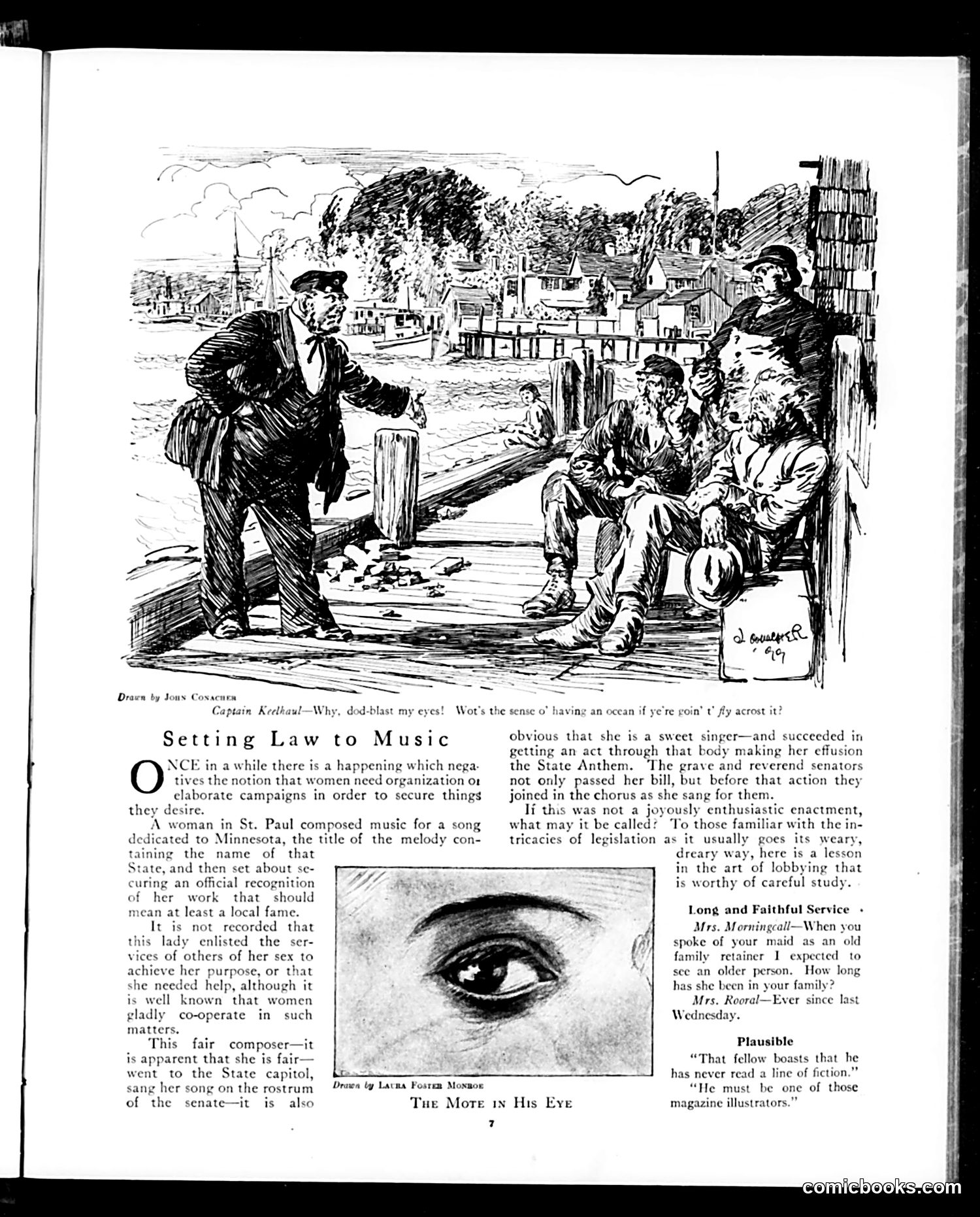
This Judge magazine page contains two distinct satirical pieces: **"Captain Keelhaul" cartoon** (top): A nautical-themed joke where an old sea captain expresses bewilderment at modern air travel, questioning why anyone would fly across an ocean when it exists to be crossed by ship. The satire mocks resistance to new technology and outdated thinking. **"Setting Law to Music" article**: Satirizes a woman composer from St. Paul who successfully lobbied the Minnesota state legislature to adopt her song as the State Anthem—apparently by performing it directly for senators, who then voted for it. The satire's point appears ironic: judges this as surprisingly effective "lobbying" compared to traditional legislative processes, noting she needed no organized campaign or female allies to succeed. The piece seems to mock both the ease of swaying legislators through charm and perhaps the frivolousness of legislative priorities. The small jokes at bottom mock outdated attitudes (pretending not to read fiction, family servants) with light satire.
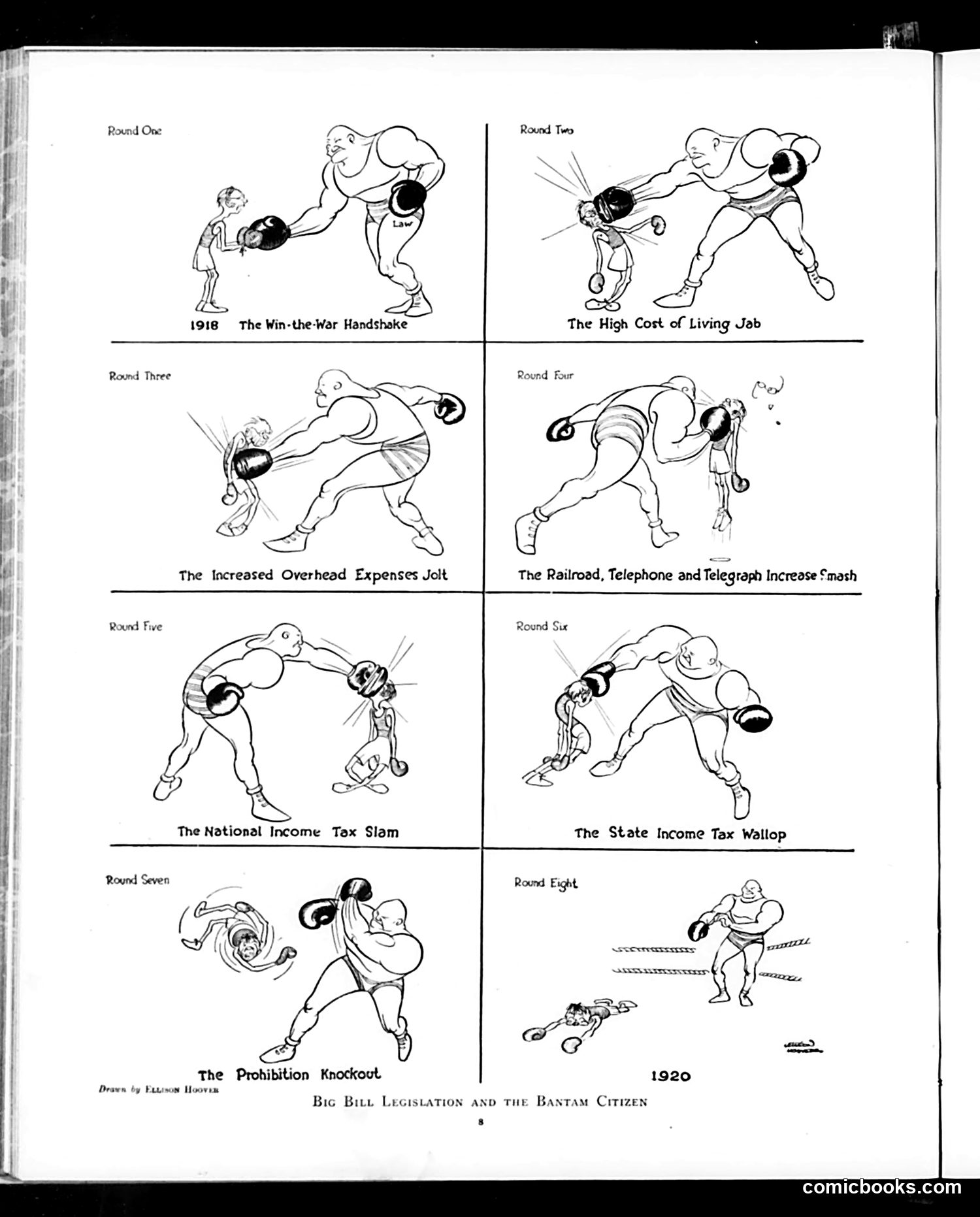
This 1920 Judge magazine page uses a boxing match metaphor to satirize legislation's impact on ordinary citizens. The small figure labeled "Bantam Citizen" fights progressively larger opponents representing various taxes and expenses: the 1918 war handshake, cost-of-living increases, overhead expenses, railroad/telephone/telegraph costs, national income tax, state income tax, prohibition enforcement, and finally—by Round Eight—appears knocked out. The cartoon's point: post-WWI legislation and taxation policies systematically devastated the average working person, with each "round" representing a different financial burden. The citizen grows progressively battered while opponents (personified legislation) appear fresh and aggressive, illustrating citizens' powerlessness against accumulating government burdens. The overall effect criticizes the government's legislative overreach affecting everyday Americans.
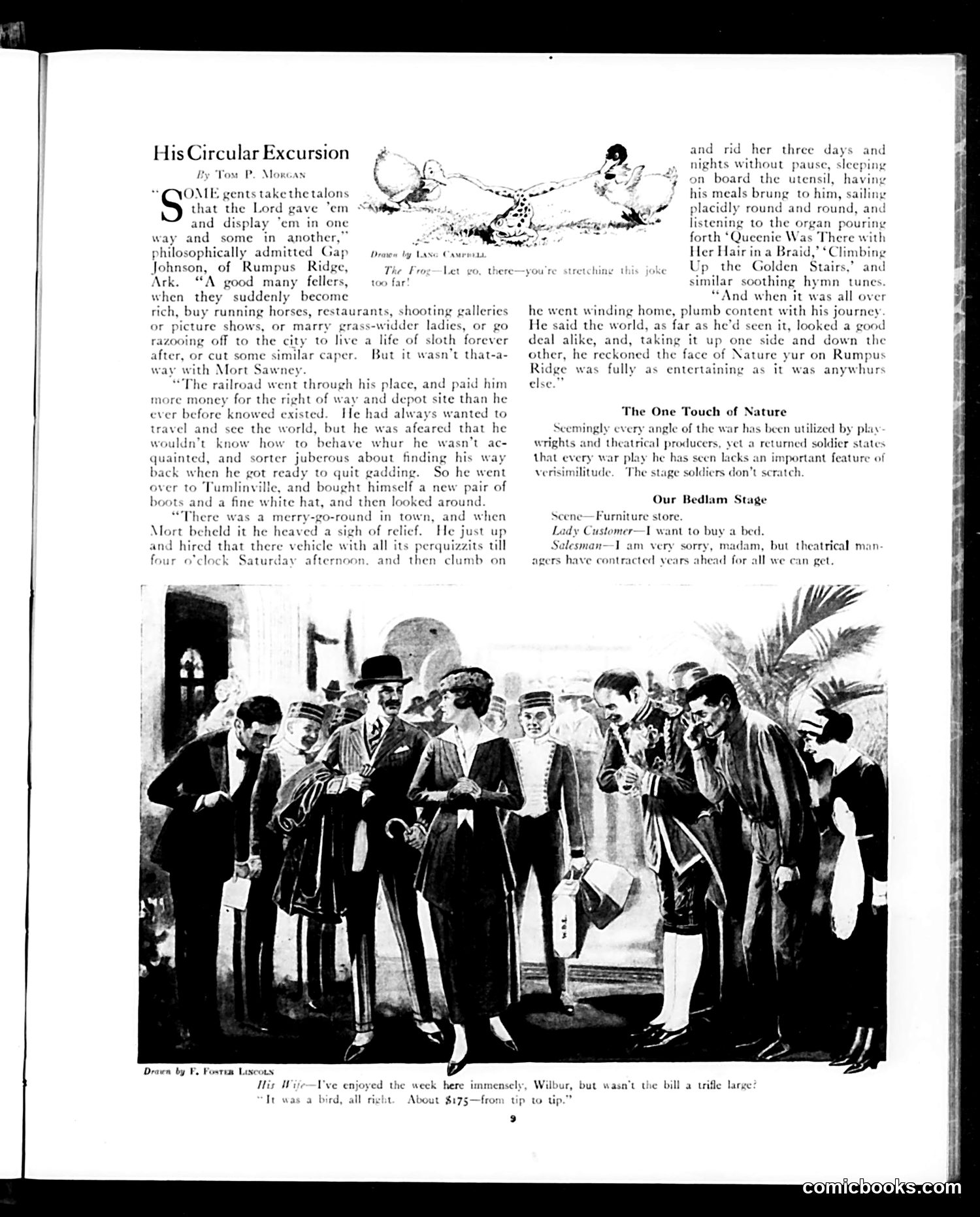
This page contains two satirical pieces from *Judge* magazine: **"His Circular Excursion"** (top): A humorous story about Mort Sawney, a poor Arkansas farmer who suddenly becomes wealthy when a railroad pays him for right-of-way. Too timid to travel properly, he instead rents a merry-go-round horse and rides it continuously for three days, sleeping aboard, calling it his "world tour." The satire mocks both rural unsophistication and the nouveau riche's ostentatious leisure pursuits—poking fun at how the newly wealthy often make foolish spending choices. **"The One Touch of Nature"** (bottom): A brief theatrical joke where a lady customer wants to buy a bed, but the salesman says theatrical managers have rented them all for war plays. The satire suggests war dramas are so prevalent and popular that they've depleted the furniture market—critiquing both wartime theatrical exploitation and the public's appetite for military entertainment. Both pieces reflect early-20th-century American humor about class mobility, rural characters, and commercial entertainment trends.
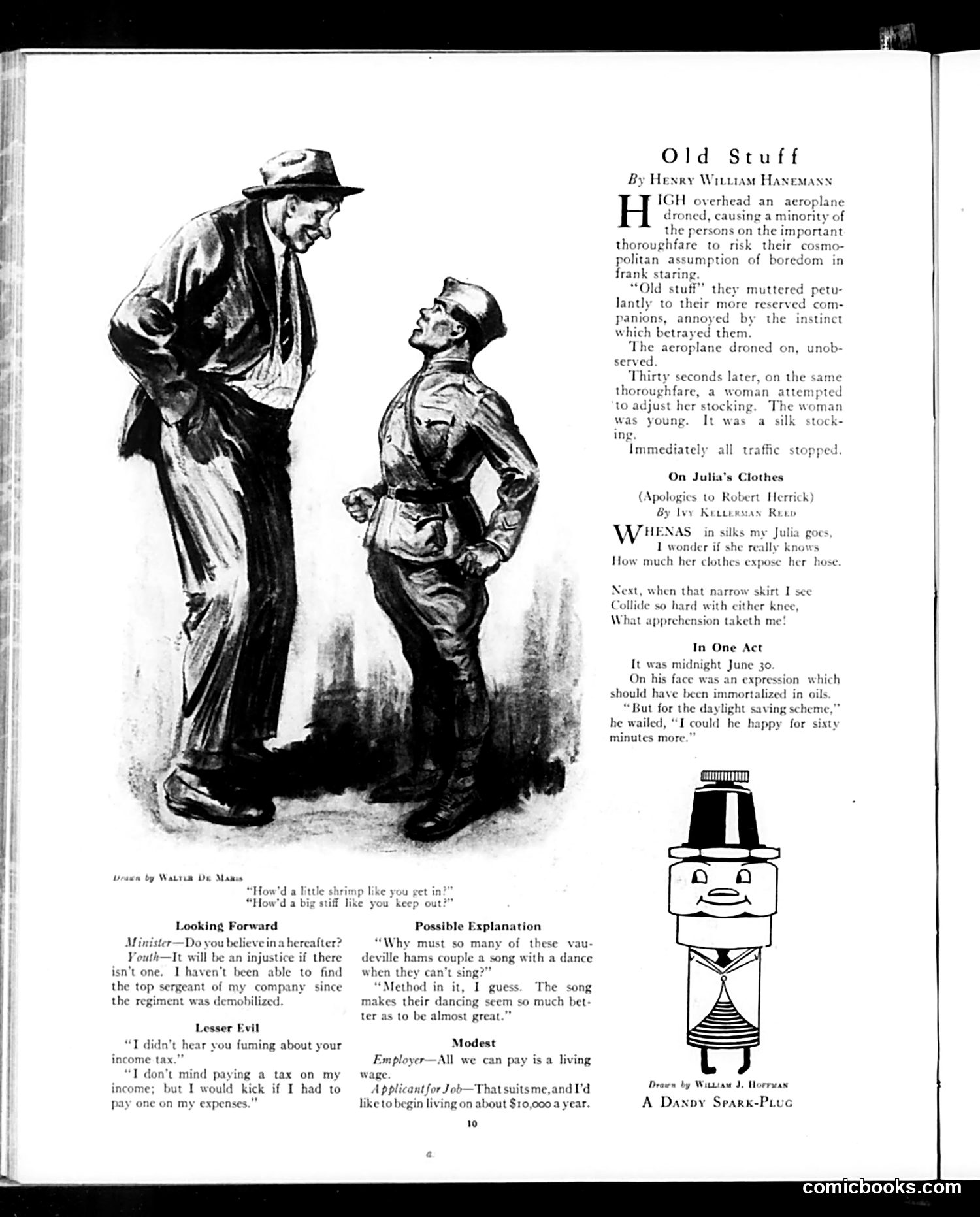
This page contains several short humorous pieces satirizing contemporary American life (likely early 20th century): **"Old Stuff"** mocks urban sophistication—commuters pretend airplanes bore them to maintain a cosmopolitan facade, yet when a woman adjusts her silk stocking, all traffic stops. The irony: their assumed world-weariness is performative; they're easily distracted by scandal. **"On Julia's Clothes"** is a poem about a woman in fashionably short skirts that expose her stockings—risqué for the era. The speaker worries her clothing reveals too much. **The shorter pieces** satirize ordinary complaints: a soldier missing after demobilization; income tax grumbling; vaudeville performers masking poor singing with dancing; and an applicant seeking a "$10,000 a year living wage"—apparently excessive for the period. The cartoons and jokes target pretension, hypocrisy, and social anxieties about modernity (aviation), changing women's fashion, and economic expectations.
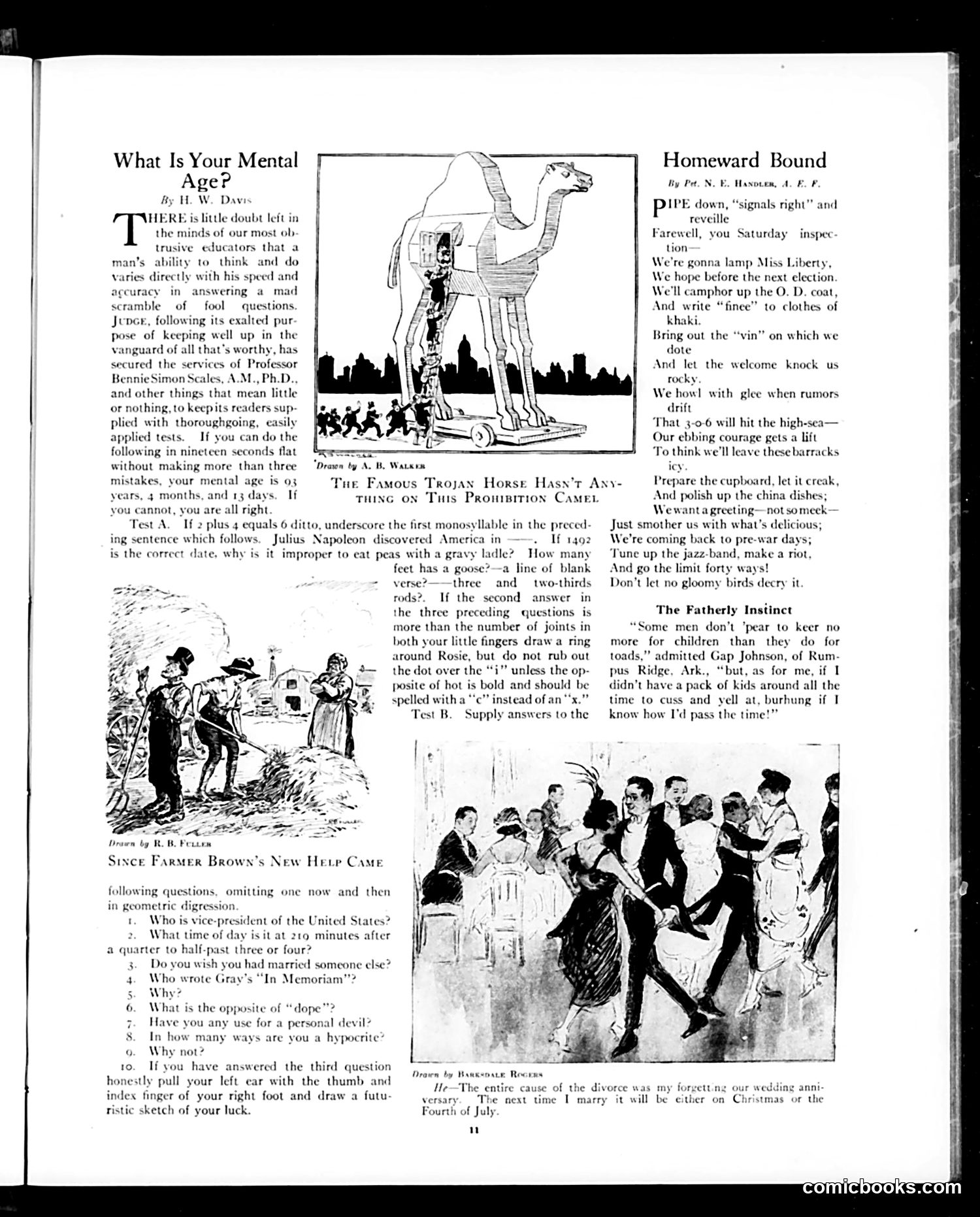
This page contains satirical mental ability tests mocking the era's obsession with IQ testing and "scientific" psychology. The absurd questions (e.g., "Who wrote Gray's 'In Memoriam'?" followed by "Why?") ridicule pseudo-intellectual assessment trends popularized by figures like psychologist James McKeen Cattell. The "Famous Trojan Horse" section extends the joke with intentionally nonsensical logic puzzles combining historical facts with meaningless arithmetic. "Homeward Bound" is a soldier's poem about WWI troops returning home—references to "O.D. coat" (olive drab uniform), "barracks," and "pre-war days" indicate soldiers anticipating demobilization and civilian life's pleasures (food, jazz, women). "The Fatherly Instinct" presents rural dialect humor where a backwoods father admits he'd be lost without children to yell at—typical period working-class caricature humor. The cartoons illustrate these pieces with period-appropriate drawings emphasizing the satire's targets.
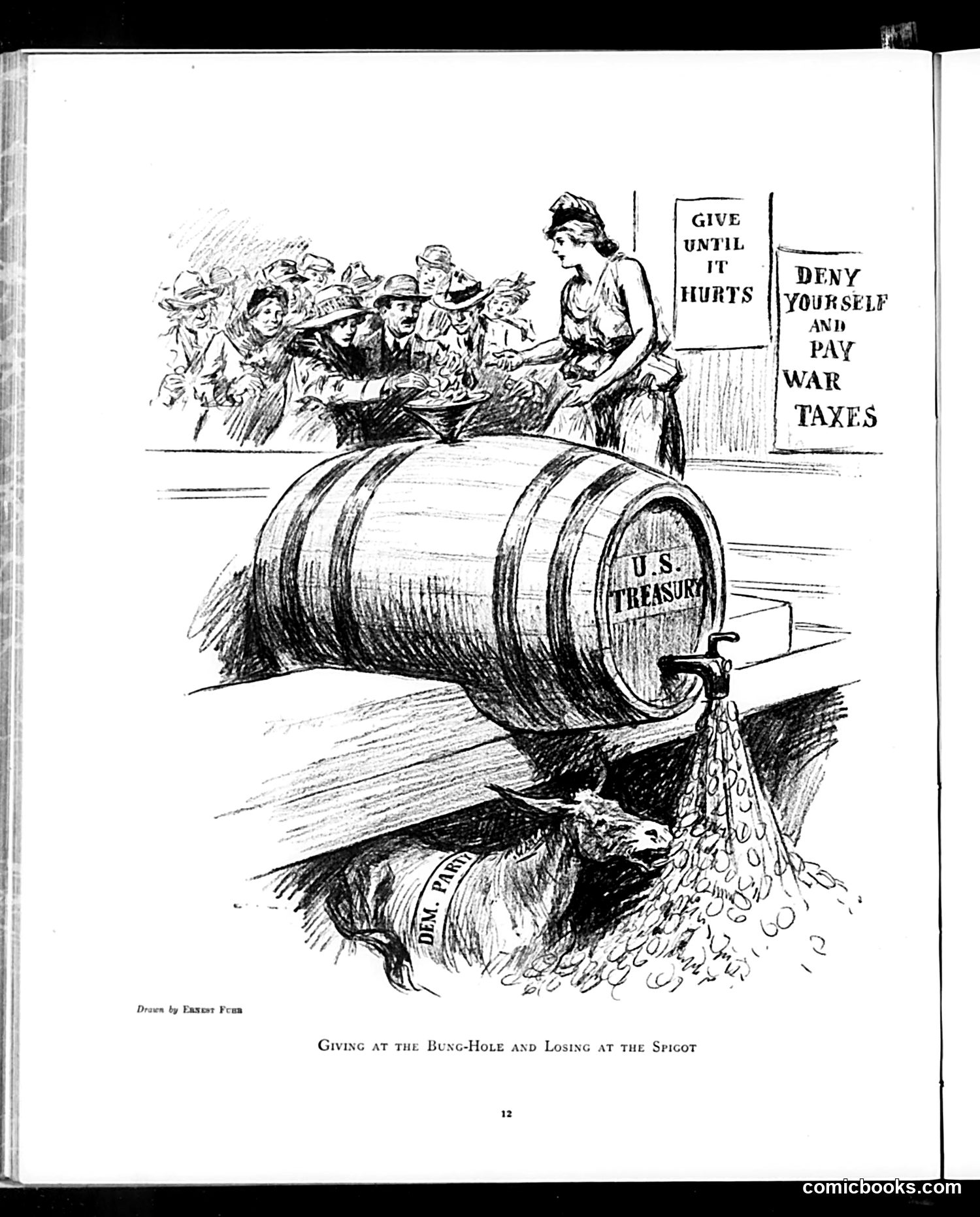
This Judge magazine cartoon satirizes American fundraising efforts during what appears to be World War I. The central image shows a large barrel labeled "U.S. TREASURY" with a tap at the bottom, leaking money. A woman holds signs urging citizens to "GIVE UNTIL IT HURTS" and "DENY YOURSELF AND PAY WAR TAXES." The cartoon's title—"Giving at the Bung-Hole and Losing at the Spigot"—is a pun suggesting that while citizens donate generously through official channels (the bung-hole, or top opening), money simultaneously drains away wastefully (the spigot, or tap). The crowd of people depicted appears to represent the public being asked for sacrifice. The satire critiques government waste and inefficiency in war spending, suggesting that patriotic donations and tax contributions are being squandered through poor fiscal management or corruption.
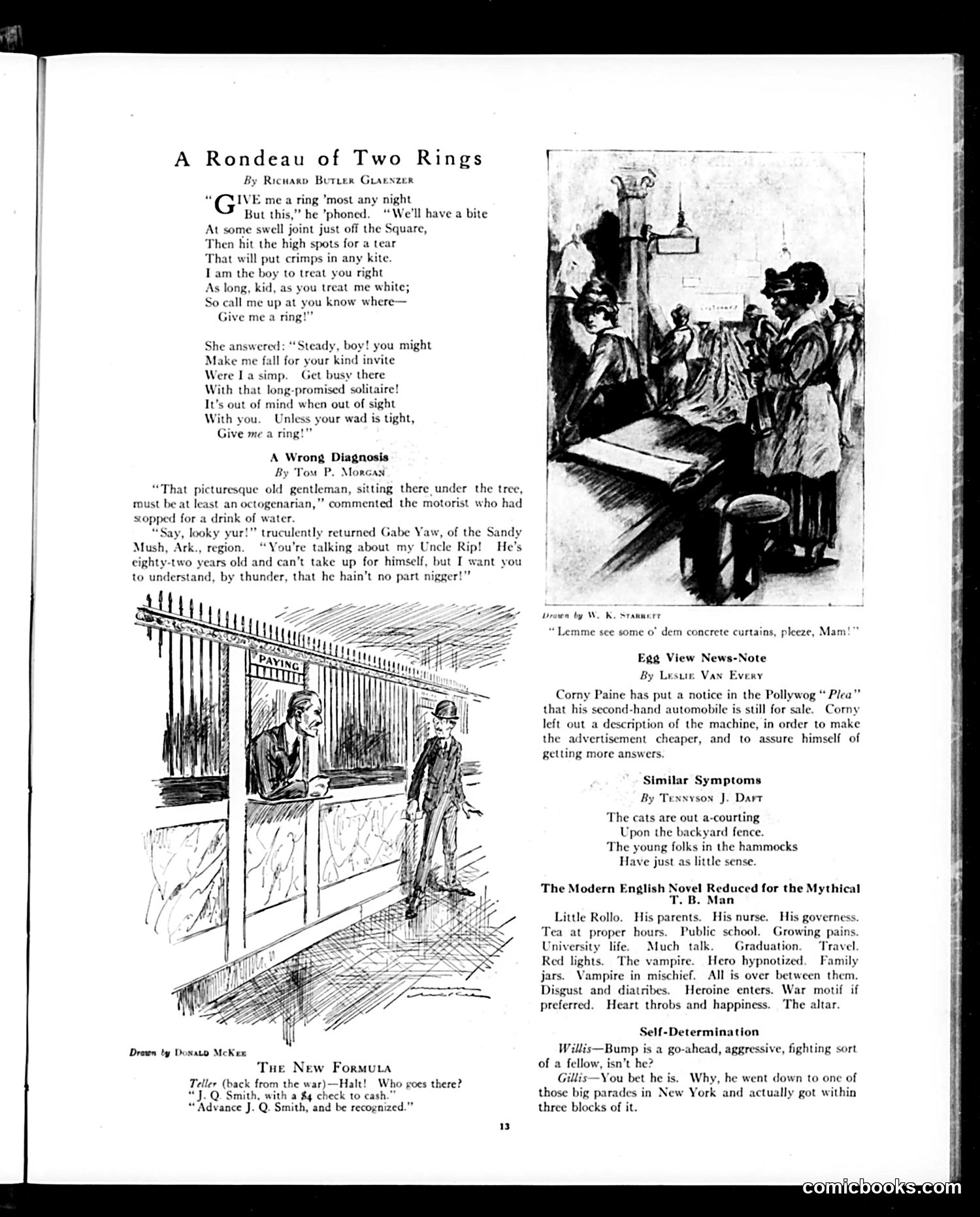
This page contains several short humorous pieces typical of early 20th-century American satire: **"A Rondeau of Two Rings"** is a flirtatious poem between a man and woman negotiating a date. He promises to "treat you right" and show her "high spots"; she demands he actually follow through on promises and have money ("unless your wad is tight"). The "rings" are telephone calls. **"A Wrong Diagnosis"** satirizes rural Southern attitudes. A motorist assumes an old man is an octogenarian; the man's relative, Gabe Yaw, defensively insists the uncle is only 82 and forcefully denies he has Black ancestry—a crude joke about defensive regional pride and racial anxieties. **"The New Formula"** shows a military officer checking a soldier's credentials post-WWI, a simple joke about bureaucratic procedure. The remaining pieces are light observational humor about courtship, automobile sales, and English novels. The page is primarily entertainment and social commentary rather than political satire.
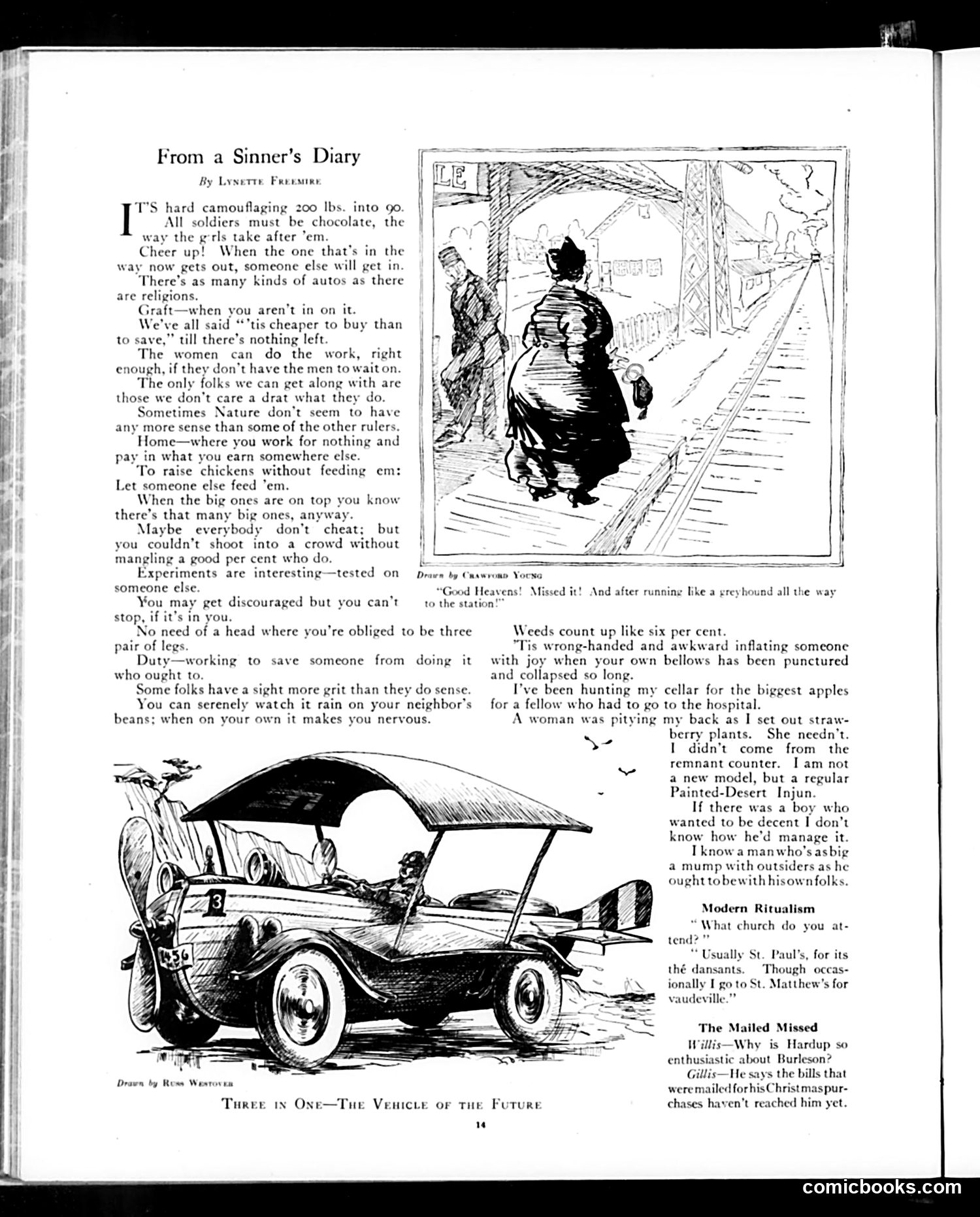
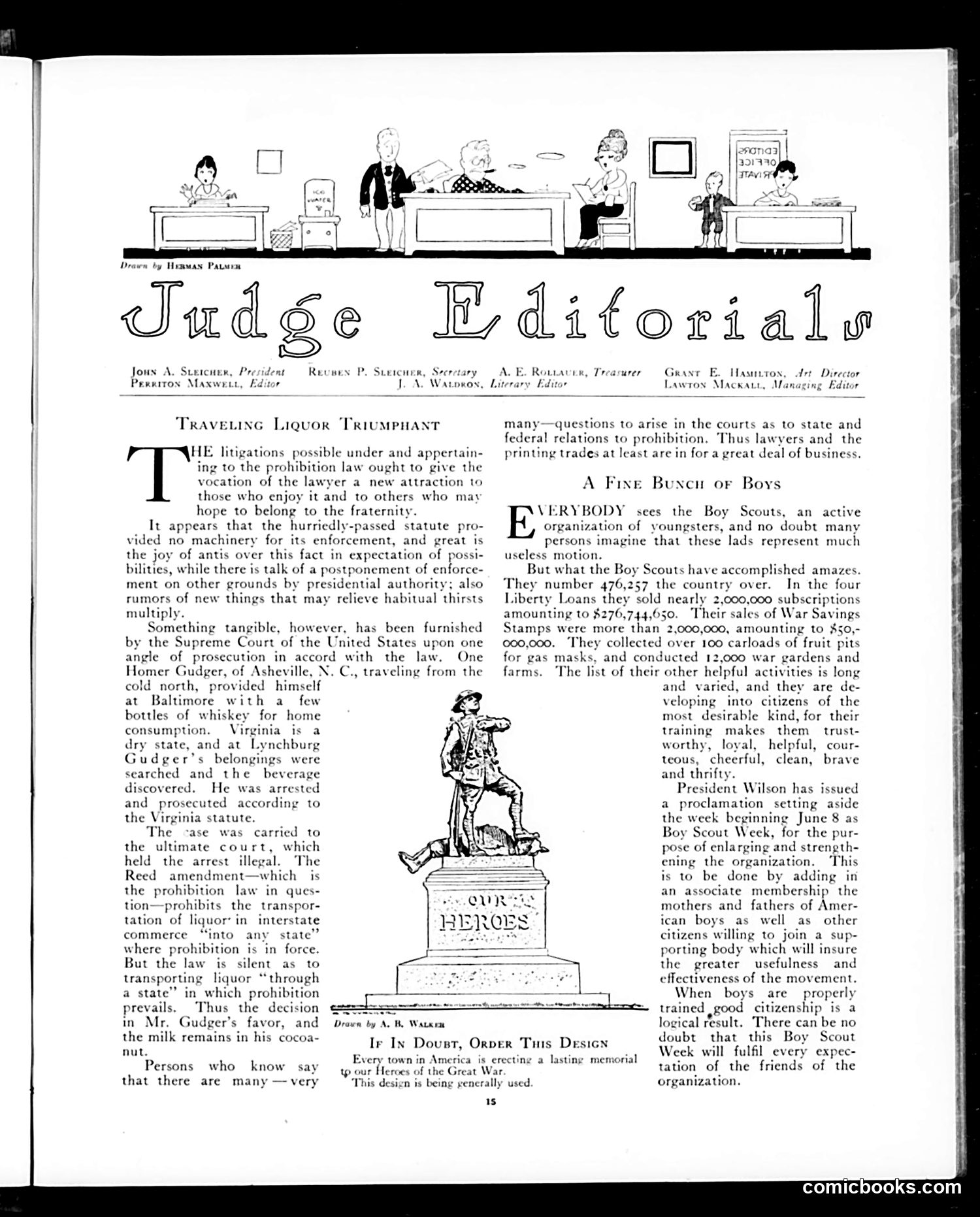
This editorial page from Judge magazine contains two distinct pieces of social commentary: **"Traveling Liquor Triumphant"** satirizes Prohibition enforcement gaps. It references a real Supreme Court case involving Homer Gudger of Asheville, NC, arrested in Virginia for transporting whiskey across state lines. The Court ruled his arrest illegal because the Reed Amendment's language left loopholes—it prohibited liquor transport "into any state" but was silent on transport "through a state." The editorial mockingly notes this legal ambiguity will enrich lawyers and printers with litigation work, undercutting Prohibition's intent. **"A Fine Bunch of Boys"** praises the Boy Scouts' wartime contributions: selling $276 million in Liberty Loans, $50 million in War Savings Stamps, collecting fruit pits for gas masks, and operating 12,000 war gardens. It announces President Wilson's Boy Scout Week (June 8) and urges parents to join as "associate members" to strengthen the organization. Both pieces address post-WWI America: one cynically, highlighting Prohibition's legal dysfunction; the other approvingly, celebrating youth civic engagement and patriotic service.
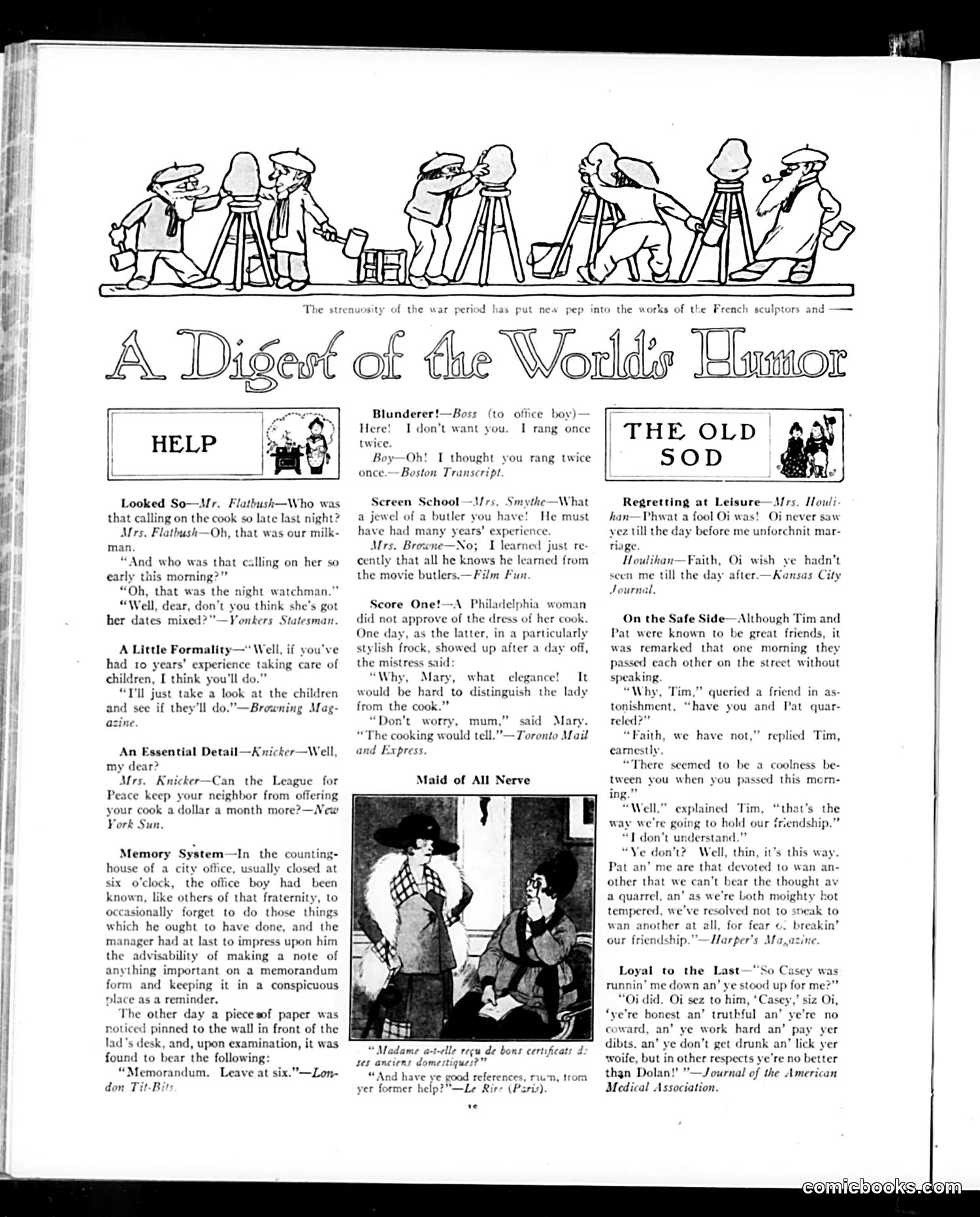
This page from *Judge* magazine presents various short humorous anecdotes satirizing domestic life and labor relations in early 20th-century America. **Key themes:** The jokes mock class dynamics and employer-servant relationships. Multiple anecdotes feature cooks and domestic workers—"Looked So" jokes about a cook receiving male visitors; "Score One!" depicts class tension when a cook dresses too elegantly; "Screen School" mocks butlers learning behavior from movies rather than experience. **Immigration humor:** "The Old Sod" section uses heavy Irish dialect ("Phwat," "Oi," "ye") and Irish names (Houlihan, Casey, Dolan), reflecting period stereotypes of Irish-American workers and immigrants. **Workplace absurdity:** Anecdotes like "Memory System" and "Blunderer!" satirize office inefficiency and miscommunication between bosses and subordinates. **The photograph** labeled "Maid of All Nerve" shows a domestic worker, reinforcing the page's focus on servant-class comedies. The overall tone reflects anxieties about social order, labor costs ("offering your cook a dollar a month more"), and the perceived pretensions of working-class people aspiring to respectability.
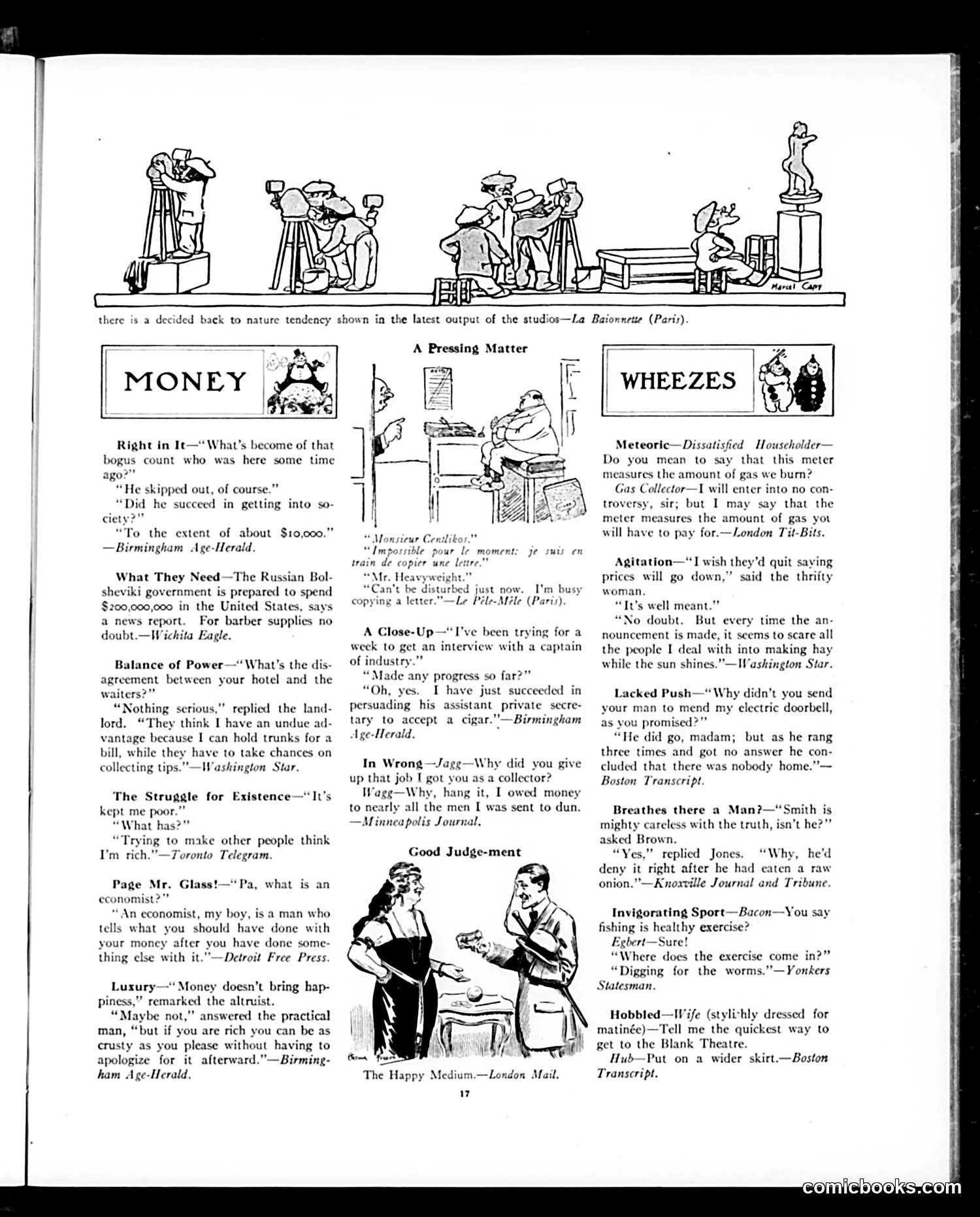
This page collects short humorous anecdotes and jokes organized by topic headings (Money, Wheezez, etc.), typical of Judge's satirical format. The cartoons illustrate contemporary social anxieties: **Top cartoon**: Depicts studio artists working on sculptures, referencing "La Baionnette" (a French publication), with commentary on artistic trends favoring naturalism. **The jokes target**: - **Fraud/con artists** ("bogus count" fleeing with $10,000) - **Post-WWI Russia** (Bolsheviks needing basic supplies like barber goods—mocking their primitiveness) - **Economic struggles** (people pretending wealth; hotel tipping culture; bill collection) - **Class dynamics** (difficulty accessing industrial leaders; gas meters measuring bills, not actual consumption) - **Domestic life** (wives' fashion impracticality; husbands' dishonesty) **The "Good Judge-ment" cartoon** shows two figures in conversation, illustrating social interaction humor. Overall, the page reflects 1920s-era anxieties about poverty, pretense, and economic uncertainty following WWI, using quick wit and class-based humor typical of Judge's readership.
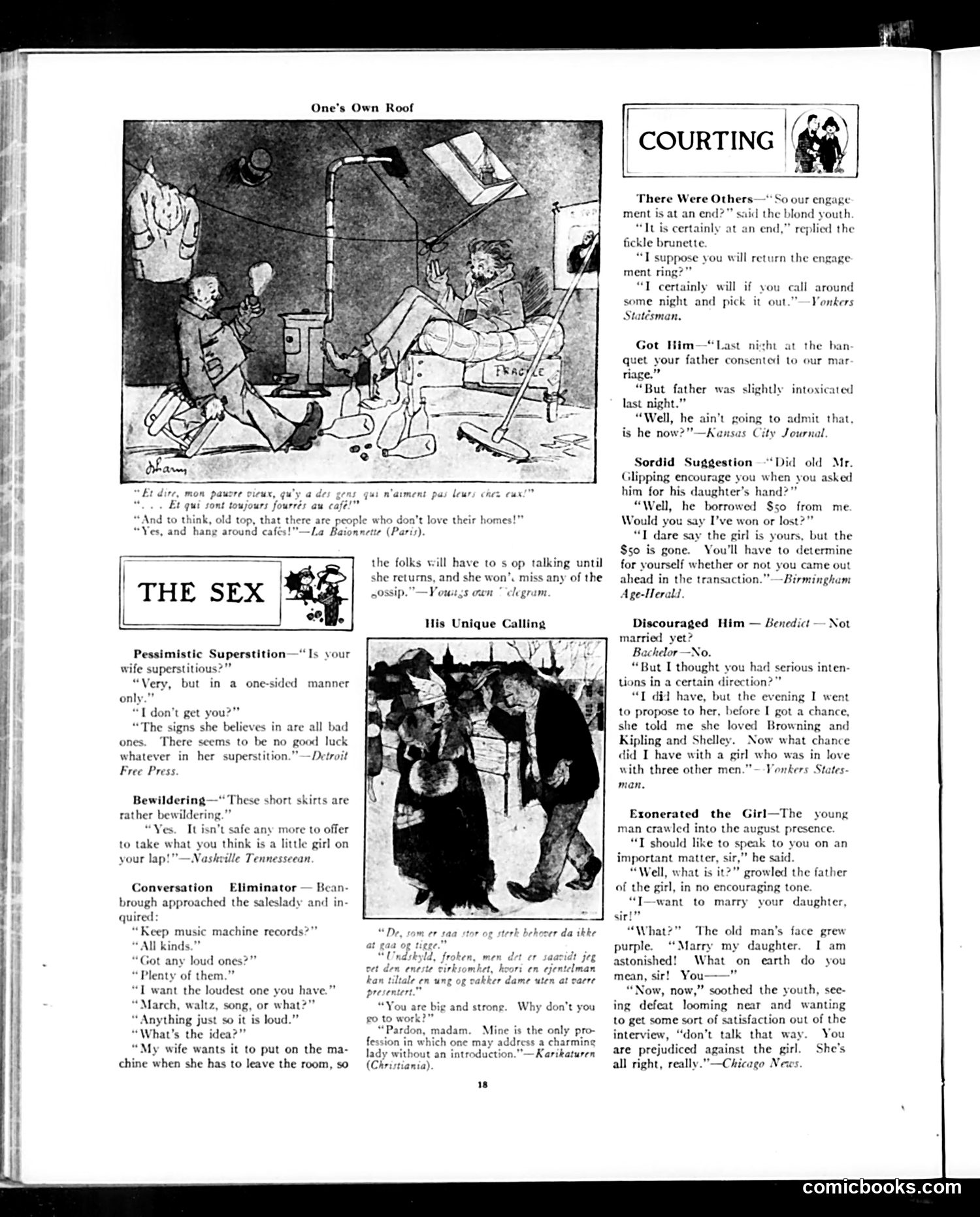
This page contains humor anecdotes and comic vignettes satirizing early 20th-century courtship, marriage, and gender relations. **Main themes:** The "Courting" section mocks romantic conventions: engagements made and broken casually, fathers interrogating suitors, and young men's awkward attempts at proposal. The humor assumes readers understand strict courtship protocols—returning engagement rings, requiring formal introductions, seeking paternal consent. **Social satire:** "Conversation Eliminator" jokes about wives controlling husbands by playing loud phonograph music to prevent gossip during the husband's absence—reflecting anxieties about women's domestic power and marital discord. "His Unique Calling" satirizes street harassers claiming profession allows accosting women without introduction—commentary on public harassment normalized as charming. The cartoons ridicule both genders: fickle women, bumbling men, suspicious fathers, and wives as domestic tyrants. **Historical context:** These anecdotes reflect rigid Edwardian/1920s courtship rules now entirely obsolete, making the humor historically specific and dated.
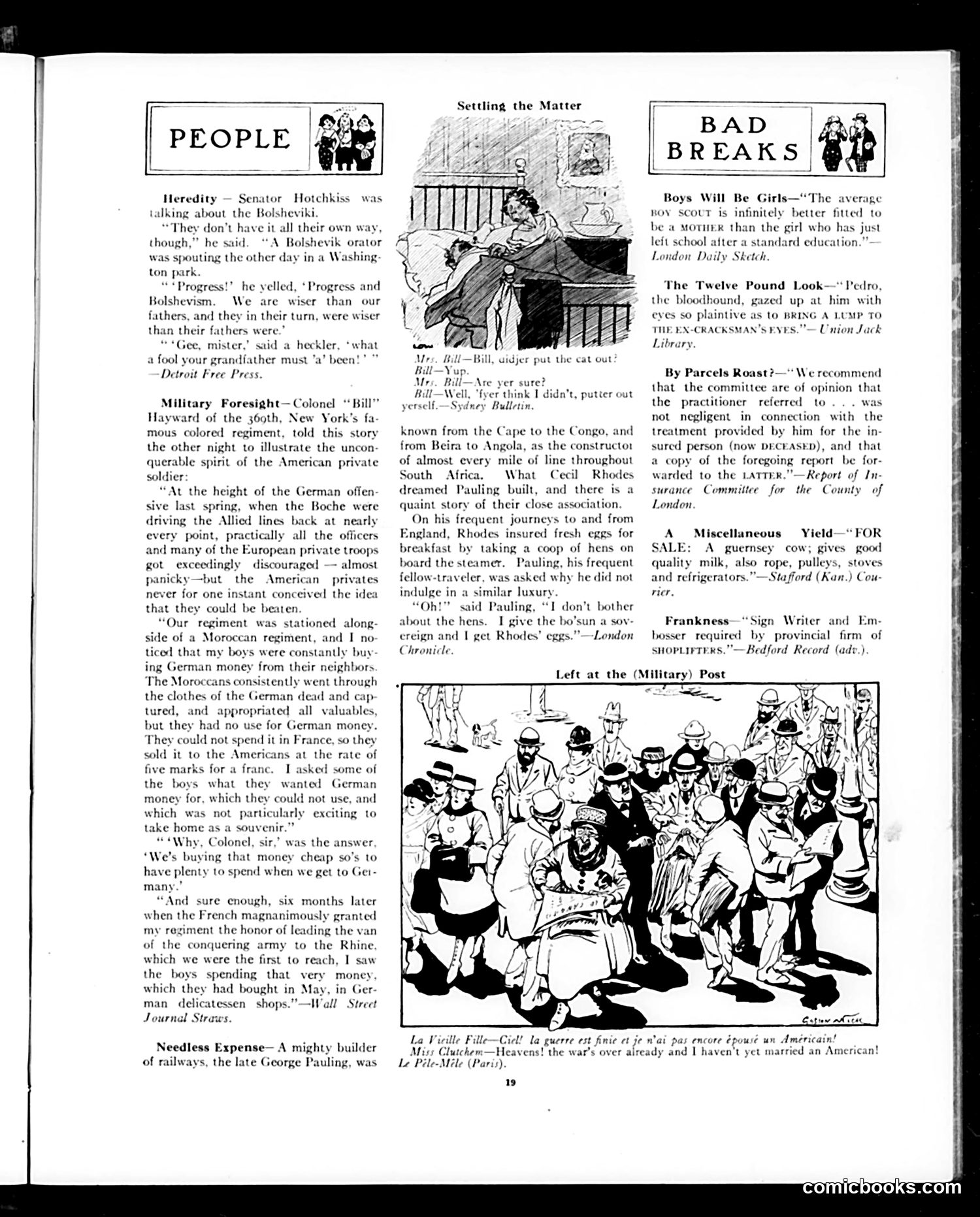
This page from *Judge* magazine contains several humorous anecdotes ("People" and "Bad Breaks" sections) rather than traditional political cartoons. **Key content:** The main illustration shows American soldiers at a military post, apparently interacting with locals after WWI. The French caption suggests a soldier claiming he hasn't yet married an American—contemporary commentary on soldiers' romantic entanglements abroad. **The text stories** satirize various subjects: - A senator mocks Bolsheviks' claims of progress through evolution - A colonel recounts American soldiers' confidence even during German offensives, and their shrewd purchase of German currency as souvenirs/future spending money - Anecdotes about Cecil Rhodes and railway builder George Pauling **The "Bad Breaks"** section collects humorous newspaper excerpts and quotes—misstatements, absurdities, and unintentional comedy from published sources. The overall tone reflects post-WWI American attitudes: confidence in American soldiers, some skepticism toward European (especially radical) ideologies, and general satirical observation of contemporary life. The page is primarily text-based humor rather than visual satire.
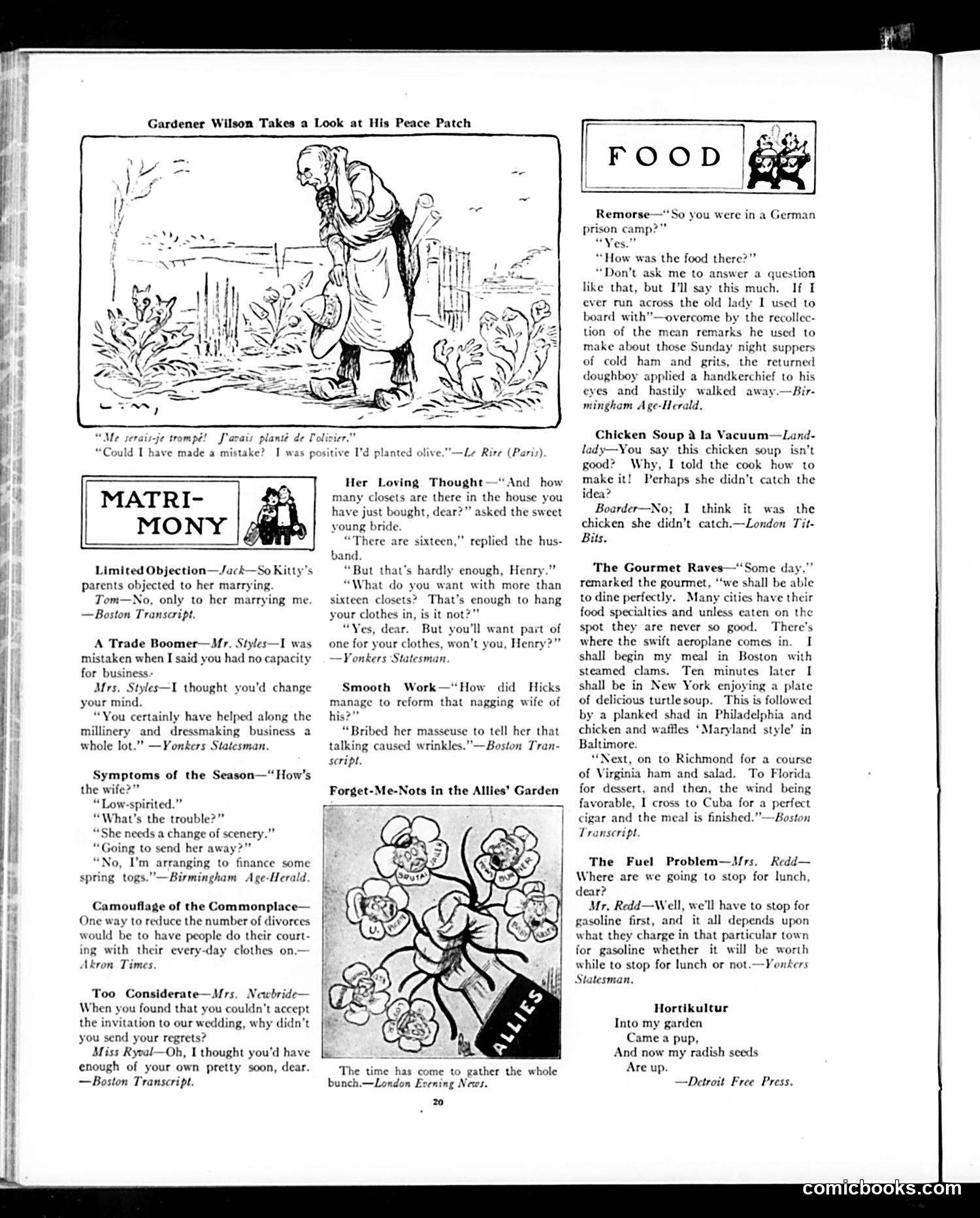
This page from *Judge* magazine contains multiple short humorous pieces typical of early 20th-century American satire. The main cartoon shows "Gardener Wilson" examining his garden, with the title suggesting a pun on President Woodrow Wilson's failed "peace" initiatives (likely post-WWI). The visual joke is that his actual garden patch shows doubt or failure, mirroring Wilson's diplomatic struggles. The remaining content comprises brief comedy pieces about marriage, domestic life, and wartime experiences—common *Judge* fare. Notable items include: a returning WWI soldier's traumatic memories of bad boarding-house food; jokes about wives' excessive closet needs; and a "gourmet" fantasy about using aeroplanes to eat regionally-specialized foods across America. "The Fuel Problem" references post-war gasoline rationing affecting travel decisions. The "Forget-Me-Nots" illustration appears to reference gathering Allied nations' support, likely WWI-related. Overall, the page reflects post-WWI American concerns: domestic humor, economic adjustments, and gentle political satire targeting Wilson's peace efforts.
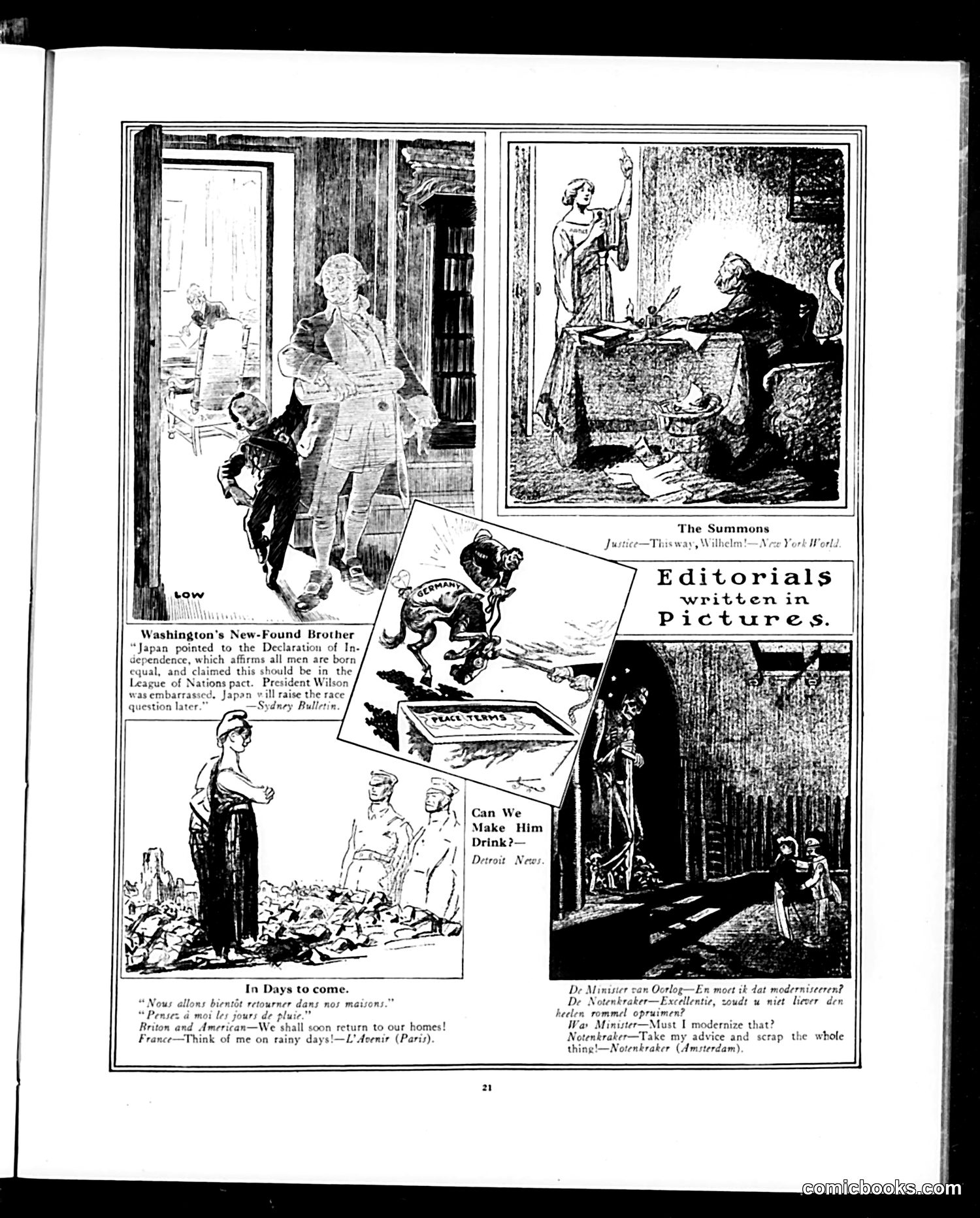
This page contains four satirical cartoons addressing post-WWI politics: **"Washington's New-Found Brother"** mocks President Wilson's embarrassment when Japan cited the Declaration of Independence's equality principle to claim racial equality in the League of Nations—suggesting Wilson wanted to avoid this "race question." **"The Summons"** (top right) depicts Justice summoning Kaiser Wilhelm to account, referencing post-war war crimes tribunals. **"In Days to Come"** shows a woman amid ruins, quoting Allied soldiers' promises to return home, satirizing the gap between wartime rhetoric and peacetime reality. **"Can We Make Him Drink?"** (bottom right, partially visible) appears to reference Prohibition debates, with dialogue suggesting modernization conflicts between Dutch and German figures. The cartoons collectively critique Wilson's diplomatic compromises, unfulfilled soldier promises, and emerging domestic policy conflicts during the uncertain post-war transition.
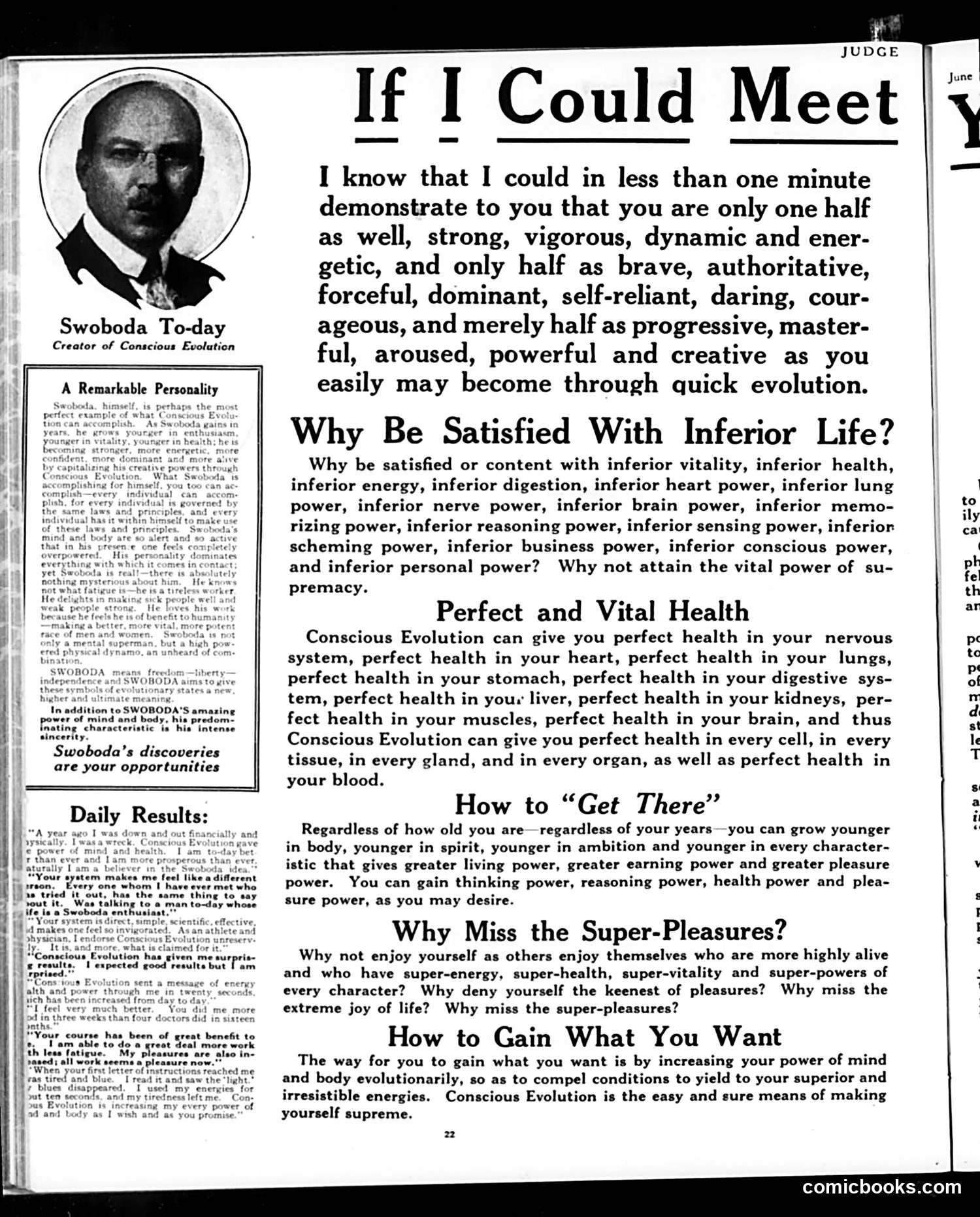
This is **not a cartoon or satire**, but rather a full-page **advertisement** for Swoboda's "Conscious Evolution" self-improvement system, appearing in Judge magazine. The page features a portrait of **Swoboda** (identified as "Creator of Conscious Evolution"), presented as a remarkable personality offering pseudo-scientific personal development promises. The ad uses hyperbolic sales language, claiming that through "Conscious Evolution," readers can become "half as well" as Swoboda—or better yet, achieve supremacy through increased "mind and body evolutionarily" power. The satire here appears **unintentional or subtle**: Judge was satirizing American consumer culture and dubious self-help movements of the era by running such obviously grandiose claims. Terms like "super-pleasures" and promises of perfect health in every organ suggest the magazine may be mocking the era's wellness charlatans, though the ad reads as earnest marketing. This reflects early 20th-century New Thought and vitalism movements popular in America.
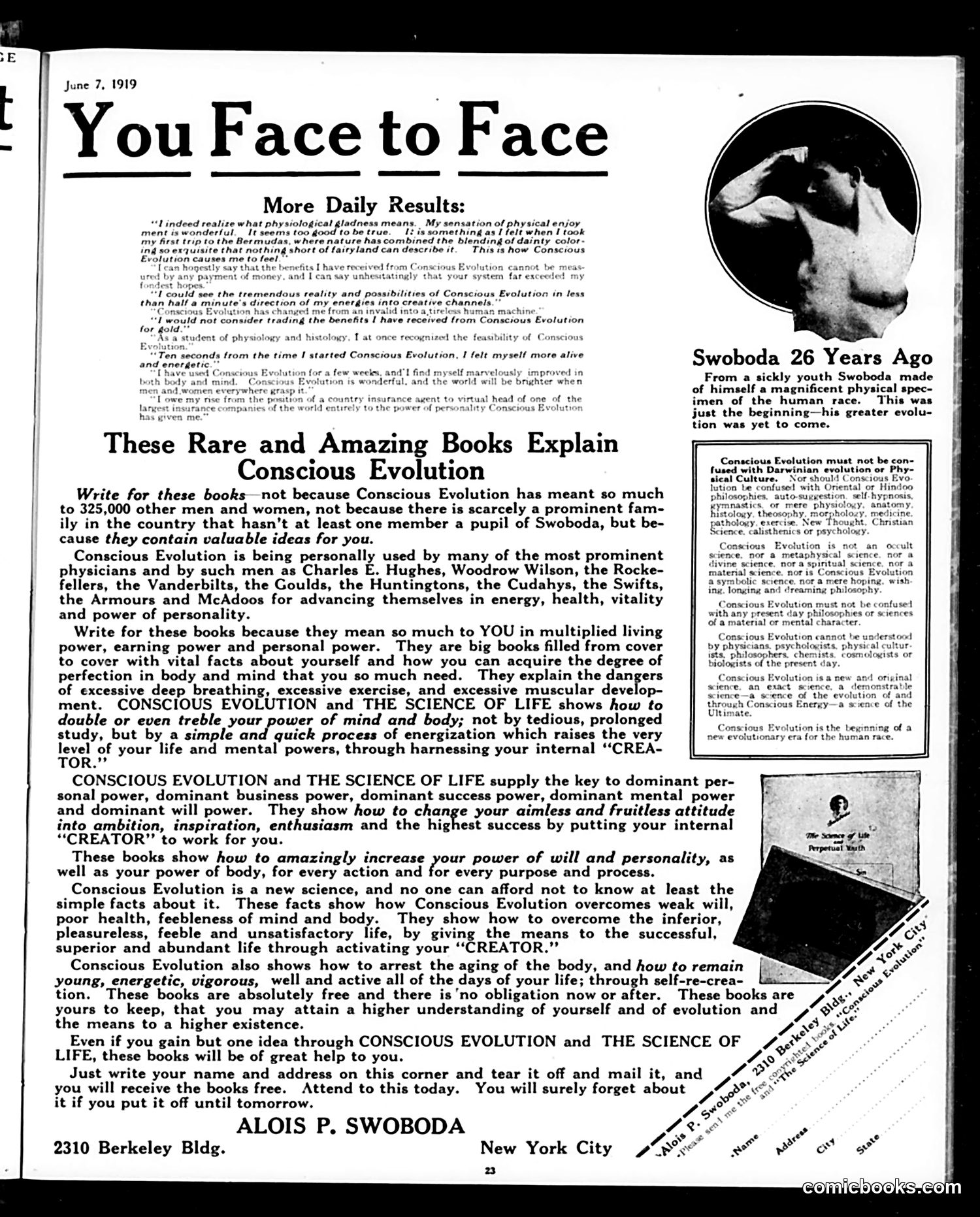
This is primarily **advertising content**, not satire or political commentary. The page promotes "Conscious Evolution," a pseudo-scientific self-help system marketed by Alois P. Swoboda. The appeal relies on early-20th-century wellness culture claims: that special breathing/energization techniques can increase willpower, health, success, and even reverse aging. The testimonial from "Swoboda 26 Years Ago" claims he transformed from "sickly youth" to physical specimen. The name-dropping of prominent figures (Woodrow Wilson, Rockefellers, Vanderbilts) appears designed to lend credibility through celebrity endorsement—a common advertising tactic then and now. **The satire**, if any exists in *Judge* magazine's context, likely mocks credulous wealthy people who fall for such schemes. However, the ad itself presents earnestly, making this primarily a **period artifact of pseudoscientific marketing** rather than satirical commentary.
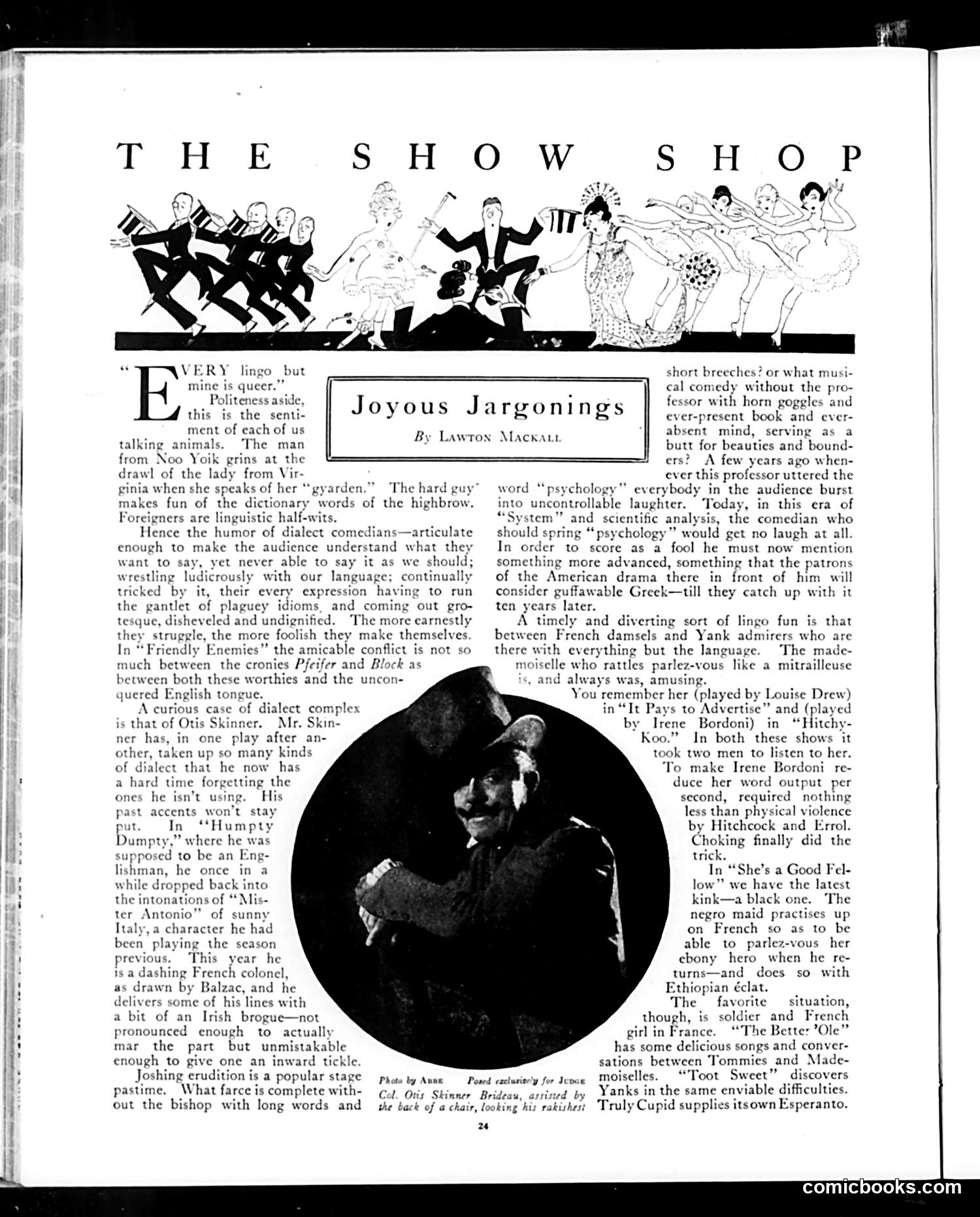
This article by Lawton Mackall celebrates the comedic tradition of dialect humor in American theater. The central joke involves performers—particularly actor Otis Skinner (pictured)—deliberately mangling English pronunciation and grammar for laughs. Mackall explains that audiences find humor in characters struggling with unfamiliar accents: Southern drawls, Irish brogues, French mademoiselles attempting English, and Black characters speaking French. The comedy lies in the contrast between what speakers *intend* to say versus their linguistic failures. Mackall notes this comedic device relies on audience superiority—laughing at characters who can't master "proper" English. He references contemporary Broadway shows featuring these stereotypes, including performers like Irene Bordoni (French accent) and Louise Drew. The article captures early 20th-century American theater's reliance on ethnic/racial caricature as entertainment, reflecting attitudes that would later be recognized as offensive. The humor depends entirely on mocking foreigners' and minorities' speech patterns.
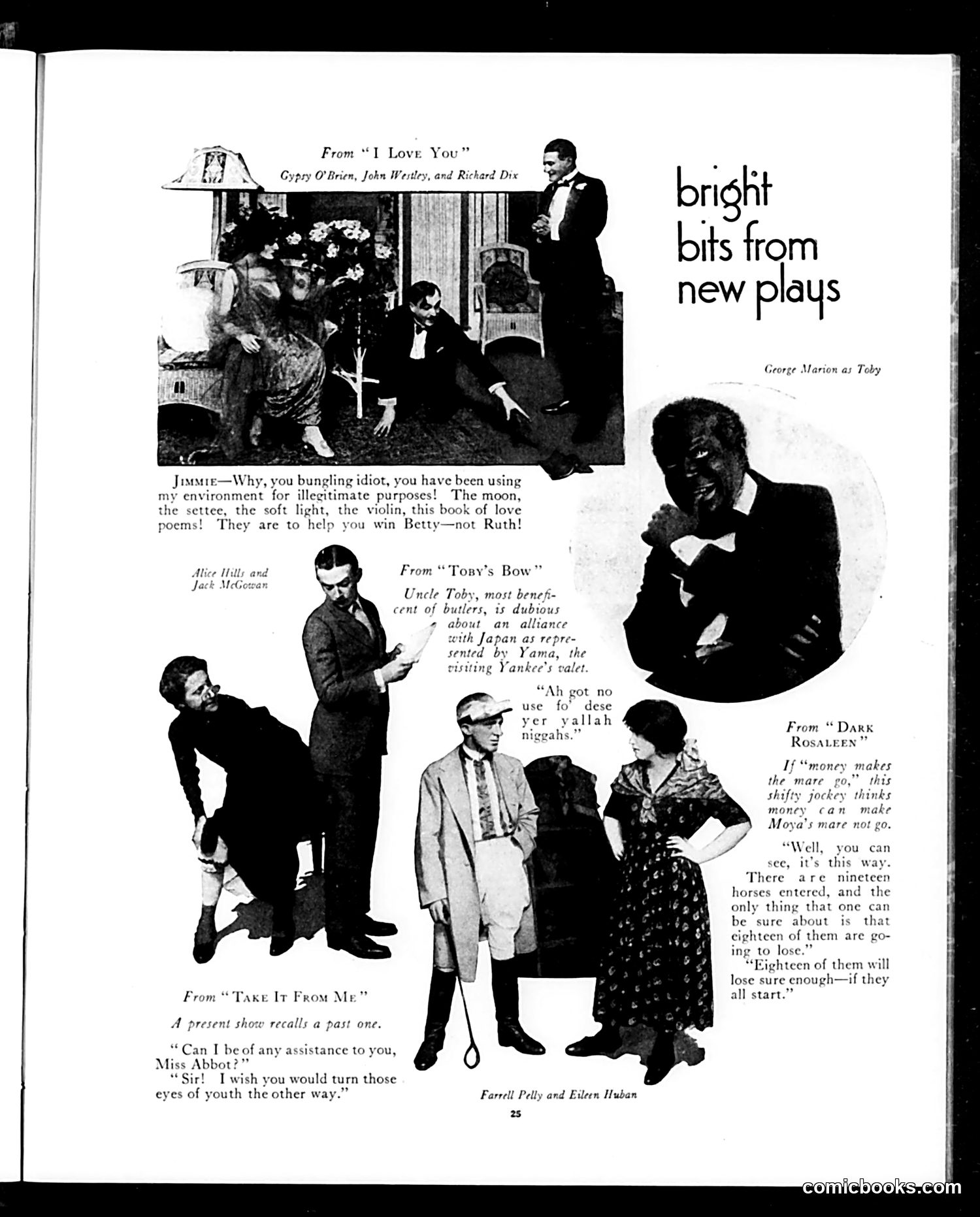
This page showcases comedic scenes from contemporary Broadway productions, likely from the 1920s. Each excerpt highlights a humorous moment: **"I Love You"**: A romantic comedy where a character has misused romantic props (moonlight, settee, violin, love poems) meant to seduce one woman to pursue another—the humor lies in the bungling of seduction strategy. **"Toby's Bow"**: Features racial humor typical of the era, with a Black butler character dismissing a Japanese valet in dialect, reflecting period prejudices about competing foreign influences. **"Dark Rosaleen"**: A gambler believes money can manipulate horse racing outcomes—the joke being his faulty logic that financial advantage guarantees victory when eighteen of nineteen horses must lose regardless. **"Take It From Me"**: A young man's youthful charm is unwelcome to a woman who wishes he'd look elsewhere. The page serves as theatrical entertainment coverage, showcasing star actors and plot devices that appealed to contemporary audiences.
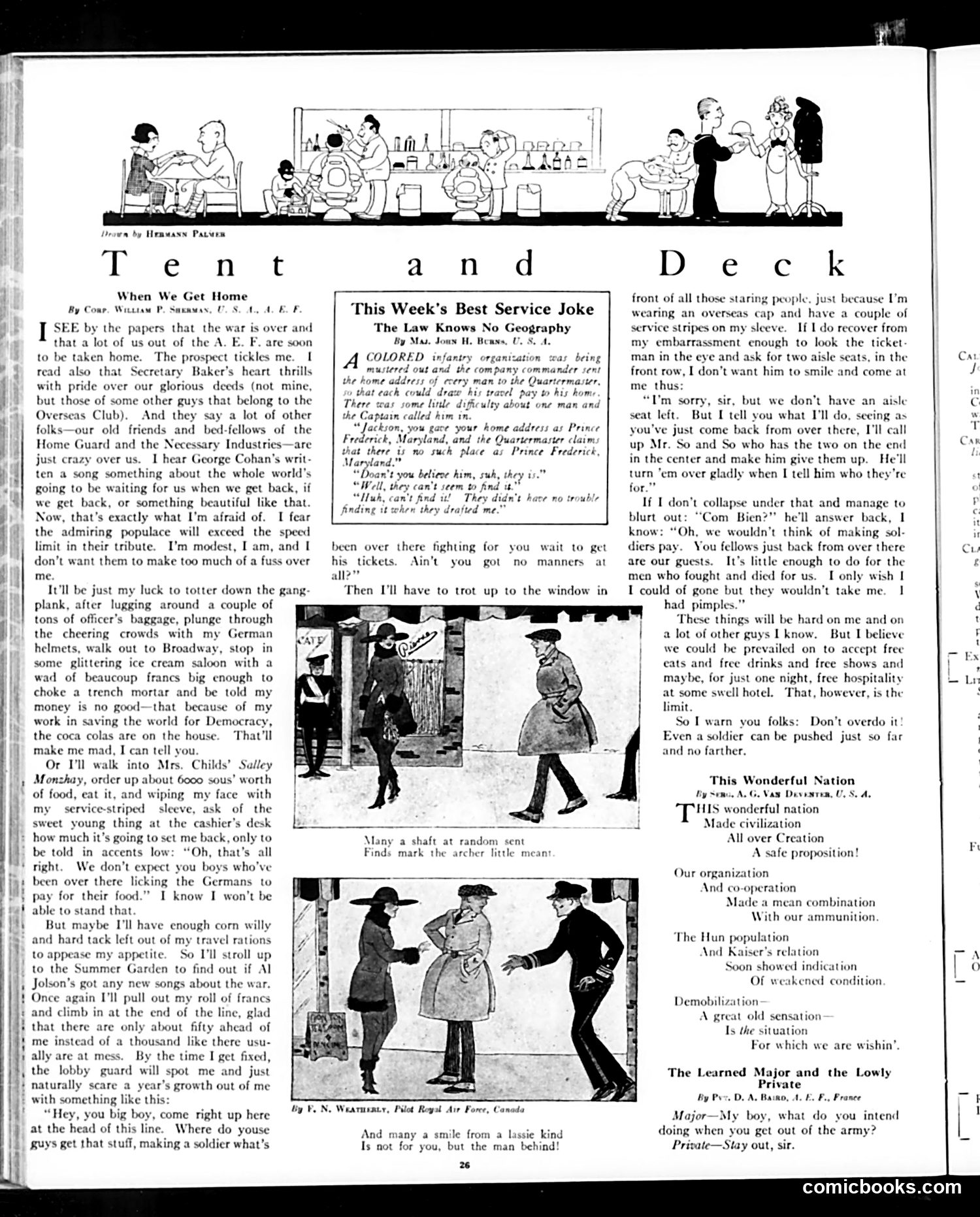
This is a WWI-era humor page from *Judge* magazine featuring soldiers returning home from overseas service. The main article, "When We Get Home," satirizes American civilian attitudes toward returning soldiers—specifically the suffocating gratitude and hero-worship the author fears will embarrass him. The soldier narrator dreads being treated as a celebrity, having free meals forced upon him, and being lionized simply for military service. The accompanying cartoons (credited to F. N. Weatherly, a Canadian pilot) illustrate military life's absurdities, including logistical confusion and romance complications. The secondary piece, "This Week's Best Service Joke," presents a racist humor bit about a Black soldier's address being questioned—typical of period publications but reflecting contemporary segregation and prejudice. The satire targets both excessive civilian sentimentality and wartime bureaucratic incompetence, using the common soldier's voice to mock jingoistic celebration.
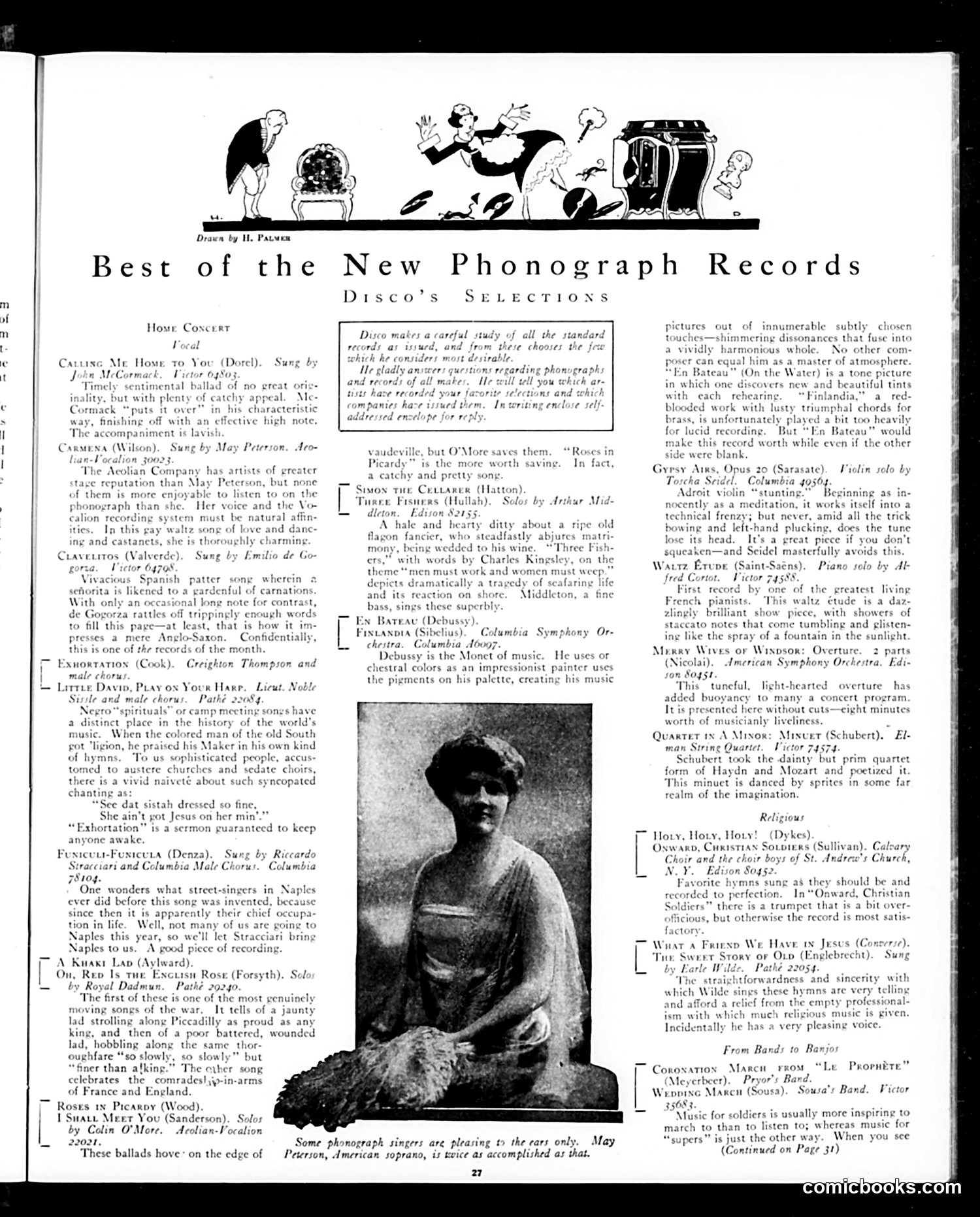
This page is **not primarily satirical content** but rather a **record review column** titled "Best of the New Phonograph Records: Disco's Selections." The **cartoon header** (drawn by M. Palwen) shows a humorous domestic scene: a man listening to phonograph music while his family members react with exaggerated physical comedy—people flying through the air, furniture overturning—suggesting the music's powerful or chaotic effect on the household. The **reviews themselves** discuss vocal and instrumental recordings, focusing on singers like John McCormack and discussing pieces like "Carry Me Home," war songs, and religious hymns. The text evaluates both musical quality and recording clarity. **The implicit satire**: the contrast between the genteel, serious tone of the written reviews and the violent domestic chaos depicted in the cartoon—suggesting that even "refined" music played at home volume can be comically disruptive. This reflects early 1900s attitudes toward the still-novel technology of recorded sound and its domestic intrusion.
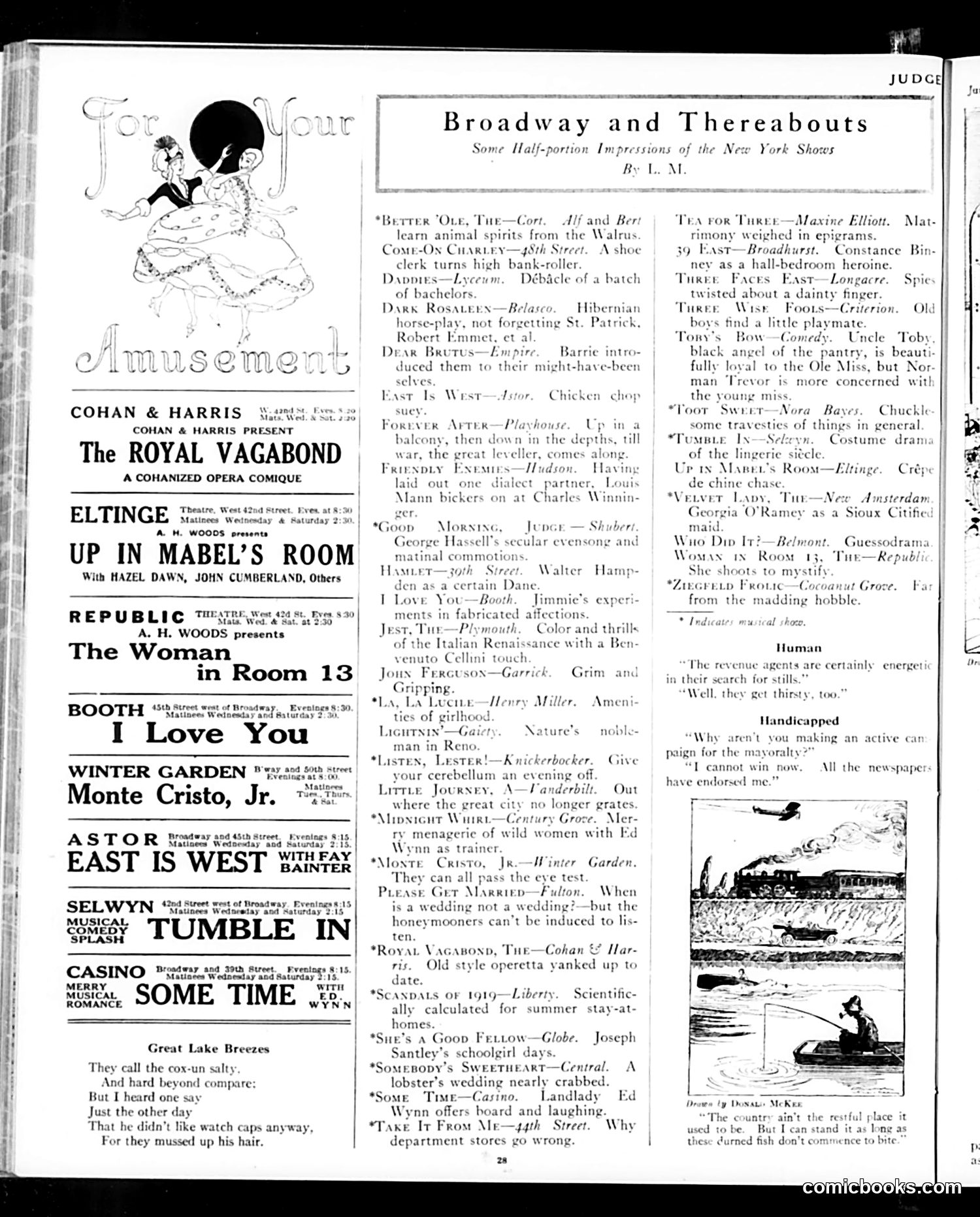
This is primarily a **theater advertising and review page** from Judge magazine, featuring listings and brief critiques of Broadway shows circa 1919-1920. The small illustrated vignette at top left appears to be decorative artwork typical of Judge's satirical style, showing figures in an "Amusement" section header. The bulk of the page contains: - **Theater advertisements** (The Royal Vagabond, Up in Mabel's Room, The Woman in Room 13, etc.) with performance details - **"Broadway and Thereabouts"** — a column of brief, witty reviews of current shows, using theatrical shorthand and insider humor - A humorous poem, "Great Lake Breezes," about sailors and watch caps The reviews employ Judge's characteristic style: sardonic one-liners mocking plots and performances. For instance, *Please Get Married* is dismissed: "When is a wedding not a wedding?—but the honeymooners can't be induced to listen." The **"Handicapped" section** features jokes about Prohibition-era revenue agents searching for illegal stills—contemporary social commentary disguised as vaudeville humor. This page reflects Judge's dual purpose as both entertainment guide and satirical commentary on New York theater and society.
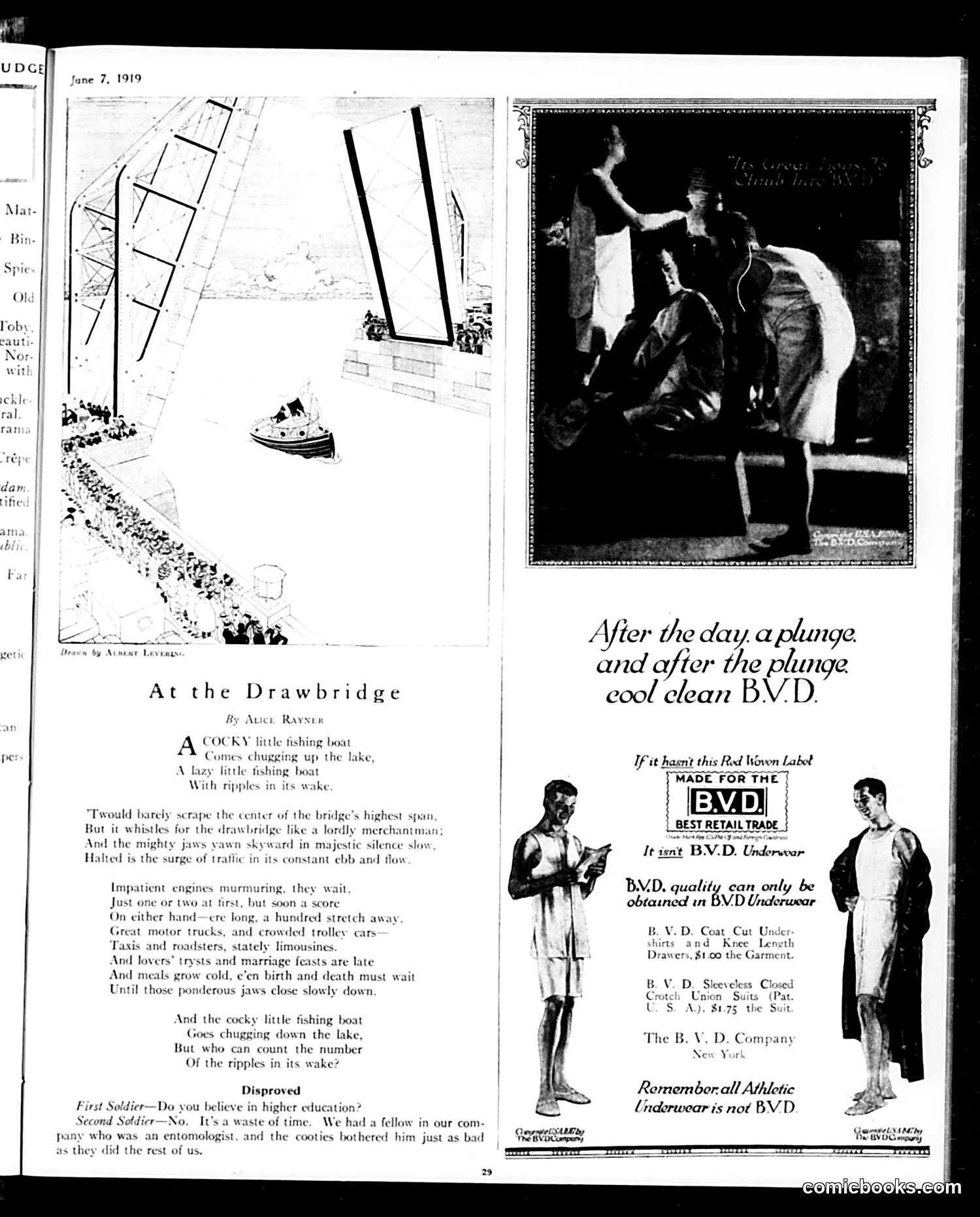
This page contains a poem "At the Drawbridge" by Alice Rayner (left) and a BVD underwear advertisement (right), with a brief soldier joke at bottom. **The Poem's Social Satire:** "At the Drawbridge" critiques urban inconvenience and class priorities. A small fishing boat causes a drawbridge to raise, halting significant traffic—motor trucks, trolleys, taxis, and people with important commitments (business, marriage feasts, births, deaths). The poem's irony: this minor vessel creates massive disruption for ordinary citizens, suggesting that individual privilege or obstruction can override collective needs. It reflects post-WWI anxieties about traffic congestion and modern urban disorder in growing American cities. **The Advertisement:** BVD promotes "athletic underwear" with quality assurances and pricing ($1.75-$1.00), using images of men in undergarments. **The Soldier Joke:** Two soldiers debate higher education's value. One claims it's wasteful; his evidence: an educated entomologist in their company was infested with lice ("cooties") just like everyone else—implying education offers no practical advantage in wartime conditions.
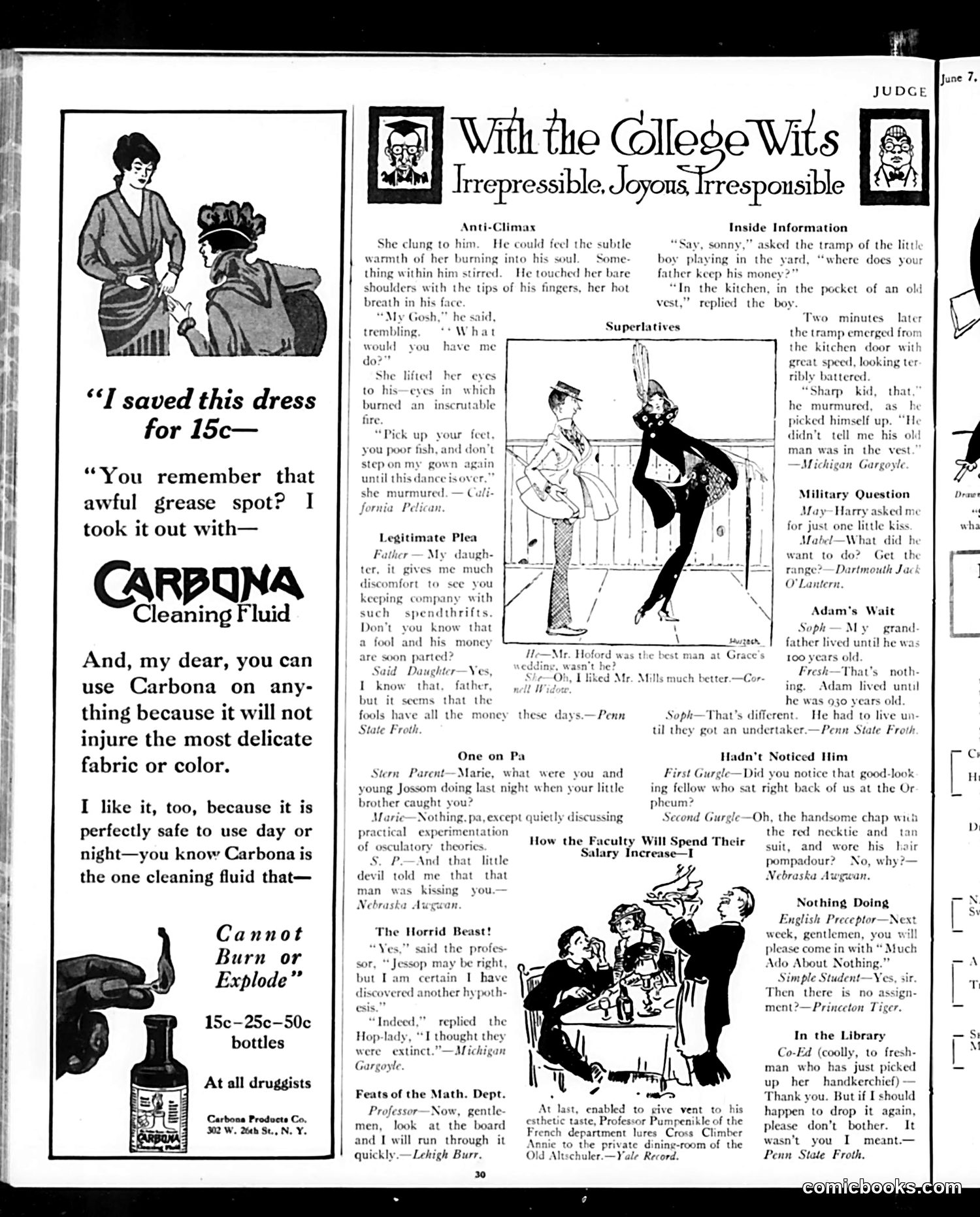
This page is primarily **advertising with sidebar humor content**. The dominant feature is a Carbona Cleaning Fluid advertisement (left side) using a domestic scenario—a woman who saved money by removing a grease stain—to sell the product as safe and non-flammable. The right side contains a humor column titled "With the College Wits: Irrepressible, Joyous, Irresponsible," featuring brief jokes from college magazines. These satirize undergraduate life through recurring tropes: romantic clichés ("Anti-Climax" mocks overwrought passion), parental disapproval of dating, professorial absent-mindedness, and student laziness. The humor relies on gentle mockery of courtship customs, academic pretension, and generational friction typical of 1920s college culture. The jokes assume a male undergraduate readership familiar with campus publications and social conventions of the era.
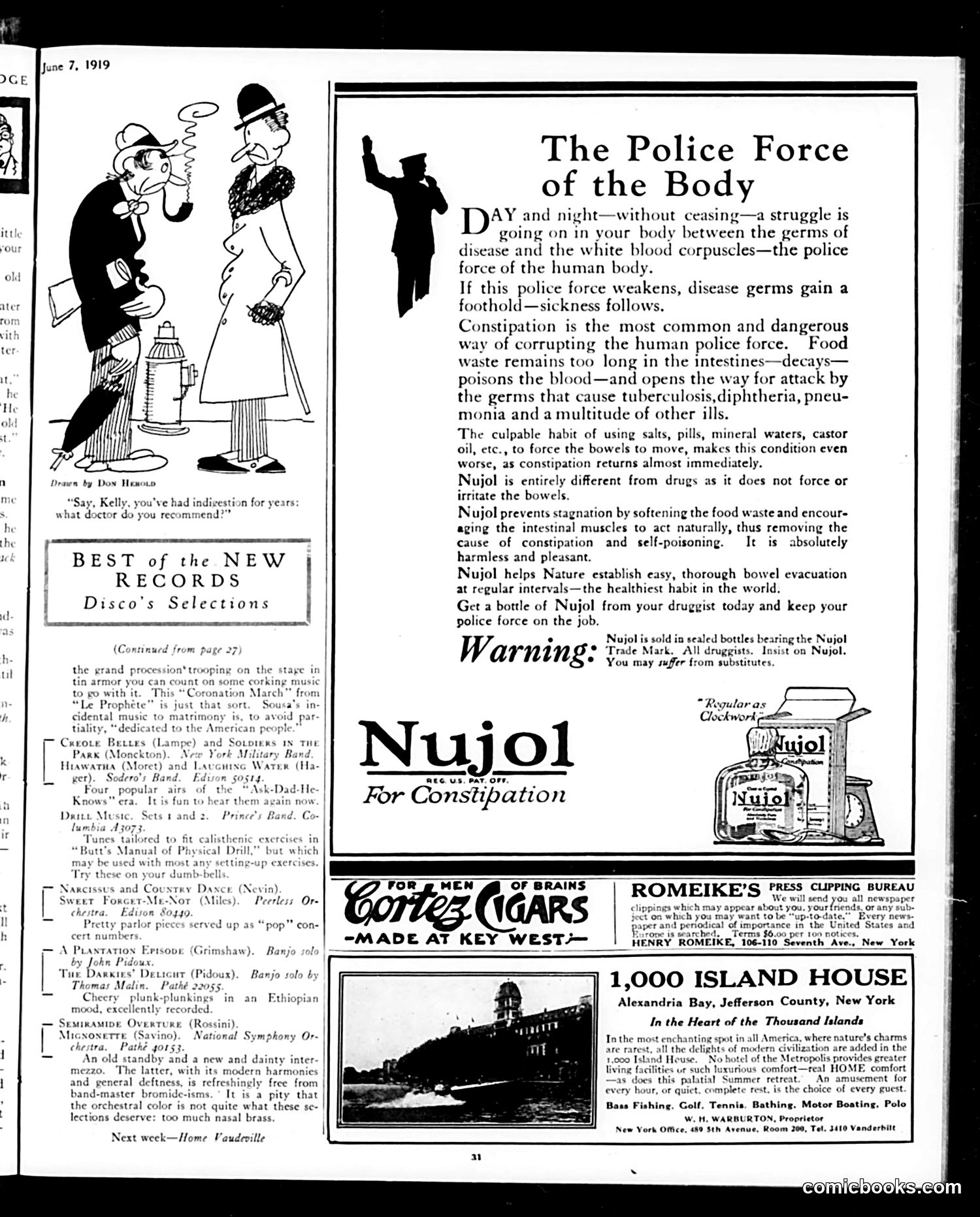
The page is primarily a **full-page advertisement** for Nujol (a mineral oil laxative), though it opens with a small cartoon by Dow Henoon. ## The Cartoon The cartoon shows two figures in conversation—appears to be a patient ("Kelly") speaking with a doctor or authority figure about a medical recommendation. The joke is visual setup for the advertisement below. ## The Advertisement The Nujol ad uses a metaphorical "Police Force of the Body" conceit: white blood corpuscles are portrayed as internal police fighting disease germs. The pitch claims **constipation weakens this police force**, allowing illness to flourish. Nujol distinguishes itself as superior to competing laxatives (salts, pills, castor oil) by claiming it works *naturally* without forcing or irritating the bowels—softening waste instead of forcing movement. The ad emphasizes Nujol is "harmless and pleasant" and urges readers to "keep your police force on the job." The remaining page content includes music reviews and other period advertisements (Cortes Cigars, 1,000 Island House resort).
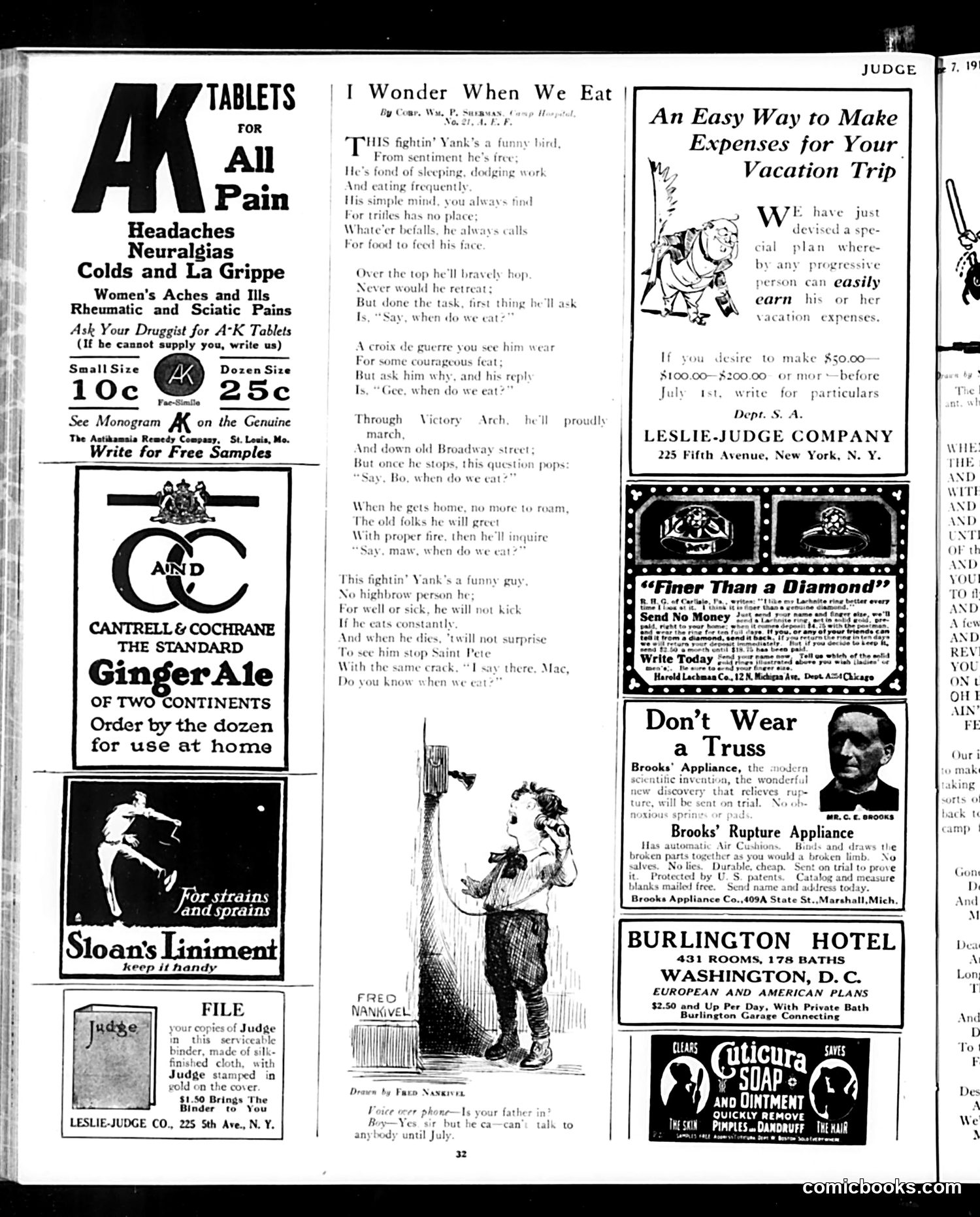
**Main Content:** This page is dominated by advertisements for patent medicines and services, with one central cartoon titled "Wonder When We Eat." **The Cartoon:** Illustrator Fred Nanivel depicts an American WWI soldier in military uniform. The satire mocks the soldier's singular preoccupation with food. Despite being a decorated war hero ("croix de guerre"), marching through Victory Arch, and parading down Broadway, the soldier's repeated refrain is "Gee, when do we eat?" **The Point:** This is lighthearted mockery of American soldiers' notorious complaints about Army rations and feeding schedules during WWI. It suggests that even patriotic celebration cannot overshadow a soldier's basic hunger and practical concerns. The joke reflects contemporary attitudes toward doughboys—portraying them as simple, food-focused rather than idealistic about military glory. **Historical Context:** Published during or shortly after WWI, this reflects American popular culture's treatment of returning soldiers with genial humor rather than serious reflection.
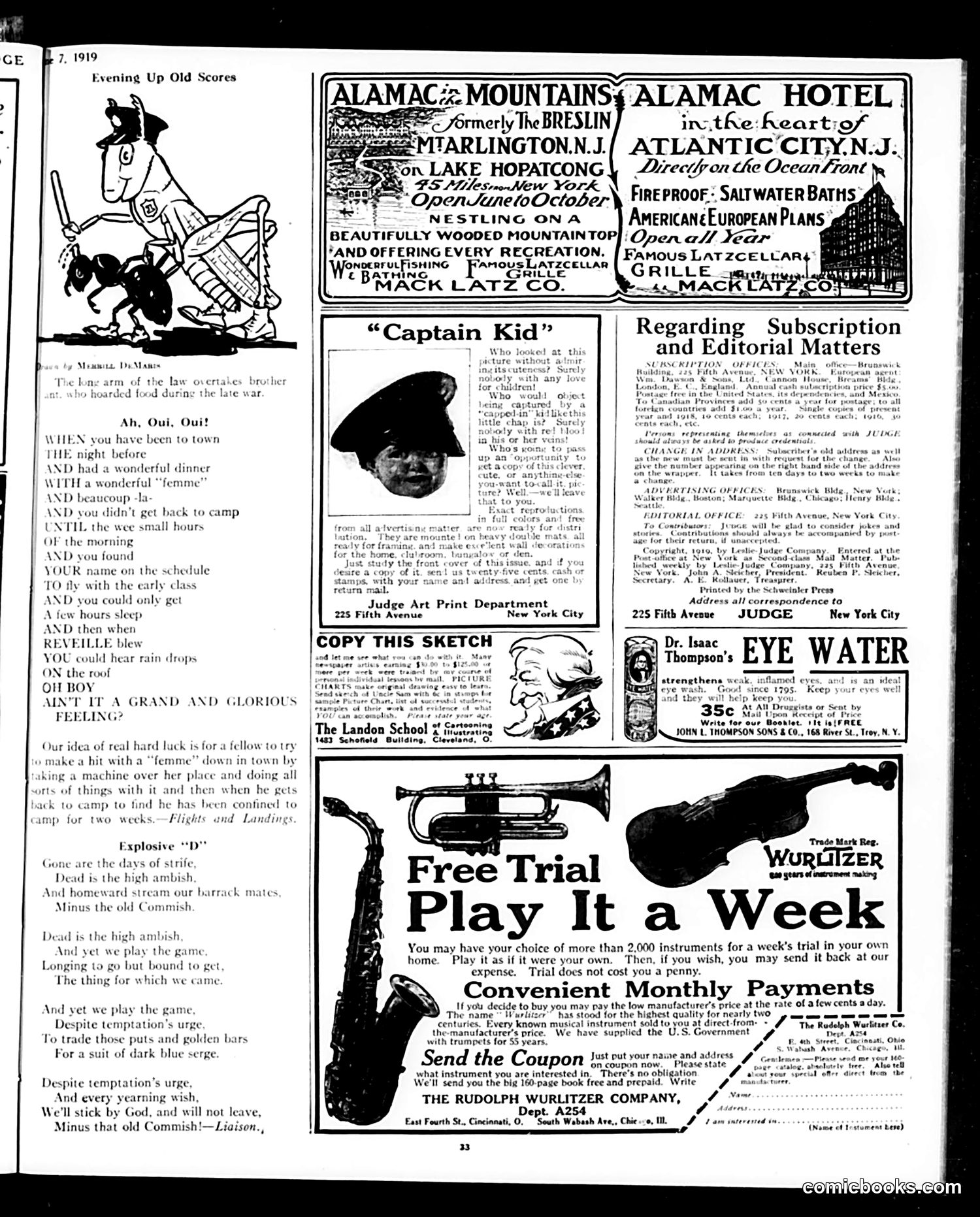
This page primarily contains **advertisements and filler content** rather than significant political satire. The main editorial content is a poem titled **"Ah, Oui, Oui!"** satirizing **American soldiers returning from World War I**. The joke concerns a soldier who had a night of romance and dining ("wonderful 'femme'") in town, returned to camp in the early morning hours exhausted, then discovered his name on the flight roster for that day—forcing him to fly combat missions while sleep-deprived and hungover. The repeated refrain "AIN'T IT A GRAND AND GLORIOUS FEELING?" is sardonic. The poem also includes verses about temptation to abandon military service for civilian life ("suit of dark blue serge"), suggesting soldiers faced pressure to desert post-war. The cartoons themselves are crude, and the rest of the page is dominated by hotel advertisements (Alamac Mountains, Atlantic City) and product ads (Wurlitzer instruments, Dr. Thompson's Eye Water). The satire targets the **difficulties of military discipline during demobilization**, not politics per se.
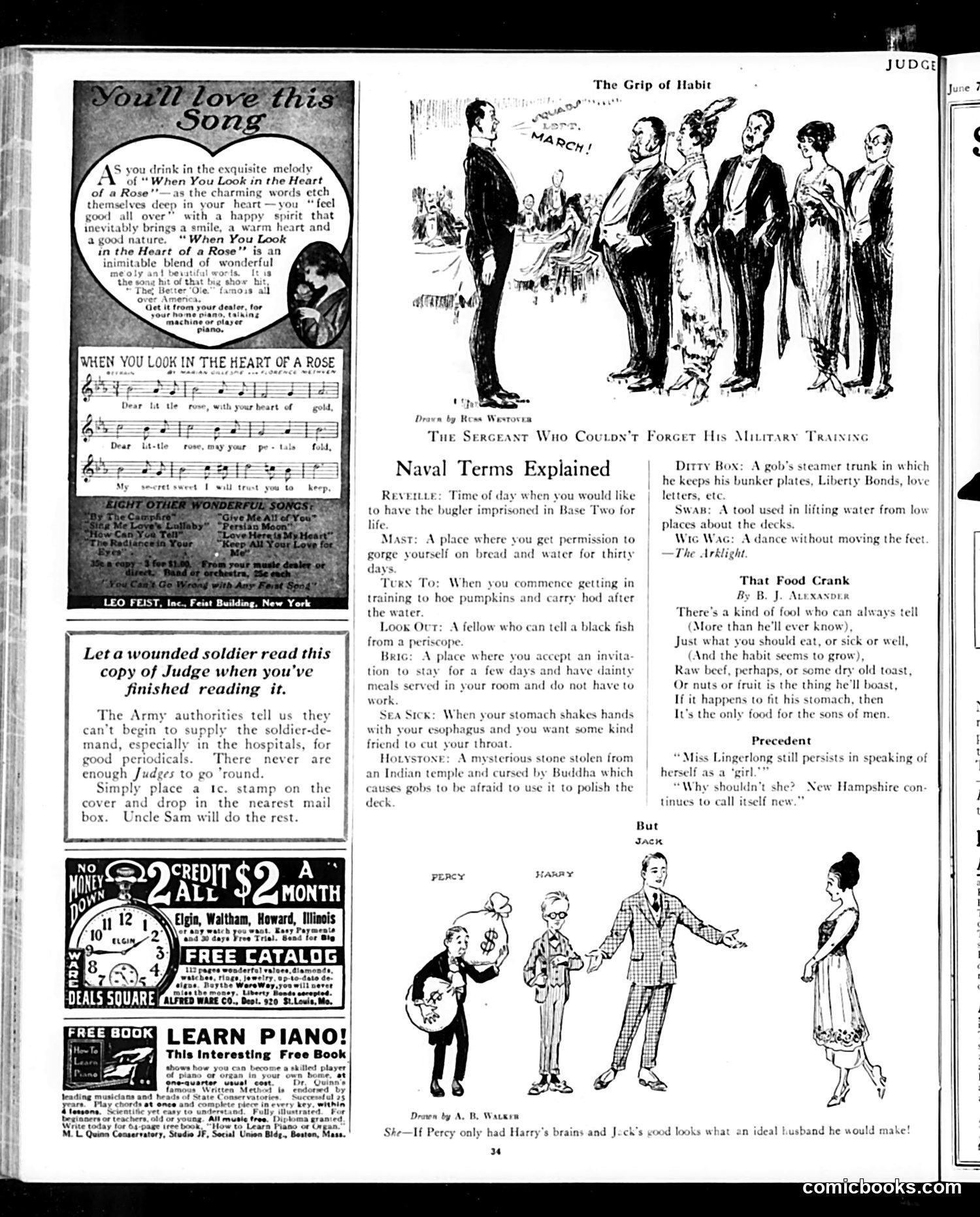
This page contains several satirical elements typical of early 20th-century Judge magazine: **"The Grip of Habit"** (top cartoon): Shows a military sergeant unable to shake his drill-sergeant mannerisms at a social gathering, greeting civilians as if they were recruits. The joke satirizes how military training becomes ingrained habit. **"Naval Terms Explained"**: A humor piece mocking naval jargon by offering deliberately absurd definitions (e.g., "Mast" = bread-and-water punishment; "Sea Sick" = wanting someone to cut your throat). This satirizes military bureaucracy's incomprehensible terminology. **"But Jack"** (bottom cartoon): A commentary on courtship and marriage prospects, where the woman imagines an "ideal husband" combining different men's best qualities—satirizing women's romantic expectations. **Public Service Appeal**: The "wounded soldier" box requests readers donate finished copies to hospitals, reflecting WWI-era patriotic messaging. The overall page reflects post-WWI American humor, mixing military satire with domestic comedy, alongside period advertisements.
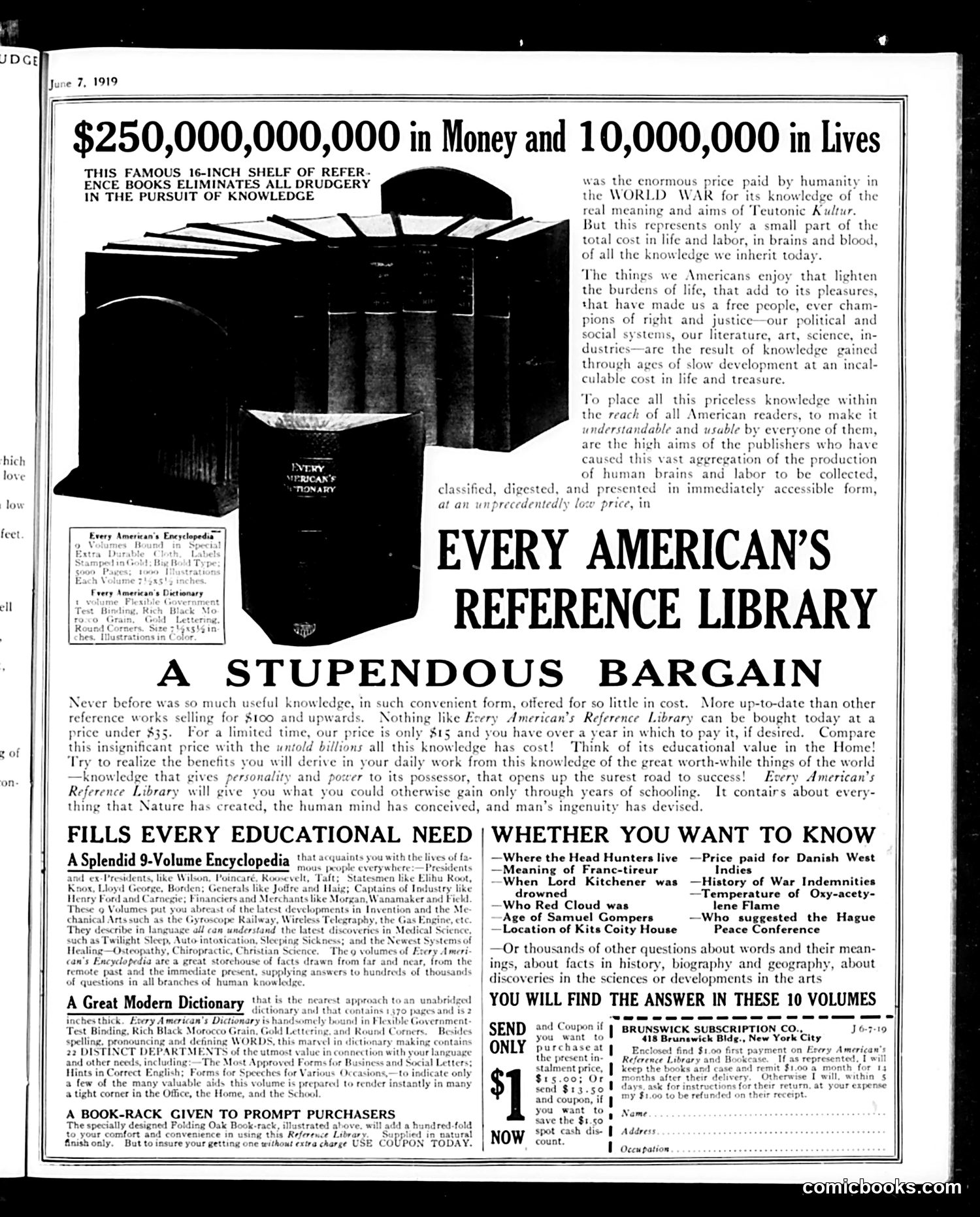
This is primarily a **commercial advertisement**, not a political cartoon. It promotes a 10-volume encyclopedia and dictionary set called "Every American's Reference Library" at the "stupendous bargain" price of $15 (payable over a year). The ad uses **patriotic and post-WWI rhetoric** to justify the product's value. It frames knowledge acquisition as fulfilling American ideals of democracy and progress, referencing the "$250 billion" and "10 million lives" lost in World War I as context—positioning this reference set as democratizing the knowledge that cost humanity so dearly. The advertisement emphasizes accessibility: knowledge "understandable and usable by everyone" rather than confined to the wealthy. Sample queries listed (about Lord Kitchener, head hunters, war indemnities) reflect contemporary post-war interests. The page includes sample entries about famous figures like Wilson, Roosevelt, and industrial leaders, positioning the encyclopedia as modern and comprehensive. This represents early 20th-century **direct-mail marketing** leveraging patriotism and educational aspiration.
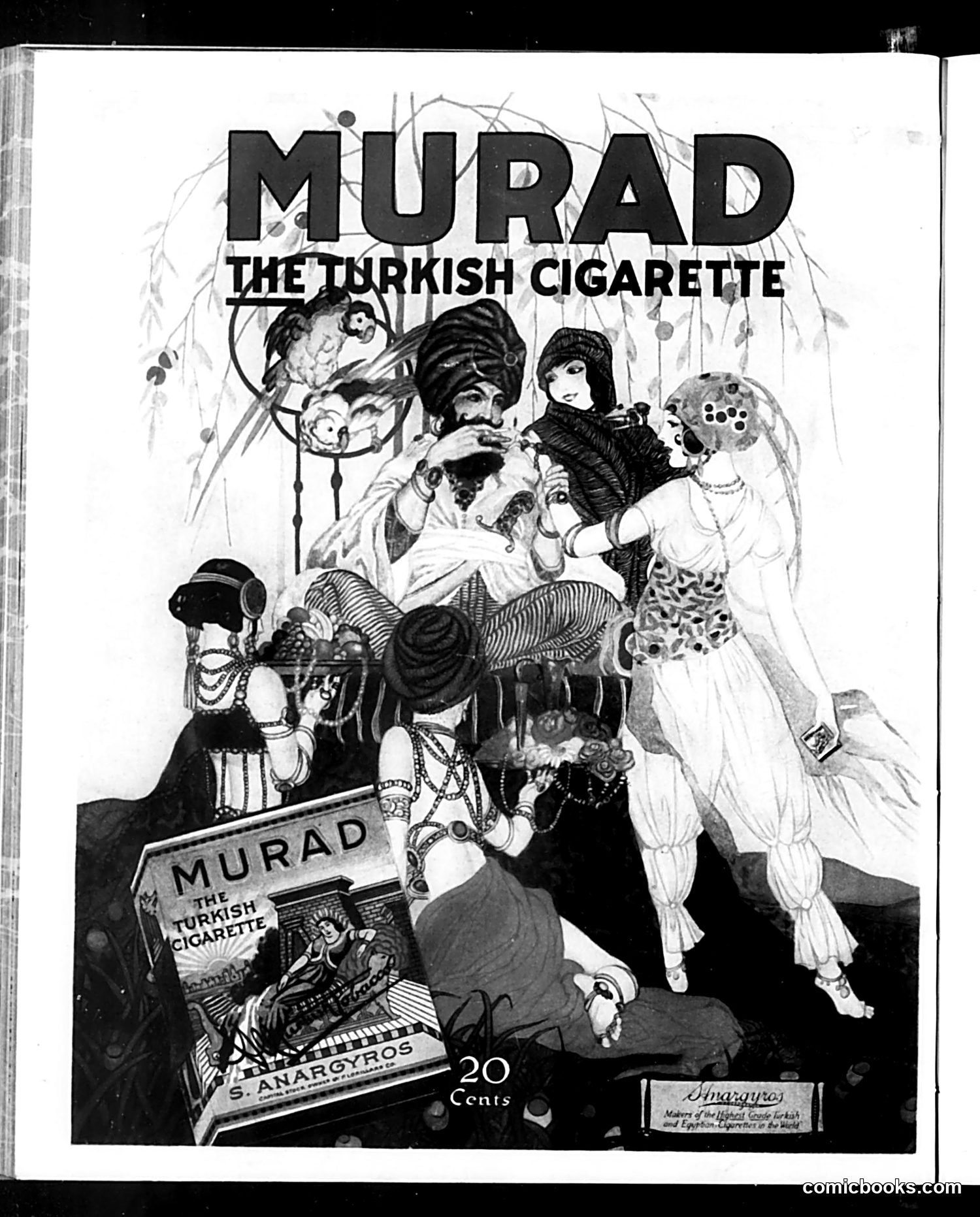
This is a cigarette advertisement rather than political satire. The page promotes "Murad: The Turkish Cigarette," priced at 20 cents, manufactured by S. Anargyros. The imagery depicts an orientalist fantasy scene featuring figures in exotic Turkish/Middle Eastern dress and styling—turbans, jeweled garments, and theatrical poses beneath drooping willows. This represents early 20th-century Western commercialism exploiting "Oriental" mystique to market products. The elaborate illustration aims to associate the cigarette brand with luxury, sophistication, and exotic appeal—common advertising tactics of the era. The artwork is purely decorative marketing, not satirical commentary, reflecting period attitudes toward non-Western cultures as exotic consumer fantasies.