
A complete issue · 32 pages · 1919
Judge — May 17, 1919
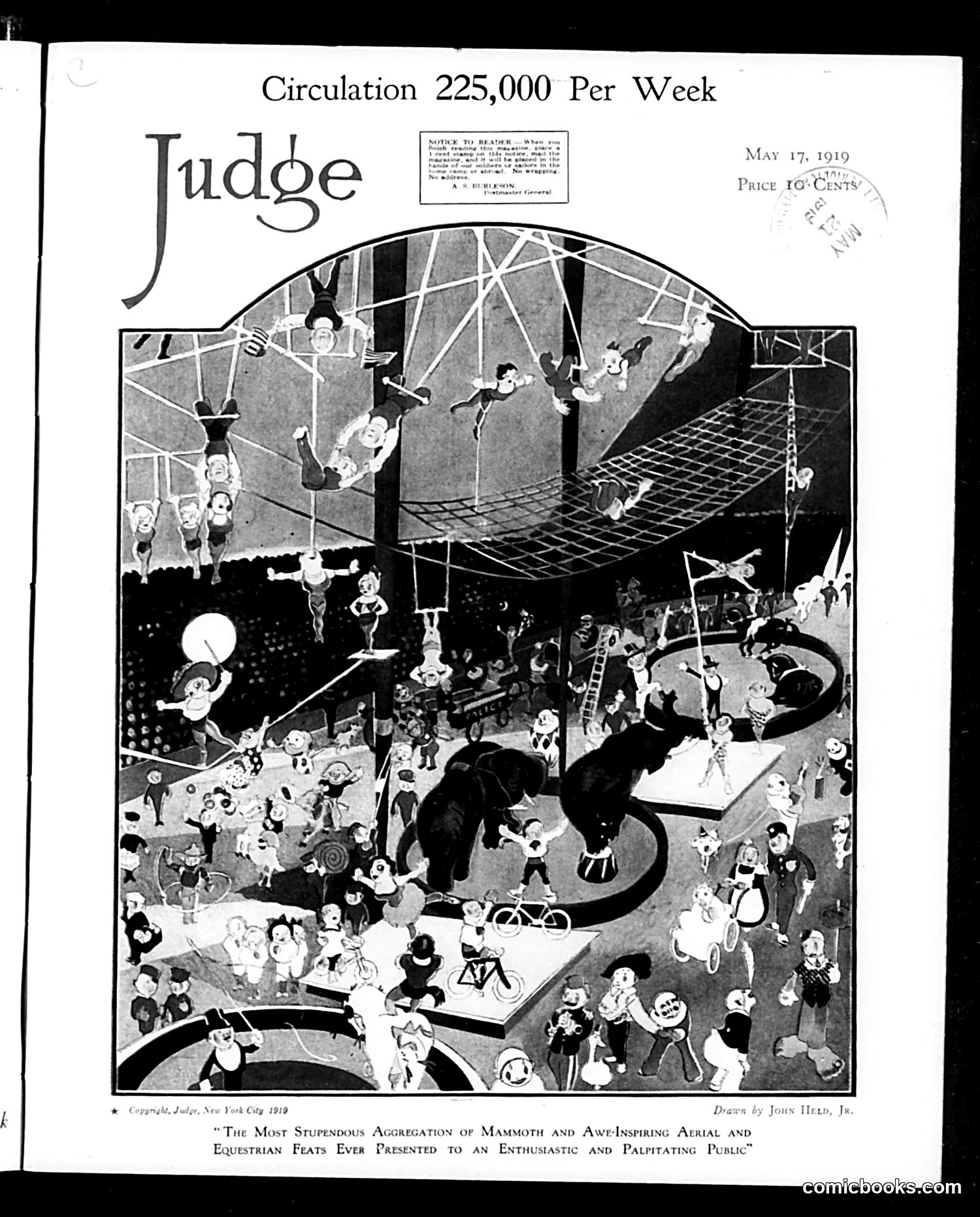
This full-page illustration by John Held Jr. depicts a fantastical circus scene featuring elephants and acrobats performing aerial and equestrian feats. The caption describes it as "The Most Stupendous Aggregation of Mammoth and Awe-Inspiring Aerial and Equestrian Feats Ever Presented to an Enthusiastic and Palpitating Public." The cartoon appears to be pure entertainment rather than political satire—a whimsical depiction of circus spectacle with numerous performers, audiences, and animals in an elaborate tent setting. The intricate detail and crowded composition showcase Held's characteristic style. Given the 1919 date, this likely represents escapist leisure content during the post-WWI period, rather than commentary on contemporary events or politics.
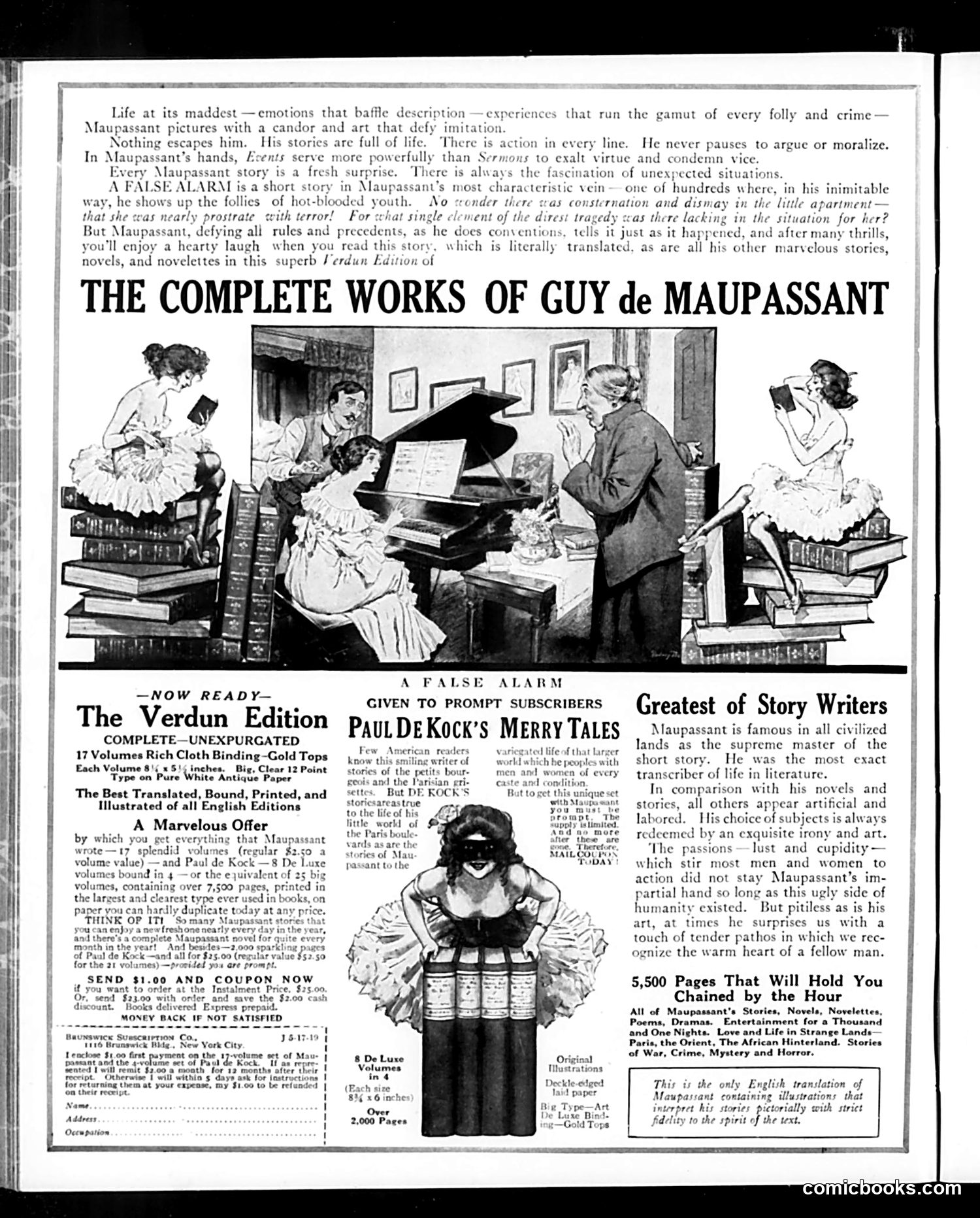
This page is primarily a **book advertisement**, not political satire. It promotes "The Complete Works of Guy de Maupassant" in the Verdun Edition—a 17-volume collection. The illustrations depict **domestic scenes of leisured reading**: women and men in parlors with books and pianos, emphasizing the refined, cultured nature of the collection. The central image shows a woman reading Maupassant's works. The ad emphasizes Maupassant's reputation as the "Greatest of Story Writers" and highlights the edition's features: unexpurgated text, cloth binding with gold tops, and 5,500 pages covering "all of Maupassant's stories, novels, novelettes, poems, dramas." A subscription coupon appears at bottom left. This represents typical Judge magazine advertising targeting educated, middle-class readers with disposable income for luxury book purchases.
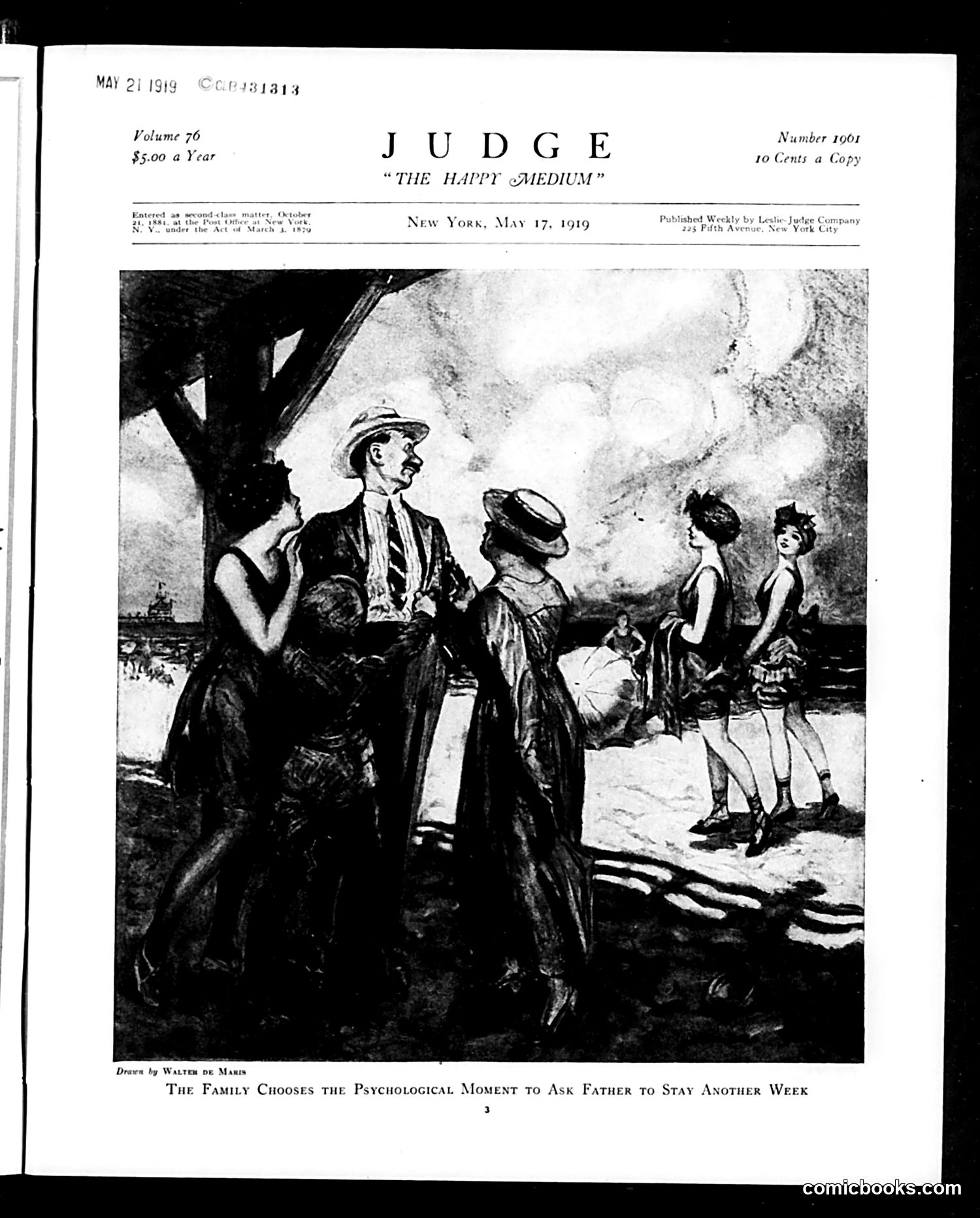
This illustration by Walter de Maris depicts a family at what appears to be a beach or seaside setting. The caption reads: "The Family Chooses the Psychological Moment to Ask Father to Stay Another Week." The satire targets domestic dynamics and gender relations in early 20th-century America. A man in business attire appears pressured by women—likely his wife and daughters—using strategic timing ("psychological moment") to extend a family vacation. The joke reflects period anxieties about masculine authority being undermined by female persuasion and manipulation within family structures. This represents common Judge magazine humor about marital power dynamics, presenting wives as cunning strategists exploiting their husbands' weaknesses, particularly regarding leisure time and domestic decision-making.
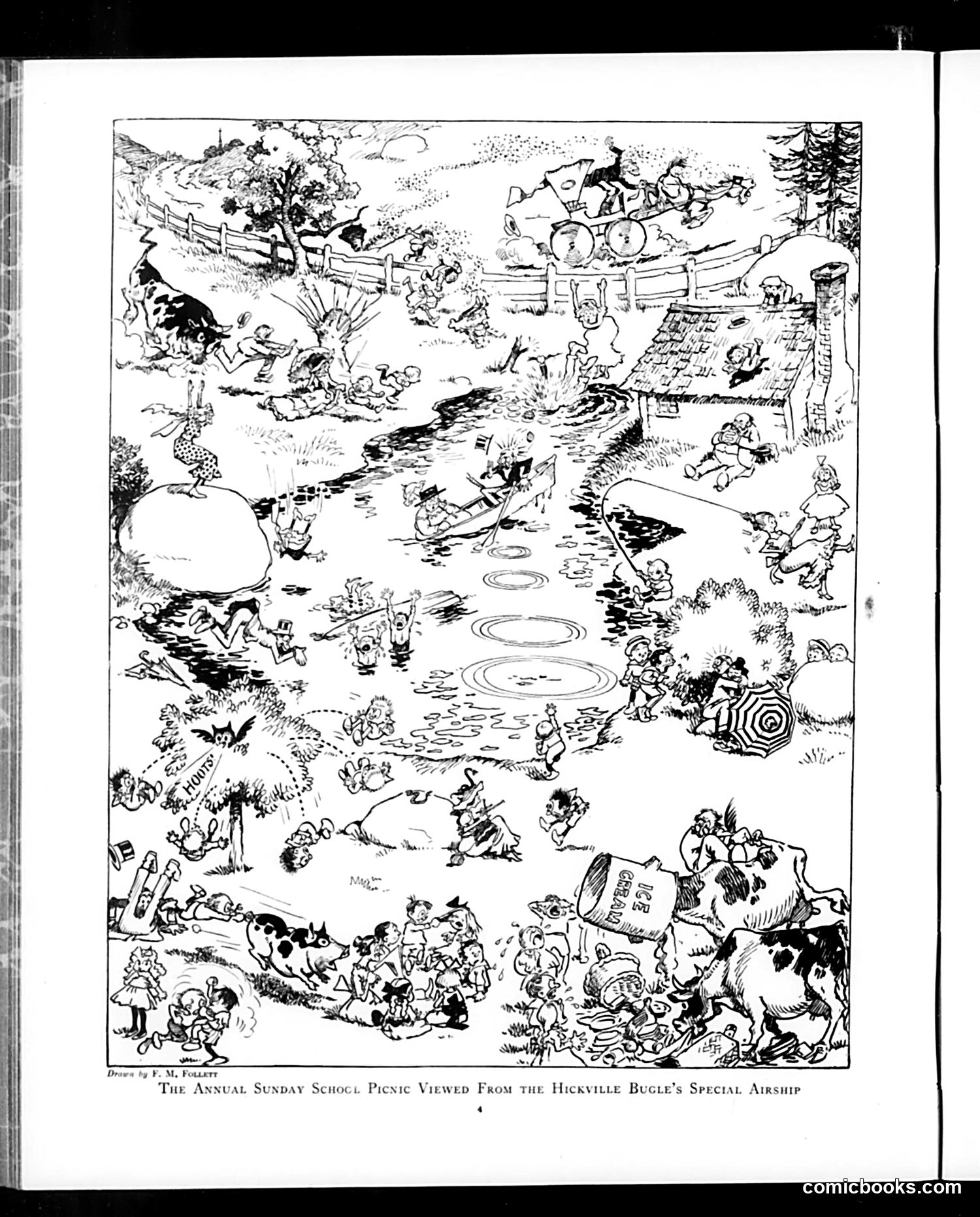
This is a whimsical cartoon titled "The Annual Sunday School Picnic Viewed From the Hickville Bugle's Special Airship," drawn by F. M. Follett. The image depicts a chaotic bird's-eye view of a countryside picnic scene. Numerous children and adults are scattered across the landscape engaging in various activities—playing games, swimming in a pond, eating, and general recreation around fences, trees, and picnic structures. The satire appears gentle rather than pointed: the "airship" vantage point was a novelty in the early 20th century, and the joke likely plays on how a local newspaper (the "Hickville Bugle") might humorously present an aerial view of an ordinary small-town event using this exciting new perspective. The densely-packed, chaotic composition emphasizes the humorous contrast between the orderly intentions of a Sunday school picnic and the actual pandemonium created by numerous excited children.
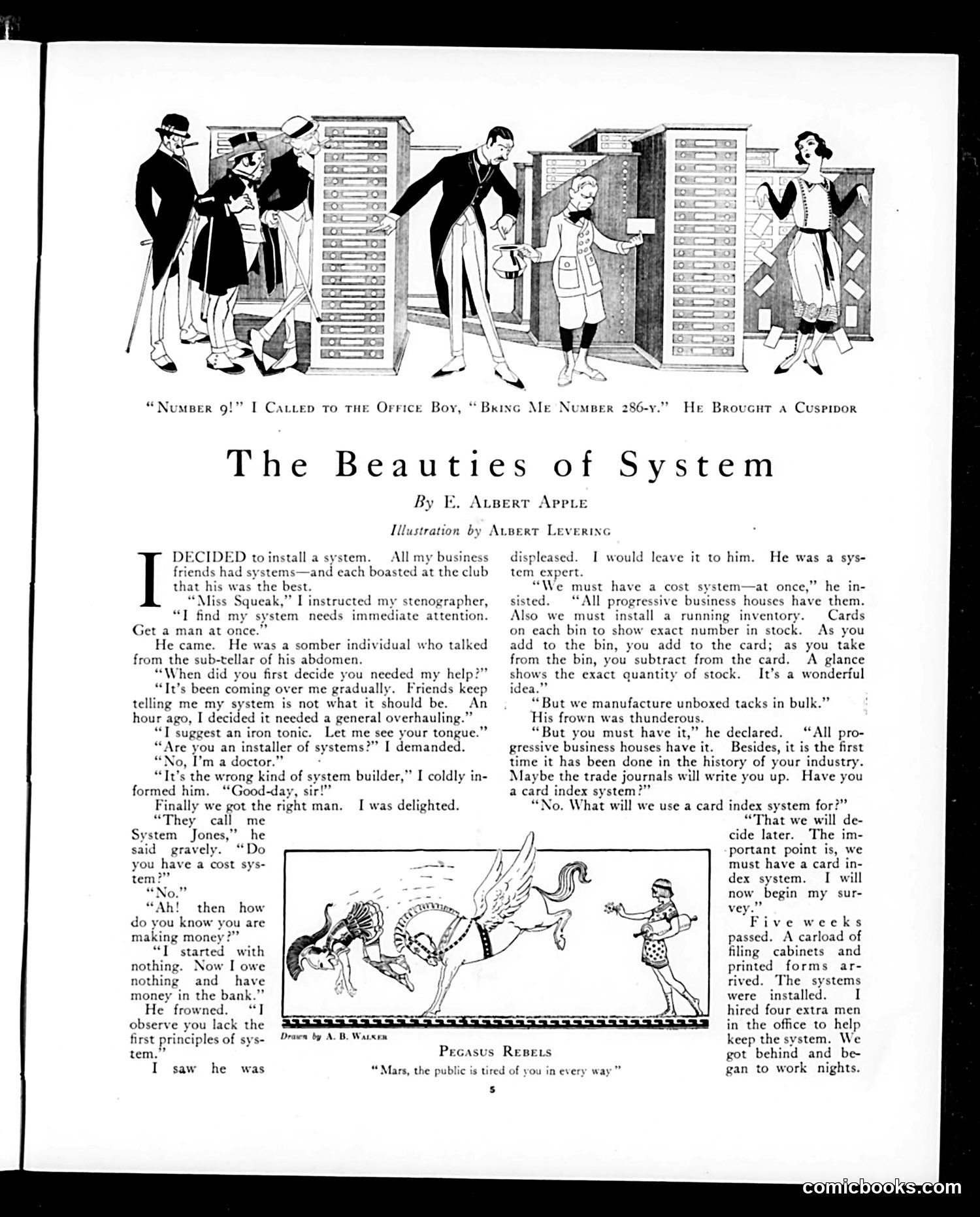
This is a satirical article by E. Albert Apple about business management efficiency. The top illustration shows office workers managing filing cabinets and card index systems—the "beauties of system" referenced in the title. The main text describes a narrator who hires a systems expert to reorganize his struggling business. The expert insists on implementing cost controls and inventory management using card index systems—then modern innovations in business organization. The embedded cartoon labeled "Pegasus Rebels" (drawn by A.B. Walker) shows Pegasus, the mythical winged horse, being controlled by Mars (god of war). The caption "Mars, the public is tired of you in every way" appears to be separate political commentary, likely about militarism or war. The satire likely mocks both overzealous system-building and contemporary attitudes toward organization and control in business.
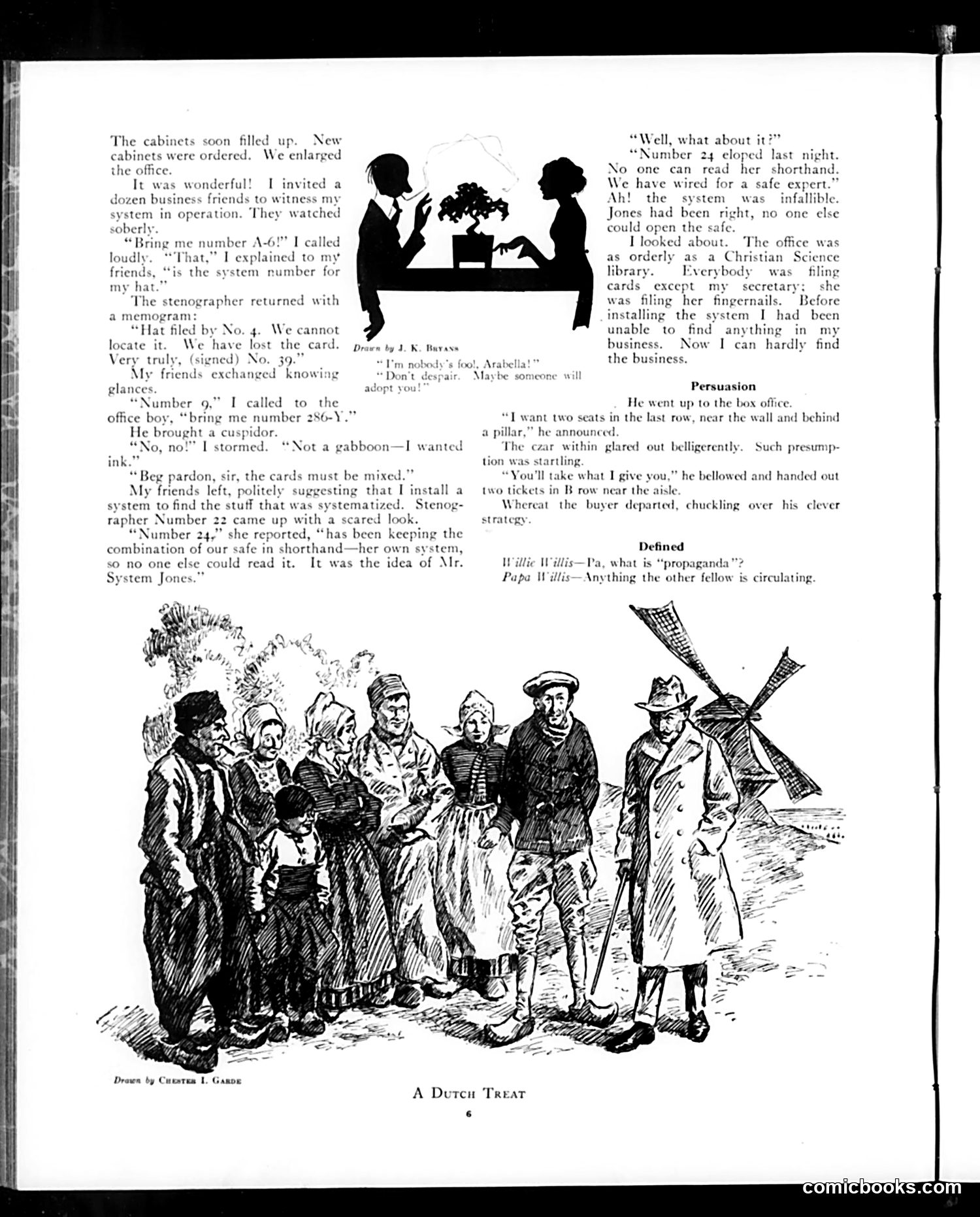
The page contains two distinct sections: **Upper portion**: A business office satire about implementing a filing system. The narrator struggles with an inefficient card-cataloging setup that's supposed to organize office records but instead creates chaos. The humor derives from the clash between modern "systematized" office management and practical reality—the system is so complicated that no one can actually use it. **Lower illustration**: "A Dutch Treat," drawn by Cesare L. Gambe, depicts a group of people (appearing to be Dutch, based on period clothing and a windmill) sharing food. The term "Dutch treat" refers to an outing where each person pays their own way—a satirical commentary on frugality or stinginess, likely poking fun at Dutch cultural stereotypes popular in early 20th-century American humor.
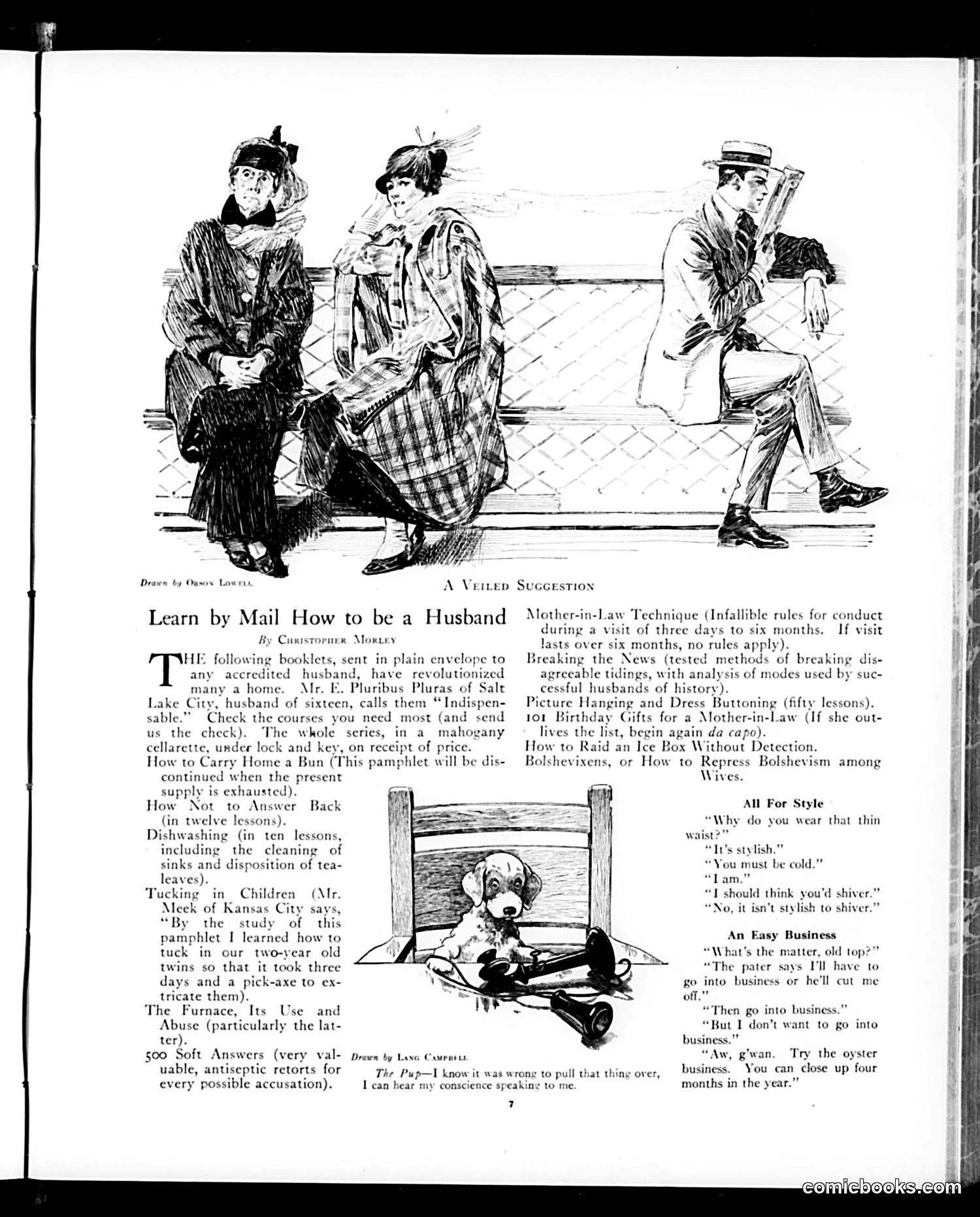
This satirical piece mocks early 20th-century mail-order correspondence courses—a real phenomenon—by imagining absurd instructional booklets for husbands. The humor targets domestic incompetence: men unable to perform basic household tasks (dishwashing, tucking in children, hanging pictures) or manage wives and mothers-in-law. The reference to "Bolshevixens, or How to Repress Bolshevism among Wives" likely alludes to post-WWI anxiety about women's independence and suffrage movements, sarcastically framing assertive women as revolutionary threats. The accompanying dog cartoon and "All For Style" dialogue mock superficial fashion choices (thin waists despite cold), while "An Easy Business" jokes about privileged young men reluctantly entering commerce. The overall tone suggests wives' frustration with husbands' domestic uselessness while satirizing both male incompetence and the commercialization of self-improvement.
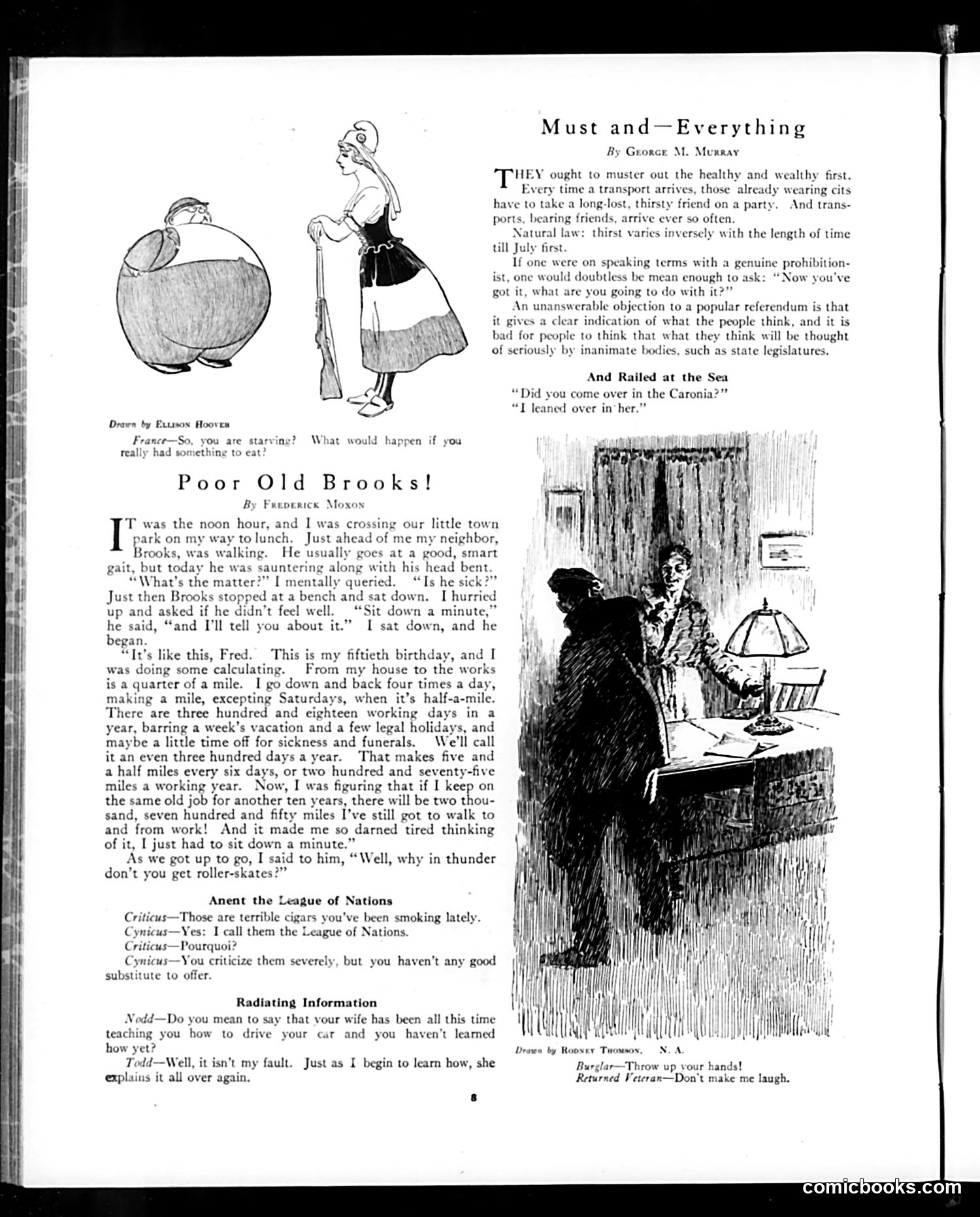
This page contains several short satirical pieces reflecting post-WWI American concerns: **"Must and—Everything"** critiques Prohibition's implementation, mocking both the law itself and those who championed it—suggesting prohibitionists hadn't thought through enforcement. **"Poor Old Brooks!"** uses dark humor about working-class routine: a man calculates he'll walk 2,750 miles commuting over ten years, becoming existentially exhausted by the prospect. The joke satirizes both repetitive labor and the absurdity of depressing oneself with arithmetic. **"Anent the League of Nations"** compares the League to bad cigars—easy to criticize but offering no viable alternative. This reflects contemporary American skepticism about the League's effectiveness. The cartoon drawings show period illustrations, including what appears to be a domestic scene and a burglar confronting a returned veteran who's too tired to comply with "throw up your hands." The overall tone mocks contemporary anxieties: post-war social adjustment, labor exhaustion, government overreach, and international diplomacy.
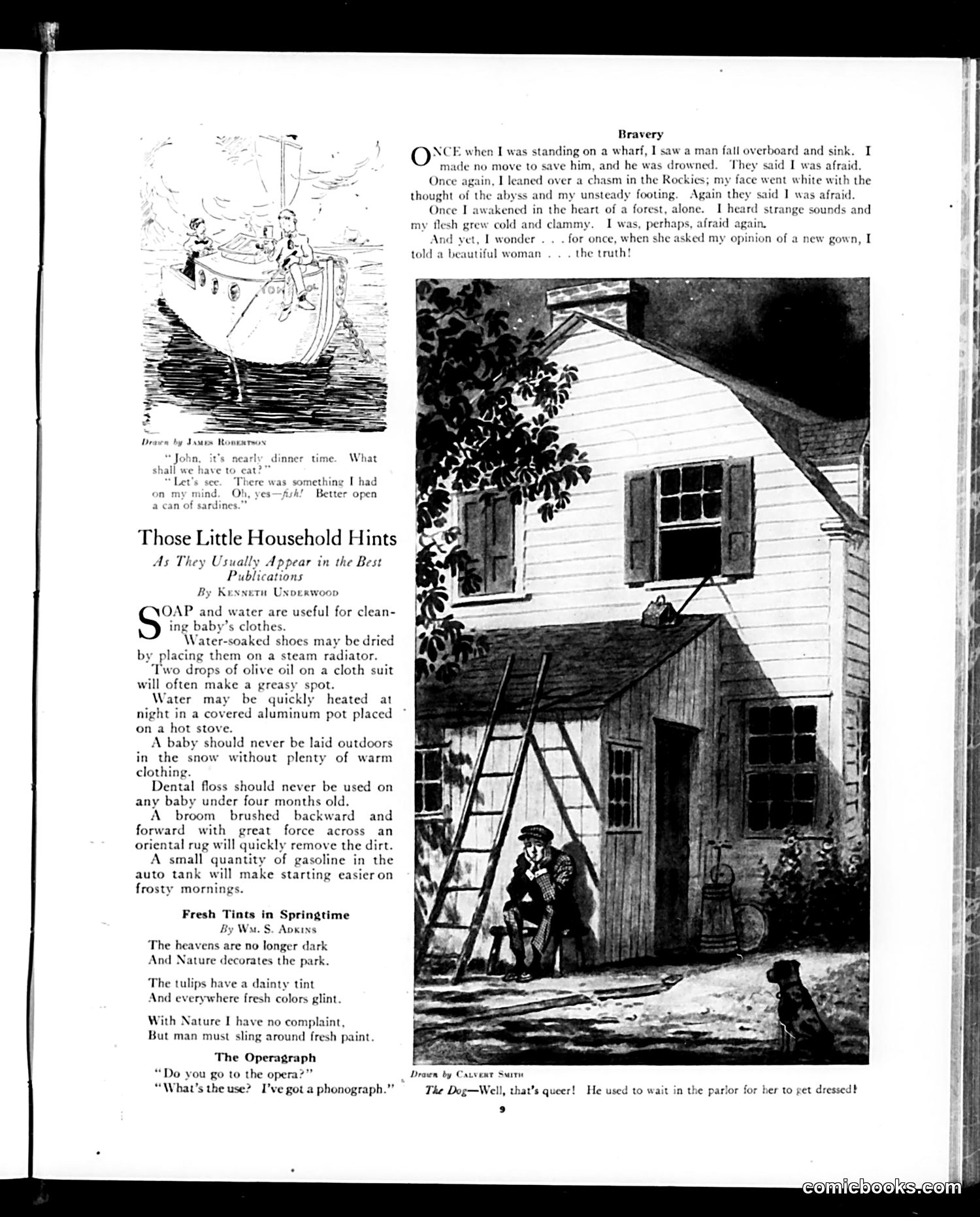
This page contains three distinct satirical pieces: 1. **"Bravery"** (top): A humorous essay mocking male bravado. The narrator describes surviving drowning, dangerous heights, and forest dangers—situations where people called him afraid. Yet when asked about a woman's new gown, he tells her the truth (implying it's unflattering), which he considers his *true* act of bravery. The joke satirizes men's fear of offending women's vanity as greater than physical danger. 2. **"Those Little Household Hints"** (center): A parody of the domestic advice columns popular in magazines of the era. The "hints" are presented earnestly but include absurd or contradictory suggestions (gasoline in car tanks, dental floss warnings for infants), mocking the credulous acceptance of such dubious domestic wisdom. 3. **"The Operagraph"** and **"Fresh Tints in Springtime"**: Brief humorous pieces—one joking about phonographs replacing opera-going, another about spring painting trends. The page satirizes contemporary domestic culture, gender relations, and the earnest advice-column format itself.
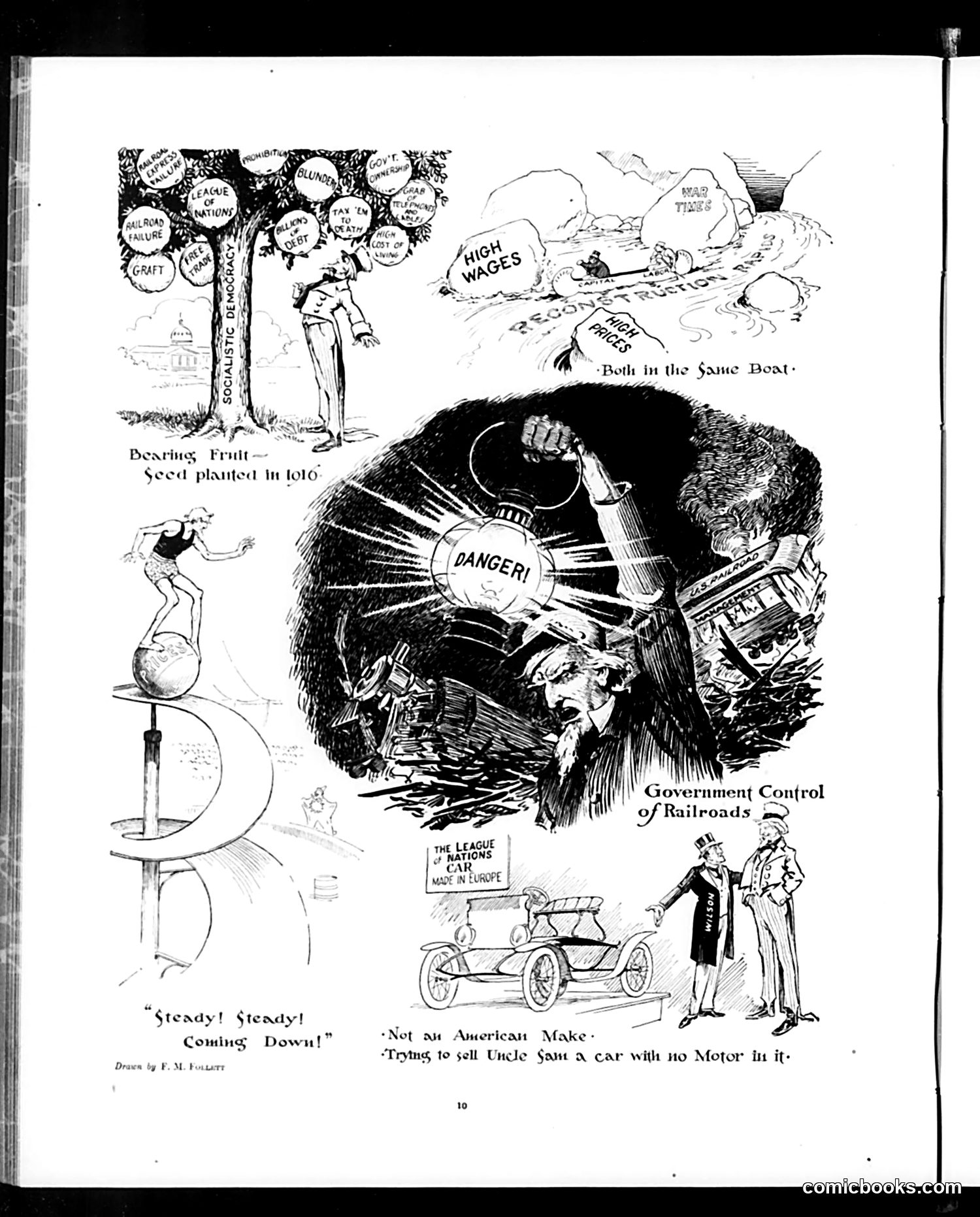
This page contains multiple satirical cartoons criticizing progressive-era policies: **Top left:** A "Socialist'sDirectory" tree bears fruit labeled with various socialist/progressive causes (minimum wage, old age pensions, etc.), mocking what conservatives saw as dangerous radical ideas. **Top right:** "Both in the Same Boat" depicts high wages and high prices as equally problematic, suggesting wage increases create inflation. **Center:** "Government Control of Railroads" shows a dangerous explosion labeled "DANGER!" with a worker and politician, opposing railroad nationalization—a hotly debated policy issue. **Bottom:** "Not an American Make" satirizes attempts to sell "Uncle Sam" (America) a League of Nations car without an "American motor," criticizing U.S. involvement in post-WWI international institutions like the League of Nations. The cartoons collectively oppose socialist policies, government intervention, and internationalism—positions Judge magazine's conservative readership would have favored during the 1920s.
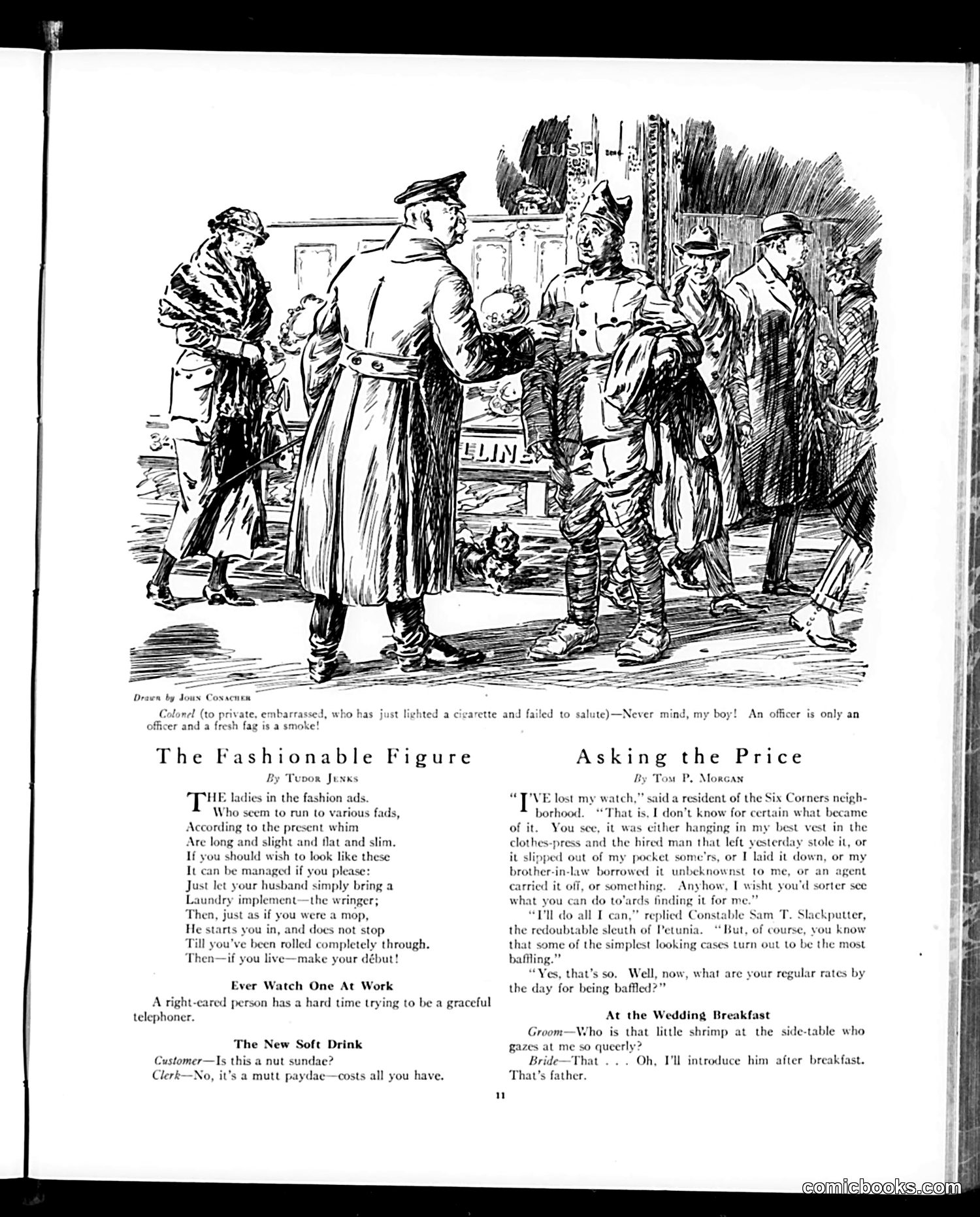
The main cartoon satirizes the "Gibson Girl" era's extreme fashion standard for women's thinness. The joke: to achieve the fashionable "long and slight and flat and slim" figure advertised in fashion magazines, a husband should run his wife through a laundry *wringer* like clothes, flattening her completely. The dark humor mocks both the absurd, unhealthy body ideals promoted by fashion advertising and the notion that women should contort themselves to meet them. Below are short comic bits typical of Judge's humor: a colonel condescendingly reassuring an embarrassed private about smoking etiquette; jokes about telephone manners, a new expensive drink, and a hapless detective; and a wedding joke about an unattractive father-in-law. These reflect early-20th-century American anxieties about propriety, class, and modern conveniences.
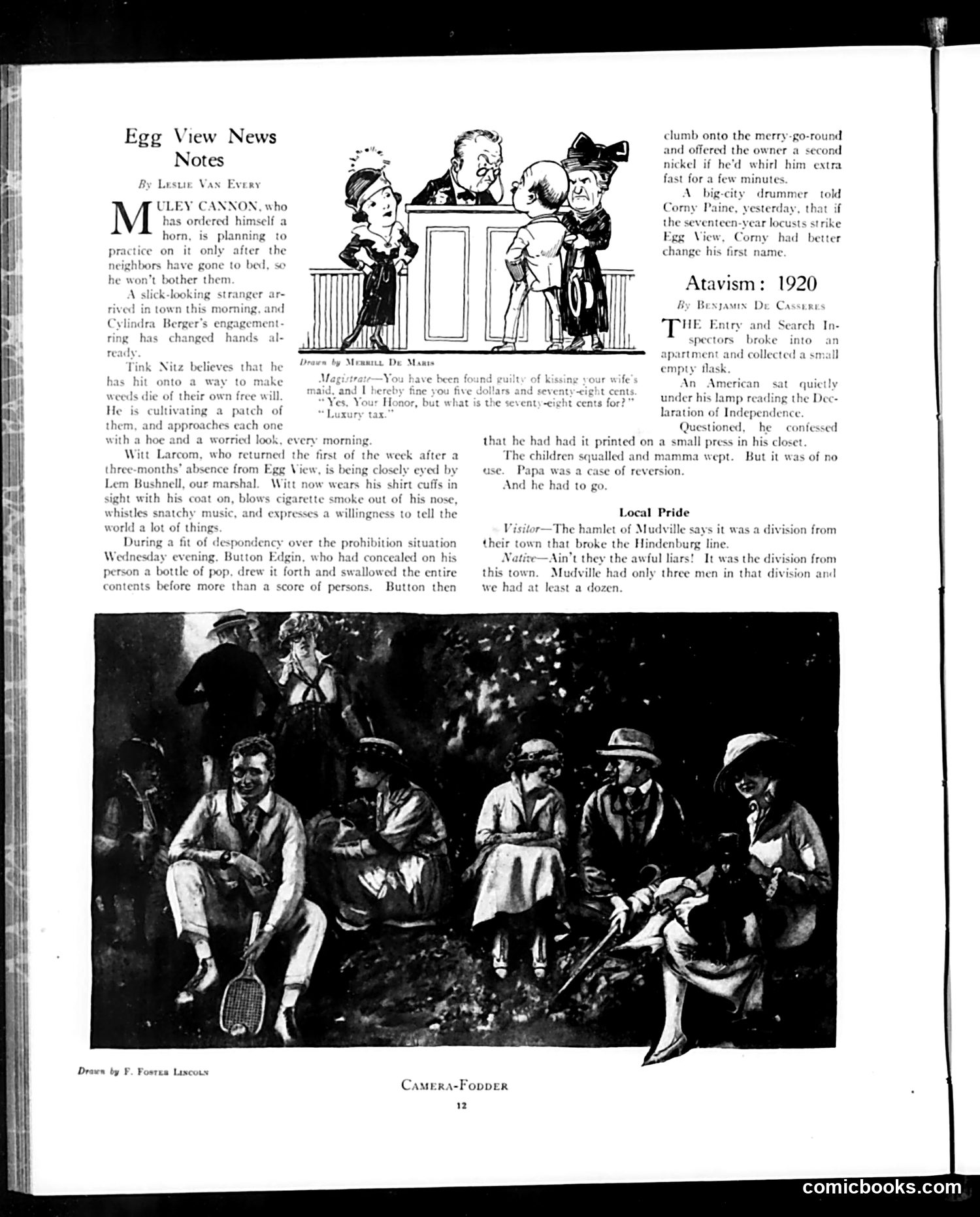
This page contains brief local gossip items ("Egg View News Notes") about small-town characters and their quirky behaviors—Muley Cannon practicing his saxophone, a drummer's joke about locusts, etc. These are light humor pieces. More significantly, it includes **"Atavism: 1920,"** a political cartoon about Prohibition enforcement. Federal agents raid an apartment and arrest a man for operating an illegal printing press—specifically one printing copies of the Declaration of Independence in his closet. The satire is sharp: during Prohibition (1920-1933), the government was so focused on alcohol enforcement that they criminalized someone for merely possessing and reproducing the foundational American civic document. It's a critique of how overreaching Prohibition enforcement had become absurd and contrary to American values. The bottom section, "Local Pride," is a brief joke about a small town exaggerating its WWI military contributions. The photograph "Camera-Fodder" shows people outdoors, likely illustrating another item.
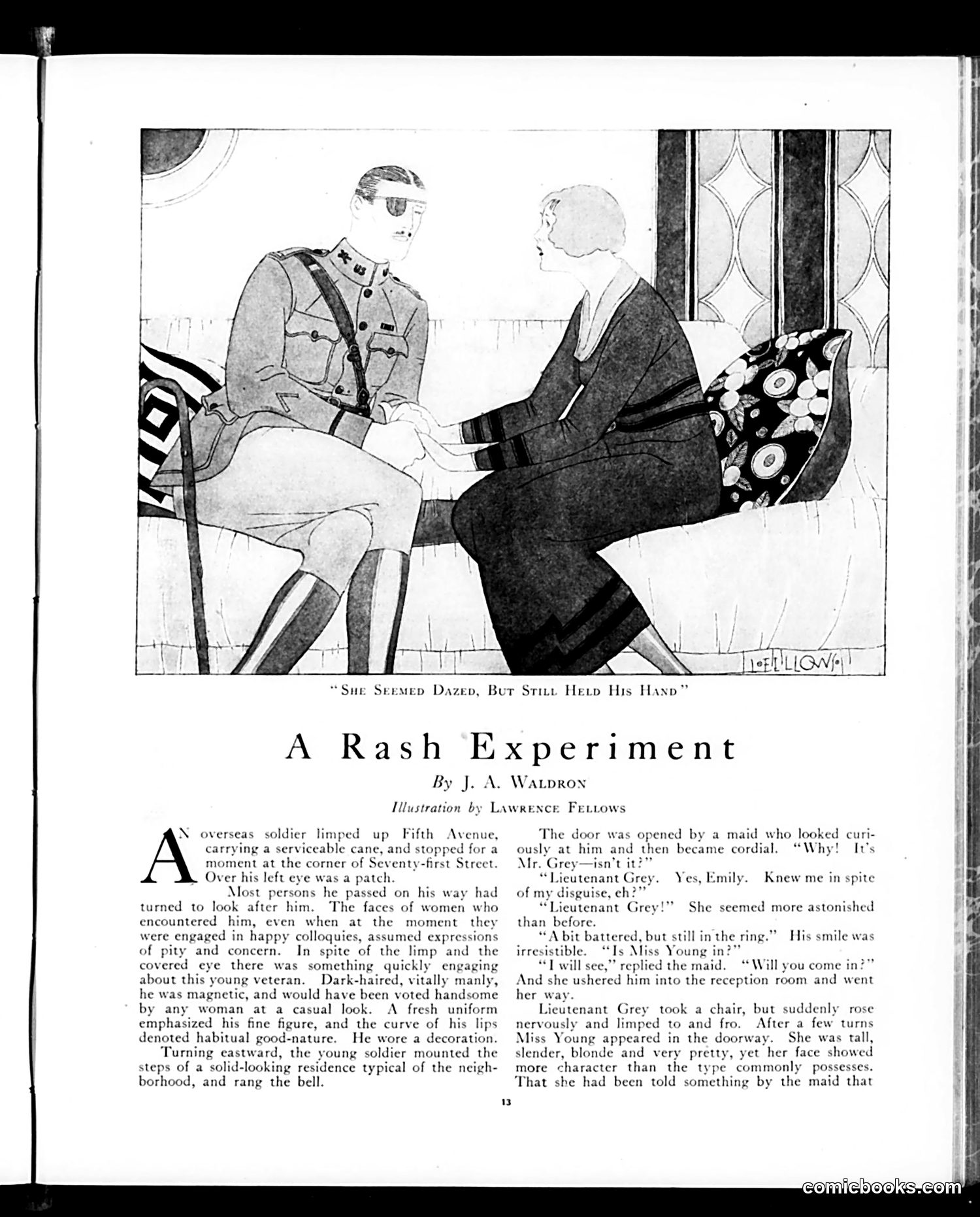
This page presents the opening of a short story (not primarily political satire) illustrated with a romantic scenario. The cartoon depicts **Lieutenant Grey**, a decorated WWI veteran with an eye patch and limp, visiting **Miss Young** at her home. The "rash experiment" of the title appears to involve Grey's disguise—the maid recognizes him "in spite of" it, suggesting he's testing whether Miss Young will accept his war injuries. The illustration's caption, "She Seemed Dazed, But Still Held His Hand," indicates an emotional moment between them. The story reflects post-WWI American culture: romanticizing wounded soldiers as heroic figures while exploring whether women would accept disabled veterans. Grey's "habitual good-nature" despite visible wounds embodies the stoic veteran archetype of the 1920s era. The narrative seems designed to be sentimental rather than satirical.
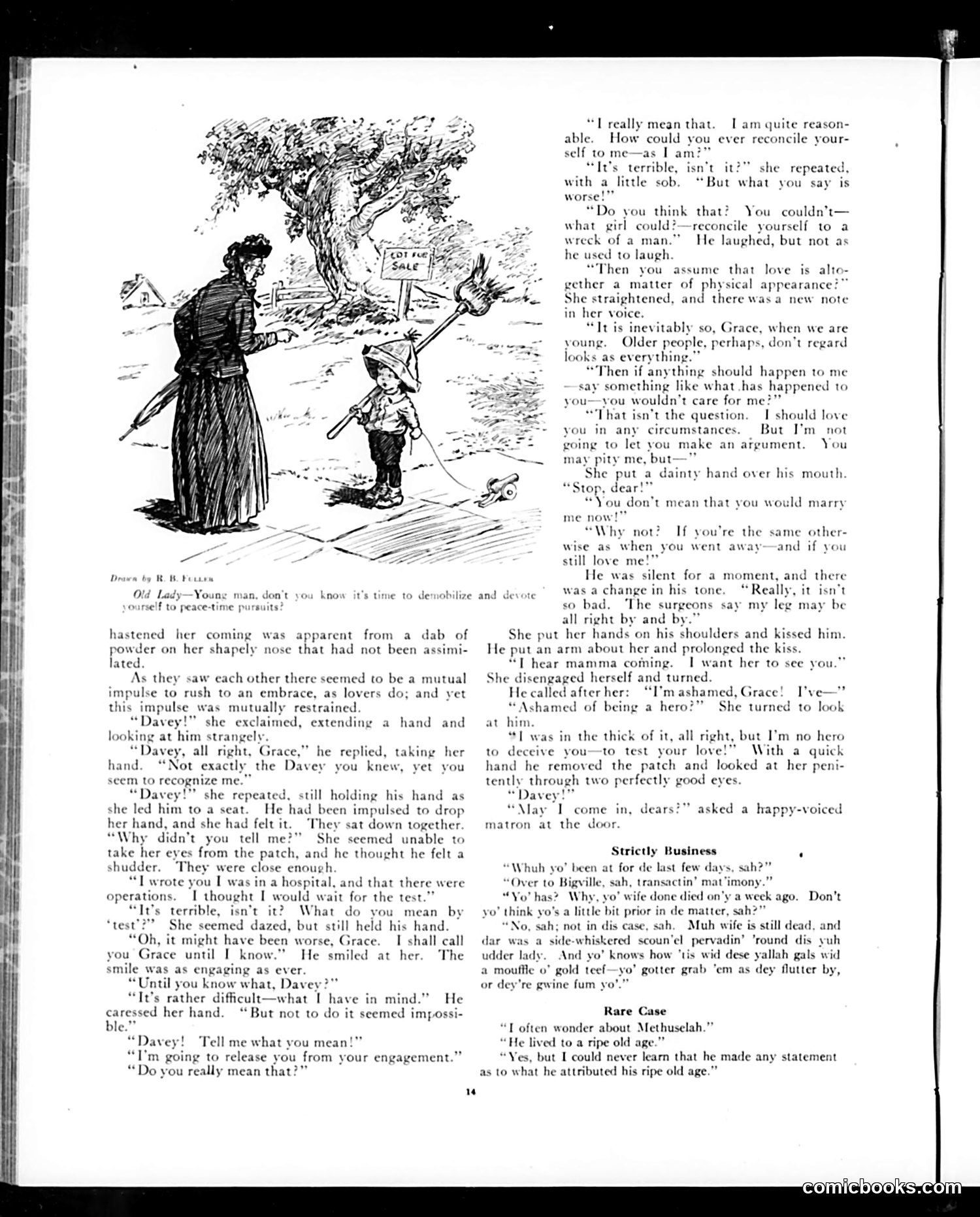
This page contains two distinct narrative pieces from *Judge* magazine: **Top Section ("Old Lady—Young Man"):** A romantic storyline depicting a soldier returning from WWI with a facial wound (indicated by the patch). The narrative explores whether his fiancée Grace will accept him despite his disfigurement. The satire critiques Victorian attitudes about love and physical appearance—the soldier assumes she'll reject him, but she insists true love transcends looks. The "twist" ending reveals his injury was minor; he was testing her character. This reflects post-WWI concerns about disabled veterans and evolving social values. **Bottom Sections:** Two brief comedic vignettes using exaggerated dialect humor. "Strictly Business" appears to mock rural/working-class figures through stereotyped speech. "Rare Case" is too fragmentary to interpret clearly from visible text. The upper narrative carries the page's primary satirical weight, suggesting *Judge's* interest in contemporary social issues regarding veteran reintegration and changing gender/relationship expectations.
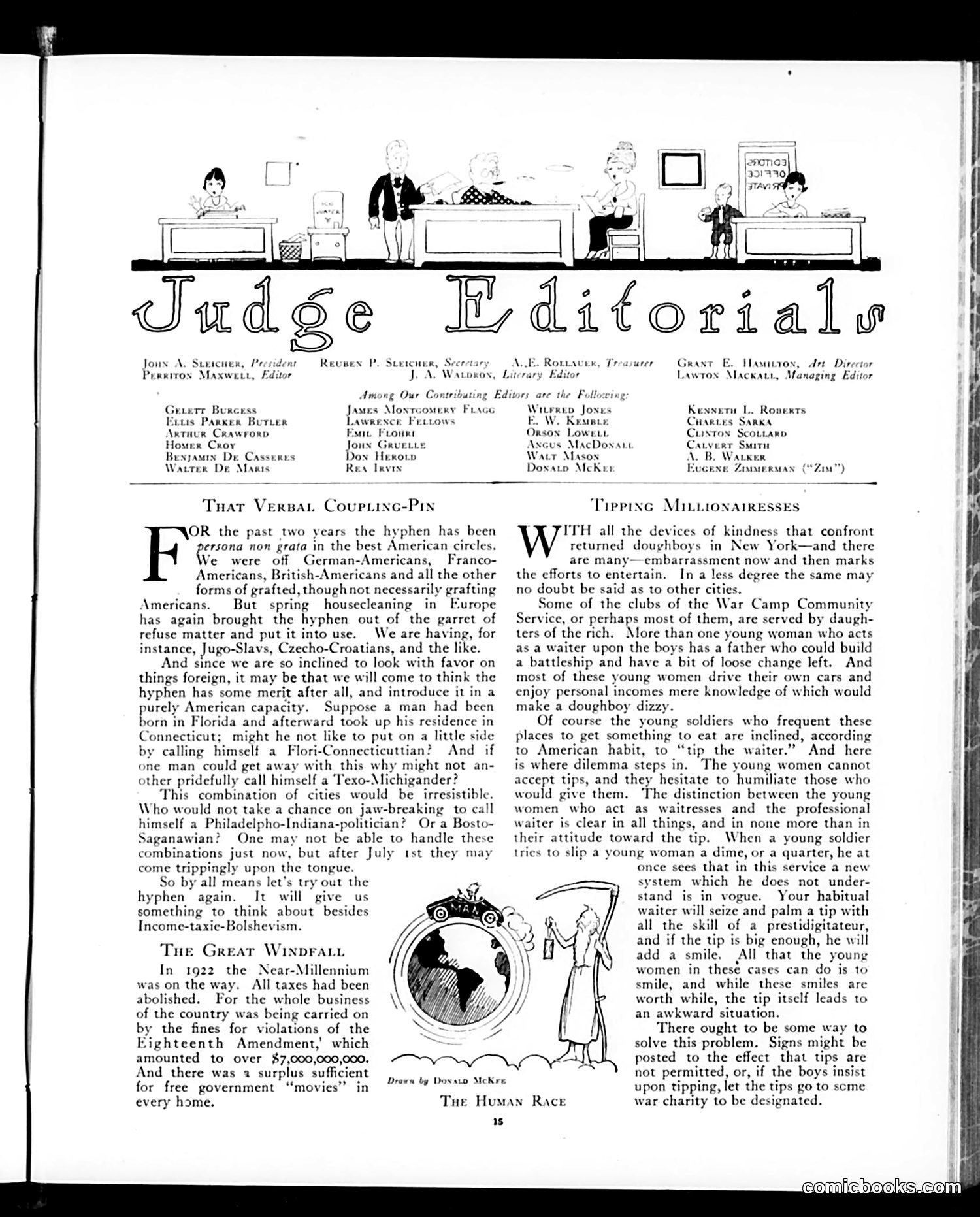
This page from *Judge* magazine contains two satirical editorials addressing post-WWI American social issues. **"That Verbal Coupling-Pin"** mocks the hyphenated ethnic identities (German-Americans, Franco-Americans) that had fallen out of favor during wartime nativism. The author sarcastically suggests Americans now embrace hyphenation for regional combinations—a "Flori-Connecticuttian" or "Texo-Michigander"—thereby deflating the pretentiousness of ethnic identity markers while commenting on changing American attitudes toward immigrants and assimilation. **"Tipping Millionairesses"** addresses the awkwardness created when wealthy young women volunteer as waitresses for returning WWI soldiers through the War Camp Community Service. The satire highlights class tension: these privileged volunteers (whose fathers "could build a battleship") cannot accept tips, yet soldiers expect to tip as custom dictates. The piece critiques both the uncomfortable position this creates and perhaps the performative charity of the wealthy. Both pieces use humor to examine American social contradictions regarding identity, class, and propriety during the immediate post-war period.
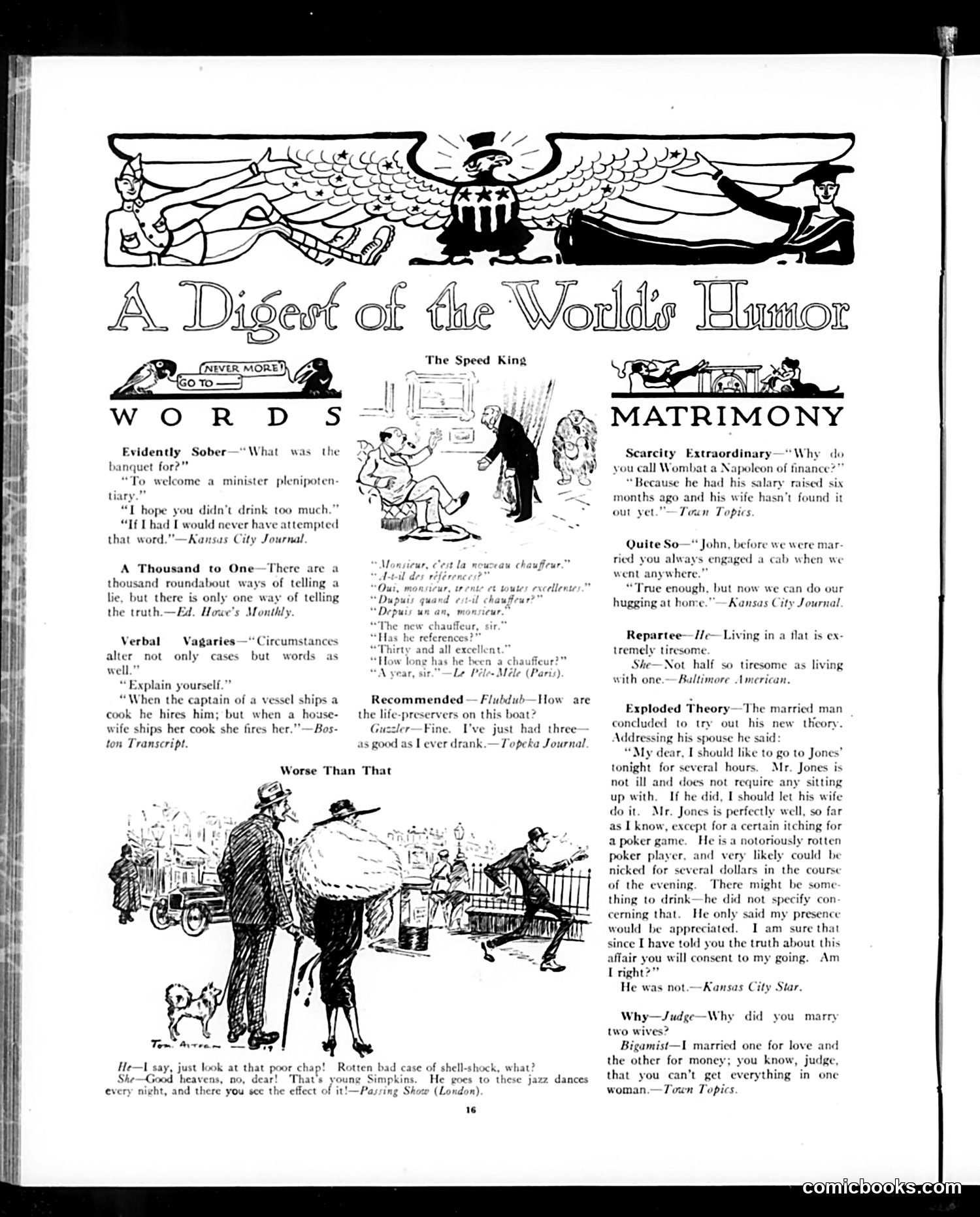
This page from *Judge* magazine compiles brief humorous anecdotes organized by theme. The satire targets **domestic life and marriage**, reflecting early 20th-century social attitudes. **Key jokes:** - **"Matrimony" section**: Jokes about wives discovering hidden salary increases, the transition from courtship (cab rides) to married life (home "hugging"), and the incompatibility of cohabitation. One anecdote mocks a husband's logical argument for attending a poker game—his wife rejects it regardless of his reasoning. - **"Words" and "Verbal Vagaries"**: Wordplay about honesty, precision, and how circumstances affect language. - **Lower cartoon**: Shows an intoxicated man; the caption jokes that young people attend jazz dances nightly and suffer "shell-shock" effects. The overall theme: **marriage as disillusionment**, wives as obstacles to pleasure, and social commentary on modern life (jazz culture, urban domesticity). The humor assumes a male perspective and mocks both spousal relationships and contemporary social behaviors.
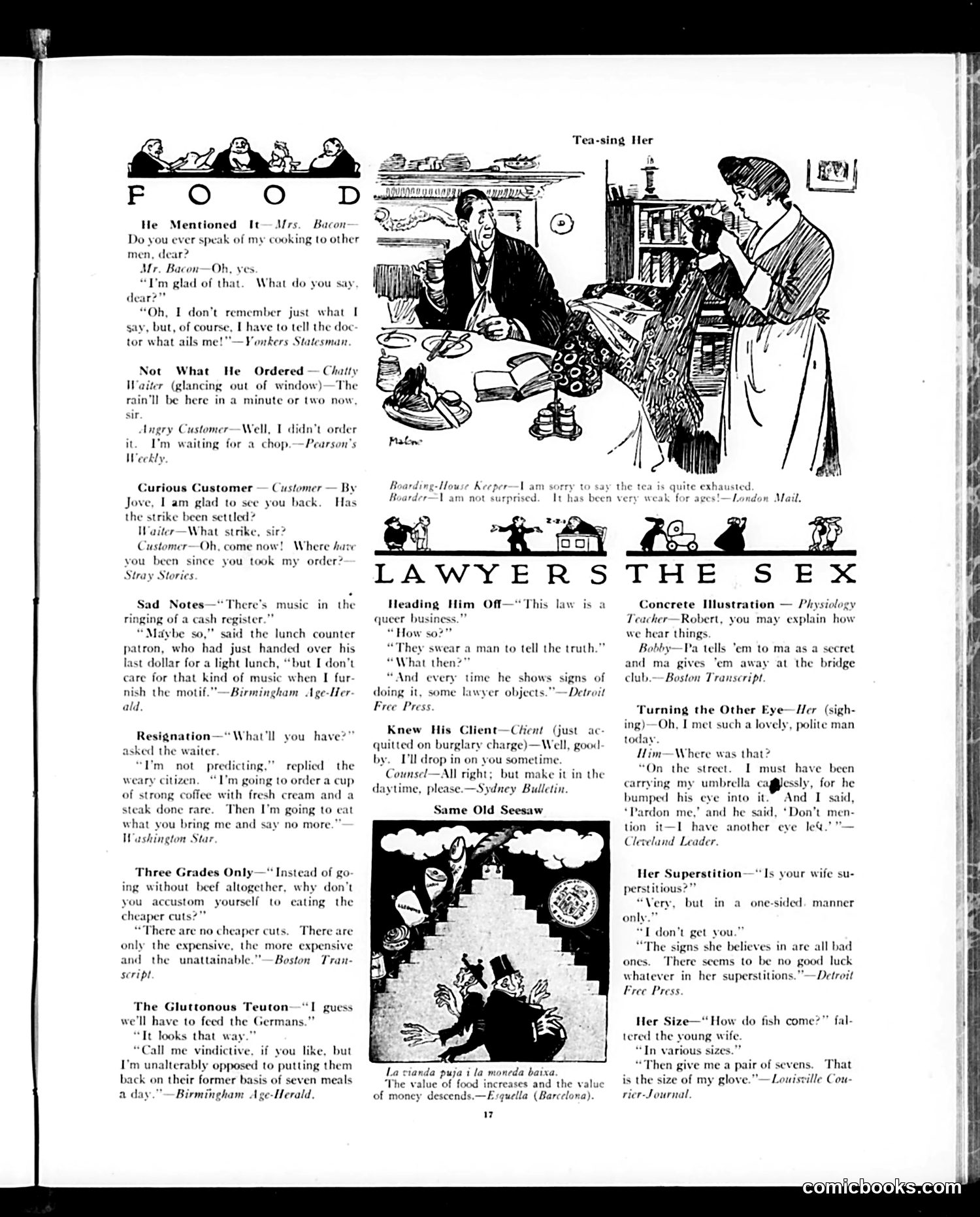
This page contains short humorous anecdotes and one cartoon, typical of early-20th-century American humor magazines. The jokes satirize everyday social situations: **Main themes:** - **Marital dynamics**: Wives concerned husbands discuss their cooking; wives' superstitions and logic - **Class/economic anxiety**: Food rationing and expense (multiple jokes about meat costs and "cheaper cuts"), reflecting wartime or post-war scarcity - **Service industry frustrations**: Waiters disappearing, ordering confusion - **Legal system critique**: Lawyers obstructing truth-telling in court - **Post-WWI sentiment**: A joke about feeding defeated Germans "seven meals a day" suggests anti-German sentiment following World War I The "Same Old Seesaw" cartoon illustrates economic principle: as food value rises, money's value descends—addressing inflation concerns. **For modern readers**: These jokes reveal working-class preoccupations with affordable food, marital tensions treated as universal comedy, and lingering wartime antagonisms—a snapshot of 1920s American anxieties.
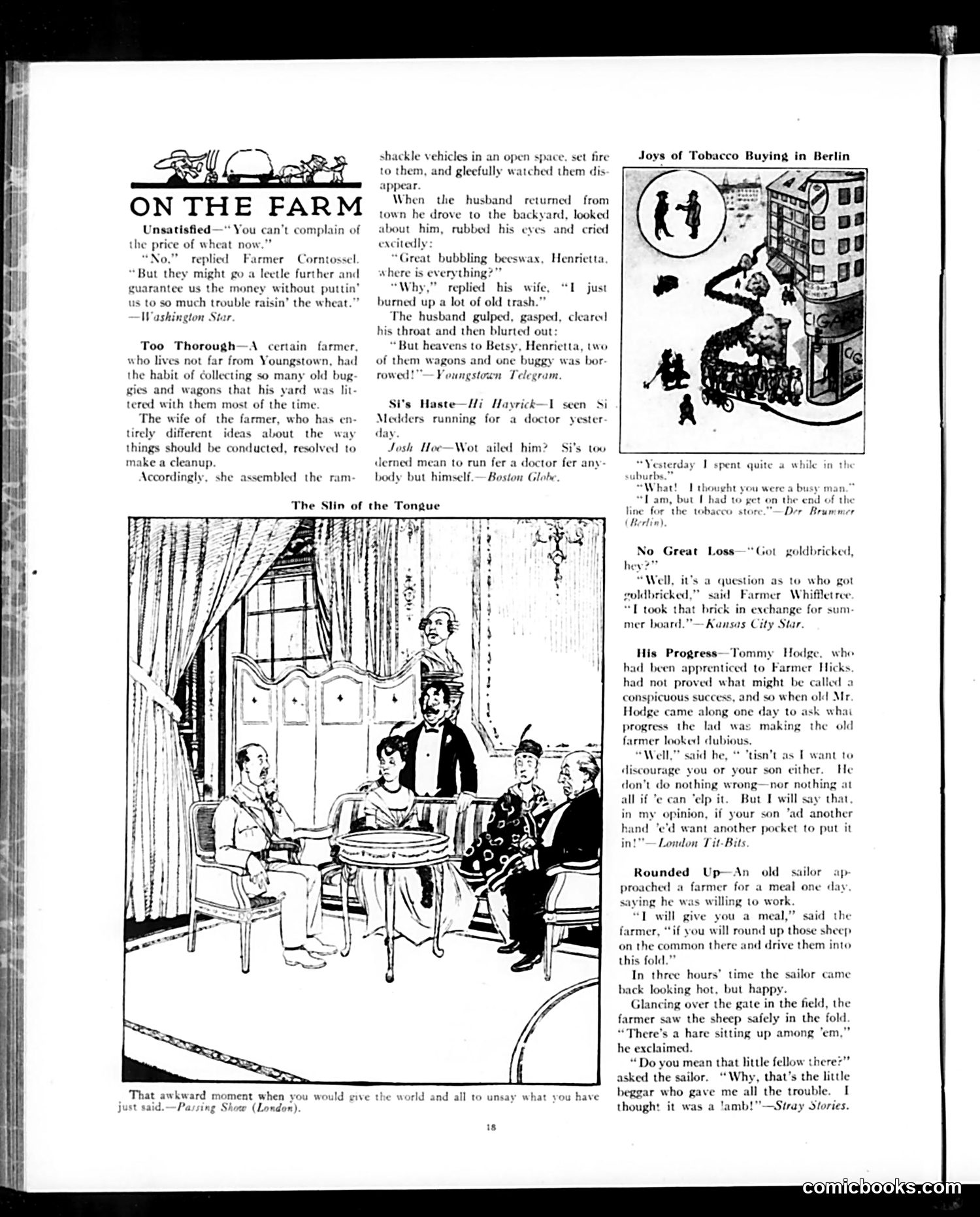
This page from the satirical magazine **Judge** contains several short humorous anecdotes mocking rural and working-class figures: **"On the Farm" section**: The jokes target farmers' attitudes and competence. One depicts a farmer so dissatisfied he wants government price guarantees *without* the effort of actually growing wheat—satirizing agricultural complaints. Another shows a farmer's wife burning his collected junk wagons, only to discover two were borrowed property, mocking both rural hoarding habits and domestic chaos. **"The Slip of the Tongue" cartoon**: A formal indoor scene showing what appears to be a social gathering, with the caption about an "awkward moment when you would give the world...to unsay what you have just said," suggesting someone committed a verbal faux pas in polite company. The remaining anecdotes mock rural simplicity (a doctor-phobic farmer, an incompetent farm apprentice, a sailor who mistakes a hare for a lamb). **The satire targets**: Rural/agricultural life as backward, unsophisticated, and comedically inept compared to urban civility. The humor relies on period class stereotypes about farmers and working people.
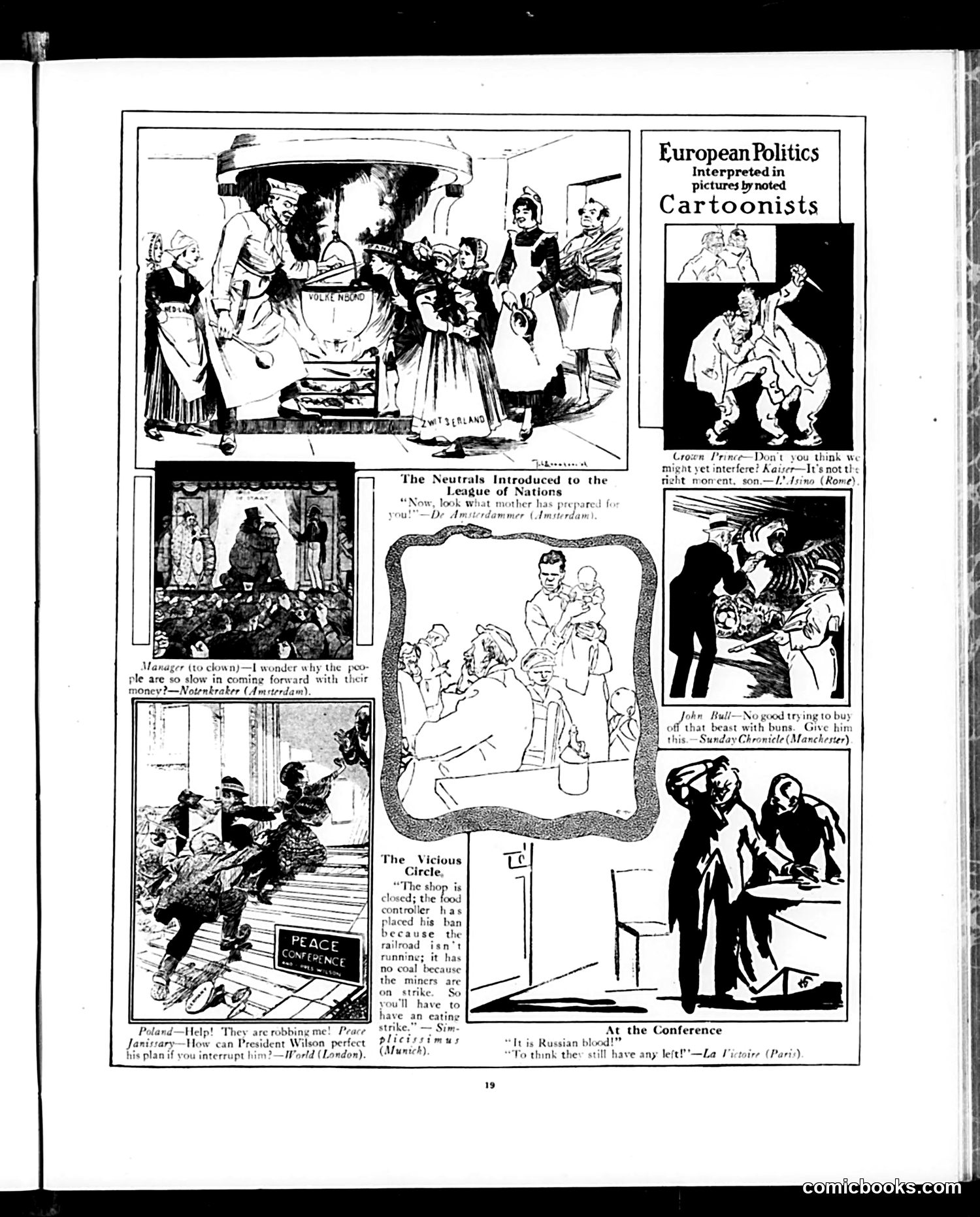
This page from *Judge* collects political cartoons from European publications satirizing post-World War I diplomacy, likely circa 1919-1920 during League of Nations negotiations. The cartoons mock: **"The Neutrals Introduced to the League"**: Depicts neutral countries (like the Netherlands/Amsterdam reference) awkwardly joining the new international body—portrayed as slow, reluctant participants. **"The Vicious Circle"**: Shows the economic collapse of post-war Europe—closed shops, food shortages, coal scarcity, railroad dysfunction—satirizing how peace negotiations failed to resolve actual human suffering. **"At the Conference"**: References "Russian blood" and food shortages, suggesting frustration that diplomatic talks ignore practical needs. The characters appear to be politicians debating while people starve. Overall, these cartoons express cynicism that international peace-building talks were disconnected from European citizens' real problems: hunger, economic devastation, and industrial collapse following the war.
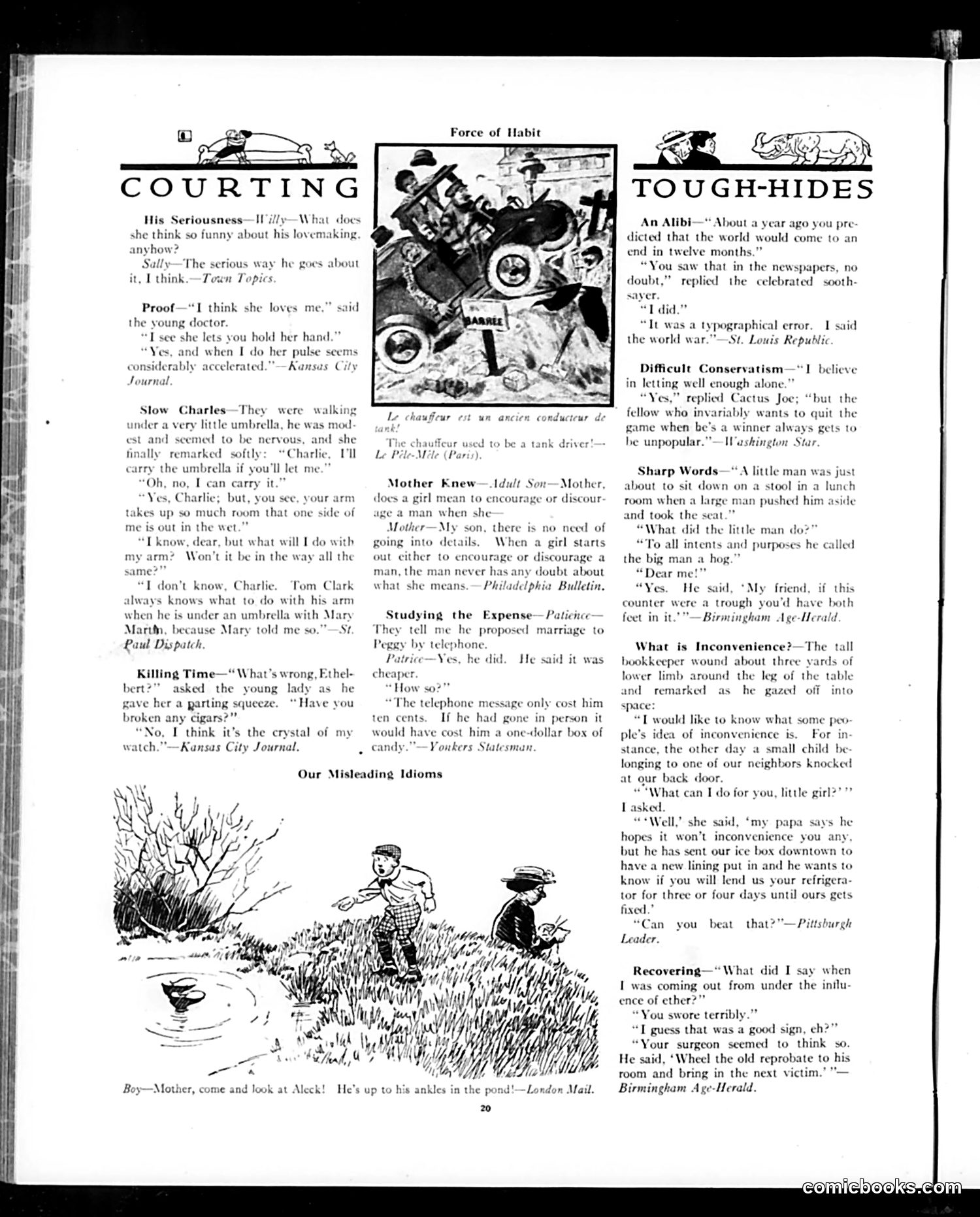
This page contains humorous short anecdotes about courtship and social situations, typical of early 20th-century American humor magazines. The "Courting" section offers comedic observations on dating: a doctor misinterprets his date's accelerated pulse as love rather than nervousness; a couple struggles awkwardly sharing an umbrella; a man worries about his crushed cigar during a kiss. The "Tough-Hides" section presents workplace and social humor: a soothsayer deflects a failed prediction by blaming typographical error (the "world war" instead of "world"); a small man's sharp insult to a large man who stole his seat; a neighbor's audacious request to borrow the bookkeeper's refrigerator. The humor relies on misunderstandings, social awkwardness, and character types recognizable to period readers. "Our Misleading Idioms" cartoon illustrates a child literally wading in pond water when told to be "up to his ankles," playing on linguistic confusion. The overall tone reflects genteel, middle-class anxieties about courtship, propriety, and everyday inconveniences—entertainment for urban magazine readers circa 1910s-1920s.
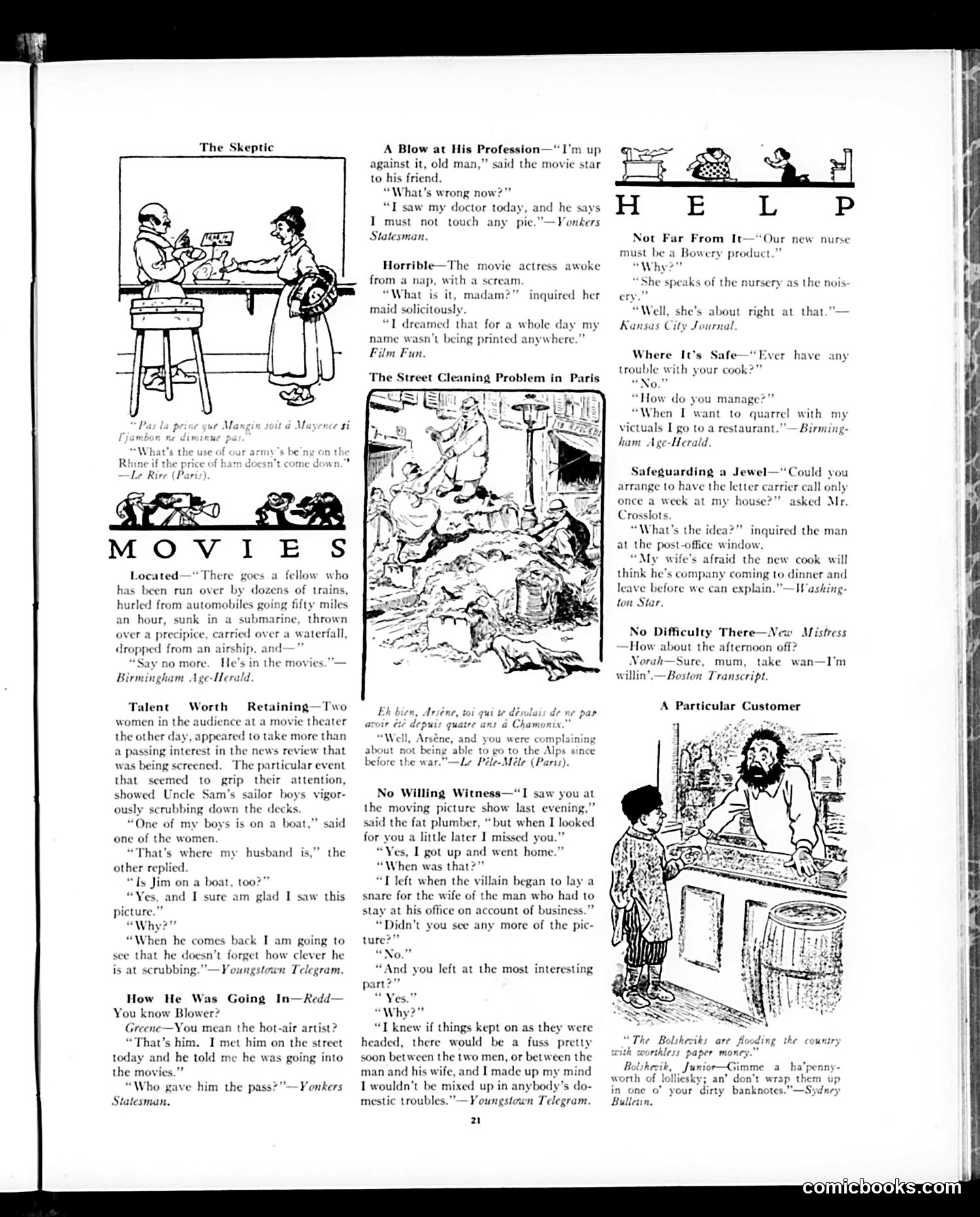
This page contains multiple brief satirical jokes about early 20th-century life, primarily targeting the film industry and domestic life: **"The Skeptic"** mocks movie stunt realism—a man survives impossible disasters (trains, submarines, waterfalls) because he's seen it all in films, so nothing shocks him anymore. **"Talent Worth Retaining"** jokes that women attending a newsreel about sailors scrubbing ship decks are excited not for patriotic reasons, but to observe proper cleaning technique for their own husbands at home. **"A Blow at His Profession"** satirizes a movie star's vanity: his doctor forbids touching pie (likely for appearance), which he treats as a catastrophe. **"Horrible"** mocks actress narcissism—her nightmare is a day without seeing her name in print. The remaining items are domestic humor: a cook's social pretensions, marital quarrels, and an Irish servant's willingness to take time off. The overall theme ridicules emerging consumer culture, vanity, and class anxieties of the period.
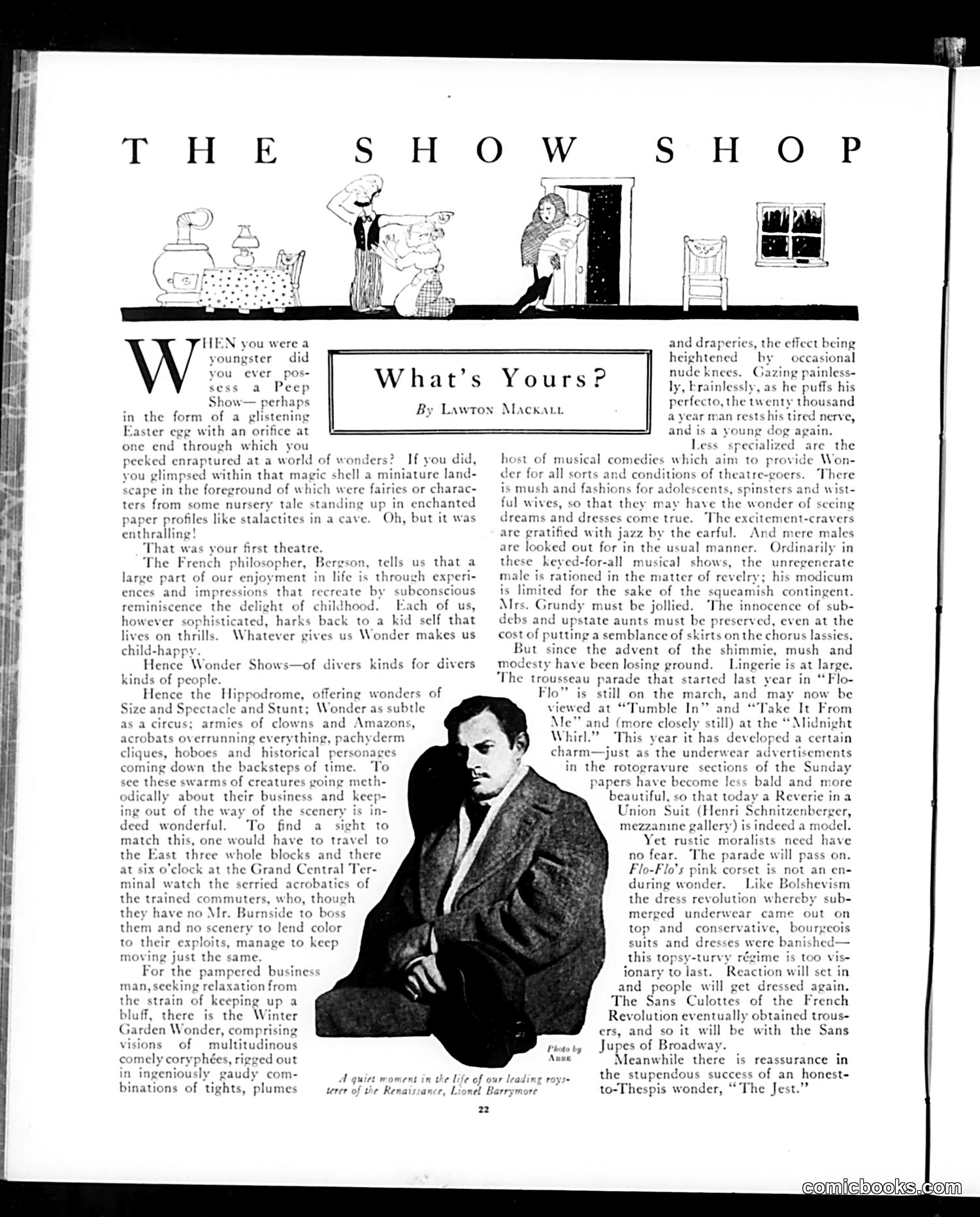
This is primarily a **text article** by Lawton Mackall about theatrical "wonder shows" rather than a political cartoon. The accompanying photo shows what appears to be a theatrical producer or impresario of the era. The piece nostalgically compares childhood "peep shows" to adult theatrical entertainment, arguing that people crave wonder and spectacle regardless of sophistication. Mackall discusses various venues—the Hippodrome (known for large-scale productions), the Winter Garden (famous for musical revues with scantily-clad dancers), and musical comedies. The article critiques how "Mrs. Grundy" (Victorian propriety) requires theatrical modesty, but notes this is breaking down with the "shimmy" dance craze and increasingly revealing lingerie-inspired costumes. He references specific shows like "Flo-Flo," "Tumble In," and "Take It From Me." The satire is gentle: Mackall suggests that even "rustic moralists" needn't fear—fashion revolutions are temporary. The underlying message mocks rigid moralism while celebrating theatrical progress.
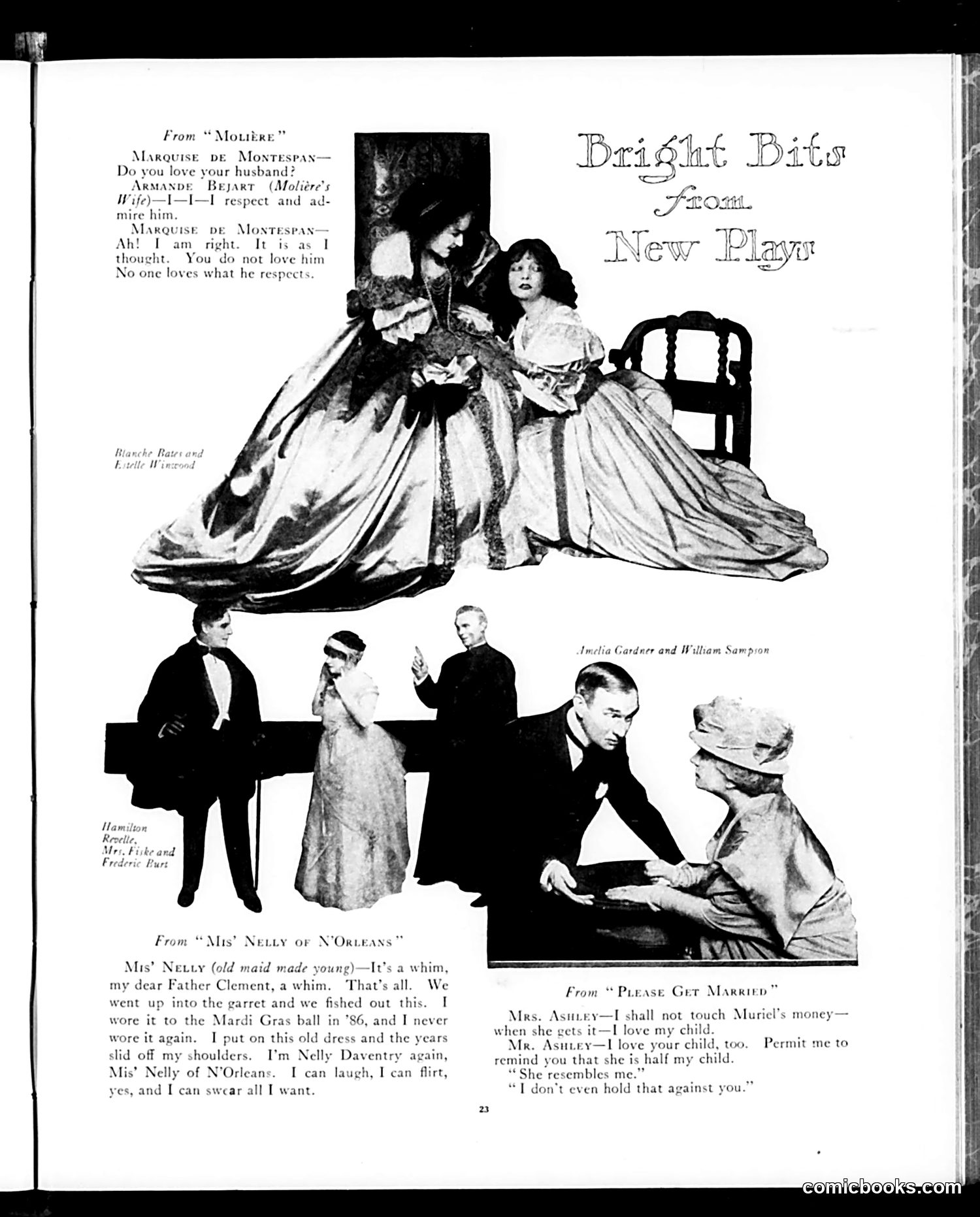
This page showcases excerpts from three theatrical productions, featuring dialogue and scenes meant to entertain readers with wit and social commentary. The **"Molière"** excerpt presents a philosophical exchange about marriage: a marquise probes whether a wife loves her husband, and receives the telling response that she merely "respects and admires" him—prompting the marquise's sardonic observation that no one loves what they respect. The joke satirizes the gap between marital duty and genuine affection in aristocratic relationships. The **"Mis' Nelly of N'Orleans"** segment depicts an elderly woman recounting how donning an old dress from an 1886 Mardi Gras ball restores her youth and freedom—she can "laugh," "flirt," and "swear" again. This plays on themes of aging, lost femininity, and the transformative power of costume. The **"Please Get Married"** scene shows a custody dispute where Mr. Ashley ironically "loves" his estranged child while refusing to acknowledge any resemblance to the mother—dark comedy about divorce and parental obligation.
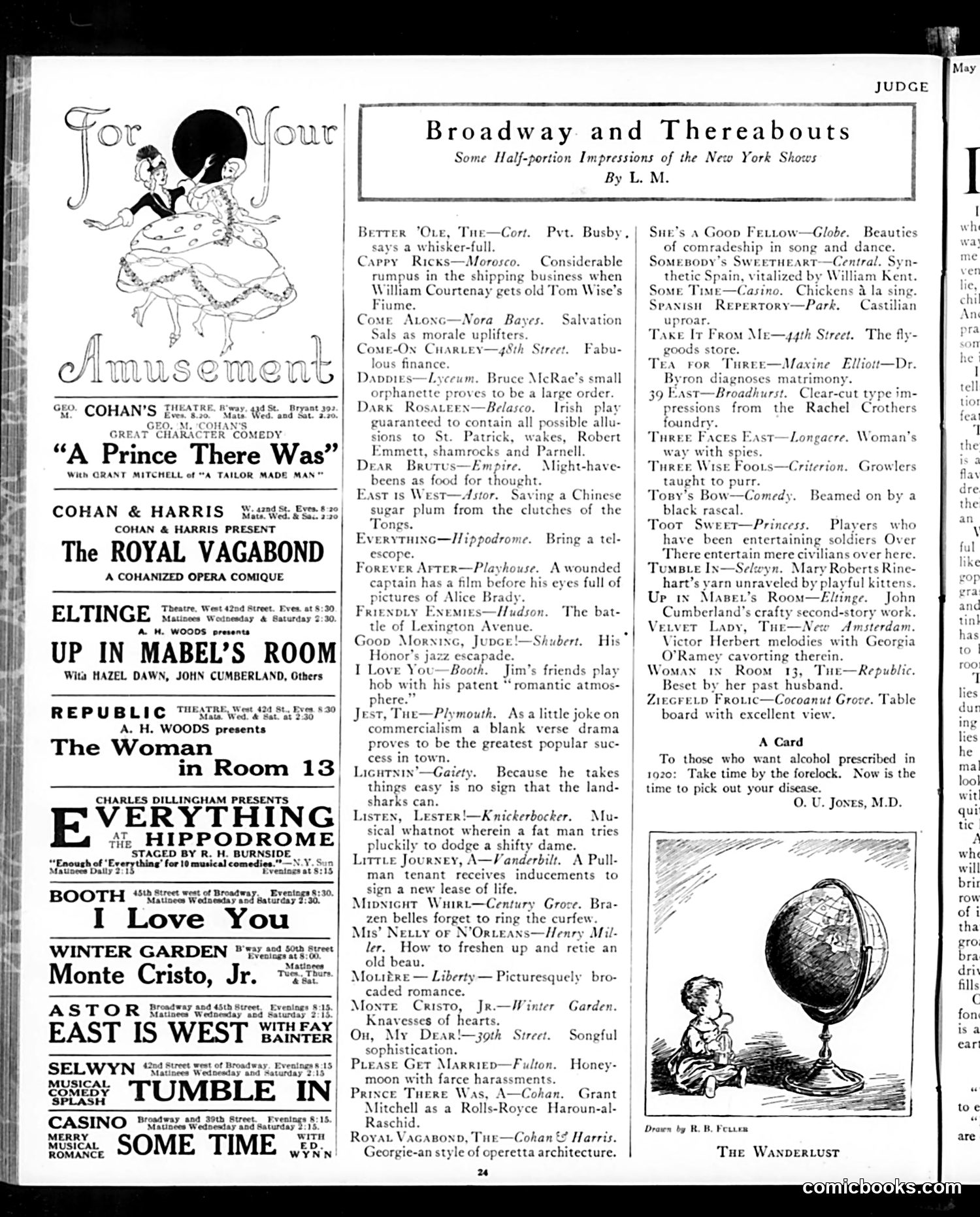
This page features theater reviews by L.M., a Judge magazine columnist commenting on New York Broadway shows. Rather than traditional criticism, these are punchy, sarcastic one-liners summarizing each play's plot or theme. The humor relies on deflating theatrical pretension through irreverent descriptions. For example, "A Prince There Was" features Grant Mitchell as a "Rolls-Royce Haroun-al-Reschid" (mocking orientalist fantasy), while "Saving a Chinese sugar plum from the clutches of the Tongs" reduces "East is West" to crude racial stereotype humor typical of the era. The reviews mock both sentimental plots ("Might-have-beens as food for thought") and commercial theater's formulaic nature. The accompanying illustration shows a child with a large balloon—likely representing theatrical escapism or inflated expectations. This reflects Judge's satirical mission: poking fun at Broadway's predictable sentimentality and commercial machinery while entertaining readers with cynical one-liners about current shows.
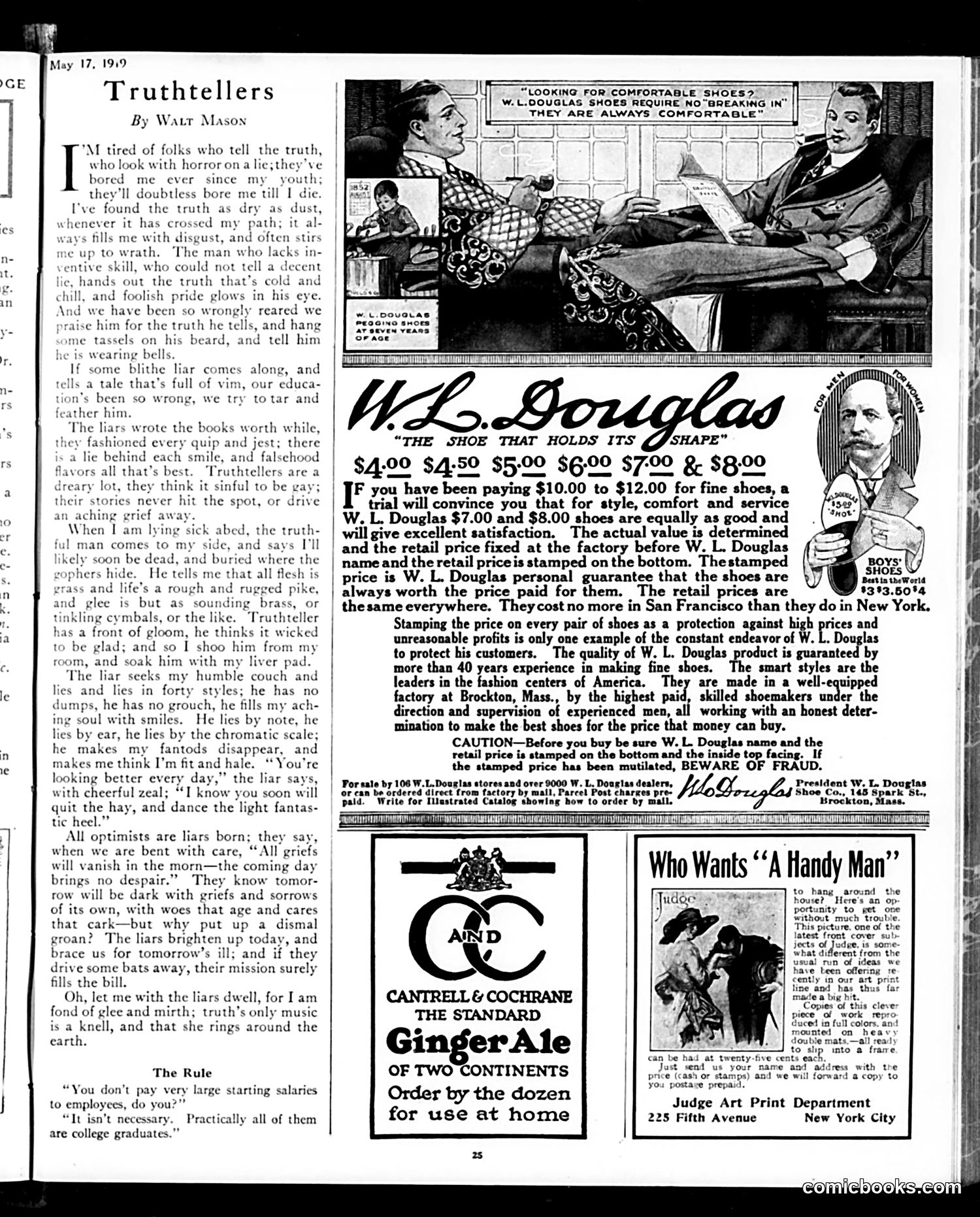
This page contains a poem by Walt Mason satirizing society's preference for charming liars over tedious truth-tellers. Mason argues that truthful people are boring and joyless—they deliver cold facts without wit or grace—while liars entertain and inspire hope. He suggests we've been "wrongly reared" to praise honesty; in reality, the best books, jokes, and optimistic encouragement come from those willing to bend the truth. The satire critiques not dishonesty itself but rather our cultural elevation of blunt, humorless truthfulness as a virtue. Mason advocates for the social value of pleasant deception and charm over unvarnished reality. The page is otherwise dominated by period advertisements (W.L. Douglas shoes, Cantrell & Cochrane ginger ale, Judge Art Print Department), which was typical for Judge magazine.
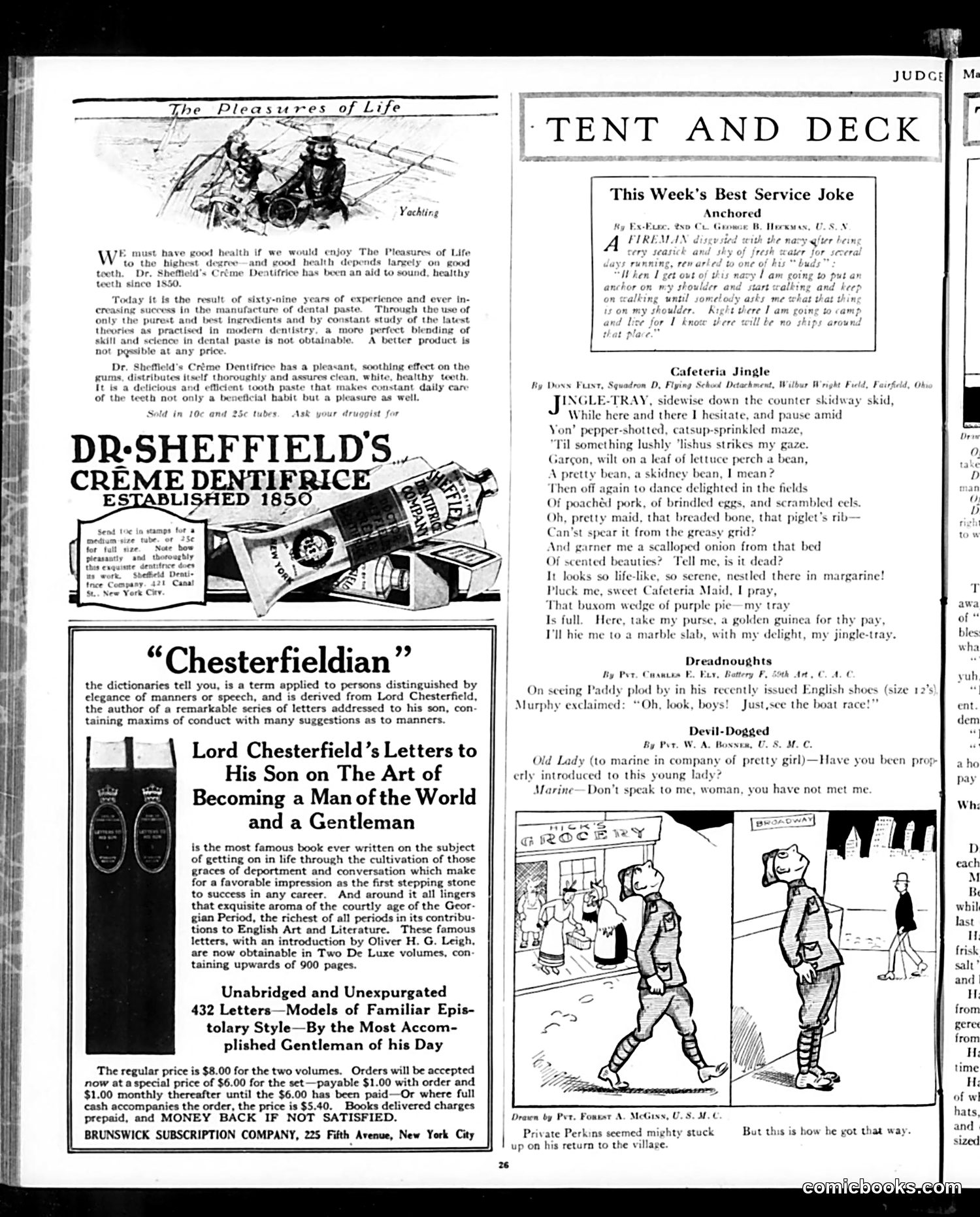
This page is primarily **advertising and humor content** rather than political satire. The main editorial cartoon appears at top left ("The Pleasures of Life"), depicting **yachting**, though the image is small and details are unclear. The page features several **military humor pieces**: - "This Week's Best Service Joke" mocks a naval officer's awkward excuse about seasickness and anchoring - "Cafeteria Jingle" satirizes mess hall food through absurdist verse, with a soldier humorously treating poor-quality cafeteria items as delicacies - "Dreadnoughts" jokes about ill-fitting shoes making a soldier look like a "boat" - "Devil-Dogged" presents a marine's rude response to social introduction The **dominant content** is commercial: large advertisements for Dr. Sheffield's toothpaste (established 1850) and Lord Chesterfield's letters on gentlemanly conduct—reflecting early 20th-century consumer culture and etiquette obsession. The military humor targets **common soldier complaints**: poor food, uncomfortable equipment, and social awkwardness—relatable themes for readers during this military-focused era.
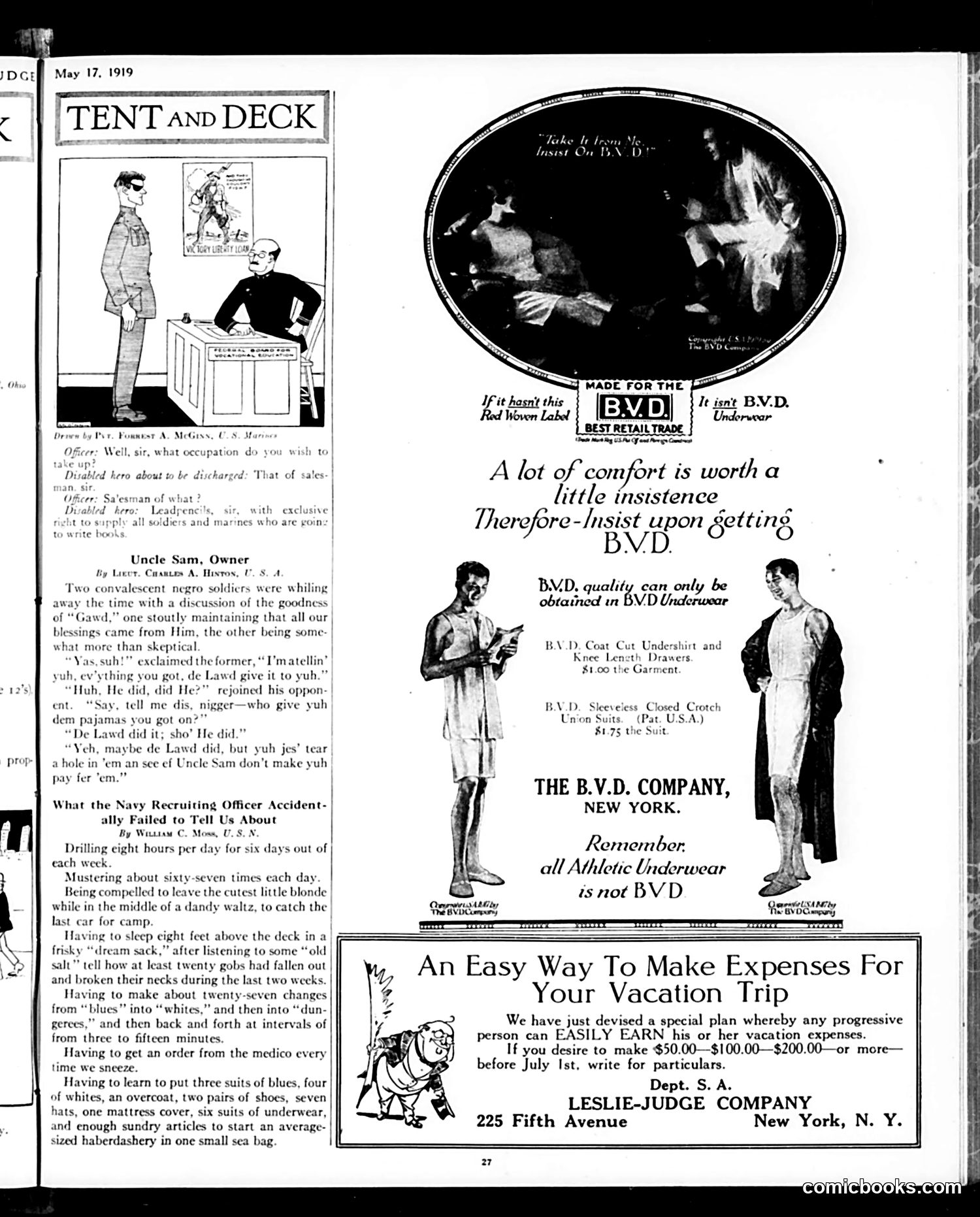
This page mixes humor about post-WWI military life with advertisements. The main cartoon "Tent and Deck," credited to Lieutenant Charles A. Hinton, uses dialect humor to satirize soldier hardship. Two Black soldiers discuss blessings—one attributes everything to God, the other skeptically points out that even their clothes belong to "Uncle Sam," who will charge them for damaged property. The joke critiques inadequate military compensation and the government's nickel-and-diming of servicemen. A second piece by William C. Moss satirizes Navy recruitment's hidden costs, detailing absurd realities: constant uniform changes, strict regulations, cramped sleeping quarters, and impossible packing requirements—mocking what recruiters fail to mention. The remainder is advertising: B.V.D. underwear emphasizing quality, and Leslie-Judge Company offering vacation money schemes.
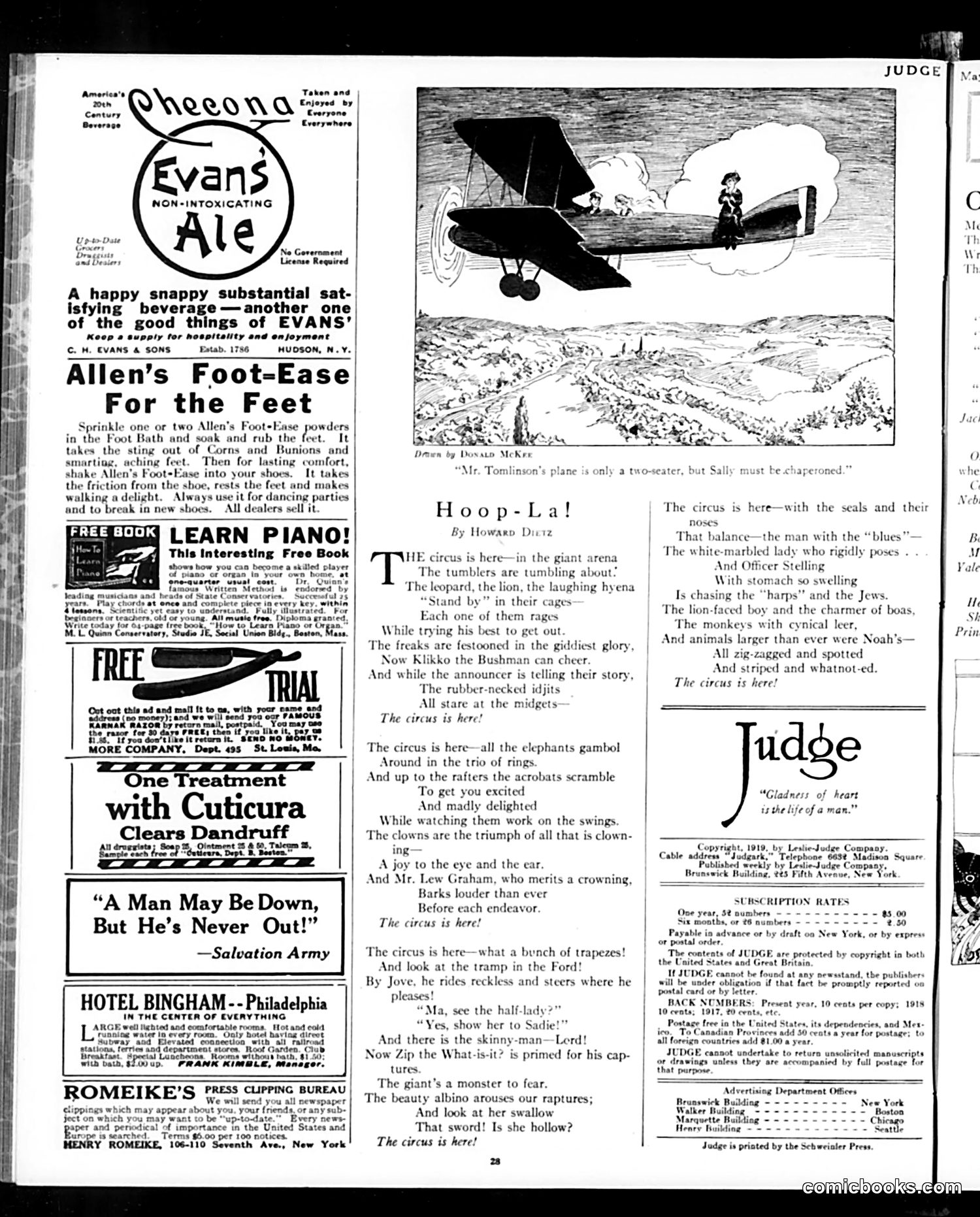
This page is primarily **advertising and entertainment content** rather than political satire. The dominant feature is a poem titled "Hoop-La!" by Howard Dietz celebrating the circus—its acrobats, clowns, exotic animals, and sideshow attractions ("half-lady," "skinny-man," "Zip the What-is-it"). The page is cluttered with **period product advertisements** (Evans' non-intoxicating ale, Allen's Foot-Ease powder, piano lessons, Cuticura dandruff treatment) typical of 1919 Judge magazine layouts. One small item—a Salvation Army motto, "A Man May Be Down, But He's Never Out!"—offers mild social commentary about resilience during hardship, likely referencing post-WWI conditions. The circus poem itself contains a **casual ethnic slur** ("harps" and "Jews") in one stanza, reflecting the casual prejudice of the era, though this appears incidental to the poem's main celebratory purpose rather than satirical commentary. Overall, this is a standard magazine entertainment page, not a political cartoon.
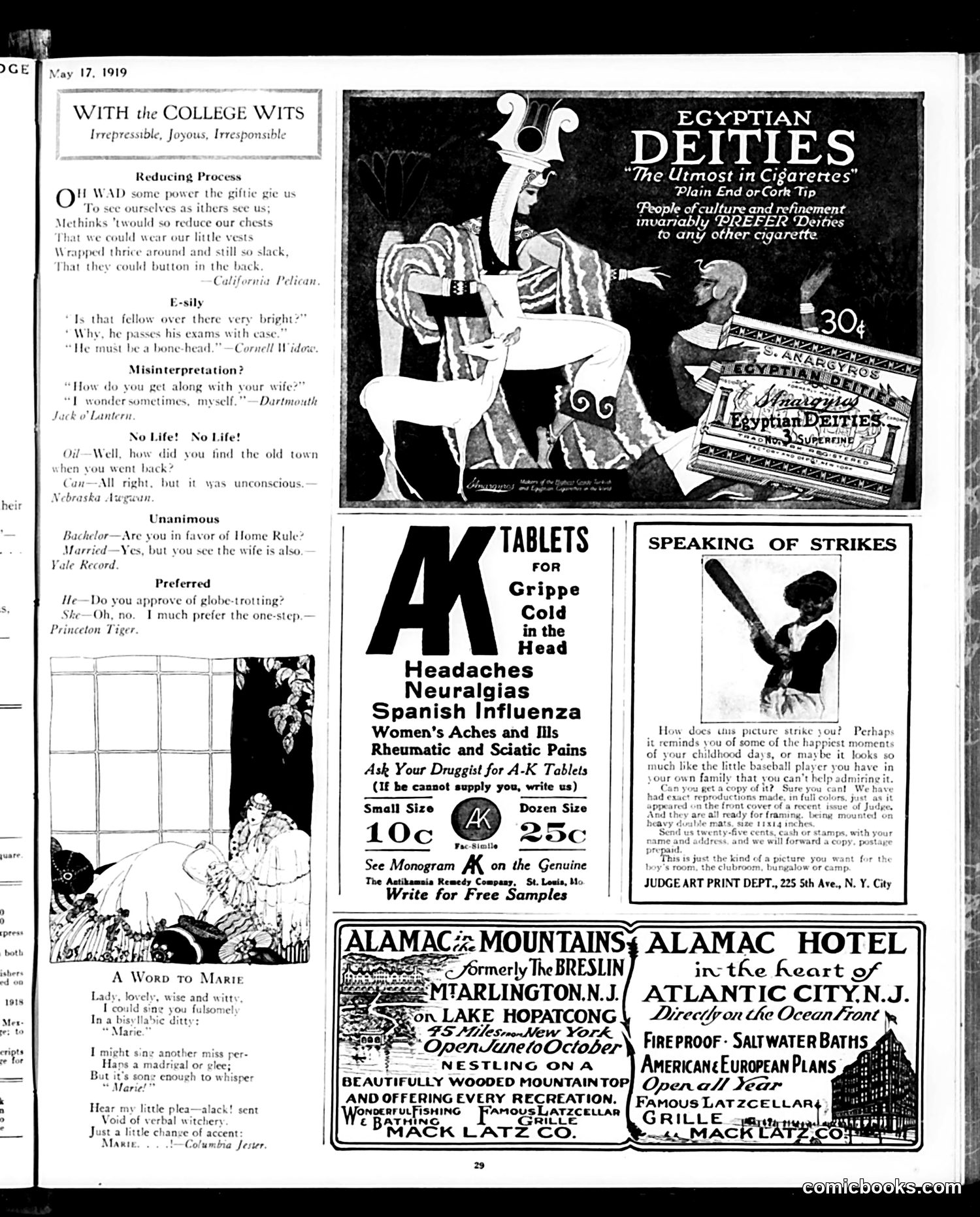
This page is primarily **advertising**, not political satire. The dominant content includes: **"With the College Wits"** (left): Reprints of student humor from college magazines—brief jokes about exams, marriage, and dating with no political content. **Egyptian Deities Cigarettes** (top right): A glamorous advertisement featuring an Egyptian-styled woman, appealing to "people of culture and refinement." Typical early 20th-century luxury marketing. **A-K Tablets** (center): Patent medicine advertisement for treating cold, influenza, headaches—notably including "Spanish Influenza," referencing the 1918-1919 pandemic still recent in May 1919. **Hotel/Resort Ads** (bottom): Advertisements for the Alamac Hotel and Mack Latz Company establishments. **"Speaking of Strikes"** (right): A brief commentary with illustration about labor unrest, but text is fragmentary and unclear from OCR. The page reflects 1919 concerns (pandemic remedies, labor issues) but is primarily a revenue-generating advertisement section rather than satirical editorial content.
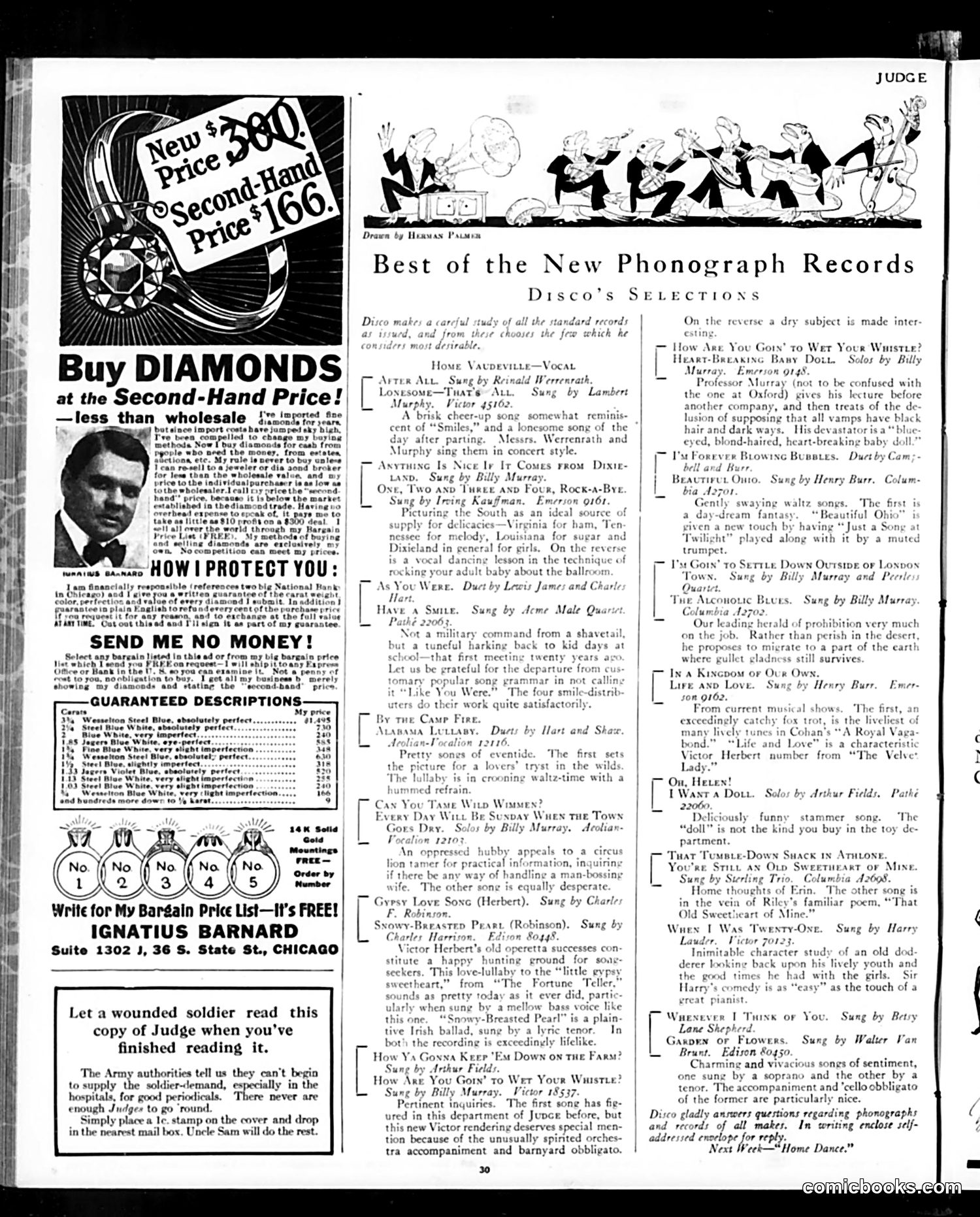
This page is primarily **advertising and consumer content**, not political satire. The top left contains a diamond retailer ad ("Buy DIAMONDS at the Second-Hand Price!"), while the bulk of the page reviews phonograph records for "Disco's Selections"—popular songs of the era performed by artists like Billy Murray and Henry Burr. The only civic content is a small box appealing to readers to donate their finished copies of Judge to wounded soldiers in hospitals, as the Army reportedly cannot meet demand for periodicals. The cartoon strip at the very top (credited to Herman Paulus) appears to show figures in formal dress, but without clearer visibility, the specific satirical subject is unclear from this reproduction. The page reflects early 20th-century consumer culture: mail-order diamonds, phonograph records as entertainment technology, and wartime charitable appeals—likely dating to WWI era based on the soldier relief plea.
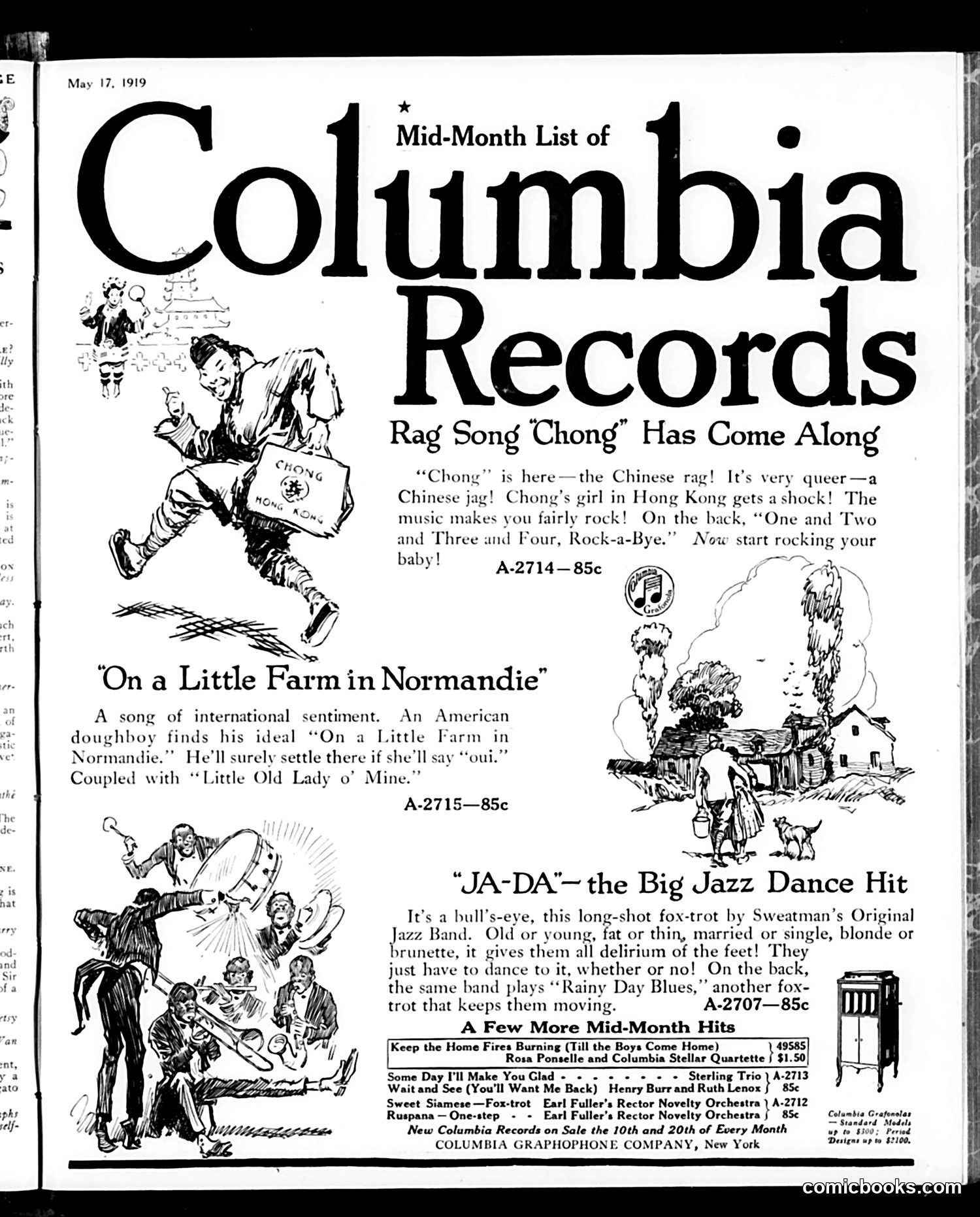
This is primarily a **music advertisement** for Columbia Records, not political satire. It showcases popular songs and dance music of the immediate post-WWI era. The page features three main record promotions: 1. **"Rag Song Chong"** — A "Chinese rag" with stereotypical Asian imagery, reflecting the casual racial caricature common in 1919 popular culture. 2. **"On a Little Farm in Normandie"** — Appeals to recently returned American soldiers ("doughboys") from WWI, romanticizing rural France and European romance. 3. **"JA-DA"** — A jazz fox-trot by Sweatman's Original Jazz Band, representing the emerging Jazz Age. The advertisements emphasize dance crazes and contemporary musical trends. The illustrations use period caricature styles typical of Judge magazine's visual approach. The lower section lists additional mid-month releases, including patriotic songs like "Keep the Home Fires Burning." The page captures 1919 popular taste: post-war sentimentality, early jazz enthusiasm, and unquestioned ethnic stereotyping.
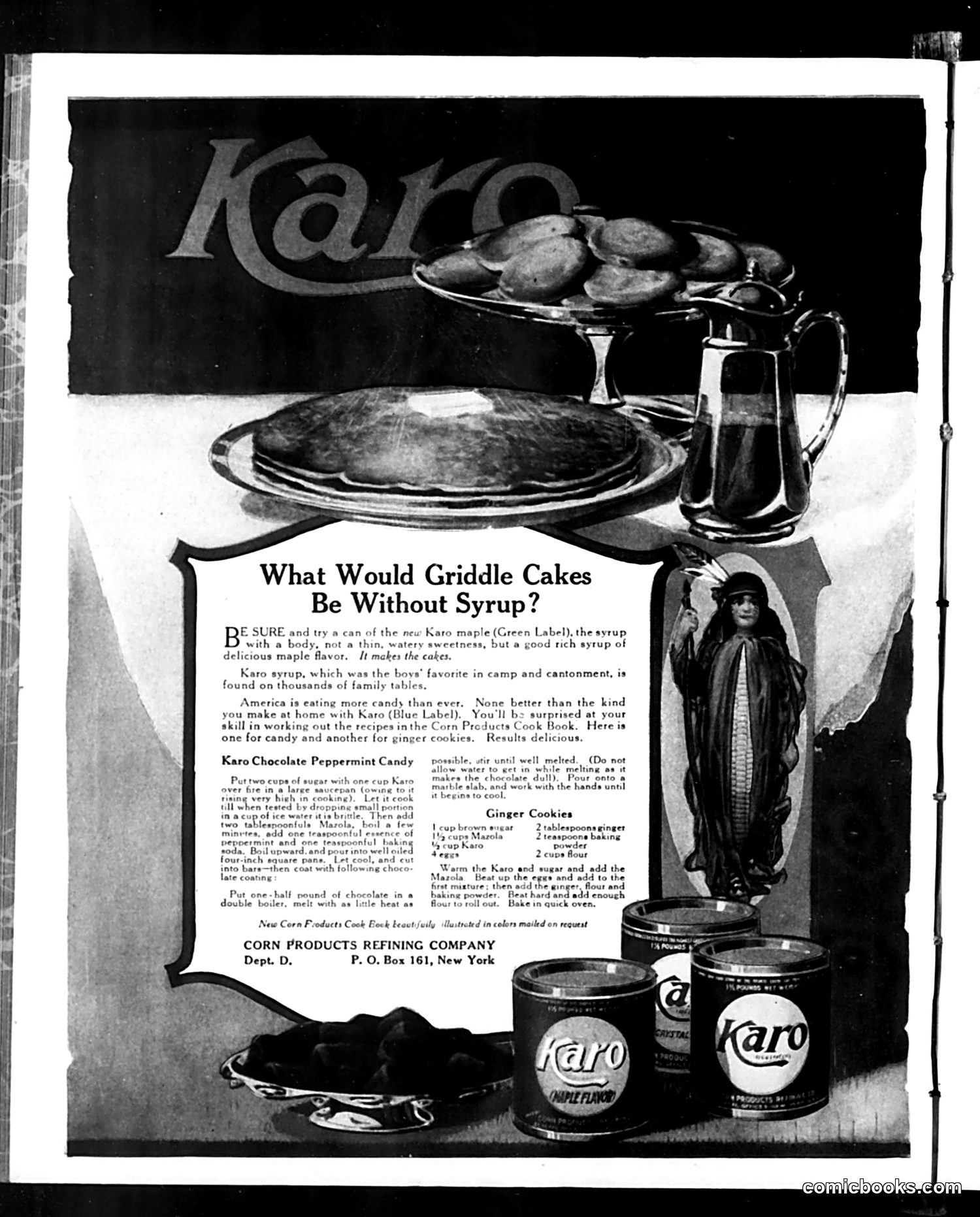
This is **not a political cartoon** — it's a **product advertisement** for Karo syrup, made by Corn Products Refining Company. The page promotes Karo maple syrup (Green Label) and Karo candy syrup (Blue Label) for home cooking. The rhetorical question "What Would Griddle Cakes Be Without Syrup?" frames syrup as essential to breakfast. The advertisement includes two candy/cookie recipes (Chocolate Peppermint Candy and Ginger Cookies) to demonstrate product versatility. A notable detail: the text references "camp and cantonment," suggesting this ad targets families with soldiers, likely dating this to **WWI era** when such language was common. The decorative imagery shows prepared foods and the syrup bottles, typical of period advertising design. This is straightforward **commercial messaging**, not satire. Judge magazine, while primarily satirical, regularly carried paid advertisements to fund publication.