
A complete issue · 32 pages · 1919
Judge — April 19, 1919
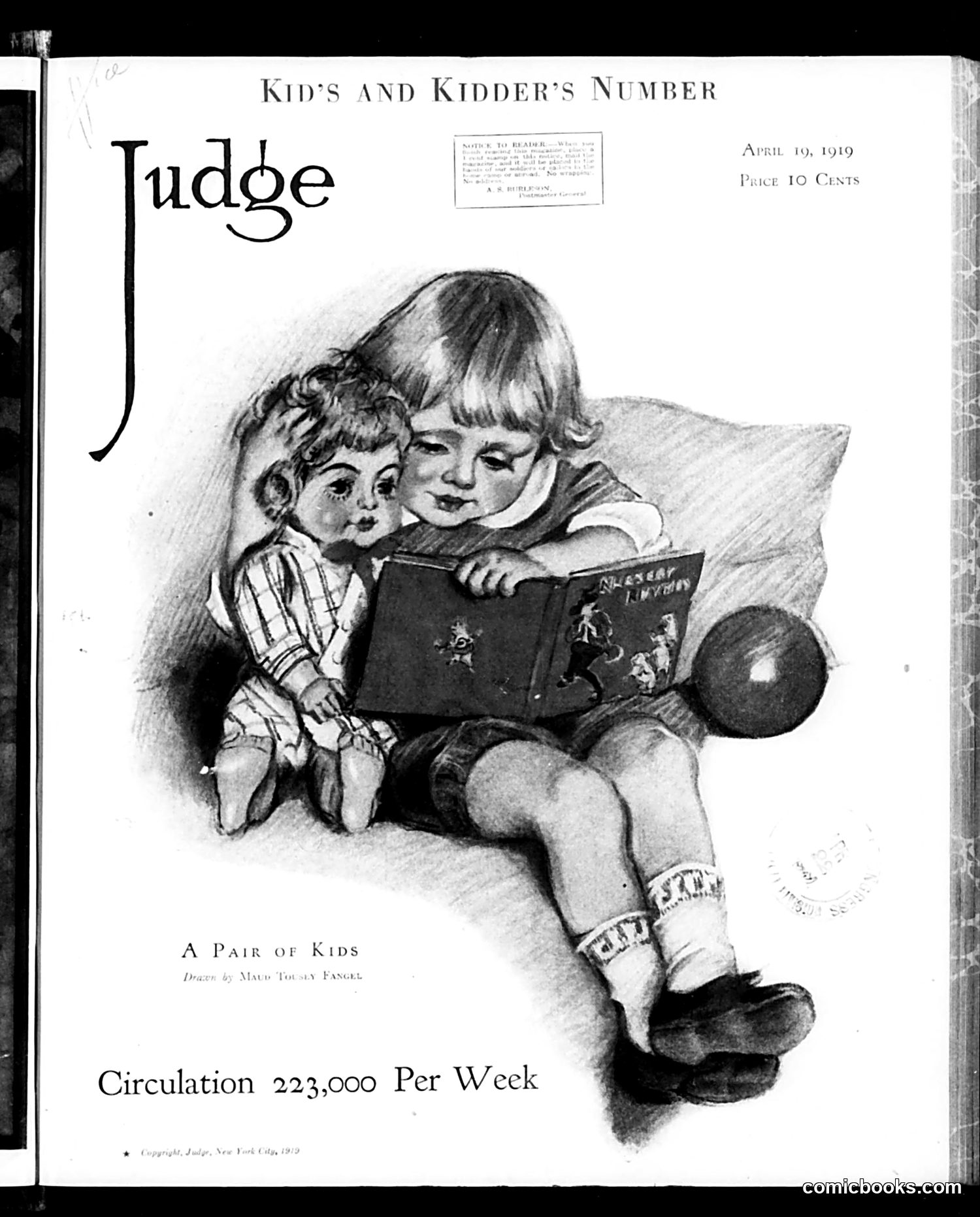
This is a cover illustration for Judge's "Kids and Kidder's Number," a special issue featuring children-oriented content. The drawing shows two young children sitting together reading a book labeled "Nursery Rhymes," with a toy ball beside them. The illustration is titled "A Pair of Kids" and credited to artist Maud Humphrey Fangel, a prominent illustrator of children's literature in the early 20th century. Rather than political satire, this appears to be a sentimental, charming cover celebrating childhood innocence—appropriate for a special children's issue. The notation "Circulation 223,000 Per Week" demonstrates Judge's substantial readership during this period. The price of 10 cents was standard for weekly magazines of that era.
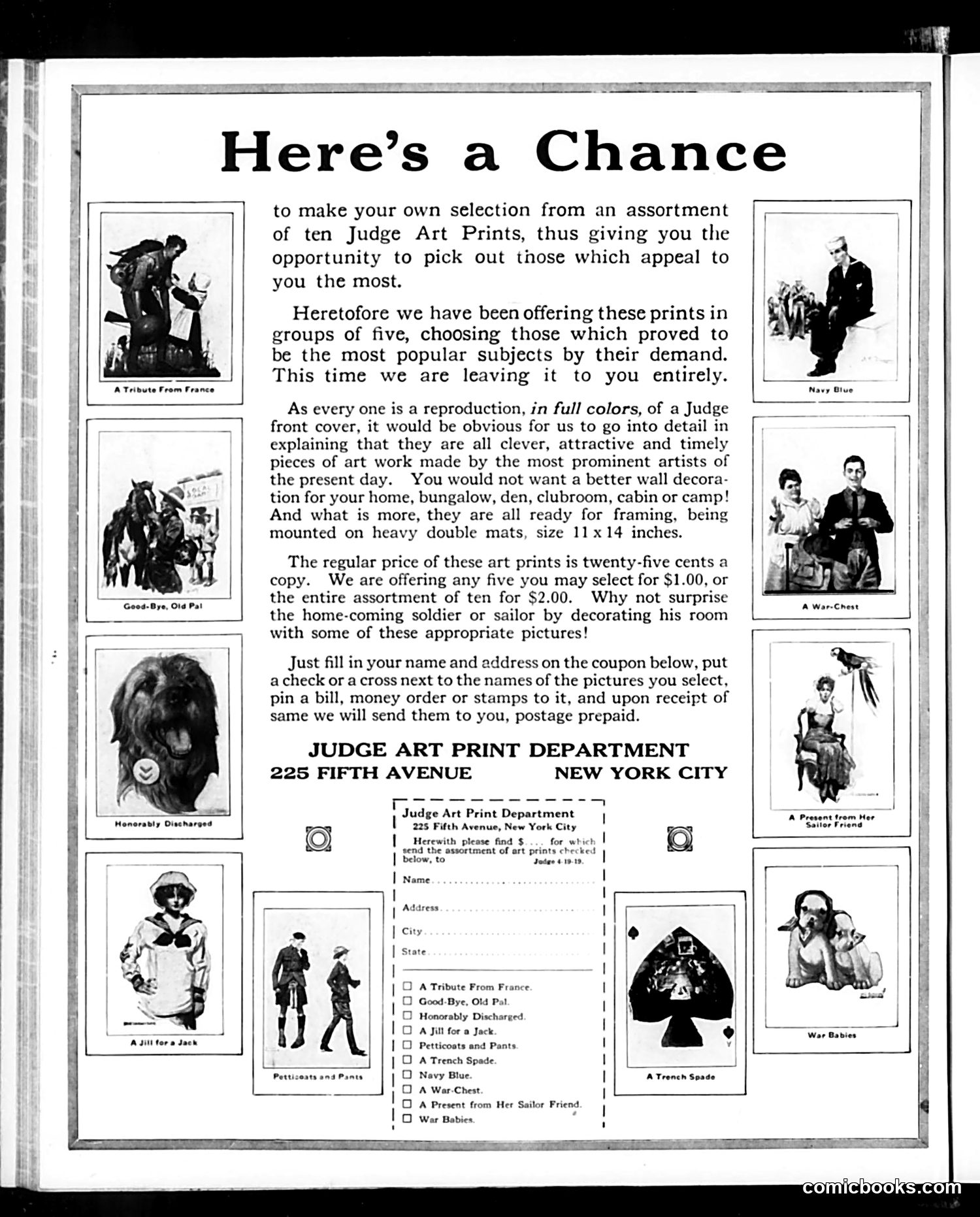
This is primarily **advertising**, not editorial satire. The Judge Art Print Department is selling reproductions of ten prints for $2.00 total (25 cents each individually). The prints themselves appear WWI-themed, based on visible titles: "A Tribute From France," "Good Bye, Old Pal," "Honorably Discharged," "Navy Blue," "A War Chest," "A Trench Spade," "Petticoats and Pants," "A Present From Her Sailor Friend," and "War Babies." The images show soldiers, sailors, women, and dogs—typical sentimental patriotic and home-front imagery from the WWI era. The advertisement targets buyers wanting to decorate soldiers' rooms with "appropriate pictures," suggesting this was marketed around soldiers' homecoming. This reflects post-WWI commercial culture rather than satire or political commentary.
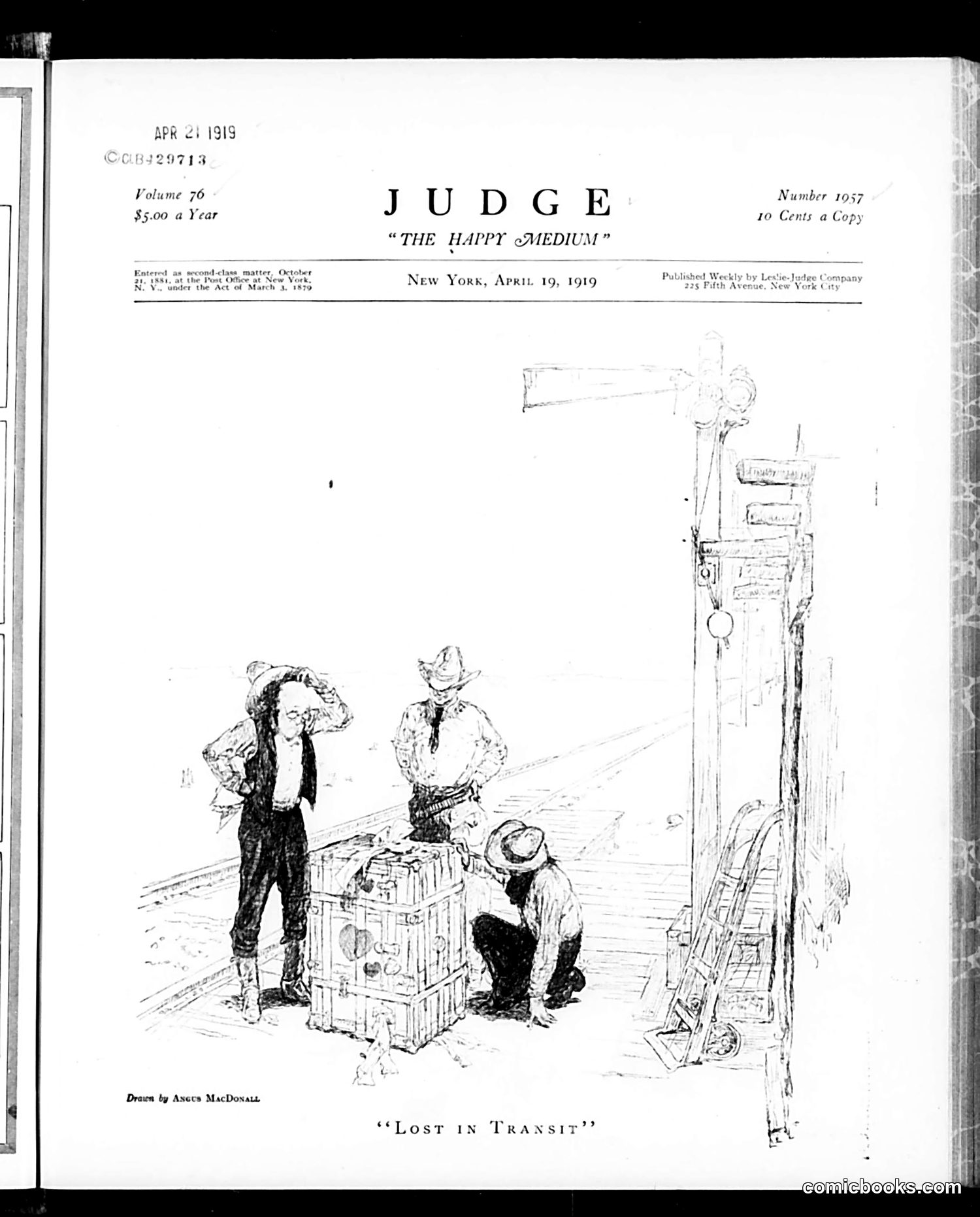
This cartoon by Agnes MacDonald depicts three men with luggage appearing confused or stranded in what looks like a train station or transit hub. The title "Lost in Transit" suggests travelers who've become disoriented, likely a commentary on post-World War I transportation chaos or confusion. Given the 1919 date, this may reference the broader disruption of travel infrastructure following WWI's end, or possibly the general disorder of the demobilization period when soldiers were returning home. The men's bewildered body language emphasizes their predicament. Without additional context, the specific satirical target—whether it's railroad incompetence, government mismanagement, or immigrant confusion—remains somewhat unclear from the image alone.
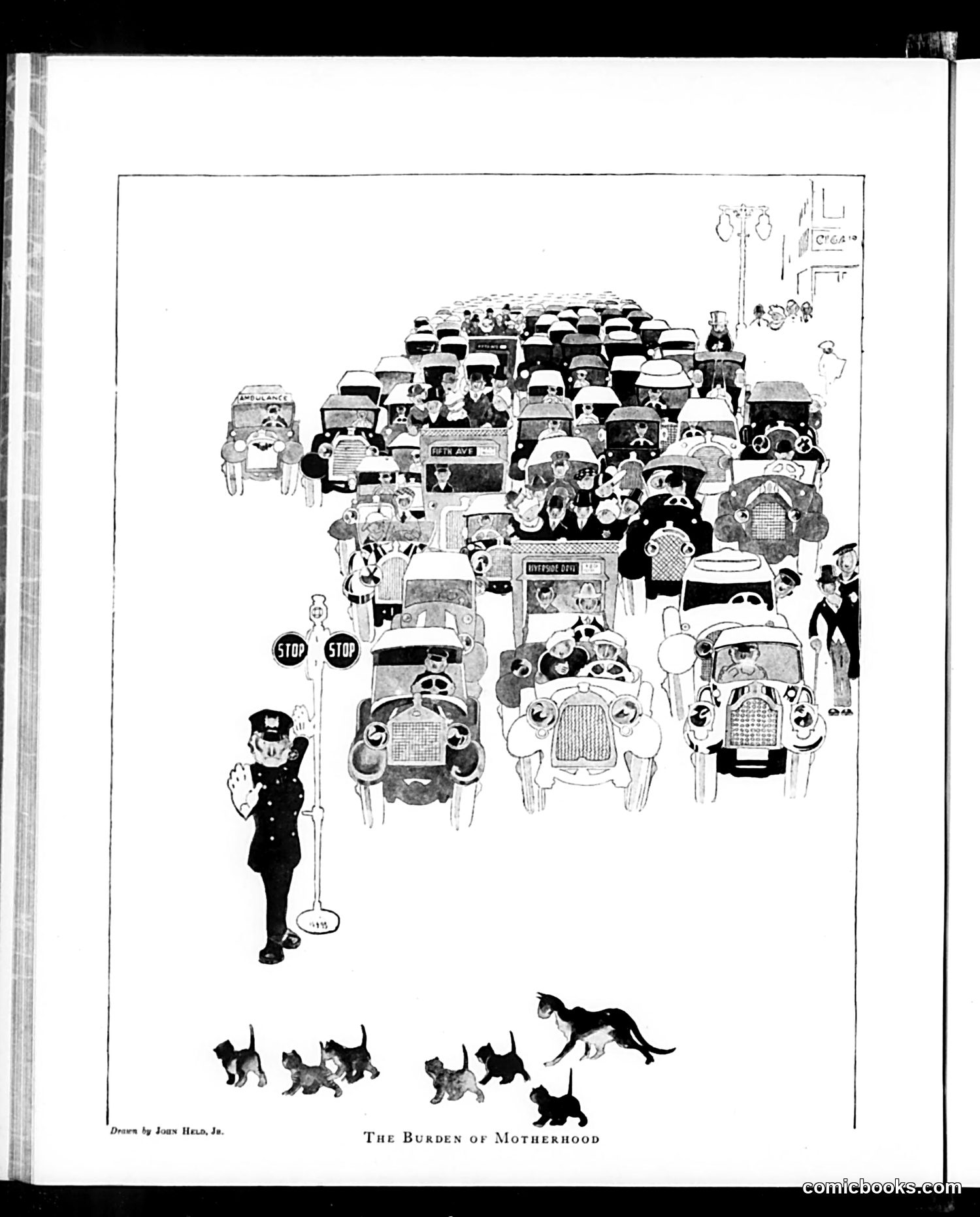
This cartoon satirizes the overwhelming responsibilities of motherhood in early 20th-century America. A traffic cop stops an enormous parade of automobiles to allow a woman—representing "Mother"—to cross the street with her brood of dogs (representing children). The jam-up of vehicles extends far into the distance, suggesting motherhood's disruptive impact on society's normal functioning. The satire operates on multiple levels: it mocks both the self-sacrificing ideal of motherhood and perhaps critiques how mothers with large families impede public progress. The dogs humorously represent children as demanding, uncontrollable creatures. The cartoon reflects anxieties about population, gender roles, and women's place in modern urban society during this period.
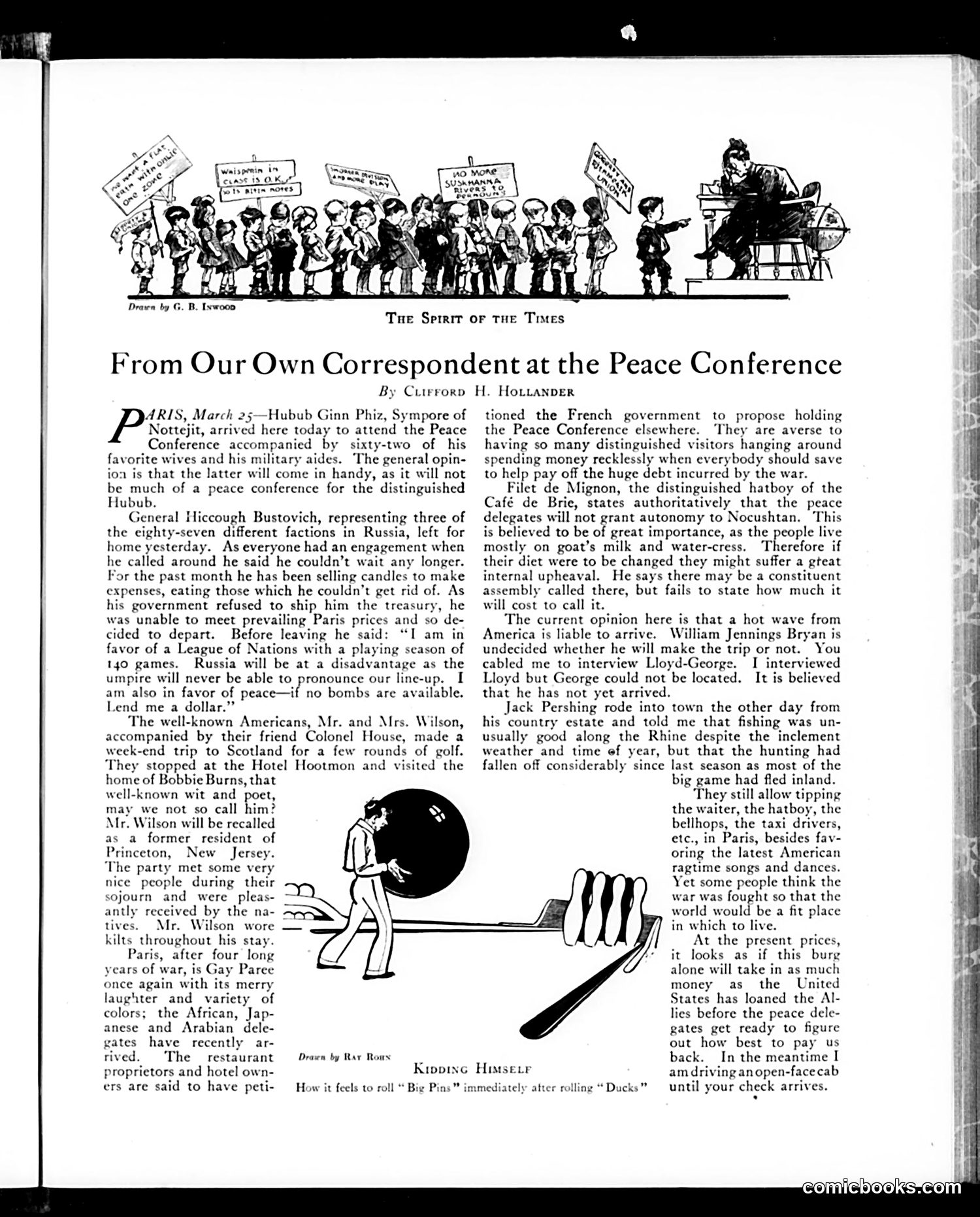
This Judge magazine page from March 25 (year unclear from image) satirizes the Paris Peace Conference following World War I. The top cartoon by G.B. Iwood shows protesters with various demands confronting a seated official—representing competing national interests and special interests clamoring for favorable treaty terms. The main article by Clifford H. Hollander reports on peace negotiations, mentioning figures like General Hiccough Bustovitch (representing Russian factions) and Americans including the Wilsons and Jack Pershing. The lower cartoon "Kidding Himself" by Hal Roach depicts someone rolling a large ball labeled "Big Pan" (possibly "Big Pan" peace terms) that falls off a slope—suggesting the optimistic peace efforts may prove unstable or fail. The satire critiques the naïve belief that post-war settlements could satisfy all parties.
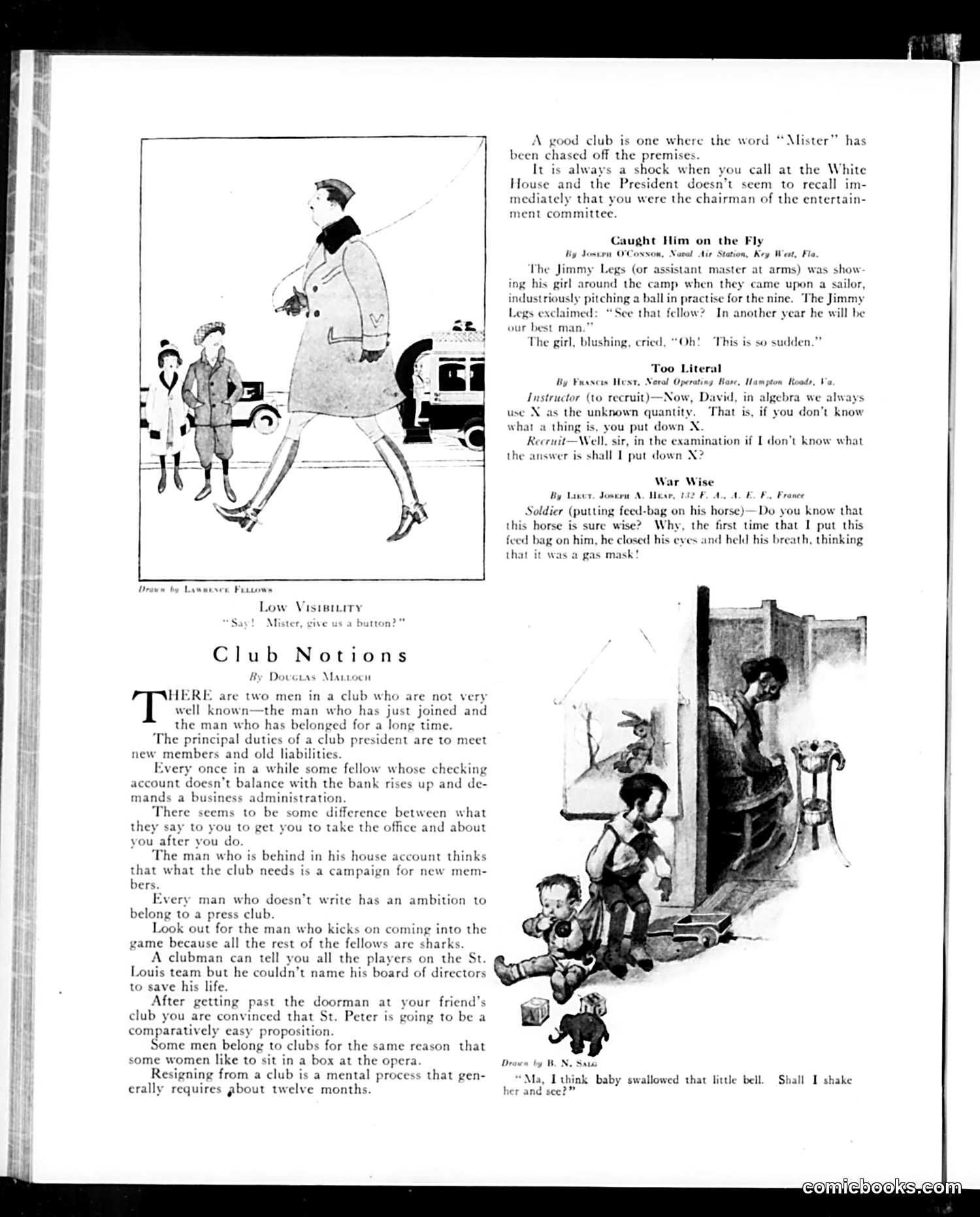
This page satirizes men's club culture and membership dynamics of the early 20th century. The main article by Douglas Malloch critiques various clubmen archetypes: the newly-joined member, those with accounting problems, and those seeking visibility or new recruits. The humor targets social pretension—comparing club membership to opera attendance and poking fun at the difficulty of resigning from clubs ("about twelve months" of mental anguish). The accompanying cartoons illustrate club scenarios: one shows a man fishing (likely representing leisurely club activity), another depicts children with a bell, captioned about swallowing it. These visual jokes reinforce the text's gentle mockery of club life's absurdities and members' behaviors.
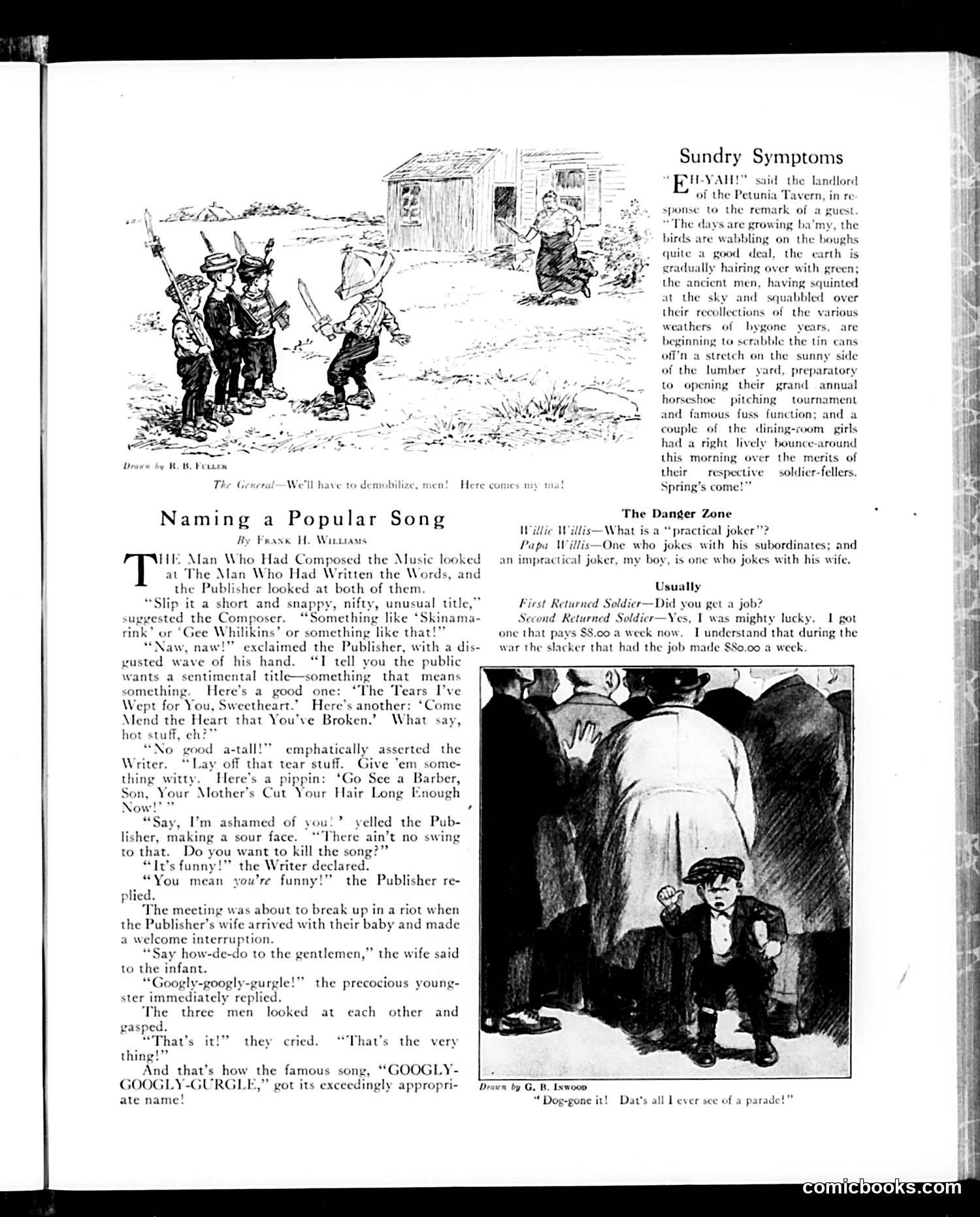
This page contains three separate satirical pieces typical of Judge's humor: **"Naming a Popular Song"** mocks the music industry's creative process. A composer, lyricist, and publisher debate song titles, with the publisher pushing sentimental clichés ("The Tears I've Wept for You, Sweetheart") while the writer wants wit. When the publisher's baby babbles "Googly-googly-gurgle," all three inexplicably declare this the perfect title—satirizing how popular songs often have absurd, meaningless names that succeed anyway. **"Sundry Symptoms"** uses a tavern keeper's rambling dialect to humorously catalog spring's arrival—birds, ancient men discussing weather, horseshoe tournaments—with a joke about dining-room girls debating their "soldier-fellers," likely referencing WWI's aftermath. **"The Danger Zone"** contrasts a recently-demobilized soldier's current $8/week wage with the $80/week a wartime "slacker" (draft-dodger) earned at the same job—bitter post-war commentary on how those avoiding military service often profited financially while soldiers sacrificed.
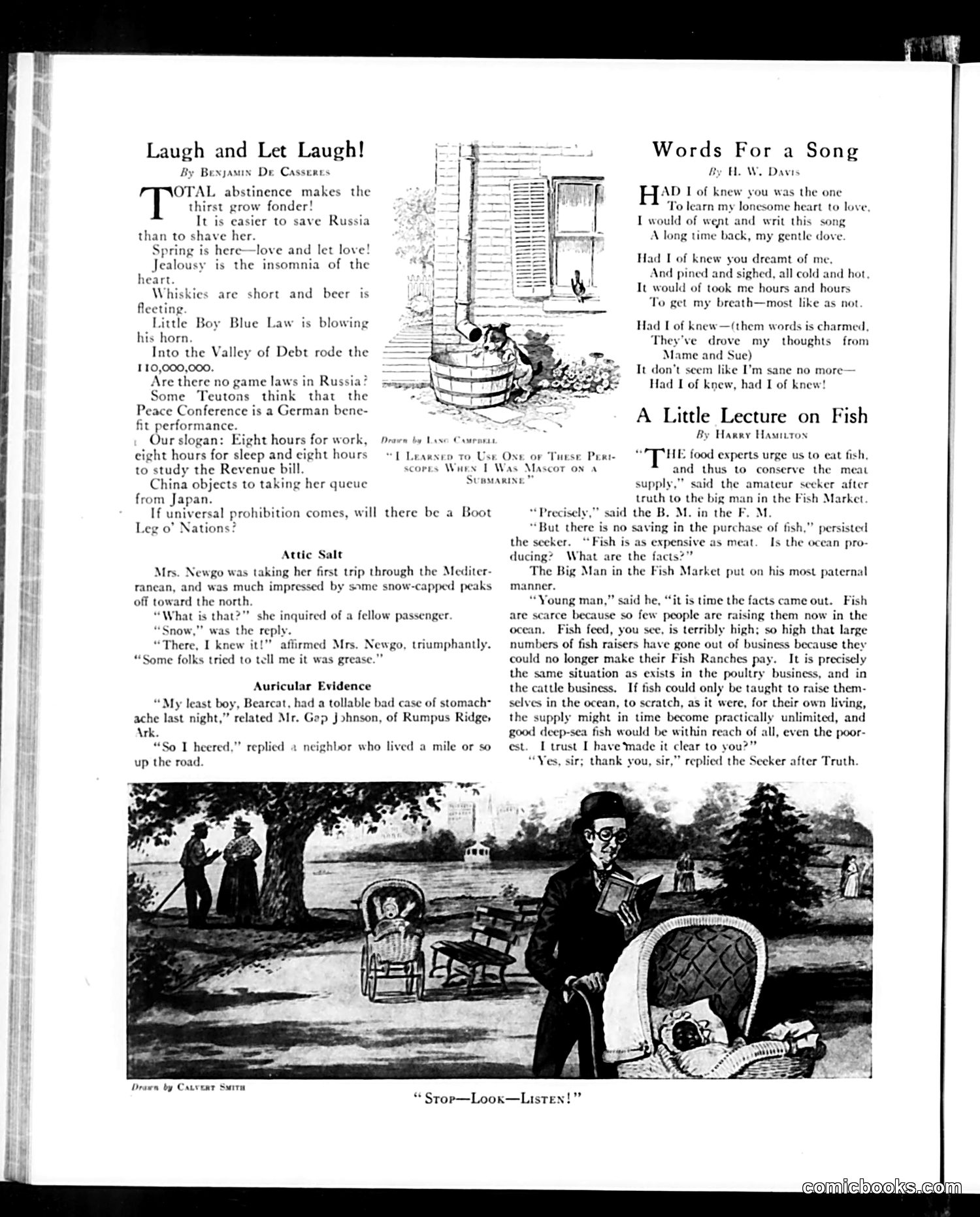
This page contains satirical commentary typical of Judge magazine's post-WWI era content: **"Laugh and Let Laugh!"** presents cynical one-liners mocking Prohibition ("Little Boy Blue Law"), war debt ("Valley of Debt rode the 110,000,000"), the Peace Conference, and international tensions. References to "save Russia" and "China objects to taking her queue from Japan" suggest post-1918 geopolitical anxieties. **"A Little Lecture on Fish"** is absurdist satire ridiculing wartime food-conservation appeals. The "Big Man in the Fish Market" comically explains fish scarcity by claiming fish "raisers" exist in the ocean like poultry farmers—a nonsensical inversion mocking both government propaganda and public gullibility about food supplies. The illustration shows a woman with a perambulator confronting a gentleman, captioned "Stop—Look—Listen!" — likely commenting on social propriety or public safety awareness. The page's lighter humor pieces ("Attic Salt," "Auricular Evidence") provide filler around the main satirical content targeting contemporary politics and consumer anxieties.
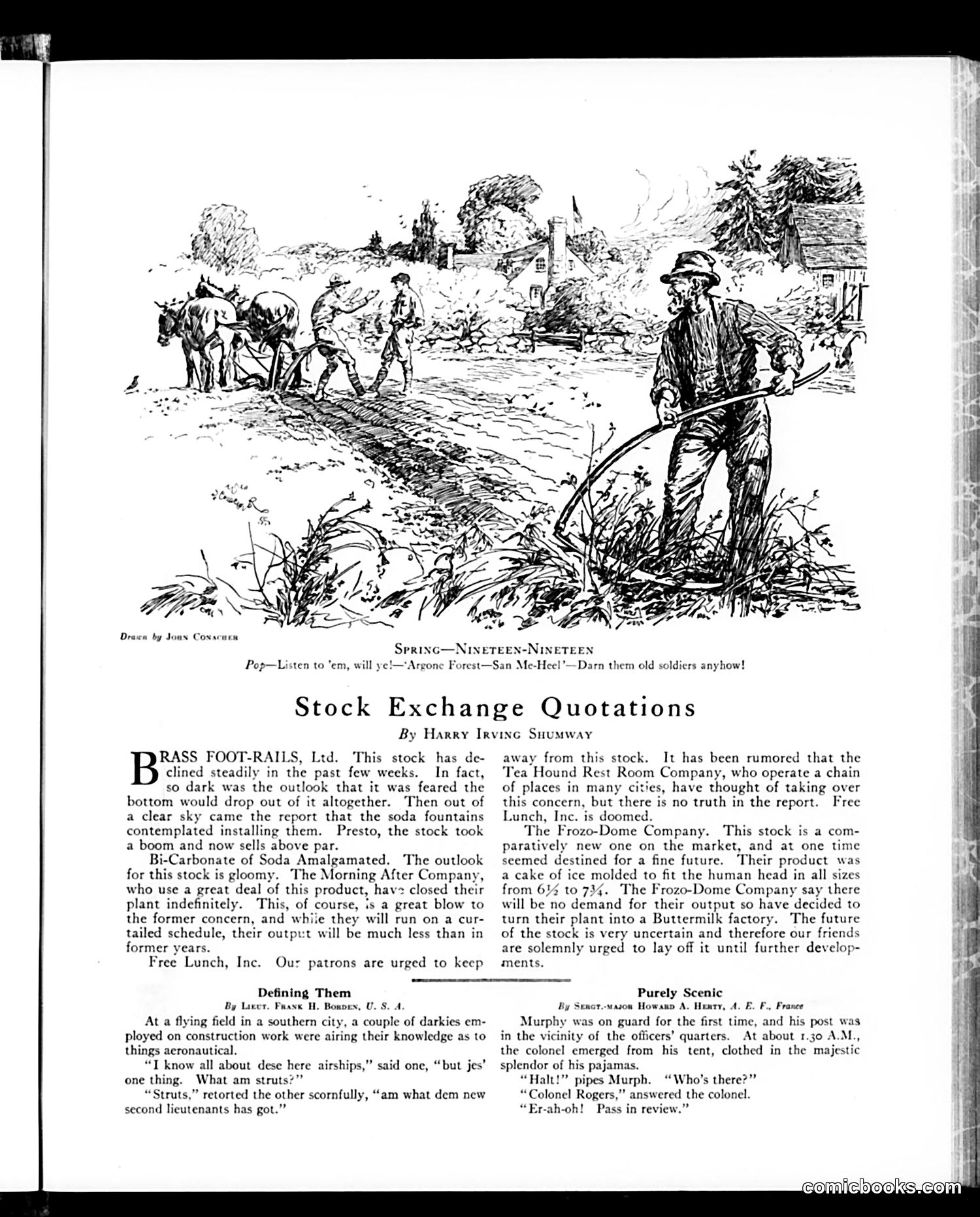
This page contains three satirical pieces: **Top Illustration**: A rural spring scene showing farmers and soldiers, captioned with dialogue mocking old soldiers' complaints—typical early-20th-century nostalgia humor. **"Stock Exchange Quotations"**: Fake financial commentary satirizing absurd business ventures. "Brass Foot-Rails" stocks rise when soda fountains plan to install them (meaningless connection). "Free Lunch, Inc." is doomed because "The Morning After Company" (hangover remedy sellers) closed—dark humor about alcohol. "Frozo-Dome Company" made ice heads for hot weather but abandoned the failed product. This mocks speculative bubbles and irrational markets. **Two Humor Pieces**: - "Defining Them" uses racist dialect humor (common in 1910s-20s Judge) where Black workers joke that "struts" (airplane parts) are what new second lieutenants have—military arrogance satire. - "Purely Scenic" involves a soldier on guard duty saluting his colonel in pajamas at 1:30 AM—gentle mockery of military formality and confusion. The page reflects period attitudes, including offensive racial stereotyping standard to the era.
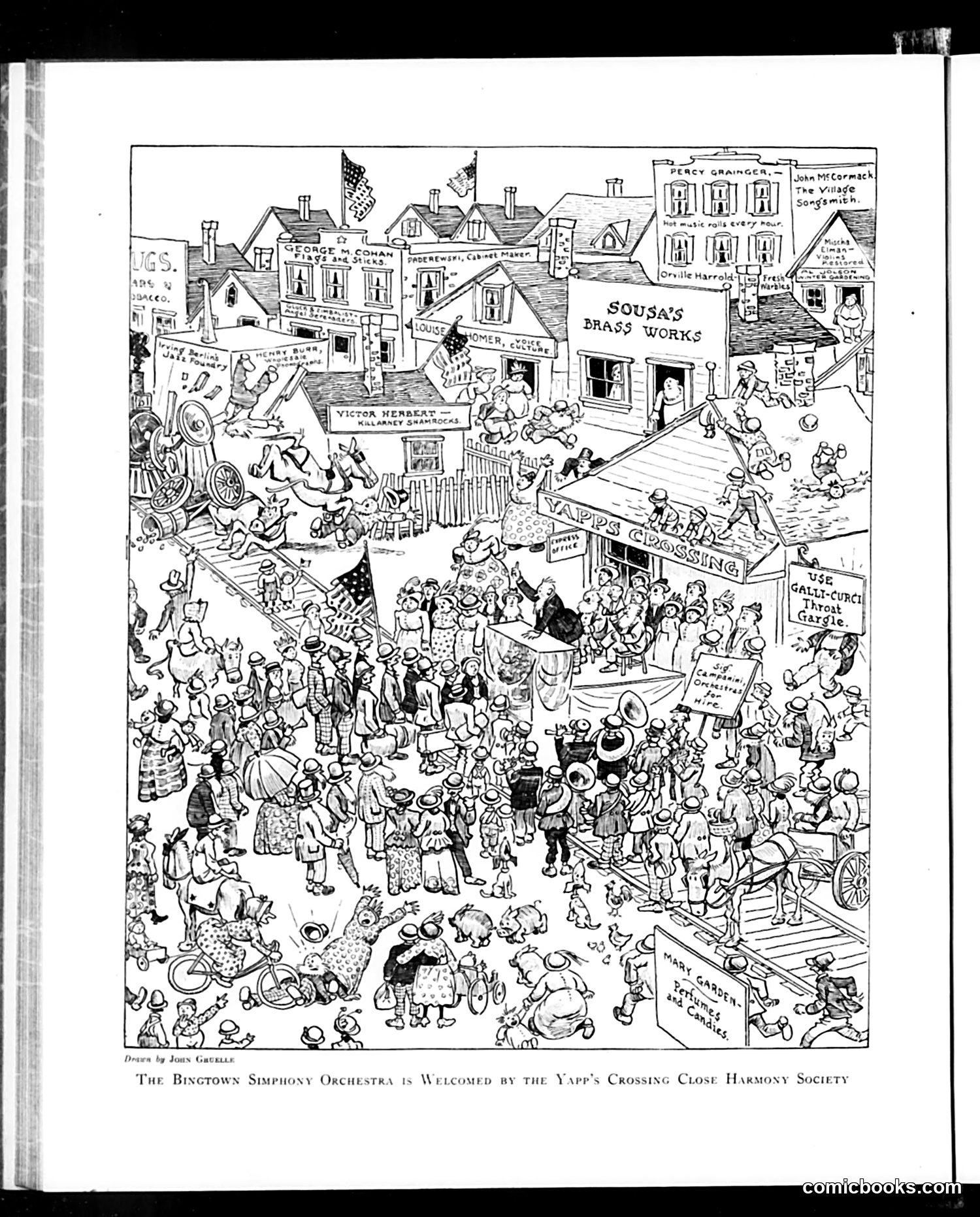
This is a detailed satirical illustration by John Gasclee titled "The Bingtowm Symphony Orchestra is Welcomed by the Yapp's Crossing Close Harmony Society." The cartoon depicts a bustling street scene in a small town, crowded with townspeople, children, and various establishments labeled with business names (Sousa's Brass Works, Percy Grainger's shop, etc.). The scene satirizes a clash between "high" and "low" culture—a visiting symphony orchestra arriving at what appears to be a working-class neighborhood where a local amateur singing group (the "Close Harmony Society") offers their own competing performance. The humor lies in the contrast: the formal orchestra's arrival meets enthusiastic but unsophisticated local musicians, suggesting provincial resistance or indifference to serious art, and the comic chaos of competing musical traditions in a small town setting.
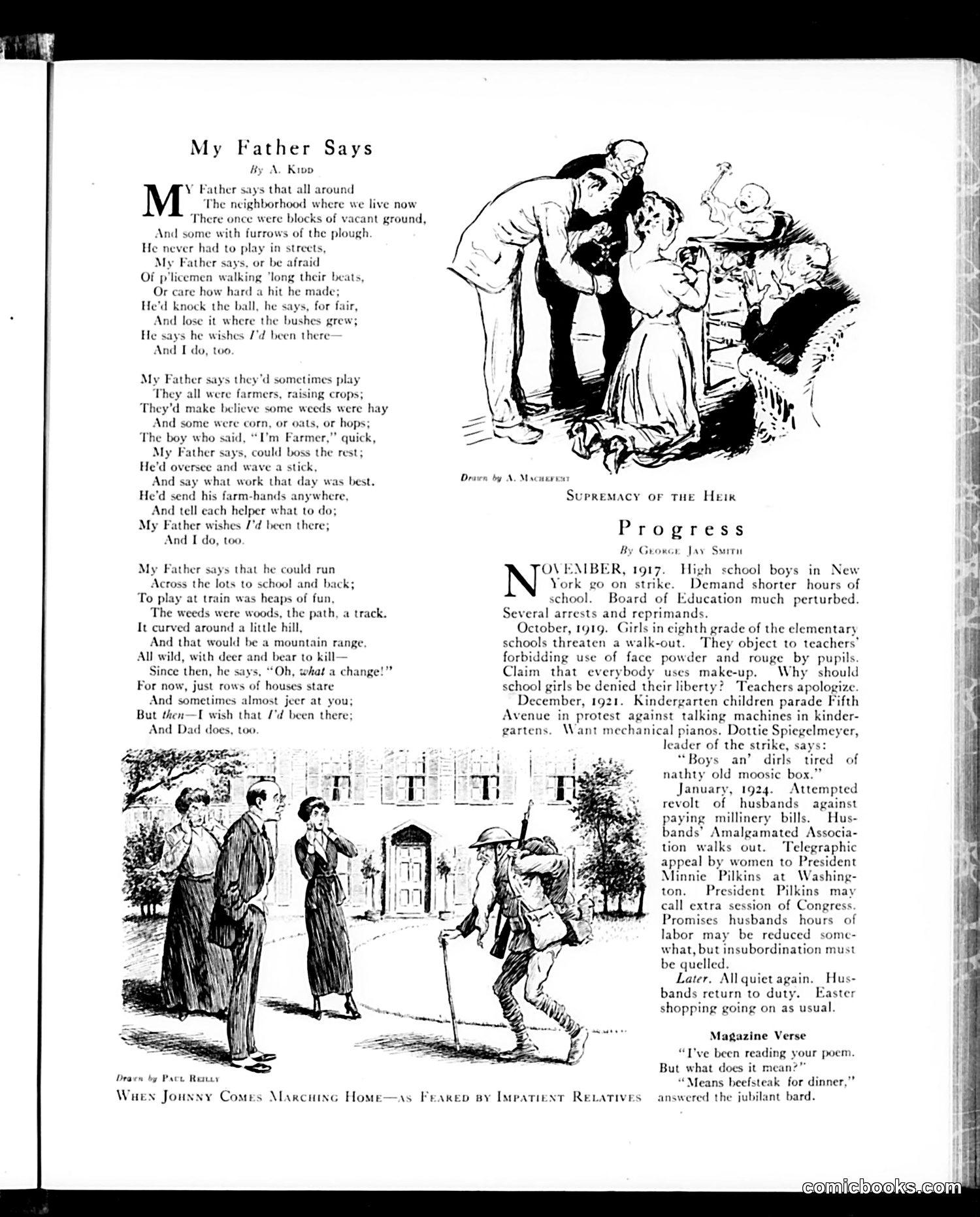
**"My Father Says"** is nostalgic verse lamenting suburban development. The poem presents an elderly father reminiscing about vacant, rural land where he played freely—running across lots, imagining weeds as crops or forests. The implicit critique: modern urbanization has replaced open space with rows of houses, eliminating children's freedom and imaginative play. The accompanying illustration shows a father gesturing fondly while children listen. **"Progress"** is sharp satire on escalating labor strikes and social unrest. It presents a darkly humorous timeline: 1917–1924 depicts strikes expanding from high school boys, to schoolgirls, to kindergarteners, culminating in husbands refusing to pay millinery bills (a contemporary joke about wives' hat expenses). The satire mocks how strike culture has become so normalized that even children and domestic disputes are weaponized through labor action. The final paragraph's restoration of order—husbands capitulating, "Easter shopping going on as usual"—undercuts the seriousness, suggesting these revolts are cyclical theater rather than meaningful change.
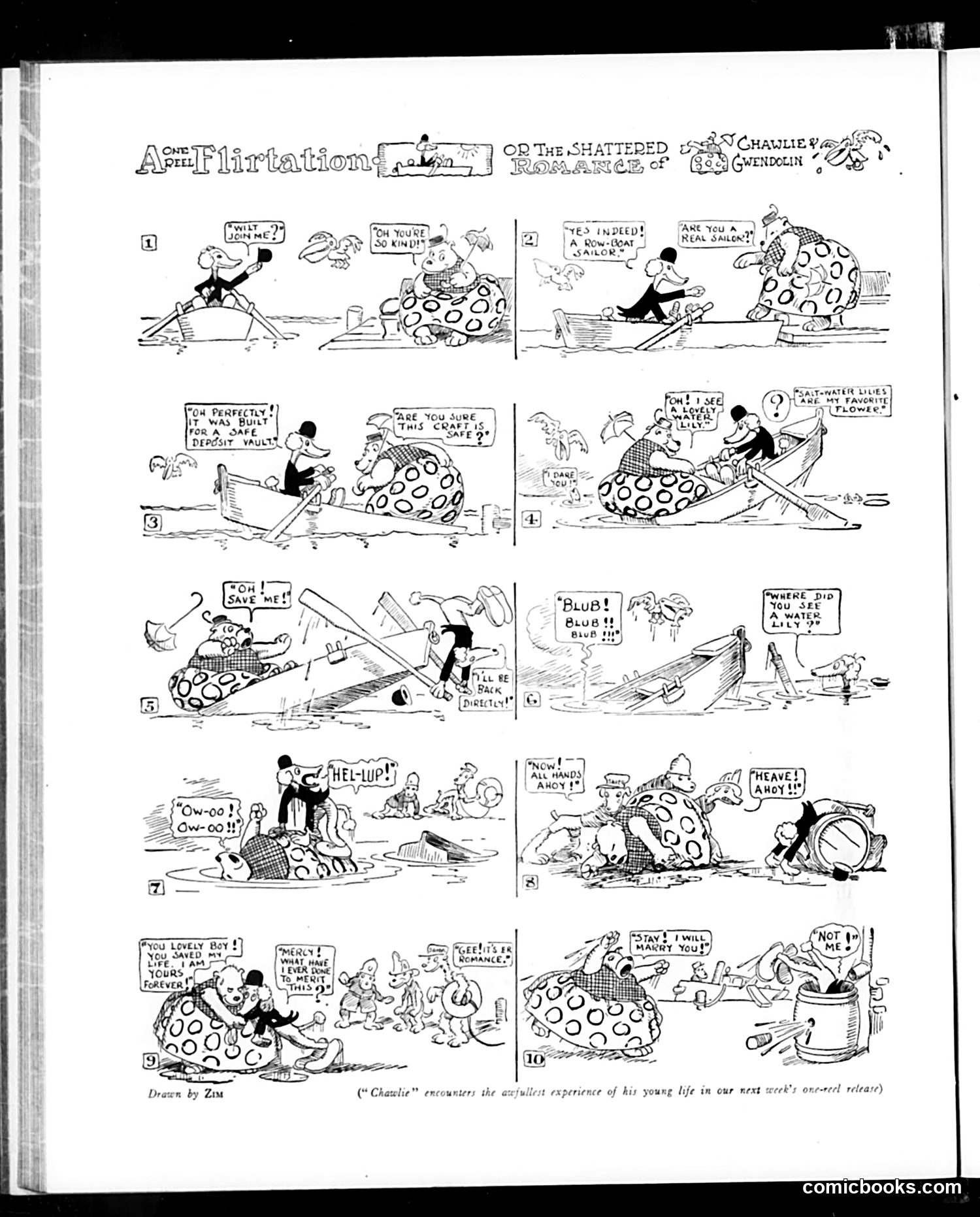
This is a silent-film parody featuring "Charley" (likely Charlie Chaplin's tramp character), who encounters a large woman in a rowboat. The humor relies on slapstick and physical comedy typical of early cinema. The plot: Charley flirts with the woman, she mistakes his advances for rescue efforts during a mishap ("row-boat sailors"), and he ends up in the water. The woman dramatically declares she'll "marry" him as repayment for saving her life—a common melodramatic movie trope of the era. The satire mocks both early film's overwrought emotional scenes and the absurdity of romantic obligation. The rowboat serves as a confined space amplifying the comedic chaos. The caption notes this depicts "the wildest experience of his young life in our next week's one-reel release"—advertising an actual film screening, suggesting this comic accompanied movie promotion in Judge magazine during the silent-film era.
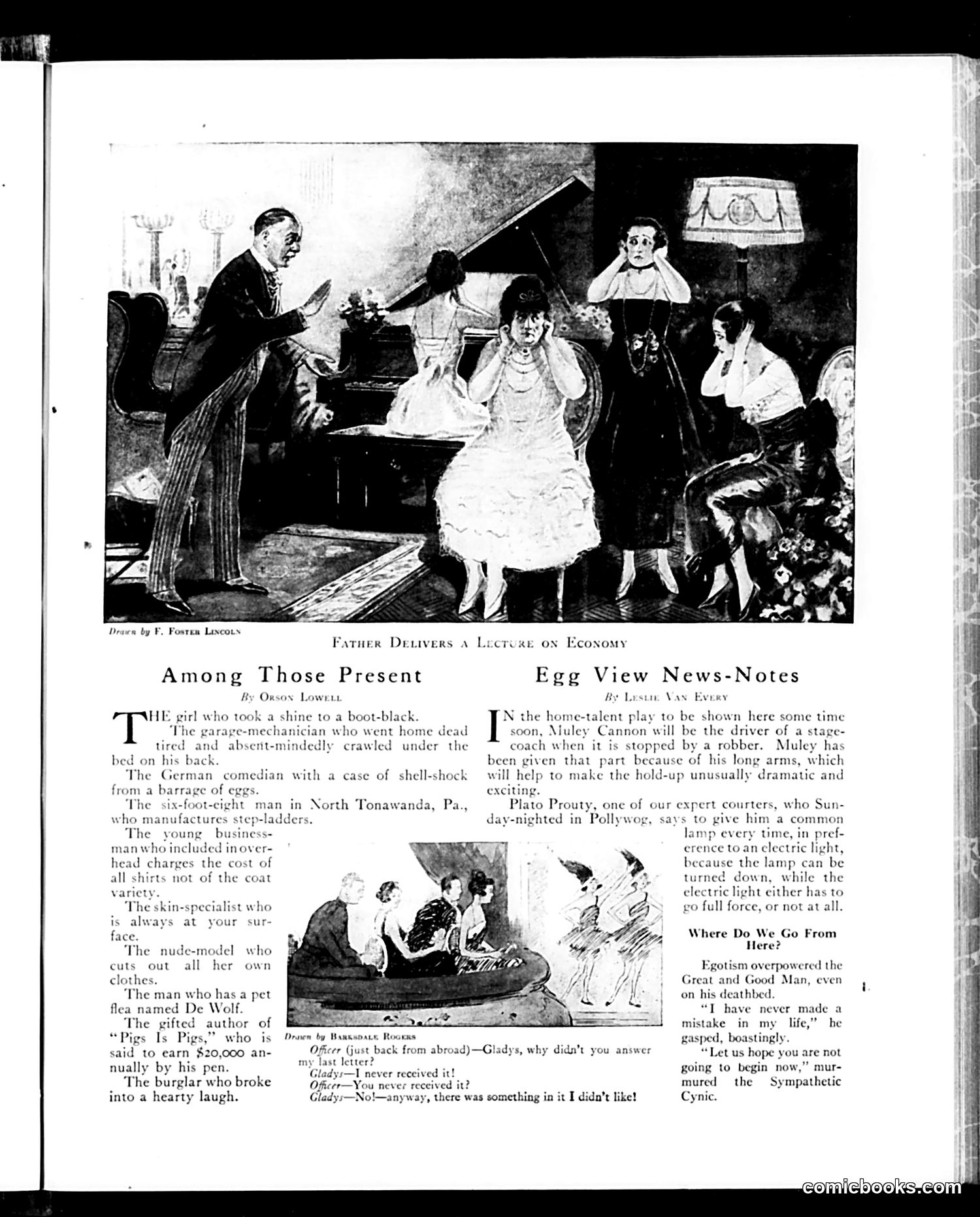
This page contains two main satirical pieces: **"Among Those Present"** (top) is a humorous list of social types, likely poking fun at everyday character archetypes of the era—the girl attracted to a mechanic, the absent-minded garage worker, various eccentrics. The humor derives from absurdist exaggeration of mundane people. **"Father Delivers a Lecture on Economy"** (top illustration) depicts a moral lesson scene: a father addresses his assembled family about financial responsibility—a common Victorian/early 20th-century domestic scenario. The satire likely mocks how such lectures often came from hypocrites. **"Egg View News-Notes"** (right) contains brief local gossip items, including one about casting for a stage robbery scene and observations about lamp preferences—inconsequential social humor. The bottom cartoon shows a police officer questioning "Gladys" about not answering his letter from abroad; her evasive response provides mild comedic tension around romantic miscommunication. Overall, the page offers light domestic and social satire targeting middle-class life and its pretensions—typical Judge magazine fare.
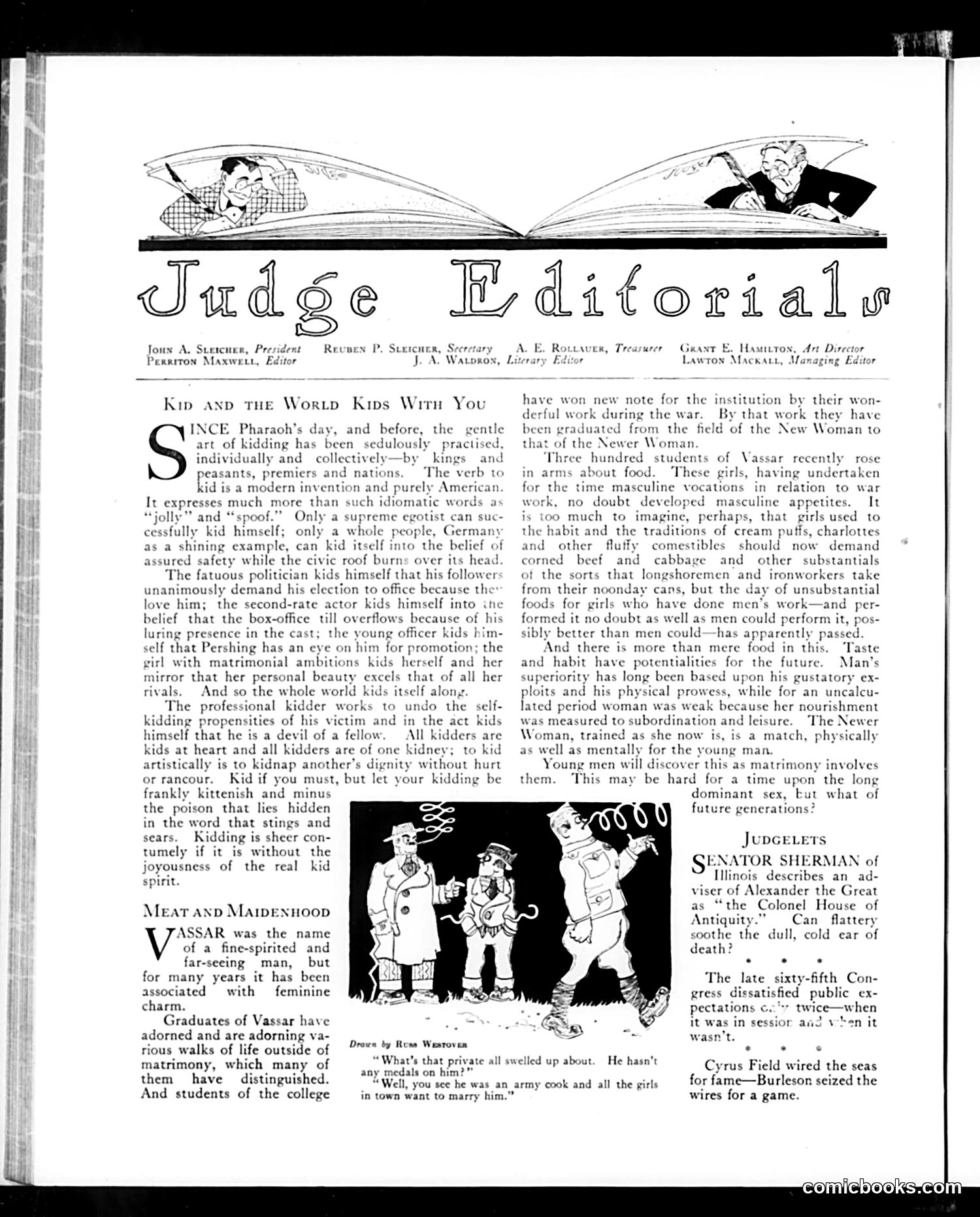
This page presents **editorial commentary on changing gender roles during World War I**. The main article, "Kid and the World Kids With You," uses "kidding" (teasing/joking) as a metaphor for self-deception, cautioning against dishonesty. The **Vassar section** addresses the "New Woman"—female college graduates entering traditionally male occupations. The text notes that 300 Vassar students took on masculine wartime work, developing "masculine appetites" and discovering they could perform men's work as well as men could. The commentary suggests this challenges assumptions about female weakness and subordination. The **cartoon by Russ Westover** illustrates this theme: a soldier brags about his war service, but the caption reveals he was merely an army cook—yet local girls want to marry him anyway. The joke satirizes how **wartime service, however humble, elevated a man's status**, while simultaneously suggesting women's desperation for marriage partners. Together, the content reflects anxiety about **women's wartime economic independence and shifting gender expectations** post-WWI.
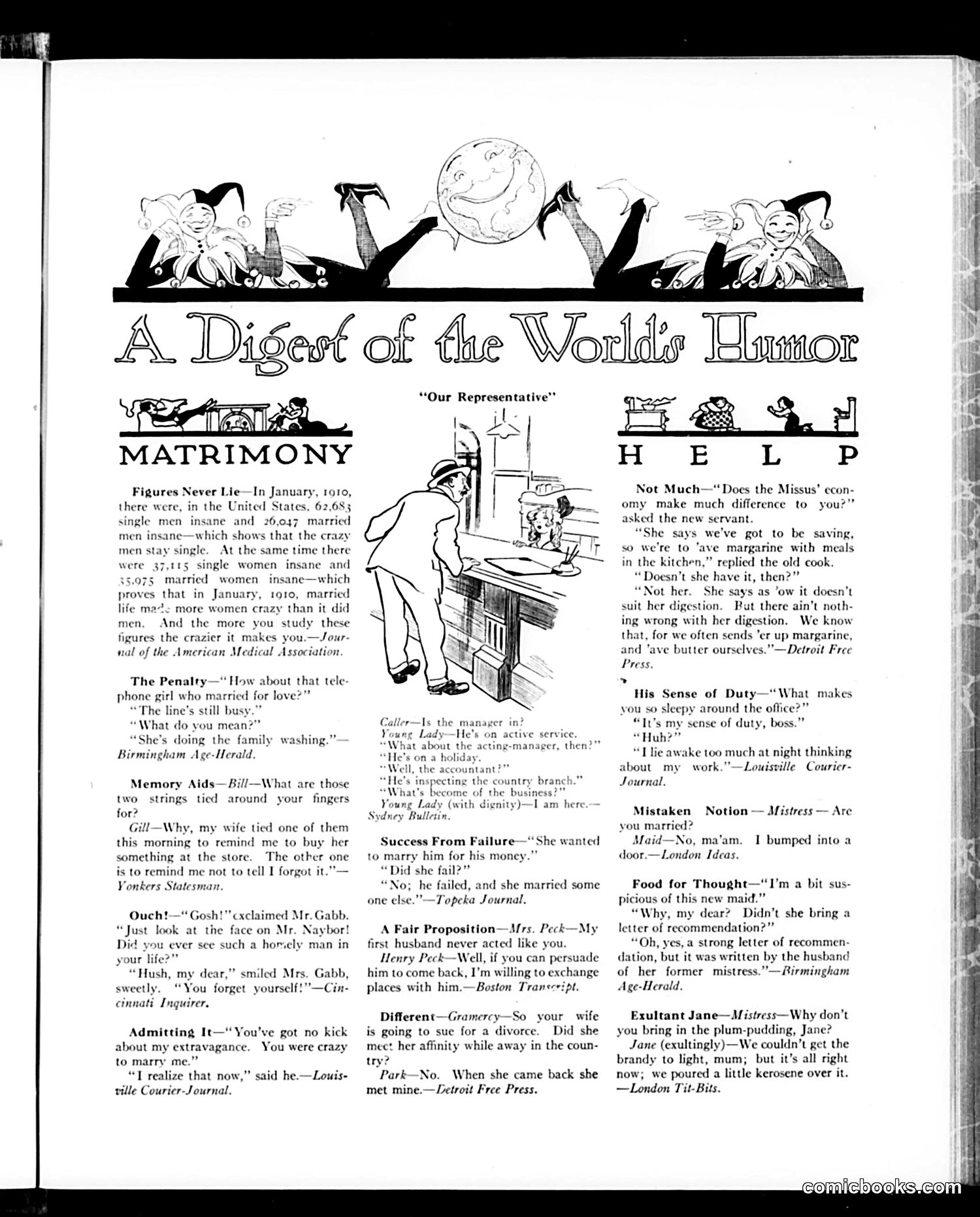
This page collects brief humorous anecdotes organized by theme, reflecting early 1910s American attitudes toward marriage, domestic service, and gender relations. **Key themes:** **Matrimony section**: Statistical jokes suggesting marriage drives women (but not men) to insanity. Includes domestic comedy about wives reminding husbands of tasks, telephone operators doing laundry after marrying for love, and wives' superior memory of husbands' failures. **Help section**: Servant-employer dynamics, where working-class domestics (maids, cooks) cleverly circumvent their employers' cost-cutting measures—eating butter while serving margarine to mistresses claiming digestive problems. **Overall satire**: These pieces mock marital discord, the economic gap between employers and servants, wives' materialism, and servants' resourcefulness. The humor relies on class distinctions and assumes readers identify with either frustrated husbands or clever domestic staff outwitting their employers. Nothing here directly references specific political events—it's pure social comedy targeting domestic life and servant culture.
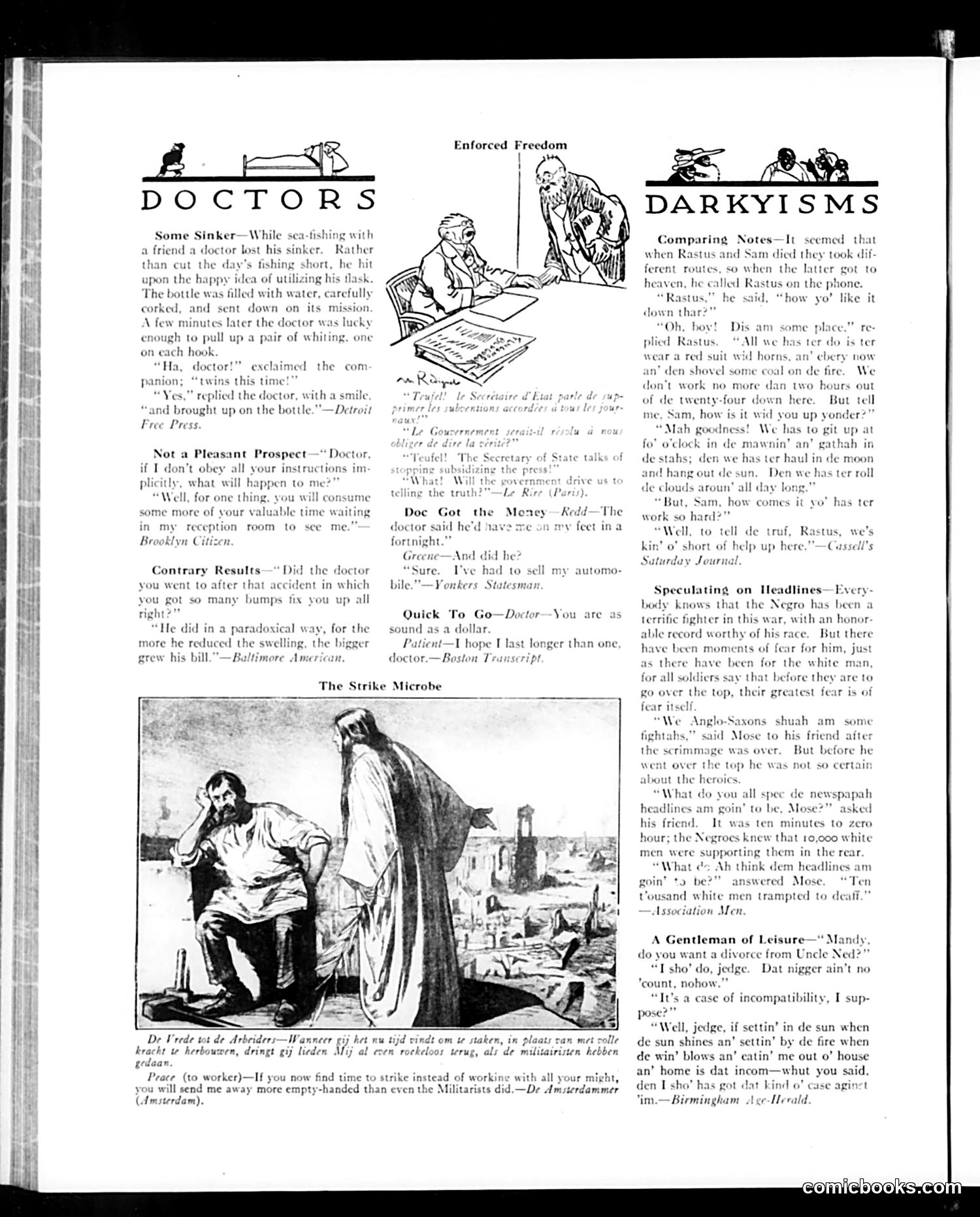
This page contains several racist dialect-humor pieces stereotyping Black Americans, typical of early-20th-century American satire magazines. **"Comparing Notes"** depicts two deceased Black men (Rastus and Sam) in contrasting afterlife scenarios—one in Hell doing manual labor, the other in Heaven performing celestial tasks. The joke relies on offensive dialect and the assumption that Black workers naturally belong in servile positions even in the afterlife. **"Speculating on Headlines"** references WWI, where Black soldiers served in segregated units. It quotes a character named Mose claiming 10,000 white soldiers supported Black troops, then jokes about newspaper headlines reading "Ten Thousand White Men Trampled to Death"—the dark humor suggesting Black soldiers would inadvertently kill their white supporters through combat. **"A Gentleman of Leisure"** uses similar dialect humor in a divorce proceeding, where a Black man explains marital incompatibility through complaints about weather and food. These pieces exemplify how Judge magazine used crude racial stereotypes and Black dialect as vehicles for "humor," reflecting deeply prejudiced attitudes normalized in early-20th-century American popular culture.
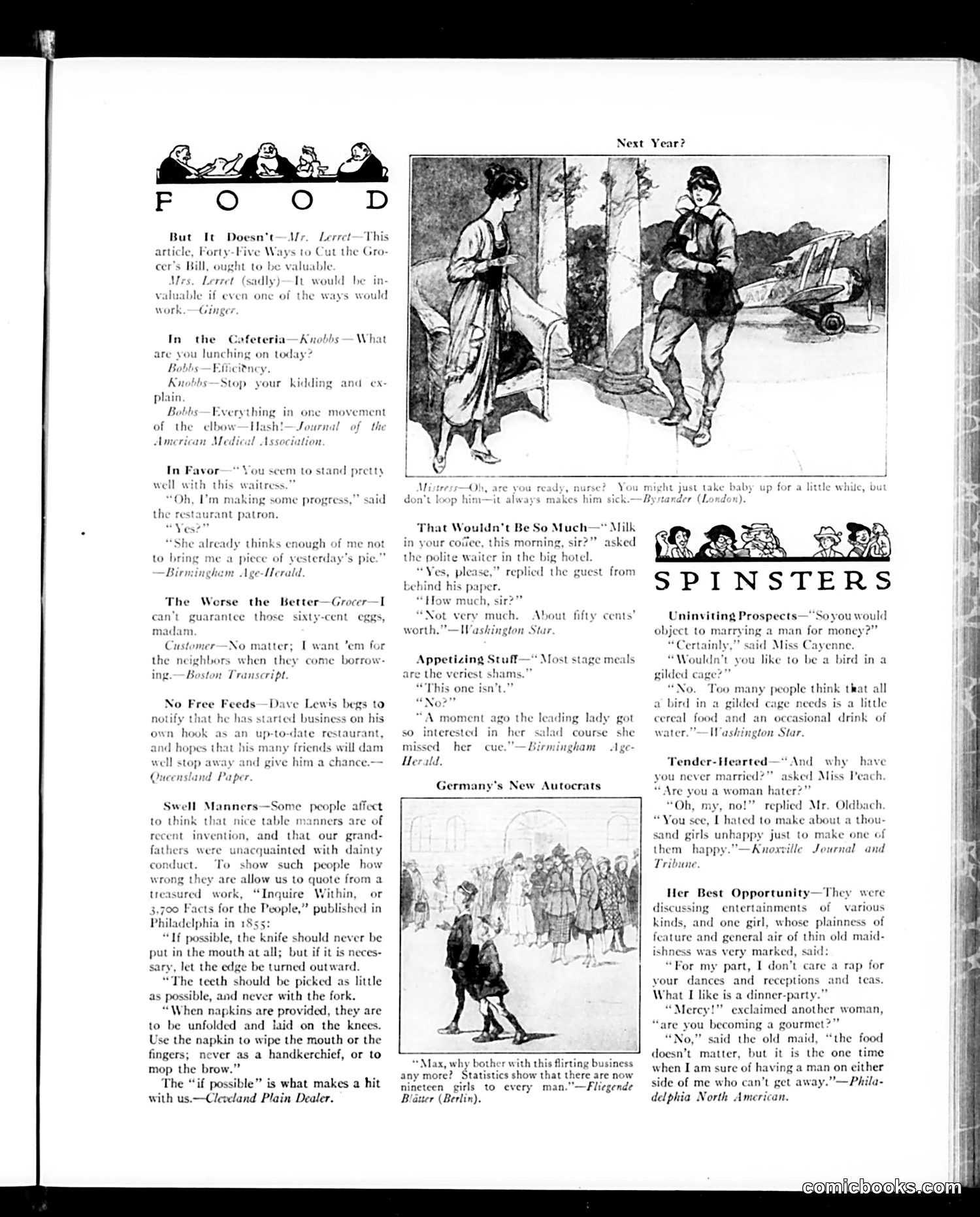
This page from *Judge* contains multiple short humorous anecdotes satirizing early 20th-century American social life and dining customs. **Main satirical targets:** 1. **"Food" section**: Mocks advice columns (referencing "Forty-Five Ways to Cut the Grocer's Bill") as impractical for actual households. 2. **Cafeteria joke**: Jokes that workers are eating "efficiency" itself rather than real food—satirizing the era's obsession with scientific management and workplace optimization. 3. **Table manners piece**: Ridicules the pretension of Victorian etiquette guides (quoting an 1855 manual about knife placement) by highlighting absurdly pedantic rules no one actually follows. 4. **"Spinsters" section**: Several jokes about unmarried women, mocking both their marital prospects and their limited social roles—suggesting women's value centered on marriage and entertaining men. 5. **Germany cartoon**: References wartime gender imbalance ("nineteen to every man"), likely from World War I's casualties. The humor reflects contemporary attitudes about class, efficiency, propriety, and gender roles typical of the period.
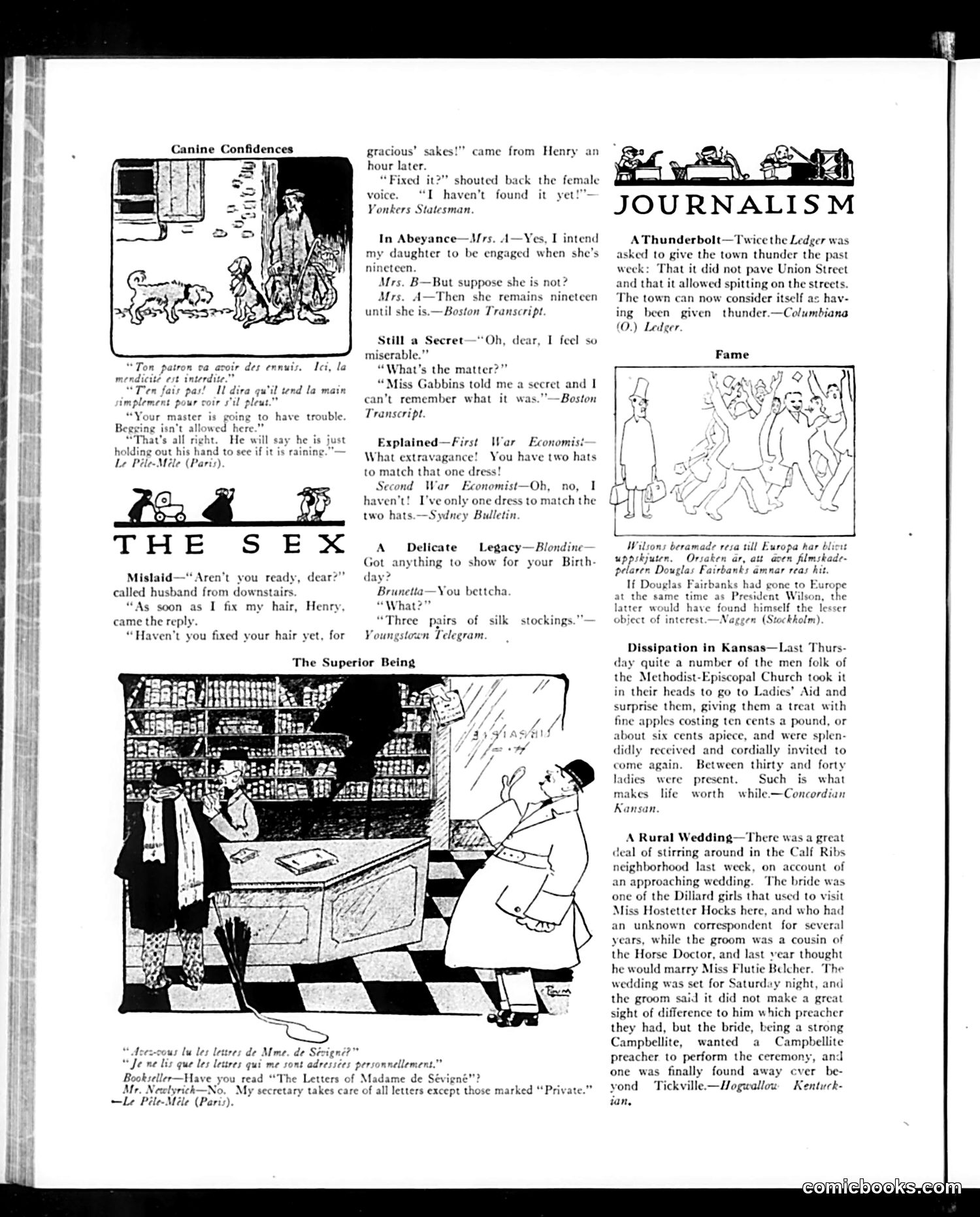
This page contains several brief humorous anecdotes and one cartoon ("The Superior Being"), typical of *Judge* magazine's satirical format. **"Canine Confidences"** (top left): A simple visual gag showing dogs discussing something, with French text suggesting domestic conversation about fixing hair. **"The Sex"** (center): A cartoon of a librarian and patron, satirizing gender dynamics—likely commenting on women's intellectual pursuits or library access in that era. **The text items** are short jokes mocking: - Marriage customs (daughters engaged young) - Women's gossip and forgetfulness - Wartime austerity humor (matching hats/dresses with few clothes) - Small-town Americana (rural wedding logistics, church socials) **"The Superior Being"** (lower left): Shows a woman at a secretary's desk. The French caption suggests commentary on pretentious letter-writing or social hierarchy—possibly mocking someone's self-importance. Overall, the page targets middle-class domestic life, gender relations, and provincial American social conventions with gentle, gossip-column style humor typical of early-20th-century satirical magazines.
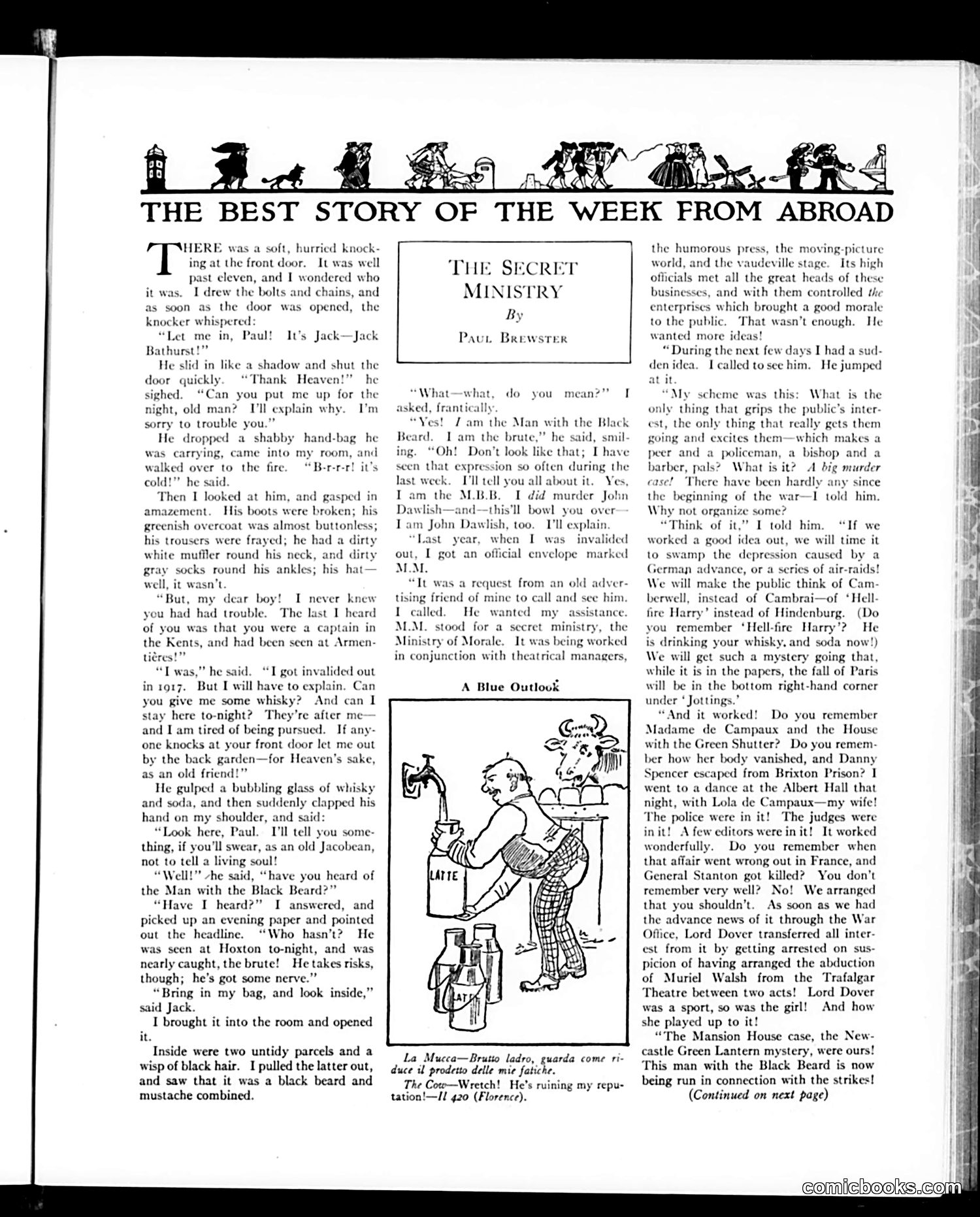
This is a serialized mystery story by Paul Brewster published in *Judge* magazine. The main narrative follows Paul encountering his old army friend Jack Bathurst, now a fugitive disguised as "the Man with the Black Beard"—a wanted criminal. Jack reveals he actually IS the criminal, but explains he's working for a secret government organization called the "Ministry of Morale." The story's satire targets wartime propaganda and morale management: the Ministry supposedly controls theatrical managers, newspapers, and entertainment to maintain public morale. Jack's scheme—to organize high-profile murders to excite the public—darkly satirizes how governments manufacture sensational news to control public attention. The sidebar cartoon depicts an Italian peasant ("La Mucca") complaining to a cow that a thief is ruining his livelihood—likely referencing post-WWI European economic hardship.
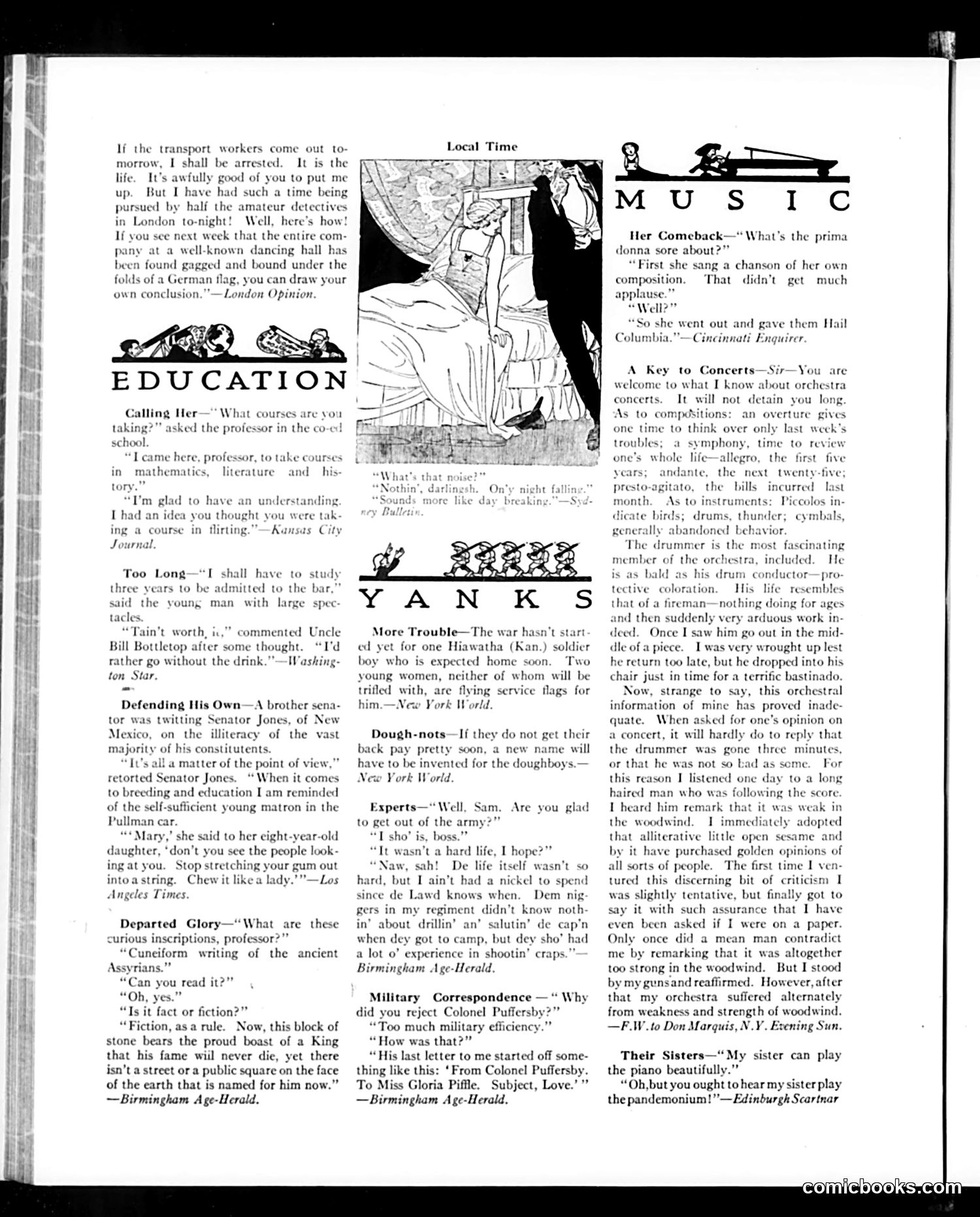
This page from *Judge* magazine contains multiple short humorous anecdotes typical of early 20th-century American satire. Key items include: **"Local Time"** (center illustration): A dramatic scene of espionage or intrigue, likely referencing WWI-era spy anxieties. A figure warns of German flags and bound bodies at a "well-known dancing hall," reflecting contemporary fears of enemy agents. **"Yanks"** (bottom): Military humor about soldiers, including a racist dialect joke about a Black soldier discussing army life and gambling, typical of the period's offensive stereotyping. **Various other quips**: Jokes about bar admission delays, politicians' constituents' literacy, ancient inscriptions (historical irony), soldiers awaiting discharge, and a woman juggling two suitors during wartime. **"Music" section**: Commentary on concert programming and musicians' pretensions. The satire targets bureaucratic inefficiency, wartime social disruptions, pomposity, and military life—common *Judge* themes. The casual racism reflects unfortunate period attitudes rather than progressive satire.
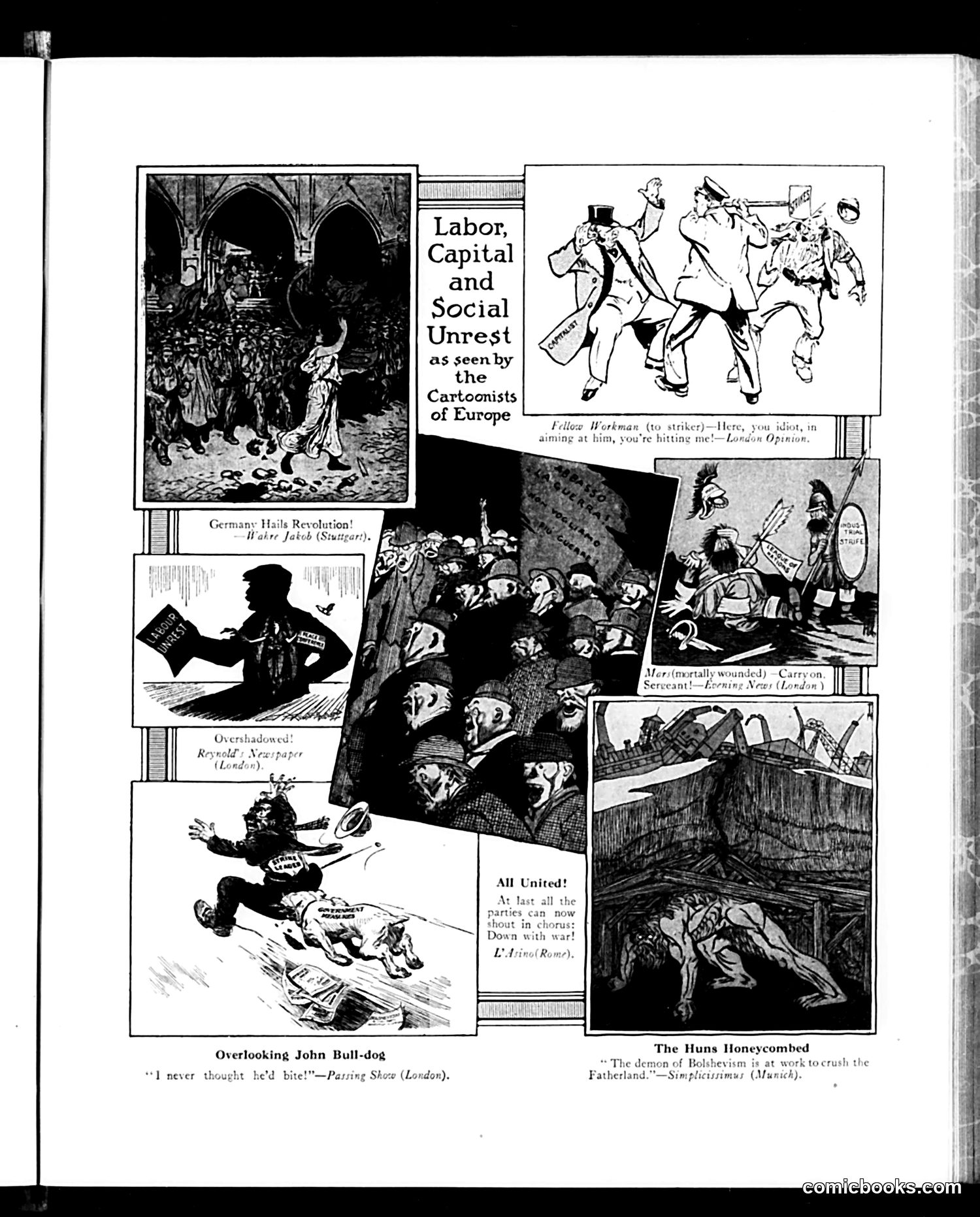
This page collects European political cartoons critiquing labor unrest and revolution around WWI. The top panel shows striking workers confronting capital/authority figures. The "Germany Hails Revolution" cartoon depicts a German military figure celebrating unrest, suggesting Germany exploited social discord. "Overlooking John Bull-dog" features Britain (the bulldog) unexpectedly biting, implying Britain underestimated revolutionary sentiment. "The Huns Honeycombed" portrays Bolshevism as parasitic destruction of society—the "Huns" (Germans/communists) undermining the social structure. "All United" ironically notes political factions uniting against war. Judge presents these as warnings: European governments ignored labor grievances and revolutionary ideology, leading to catastrophic social breakdown. The cartoons reflect American anxieties about similar unrest spreading domestically.
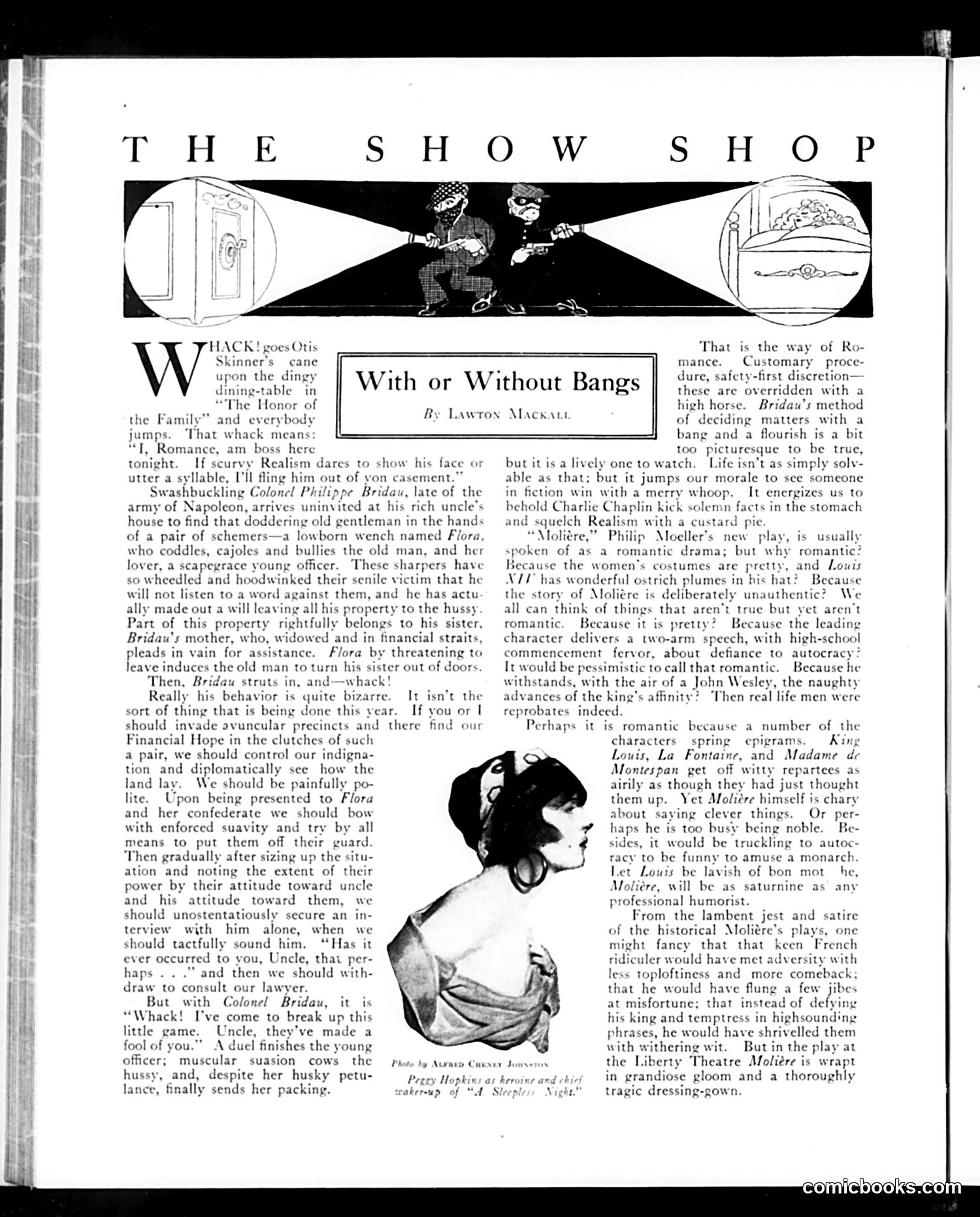
This page critiques romantic drama versus realistic behavior through a theater review. The text discusses Colonel Bridau from "The Honor of the Family"—a swashbuckling Napoleonic officer who violently expels con artists exploiting his uncle, using physical force rather than diplomacy. The author contrasts this theatrical romanticism with how actual people would handle such situations: cautiously, diplomatically, consulting lawyers. The point: audiences find such dramatic action thrilling but impractical in real life. The review then examines Philip Moeller's play "Molière," questioning why it's called "romantic." The author argues it's merely pretty costumes and witty banter—characters deliver epigrams effortlessly, unlike the real Molière who was "chary about saying clever things." The satire targets theater's tendency to label spectacle and eloquence as "romance" while ignoring the gap between staged heroics and actual human complexity.
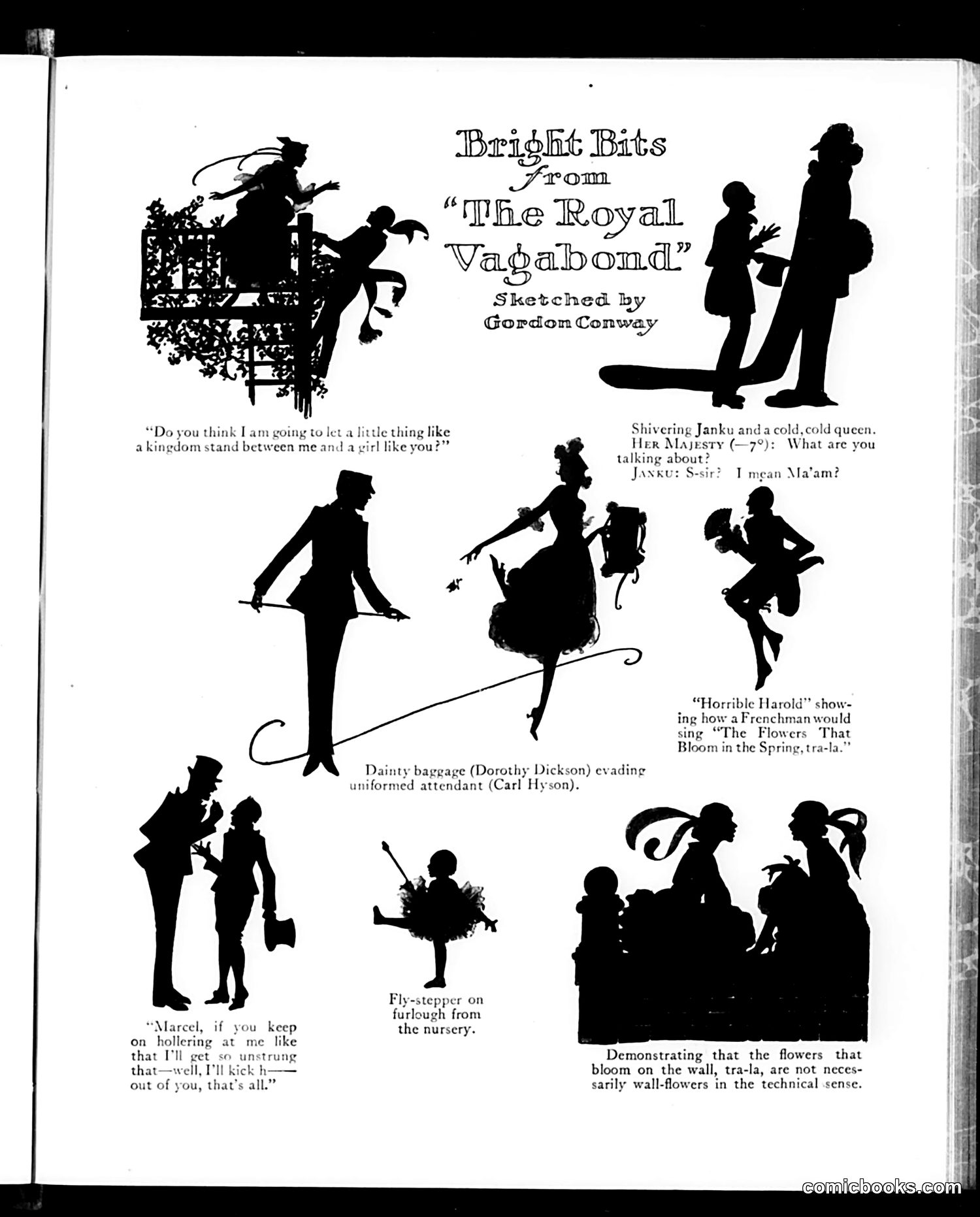
This page collects silhouette sketches by Gordon Conway from the theatrical production "The Royal Vagabond," a musical comedy. The sketches humorously illustrate scenes and dialogue from the show. The humor relies on theatrical situations: a man threatening a woman's romantic interest ("kingdom stand between me and a girl like you"), a character evading an attendant, slapstick physical comedy (the "fly-stepper"), and wordplay jokes about French singers and wall-flowers. The "Horrible Harold" sketch makes fun of how Frenchmen supposedly sing. For modern readers: this is essentially theater coverage—a magazine feature showcasing comedic moments from a Broadway or touring production through witty visual captioning. The humor is character-based and situational rather than political. Judge magazine regularly featured such theatrical "bright bits" to entertain readers and promote popular shows of the era.
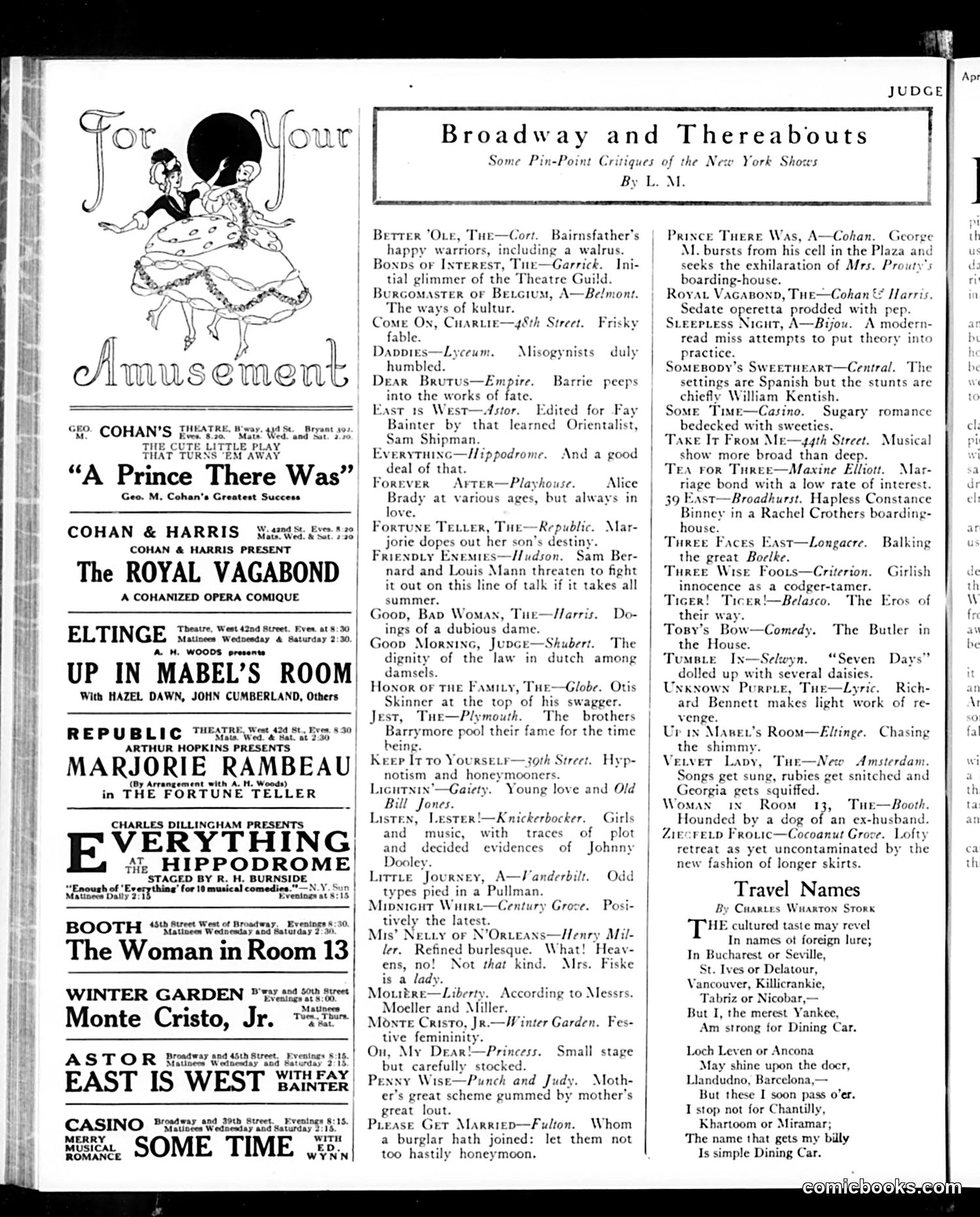
This page is primarily **theater advertising and criticism**, not political satire. The left side features advertisements for Broadway shows popular around the 1910s-1920s (identified by titles like "A Prince There Was" by George M. Cohan). The right side contains **"Broadway and Thereabouts,"** a theater column by L.M. offering brief, witty critiques of current shows. These are punchy one-liners evaluating plots and performances—for example, mocking "Mis' Nelly of N'Orleans" as "refined burlesque" and noting *Molière* is "according to Messrs. Moeller and Miller" (implying loose adaptation). The small cartoon at top-left labeled **"For Your Amusement"** appears to be decorative theater-themed illustration rather than political commentary. This is essentially a **theater guide and gossip column**, reflecting early 20th-century Broadway culture and entertainment criticism in a general-interest satirical magazine.
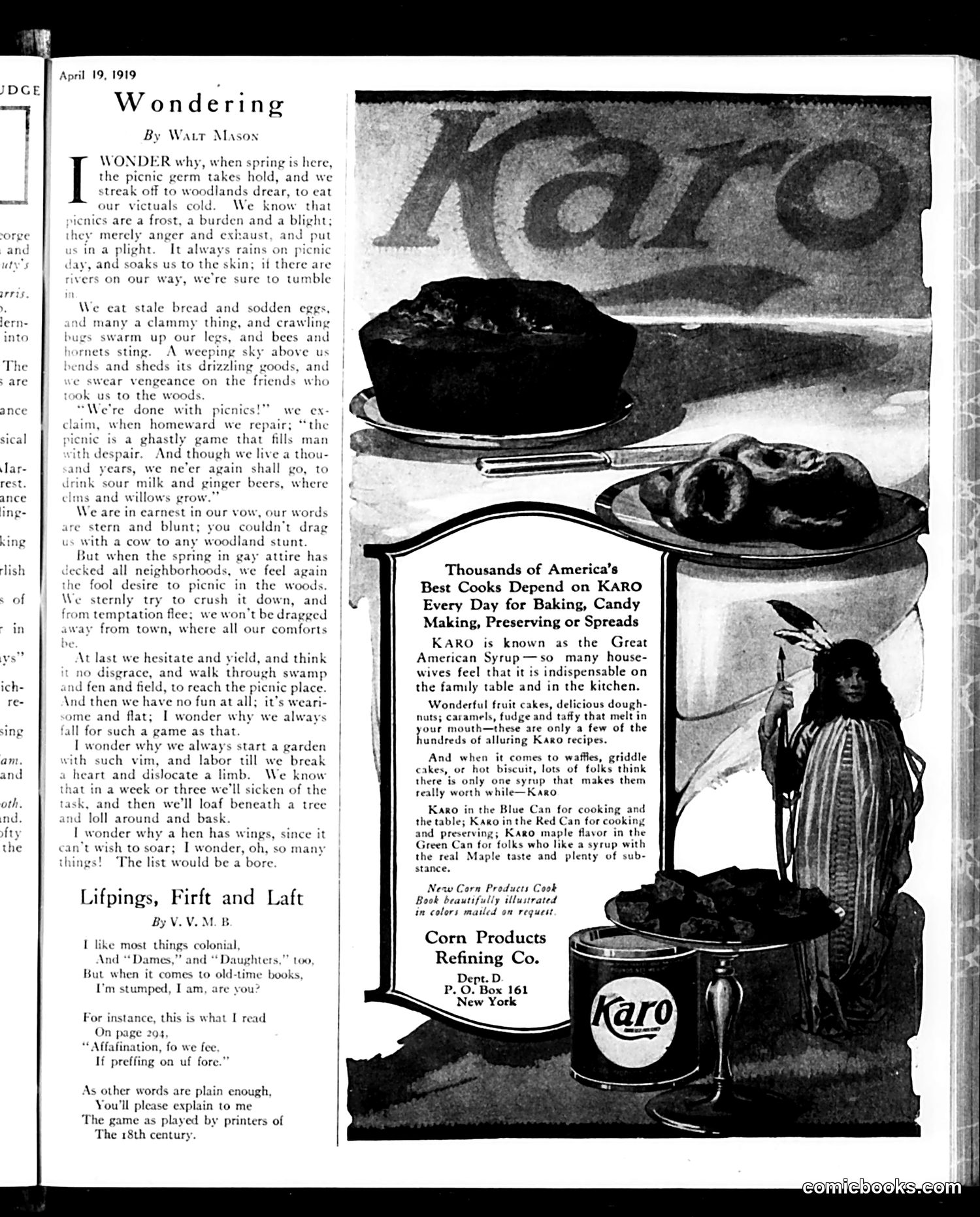
This page contains two distinct pieces: a humorous poem and a linguistics puzzle, plus advertising. **"Wondering" by Walt Mason** satirizes the human tendency toward masochism regarding picnics. Mason catalogs the genuine miseries of outdoor eating—rain, insects, stale food, discomfort—yet notes people compulsively return to them each spring despite swearing off them forever. The satire targets not picnics themselves but human irrationality: we repeat activities we know will disappoint us. **"Lifpings, Firft and Laft" by V.V.M.B** presents an unsolved puzzle from an 18th-century printed book where archaic typography or printing errors render phrases like "Affafination, fo we f" nonsensical. The author requests help deciphering what the original text meant—likely poking fun at the difficulty modern readers face with colonial-era printing conventions and letterforms. **The right side** is a **Karo syrup advertisement** featuring baked goods and cooking vessels, claiming the product is indispensable for American home cooking.
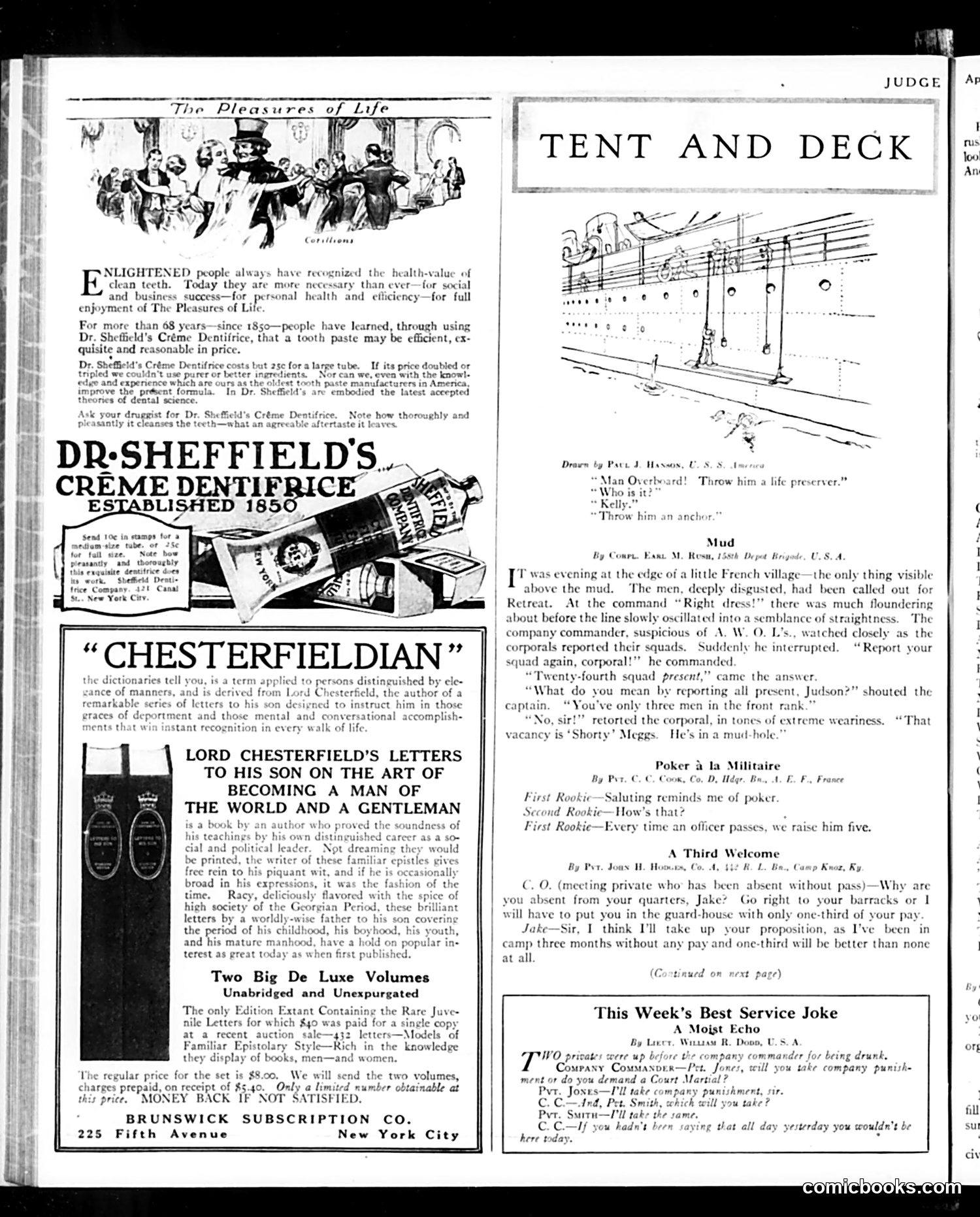
This is primarily an **advertising page** from Judge magazine, with minor humorous military content. The main advertisements promote Dr. Sheffield's Creme Dentifrice (toothpaste, established 1850) and Lord Chesterfield's Letters—a classic etiquette book positioned as essential for becoming "a man of the world and a gentleman." The page includes brief **military humor pieces**, likely from WWI era based on references to "French village," mud, and army ranks. "Mud" depicts a company commander discovering soldiers missing during a retreat; "Poker à la Militaire" jokes that soldiers "raise" officers like poker bets; "A Third Welcome" presents a soldier choosing punishment over unpaid furlough, finding one-third pay better than none. These sketches mock military incompetence and the soldiers' desperate financial situations—typical satirical fare for Judge during wartime. The humor is gentle rather than biting, serving mainly as filler around the commercial content.
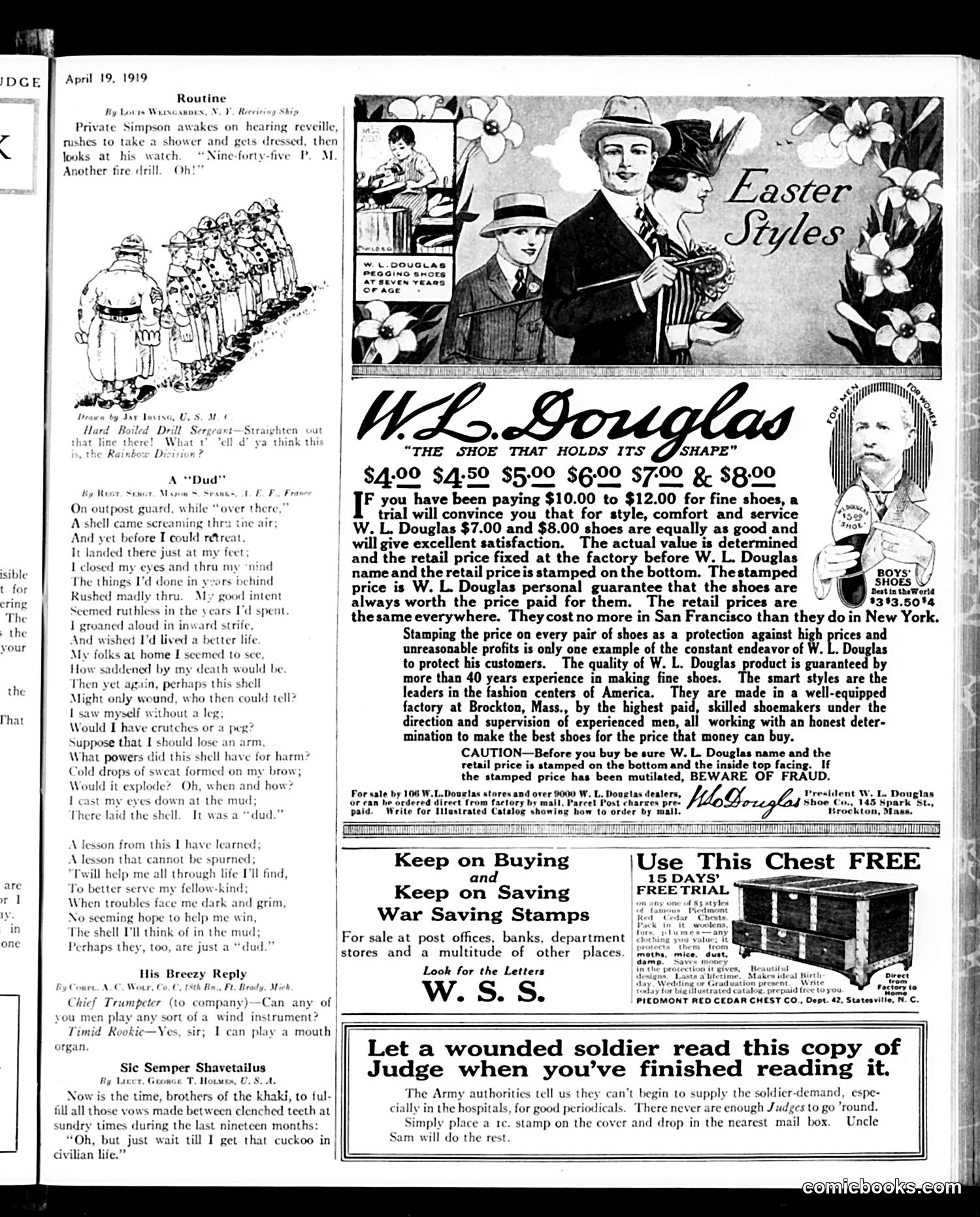
This page contains two distinct elements: **"Routine" Poem**: A WWI soldier's interior monologue during combat. Private Simpson experiences a shell landing near him and, facing potential death, reflects on his life choices and mortality. The "dud" (unexploded shell) becomes a catalyst for existential reckoning—he contemplates lost limbs, regrets, and his duty to family and country. The satirical point is the absurdity of military routine: a fire drill segues directly into genuine mortal danger, highlighting the disconnect between peacetime preparation and actual warfare. **Primary Content**: The page is dominated by a W.L. Douglas shoe advertisement (Easter Styles), a major commercial presence typical of Judge's revenue model. **Bottom Section**: Public service announcements encouraging War Savings Stamps and newspaper donation to wounded soldiers—patriotic content reflecting post-WWI America's transition. The "Routine" poem's satire lies in contrasting mundane military procedures with the existential terror of combat, relevant to 1919 readers processing recent war experiences.
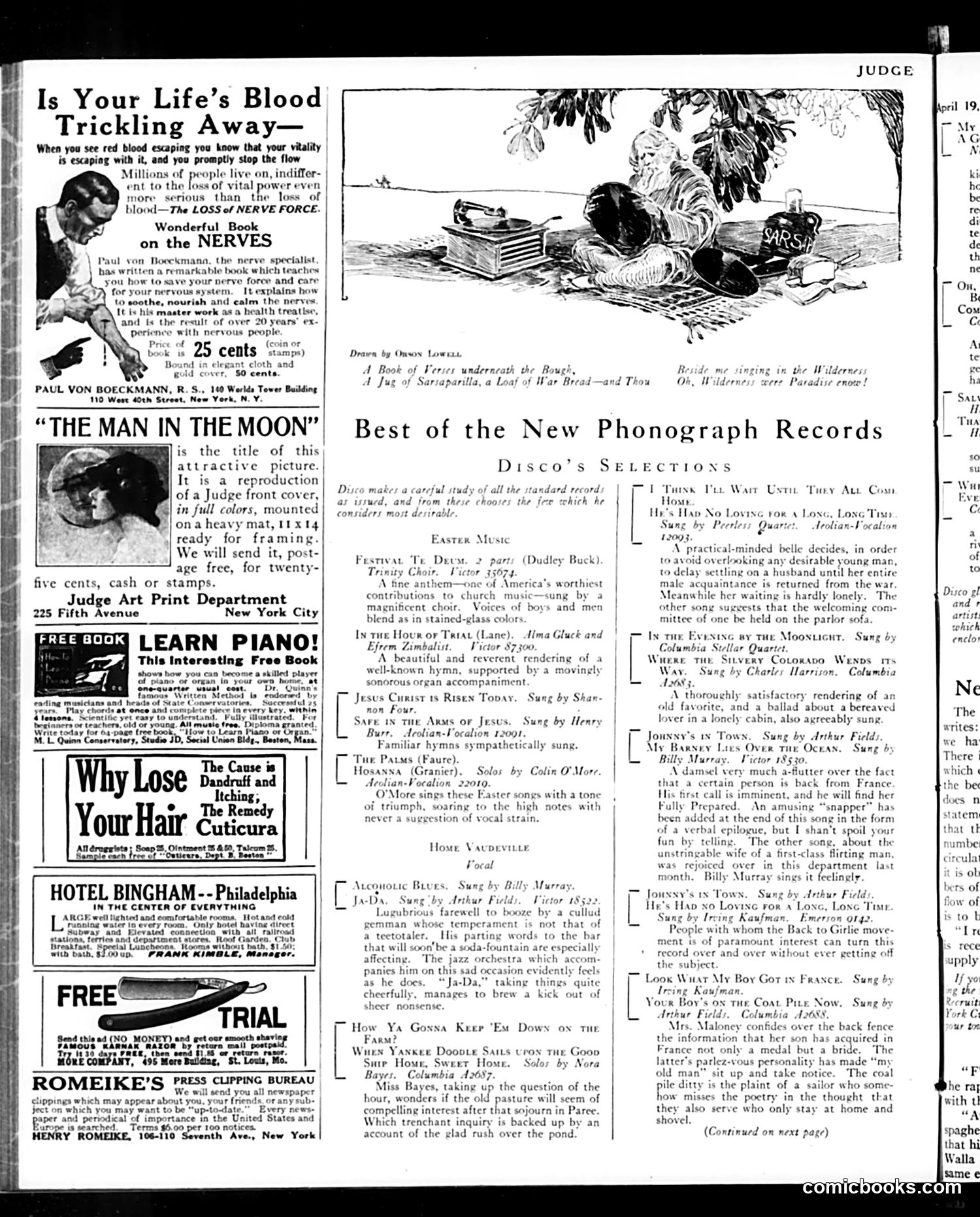
This page is primarily **advertising and product promotion**, typical of early 20th-century magazines. The key content includes: **Main advertisements:** - A nerve-health book by "Paul von Boeckmann" claiming to restore "nerve force" (a now-debunked pseudoscientific concept popular in the era) - "The Man in the Moon" picture print available for purchase - A piano instruction book - Hair loss remedy - Hotel and press clipping service ads **The cartoon** (by Owson Lowell, top center) appears to reference literary themes—likely Omar Khayyam's *Rubaiyat* ("A Book of Verses...A Jug...and Thou"), contrasted with wartime austerity ("a Loaf of War Bread"). The joke seems to contrast romantic literary ideals with harsh reality. **The phonograph records section** reviews Easter-themed vocal recordings—standard contemporary entertainment. The page reflects early 1900s concerns: health anxiety, consumer culture, and wartime conditions (references to "War Bread" suggest WWI era).
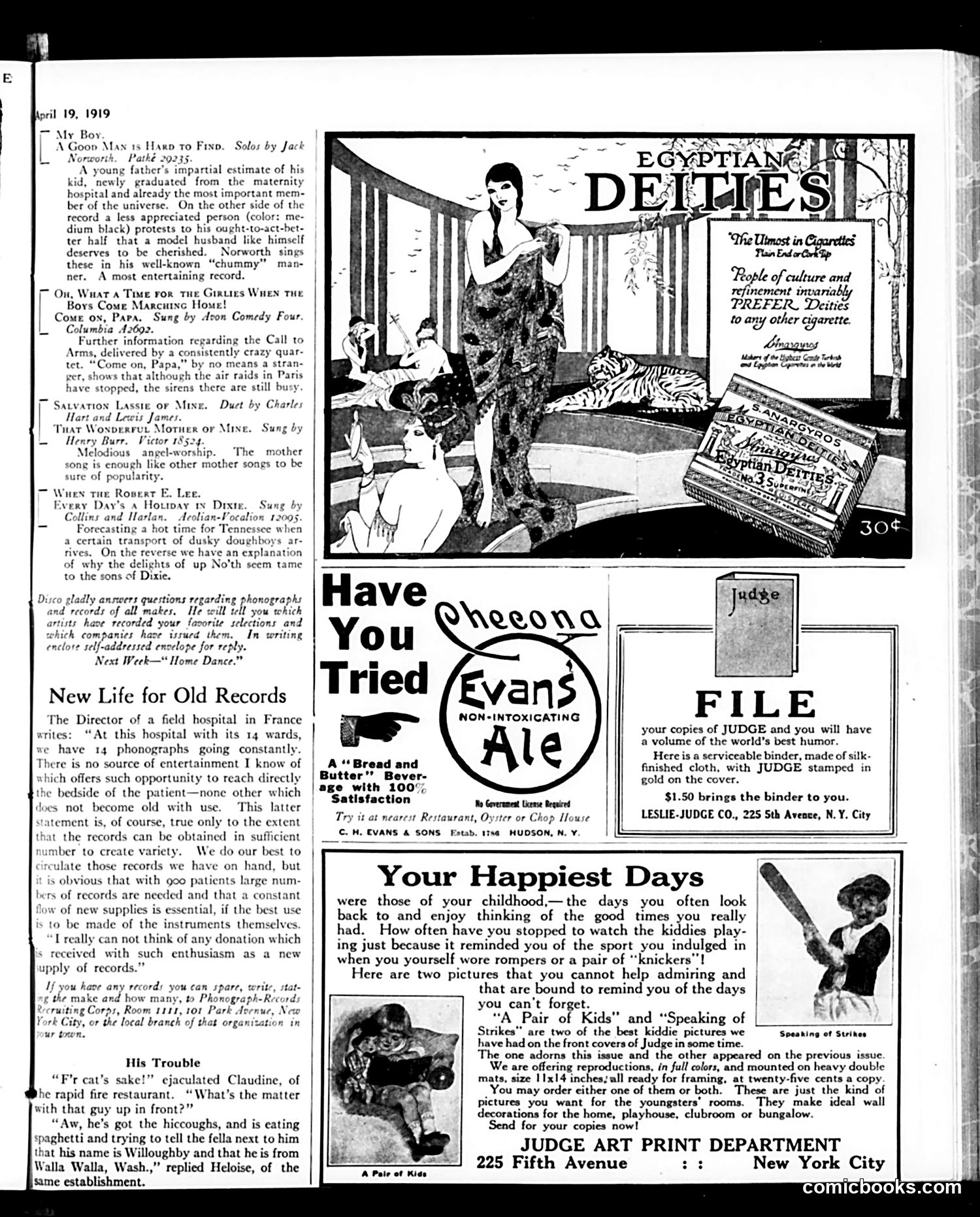
This page is primarily **advertising and filler content** rather than political satire. The main items include: **Egyptian Deities Cigarettes ad**: A glamorous woman in exotic dress promotes cigarettes as "the finest" available, priced at 30 cents. This reflects 1919's unregulated cigarette marketing to general audiences. **Cheona Evans Ale ad**: Promotes non-intoxicating ale, likely responding to Prohibition's approach (enacted January 1920). **Record reviews**: Several brief reviews of phonograph records and singing performances—entertainment content typical of the era. **Judge Art Print Department ad**: Offers reproductions of children's artwork from previous Judge issues. **Brief humor pieces**: Including "His Trouble," a simple joke about a hiccoughing man in a restaurant mangling his name and origin. The page reflects **post-WWI America** (note the hospital letter about entertaining troops) but contains no evident political cartoon or sophisticated satire. It's a representative sample of Judge's commercial and entertainment content from this period.
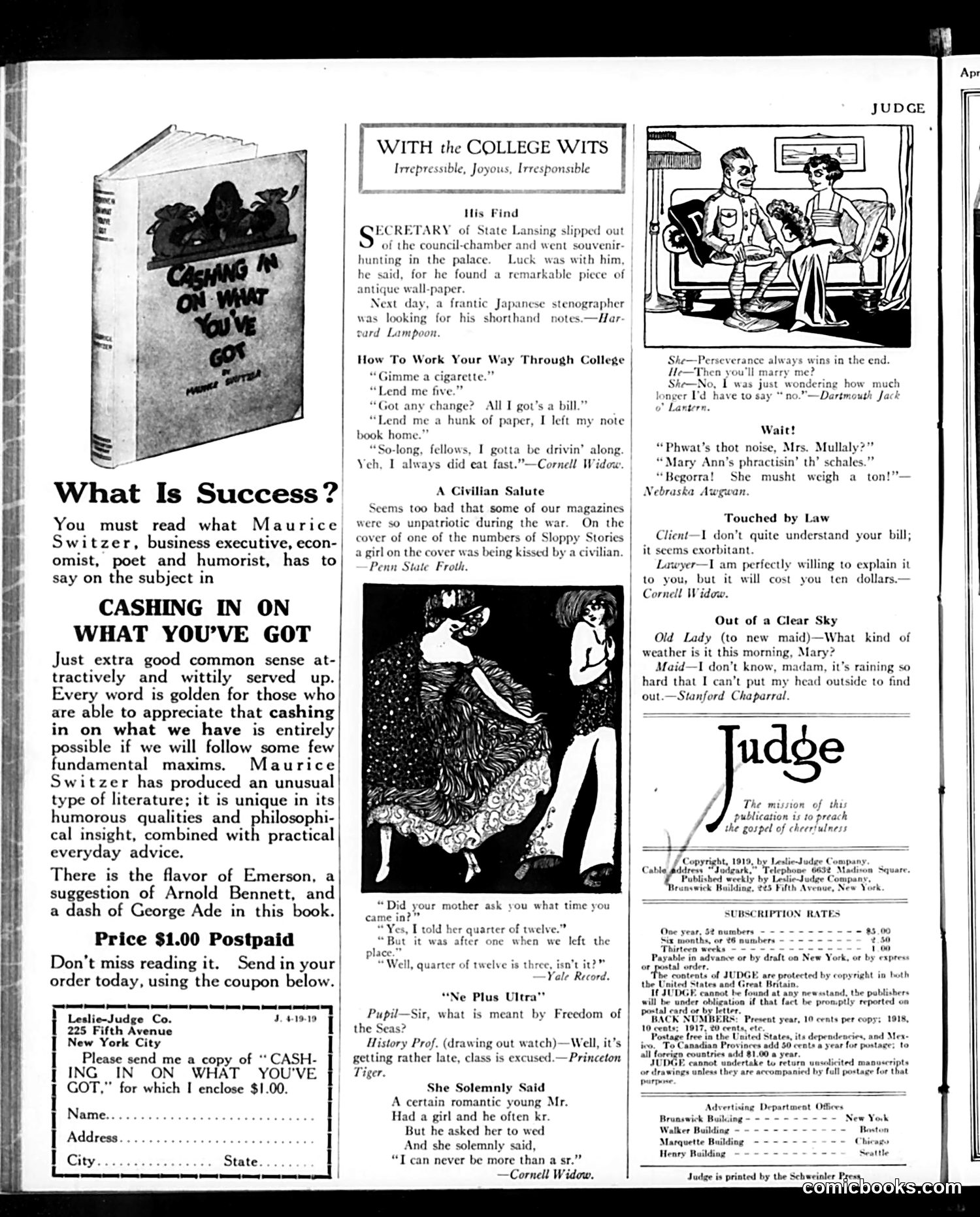
This page is primarily **advertising and miscellaneous collegiate humor** rather than political cartoons. The main content advertises Maurice Switzer's book *"Cashing In On What You've Got,"* promoting practical advice with philosophical overtones. The rest consists of brief jokes reprinted from college humor magazines (Cornell Widow, Yale Record, Princeton Tiger, etc.). These are gentle gags about dating, lying to mothers about curfew, a girl rejecting marriage, and weather complaints—typical campus humor of the era with no political content. One item references **Secretary of State Lansing** during what appears to be post-WWI peace negotiations (note the 1919 date), joking he hunted for antique wallpaper while diplomacy occurred—gentle satire on diplomatic priorities. The humor throughout is apolitical, college-focused, and reflects 1919 social conventions around courtship and student life. There are no significant political cartoons or caricatures on this page.
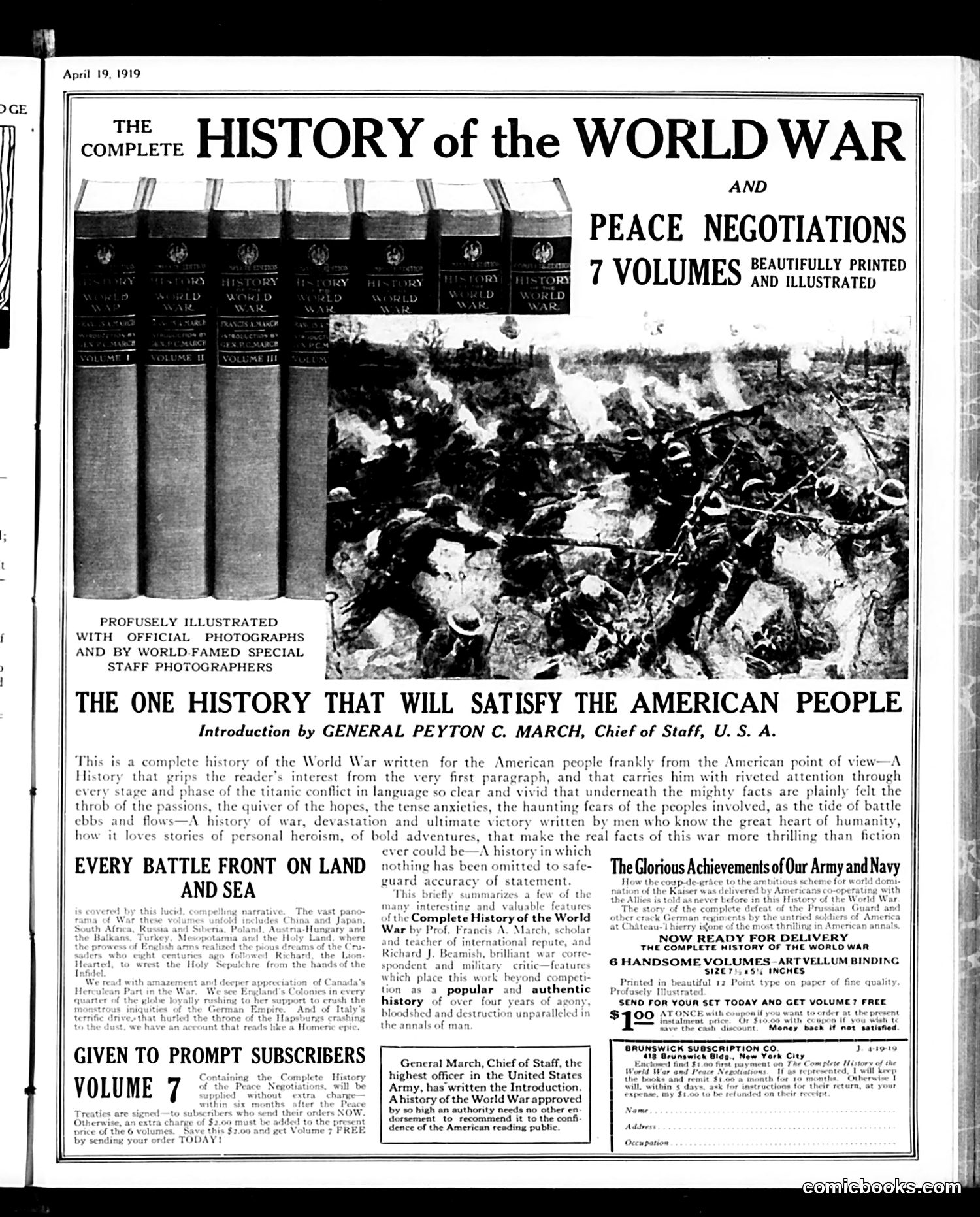
This is primarily a **full-page advertisement**, not a cartoon or satirical content. It promotes "The Complete History of the World War and Peace Negotiations"—a seven-volume encyclopedia set published by Brunswick Subscription Company. **Key context:** Dated April 19, 1919, this appears just days after World War I's armistice (November 1918) and during the Paris Peace Conference negotiations. The advertisement capitalizes on Americans' hunger for authoritative accounts of the recently-ended war. **Marketing appeal:** The ad emphasizes that General Peyton C. March, the U.S. Army's Chief of Staff, wrote the introduction, lending military credibility. It promises the history is "written for the American people frankly from the American point of view"—reassuring domestic readers they'll get an American-centered narrative. The dramatic battlefield photograph and promise of "official photographs" and "world-famed special staff photographers" appeal to readers wanting authentic documentation of the conflict they'd just lived through. This reflects post-war American appetite for comprehensive war histories and subscription-based encyclopedic publishing.
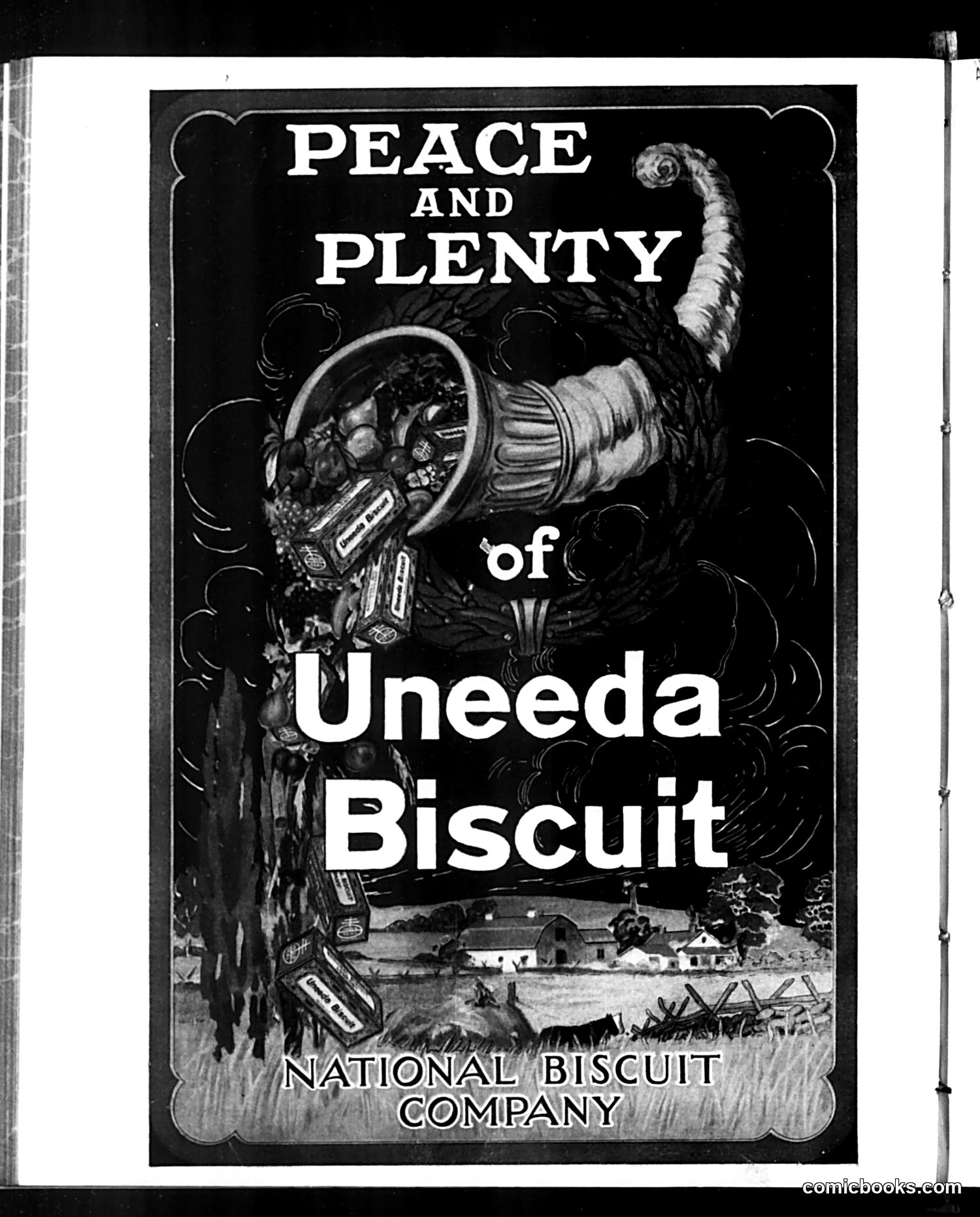
This is a **National Biscuit Company (Nabisco) advertisement**, not political satire. The page features a cornucopia—the classical "horn of plenty"—overflowing with food and abundance. The headline "PEACE AND PLENTY of Uneeda Biscuit" uses the cornucopia as a visual metaphor for prosperity and nourishment. The rural farmland scene at the bottom reinforces themes of agricultural abundance. This appears designed for the post-WWI era, when "peace" (following World War I) and economic prosperity were contemporary concerns. The advertisement conflates the product with national abundance and well-being—a common marketing strategy positioning commercial goods as symbols of American prosperity and peace. It's straightforward product advertising rather than satirical commentary.