
Judge, 1919-04-19 · page 20 of 32
Judge — April 19, 1919 — page 20: what you’re looking at
What you’re looking at
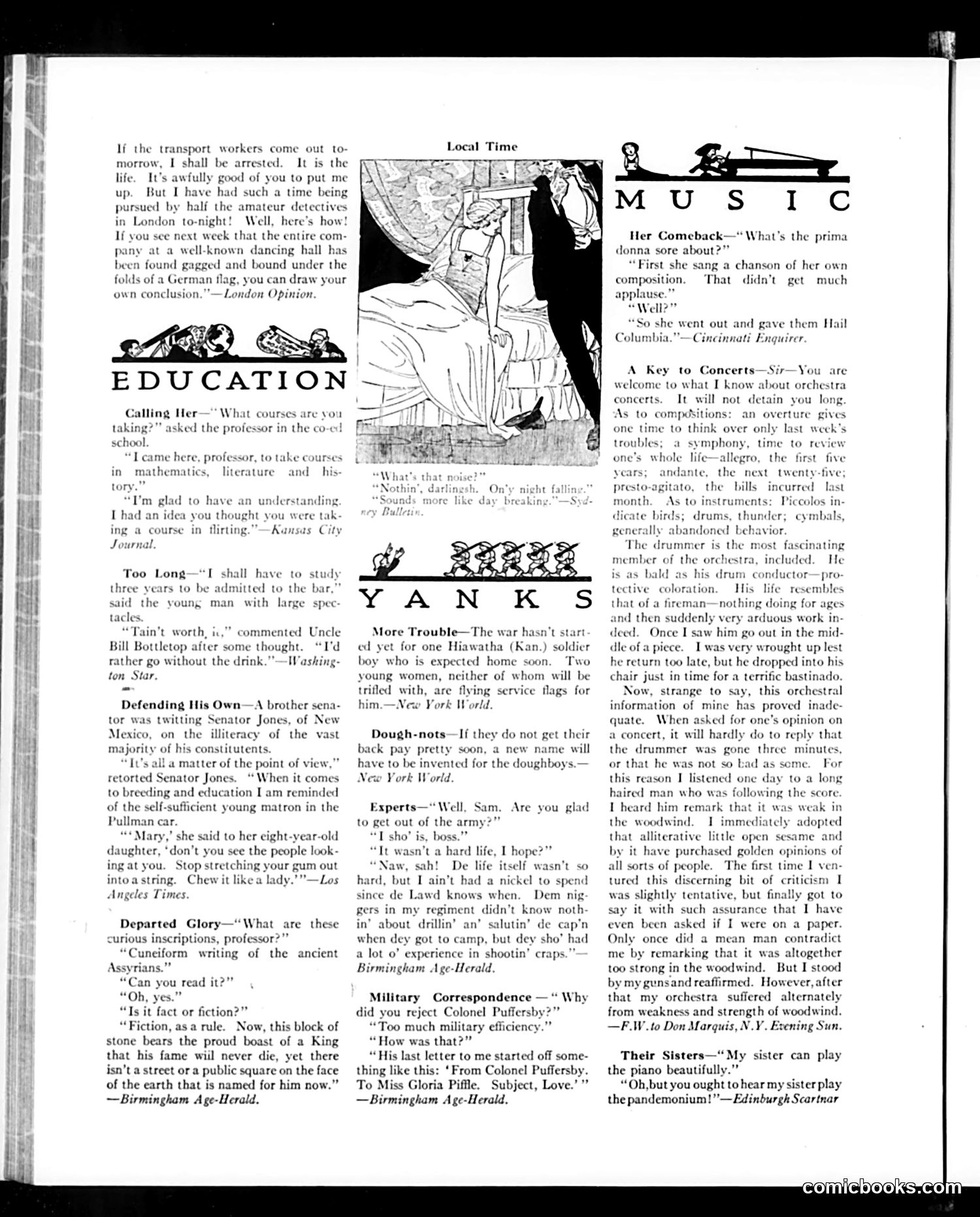
This page from *Judge* magazine contains multiple short humorous anecdotes typical of early 20th-century American satire. Key items include: **"Local Time"** (center illustration): A dramatic scene of espionage or intrigue, likely referencing WWI-era spy anxieties. A figure warns of German flags and bound bodies at a "well-known dancing hall," reflecting contemporary fears of enemy agents. **"Yanks"** (bottom): Military humor about soldiers, including a racist dialect joke about a Black soldier discussing army life and gambling, typical of the period's offensive stereotyping. **Various other quips**: Jokes about bar admission delays, politicians' constituents' literacy, ancient inscriptions (historical irony), soldiers awaiting discharge, and a woman juggling two suitors during wartime. **"Music" section**: Commentary on concert programming and musicians' pretensions. The satire targets bureaucratic inefficiency, wartime social disruptions, pomposity, and military life—common *Judge* themes. The casual racism reflects unfortunate period attitudes rather than progressive satire.
📄 Transcribed text from this page (OCR, searchable)
Machine-transcribed from the original scan — historical spelling and the odd misread are preserved.
If the transport workers come to- morrow shall be arrested. It is the life. It’s awfully good of you to put me up. But I have had such a time being pursued by half the amateur detectives in London to-night! Well, here’s how! If you see next week that the entire com. pany at a well-known dancing hall has been found gagged and bound under the folds of a Germa an flag, you can draw your own conclusion.” —London Opini ¢ Her—* What courses are you w aaked the professor in the co-ed “Tcame here, professor, to take courses in mathematics, literature and _ his tory.” “I'm glad to have a I had an idea you thought you were tak ing a course in flirting.” —Aansas City Jour n understanding Too Long I shall have to three years to be admitted to the bar,” said the young man with large spec tacles commented Uncle ght. “I'd Washing- Tain’t worth, ic,” Bill Bottletop after some the rather go without the drink.” ton Star. Defending His Own—A brother sena tor was twitting Senator Jones, of New Mexico, on the illiteracy of the vast majority of his constitutents. “It’s all a matter of the point of view, retorted Senator Jones. “When it comes to breeding and education [ am reminded of the self-sufficient young matron in the Pullman car. “*Mary,’ she said to her eight-year-old daughter, ‘don’t you see the people look- ing at you. Stop stretching your gum out intoa string. Chew it like a lady Angeles Times. Departed Glory—“ What are these curious inscriptions, professor?” “Cuneiform writing of the syrians.”” Can you read it?” “Oh, yes.” “Ts it fact or fiction?” “Fiction, asa rule. Now, this block of stone bears the proud boast of a King that his fame wiil never die, yet there isn’t a street or a public square on the face of the earth that is named for him now.” —Birmingham Age-Herald. ancient Local Time More Trouble—The war hasn't start ed yet for one Hiawatha (Kan.) soldier boy who is expected home soon. Two young women, neither of whom will be trifled with, are flying service flags for him.—New York World. y do not get their ame will Dough-nots—If th back pay pretty soon, a n have to be invented for the New York Work Joughboys.— Experts—" Well, Sam. Are to get out of the army?” “T sho’ is, “It wasn’t a hard life, 1 hope?” “Naw, De life itse hard, but I ain’t had a nickel to spend since de Lawd knows when. Dem nig gers in my regiment didn’t know noth in’ about drillin’ an’ salutin’ de cap'n when dey got to camp, but dey sho’ had a lot 0 experience in shootin’ craps.” Birmingham Age-Herald. boss. sah! wasn't so Military Correspondence — “ Why did you reject Colonel Puffersby?” “Too much military efficiency.” “ How was that? “His last letter to me started off some- thing like this: ‘From Colonel Puffersby. To Miss Gloria Piffle. Subject, Love.’ ” —Birmingham Age-Herald. MUS IC Her Comeback—" What's the prima donna sore about?” “First she sang a chanson of her own composition, ‘That didn’t get much applause.” “Well?” “So she went out and gave them Hail Columbia.”"—Cincinnati Enquirer A Key to Concerts—Sir—You are welcome to what I know about orchestra concerts. It will not detain you long “As to composi overture gives one time to think over only last weck’s troubles; a symphony, time to whole life ions: an review allegro, the first five andante, the next twenty-five; ogitato, the bills incurred last As to instruments colos in- thunder; cy one’s years prestc month > birds; drums, vals, generally abandoned behavior. The drummer is the most fascinating member of the orchestra, included. He s drum co His 1 nothing d is as bald as I tor—pro. ration resembles man ng for ages and then suddenly very arduous work in deed. Once I saw him go out in the mid- dle of a piece. I was very wrought up lest he return too late, but he dropped into his chair just in time for a terrific bastinado. Now, strange to say, this orchestral information of mine has proved inade- quate. When asked for one’s opinion on a concert, it will hardly do to reply that the drummer was gone three minutes, or that he was not so kad as some. For this reason I listened one day to a long haired man who was following the score. I heard him remark that it was weak in the woodwind. I immediately adopted that alliterative little open sesame and by it have purchased golden opinions all sorts of people. The first time I ven- tured this discerning bit of criticism I was slightly tentative, but finally got to say it with such assurance that I have even been asked if I were on a paper. Only once did a mean man contradict me by remarking that it was altogether too strong in the woodwind. But I stood by my gunsand reaffirmed. However, after that my orchestra suffered alternately from weakness and strength of woodwind. —F.W.to Don Marquis, N.Y. Evening Sun. Their Sisters—‘“ My sister can play the piano beautifully. “Oh, but you ought to hear my sister play the pandemonium!”"—Edinburgh Scartnar