
Judge, 1919-04-19 · page 11 of 32
Judge — April 19, 1919 — page 11: what you’re looking at
What you’re looking at
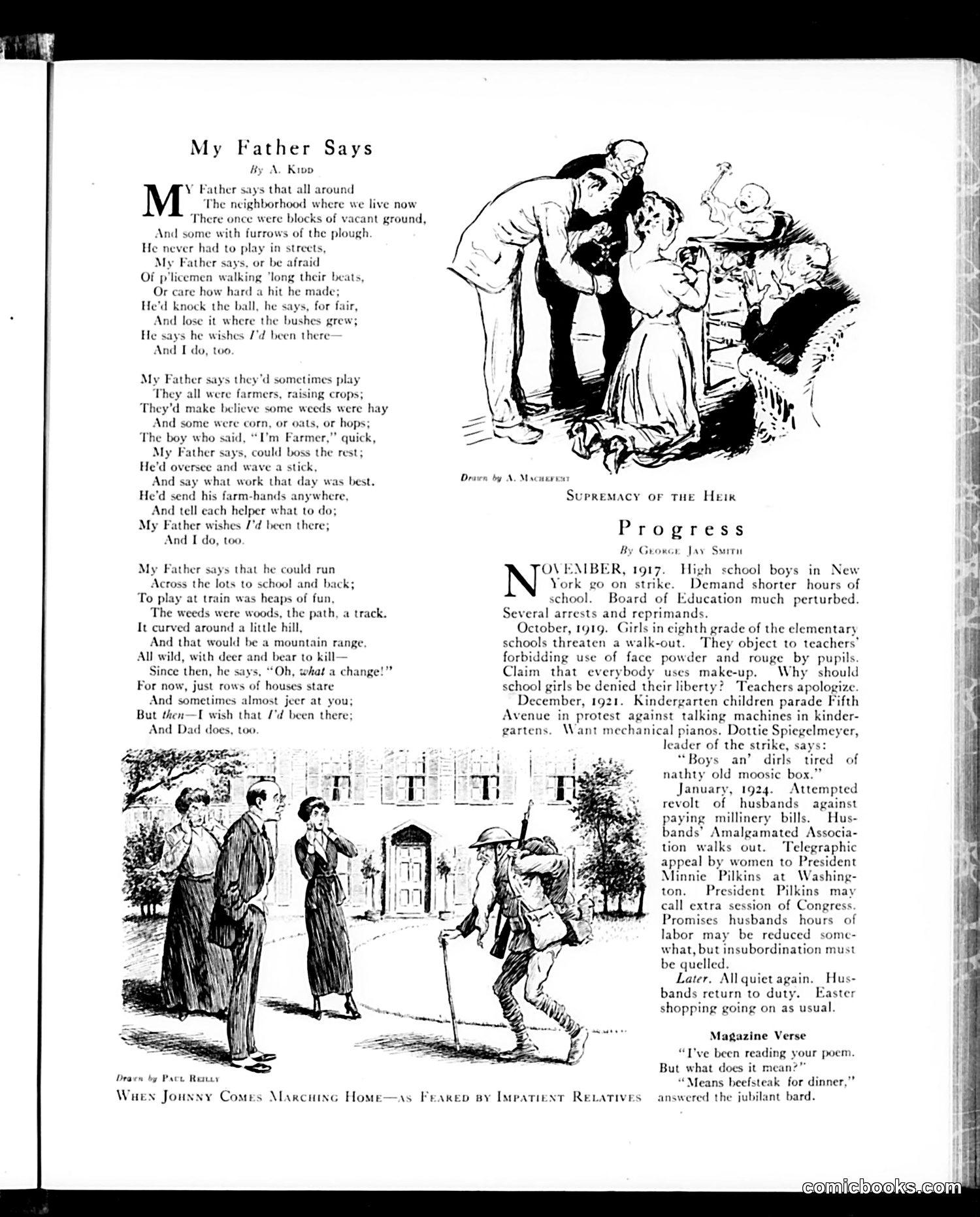
**"My Father Says"** is nostalgic verse lamenting suburban development. The poem presents an elderly father reminiscing about vacant, rural land where he played freely—running across lots, imagining weeds as crops or forests. The implicit critique: modern urbanization has replaced open space with rows of houses, eliminating children's freedom and imaginative play. The accompanying illustration shows a father gesturing fondly while children listen. **"Progress"** is sharp satire on escalating labor strikes and social unrest. It presents a darkly humorous timeline: 1917–1924 depicts strikes expanding from high school boys, to schoolgirls, to kindergarteners, culminating in husbands refusing to pay millinery bills (a contemporary joke about wives' hat expenses). The satire mocks how strike culture has become so normalized that even children and domestic disputes are weaponized through labor action. The final paragraph's restoration of order—husbands capitulating, "Easter shopping going on as usual"—undercuts the seriousness, suggesting these revolts are cyclical theater rather than meaningful change.
📄 Transcribed text from this page (OCR, searchable)
Machine-transcribed from the original scan — historical spelling and the odd misread are preserved.
Dracn by Pace Reatey My Father Says By A. Kipp Y Father says that all around M ‘The neighborhood where we live now There once were blocks of vacant ground, And some with furrows of the plough He never had to play in streets, My Father says, or be afraid Of p'licemen walking ‘long their beats, Or care how hard a hit he made; He'd knock the ball, he says, for fair, And lose it where the bushes grew; He says he wishes /’d been there And I do, too. My Father says they'd sometimes play They all were farmers, raising crops; They'd make believe some weeds were hay And some were corn, or oats, or hops; The boy who said, “I’m Farmer,” quick, My Father says, could boss the rest; He'd oversee and wave a stick, And say what work that day was best. He'd send his farm-hands anywhere, And tell each helper what to do; My Father wishes I'd been there; And I do, too. My Father says that he could run Across the lots to school and back; To play at train was heaps of fun, The weeds were woods, the path, a track. It curved around a little hill, And that would be a mountain rang All wild, with deer and bear to kill— Since then, he says, “Oh, what a change!” For now, just rows of houses stare And sometimes almost jeer at you; But then—[ wish that /’d been there; And Dad does, too. Draen by A. Macuereser Supremacy or tHe Heik Progress By Growce Jay Sure OVEMBER, 1917. High school boys in New N York go on strike. Demand shorter hours of school. Board of Education much perturbed. Several arrests and reprimands. October, 1919. Girls in cighth grade of the clementary schools threaten a walk-out. They object to teachers’ forbidding use of face powder and rouge by pupils Claim that everybody uses make-up. Why should school girls be denied their libert Teachers apologize December, 1921. Kindergarten children parade Avenue in protest against talking machines in kinder- gartens. Want mechanical pianos. Dottie Spiegelmeye' leader of the strike, says: “Boys an’ dirls tired of nathty old moosic box.” January, 1924. Attempted revolt of husbands against paying millinery bills. Hus- bands’ Amalgamated Associa- tion walks out. Telegraphic appeal by women to President Minnie Pilkins at Washing- ton. President Pilkins may call extra session of Congress Promises husbands hours of labor may be reduced some- what, but insubordination must be quelled. Later. Allquietagain. Hus- bands return to duty. Easter shopping going on as usual. Magazine Verse “T've been reading your poem. But what docs it mean?” “Means beefsteak for dinner,” Wuex Jounsy Comes Marcuinc Home—as Feareo ay Impatient Renatives answered the jubilant bard.