
Judge, 1919-04-19 · page 7 of 32
Judge — April 19, 1919 — page 7: what you’re looking at
What you’re looking at
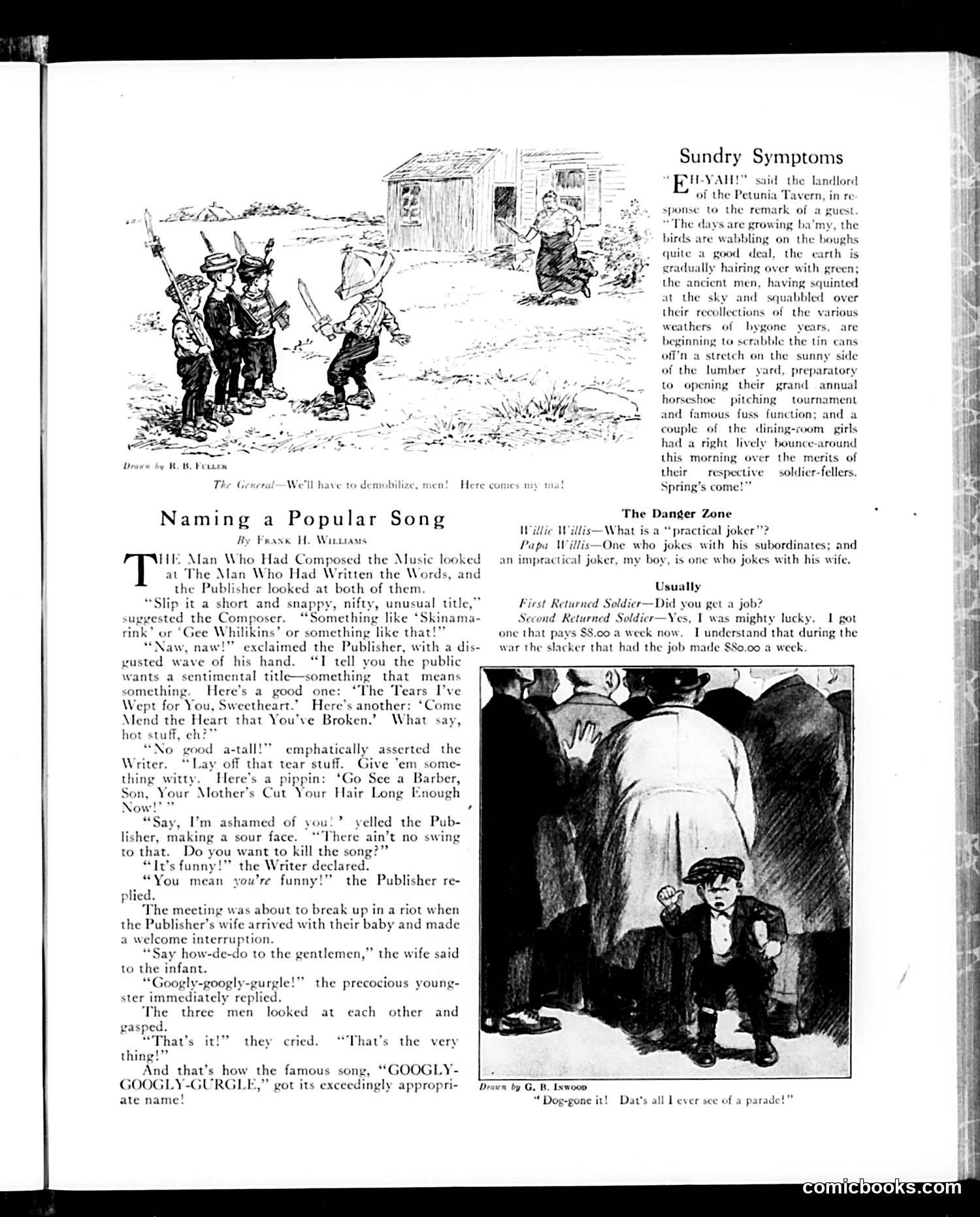
This page contains three separate satirical pieces typical of Judge's humor: **"Naming a Popular Song"** mocks the music industry's creative process. A composer, lyricist, and publisher debate song titles, with the publisher pushing sentimental clichés ("The Tears I've Wept for You, Sweetheart") while the writer wants wit. When the publisher's baby babbles "Googly-googly-gurgle," all three inexplicably declare this the perfect title—satirizing how popular songs often have absurd, meaningless names that succeed anyway. **"Sundry Symptoms"** uses a tavern keeper's rambling dialect to humorously catalog spring's arrival—birds, ancient men discussing weather, horseshoe tournaments—with a joke about dining-room girls debating their "soldier-fellers," likely referencing WWI's aftermath. **"The Danger Zone"** contrasts a recently-demobilized soldier's current $8/week wage with the $80/week a wartime "slacker" (draft-dodger) earned at the same job—bitter post-war commentary on how those avoiding military service often profited financially while soldiers sacrificed.
📄 Transcribed text from this page (OCR, searchable)
Machine-transcribed from the original scan — historical spelling and the odd misread are preserved.
We'll have Naming a Popular Song By Fraxk He Wittiaus HI Man Who Had Composed the Music looked at The Man Who Had Written the Words, and the Publisher looked at both of them. “Slip it a short and snappy, nifty, unusual title,” gested the Composer. “Something like ‘Skin rink’ or ‘Gee Whilikins’ or something like that!” “Naw, naw!” exclaimed the Publisher, with a dis- yusted wave of his hand. “TI tell you the public wants a sentimental titke—something that means something. Here’s a good one: ‘The Tears I’ve Wept for You, Sweetheart.” Here’s another: ‘Come Mend the Heart that You've Broken.’ What say, hot stuff, ch?” nd a-tall!’’ emphatically asserted the Writer. y off that tear stuff. C em some- thing witty. Here's a pippin: ‘Go See a Barber, Son, Your Mother’s Cut Your Hair Long Enough Now!’” , “Say, [’'m ashamed of ” yelled the Pub- lisher, making a sour face There ain’t no swing to that. Do you want to kill the song?” “It’s funny!” the Writer declared. “You mean you’re funny!” the Publisher re- plied. ‘The meeting was about to break up in a riot when the Publisher’s wi rived with their baby and made a welcome interruption. “Say how-de-do to the gentlemen,” the wife said to the infant. “Googly-googly-gurgl ster immediately replied. The three men looked at each other and gasped. “That's it!” they cried. 19 an the precocious young- “That's the very And that’s how the famous song, “GOOGLY- GOOGLY-GURGLE,” got its exceedingly appropri- ate name! Sundry Symptoms “BRILYAH!” said the landlord of the Petunia Tavern, in ri sponse to the remark of a guest “The days are growing ba’my, the birds are wabbling on the boughs quite a good deal, the earth is gradually hairing over with green; the ancient men, having squinted at the sky and squabbled over their recollections of the various weathers of bygone years, are beginning to scrabble the tin cans off’n a stretch on the sunny side of the lumber yard, preparatory to opening their grand annual horseshoe pitching tournament and famous fuss function; and a couple of the dining-room girls had a right lively bounce-round this morning over the merits of their respective — soldier-fellers. my ma! Spring’s come! The Danger Zone Willie Willis—What is a “practical joker”? Papa Willis—One who jokes with his subordinates; and an impractical joker, my boy, is one who jokes with his wife. Usually First Returned Soldier—Did you get a job? Second Returned Soldicrp—Yes, 1 was mighty lucky. 1 got one that pays $8.00 a week now. I understand that during the war the slacker that had the job made $80.00 a week. Drawn by G. B, Ixwooo “Dogegone it! Dat's all I ever sce of a parad