
Judge, 1919-04-19 · page 22 of 32
Judge — April 19, 1919 — page 22: what you’re looking at
What you’re looking at
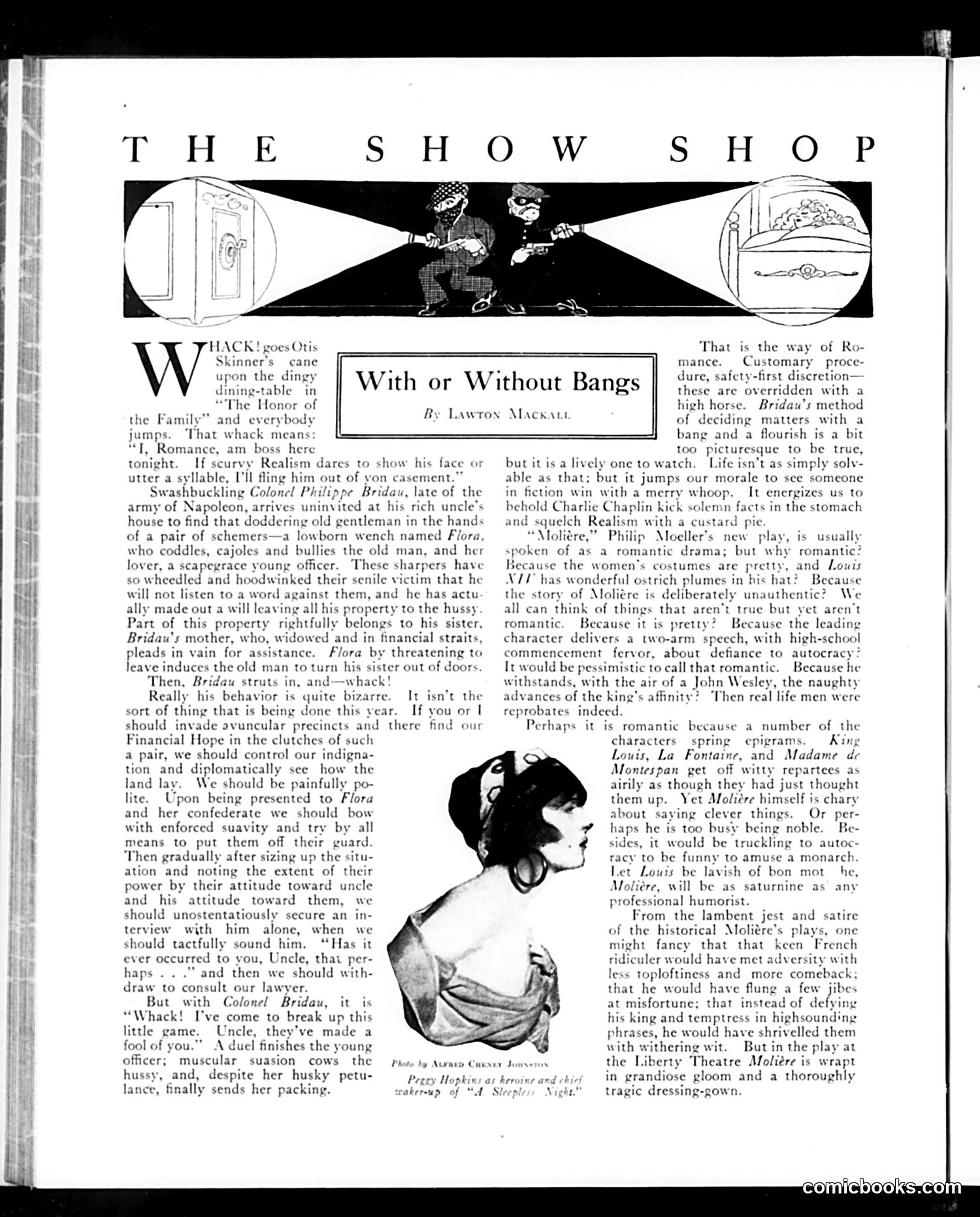
This page critiques romantic drama versus realistic behavior through a theater review. The text discusses Colonel Bridau from "The Honor of the Family"—a swashbuckling Napoleonic officer who violently expels con artists exploiting his uncle, using physical force rather than diplomacy. The author contrasts this theatrical romanticism with how actual people would handle such situations: cautiously, diplomatically, consulting lawyers. The point: audiences find such dramatic action thrilling but impractical in real life. The review then examines Philip Moeller's play "Molière," questioning why it's called "romantic." The author argues it's merely pretty costumes and witty banter—characters deliver epigrams effortlessly, unlike the real Molière who was "chary about saying clever things." The satire targets theater's tendency to label spectacle and eloquence as "romance" while ignoring the gap between staged heroics and actual human complexity.
📄 Transcribed text from this page (OCR, searchable)
Machine-transcribed from the original scan — historical spelling and the odd misread are preserved.
HACK! goes Otis kinner’s cane upon the dingy ning-table in “The Honor of the Family” and everybody With or Without Bangs By Lawtox Mackaut That is the way of Ro- mance. Customary proc dure, safety-first discretion these are overridden with a high horse. Bridau’s method of deciding matters with a bang and a flourish is a bit jumps. That whack means: “I, Romance, am boss h tonight. If scurvy Realism dares to show utter a syllable, I'll fling him out of yon casement.” Swashbuckling Colonel Philippe Bridau, late of the army of Napoleon, arrives uninvited at his rich uncle's house to find that doddering old gentleman in the hands of a pair of schemers—a lowborn wench named Flora, who coddles, cajoles and bullies the old man, and her lover, a scapegrace young officer. These sharpers have so wheedled and hoodwinked their senile victim that he will not listen to a word against them, and he has actu ally made out a will leaving all his property to the hussy Part of this property rightfully belongs to his sister, Bridau’s mother, who, widowed and in financial straits, pleads in vain for assistance. Flora by threatening to Jeave induces the old man to turn his sister out of doors Then, Bridau struts in, and—whack! Really his behavior is quite bizarre sort of thing that is being done this year. If you or | should invade avuncular precincts and there find our Financial Hope in the clutches of such a pair, we should control our indigna- tion and diplomatically see how the land lay. We should be painfully po- lite. Upon being presented to Flora and her confederate we should bow with enforced suavity and try by all means to put them off their guard Then gradually after sizing up the situ- ation and noting the extent of their power by their attitude toward uncle and his attitude toward them, we should unostentatiously secure an in- terview with him alone, when we should tactfully sound him. “Has it ever occurred to you, Uncle, that per- haps .. .” and then we should with- draw to consult our lawyer. But with Colonel Bridau, it is “Whack! I’ve come to break up this little game. Uncle, they’ve made a fool of you.” A duel finishes the young officer; muscular suasion cows the phot by Aurnro € hussy, and, despite her husky petu- vy Thos lance, finally sends her packing. ccakerup of face or It isn’t the too picturesque to be true, but it is a lively one to watch. Life isn’t as simply solv- able as that; but it jumps our morale to sce someone in fiction win with a merry whoop. It energizes us to Id Charlie Chaplin kick solemn facts in the stomach and squelch Realism with a custard rd pi “Molitre,” Philip Moeller’s new play, is usually spoken of as a romantic drama; but why romantic? Because the women’s costumes are pretty, a NII has wonderful ostrich plumes in his hat the story of Moliére is deliberately unauthentic? all can think of things that aren't true but yet aren't romantic. Because it is pretty? Because the le character delivers a two-arm speech, with high-school commencement fervor, about defiance to autocracy? It would be pessimistic to call that romantic. Because he withstands, with the air of a John Wesley, the naughty advances of the king’s affinity? Then real life men were reprobates indeed. Perhaps it is romantic because a number of the characters spring epigrams. King Louis, La Fontaine, and Madame de Montespan get off witty repartees as airily as though they had just thought them up. Yet Moliére himself is chary about saying clever things. Or per- haps he is too busy being noble. B sides, it would be truckling to autoc- racy to be funny to amuse a monarch Let Louis be lavish of bon mot he, Moliére, will be as saturnine as any professional humorist. From the lambent jest and satire of the historical Molire’s plays, « might fancy that that keen French ridiculer would have met adversity with less toploftiness and more comeback; that he would have flung a few jibes at misfortune; that instead of defying his king and temptress in highsounding phrases, he would have shrivelled them with withering wit. Butin the play at the Liberty Theatre Moliére is wrapt in grandiose gloom and a thoroughly tragic dressing-gown.