
A complete issue · 32 pages · 1918
Judge — December 7, 1918
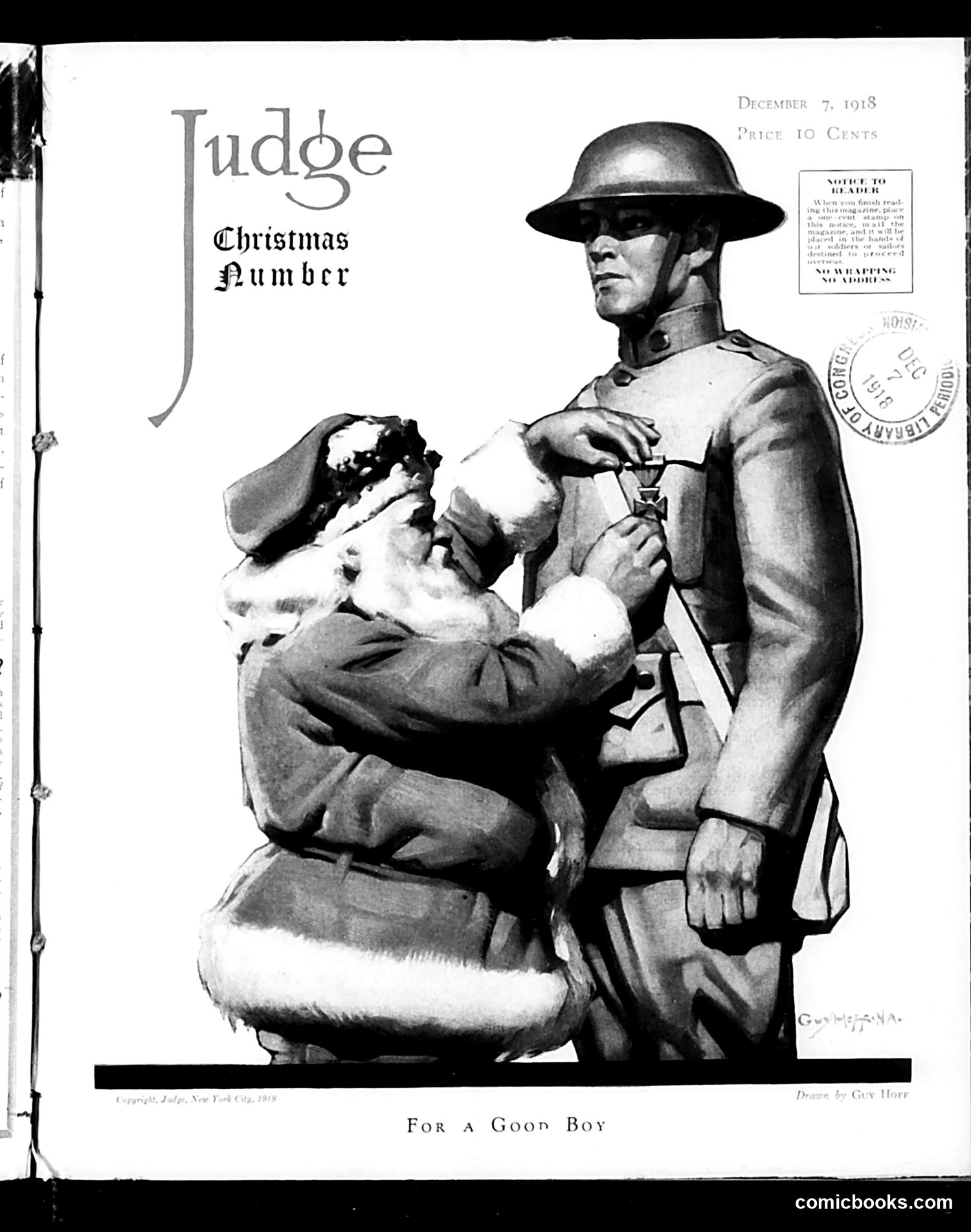
This cover depicts a soldier in World War I military uniform presenting a medal or decoration to a figure dressed as Santa Claus. The caption reads "For a Good Boy." The satire appears to reference the recent armistice (November 11, 1918) ending WWI. The soldier—representing American forces or soldiers generally—is "rewarding" Santa Claus, suggesting that peace itself is the Christmas gift soldiers have earned through their service. Alternatively, it could satirize the idea that only through military victory has Santa Claus (American prosperity/normalcy) been restored for children at Christmas. The timing, just weeks after the war's end, makes this a triumphalist commentary on American military success and the restoration of peacetime celebration.
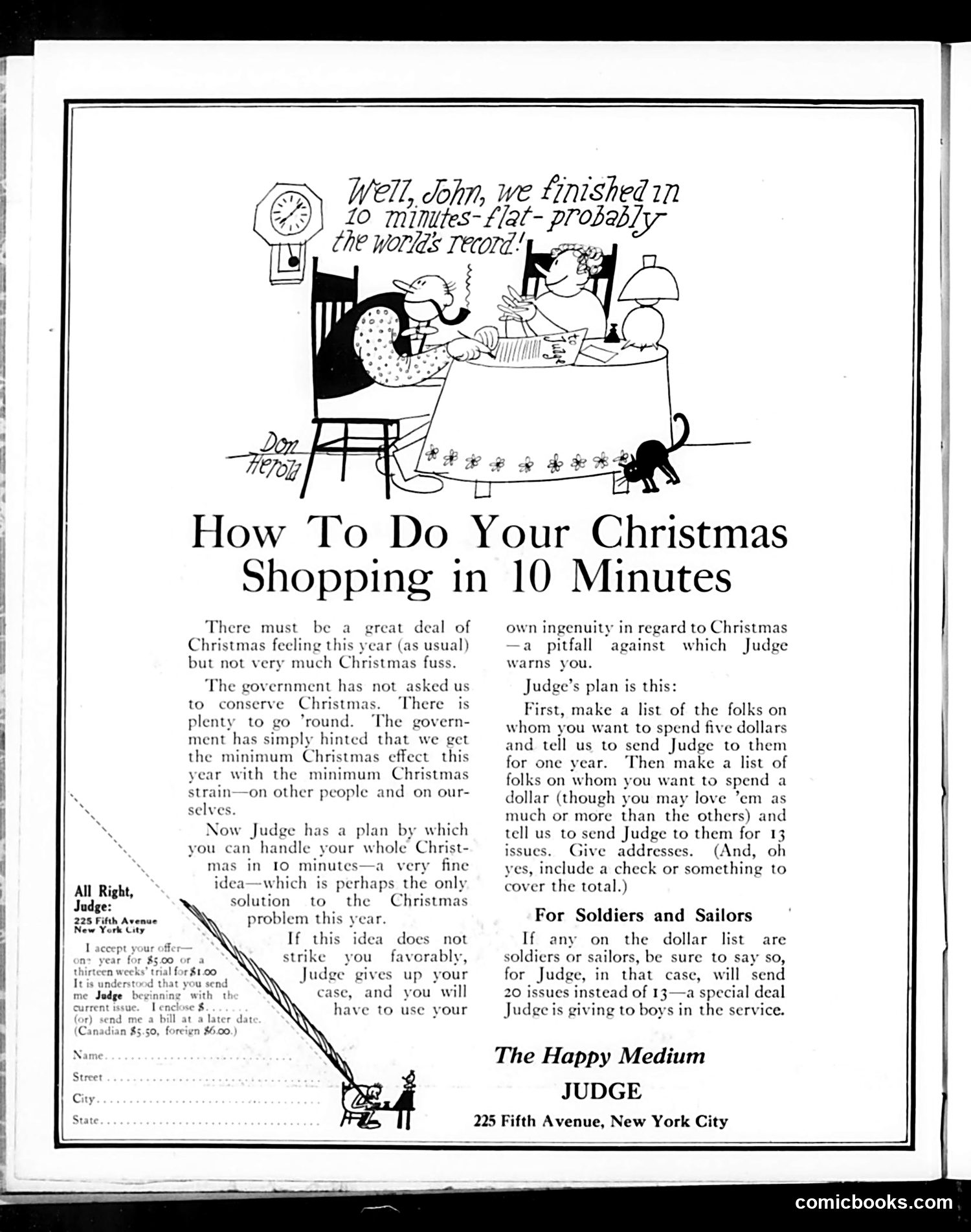
This is primarily a **humorous advertisement** for "Judge" magazine, disguised as practical advice. The cartoon shows a couple completing Christmas shopping in record time while a clock displays the achievement. The satire targets **post-WWI economic anxiety**. The text mocks the government's hints that citizens should minimize Christmas spending to conserve resources—a reference to wartime or post-war austerity measures. "Judge" (the magazine's mascot/advice columnist) proposes a tongue-in-cheek solution: organize gift-giving into tiered lists ($5 gifts, $1 gifts) distributed through the magazine itself, supposedly solving the Christmas expense problem. The special mention of "soldiers and sailors" receiving extra issues reflects the post-WWI period when servicemen were prominent in public consciousness. The satire's real point: this elaborate scheme is deliberately impractical—it mocks both government frugality appeals and consumer anxiety about holiday expenses.
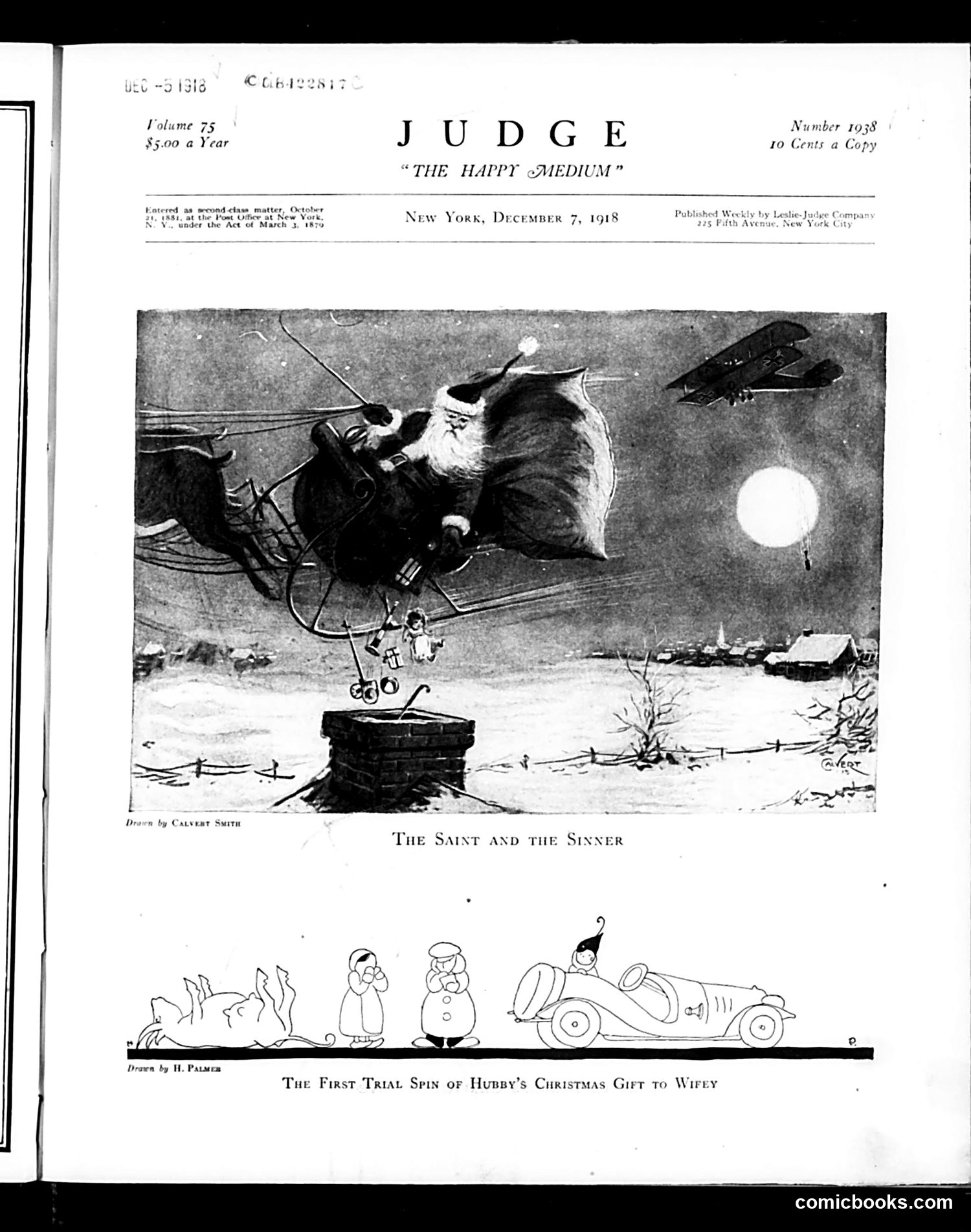
**Top Cartoon: "The Saint and the Sinner"** This depicts Santa Claus descending from an airplane (carrying military supplies) toward a snowy wartime landscape with trenches. The imagery suggests Santa bringing Christmas relief to soldiers during World War I, which had ended just weeks before this publication (November 1918). The juxtaposition of the jolly saint figure with the grim military setting creates ironic contrast—showing how even holiday traditions were overshadowed by the recent conflict. **Bottom Cartoon: "The First Trial Spin of Hubby's Christmas Gift to Wife"** A humorous domestic scene showing a husband's new automobile causing chaos—it appears to run over a Christmas tree and scatter flames, with his wife riding precariously. The joke satirizes the automobile as a dangerous, unpredictable Christmas gift.
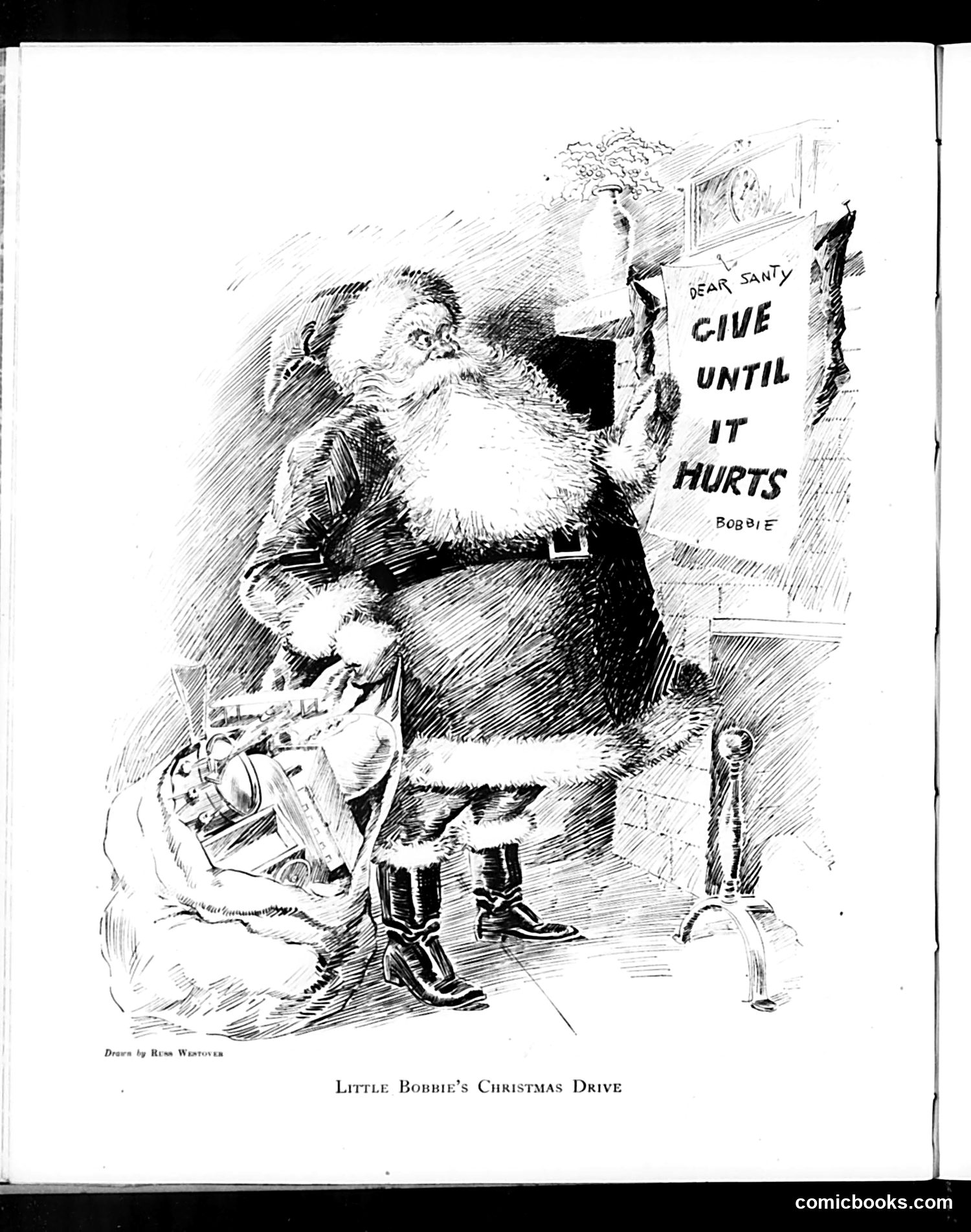
This cartoon satirizes a charity campaign, likely from the early 20th century. Santa Claus is depicted reading a sign that says "DEAR SANTY GIVE UNTIL IT HURTS" — a solicitation for charitable donations presented as a Christmas appeal. The satire targets the aggressive nature of fundraising tactics. Instead of Santa representing generous gift-giving, he's confronted with a demand to give money until experiencing financial pain ("until it hurts"). The child figure ("Little Bobbie") appears to be conducting this charity drive, suggesting the irony of a youngster pressuring even Santa himself into reluctant giving. The cartoon critiques how charitable campaigns exploit holiday sentiment and goodwill, turning Christmas generosity into uncomfortable financial coercion.
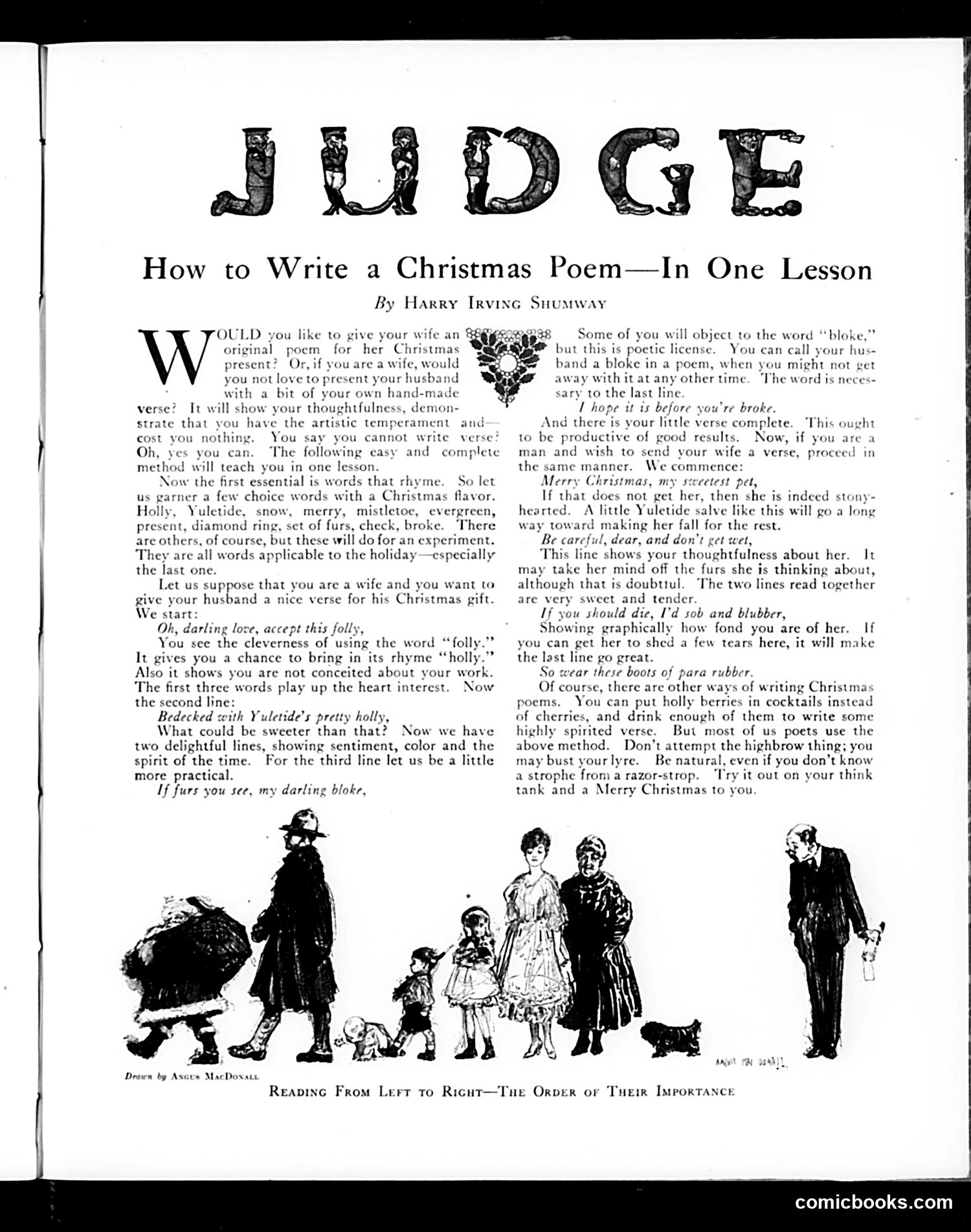
This is a humorous instructional article by Harry Irving Shumway teaching readers to compose Christmas verse. The piece satirizes sentimental holiday poetry by providing a formula using predictable rhyming words: "folly," "holly," "Yuletide," "bloke," and "mistletoe." The satire lies in Shumway's tongue-in-cheek approach—he acknowledges these are clichéd devices while demonstrating their inevitable effectiveness. The example poem ("Oh, darling love, accept this folly") exemplifies overwrought sentimentality Judge's readers would recognize in contemporary Christmas verse. The illustration showing various social classes reading the poem—from wealthy gentlemen to working families—suggests such verses appealed across society despite their formulaic nature. This is gentle social satire about mass-produced sentiment and holiday commercialism.
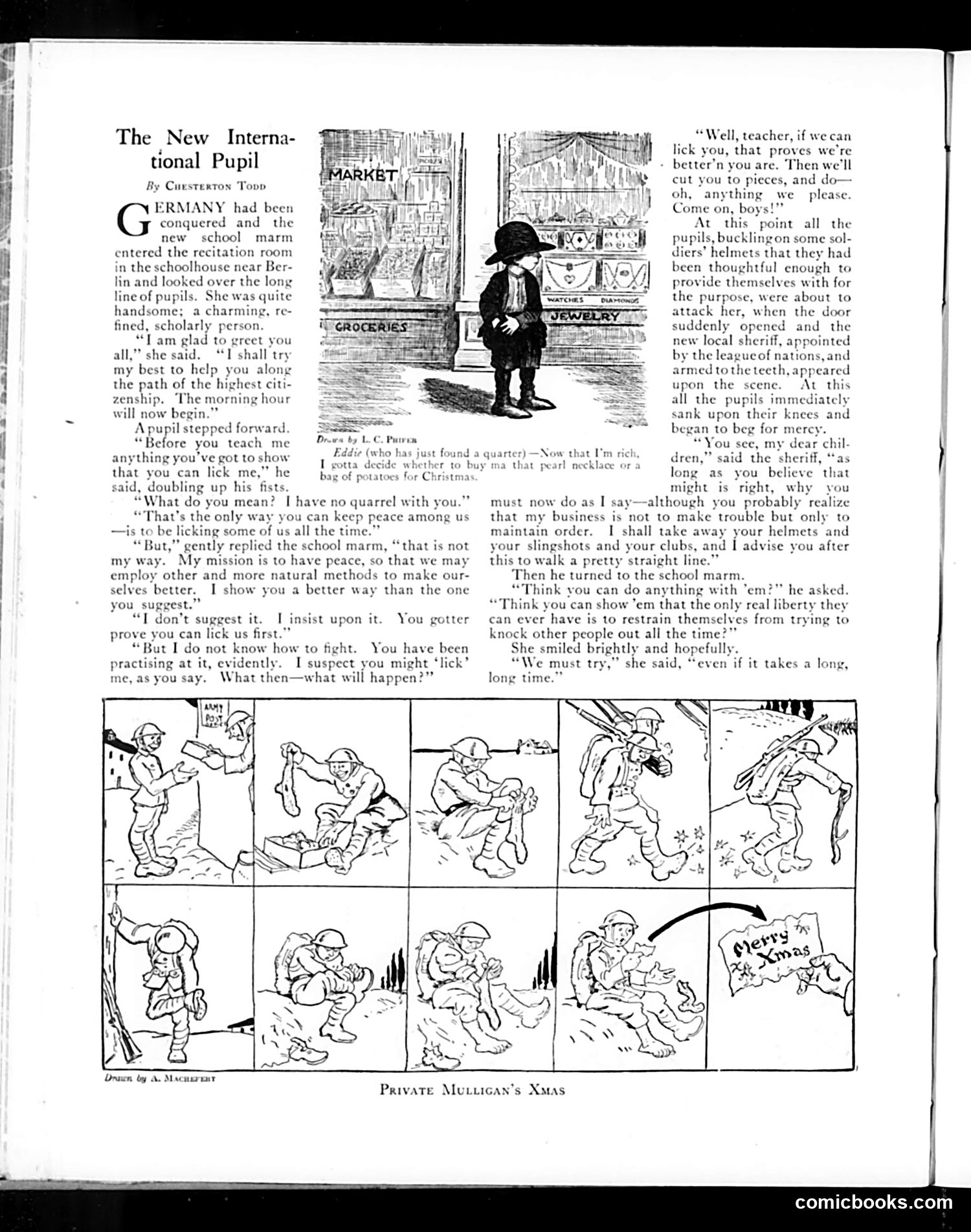
**Main Story**: A German schoolteacher addresses pupils about international peace and citizenship, arguing that violence should be replaced by dialogue and natural methods. The teacher appears to represent post-WWI efforts at teaching pacifism or internationalism to German youth. **"Private Mulligan's Xmas" Comic Strip**: Depicts soldiers (likely American, given "Mulligan") celebrating Christmas on the front lines during wartime, showing them exchanging gifts, relaxing, and wishing each other "Merry Xmas" despite military surroundings. **Satire's Point**: The juxtaposition appears ironic—the idealistic peace message contrasts sharply with the comic's realistic wartime celebration, suggesting tension between pacifist ideals and military reality during the WWI era.
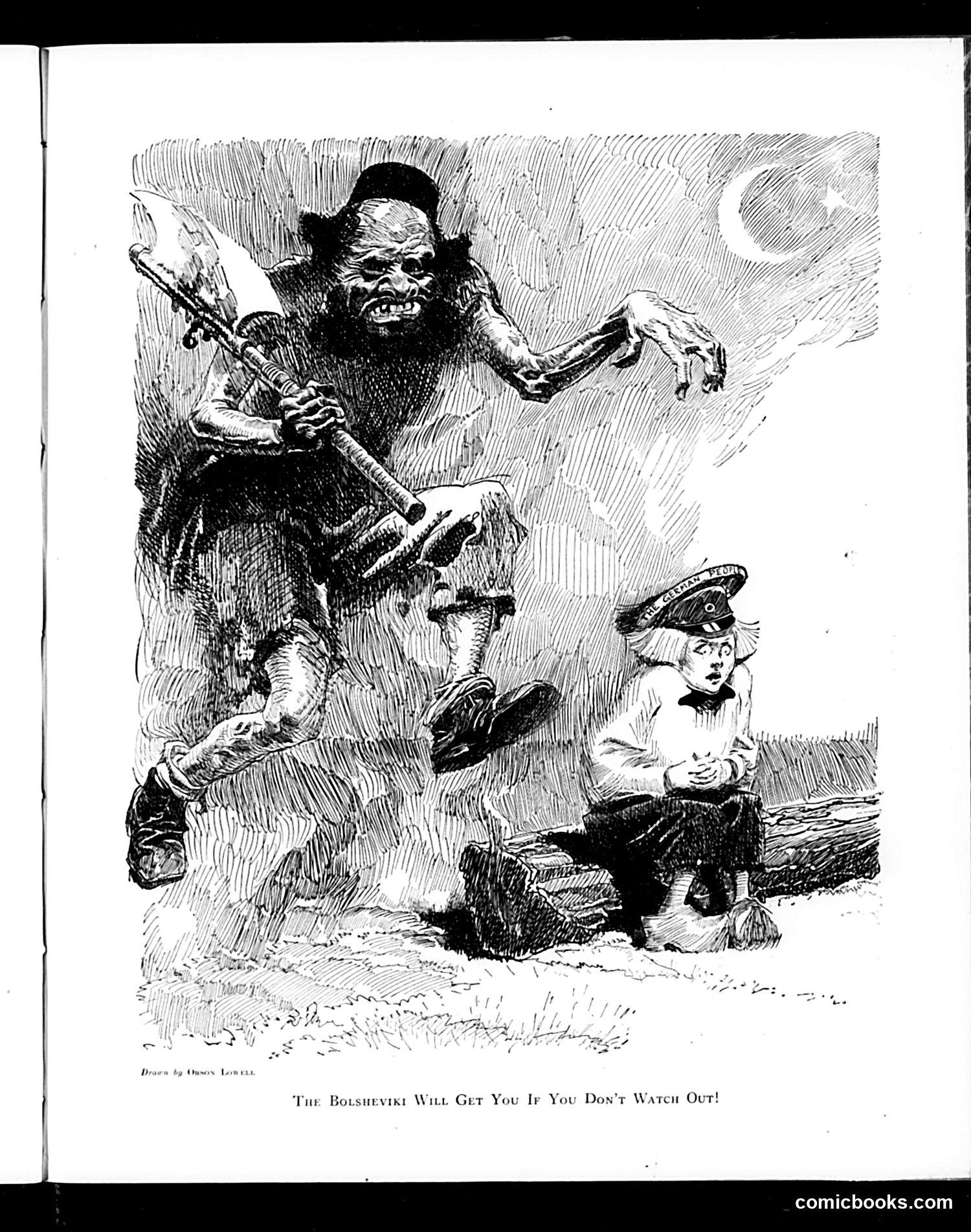
This is anti-Bolshevik propaganda from Judge magazine's early Soviet period (likely 1918-1920s). The caption "The Bolsheviki Will Get You If You Don't Watch Out!" warns American readers of the communist threat. The menacing figure represents a Bolshevik revolutionary—depicted with exaggerated, monstrous features (beard, wild expression, weapon)—a common xenophobic caricature of the era. The figure threatens a small child in sailor outfit, suggesting vulnerable Americans faced danger from revolutionary violence. The cartoon reflects American Cold War anxieties following the 1917 Russian Revolution, portraying Bolshevism as a foreign, violent threat to American citizens and children. This represents typical capitalist-era American media demonization of communism and immigrants associated with radical ideology.
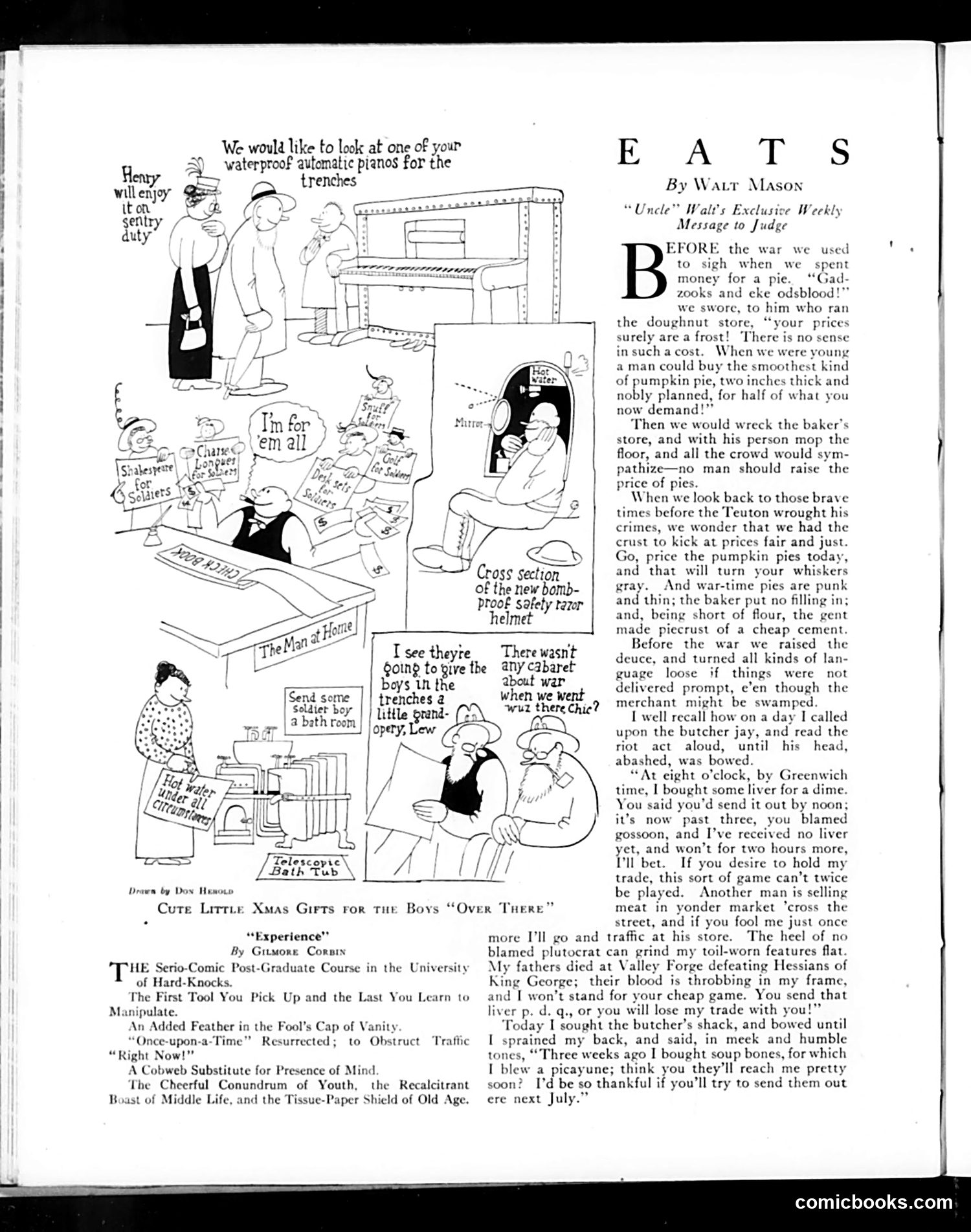
This page combines two satirical pieces about wartime inflation and consumer hardship during World War I. **The cartoon** (left) depicts soldiers and civilians discussing impractical "trenches gifts"—including waterproof pianos and bomb-proof safety razors—mocking both the absurdity of war merchandise and profiteering. **Mason's essay** (right) uses nostalgic humor to critique wartime food prices. Pre-war, customers angrily confronted bakers over pie costs; now, humbled by inflation and scarcity, that same man meekly begs the butcher for prompt delivery of liver and soup bones, grateful for any service. Mason's point: wartime shortages and price-gouging have so beaten down ordinary citizens' expectations that they've abandoned their former righteous indignation. The satire targets both merchant greed and how desperation erodes consumer dignity—a civilian parallel to soldiers' trenches sacrifice. The piece reflects genuine WWI-era frustration with food rationing and inflation on the home front.
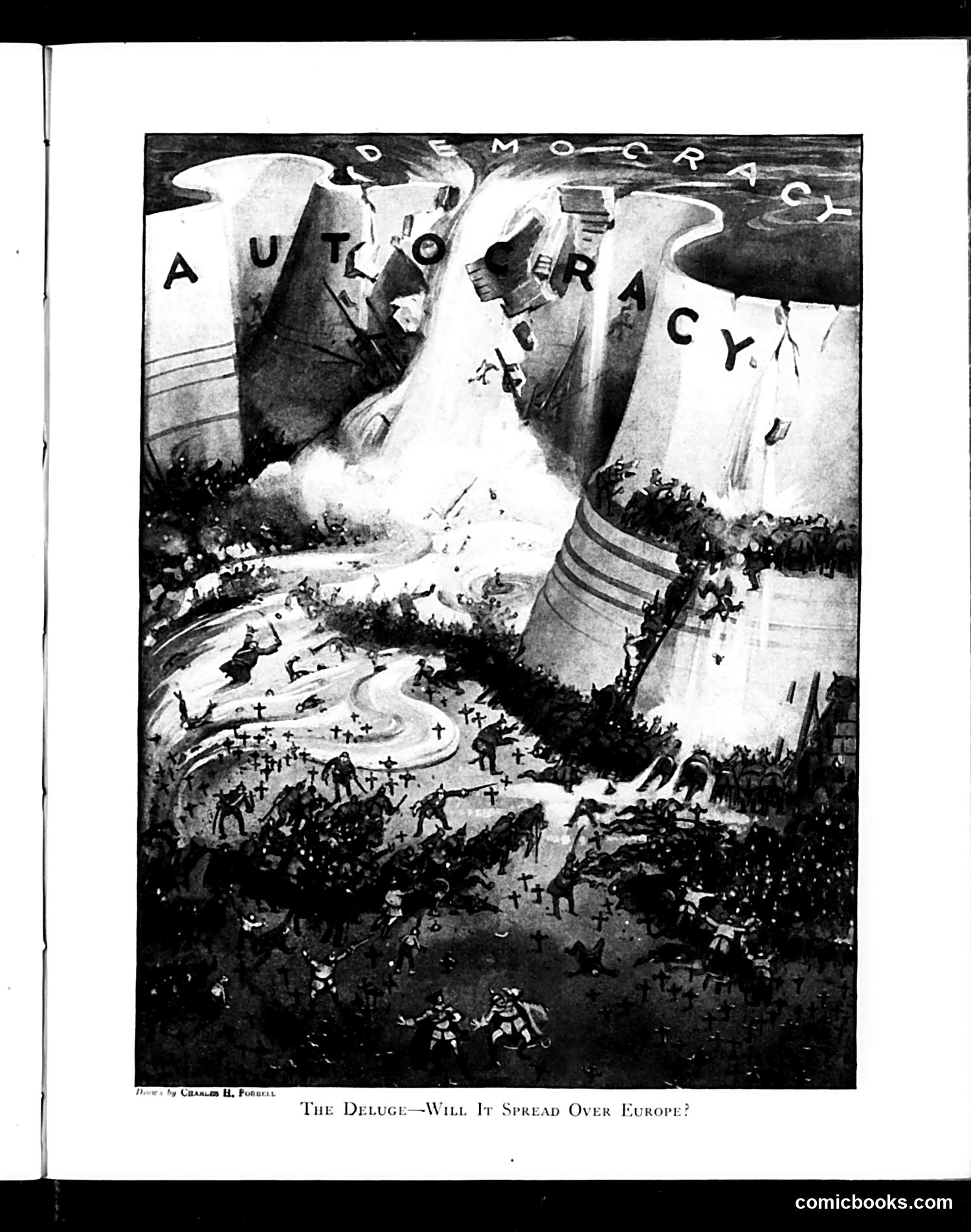
This political cartoon by Cesare (Charles) H. Pommele depicts a catastrophic flood engulfing what appears to be a city or region (labeled with letters A, C, Y), with masses of people fleeing in panic below. The composition suggests a biblical or apocalyptic disaster. The title's question—"Will it spread over Europe?"—indicates this represents some crisis threatening to expand beyond its origin. Given Judge magazine's American context, "the Deluge" likely refers to a major contemporary disaster or social upheaval the cartoonist feared might have continental consequences. Without the publication date visible, the specific event is unclear, but the imagery conveys widespread alarm about contagion or catastrophe spreading internationally.
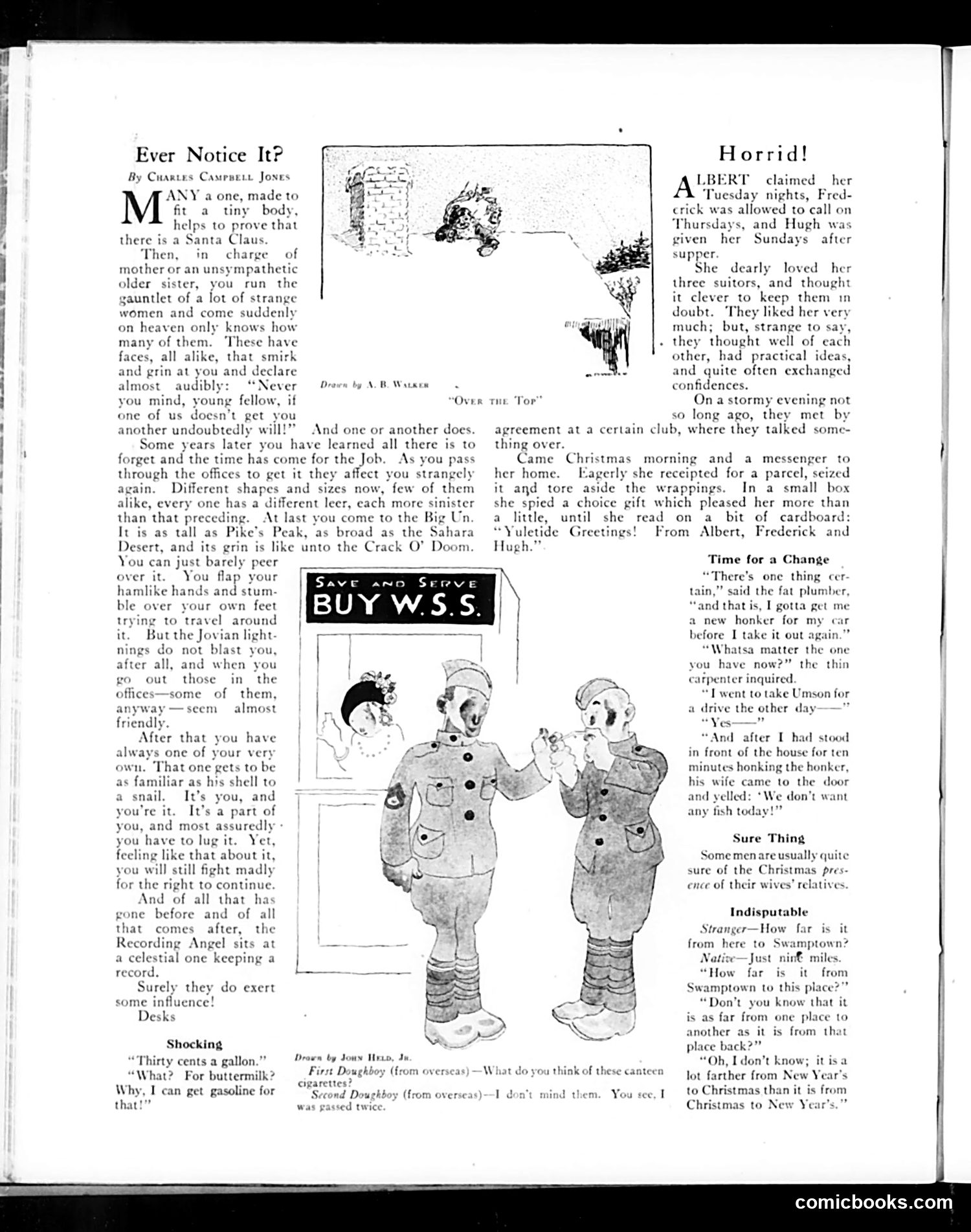
This page contains several satirical pieces reflecting post-WWI American life: **"Ever Notice It?"** by Charles Campbell Jones observes how office women appear different at various life stages—from sweet-faced Santa helpers in childhood to increasingly sinister figures when job-hunting, culminating in an intimidating "Big Un." The satire critiques how perceptions of women shift based on context and power dynamics. **The W.S.S. Advertisement** promotes War Savings Stamps, a government bond program from the World War I era, using soldiers as spokespeople. **"Horrid!"** satirizes a woman juggling three suitors (Albert, Frederick, Hugh) who discover her deception when receiving a shared Christmas gift—mocking romantic entanglement. **The remaining humor pieces** mock buttermilk pricing, a plumber's mistaken car horn for a fish vendor, and relativity of distance. These reflect everyday post-war American concerns: inflation, misunderstandings, and absurdist logic. The overall tone is light domestic satire typical of Judge magazine's approach to contemporary social behavior.
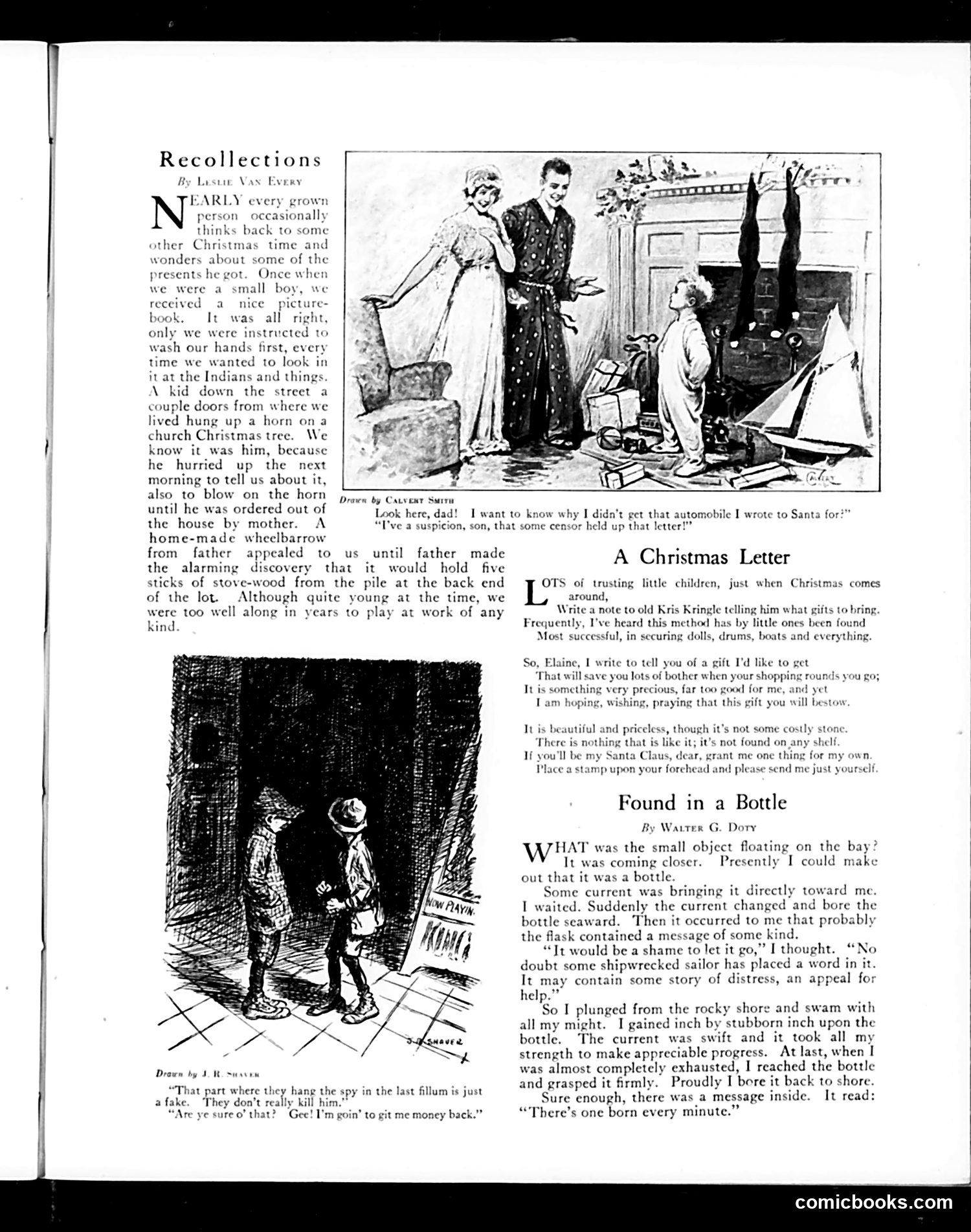
This page contains three separate nostalgic/humorous pieces typical of Judge's satirical format: **"Recollections"** (top left): A memoir about childhood Christmas presents, mocking how parents restrict children's enjoyment—a hand-washing requirement before viewing an illustrated book, a homemade wheelbarrow immediately repurposed for labor. **The cartoon** (center): Shows a child and father discussing a movie. The child thinks a death scene was fake; the father cynically suggests a censor actually censored the letter the child wrote to Santa, preventing him from receiving an automobile. This satirizes both childhood naiveté and film censorship practices of the era. **"A Christmas Letter"** (right): Sentimental verse about children writing Santa, ultimately requesting only their father's presence—touching sentimentality masking the era's economic hardship. **"Found in a Bottle"** (bottom right): An adventure parody where the narrator exhaustedly retrieves a mysterious bottle from the sea, only to find it contains the cynical con-artist phrase "There's one born every minute"—mocking gullibility and the human tendency toward self-deception. The page emphasizes Christmas themes mixed with satirical commentary on American life, consumerism, and human folly.
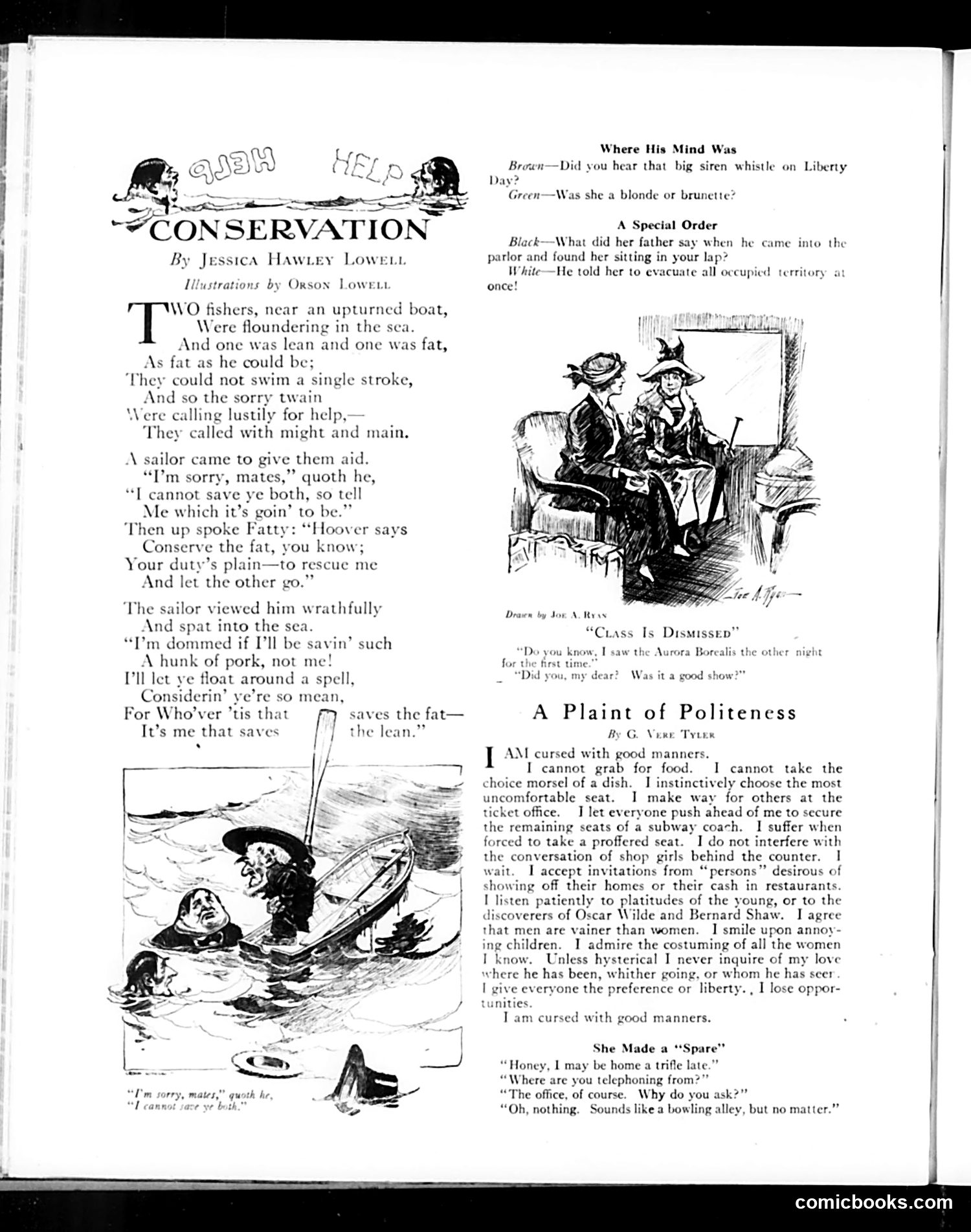
**"Conservation" (main poem/cartoon):** This satirizes Herbert Hoover's famous "Conservation" policy during WWI rationing. A fat man drowning demands rescue while claiming "conserve the fat, you know"—mocking those who preach conservation while hoarding resources themselves. The sailor's refusal to save such hypocrisy delivers the moral punch: conservation means genuine sacrifice, not selective self-interest. **Sidebar jokes:** Light social commentary on gender dynamics and modern life—a woman's vague answer about a "siren whistle" on Liberty Day, a father discovering a suitor's presumption, and observations about workplace courtship. **"A Plaint of Politeness":** Satire on excessive manners as self-defeating; the narrator's rigid adherence to propriety costs him opportunities and comfort, suggesting American culture valued authenticity over strict etiquette. The page reflects early-20th-century American anxieties about resource scarcity, gender relations, and social conduct.
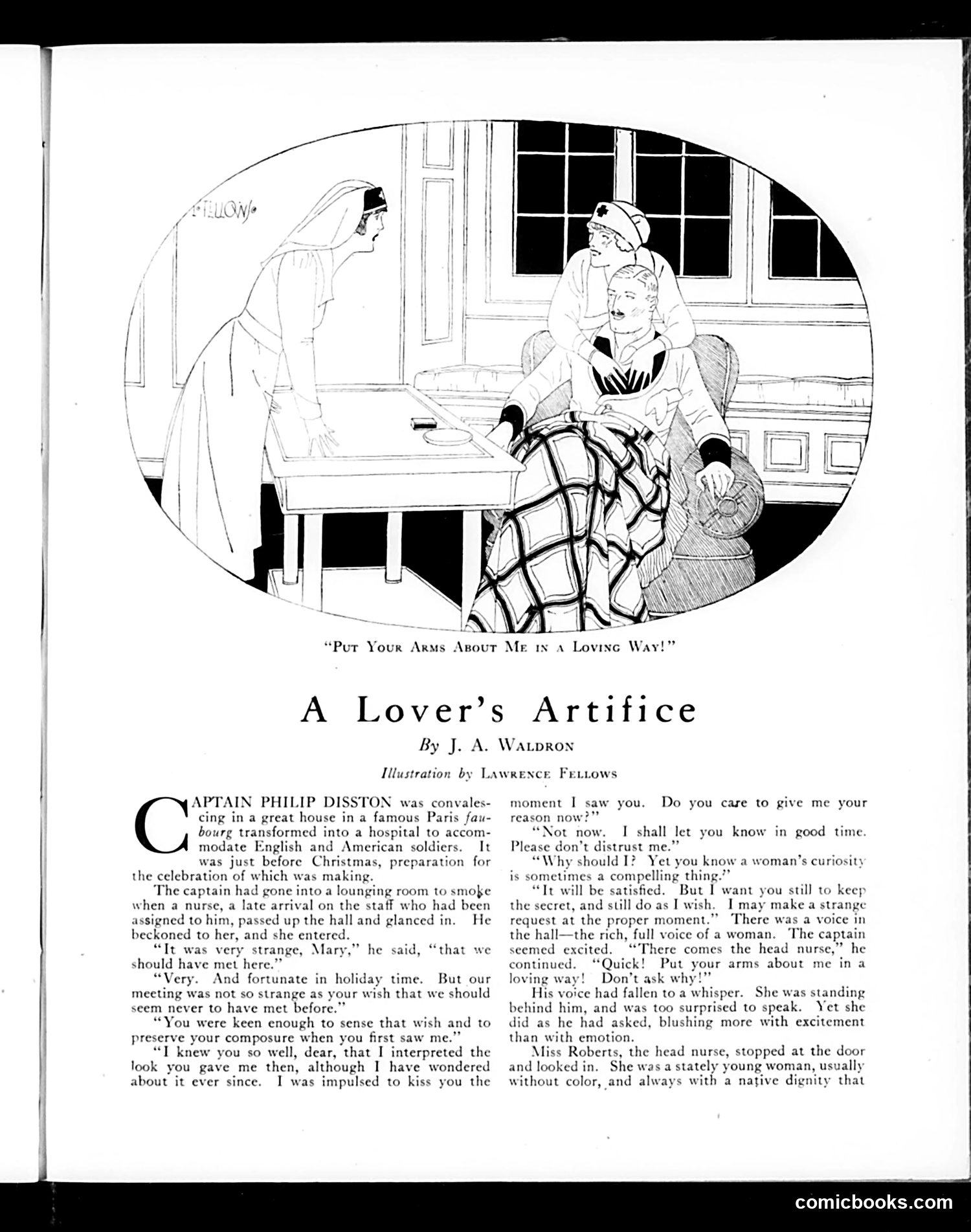
This is the opening page of a serialized short story (not a political cartoon), illustrated by Lawrence Fellows for *Judge* magazine. The narrative concerns Captain Philip Disston, convalescencing in a Paris hospital converted to treat English and American soldiers during World War I. A nurse arrives whom he recognizes but wants to conceal their prior acquaintance. When the head nurse (Miss Roberts) approaches, he impulsively asks the first nurse to embrace him "in a loving way"—ostensibly to appear romantically involved and perhaps deflect the head nurse's attention or suspicion. The setup suggests a romantic entanglement or deception involving three characters. The story's title, "A Lover's Artifice," hints that romance and strategic maneuvering will drive the plot. This is domestic fiction typical of *Judge*'s serialized content—entertainment rather than satire.
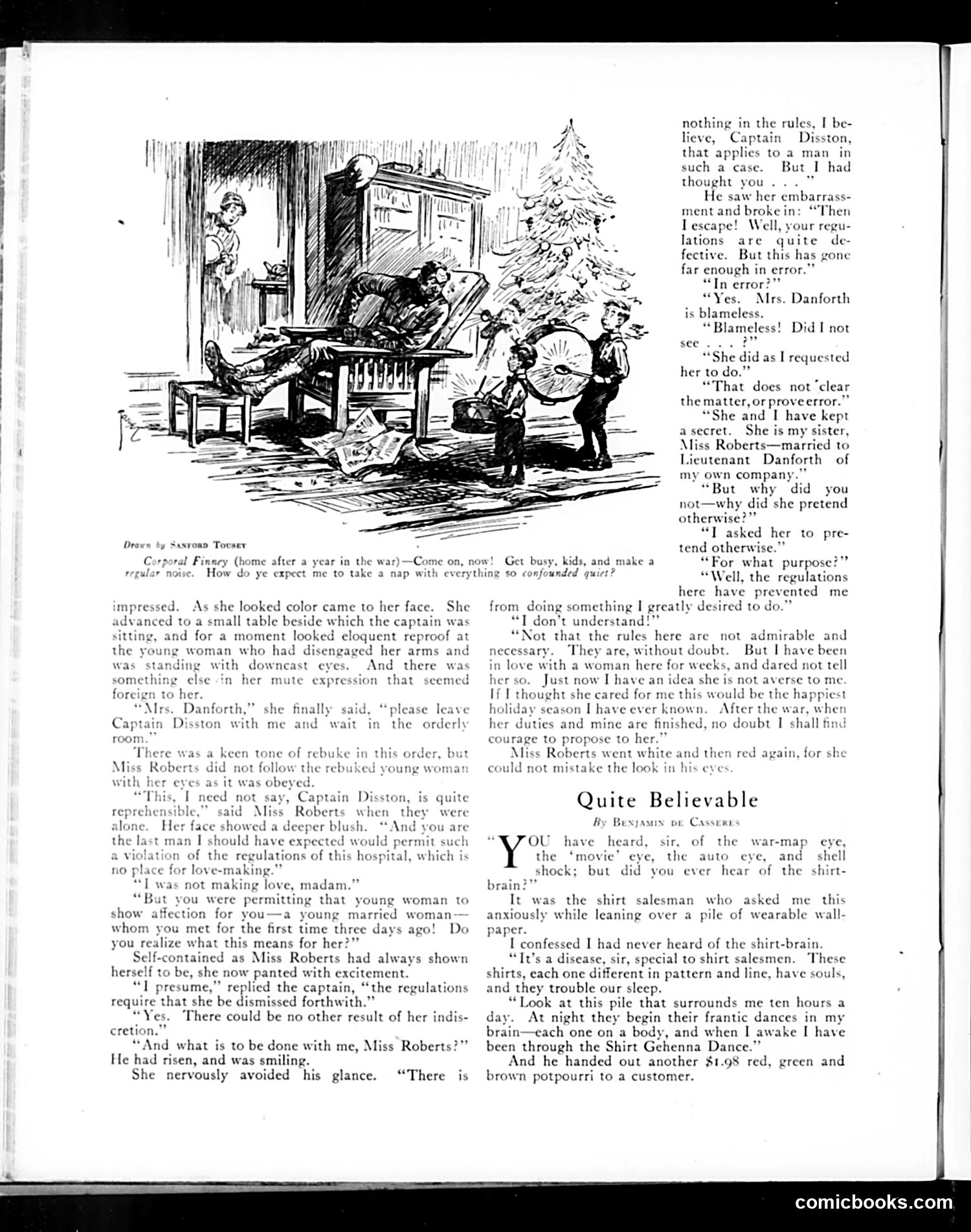
This Judge magazine page contains two stories: **"Corporal Finney"** (top): A WWI soldier returns home and discovers a military regulation violation. Captain Disston allowed a young married woman (Mrs. Danforth) to show affection to him—actually his sister—breaking hospital rules. When confronted by Miss Roberts (a superior officer), Disston reveals he's in love with *her* and staged the deception to test her feelings. The satire critiques rigid military regulations that prevent human connection, while Disston's clever rule-bending wins sympathy. **"Quite Believable"** (bottom): A humorous anecdote about a shirt salesman suffering from "shirt-brain"—a nervous condition where the countless shirt patterns he handles obsess him at night, causing hallucinatory "dances." The joke mocks commercial salesmanship and nervous exhaustion from repetitive consumer goods marketing, common postwar anxieties about modern commercial life. Both pieces use romantic and absurdist humor typical of 1920s satirical magazines targeting educated readers.
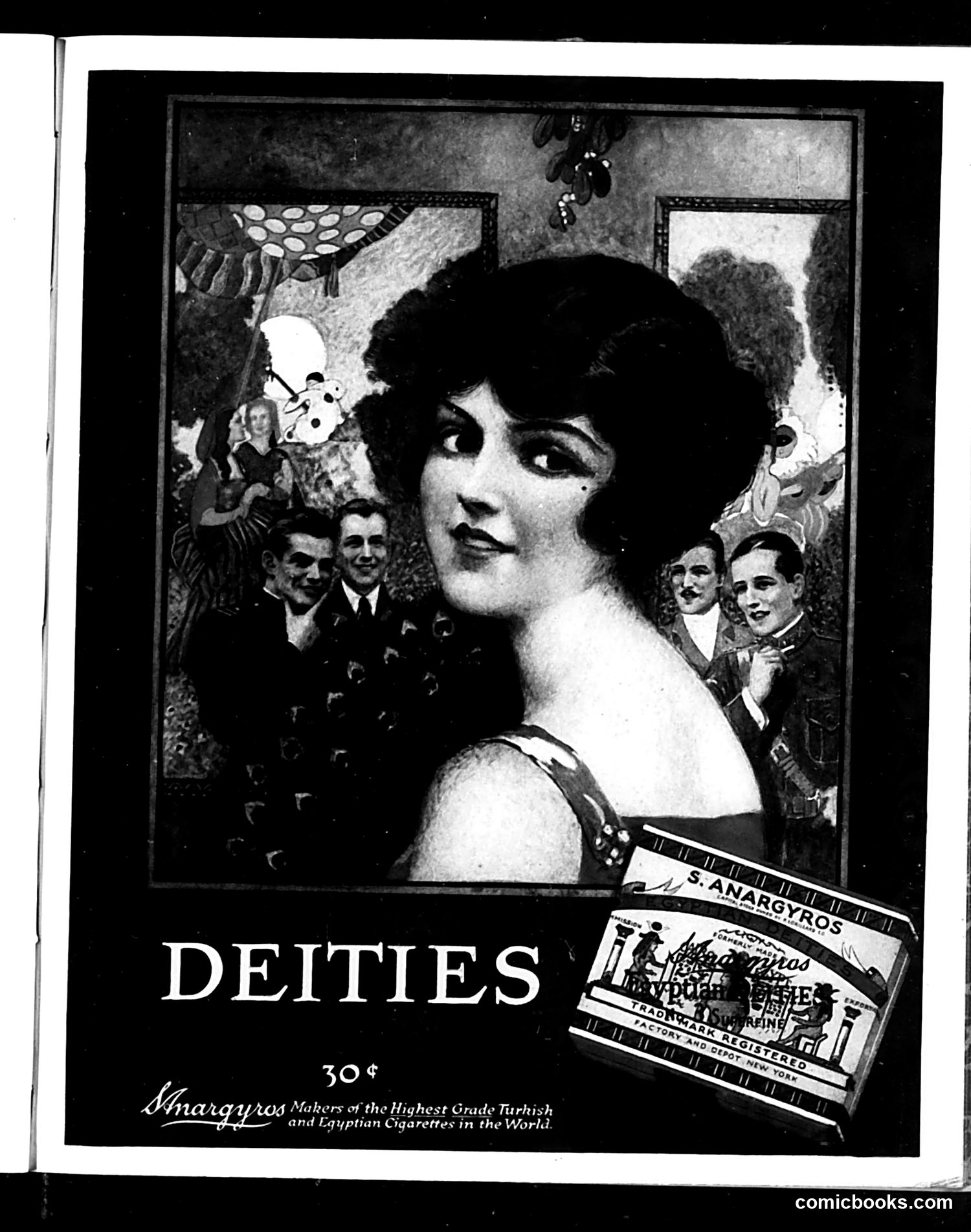
This is primarily a **cigarette advertisement** rather than a political cartoon. The page features a glamorous woman in profile as the focal point, with well-dressed men in formal attire depicted in the background scene. The advertisement is for Anargyros brand cigarettes, marketed as "Makers of the Highest Grade Turkish and Egyptian Cigarettes in the World." The artistic composition—with the prominent female figure and sophisticated gentleman observers—reflects early 20th-century advertising aesthetics designed to associate the product with elegance, refinement, and social prestige. The decorative theatrical elements in the background suggest luxury and entertainment. There is no discernible political satire or social commentary on this page; it functions as a straightforward commercial advertisement using aspirational imagery typical of the era.
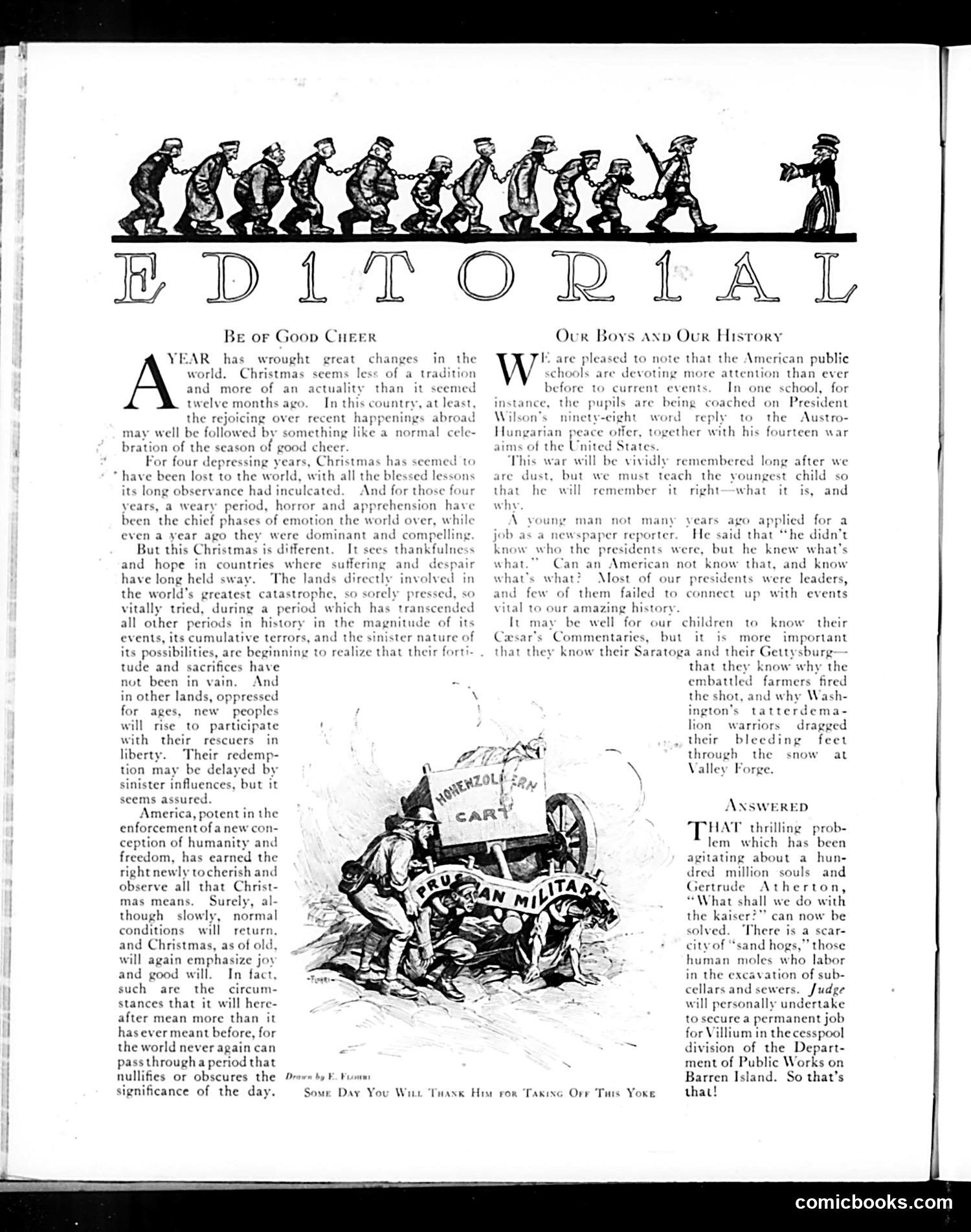
This is a multi-part editorial page from Judge magazine responding to Christmas 1918—just after World War I's end. **"Be of Good Cheer"** (left column) is a serious essay celebrating Christmas's return after "four depressing years" of war. It praises America's role in enforcing "a new conception of humanity and freedom" and expresses hope that suffering nations will now recover. **"Our Boys and Our History"** (right column) advocates teaching American schoolchildren about historical events—specifically invoking President Wilson's peace efforts, Saratoga, Gettysburg, and Valley Forge—so they understand why wars are fought. **The cartoon** (center) satirizes the ongoing question "What shall we do with the Kaiser?" by suggesting an absurdist solution: employ the deposed German leader (Kaiser Wilhelm) as a "sand hog" (subway excavation worker) in New York's cesspool division on Barren Island—the lowest, most degrading job imaginable. The joke exposes post-war anger toward Germany while mocking the serious political debate about the Kaiser's fate.
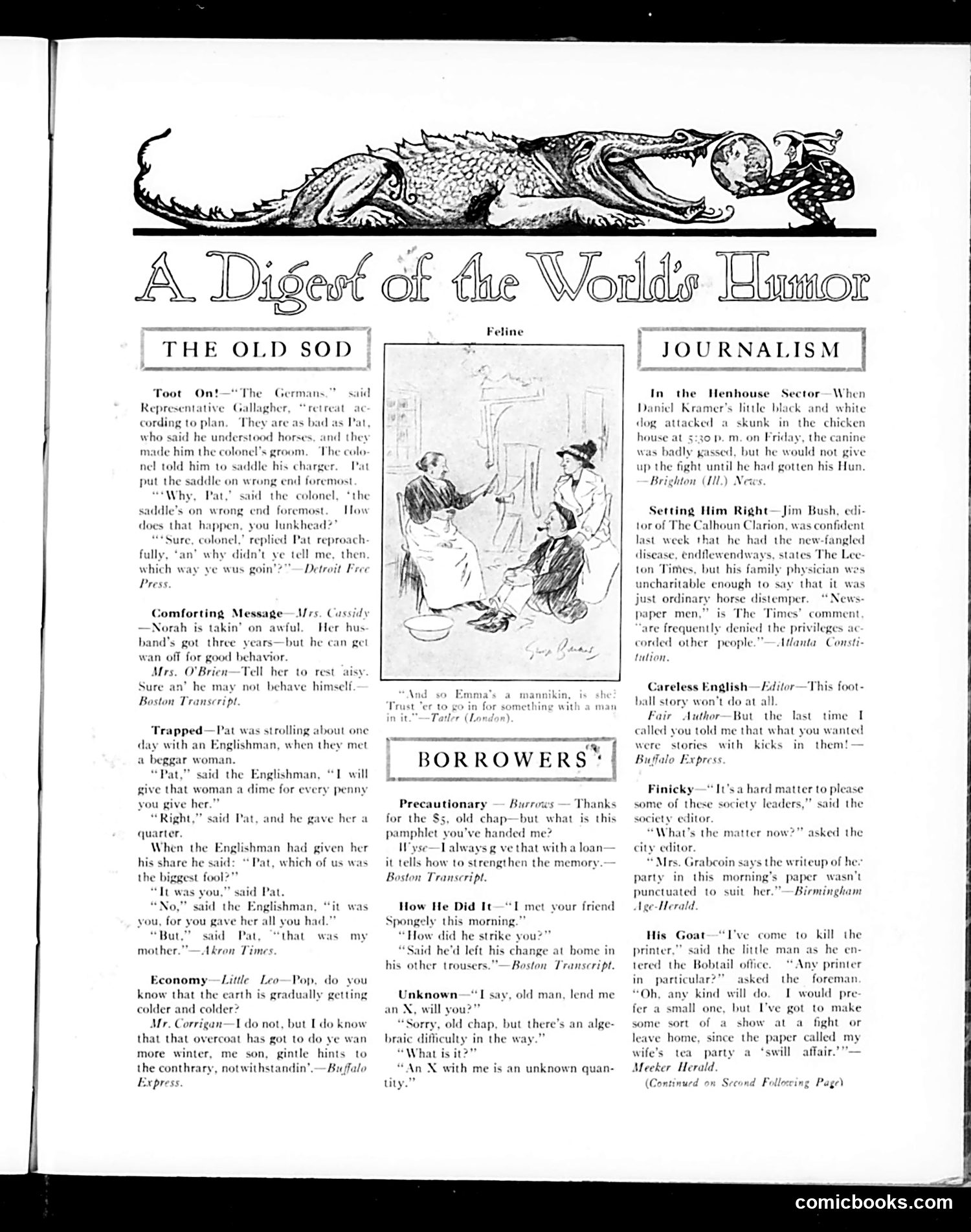
This page collects humorous anecdotes organized by topic. The dominant theme is **Irish-American stereotypes**, particularly the character "Pat," depicted as simple-minded but good-hearted. In "The Old Sod," Pat bundles a saddle backward and later gives away his mother's quarter to a beggar—jokes playing on Irish naïveté and generous foolishness. The "Journalism" section mocks **newspaper editors and writers** for carelessness and pretension: a football story with missing "kicks," unpunctuated society writeups, and the reference to a wife's "tea party" called a "swill affair" (suggesting working-class mockery). Other pieces satirize **marriage troubles, economic hardship** ("the overcoat has got to do ye wan more winter"), and **borrowing culture** among the working class. One joke plays on an algebraic pun about lending "an X." The central cartoon (by Cesare) depicts genteel figures in conversation, likely illustrating one of these anecdotes about social miscommunication. Overall, this represents early 20th-century *Judge* humor: class-based, ethnic-stereotype-heavy satire aimed at middle-class readers.
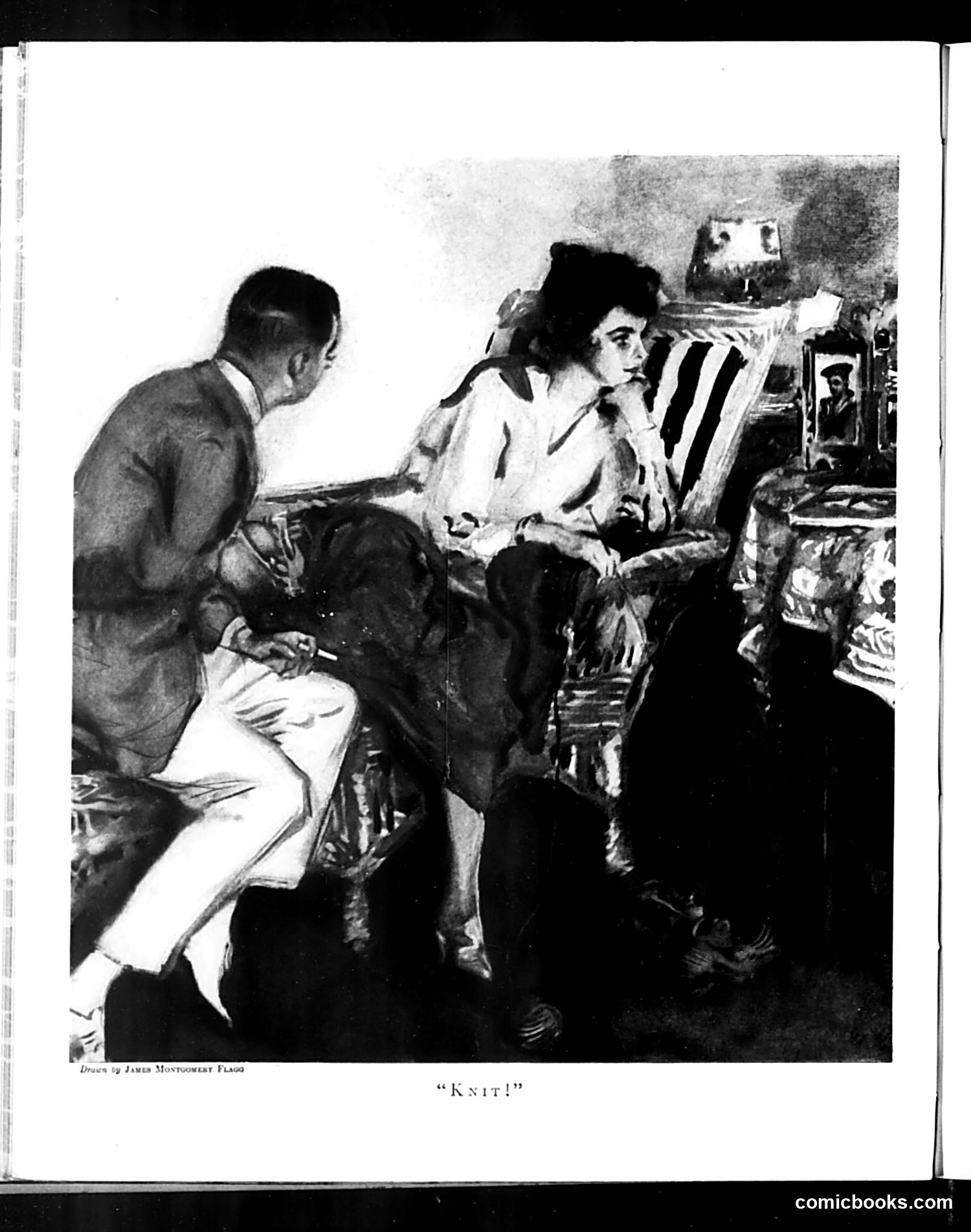
This appears to be a James Montgomery Flagg illustration titled "Knit!" from Judge magazine. The image depicts an indoor scene where a man sits beside a woman who is knitting. The domestic setting and her focused work on knitting suggest this is propaganda or social commentary, likely from the World War I era when knitting became a patriotic duty for civilians—women especially were encouraged to knit socks, scarves, and other items for soldiers. The man's presence and attentive posture suggests he may be overseeing or encouraging her patriotic contribution. The title "Knit!" functions as a direct command, reinforcing the social pressure on citizens (particularly women) to participate in the war effort through domestic production.
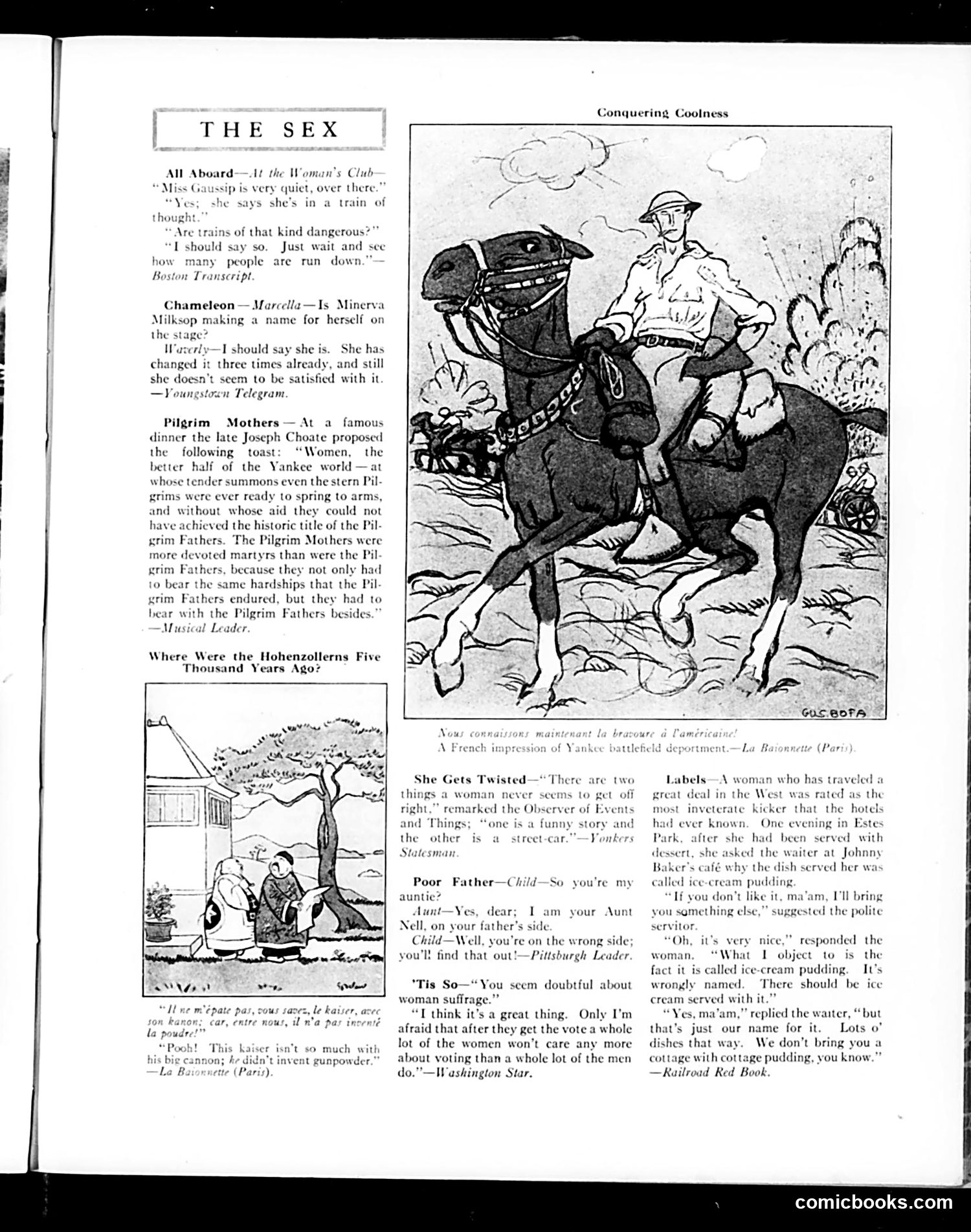
This page from *Judge* magazine contains several short satirical pieces about women and social attitudes circa the 1920s (likely around the time of women's suffrage debates). **"Conquering Coolness"** (main cartoon): Shows a man riding a camel in desert clothing, captioned with a French phrase about "American" impressions. The satire appears to mock exaggerated Western/colonial adventure fantasies. **Other brief jokes** mock women's behavior: "Chameleon" jokes about a woman changing her stage name repeatedly; "Poor Father" plays on gender confusion; "'Tis So" expresses skepticism that women voters will actually care about voting rights. **"Pilgrim Mothers"** reprints a Joseph Choate toast honoring women's historical contributions—reframing them as equal or superior to men's roles in American founding. **"Labels"** mocks a picky female traveler who complains that "ice-cream pudding" is a misleading name—satire suggesting women are difficult customers obsessed with trivial semantic complaints. The overall tone reflects period attitudes: mixing mild feminist acknowledgment with jokes portraying women as vain, fickle, and petulant.
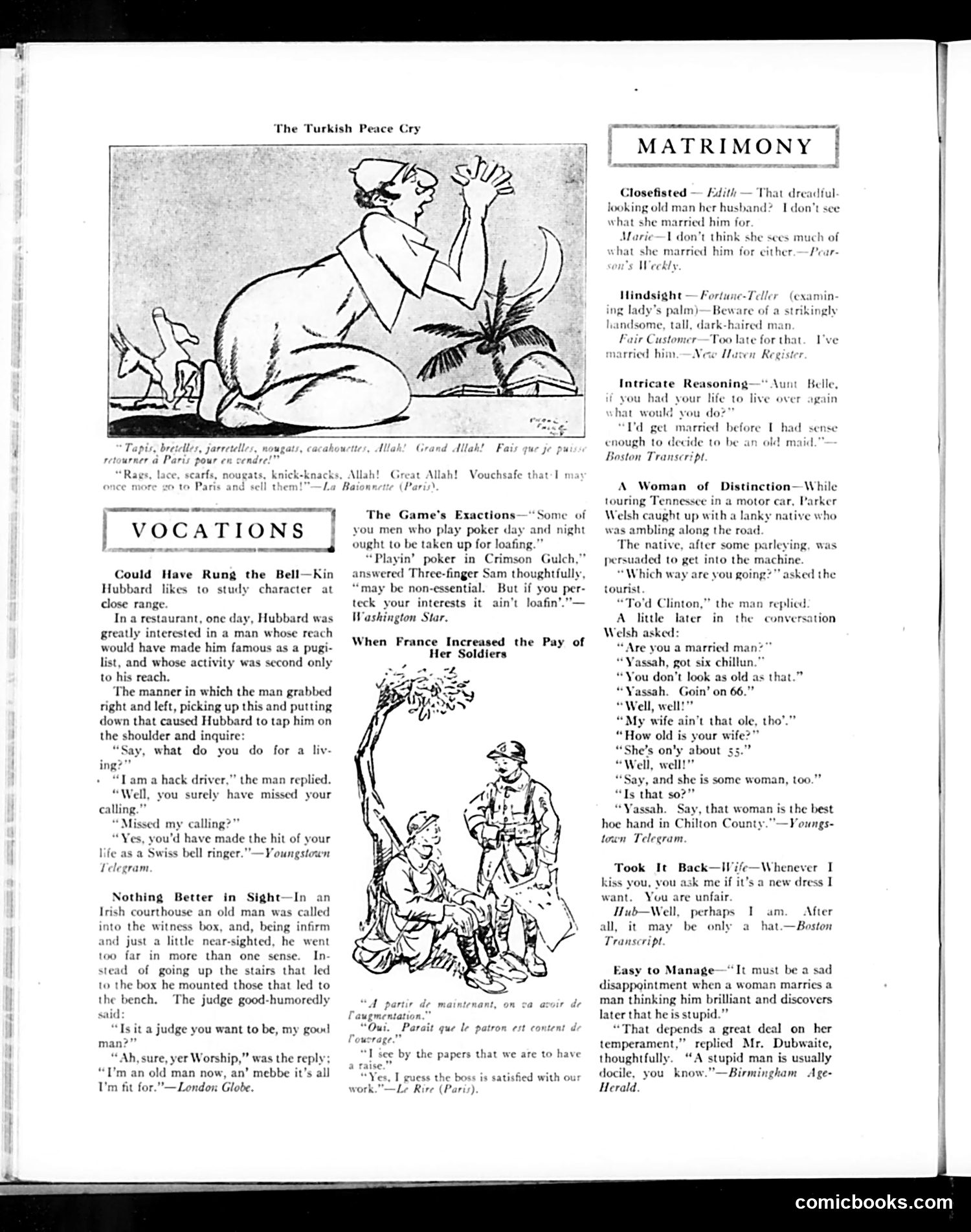
This page from *Judge* magazine contains multiple short humorous anecdotes rather than a single political cartoon. **"The Turkish Peace Cry"** (top left illustration) appears to reference the Ottoman Empire, showing a figure in Turkish dress making emphatic gestures—likely satirizing Turkish diplomatic communications or peace negotiations, though the specific historical context isn't clearly labeled. The remaining content consists of brief comedic stories about everyday life: a man with exceptional reach who should be a bell-ringer, an elderly Irish witness who climbs to the judge's bench instead of the witness box, and poker players justifying their leisure time as legitimate work. The **"Matrimony"** section on the right collects marriage-related jokes—husbands and wives complaining about each other, a fortune-teller's warning about handsome men, and observations about stupidity in marriage. These reflect early 20th-century American attitudes toward marriage as an institution worthy of gentle ridicule. The humor is largely observational and domestic rather than overtly political.
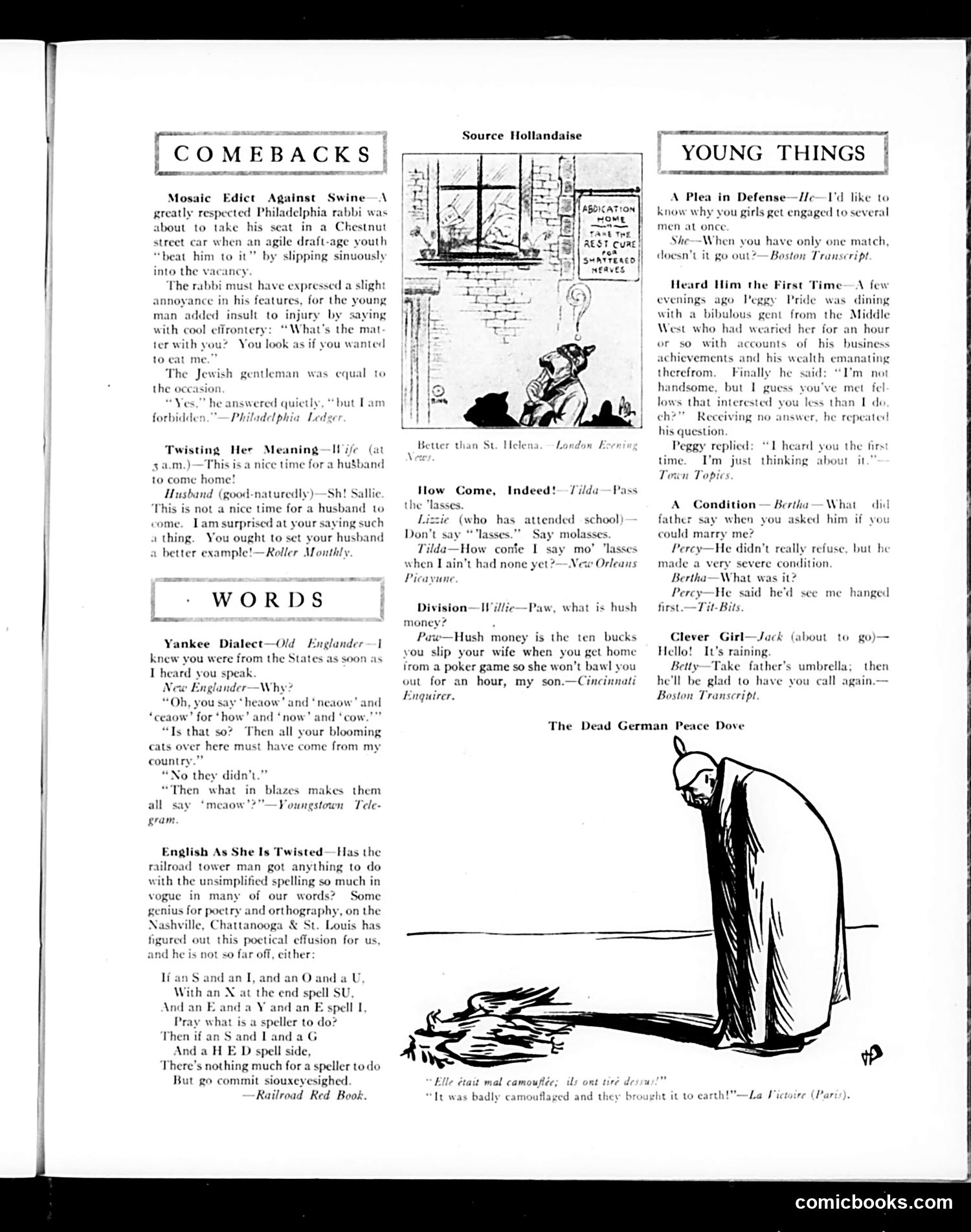
This page from *Judge* magazine contains humorous anecdotes and wordplay typical of early 20th-century American humor. The content includes: **"Comebacks"** section: Brief witty exchanges, including a Jewish rabbi's clever retort to a rude young man on a trolley, and marital squabbles about late arrivals home. **"Words"** section: Dialect humor contrasting American and English speech patterns, and a satirical poem about English spelling inconsistencies (attributed to a railroad company). This mocks the "simplified spelling" movement that was briefly popular in that era. **"Young Things"** section: Short romantic/courtship anecdotes with punchlines about engagements, relationships, and social courtship customs. **"The Dead German Peace Dove"**: A stark editorial cartoon showing a dead dove—likely satirizing failed German peace efforts during or after World War I. The overall tone reflects genteel, middlebrow humor of its era: observational comedy about class, dialect, marriage, and courtship, with serious editorial commentary on contemporary geopolitics inserted.
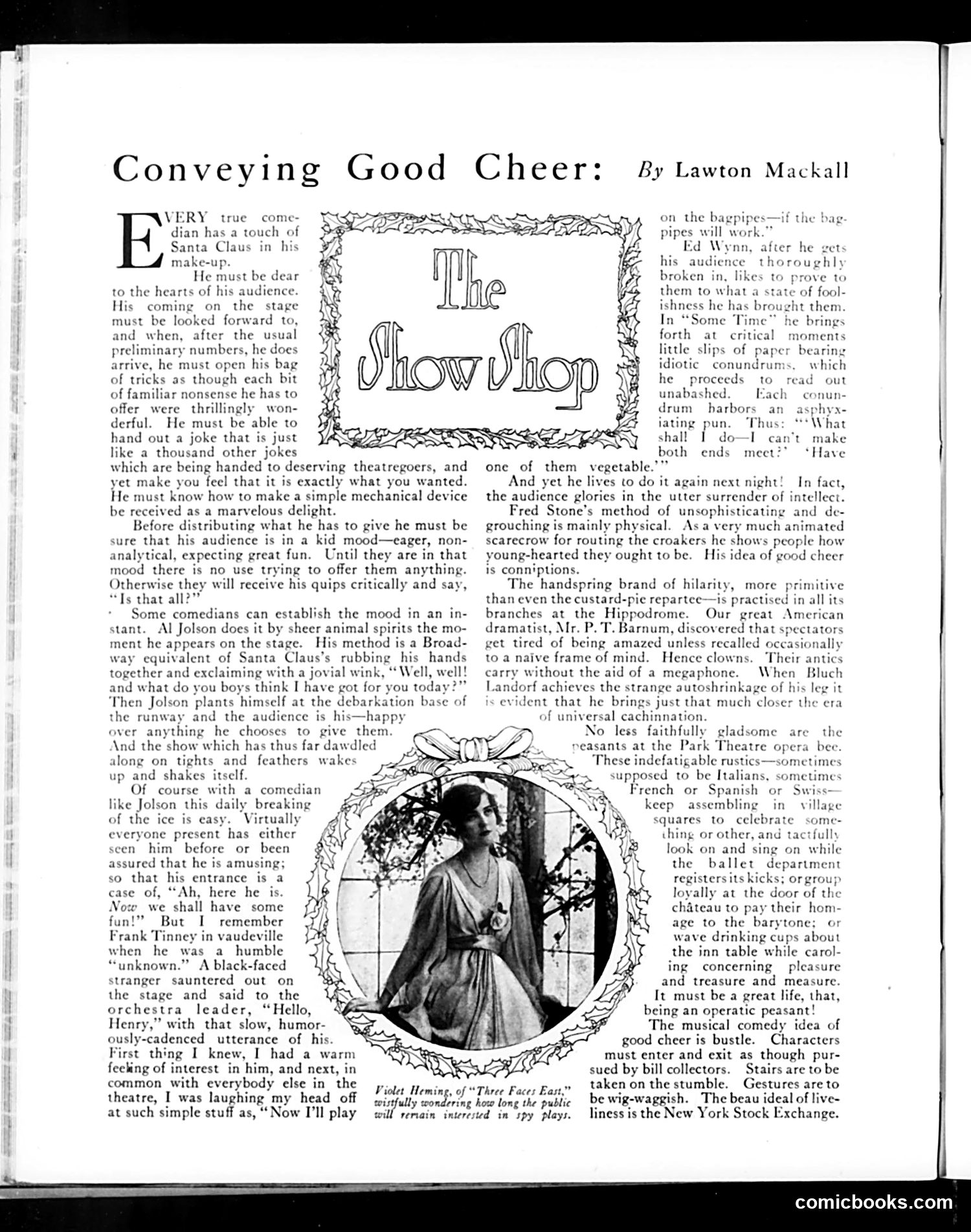
This article by Lawton Mackall analyzes how comedians create audience delight. The piece discusses specific performers—Al Jolson, Ed Wynn, Frank Tinney, and Fred Stone—explaining their techniques for establishing a "kid mood" of receptivity before delivering jokes. The central argument: comedians must function like Santa Claus, creating anticipation and goodwill so audiences embrace even familiar material as fresh. Jolson achieves this through "animal spirits"; Wynn uses absurdist non-sequiturs on paper; Stone uses physical comedy; Tinney created warmth simply by saying "Hello, Henry." The article emphasizes that comedians must understand audience psychology—that intellectual resistance must be suspended before humor lands. The featured illustration shows a woman in classical dress, likely representing theatrical entertainment or muse figures common to Judge magazine's visual style.
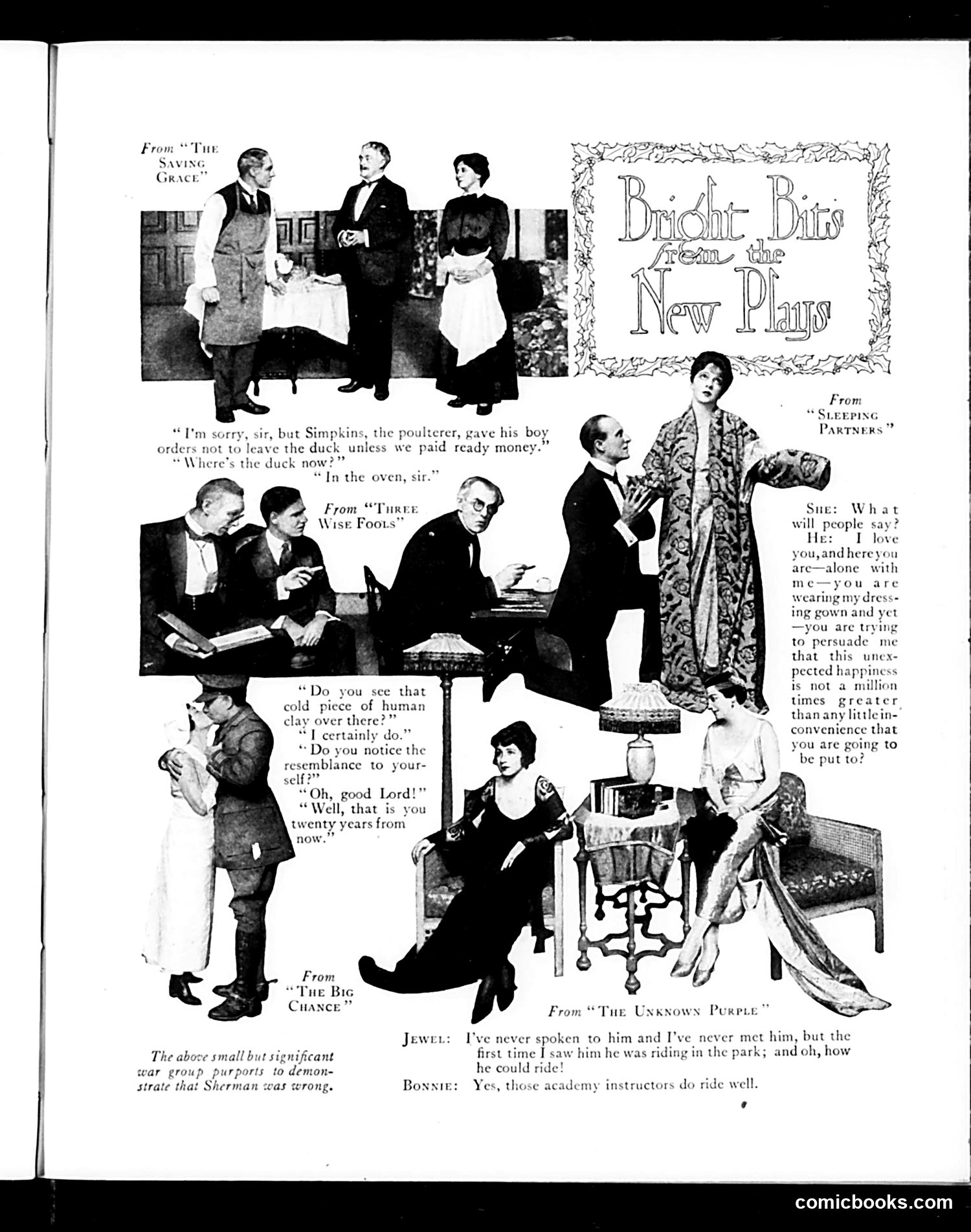
This page collects comedic scenes from contemporary theatrical productions, presented as film stills with accompanying dialogue. The humor derives from situational comedy and romantic entanglement rather than political satire. The scenes include: a domestic dispute over a poulterer's unpaid bill (with the duck already cooked); a romantic encounter where a woman wears a man's dressing gown while denying impropriety; a macabre moment where someone confronts a sculpture or corpse resembling their future self; and a woman praising a man's riding skills, with her companion suggesting the man is merely a riding instructor. The page appears designed to promote these theatrical productions through witty dialogue snippets. The "Sherman" reference in the caption suggests costume design or staging details, though the specific plays and their dates remain unclear from the visible text alone.
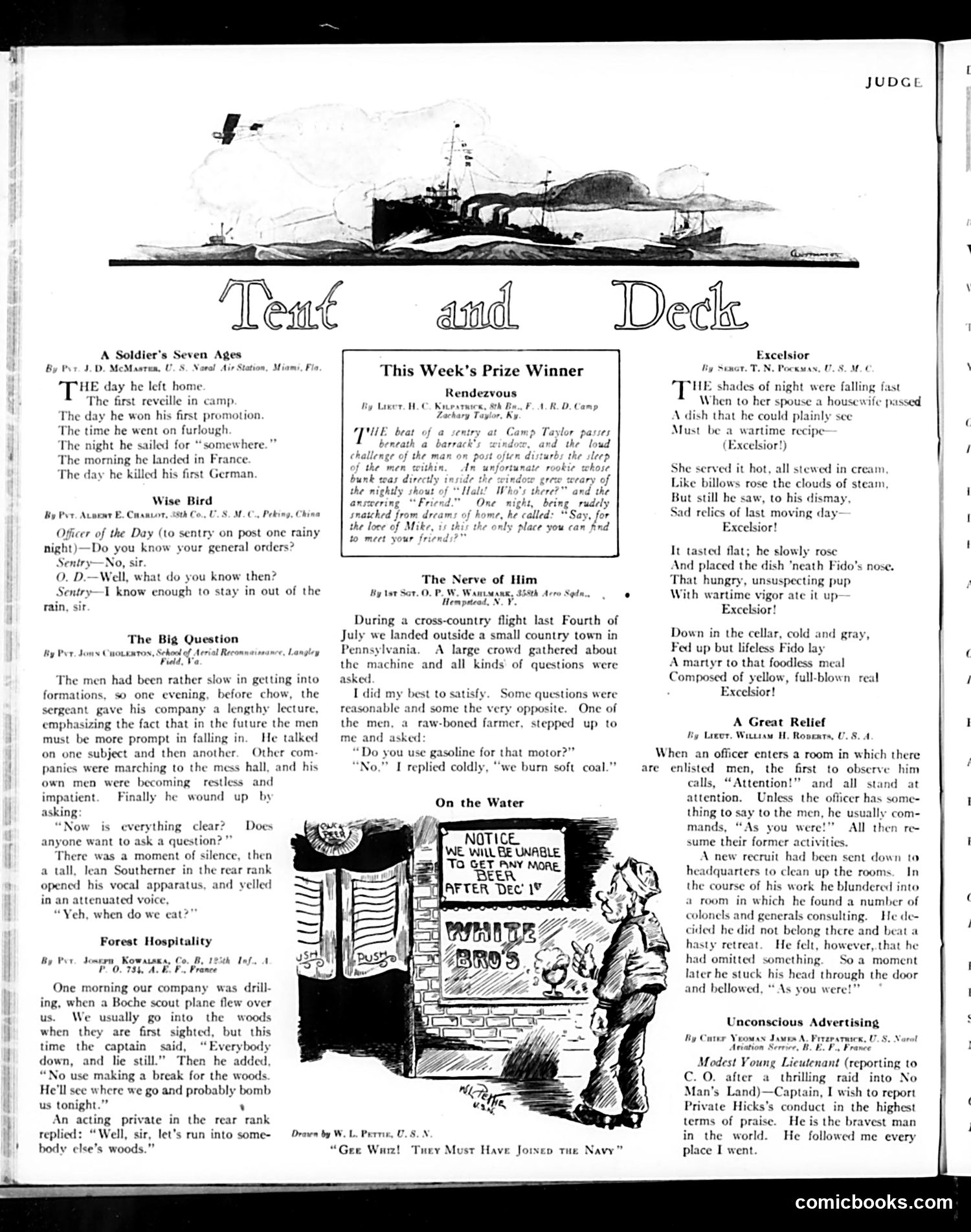
This is a **soldiers' humor page** from Judge magazine, likely WWI-era based on references to France, Boche (German) scouts, and military camps. The cartoons and verses satirize **military life's absurdities**: - **"A Soldier's Seven Ages"** parodies Shakespeare, reducing a soldier's life to seven mundane or grim moments - **"The Wise Bird"** jokes about a sentry's practical ignorance—he knows only to avoid rain, not regulations - **"The Big Question"** mocks a sergeant's lengthy lecture interrupted by a hungry soldier's blunt "when do we eat?"—the universal soldier concern - **"Forest Hospitality"** finds dark humor in combat: a soldier suggests running into *enemy* woods rather than risk bombing The **"Gee Whiz" cartoon** shows a bar announcing no more beer after December 1st—likely referencing Prohibition's approach (ratified 1919). **"Excelsior"** satirizes wartime food shortages: a housewife serves mystery leftovers so unpalatable the family dog dies eating it—dark humor about home-front deprivation. The page targets military futility, command absurdity, and civilian sacrifice with sardonic wit.
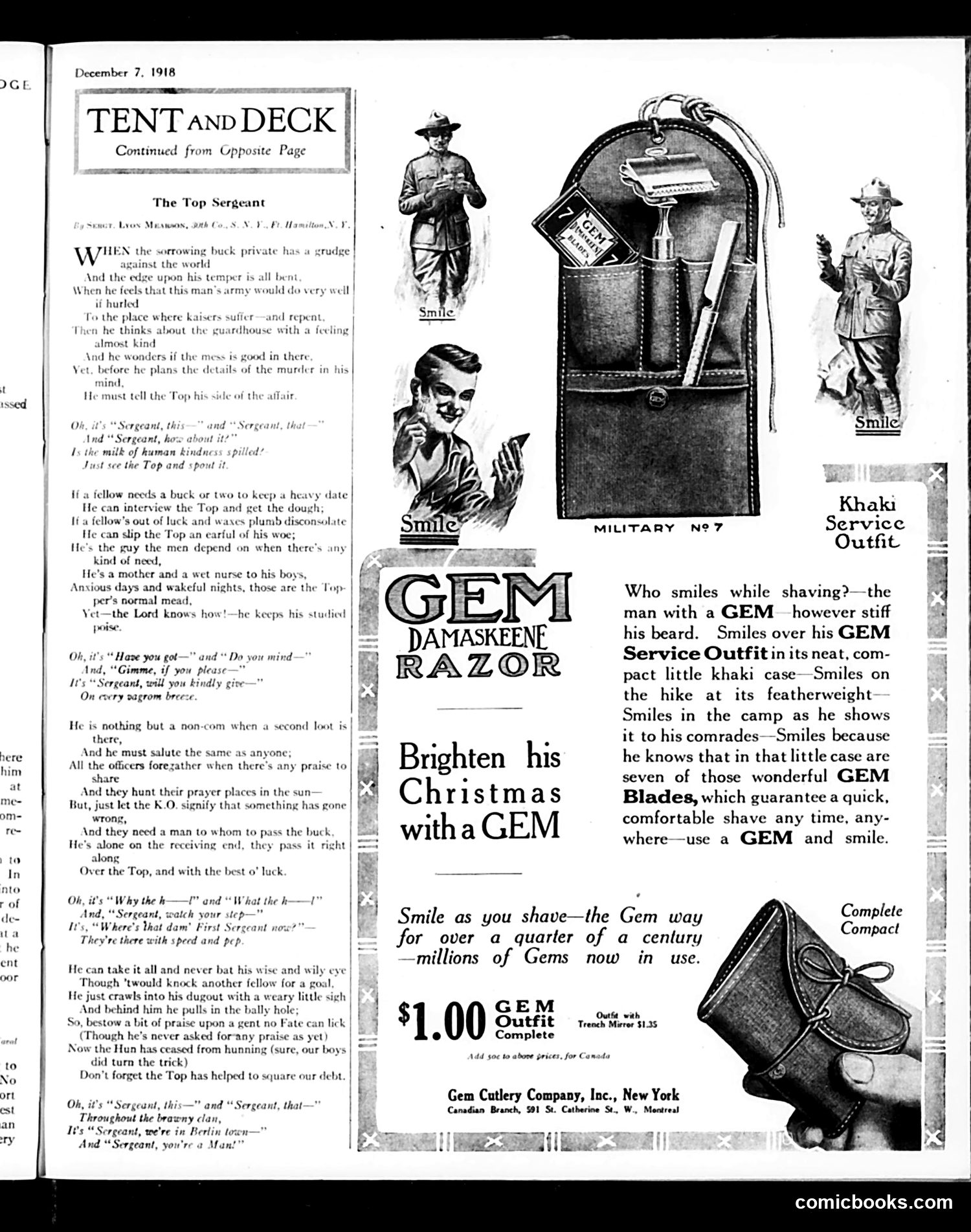
This page contains a poem titled "The Top Sergeant" celebrating the non-commissioned officer who serves as intermediary between enlisted men and officers in the U.S. Army. Published just after WWI's armistice (November 1918), it praises the Top Sergeant as indispensable—a figure who listens to soldiers' grievances, helps with personal needs, absorbs blame from officers, and ultimately deserves credit for military success. The accompanying GEM razor advertisements exploit this military context, depicting soldiers shaving in camp and linking the product to soldier comfort and morale. The "Service Outfit" appeal—showing a khaki case with seven blades—markets to servicemen directly. There is no political satire here. Rather, this is straightforward patriotic content honoring military hierarchy and NCO leadership, combined with commercial advertising capitalizing on American soldiers' prominence in public consciousness at war's end.
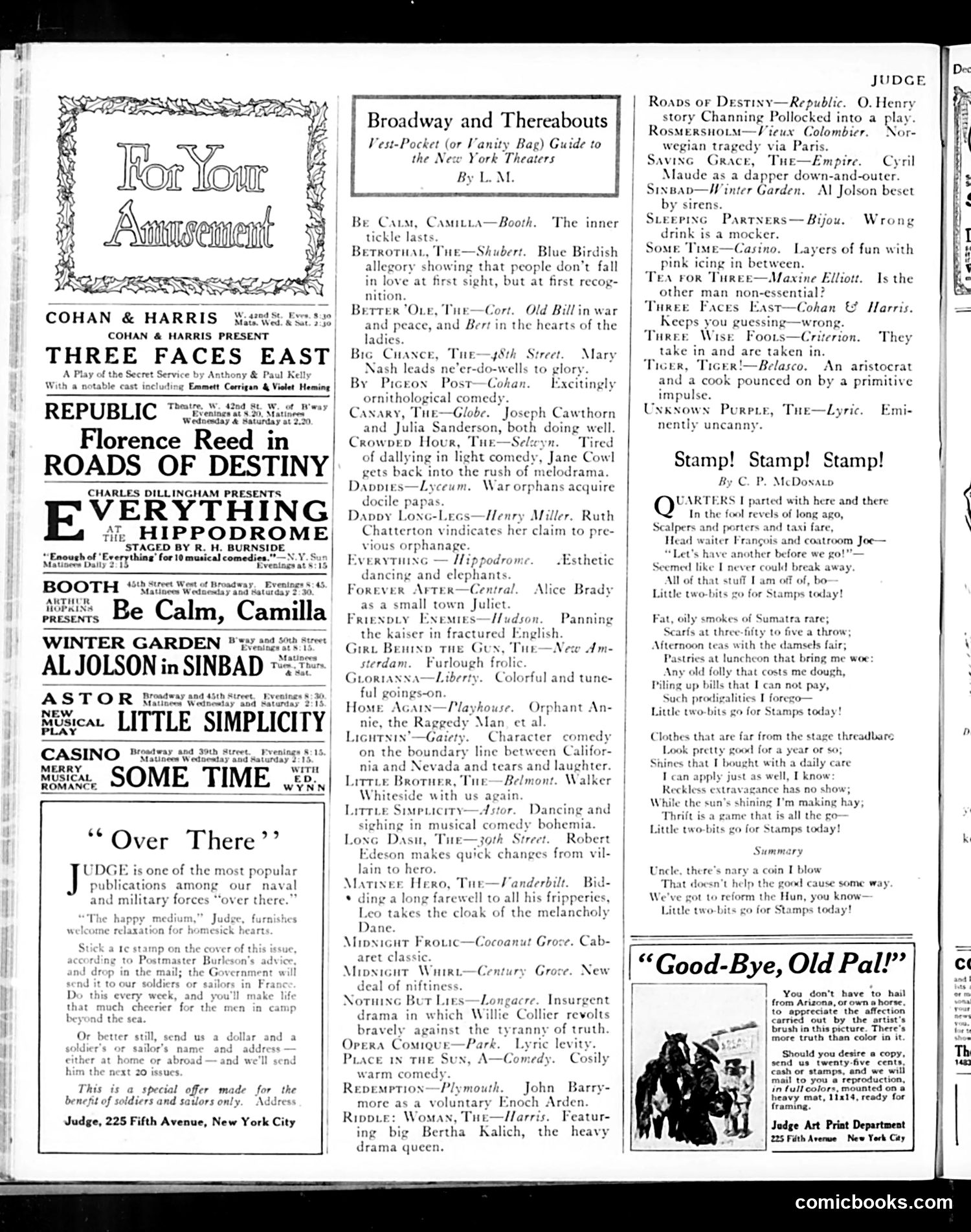
This page is primarily **theatrical advertising and reviews**, not political satire. It's a "Broadway and Thereabouts" guide listing New York theater productions, likely from WWI era (references to "soldiers and sailors," orphans from war). The only non-advertising content is a small box titled **"Over There,"** referencing the popular WWI song. It's a fundraising appeal: *Judge* magazine is collecting donations for soldiers abroad, with a note that contributions can be mailed to aid "homesick hearts." The language ("the happy medium") emphasizes patriotic duty to support troops. The reviews mock contemporary plays with quick witticisms—e.g., "Three Faces East: Keeps you guessing—wrong." **There is no identifiable political cartoon on this page.** It's essentially a theater-listing publication with patriotic war-relief messaging woven throughout, typical of American magazines during WWI.
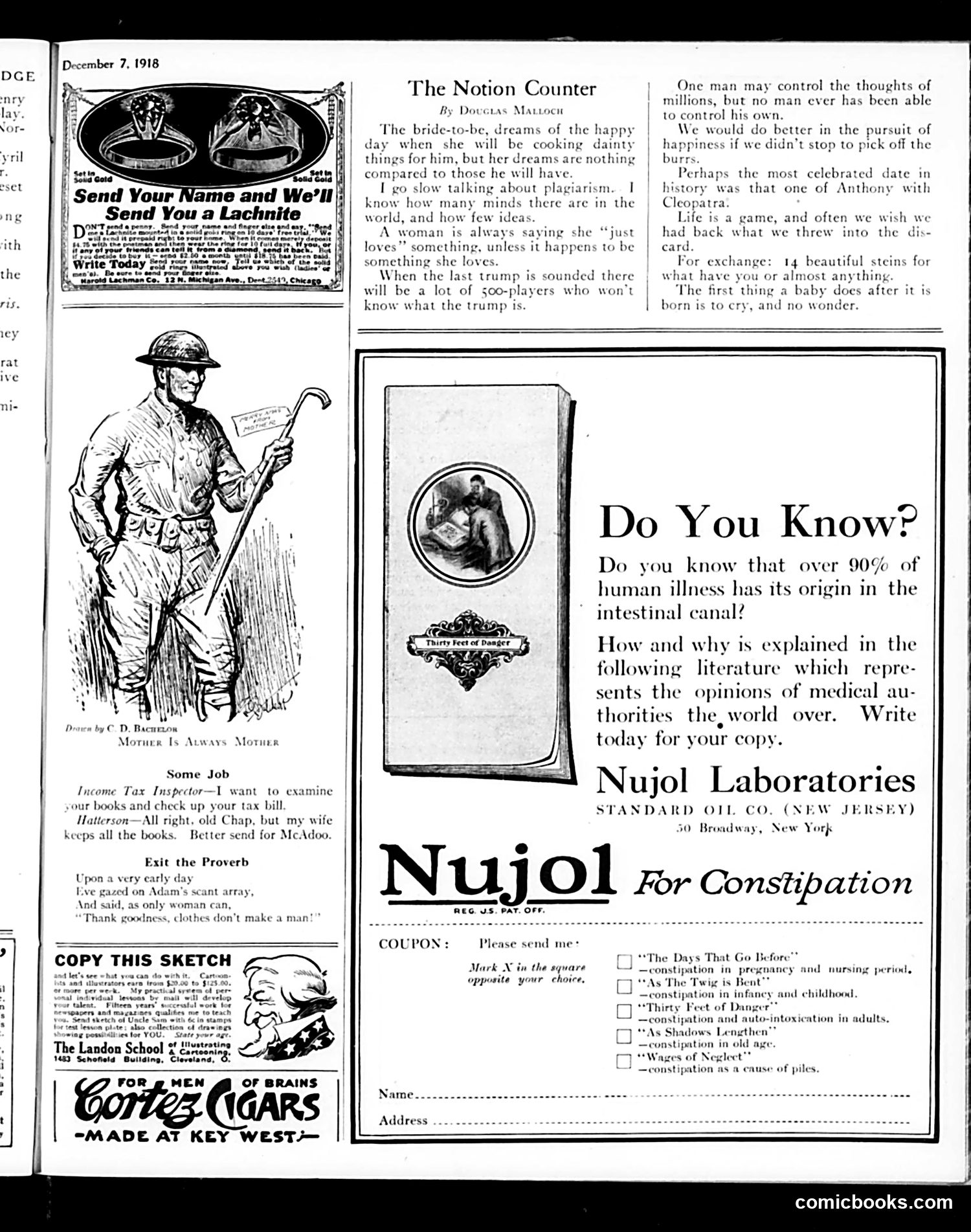
This page is primarily **advertising with minor satirical content**. The main items are: **"The Notion Counter"** is a brief humor column offering aphorisms about marriage, plagiarism, and card games—typical lightweight satirical observations common to the magazine. **Notable advertisements:** - A bride-focused product ad (top) - Nujol laxative (center/bottom), a Standard Oil constipation remedy with a medical coupon - Coffez Cigars and Landon School of Illustrating ads **Historical context:** The Nujol ad is notable as a period example of patent medicine marketing, claiming to cure 90% of human illness through intestinal treatment—a common (and largely bogus) medical claim of the 1910s-20s era. The McAdoo reference in "Some Job" likely alludes to William G. McAdoo, Treasury Secretary under Wilson, possibly a joke about tax collection. The page reflects post-WWI American consumer culture and the prevalence of medicinal pseudoscience advertising in mainstream publications.
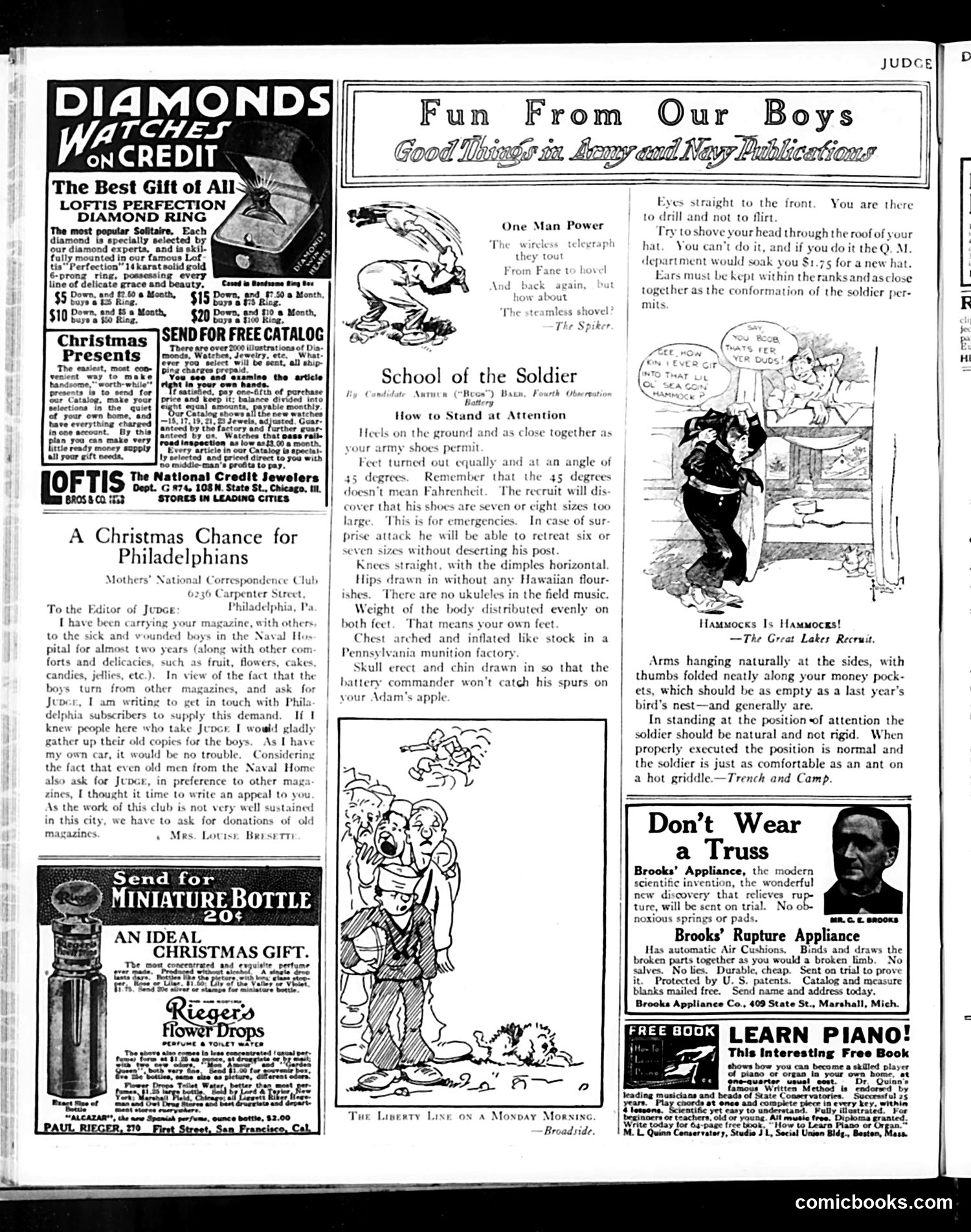
This page from *Judge* magazine features satirical military instruction mixed with advertisements and a reader letter. The main content is "School of the Soldier," a humorous guide to proper military posture. The satire mocks both rigid military drill and the awkwardness of recruits transitioning to army life. Jokes include soldiers' shoes being "seven or eight sizes too large" and absurd instructions like "Try to shove your head through the roof of your hat" (which would cost $1.75 to replace). The humor plays on the physical comedy of young men learning regimented behavior. The accompanying cartoons illustrate slapstick scenarios of soldiers struggling with basic posture and discipline, reinforcing the theme that military training is simultaneously rigorous and ridiculous. A separate letter from a Philadelphia woman requests donated old magazines for wounded Navy Hospital boys, showing wartime charitable efforts. The advertisements (diamonds on credit, perfume, piano lessons) are typical period commercial content.
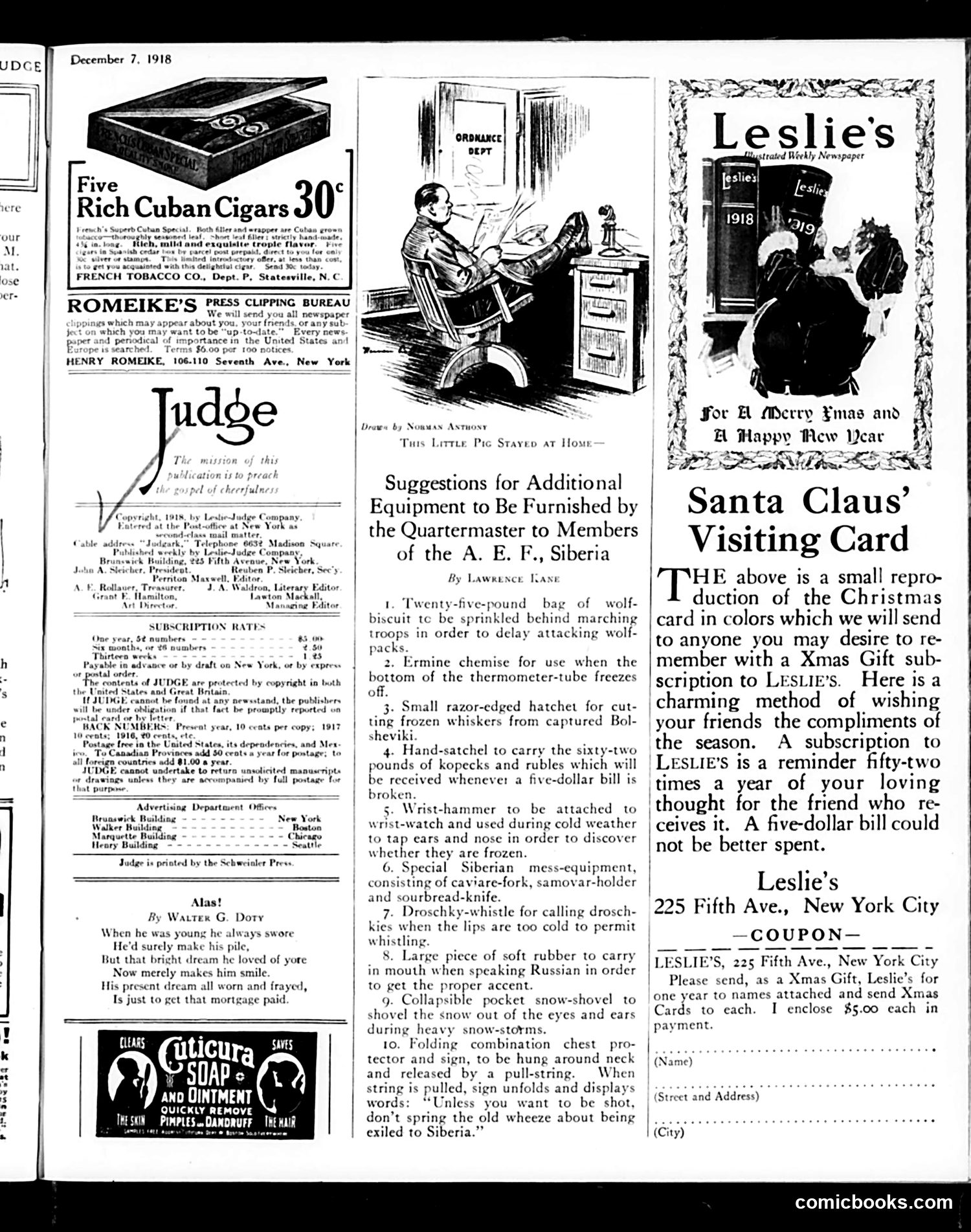
The central cartoon by Norman Anthony satirizes American military involvement in the Russian Civil War. In December 1918, U.S. troops were deployed to Siberia ostensibly to support anti-Bolshevik forces. The cartoon depicts a soldier relaxing at his desk labeled "Ordnance Dept," imagining absurd equipment needs for this frozen, chaotic deployment. The humor is biting: Lawrence Kane's accompanying list mocks the impossible conditions soldiers faced—wolves, extreme cold, hostile "Bolsheviki," worthless local currency, language barriers, and snow so severe it blinds. Items like "droschky-whistle" (a Russian carriage) and the final sign ("Unless you want to be shot, don't spring the old wheeze about being exiled to Siberia") satirize both the nightmare logistics and gallows humor troops used to cope. The joke: America sent soldiers to fight Bolshevism in one of Earth's most inhospitable places with inadequate support. Judge magazine, conservative and anti-communist, still mocked this military folly as impractical and darkly comic.
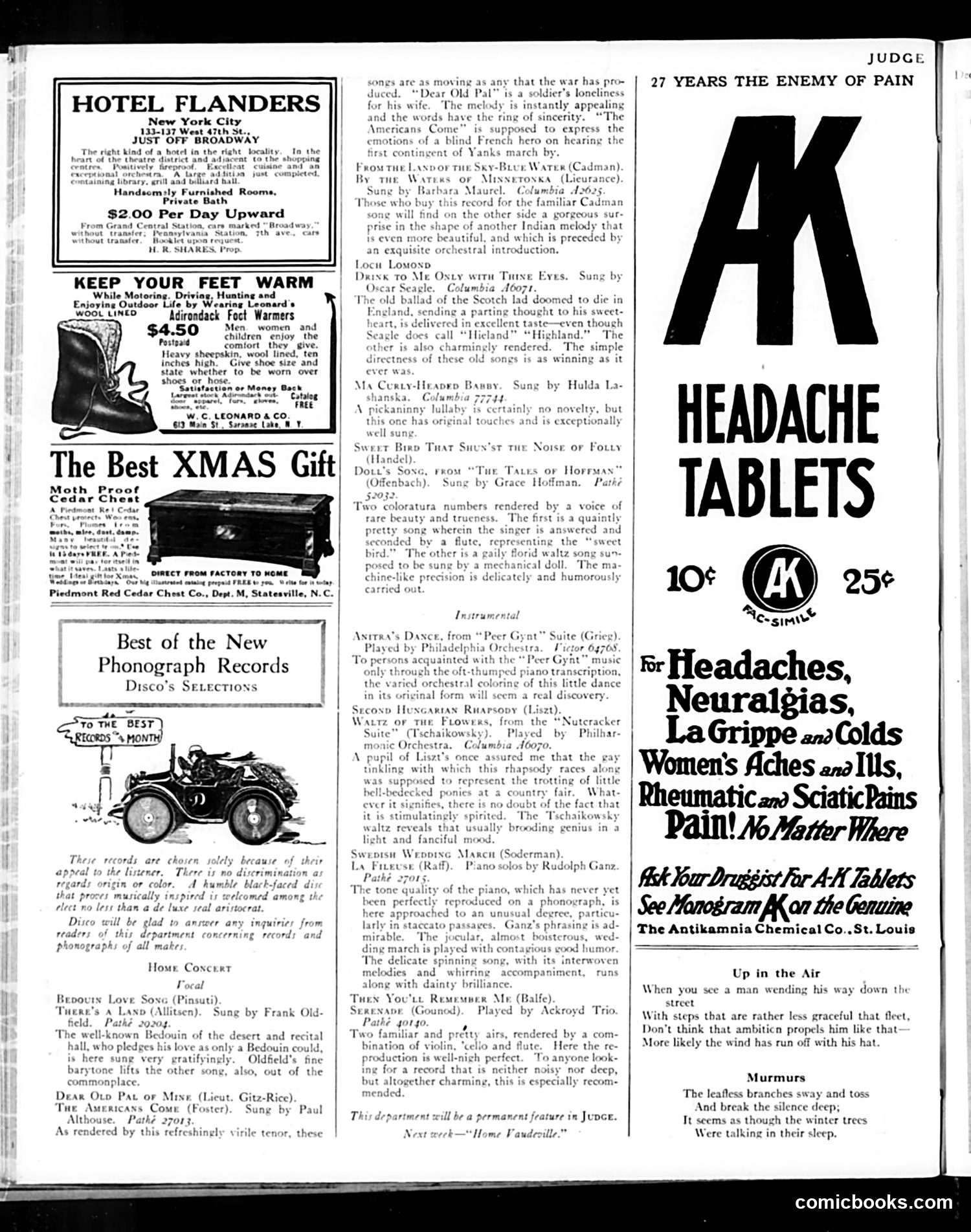
This page is primarily **advertisements and filler content** rather than political satire. The dominant feature is a large **AK Headache Tablets advertisement** (center-right), claiming 27 years as "the enemy of pain" and promoting treatment for headaches, neuralgia, colds, and rheumatic pain. Surrounding this are typical period ads: a hotel listing, wool-lined foot warmers, a moth-proof cedar chest, and phonograph record selections (including patriotic titles like "The American Come" and songs with WWI themes). The page includes two short humorous poems—"Up in the Air" (about wind blowing off a man's hat) and "Murmurs" (about winter trees)—but these are generic observations without political content. **No identifiable political cartoons appear.** This is a standard commercial page from Judge magazine, mixing advertisements with light verse filler.
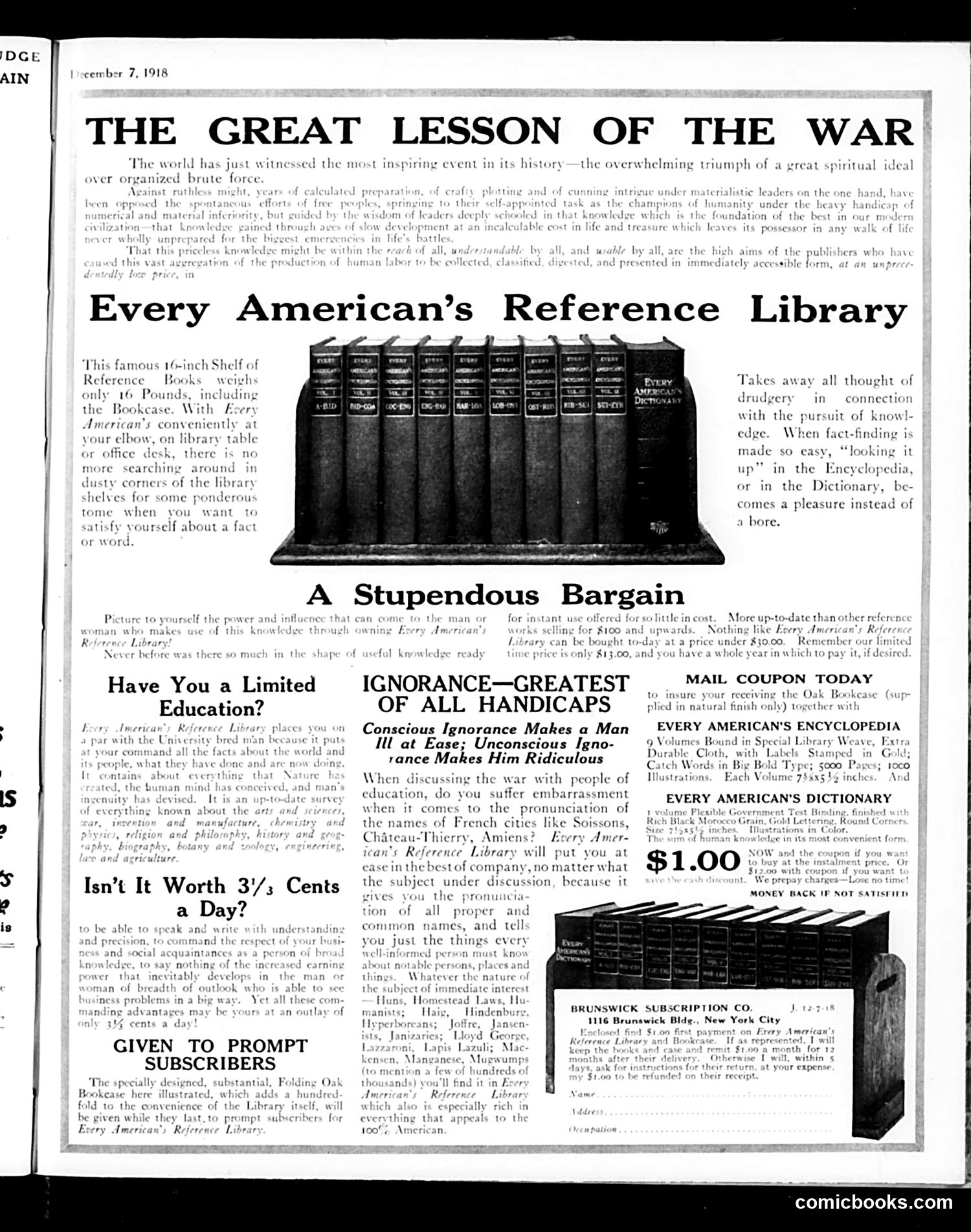
This page is primarily **advertising**, not political satire. It's a December 7, 1918 advertisement for "Every American's Reference Library"—a 16-volume encyclopedia set. The satirical framing uses the **recent WWI armistice** (November 1918) as context. The headline "The Great Lesson of the War" claims the conflict proved the triumph of "spiritual ideal" over "brute force." This patriotic opening then pivots to selling reference books by arguing that ignorance is a handicap—Americans need knowledge to participate intelligently in civic life (discussing French place names, pronunciations, etc.). The implicit satire: America's "lesson" from winning the war should be self-improvement through education. The ads mock "conscious ignorance" (embarrassing yourself discussing French cities) and promise that owning this encyclopedia set at only $1.00 monthly removes such social embarrassment. It's essentially leveraging postwar American optimism and civic pride to market educational products—practical advertising dressed in patriotic language.
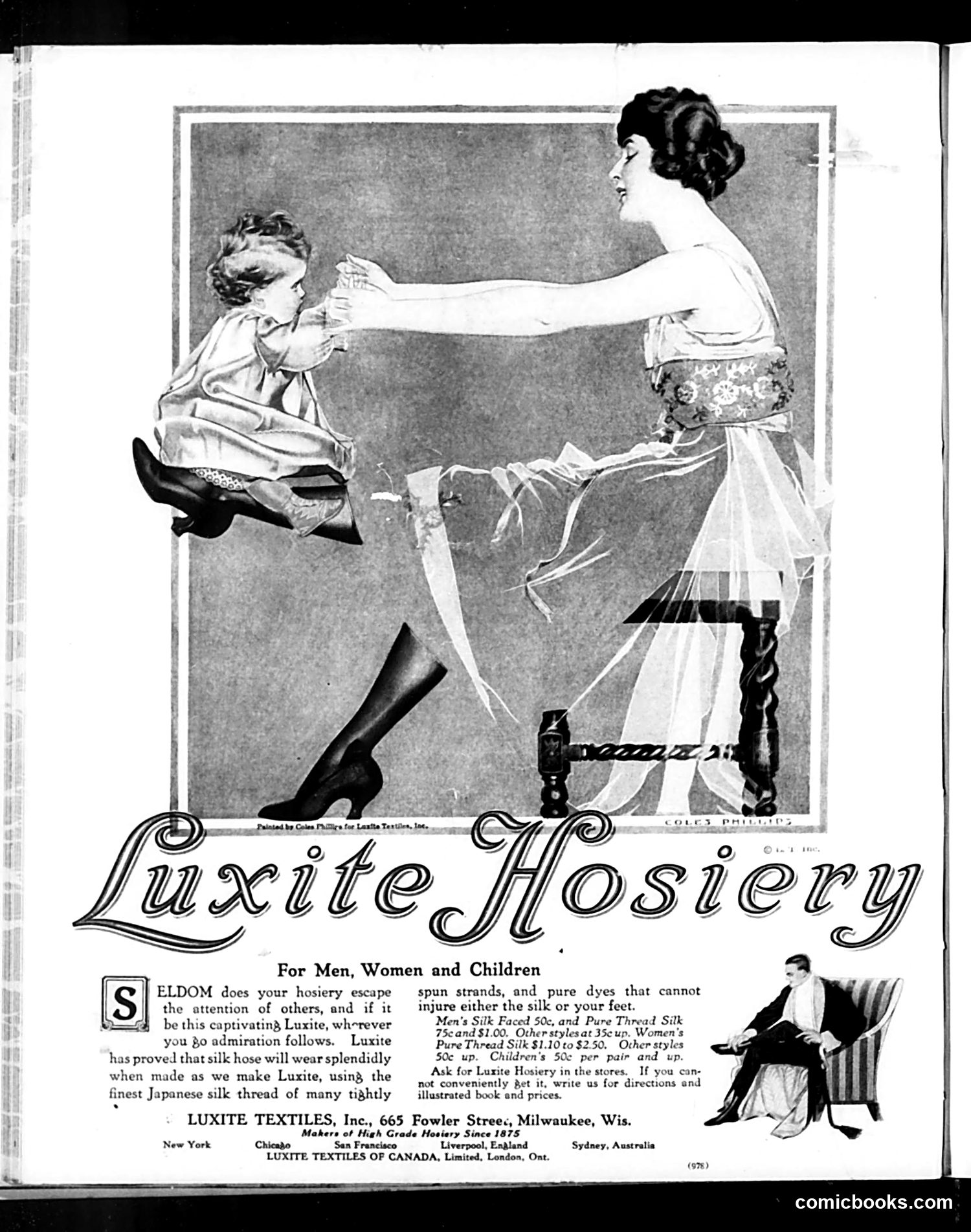
This page is **primarily an advertisement**, not political satire. It's a Luxite Hosiery ad from Judge magazine. The illustration shows a woman dressing a child, meant to convey elegance and care—suggesting that Luxite hosiery is refined enough for discerning families. The accompanying male figure (right) appears to be a satisfied customer or represents the approval hosiery receives. The text emphasizes quality: Japanese silk thread, pure dyes, durability, and availability in multiple price points "for Men, Women and Children." The phrase "admiration follows" plays on vanity—a common advertising appeal of the era. There is **no political satire or caricature** visible here. This is straightforward early 20th-century product marketing using aspirational imagery and claims of superior materials to justify premium pricing for silk hosiery.