
Judge, 1918-12-07 · page 22 of 32
Judge — December 7, 1918 — page 22: what you’re looking at
What you’re looking at
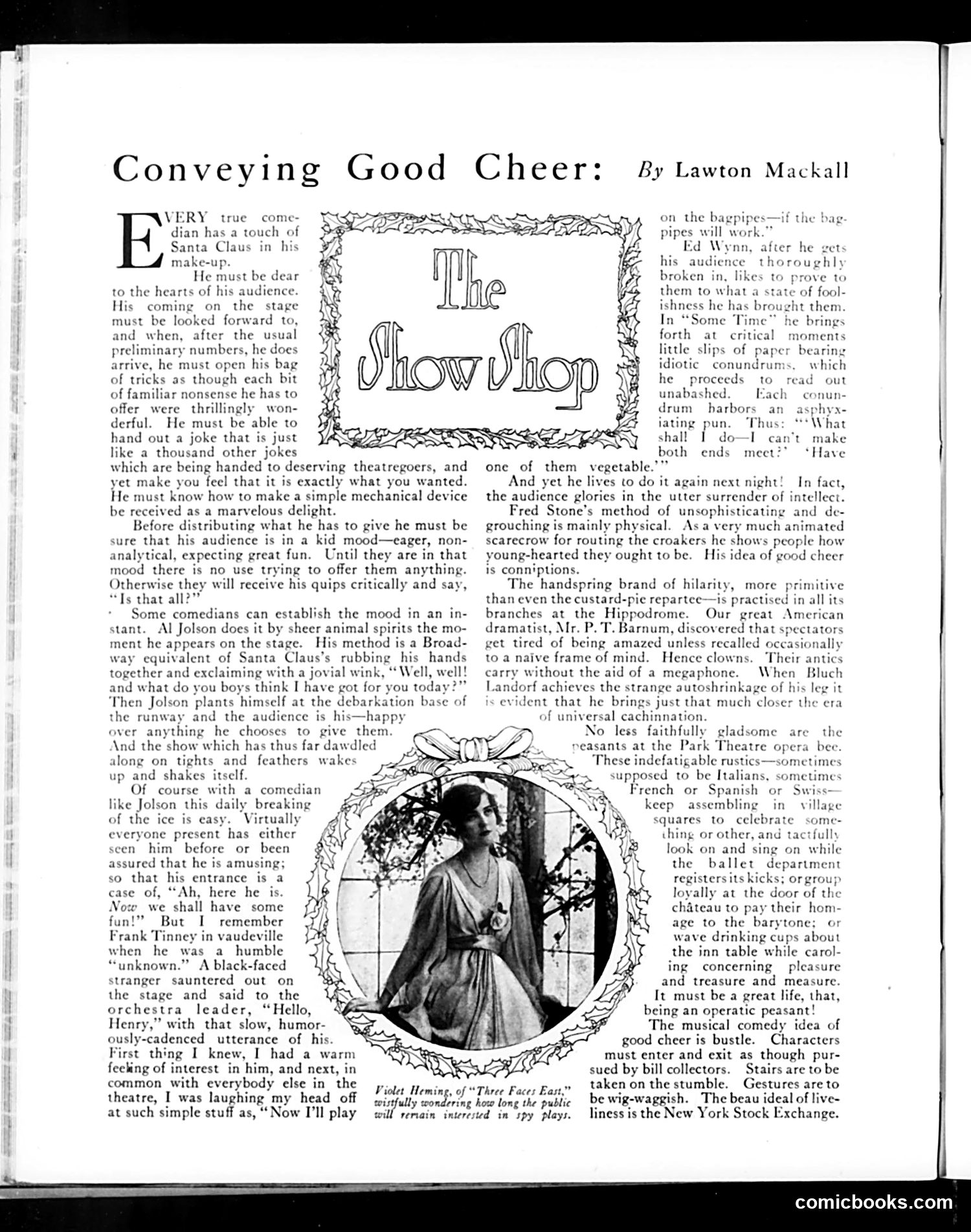
This article by Lawton Mackall analyzes how comedians create audience delight. The piece discusses specific performers—Al Jolson, Ed Wynn, Frank Tinney, and Fred Stone—explaining their techniques for establishing a "kid mood" of receptivity before delivering jokes. The central argument: comedians must function like Santa Claus, creating anticipation and goodwill so audiences embrace even familiar material as fresh. Jolson achieves this through "animal spirits"; Wynn uses absurdist non-sequiturs on paper; Stone uses physical comedy; Tinney created warmth simply by saying "Hello, Henry." The article emphasizes that comedians must understand audience psychology—that intellectual resistance must be suspended before humor lands. The featured illustration shows a woman in classical dress, likely representing theatrical entertainment or muse figures common to Judge magazine's visual style.
📄 Transcribed text from this page (OCR, searchable)
Machine-transcribed from the original scan — historical spelling and the odd misread are preserved.
Conveying Good Cheer: VERY true come- dian has a touch Santa Claus in make-up. He must be dear to the hearts of his audience. His coming on the stage must be looked forward to, and when, after the usual preliminary numbers, he does arrive, he must open bag of tricks as though each bit of familiar nonsense he has to offer were thrillingly won- derful. He must be able to hand out a joke that is just like a thousand other jokes which are being handed to deserving theatregoers, and yet make you feel that it is exactly what you wanted. He must know how to make a simple mechanical device be received as a marvelous delight. Before distributing what he has to give he must be sure that his audience is in a kid mood—eager, non- analytical, expecting great fun. Until they are in that mood there is no use trying to offer them anything. Otherwise they will receive his quips critically and say, “Is that all? Some comedians can establish the mood in an in- stant. Al Jolson does it by sheer animal spirits the mo- ment he appears on the stage. His method is a Broad- way equivalent of Santa Claus’s rubbing his hands together and exclaiming with a jovial wink, ‘* Well, well! and what do you boys think I have got for you today?” Then Jolson plants himself at the debarkation base of the runway and the audience is his—happy over anything he chooses to give them. And the show which has thus far dawdled along on tights and feathers wakes up and shakes itself. Of course with a comedian like Jolson this daily breaking of the ice is easy. Virtually everyone present has either seen him before or been assured that he is amusing; so that his entrance is a case of, “Ah, here he is. Now we shall have some fun! But I remember Frank Tinney in vaudeville when he was a humble “unknown.” A black-faced stranger sauntered out on the stage and said to the orchestra leader, “Hello, Henry,” with that slow, humor- cadenced utterance of his. st thing I knew, I had a warm feeking of interest in him, and next, in common with everybody else in the Violet Heming, of “Three Faces Ea theatre, I was laughing my head off sistfulty onde how long the public be wig-waggish. The beau ideal of live- By Lawton Mackall on the bagpipes—if the bag. pipes will work.” Ed Wynn, after he his audience thorous broken in, likes to them to what a st In “Some © brings forth at critical moments little slips of paper bearing idiotic conur which he proceeds i out unabashed. conun- drum harbors an asphy iating pun. Thus ‘What shall I do—I can’t make both ends mect?* ‘Have one of them vegetable.’” And yet he lives to do it again next night! In fact, the audience glories in the utter surrender of intellect. Fred Stone’s method of unsophisticating and de- grouching is mainly physical. Asa very much animated scarecrow for routing the croakers he shows people how young-hearted they ought to be. His idea of good cheer is conniptions. The handspring brand of hilarity, more primitive than even the custard-pie repartee—is practised in all its branches at the Hippodrome. Our great American dramatist, Mr. P. T. Barnum, discovered that spectators get tired of being amazed unless recalled occasionally to a naive frame of mind. Hence clowns. Their antics carry without the aid of a megaphone. When Bluch Landorf achieves the strange autoshrinkage of his leg evident that he brings just that much closer the era of universal cachinnation. No less faithfully gladsome are the peasants at the Park Theatre opera bee. These indefatigable rustics—sometimes supposed to be Italians, sometimes French or Spanish or Swiss- keep assembling in village squares to celebrate some- thing or other, and tactfully look on and sing on while the ballet department registers its kicks; orgroup loyally at the door of the cau to pay their hom- age to the barytone; or wave drinking cups about the inn table while carol- ing concerning pleasure and treasure and measure. It must be a great life, that, being an operatic peasant! The musical comedy idea of good cheer is bustle. Characters must enter and exit as though pur- sued by bill collectors. Stairs are to be | taken on the stumble. Gestures are to i at such simple stuff as, ‘Now I'll play will remain interested in spy plays. liness is the New York Stock Exchange. comicbooks.com