
A complete issue · 32 pages · 1918
Judge — November 23, 1918
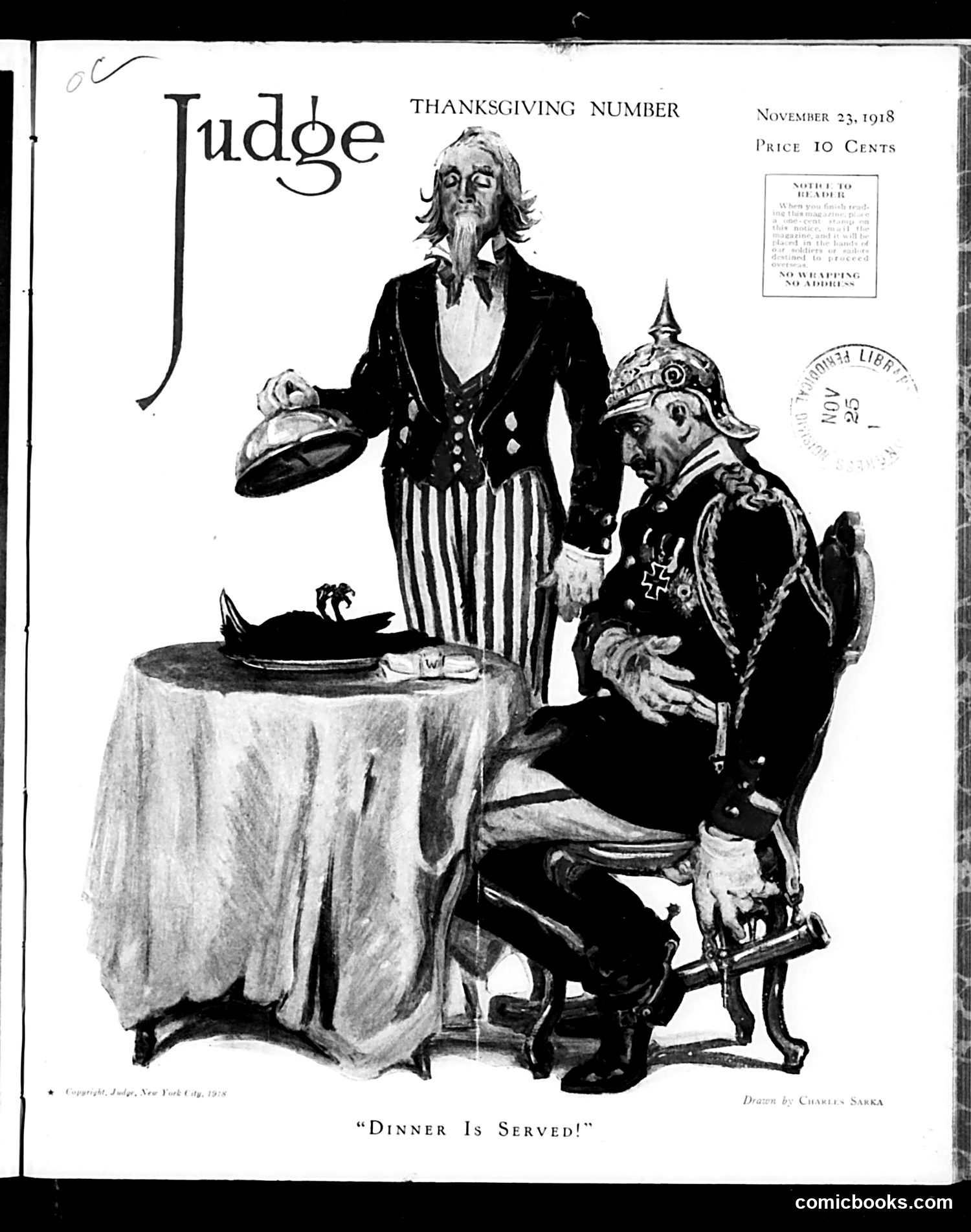
This cartoon, titled "Dinner Is Served!", appears to satirize post-World War I diplomacy. The tall figure in striped pants and formal coat represents Uncle Sam (America), serving dinner to a seated military officer wearing a German-style spiked helmet (Pickelhaube), likely representing Germany or German leadership. The imagery suggests America is "serving" terms or consequences to defeated Germany following WWI's armistice (signed November 11, 1918—just days before this issue). The waiter-to-diner dynamic inverts power relations: though Germany lost militarily, the cartoon may mock how peace negotiations would unfold, with America positioned as the one controlling what's "served" to the vanquished nation.
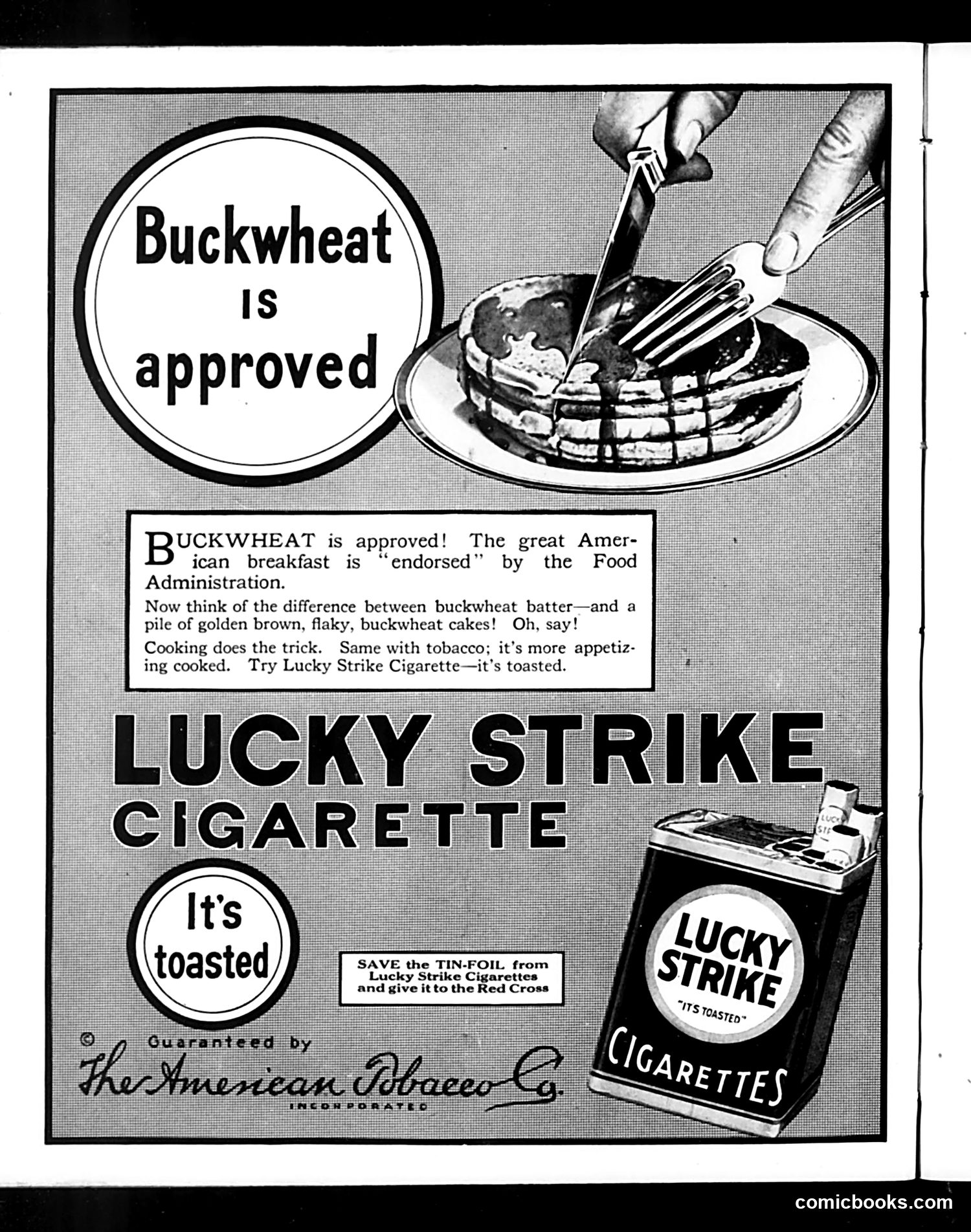
This is primarily a **Lucky Strike cigarette advertisement**, not political satire. The ad cleverly exploits government approval to market cigarettes. The "Buckwheat is approved" messaging refers to **Food Administration endorsement** of buckwheat pancakes during wartime rationing (likely WWI era, when food was strictly regulated). The ad draws a humorous parallel: just as the government approved buckwheat as a nutritious breakfast, Lucky Strike cigarettes are "toasted" and thus supposedly endorsed as quality. The comparison is absurd by modern standards—equating food safety approval with cigarette quality—but represents early **tobacco industry marketing tactics** exploiting government credibility. The sidebar mentions saving tin-foil for the Red Cross, dating this to wartime. Modern readers should recognize this as a **now-banned advertising practice**: using false health/government associations to sell cigarettes.
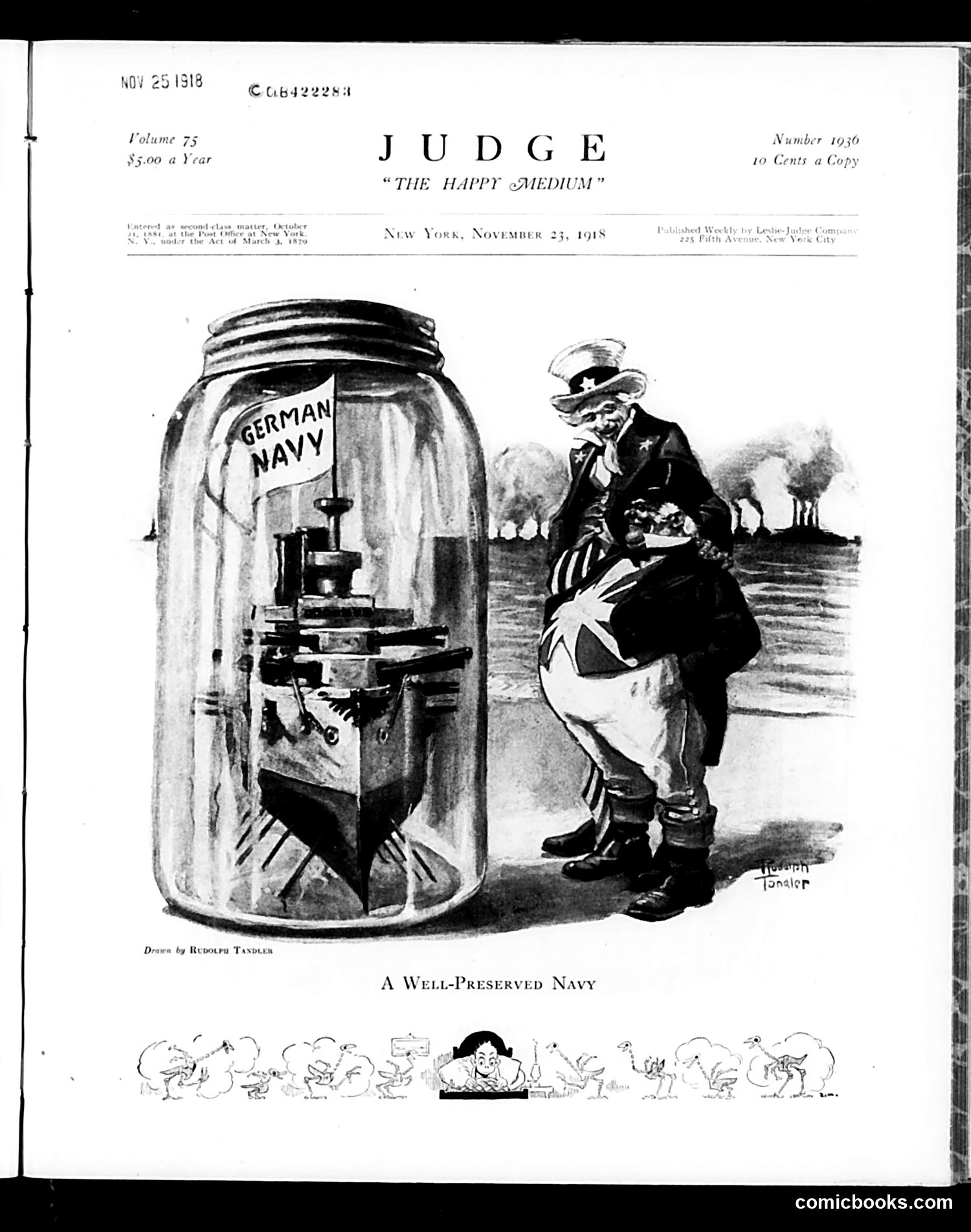
This November 1918 Judge magazine cartoon satirizes Germany's naval capacity during WWI's final weeks. The drawing shows a caricatured German military figure proudly displaying the German Navy—depicted as a single warship preserved in a jar, like a specimen in formaldehyde. The joke targets Germany's drastically diminished fleet after years of naval warfare and the British blockade. By reducing the once-formidable German Navy to a bottled relic, the cartoonist mocks Germany's military decline as the war neared its conclusion. The figure's proud posture contrasts sharply with the pathetic reality of what remains—emphasizing the complete collapse of German naval power and, by extension, Germany's overall military defeat.
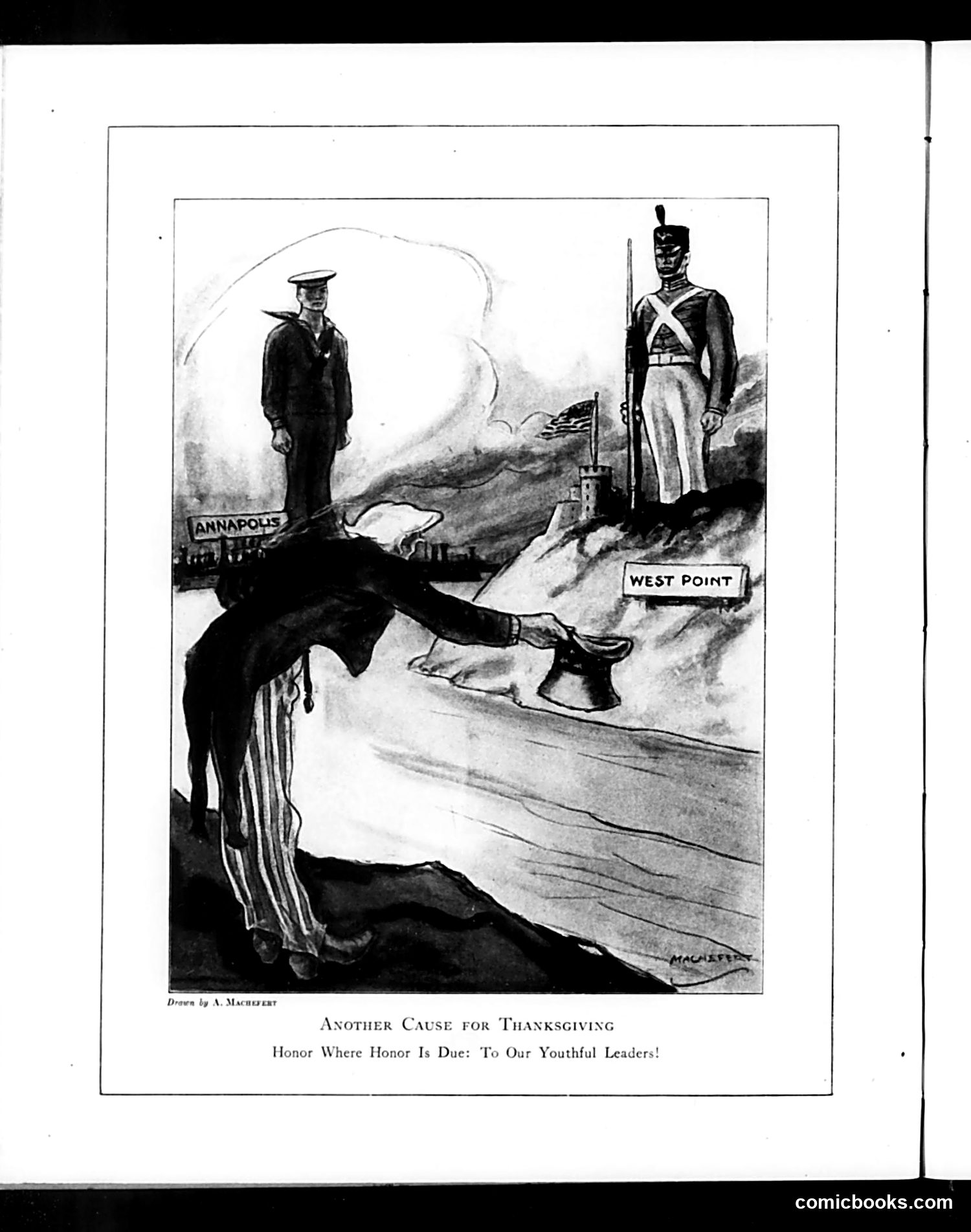
This political cartoon depicts a naval officer (labeled "Annapolis") and a military officer at West Point standing guard over a fallen, robed female figure representing America or Liberty. The caption reads "Honor Where Honor Is Due: To Our Youthful Leaders!" The satire appears to commemorate military leadership during a period of national crisis—likely World War I era, given the uniform styles and patriotic tone. The cartoon praises the nation's young military academy graduates (from Annapolis Naval Academy and West Point Military Academy) as saviors protecting the nation during turbulent times. The fallen, prostrate figure suggests America faced serious threat or hardship that these "youthful leaders" helped overcome, warranting Thanksgiving gratitude for their service and leadership.
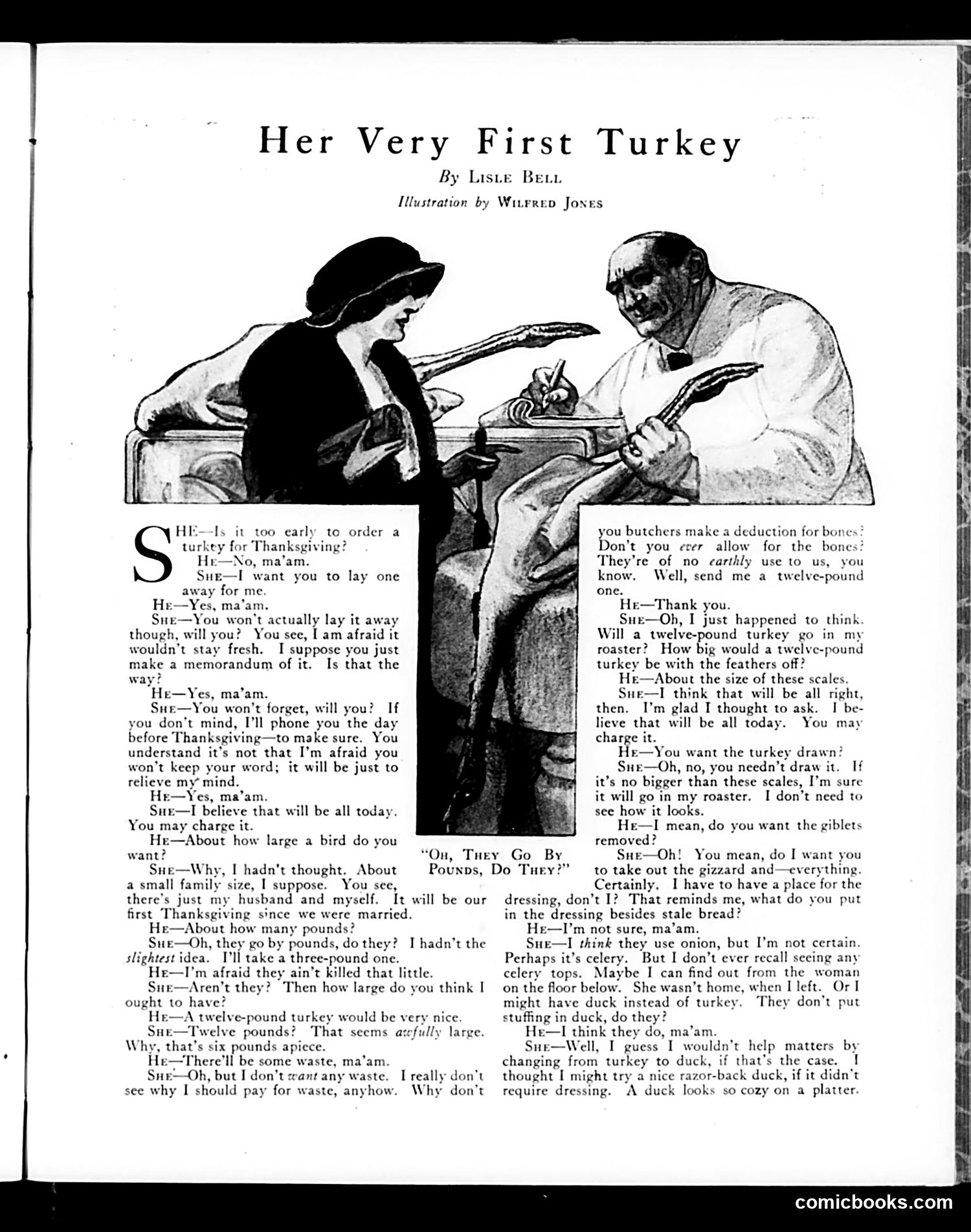
This is a humorous domestic dialogue between a newlywed wife and butcher about purchasing her first turkey for Thanksgiving. The satire centers on the wife's inexperience with household management and cooking. She lacks basic knowledge about turkey size, preparation, and whether to remove giblets or stuffing before roasting. The butcher patiently answers her naive questions about bone deductions, bird weight, and even suggests substituting duck instead. The joke reflects early 20th-century gender expectations: a young bride is comically ignorant about domestic duties despite marriage. The illustration shows the butcher's bemused expression as he indulges her questions, emphasizing the humor of her complete culinary incompetence. This gentle satire mocks both newlyweds' adjustment to household responsibilities.
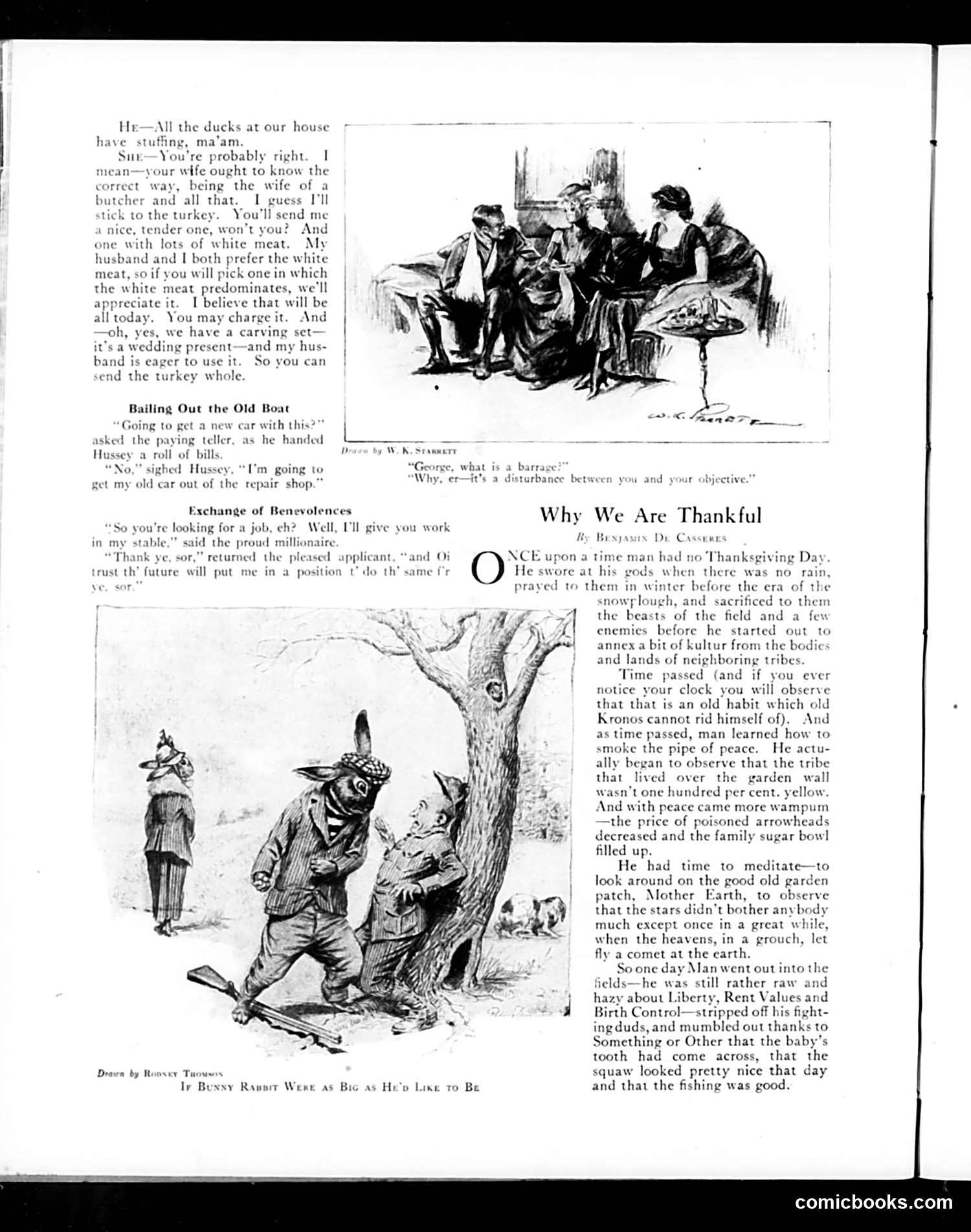
The page contains three distinct sections: 1. **"Bailing Out the Old Boat"** - A brief joke about someone named Hussey taking his car to a repair shop, establishing the vehicle as a metaphor for financial troubles needing repair. 2. **"Exchange of Benevolences"** - A cartoon showing a millionaire offering job work to an applicant in his stable, with the applicant grateful for any position. It satirizes the power imbalance between wealthy employers and desperate job-seekers. 3. **"Why We Are Thankful"** by Benjamin De Casseres - An essay-length piece reflecting on humanity's progress from primitive times to modern civilization, discussing peace, agriculture, and gratitude. It's philosophical rather than satirical, celebrating human advancement. The page mixes humor about economic hardship with earnest social commentary typical of Judge's approach to contemporary issues.
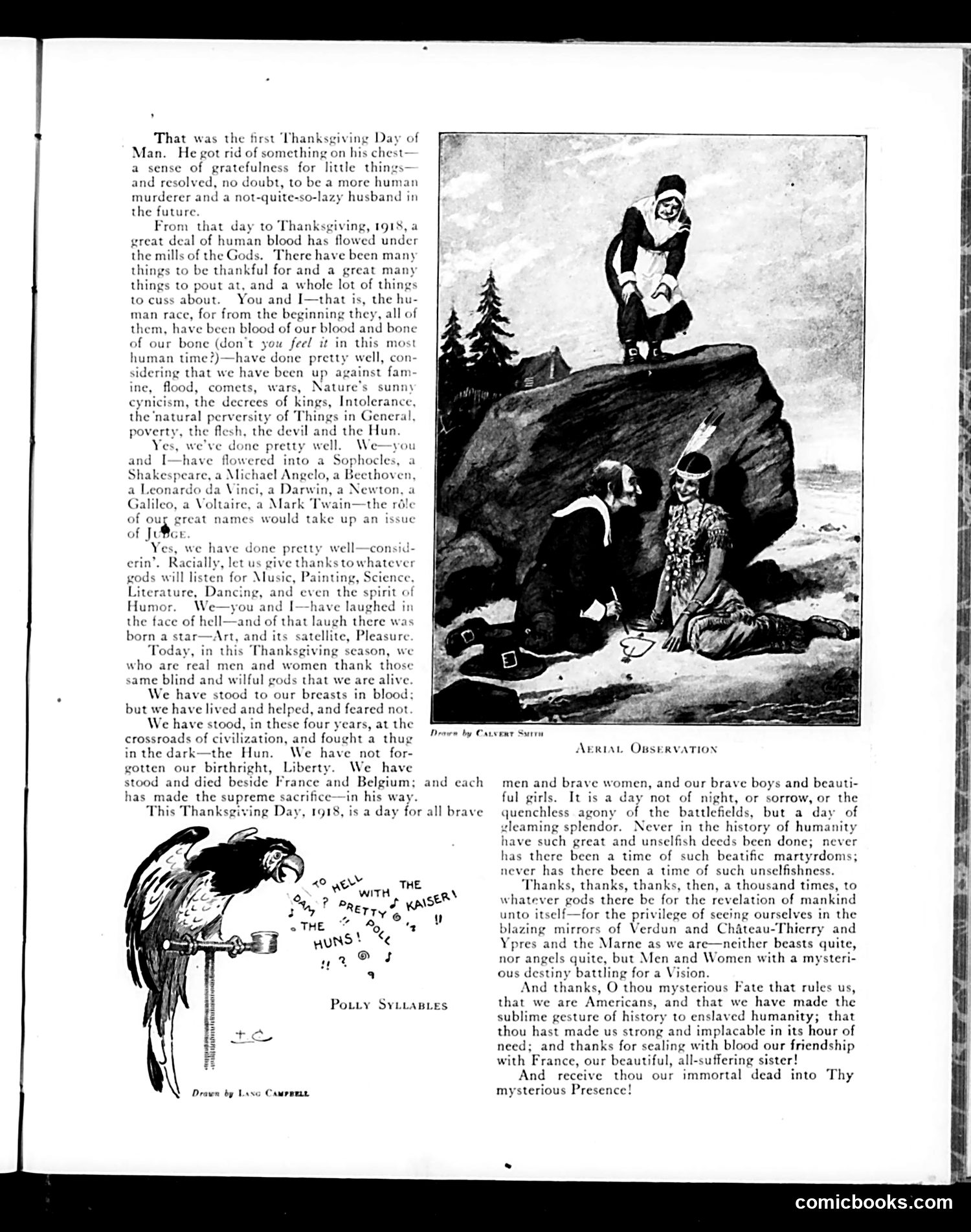
This Thanksgiving 1918 editorial celebrates Allied victory in World War I, published just after the armistice. The text presents a grandiose meditation on human achievement despite suffering, listing great artists (Shakespeare, da Vinci, Newton) as proof of mankind's nobility. The **"Aerial Observation"** cartoon (top right) depicts two soldiers observing enemy positions from a hilltop—a WWI military practice. The **"Polly Syllables"** cartoon (bottom left) appears to be a satirical parrot reciting phrases about the Kaiser, likely mocking enemy propaganda or jingoistic rhetoric. The main text's satire is subtle: it ironically praises humanity's resilience while acknowledging we've fought "a thug in the dark—the Hun" (Germany), stood "to our breasts in blood," and celebrates American sacrifice alongside France and Belgium. The piece conflates artistic greatness with military valor, suggesting warfare itself proves human nobility—a propagandistic conflation typical of WWI-era patriotic writing.
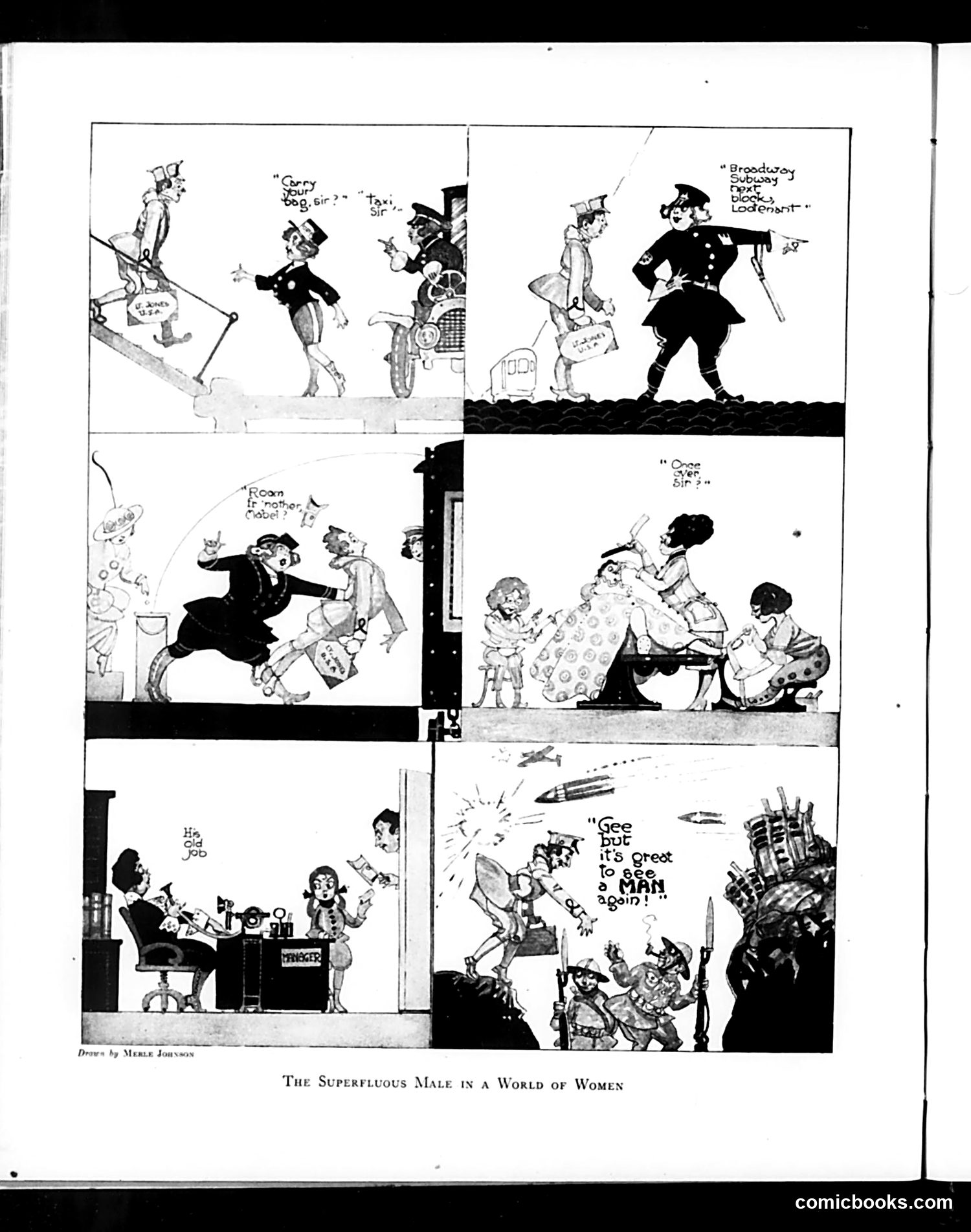
This satirical comic by Merle Johnson depicts a man repeatedly displaced and overwhelmed by women in various settings. The six panels show: 1. A man ousted from positions of authority by women in formal dress 2. A man surrounded by aggressive women in domestic/social spaces 3. A man flustered while women control the household 4. Women taking over traditionally male roles and spaces 5. A man at a desk being ignored by female workers 6. A chaotic scene where women dominate militaristically The satire comments on early 20th-century anxieties about women's expanding social and economic roles—likely referencing suffrage movements and women entering the workforce. The title and visual humor suggest contemporary male fears that female empowerment rendered men "superfluous." The exaggerated, comedic tone indicates Judge magazine's skeptical, satirical view of these social changes.
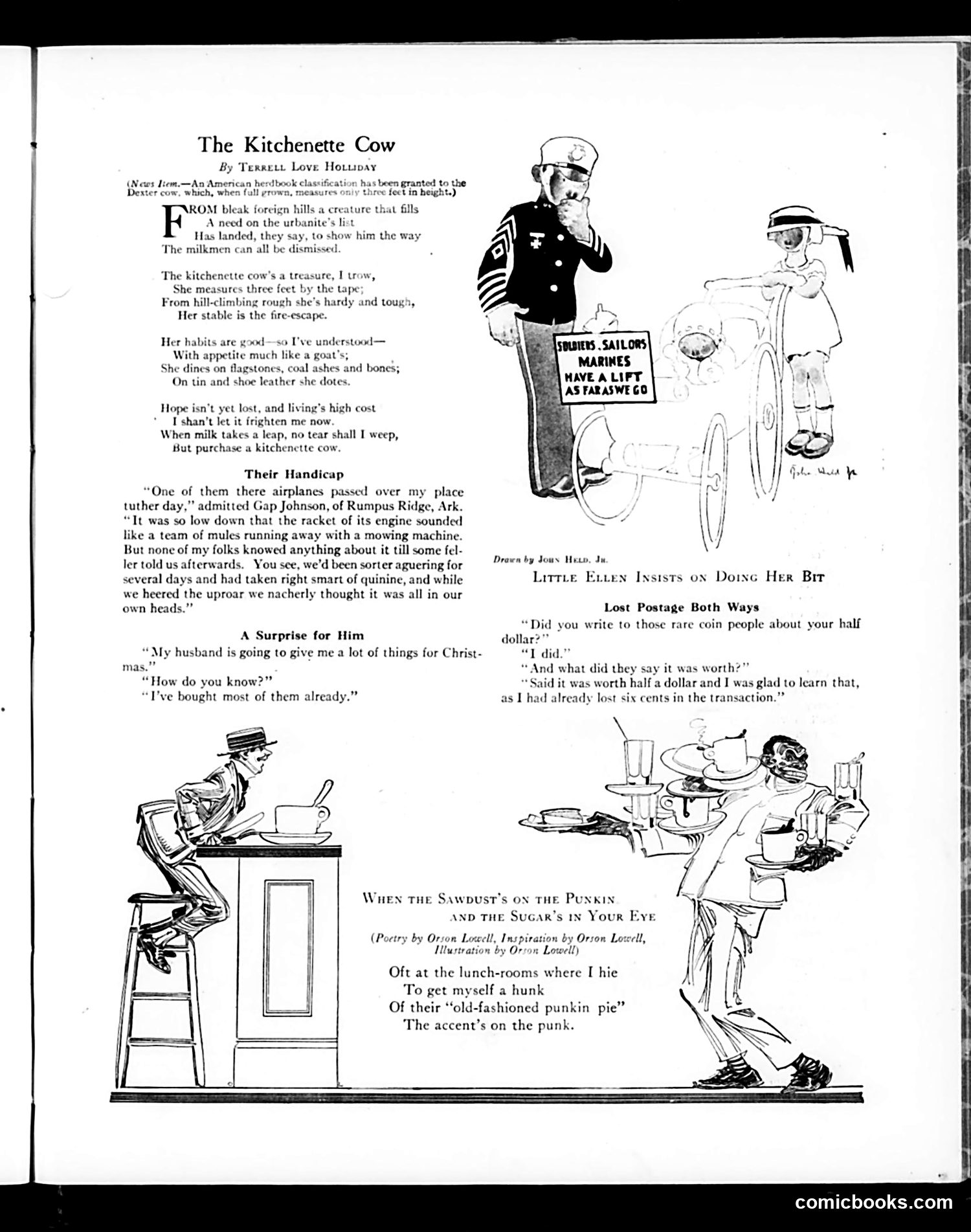
This page satirizes urban living conditions and economic anxieties of the early 20th century. "The Kitchenette Cow" mocks the cramped apartments ("kitchenettes") where poor urbanites lived, imagining a miniature cow that survives on garbage (flagstones, coal ashes, tin) and lives on a fire escape—a darkly comic solution to expensive milk and high living costs. The other pieces continue this theme: "Lost Postage Both Ways" jokes about penny-pinching when dealing with rare coin dealers; "A Surprise for Him" satirizes wives' financial control; and "When the Sawdust's on the Punkin" puns on cheap, low-quality lunch-room food disguised as traditional fare. Together, these pieces reflect Judge's satirical commentary on working-class economic struggles, inflation, and the gap between idealized American life and gritty urban reality.
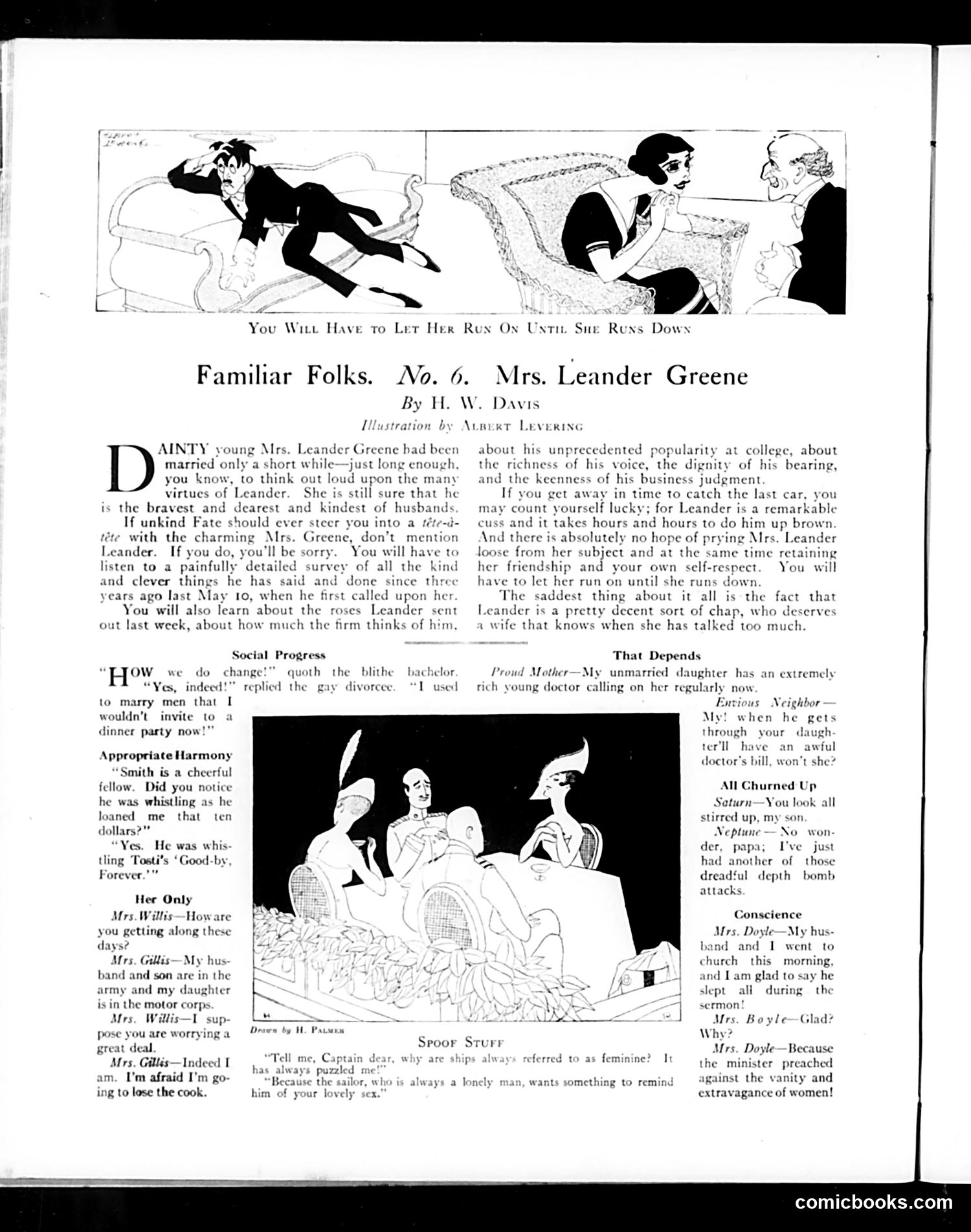
This page from *Judge* magazine contains multiple short humor pieces satirizing early 20th-century social types and domestic life: **"Mrs. Leander Greene"** mocks newly married women who obsessively praise their husbands to anyone who will listen, boring people with endless anecdotes about his virtues. The satire suggests such women lack awareness of social boundaries. **The smaller vignettes** target various social pretensions: a divorced woman's changed dating standards, wartime anxiety about household staff shortages, a mother boasting about a wealthy suitor (with the punchline that he'll run up doctor's bills), and a wife pleased her husband slept through a sermon criticizing female vanity. The overall theme is *domestic comedy*—poking fun at marriage, social climbing, gender relations, and the gap between public propriety and private reality. The humor assumes a readership familiar with upper-middle-class social rituals and marital dynamics of the era. References to college, motor corps, and depth bombs suggest early WWI period.
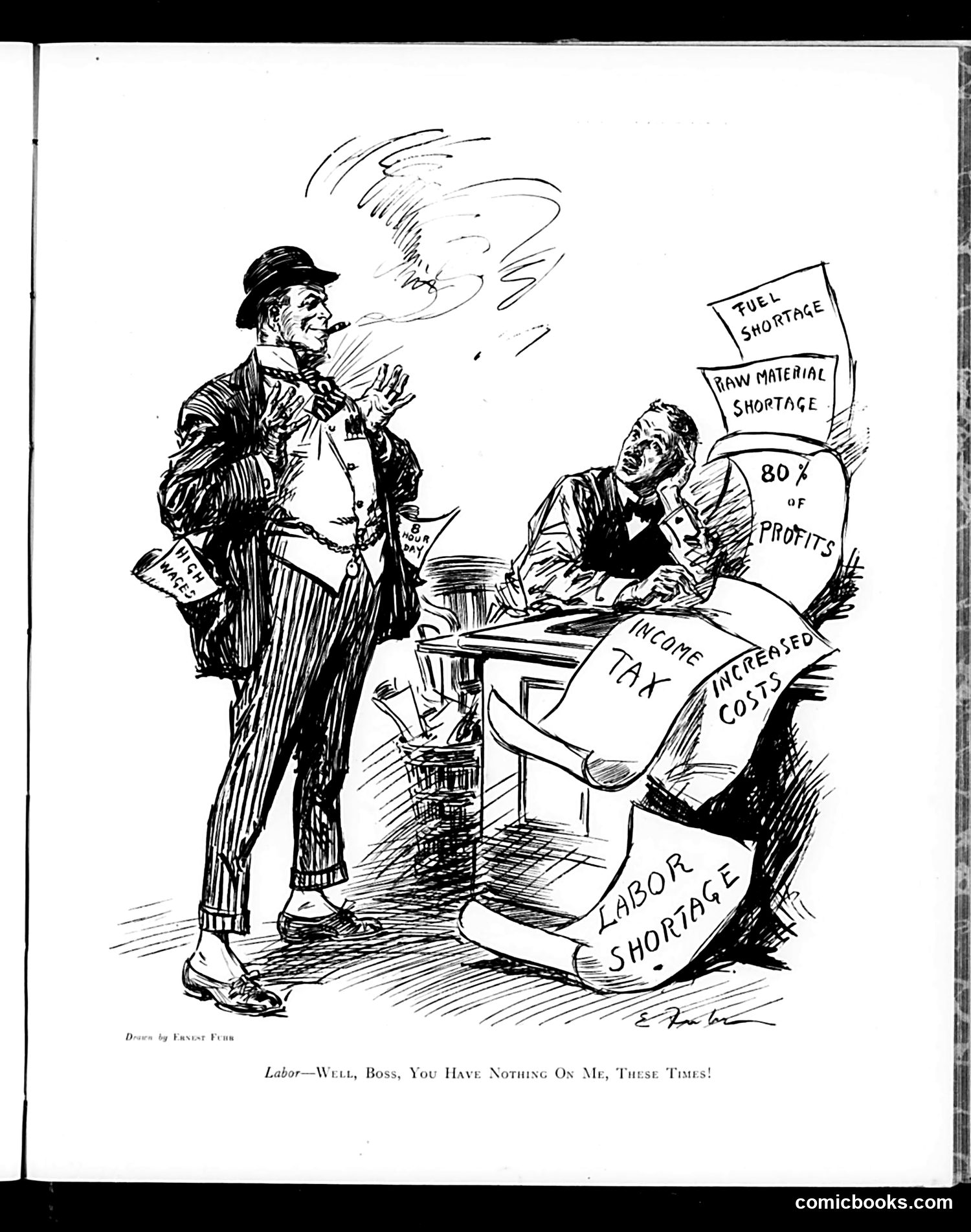
This Judge magazine cartoon depicts a confrontation between a well-dressed businessman ("Boss") and a laborer. The laborer is surrounded by papers listing economic hardships: "Fuel Shortage," "Raw Material Shortage," "Labor Shortage," "Income Tax Increased Costs," and "80% of Profits." The cartoon satirizes post-World War I economic conditions, likely from the early 1920s. Labor claims the boss has "nothing on" him—meaning labor's burdens from fuel rationing, material scarcity, and tax increases rival or exceed the boss's complaints about lost profits. The satire critiques how businesses blamed workers for economic problems while workers faced genuine shortages and increased tax burdens. It's a commentary on class tensions during America's post-war economic adjustment period.
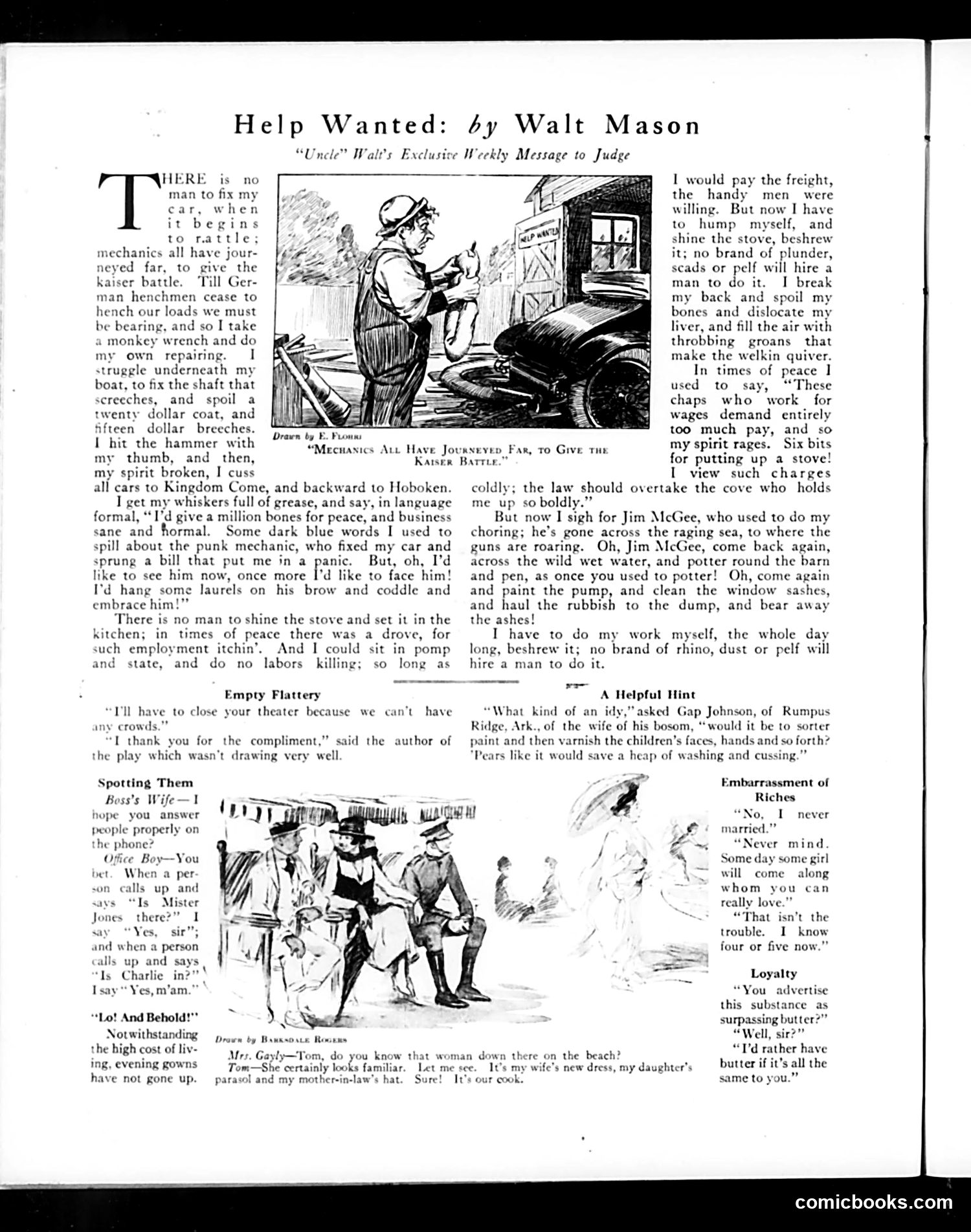
This page reflects American life during **World War I**, when mechanics and service workers enlisted or were drafted into military service ("to give the kaiser battle"). **Main cartoon (top):** A frustrated homeowner attempts DIY car repair, unable to hire mechanics who've gone to war. The satire targets the labor shortage and civilians forced into unfamiliar manual work—a common wartime complaint. **Smaller pieces below:** - **"Empty Flattery"**: A playwright mistakes criticism for compliment when told his theater must close due to crowds (likely a joke about his play being unpopular). - **"Spotting Them"**: A domestic humor sketch about recognizing callers on the phone. - **"Lo! And Behold!"**: Women still buying expensive evening gowns despite wartime economy. - **"A Helpful Hint" / "Embarrassment of Riches" / "Loyalty"**: Brief humorous observations about domestic life and consumer culture. The overarching theme: wartime disruption of everyday life and the absurdity of maintaining peacetime luxuries during national crisis.
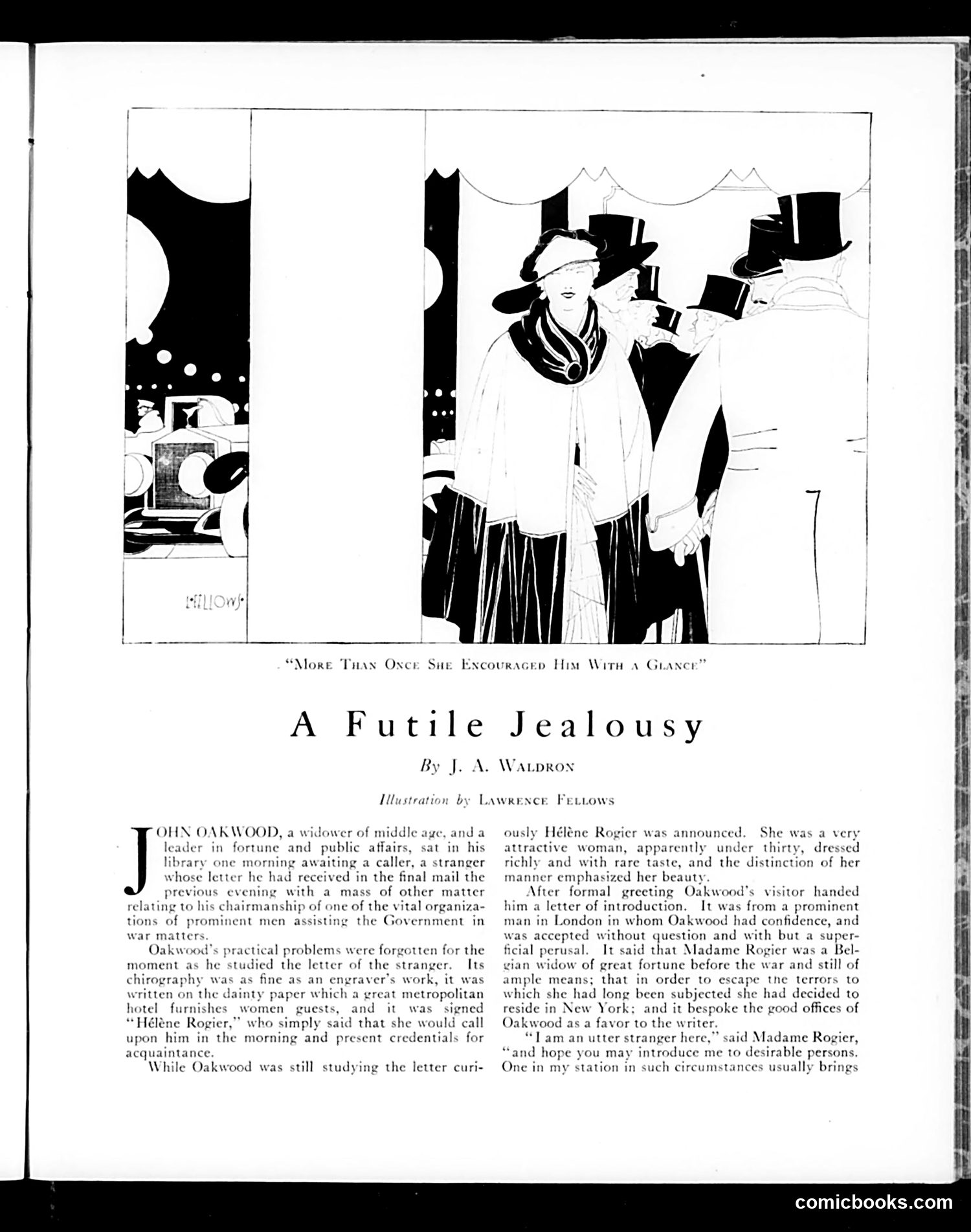
This is the opening of a serialized short story (not a political cartoon) in *Judge* magazine, illustrated by Lawrence Fellows. The narrative concerns John Oakwood, a wealthy widower and public figure involved in war-related government work, who receives a mysterious letter from an attractive stranger, Madame Hélène Rogier. Rogier presents herself as a Belgian widow of fortune fleeing wartime terrors—a socially plausible cover story given WWI's displacement of European refugees. She carries credentials from a trusted London contact and seeks Oakwood's help introducing her to "desirable persons." The setup suggests a seduction or con-artist plot typical of 1910s-1920s pulp fiction: an attractive foreign woman of unclear background targeting a respectable, unattached man in a position of influence. The story's title promises romantic jealousy will ensue. The illustration's caption—"More Than Once She Encouraged Him With a Glance"—confirms the manipulative flirtation angle.
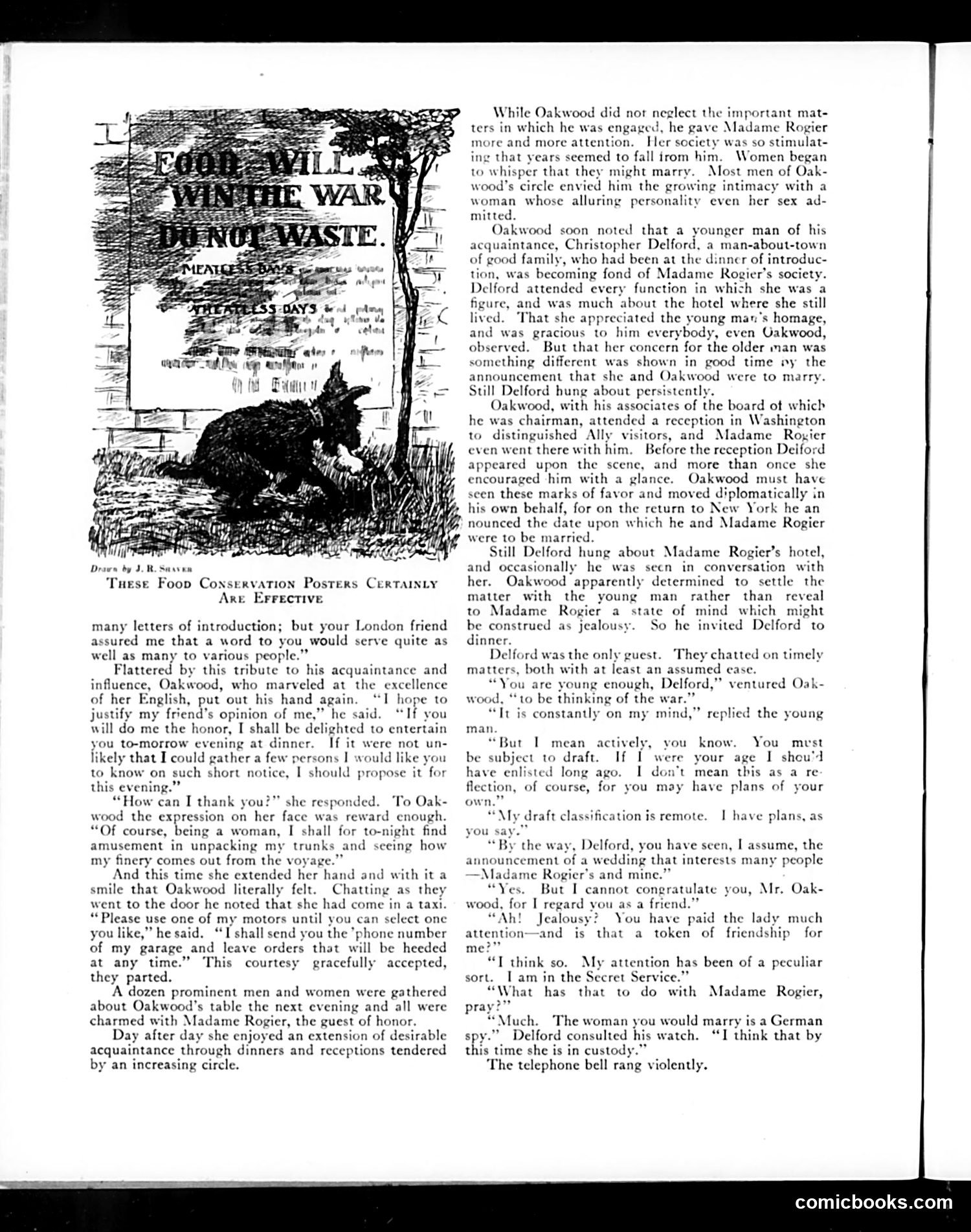
The cartoon at top left ("Food Conservation Posters Certainly Are Effective") uses wartime propaganda imagery—a food conservation poster with a soldier—as visual irony, though the connection to the accompanying narrative isn't immediately clear. The main text is a serialized romantic story apparently titled something like "Oakwood and Madame Rogier." It concerns a wealthy businessman (Oakwood) who becomes romantically involved with an elegant French woman (Madame Rogier). A younger rival (Christopher Delford) pursues her as well. The story appears set during World War I, as references to "the war" and military service emerge. The narrative suggests espionage may be involved—Delford mentions being in the "Secret Service," and someone calls Madame Rogier potentially "a German spy." The final line—"The telephone bell rang violently"—creates dramatic tension. This appears to be a serialized pulp romance with wartime spy-thriller elements, typical of Judge's entertainment content.
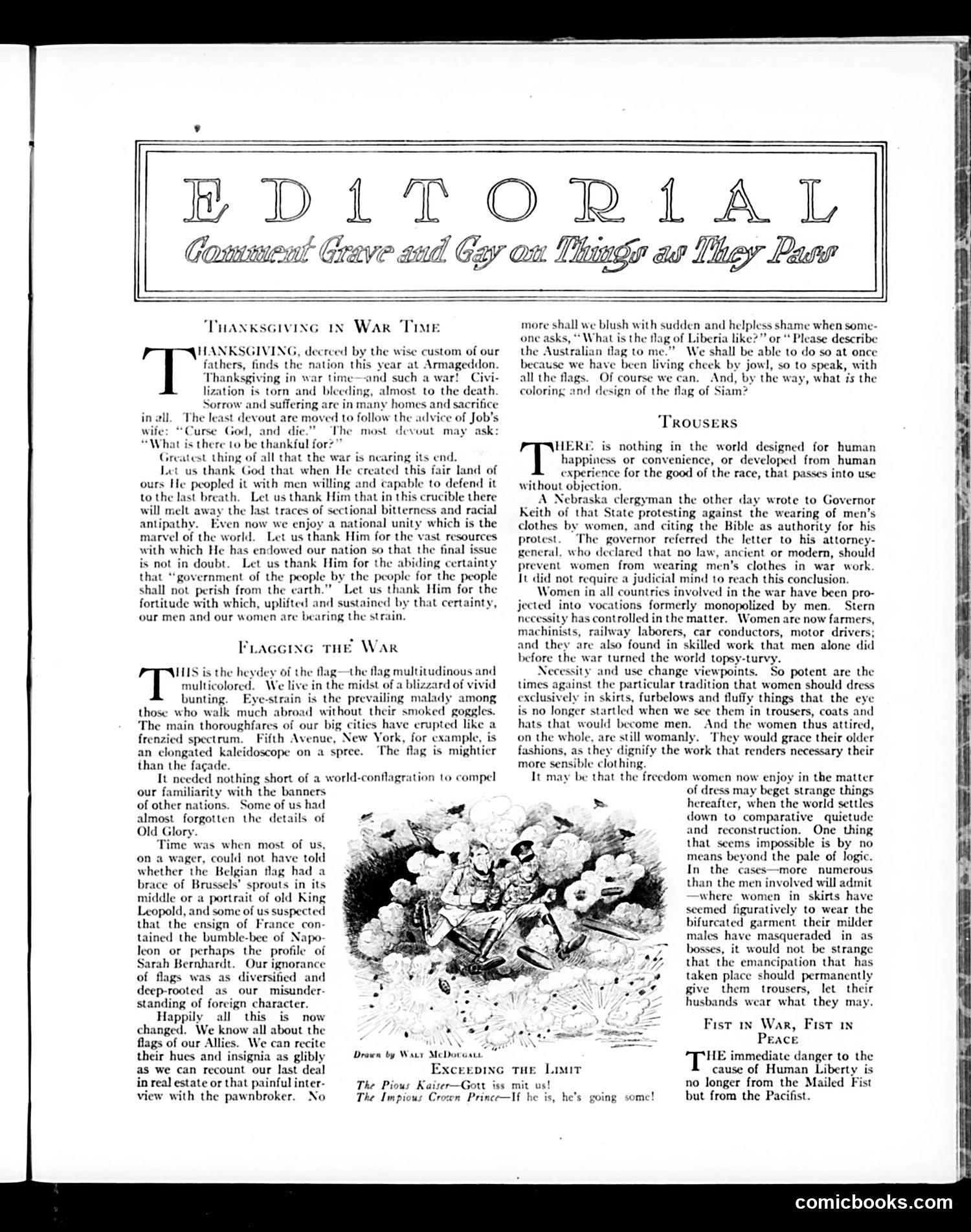
This editorial page addresses American wartime concerns during World War I. The main sections are: **"Thanksgiving in War Time"**: A meditation on gratitude despite the war's devastation, emphasizing national unity, resources, and faith that democracy will survive. **"Flagging the War"**: Satirizes Americans' sudden obsession with displaying Allied flags everywhere—so intensely that it causes eye strain. The piece mocks prewar ignorance of other nations' flags (Belgian, French, etc.) while celebrating newfound patriotic awareness. **"Trousers"**: Defends women wearing practical work clothes in wartime jobs. It references a Nebraska clergyman's biblical objection to women in men's clothing, showing the absurdity of such protests when women now work as farmers, laborers, and drivers—traditionally male roles. The attorney general correctly ruled no law forbids this. The overall tone is patriotic but gently critical of excessive jingoism and outdated social conventions that obstruct the war effort.
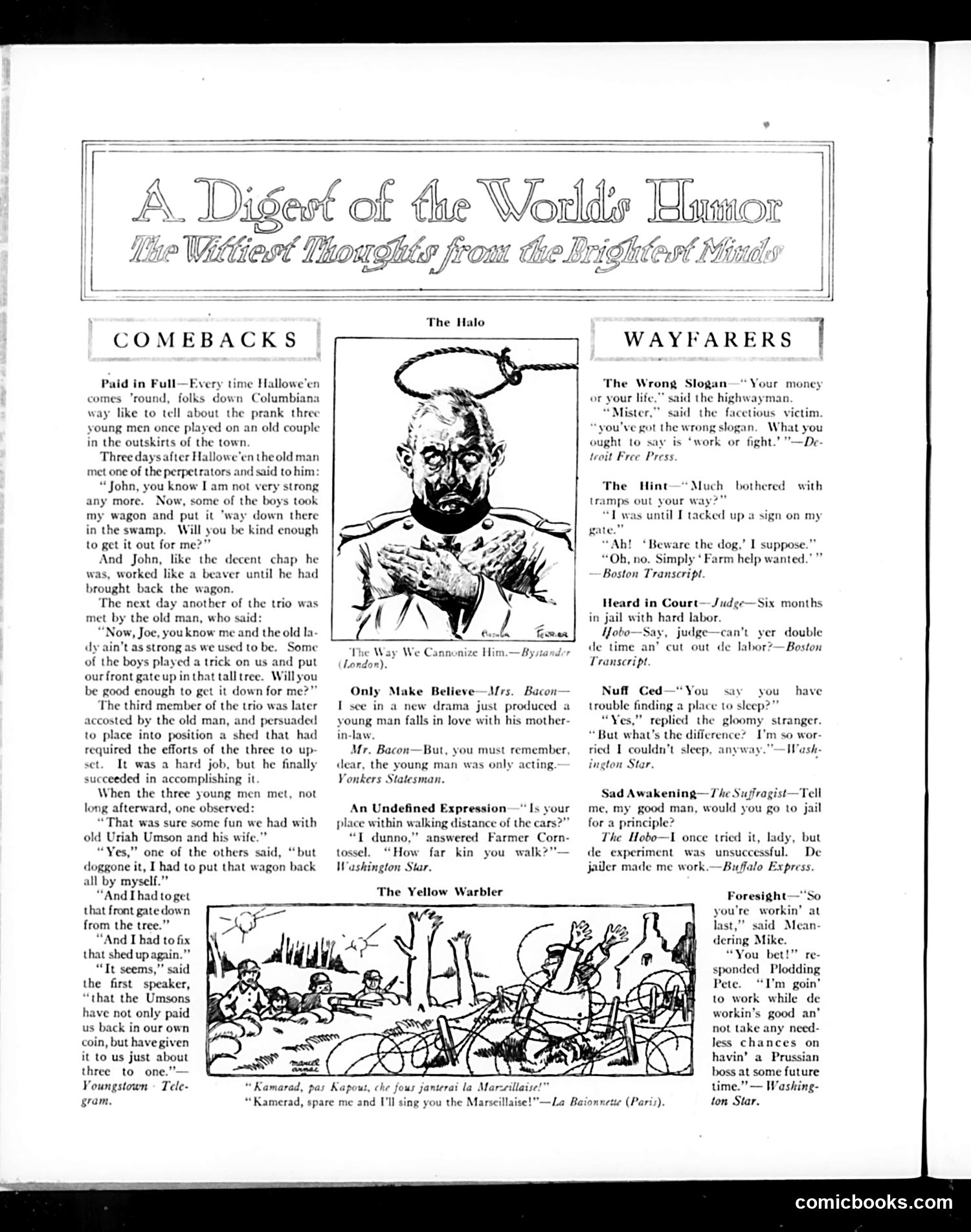
This page collects short humorous anecdotes organized under "Comebacks" and "Wayfarers" sections, plus a cartoon titled "The Way We Cannonize Him." **The Main Cartoon** depicts a German soldier being held at gunpoint, offering to sing the Marseillaise (French national anthem) to spare his life. This references WWI-era mockery of Germans—the joke being that a German would adopt French patriotic symbols under duress, highlighting perceived German cultural opportunism or lack of authentic nationalism. **The Anecdotes** are brief jokes about everyday life: a farmer's prank backfiring when victims reverse the trick, misunderstandings about slogans and signs, a hobo refusing jail labor, and a suffragist's principles versus a hobo's practicality. One joke references "Prussian boss," again invoking anti-German sentiment common during the WWI period. **Context**: This appears to be from WWI-era Judge magazine, when anti-German satire was prominent American humor. The cartoons and jokes reflect both period attitudes and timeless themes of comeuppance and life's ironies.
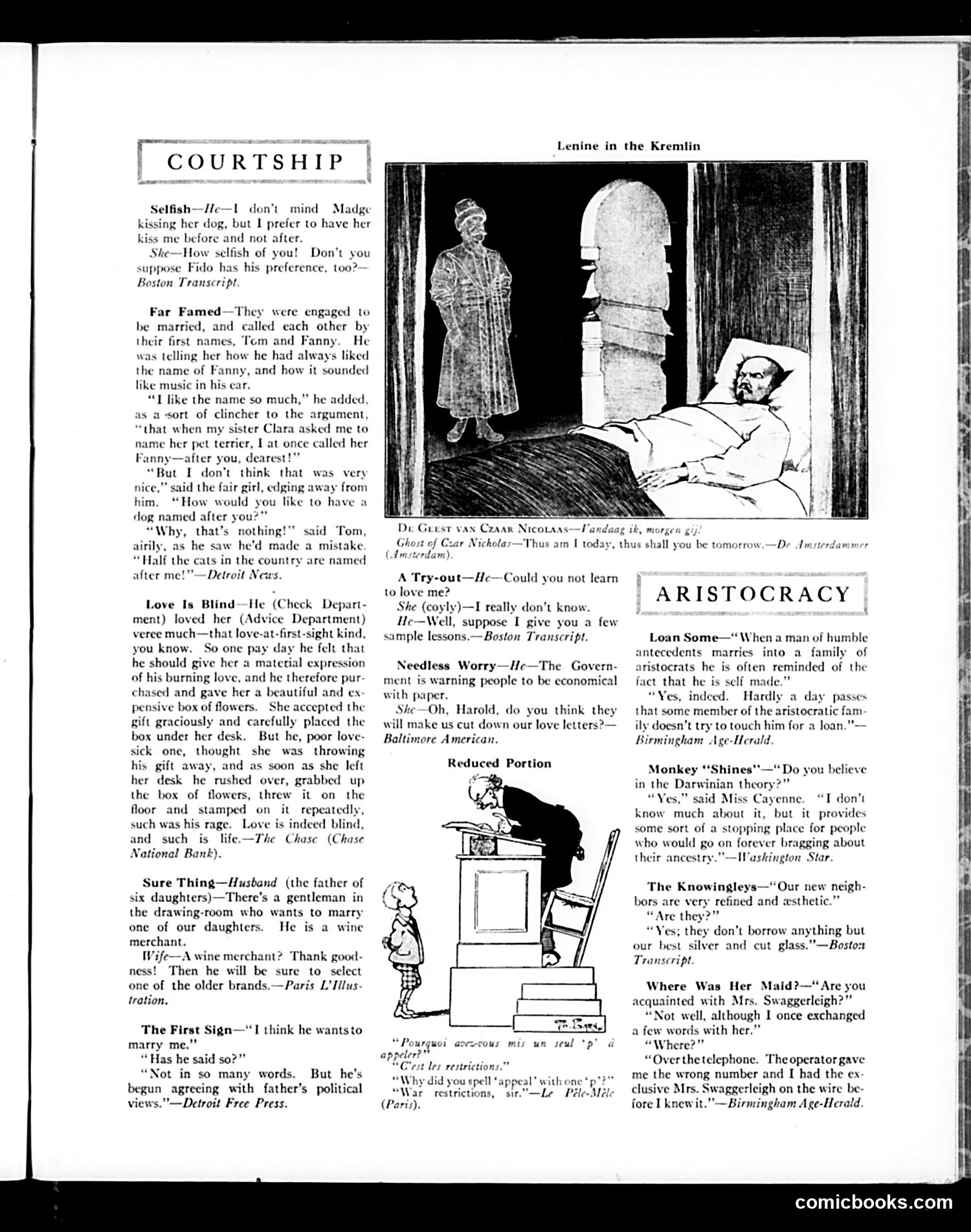
This page from *Judge* magazine contains humor columns labeled "Courtship" and "Aristocracy," plus one political cartoon titled "Lenine in the Kremlin." **The Political Cartoon:** The image shows Lenin (identified in caption) as a ghost of Czar Nicholas II, with the caption's grim message: the Czar warns "Thus am I today, thus shall you be tomorrow"—predicting Lenin will suffer the Czar's fate (execution during the Russian Revolution). This reflects post-WWI anxieties about Bolshevism and violent political upheaval. **The Humor Columns:** These are light domestic/social comedy anecdotes—jokes about courtship mishaps, marital confusion, and class pretension. They satirize romantic miscommunication and the affectations of the newly wealthy trying to appear aristocratic while remaining financially insecure. The "Reduced Portion" cartoon depicts wartime rationing during what appears to be WWI, with a joke about spelling restrictions under wartime austerity measures.
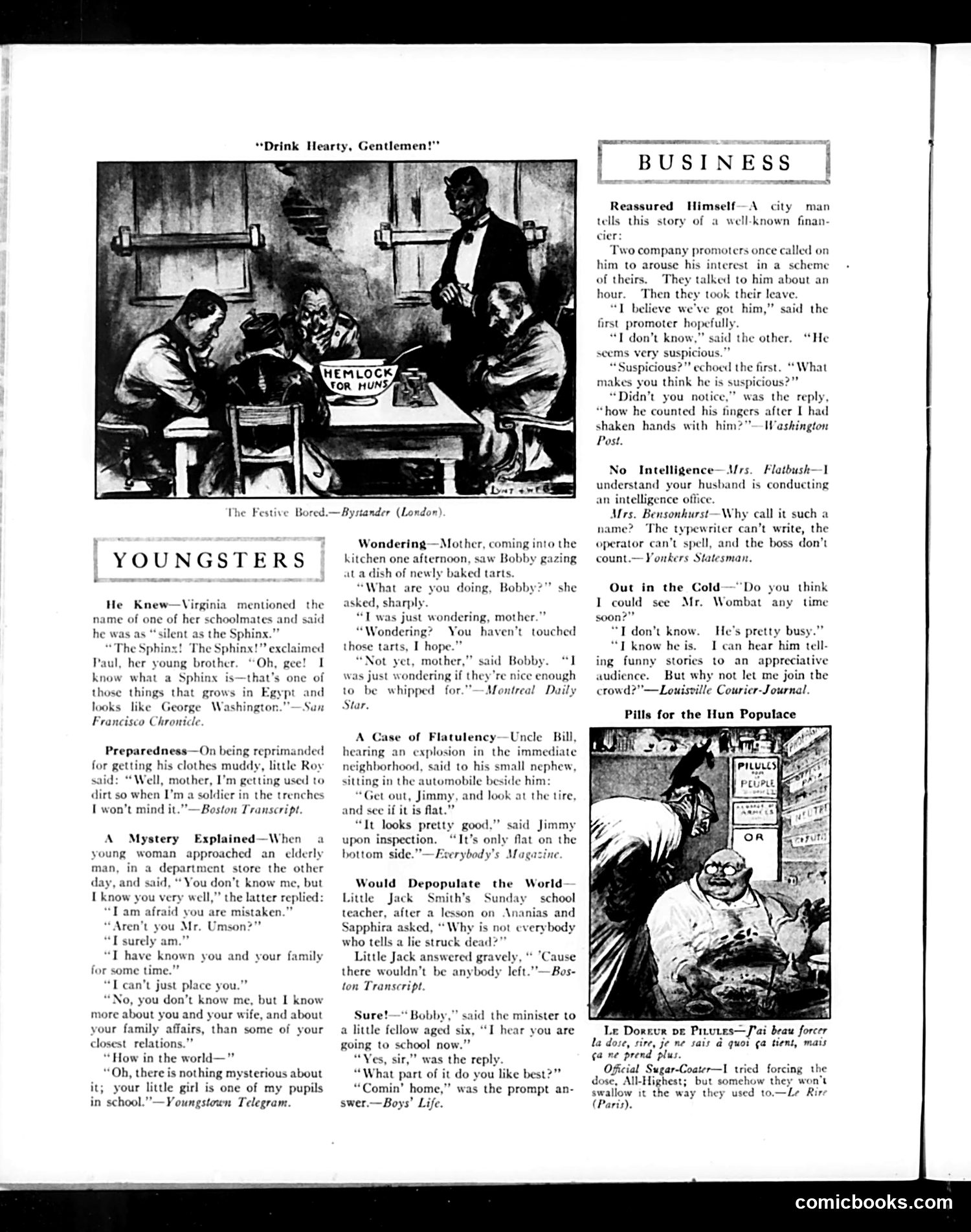
This page contains several brief humorous anecdotes ("Youngsters" and "Business" sections) and satirical cartoons typical of Judge's early 20th-century format. **The main cartoon**, "Drink Hearty, Gentlemen!" (credited to London's *Bystander*), depicts what appears to be a gambling or drinking scene labeled "The Festive Bored"—a visual pun suggesting supposed merriment is actually dull. Men sit around a table with "HEMLOCK" visible, evoking both the poisonous substance and classical references to enforced death. **The business section** includes a joke about a financier counting his fingers after shaking hands with promoters—implying distrust of their honesty, a common stereotype about business dealings and fraud. **"Pills for the Hun Populace"** is a wartime cartoon (appearing to reference WWI, given the "All-Highest" reference to the German Kaiser) showing a military figure unable to maintain morale—the "dose" of propaganda no longer works on the population. The page primarily satirizes boredom, business deception, and wartime morale challenges rather than featuring specific named political figures.
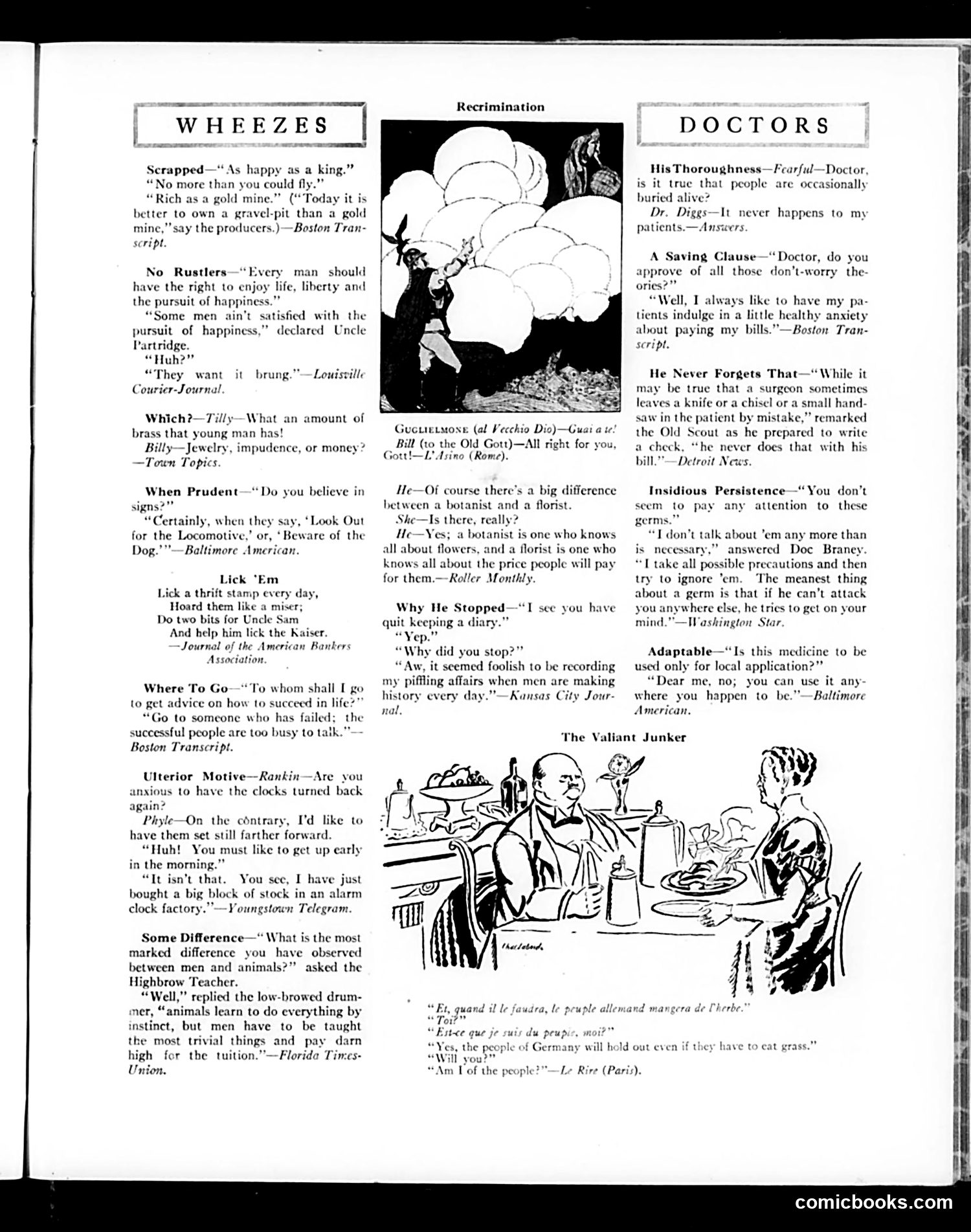
This page collects humorous one-liners and jokes typical of Judge's satirical "Wheezes" section. The humor targets everyday hypocrisies and social absurdities: **Key satires include:** - Wealth contradictions (owning gravel pits now more valuable than gold mines—likely WWI-era economic shifts) - Thrift stamps and war bonds ("Do two bits for Uncle Sam / And help him lick the Kaiser"—clearly WWI-era propaganda) - Doctor mockery: physicians who profit from patient anxiety, surgeons who leave instruments inside patients, or charge exorbitant bills regardless of mistakes **"The Valiant Junker" cartoon** (bottom) appears to mock German aristocratic arrogance during WWI, showing a German nobleman discussing whether common people will starve, with dialogue in French and German. The overall tone is cynical about profiteers, medical incompetence, and wartime jingoism—standard Judge fare lampooning American institutions and the war effort's social impact.
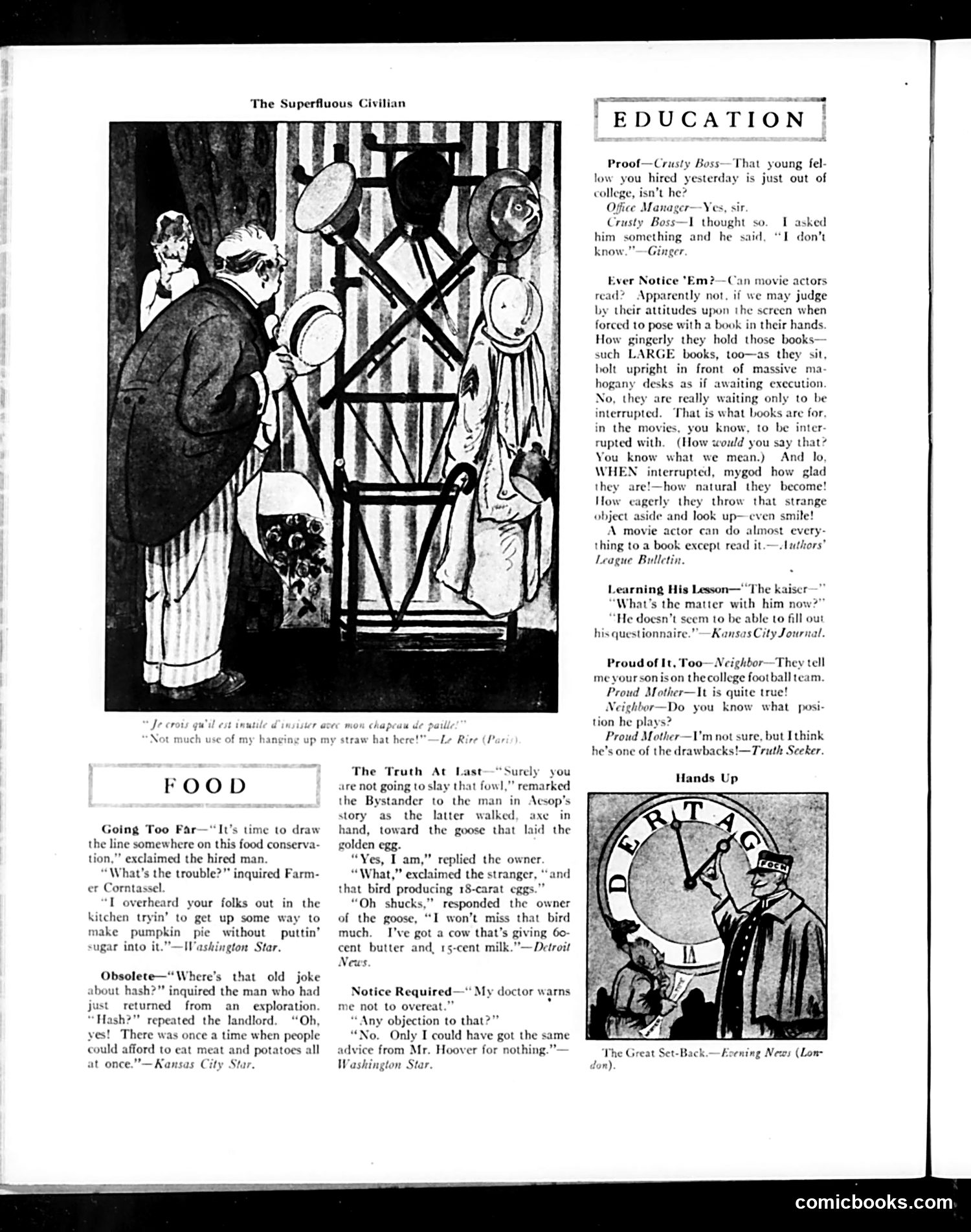
This page contains wartime humor satirizing American home-front conditions, likely from World War I (references to food conservation and "Mr. Hoover" suggest the Herbert Hoover-led rationing era). **The main cartoon** depicts civilians with kitchen implements confronting what appears to be rationing officials or authority figures—visualizing tension between strict food conservation mandates and public resistance. **The "Food" section** mocks extreme rationing: jokes about making pumpkin pie without sugar, and hash being a forgotten luxury when meat and potatoes were once affordable together. The "goose that laid golden eggs" joke suggests wartime sacrifice of productivity for immediate gain. **The "Education" section** includes unrelated humor about movie actors' awkward posturing with books and a Kaiser unable to complete questionnaires (post-WWI mockery). The overall theme: civilian frustration with government-imposed deprivation presented as comedic absurdity rather than patriotic duty.
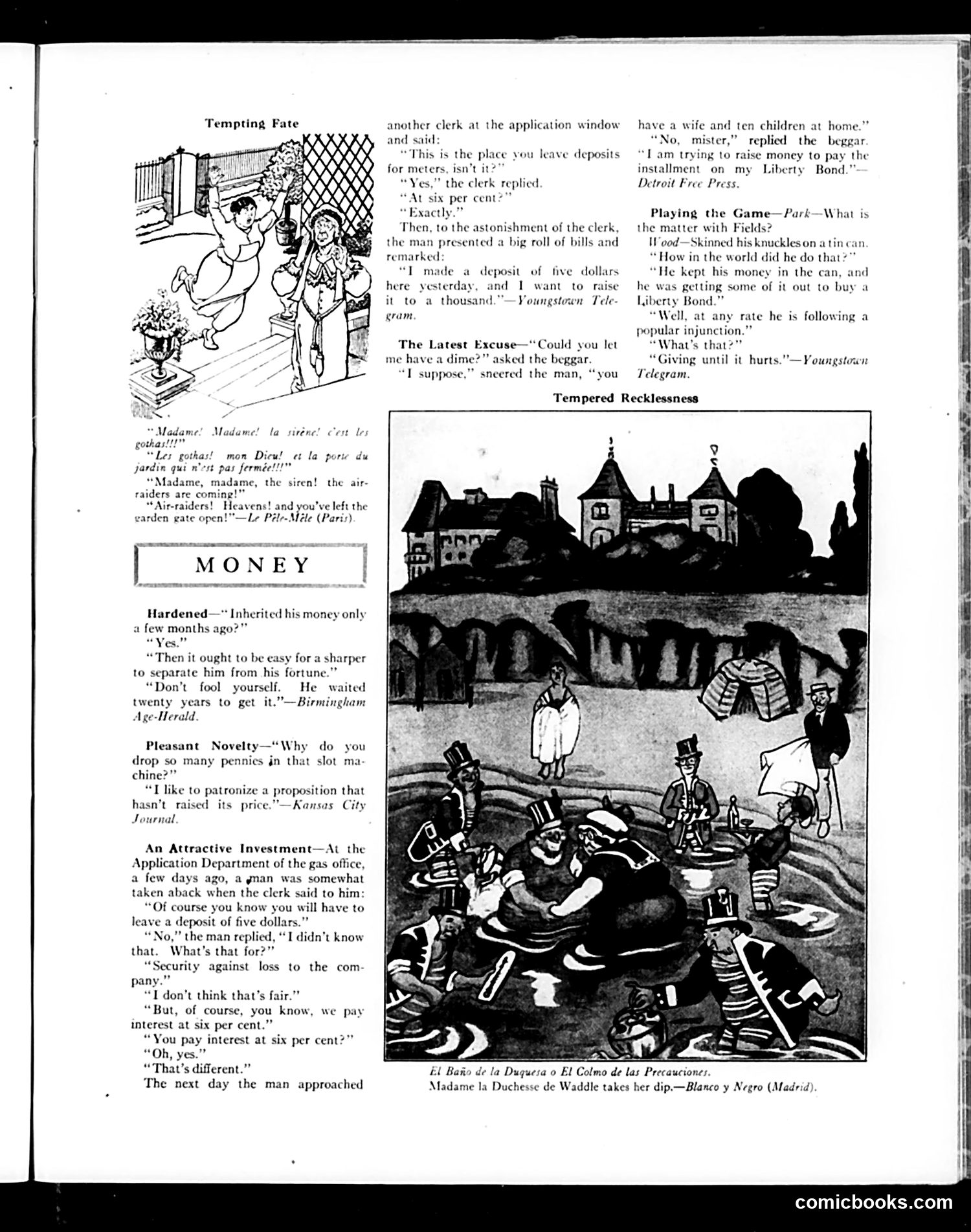
This page contains several brief satirical anecdotes about money, typical of Judge's humor style. **"Tempting Fate"** mocks a beggar's audacious request to a bank clerk—he deposited $5 and wants to withdraw $1,000, as if compound interest at 6% would work miracles overnight. **"Playing the Game"** jokes about a man hiding money in a tin can to save for a Liberty Bond (war bonds sold to finance WWI), then injuring himself retrieving it—satire on Americans' patriotic over-enthusiasm. **"Tempered Recklessness"** shows a French woman leaving her garden gate open during an air raid, with the caption mocking her carelessness about wartime security. The **"Money"** section contains four anecdotes mocking financial naiveté: a man expecting interest to multiply inherited money quickly; penny-slot machines as stable investments; a gas company's "attractive" 6% interest on security deposits; and a newly wealthy man's delayed gratification. All reflect early 20th-century American anxieties about finance, war bonds, and personal economics.
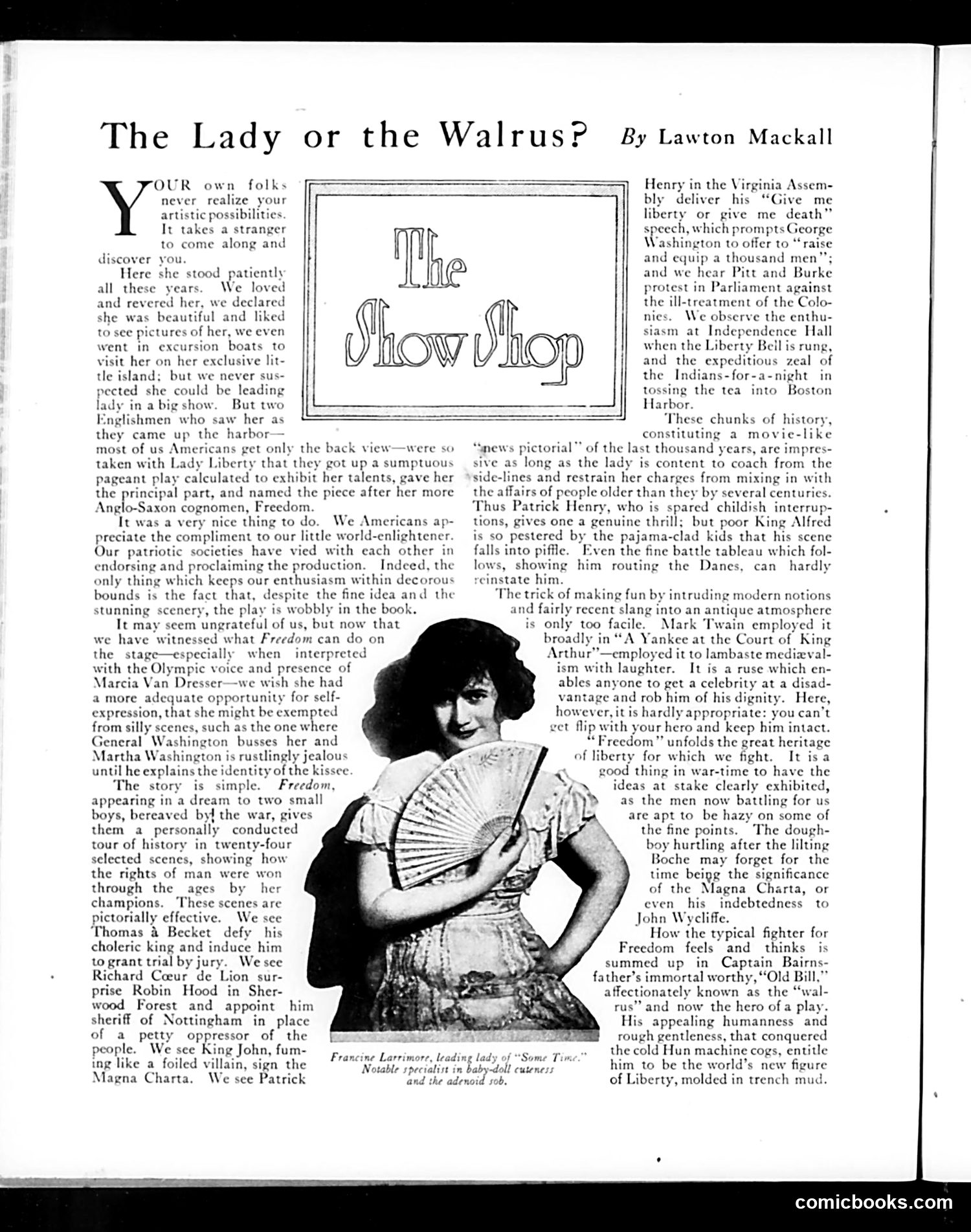
This is a theater review of a patriotic pageant play titled *Freedom*, starring actress Marcia Van Dresser as Lady Liberty/Freedom. The production dramatizes American historical moments (Patrick Henry's speech, the Magna Carta, King Alfred vs. the Danes) through twenty-four scenes depicting mankind's progress toward liberty. Mackall praises the *concept*—giving the Statue of Liberty a starring role is patriotic and flattering. However, he critiques the *execution*. The script is "wobbly," and the play commits the sin of inserting modern slang and humor into historical scenarios (comparing it to Mark Twain's *A Connecticut Yankee in King Arthur's Court*). He finds particularly weak a scene where General Washington kisses Lady Liberty, making Martha jealous—a silly domestic comedy moment undermining the dignity of both historical figures and the patriotic concept. The central complaint: the production trivializes serious historical events and Liberty herself through anachronistic comedy and juvenile interruptions by child characters.
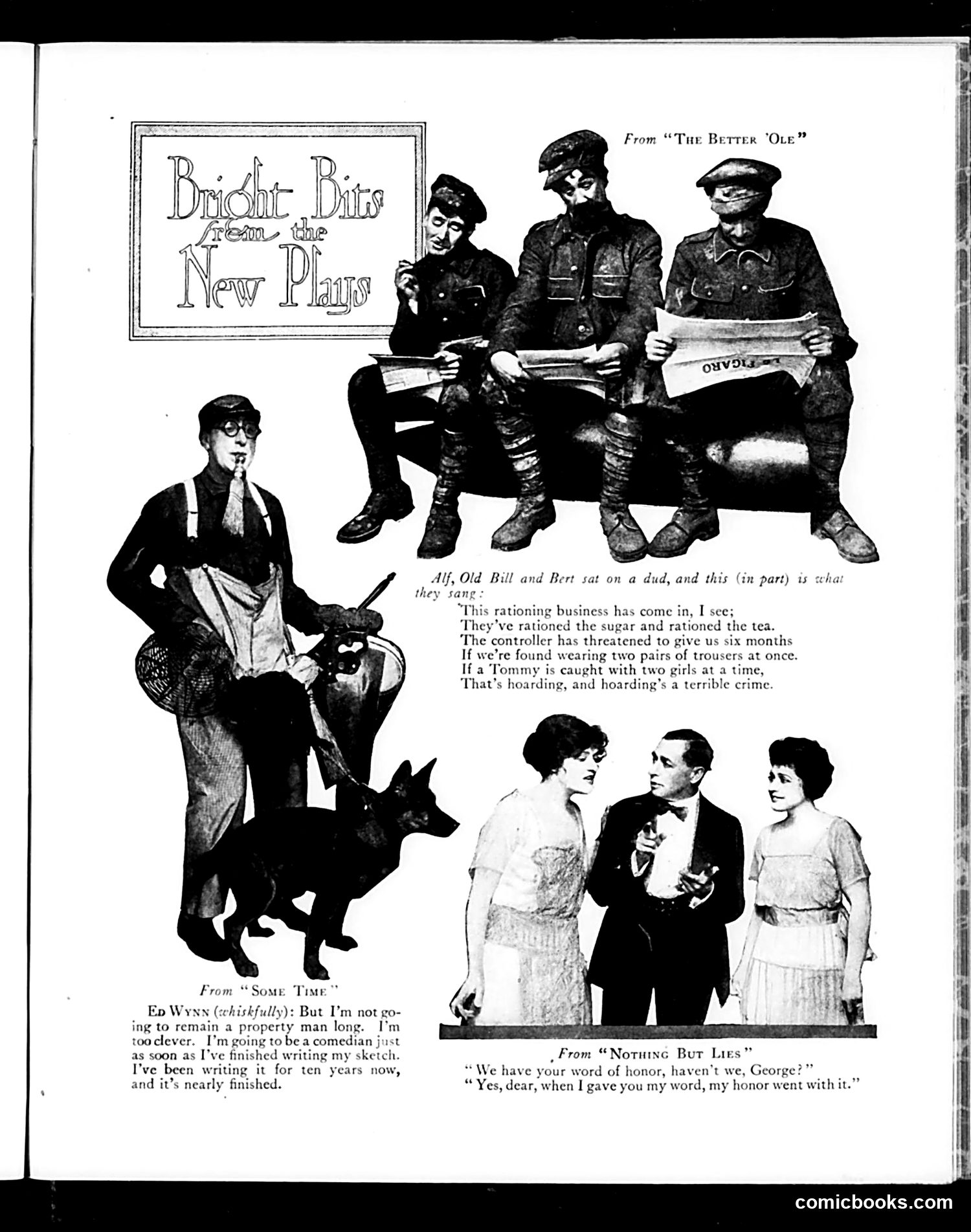
This page presents "Bright Bits from the New Plays"—theatrical comedy sketches from contemporary stage productions. **Top section** depicts three soldiers (labeled "Alf, Old Bill and Bert") satirizing British WWI-era rationing policies. They mock the government's strict controls over sugar, tea, and clothing, while humorously equating romantic encounters with women to "hoarding"—a crime under wartime rationing. This reflects public frustration with civilian restrictions during the war. **Bottom left** shows Ed Wynn, a vaudeville performer, joking about his aspirations to become a comedian rather than remain a property man, despite claiming to have spent ten years writing a sketch. **Bottom right** presents a domestic scene from "Nothing But Lies" where a man admits his honor "went with" his word—implying broken promises or infidelity. The page satirizes both wartime bureaucracy and theatrical personalities' pretensions.
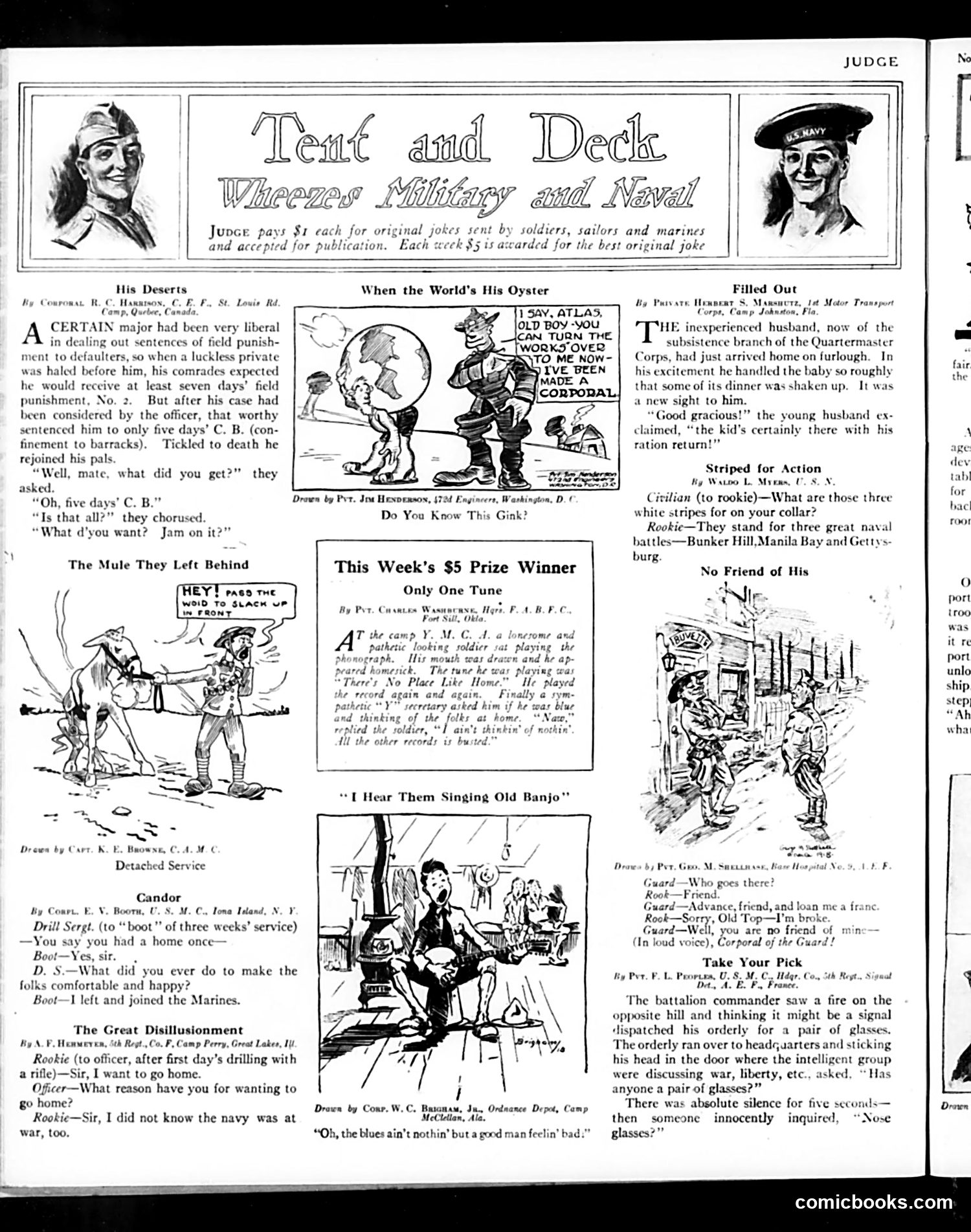
This page collects jokes and cartoons submitted by soldiers, sailors, and Marines during World War I, with $1 payment per published joke and $5 for the best. The humor reflects recruits' experiences with military discipline and absurdity. Key jokes include: - **"His Deserts"**: A soldier unexpectedly receives a lenient five-day punishment instead of the severe seven days his peers anticipated. - **"The Great Disillusionment"**: A new recruit (boot) wants to leave after his first day, having apparently joined the Marines believing something false about military life. - **"Striped for Action"**: A rookie comically misidentifies three collar stripes as representing naval battles (Bunker Hill, Manila Bay, Gettysburg)—historically inaccurate, suggesting confusion about rank insignia. - **"Take Your Pick"**: Officers mishear a request for "glasses" (binoculars) as "nose glasses" (spectacles), revealing either dim-wittedness or intentional evasion. The humor satirizes military bureaucracy, recruit naïveté, and officer incompetence.
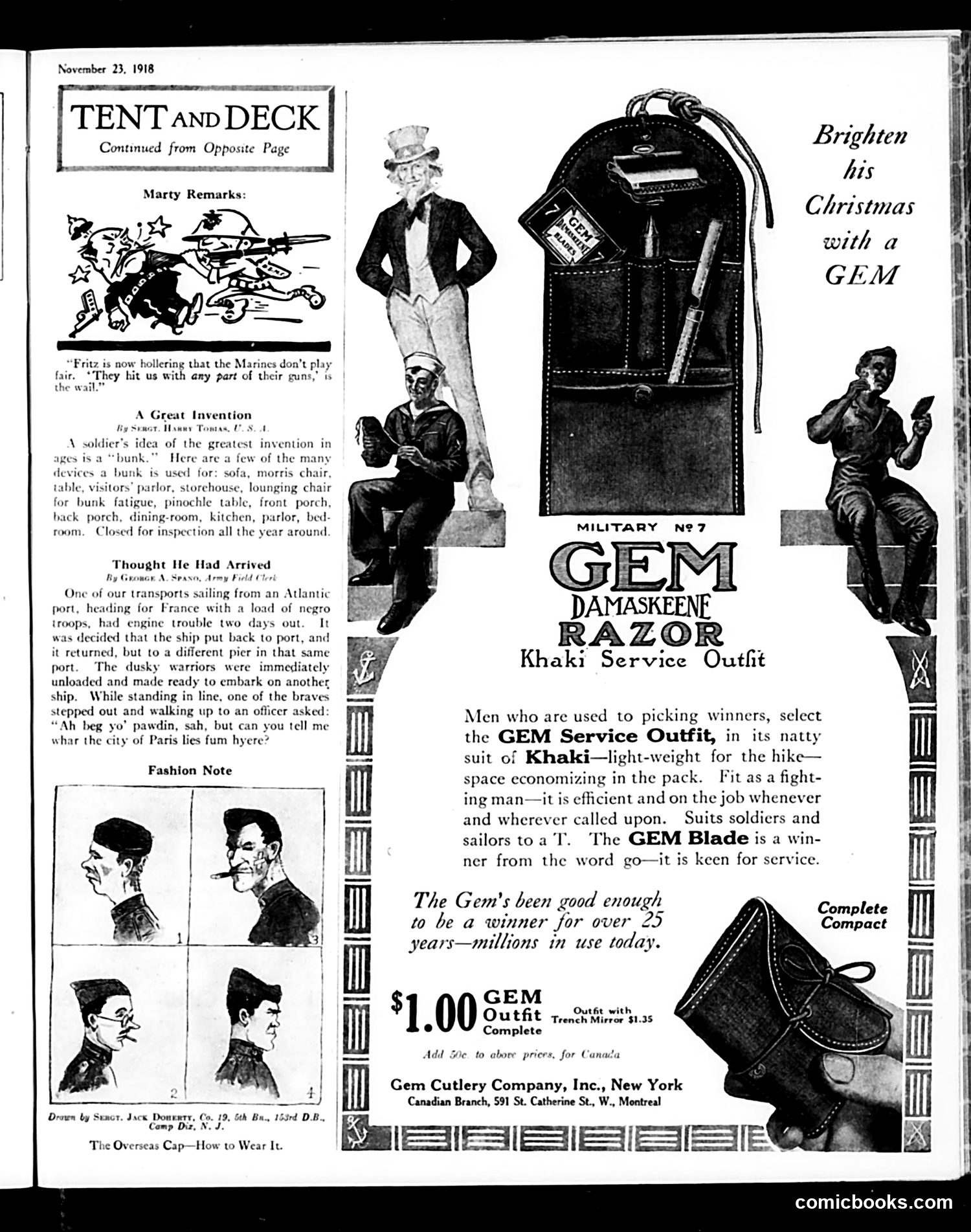
This page contains wartime humor from just after WWI's armistice (November 11, 1918). **"Marty Remarks"** satirizes German complaints: "Fritz" (the enemy) protests that American Marines fight unfairly by using their guns—absurdist humor mocking Germany's defeat. **"A Great Invention"** jokes that soldiers view bunks as multi-purpose furniture—sofa, dining table, porch—reflecting the grim reality of military bunks serving as soldiers' entire living space. **"Thought He Had Arrived"** appears to mock African American soldiers through dialect humor (a regrettable period convention). A Black soldier, confused about geography, asks an officer where "Paris" is located, suggesting naïveté about the European destination. **The bulk of the page is advertising** for the GEM Damascene Razor, marketed as a practical "military" service outfit for soldiers and sailors, positioning the razor as essential military equipment. The content reflects 1918 attitudes: military patriotism, casual racial stereotyping, and commercial opportunism exploiting wartime demand.
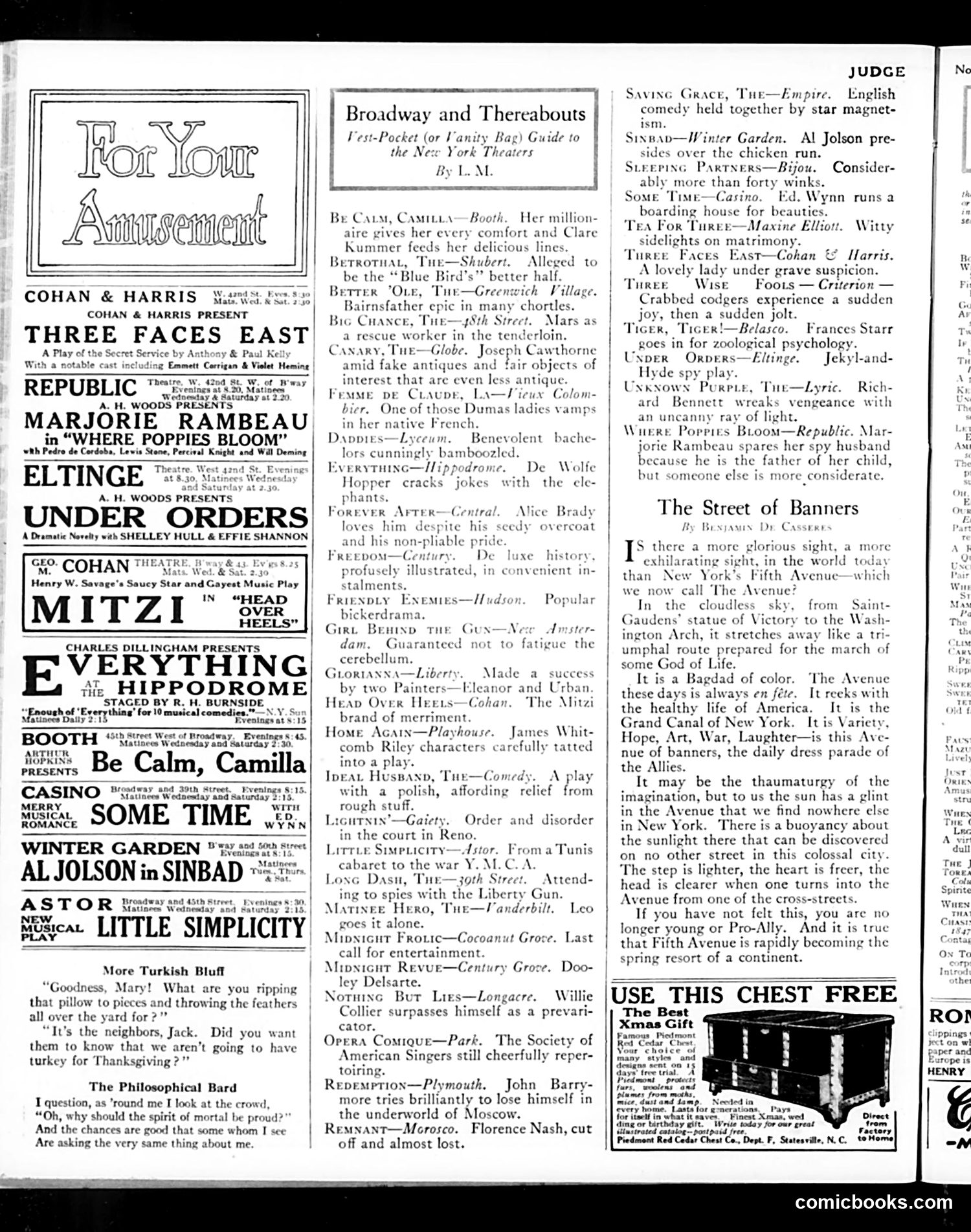
This is primarily a **theater advertising and review page** from Judge magazine, not a political cartoon. The left side features Broadway theater advertisements for popular shows like "Three Faces East," "Head Over Heels" (starring Mitzi), and "Sinbad" (starring Al Jolson). The right side contains brief, humorous capsule reviews of current Broadway productions—a standard Judge feature mocking theatrical offerings. These sardonic one-liners target plots, actors, and production quality. Two small standalone pieces appear: 1. **"More Turkish Bluff"**: A domestic humor sketch about a wife destroying pillow feathers so neighbors won't know they can't afford turkey for Thanksgiving—satirizing Depression-era economic anxiety and keeping up appearances. 2. **"The Philosophical Bard"**: A brief poem questioning human dignity and mortality. The **"Street of Banners"** essay celebrates Fifth Avenue's patriotic decorations, likely from World War I era (references to "Allies," "march of some God of Life").
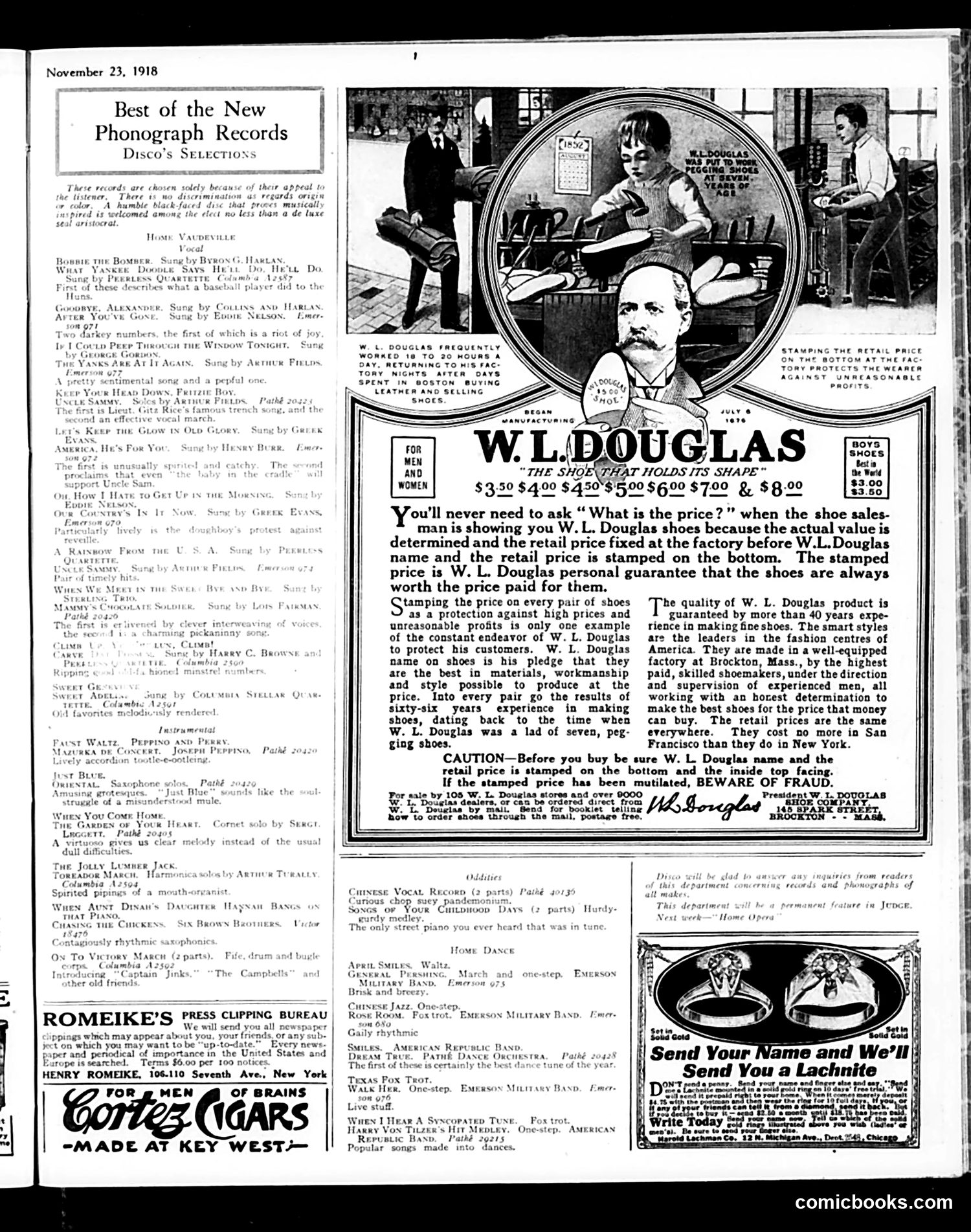
This page is primarily **advertising**, not political satire. The dominant feature is a W.L. Douglas shoe advertisement with a circular portrait of the company founder. The ad's key message concerns **price transparency and consumer protection**: Douglas stamps the actual retail price directly on shoe bottoms to prevent fraud and price-gouging. This was a significant consumer-trust issue in 1918—retailers frequently marked up prices arbitrarily, so Douglas's practice of fixing prices at the factory and stamping them visibly was marketed as progressive consumer advocacy. The biographical detail that Douglas began "pegging shoes" at age seven emphasizes honest craftsmanship and American bootstrap mythology, lending credibility to his anti-fraud pledge. The page also includes a phonograph records column and press clipping service advertisement—standard Judge magazine content from this era. **No political figures or satire are present.** This is straightforward commercial messaging framed as consumer protection during the World War I era.
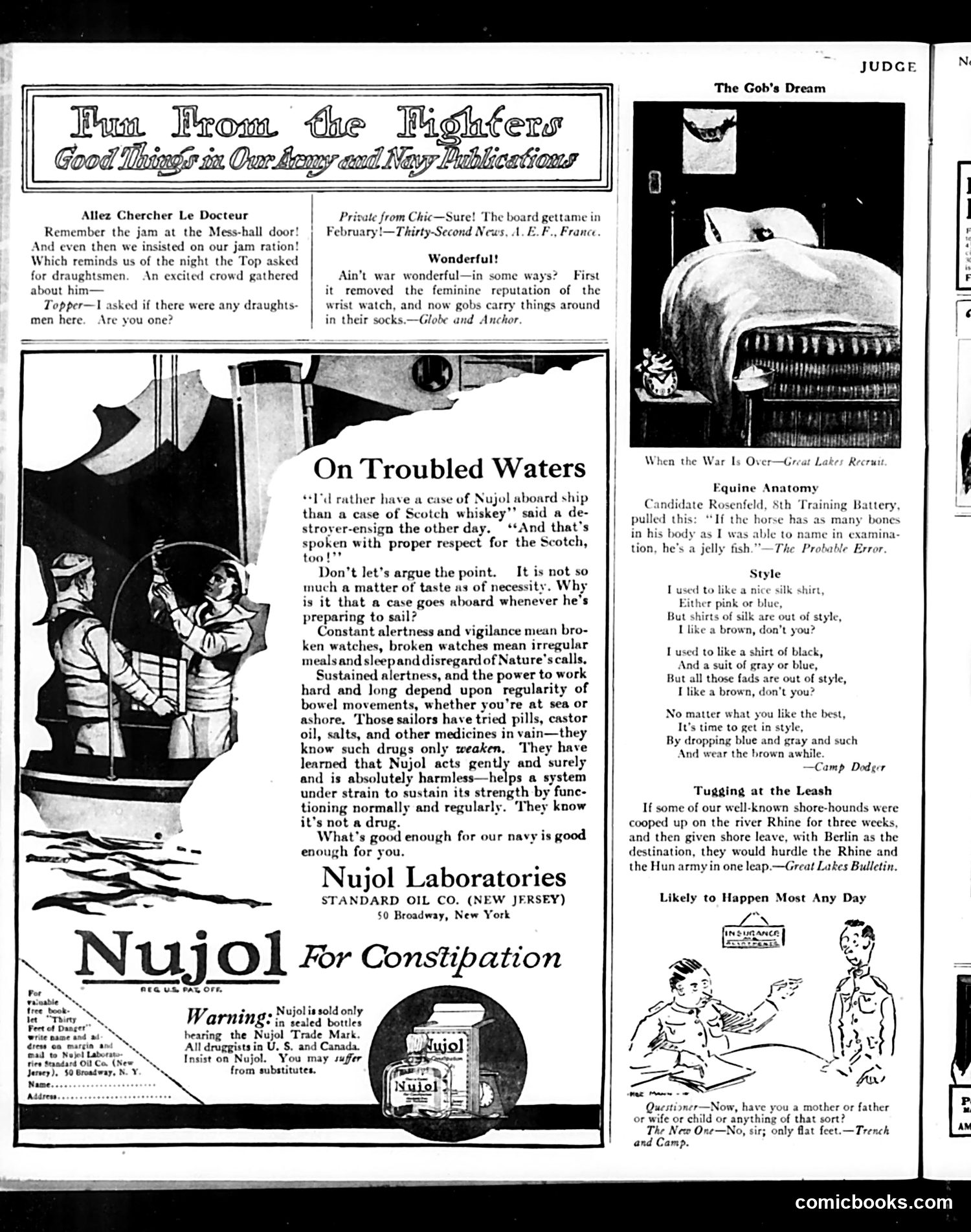
This page combines WWI-era military humor with a Nujol constipation remedy advertisement. **The cartoons** mock sailor and soldier life through brief anecdotes. "Allez Chercher Le Docteur" jokes about mess-hall rations; "On Troubled Waters" presents an extended Nujol ad disguised as a testimonial about sailors' digestive health during wartime stress. "The Gob's Dream" shows a sleeping sailor, while other items include a joke about a horse's skeletal anatomy, a poem about brown uniforms replacing colorful prewar clothing, and quips about homesick soldiers. **The humor is gentle service comedy**—poking fun at military food, uniforms, and discipline rather than criticizing the war itself. The Nujol advertisement exploits wartime anxieties about sailors' health and regularity, framing a laxative as patriotic necessity. **For modern readers**: "Gob" means sailor; references to the Rhine and Hun reflect the Western Front context; the emphasis on brown uniforms reflects actual 1917-1918 military standardization replacing varied peacetime dress.
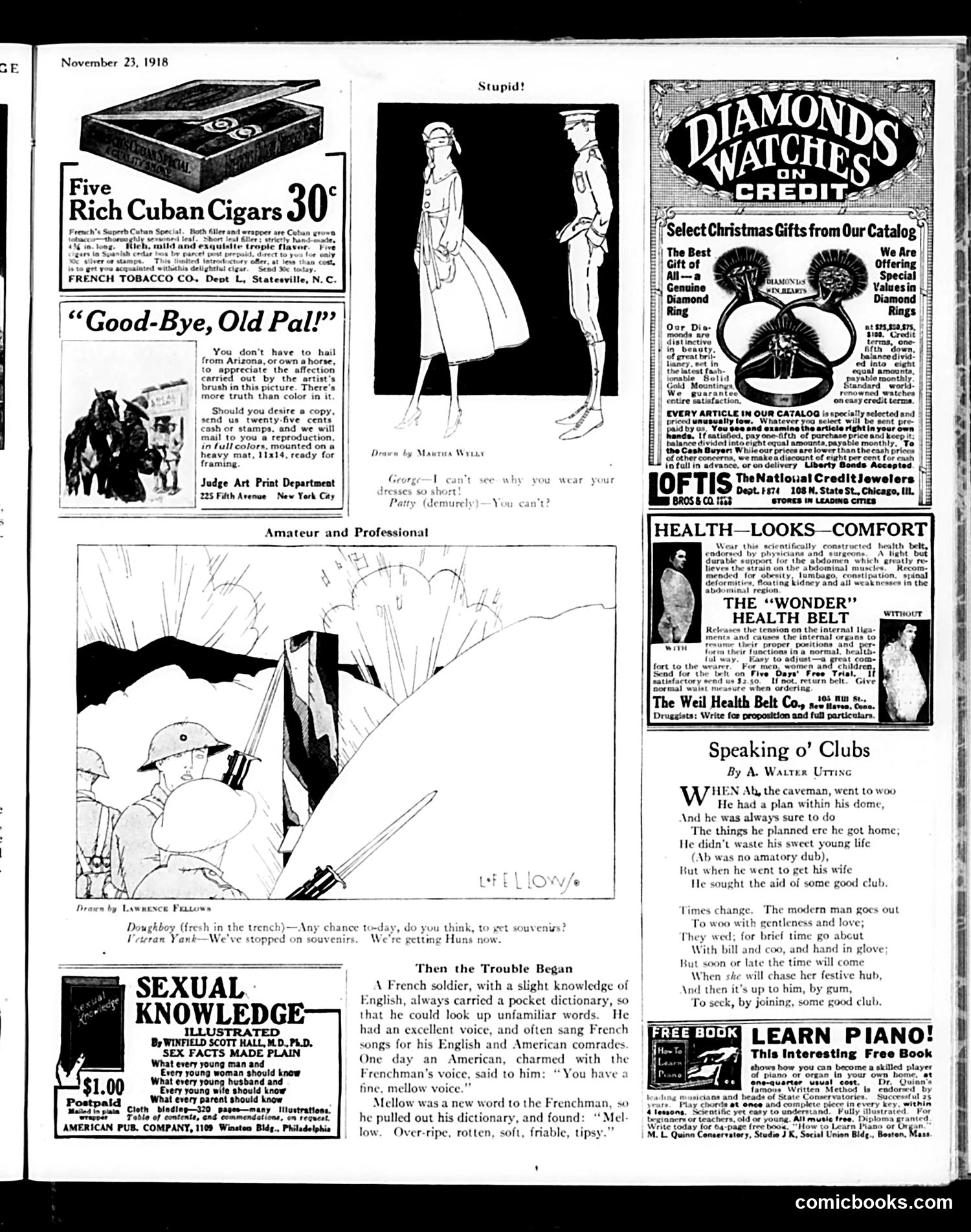
This page contains several distinct items rather than a unified cartoon narrative: **"Good-Bye, Old Pal!"** (left): A sentimental illustration showing soldiers parting, likely referencing WWI's end—the Armistice was signed November 11, 1918, just days before this publication. The accompanying text promotes prints of the artwork. **"Stupid!" (center)**: A brief satirical dialogue where a woman asks a man why he wears his dress to a ball. The humor appears to mock either fashion conventions or male obtuseness about women's clothing choices. **"Then the Trouble Began"** (lower left): An anecdote about a French soldier whose poor English led him to misinterpret "mellow" (meaning soft/pleasant voice) as "over-ripe, rotten, soft, tipsy"—a common WWI-era joke playing on language barriers between Allied forces. **"Speaking o' Clubs"**: A poem comparing courtship methods: cavemen used clubs literally; modern men use social clubs to escape domestic life. The page is primarily **advertising** (cigars, health belts, credit jewelry, piano lessons) with scattered humor content typical of Judge's format.
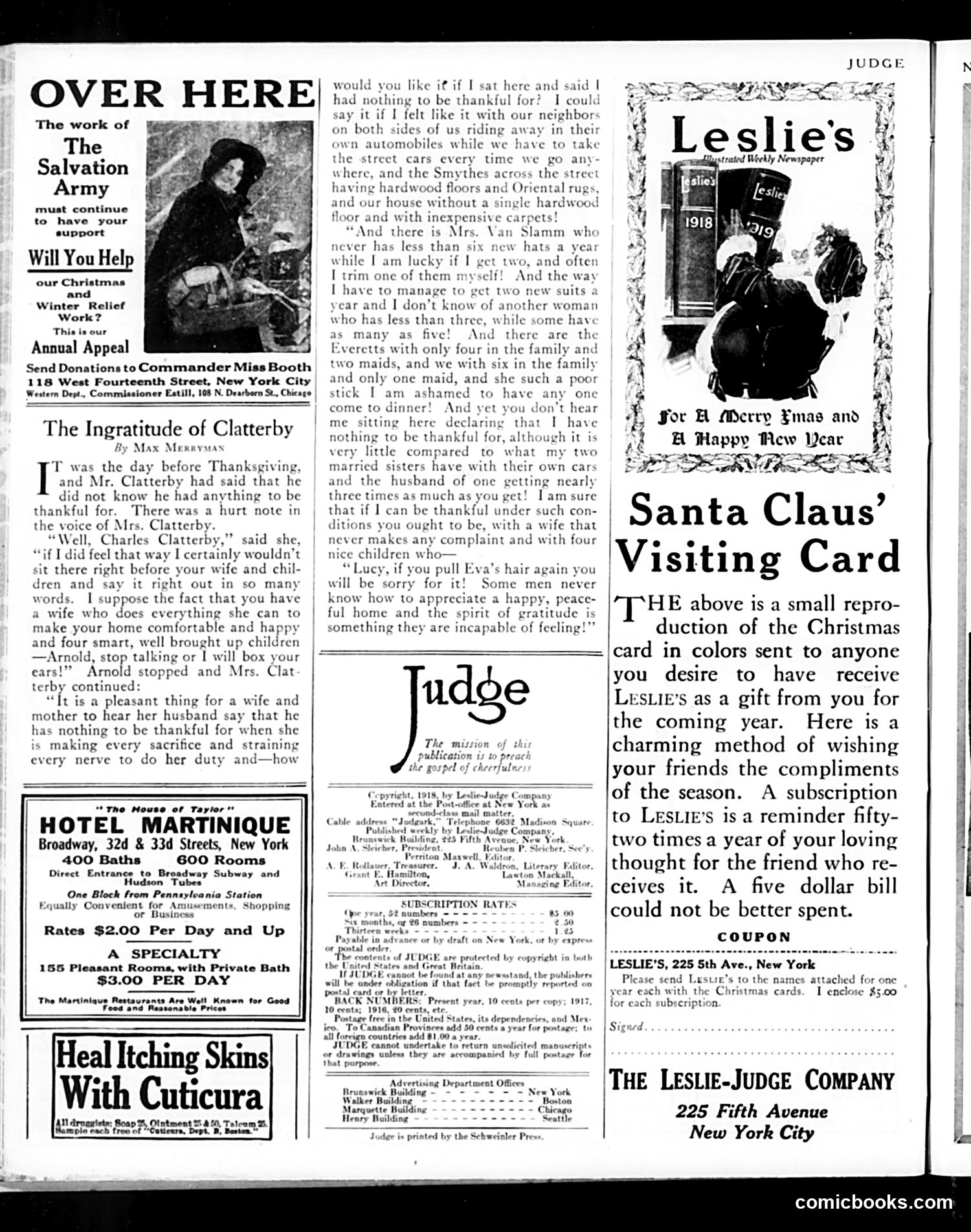
This satirical story mocks ingratitude and status anxiety in early 20th-century middle-class American life. Mr. Clatterby complains he has nothing to be thankful for on Thanksgiving eve. His wife Mrs. Clatterby responds with biting sarcasm, listing her own sacrifices and then—crucially—comparing their family unfavorably to wealthier neighbors: the Van Stamms with automobiles, the Smythes with hardwood floors and Oriental rugs, and the Everetts with servants. The satire's point: Mrs. Clatterby is supposedly lecturing her husband about ingratitude while herself demonstrating acute class resentment and constant social comparison. She catalogs her deprivations relative to richer families in exhausting detail, undercutting her moral position. The piece satirizes how material envy and status competition could poison even domestic gratitude and family contentment in prosperous America.
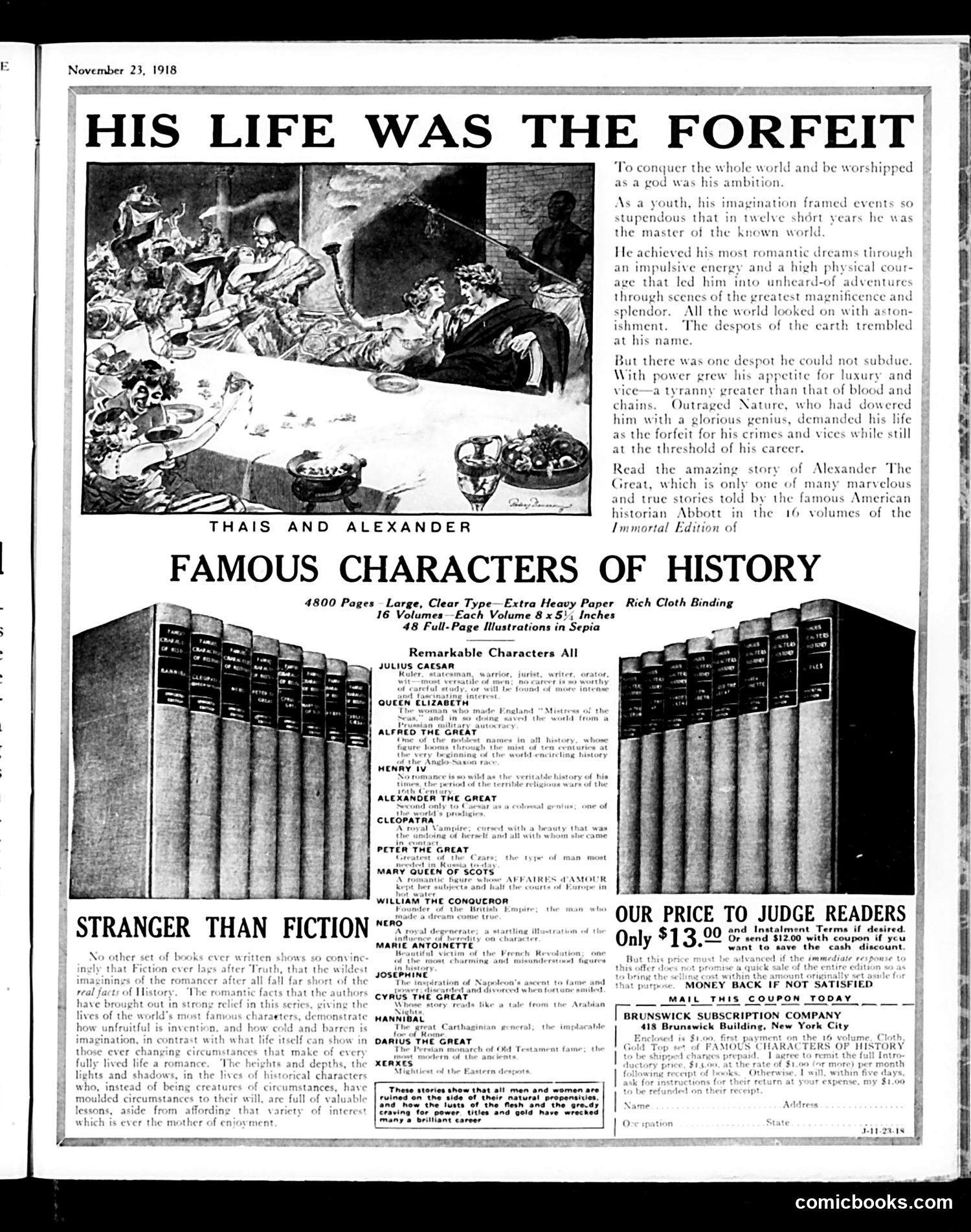
This page is primarily **advertising**, not political satire. Dated November 23, 1918 (just after WWI's armistice), it promotes a 16-volume encyclopedia set called "Famous Characters of History" by historian Jacob Abbott. The illustration labeled "Thais and Alexander" depicts Alexander the Great at a feast, accompanying text describing his ambition to conquer the world. The ad uses Alexander as a hook—presenting his story as one of many "marvelous and true stories" in the collection. The accompanying text employs a moralistic tone typical of the era, warning that Alexander's unchecked appetite for luxury and vice ultimately led to his downfall, suggesting the books offer both entertainment and moral instruction. The page lists other historical figures covered (Julius Caesar, Queen Elizabeth, Napoleon, Cleopatra, Peter the Great, etc.) and offers the set for $13.00 to Judge magazine readers. This is essentially a mail-order book advertisement rather than satirical commentary.
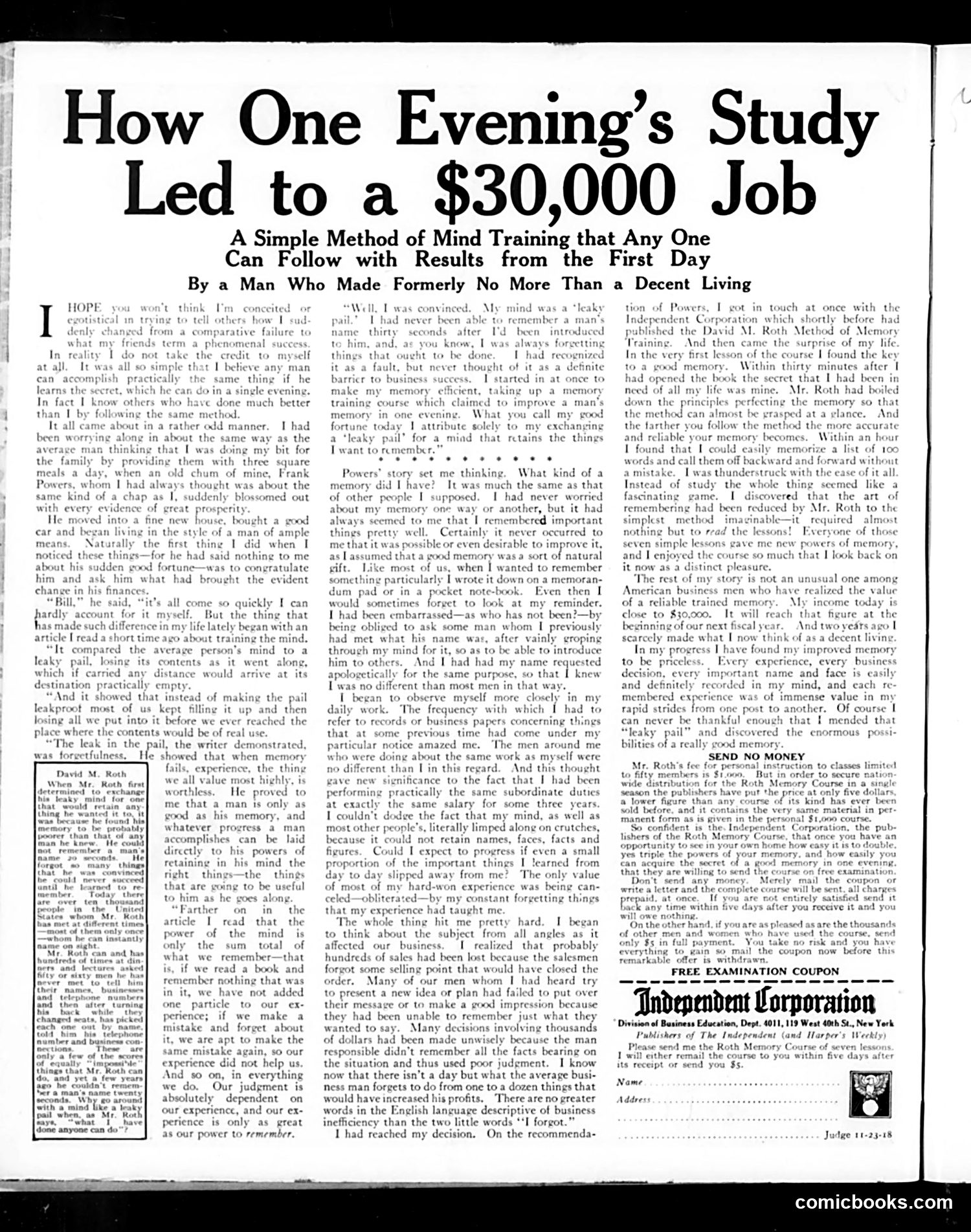
This page is primarily **advertising disguised as editorial content**—a common practice in early 20th-century magazines. It presents a testimonial for the "David M. Roth Method of Memory," a mail-order memory-training course. The article claims a man of modest means earned a $30,000 job (substantial income at the time) by studying Roth's memory system one evening. The narrative emphasizes how improved memory directly increases business success and profits. **The satire/critique:** Judge magazine, being satirical, likely intends this as **mockery of get-rich-quick schemes and mail-order courses** that proliferated in that era. The implausibly dramatic rags-to-riches story, the breathless testimonial style, and the heavy advertising component all parody the pseudoscientific self-improvement industry. The coupon at bottom ("FREE EXAMINATION COUPON") is the actual product being sold—typical of period direct-mail marketing. **For modern readers:** This represents early 20th-century consumer skepticism toward dubious self-help products, packaged as satirical editorial.