
Judge, 1918-11-23 · page 22 of 32
Judge — November 23, 1918 — page 22: what you’re looking at
What you’re looking at
This is a theater review of a patriotic pageant play titled *Freedom*, starring actress Marcia Van Dresser as Lady Liberty/Freedom. The production dramatizes American historical moments (Patrick Henry's speech, the Magna Carta, King Alfred vs. the Danes) through twenty-four scenes depicting mankind's progress toward liberty. Mackall praises the *concept*—giving the Statue of Liberty a starring role is patriotic and flattering. However, he critiques the *execution*. The script is "wobbly," and the play commits the sin of inserting modern slang and humor into historical scenarios (comparing it to Mark Twain's *A Connecticut Yankee in King Arthur's Court*). He finds particularly weak a scene where General Washington kisses Lady Liberty, making Martha jealous—a silly domestic comedy moment undermining the dignity of both historical figures and the patriotic concept. The central complaint: the production trivializes serious historical events and Liberty herself through anachronistic comedy and juvenile interruptions by child characters.
📄 Transcribed text from this page (OCR, searchable)
Machine-transcribed from the original scan — historical spelling and the odd misread are preserved.
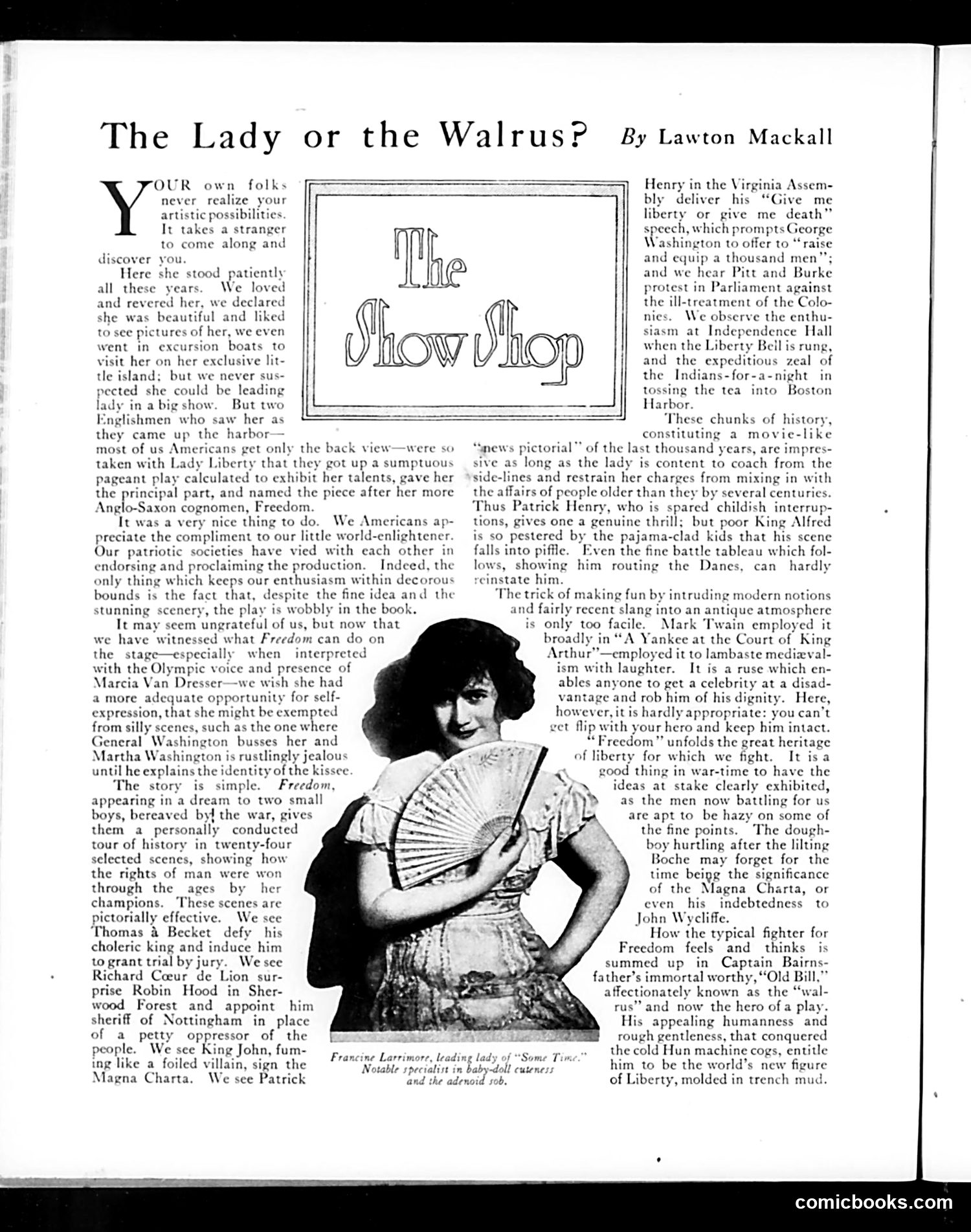
The Lady or the WalrusP By Lawton Mackall OUR own folks FR never realize your artistic possibilities It takes a stranger along and to come discover you Here she stood patiently all these years. We loved |} and revered her, we declared she was beautiful and liked to see pictures of her, we even went in excursion boats to visit her on her exclusive lit- tle island; but we never sus- pected she could be leading JLIMe Henry in the Virginia Assem- bly deliver his “Give me liberty or give me death” speech, which prompts George Washington to offer to “raise and equip a thousand men and we hear Pitt and Burke protest in Parliament against the ill-treatment of the Colo- nies. We observe the enthu- siasm at Independence Hall when the Liberty Bell is rung, and the expeditious zeal of the Indians-for-a-night in tossing the tea into Boston lady in a big show. But two a] Harbor. These chunks of history, Englishmen who saw her as they came up the harbor most of us Americans get only the back view taken with Lady Liberty that they got up a sumptuous pageant play calculated to exhibit her talents, gave her the principal part, and named the piece after her more Anglo-Saxon cognomen, Freedom It was a very nice thing to do. We Americans ap- preciate the compliment to our little world-enlightener. Our patriotic societies have vied with each other in endorsing and proclaiming the production. Indeed, the only thing which keeps our enthusiasm within decorous bounds is the fact that, despite the fine idea and the stunning scenery, the play is wobbly in the book. Tt may seem ungrateful of us, but now that we have witnessed what Freedom can do on the stage—especially when interpreted with the Olympic voice and presence of Marcia Van Dresser—we wish she had a more adequate opportunity for self- expression, that she might be exempted from silly scenes, such as the one where General Washington busses her and Martha Washington is rustlingly jealous until he explains the identity of the kissee The story is simple. Freedom, appearing in a dream to two small boys, bereaved byl the war, gives them a personally conducted tour of history in twenty-four selected scenes, showing how the rights of man were won through the ages by her champions. These scenes are pictorially effective. We sce Thomas & Becket defy his choleric king and induce him to grant trial by jury. We see Richard Coeur de Lion sur- prise Robin Hood in Sher- were so wood Forest and appoint him sheriff of Nottingham in place of a petty oppressor of the people. We see King John, fum- ing like a foiled villain, sign the Magna Charta. We see Patrick constituting a movie-like “news pictorial” of the last thousand years, are impres- sive as long as the lady is content to coach from the side-lines and restrain her charges from mixing in with the affairs of people older than they by several centuries. Thus Patrick Henry, who is spared childish interrup- . tions, gives one a genuine thrill; but poor King Alfred is so pestered by the pajama-clad kids that his scene falls into piffle. Even the fine battle tableau which fol- lows, showing him routing the Danes, can hardly reinstate him. The trick of making fun by intruding modern notions and fairly recent slang into an antique atmosphere is only too facile. Mark ‘Twain employed it broadly in “A Yankee at the Court of King Arthur”—employed it to lambaste medizval- ism with jaughesr. It is a ruse which en- ables anyone to get a celebrity at a disad- vantage and rob him of his dignity. He however, itis hardly appropriate: you can’t get flip with your hero and keep him intact. “Freedom” unfolds the great heritage of liberty for which we fight. It is a good thing in war-time to have the ideas at stake clearly exhibited, as the men now battling for us are apt to be hazy on some of the fine points. The dough- boy hurtling after the lilting Boche may forget for the time being the significance of the Magna Charta, or even his indebtedness to John Wycliffe. How the typical fighter for Freedom feels and thinks is summed up in Captain Bairns- father’s immortal worthy, “Old Bill,” affectionately known as the “wal- rus” and now the hero ofa play. His appealing humanness and rough gentleness, that conquered the cold Hun machine cogs, entitle him to be the world’s new figure of Liberty, molded in trench mud. “Som Ml cuteness comicbooks.com