
A complete issue · 32 pages · 1918
Judge — October 12, 1918
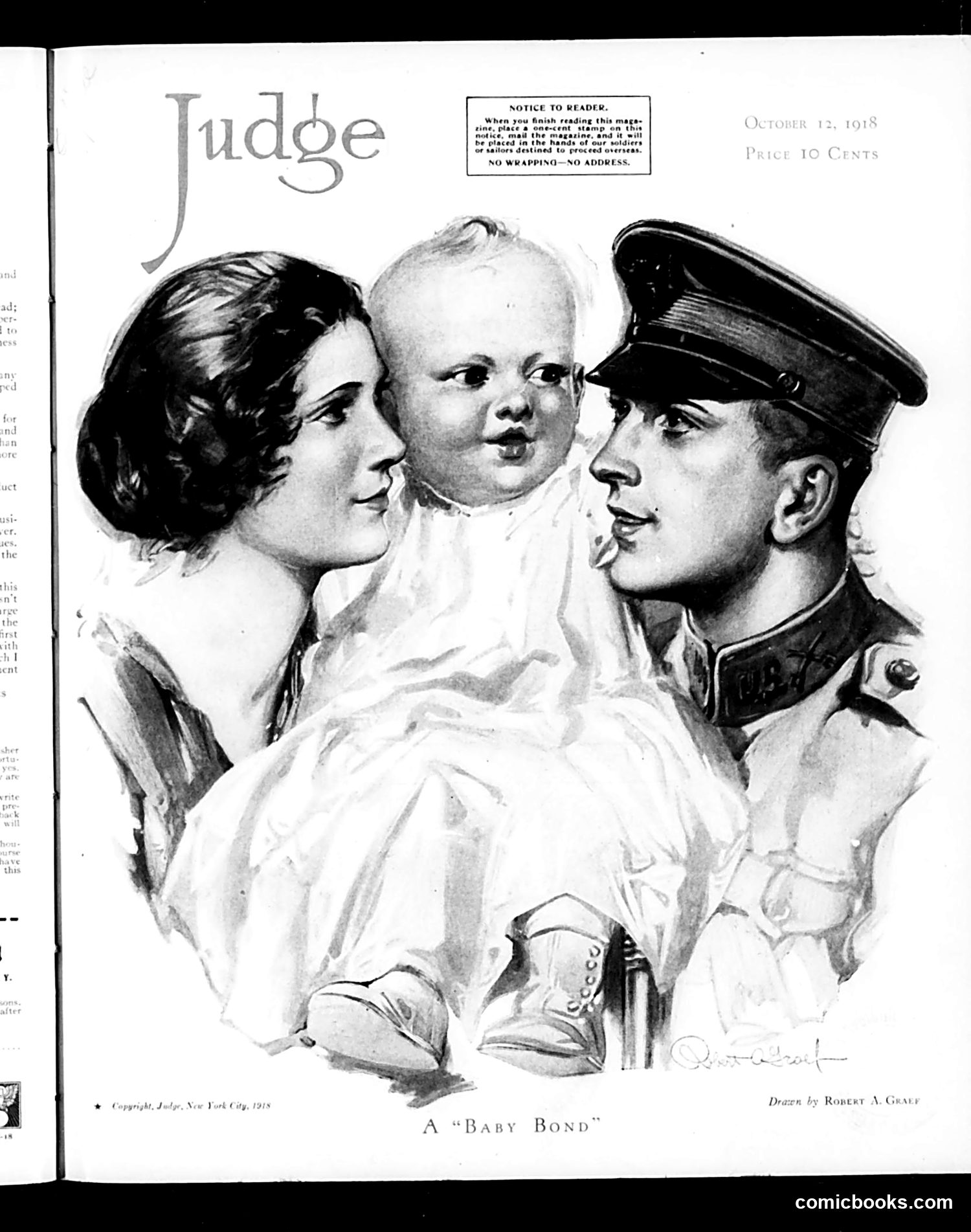
This *Judge* magazine cover from October 12, 1918 uses the title "A Baby Bond" as a double entendre. The illustration depicts a woman and man in military uniform with an infant, creating a visual pun on "bond"—simultaneously referencing both financial war bonds (which Americans were encouraged to purchase to fund WWI) and the emotional/familial bond between a soldier, civilian woman, and child. The cartoon likely satirizes the romanticized narrative of soldier-family separation during wartime, or possibly comments on the emotional appeals used to promote war bond sales. The timing—just weeks before WWI's armistice—suggests contemporary relevance to wartime patriotism and sacrifice. The artist is credited as Robert A. Graefe.
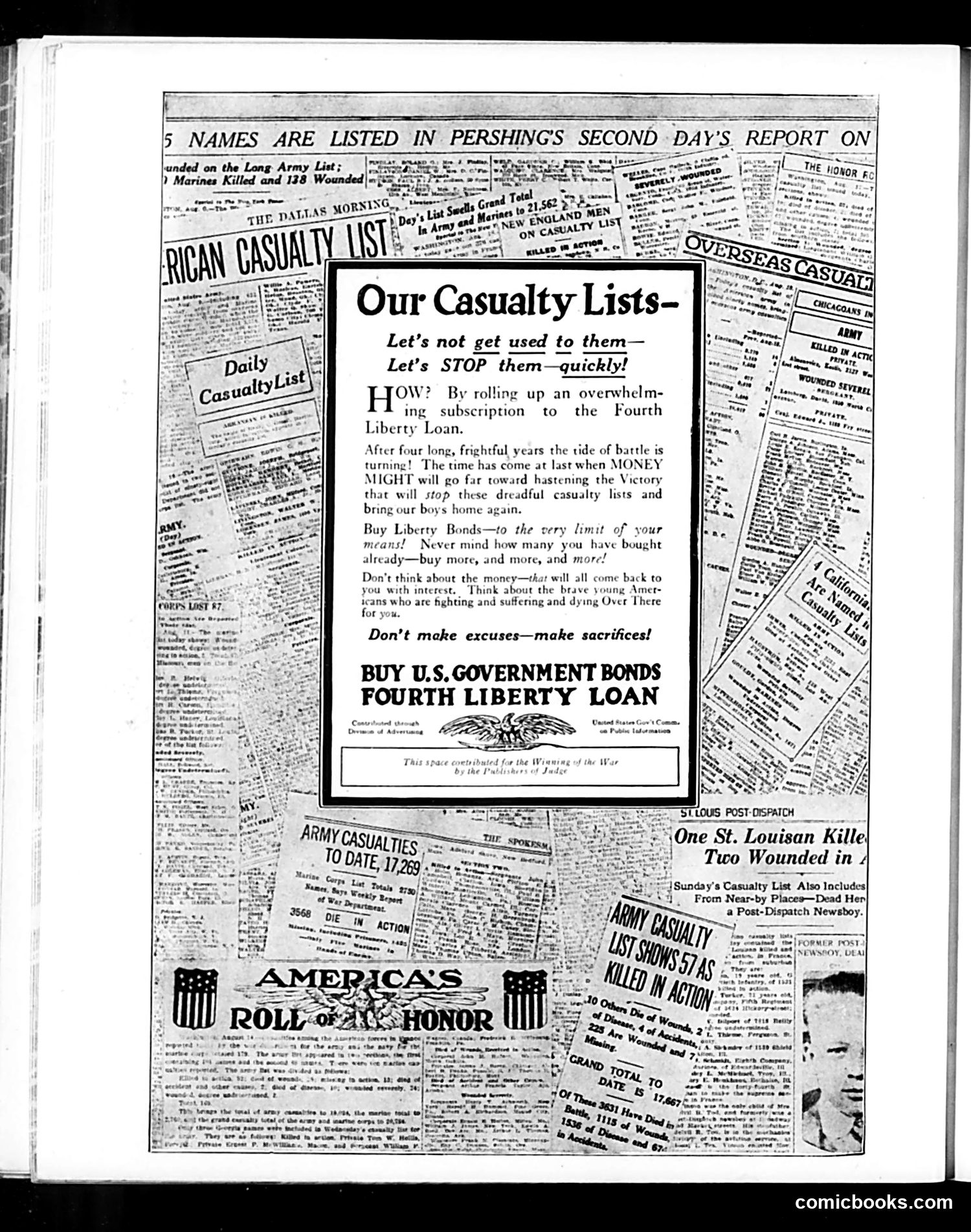
This page is **primarily a war bond advertisement**, not satire or political cartoon. The central element is a government propaganda poster urging Americans to purchase Fourth Liberty Loan bonds. The poster's message is direct: stop casualty lists by financing the war effort to achieve quick victory. The surrounding newspaper clippings—showing actual casualty lists from various publications—serve as visual evidence of the human cost of the ongoing conflict. By framing these grim headlines around the bond advertisement, the page emotionally manipulates readers: investing money will theoretically reduce deaths and bring soldiers home. This appears to be from **World War I era** (references to "four long, frightful years" suggest 1918). The page conflates financial sacrifice with patriotism, a common propaganda technique.
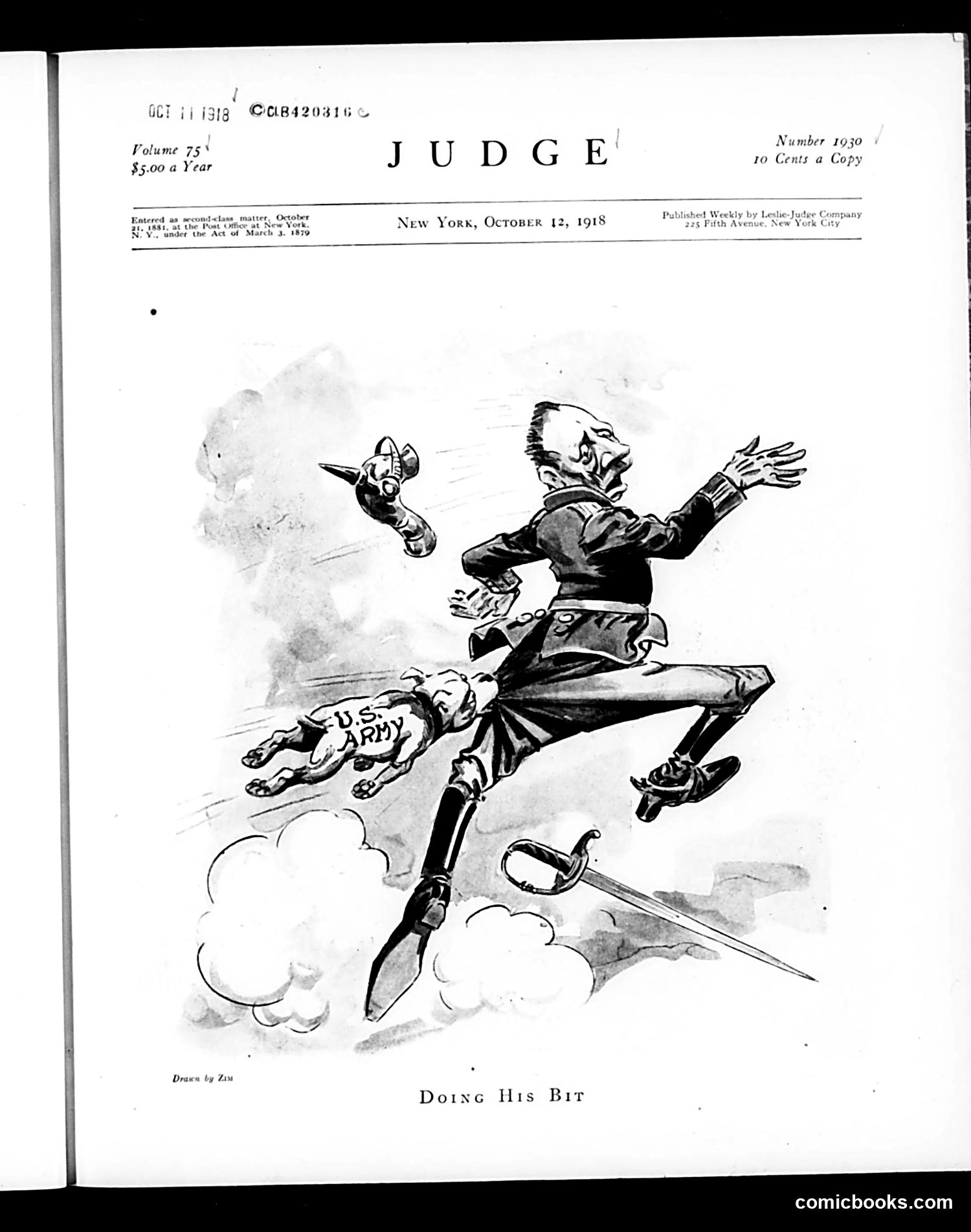
This cartoon depicts a military officer performing an acrobatic juggling act while riding a missile or artillery shell downward through clouds. He's juggling a bomb and what appears to be military equipment. Below him, a dog labeled "U.S. ARMY" follows along. Published during World War I (just before the November 1918 armistice), the title "Doing His Bit" sarcastically comments on wartime military leadership. The precarious juggling act—combined with the downward trajectory—suggests the cartoonist is critiquing either military incompetence, the chaotic nature of war strategy, or perhaps ridiculing officers who appeared to be recklessly improvising rather than executing coherent plans. The loyal dog following represents the enlisted troops who must follow orders.
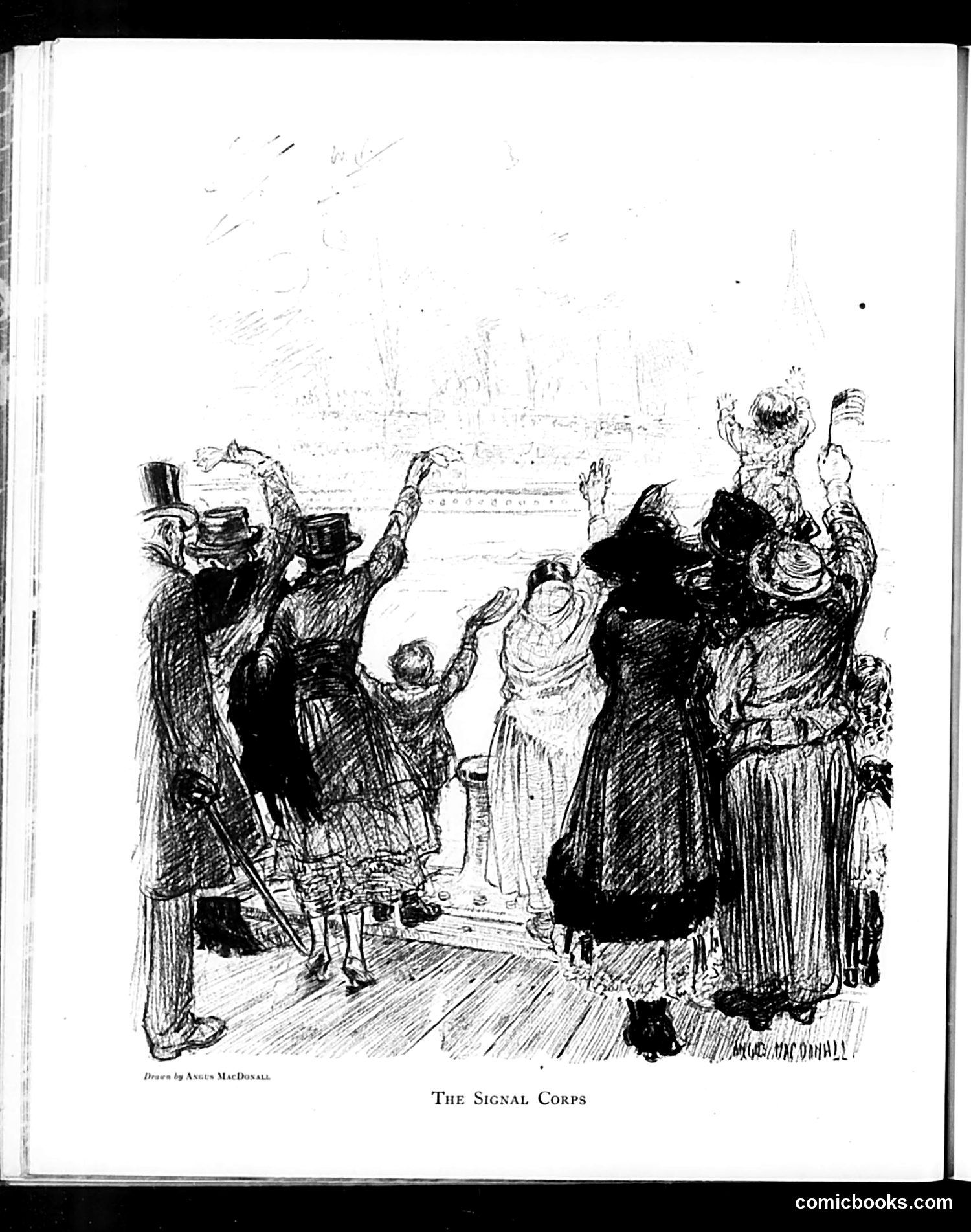
This cartoon by Agnes MacDonald satirizes what appears to be a military or governmental communication/signaling group, titled "The Signal Corps." The sketch shows formally dressed figures—men in top hats and coats alongside women—engaged in animated gestures and raised arms, as if sending signals or semaphore. The satire likely mocks either incompetence, confusion, or the absurdity of actual Signal Corps operations (a real U.S. Army unit). The mixed group of civilians and formally dressed individuals, combined with their exaggerated, uncoordinated gestures, suggests the cartoon ridicules either disorganization, amateur bungling, or perhaps satirizes the inclusion of women in military roles—a contentious social issue in the early 20th century when Judge magazine was prominent.
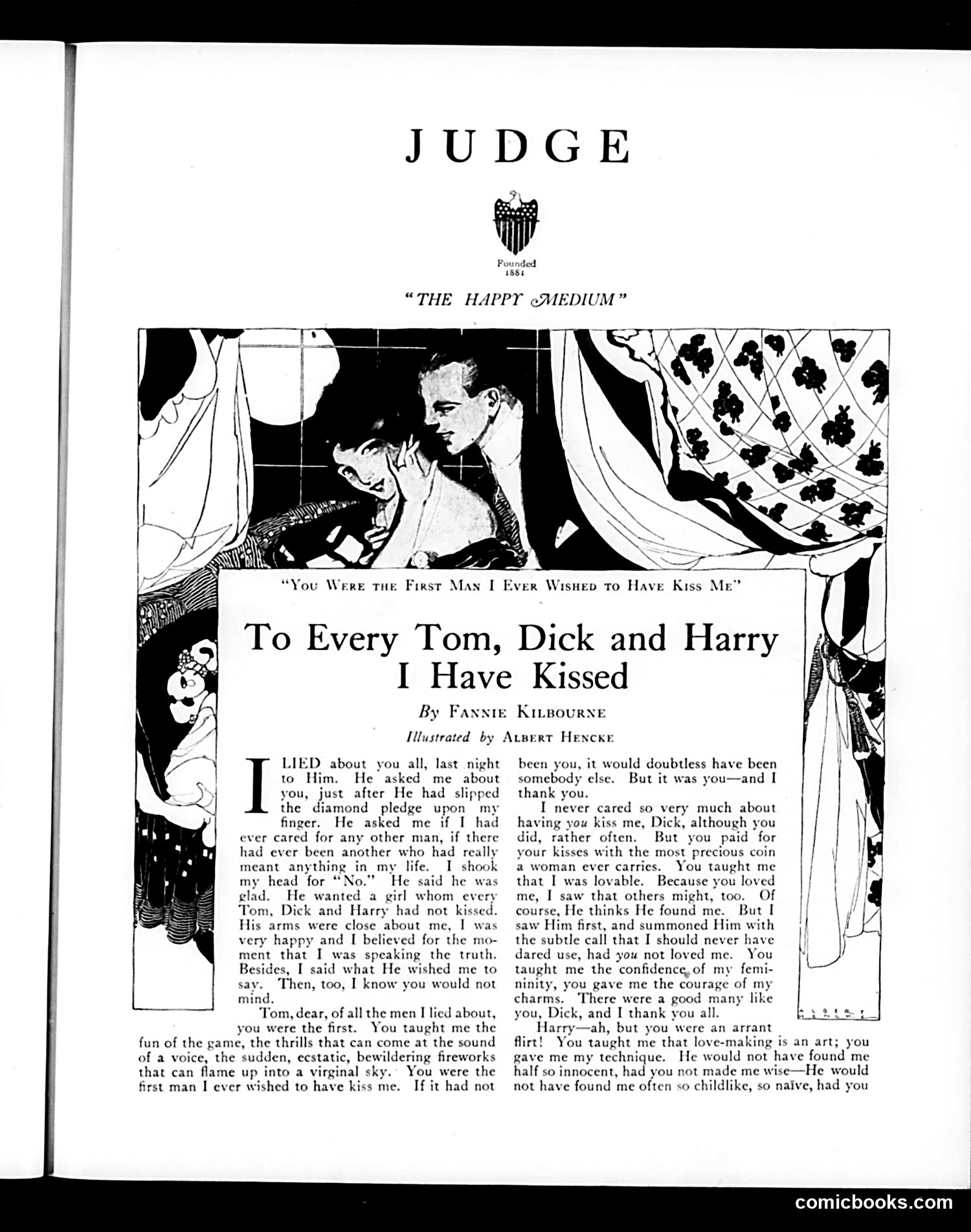
This page contains a short story titled "To Every Tom, Dick and Harry I Have Kissed" by Fannie Kilbourne, illustrated by Albert Hencke. It is **not political satire or social commentary**. Rather, it's a humorous romantic confession addressed to multiple former romantic partners. The narrator—a woman—reflects on her kissing relationships with various men named Tom, Dick, and Harry, crediting each with teaching her something about love and affection. The piece uses the "Tom, Dick, and Harry" phrase (meaning "every ordinary man") as a playful framework. The illustration shows an intimate scene between a couple. This appears to be entertainment content typical of Judge magazine's lighter fare—romantic humor aimed at adult readers rather than political critique.
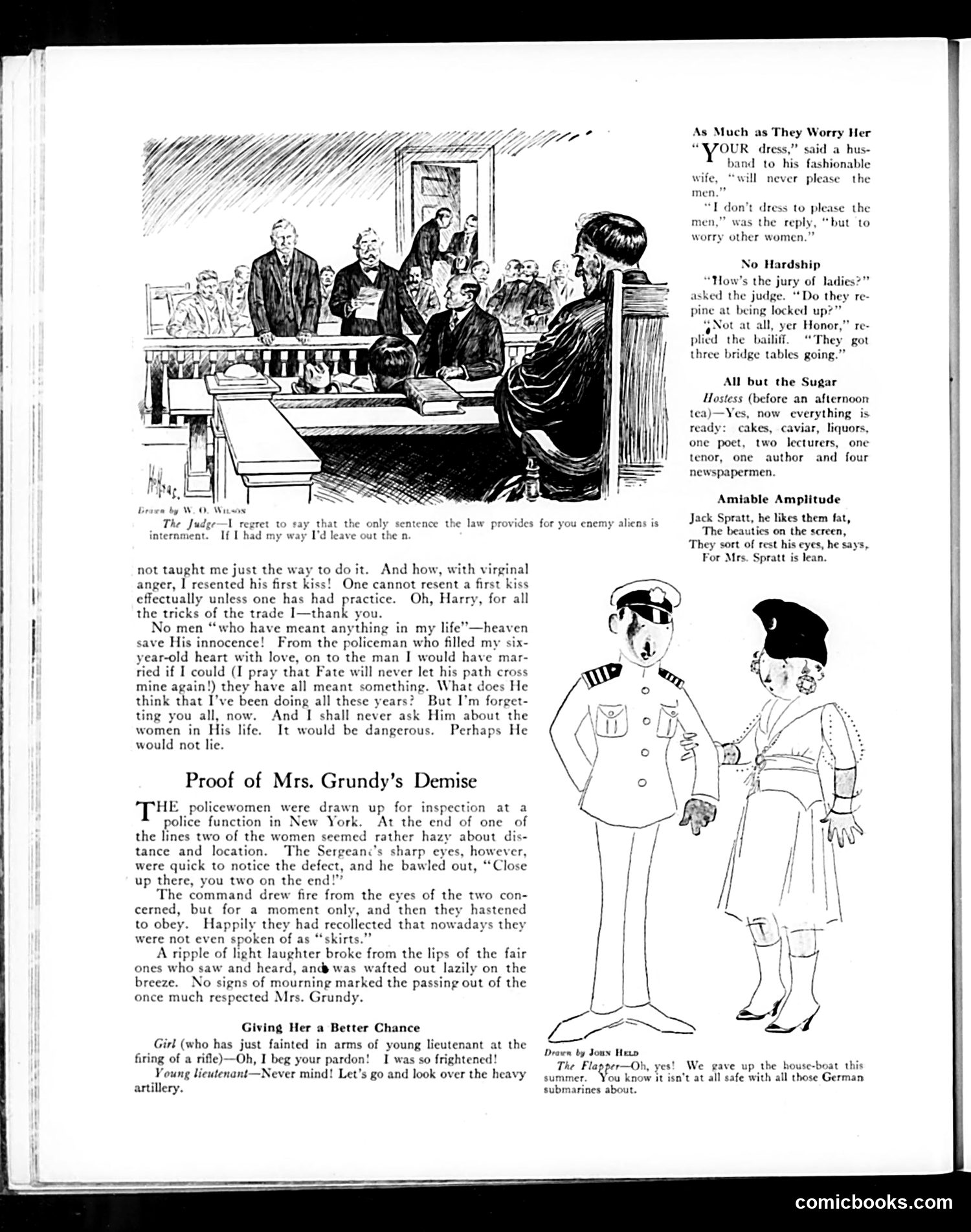
The main cartoon depicts a courtroom scene titled "Proof of Mrs. Grundy's Demise." It shows policewomen testifying at a New York police function about their duties and locations. The joke satirizes "Mrs. Grundy"—a Victorian-era personification of rigid social propriety and moral respectability. The caption's punchline involves the sergeant objecting to the women's testimony with "Close up there, you two on the end!"—suggesting these policewomen violate traditional notions of feminine decorum simply by existing in public professional roles. The surrounding text snippets mock women's fashion choices and social anxieties, reinforcing the cartoon's theme: modern women's participation in previously male-dominated spaces represents the death of old-fashioned social conventions. This likely dates to the early 20th century, when women first entered policing.
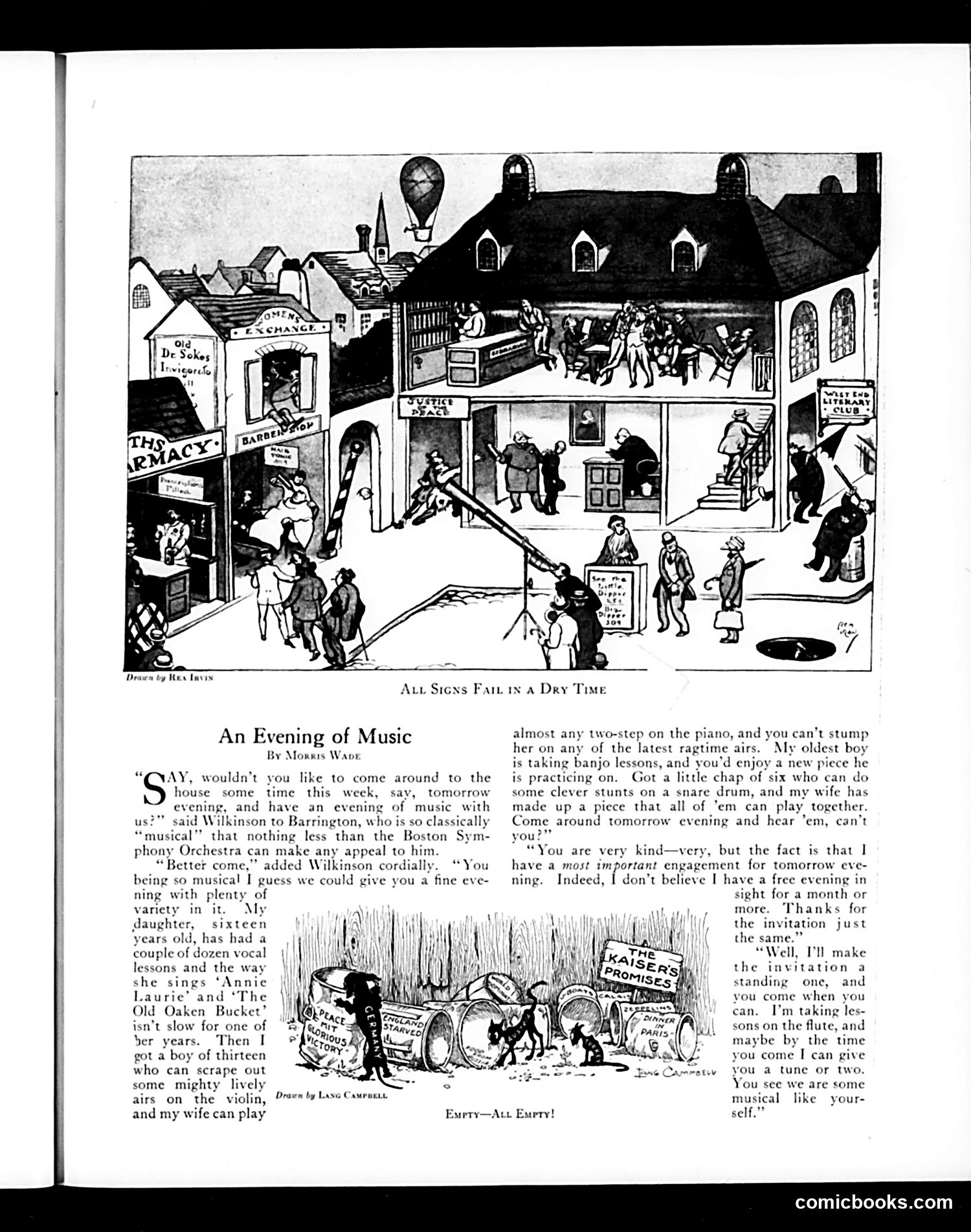
This satirical piece mocks the pretensions of amateur musicians and the social obligation of accepting dinner invitations. **The Setup:** Wilkinson invites the snobbish "classically musical" Barrington to an evening of home music-making. Wilkinson then earnestly catalogs his family's musical activities—his daughter's vocal lessons, his son's violin "airs," his wife's ragtime piano playing, his oldest boy's banjo, his youngest child's snare drum, and his own newly-begun flute lessons. **The Satire:** The joke targets Wilkinson's obliviousness to how amateurish and cacophonous this "variety" would sound. He's genuinely proud of these humble accomplishments while Barrington—who requires a professional symphony orchestra to be satisfied—obviously finds the prospect excruciating and invents an excuse to escape. **Social Commentary:** Judge ridicules both the self-deluding amateur musician who overestimates family talent, and the insufferable snob who cannot appreciate earnest domestic efforts. The piece satirizes middle-class social anxiety and the gap between musical aspiration and actual ability.
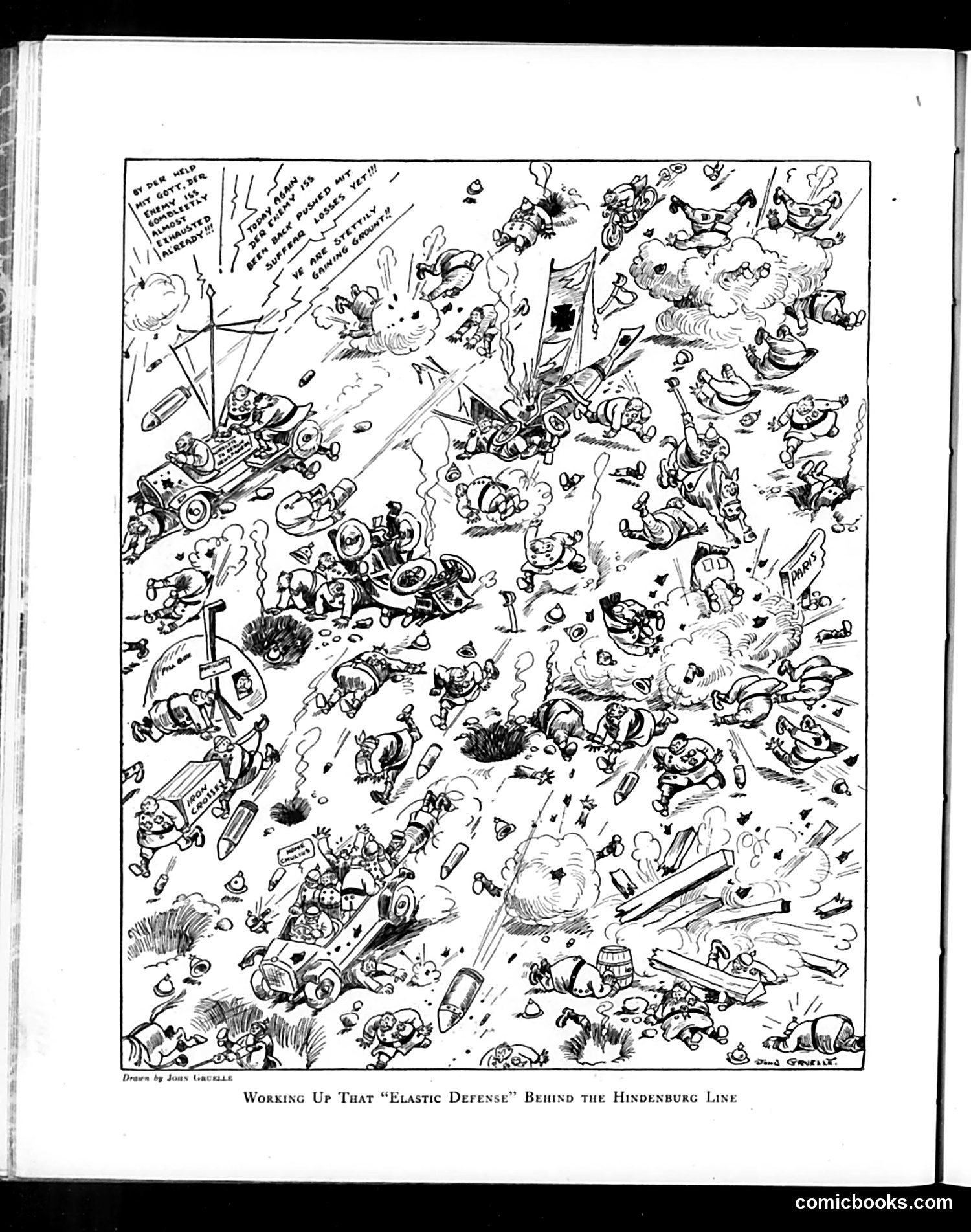
This satirical cartoon depicts chaotic military activity behind Germany's Hindenburg Line defensive fortifications during World War I. The title "Working Up That 'Elastic Defense' Behind the Hindenburg Line" references Germany's tactical strategy of flexible, elastic defense rather than static trench warfare. The cartoon satirizes German war preparations through exaggerated, frenzied imagery: soldiers, vehicles, artillery, and equipment scattered in apparent disorganization. The packed, overwhelming composition suggests either massive military mobilization or incompetence—likely mocking German defensive capabilities. The speech bubble (text unclear in OCR) appears to provide commentary, possibly expressing confidence or ironic skepticism about German preparations. Published in *Judge*, this reflects American wartime sentiment, presenting German military efforts as either futilely chaotic or desperately improvised. The "elastic defense" concept, historically a German strategic doctrine, becomes the cartoon's target for ridicule.
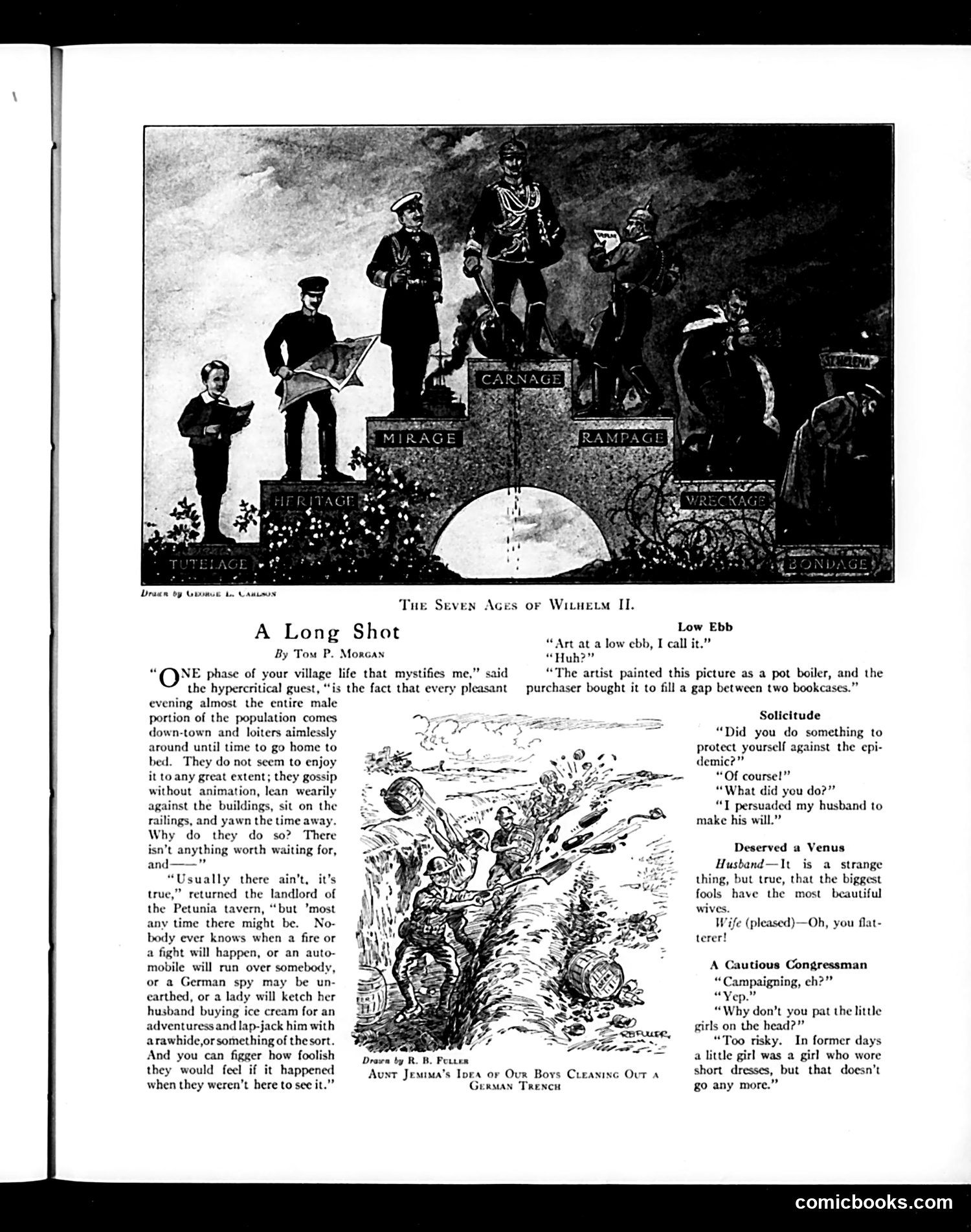
This page contains multiple short humorous pieces typical of Judge's satirical style: **"A Long Shot"** depicts village social life during WWI-era America (references to "German spy" suggest the period). The joke: villagers gather downtown nightly not for entertainment but in hopes of witnessing excitement—fires, fights, car accidents, or scandals. The humor satirizes small-town boredom and people's morbid fascination with disaster. **"The Seven Ages of Wilhelm II"** (top illustration) appears a political allegory showing Kaiser Wilhelm II's military progression through different ranks/stages, likely satirizing German military hierarchy. The remaining pieces are brief comedic vignettes mocking social conventions: a wife's pragmatism regarding epidemics (making her husband write a will), a politician's fear of impropriety when interacting with children due to changing dress standards, and commentary on artistic mediocrity. The tone throughout is lighthearted domestic satire rather than hard-hitting political commentary.
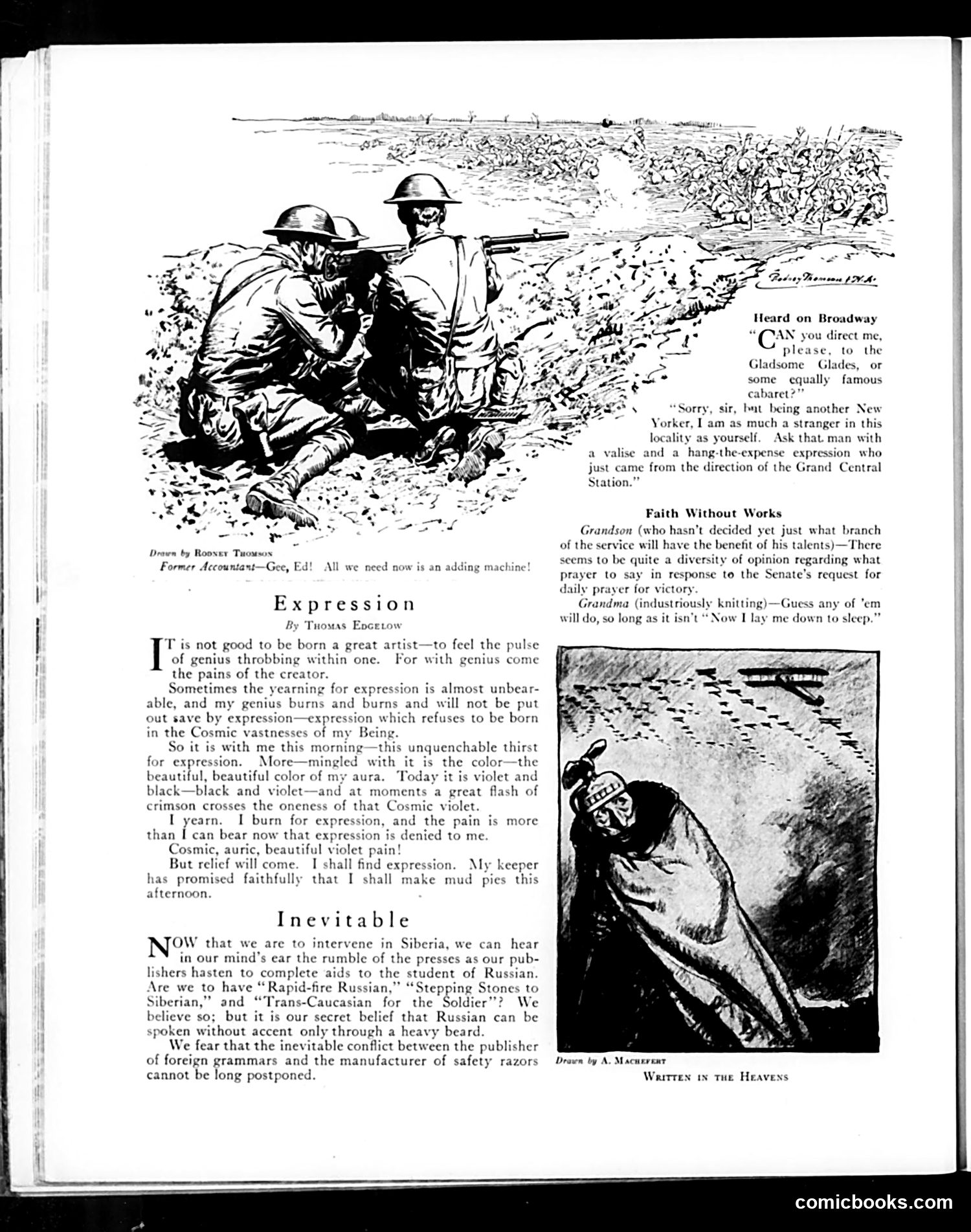
This page contains three satirical pieces from Judge, likely WWI-era (references to Siberian intervention and military service suggest 1918): **Top cartoon**: Two soldiers in a trench ask directions from a well-dressed man with a suitcase. The joke mocks wealthy New Yorkers visiting the front—even this affluent visitor from Grand Central Station is as lost as the soldiers, suggesting the absurdity of civilians treating wartime like tourism. **"Faith Without Works"**: A grandson undecided about military service asks his grandmother what prayer to use for victory. She knits while suggesting any prayer works "so long as it isn't 'Now I lay me down to sleep'"—mocking hollow patriotic sentiment and the contradiction between religious faith and actual commitment to war effort. **"Expression"** and **"Inevitable"**: These are humorous essays. The first satirizes pretentious artistic temperament (a patient in an asylum blaming his keeper for preventing "expression" through mud pies). The second jokes that U.S. intervention in Siberia will spawn numerous language-learning books, but adds a punchline: Russians need heavy beards to speak their language properly—a dig at masculine stereotypes.
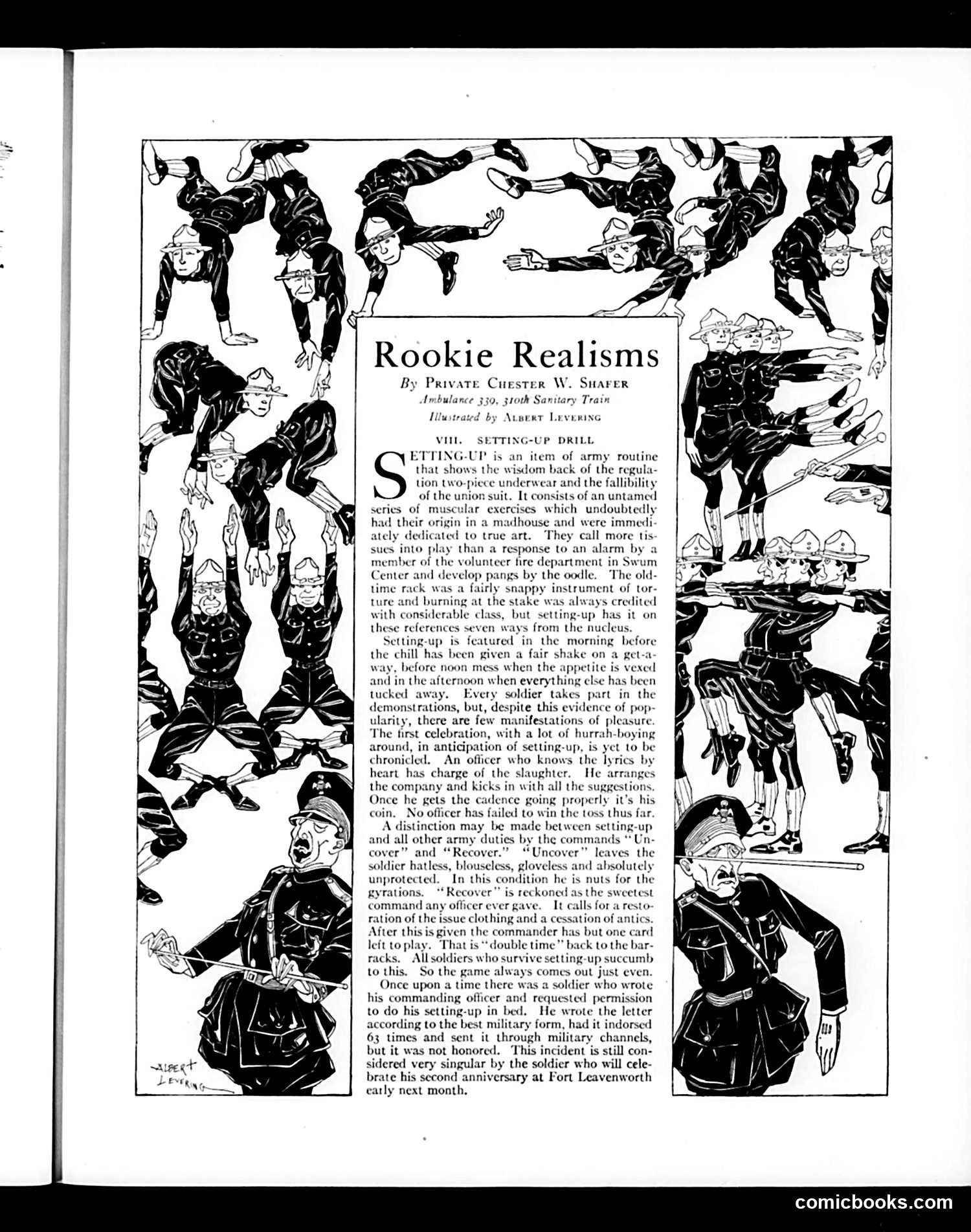
This is a humorous military article from Judge magazine, illustrated with cartoons showing soldiers performing calisthenics. The piece, attributed to "Private Chester W. Shafer" of the 310th Sanitary Train during World War I, satirizes the army's mandatory physical exercises ("setting-up drill"). The joke is that these exercises—performed at awkward times (early morning, before meals, afternoon) in various states of undress per regulation—are presented as simultaneously pointless torture and universal military routine. The illustrations show soldiers contorting themselves in uncomfortable positions. The humor culminates in an anecdote about a soldier who formally requested (through proper military channels, endorsed 63 times) to do his exercises in bed—a request denied, leaving him bitter enough to mention it months later. The satire mocks both the absurdity of military discipline and soldiers' helpless resignation to it.
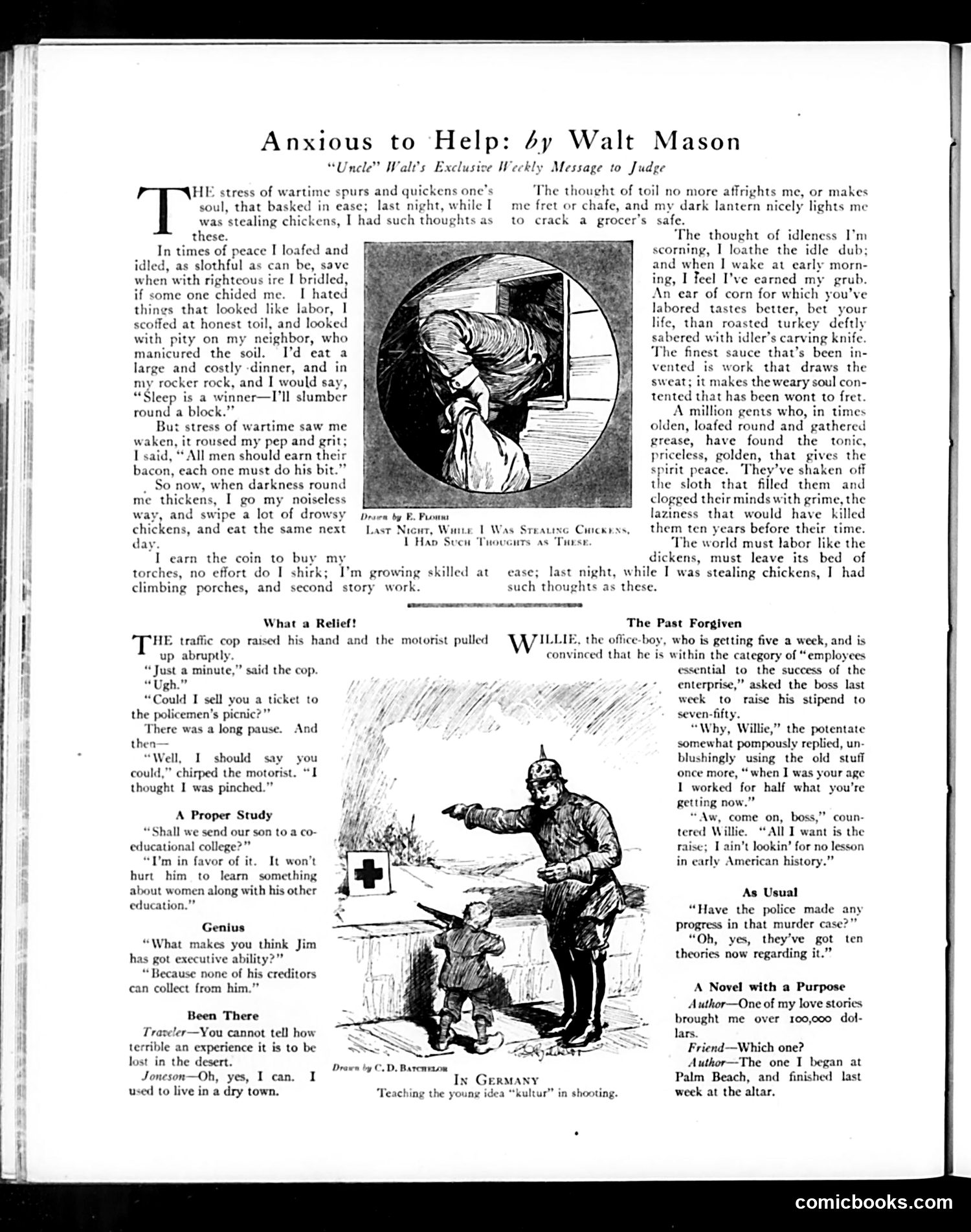
This page from Judge magazine contains satirical humor reflecting WWI-era American attitudes: **"Anxious to Help"** (main piece by Walt Mason): A ironic narrative where a previously lazy man, inspired by wartime rhetoric about contributing to the war effort, now engages in petty crime—stealing chickens and robbing safes—claiming he's "earning his coin" and avoiding idleness. The satire mocks how patriotic wartime messaging about labor and sacrifice could be twisted to justify criminal behavior, or how some people performatively embrace "hard work" while actually doing harmful things. **Side jokes** include crude humor about traffic stops, college education, and an illustration labeled "In Germany" showing military "kultur" training a child in shooting—mocking German militarism. The satire targets American hypocrisy: how wartime moral exhortations could cloak selfish or criminal motives, and how people might exploit patriotic language for personal gain. The humor is dark but period-typical for a satirical magazine during WWI.
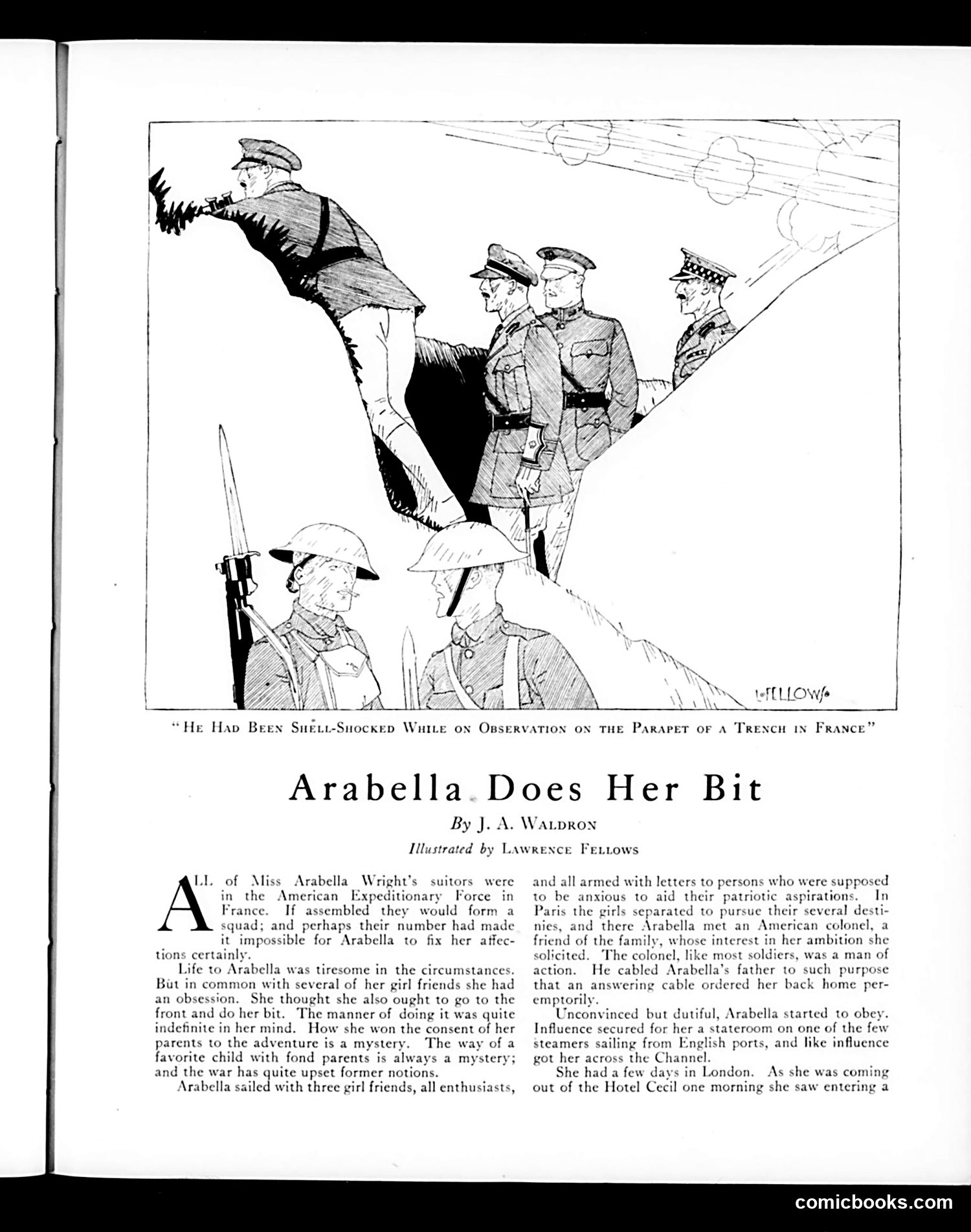
This is a story illustration, not a political cartoon, from the WWI era. The narrative satirizes American women who wished to "do their bit" for the war effort by going to France. The story follows Miss Arabella Wright, who has multiple suitors in the American Expeditionary Force and, bored with domestic life, decides she too should contribute to the war. With her girl friends, she travels to France armed with letters of introduction from influential contacts. She meets an American colonel who, impressed by her patriotic ambitions, cables her father—who promptly orders her home. The satire targets the earnest but naive patriotism of young women wanting to participate in the war, and perhaps their expectation that influential connections could secure meaningful war work. The illustration shows military officers observing a soldier shell-shocked in a trench, emphasizing the contrast between romantic war enthusiasm and grim combat reality.
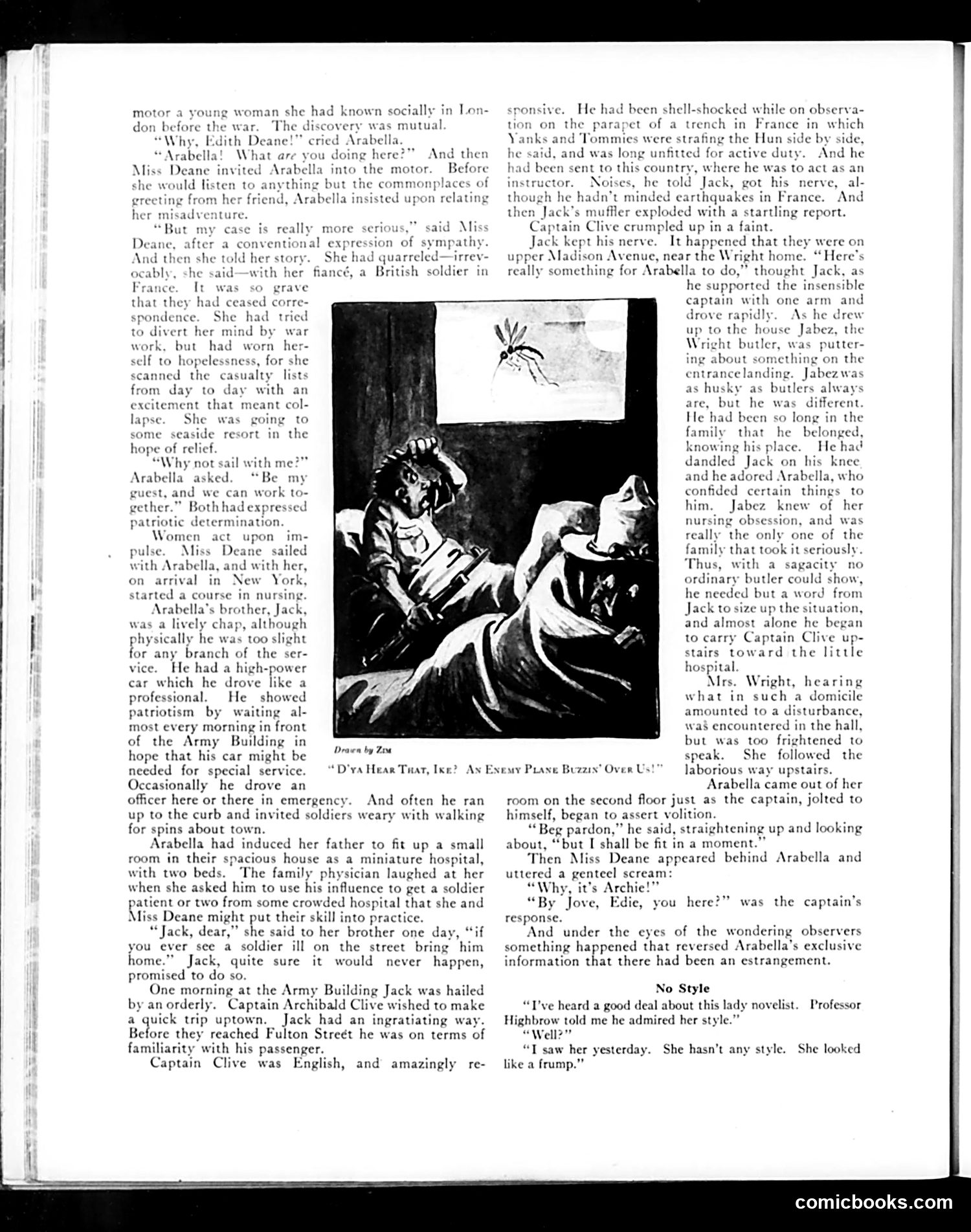
This page from *Judge* magazine presents a WWI-era domestic comedy. The illustrated cartoon, captioned "D'ya Hear That, Ike? An Enemy Plane Buzzin' Over Us!", depicts a shell-shocked soldier reacting violently to a loud noise—likely a car backfire—believing it's enemy fire. The accompanying story narrates how Jack, a patriotic young man with a powerful automobile, befriends Captain Archibald Clive, an English officer recovering from shell shock contracted in the trenches. When Jack's car muffler explodes, the traumatized captain faints. Jack rushes him to his sister Arabella's improvised home hospital, where the family's longtime butler Jabez helps carry the captain upstairs. **The satire targets** the social anxieties of the era: shell shock (then poorly understood), the contrast between actual combat trauma and civilian patriotism, and how well-meaning Americans attempt to assist wounded soldiers. The humor derives from the gap between earnest patriotic intentions and the messy reality of war's psychological toll.
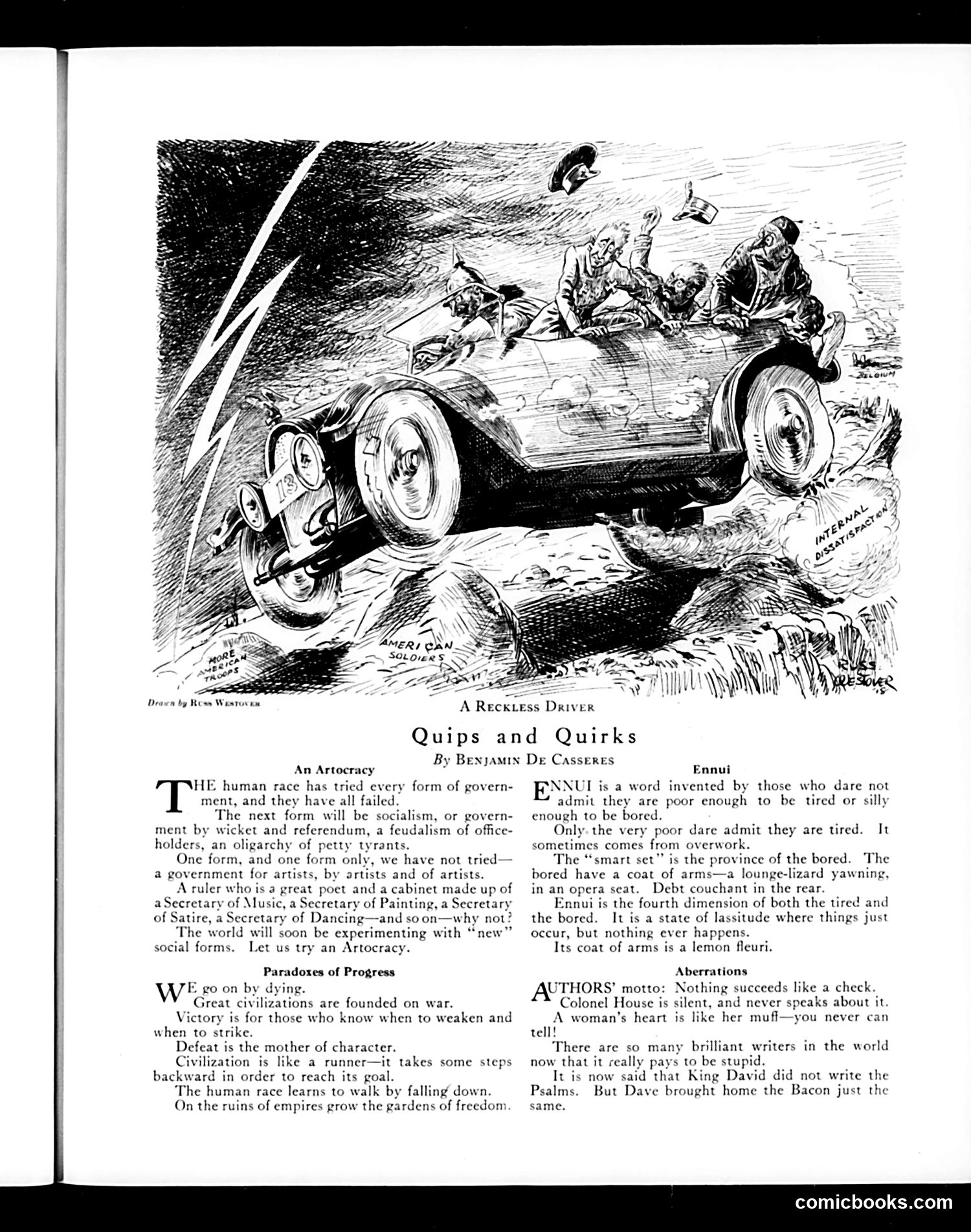
The cartoon depicts a car that has crashed into a tree, with passengers scattered about. The sketch satirizes dangerous driving—a modern hazard of the automobile age. The accompanying text by Benjamin De Casseres presents philosophical "quips and quirks" on contemporary topics. "An Artocracy" proposes (satirically) that since all government forms have failed, society should try rule by artists and poets. "Paradoxes of Progress" offers ironic observations on civilization—that great societies are founded on war, defeat builds character, and empires' ruins become gardens of freedom. "Ennui" mocks wealthy elites who claim boredom as a status symbol while only the poor admit exhaustion. "Aberrations" contains witty one-liners poking fun at writers, politicians (Colonel House—likely Woodrow Wilson's advisor), and biblical scholarship trends. The satire targets early 20th-century intellectual pretension and social hypocrisy.
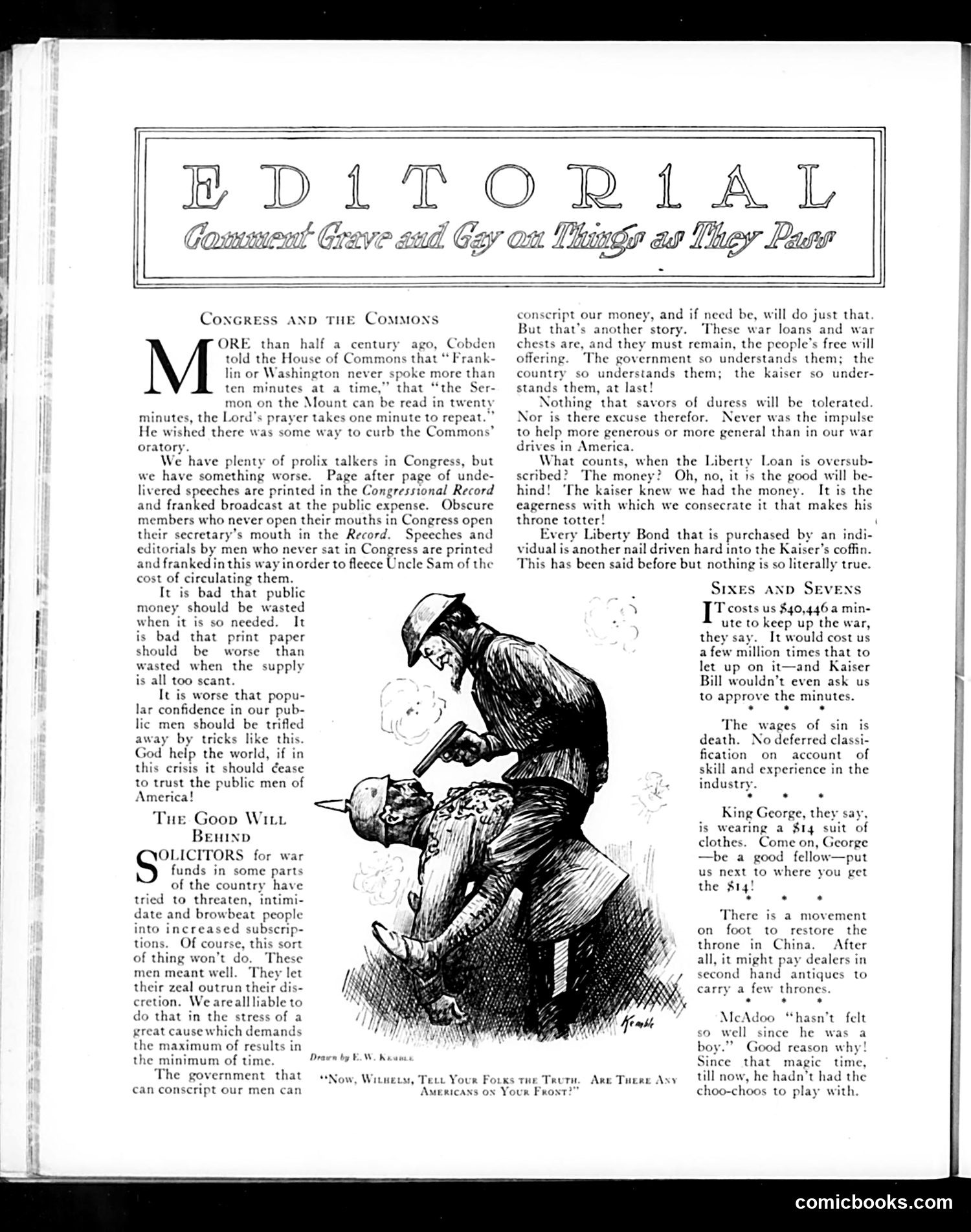
This editorial page contains three satirical pieces criticizing American public institutions during World War I: **"Congress and the Commons"** attacks wasteful spending: Members deliver speeches never actually given, which are then printed in the Congressional Record and mailed free using congressional franking privileges—squandering public money and paper during wartime scarcity. **"The Good Will Behind Solicitors"** condemns aggressive tactics used to pressure citizens into buying Liberty Bonds. While approving voluntary war fundraising, the author objects to intimidation and coercion, arguing that genuine public enthusiasm—not force—demonstrates America's strength against the Kaiser. **"Sixes and Sevens"** is a humor column mocking various figures and situations: the war's staggering cost, traditional sin/death consequences, King George's expensive clothing, potential Chinese monarchy restoration, and Treasury Secretary McAdoo's alleged happiness now that he controls railroads. The large illustration depicts a soldier or worker, likely commenting on wartime sacrifice and labor.
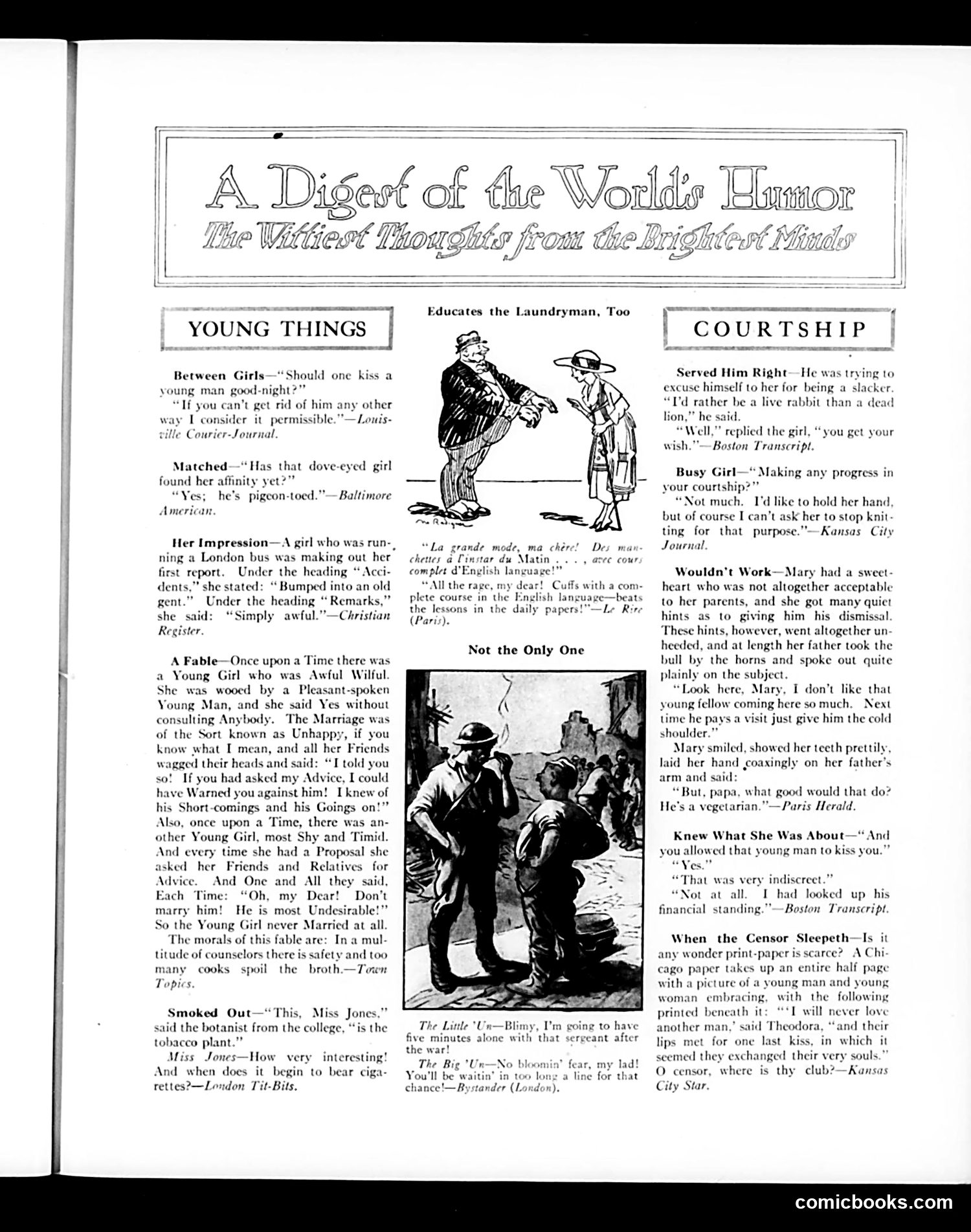
This page collects brief humorous anecdotes and jokes organized by topic—"Young Things," "Courtship," and related matters. The content reflects early 20th-century social attitudes about courtship, gender roles, and domestic life. **Key themes:** - **Gender dynamics**: Women are portrayed as indecisive, needing advice on romance, or strategically using femininity (the girl who mentions her suitor is "vegetarian" to avoid dismissal). - **Social commentary**: One fable satirizes women who either marry hastily or never marry due to excessive advice-seeking—mocking both extremes. - **Wartime reference**: A "slacker" joke reflects WWI-era criticism of men avoiding military service. - **The "Censor" joke**: Critiques paper rationing during wartime by noting a Chicago newspaper wastes precious print space on a sentimental romantic image. The humor relies on observational jokes about courtship conventions, female indecision, and contemporary anxieties, presented in a light, satirical tone typical of Judge magazine's social commentary.
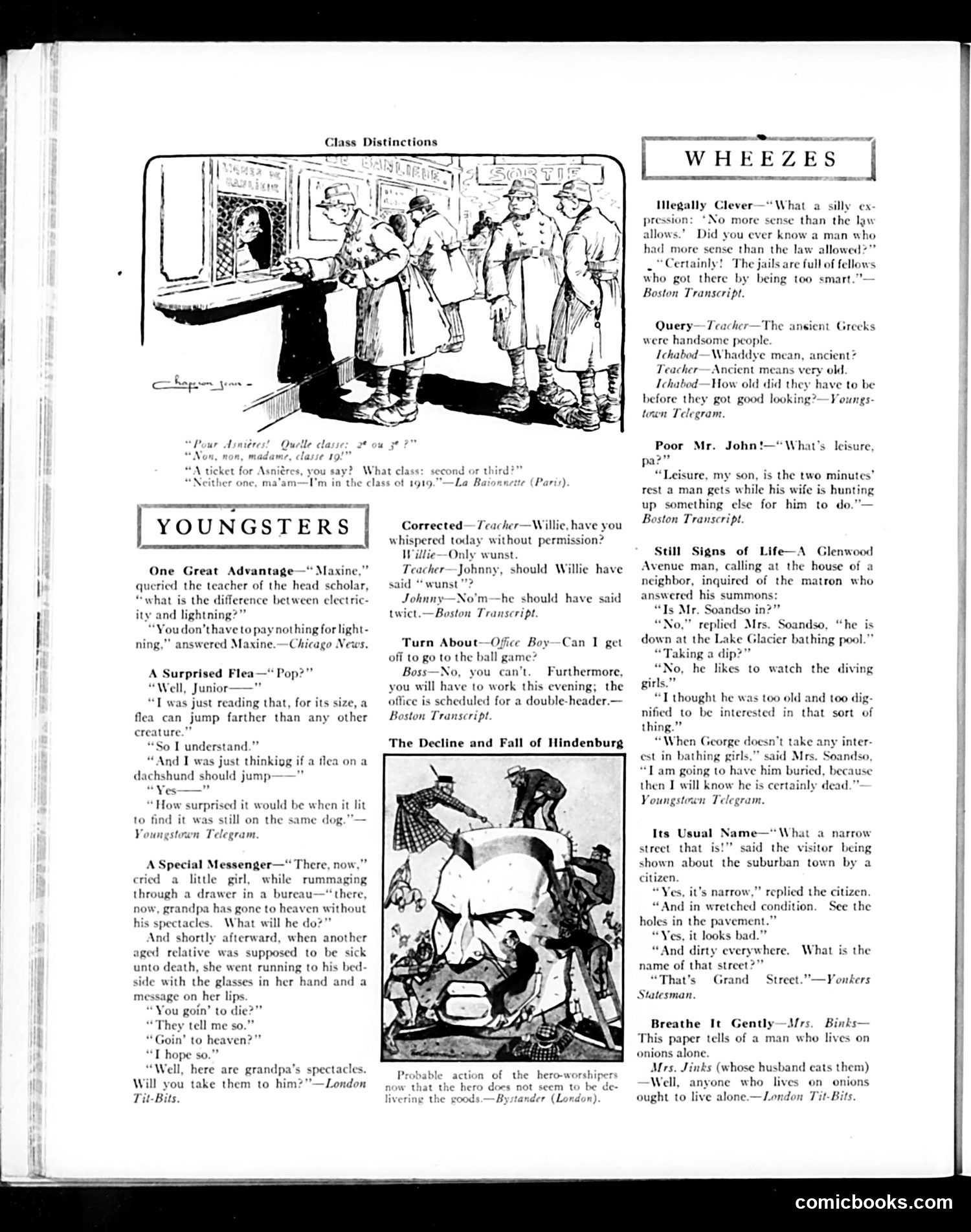
This page from *Judge* magazine contains several humor sections typical of early 20th-century American satirical publications: **"Class Distinctions"** (top cartoon): Shows working-class men being turned away from what appears to be an exclusive establishment. The joke plays on social hierarchy—the wealthy woman inside represents a class barrier the men cannot cross, satirizing rigid class divisions of the era. **"The Decline and Fall of Hindenburg"** (center cartoon): References Paul von Hindenburg, the German military leader. The image shows figures dismantling or damaging a large bust/monument, likely satirizing Germany's defeat in World War I and the collapse of German authority. **Text sections** ("Youngsters," "Wheezes"): Short joke columns featuring children's naive logic, teacher-student exchanges, and domestic humor—common filler content in period magazines. The overall page reflects *Judge*'s formula: combining visual political satire with brief topical jokes and mild domestic humor to entertain educated American readers concerned with current events and social commentary.
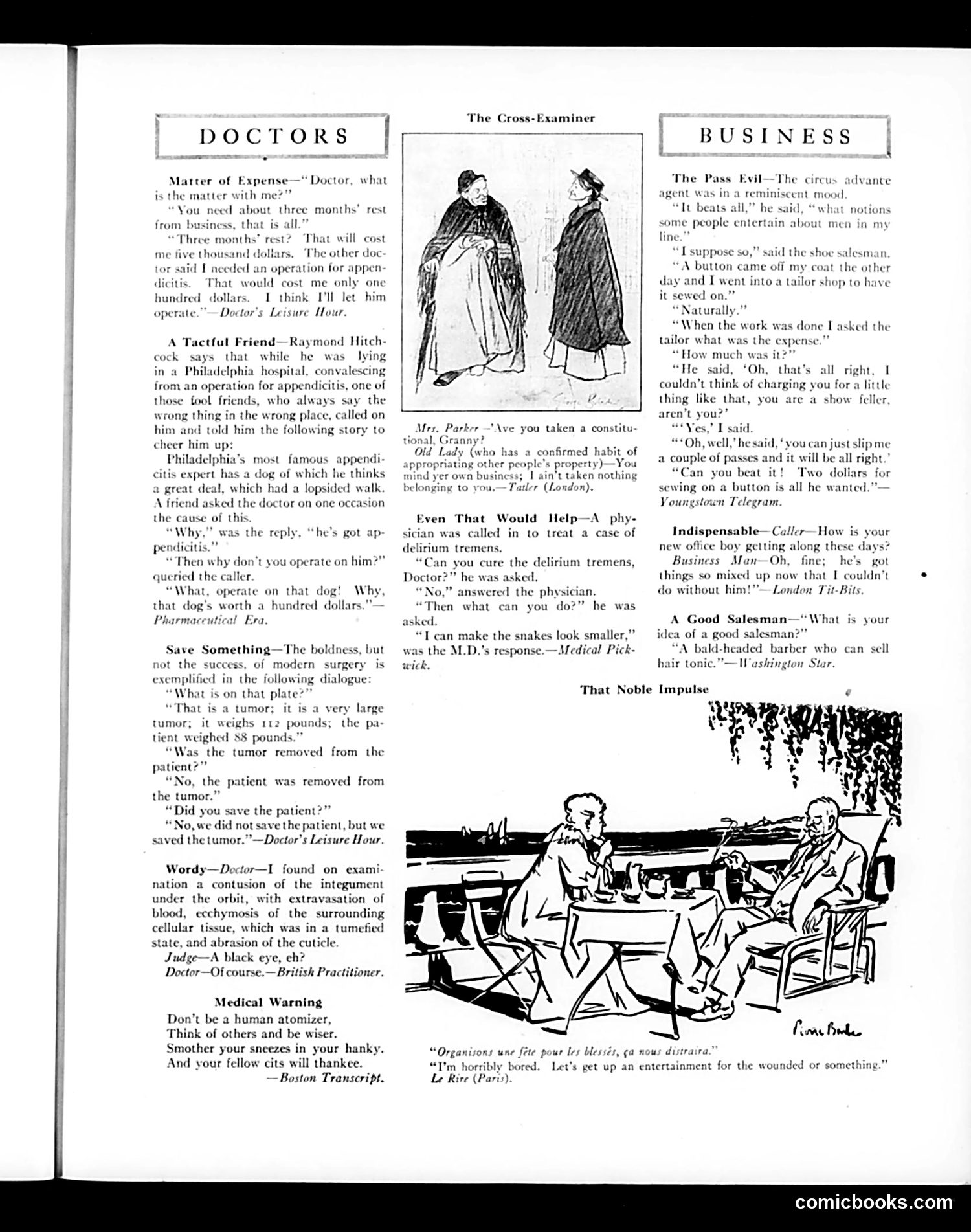
This page contains humor columns about doctors and business, plus a cartoon. The satire reflects early 20th-century anxieties: **"Matter of Expense"** mocks how prohibitively expensive surgery was—a patient would rather risk appendicitis than pay $5,000 for rest, yet chooses a $100 operation. **"Save Something"** darkly jokes about modern surgery's callousness: doctors saved the tumor, not the patient—absurdist humor about medical incompetence. **"The Pass Evil"** (bottom right cartoon) shows circus advance agents exploiting small-town merchants' desire for free circus passes. The tailor won't charge money but demands free admission—satirizing how entertainers expect perpetual free perks. **The French cartoon** depicts wealthy Parisians suggesting entertainment for wounded soldiers purely to cure their own boredom—cynical commentary on performative charity masking indifference. Throughout, the satire targets professional greed, medical hubris, and the self-interested nature of supposedly charitable impulses.
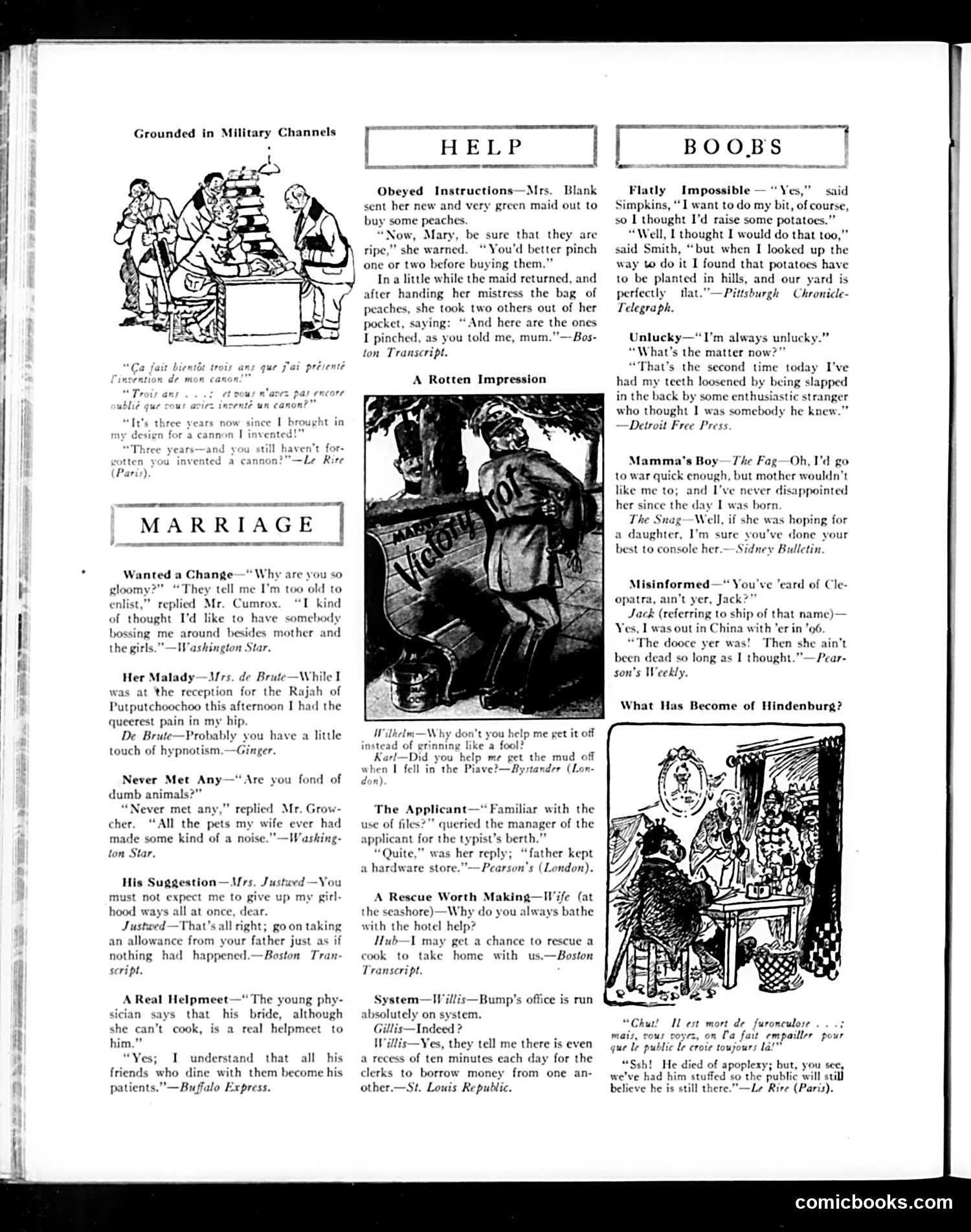
This page collects brief satirical anecdotes mocking various social types during the WWI era. The **"Marriage"** section ridicules domestic relationships: a man eager to enlist to escape his wife and mother-in-law; a society woman obsessing over trivial ailments; a husband annoyed by his wife's noisy pets; a newlywed wife refusing to abandon her allowance. The **"Help"** section targets servants and working-class incompetence: a maid literally pinching peaches as instructed, misunderstanding the order; a typist claiming familiarity with "files" because her father ran a hardware store. The **"Boobs"** section features various fools: men too lazy to grow potatoes properly; an unlucky fellow repeatedly struck by strangers; a cowardly "mama's boy" unwilling to enlist; a man misinformed about historical figures. A cartoon depicts **Hindenburg** (German WWI general) as a taxidermied corpse, a dark joke about his death and Germany's defeat—reflecting American wartime sentiment. The page reflects 1910s-1920s attitudes toward gender roles, class, military service, and enemy nations.
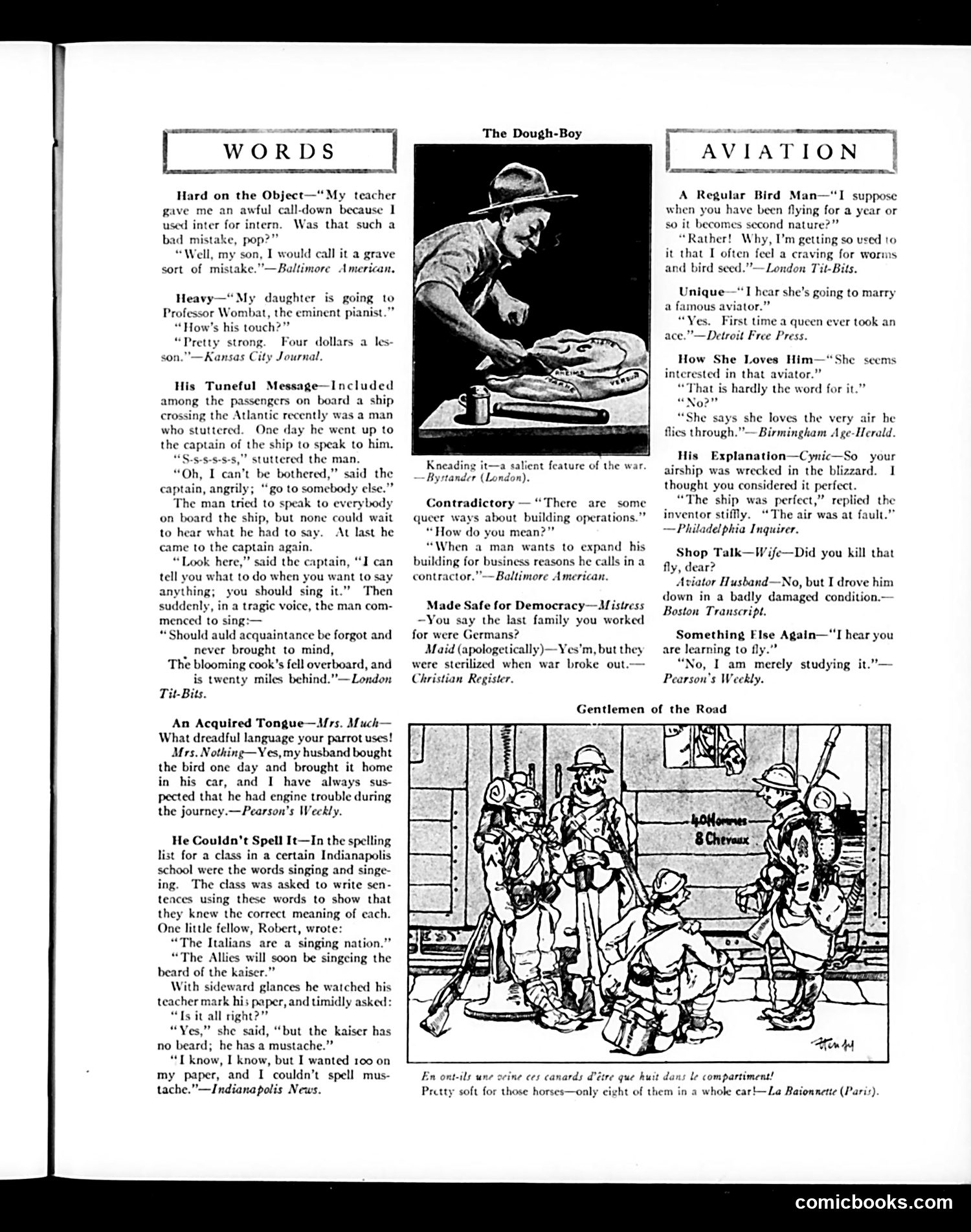
This *Judge* magazine page contains three sections of short humorous anecdotes ("WORDS"), a central illustration titled "The Dough-Boy" showing a WWI soldier preparing food, and aviation-themed jokes. **"The Dough-Boy" illustration** depicts an American soldier (doughboy was WWI slang for enlisted men) kneading dough—a visual pun on his nickname. The caption references this as "a salient feature of the war," treating mundane military cooking as noteworthy. **Aviation jokes** play on the novelty of early aviation—pilots acquiring "second nature" to flying, marrying an aviator as "taking an ace," planes crashing in bad weather. These reflect 1910s-era fascination with newfangled aircraft. **Scattered anecdotes mock**: language pedantry, stuttering, parrots acquiring profanity (likely from car engine trouble—a jab at automobiles), spelling errors, and German immigrants post-U.S. entry into WWI (the "sterilized" joke references wartime xenophobia). The "Gentlemen of the Road" cartoon at bottom appears unrelated satirical content.
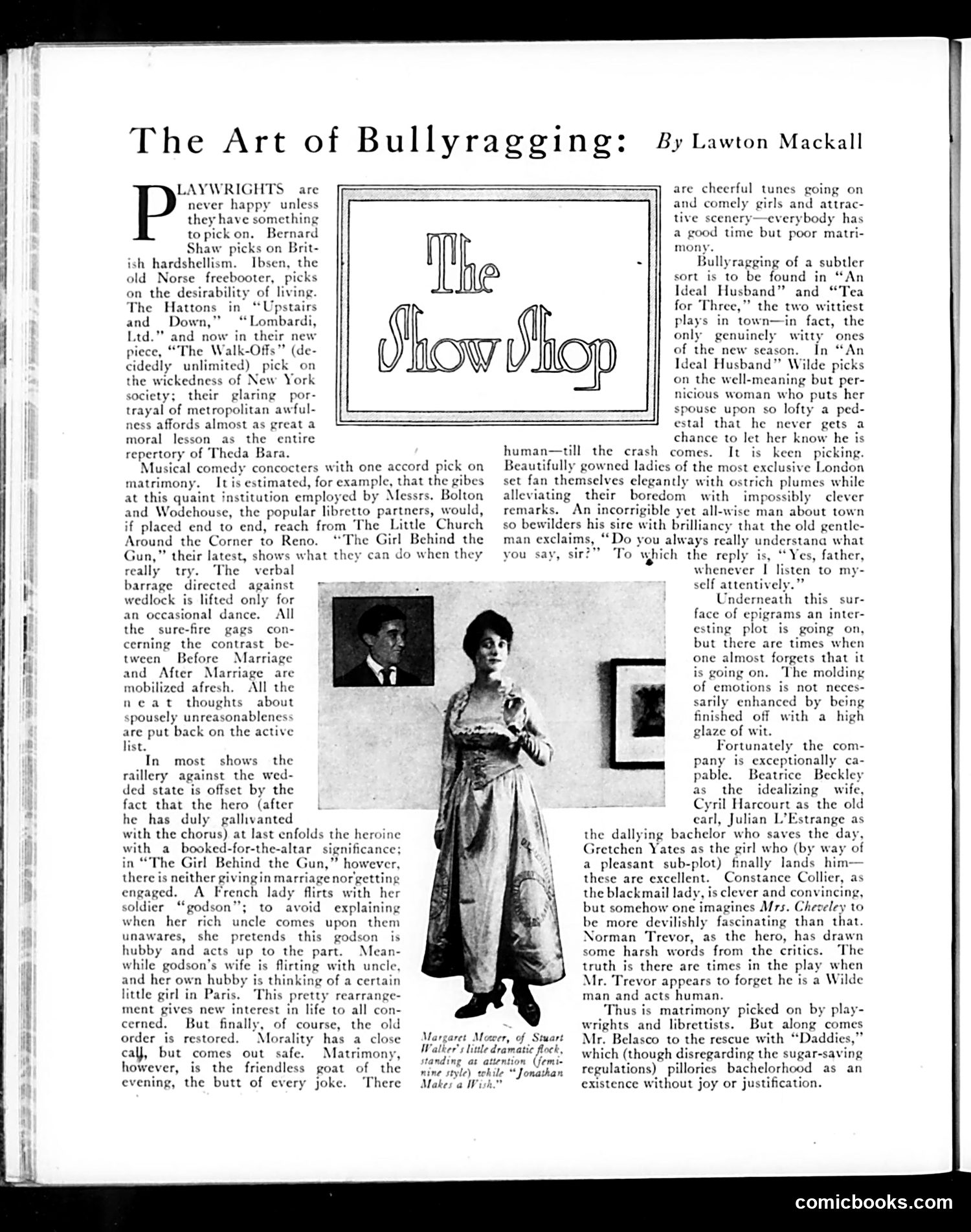
This is a theatrical review by Lawton Mackall analyzing how contemporary playwrights use marriage as their primary target for satire and mockery. The article identifies a pattern: writers like Bernard Shaw and Henrik Ibsen pick on social institutions, while musical comedy teams (Bolton and Wodehouse) relentlessly ridicule matrimony through jokes comparing "Before Marriage" and "After Marriage." The review discusses several current Broadway productions, particularly Oscar Wilde's "An Ideal Husband" and "Tea for Three," praising their wit. It notes that "The Girl Behind the Corner" uses marital confusion as its plot device, though ultimately "morality has a close call, but comes out safe." The photograph shows Margaret Moore from the production "Stuart Walters' little dramatic piece," illustrating one of the plays discussed. The satire's point: marriage is theater's favorite punching bag, consistently mocked across all dramatic genres of the era.
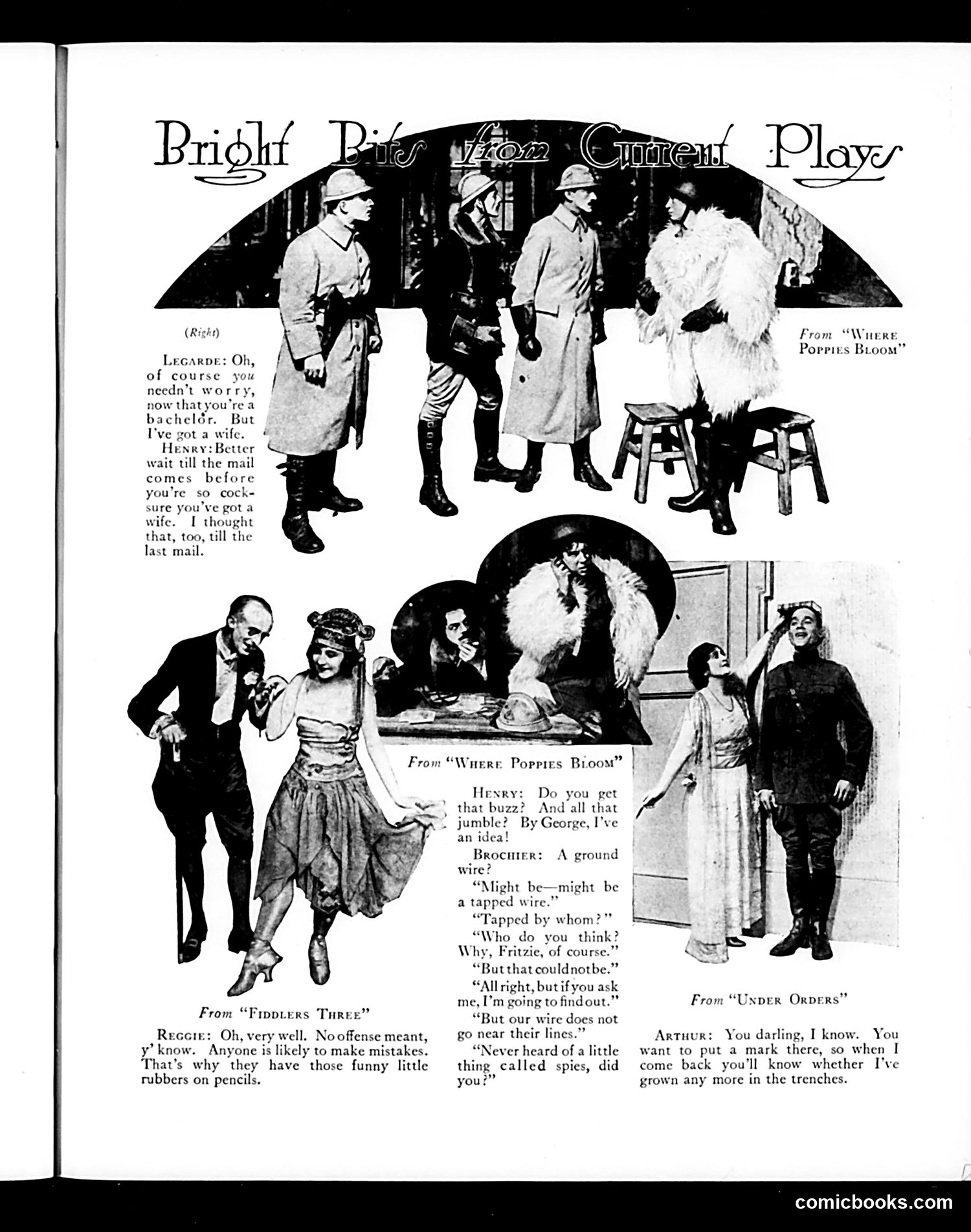
This page presents dialogue snippets from theatrical productions, likely from 1917-1918 based on the WWI references. The sketches satirize contemporary concerns: **"Fiddlers Three"** jokes about marital uncertainty—a bachelor assumes bachelorhood is safe, but a married man cynically notes mail (likely divorce or separation notices) can change that. **"Where Poppies Bloom"** contains espionage references: characters debate whether enemy agents ("Fritzie"—slang for Germans) have tapped their communications wire. The humor comes from one character dismissing the possibility while another insists on investigating anyway—reflecting wartime paranoia about spies. **"Under Orders"** shows a soldier and woman discussing a mark she'll make on his body so she can verify whether he's grown taller upon his return from the trenches, mixing dark humor with the emotional reality of wartime separation and mortality. The page reflects public anxieties: romantic instability, enemy infiltration fears, and the psychological toll of trench warfare on soldiers and their loved ones.
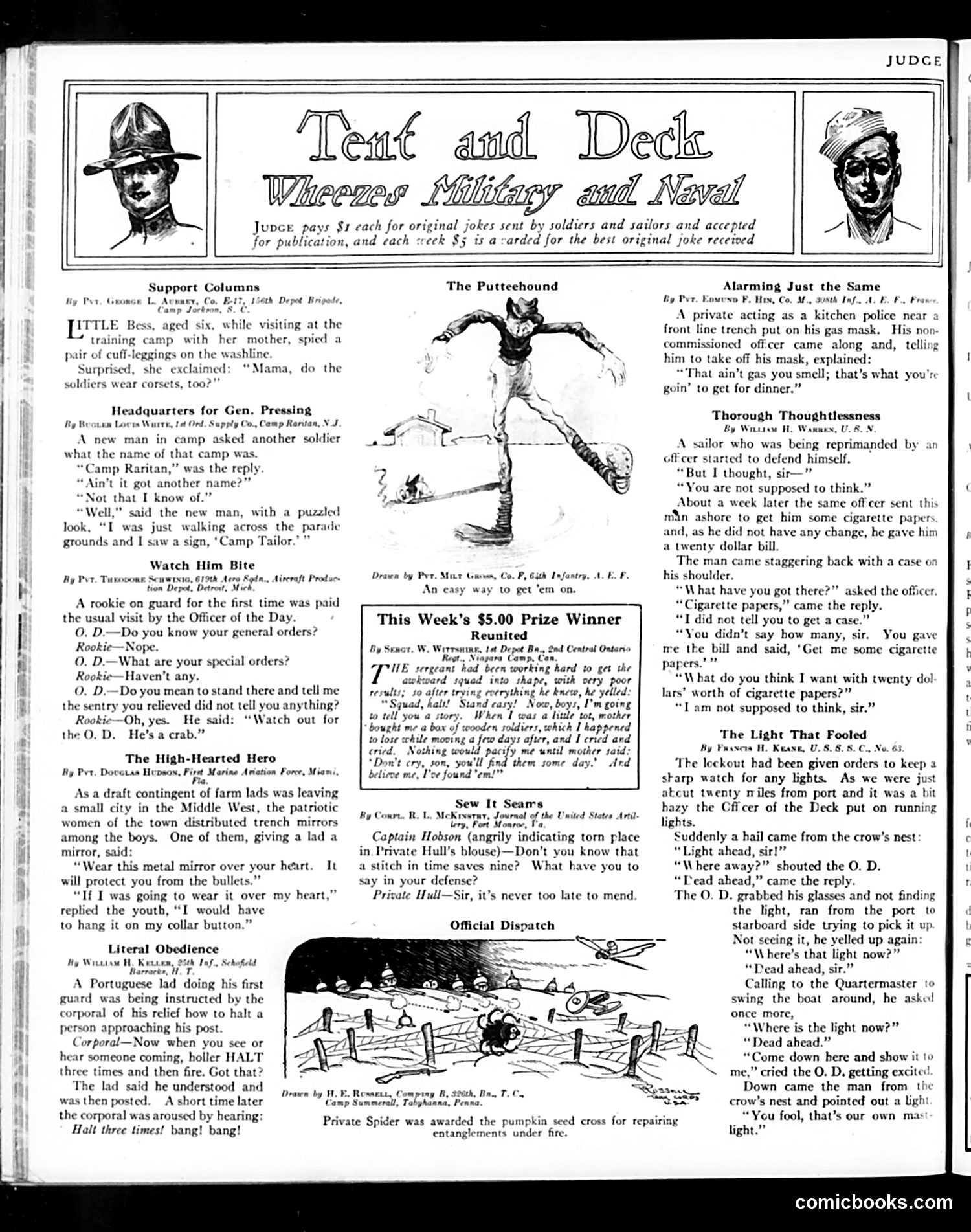
This is a humor page from *Judge* magazine featuring military jokes submitted by soldiers and sailors during World War I. The magazine paid $1 per published joke and $5 weekly for the best original submission. The cartoons and jokes mock basic military life: rookie confusion about camp names and guard duties, the physical awkwardness of military equipment (a child confusing puttees—leg wrappings—with corsets), and the gap between officers' instructions and soldiers' literal obedience (a Portuguese recruit actually firing after being told "halt three times and then fire"). "The Putteehound" cartoon illustrates the difficulty of putting on puttees, spiral leg wrappings standard in WWI uniforms. The humor relies on enlisted men's perspectives—poking gentle fun at military hierarchy, incompetence, and the absurdities of training rather than criticizing the war effort itself. It reflects how soldiers coped with military life through humor during wartime.
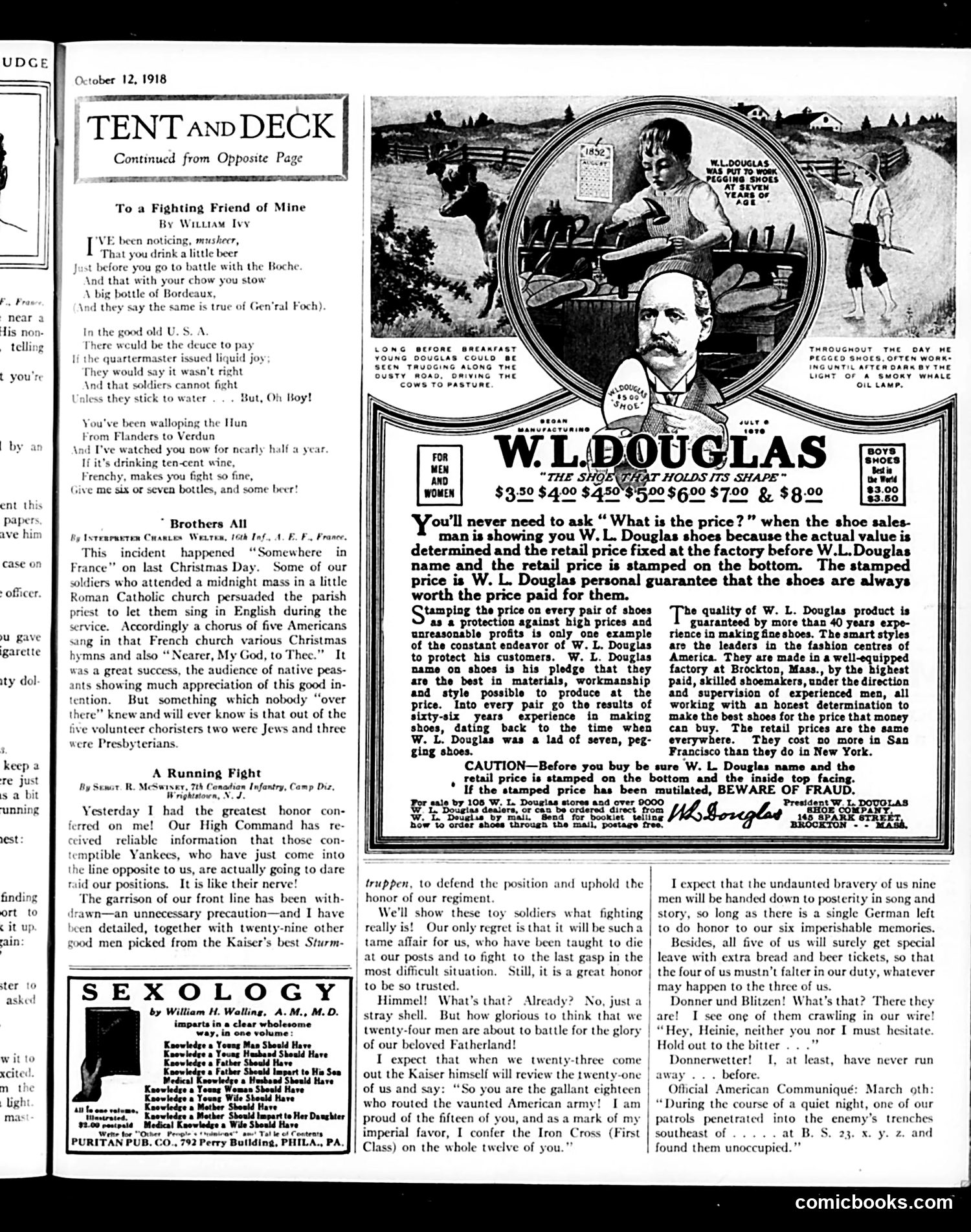
This page combines WWI-era patriotic poetry with advertising, reflecting American concerns in the final weeks of the Great War. **The Poetry:** Two pieces appear: "To a Fighting Friend of Mine" satirizes American military prohibition by contrasting it with French soldiers' wine consumption. The poem suggests French commanders like Foch drink before battle—mocking American temperance advocates who opposed alcohol for troops. "Brothers All" celebrates interfaith cooperation, noting five American soldiers singing Christmas carols in a French church included two Jews and three Presbyterians, emphasizing unity during wartime. **The Advertisement:** A large W.L. Douglas shoes advertisement dominates the right side. The circular inset shows Douglas himself supervising factory work. The ad emphasizes the company's quality guarantee through stamped prices, positioning this as protection against inflation and profiteering—concerns for consumers in 1918 as wartime prices climbed. The advertisement reflects both commercial enterprise and patriotic messaging. **Historical Context:** The page captures October 1918—just before the Armistice—when American troops were actively engaged and public morale mattered greatly.
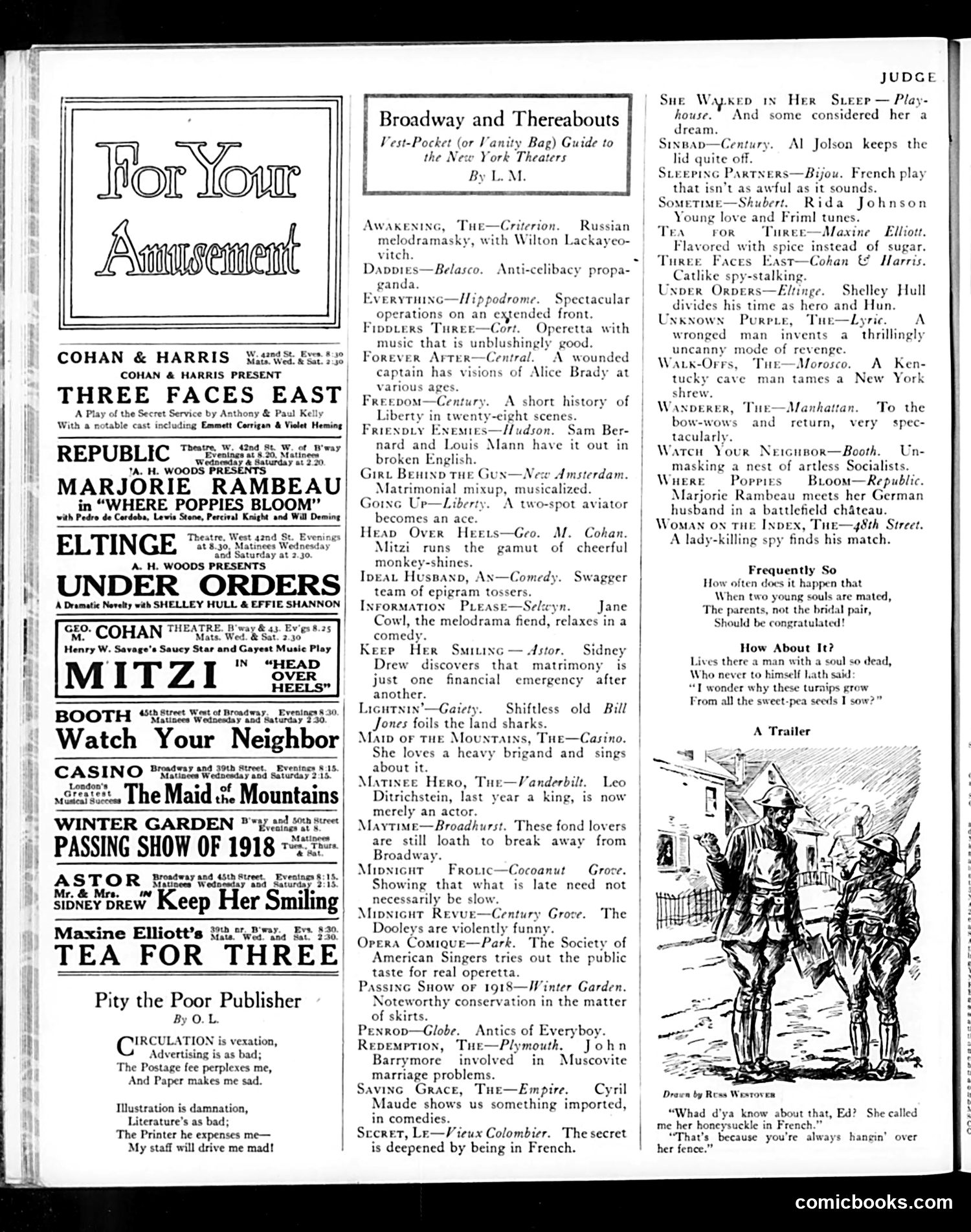
This is primarily a **theater advertisement and review page**, not a political cartoon. The page lists Broadway theaters and brief reviews of current productions (circa 1918, based on "Passing Show of 1918"). The left side contains theater advertisements for plays like "Three Faces East," "Where Poppies Bloom," and "Mitzi." The right side offers capsule reviews of New York productions, many featuring recognizable actors of the era (Sidney Drew, Leo Ditrichstein, Cyril Maude). The **"Pity the Poor Publisher"** verse satirizes the publishing industry's frustrations—circulation problems, advertising challenges, printing costs, and staff management—a light complaint about business operations rather than political satire. The single **illustration** at bottom right shows a figure on horseback, with a caption about honeysuckle and a fence—apparently an unrelated humorous vignette. This page reflects the entertainment focus Judge magazine offered alongside its satirical commentary, showcasing Broadway's offerings to affluent readers.
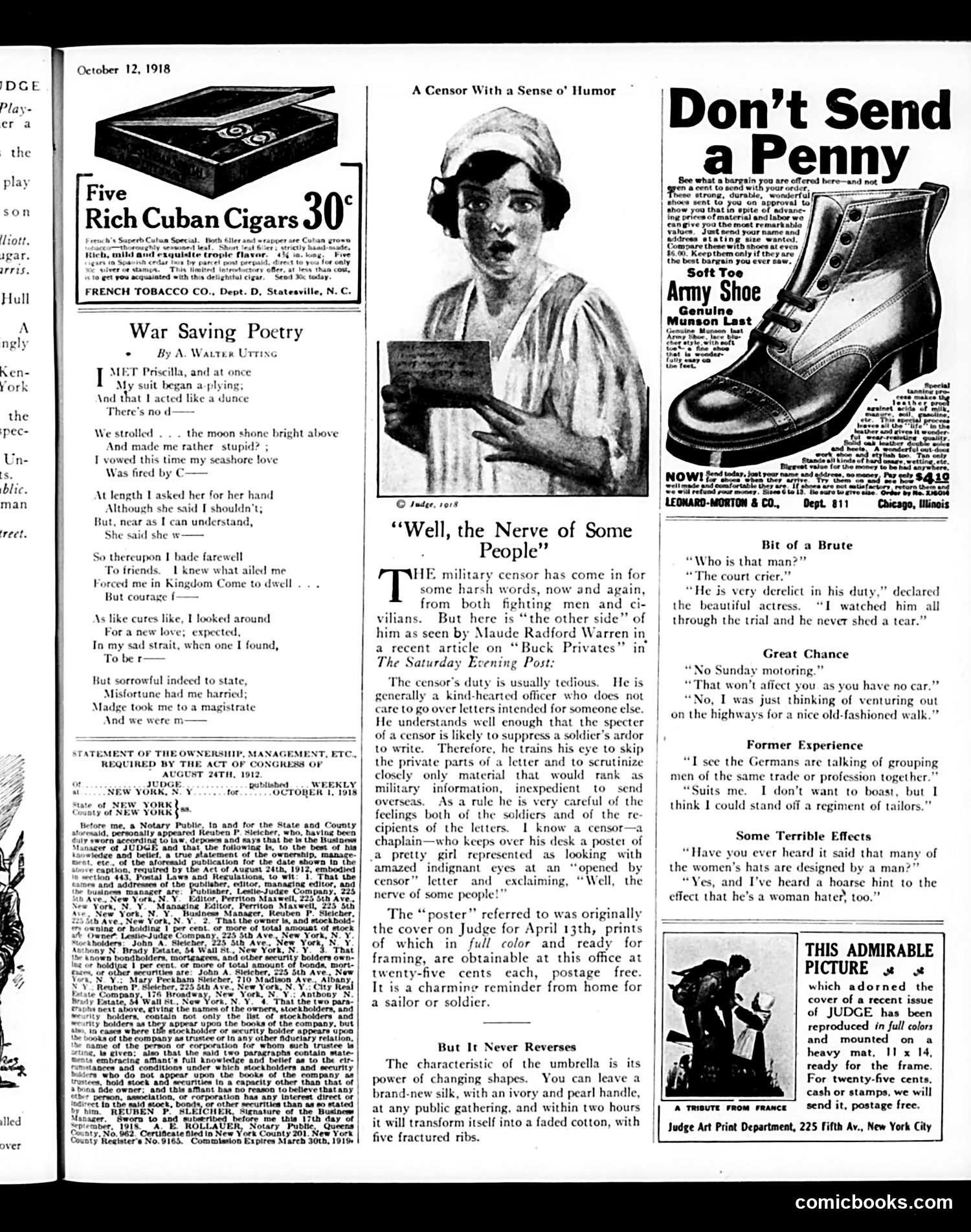
This page from *Judge* (October 12, 1918) is primarily advertisements and filler content rather than political satire. The main items are: **Advertisements**: Rich Cuban cigars (30¢), an Army shoe, and a frame-mounting service dominate the page visually. **"War Saving Poetry"**: A humorous poem by A. Walter Utton about romantic misadventures, using censored words (dashes replacing letters)—likely satirizing wartime censorship itself, which was strict in 1918. The poem describes a man's failed courtship attempts ending in forced marriage ("magistrate"). **"A Censor With a Sense of Humor"**: An article about military censors reviewing soldiers' letters, noting the censor's difficult job balancing security with soldiers' privacy and dignity. The accompanying photograph shows what appears to be a censor reviewing correspondence. The page reflects 1918 American concerns: active WWI censorship, wartime economy ("war savings"), and domestic anxieties about romance and marriage during wartime.
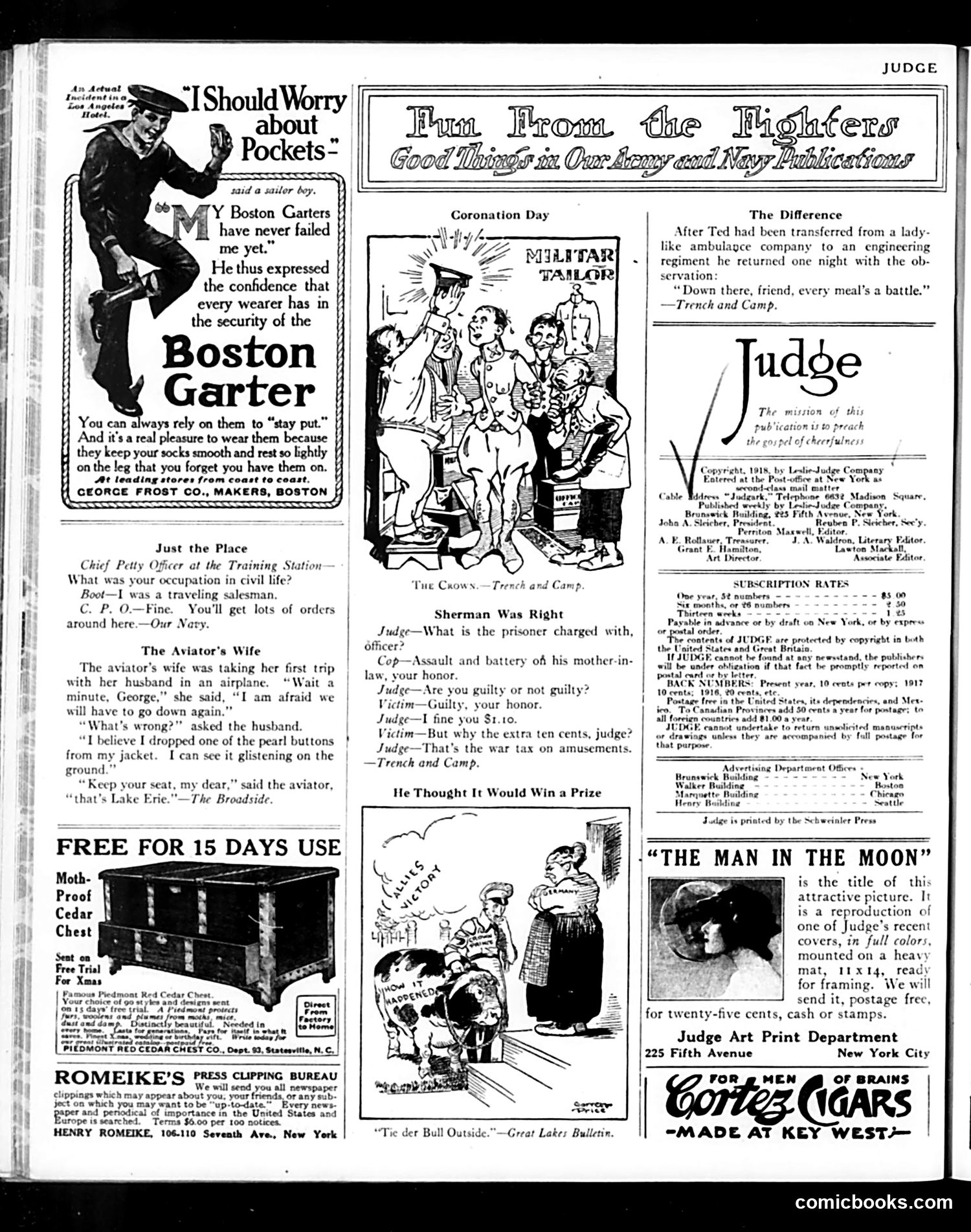
This is primarily a **title page and advertisements**, with several brief wartime humor pieces reflecting WWI-era sensibilities. The cartoon section titled "Sherman Was Right" parodies a courtroom exchange where a man assaulted his mother-in-law and receives a $1.10 fine—$1 for the crime, plus ten cents as a "war tax on amusements." The joke satirizes wartime excess taxes while implying that beating one's mother-in-law is amusing entertainment. Other short pieces mock military life: a boot camp recruit is told "you'll get lots of orders," a soldier observes "every meal's a battle," and a young woman mistakes Lake Erie for a dropped pearl button—playing on civilian naiveté about the world. The **advertisements** (Boston Garters, cedarchests, press clipping services) were typical magazine revenue. The page is dated **1918**, during America's WWI involvement, which explains the military references throughout.
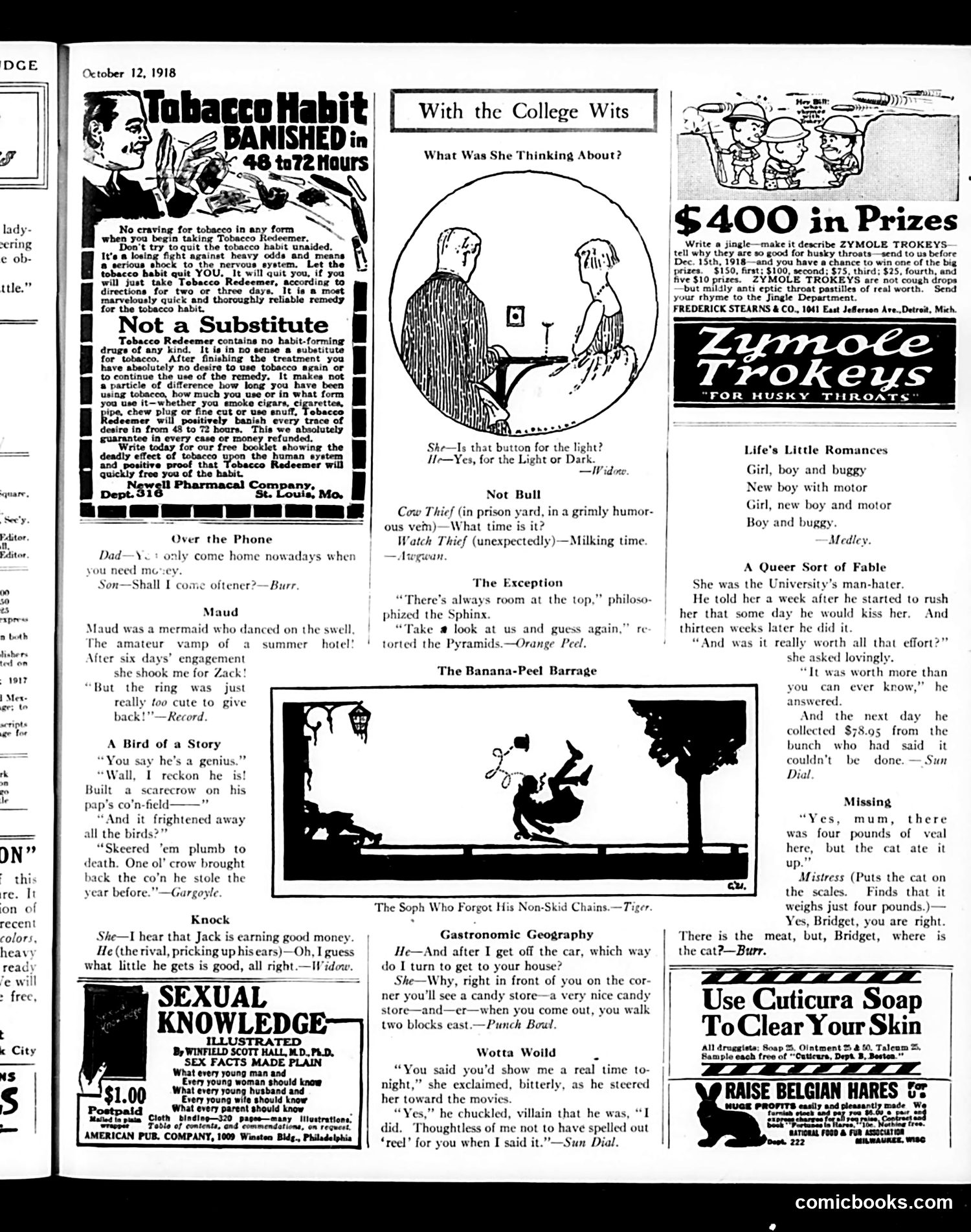
This page mixes advertisements with humorous shorts typical of Judge's satirical format. **Main Content:** The dominant advertisement promotes "Tobacco Redeemer," claiming to eliminate tobacco cravings in 48-72 hours—likely targeting WWI-era public health concerns about soldier readiness and moral improvement. **The Cartoons:** The brief comic strips and one-liners are domestic humor: a couple debating light switches, a mermaid who ditches her boyfriend over a ring, a scarecrow that steals corn, and a cook whose cat mysteriously gained four pounds of veal. These appear to be gentle, family-oriented jokes with no political content. **Secondary Advertisements:** Include Zymole Trokeys (throat lozenges), Cuticura Soap, and "Sexual Knowledge Illustrated"—typical early-20th-century mail-order products. The page reflects 1918 attitudes toward habit-breaking, consumer goods marketing, and light domestic comedy without apparent satire of current events or public figures.
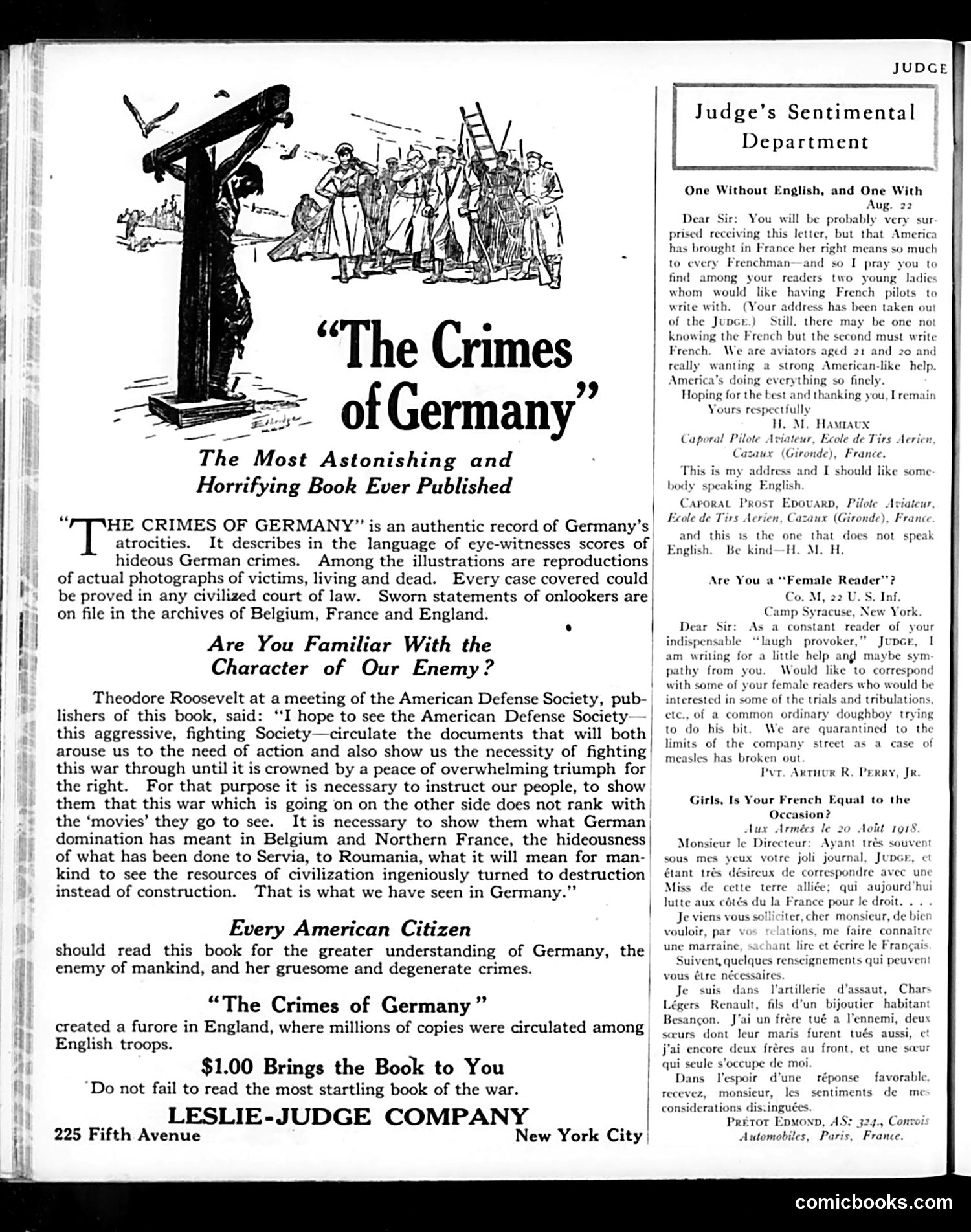
This page primarily advertises a wartime propaganda book titled "The Crimes of Germany," published by Leslie-Judge Company during World War I. The large illustration depicts a crucifix with soldiers gathered below, evoking religious and moral outrage at German military conduct. The text quotes Theodore Roosevelt endorsing the book as essential for American civilians to understand German "atrocities" in Belgium, France, and Romania. The advertisement emphasizes eyewitness accounts and photographic evidence to justify continued American support for the war effort. The right-hand "Judge's Sentimental Department" contains reader letters—notably several from French and Belgian soldiers seeking American female pen pals, framed as cultural exchange and expressions of gratitude for American military assistance. These letters serve the propaganda function by humanizing Allied soldiers and reinforcing American obligation to the European cause. Together, the page mobilizes both emotional outrage at alleged enemy crimes and sentimental connection to grateful allies to sustain American war commitment.
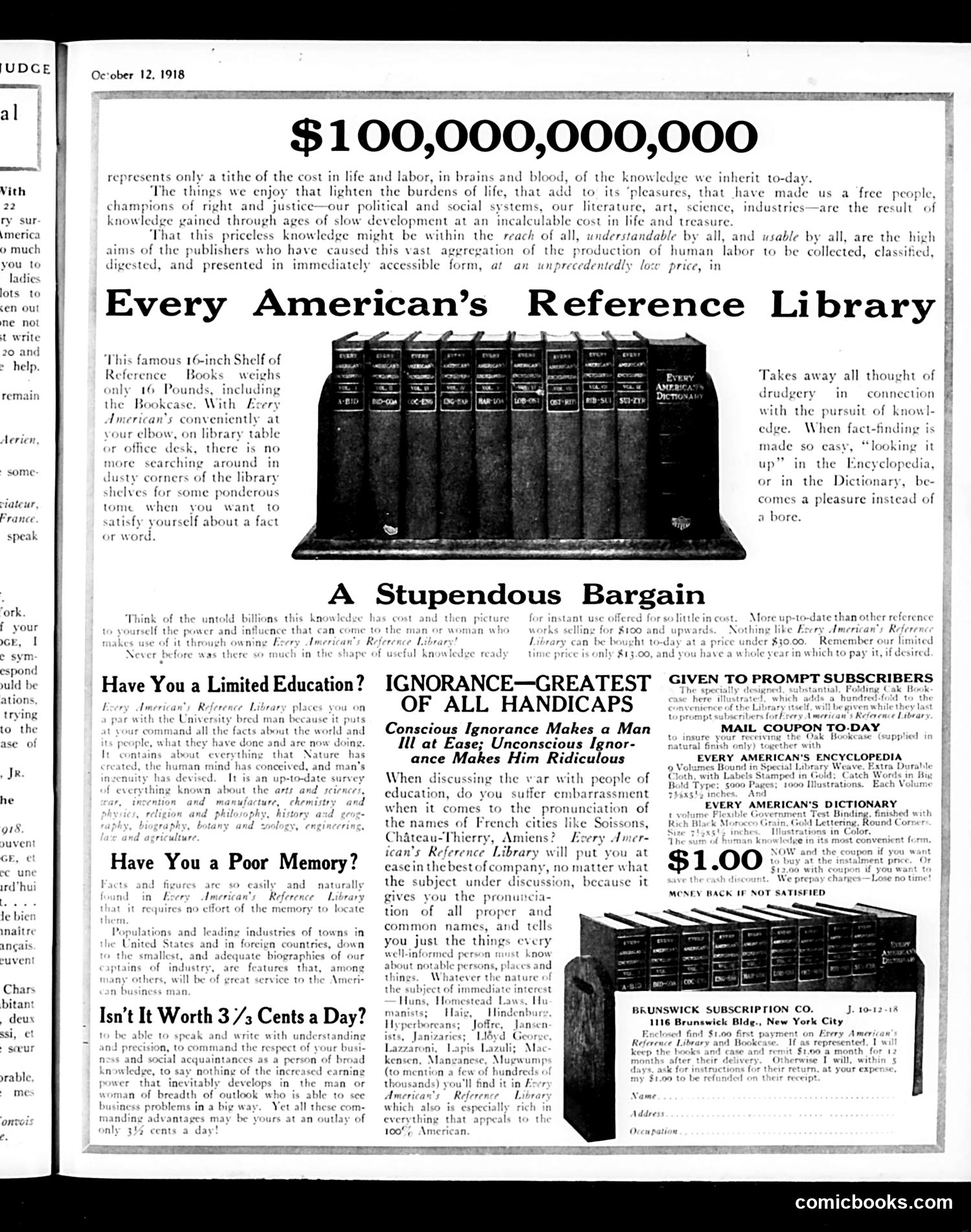
This page is primarily an **advertisement for "Every American's Reference Library"** — a 16-volume encyclopedia set — rather than political satire. It appears in *Judge* magazine from October 12, 1918, near the end of World War I. The ad frames the reference library as a patriotic purchase, claiming the knowledge contained represents "$100,000,000,000" in accumulated human wisdom. It appeals to American readers' anxieties about appearing ignorant, particularly regarding the war: embarrassment over mispronouncing French city names (Soissons, Château-Thierry) or unfamiliar military leaders (Hindenburg, Joffre). The rhetoric connects knowledge with citizenship and patriotism — understanding the war effort is presented as a civic duty. The "Ignorance—Greatest of All Handicaps" headline uses wartime anxieties to market an educational product to middle-class Americans seeking self-improvement and cultural authority. This is fundamentally a **commercial pitch disguised as patriotic messaging**, typical of WWI-era advertising.
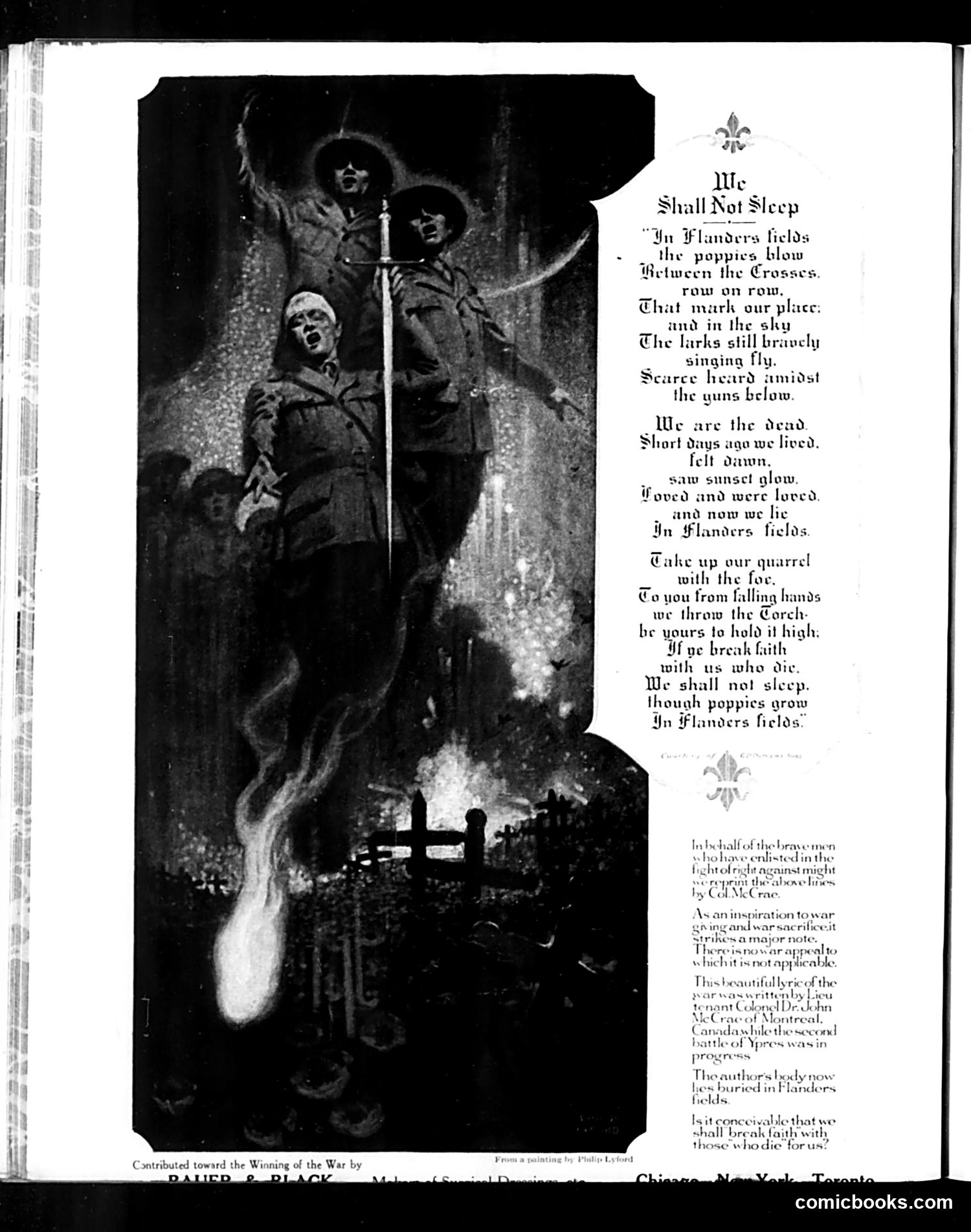
This is not satire but a solemn commemorative page from *Judge* magazine featuring John McCrae's famous poem "In Flanders Fields." The dramatic illustration depicts ghostly soldiers appearing above a battlefield cross, emphasizing sacrifice and duty. The page honors Canadian and Allied soldiers killed in World War I, particularly at the Battle of Ypres (referenced in the text). McCrae's poem—written after witnessing soldiers' deaths—became an iconic WWI memorial. The ghostly figures represent the dead calling on the living to "take up our quarrel with the foe" and hold faith with those who died. The attribution to "Col. McCrae" and the note that the author is "now buried in Flanders fields" underscores the poem's tragic authenticity: McCrae himself died in 1918. Rather than satire, this represents *Judge*'s patriotic contribution to war remembrance during or shortly after WWI.