
Judge, 1918-10-12 · page 22 of 32
Judge — October 12, 1918 — page 22: what you’re looking at
What you’re looking at
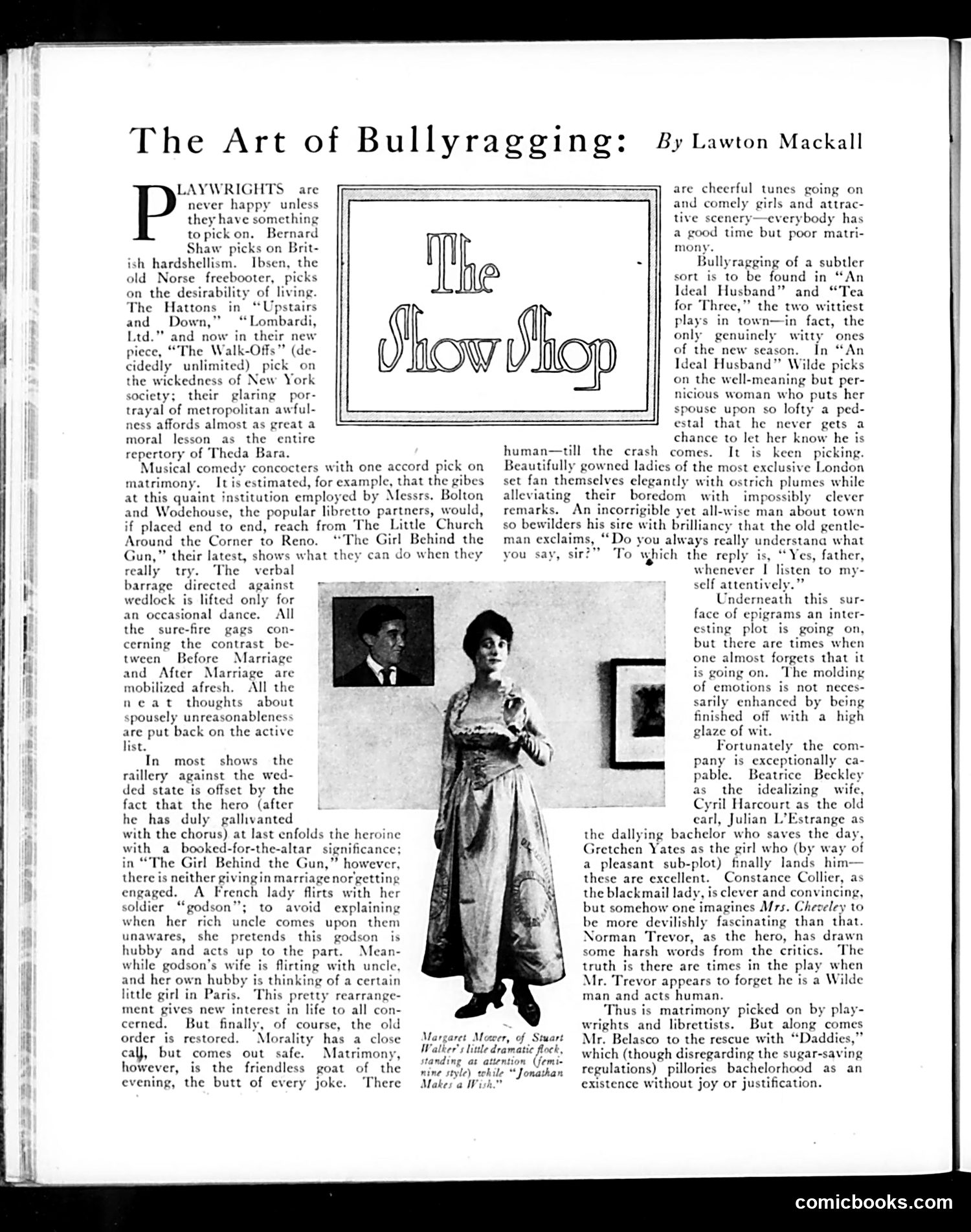
This is a theatrical review by Lawton Mackall analyzing how contemporary playwrights use marriage as their primary target for satire and mockery. The article identifies a pattern: writers like Bernard Shaw and Henrik Ibsen pick on social institutions, while musical comedy teams (Bolton and Wodehouse) relentlessly ridicule matrimony through jokes comparing "Before Marriage" and "After Marriage." The review discusses several current Broadway productions, particularly Oscar Wilde's "An Ideal Husband" and "Tea for Three," praising their wit. It notes that "The Girl Behind the Corner" uses marital confusion as its plot device, though ultimately "morality has a close call, but comes out safe." The photograph shows Margaret Moore from the production "Stuart Walters' little dramatic piece," illustrating one of the plays discussed. The satire's point: marriage is theater's favorite punching bag, consistently mocked across all dramatic genres of the era.
📄 Transcribed text from this page (OCR, searchable)
Machine-transcribed from the original scan — historical spelling and the odd misread are preserved.
i ‘ The Art of Bullyragging: 2) Lawton Mackall LAYWRIGHTS are [fe never happy unless they have something topick on. Bernard Shaw picks on Brit- ish hardshellism. Ibsen, the old Norse freebooter, picks on the desirability of living. The Hattons in “Upstairs and Down,” “Lombardi, Ltd.” and now in their new piece, “The Walk-Offs” (de- cidedly unlimited) pick on the wickedness of New York society; their glaring por- trayal of metropolitan awful- are cheerful tunes going on and comely girls and attrac- tive scenery—everybody has a good time but poor matri- mony. : Bullyragging of a subtler sort is to be found in “An Idi Husband” and “Tea for Three,” the two wittiest plays in town—in fact, the only genuinely witty ones of the new season. In “An Ideal Husband” Wilde picks on the well-meaning but per- nicious woman who puts her =] spouse upon so lofty a ped- ness affords almost as great a moral lesson as the entire repertory of Theda Bara. Musical comedy concocters with one accord pick on matrimo! It is estimated, for example, that the gibes at this quaint institution employed by Messrs. Bolton and Wodehouse, the popular libretto partners, would, if placed end to end, reach from The Little Church Around the Corner to Reno. “The Girl Behind the Gun,” their latest, shows what they can do when they really try. The verbal barrage directed against wedlock is lifted only for an occasional dance. All the sure-fire gags con- cerning the contrast be- tween Before Marriage and After Marriage are mobilized afresh. All the neat thoughts about spousely unreasonableness are put back on the active list. In most shows the raillery against the wed- ded state is offset by the fact that the hero (after he has duly gallivanted with the chorus) at last enfolds the hero’ with a booked-for-the-altar significance in “The Girl Behind the Gun,” howev there is neither givingin marriage norgetting engaged. A French lady flirts with her soldier “godson”; to avoid explaining when her rich uncle comes upon them unawares, she pretends this godson is hubby and acts up to the part. Mean- while godson’s wife is flirting with uncle, and her own hubby is thinking of a certain little girl in Paris. This pretty rearrange- ment gives new interest in life to all con- cerned. But finally, of course, the old ne order is restored. Morality has a close Margaret Aeerer, of Stuart Mr. Belasco to the rescue with “Daddies, s little dramati cal, but comes out safe. Matrimony, /a/ée however, is the friendless goat of the evening, the butt of every joke. There Me estal that he never gets a chance to let her know he is human—till the crash comes. It is keen picking. Beautifully gowned ladies of the most exclusive London set fan themselves elegantly with ostrich plumes while alleviating their boredom with impossibly clever remarks. An incorrigible yet all-wise man about town so bewilders his sire with brilliancy that the old gentle- man exclaims, “Do you always really understana what you say, sir?” To Which the reply is, “Yes, father, whenever I listen to my- self attentively.” Underneath this sur- face of epigrams an inter- esting plot is going on, but there are times when one almost forgets that it is going on. The molding of emotions is not neces- sarily enhanced by being finished off with a high glaze of wit. Fortunately the com- pany is exceptionally ca- pable. Beatrice Beckley as the idealizing wife, Cyril Harcourt as the old carl, Julian L’Estrange as the dallying bachelor who saves the day, Gretchen Yates as the girl who (by way of a pleasant sub-plot) finally lands him— these are excellent. Constance Collier, as the blackmail lady, is clever and convincin but somehow one imagines Mrs. Cheveley to be more devilishly fascinating than that. Norman Trevor, as the hero, has drawn some harsh words from the critics. The truth is there are times in the play when Mr. Trevor appears to forget he is a Wilde man and acts human. Thus is matrimony picked on by pla wrights and librettists. But along com flock on (fem ‘Jonathan which (though disregarding the sugar-saving regulations) pillorics bachelorhood as an tence without joy or justification. comicbooks.com