
A complete issue · 29 pages · 1917
Judge — December 29, 1917
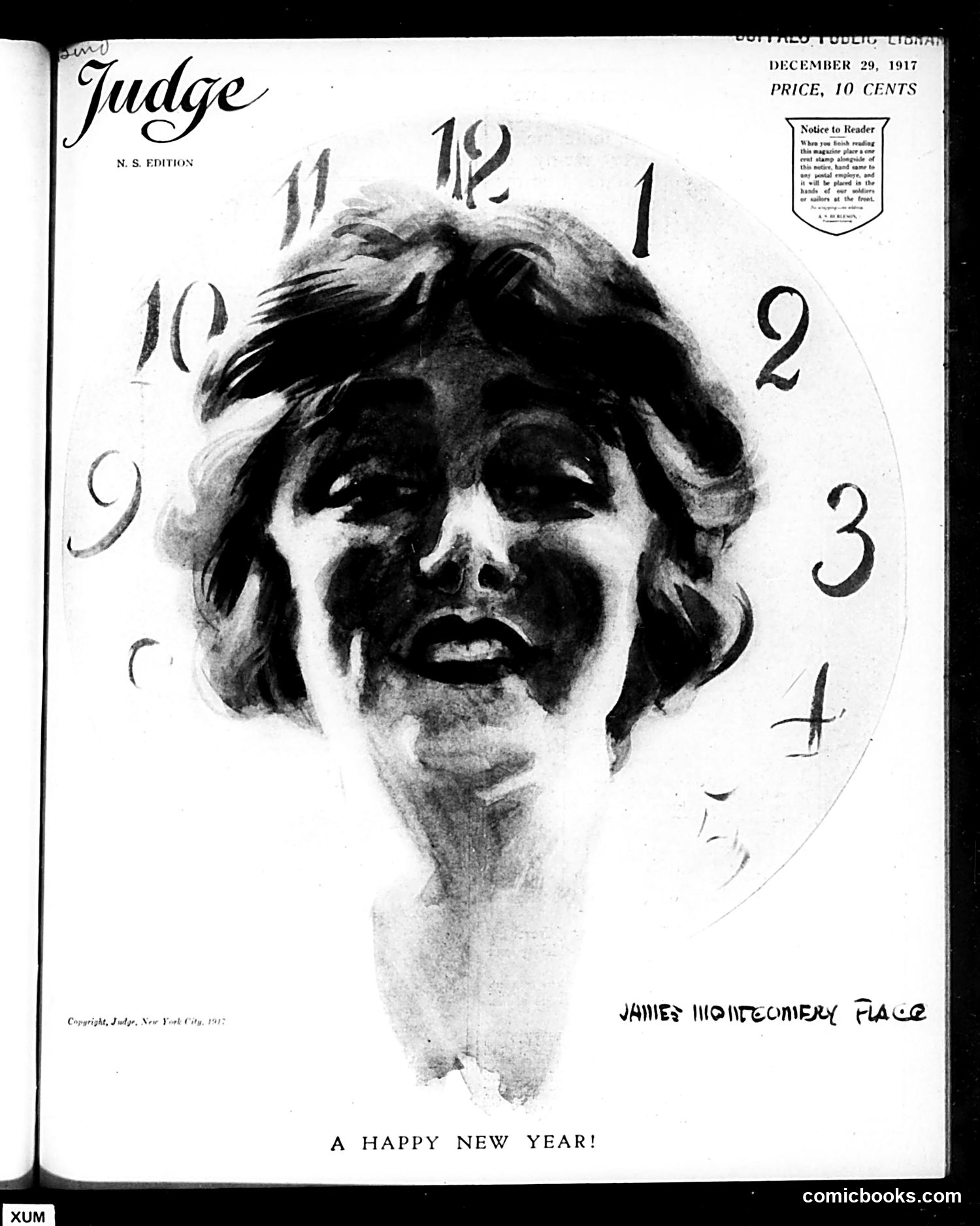
This is a New Year's greeting cover by artist James Montgomery Flagg. The illustration shows a woman's face transformed into a clock face, with the clock hands positioned at midnight (12 o'clock), marking the transition from 1917 to 1918. The image plays on the traditional New Year's imagery of time passing and new beginnings. The woman's features—her hair, eyes, and mouth—are integrated into the clock design, creating a visual pun about time and femininity. Published during World War I (the U.S. entered in April 1917), this cover simply offers seasonal well-wishes to readers rather than political commentary. It's characteristic of Judge magazine's lighter holiday content.
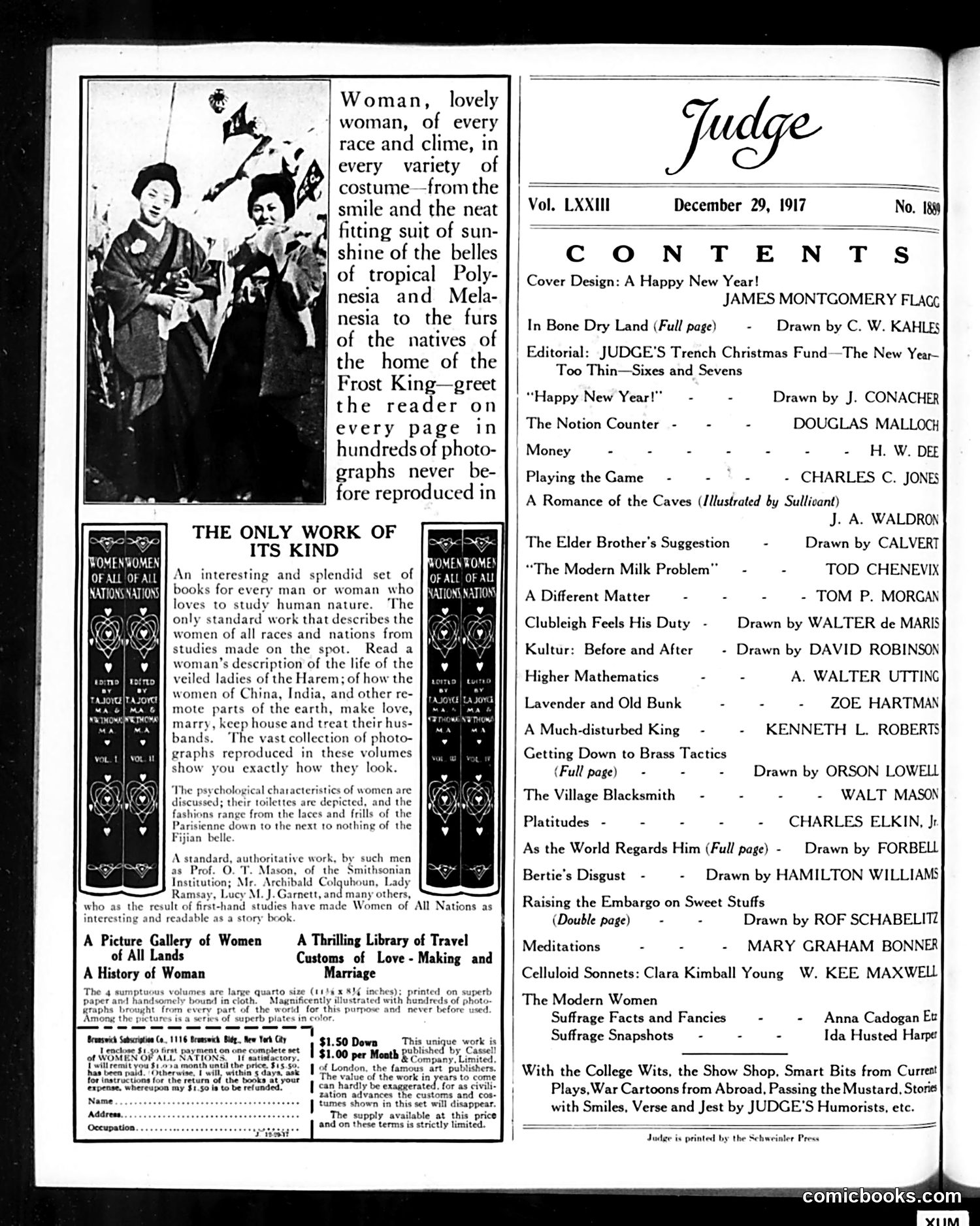
This is primarily a **contents page and advertisement** rather than a satirical cartoon. The left side advertises "Women of All Nations" — an encyclopedic work featuring photographs and descriptions of women from different races and climates, emphasizing exotic dress and customs. The framing reflects early 20th-century anthropological interests and attitudes typical of that era. The right side lists **Judge's table of contents** for a New Year's issue. Featured articles include political/social satire ("The Modern Milk Problem," "Higher Mathematics," "Suffrage Facts and Fancies"), suggesting the magazine addressed contemporary debates including women's suffrage — a major political issue in 1917, the year before the 19th Amendment passed.
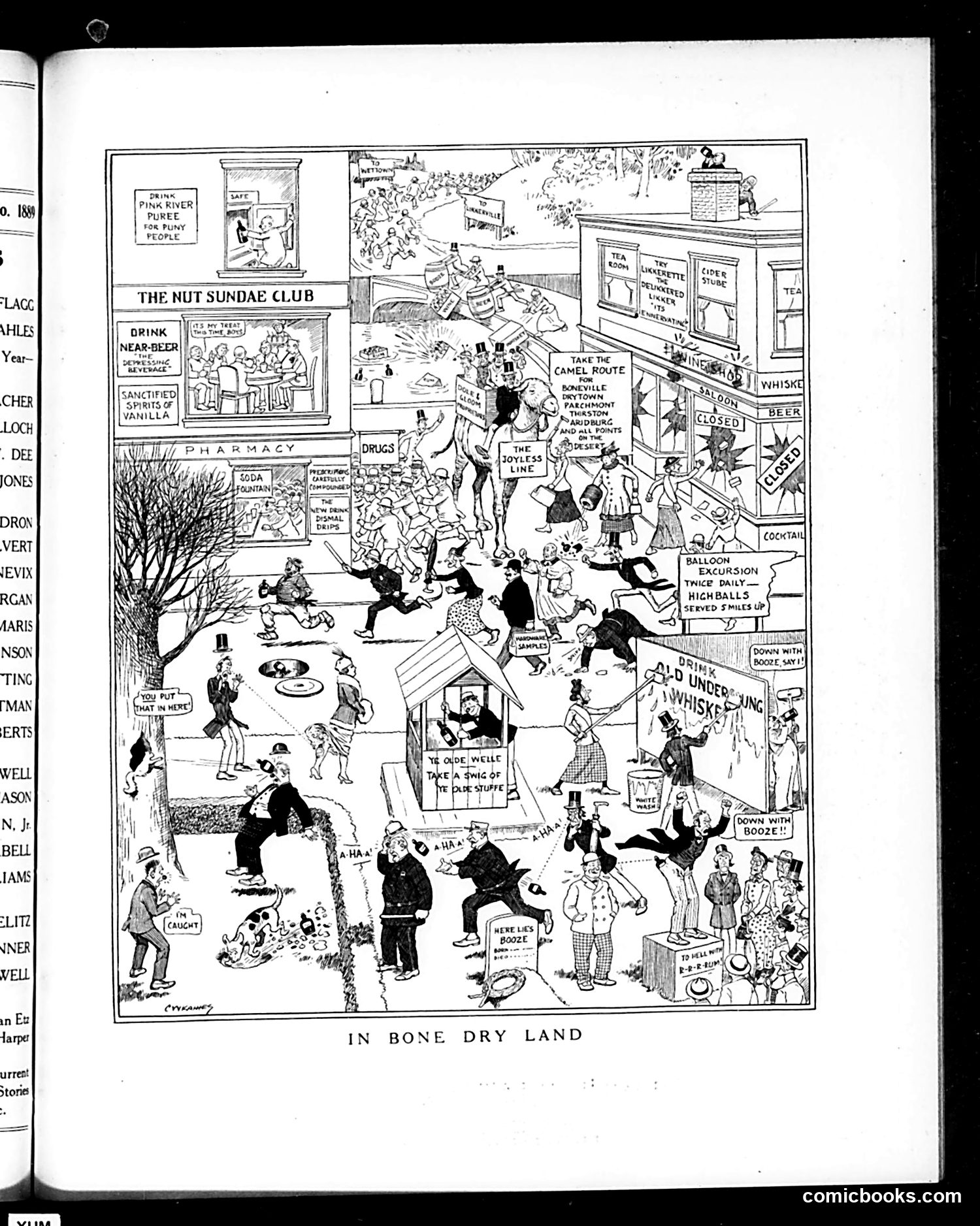
This Judge magazine cartoon satirizes life during Prohibition (the ban on alcohol sales, 1920-1933). The title "In Bone Dry Land" refers to the dry/alcohol-free society that Prohibition was meant to create. The comic depicts a chaotic street scene showing widespread *secret* drinking despite the legal ban. Visible establishments include "The Nut Sundae Club" (serving near-beer and sanctioned drinks), a pharmacy (which legally sold alcohol for "medicinal" purposes), and hidden speakeasies. Signs reference smuggled whiskey and the "Camel Route" bootleg operation. The satire's point: Prohibition failed spectacularly. Rather than eliminating drinking, it drove the activity underground, creating criminal enterprises, hypocrisy, and public disorder. The cartoon mocks both the law's ineffectiveness and society's continued thirst for forbidden alcohol.
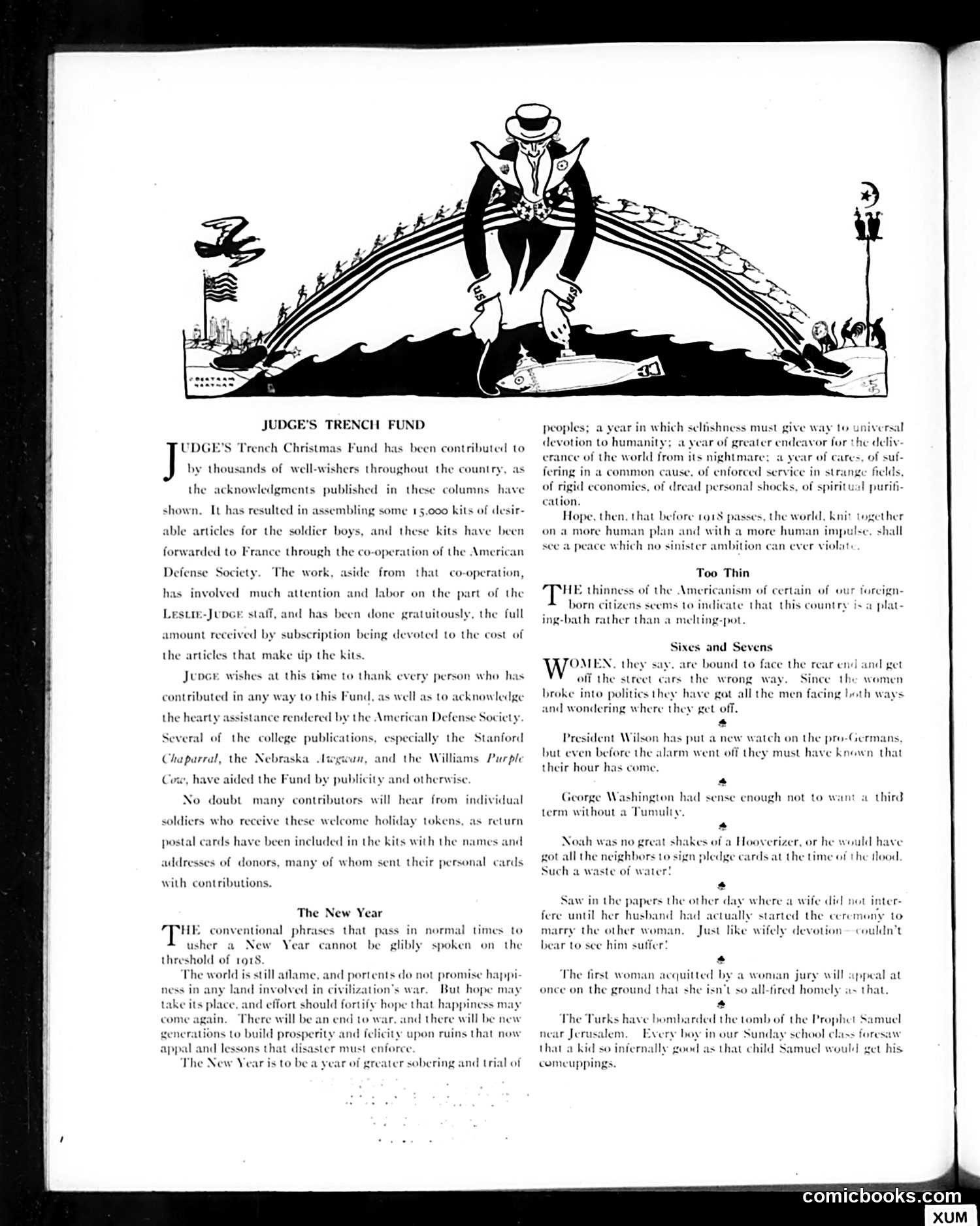
The main illustration shows a man in formal dress straddling a large chasm or trench, labeled "JUDGE'S TRENCH FUND." The figure appears to represent Judge magazine itself or its leadership, literally bridging a gap—likely referencing WWI fundraising efforts for soldiers' welfare packages. The accompanying article describes a Christmas fund for soldiers, assembled into 15,000 kits and distributed through the American Defense Society. The text thanks contributors and acknowledges college publications that helped publicize the effort. The remaining columns contain satirical commentary on contemporary issues: American isolationism, gender politics (women voters and street cars), President Wilson's policies, and biblical/historical references used for comedic effect. The overall page celebrates the magazine's charitable war-relief work while maintaining its satirical voice on current events.
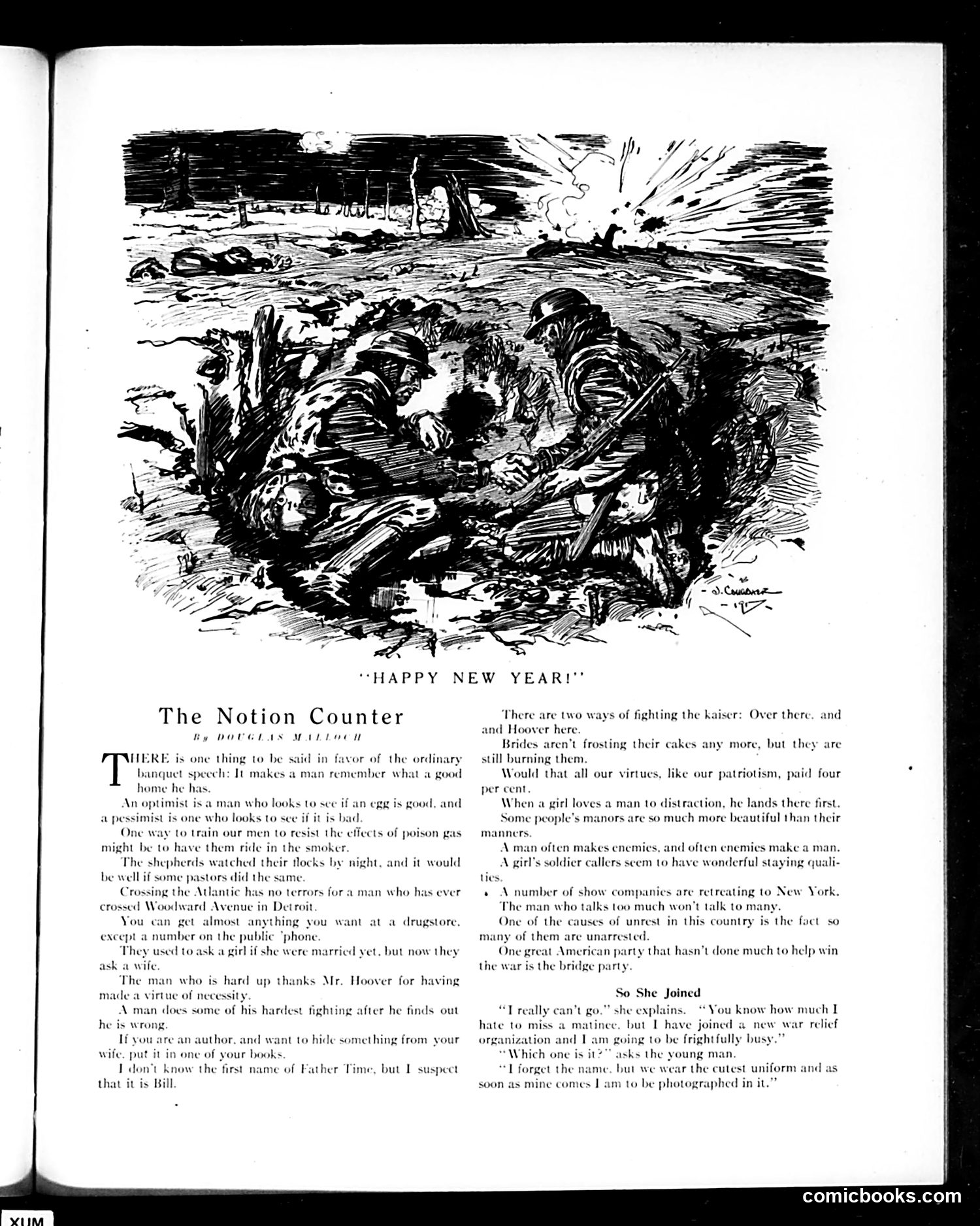
This page combines a WWI-era illustration titled "Happy New Year!" with satirical commentary called "The Notion Counter" by Douglas Malloch. The central cartoon depicts soldiers in a trench during combat—likely representing American forces in WWI. The "Happy New Year" caption appears darkly ironic, contrasting holiday sentiment with battlefield carnage visible in the background. "The Notion Counter" contains scattered observations about wartime American life: criticism of those profiting from war, commentary on patriotism "paid four per cent," and observations about social disruption. References to Woodward Avenue (Detroit) and bridge parties suggest domestic impacts of the war. A secondary piece, "So She Joined," depicts a woman explaining her entry into war relief work, prioritizing the "cutest uniform" for photographs over substantive contribution—mocking shallow patriotism and performative activism among wealthy women.
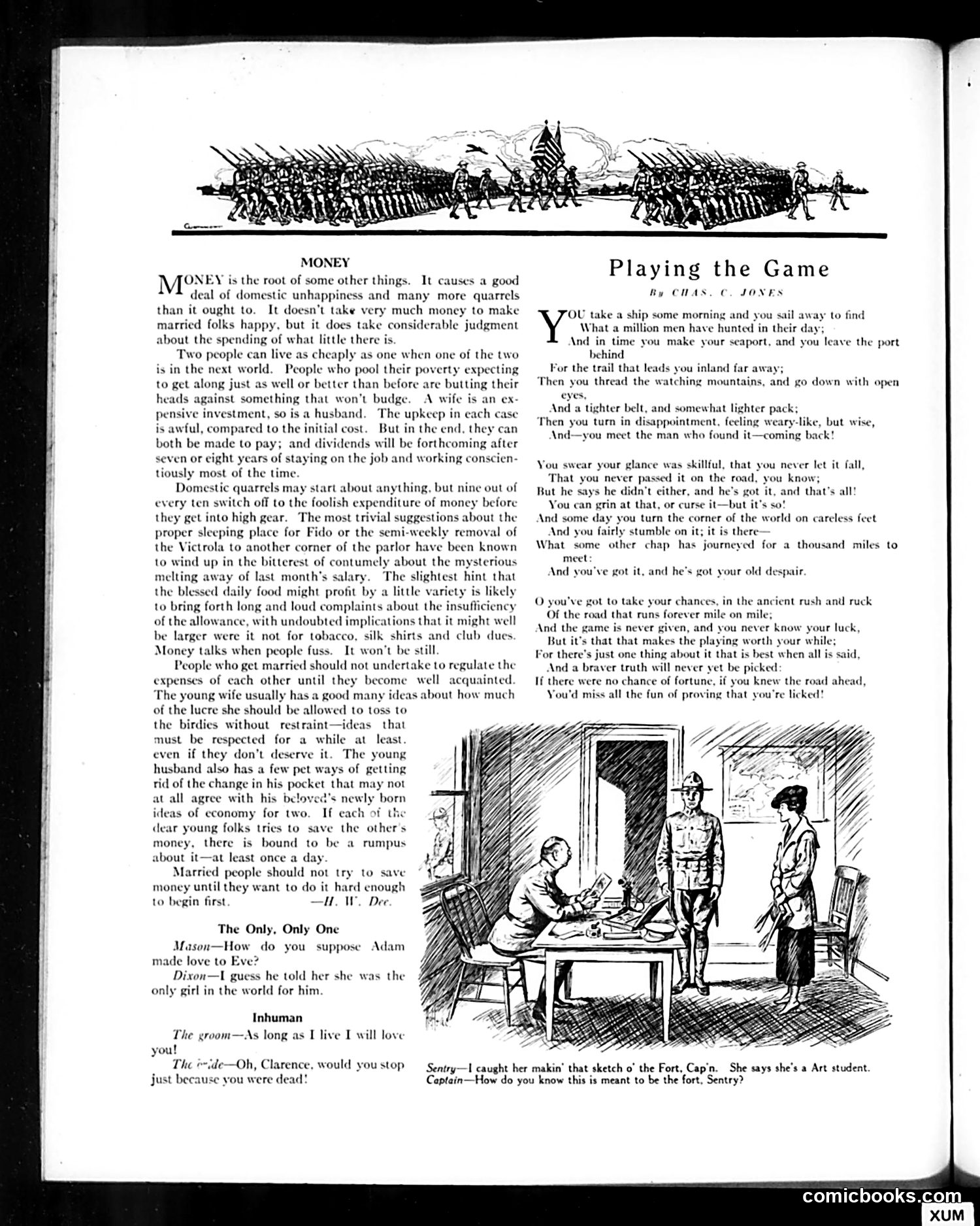
This page contains two distinct pieces: **"Money"** (left column): A prose essay arguing that financial disagreements cause domestic strife. It advocates for married couples to discuss spending transparently before problems arise, suggesting pooled resources and mutual agreement on expenditures. **"Playing the Game"** (right): A poem by Charles S. Jones about life's uncertainties and the value of taking chances, encouraging readers to embrace adventure despite risks. **The illustration** depicts a military scene: a sentry has caught someone sketching a fort. The captain questions the sentry about whether the artist is legitimate. This appears to be a joke about wartime security concerns—the humor lying in the sentry's suspicion of an innocent activity during militarily sensitive times. The page primarily addresses marriage, adventure, and home-front vigilance themes typical of early 20th-century American periodicals.
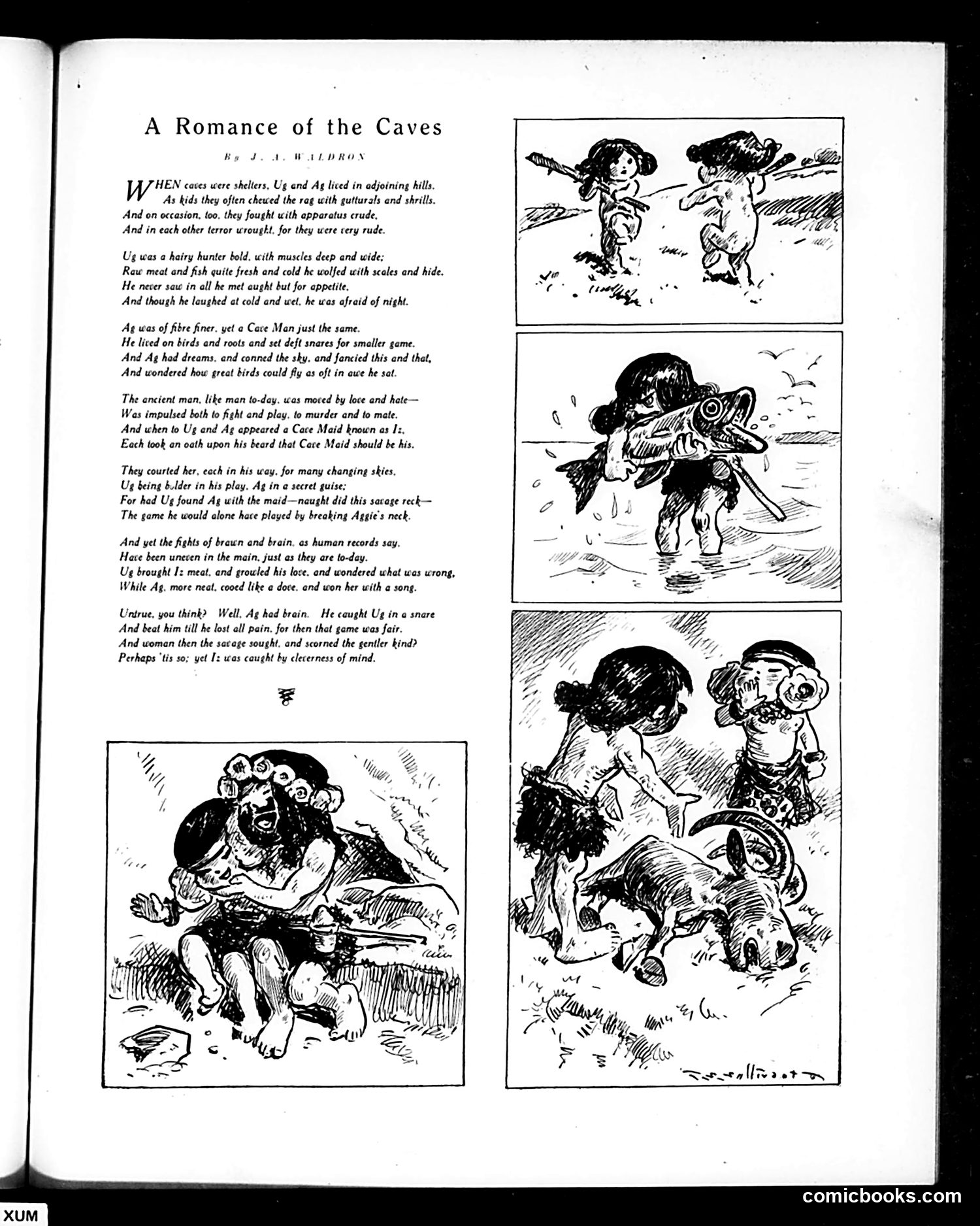
This humorous poem and accompanying illustrations present a prehistoric love triangle satirizing timeless human nature. Two cavemen—Ug (brutish, muscular, appetitive) and Ag (thoughtful, artistic, clever)—compete for a cave maiden named Iz. The satire's point: despite our evolutionary progress, humans remain governed by the same base impulses as our primitive ancestors. Ug represents brute strength and violence; Ag represents intellect and refinement. The twist—that Ag ultimately wins Iz not through force but cleverness and song—suggests that intelligence and culture can triumph over brutality. The final couplet's ironic conclusion ("caught by cleverness of mind") implies that even romantic conquest involves strategy rather than pure emotion. This reflects Judge magazine's common theme: modern civilization merely masks our savage origins.
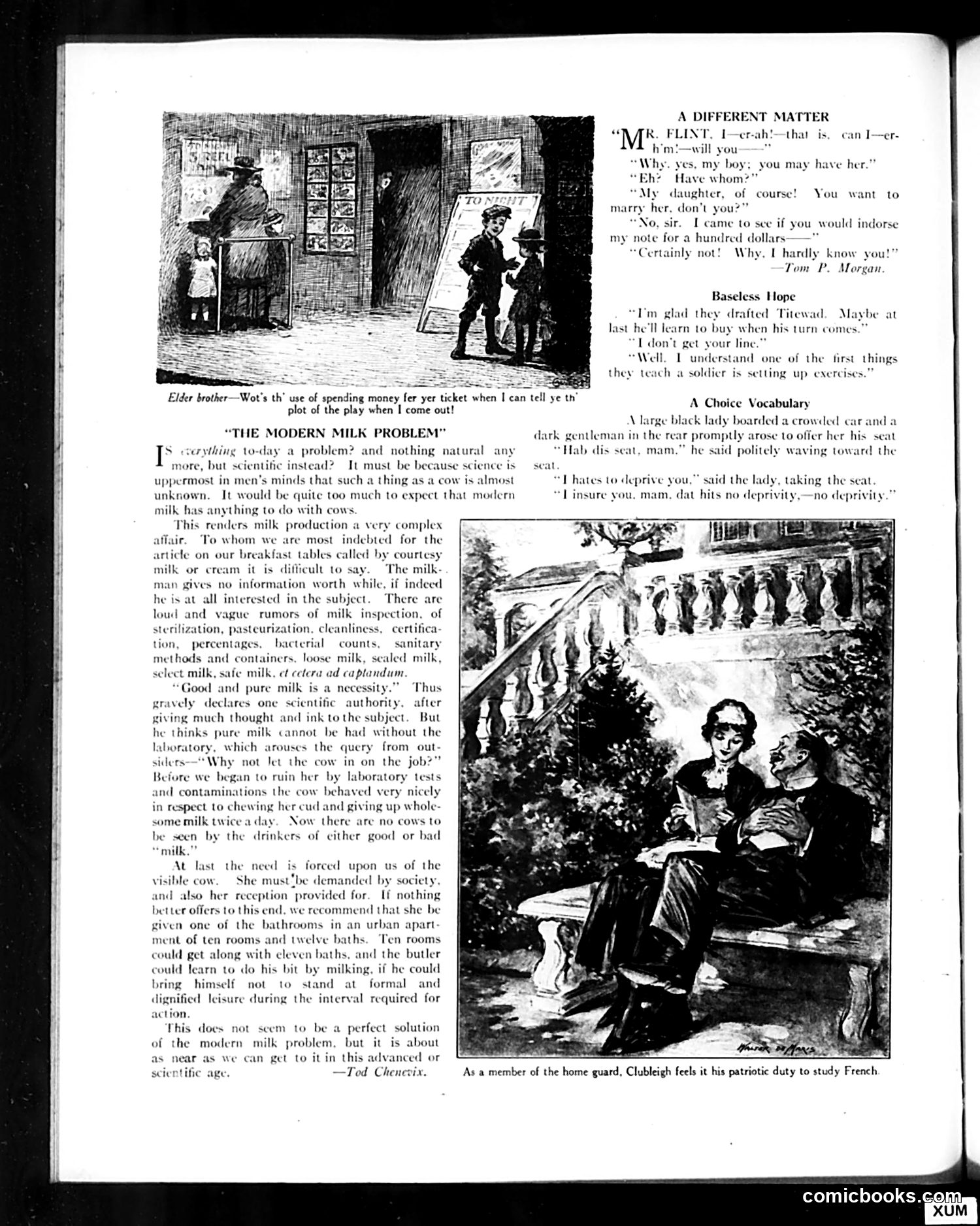
This page contains multiple short satirical pieces typical of Judge magazine's humor: **"A Different Matter"** (top): A young man visits a father to get a loan endorsement, but the father mistakes his intentions for a marriage proposal regarding his daughter. The joke plays on miscommunication and social assumptions about courtship. **"Baseless Hope"** (middle right): Satirizes a wealthy miser ("Titewad") being drafted into military service, with the joke being that mandatory military exercises might finally teach him to spend money. **"The Modern Milk Problem"** (main article): Critiques the era's obsession with scientific inspection and pasteurization of milk, suggesting that laboratory testing has actually made milk production unnecessarily complicated. The satire questions whether modern "science" has worsened rather than improved a simple natural process. The author sarcastically proposes keeping a cow in an urban apartment bathroom. **"A Choice Vocabulary"** (bottom): A brief anecdote poking fun at affected, overly formal speech patterns used by a well-dressed Black gentleman in a streetcar. These pieces reflect early 20th-century concerns about modernization, scientific progress, and social pretension.
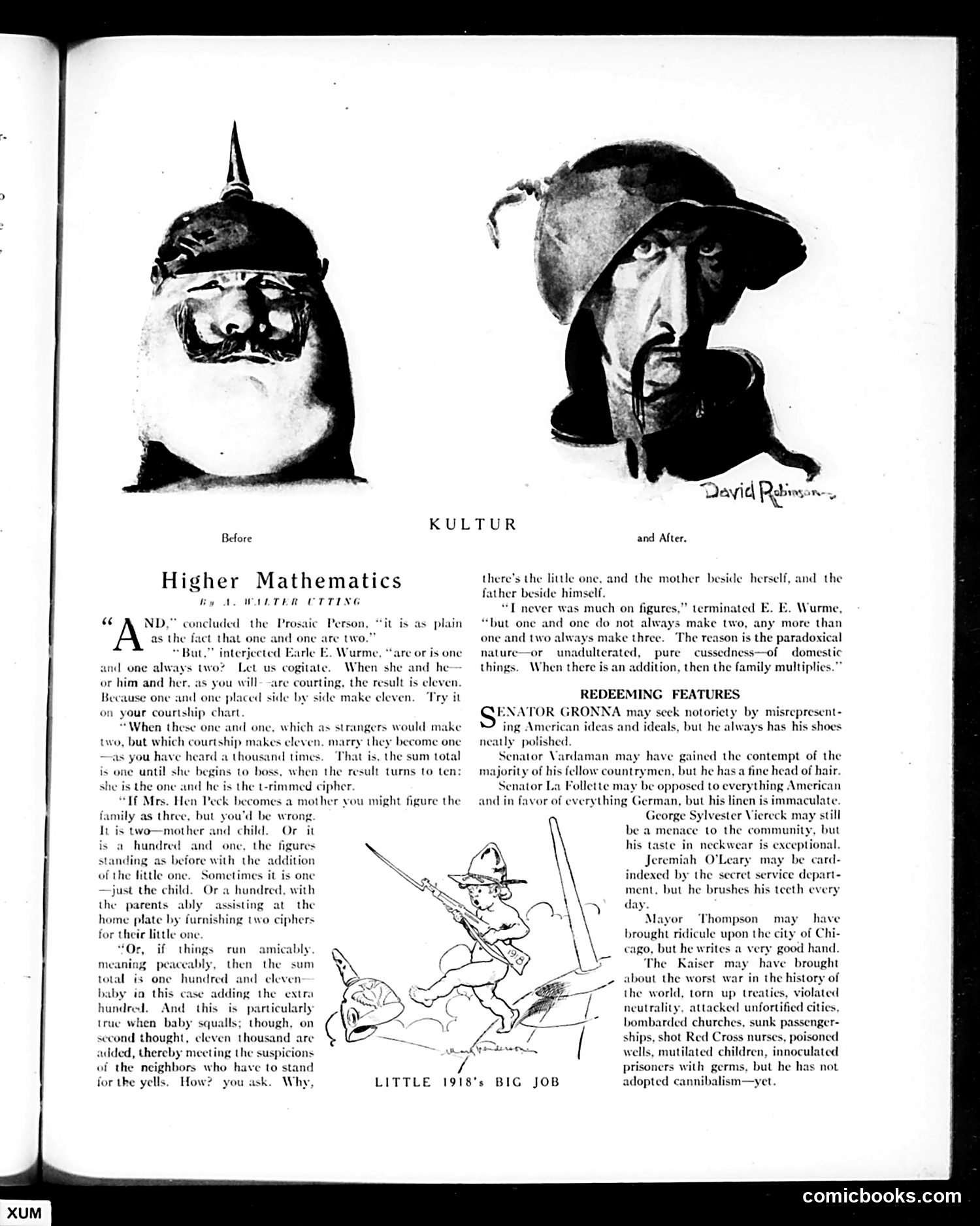
This Judge magazine page contains two satirical pieces from around 1918: **"Higher Mathematics"** (left): A humorous dialogue mocking courtship and marriage through absurd arithmetic. The joke: when courting couples are together, "one and one make eleven" (they're inseparable); after marriage, they become "one" (unified); but when the wife dominates, the result is "ten" (the husband becomes a "cipher"—worthless). Adding children and their crying multiplies the chaos exponentially. This satirizes domestic power dynamics and the stereotype of nagging wives. **"Redeeming Features"** (right): Wartime political satire attacking German-sympathetic figures and Germany itself during WWI. It sarcastically credits various American politicians (Gronna, Vardaman, La Follette, O'Leary) and the German Kaiser with minor virtues while listing their major crimes or anti-American positions. The punchline—that even the Kaiser hasn't adopted cannibalism—represents the ultimate condemnation of his brutality. Both pieces reflect 1918 American attitudes: domestic humor and fierce anti-German propaganda during the final year of World War I.
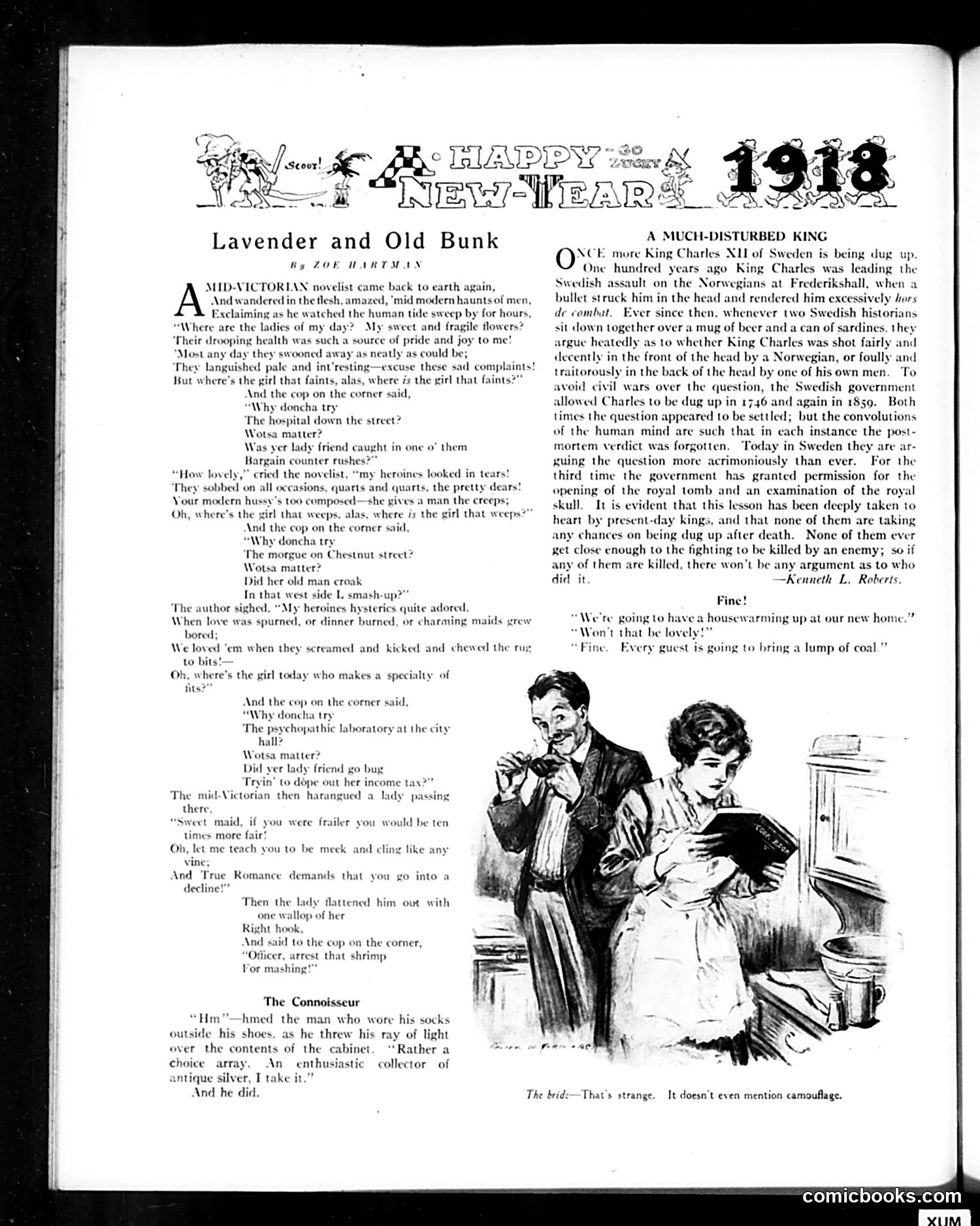
This satirical piece mocks Victorian-era literature and its melodramatic heroines. A mid-Victorian novelist returns to the modern world (1918) searching for the delicate, weeping, fainting women who populated his novels. A pragmatic cop repeatedly redirects him toward hospitals, morgues, and psychiatric facilities—suggesting modern women have abandoned such affectations or are institutionalized. The joke culminates when the novelist lectures a contemporary woman on proper feminine weakness; she responds by punching him. The cop then arrests *her* for "mashing" (accosting)—a final ironic twist showing how gender norms have inverted. The accompanying illustration shows a modern woman confidently reading while a bewildered man gestures in frustration—visualizing the clash between outdated romantic ideals and actual modern women's independence. The satire celebrates women's liberation from oppressive Victorian performance while mocking men nostalgic for that era.
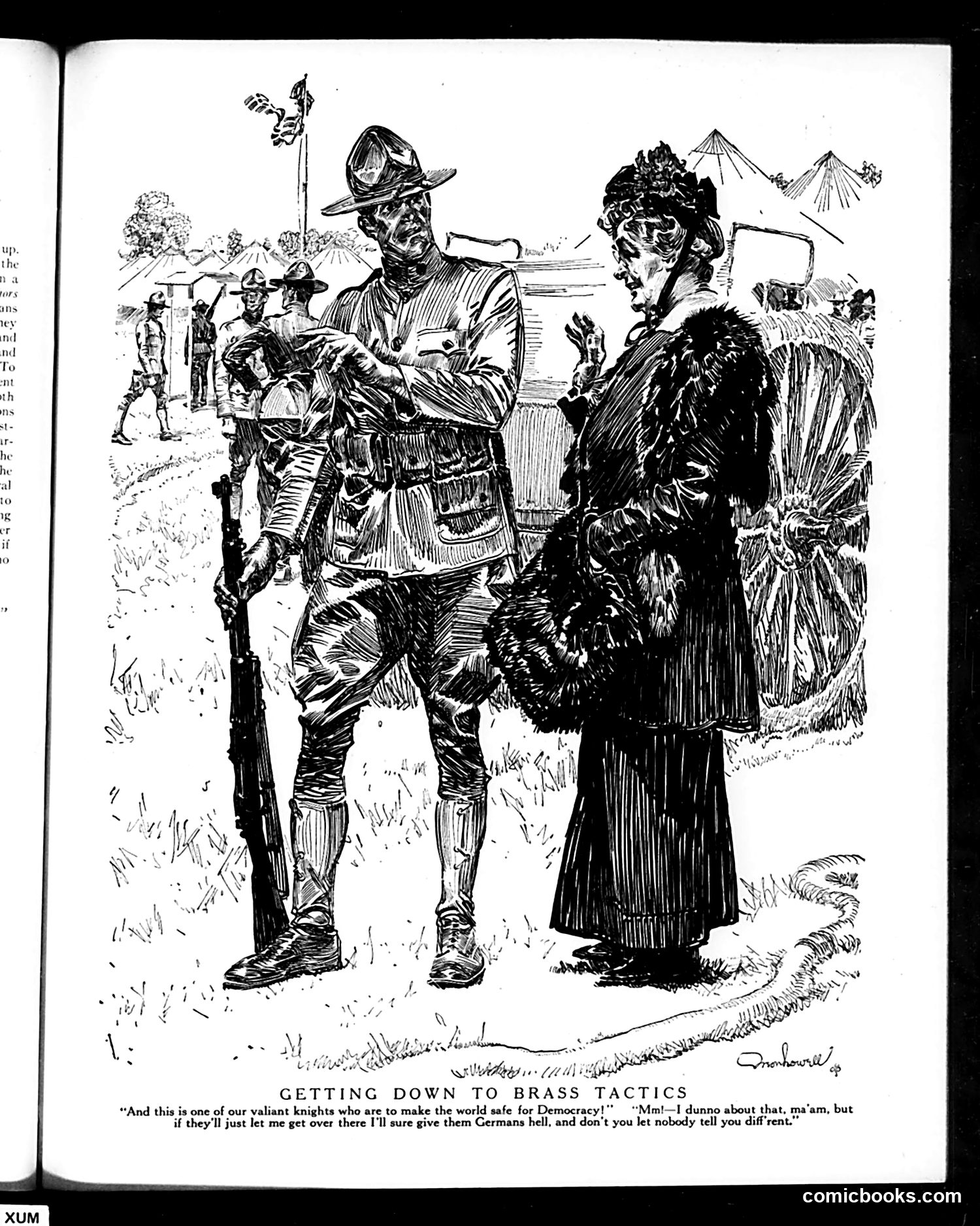
This WWI-era political cartoon satirizes American military recruitment rhetoric. A soldier in uniform boasts to a woman about making "the world safe for Democracy" and defeating "the Germans," using patriotic clichés. The woman's skeptical response ("I dunno about that, ma'am") undercuts his bravado. The title suggests the cartoon is mocking the gap between soldiers' confident talk and the harsh realities of trench warfare—the "brass tactics" of military leadership versus ground-level experience. The satire critiques how recruitment propaganda encouraged young men to volunteer for combat with idealistic slogans, while implying doubts about whether these promises matched actual outcomes. This reflects growing wartime cynicism about official messaging.
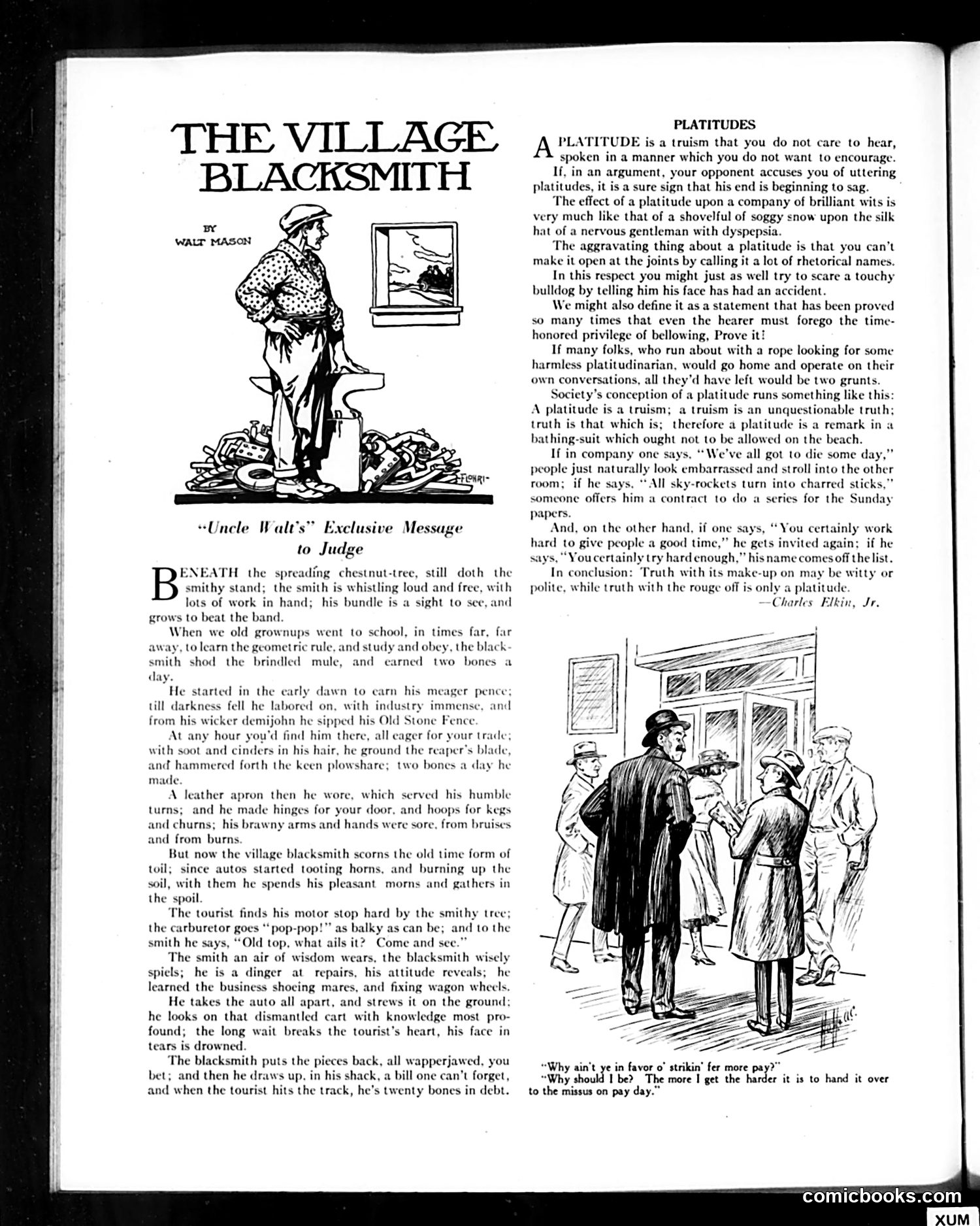
**The Main Story (by Walt Mason):** This nostalgic narrative contrasts the traditional blacksmith's life with modern times. The old blacksmith worked dawn-to-dusk for meager pay ("two bones a day"—slang for dollars), shoeing mules and sharpening farm tools. Now, automobiles have arrived, and the blacksmith has reinvented himself as a mechanic. The satire: tourists' cars break down at his shop; he disassembles the engine, leaves the owner waiting anxiously, then presents an astronomical repair bill ("twenty bones in debt"). The joke mocks both the blacksmith's sudden prosperity exploiting wealthy tourists AND the tourists' helplessness with newfangled machinery. **The "Platitudes" Essay:** This companion piece defines platitudes as annoying truisms. It satirizes how stating obvious facts ("we all die") causes discomfort while absurdities ("sky-rockets turn to charred sticks") get entertainment contracts. The humor targets social hypocrisy and the arbitrary reception of speech. **Context:** Early automotive age (likely 1910s); rural America meeting modernity; class tensions between wealthy tourists and village workers.
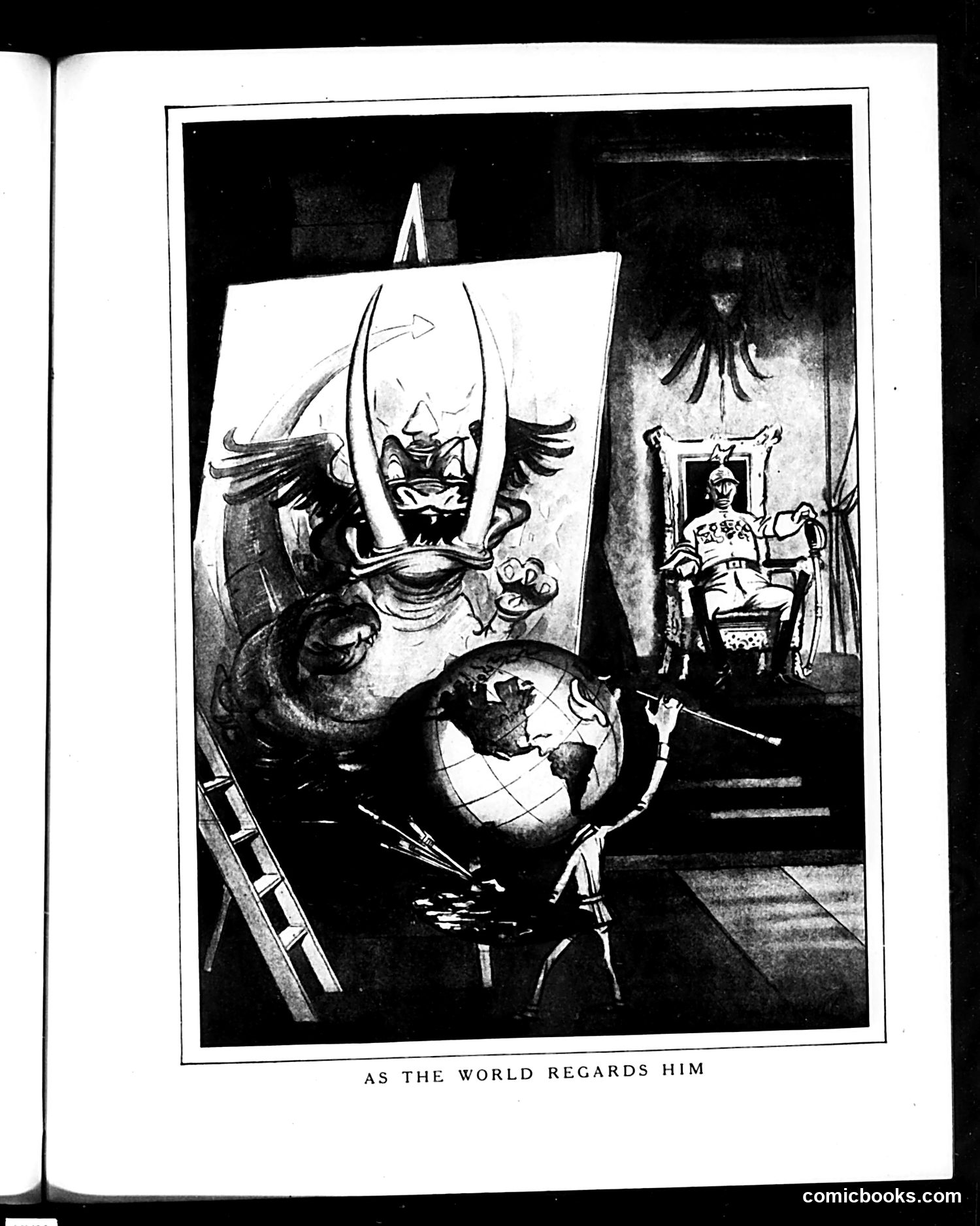
This political cartoon depicts a theatrical scene with the caption "AS THE WORLD REGARDS HIM." The image shows a demonic or villainous figure with horns and wings displayed on a stage backdrop or painting, while a globe sits prominently in the foreground. In the background, a throne or seat of power is visible with radiating lines suggesting importance or authority. The satire appears to target a specific political leader or figure whom the cartoonist presents as tyrannical or evil—"as the world regards him." The theatrical presentation suggests the figure's power is performative or constructed for public consumption. The globe emphasizes global perception of this person's malevolent influence. Without the publication date visible, identifying the specific figure or historical moment remains unclear, though the imagery suggests early-to-mid 20th century geopolitical commentary.
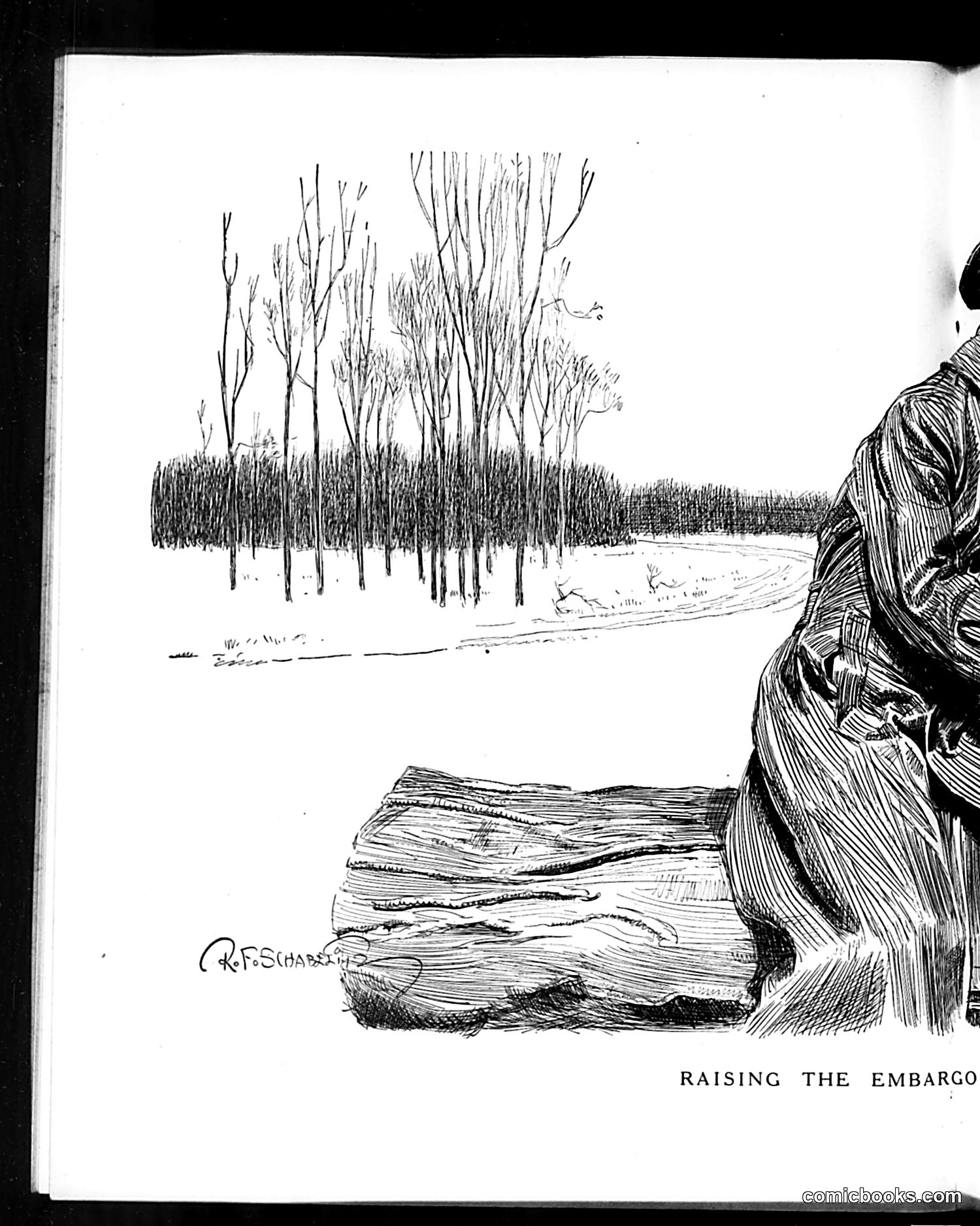
This appears to be a political cartoon depicting the lifting of a trade embargo. The image shows a figure (right side) with a log or wooden barrier, set against a winter landscape with bare trees and snow. The caption "RAISING THE EMBARGO" suggests the removal of trade restrictions. The cartoon likely references a historical U.S. embargo—possibly the Napoleonic Wars era or another period of trade conflict. The act of "raising" the physical barrier (the log) serves as visual metaphor for lifting commercial restrictions. The stark winter setting may suggest economic hardship caused by the embargo that would be relieved by its removal. The artist's signature appears to be "R.F. Schabel" or similar.
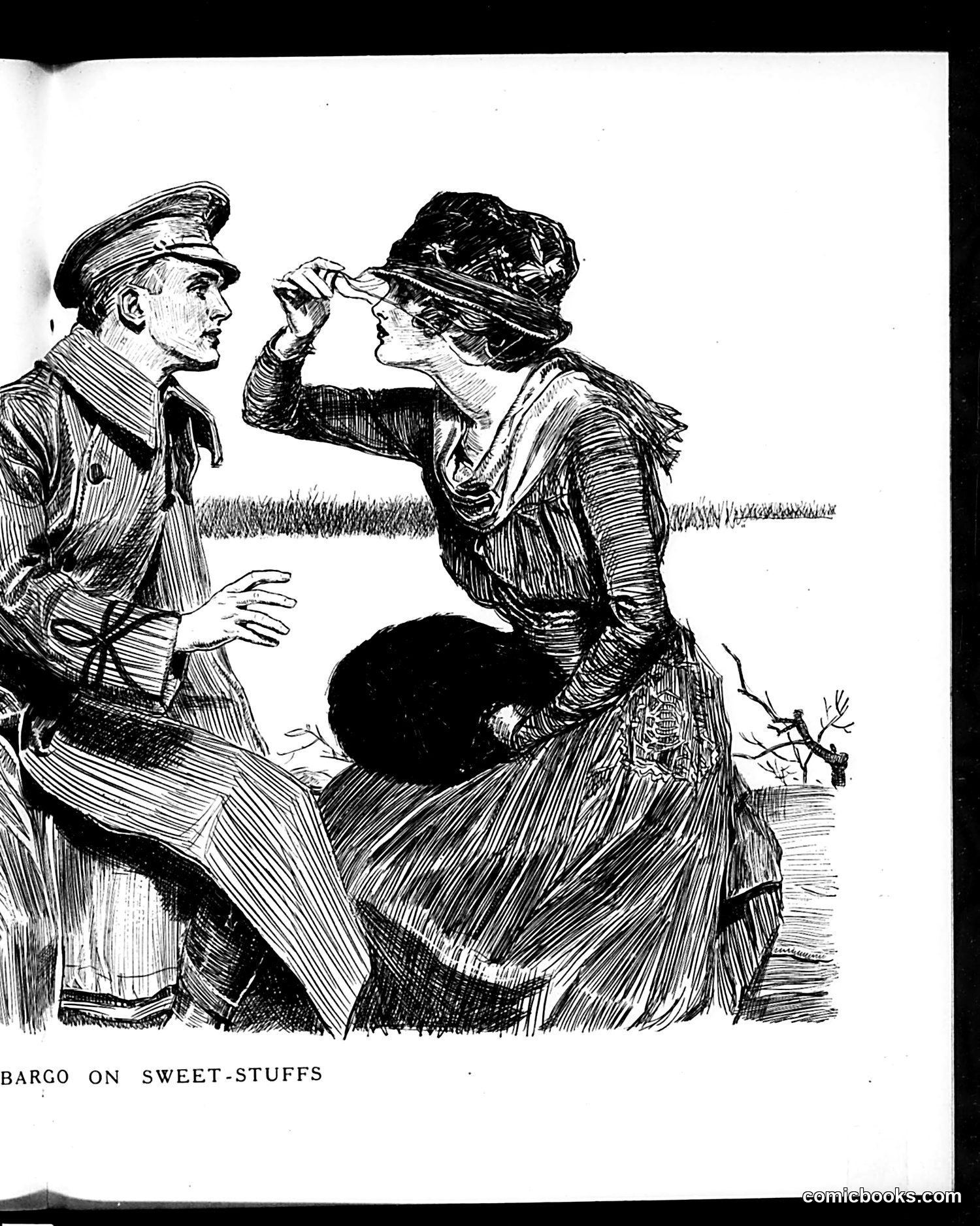
This cartoon depicts a woman adjusting a man's hat or head covering while he gestures in conversation. The caption reads "Bargo on Sweet-Stuffs" (likely "Embargo on Sweet-Stuffs"). The joke appears to reference wartime rationing or trade restrictions on sugar and candy. The woman's action of adjusting his hat seems to be visual wordplay—she's literally putting restrictions on his "sweet stuff" (his head/hat), mirroring government embargoes on actual sweets. The intimate domestic setting and the woman's assertive gesture suggest satire about how rationing or restrictions affected everyday life and relationships. Without knowing the specific publication date, the context suggests this references either WWI or WWII-era food rationing policies that restricted sugar availability to civilians.
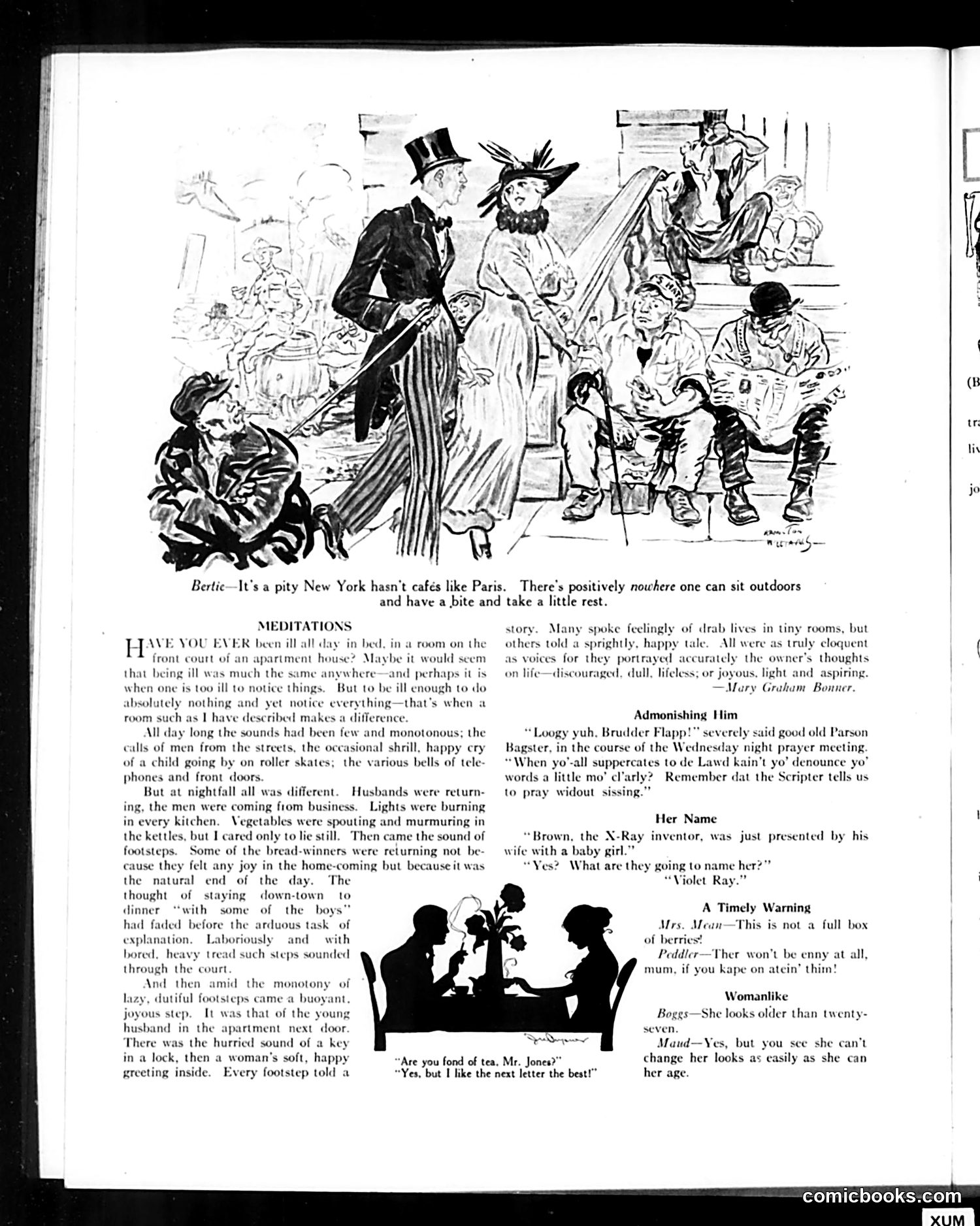
The top illustration satirizes **New York City's lack of outdoor café culture** compared to Paris. A well-dressed couple and fashionable pedestrians are depicted in what appears to a public space, with the caption suggesting New Yorkers have nowhere to sit outdoors leisurely—a social complaint about American urban life versus European sophistication. The "Meditations" essay reflects on **apartment living during illness**, capturing the sounds and rhythms of urban working-class domesticity: weary breadwinners returning home with resignation, contrasted with one joyful young couple, illustrating varying attitudes toward marriage and work. The smaller jokes at bottom are typical Judge humor: a pun about "tea" vs. the letter "U"; a play on "Violet Ray" (X-ray technology); criticism of a woman eating too many berries; and a dig at female vanity about aging. Overall, the page reflects early-20th-century middle-class concerns: urban isolation, the monotony of wage labor, marriage dynamics, and gender stereotypes.
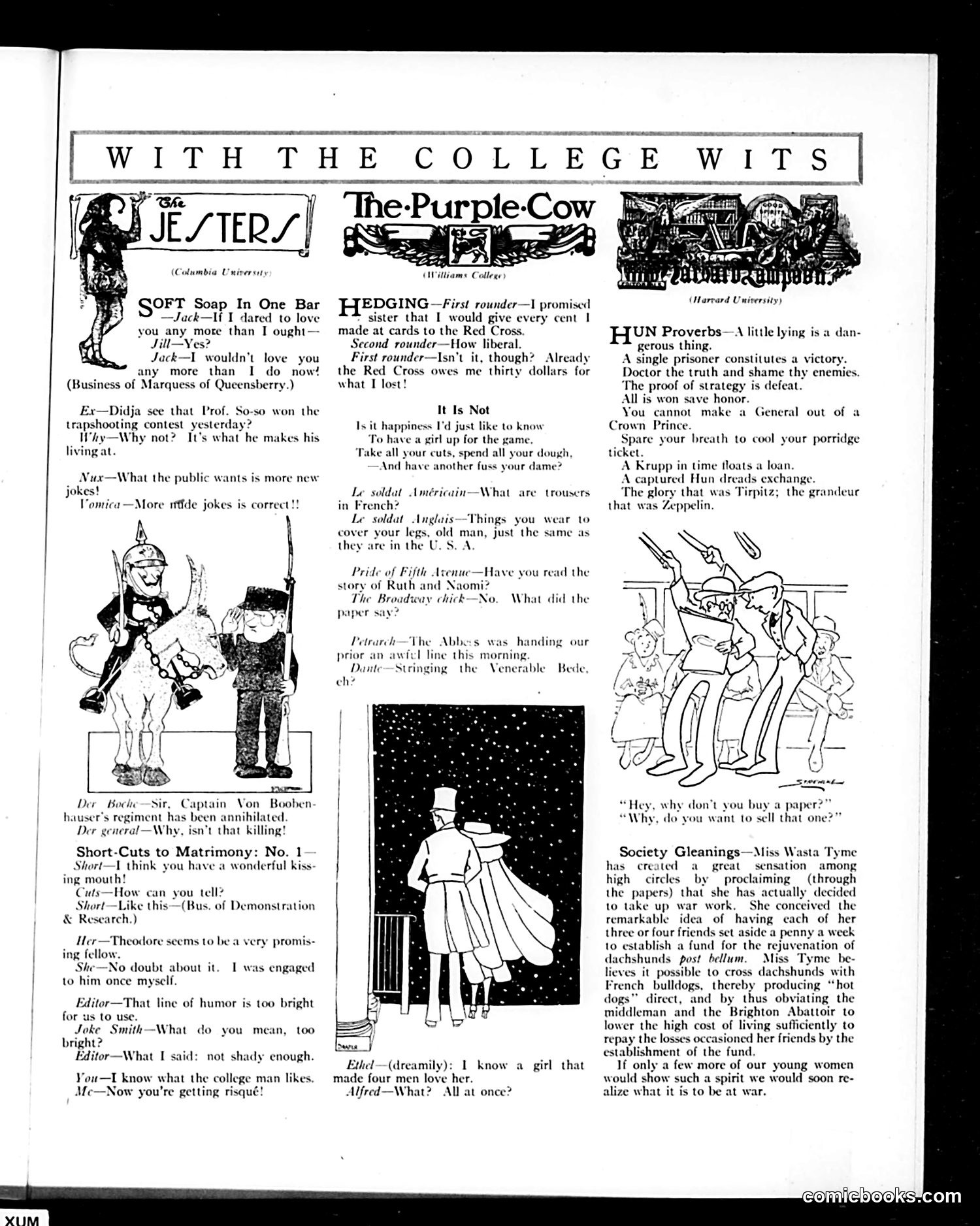
This page collects humorous sketches and jokes from college newspapers at Columbia, Williams, and Harvard, typical of Judge's "college wit" feature. **Key content:** The cartoons mock student pretensions and wartime contradictions. "Der Boche" references World War I's German military (appearing to satirize casual attitudes toward casualties). "UN Proverbs" inverts familiar sayings into cynical observations about war—"All is won save honor" and references to Zeppelins and Krupp (German munitions manufacturer) indicate WWI-era satire about the costs of industrial warfare. **Social satire** targets wealthy women: "Miss Wasta Tyme" mocks a society woman's token war charity (collecting pennies for dachshund rehabilitation) while war rages—the joke being her absurdly self-serving "contribution" and the suggestion to breed "hot dogs" (dachshunds crossed with French bulldogs) to profit from anti-German sentiment. The page's humor relies on college-age cynicism about romance, materialism, and hollow patriotism during WWI.
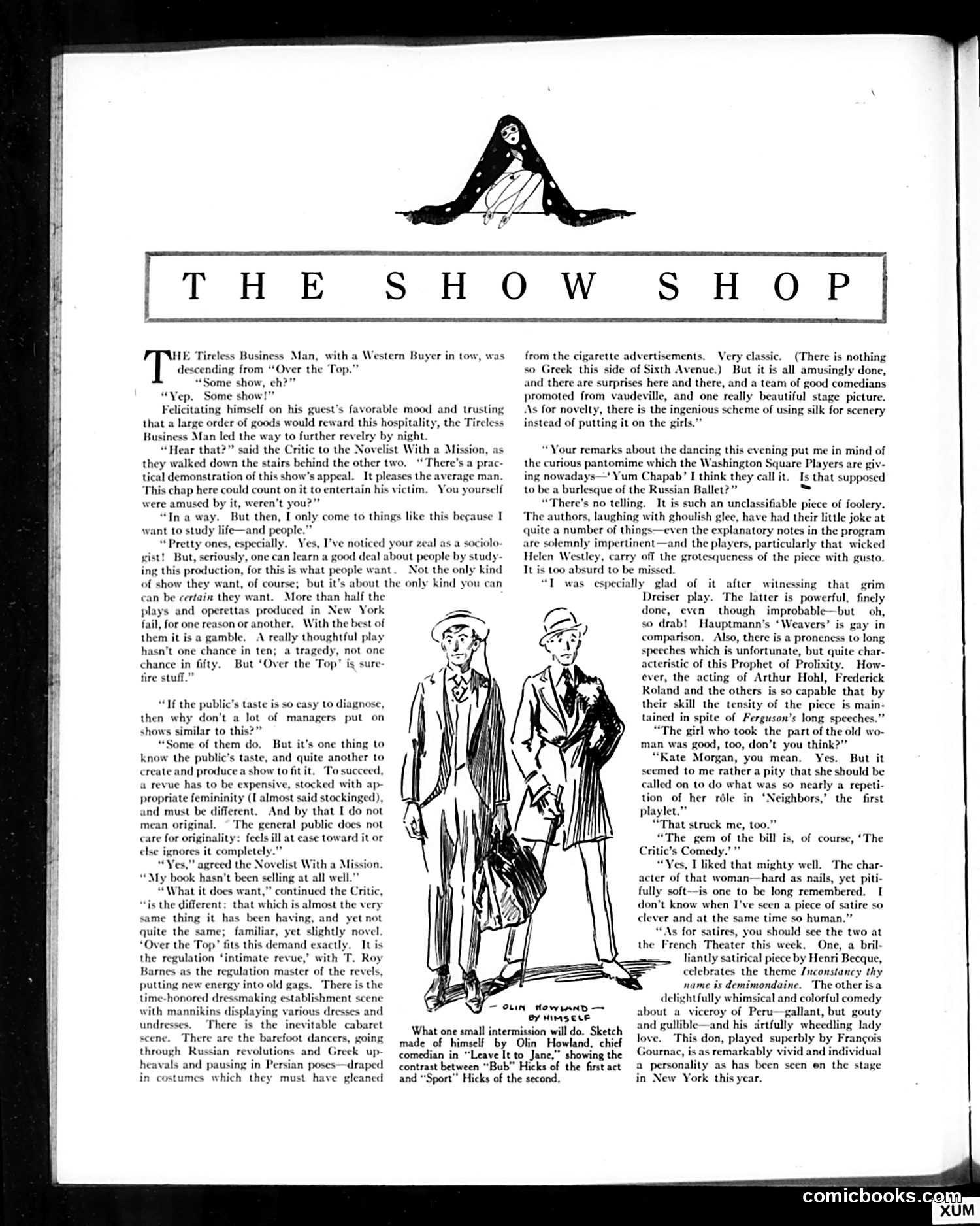
This page from *Judge* magazine reviews "Over the Top," a 1917 Broadway revue. The cartoon depicts a theatrical producer (the "Tireless Business Man") entertaining a Western buyer, followed by a Critic and Novelist discussing the show's appeal. The satire critiques popular entertainment versus artistic merit. The Critic explains that "Over the Top" succeeds because it offers familiar comfort—"the different: that which is almost the very same thing"—rather than genuine originality. He notes that truly thoughtful plays fail commercially, while formulaic revues with established comedians (T. Roy Barnes), familiar scenes (dressmaking shops, cabaret acts), and "barefoot dancers" doing Russian and Persian-inspired choreography reliably succeed. The joke targets both audience taste and theatrical economics: the public wants safely novel entertainment, not real innovation. The Novelist's failed book sales underscore this tension between commercial viability and artistic ambition—a timeless cultural complaint.
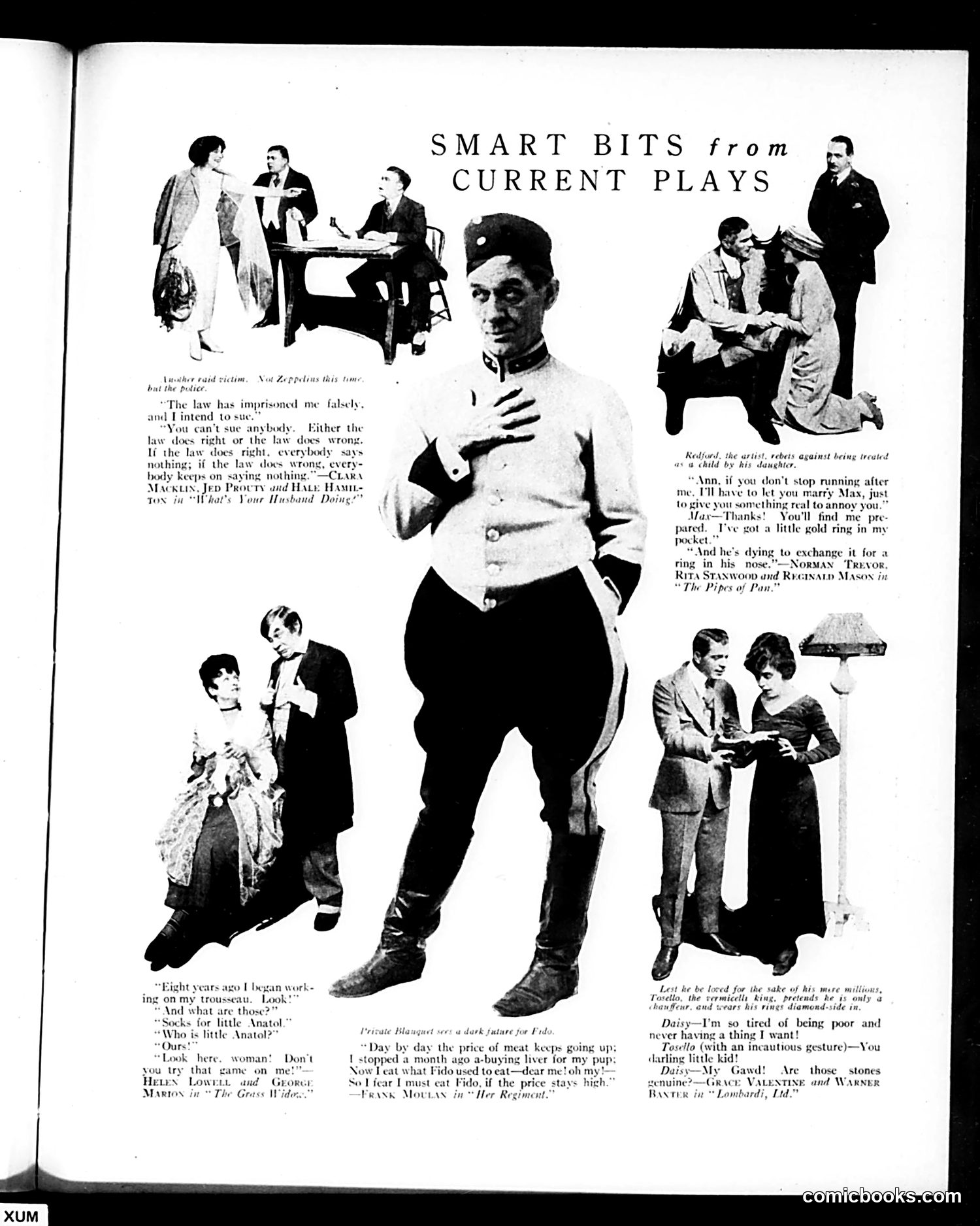
This page collects humorous quotes and scenes from Broadway productions of the era (likely 1910s-1920s based on style). Rather than political satire, it's theatrical humor—witty dialogue and comedic moments from popular plays. The vignettes showcase domestic comedy and social observation: a man imprisoned for legal technicalities; romantic entanglements involving marriage proposals; complaints about poverty and rising meat prices (suggesting post-WWI economic strain); and a woman proudly displaying jewelry. The central full-figure photograph appears to be an actor in character—possibly a comedic role emphasizing physicality. The quoted exchanges highlight the plays' appeal: clever wordplay about legal absurdities, romance, and economic hardship that audiences found entertaining. This is essentially theatrical advertising—Judge magazine promoting current Broadway shows to readers as sources of sophisticated humor and entertainment.
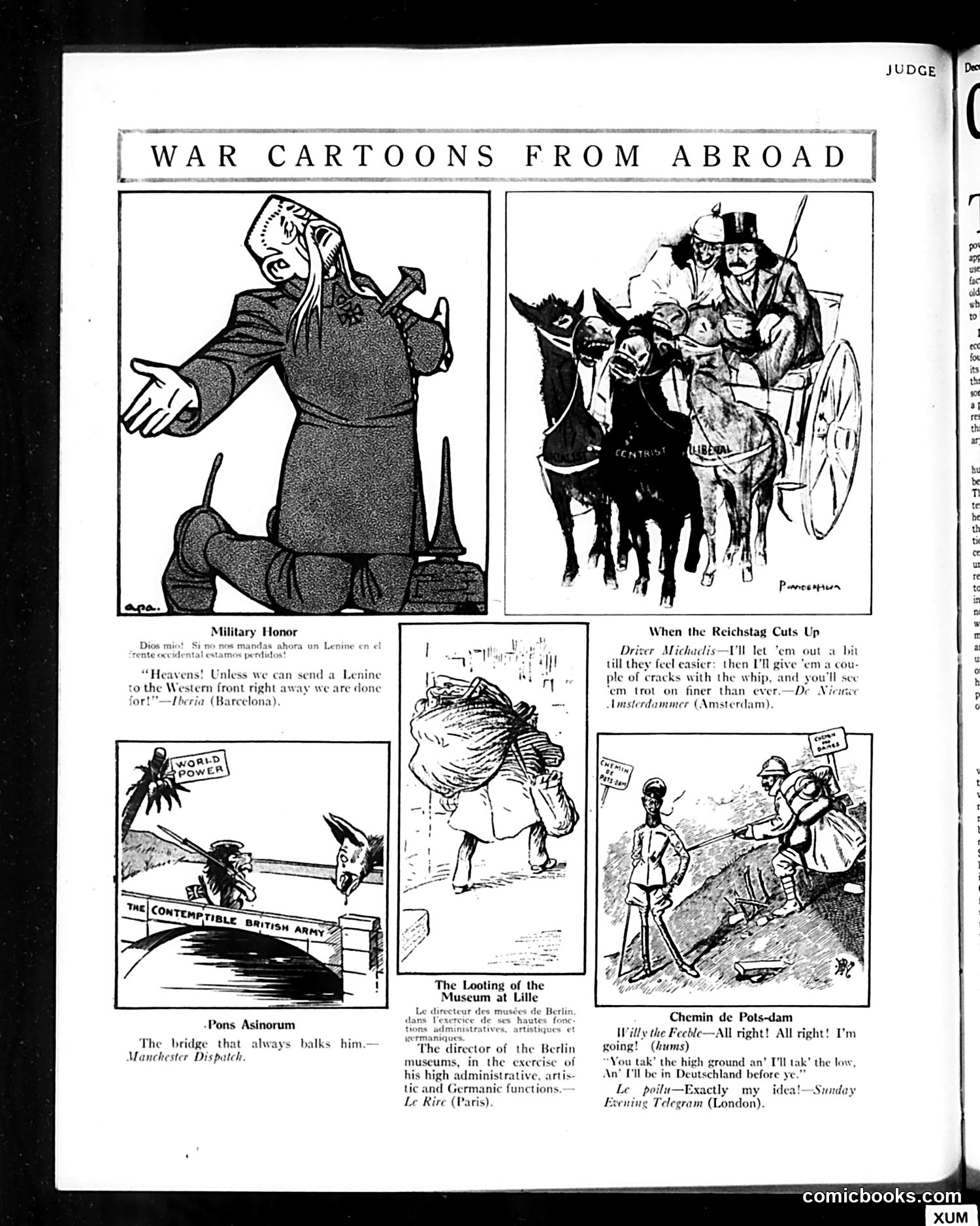
This page compiles anti-German political cartoons from European newspapers during World War I, satirizing German leadership and military conduct. **Key cartoons:** - **"Military Honor"**: A grotesque German figure, likely representing German militarism or leadership, kneels before weapons. The caption mocks German desperation—they need to send Lenin to the Western Front or face defeat. - **"Pons Asinorum"**: References a bridge "that always balks him," likely depicting the British blockade as an obstacle Germany cannot overcome. - **"Looting of the Museum at Lille"**: Satirizes German cultural destruction and theft during occupation, with the Berlin museum director justifying plunder as "administrative" duties. - **"When the Reichstag Cuts Up"** and **"Chemin de Pots-dam"**: Mock German military command and exhausted soldiers, suggesting brutal discipline and futile orders. These are reprinted foreign cartoons, showing how Allied nations ridiculed German conduct and competence.
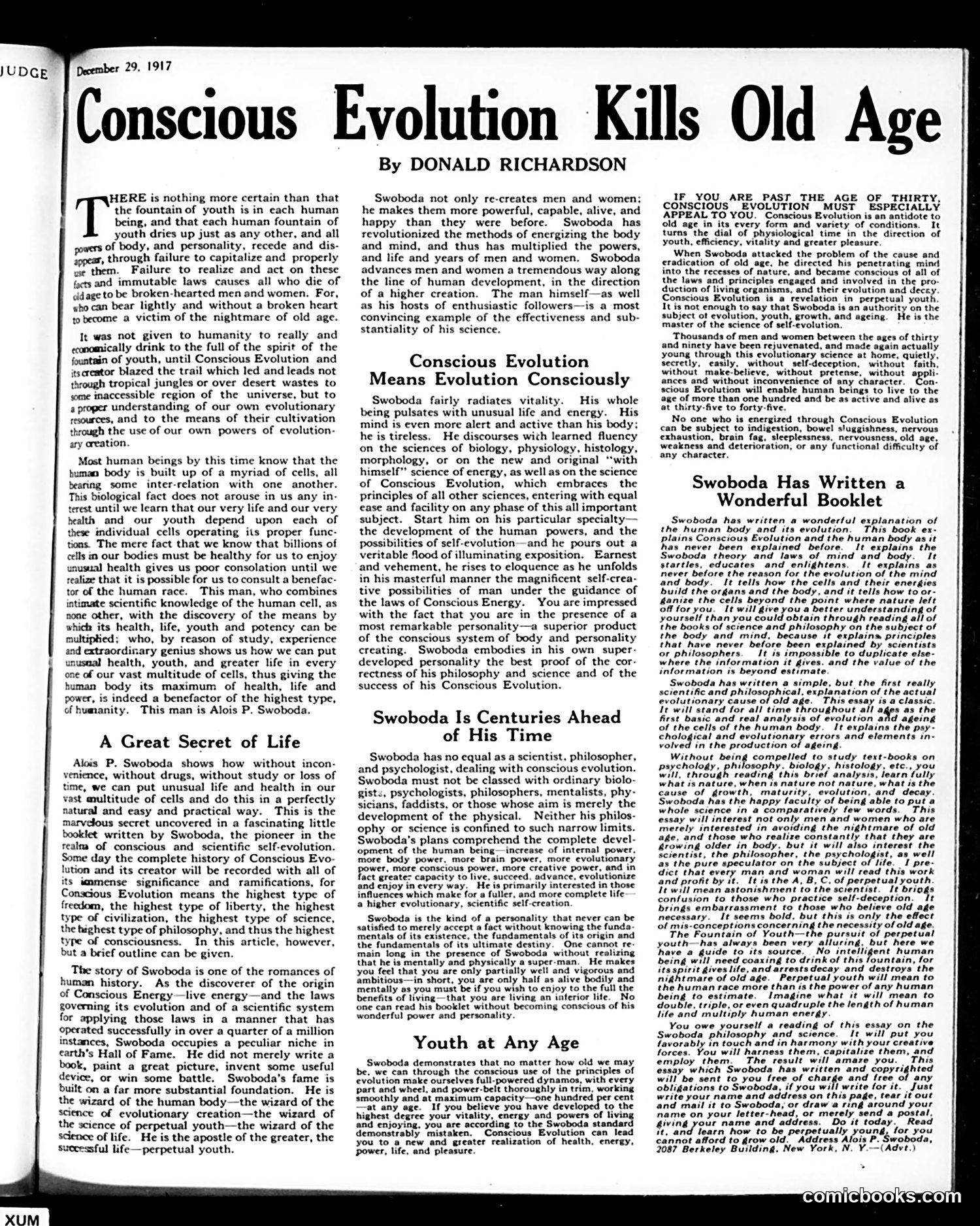
This page is primarily **promotional advertising disguised as editorial content**, promoting Alois P. Swoboda and his "Conscious Evolution" philosophy—a pseudoscientific self-help system claiming to reverse aging. The text makes grandiose claims that through proper understanding of cellular biology and "conscious" control of one's body, anyone can maintain eternal youth without drugs or effort. Swoboda is portrayed as a visionary genius comparable to great historical figures. **For modern readers:** This represents early 20th-century wellness pseudoscience—a precursor to today's dubious anti-aging products. The breathless, messianic language ("benefactor of humanity," "wizard") and vague promises of vitality through "consciousness" mirror modern wellness marketing. Judge magazine appears to have accepted payment to present this advertisement as legitimate editorial content—a practice that predates modern sponsored content but serves the same function: blurring advertising and journalism.
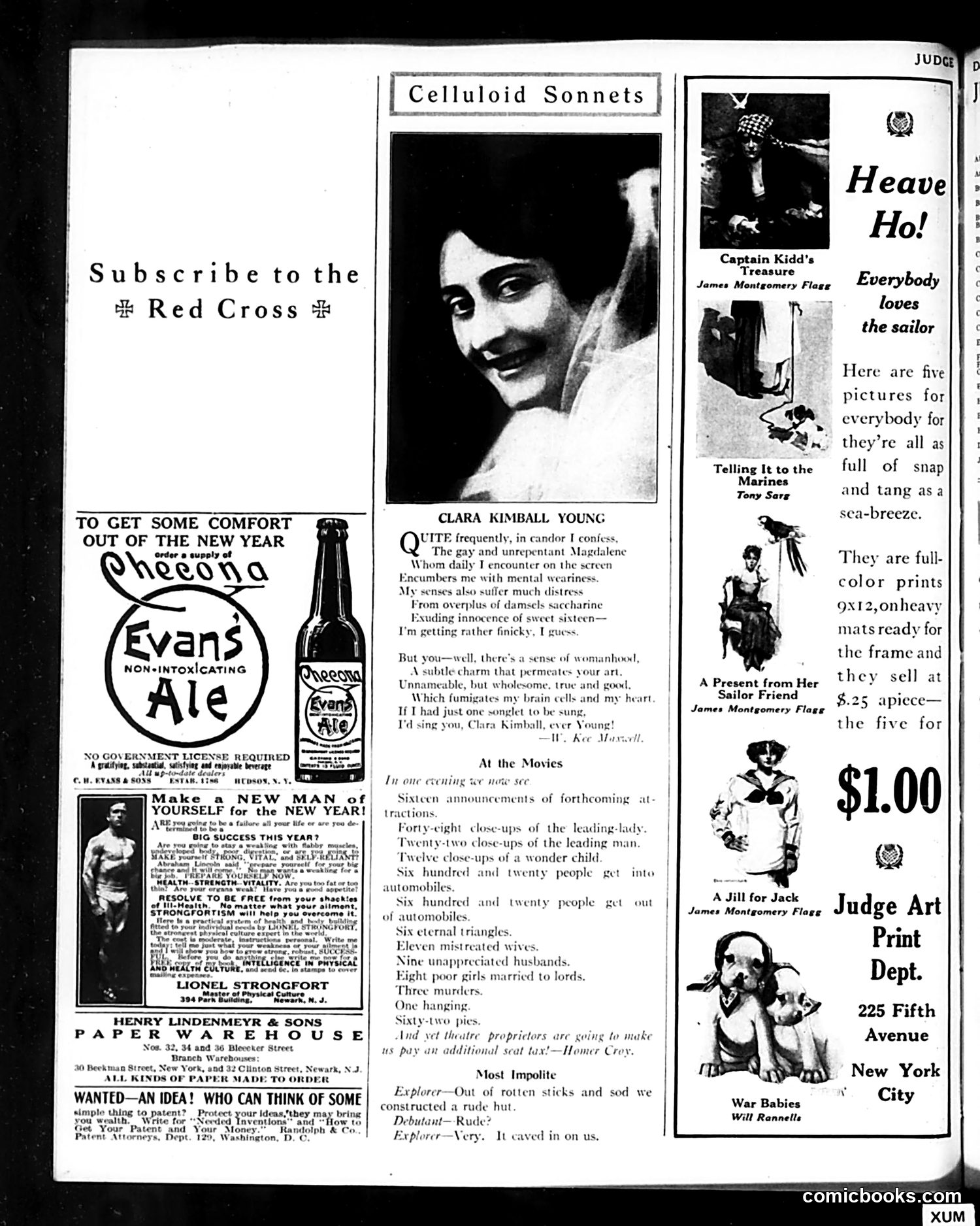
This page is primarily **advertising and promotional content** rather than political satire. It includes: **Main Features:** - A "Celluloid Sonnets" section featuring actress **Clara Kimball Young**, with a romantic tribute poem praising her "womanhood" and artistic quality compared to other saccharine film heroines - A humorous movie critique by Homer Croy listing absurd statistics about typical film content (close-ups, car scenes, melodramatic plots), satirizing the formulaic nature of silent cinema - A brief joke about an explorer's rude hut **Advertisements:** - Evans non-intoxicating ale (notably marketed as requiring "no government license") - Various self-improvement products and services - Judge Art Print Department selling illustrated prints by James Montgomery Flagg The page reflects early 1920s concerns: silent film industry conventions, Prohibition-era beverage marketing, and popular commercial art. The satire targets predictable movie formulas rather than political issues.
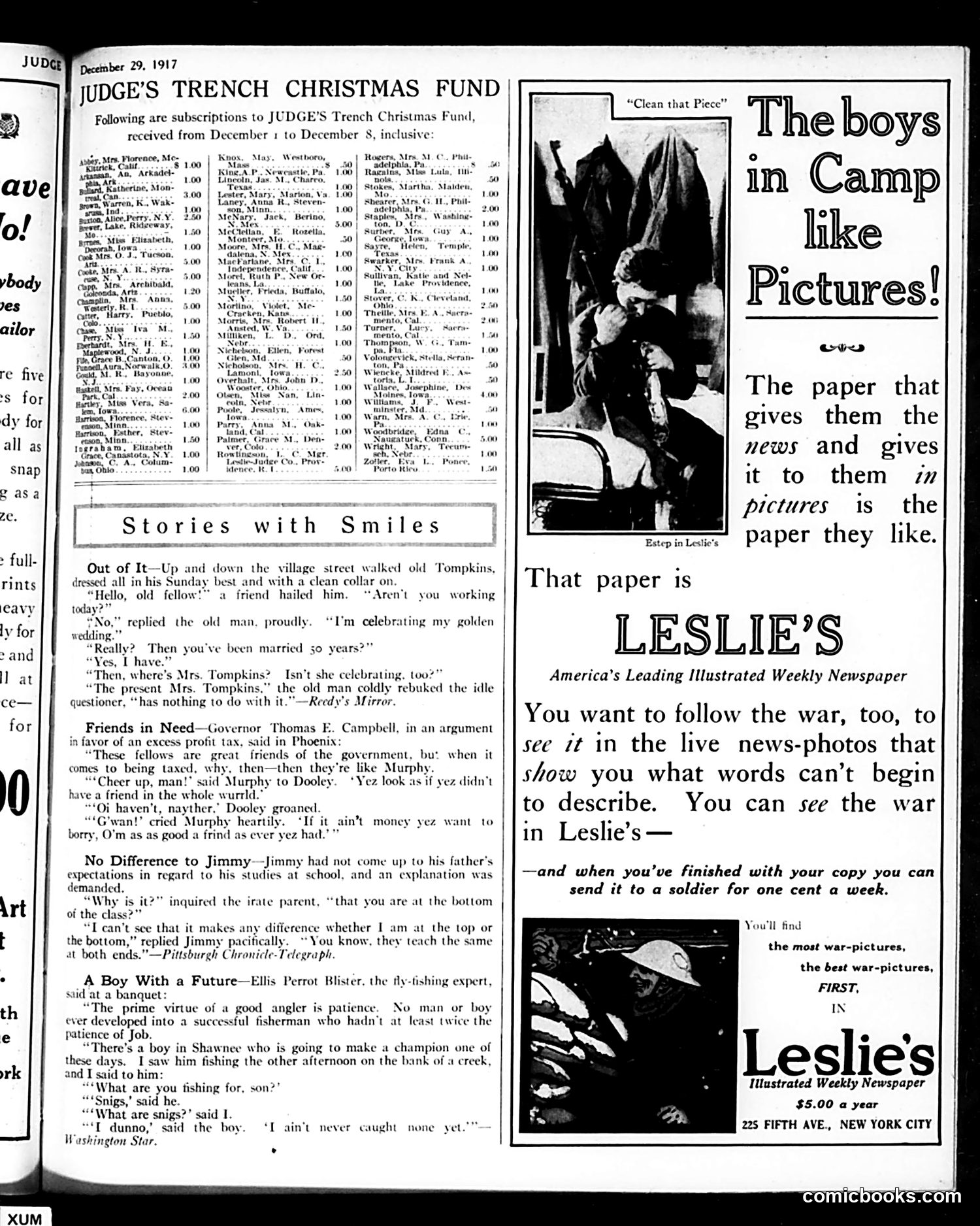
This page combines a charitable fundraiser with humorous content and advertising, published during WWI. **Upper left**: The "Judge's Trench Christmas Fund" lists reader donations for soldiers, a timely patriotic appeal as America was actively fighting in Europe (the U.S. entered WWI in April 1917). **"Stories with Smiles"**: Four short comic anecdotes mock human foibles—a man celebrating his "golden wedding" (with a second wife), misers who befriend others only when they're not being taxed, a boy indifferent to academic ranking, and a young fisherman who catches nothing. These are mild, apolitical humor typical of the era. **Right side**: An advertisement for **Leslie's Illustrated Weekly Newspaper** pitches the publication to soldiers and civilians by emphasizing its war photographs—"the most war-pictures, the best war-pictures, FIRST." The rhetoric appeals to readers wanting visual documentation of the war effort, and offers a patriotic service: sending used copies to soldiers costs "one cent a week." The page reflects 1917 American culture: simultaneous support for troops, light entertainment, and media competition emphasizing photojournalism.
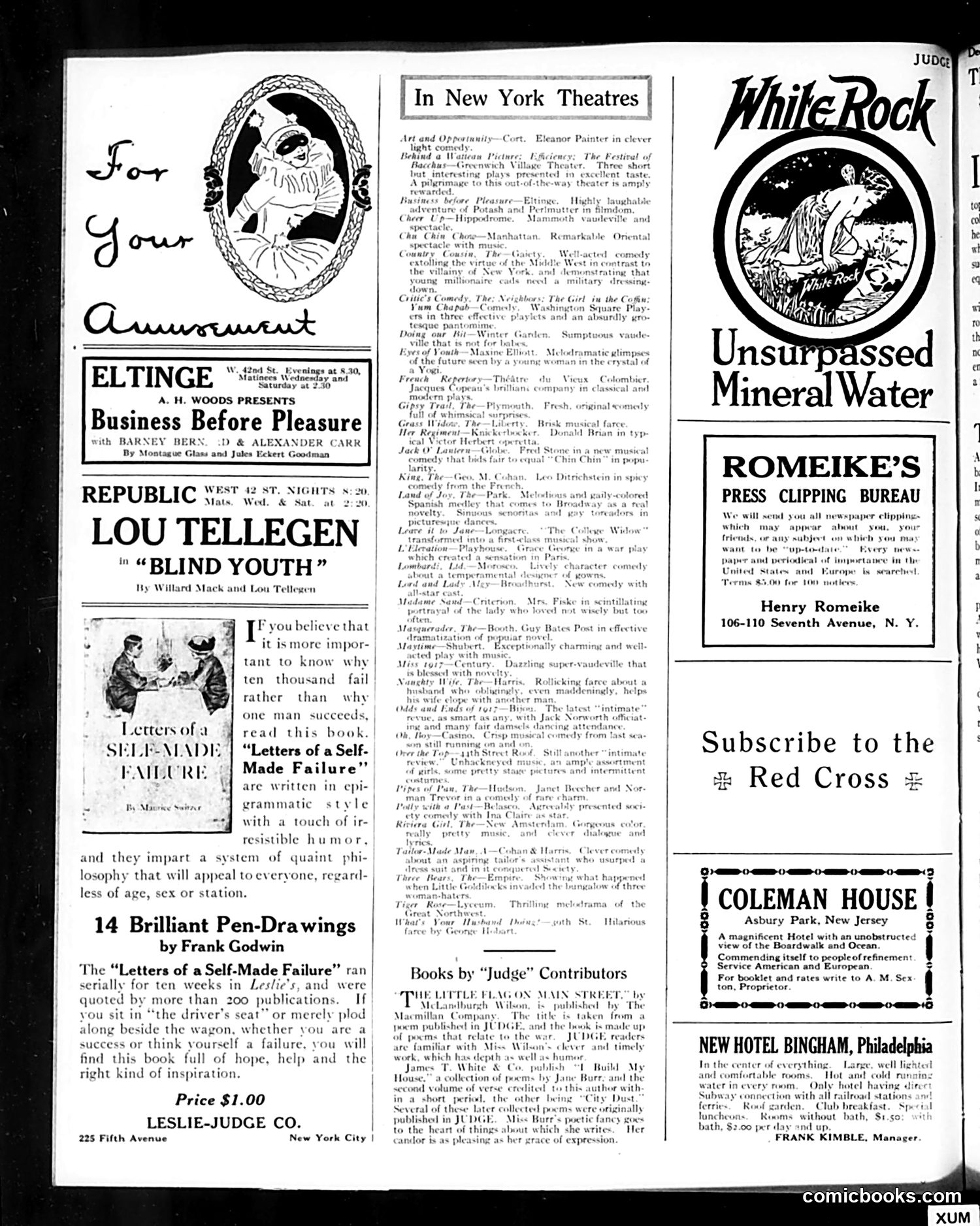
This is primarily an **advertising and theater listings page** from Judge magazine, not a political cartoon page. The content includes: **Theater advertisements** for Broadway productions like "Business Before Pleasure" (at the Eltinge) and "Blind Youth" (at the Republic), typical entertainment promotion for the era. **A book advertisement** for "Letters of a Self-Made Failure," emphasizing its serial publication in Leslie's magazine and its inspirational message about success and failure—pitched to appeal broadly regardless of "age, sex or station." **Service advertisements** for a press clipping bureau, Red Cross subscription, and hotels (Coleman House in Asbury Park and Hotel Bingham in Philadelphia). The **pen-drawings by Frank Godwin** accompanying the book are decorative rather than satirical. There are **no visible political cartoons or satire** on this page. It represents Judge's commercial side—revenue from advertisements rather than editorial content. The page demonstrates how early 20th-century magazines funded themselves through advertisements mixed with content.
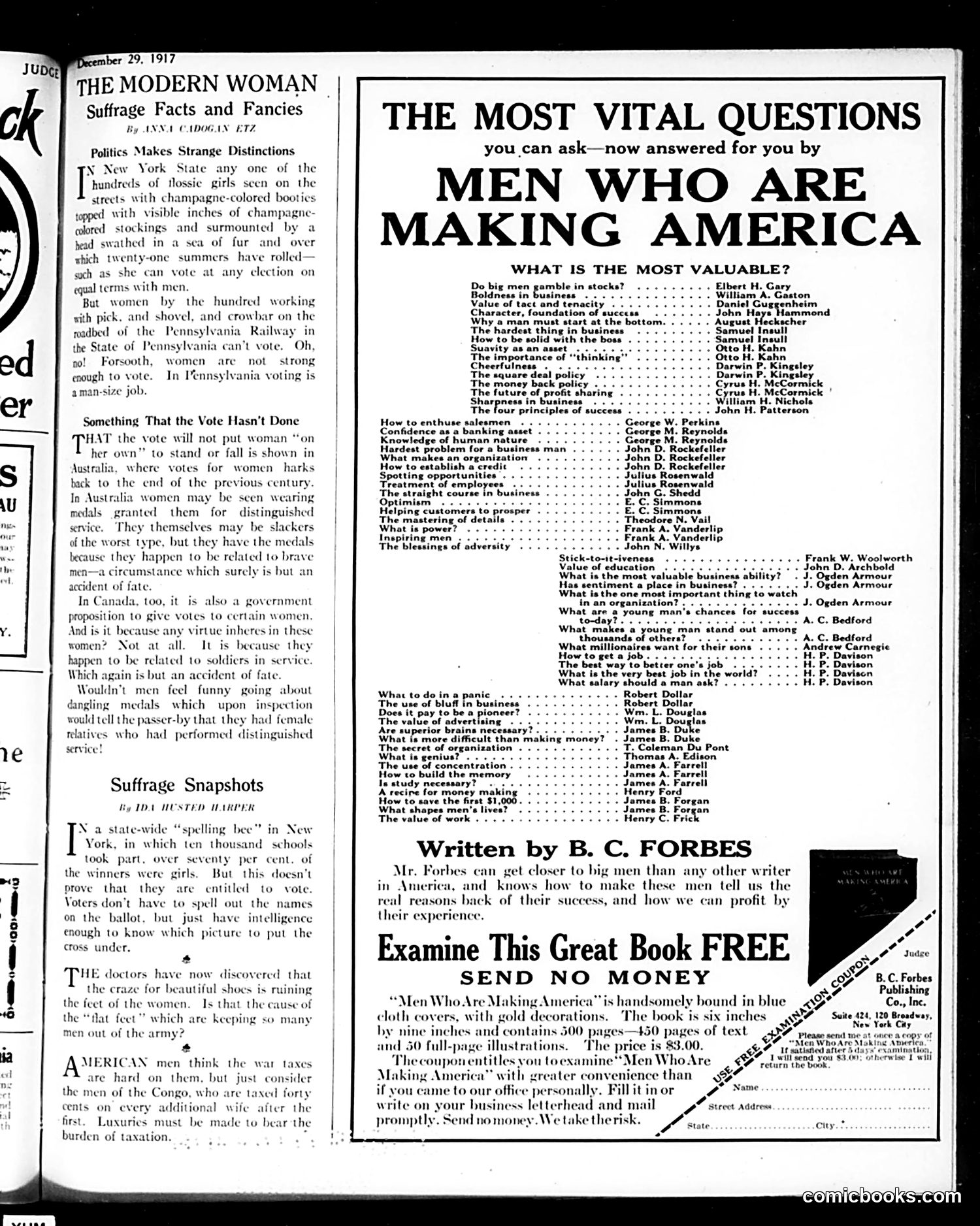
This page satirizes women's suffrage through two distinct sections: **Left Column ("The Modern Woman"):** The author (Anna Cadogan Etz) uses **ironic logic** to expose suffrage opponents' hypocrisy. She notes that wealthy young women in New York can vote despite doing nothing of social value, while female laborers on the Pennsylvania Railway—demonstrating actual strength and capability—are deemed "unfit" to vote. The joke: voting ability supposedly requires a "man-size job," yet it's granted to idle socialites. Additional examples from Australia and Canada show women receiving war medals merely for *being related to* soldiers, further mocking the notion that women lack independent value. **Right Column (Advertisement):** A book titled "Men Who Are Making America" claims to answer "vital questions" through interviews with wealthy industrialists (Rockefeller, Carnegie, Ford, etc.). This is satirical juxtaposition—while women are debated as unfit for citizenship, male captains of industry are treated as philosophical authorities on success and morality, exposing the gendered double standard in whose wisdom society trusts. The page's irony: women's competence is questioned despite evidence, while men's authority goes unquestioned.
This is primarily a **table of contents and advertising page** rather than a political cartoon page. The left column announces the upcoming New Year issue's cover by Orson Lowell titled "CANNED" and lists contributing cartoonists and writers. The center section contains **brief humorous anecdotes** typical of Judge's humor: - Jokes about automobiles (common satirical targets of the era) - Wordplay on banking and military terminology - Domestic comedy scenarios The right side advertises **"The European War"** — a 10-volume New York Times compilation of WWI records, priced at $1 down. Given the December 1917 date, America had recently entered WWI (April 1917), making this a timely commercial tie-in. The humor throughout reflects early 20th-century sensibilities: malapropisms, class-based jokes, and domestic disputes presented as light entertainment rather than sharp political satire.
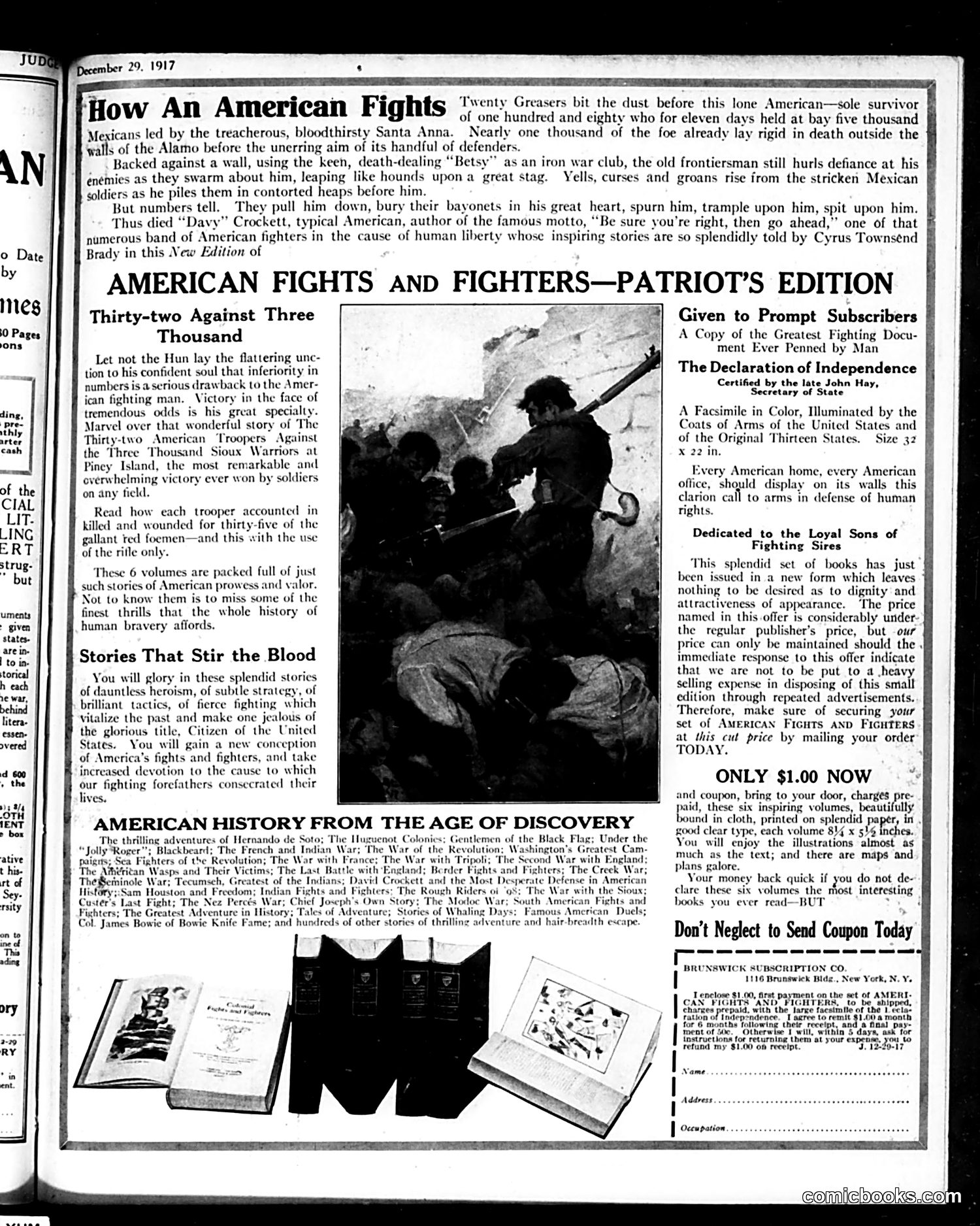
This page is primarily **advertising for a book series**, not satire. The "cartoon" is actually promotional illustration for "American Fights and Fighters—Patriot's Edition" by Cyrus Townsend Brady. The content glorifies American military heroism through historical narratives: the Alamo defense (invoking "Davy" Crockett fighting Mexican forces) and a battle between 32 American soldiers and 3,000 Sioux warriors at Piney Island. These stories frame Americans as vastly outnumbered yet victorious through skill and courage. **Historical context**: Published during World War I (1917), this advertisement uses patriotic mythology to encourage American martial spirit and recruitment. The reference to "the Hun" (Germany) explicitly connects past American victories to current conflict justification. The page also offers a facsimile Declaration of Independence as a premium—linking the books to founding ideals of American liberty and duty. This is **propaganda disguised as entertainment and education**, leveraging historical narratives to cultivate patriotic fervor among readers during wartime.
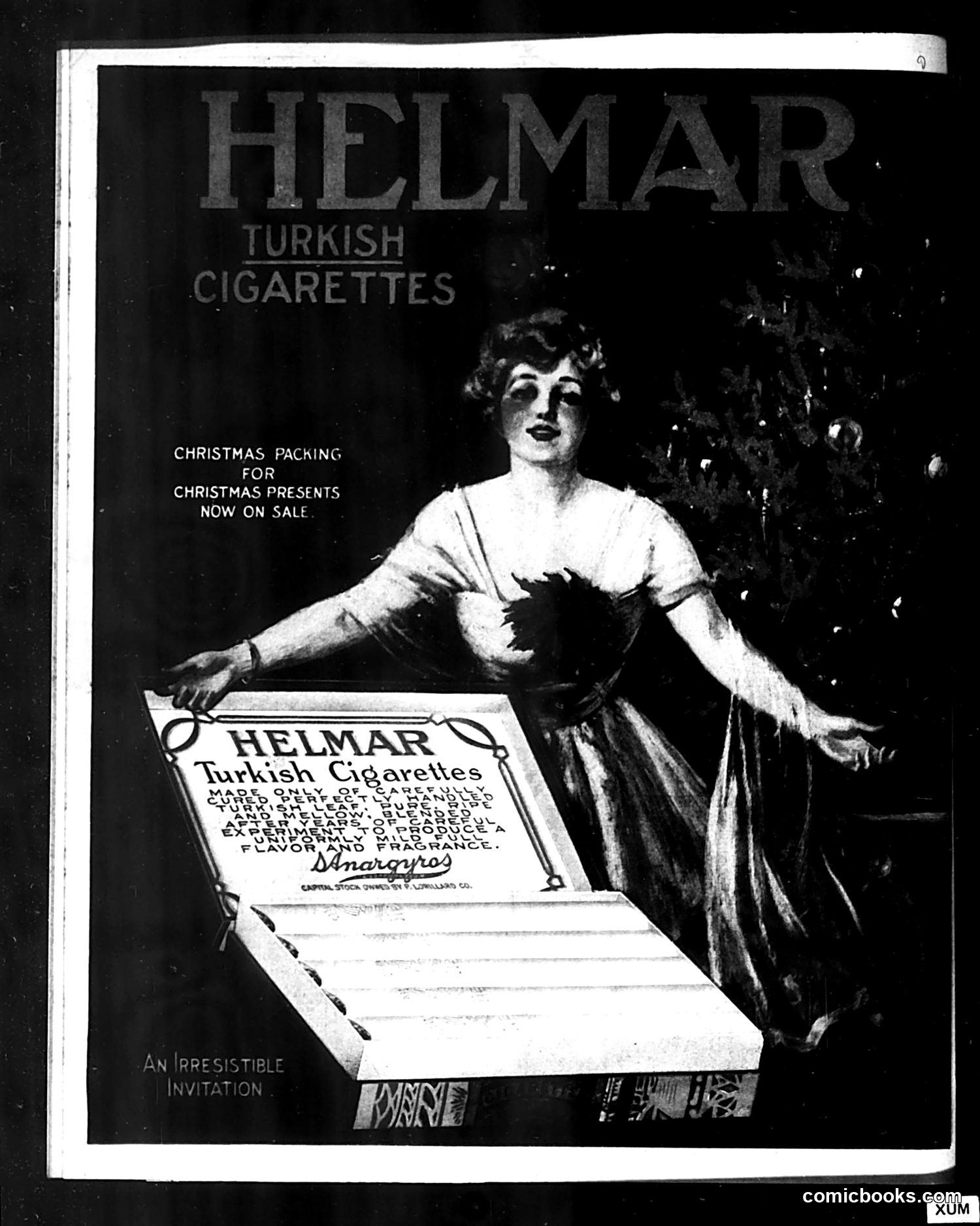
This page is primarily a **cigarette advertisement**, not political satire. It advertises Helmar Turkish Cigarettes, featuring a woman in classical dress presenting an ornate cigarette box. The ad emphasizes Christmas gift-giving, promoting special holiday packaging "now on sale." The woman's elegant appearance and the phrase "An Irresistible Invitation" aim to make the product desirable and sophisticated. The box lists flavor descriptors (quality, fragrance, etc.) to highlight the cigarettes' supposed appeal. **Context for modern readers:** Early 20th-century tobacco advertising freely used glamorous imagery and holiday messaging to market cigarettes as luxury gifts—marketing practices now heavily restricted due to health concerns. The classical styling suggests Helmar positioned itself as a premium, refined product.

I cannot reliably analyze this page. The image is predominantly black with very poor contrast and visibility—the cartoon(s) or illustrations are not clearly distinguishable to me. The OCR text appears to be corrupted or incomplete (showing only "XN," partial characters, and "comicbooks.com"), providing no substantive content to interpret. To properly explain the satire, political references, and historical context for a modern reader, I would need: a clearer, higher-contrast image of the actual cartoon artwork, and legible OCR text identifying the publication date, article titles, or caption information. I cannot responsibly guess at what figures or references might be depicted.