
Judge, 1917-12-29 · page 18 of 29
Judge — December 29, 1917 — page 18: what you’re looking at
What you’re looking at
This page from *Judge* magazine reviews "Over the Top," a 1917 Broadway revue. The cartoon depicts a theatrical producer (the "Tireless Business Man") entertaining a Western buyer, followed by a Critic and Novelist discussing the show's appeal. The satire critiques popular entertainment versus artistic merit. The Critic explains that "Over the Top" succeeds because it offers familiar comfort—"the different: that which is almost the very same thing"—rather than genuine originality. He notes that truly thoughtful plays fail commercially, while formulaic revues with established comedians (T. Roy Barnes), familiar scenes (dressmaking shops, cabaret acts), and "barefoot dancers" doing Russian and Persian-inspired choreography reliably succeed. The joke targets both audience taste and theatrical economics: the public wants safely novel entertainment, not real innovation. The Novelist's failed book sales underscore this tension between commercial viability and artistic ambition—a timeless cultural complaint.
📄 Transcribed text from this page (OCR, searchable)
Machine-transcribed from the original scan — historical spelling and the odd misread are preserved.
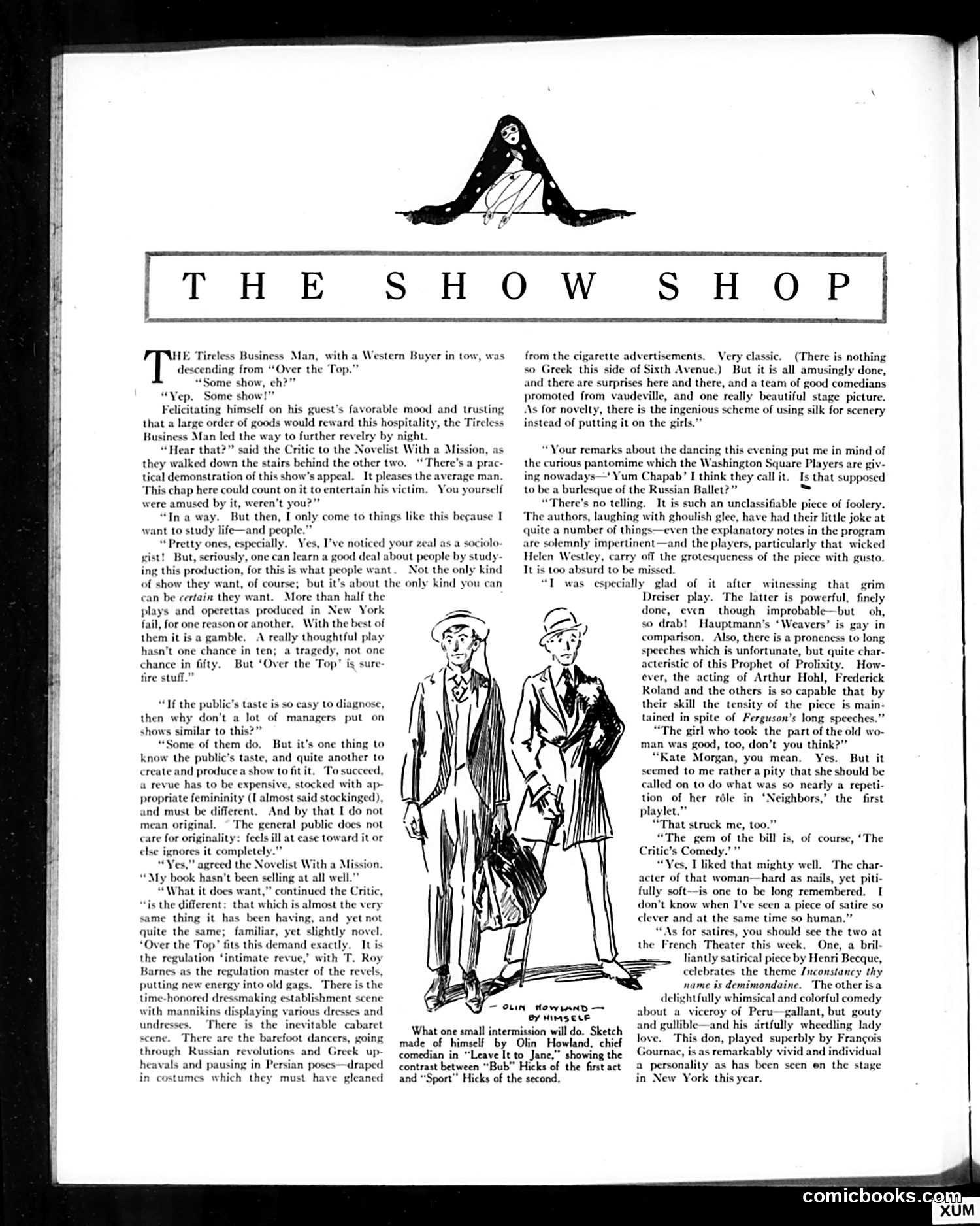
qe can nt etn S H O W | THE HE Tireless Business Man, with a Western Buyer in tow, was i descending from “Over the Top.” ome show, ch?” “Yep. Some show I ating himself on his guest’s favorable mood and trusting that a large order of goods would reward this hospitality, the Tireless Business Man led the way to further revelry by night. “Hear that?” said the Critic to the Novelist With a Mission, as they walked down the stairs behind the other two, “There's a prac- tical demonstration of this show's appeal. It pleases the average man. This chap here could count on it to entertain his victim. You yourself e amused by it, weren't you?” “In a way. But then, I onl; want to study life—and people. 'y ones, especially. Y gist! But, seriously, one can learn a good deal about people by study- ing this production, for this is what people want. Not the only kind of show they want, of course; but it's about the only kind you can can be certain they want. More half the plays and operettas produced in New York fail, for one reason or another. With the best of them it is a gamble, A really thoughtful play hasn’t one chance in ten; a tragedy, not one chance in fifty. But ‘Over the Top’ ig sure fire stuff.” come to things like this because I I've noticed your zeal as a sociolo- “If the public’s taste is so easy to diagnose, then why don’t a lot of managers put on shows similar to this?” “Some of them do. But it’s one thing to know the public’s taste, and quite another to create and produce a show to fit it. To succe a revue has to be expensive, stocked with propriate femininity (I almost said stockinged), and must be different. And by that I do not mean original. ~ The general public does not care for originality: feels ill at ease toward it or es it completely.” Yes,” agreed the Novelist With a \ “My book hasn't been selling at all well.” “What it does want,” continued the Critic, “is the different: that which is almost the very same thing it has been having, and yet not quite the same; familiar, yet slightly novel ‘Over the Top’ fits this demand exact Itis the regulation ‘intimate revue,’ with T. Roy Barnes as the regulation master of the revels, putting new energy into old gags. There is the time-honored dressmaking establishment scene with mannikins displaying various dresses and undresses, There is the inevitable cabaret scene. There are the barefoot dancers, going through Russian revolutions and Greek up- heavals and pausing in Persian poses—draped else ij — Olin towLanD — ‘What one small intermission will do. Sketch If by Olin Howland, chief comedian in “Leave It to Jane,” showing the contrast between “Bub” Hicks of the first act S H OP from the cigarette advertisements. Very classic. (There is nothing ireek this side of Sixth Avenue.) But it is all amusingly done, and there are surprises here and there, and a team of good comedians promoted from vaudeville, and one really beautiful stage picture. <\s for novelty, there is the ingenious scheme of using silk for scenery instead of putting it on the girls.”” “Your remarks about the dancing this evening put me in mind of the curious pantomime which the Washington Square Players are gi ing nowadays—' Yum Chapab’ I think they call it. Is that supposed to be a burlesque of the Russian Ballet?” - There's no telling. It is such an unclassifiable piece of foolery. The authors, laughing with ghoulish glee, have had their little joke at quite a number of things—even the explanatory notes in the progra are solemnly impertinent—and the pla , particul: Helen Westley, carry off the grotesqueness of the piece with gusto. It is too absurd to be missed. “IT was especially glad of it Dreiser play after witnessing that grim y. The latter is powerful, finely done, even though improbable—but oh, so drab! Hauptmann’s ‘Weavers’ is gay in comparison, Also, there is a proneness to long speeches which is unfortunate, but quite char- acteristic of this Prophet of Prolixity. How- ever, the acting of Arthur Hohl, Frederick Roland and the others is so capable that by their skill the tensity of the piece is main- tained in spite of Ferguson's long speeches.” “The girl who took the part of the old wo- man was good, too, don’t you think?’ “Kate Morgan, you mean. Yes. But it seemed to me rather a pity that she should be alled on to do what was so nearly a repe tion of her rdle in ‘Neighbors,’ the first playlet.”” “That struck me, too.” “The gem of the bill is, of course, ‘The Critic’s Comedy.’ “Yes, I liked that mighty well. The char- acter of that woman—hard as nails, yet piti fully soft—is one to be long remembered. I don’t know when I've seen a piece of satire so clever and at the same time so human.” “As for satires, you should see the two at the French Theater this w One, a bril- liantly satirical piece by Henri Becque, celebrates the theme Inconstancy thy name is demimondaine. The other isa delightfully whimsical and colorful comedy about a viceroy of Peru—gallant, but gouty and gullible—and his drtfully wheedling lady love. This don, played superbly by Frani Gournac, is as remarkably vivid and individual a personality as has been seen en the stage in New York this year. Oy HiImseLe » costumes which they must have gleaned and “Sport” Hicks of the second. comicbooks.com,