
Judge, 1917-12-29 · page 6 of 29
Judge — December 29, 1917 — page 6: what you’re looking at
What you’re looking at
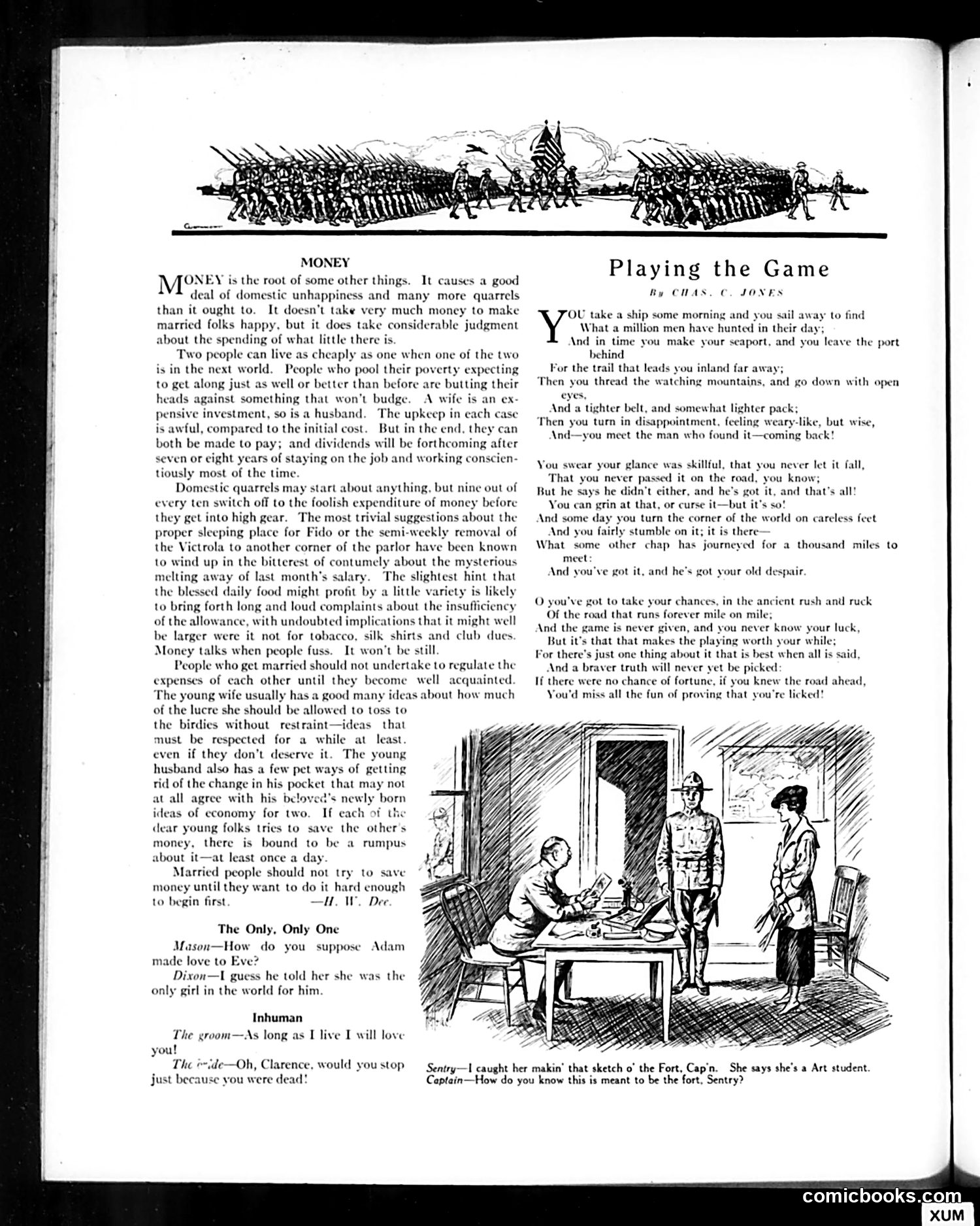
This page contains two distinct pieces: **"Money"** (left column): A prose essay arguing that financial disagreements cause domestic strife. It advocates for married couples to discuss spending transparently before problems arise, suggesting pooled resources and mutual agreement on expenditures. **"Playing the Game"** (right): A poem by Charles S. Jones about life's uncertainties and the value of taking chances, encouraging readers to embrace adventure despite risks. **The illustration** depicts a military scene: a sentry has caught someone sketching a fort. The captain questions the sentry about whether the artist is legitimate. This appears to be a joke about wartime security concerns—the humor lying in the sentry's suspicion of an innocent activity during militarily sensitive times. The page primarily addresses marriage, adventure, and home-front vigilance themes typical of early 20th-century American periodicals.
📄 Transcribed text from this page (OCR, searchable)
Machine-transcribed from the original scan — historical spelling and the odd misread are preserved.
MONEY } ONEY is the root of some other things. It causes a good deal of domestic unhappiness and many more quarrels than it ought to. It doesn’t take very much money to make married folks happy, but it does take considerable judgment about the spending of what little there is. Two people can live as cheaply as one when one of the two is in the next world. People who pool their poverty expecting to get along just as well or better than before are butting their heads against something that won't budge. A wife is an ex- pensive investment, so is a husband. The upkeep in each is awful, compared to the initial cost. But in the end, they both be made to pay; and dividends will be forthcoming after seven or cight years of staying on the job and working conscien- tiously most of the time. Domestic quarrels may start about anything, but nine out of every ten switch off to the foolish expenditure of money before they get into high gear. The most tr tions about the proper sleeping place for Fido or the se removal of the Victrola to another corner of the parlor have been known to wind up in the bitterest of contumely about the mysterious melting away of last month's salary he slightest hint that the blessed daily food might profit by a little variety is likely to bring forth long and loud complaints about the insufficiency of the allowance, with undoubted implications that it might well be larger were it not for tobacco, silk shirts and club dues. Money talks when people fuss. It won't be still. People who get married should not undertake to regulate the expenses of cach other until they become well acquainted The young wife usually has a good many ideas about how much of the lucre she should be allowed to toss to the birdies without restraint—ideas that must be respected for a while at least even if they don’t deserve it. The young husband also has a few pet ways of getting rid of the change in his pocket that may not at all agree with his beloved’s newly born ideas of economy for two. If each of the dear young folks tries to save the other's money, there is bound to be a rumpus about it—at least once a day Married people should not try to save money until they want to do it hard enough to begin first —H. W. Dee The Only, Only One Mason—How do you suppose Adam made love to Ev Dixon—I guess he told her she was the only girl in the world for him. Inhuman The groom—As long as I live I will love you! The *ide—Oh, Clarence, would you stop just because you were dead! Playing the Game Ry CHAS. ©. JONES a ship some morning and you sail away’ to find ‘hat a million men have hunted in their da And in time you make your seaport, and you leave the port behind For the trail that leads you inland far away; Then you thread the watching mountains, and go down with open eyes, And a tighter belt, and somewhat lighter pack Then you turn in disappointment, feeling we: but wise, And—you meet the man who found it—coming back! You swear your glance was skillful, that you never let it fall, That you never passed it on the road, you know; But he says he didn’t either, and he’s got it, and that’s all! You can grin at that, or curse it—but it’s so! And some day you turn the corner of the world on careless feet And you fairly stumble on it; it is there What some other chap has journeyed for a thousand miles to meet And you've got it, and he’s got your old despair O you've got to take your chances, in the ancient rush andl ruck Of the road that runs forever mile on mile; And the game is never given, and you never know your luck, But it’s that that makes the playing worth your while; For there’s just one thing about it that is best when all is said, And a braver truth will never yet be picked If there were no chance of fortune, if you knew the road ahead, You'd miss all the fun of proving that you're licked! Sentry—I caught her makin’ that sketch o' the Fort, Cap'n. She says she’s a Art student. Captain—How do you know this is meant to be the fort, Sentry? comicbooks.com XUM