
Judge, 1917-12-29 · page 12 of 29
Judge — December 29, 1917 — page 12: what you’re looking at
What you’re looking at
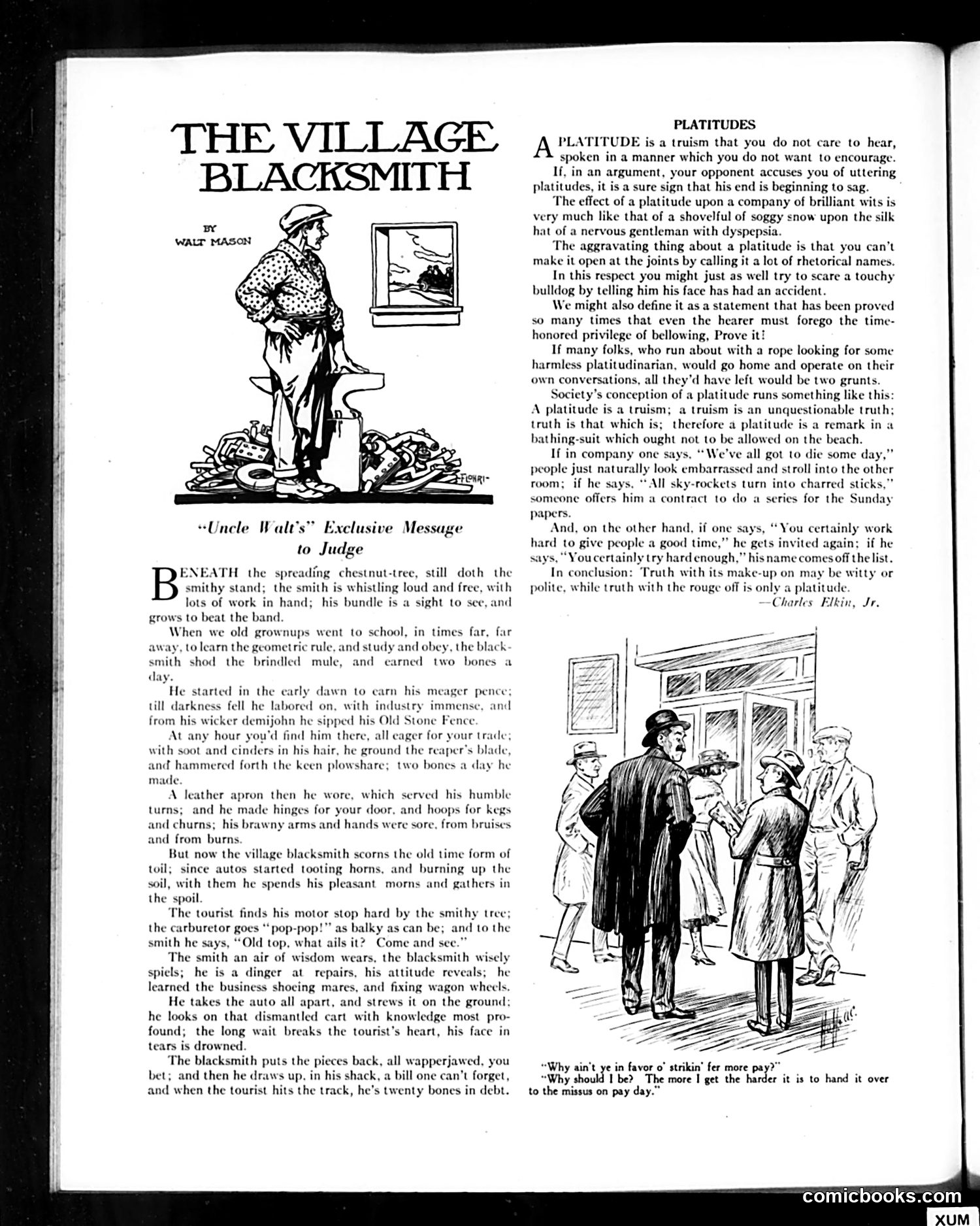
**The Main Story (by Walt Mason):** This nostalgic narrative contrasts the traditional blacksmith's life with modern times. The old blacksmith worked dawn-to-dusk for meager pay ("two bones a day"—slang for dollars), shoeing mules and sharpening farm tools. Now, automobiles have arrived, and the blacksmith has reinvented himself as a mechanic. The satire: tourists' cars break down at his shop; he disassembles the engine, leaves the owner waiting anxiously, then presents an astronomical repair bill ("twenty bones in debt"). The joke mocks both the blacksmith's sudden prosperity exploiting wealthy tourists AND the tourists' helplessness with newfangled machinery. **The "Platitudes" Essay:** This companion piece defines platitudes as annoying truisms. It satirizes how stating obvious facts ("we all die") causes discomfort while absurdities ("sky-rockets turn to charred sticks") get entertainment contracts. The humor targets social hypocrisy and the arbitrary reception of speech. **Context:** Early automotive age (likely 1910s); rural America meeting modernity; class tensions between wealthy tourists and village workers.
📄 Transcribed text from this page (OCR, searchable)
Machine-transcribed from the original scan — historical spelling and the odd misread are preserved.
THE VILLAGE “Uncle Walt’s” Exclusive Message to Judge EATH the spreading chestnut-tree, still doth the smithy stand; the smith is whistling loud and free, with lots of work in hand; his bundle is a sight to see, and grows to beat the band. When we old grownups went to school, in times far, far away, to learn the geometric rule, and study and obey, the black smith shod the brindled mule, and earned two bones a day. He started in the carly dawn to carn his meager pence; till darkness fell he labored on, with industry immense, and from his wicker demijohn he sipped his Old Stone Fence At any hour you'd find him there, all eager for your trade; with soot and cinders in his hair, he ground the reaper’s blade, and hammered forth the keen plowshare; two bones a day he made. A leather apron then he wore, which served his humble turns; and he made hinges for your door, and hoops for kegs and churns; his brawny arms and hands were sore, from bruises and from burns. But now the village blacksmith scorns the old time form of toil; since autos started tooting horns, and burning up the soil, with them he spends his pleasant’ morns and gathers in the spoil ‘The tourist finds his motor stop hard by the smithy tree; the carburetor goes “ pop-pop!” as balky as can be; and to the smith he says, “Old top, what ails it? Come and see.” The smith an air of wisdom wears, the blacksmith wisely spicls; he is a dinger at repairs, his attitude reveals; he learned the business shoeing mares, and fixing wagon wheels. He takes the to all apart, and strews it on the ground: he looks on that dismantled cart with knowledge most pro- found; the long wait breaks the tourist’s heart, his face in tears is drowned. The blacksmith puts the pieces back, all wapperjawed, you bet; and then he draws up, in his shack, a bill one can’t forget, and when the tourist hits the track, he’s twenty bones in debt. PLATITUDES PLATITUD a truism that you do not care to hear, spoken in a manner which you do not want to encourage. If, in an argument, your opponent accuses you of uttering platitudes, it is a sure sign that his end is beginning to sag. The effect of a platitude upon a company of brilliant wits is very much like that of a shovelful of soggy snow upon the silk hat of a nervous gentleman with dyspepsia. The aggravating thing about a platitude is that you can’t make it open at the joints by calling it a lot of rhetorical nam In this respect you might just as well try to scare a touc bulldog by telling him his face has had an accident. We might also define it as a statement that has been proved so many times that even the hearer must forego the time- honored privilege of bellowing, Prove it! If many folks, who run about with a rope looking for some harmless platitudinarian, would go home and operate on their own conversations, all they'd have left would be two grunts. Society’s conception of a y ude runs something like this: A platitude is a truism; a truism is an unquestionable truth; truth is that which is; therefore a platitude is a remark in a bathing-suit which ought not to be allowed on the beach. If in company one “We've all got to die some day,” people just naturally look embarrassed and stroll into the other room; if he says, ‘All sky-rockets turn into charred sticks,” someone offers him a contract to do a series for the Sunday papers. And, on the other hand, if one say hard to give people a good time,” he gets i says, “Youc nly In conclusion: Truth with its make-up on may be witty or polite, while truth with the rouge off is only a platitude: Charles Elkin, Jr. “Why ain't ye in favor o” strikin’ fer more pay?” . “Why should 1 be? The more I get the harder it is to hand it over to the missus on pay day.” comicbooks.com