
A complete issue · 28 pages · 1917
Judge — December 15, 1917
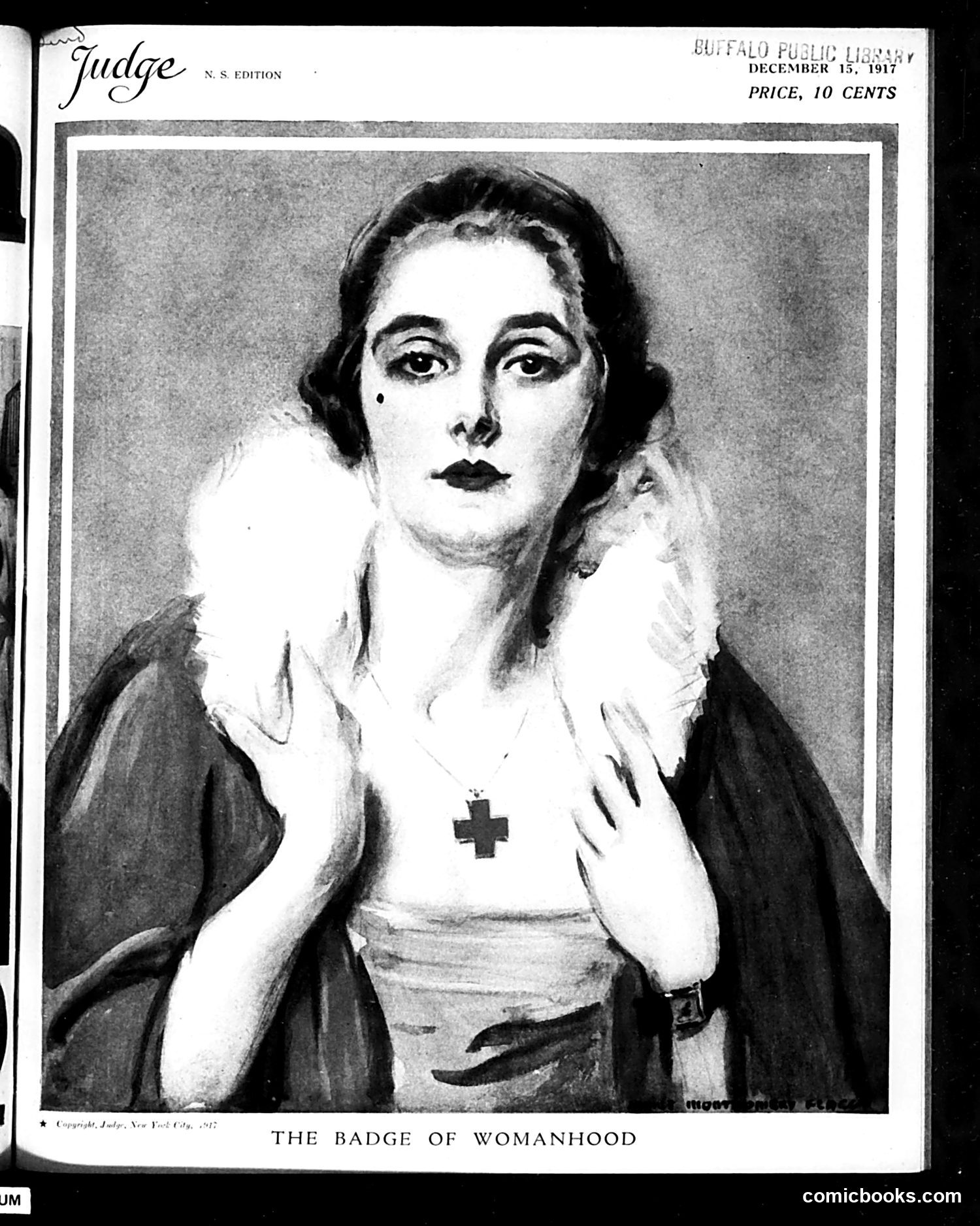
This December 1917 *Judge* cover satirizes women's wartime nursing service during World War I. The image shows a woman wearing a Red Cross badge—the distinctive cross visible on her chest—draped in fur stole and fashionable attire. The title "The Badge of Womanhood" appears ironic or critical. The satire likely mocks women who wore Red Cross insignia as a fashion statement or social status symbol rather than engaging in genuine nursing work. By pairing the sacred medical badge with conspicuous luxury items (fur, jewelry, makeup), the cartoon suggests these women adopted wartime volunteer identity superficially—performing patriotism as a trend rather than making real sacrifice. This reflects contemporary debates about women's actual versus performative contributions to the war effort.
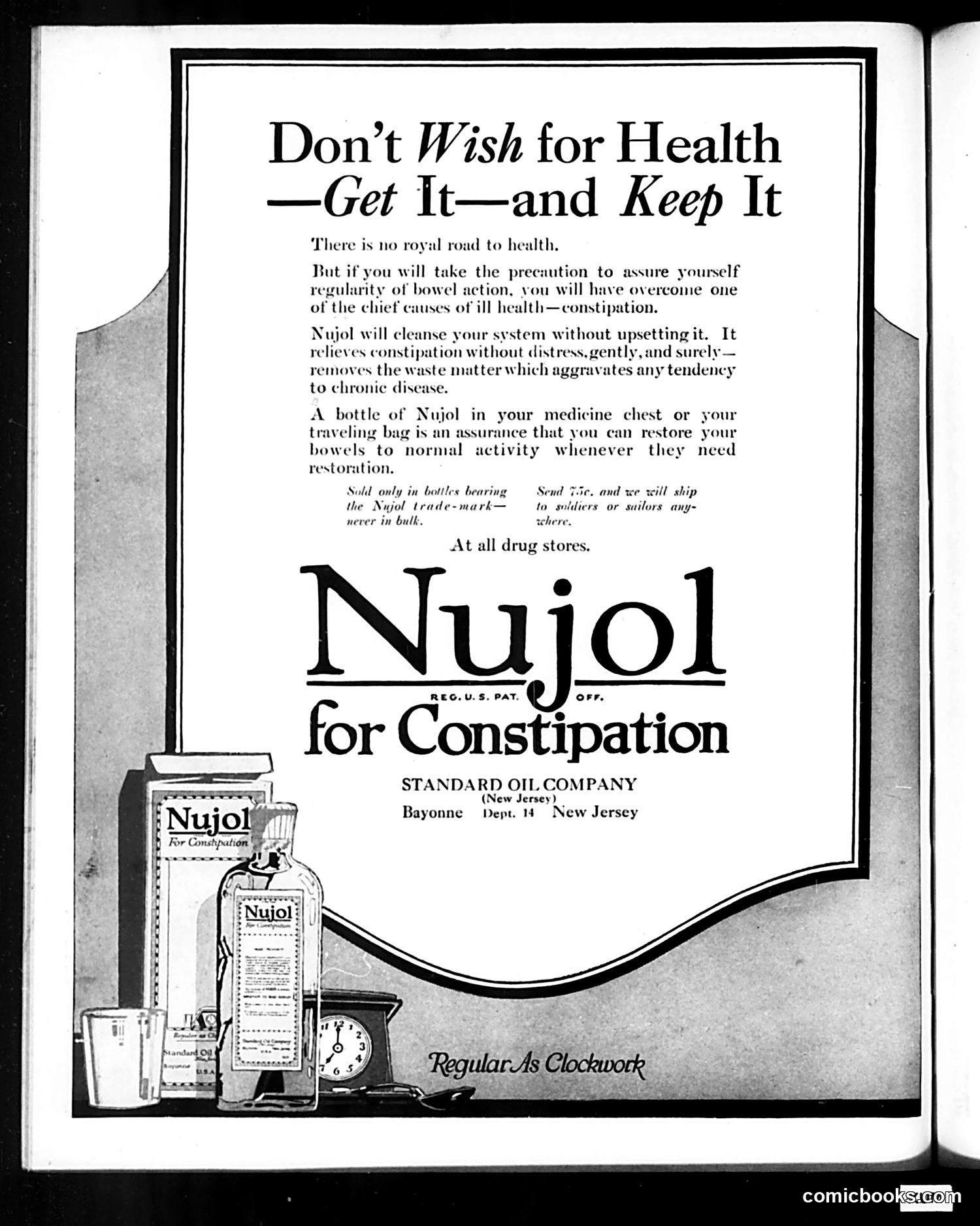
This is **not a cartoon or satire page** — it's a straightforward **product advertisement** for Nujol, a mineral oil laxative manufactured by Standard Oil Company (New Jersey). The ad uses common early-20th-century marketing rhetoric, claiming the product gently cleanses the system and relieves constipation without "upsetting" the body. The tagline "Regular as Clockwork" (shown with an actual clock in the illustration) promises reliable bowel regularity. The phrase "Don't Wish for Health—Get It—and Keep It" reflects period health messaging emphasizing personal responsibility and prevention. There is no political satire or caricature present — this is a straightforward medicinal advertisement typical of Judge magazine's revenue model.
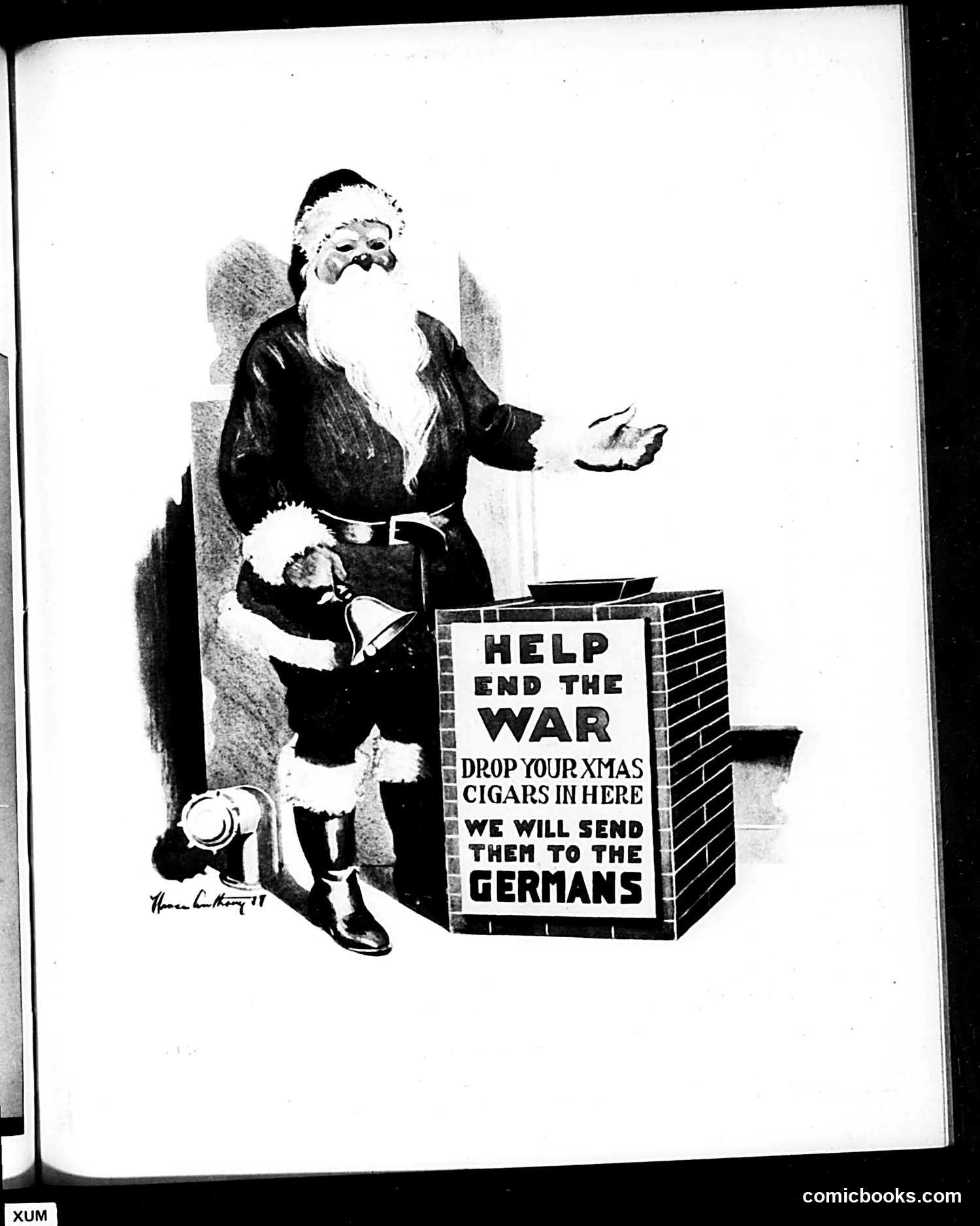
This WWI-era cartoon depicts Santa Claus as a patriotic fundraiser for the war effort. The image uses the beloved Christmas figure to appeal to Americans' generosity and patriotism by asking them to donate cigars instead of Christmas gifts. The text reads: "HELP END THE WAR / DROP YOUR XMAS CIGARS IN HERE / WE WILL SEND THEM TO THE GERMANS" The satire is darkly ironic: Santa ostensibly collects cigars to "send to the Germans," but the actual message is that Americans should sacrifice their Christmas luxuries to support the war effort against Germany. It's propaganda disguised as holiday goodwill—using Santa's authority and the season's charitable spirit to encourage wartime sacrifice and resource conservation for American troops.
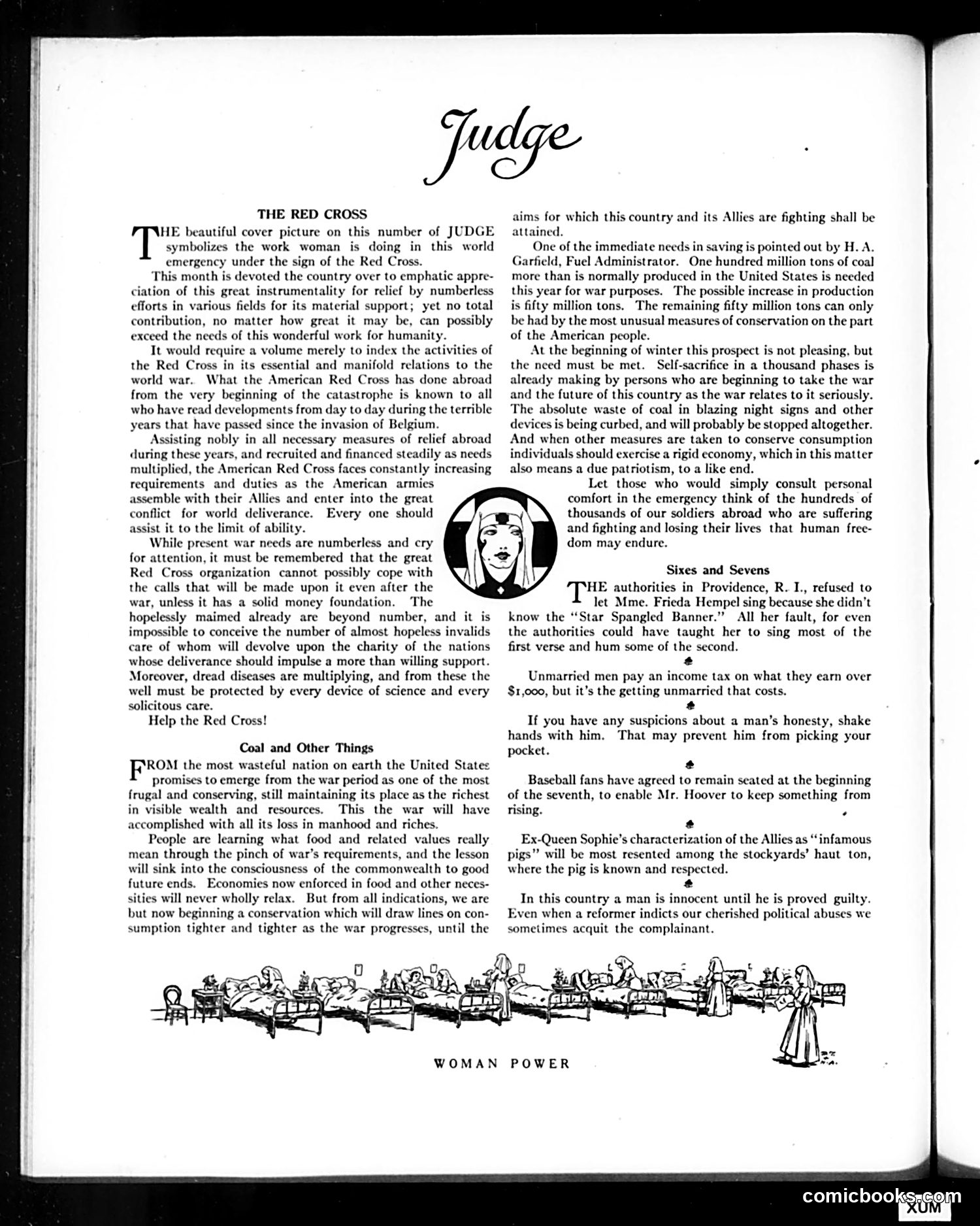
This editorial page from Judge magazine uses wartime appeals to encourage American sacrifice and conservation. The main article promotes Red Cross support and coal rationing during what appears to be World War I. The "Woman Power" illustration at the bottom depicts women engaged in industrial/factory work, likely celebrating female labor contributions to the war effort. The cartoon suggests women's productive capacity as essential to national defense. The scattered brief items ("Sizes and Sevens") employ light satire: mocking authorities who censored patriotic songs, poking fun at tax burdens on unmarried men, and offering cynical observations about honesty and legal justice. The overall message frames civilian sacrifice and female workforce participation as patriotic duties necessary for military victory.
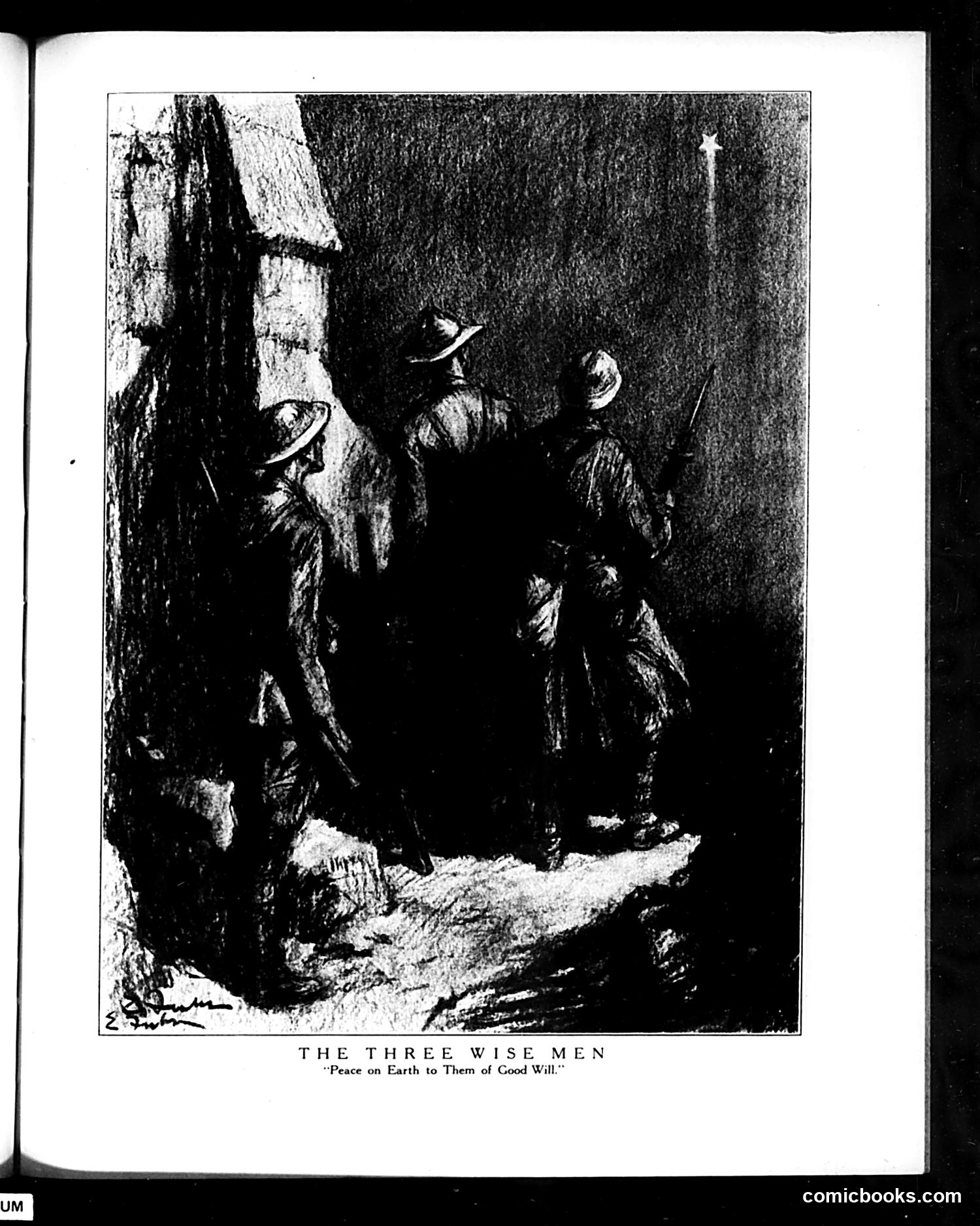
This engraving depicts three figures visiting a nativity scene, with the caption "Peace on Earth to Them of Good Will." The image appears to reference the biblical Three Wise Men (Magi) who visited the infant Jesus. However, the satirical context suggests this is political commentary rather than religious illustration. The figures' period clothing and the artist's style indicate this likely critiques specific contemporary political figures or leaders from Judge magazine's era. The juxtaposition of "wise men" bringing "peace on earth" may ironically comment on politicians' peace-making efforts or their actual impact on world affairs. Without additional contextual information about Judge's publication date and the specific political climate, I cannot definitively identify which leaders or events are being satirized here.
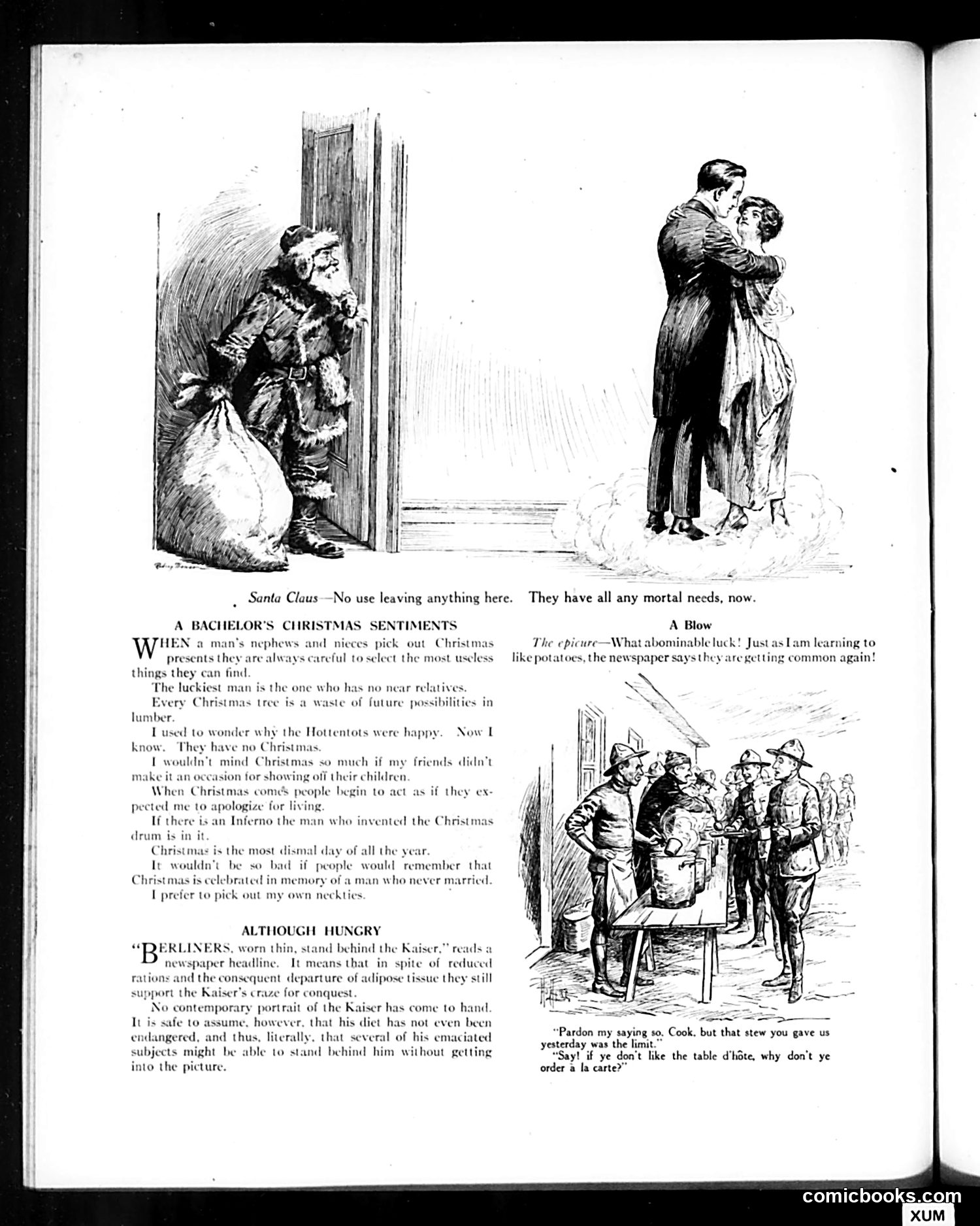
This page contains three separate satirical pieces from *Judge* magazine: 1. **Top cartoon** ("Santa Claus"): Shows Santa at a door telling an embracing couple that the poor "have all any mortal needs, now"—likely satirizing either post-WWI attitudes about poverty or, more probably, wartime rationing that made luxury gift-giving impossible. 2. **"A Bachelor's Christmas Sentiments"**: A cynical essay mocking unmarried men's relief that Christmas obligations to relatives are reduced. The satire targets both bachelor selfishness and the commercialization of the holiday. 3. **"Although Hungry" / "Berliners Behind the Kaiser"**: References post-WWI Berlin, suggesting German citizens remained malnourished despite the Kaiser's political downfall, likely commentary on occupation conditions or food shortages. The page's dominant theme: wartime/postwar deprivation and its social consequences.
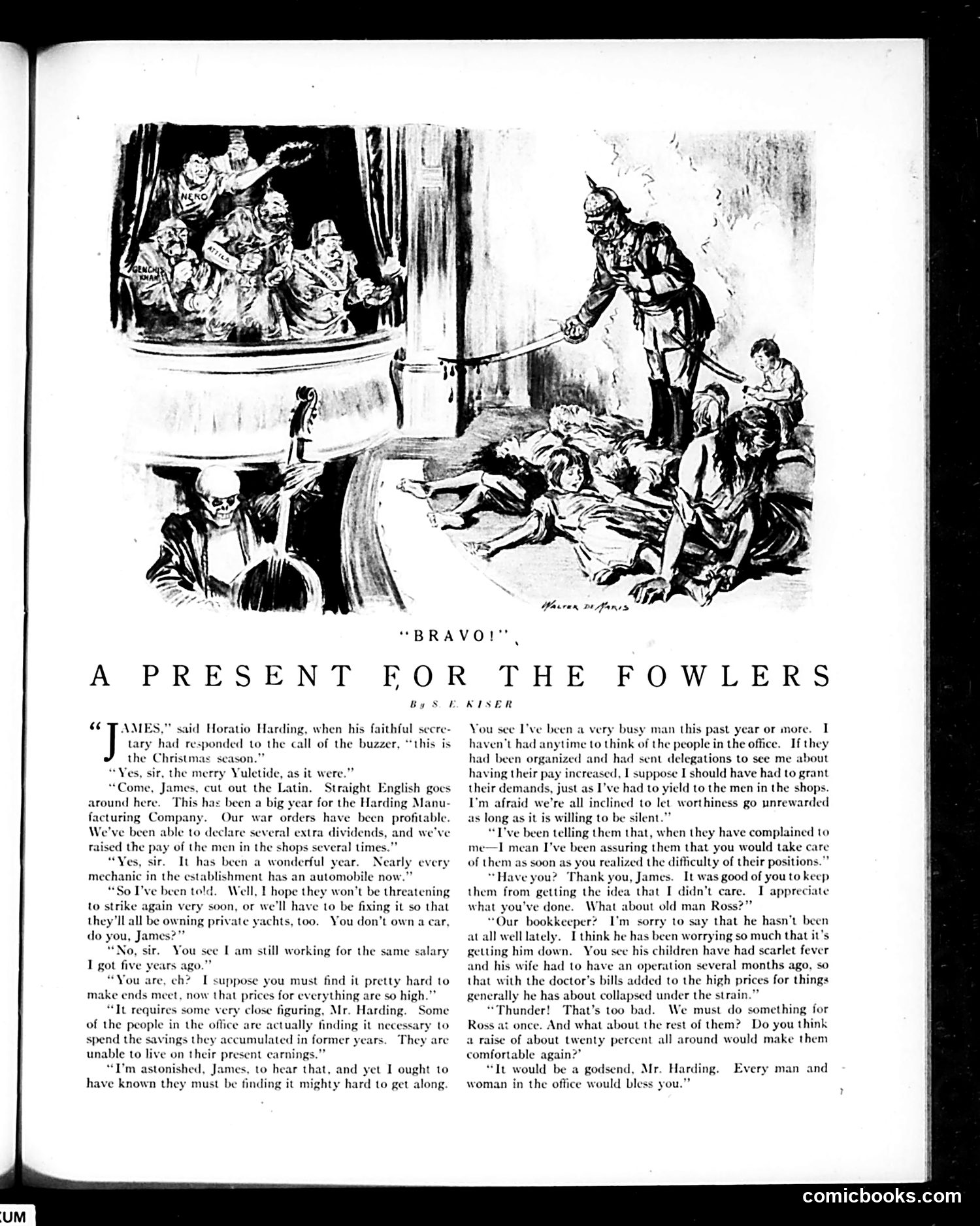
This satirical piece by S. Kiser critiques economic hypocrisy during the post-WWI era. The cartoon depicts a factory owner, Horatio Harding, congratulating himself on war profiteering while his secretary James reveals the hidden reality: office workers haven't received raises in five years despite inflation, and are depleting savings to survive. The satire's bite lies in Harding's obliviousness—he's raised shop workers' pay to prevent strikes and given them enough for automobiles, yet ignores salaried employees unless they formally organize. His sudden willingness to grant a 20% raise only *after* learning of their suffering exposes the cruelty of withholding aid from "worthiness" that "willing to be silent." The title "A Present for the Fowlers" suggests office workers are being treated as expendable birds. The imagery shows contrast between luxury (theater scene, top) and worker desperation (bottom), underscoring the class divide his benevolence conveniently ignores.
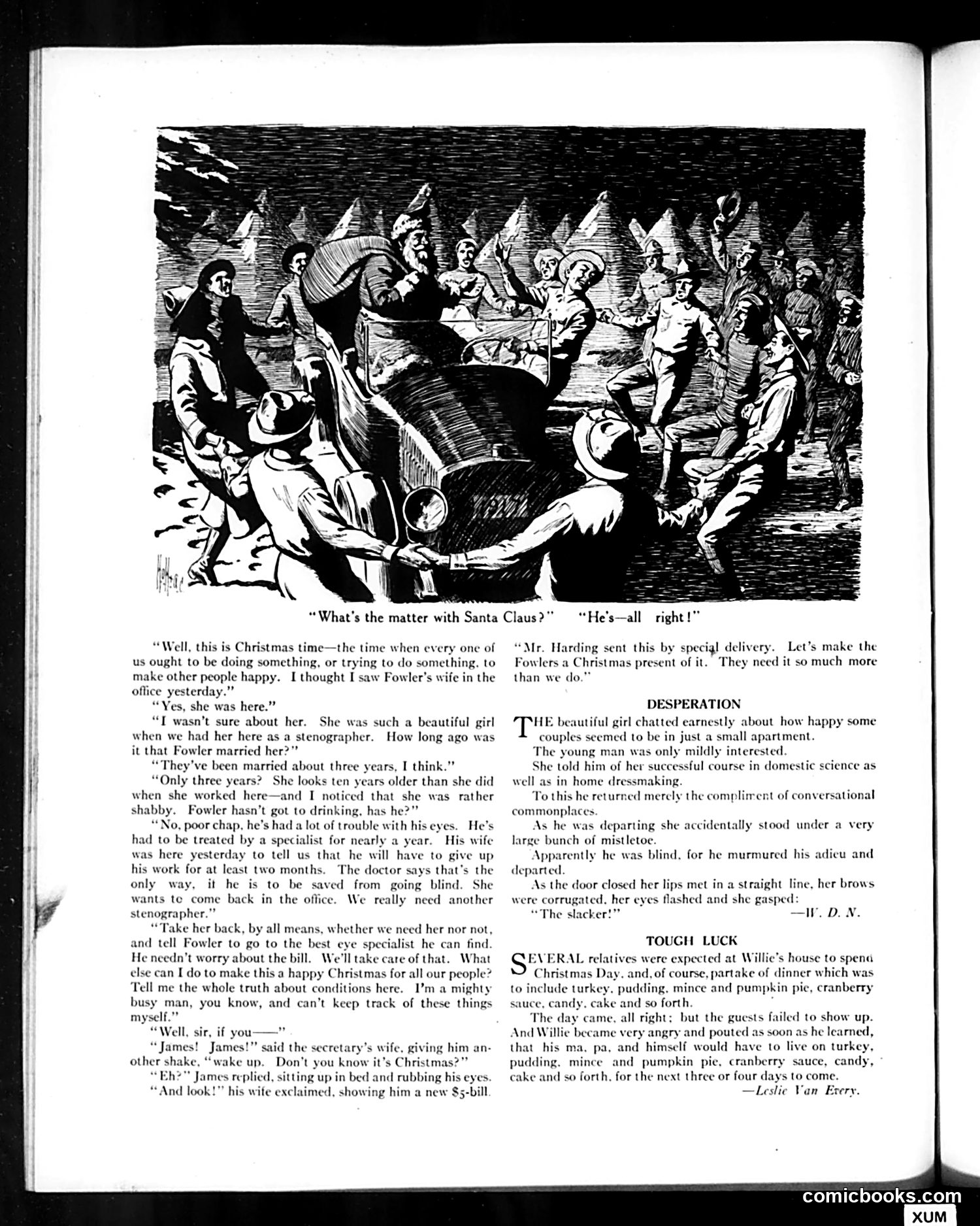
This page contains three separate stories satirizing Christmas generosity and domestic life around the 1920s. **"What's the matter with Santa Claus?"** depicts a boss discovering his employee Fowler is going blind and his wife has become shabby. In a dream sequence, the boss decides to rehire her and pay for his medical care. He awakes to find his secretary's wife has given him a $5 bill from "Mr. Harding" (likely President Warren G. Harding) to gift the Fowlers—satirizing how even wealthy employers expect government or luck, rather than their own charity, to solve workers' hardships. **"Desperation"** shows a young woman unsuccessfully attempting to attract a man's romantic attention through domestic skills and strategically positioning herself under mistletoe—mocking women's limited courtship strategies. **"Tough Luck"** humorously depicts a boy's disappointment when Christmas relatives don't arrive, leaving him stuck eating turkey and pie—ironic "suffering" that critiques entitled attitudes toward abundance.
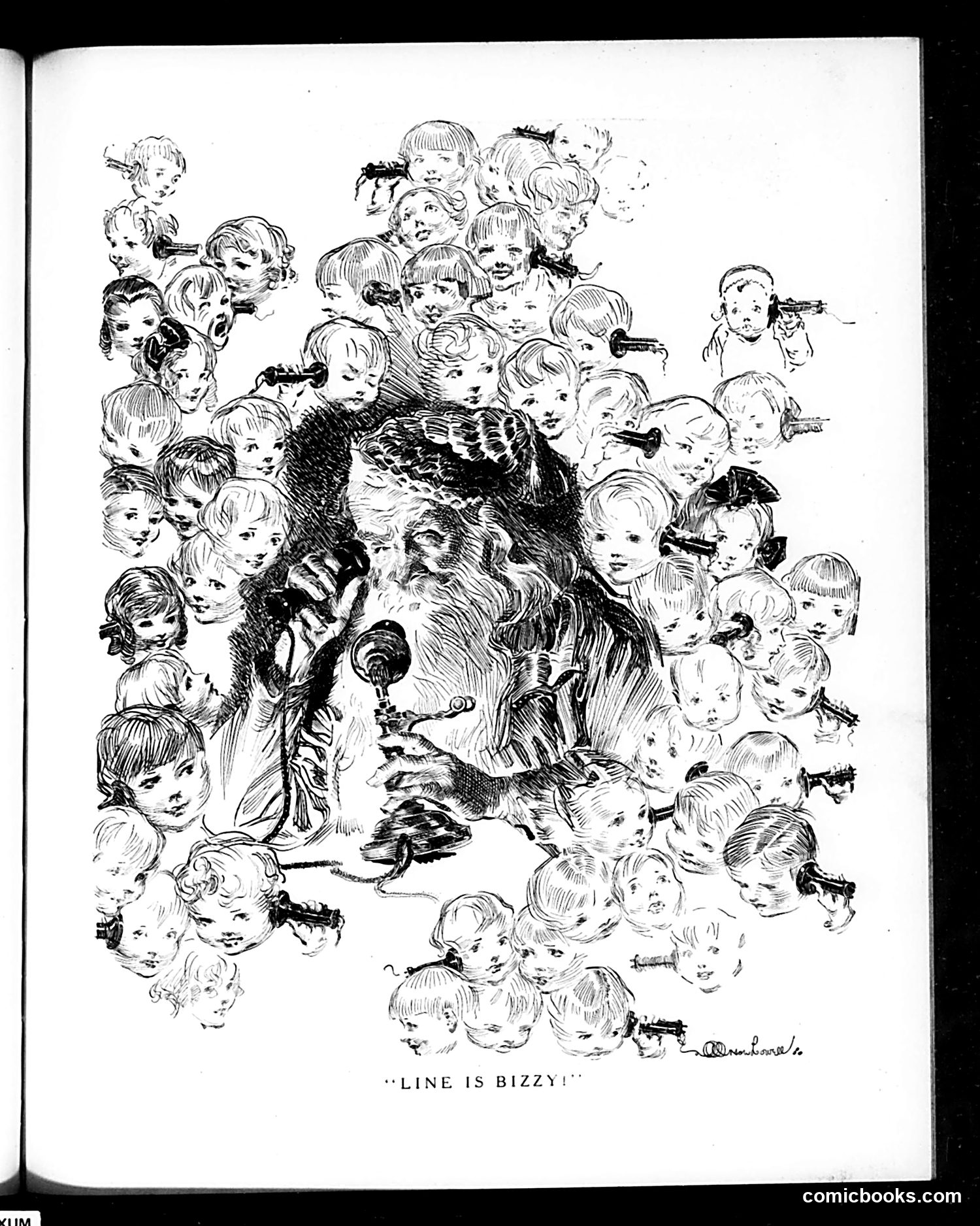
This cartoon depicts a bearded man (likely representing a prominent public figure of the era, though unclear who specifically) surrounded by numerous children. The children appear to be pulling at him or demanding his attention simultaneously, creating chaos and crowding. The caption "Line is Bizzy!" suggests commentary on someone overwhelmed by public demand or responsibility. The satire likely mocks either: - A politician fielding countless petitions or complaints - A public servant unable to manage competing interests - Someone's inflated importance being satirized through exaggerated demand for their attention The densely packed composition emphasizes the overwhelming nature of the situation. Without additional context about Judge magazine's publication date and political climate, the specific target remains unclear, though the work critiques someone's inability to handle public pressures.
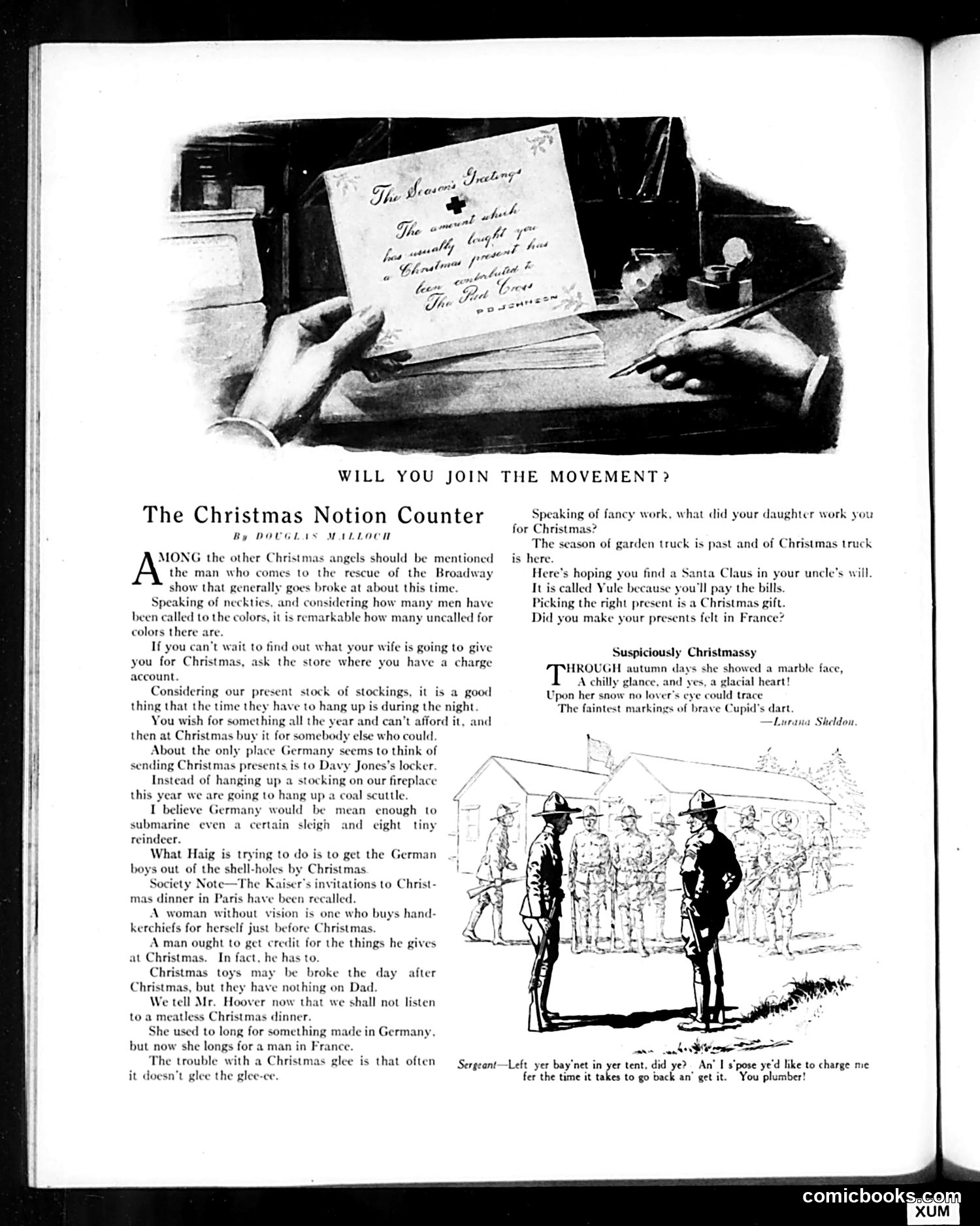
This WWI-era satirical page uses Christmas as a framework to mock wartime absurdities and social pretense. **"The Christmas Notion Counter"** by Douglas Malloch offers cynical commentary on holiday gift-giving during wartime. Key targets include: - Men being drafted ("called to the colors") while society obsesses over neckties - The Kaiser's rejection of Paris dinner invitations (mocking German military defeat hopes) - Field Marshal Haig's strategy to dislodge Germans from trenches by Christmas (a failed objective) - American food rationing under Herbert Hoover's direction - Women prioritizing French soldiers over German manufactures **The cartoon** depicts a sergeant scolding a soldier for losing his bayonet, sarcastically calling him "plumber"—mocking incompetence in the trenches. The soldier's casual attitude contrasts with military discipline. Overall, the page blends holiday sentiment with sharp commentary on military bungling, home-front sacrifice, and shifting wartime priorities. The satire assumes readers understood specific 1918 military campaigns and rationing policies.
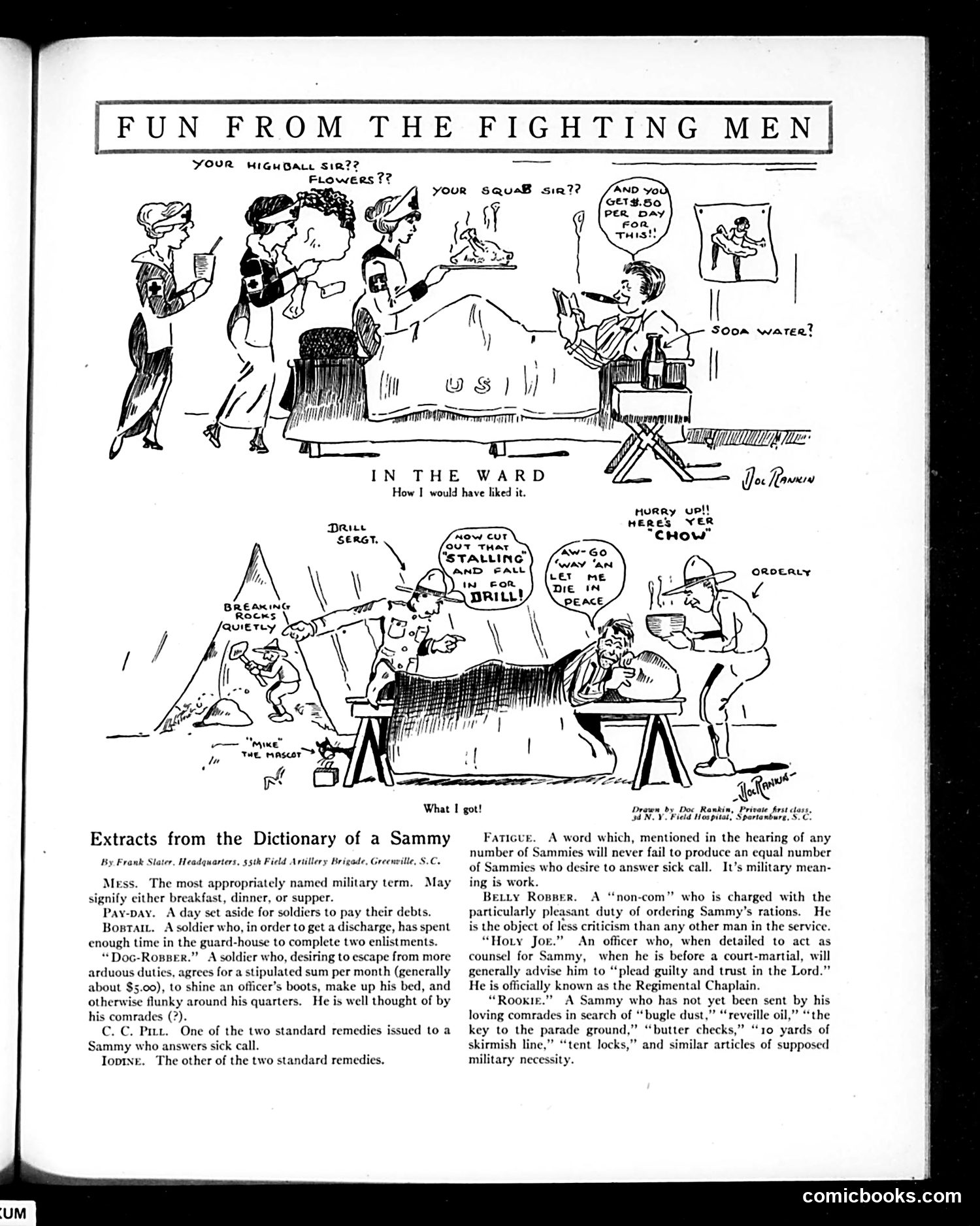
This page from *Judge* magazine satirizes World War I military life through a soldier's perspective. The top cartoon contrasts idealized camp hospitality (officers serving highballs and soda water to relaxed soldiers) with reality (chaotic, exhausting conditions with drilling and harsh treatment). The "Dictionary of a Sammy" (military slang for American soldiers) defines camp terms humorously. Key entries mock military inefficiency and hardship: "Mess" refers to any meal; soldiers face endless "fatigue" (work details); officers assigned as chaplains ("Holy Joe") give useless legal advice; and "rookies" are sent on fool's errands searching for impossible items like "bugle dust" and "reveille oil"—pranks senior soldiers play on newcomers. The satire targets the gap between military romance and grunt-level reality: poor food, arbitrary discipline, and exploitation by both superiors and fellow soldiers. The author's unit affiliation (55th Field Artillery Brigade) suggests firsthand experience with these grievances.
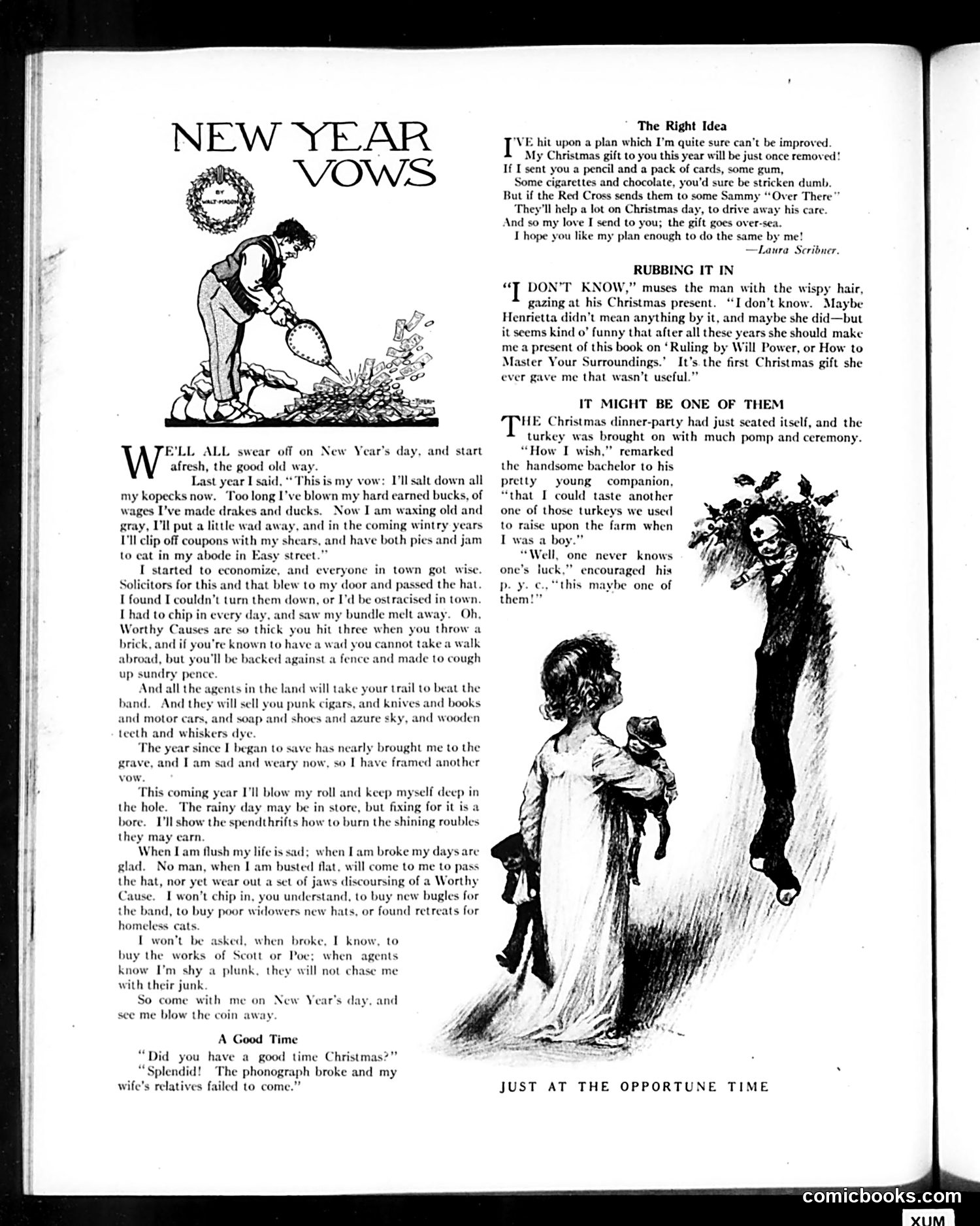
This Judge magazine page contains three satirical pieces mocking New Year's resolutions and holiday gift-giving around WWI-era America. **"The Right Idea"** (top): A poem by Laura Scribner suggests sending Christmas gifts to American soldiers ("Sammy") serving overseas rather than to loved ones at home—a Red Cross fundraising appeal disguised as holiday sentiment. **"Rubbing It In"** (middle): A husband receives a self-help book titled "Ruling by Will Power" from his wife Henrietta. The joke: after years of marriage, she's finally giving him a "useful" gift—by implying he needs to improve himself. **"It Might Be One of Them"** (right): A bachelor regrets he can't taste farm-raised turkey at a dinner party, suggesting modern domesticated poultry is inferior. The illustration shows a woman arriving with a turkey—"just at the opportune time." **"A Good Time"** (bottom): Dark humor: a man celebrates Christmas because "the phonograph broke and my wife's relatives failed to come"—escaping unwanted entertainment and family obligations. All pieces satirize social expectations, marital dynamics, and holiday traditions.
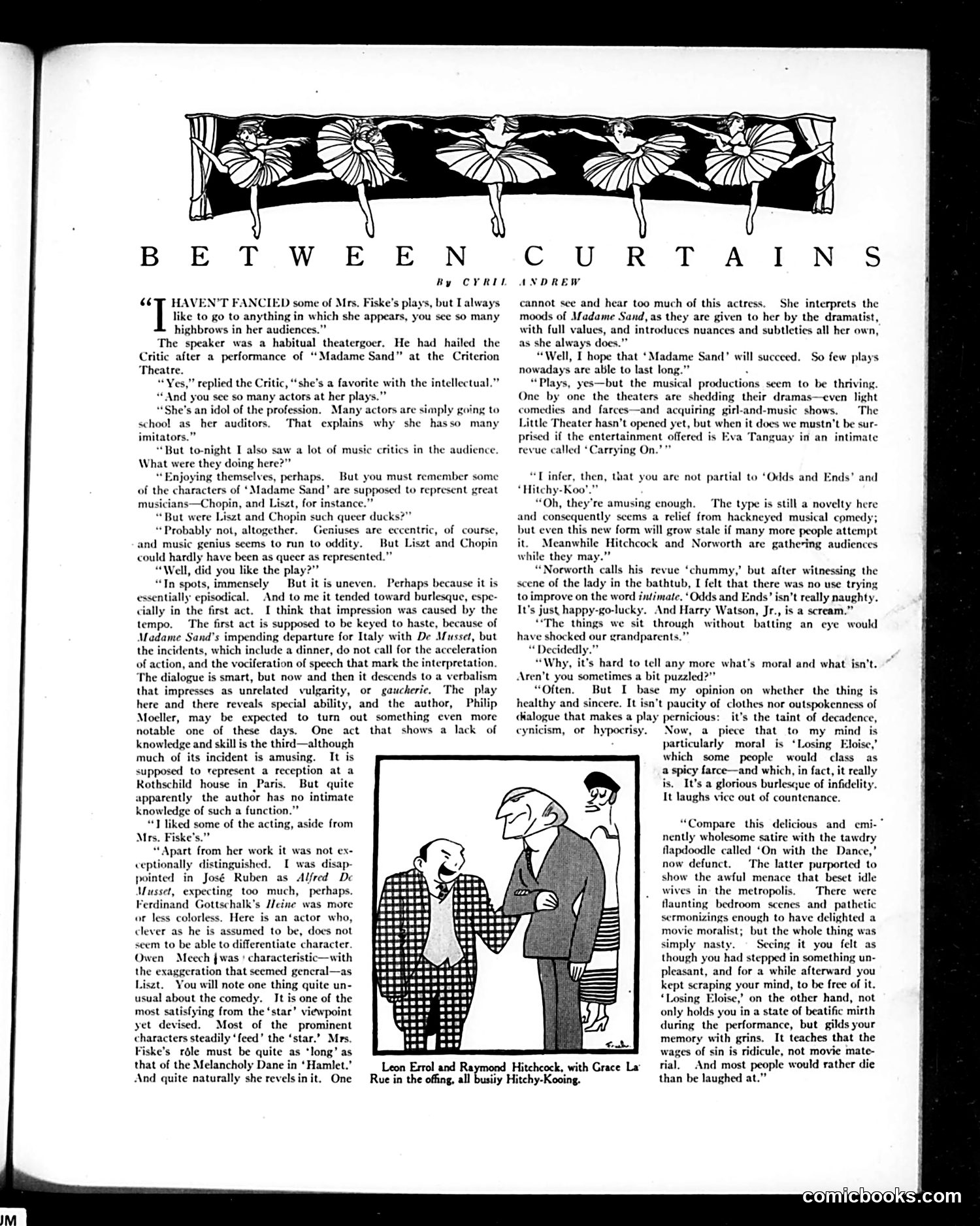
This page features a theater criticism dialogue by Cyril Andrew discussing a Broadway production of *Madame Sand* starring Mrs. Fiske at the Criterion Theatre. The article reviews the play—which dramatizes the life of French author George Sand, featuring portrayals of composers Chopin and Liszt. The accompanying cartoon shows three men in period dress, likely representing the historical figures discussed (Liszt, a central character, and associates), illustrating the play's subject matter. The critic praises Mrs. Fiske's performance and intellectual appeal while critiquing the uneven script by Philip Moeller. He notes the first act's excessive tempo, weak supporting performances (particularly José Ruben as Alfred de Musset and Ferdinand Gottschalk as Heine), and the third act's superficial portrayal of Parisian high society. The piece reflects early 20th-century theater culture's interest in biographical dramas and the "star system" where leading actors dominated productions. References to the emerging "Little Theater" movement suggest contemporary theatrical debates about commercial versus experimental theater.
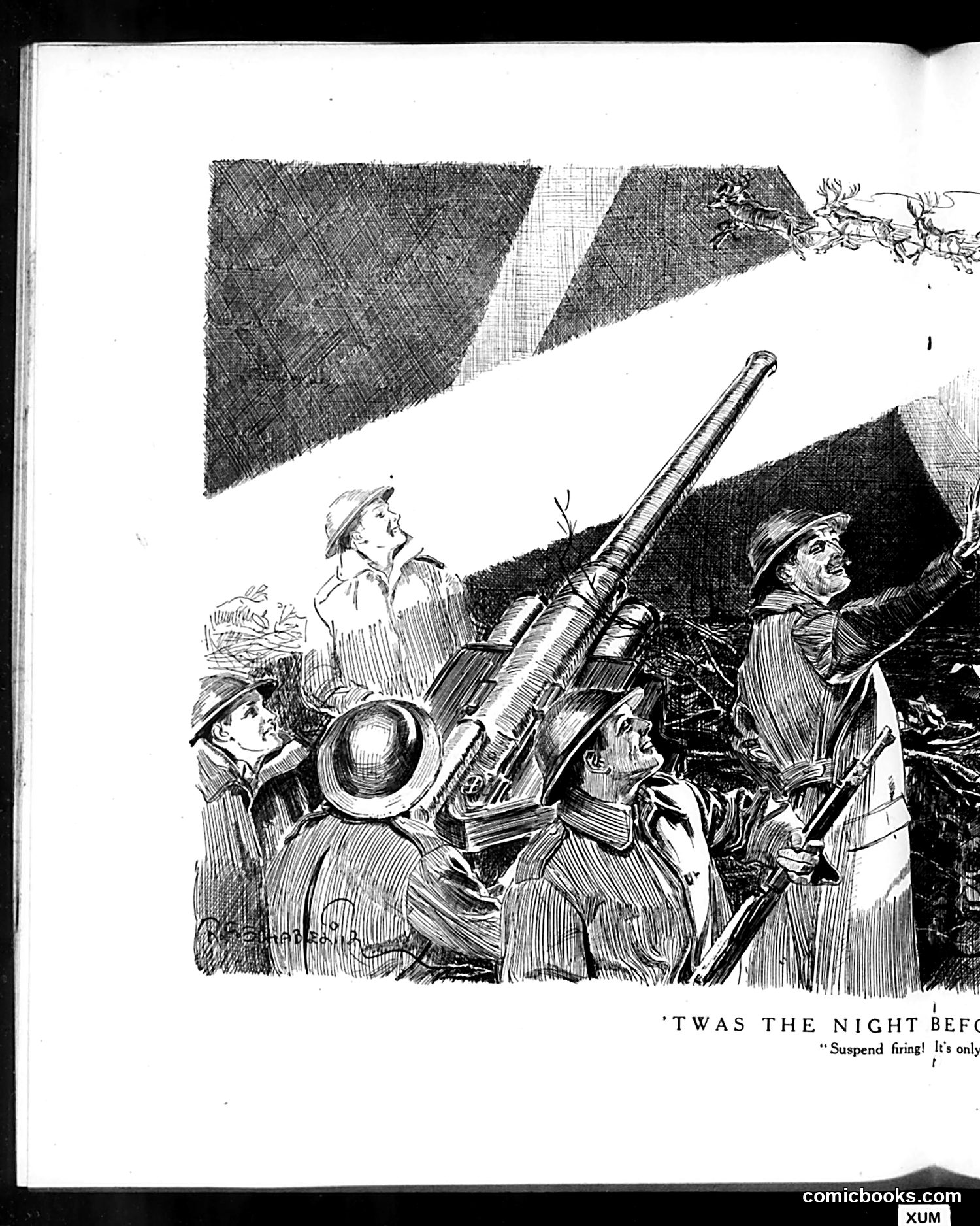
This cartoon appears to be a WWI-era military scene, likely referencing the famous Christmas truce or a seasonal military moment. The title "'Twas the Night Before" alludes to "'Twas the Night Before Christmas," suggesting a holiday theme. The image shows soldiers operating what appears to be a large artillery piece or gun emplacement. One figure commands "Suspend firing! It's only..." — the text cuts off, but the joke likely involves mistaking something harmless (possibly a reindeer or holiday imagery) for an enemy target. The satire appears to mock the absurdity of warfare interrupting peacetime traditions, or soldiers' hair-trigger readiness during a sacred holiday moment. The specific context of the incomplete caption prevents fuller interpretation.
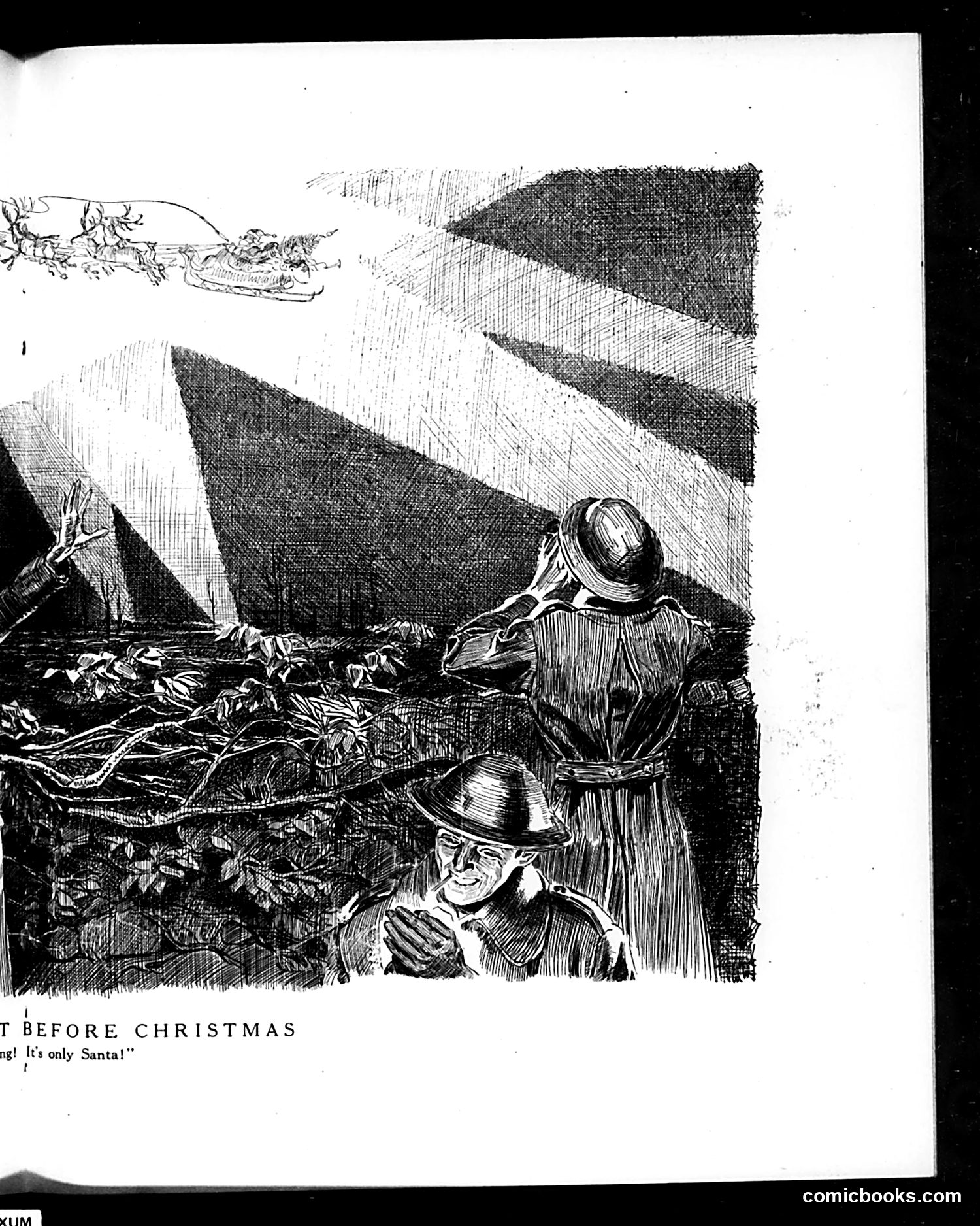
This appears to be a Christmas-themed cartoon from Judge magazine, though the image quality and partial OCR make specifics difficult. The visible scene shows two figures in what appears to be a nighttime setting with a large dark triangular shape (possibly representing a Christmas tree or similar festive element) in the background. The dialogue fragment "It's only Santa!" suggests the cartoon plays on Christmas expectations—likely depicting someone startled or reacting to Santa Claus. Without clearer text or additional context, the exact satirical point remains unclear, though it seems to mock holiday excitement or perhaps mistaken identity involving Santa. The vintage illustration style and Judge magazine publication context indicate this is early-to-mid 20th century American satire, but the specific social or political commentary cannot be reliably determined from this partial page.
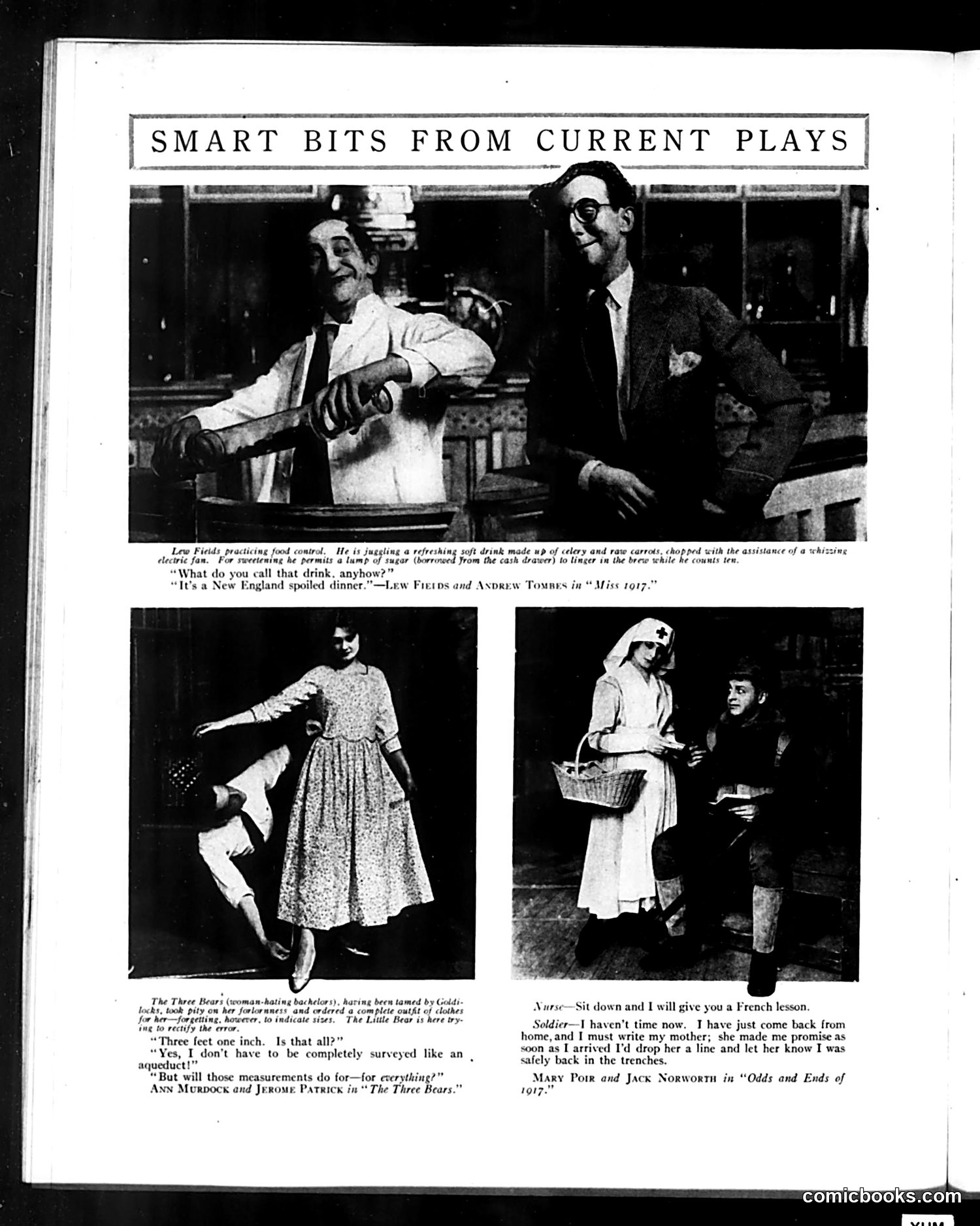
This page showcases humorous dialogue snippets from Broadway productions of 1917, presented with photographs from each show. The top image features Lew Fields and Andrew Townes in "Miss 1917," joking about a health-conscious drink made from vegetables—a satire on the era's food-conservation efforts (likely related to WWI rationing) and contemporary health fads. "The Three Bears" scene mocks gender relations: a woman-hating bachelor character must order clothes for a woman without proper measurements, leading to awkward comedic exchanges about female body sizing. The final image from "Odds and Ends of 1917" shows a soldier and nurse, with dialogue satirizing wartime separation and filial duty—the soldier must write his mother from the trenches, a poignant backdrop to the comedic setup. These vignettes reflect 1917 America's preoccupations: WWI service, home-front concerns, and period attitudes toward gender and domesticity, all filtered through theatrical humor.
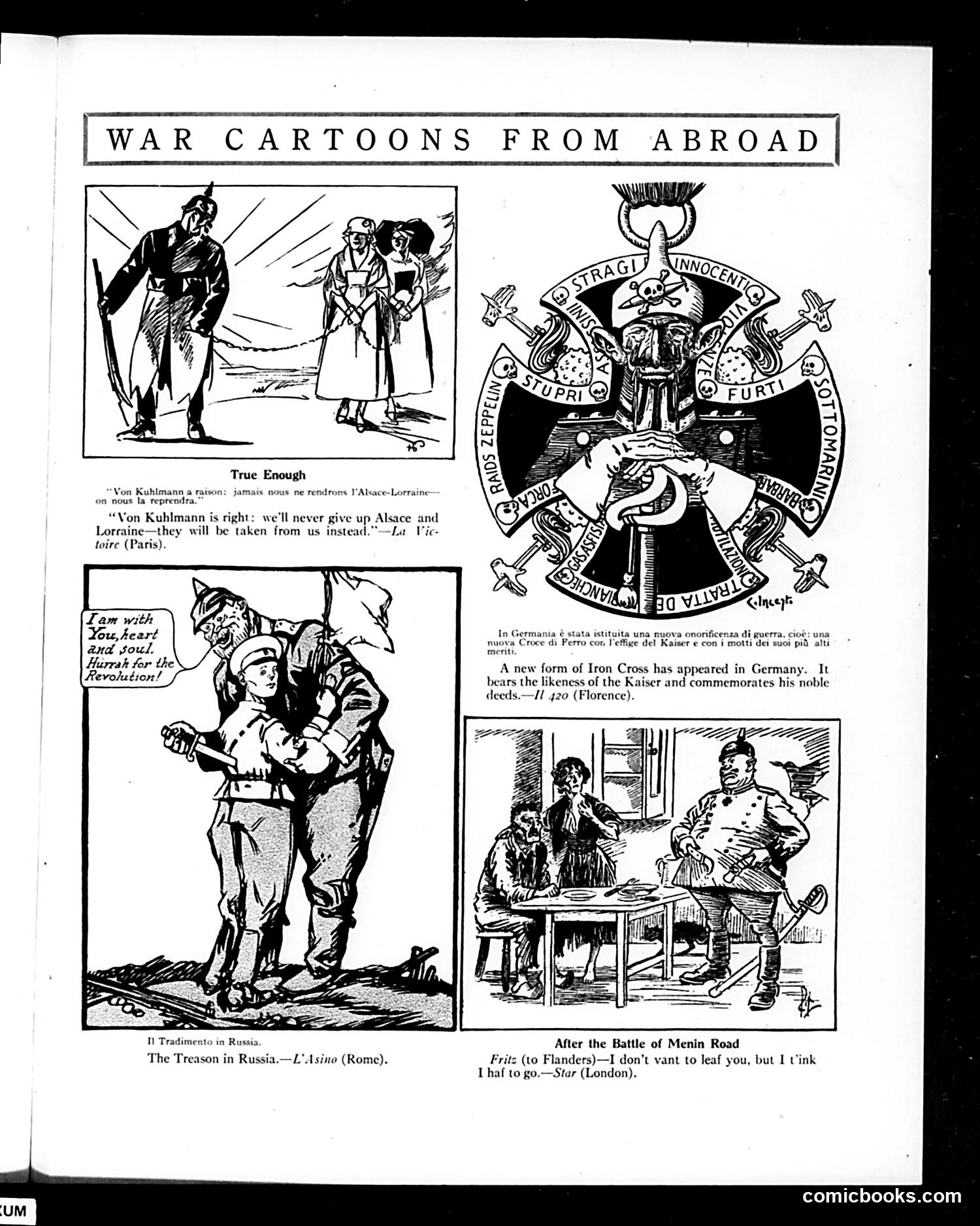
This page collects satirical cartoons from Allied newspapers during World War I, mocking Germany and its leadership. **Top left ("True Enough")**: A French cartoon about Von Kuhlmann (German politician) sarcastically noting Germany will never voluntarily return Alsace-Lorraine to France—they'll be taken by force instead. **Center**: A Florence cartoon mocking a new German military decoration bearing the Kaiser's likeness, sarcastically calling it an "Iron Cross" that commemorates his "noble deeds"—implying the Kaiser has done nothing worthy of honor. **Bottom left ("The Treason in Russia")**: References Russia's separate peace treaty with Germany (1918), showing a figure saying "I am with you, heart and soul" before abandoning the Alliance—satirizing Russian betrayal. **Bottom right ("After the Battle of Menin Road")**: A British cartoon of a German soldier reluctantly telling his companion he must leave—dark humor about German casualties and retreat.
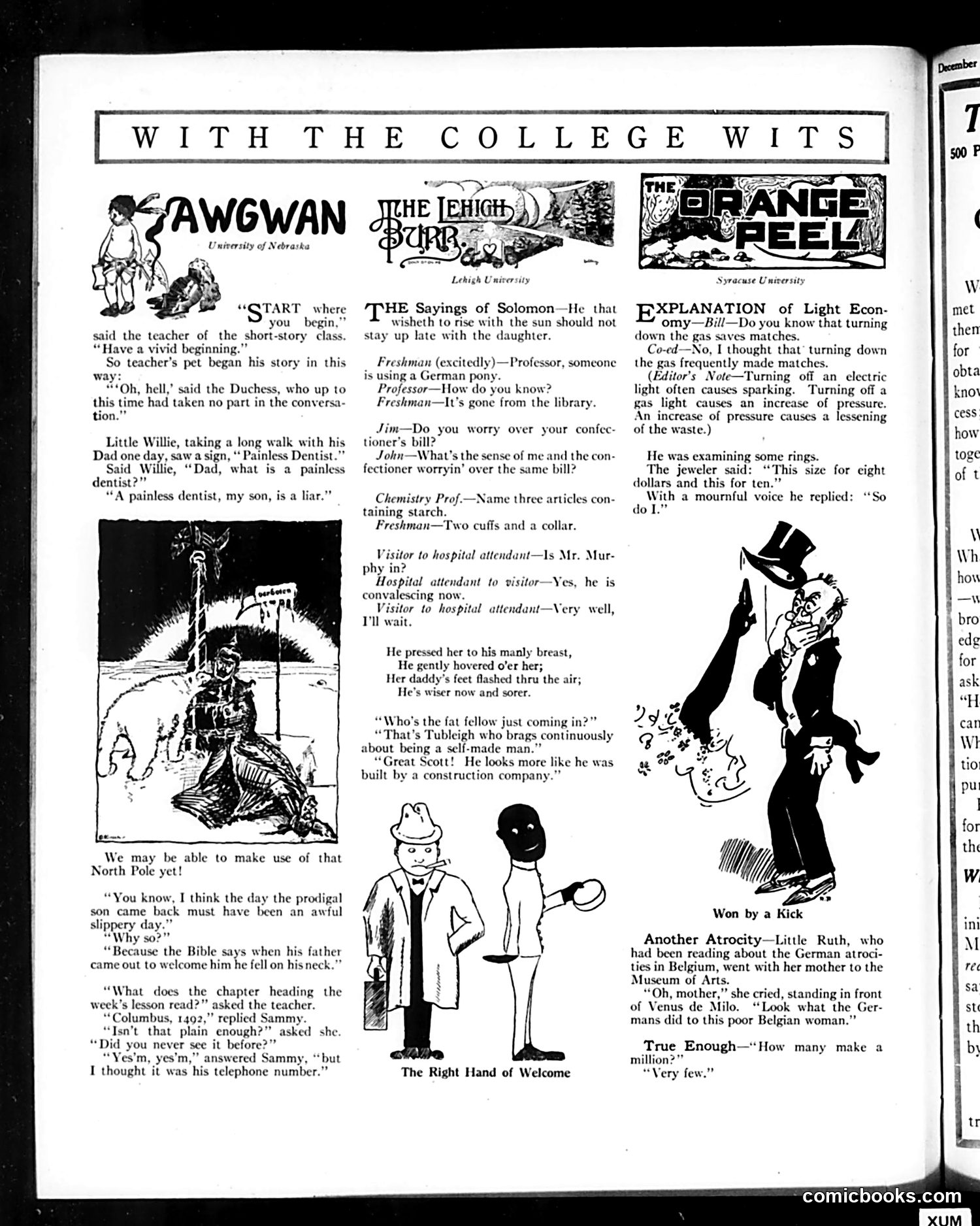
This page from Judge magazine contains college humor and short jokes targeting student life and academic settings (University of Nebraska, Lehigh, Syracuse). The cartoons mock: **"The Right Hand of Welcome"**: A crude cartoon showing a man being kicked by an angry father after embracing a young woman—a standard "caught courting" scenario reflecting early 20th-century parental vigilance over courtship. **The humor pieces** satirize: - Student pretension (the "short-story class" joke mocking affected writing) - Academic dishonesty (the "German pony"—a translation aid—smuggled from the library) - Student naiveté and double meanings (the "confectioner's bill" wordplay; the light-economy joke confusing gas lamps with romance) - Authority figures (incompetent professors, suspicious administrators) The "Atroci[ties]" joke references German atrocities in Belgium during WWI, making a dark humor connection between wartime destruction and an armless classical statue. Overall, this is lighthearted collegiate satire typical of the era, poking fun at student life, romance, and academic pretension.
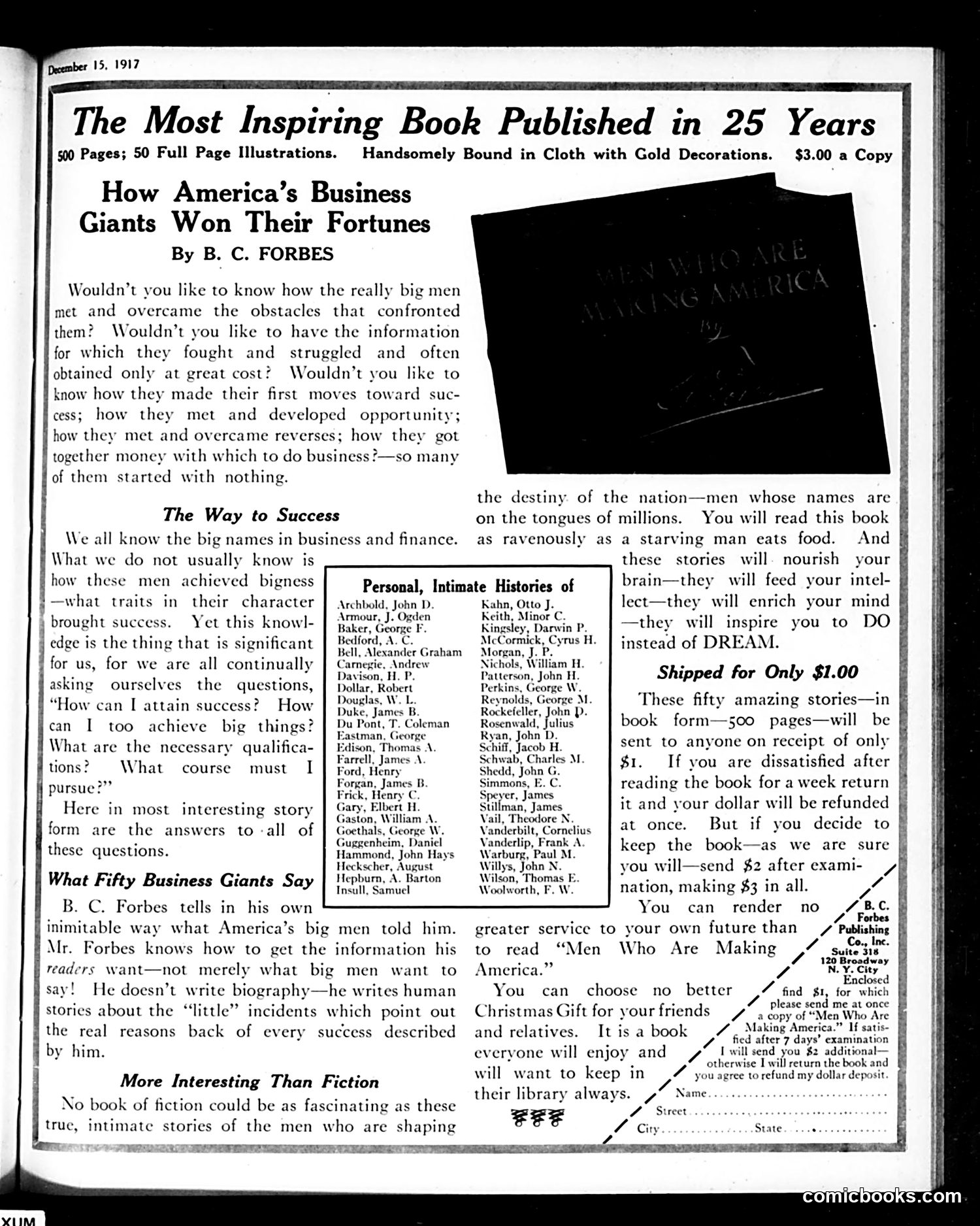
This page is **not a cartoon or satirical piece**—it's a full-page advertisement for B.C. Forbes's book "How America's Business Giants Won Their Fortunes," published December 15, 1917. The ad promotes a biographical collection featuring fifty American industrial titans (Rockefeller, Ford, Carnegie, Vanderbilt, etc.), emphasizing inspiring "human stories" about how they overcame obstacles and achieved success from nothing. The marketing pitch targets readers seeking self-improvement through learning the "real reasons" behind these fortunes. **Historical context**: Published during World War I, this reflects the era's celebration of American industrial capitalism and "self-made" businessmen as national heroes. The $1 introductory offer (with $2 due after examination) was a common direct-mail sales tactic. **The satire is implicit**: For modern readers, the gap between the promise of democratized success knowledge and actual wealth concentration would be ironic, though the advertisement itself presents this earnestly without self-awareness.
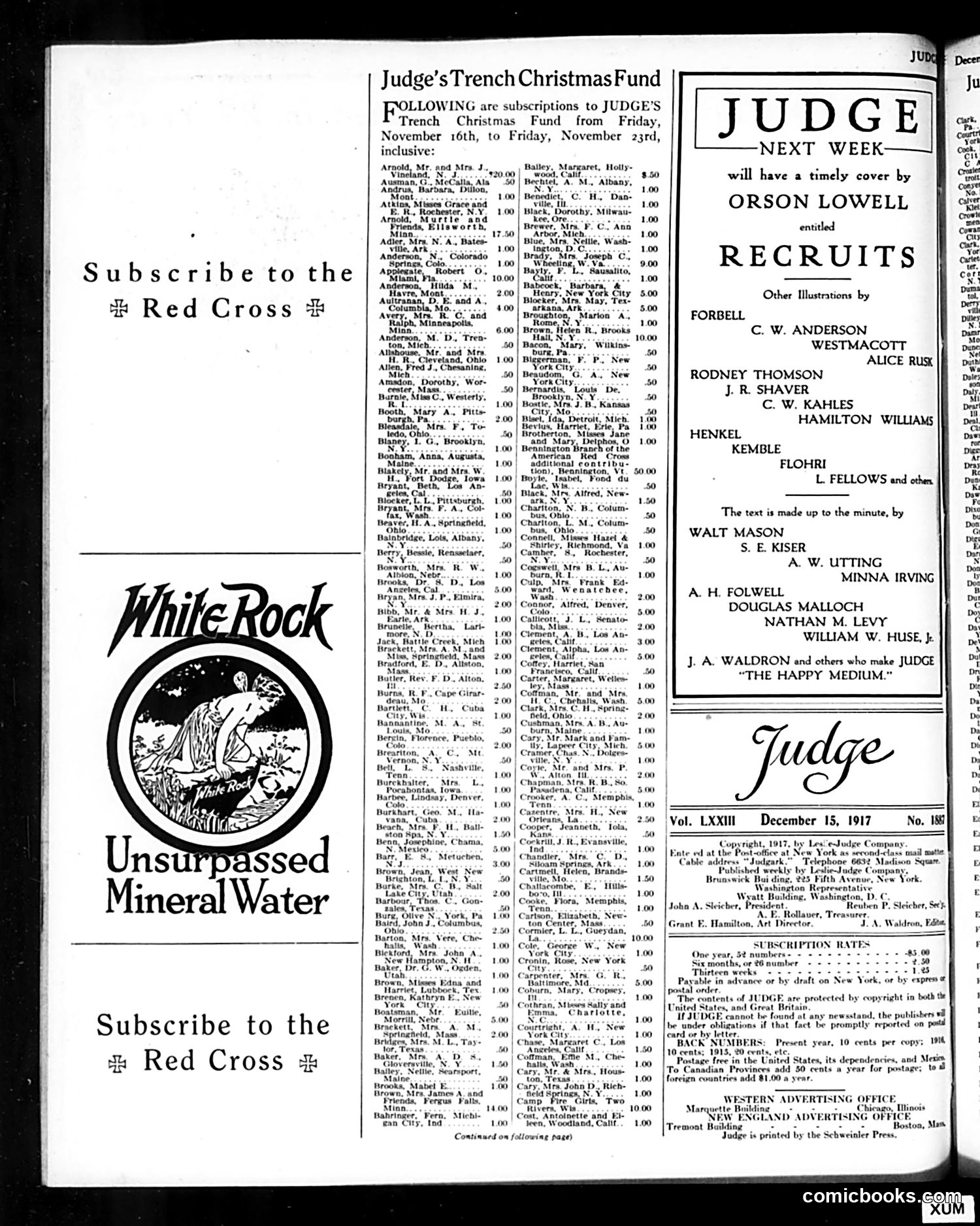
This page is primarily **administrative and advertising** rather than satirical cartoon content. It consists of: 1. **Judge's Trench Christmas Fund**: A subscription list (November 16-23, 1917) showing donations to support soldiers in World War I trenches. Names and amounts are listed, ranging from 50 cents to $20. 2. **Advertisements**: White Rock mineral water ads ("Unsurpassed Mineral Water") and Red Cross subscription appeals—both patriotic messaging typical of WWI-era publications. 3. **Masthead information**: Details about next week's cover by Orson Lowell on "Recruits," with contributor credits (C.W. Anderson, Rodney Thomson, etc.). The page reflects **wartime concerns** (trench warfare, recruitment, Red Cross fundraising) rather than political satire. It demonstrates how American magazines like *Judge* mobilized for the war effort through fundraising and patriotic messaging during 1917.
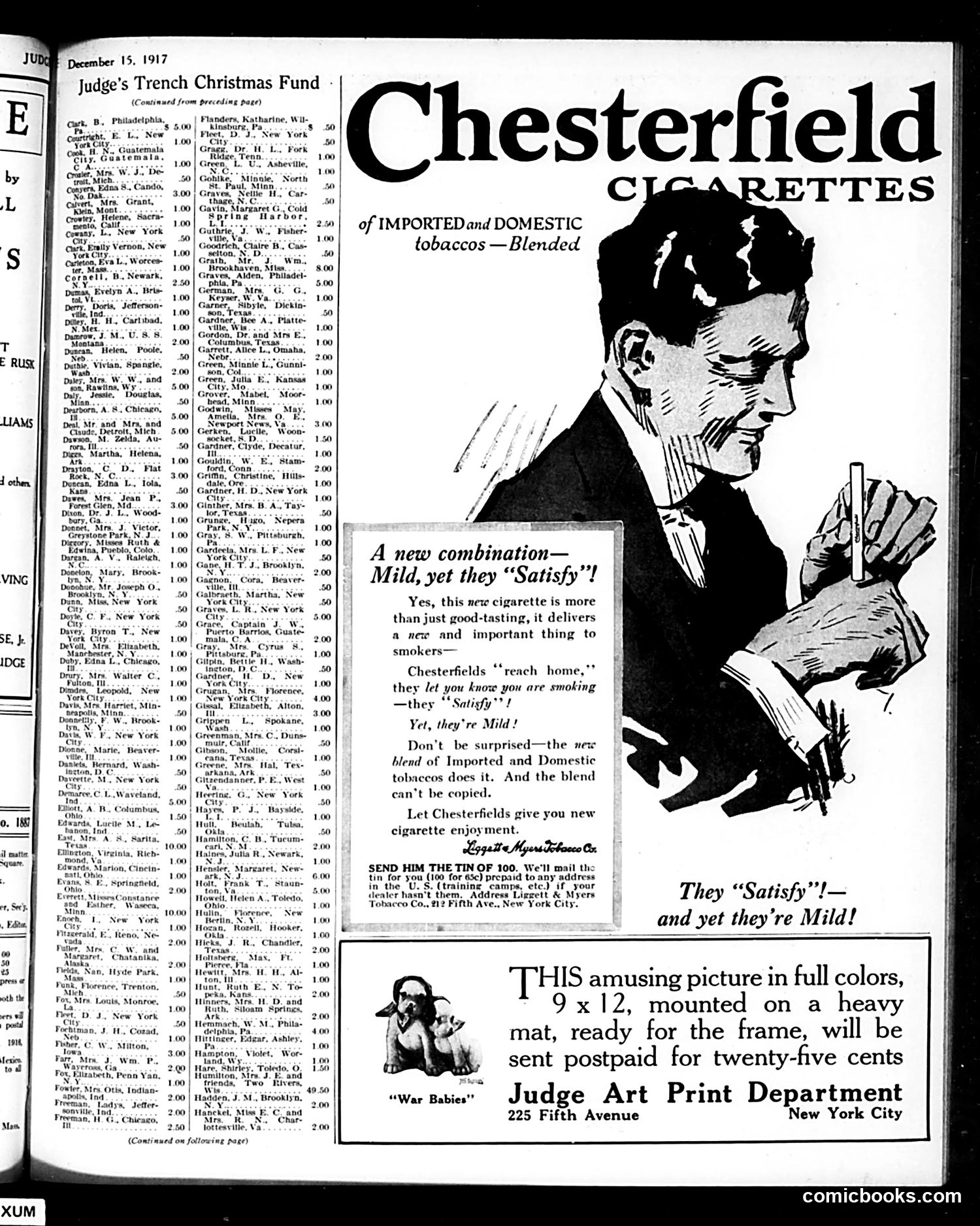
This page is primarily a **charitable fundraising list**, not a political cartoon. It shows donations to Judge's Trench Christmas Fund—a wartime charity supporting soldiers in WWI trenches (the U.S. entered the war in 1917). The only illustration is a **Chesterfield Cigarettes advertisement** featuring a man in profile smoking, with text claiming the cigarettes "Satisfy" smokers by being "Mild, yet they 'Satisfy'!" The ad uses patriotic framing, mentioning soldiers receiving cigarettes as care packages. The page's main content is simply donors' names and contribution amounts. The "War Babies" small illustration at bottom is part of the ad promoting a color print available for 25 cents. **The satire/irony a modern reader might miss**: Wartime Americans sent cigarettes to soldiers as comfort items; the ad capitalizes on this patriotic impulse to sell cigarettes—mixing commercial marketing with wartime charity appeals.
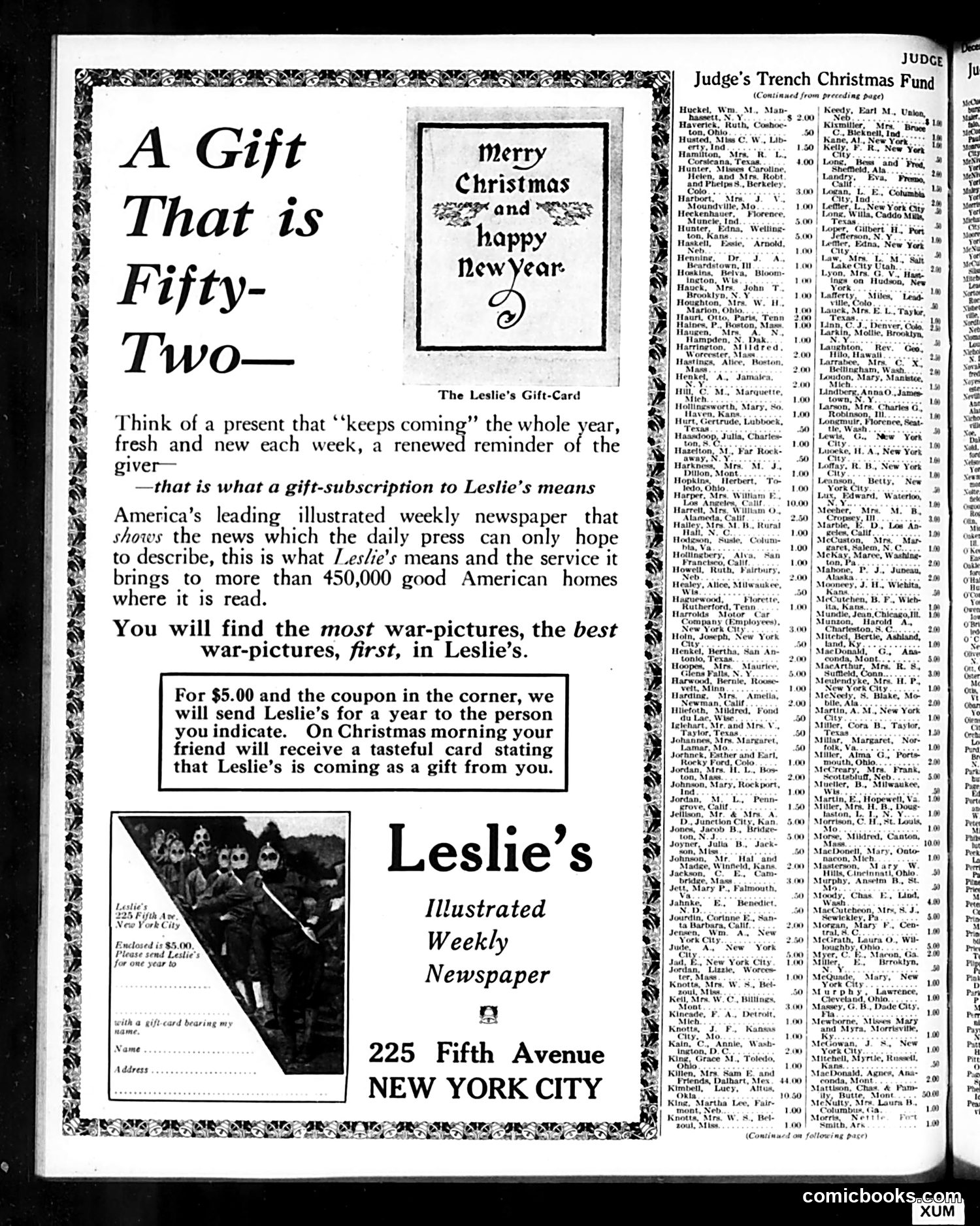
This page is primarily an **advertisement**, not a political cartoon. It promotes Leslie's Illustrated Weekly Newspaper as a Christmas gift subscription. The ad pitches a $5.00 yearly subscription as "a gift that keeps coming" throughout the year. It emphasizes Leslie's as "America's leading illustrated weekly newspaper," claiming it shows war pictures superior to daily newspapers—likely referencing World War I coverage, which was a major selling point for illustrated weeklies of this era. The right column lists donors to the "Judge's Trench Christmas Fund," suggesting this magazine issue was raising charitable contributions, possibly for soldiers or war relief. The small illustration shows what appears to be **four women's faces** (unclear if caricatures of specific people), but without identifying context on this page, their significance cannot be determined. The page is essentially a gift-promotion advertisement with charitable fundraising information, not satirical content.
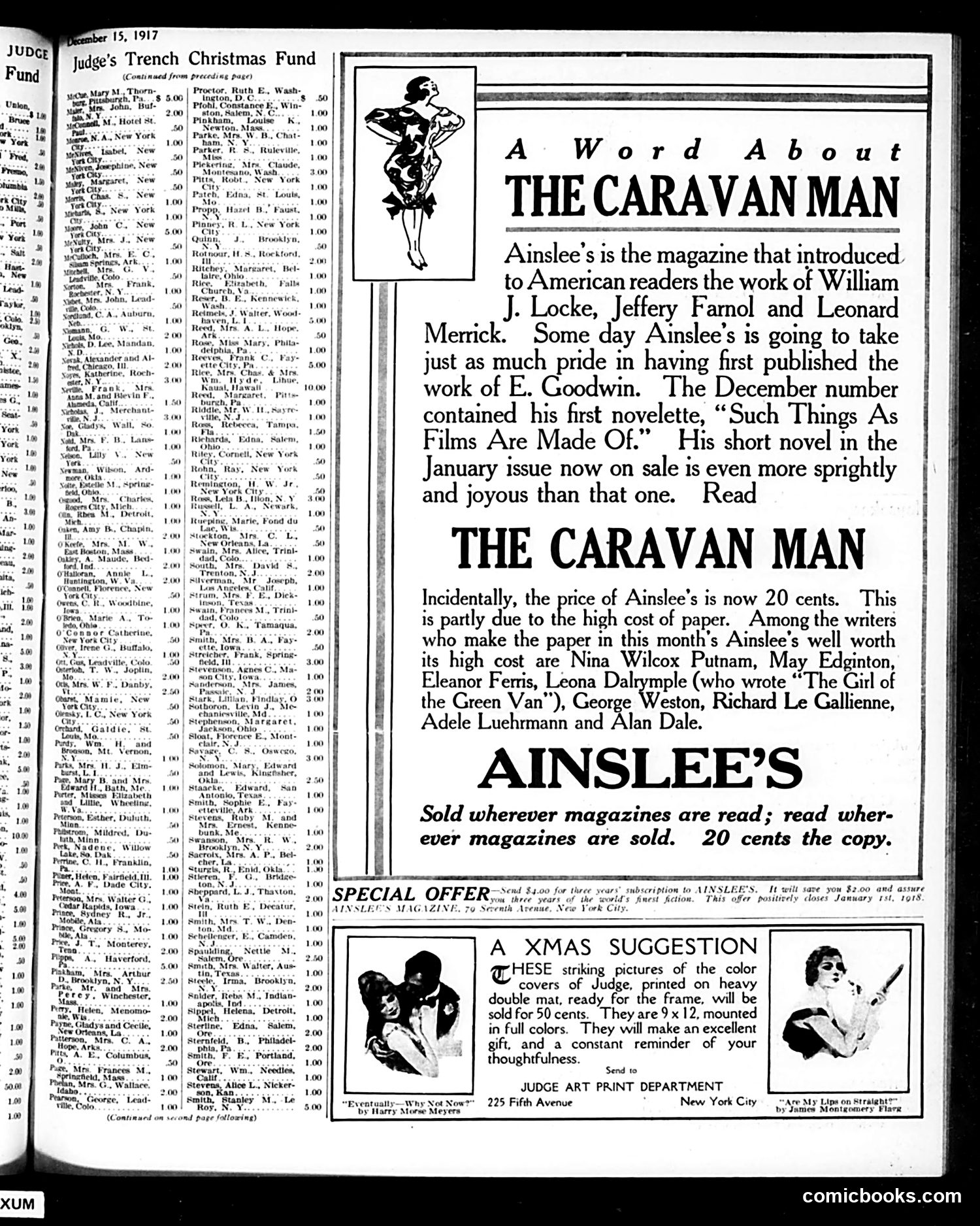
This page is primarily **advertising and promotional content** rather than political cartoons. The left column lists donations to Judge's "Trench Christmas Fund"—a charitable drive supporting soldiers in World War I, which the U.S. had entered months earlier. The main content promotes **Ainslee's magazine**, highlighting its literary contributors and announcing a price increase to 20 cents due to wartime paper costs. Named writers include established authors like Leonard Merrick and emerging talents. At bottom, a small advertisement offers **Judge magazine's color cover prints** (9x12 inches, mounted, 50 cents each) as Christmas gift suggestions—positioning them as "a constant reminder of your thoughtfulness." The page reflects 1917 America: active wartime charity, consumer magazine culture, and holiday gift marketing in the midst of global conflict.
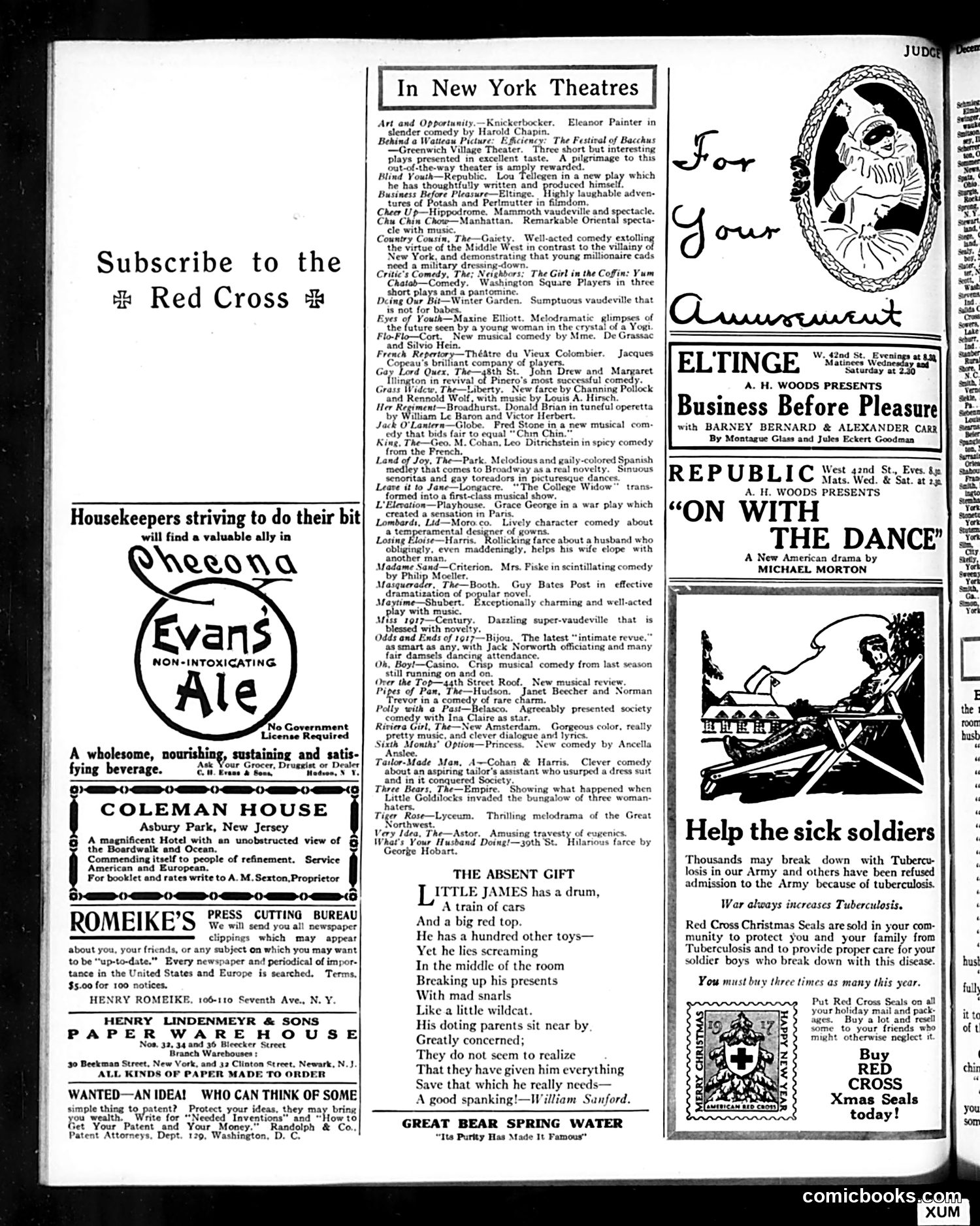
This is primarily an **advertising page** from Judge magazine, interspersed with theater listings. The main content includes ads for consumer products and services marketed to American householders during World War I (the Red Cross subscription appeal and references to "doing their bit" suggest wartime). The notable advertisement is **Pheona Evans Ale**—prominently positioned and labeled "Non-Intoxicating." This is ironic: Evans is marketing a beverage as a patriotic "ally" for housekeepers during wartime, yet emphasizing it requires no government license. This likely references Prohibition debates of the era, when alcohol regulation was contentious. The ad attempts to position non-alcoholic ale as both respectable and aligned with wartime austerity. The **Red Cross appeal** and **tuberculosis prevention advertisement** reflect genuine WWI-era public health concerns and charitable fundraising. The theater section provides straightforward New York playhouse listings with no satirical content visible.
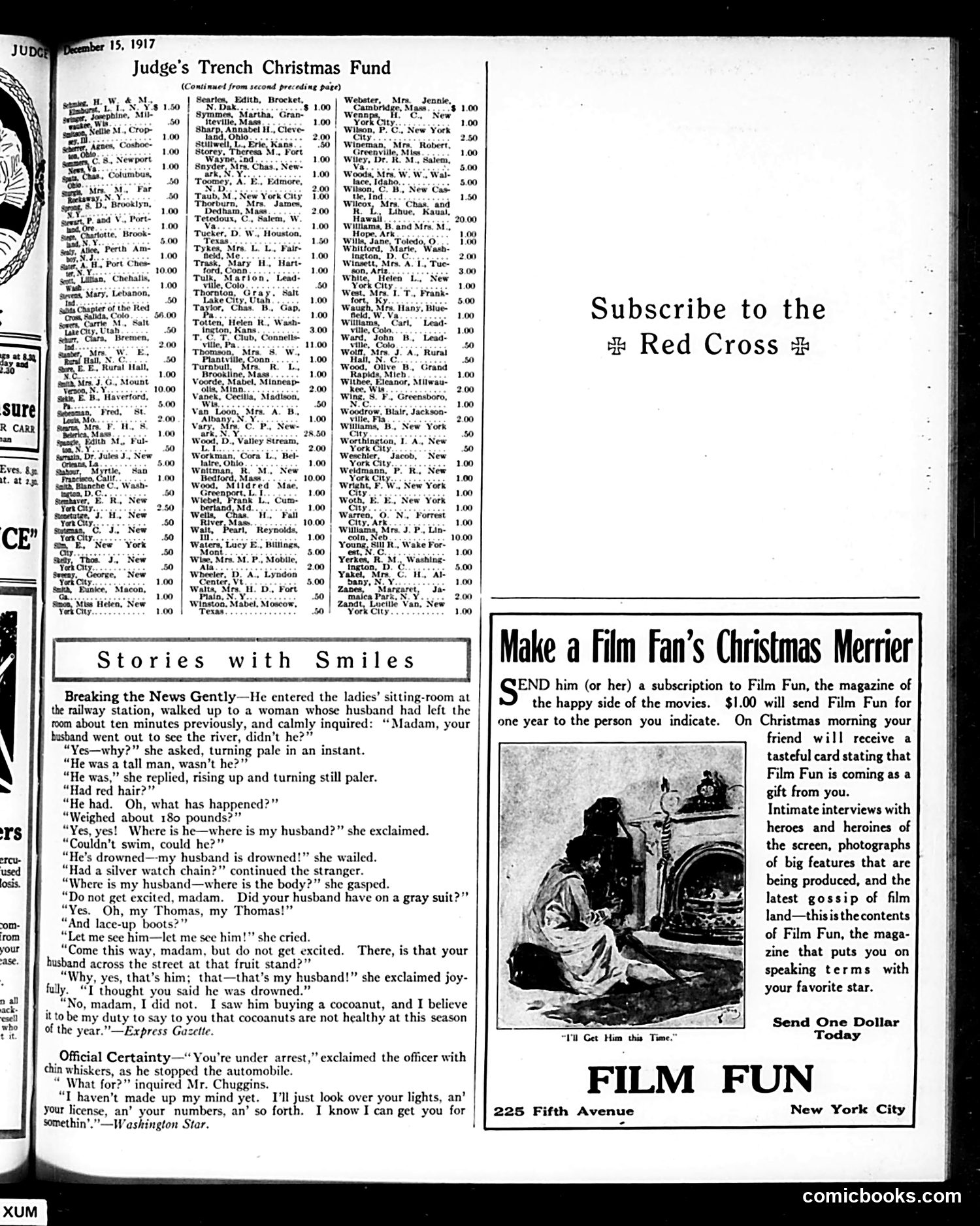
This page is primarily **a charitable donation list** for Judge's Trench Christmas Fund—a wartime fundraising effort to support soldiers in WWI trenches. The bulk of the page consists of names and dollar amounts ($0.50 to $10.00) from readers contributing to this cause. The humorous content appears in the "Stories with Smiles" section: two brief comedic anecdotes with no political content. The first depicts a man cruelly building suspense about a husband's supposed drowning, only to reveal the man alive at a fruit stand—the joke being the clumsy "kindness" of warning about coconuts. The second fragment shows a traffic officer admitting he has no actual reason for the arrest, just wants to inspect the vehicle. An advertisement for **Film Fun magazine** ($1.00 annual subscription) also appears. The page reflects **1917 American homefront concerns**: patriotic fundraising for troops abroad, alongside lighthearted domestic humor to maintain morale during wartime.
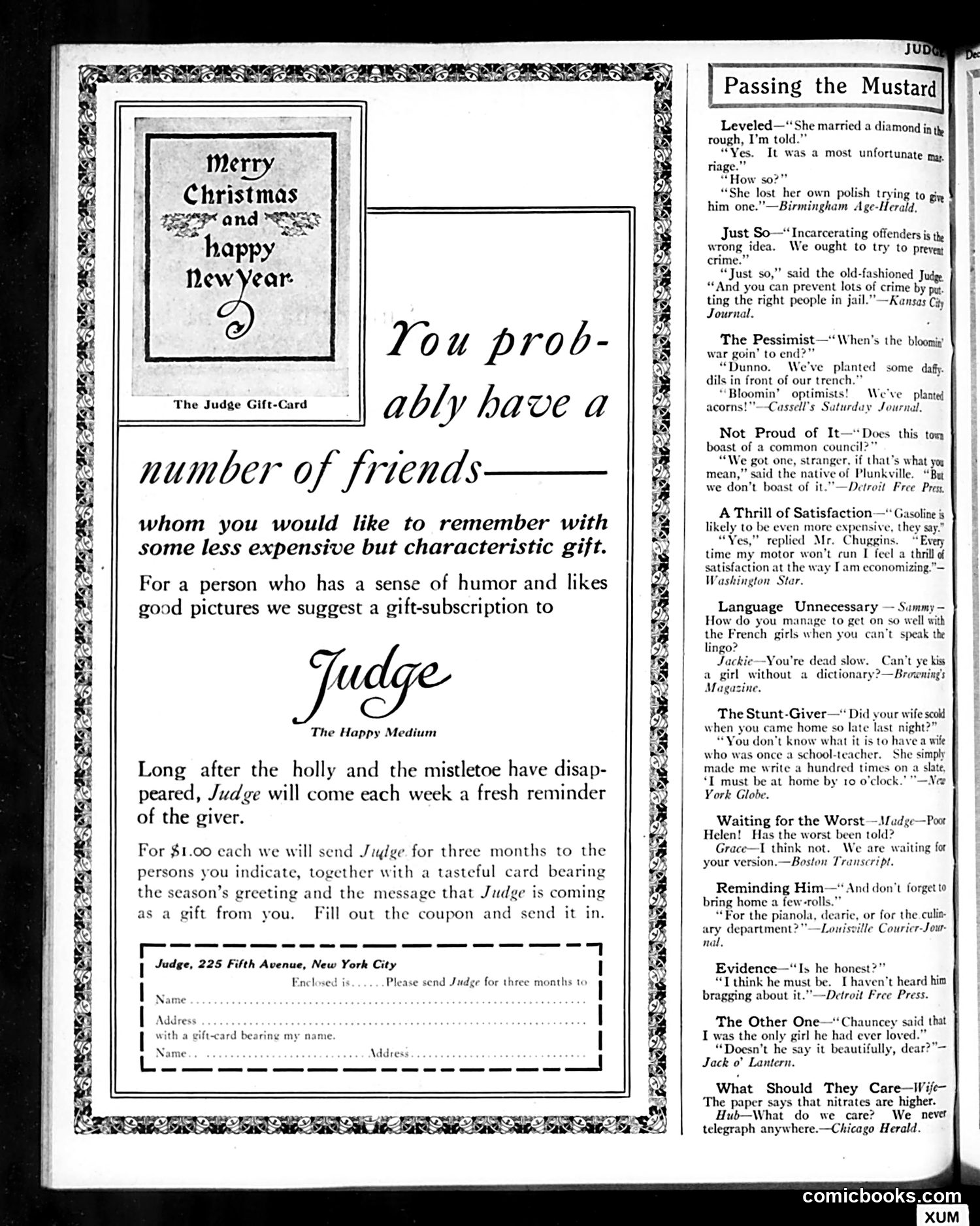
This page is primarily a **gift subscription advertisement** for Judge magazine itself, presented as a Christmas gift idea. The main content features a testimonial promoting a three-month subscription ($1.00) as an affordable yet "characteristic" gift for humor-loving friends. The right column contains **"Passing the Mustard,"** a collection of brief jokes and witticisms clipped from various newspapers. These satirize everyday frustrations and social absurdities: a woman who loses her polish trying to improve a rough husband; old-fashioned ideas about crime prevention through incarceration; wartime anxiety; a motorist perversely satisfied by expensive gasoline; a wife (former schoolteacher) forcing her husband to write lines; and a man praised only for not bragging about honesty. The humor is gentle, domestic, and observational rather than political. These are society-page jokes reflecting middle-class anxieties of the World War I era—particularly the reference to trenches and wartime rationing—but without sharp satirical bite. The page essentially markets Judge by demonstrating the magazine's own comedic sensibility.
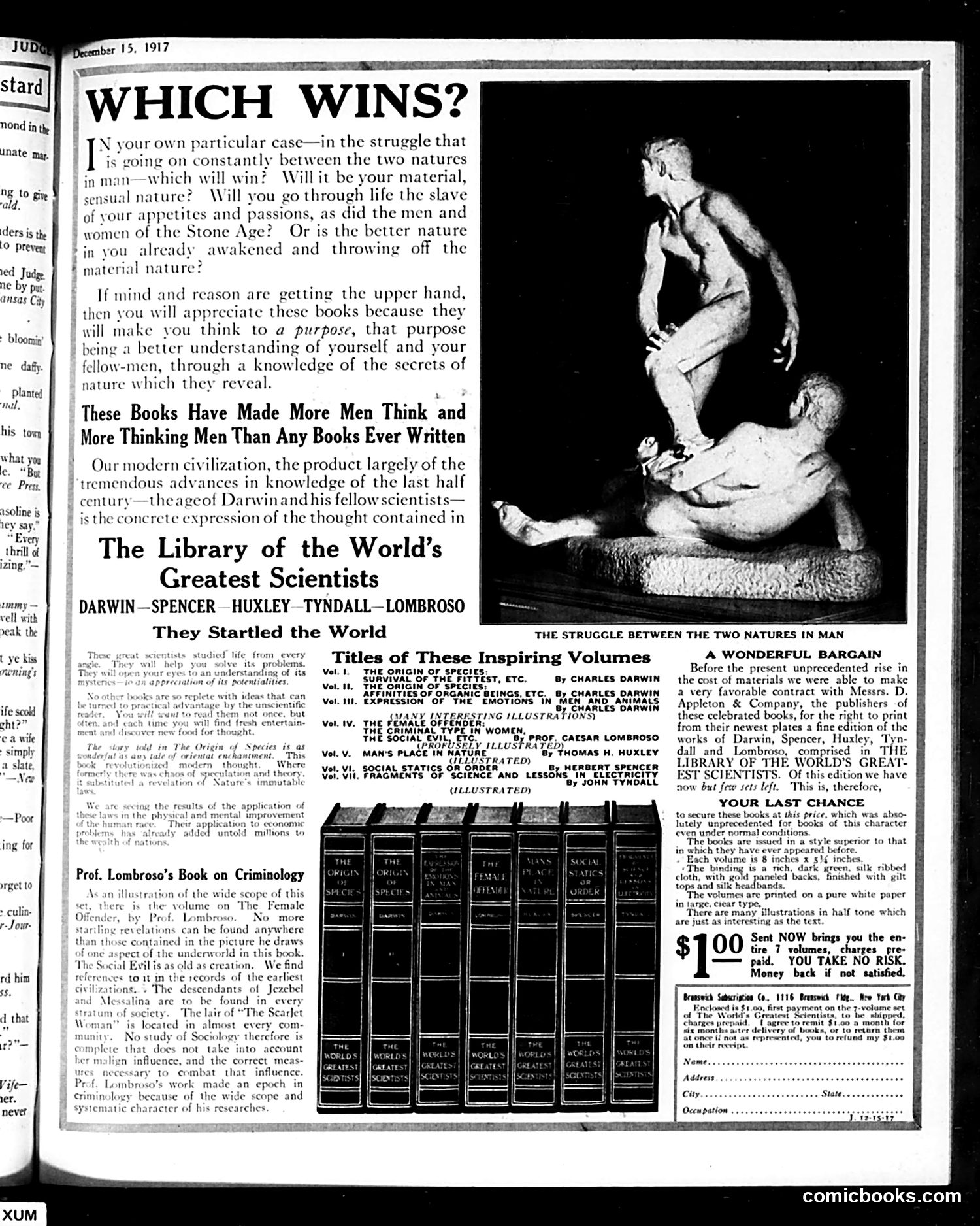
This page is primarily **advertising rather than satire**—it promotes "The Library of the World's Greatest Scientists," a book collection featuring Darwin, Spencer, Huxley, Tyndall, and Lombroso. The illustration titled "The Struggle Between the Two Natures in Man" depicts a muscular male figure in internal conflict, representing the central sales pitch: readers must choose between their "material, sensual nature" (enslaved to "appetites and passions") or their "better nature" (reason and mind). The books are marketed as tools for self-improvement through scientific knowledge. The copywriting reflects early-20th-century enthusiasm for Social Darwinism and scientific determinism—the belief that evolutionary science could explain human behavior and improve civilization. The reference to "Stone Age" men as slaves to passion, contrasted with modern "thinking men," reinforces this hierarchy. The $1.00 price and "last chance" urgency tactics suggest this is a remaindered edition. The content reflects pre-WWI optimism about science's power to elevate humanity—a perspective that would face serious challenge in the post-1918 world.
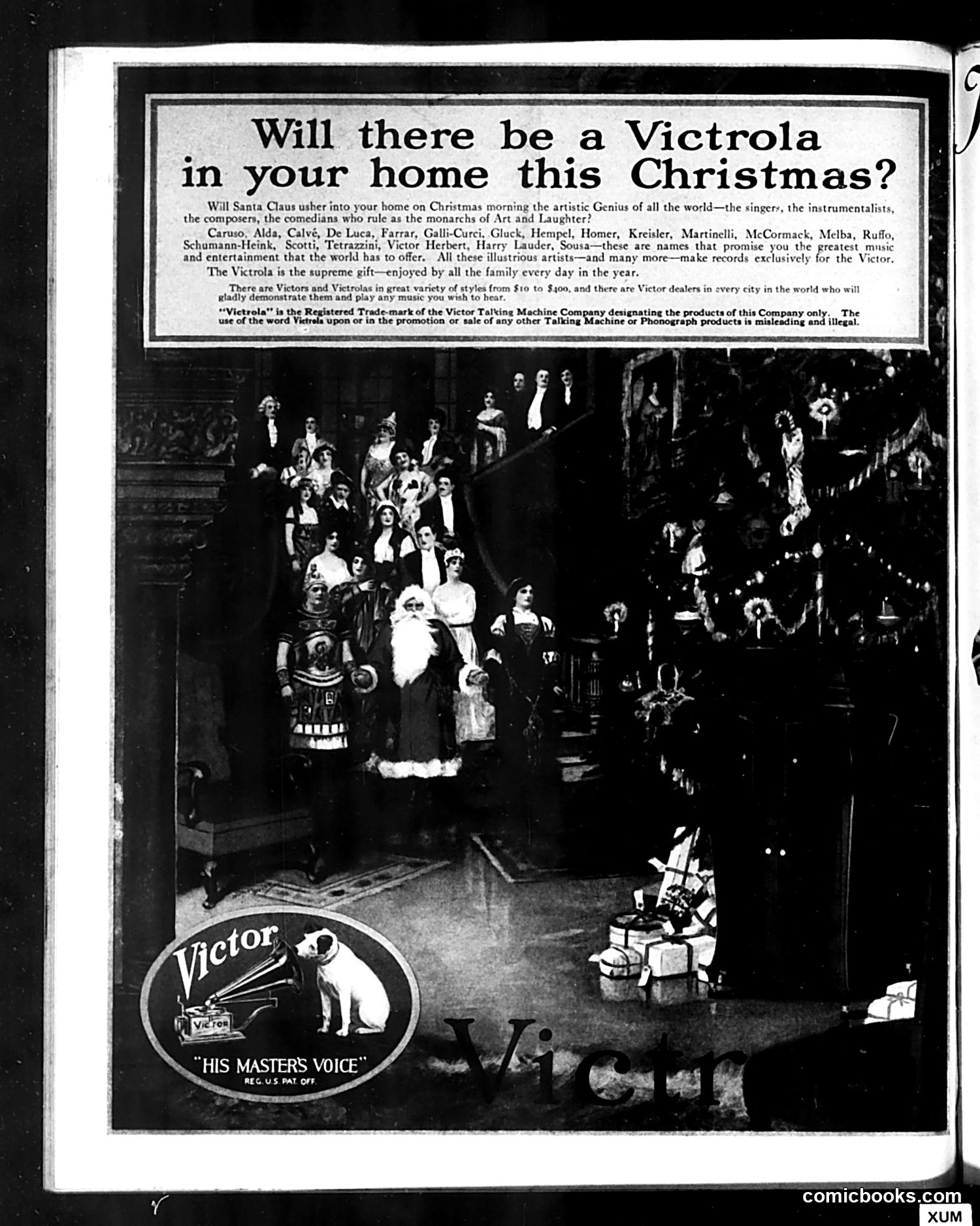
This is **not a cartoon or satire**, but a **Victrola phonograph advertisement** from Judge magazine. The page promotes the Victor Talking Machine Company's Victrola as a Christmas gift. It lists famous opera singers and musicians (Caruso, Galli-Curci, etc.) whose recordings could be played on the device, framing it as bringing "the artistic Genius of all the world" into homes. The image shows an idealized Christmas scene with Santa delivering a Victrola, surrounded by presents and a decorated interior with performers visible in the background—visualizing the luxury and entertainment the product promises. The ad emphasizes price range ($10-$400), availability through dealers worldwide, and legal trademark protection. For modern readers: this represents early 20th-century marketing of recorded music technology as aspirational entertainment—a luxury consumer good that democratized access to celebrated artists previously only available through live performance.