
Judge, 1917-12-15 · page 7 of 28
Judge — December 15, 1917 — page 7: what you’re looking at
What you’re looking at
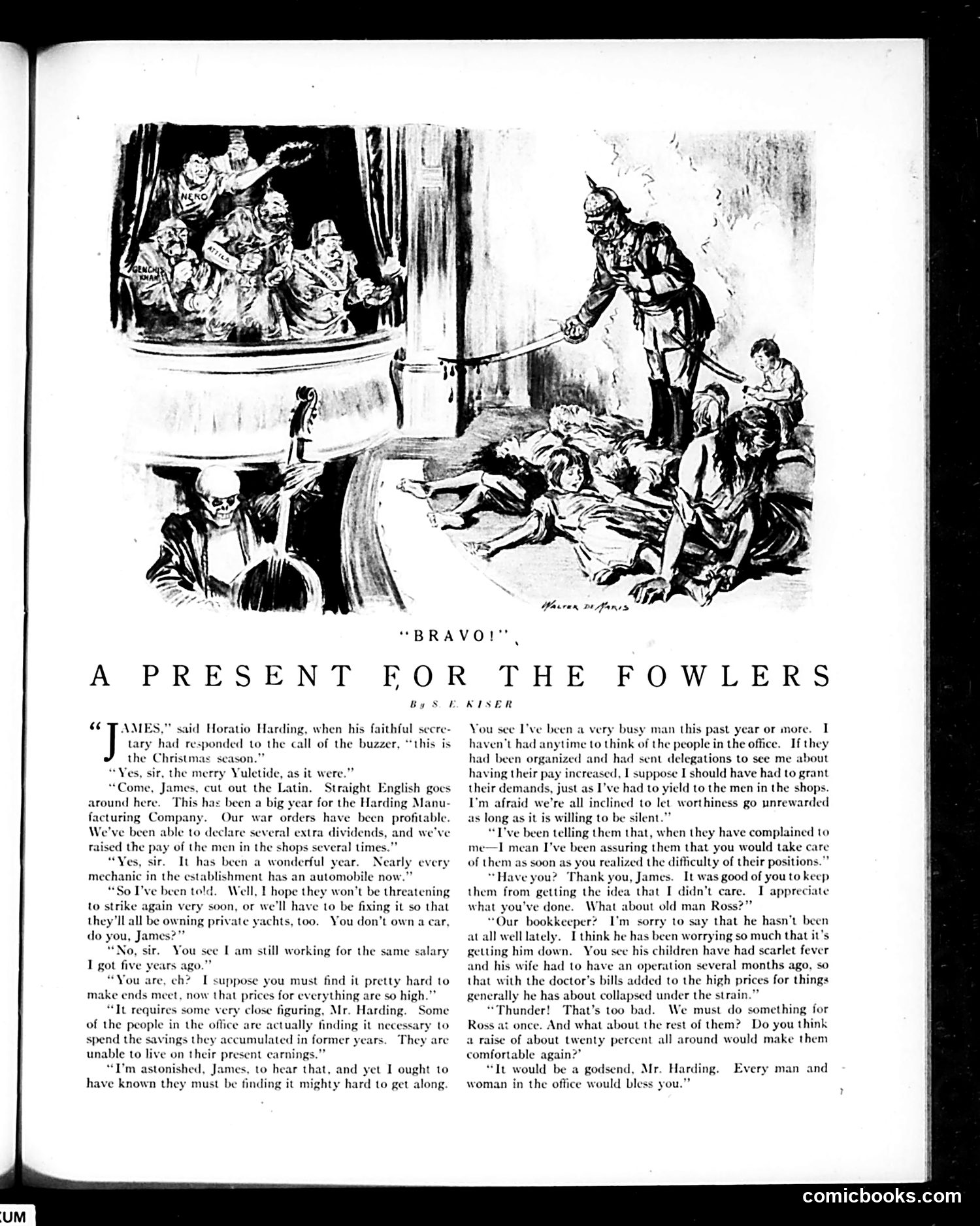
This satirical piece by S. Kiser critiques economic hypocrisy during the post-WWI era. The cartoon depicts a factory owner, Horatio Harding, congratulating himself on war profiteering while his secretary James reveals the hidden reality: office workers haven't received raises in five years despite inflation, and are depleting savings to survive. The satire's bite lies in Harding's obliviousness—he's raised shop workers' pay to prevent strikes and given them enough for automobiles, yet ignores salaried employees unless they formally organize. His sudden willingness to grant a 20% raise only *after* learning of their suffering exposes the cruelty of withholding aid from "worthiness" that "willing to be silent." The title "A Present for the Fowlers" suggests office workers are being treated as expendable birds. The imagery shows contrast between luxury (theater scene, top) and worker desperation (bottom), underscoring the class divide his benevolence conveniently ignores.
📄 Transcribed text from this page (OCR, searchable)
Machine-transcribed from the original scan — historical spelling and the odd misread are preserved.
Me Waren Di fans “BRAVO!” . A PRESENT FOR THE FOWL oS E “ ."’ said Horatio Harding, when his faithful secre- J tary had responded to the call of the buzzer, “this is the Christmas season.” Yes, sir, the merry Yule’ Come, James, cut out the Latin. Straight English goes around here. This has been a big year for the Harding Manu- facturing Company. Our war orders have been profitable. We've been able to declare several extra dividends, and we've raised the pay of the men in the shops several times.” “Yes, sir. It has been a wonderful year. Near: mechanic in the establishment has an automobile now. “So I've been to Well, I hope they won't be threatening to strike again very soon, or we'll have to be fixing it so that they'll all be owning private yachts, too. You don’t own a car, do you, James?” “No, sir. You sce I am still working for the same salary I got five years ago.” “You are, ch? [ suppose you must find it pretty hard to make ends meet, now that prices for everything are so high.” “Tt requires some very close figuring, Mr. Harding. Some of the people in the office are actually finding it necessary to spend the savings they accumulated in former years. They are unable to live on their present earnings.” “I'm astonished, James, to hear that, and yet I ought to have known they must be finding it mighty hard to get along. ide, as it wer KISER You see I've been a very busy man this past year or more. I haven't had anytime to think of the people in the office. If they had been organized and had sent delegations to see me about having their pay increased, I suppose I should have had to grant their demands, just as I’ve had to yield to the men in the shops. I'm afraid we're all inclined to let worthiness go unrewarded as long as it is willing to be silent.” “T've been telling them that, when they have complained to me—I mean I’ve been assuring them that you would take care of them as soon as you realized the difficulty of their positions.” “Have you? Thank you, James. It was good of you to keep them from getting the idea that I didn’t care. I appreciate what you've done. What about old man Ross?” “Our bookkeeper? I'm sorry to say that he hasn't been at all well lately. I think he has been worrying so much that it’s getting him down, You see his children have had scarlet fever and his wife had to have an operation several months ago, so that with the doctor's bills added to the high prices for things generally he has about collapsed under the strain.” *Thundei That’s too bad. We must do something for Ross at once. And what about the rest of them? Do you think a raise of about twenty percent all around would make them comfortable again?” “It would be a godsend, Mr. Harding. woman in the office would bless you.” Every man and comicbooks.com