
Judge, 1917-12-15 · page 4 of 28
Judge — December 15, 1917 — page 4: what you’re looking at
What you’re looking at
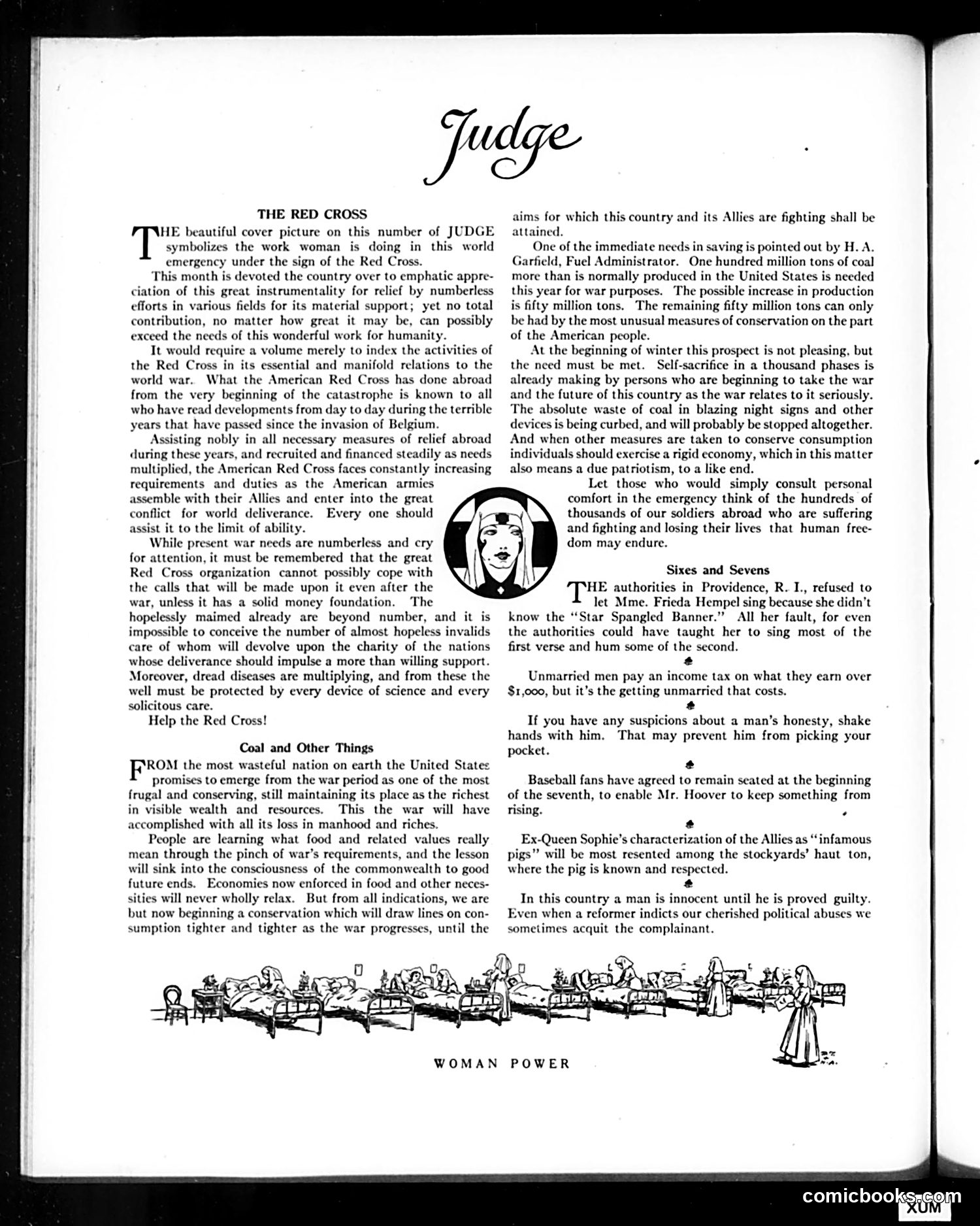
This editorial page from Judge magazine uses wartime appeals to encourage American sacrifice and conservation. The main article promotes Red Cross support and coal rationing during what appears to be World War I. The "Woman Power" illustration at the bottom depicts women engaged in industrial/factory work, likely celebrating female labor contributions to the war effort. The cartoon suggests women's productive capacity as essential to national defense. The scattered brief items ("Sizes and Sevens") employ light satire: mocking authorities who censored patriotic songs, poking fun at tax burdens on unmarried men, and offering cynical observations about honesty and legal justice. The overall message frames civilian sacrifice and female workforce participation as patriotic duties necessary for military victory.
📄 Transcribed text from this page (OCR, searchable)
Machine-transcribed from the original scan — historical spelling and the odd misread are preserved.
THE RED CROSS HE beautiful cover picture on this number of JUDGE symbolizes the work woman is doing in this world emergency under the sign of the Red Cross. This month is devoted the country over to emphatic appre- ciation of this great instrumentality for relief by numberless efforts in various fields for its material support; yet no total contribution, no matter how great it may be, can possibly exceed the needs of this wonderful work for humanity. It would require a volume merely to index the activities of the Red Cross in its essential and manifold relations to the world war. What the American Red Cross has done abroad from the very beginning of the catastroph known to all who have read developments from day to day during the terrible years that have passed since the invasion of Belgium. Assisting nobly in all necessary measures of relief abroad during these years, and recruited and financed steadily as needs multiplied, the American Red Cross faces constantly increasing requirements and duties as the American armies assemble with their Allies and enter into the great conflict for world deliverance. Every one should /) assist it to the limit of ability. While present war needs are numberless and cry for attention, it must be remembered that the great Red Cross organization cannot possibly cope with the calls that will be made upon it even after the war, unless it has a solid money foundation. The hopelessly maimed already are beyond number, and it is impossible to conceive the number of almost hopeless invalids care of whom will devolve upon the charity of the nations whose deliverance should impulse a more than willing support. Moreover, dread diseases are multiplying, and from these the well must be protected by every device of science and every solicitous care. Help the Red Cross! Coal and Other Things ROM the most wasteful nation on earth the United States promises to emerge from the war period as one of the most frugal and conserving, still maintaining its place as the richest in visible wealth and resources. This the war will have accomplished with all its loss in manhood and riches. People are learning what food and related values really mean through the pinch of war’s requirements, and the lesson will sink into the consciousness of the commonwealth to good future ends. Economies now enforced in food and other neces- sities will never wholly relax. But from all indications, we are but now beginning a conservation which will draw lines on con- sumption tighter and tighter as the war progresse: aims for which this country and its Allies are fighting shall be attained. One of the immediate needs in saving is pointed out by H. A. Garfield, Fuel Administrator. One hundred million tons of coal more than is normally produced in the United States is needed this year for war purposes. The possible increase in production is fifty million tons. The remaining fifty million tons can only be had by the most unusual measures of conservation on the part of the American people. At the beginning of winter this prospect is not pleasing, but the need must be met. Self-sacrifice in a thousand phases is already making by persons who are beginning to take the war and the future of this country as the war relates to it seriously. The absolute waste of coal in blazing night signs and other devices is being curbed, and will probably be stopped altogether. And when other measures are taken to conserve consumption individuals should exercise a rigid economy, which in this matter also means a due patriotism, to a like end. Let those who would simply consult personal comfort in the emergency think of the hundreds of thousands of our soldiers abroad who are suffering and fighting and losing their lives that human free- dom may endure. \ Sixes and Sevens HE authorities in Providence, R. I., refused to let Mme. Frieda Hempel sing because she didn’t know the “Star Spangled Banner.” All her fault, for even the authorities could have taught her to sing most of the first verse and hum some of the second. 2 Unmarried men pay an income tax on what they earn over $1,000, but it’s the getting unmarried that costs. 2 If you have any suspicions about a man’s honesty, shake hands with him. That may prevent him from picking your pocket. e Baseball fans have agreed to remain seated at the beginning of the seventh, to enable Mr. Hoover to keep something from rising. . Ex-Queen Sophie’s characterization of the Allies as “infamous pigs” will be most resented among the stockyards’ haut ton, where the pig is known and respected. # In this country a man is innocent until he is proved guilty. Even when a reformer indicts our cherished political abuses we sometimes acquit the complainant. WOMAN POWER