
Judge, 1917-12-15 · page 13 of 28
Judge — December 15, 1917 — page 13: what you’re looking at
What you’re looking at
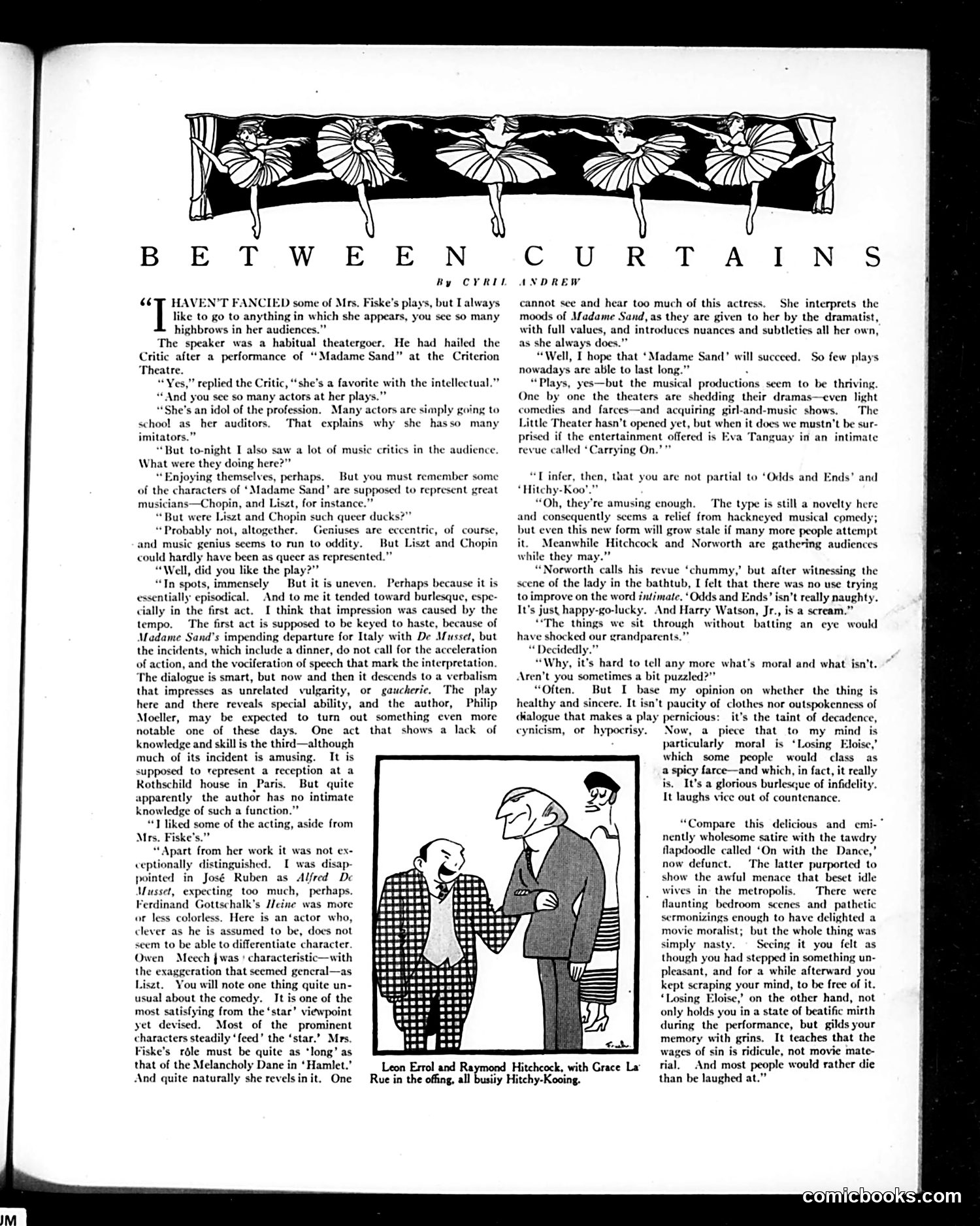
This page features a theater criticism dialogue by Cyril Andrew discussing a Broadway production of *Madame Sand* starring Mrs. Fiske at the Criterion Theatre. The article reviews the play—which dramatizes the life of French author George Sand, featuring portrayals of composers Chopin and Liszt. The accompanying cartoon shows three men in period dress, likely representing the historical figures discussed (Liszt, a central character, and associates), illustrating the play's subject matter. The critic praises Mrs. Fiske's performance and intellectual appeal while critiquing the uneven script by Philip Moeller. He notes the first act's excessive tempo, weak supporting performances (particularly José Ruben as Alfred de Musset and Ferdinand Gottschalk as Heine), and the third act's superficial portrayal of Parisian high society. The piece reflects early 20th-century theater culture's interest in biographical dramas and the "star system" where leading actors dominated productions. References to the emerging "Little Theater" movement suggest contemporary theatrical debates about commercial versus experimental theater.
📄 Transcribed text from this page (OCR, searchable)
Machine-transcribed from the original scan — historical spelling and the odd misread are preserved.
Ss he BET WEEN By CYRIL HAVE s. Fiske’s plays, but Lalways I like to go to anything in which she appears, you see so many highbrows in her audiences.” The speaker was a habitual theatergoer. He had hailed the Critic after a performance of ‘Madame Sand” at the Criterion ‘Theatre. “Yes,” replied the Critic, “she’s a favorite with the intellectual.” “And you see so many actors at her plays.” “She's an idol of the profession. Many actors are simply going to school as her auditors, That explains why she hasso many imitator “But to-night I also saw a lot of music critics in the audience. What were they doing here?” joying themselves, perhaps. But you must remember some of the characters of ‘Madame Sand’ are supposed to represent great musicians—Chopin, and Liszt, for instance, But were Liszt and Chopin such queer duck: “Probably not, altogether. Geniuses are eccentric, of course, and music genius seems to run to oddity. But Liszt and Chopin could hardly have been as queer as represented.” “Well, did you like the play “In spots, immensely But it is uneven. Perhaps because it is essentially episodical. And to me it tended toward burlesque, espe- cially in the first act. I think that impression was caused by the tempo. The first act is supposed to be keyed to haste, because of Madame Sand’s impending departure for Italy with De Musset, but the incidents, which include a dinner, do not call for the acceleration of action, and the vociferation of speech that mark the interpretation. The dialogue is smart, but now and then it descends to a verbalism that impresses as unrelated vulgarity, or gaucherie, The play here and there reveals special ability, and the author, Philip Moeller, may be expected to turn out something even more notable one of these days. One act that shows a lack of knowledge and skill is the third—although much of its incident is amusing. It is supposed to represent a reception at a Rothschild house in Paris. But quite apparently the author has no intimate knowledge of such a function.” “T liked some of the acting, aside from Mrs. Fiske’s.”” “Apart from her work it was not ex- ceptionally distinguished. I was disap- pointed in José Ruben as Alfred De Musset, expecting too much, perhaps. Ferdinand Gottschalk’s Heine was more or less colorless. Here is an actor who, clever as he is assumed to be, does not seem to be able to differentiate character, Owen Meech j was | characteristic—with the exaggeration that seemed gencral—as Liszt. You will note one thing quite un- usual about the comedy. Jt is one of the isfying from the ‘star’ viewpoint ised. Most of the prominent characters steadily ‘feed’ the ‘star.’ Mrs. Fiske’s réle must be quite as ‘long’ as that of the Melancholy Dane in ‘Hamlet.’ And quite naturally she revels init. One iy Hitchy-Kooing. aS” b C U RTAT ANDREW w= Gwe~: N §$ cannot sce and hear too much of this actress. She interprets the moods of Madame Sand, as they are given to her by the dramatist, with full values, and introduces nuances and subtleties all her own, as she always does.” “Well, I hope that ‘Madame Sand’ will succeed. So few plays nowadays are able to last long.” “Plays, yes—but the musical productions seem to be thriving. One by one the theaters are shedding their dramas—even light comedies and farces—and_ ac s The Little Theater hasn’t opened yet, but when it does we mustn't be sur- prised if the entertainment offered i is Eva Ta nan intimate revue called ‘Carrying On.’ “T infer, then, that you are not partial to ‘Odds and Ends’ and ‘Hitchy-Koo’.”” “Oh, they're amusing enough. The type is still a novelty here and consequently scems a relief from hackneyed musical comedy; but even this new form will grow stale if many more people attempt it. Meanwhile Hitchcock and Norworth are gathering audiences while they may.” “Norworth calls his revue ‘chummy,’ but after witnessing the scene of the lady in the bathtub, I felt that there was no use trying to improve on the word intimate, ‘Odds and Ends’ isn’t really naughty. It's just happy-go-lucky. And Harry Watson, Jr., is a scream.” “The things we sit through without batting an eye would have shocked our grandparents.”” “ Decidedly.” “Why, hard to tell any more what's moral and what isn’t. Aren't you sometimes a bit puzzled?” “Often, But I base my opinion on whether the thing is healthy and sincere. It isn’t paucity of clothes nor outspokenness of dialogue that makes a play pernicious: it’s the taint of decadence, cynicism, or hypocri: Now, a piece that to my mind is particularly moral is ‘Losing Eloise,’ which some people would class as a spicy farce—and which, in fact, it really is. It's a glorious burlesque of infidelity. It laughs vice out of countenance. “Compare this delicious and emi-* nently wholesome satire with the tawdry flapdoodle called ‘On the Dance,’ now defunct. ‘The latter purported to show the awful menace that beset idle wives in the metropolis. There were flaunting bedroom scenes and pathetic 's enough to have delighted a movie moralist; but the whole thing was simply nasty. — Sccing it you felt as though you had stepped in something un- pleasant, and for a while afterward you kept scraping your mind, to be free of it. ‘Losing Eloise,’ on the other hand, not only holds you in a state of beatific mirth during the performance, but. gilds your memory with grins. It teaches that the wages of sin is ridicule, not movie mate- rial, And most people would rather die than be laughed at.” Hitchcock, with Grace La