
A complete issue · 28 pages · 1917
Judge — October 20, 1917
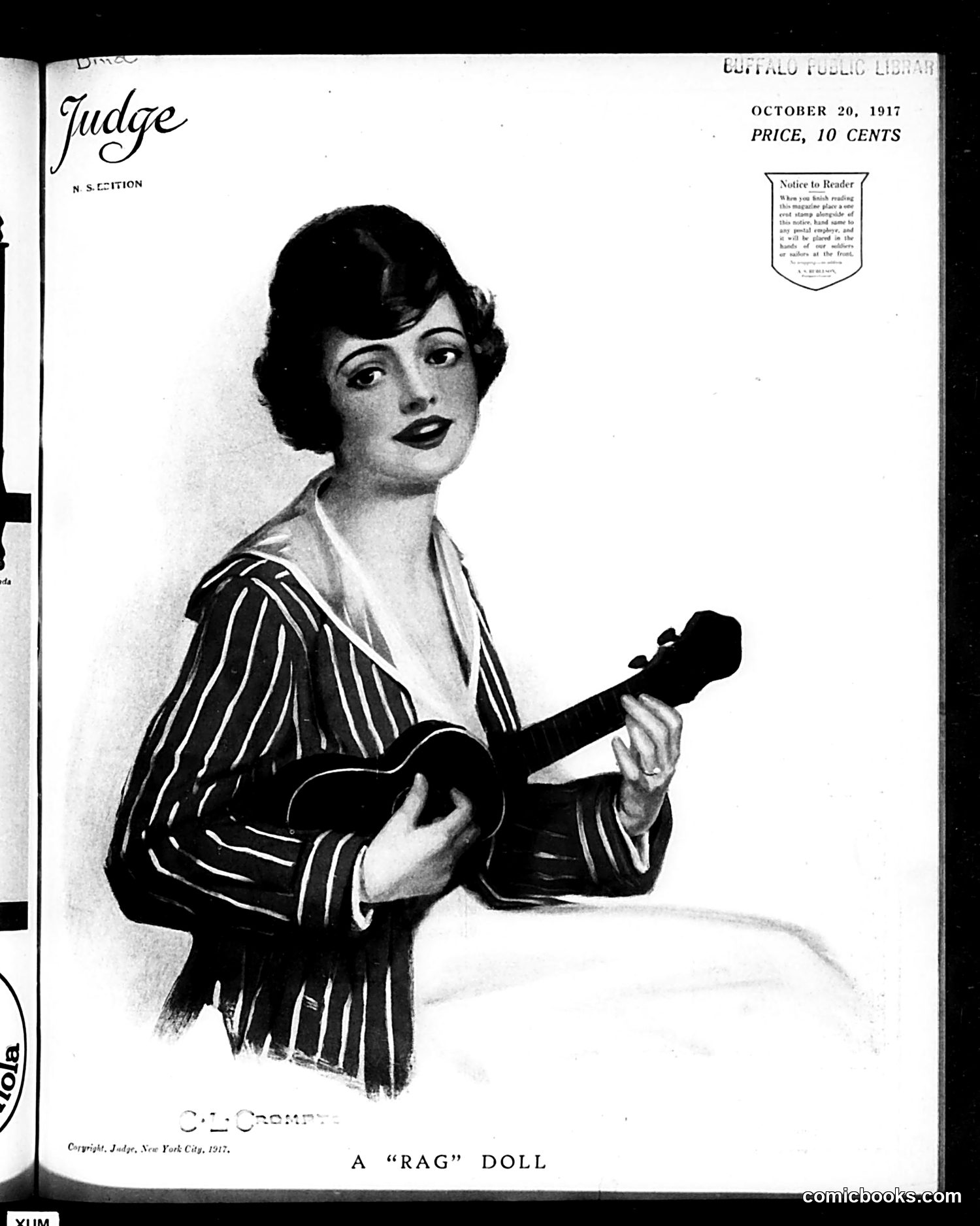
This October 1917 *Judge* cover depicts a woman in a pinstriped jacket holding a ukulele, captioned "A 'Rag' Doll." The satire likely plays on the simultaneous popularity of two musical trends: "rag" music (ragtime and jazz) and the ukulele craze sweeping America in the 1910s. The woman's fashionable, somewhat masculine pinstriped attire suggests the "modern woman" of the era—independent and culturally engaged with contemporary entertainment. The title's double meaning—conflating the woman with both "rag" music and a plaything—may mock how popular culture commodified and trivialized women, reducing them to fashionable objects rather than serious participants. The ukulele, still novel to American audiences, symbolizes the era's musical modernism and cultural borrowing from Hawaiian culture.
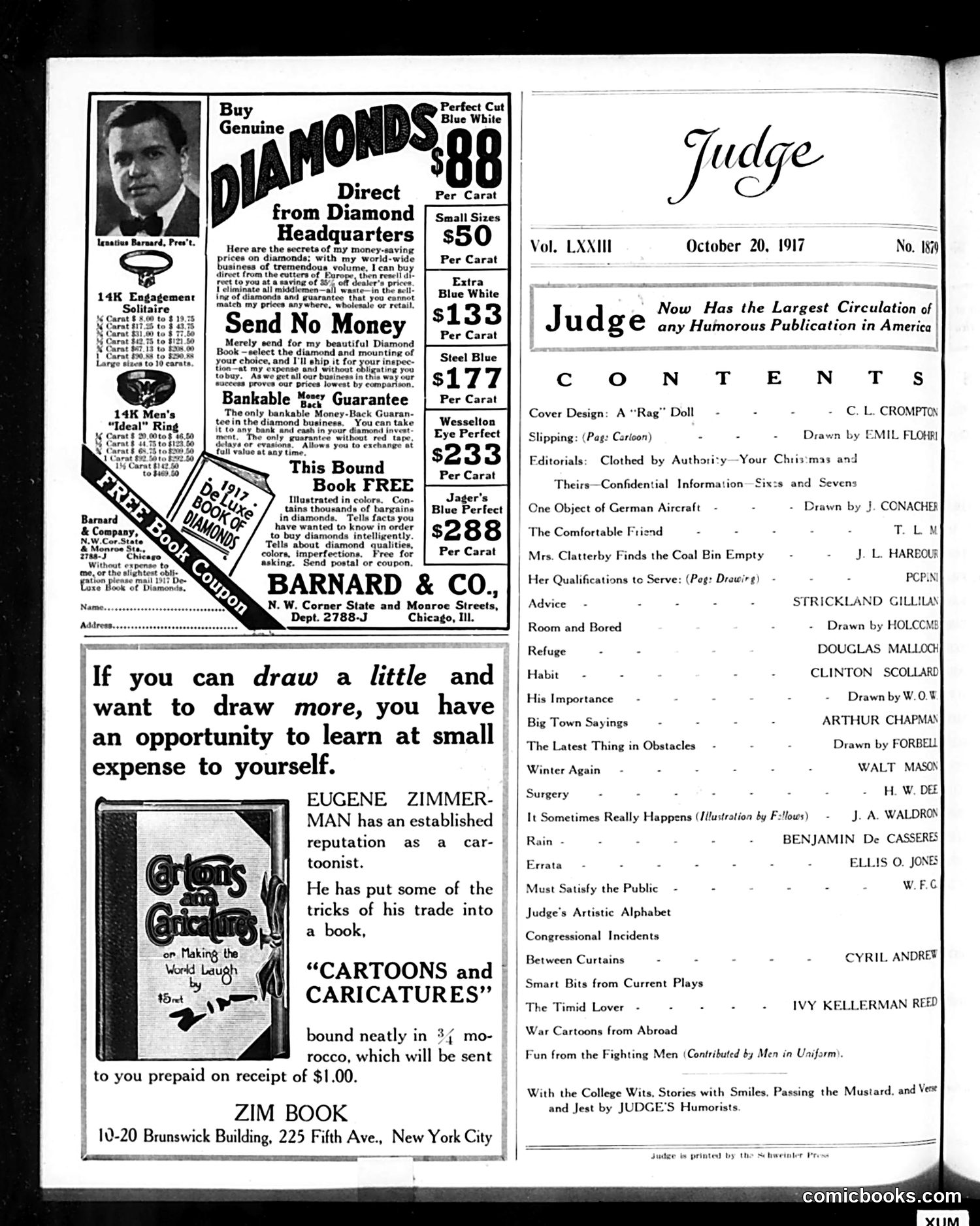
This page is primarily **advertising and table of contents** rather than political cartoons. The left side features diamond ring advertisements from Barnard & Co., and an ad for Eugene Zimmerman's instructional cartooning book, "Cartoons and Caricatures: on Making the World Laugh" ($1.00). The right side lists the magazine's contents for this issue, including various humorous articles and illustrations—typical of Judge's satirical format. Given the **October 1917 date**, this falls during America's involvement in World War I, as evidenced by mentions of "War Cartoons from Abroad" and "Fun from the Fighting Men" in the contents, though specific political figures or satire aren't visible on this particular page spread.
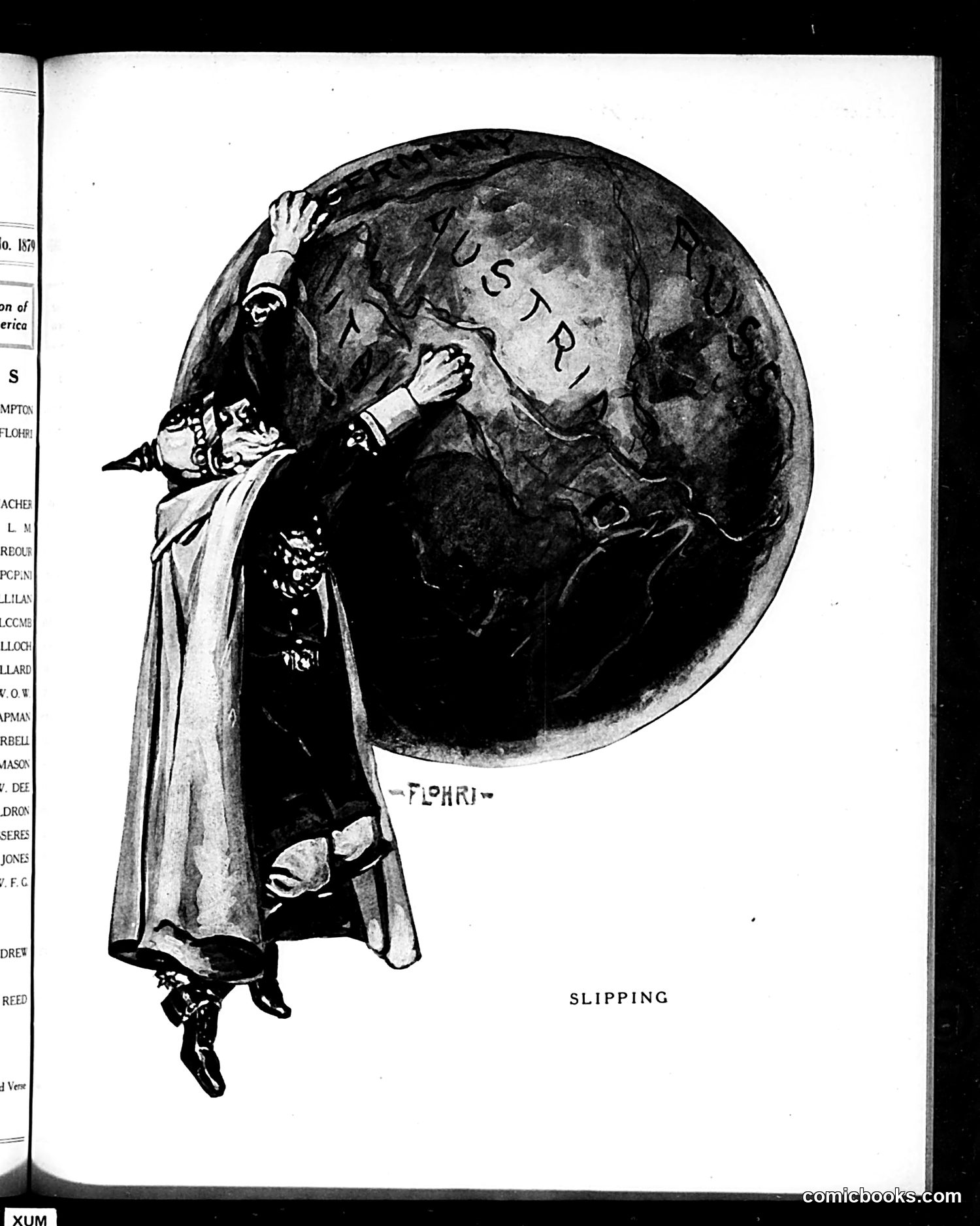
This political cartoon depicts a wizard-like figure in a pointed hat inscribing letters "S.P.R." on a large spherical object (likely representing the moon or a celestial body). The figure appears to be "slipping"—losing grip or control—as suggested by the title and the precarious positioning. The "S.P.R." likely refers to the Society for Psychical Research, an organization that investigated supernatural phenomena and spiritualism. The cartoon satirizes spiritualists or their advocates as charlatans attempting to claim or mark territory through fraudulent supernatural claims. The figure's unstable position suggests their efforts are failing or their credibility is slipping away. This reflects late 19th/early 20th-century skepticism toward spiritualism movements.
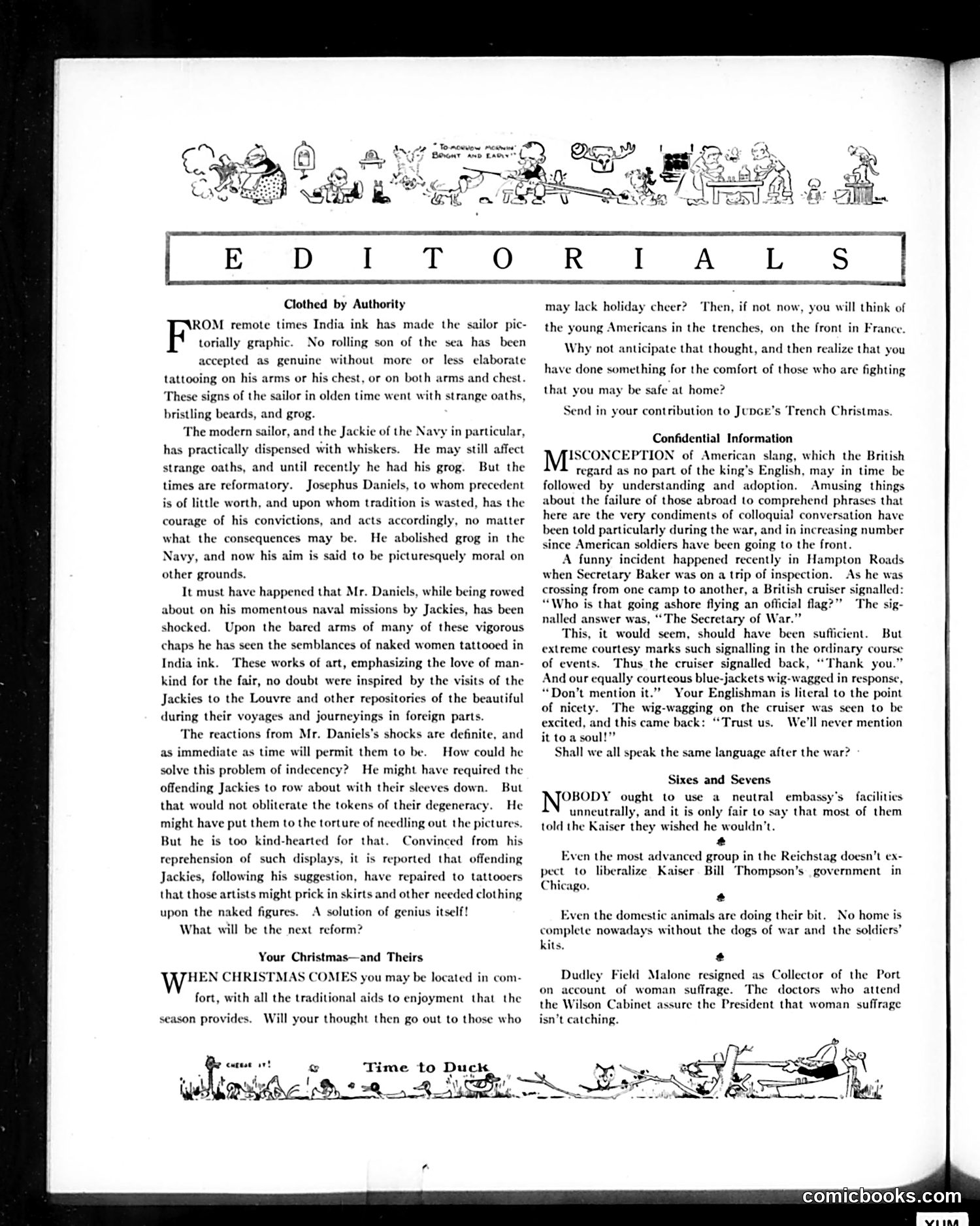
This is an editorials page from *Judge* magazine featuring several satirical pieces addressing WWI-era concerns: **"Clothed by Authority"** mocks sailor tattoos, using Josephus Daniels (Navy Secretary) as the implied target. The piece suggests modern Navy discipline has eliminated the colorful, rebellious traditions of old seafarers. **"Your Christmas—and Theirs"** encourages readers to consider soldiers' comfort during the holidays, framed as patriotic duty. **"Confidential Information"** satirizes American soldiers adopting British slang and military customs, with an anecdote about a secretary being mistaken for a military official—poking fun at transatlantic cultural confusion during wartime cooperation. The pieces reflect American adjustment to active WWI involvement and allied cooperation with Britain.
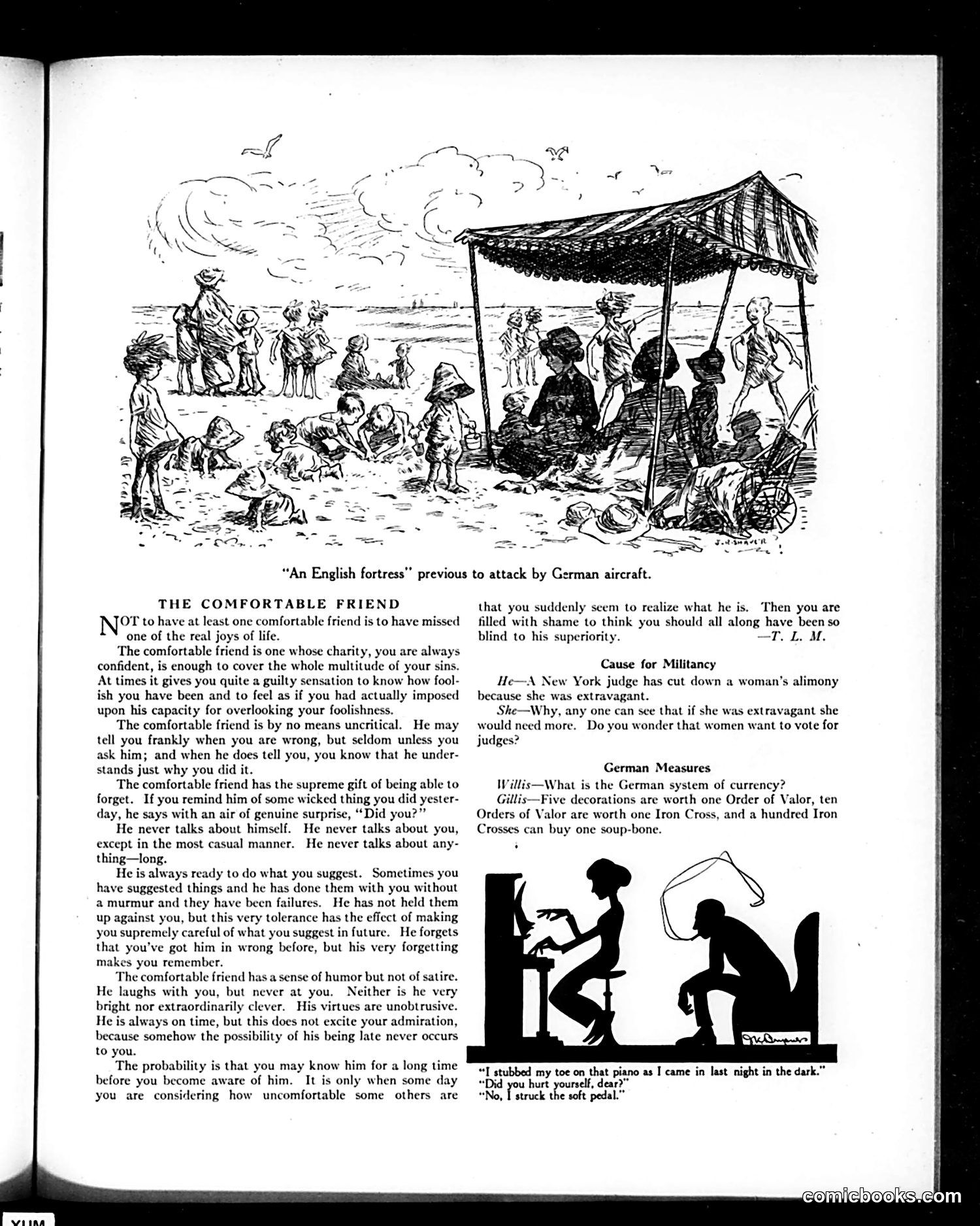
**Top Illustration**: Depicts a beach scene labeled "An English fortress" prior to German aircraft attack. Shows civilians—families with children—sheltering under a makeshift canopy, representing how ordinary British people improvised protection during WWII aerial bombardment. This is satirical commentary on civilian vulnerability during wartime. **"The Comfortable Friend"**: An essay praising the value of loyal friends who overlook your faults, maintain discretion about your mistakes, and offer reliable support without judgment or self-promotion. The piece celebrates unpretentious friendship. **"Cause for Militancy" and "German Measures"**: Brief humor pieces about women's suffrage and German currency/military honors respectively. **Bottom Cartoon**: Domestic humor—a woman explains injuring herself on a piano pedal in the dark, not from the man's suggested toe-stubbing.
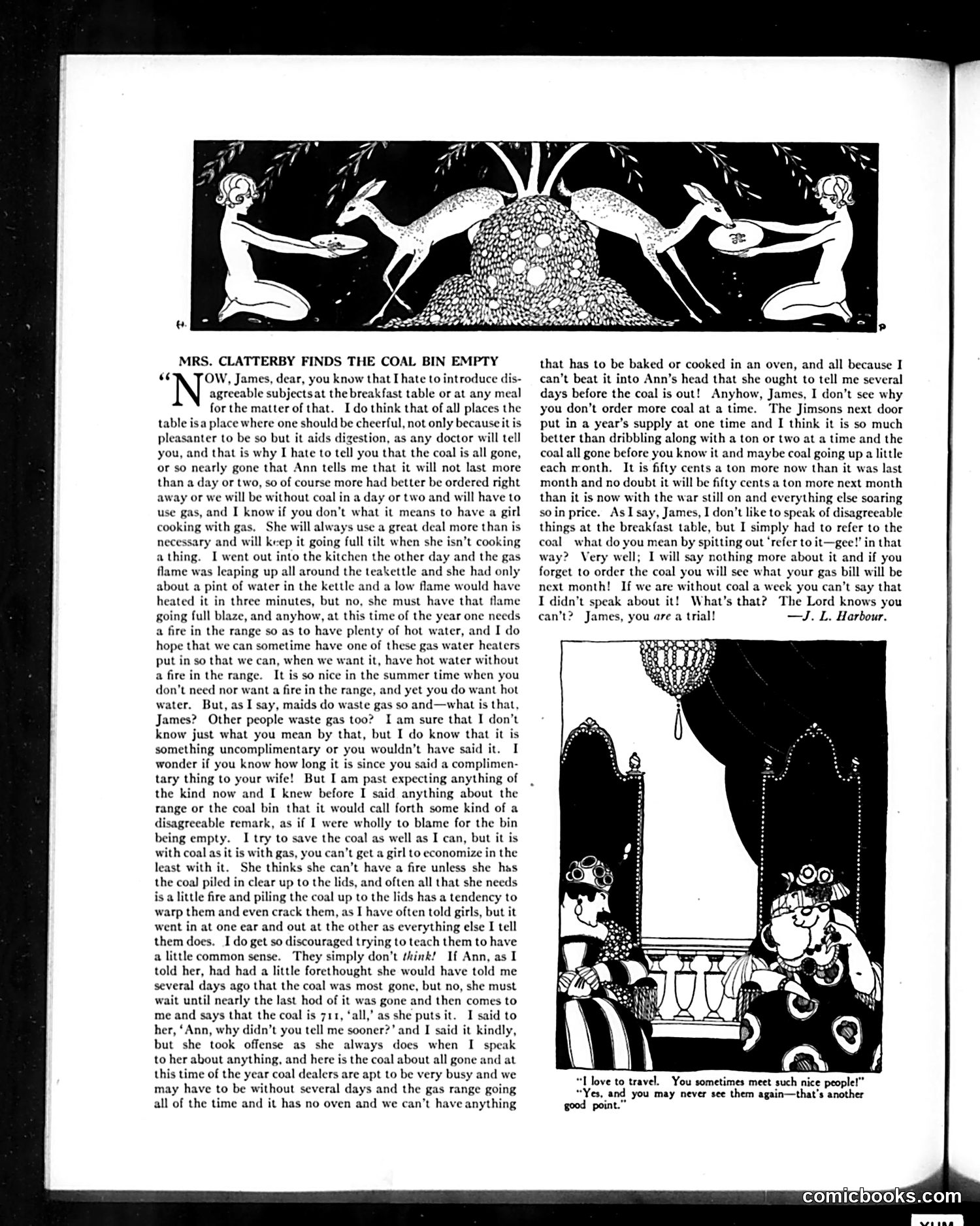
This page from *Judge* magazine contains a humorous domestic complaint letter titled "Mrs. Clatterby Finds the Coal Bin Empty." The text is a wife's lengthy complaint to her husband James about running out of coal, forcing them to use a gas range instead—which she considers wasteful and inferior for cooking. The satire targets **domestic frustrations of the coal-dependent era**, likely early 20th century. The humor lies in the wife's escalating indignation over mundane household management. The decorative header features Art Deco-style nudes and gazelles, while the lower cartoon shows a domestic scene with the caption about meeting nice people while traveling. The piece satirizes both **marital dynamics** (nagging wives) and the practical inconveniences of coal-based heating and cooking before widespread electrification.
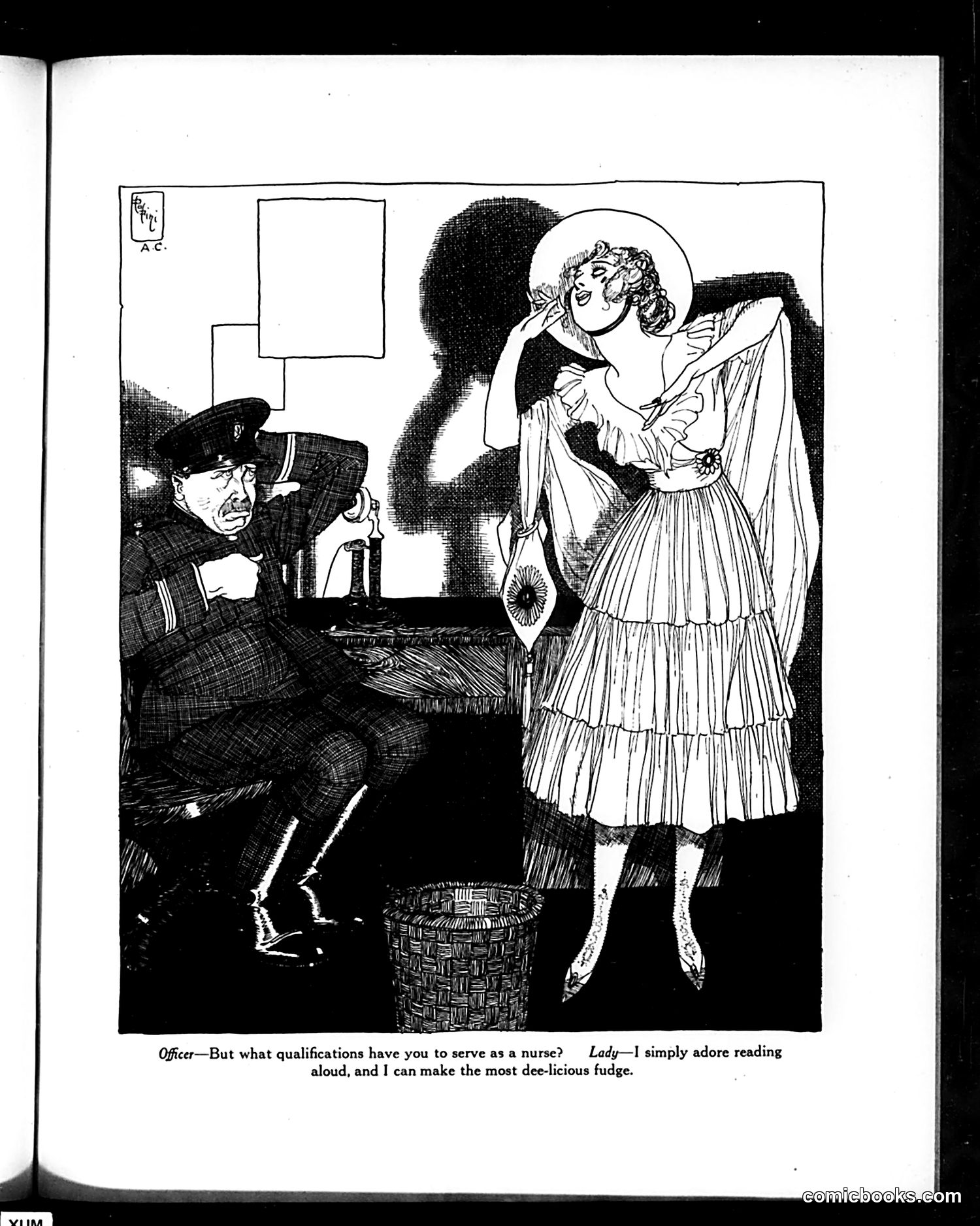
This cartoon satirizes unqualified women seeking nursing positions, likely during World War I when nursing demand surged. An officer (presumably a military recruiter) questions a fashionably dressed woman about her nursing qualifications. Her absurd response—that she enjoys reading aloud and makes good fudge—reveals her complete lack of medical training or practical skills. The satire targets upper-class women who viewed nursing as a fashionable wartime contribution without understanding its rigorous demands. The woman's elegant dress and naive confidence suggest she sees the role as social rather than professional. The cartoon mocks both her assumptions and broader attitudes that trivialized nursing work, implying that genuine qualification required more than pleasant domestic accomplishments.
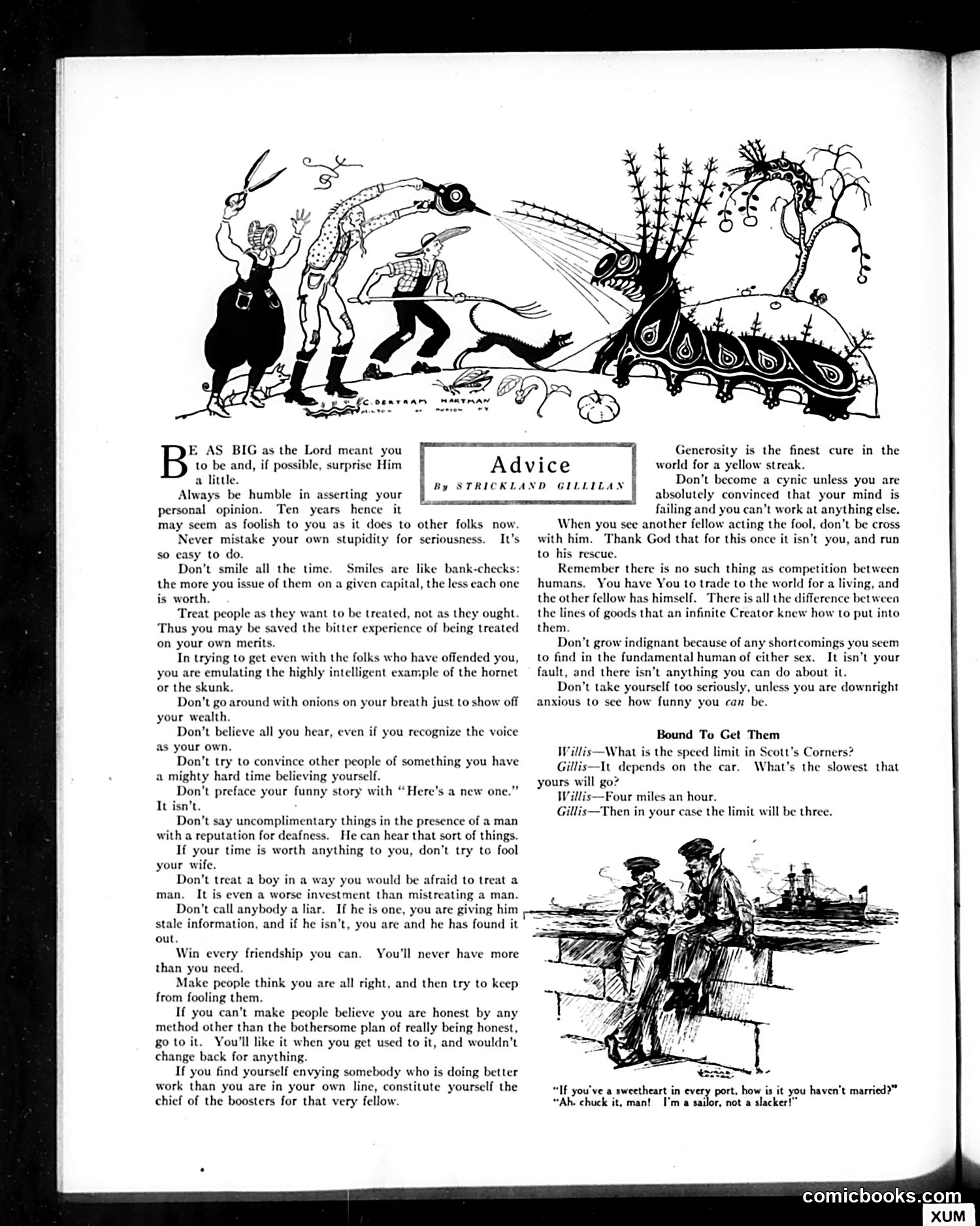
This page from *Judge* contains two distinct elements: **Main Content - "Advice" by Strickland Gillilan:** A lengthy humorous essay offering satirical life advice to readers. The tone is mock-serious, offering counterintuitive or exaggerated guidance ("Don't smile all the time. Smiles are like bank-checks..."). The humor derives from presenting cynical observations as wisdom—advice to manage social impressions rather than be genuinely virtuous. It reflects early 20th-century American satirical commentary on hypocrisy and social performance. **Bottom Cartoon:** Two sailors discuss speed limits. The joke plays on a sailor's reputation for having romantic relationships in multiple ports ("a sweetheart in every port"), with one deflecting marriage by claiming sailors aren't "slackers"—a WWI-era term for draft dodgers. The punchline suggests sailors prioritize seafaring over commitment, mocking both maritime stereotypes and wartime anxieties about duty. Both pieces use sharp wit to satirize contemporary social behavior and masculine identity.
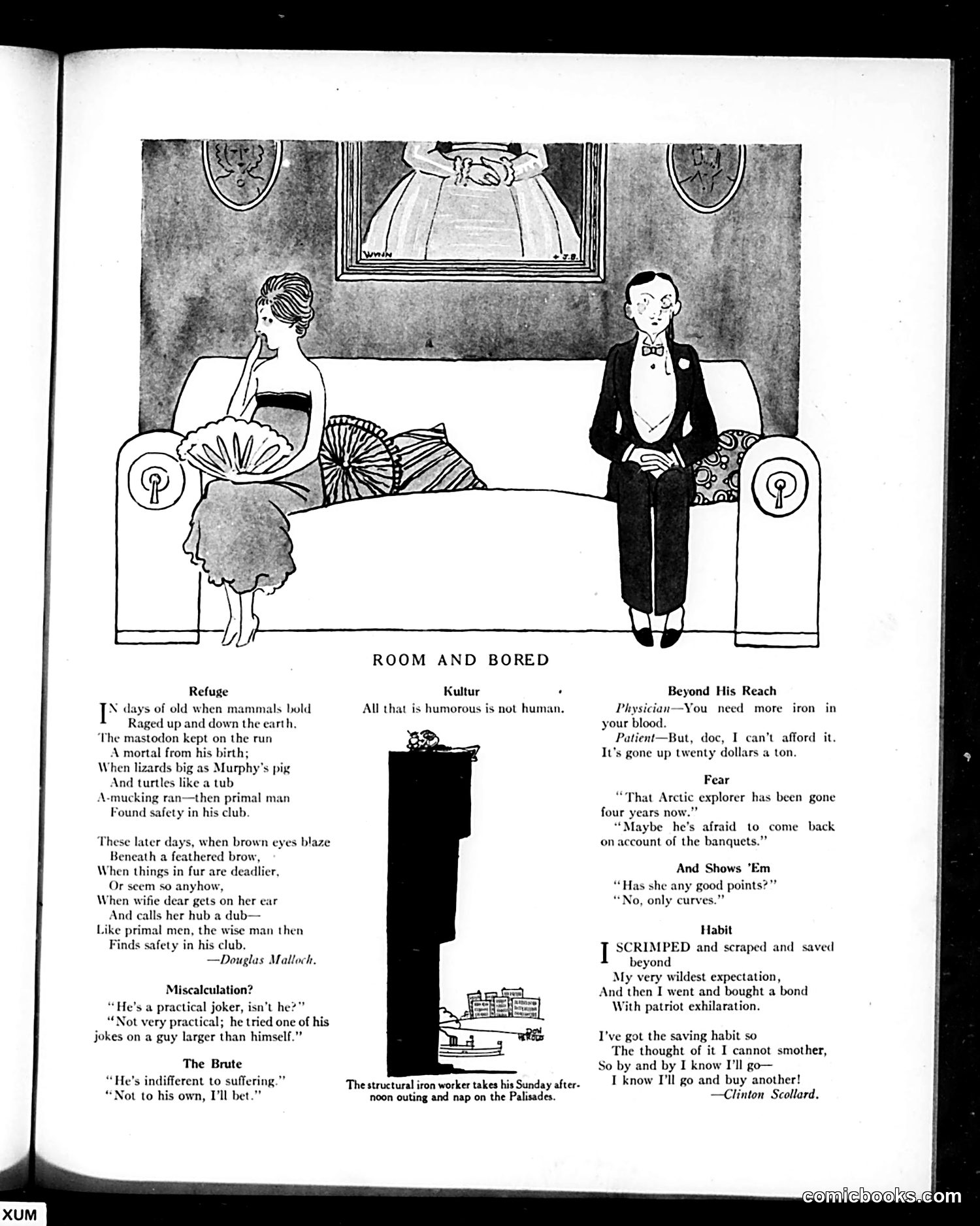
The main cartoon depicts a couple sitting awkwardly on a sofa—a woman in evening dress on the left, a man in formal attire on the right—separated and clearly disengaged from each other. The title "Room and Bored" is a pun: they have physical space between them but lack engagement or connection. The surrounding satirical pieces mock various social types: a man whose practical jokes backfire on someone larger; a callous brute indifferent to others' suffering; an Arctic explorer avoiding banquets (mocking exploration narratives); a doctor's patient who can't afford iron supplements because iron prices have risen (likely referencing post-WWI inflation); and poems about masculine "club" refuge from women and the compulsion to save/invest. The overall theme is social disconnection and malaise—particularly between genders and regarding post-war economic anxieties. The "Kultur" illustration of an iron worker napping suggests leisure and working-class life. These pieces collectively satirize modern social awkwardness, economic hardship, and the failure of romance and companionship in contemporary life.
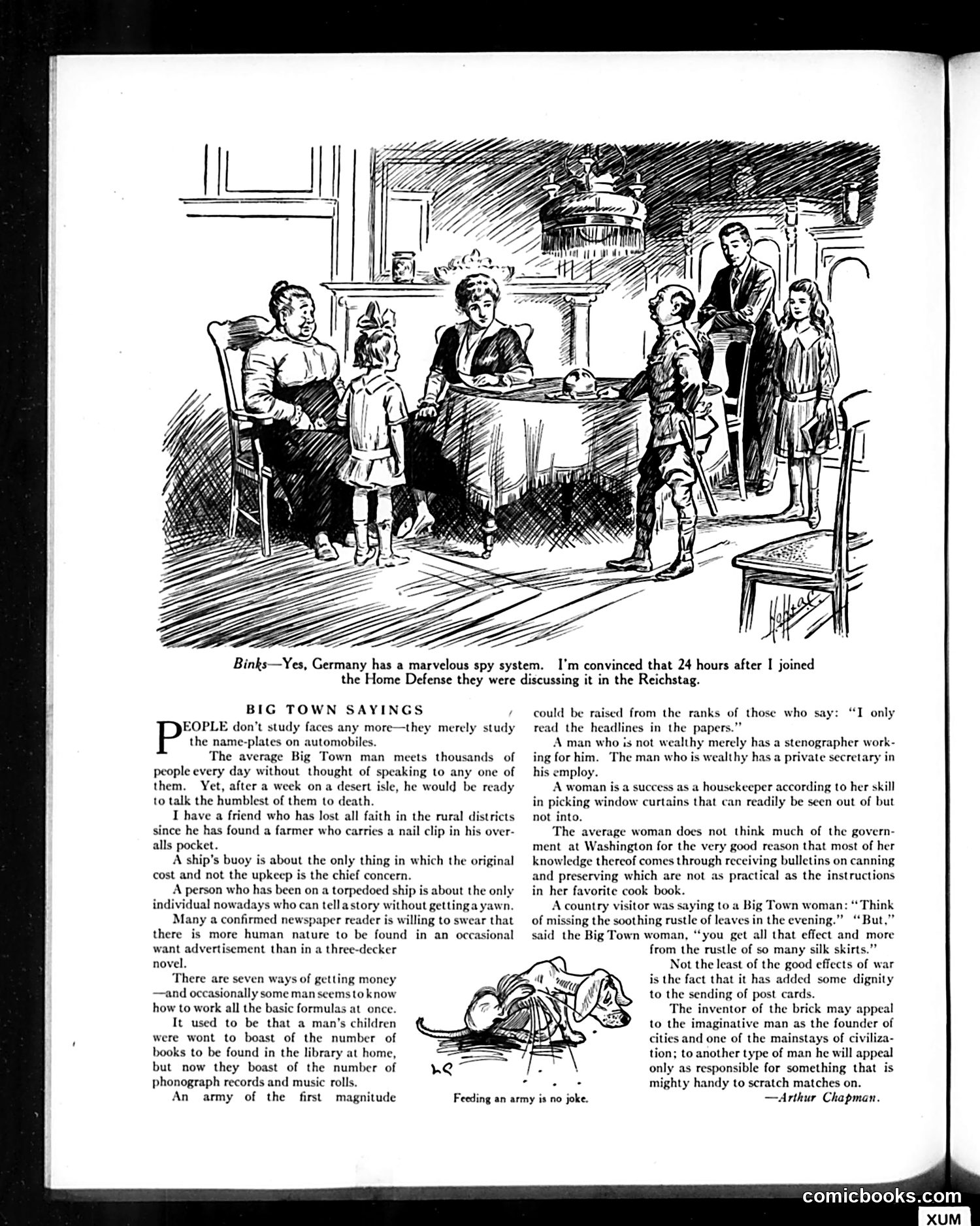
The top cartoon depicts a conversation between two men about German espionage. "Binks" jokes that Germany's spy network is so effective that within 24 hours of him joining the "Home Defense" (likely a civilian defense organization), the information reached the German Reichstag (parliament). This reflects **WWI-era anxiety about German spies infiltrating American institutions**—a genuine concern at the time, though often exaggerated. Below is a collection of humorous observations about urban American life titled "Big Town Sayings," attributed to Arthur Chapman. These are satirical quips about modern city dwellers: their materialism (studying car nameplates instead of faces), their superficiality, their obsession with phonograph records over books, and their selective newspaper reading (only headlines). The commentary gently mocks wealthy pretension and women's concerns with appearances and domestic trivia. The small illustration of a sleeping dog labeled "Feeding an army is no joke" likely refers to wartime food rationing concerns.
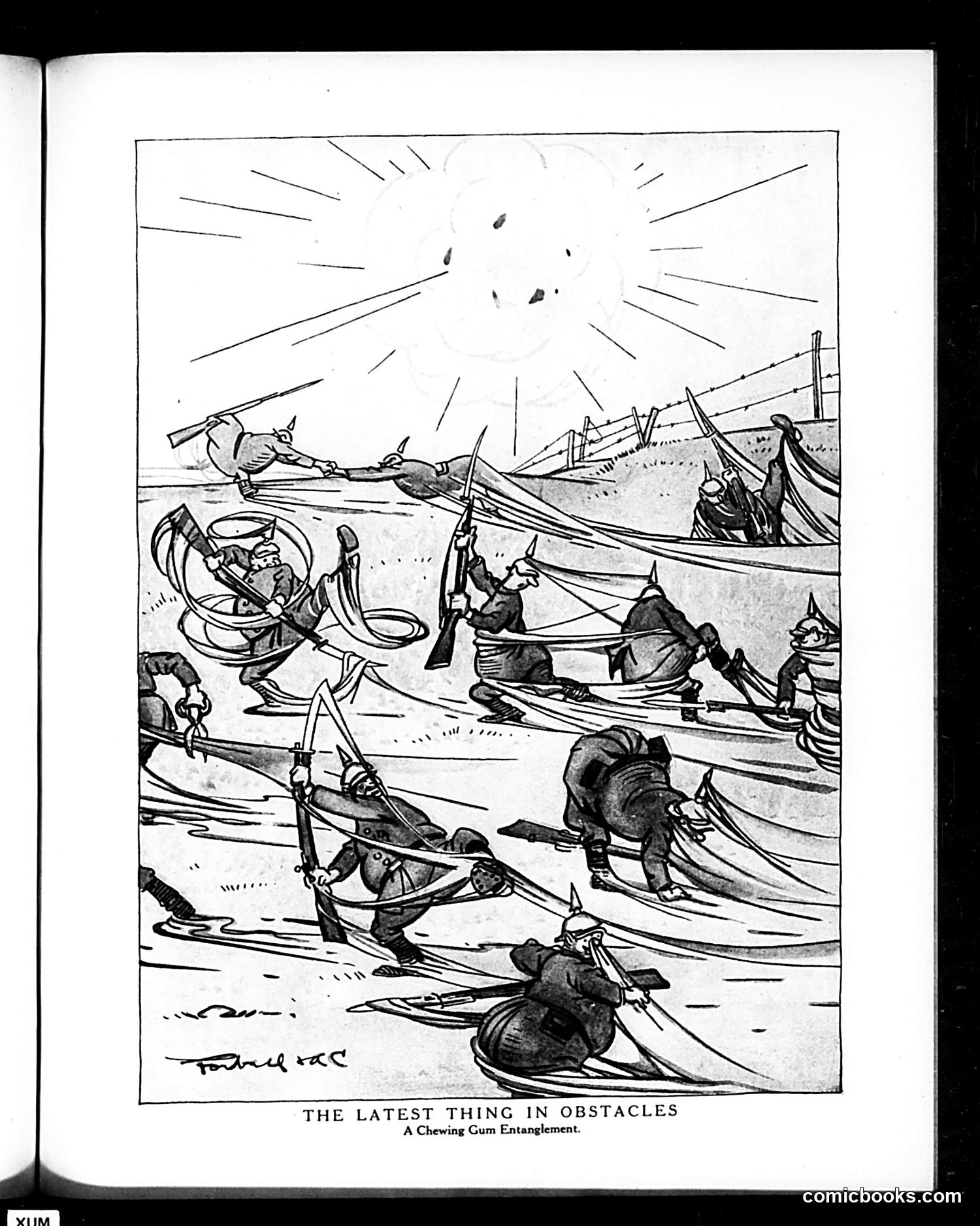
This satirical cartoon from *Judge* depicts soldiers or military figures tangled in massive coils of chewing gum on a battlefield. The title "The Latest Thing in Obstacles" sarcastically presents chewing gum as a new form of military impediment. The cartoon appears to mock either: - The unexpected practical hazards of chewing gum on the battlefield, or - A commentary on frivolous American consumer culture interfering with serious military matters The bright sun radiating overhead and the chaotic entanglement suggest the absurdity of the scenario. Without a specific date or clear identification of the soldiers' uniforms, the exact historical conflict referenced remains unclear, though the style suggests early-to-mid 20th century. The satire likely critiques American industrial/consumer products or troop readiness.
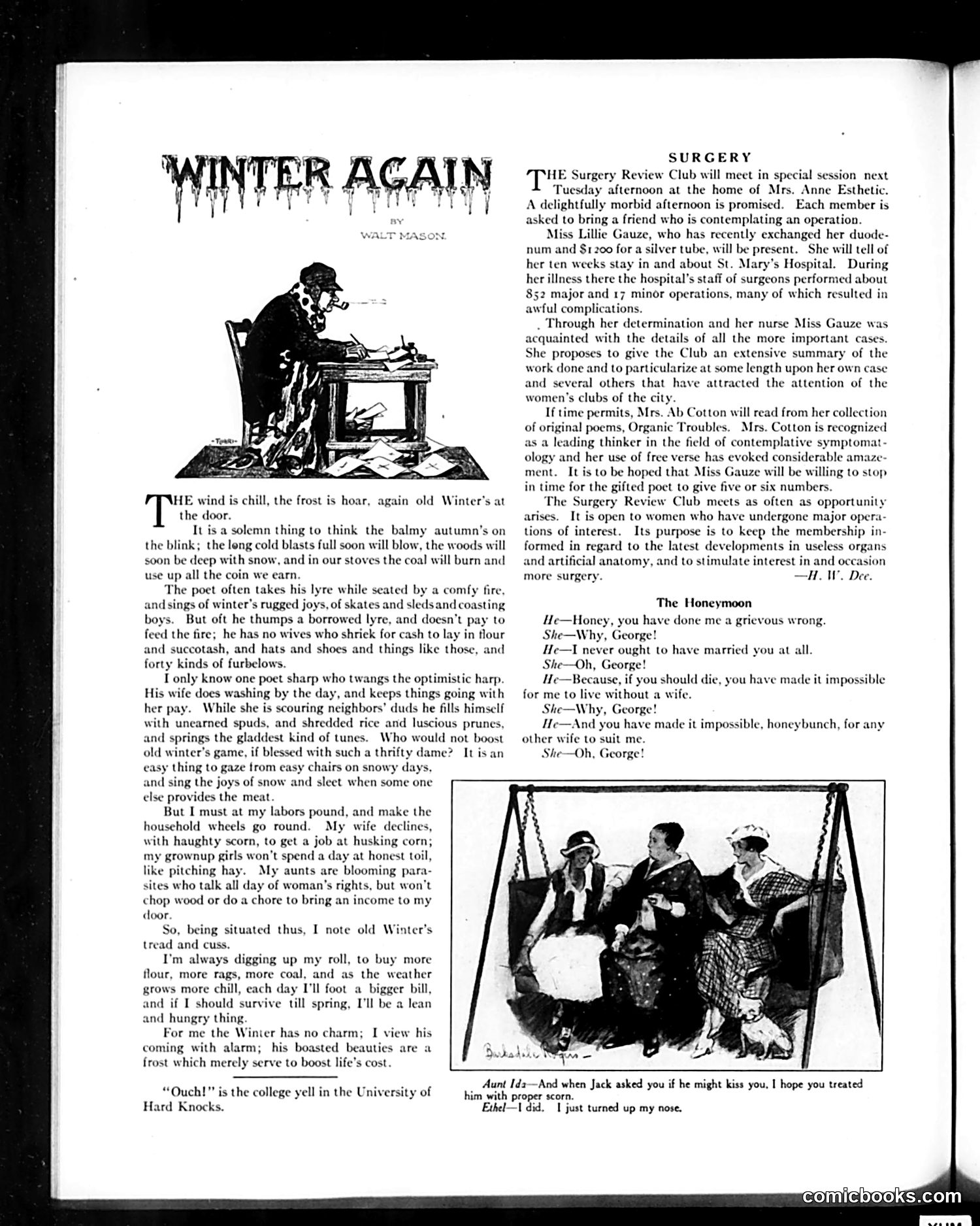
**"Winter Again" (left column):** Walt Mason's poem satirizes romanticized depictions of winter. While poets and comfortable people celebrate snow and sledding, Mason—speaking as an ordinary working man—describes winter as financially ruinous. His wife refuses to work ("declines, with haughty scorn"), his grown daughters won't take jobs, and his aunts talk of "woman's rights" but won't contribute income. The satire targets both lazy poets who celebrate hardship they don't experience and the contradiction of women claiming rights while remaining financially dependent. This reflects early-1900s debates about women's roles and labor. **"Surgery" (right column):** A humorous notice about a women's club meeting where members discuss surgical procedures. The satire is gentle: women gather to hear from Miss Gauze, who traded her duodenum for a silver tube, and share medical war stories. This reflects both the era's fascination with modern surgery and perhaps gentle mockery of women's social clubs' sometimes morbid preoccupations. **"The Honeymoon":** A brief marital joke (incomplete on this page) about newlyweds' disagreements.
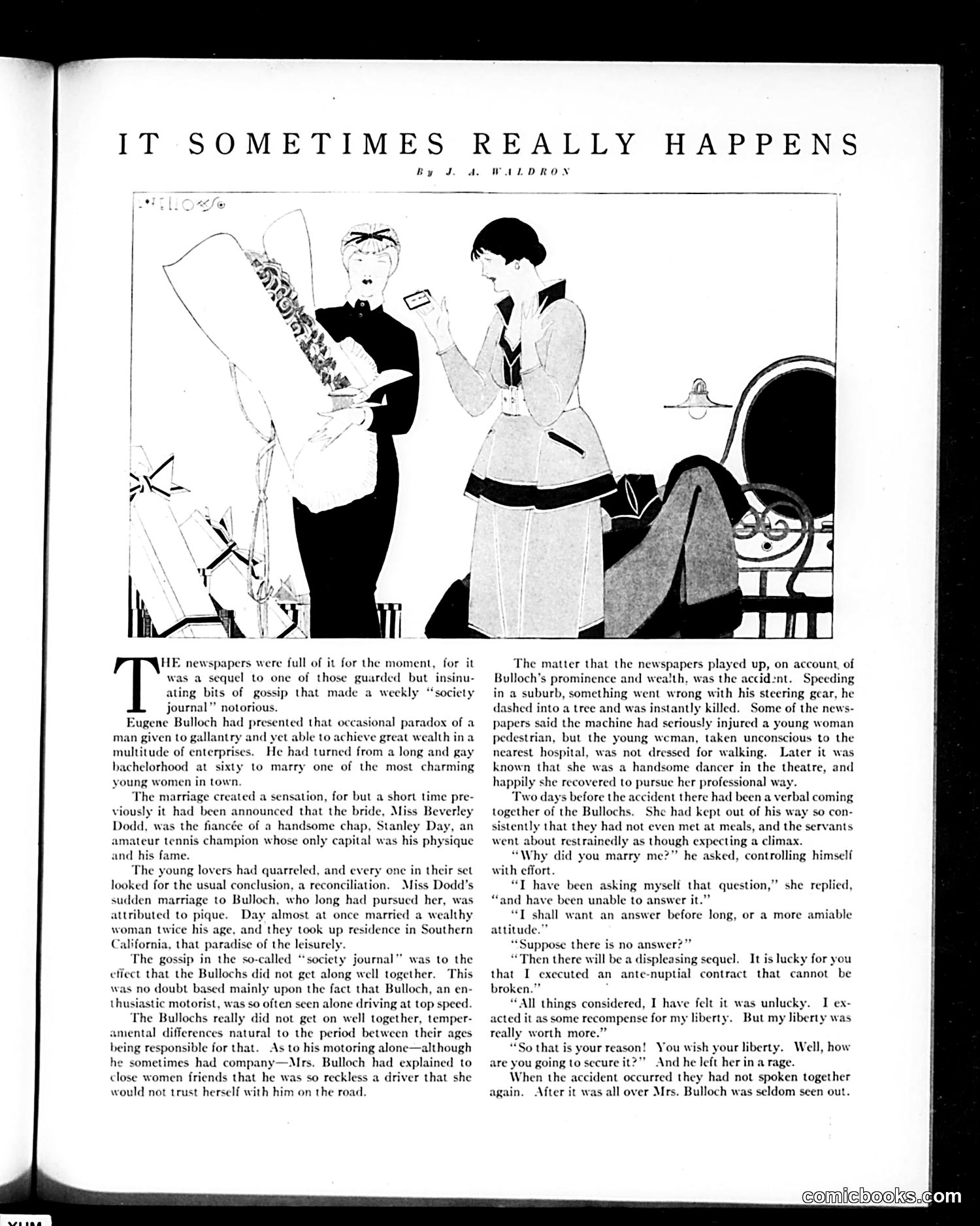
This story satirizes upper-class marriage and social gossip circa 1910s-1920s. Eugene Bulloch, a wealthy elderly motorist, marries young Beverley Dodd after she breaks her engagement to Stanley Day (a tennis champion of modest means). Society papers speculate the couple is unhappy, attributing tension to their age difference and Bulloch's reckless driving. Days after a heated argument where Mrs. Bulloch demands freedom, Bulloch's car crashes into a tree, killing him instantly. A young female dancer is injured in the accident—the implication being she was his passenger, confirming infidelity. Mrs. Bulloch, who had demanded her liberty, now remains secluded, suggesting she's trapped by circumstance rather than freed by his death. The satire targets gossip-mongering society journals, May-December marriages motivated by wealth, and ironic consequences: her escape from an unhappy marriage comes at a social cost that confines her further.
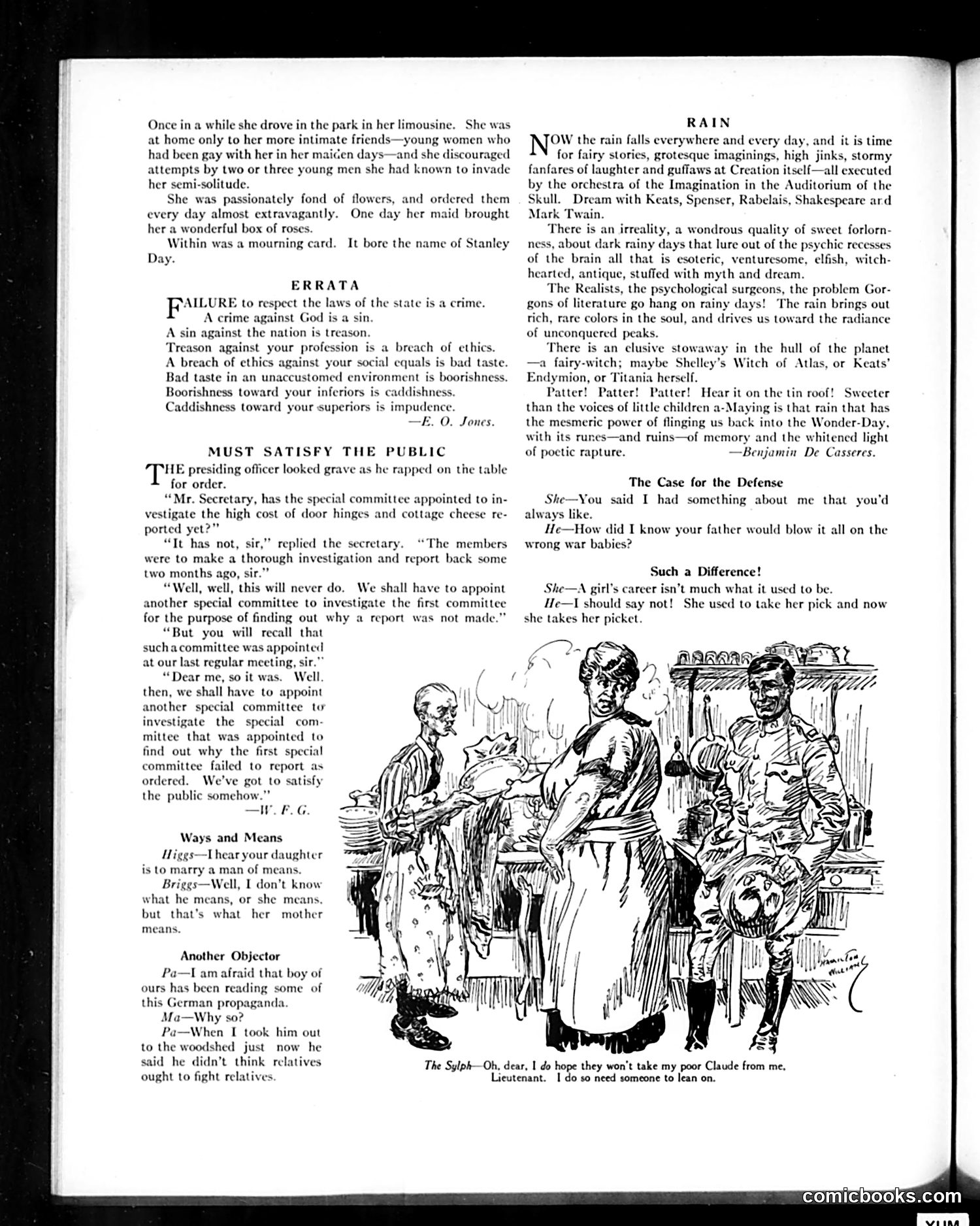
This page contains several satirical pieces typical of early 20th-century American humor: **"Errata"** mocks bureaucratic absurdity through a hierarchical list of transgressions, descending from crimes against God to social rudeness—suggesting that society treats minor breaches of etiquette with the same gravity as actual crimes. **"Must Satisfy the Public"** satirizes government inefficiency: a presiding officer appoints committees to investigate committees that failed to investigate the original committee—a circular bureaucratic nightmare meant to mock how government avoids actual accountability by creating endless oversight layers. **"Ways and Means" and "Another Objector"** are brief domestic humor pieces about marriage and generational conflict (the boy reading German propaganda opposing family warfare, likely WWI-related). **The illustration** shows women discussing "poor Claude," likely referencing military conscription concerns during wartime. **"Rain"** is poetic prose celebrating rainy days' imaginative power, contrasting Romantic idealism with harsh Realism. The overall tone reflects Judge's satirical approach to government inefficiency, social pretension, and contemporary anxieties about war.
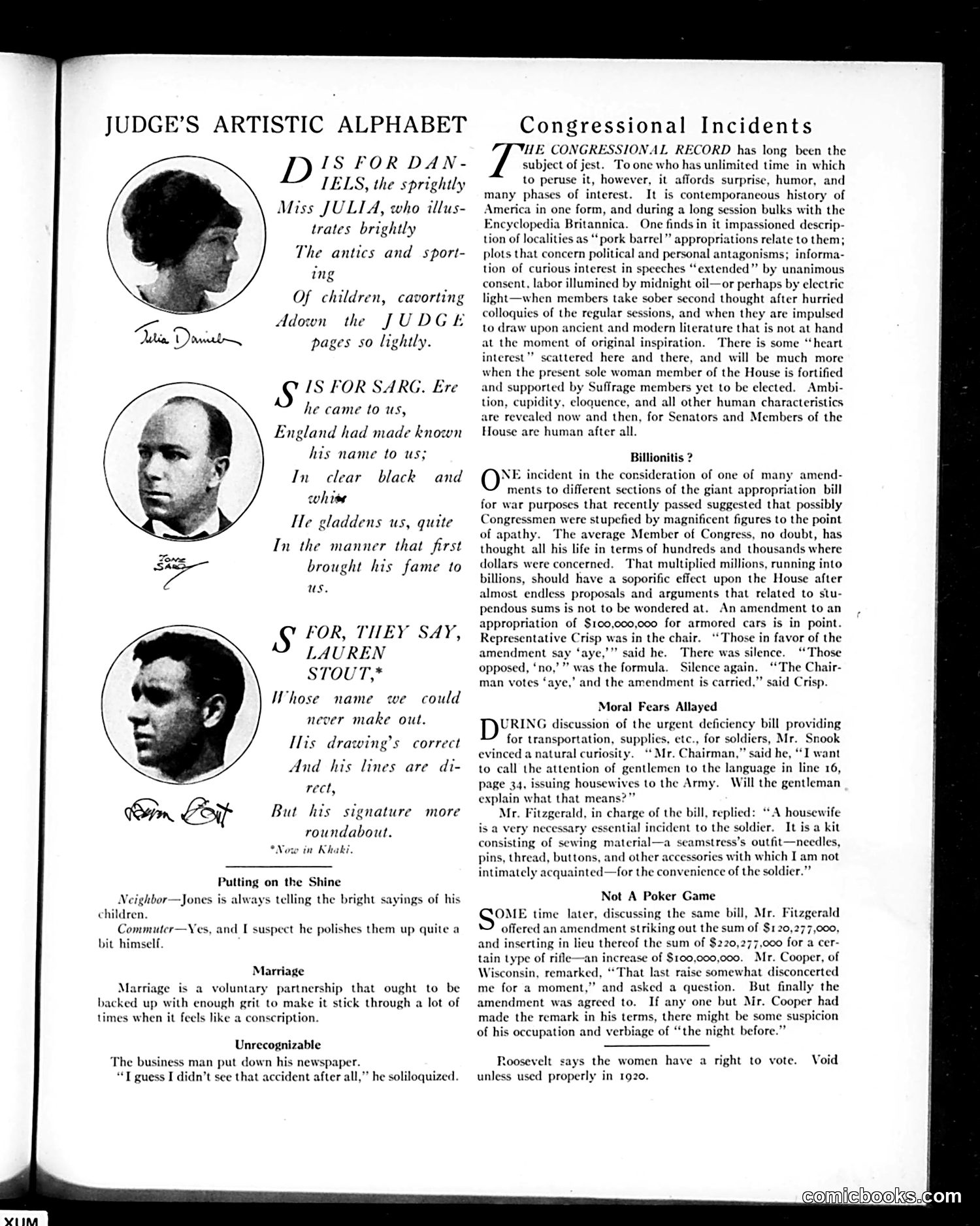
**Left side** presents cartoonist profiles as part of an alphabetical feature celebrating Judge magazine's contributors—likely Julia Daniels, John Singer Sargent, and Lauren Stout (marked with asterisk, "Voe in Khaki"). The format humorously describes their artistic styles and signatures. **Right side** discusses absurdities in Congressional Record deliberations, particularly wartime appropriations bills. The "Billionitis" section mocks Congressmen rendered numb by enormous budget figures ($100 million+). Representative Crisp silently passes an amendment for armored cars because debate over such sums has become meaningless—illustrating how massive numbers produce legislative apathy. The "Moral Fears Allayed" section satirizes naive Congressional discussion about issuing "housewives" (actually sewing kits) to soldiers, with Mr. Fitzgerald earnestly explaining these are necessary military supplies. **Overall satire:** Congress conducting serious wartime business while intellectually paralyzed by scale and trivial misunderstandings.
This page discusses George Bernard Shaw's play "Misalliance," which opened at the Broadhurst Theater. The dialogue between a "Jaded Reviewer" and a "Society Doctor" debates Shaw's dramatic style. The satire critiques Shaw's plays as intellectual exercises rather than traditional drama. The Reviewer argues Shaw substitutes philosophical conversation for plot and action—when a pistol-wielding scene could climax dramatically, Shaw instead turns it into a "theoretical discussion" about morality. Characters remain unchanged; nothing happens except talking. The Doctor counters that Shaw's wit and social criticism are entertainingly brilliant, even if unconventional. However, the Doctor finds the endless dialogue exhausting, comparing it to patients in a sanatorium describing their "intellectual symptoms"—a critique of Shaw's cerebral approach as tedious rather than dramatically engaging. The cartoon illustrates contemporary theatrical debate: whether Shaw's intellectual drama represents theatrical innovation or self-indulgent philosophy masquerading as entertainment.
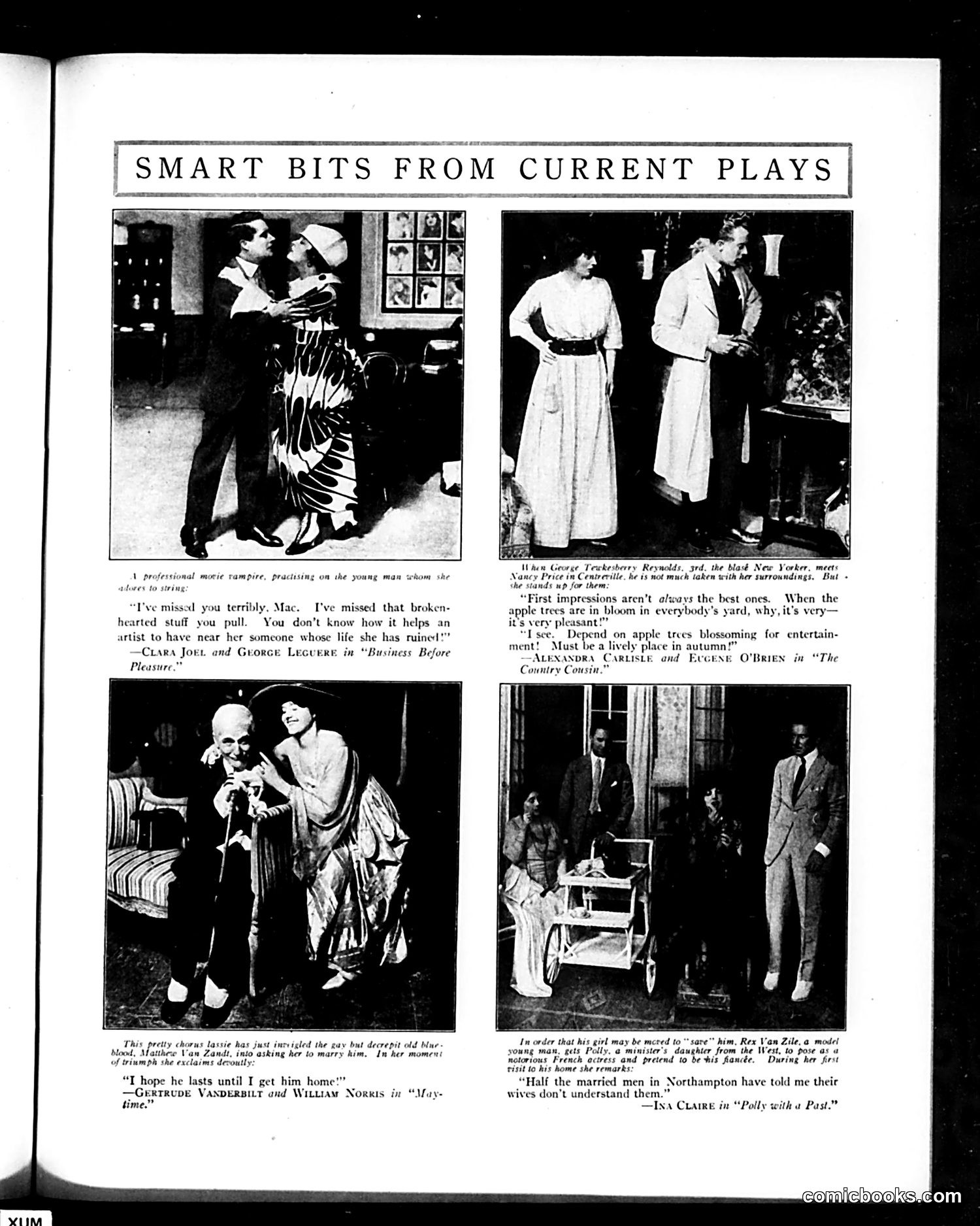
This page presents theatrical excerpts from contemporary Broadway productions, arranged as humorous "smart" dialogue. Each caption pairs a witty quote with a scene photo and character names. The content reflects early 20th-century theatrical humor: a woman manipulating an artist through emotional trauma ("Business Before Pleasure"); a young woman marrying an elderly man hoping he survives the honeymoon ("Maytime"); a city visitor's condescension toward rural charm ("The Country Cousin"); and a young man staging an elaborate deception using a fake French mistress to impress a minister's daughter ("Polly with a Past"). These excerpts satirize contemporary social anxieties: gold-digging women, class differences between urban sophistication and rural simplicity, and deceptive courtship practices. The humor derives from characters' cynical or unguarded remarks revealing mercenary motives and social pretension—typical of Judge magazine's satirical approach to modern American manners.
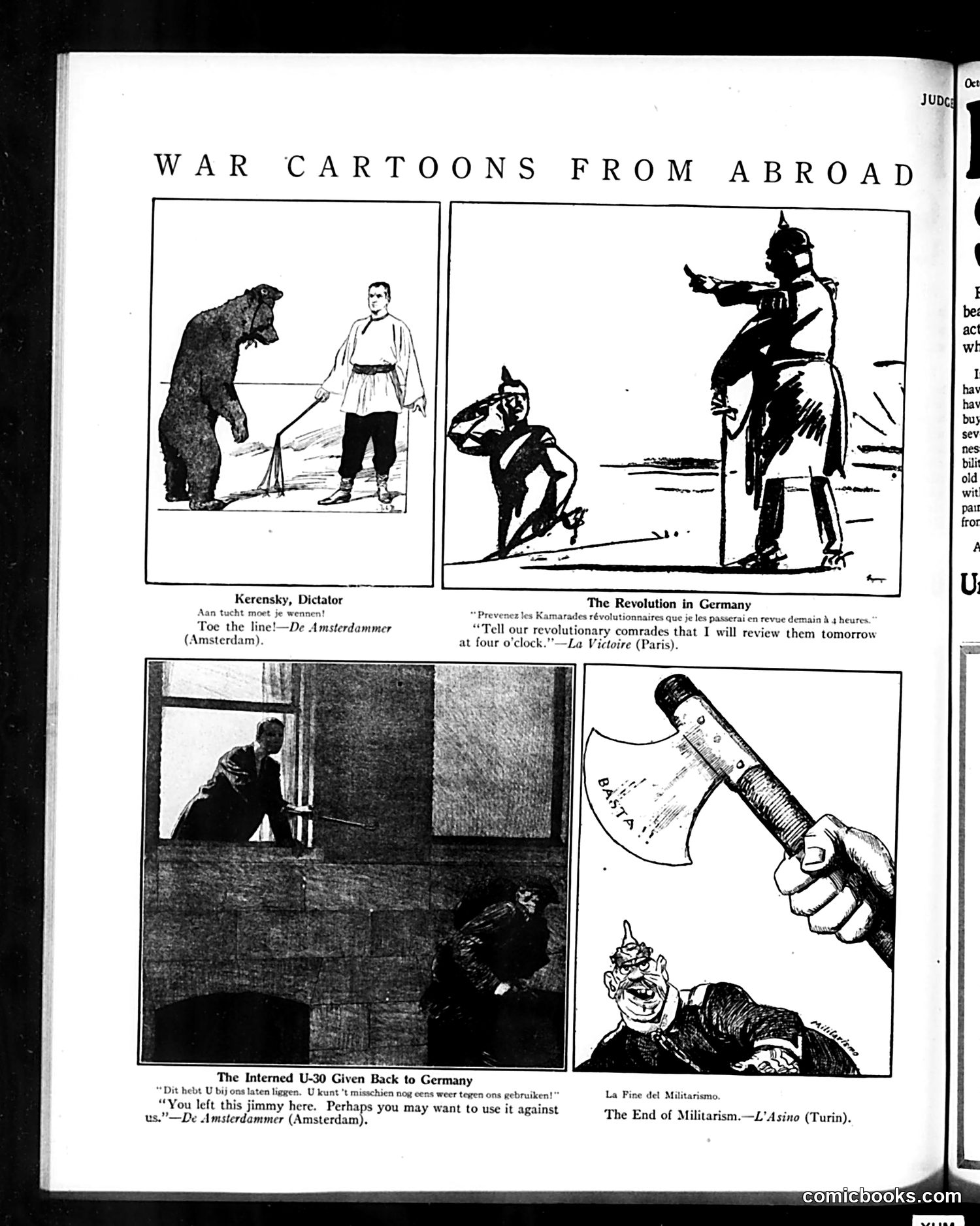
This page collects anti-German propaganda cartoons from European publications during the immediate post-WWI period, likely 1918-1919. **Top left:** Kerensky (Russian revolutionary leader) is depicted as a "dictator" being forced to "toe the line"—criticizing his authoritarian control despite revolutionary rhetoric. **Top right:** "The Revolution in Germany" shows a German revolutionary being reviewed by a Spiked Helmet figure (representing German militarism), suggesting the revolution hasn't truly eliminated Prussian military dominance. **Bottom left:** A U-30 submarine returned to Germany is sarcastically presented as a weapon the Allies foolishly allowed them to keep for future use. **Bottom right:** A caricatured German military figure (likely representing militarism itself) is axed—celebrating militarism's supposed "end," though the cartoonists appear skeptical of lasting peace given the previous cartoon's message. The collection expresses Allied doubt that defeated Germany or Russian revolution would genuinely reform.
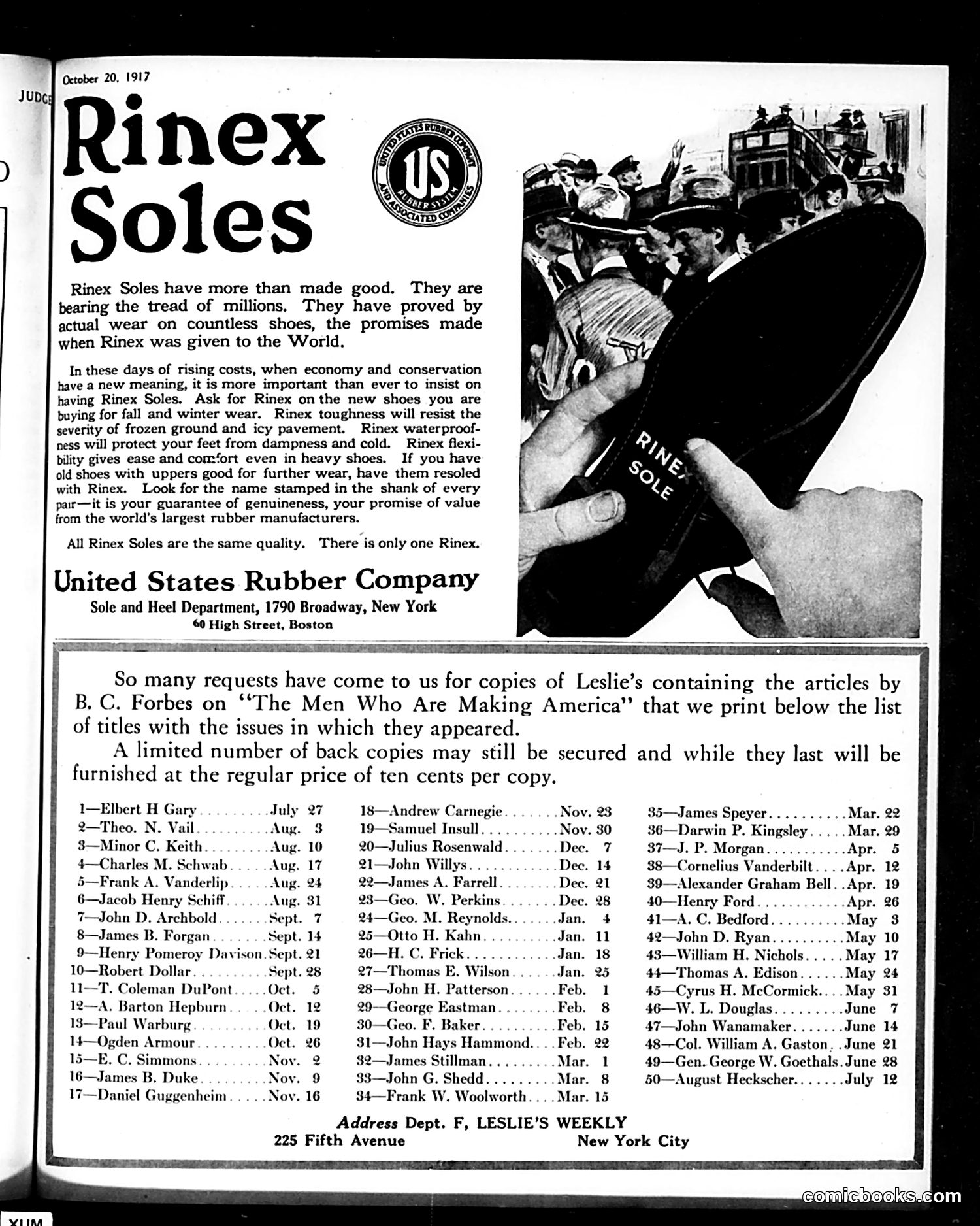
This page is primarily **advertising and editorial promotion**, not satire or political cartooning. The upper half features a **Rinex Soles advertisement** from United States Rubber Company (dated October 20, 1917). The ad emphasizes durability and economy during wartime—relevant context for 1917, when America had recently entered World War I and resources were strained. The accompanying photograph shows a crowd boarding what appears to be a ship or vessel, visually supporting the message that Rinex soles have "proved by actual wear on countless shoes." The lower half promotes back-issue copies of **Leslie's Weekly magazine**, advertising a series of biographical articles by B.C. Forbes titled "The Men Who Are Making America." The list includes prominent industrialists and financiers of the era (Carnegie, Ford, Vanderbilt, J.P. Morgan, etc.), offered at ten cents per copy. There is **no satirical cartoon content** on this page—it functions as a commercial and promotional publication spread.
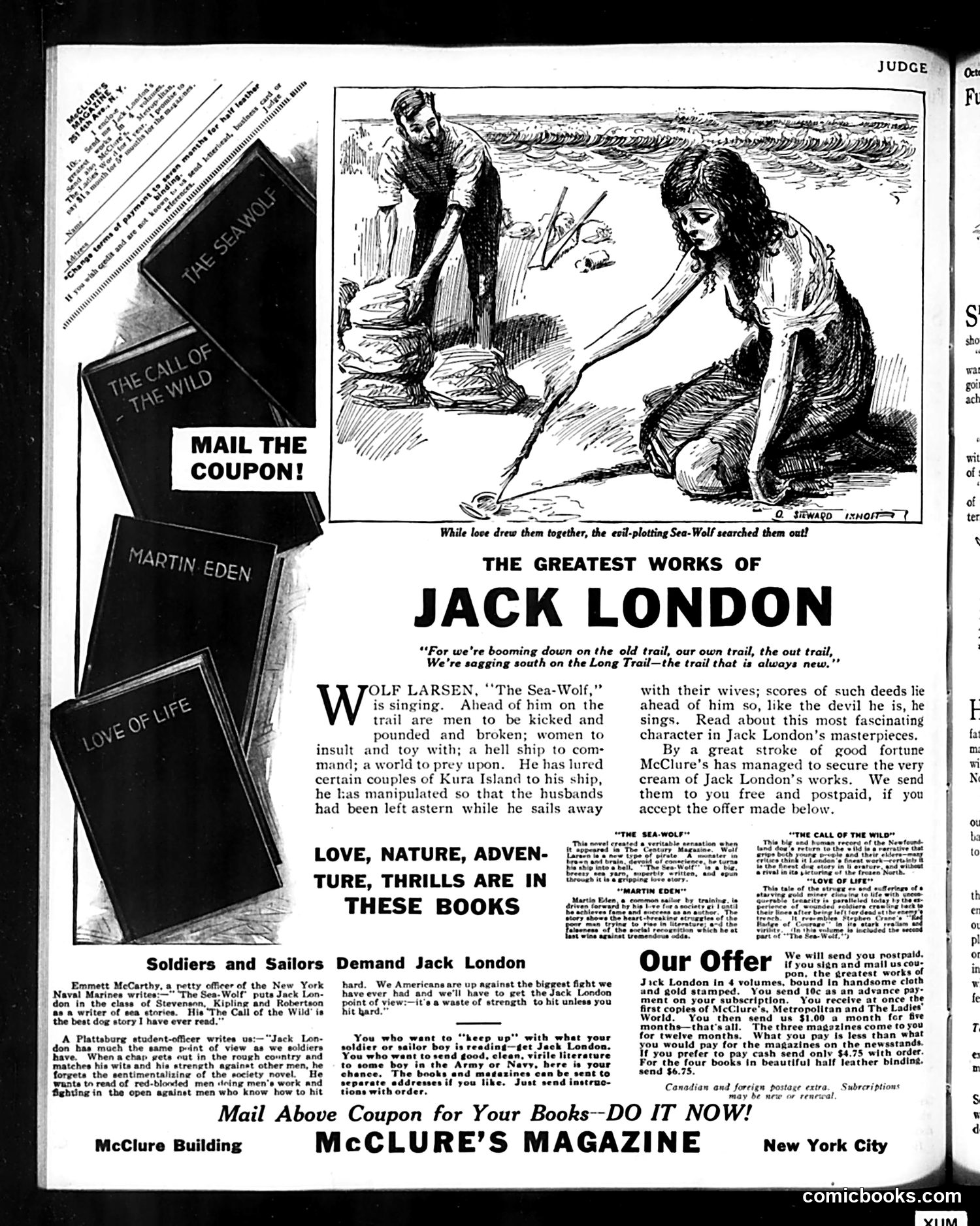
This is primarily a **subscription advertisement** for McClure's Magazine, not political satire. The page promotes a four-volume collection of Jack London works, particularly emphasizing *The Sea-Wolf* and *The Call of the Wild*. The illustration depicts a scene from *The Sea-Wolf*—a woman and bearded man on a beach, illustrating the novel's plot of manipulation and predatory behavior by the antagonist Wolf Larsen. **Marketing angle**: The ad targets soldiers and sailors during what appears to be **WWI era** (references to "Plattsburg," Army, Navy suggest pre-1918). It frames London's work as appealing to military men because of its themes of strength, survival, and masculine struggle—qualities deemed desirable for fighting men. The testimonials present London as comparable to Stevenson and Kipling, positioning these adventure novels as serious literature. The offer incentivizes subscriptions through discounted bundling: readers pay 10 cents upfront plus $1/month for five months (or $4.75 cash) to receive both the four-book set and a year of magazines.
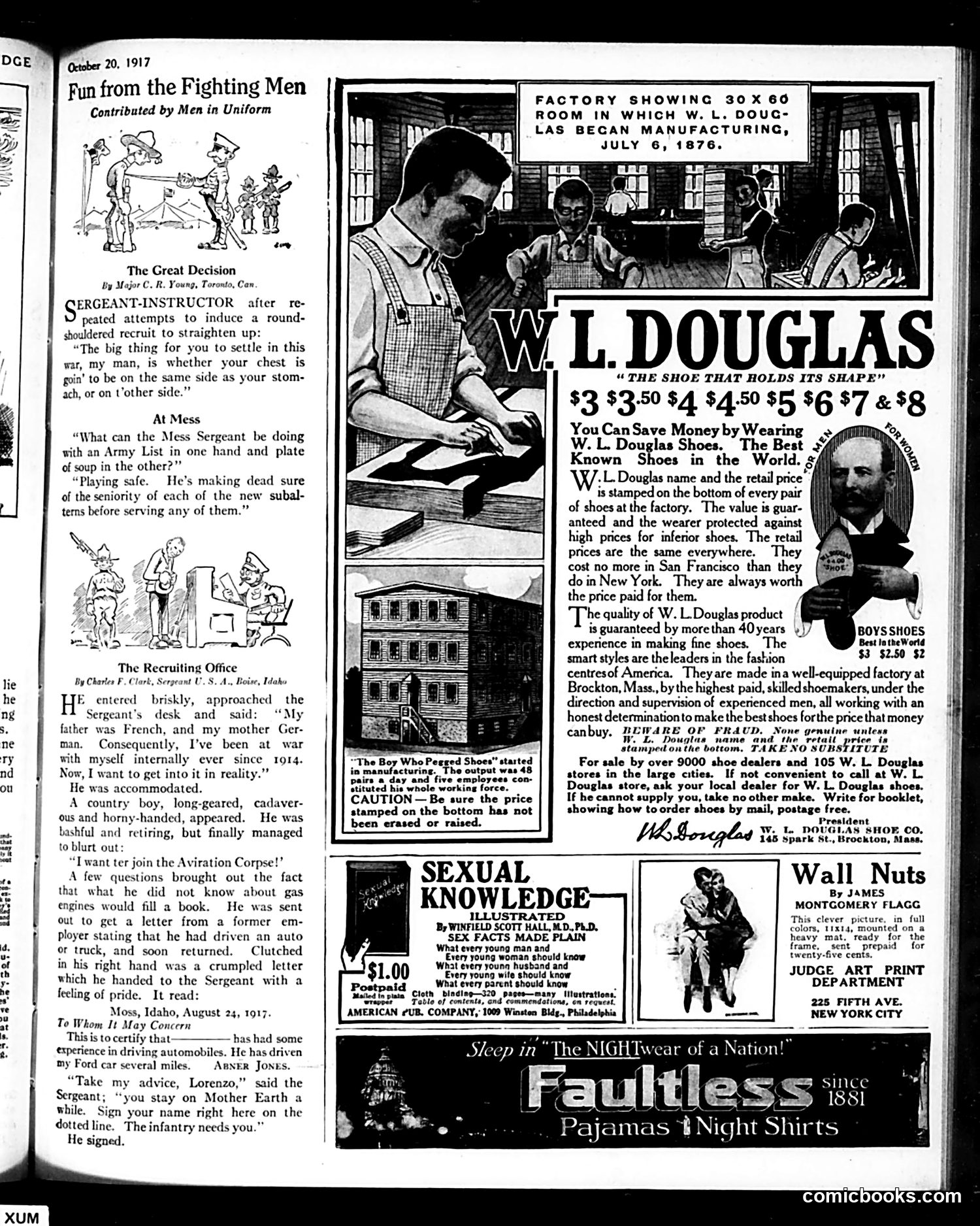
This is primarily **an advertising-heavy issue from October 1917**, during America's WWI involvement. The left column features three humor pieces "from the Fighting Men"—cartoons mocking military training, mess halls, and recruitment. The humor relies on soldiers' perspectives: a sergeant insisting a slouching recruit straighten his posture, an officer prioritizing rank-seniority when serving soup, and recruits of questionable ability joining up (one claiming internal "war" between French and German heritage; another wanting to join the "Aviration Corpse," misspelling "Corps"). The page is dominated by **W.L. Douglas Shoe advertisements** with period pricing and claims about standardized retail prices nationwide—notable as consumer protection messaging. Additional smaller ads include a "Sexual Knowledge" book and "Faultless Pajamas." The content reflects 1917 attitudes toward military service, ethnic identity, and consumer capitalism during wartime.
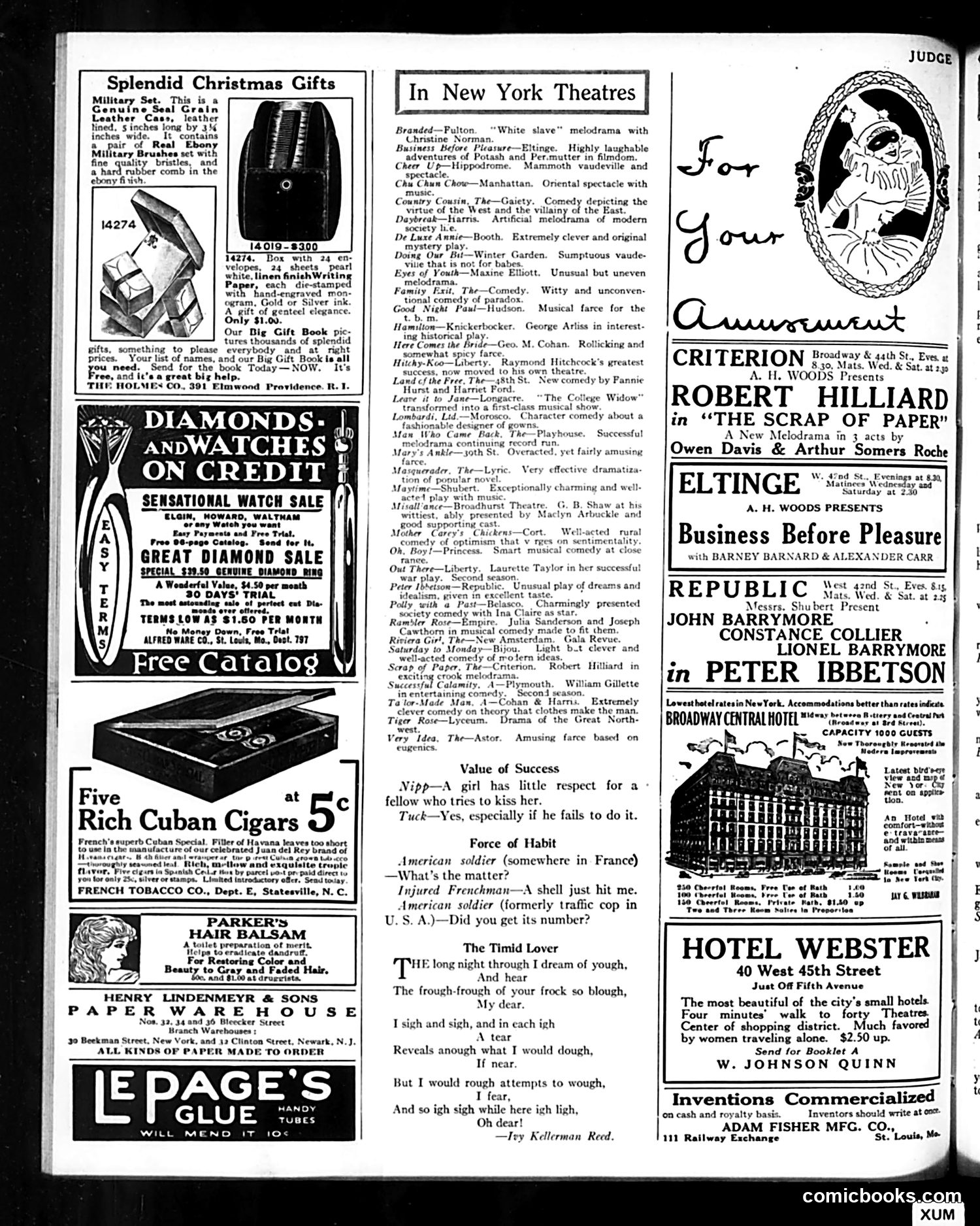
This page is primarily **advertising and theater listings**, not political satire. The visible cartoons are minimal. The main content includes: 1. **Theater Reviews** ("In New York Theatres"): Brief synopses of Broadway productions, including titles like "Business Before Pleasure," "Country Cousin," and "Peter Ibbetson" (starring John Barrymore and Lionel Barrymore). These appear to be standard contemporary theater notices. 2. **Small Comic Snippets**: Near the bottom, there are brief joke exchanges, including one about an "American soldier (somewhere in France)" and a "Timid Lover" poem. The France reference suggests **WWI-era content** (likely 1917-1918), making these likely topical wartime humor. 3. **Advertisements**: Diamonds, watches, cigars, hair products, and hotels dominate the page—typical Judge magazine filler. The page lacks the distinctive political cartooning Judge was known for; it's essentially a theater and commerce-focused issue section with incidental period wartime humor.
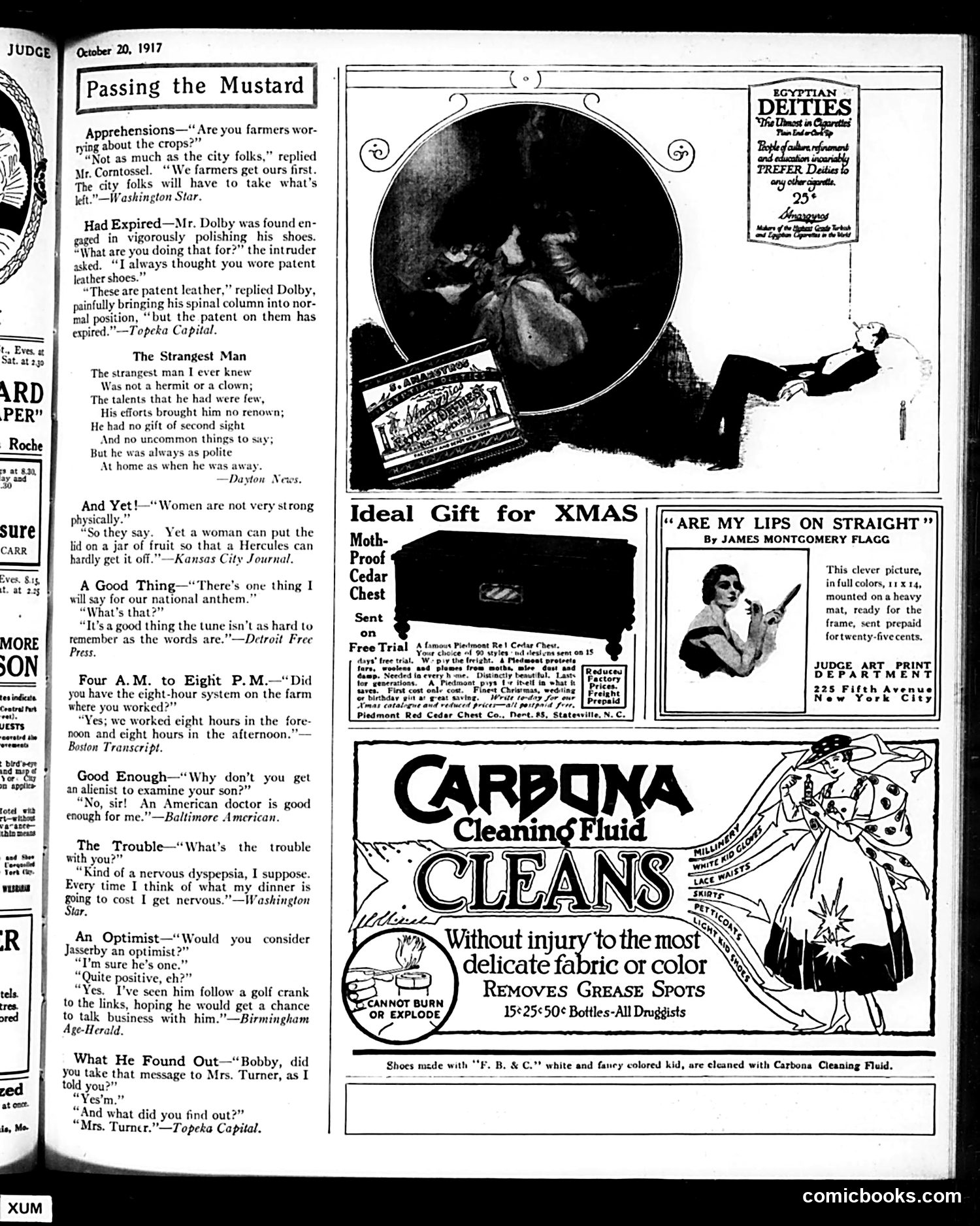
This page contains primarily **short humorous anecdotes** rather than political cartoons. The jokes reflect WWI-era American attitudes: **Key Content:** - "Passing the Mustard" section offers brief quips on domestic life, gender roles, and work conditions - Notable joke: A farmer claims city folk will "have to take what's left"—reflecting food rationing/scarcity concerns during wartime - Another jokes about women's strength yet ability to seal jars—typical period gender humor - "Four A.M. to Eight P.M." references exhausting farm labor (sixteen-hour days), likely resonating with wartime labor shortages **Advertisements dominate the right side:** - Egyptian Dettes cigarettes - James Montgomery Flagg art print ("Are My Lips on Straight")—Flagg was famous for WWI recruitment posters - Carbona Cleaning Fluid advertisement **Context for modern readers:** The page reflects 1917 America managing wartime resource scarcity while maintaining light domestic humor. The advertising presence suggests Judge functioned as much as a commercial vehicle as a satirical publication.
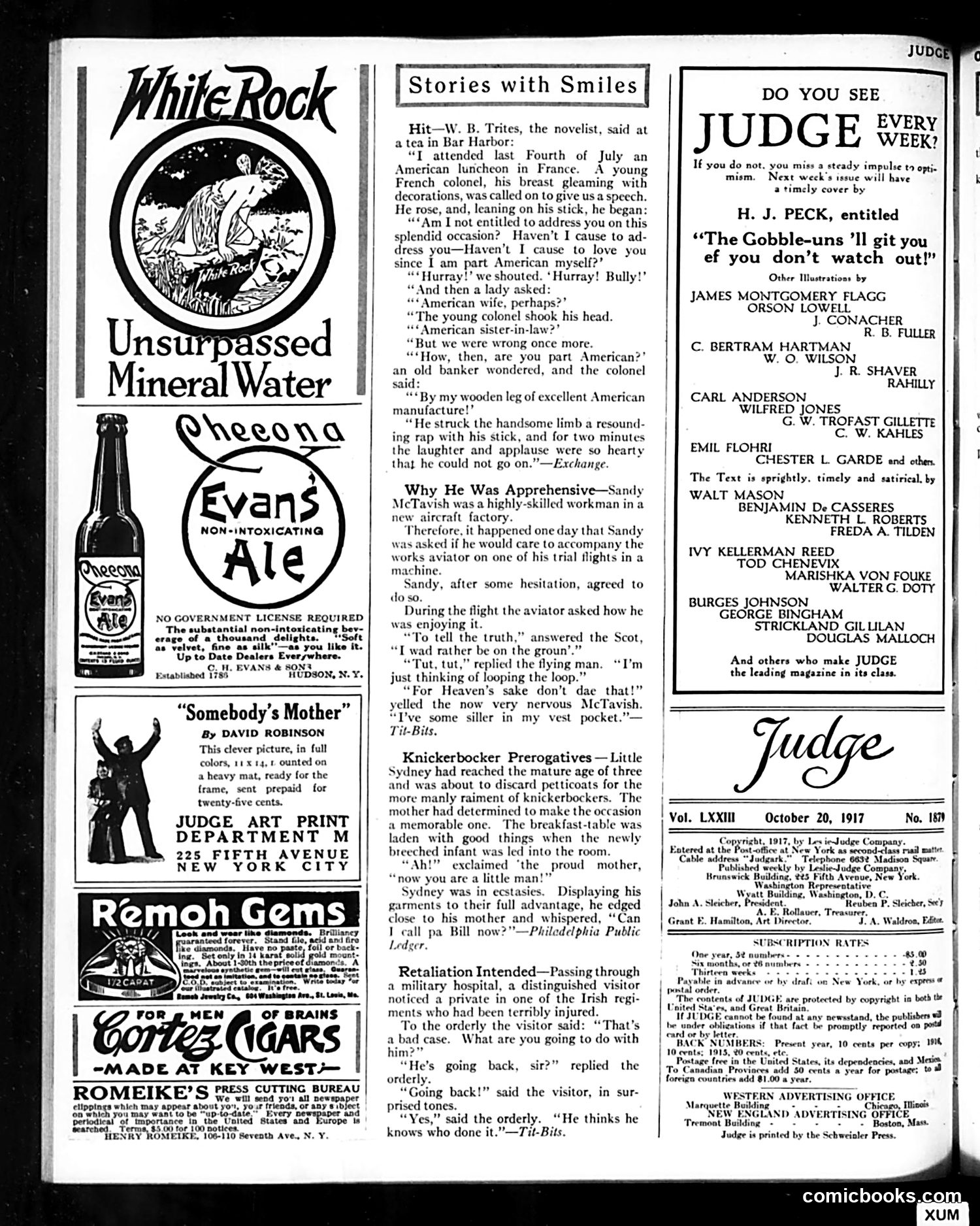
This is primarily an **advertising and humor page** from Judge, a satirical weekly. The main content consists of four brief humorous anecdotes rather than political cartoons: 1. **"Hit"** — A story about a French colonel claiming American heritage through his wooden prosthetic leg (WWI-era humor about Franco-American relations). 2. **"Why He Was Apprehensive"** — Scottish dialect humor about a nervous factory worker reluctant to loop-the-loop in an airplane. 3. **"Knickerbocker Prerogatives"** — A child's innocent misunderstanding: a three-year-old in his first "grown-up" clothes asks if he can now call his father by his first name. 4. **"Retaliation Intended"** — Dark WWI hospital humor about an injured Irish soldier planning revenge on whoever wounded him. The page is dominated by **advertisements** for White Rock mineral water, Evans Ale, Remolke's press clipping service, Cortez cigars, and other products. No significant political satire is present—this is light entertainment mixed with period advertising.
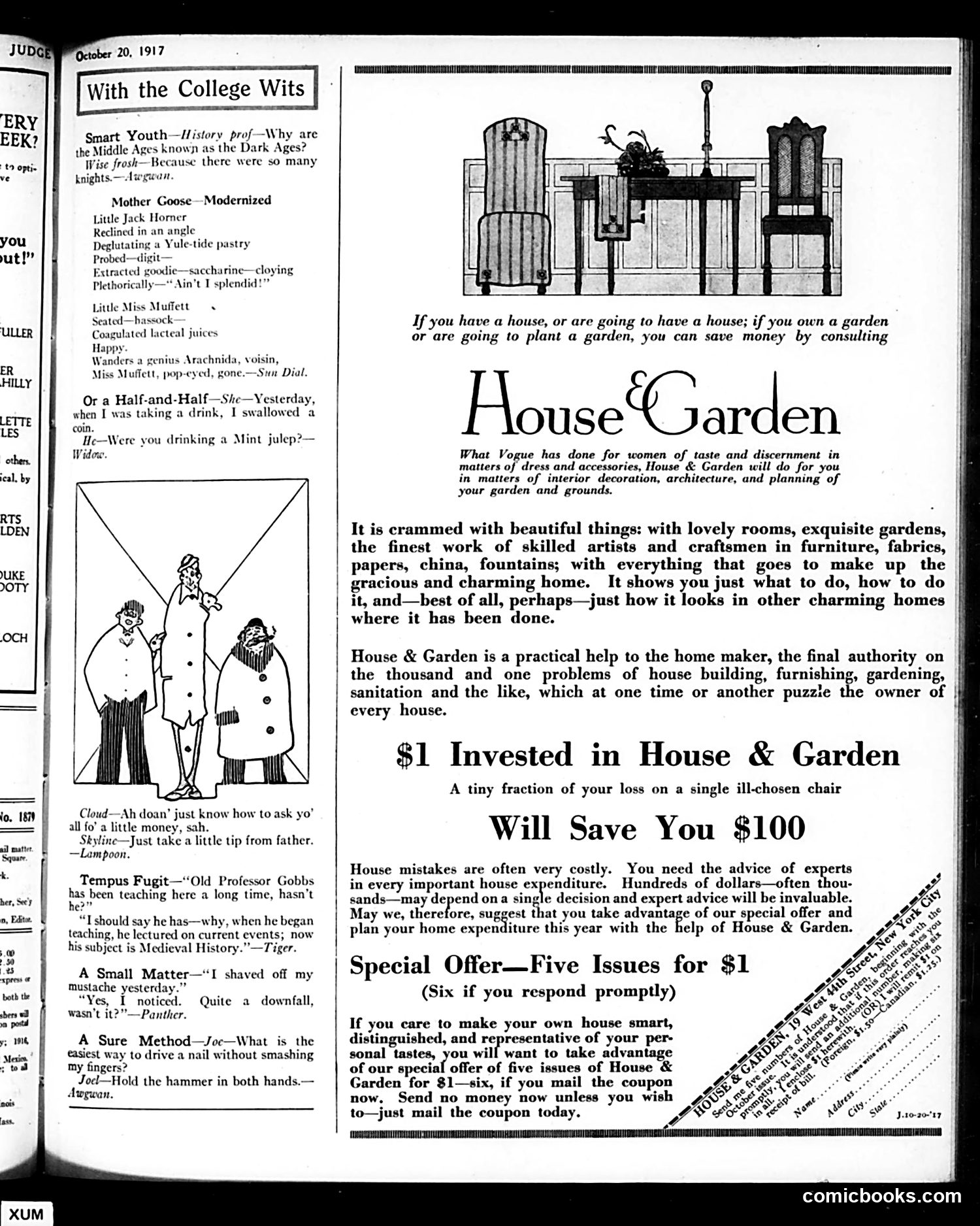
This page contains two distinct sections: **Left side—"With the College Wits":** A collection of brief humorous jokes attributed to various college humor magazines (Awgwan, Sun Dial, Lampoon, Tiger, Panther). These are light student humor: puns about history ("Dark Ages" = many knights), modernized nursery rhymes, and wordplay. The cartoon shows figures under an umbrella labeled with money, illustrating a joke about borrowing from one's father. These jokes represent typical early-20th-century collegiate wit—innocent wordplay and mild absurdism. **Right side:** A full-page advertisement for *House & Garden* magazine, positioning it as practical home-advice authority. The ad emphasizes that expert guidance prevents costly mistakes in furnishing and design, framing a $1 subscription as an investment that saves $100. This reflects 1917 consumer culture where home improvement magazines targeted middle-class homeowners seeking professional guidance. The page is primarily **advertising disguised as editorial content**, common in Judge magazine.
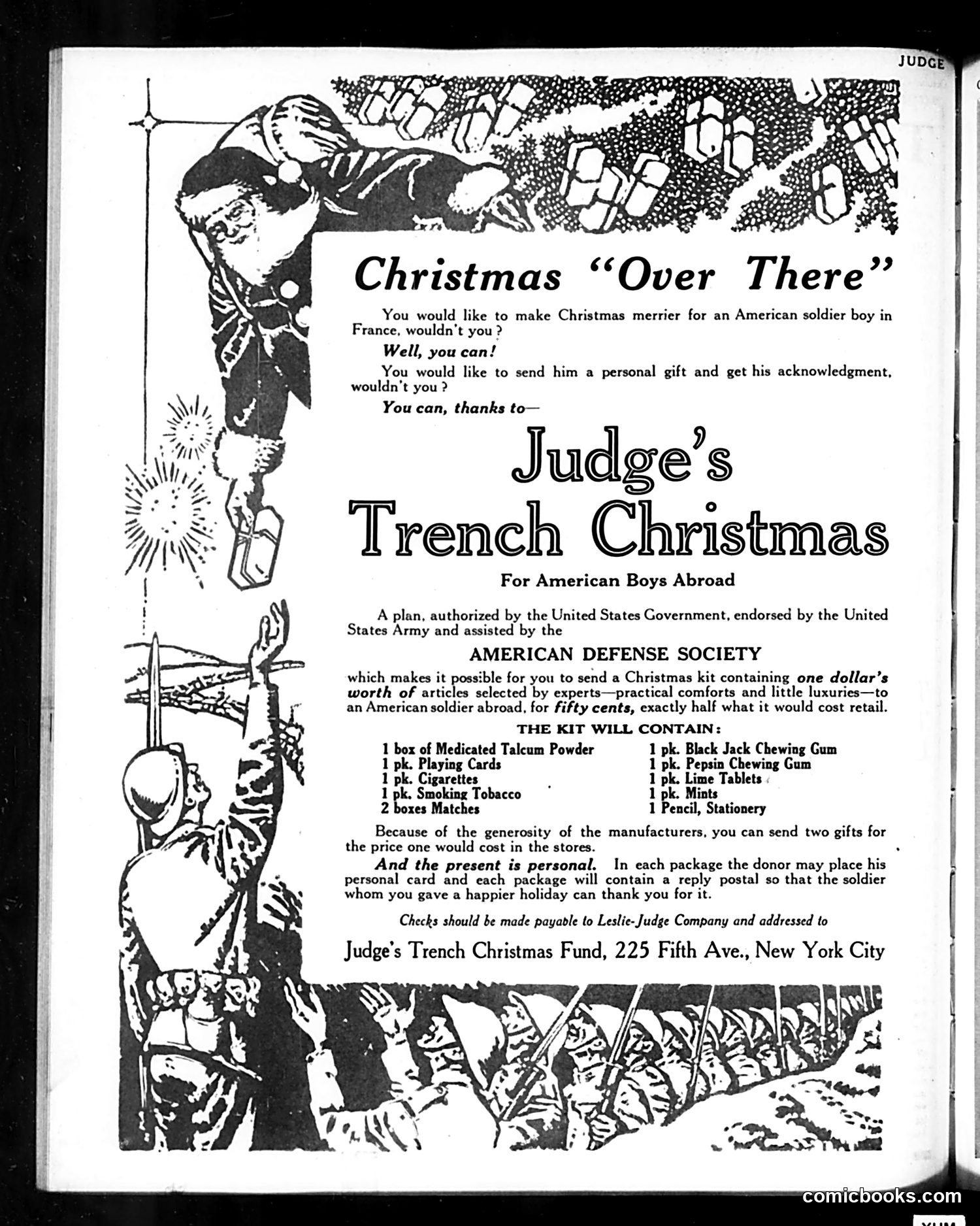
This is primarily a **WWI-era charitable advertisement**, not political satire. The page promotes "Judge's Trench Christmas," a fundraising program enabling American civilians to send care packages to soldiers fighting in France. The illustration depicts **Santa Claus descending into a trench**, merging holiday imagery with wartime reality—a visual metaphor for bringing Christmas cheer to troops in harsh combat conditions. The phrase "Over There" references the popular WWI song encouraging American participation in the war. The campaign leverages manufacturer generosity to offer $1 worth of practical items (cigarettes, gum, matches, cards, toiletries) for fifty cents. Donors could include personal notes and receive thank-you postcards, creating personal connection between home front and battlefield. This reflects **American patriotic mobilization during WWI**, when magazines like Judge helped coordinate civilian support for soldiers abroad through charitable initiatives endorsed by the government and Army.
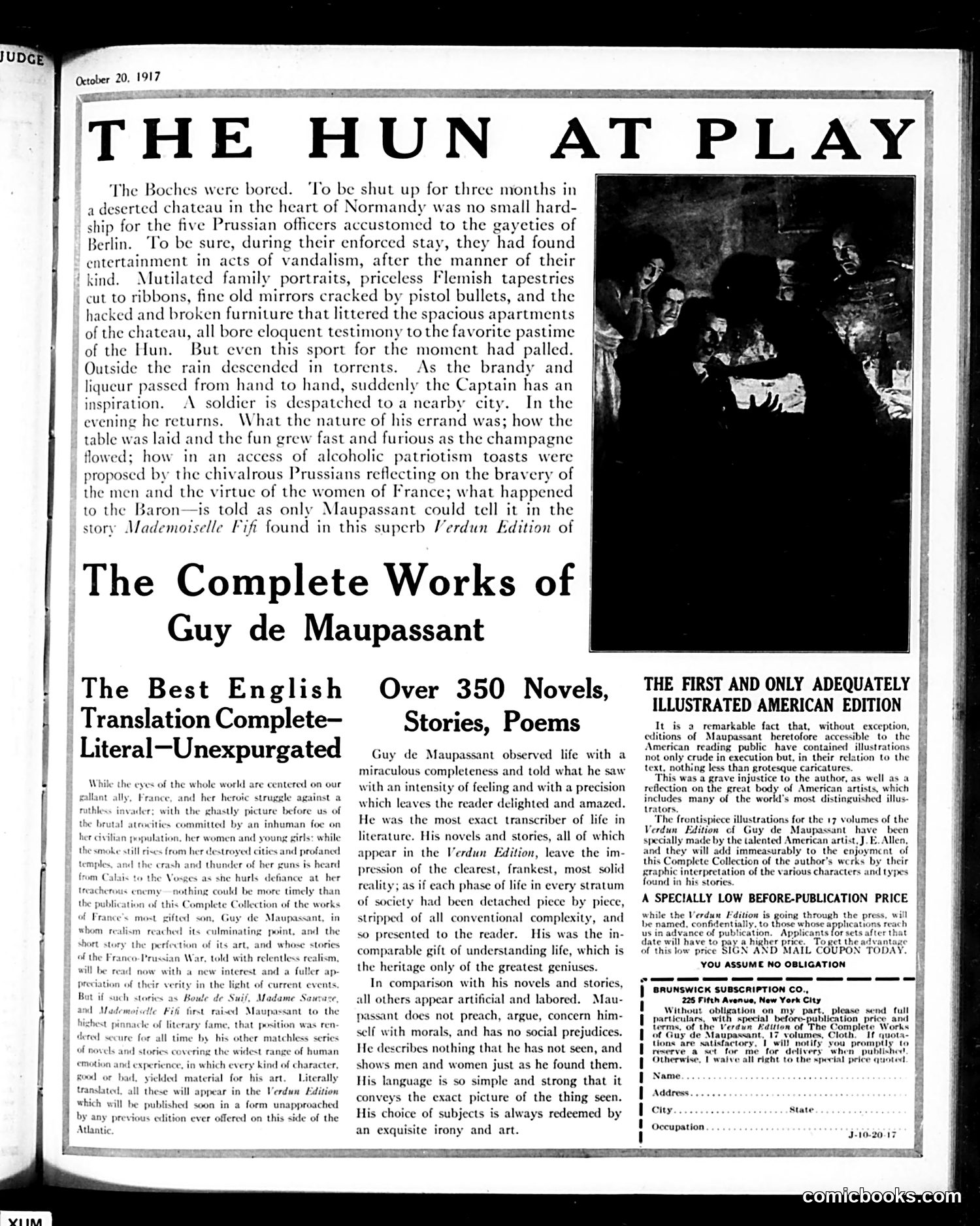
This page advertises Maupassant's *Complete Works* by promoting the story "Mademoiselle Fifi," framed within topical anti-German wartime propaganda. **The Context:** Published while America was actively fighting World War I, the text describes German ("Boche"/"Hun") officers quarantined in occupied Normandy, France, entertaining themselves through vandalism and destructive behavior. The narrative builds toward an unspecified incident involving "the Baron"—which Maupassant's story allegedly reveals. **The Satire:** The advertisement exploits wartime sentiment by positioning Maupassant as a chronicler of French life and implicitly German brutality. The timing is pointed: celebrating French literature and culture while Germans occupy French territory frames the *Complete Works* as both culturally superior and politically timely. **For Modern Readers:** This is essentially a wartime advertisement weaponizing classical literature. By invoking occupied France and German misconduct, it appeals to American patriotic sentiment while selling books—a clever marketing strategy that merges commerce with propaganda during active conflict.
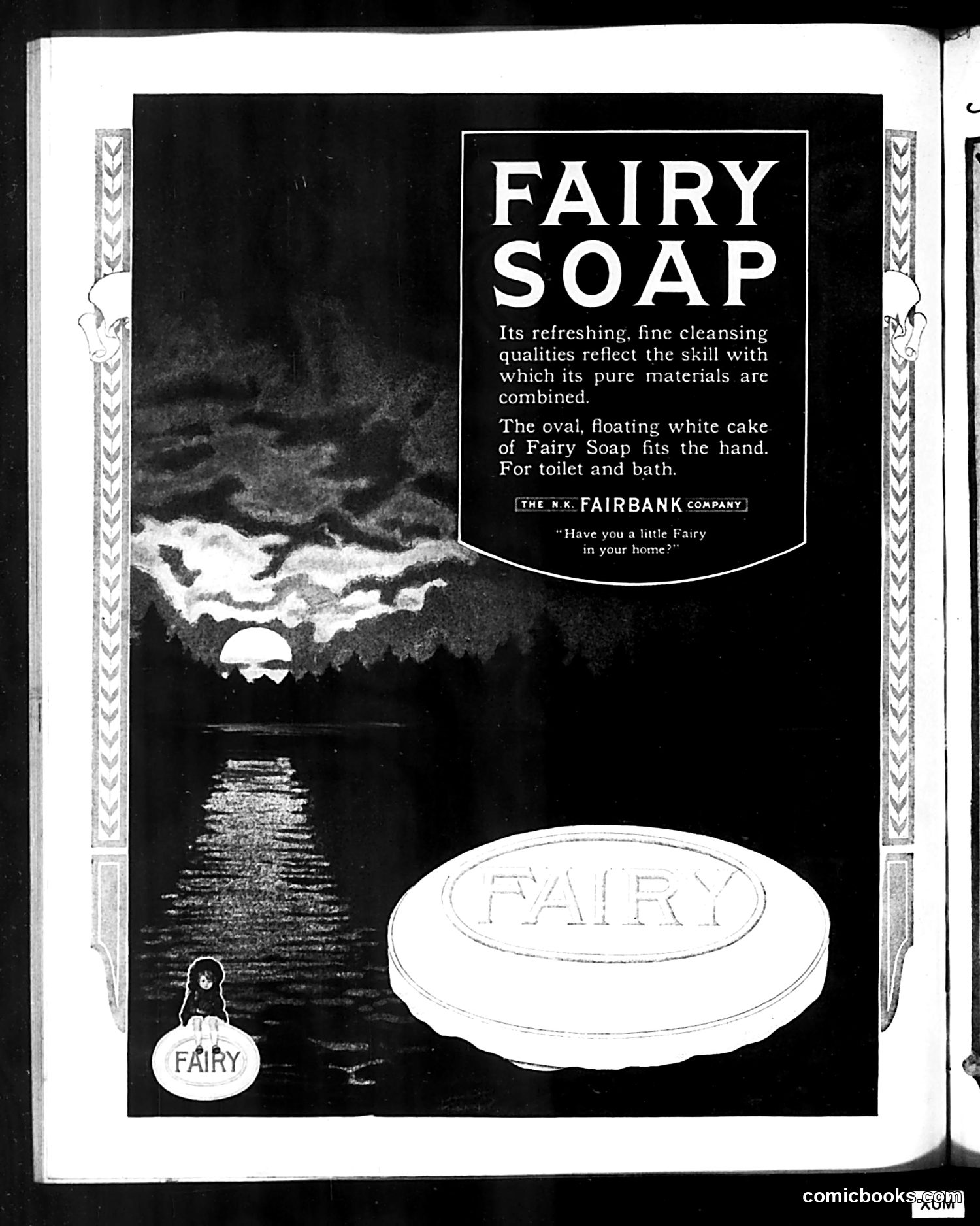
This is a full-page advertisement for Fairy Soap by the N.K. Fairbank Company, not a political cartoon or satirical content. The ad features a dreamy, romantic nighttime scene with moonlight over water and clouds, meant to evoke cleanliness and purity. The product itself—an oval, white floating soap cake—is displayed prominently at bottom. The tagline "Have you a little Fairy in your home?" uses the product name playfully, suggesting that owning Fairy Soap brings magic and refinement to domestic life. This reflects early 20th-century advertising's emphasis on soap as a marker of gentility and proper housekeeping. The ethereal imagery and fairy-tale associations were common marketing tactics to position consumer goods as aspirational rather than merely functional.