
Judge, 1917-10-20 · page 14 of 28
Judge — October 20, 1917 — page 14: what you’re looking at
What you’re looking at
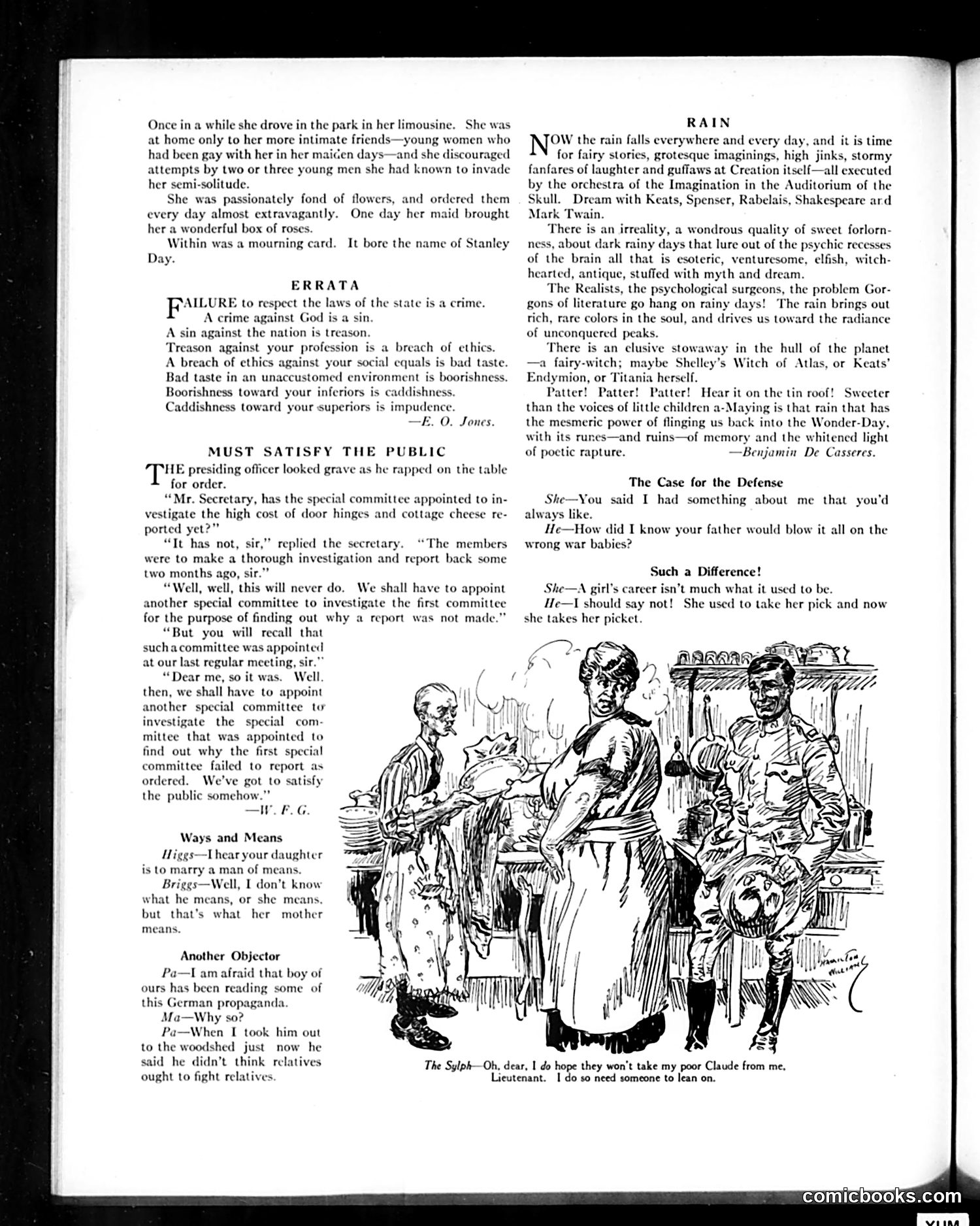
This page contains several satirical pieces typical of early 20th-century American humor: **"Errata"** mocks bureaucratic absurdity through a hierarchical list of transgressions, descending from crimes against God to social rudeness—suggesting that society treats minor breaches of etiquette with the same gravity as actual crimes. **"Must Satisfy the Public"** satirizes government inefficiency: a presiding officer appoints committees to investigate committees that failed to investigate the original committee—a circular bureaucratic nightmare meant to mock how government avoids actual accountability by creating endless oversight layers. **"Ways and Means" and "Another Objector"** are brief domestic humor pieces about marriage and generational conflict (the boy reading German propaganda opposing family warfare, likely WWI-related). **The illustration** shows women discussing "poor Claude," likely referencing military conscription concerns during wartime. **"Rain"** is poetic prose celebrating rainy days' imaginative power, contrasting Romantic idealism with harsh Realism. The overall tone reflects Judge's satirical approach to government inefficiency, social pretension, and contemporary anxieties about war.
📄 Transcribed text from this page (OCR, searchable)
Machine-transcribed from the original scan — historical spelling and the odd misread are preserved.
Once in a while she drove in the park in her limousine. She was at home only to her more intimate friends—young women who had been gay with her in her maiden days—and she discouraged attempts by two or three young men she had known to invade and ordered them avagantly. One day her maid brought wonderful box of roses. Within was a mourning card. Day. It bore the name of Stanley ERRATA ‘AILURE to respect the laws of the state is a crime. A crime against God i: A sin against the nation is treason. Treason against your profession is a breach of ethics. A breach of ethics against your social equals is bad taste. Bad taste in an unaccustomed environment is boorishness. Boorishness toward your inferiors is caddishness. ness toward your superiors is impudence. O. Jones. MUST SATISFY THE PUBLIC THe presiding officer looked grave as he rapped on the table for order. “Mr. Secretary, has the spe committee appointed to in- vestigate the high cost of door hinges and cottage cheese re- ported yet? “Tt has not, sir,” replied the secretary. were to make a thorough investigation and report bai two months ago, sir.”” “Well, well, this will never do. We shall have to appoint another sp I committee to investigate the first committee for the purpose of finding out why a report was not made.” “But you will recall that suchacommittee was appointed at our last regular meeting, sir.” “Dear me, so it was. Well then, we shall have to appoint another special committee to investigate the special com- mittee that was appointed to find out why the first special committee failed to report as ordered. We've got to satisfy the public somehow.” —W. “The members ‘ some F.G. Ways and Means Higgs—T hear your daughter is to marry a man of means. Briggs—Well, L don’t know what he means, or she means, but that's what her mother means. Another Objector Pa—I am afraid that boy of ours has been reading some of this German propaganda Ma—Why so? Pa—When I took him out to the woodshed just now he said he didn’t think relatives ought to fight relatives. RAIN OW the rain falls everywhere and every da for fairy stories, grotesque imaginings, high fanfares of laughter and guffaws at Creation itself—a by the orchestra of the Imagination in the Auditorium of the Skull. Dream with Keats, Spenser, Rabelais, Shakespeare ard Mark Twain. There is an irreality, a wondrous quality of sweet forlorn- ness, about dark rainy days that lure out of the psychic recesses of the brain all that is esoteric, venturesome, elfish, witch- hearted, antique, stuffed with myth and dream. The Realists, the psychological surgeons, the problem Gor- gons of literature go hang on rainy days! The rain brings out tich, rare colors in the soul, and drives us toward the radiance of unconquered peak There is an elusive stowaway in the hull of the plan —a_ fairy-witch be Shelley’s Witch of Atlas, or Keats’ Endymion, or T Patter! Pa er! Hear it on the tin roof! Sweeter than the Idren a-Maying is that rain that has the meric power of flinging us back into the Wonder-L with runes—and ruins—of memory and the whitened light of poctic rapture. —Benjamin De Casseres. The Case for the Defense You said I had something about me that you'd like. He—How did I know your father would blow it all on the wrong war babies? Such a Difference! She—A girl’s career isn’t much what it used to be. He—I should say not! She used to take her pick and now she takes her picket. x \ The Sylph—Oh, dear, | do hope they won't take my poor Claude from me, Lieutenant. I do so need someone to lean on. comicbooks.com