
Judge, 1917-10-20 · page 12 of 28
Judge — October 20, 1917 — page 12: what you’re looking at
What you’re looking at
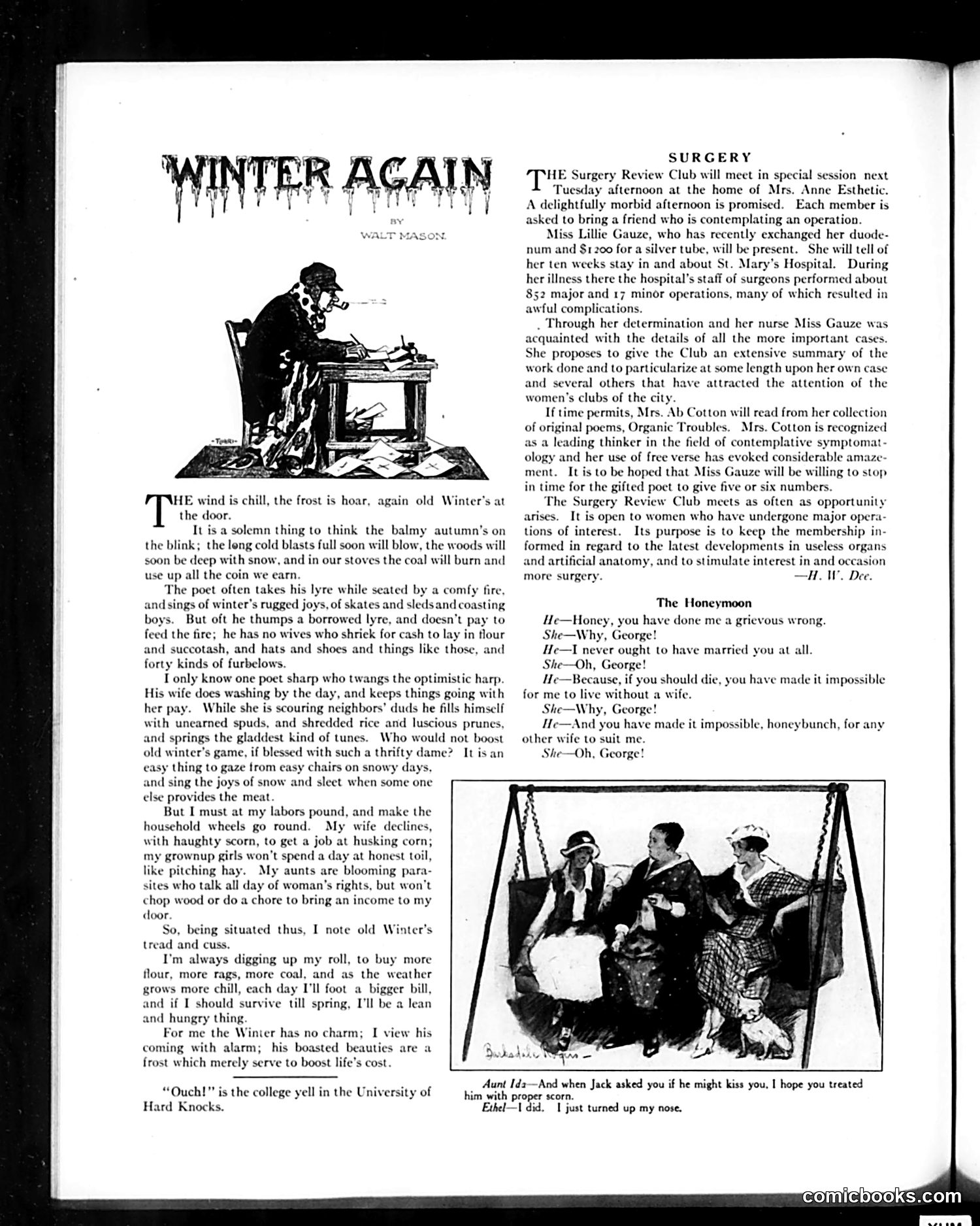
**"Winter Again" (left column):** Walt Mason's poem satirizes romanticized depictions of winter. While poets and comfortable people celebrate snow and sledding, Mason—speaking as an ordinary working man—describes winter as financially ruinous. His wife refuses to work ("declines, with haughty scorn"), his grown daughters won't take jobs, and his aunts talk of "woman's rights" but won't contribute income. The satire targets both lazy poets who celebrate hardship they don't experience and the contradiction of women claiming rights while remaining financially dependent. This reflects early-1900s debates about women's roles and labor. **"Surgery" (right column):** A humorous notice about a women's club meeting where members discuss surgical procedures. The satire is gentle: women gather to hear from Miss Gauze, who traded her duodenum for a silver tube, and share medical war stories. This reflects both the era's fascination with modern surgery and perhaps gentle mockery of women's social clubs' sometimes morbid preoccupations. **"The Honeymoon":** A brief marital joke (incomplete on this page) about newlyweds' disagreements.
📄 Transcribed text from this page (OCR, searchable)
Machine-transcribed from the original scan — historical spelling and the odd misread are preserved.
HE wind is chill, the frost is hoar, again old Winter's at T the door. It is a solemn thing to think the balmy autumn’s on the blink; the leng cold blasts full soon will blow, the woods will soon be deep with snow, and in our stoves the coal will burn and use up all the coin we earn. The poet often takes his lyre while seated by a comfy fire, and sings of winter's rugged joys, of skates and sleds and coasting boys. But oft he thumps a borrowed lyre, and doesn’t pay to feed the fire; he has no wives who shriek for cash to lay in flour and succotash, and hats and shoes and things like those, and forty kinds of furbelows. i only know one poet sharp who twangs the optimistic harp His wife does washing by the day, and keeps things going with her pay. While she is scouring neighbors’ duds he fills himself with unearned spuds, and shredded rice and luscious prunes, and springs the gladdest kind of tunes. Who would not boost old winter's game, if blessed with such a thrifty dame? It is an easy thing to gaze from easy chairs on snowy days, and sing the joys of snow and sleet when some one else provides the meat. But I must at my labors pound, and make the household wheels go round. My wife declines, with haughty scorn, to get a job at husking corn; my grownup girls won't spend a day at honest toil, like pitching hay. My aunts are blooming para- sites who talk all day of woman's rights, but won't chop wood or do a chore to bring an income to my door So, being situated thus, I tread and cuss. I'm always digging up my roll, to buy more flour, more rags, more coal, and as the weather grows more chill, each day I'll foot a bigger bill, and if I should survive till spring, I'll be a lean and hungry thinj For me the Winter has no charm; I view his coming with alarm; his boasted beauties are a frost which merely serve to boost life’s cost. note old Winter's SURGERY HE Surgery Review Club will meet in special session next Tuesday afternoon at the home of Mrs. Anne Esthe' A delightfully morbid afternoon is promised. Each member is asked to bring a friend who is contemplating an operation. Miss Lillie Gauze, who has recently exchanged her duode- num and $1200 fora silver tube, will be present. She will tell of her ten weeks stay in and about St. Mary’s Hospital. During her illness there the hospital's staff of surgeons performed about 852 major and 17 minor operations, many of which resulted in awful complications. . Through her determination and her nurse Miss Gauze was acquainted with the details of all the more important cases. She proposes to give the Club an extensive summary of the work done and to particularize at some length upon her own case and several others that have attracted the attention of the women’s clubs of the If time permits, Mrs. Ab Cotton will read from her collection of original poems, Organic Troubles. Mrs. Cotton is recognized as a leading thinker in the field of contemplative symptomat- ology and her use of free verse has evoked considerable amaze- ment. It is to be hoped that Miss Gauze will be willing to stop in time for the gifted poet to give five or six numbers. The Surgery Review Club meets as often as opportunity arises. It is open to women who have undergone major operi- tions of interest. Its purpose is to keep the membership in- formed in regard to the latest developments in useless organs and artificial anatomy, and to stimulate interest in and occasion more surgery. H.W. Dee. The Honeymoon He—Honey, you have done me a grievous wrong. She—Why, George! He—I never ought to have married you at all. She—Oh, George! He—Because, if you should die, you have made it impossible for me to live without a wife. She—Why, George He—And you have made it impossible, honeybunch, for any other wife to suit me She—Oh, George! “Ouch!” is the college yell in the University of Hard Knocks. Eckel: Aunt Idz—And when Jack asked you if he might kiss you, I hope you treated him with proper scorn. I did. 1 just turned up my nose.