
Judge, 1917-10-20 · page 16 of 28
Judge — October 20, 1917 — page 16: what you’re looking at
What you’re looking at
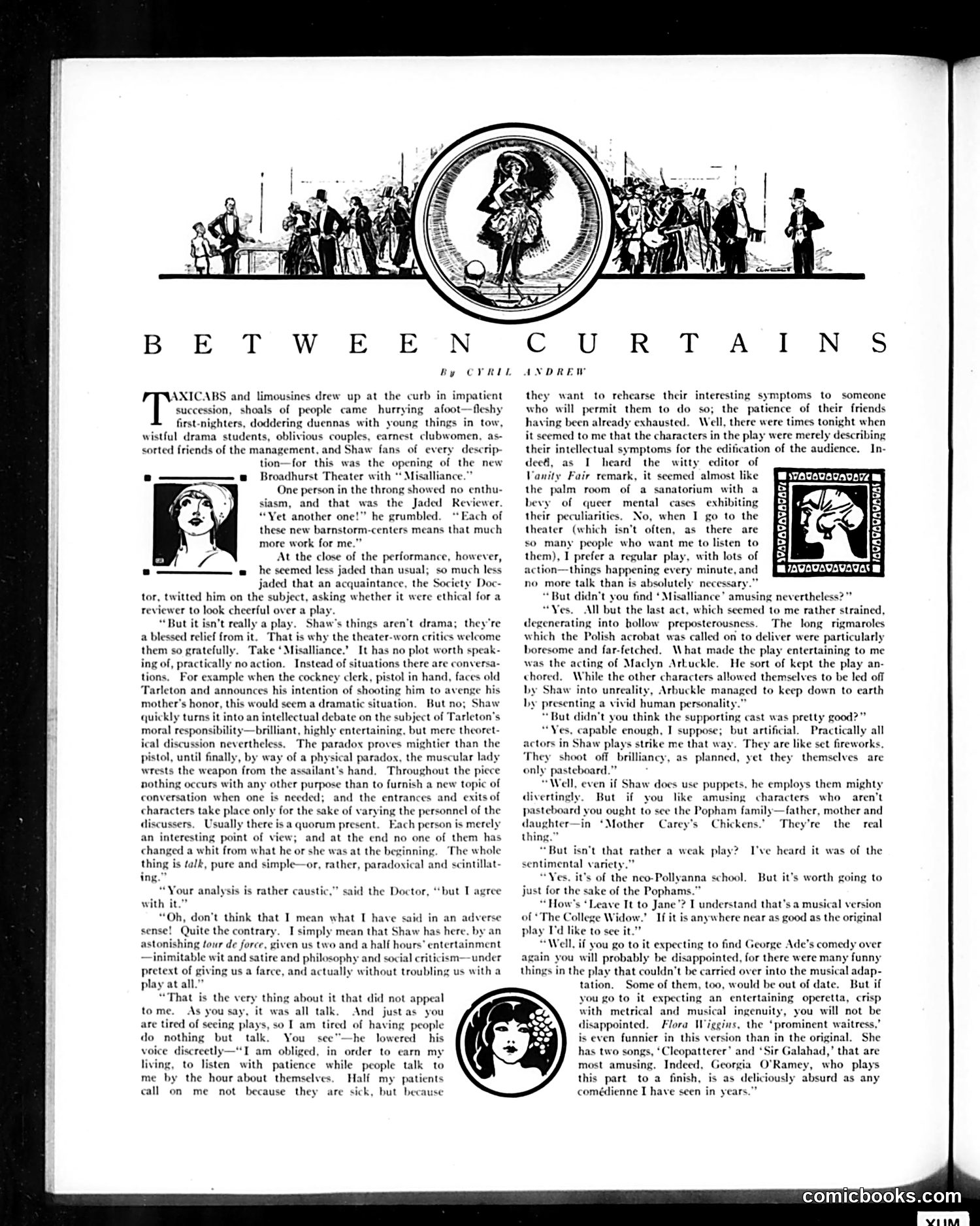
This page discusses George Bernard Shaw's play "Misalliance," which opened at the Broadhurst Theater. The dialogue between a "Jaded Reviewer" and a "Society Doctor" debates Shaw's dramatic style. The satire critiques Shaw's plays as intellectual exercises rather than traditional drama. The Reviewer argues Shaw substitutes philosophical conversation for plot and action—when a pistol-wielding scene could climax dramatically, Shaw instead turns it into a "theoretical discussion" about morality. Characters remain unchanged; nothing happens except talking. The Doctor counters that Shaw's wit and social criticism are entertainingly brilliant, even if unconventional. However, the Doctor finds the endless dialogue exhausting, comparing it to patients in a sanatorium describing their "intellectual symptoms"—a critique of Shaw's cerebral approach as tedious rather than dramatically engaging. The cartoon illustrates contemporary theatrical debate: whether Shaw's intellectual drama represents theatrical innovation or self-indulgent philosophy masquerading as entertainment.
📄 Transcribed text from this page (OCR, searchable)
Machine-transcribed from the original scan — historical spelling and the odd misread are preserved.
BETWEEN By CYRIL succession, shoals of people came hurrying afoot—fleshy first-nighters, doddering duennas with young things in tow, wistful drama students, oblivious couples, earnest clubwomen, as- sorted friends of the management, and Shaw fans of every descrip- tion—for this was the opening of the new Broadhurst Theater with ** Misalliance.” One person in the throng showed no enthu- siasm, and that was the Jaded Reviewer. “Yet another one!” he grumbled. Zach of these new barnstorm-centers means that much more work for me.” At the close of the performance, however, he seemed less jaded than usual; so much less jaded that an acquaintance, the Society Doc- tor, twitted him on the subject, asking whether it were ethical for a reviewer to look cheerful over a play. “But it isn’t really a play. Shaw's things aren't drama; they're a blessed relief from it. That is why the theater-worn critics welcome them so gratefully. Take ‘Misalliance.’ It has no plot worth speak- ing of, practically no action. Instead of situations there are conversa- tions. For example when the cockney clerk, pistol in hand, faces old Tarleton and announces his intention of shooting him to avenge his mother’s honor, this would seem a dramatic situation. But no; Shaw quickly turns it into an intellectual debate on the subject of Tarleton’s moral responsibility—brilliant, highly entertaining. but mere theoret- ical discussion nevertheless. The paradox proves mightier than the pistol, until finally, by way of a physical paradox, the muscular lady wrests the weapon from the assailant’s hand, Throughout the picce nothing occurs with any other purpose than to furnish a new topic of conversation when one is needed; and the entrances and exits of characters take place only for the sake of varying the personnel of the discussers. Usually there is a quorum present. Each person is merely an interesting point of view; and at the end no one of them has changed a whit from what he or she was at the beginning. The whole thing is talk, pure and simple—or, rather, paradoxical and scintillat ing. 4 bee and limousines drew up at the curb in impatient Your analysis is rather caustic,” said the Doctor, “but T agree with it. “Oh, don’t think that I mean what I have said in an adverse sense! Quite the contrary. I simply mean that Shaw has here. by an astonishing four de force, given us two and a half hours’ entertainment —inimitable wit and satire and philosophy and social criticism—under pretext of giving us a farce, and actually without troubling us with a play at all “That is the very thing about it that did not appeal tome. As you say, it was all talk. And justas you are tired of seeing plays, so I am tired of having people do nothing but talk. You see”—he lowered his voice discreetly—“I am obliged, in order to earn my living, to listen with patience while people talk to the hour about themselves. Half my patients on me not because they are sick, but because N §$ C U R INDREW they want to rehearse their interesting symptoms to someone who will permit them to do so; the patience of their friends having been already exhausted. Well, there were times tonight when it seemed to me that the characters in the play were merely describing their intellectual symptoms for the edification of the audience. In- dee, as I heard the witty editor of Vanity Fair remark, it seemed almost like the palm room of a sanatorium with a bevy of queer mental cases exhibiting > their peculiarities. No, when I go to the 5 PS FA theater (which isn’t often, as there are 8 & a Wyvatavavavaye so many people who want me to listen to them), I prefer a regular play, with lots of action—things happening every minute, and no more talk than is absolutely necessary.” “But didn’t you find ‘ Misalliance’ amusing nevertheless?” “Yes. All but the last act, which seemed to me rather strained, degenerating into hollow preposterousness. The long rigmaroles which the Polish acrobat was called on to deliver were particularly boresome and far-fetched. What made the play entertaining to me was the acting of Maclyn Arkuckle. He sort of kept the play an- chored. While the other characters allowed themselves to be led off by Shaw into unreality, Arbuckle managed to keep down to earth by presenting a vivid human personalit “But didn’t you think the supporting cast was pretty good?” “Yes, capable enough, I suppose; but artificial. Practically all actors in Shaw plays strike me that way. They are like set fireworks, They shoot off brilliancy, as planned, yet they themselves are only pasteboard.” “Well, even if Shaw does use puppets, he employs them mighty divertingly. But if you like amusing characters who aren't pasteboard you ought to see the Popham family—father, mother and daughter—in ‘Mother Carey’s Chickens.’ They're the _ real thing.” “But isn’t that rather a weak play? I've heard it was of the sentimental variety “Yes, it's of the nco-Pollyanna school. But it’s worth going to just for the sake of the Pophams.”” “How's ‘Leave It to Jane’? IT understand that’s a musical version of * The College Widow.’ If it is anywhere near as good as the original play I'd like to see it.” “Well. if you go to it expecting to find George Ade’s comedy over again you will probably be disappointed, for there were many funny things in the play that couldn't be carried over into the musical adap- tation. Some of them, too, would be out of date. But if you go to it expecting an entertaining operetta, crisp with metrical and musical ingenuity, you will not be disappointed. Flora Wiggins, the ‘prominent waitress.” is even funnier in this version than in the original. She has two songs, ‘Cleopatterer’ and ‘Sir Galahad,’ that are most amusing. Indeed, Georgia O'’Ramey, who plays this part to a finish, is as deliciously absurd as any comédienne I have seen in years.” MIAVAVAUAUAVAL wavauavouarat comicbooks.com YVIIRA