
Judge, 1917-10-20 · page 15 of 28
Judge — October 20, 1917 — page 15: what you’re looking at
What you’re looking at
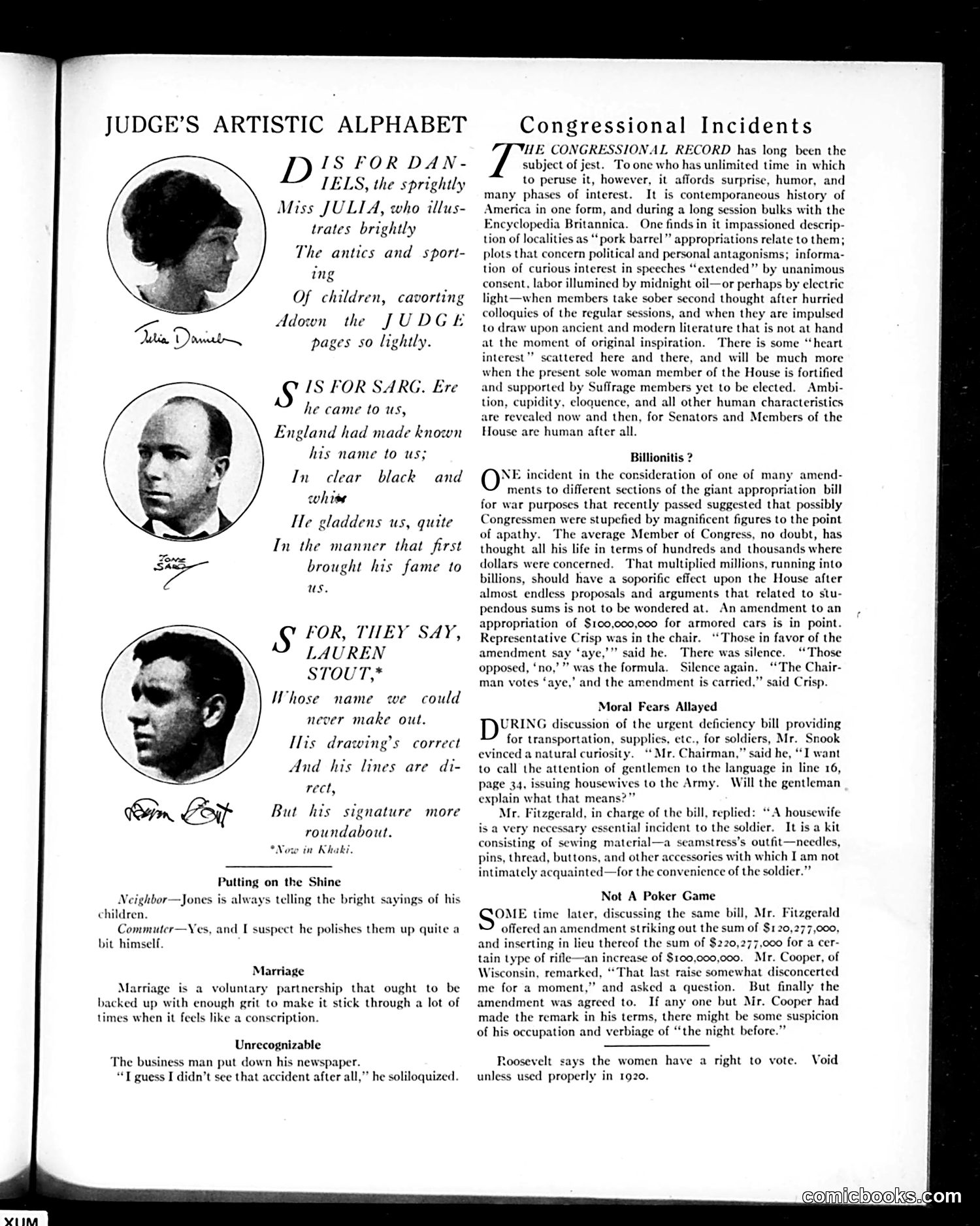
**Left side** presents cartoonist profiles as part of an alphabetical feature celebrating Judge magazine's contributors—likely Julia Daniels, John Singer Sargent, and Lauren Stout (marked with asterisk, "Voe in Khaki"). The format humorously describes their artistic styles and signatures. **Right side** discusses absurdities in Congressional Record deliberations, particularly wartime appropriations bills. The "Billionitis" section mocks Congressmen rendered numb by enormous budget figures ($100 million+). Representative Crisp silently passes an amendment for armored cars because debate over such sums has become meaningless—illustrating how massive numbers produce legislative apathy. The "Moral Fears Allayed" section satirizes naive Congressional discussion about issuing "housewives" (actually sewing kits) to soldiers, with Mr. Fitzgerald earnestly explaining these are necessary military supplies. **Overall satire:** Congress conducting serious wartime business while intellectually paralyzed by scale and trivial misunderstandings.
📄 Transcribed text from this page (OCR, searchable)
Machine-transcribed from the original scan — historical spelling and the odd misread are preserved.
JUDGE’S ARTISTIC ALPHABET IS FOR DAN- TELS, the sprightly Miss JULIA, who illus- trates brightly The antics and sport- ing Of children, cavorting Adown the JUDGE pages so lightly. 1S FOR SARG. Ere he came to us, England had made known his name to us; black and In clear white Tle gladdens us, quite In the manner that first brought his fame to us. FOR, THEY SAY, LAUREN STOUT,* Whose name could never make out. we His drawing’s correct And his lines are di- rect, But his signature more roundabout. in Khaki. Putting on the Shine ighbor—Jones is always telling the bright s children. Commuter—Yes, and [ suspect he polishes them up quite a bit himself. ings of his Ne Marriage Marriage is a voluntary partnership that ought to be backed up with enough grit to make it stick through a lot of times when it feels like a conscription. Unrecognizable The business man put down his newspaper. “T guess I didn’t see that accident after all,” he soliloquiz Congressional Incidents CUE CONGRESSIONAL RECORD has long been the subject of jest. To one who has unlimited time in which to peruse it, however, it affords surprise, humor, and many phases of interest. It is contemporaneous history of America in one form, and during a long session bulks with the Encyclopedia Britannica. One finds in it impassioned descrip- tion of localities as “ pork barrel” appropriations relate to the: plots that concern political and personal antagonisms; inform tion of curious interest in speech xtended” by unanimot consent, labor illumined by midnight oil—or perhaps by electric light—when members t sober second thought after hurried colloquies of the regular sessions, and when they are impulsed to draw upon ancient and modern literature that is not at hand at the moment of original inspiration. There is some “heart interest” scattered here and there, and will be much more when the present sole woman member of the House is fortified and supported by Suffrage members yet to be elected. Ambi- tion, cupidity, eloquence, and all other human characteristics are revealed now and then, for Senators and Members of the House are human after all. O incident in the consideration of one of many amend- ments to different sections of the giant appropriation bill for war purposes that recently passed suggested that possibly Congressmen were stupefied by magnificent figures to the point of apathy. The average Member of Congress, no doubt, has thought all his life in terms of hundreds and thousands where dollars were concerned. at multiplied millions, running into billions, should have a soporific effect upon the House after almost endless proposals and arguments that related to stu- pendous sums is not to be wondered at. An amendment to an appropriation of $100,000,000 for armored cars is in point. Representative Crisp in the chair. ‘Those in favor of the amendment say ‘aye,’” said he. There was silence. “Those opposed, ‘no,’”” was the formula. Silence again. ‘The Chair- man votes ‘aye,’ and the amendment is carried,” said Crisp. Billionitis ? Moral Fears Allayed DURING discussion of the urgent deficiency bill providing for transportation, supplies, etc., for soldiers, Mr. Snook evinced a natural curiosity.‘ Mr. Chairman,” said he, “I want to call the attention of gentlemen to the language in line 16, page 34, issuing housewives to the Army. Will the gentleman explain what that means? Mr. Fitzgerald, in charge of the is a very necessary essential incident to the soldier. It is a kit consisting of sewing material—a seamstre: outfit—needles, pins, thread, buttons, and other accessories with which I am not intimately acquainted—for the convenience of the soldier.” . teplied: “A housewife Not A Poker Game OME time later, discussing the same bill, Mr. Fitzgerald offered an amendment striking out the sum of $120,277,000, and inserting in lieu thereof the sum of $220,277,000 for a cer- n increase of $100,000,000. Mr. Cooper, of That last raise somewhat disconcerted me for a moment,” and asked a question. But finally the amendment was agreed to. If any one but Mr. Cooper had made the remark in his terms, there might be some ion of his occupation and verbiage of “the night before. tain type of rifle Wisconsin, remarked, a right to vote. Void Roosevelt says the women hav unless used properly in 1920.