
Judge, 1917-10-20 · page 5 of 28
Judge — October 20, 1917 — page 5: what you’re looking at
What you’re looking at
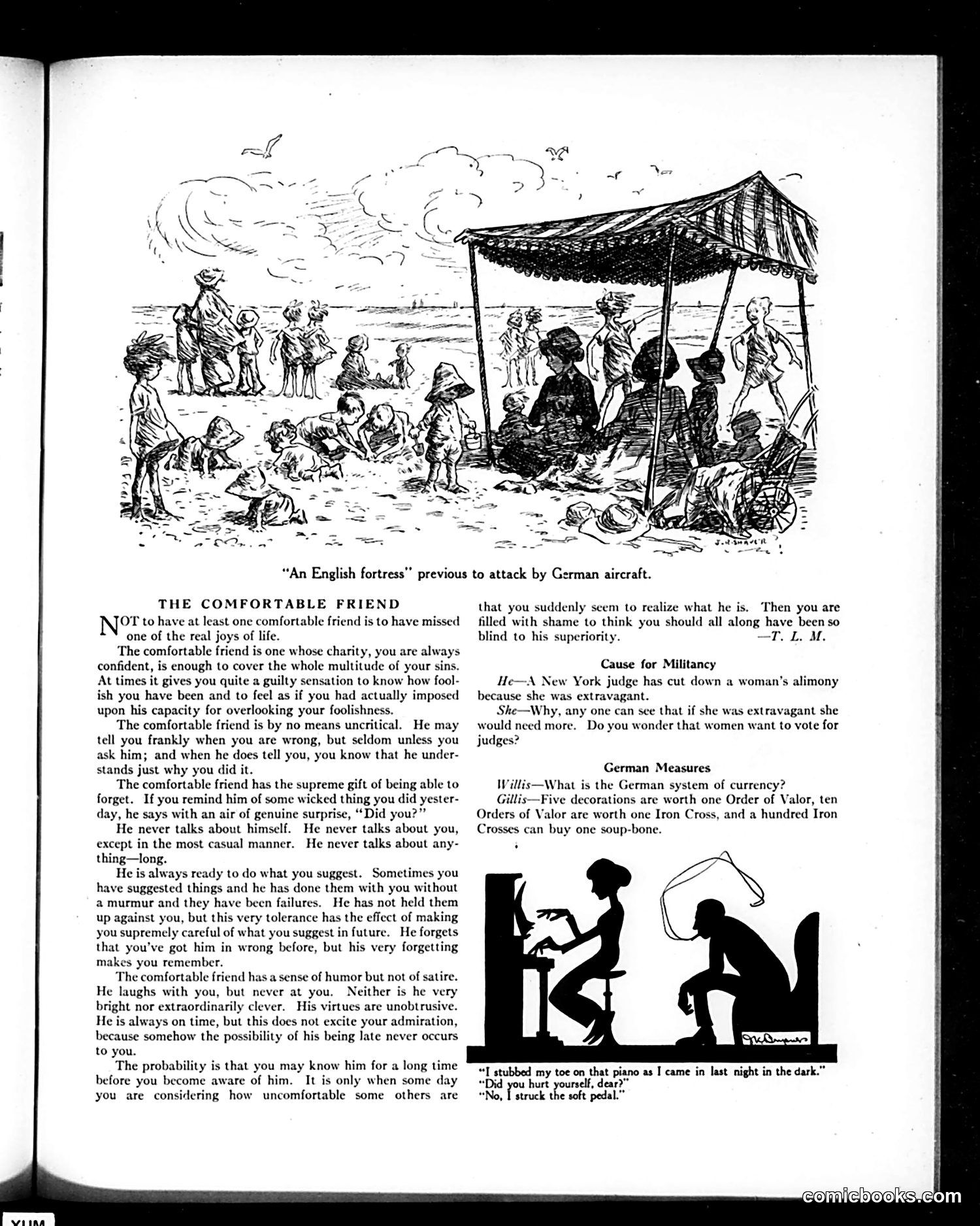
**Top Illustration**: Depicts a beach scene labeled "An English fortress" prior to German aircraft attack. Shows civilians—families with children—sheltering under a makeshift canopy, representing how ordinary British people improvised protection during WWII aerial bombardment. This is satirical commentary on civilian vulnerability during wartime. **"The Comfortable Friend"**: An essay praising the value of loyal friends who overlook your faults, maintain discretion about your mistakes, and offer reliable support without judgment or self-promotion. The piece celebrates unpretentious friendship. **"Cause for Militancy" and "German Measures"**: Brief humor pieces about women's suffrage and German currency/military honors respectively. **Bottom Cartoon**: Domestic humor—a woman explains injuring herself on a piano pedal in the dark, not from the man's suggested toe-stubbing.
📄 Transcribed text from this page (OCR, searchable)
Machine-transcribed from the original scan — historical spelling and the odd misread are preserved.
“An English fortress’ previous to attack by German aircraft. THE COMFORTABLE FRIEND OT to have at least one comfortable friend is to have missed one of the real joys of life. The comfortable friend is one whose charity, you are always confident, is enough to cover the whole multitude of your sins. At times it gives you quite a guilty sensation to know how fool- ish you have been and to feel as if you had actually imposed upon his capacity for overlooking your foolishness. The comfortable friend is by no means uncritical. He may tell you frankly when you are wrong, but seldom unless you ask him; and when he does tell you, you know that he under- stands just why you did it. The comfortable friend has the supreme gift of being able to forget. If you remind him of some wicked thing you did yester- day, he says with an air of genuine surprise, “Did you?” He never talks about himself. He never talks about you, except in the most casual manner. He never talks about any- thing—long. He is always ready to do what you suggest. Sometimes you have suggested things and he has done them with you without a murmur and they have been failures. He has not held them up against you, but this very tolerance has the effect of making you supremely careful of what you suggest in future. He forgets that you’ve got him in wrong before, but his very forgetting makes you remember. The comfortable friend has a sense of humor but not of satire. He laughs with you, but never at you. Neither is he bright nor extraordinarily clever. His virtues are unobtrusive. He is always on time, but this does not excite your admiration, because somehow the possibility of his being late never occurs to you. The probability is that you may know him for a long time before you become aware of him. It is only when some day you are considering how uncomfortable some others are that you suddenly scem to realize what he is. Then you are filled with shame to think you should all along have been so blind to his superiority. T.L. M. Cause for Militancy He—A New York judge has cut down a woman’s alimony because she was extravagant. She—Why, any one can see that if she was extravagant she would need more. Do you wonder that women want to vote for judges? German Measures Willis—What is the German system of currency? Gillis—Five decorations are worth one Order of Valor, ten Orders of Valor are worth one Iron Cross, and a hundred Iron Crosses can buy one soup-bone. tubbed my toe on that piano as I came in last night in the dark.” Did f, dear?’ urs 1¢ soft pedal.” ju hurt struck tl