
A complete issue · 28 pages · 1917
Judge — August 11, 1917
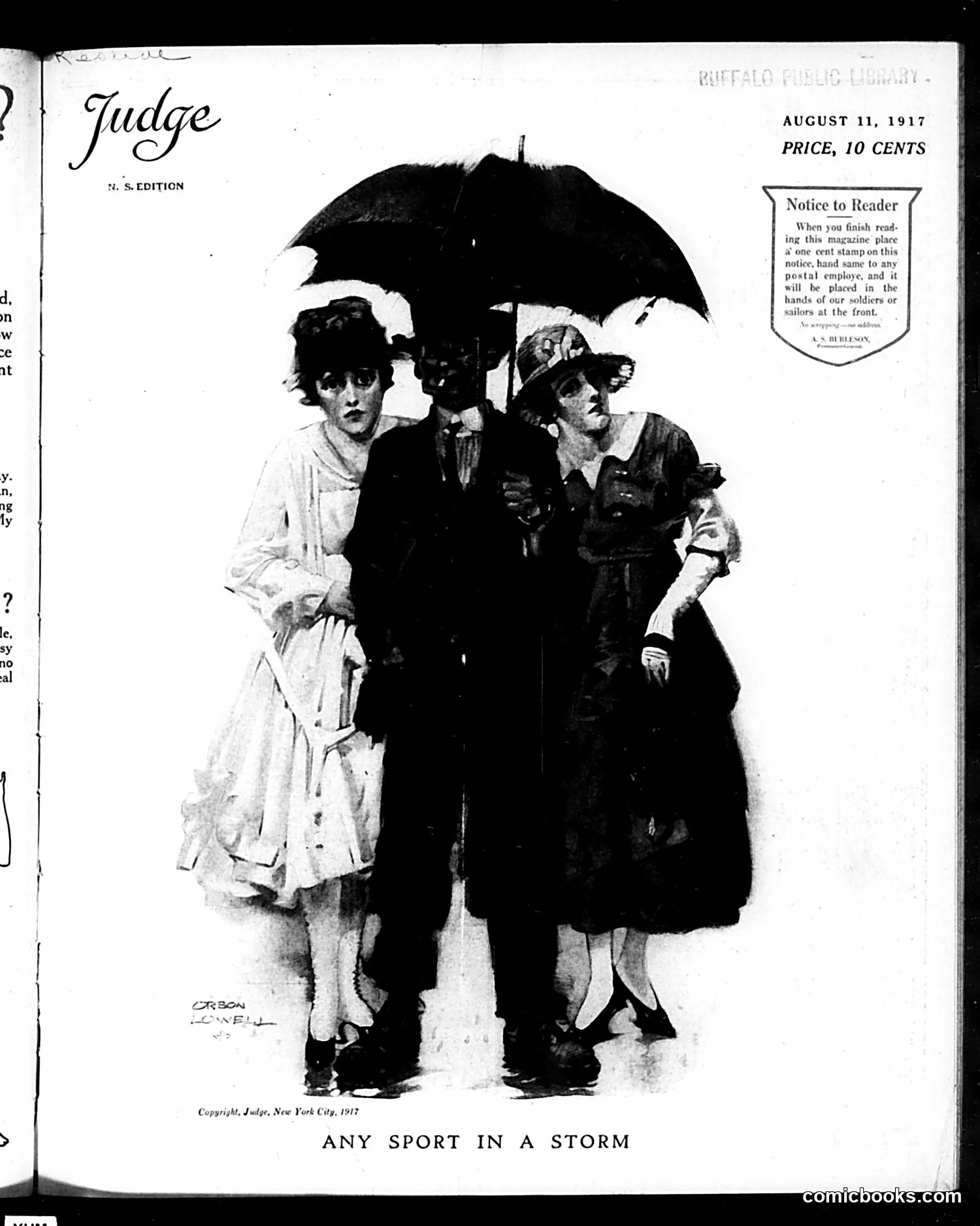
This August 1917 *Judge* cover depicts three figures sheltering under an umbrella during rain, captioned "Any Sport in a Storm." The cartoon likely satirizes how people adapt their recreational activities during adverse conditions—or possibly comments on wartime behavior shifts. Given the 1917 date (U.S. entry into World War I), the figures may represent civilians finding entertainment or distraction despite national crisis, playing on the phrase "any port in a storm." The middle figure appears more formally dressed than the others, suggesting possible class commentary. The "Notice to Reader" requests readers stamp the magazine for soldiers/sailors at the front, confirming the wartime context. The exact satirical target remains unclear without additional context, though it likely addresses civilian attitudes during the war effort.
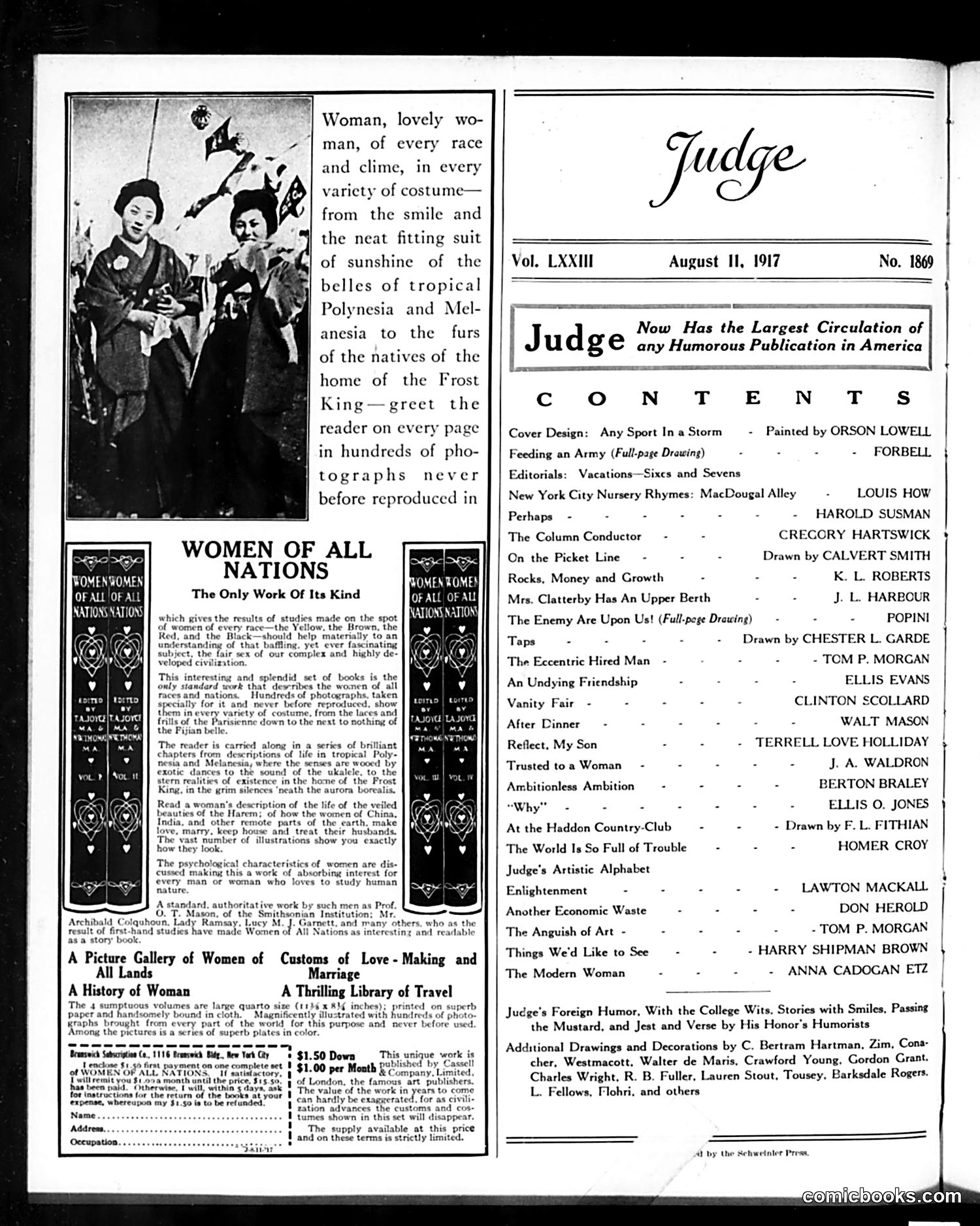
This page is primarily a **table of contents and advertisement** for Judge magazine's humor and artwork offerings, with minimal political cartoon content visible. The left side advertises "Women of All Nations," a book series depicting women from various cultures through photography and illustration. The text uses period-typical language describing women from "tropical Polynesia" to Arctic regions, presented as exotic subjects for Victorian-era readers. The main content lists satirical articles and drawings, likely commenting on WWI-era American life—references include "An Undying Friendship," "The Enemy Are Upon Us!" and military-related pieces. **The actual satirical cartoons themselves are not clearly visible** in this reproduction, making specific political interpretation difficult. The page functions primarily as a promotional/contents listing rather than displaying substantive editorial commentary.
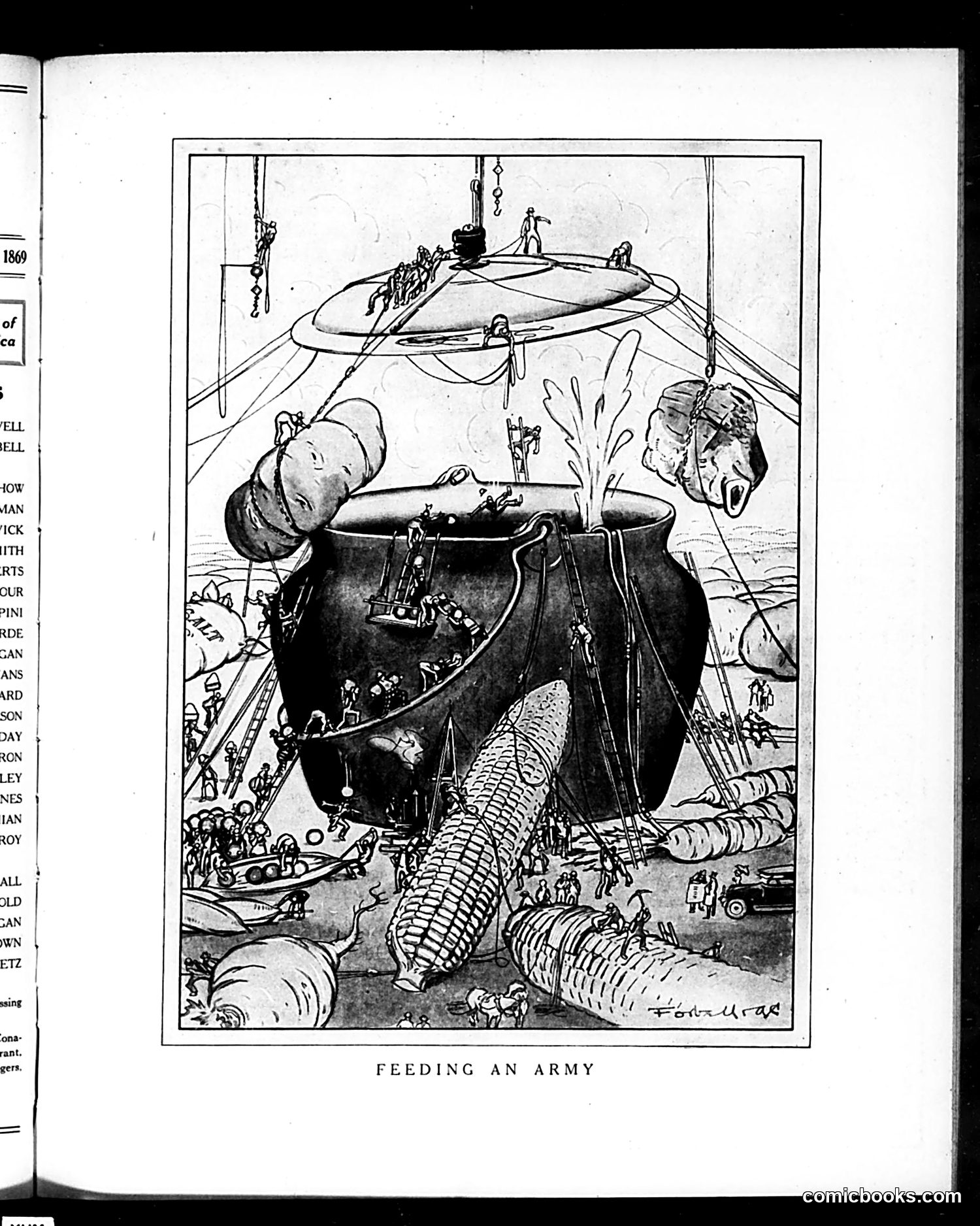
This satirical cartoon depicts the massive logistical challenge of feeding a military force. The image shows a giant cauldron or pot being supplied by enormous pipes and tubes, with tiny human figures operating cranes and equipment above to manage the enormous scale of provisions. The satire critiques the complexity and expense of military supply chains—a perennial target of political humor. The absurdly oversized cooking apparatus emphasizes how armies require vast quantities of food and resources. The small workers managing the giant infrastructure suggest the overwhelming bureaucratic challenge of feeding soldiers. Without additional context from the magazine's date or accompanying articles, the specific historical military reference (which army, which conflict) remains unclear, though the 1869 date visible on the page indicates this likely relates to post-Civil War military organization or perhaps contemporary international military affairs.
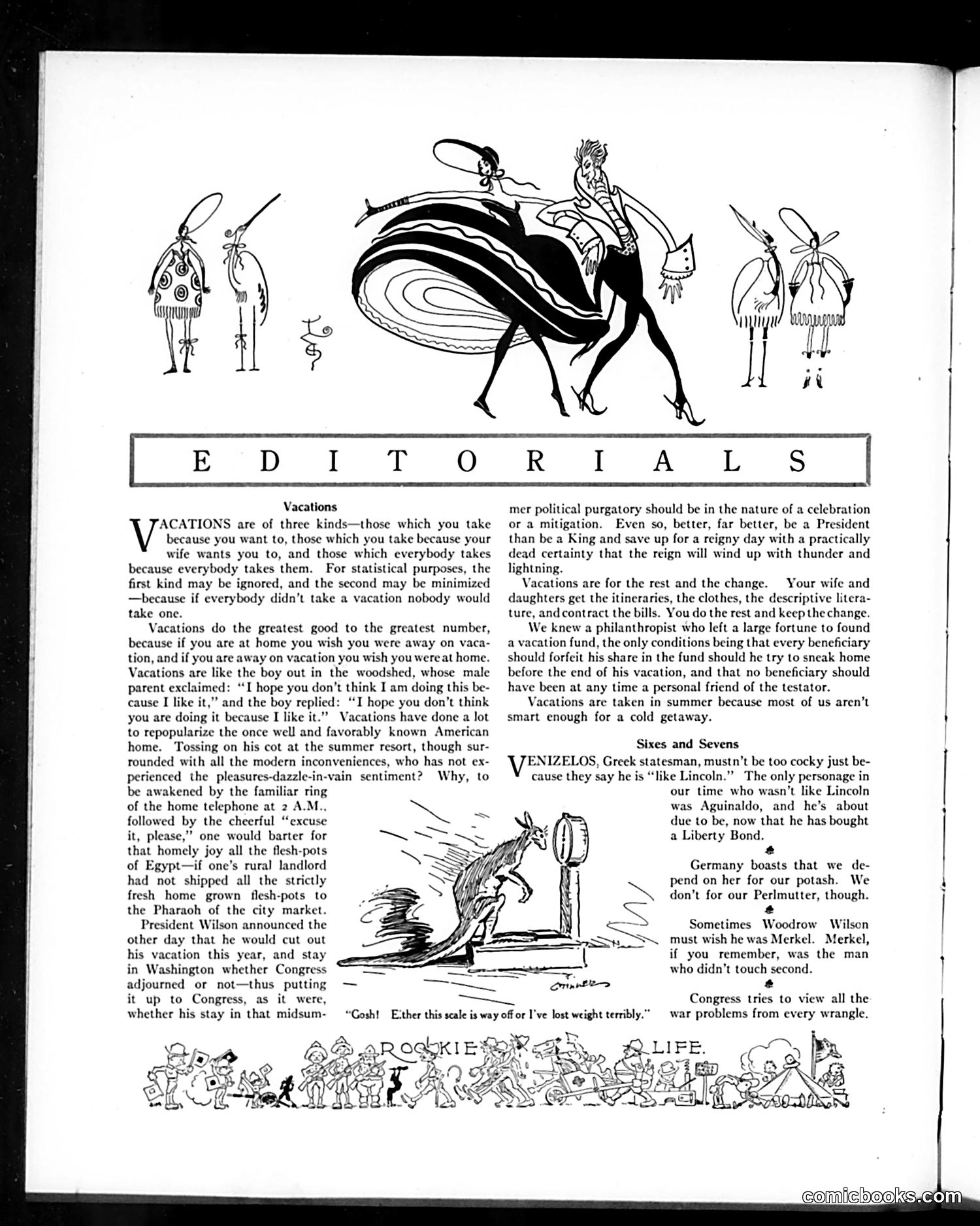
This page from Judge contains editorials and satirical commentary rather than primary political cartoons. The "Vacations" editorial mocks American vacation culture—how people feel obligated to take them despite preferring to stay home, and how vacations have become standardized rather than genuinely restorative. The "Sixes and Sevens" section includes brief political jabs: one references Venizelos (Greek statesman) and a comparison to Lincoln; another criticizes Germany's boasting about potash while depending on imports; a third jokes that Woodrow Wilson might wish he were Merkel (unclear reference); finally, it quips that Congress views war problems from "every wrangle." The kangaroo cartoon appears to illustrate the vacations theme about discomfort or awkwardness while traveling. The publication date and specific historical context remain unclear from this page alone.
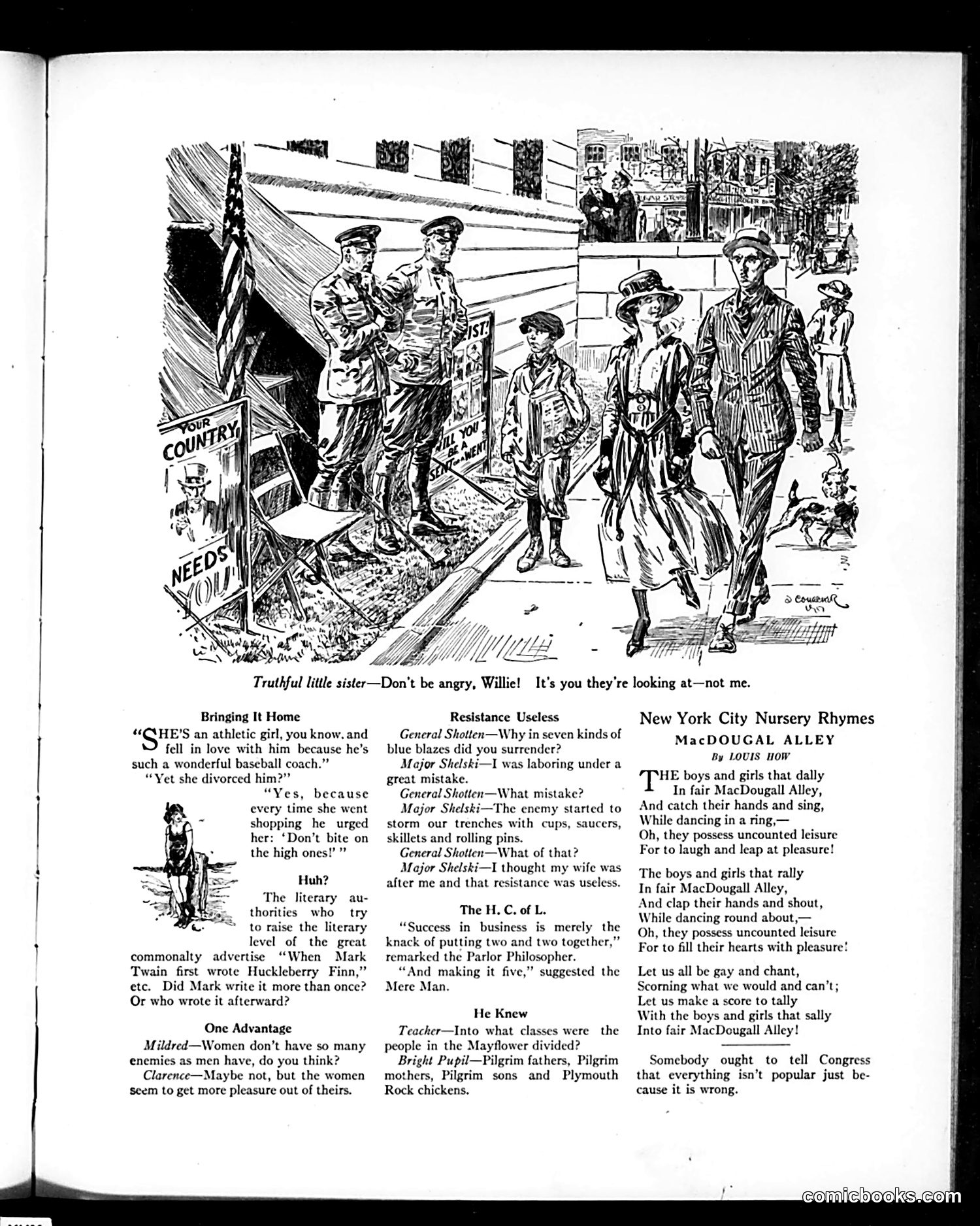
The main cartoon depicts a military recruitment scene, likely from World War I era. Soldiers in uniform stand near a tent marked "YOUR COUNTRY NEEDS YOU," while civilians (including women and children) approach. The caption "Truthful little sister—Don't be angry, Willie! It's you they're looking at—not me" suggests satire about selective recruitment or conscription practices. The surrounding text includes humorous dialogues mocking military leadership ("Resistance Useless"), newspaper columnists, and literary pretensions. The "MacDougal Alley" poem celebrates bohemian New York youth culture. Overall, the page satirizes wartime recruitment propaganda, military inefficiency, and social pretension—typical Judge magazine fare mixing visual satire with topical humor for educated readers.
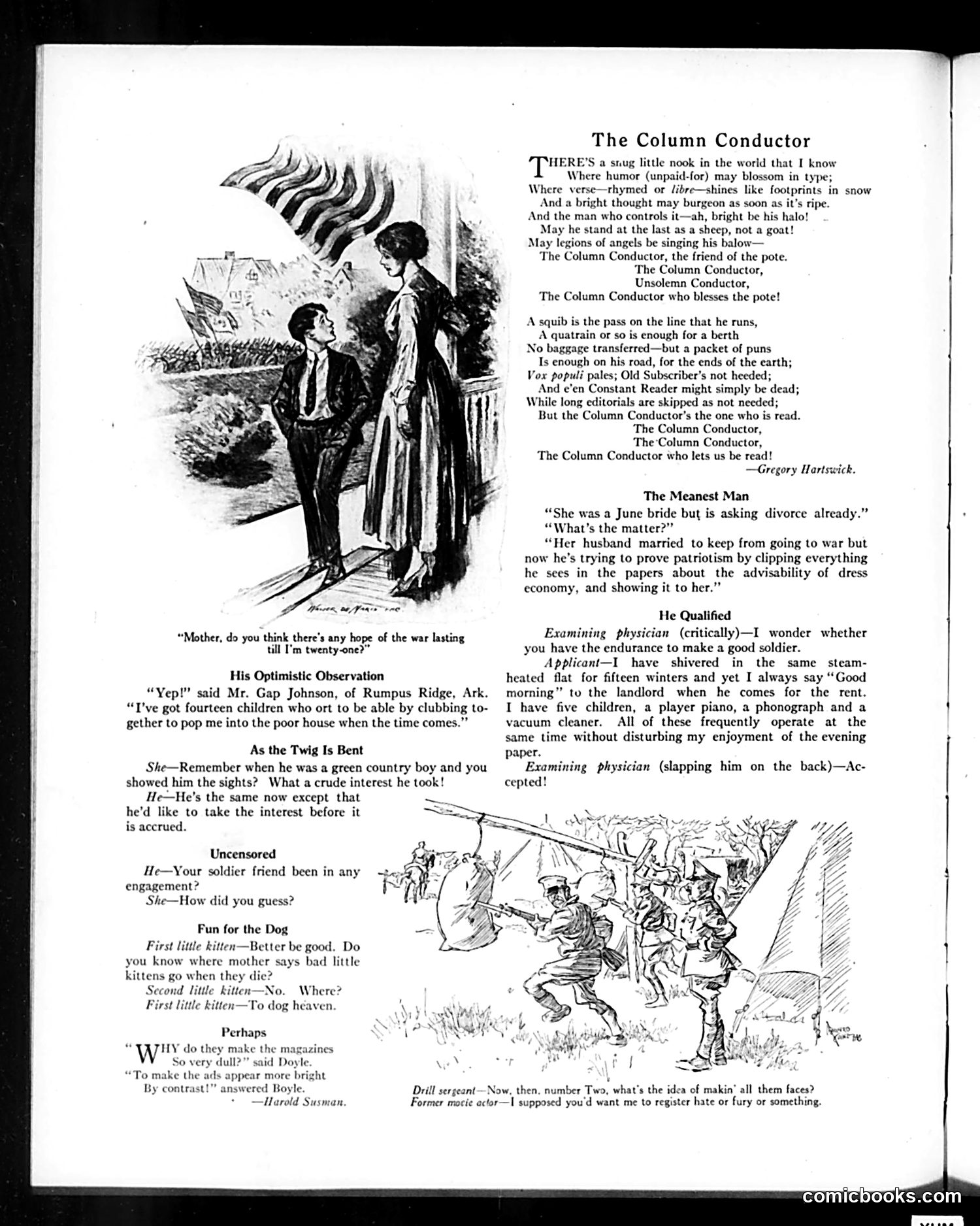
This page contains humorous short pieces and sketches rather than political cartoons. The main illustration shows two men in conversation near a fence, accompanying a poem titled "The Column Conductor" that celebrates the magazine's editorial column feature. Below are several brief satirical vignettes mocking wartime and social situations: a couple's hasty marriage ending in divorce, a husband clipping newspaper economy articles to prove patriotism to his wife, and a physician questioning a recruit's fitness for military service despite hardships endured. The bottom section includes military humor (an officer directing soldiers) and wordplay jokes about dogs and magazine advertising practices. The content reflects WWI-era American domestic concerns—hasty wartime marriages, women's roles, military recruitment standards—presented as light satirical humor rather than serious political commentary.
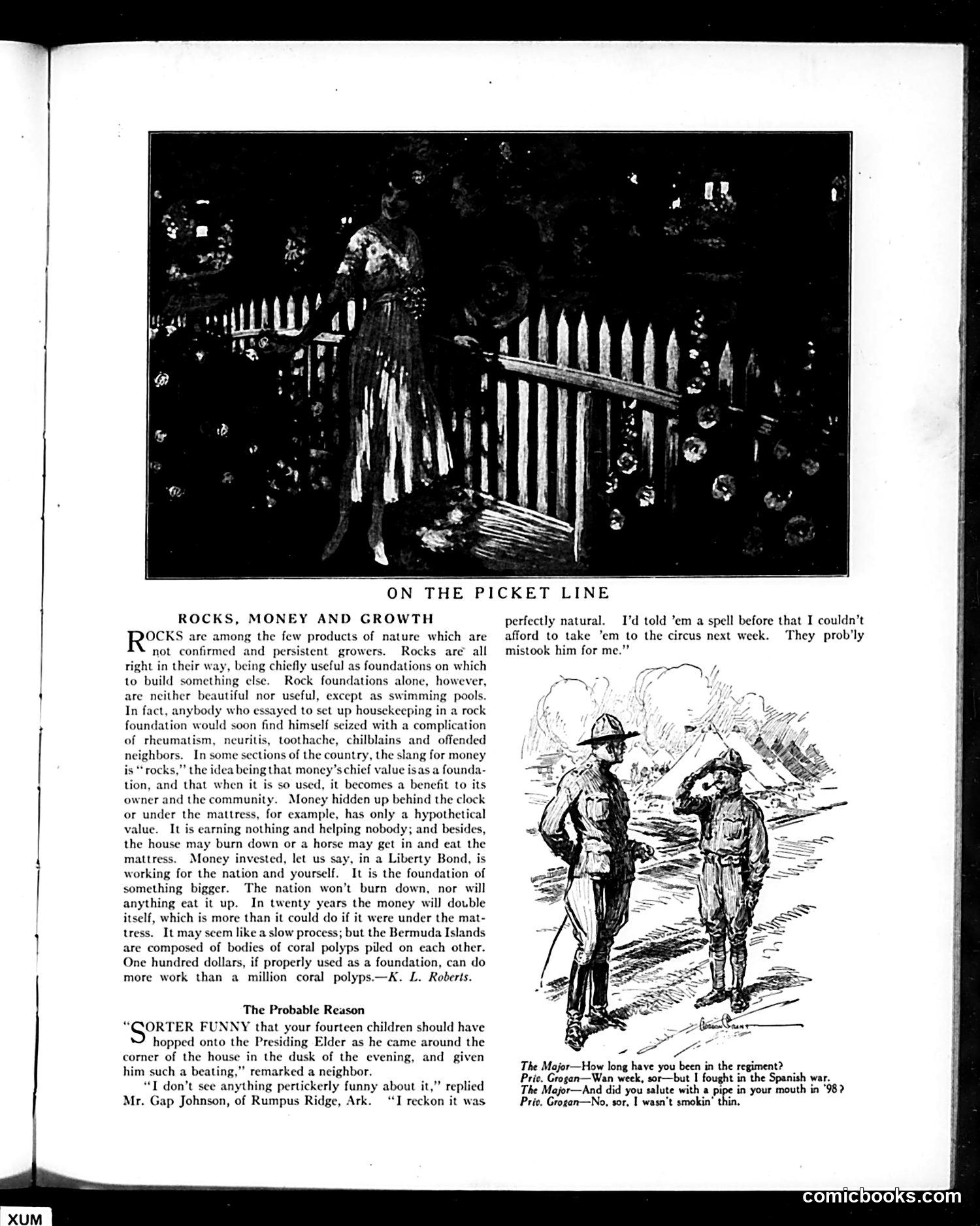
This page contains three distinct humor pieces rather than political cartoons: **"Rocks, Money and Growth"**: An essay-length argument promoting Liberty Bonds (WWI-era U.S. war bonds) as investments. The metaphor compares money to coral polyps—individually small, but cumulatively powerful when invested productively rather than hidden away. This is wartime propaganda dressed as financial advice. **"The Probable Reason"**: A rural dialect joke about Mr. Gap Johnson of Arkansas. His fourteen children beat up the Presiding Elder (a church official), mistaking him for their father in the dark. The humor relies on stereotypes about rural poverty, large families, and physical violence as entertainment—typical of Judge's condescending urban perspective on rural America. **Military Jokes**: Brief exchange jokes about a soldier's regiment service, emphasizing the absurdity of military protocol. The overall tone reflects early 20th-century American magazine humor: promoting war bonds, stereotyping rural people as violent and ignorant, and mocking military formality.
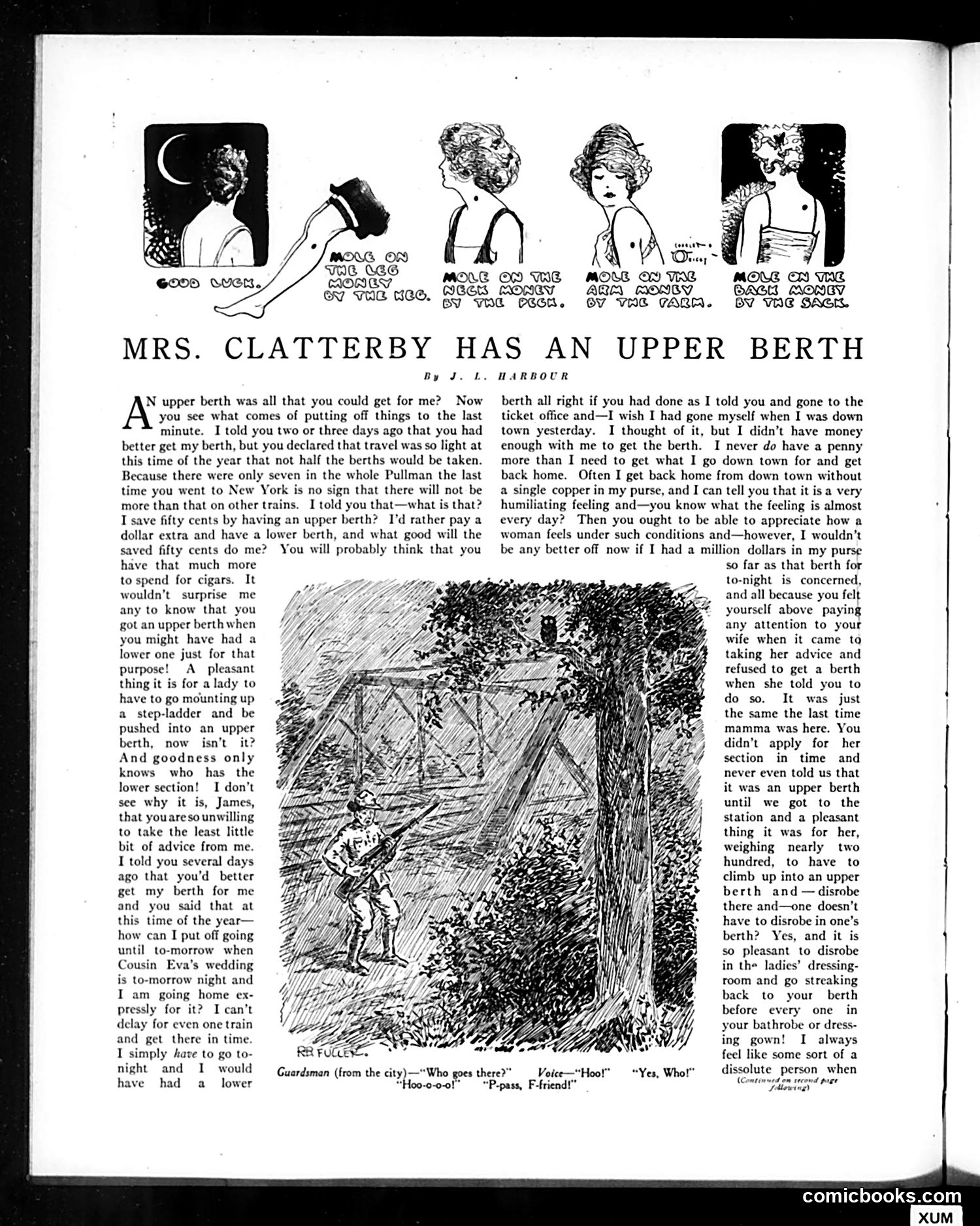
This domestic humor piece satirizes nagging wives and henpecked husbands—a common Judge magazine theme. Mrs. Clatterby berates her husband James for failing to book a lower berth on a Pullman train for an urgent trip to cousin Eva's wedding. She catalogs his incompetence: ignoring her advance warnings, prioritizing fifty cents savings over her comfort, and repeating the mistake from his mother-in-law's visit. The satire targets both parties: James's passivity and penny-pinching stubbornness, but primarily Mrs. Clatterby's relentless, exhausting complaints about the indignity of climbing into an upper berth and undressing publicly. The accompanying illustration shows a train guard and passengers, emphasizing the social embarrassment of her predicament. The joke assumes readers find marital conflict and female shrewishness inherently comedic.
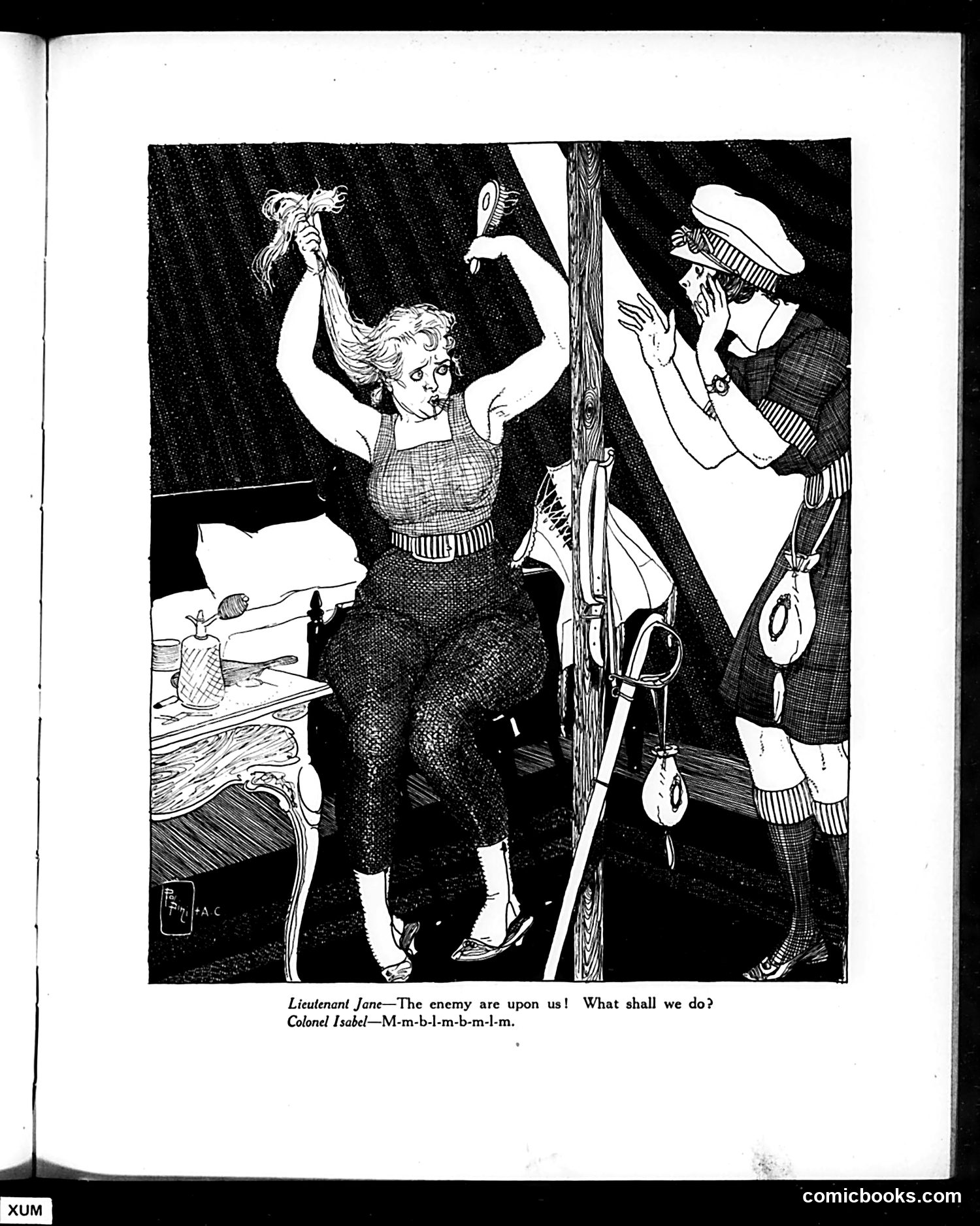
This appears to be a WWI-era satirical cartoon mocking women in military auxiliary roles. "Lieutenant Jane" and "Colonel Isabel" are fictional female military figures—likely references to actual women's military service organizations that emerged during World War I (such as the Women's Army Auxiliary Corps). The humor is in "Colonel Isabel's" response: "M-m-b-l-m-b-m-l-m"—nonsensical stammering presented as military authority. The satire ridicules the notion of women commanding troops, suggesting they're incompetent or panic-stricken under pressure. The scene shows them in a tent with weapons, suggesting combat readiness. This reflects period anxieties about gender roles and women's participation in traditionally male military domains. The cartoon uses mockery to delegitimize women's military service.
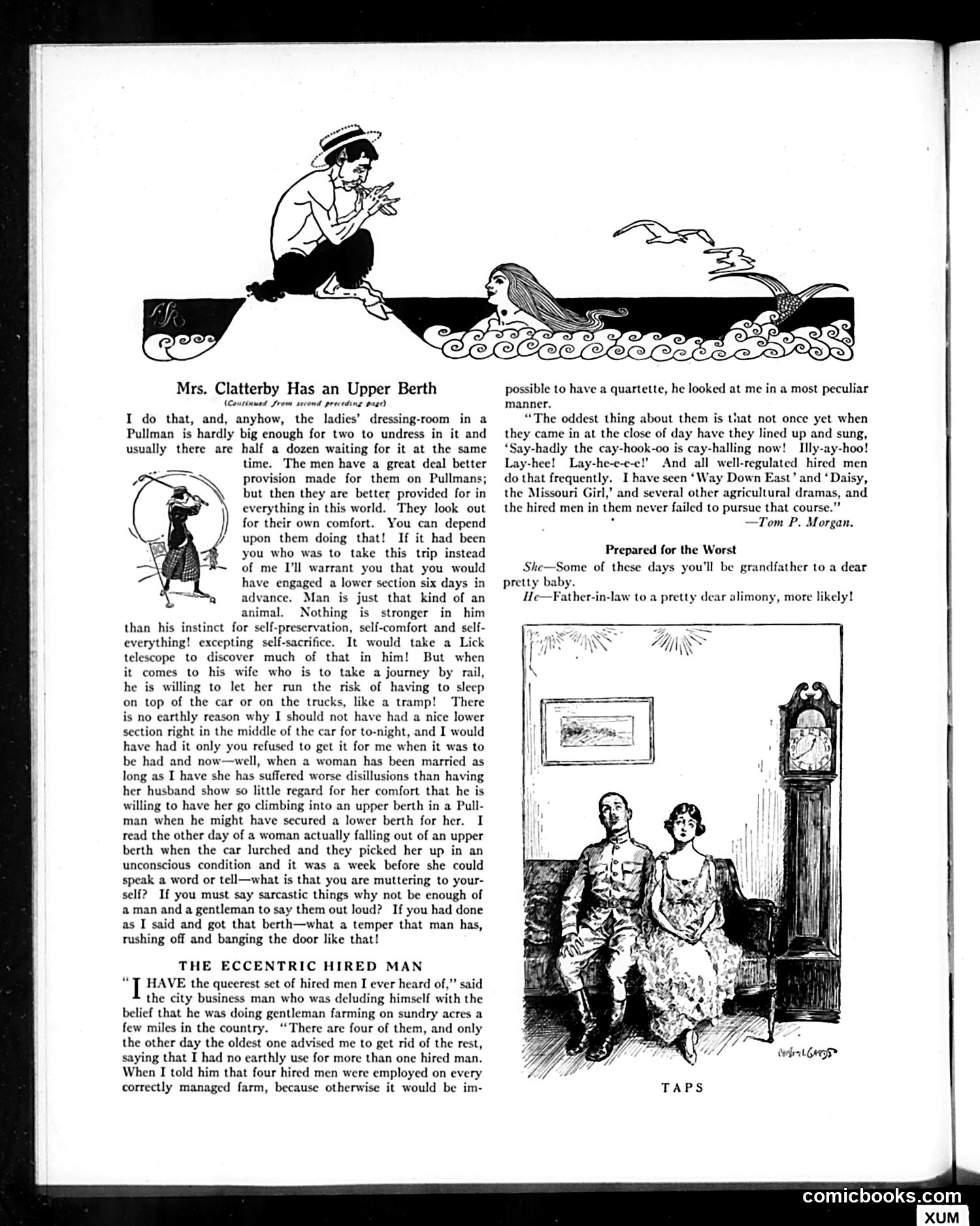
This page contains three separate satirical pieces lampooning early 20th-century American domestic and rural life. **"Mrs. Clatterby Has an Upper Berth"** mocks a complaining wife on a Pullman train, presenting her as ungrateful and nagging toward her husband. The satire targets both her constant grievances and—implicitly—the era's gender dynamics where husbands controlled accommodations. **"The Eccentric Hired Man"** ridicules a city businessman attempting "gentleman farming" who expects hired workers to perform like theatrical farmhands—specifically, to sing folk songs like those from popular plays ("Way Down East," "Daisy, the Missouri Girl"). The joke exposes the gap between sentimental rural stereotypes and actual farm labor. **"Prepared for the Worst"** is a brief joke about marriage cynicism: a man expects to become a father-in-law to alimony payments rather than a grandfather, suggesting pessimism about modern marriages and divorce. All three pieces use satire to critique American social pretension, gender relations, and the divorce culture emerging in the 1910s-20s.
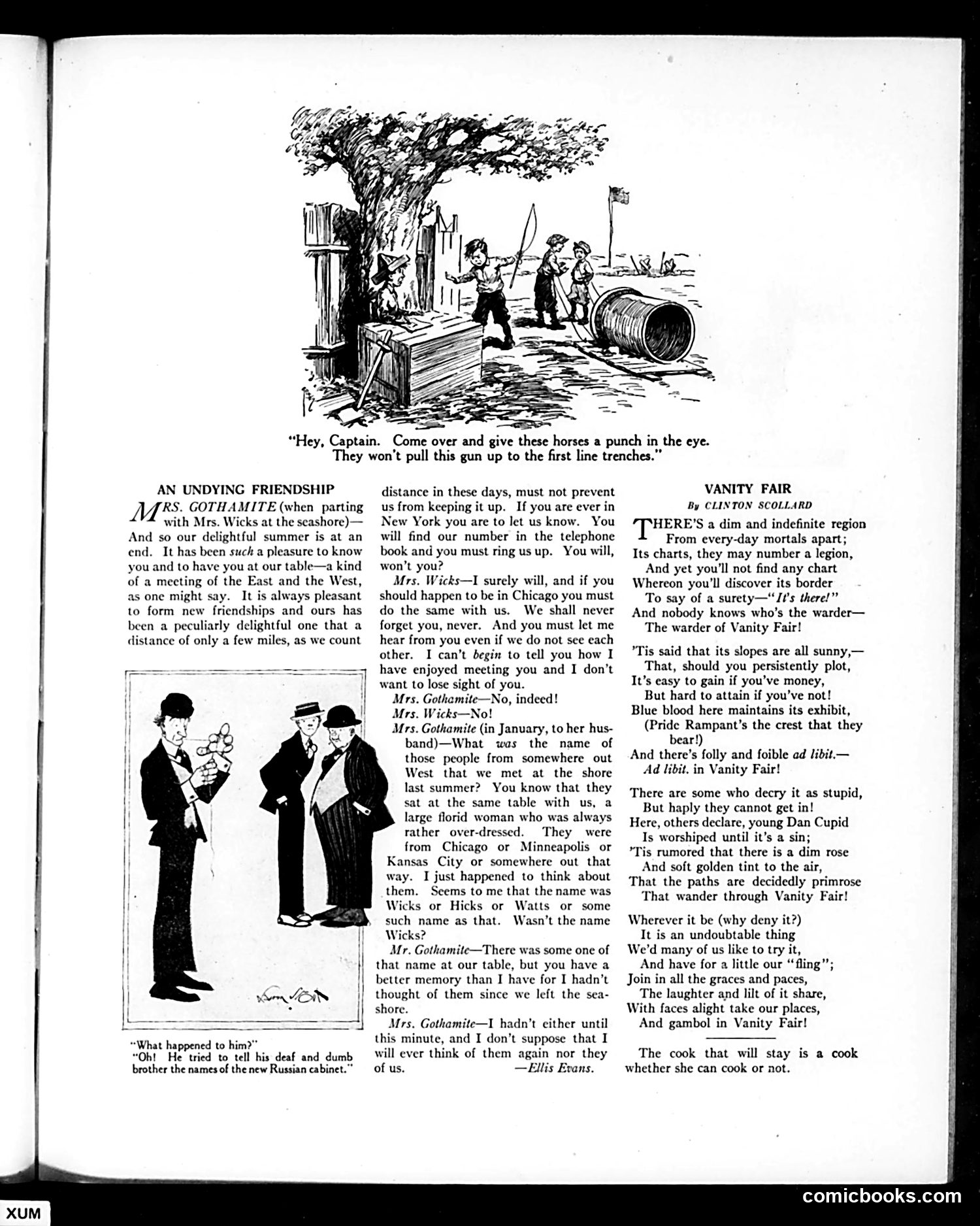
**Top Cartoon**: A WWI-era joke mocking incompetence. A military officer is asked to punch horses to make them pull a cannon to the front trenches—absurd logic suggesting either the officer's stupidity or the desperate, illogical nature of war itself. **Main Story "An Undying Friendship"**: Social satire on shallow upper-class relationships. Two women (Mrs. Gothamite from New York and Mrs. Wicks from the Midwest) tearfully promise eternal friendship at summer's end, swearing to stay in touch. By January, Mrs. Gothamite has completely forgotten Mrs. Wicks's name and basic details about her. The satire targets the performative, forgettable nature of polite society friendships—genuine warmth evaporates once social convenience disappears. **Sidebar Joke**: A political gag about someone trying to describe the "new Russian cabinet" to a deaf-and-dumb person—likely referencing recent Russian political turmoil (possibly the 1917 Revolution era), making it inherently absurd to communicate. **"Vanity Fair" Poem**: Whimsical verse about an exclusive, aspirational social realm accessible only to the wealthy and well-connected—classic period class commentary.
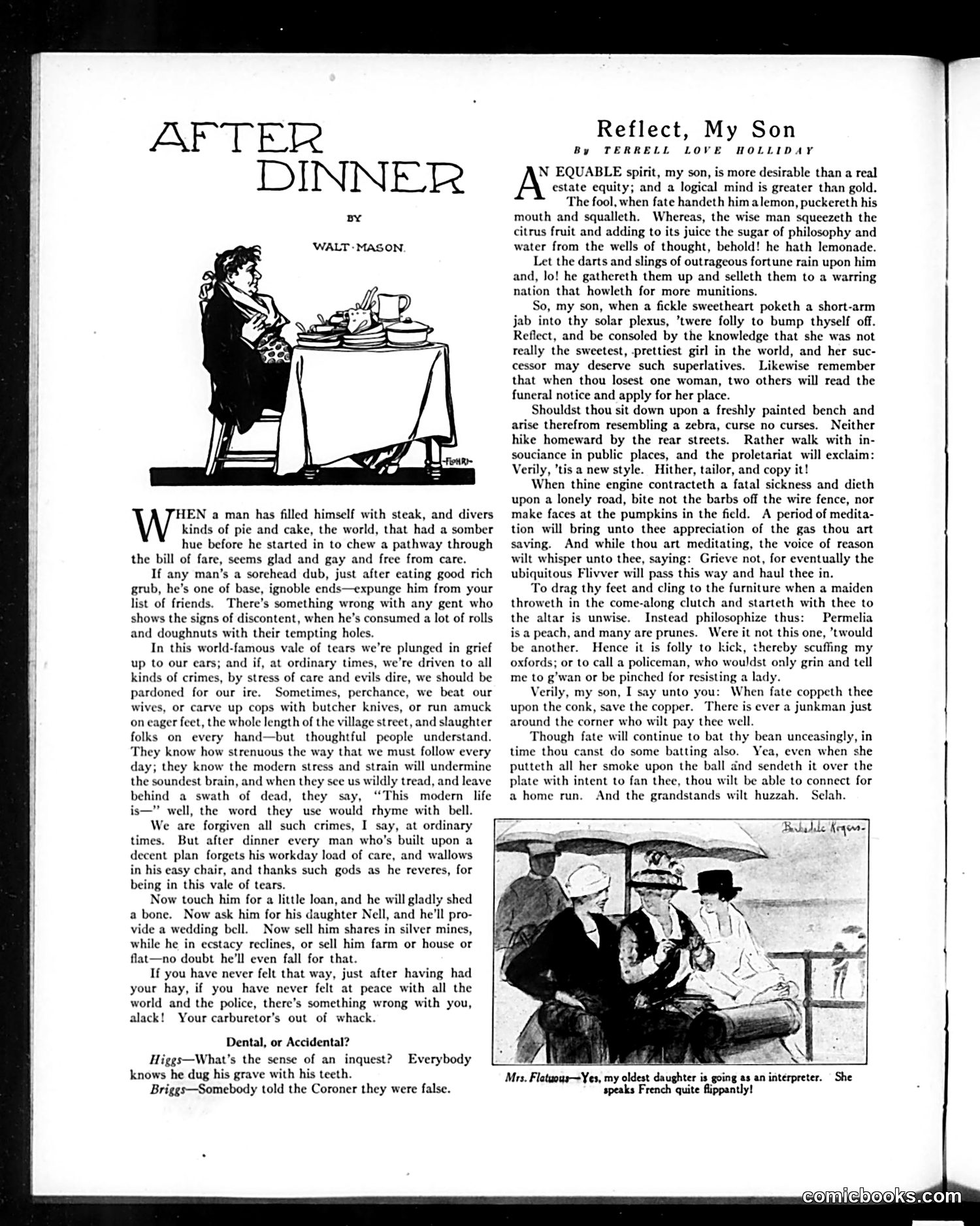
This page contains two humorous pieces from *Judge* magazine, likely early 20th century. **"After Dinner"** by Walt Mason is a comic poem about how a good meal transforms a man's mood and judgment. The accompanying illustration shows a satisfied diner. Mason argues that after eating well, men become generous, forgiving, and susceptible to poor financial decisions—they'll loan money, agree to weddings, or invest in dubious schemes. The joke satirizes the notion that a full stomach makes men foolish and easily manipulated, yet society excuses such behavior as natural to modern stress. **"Reflect, My Son"** by Terrell Love Holliday is mock-philosophical advice using archaic language ("behold," "'twere"). It humorously counsels emotional resilience through absurd situations: a rejected lover should remember other women exist, paint-stained clothes should be worn publicly without shame, and a broken-down car should inspire philosophical gratitude for fuel savings. The satire targets self-help sentimentalism by exaggerating stoic acceptance to ridiculous extremes.
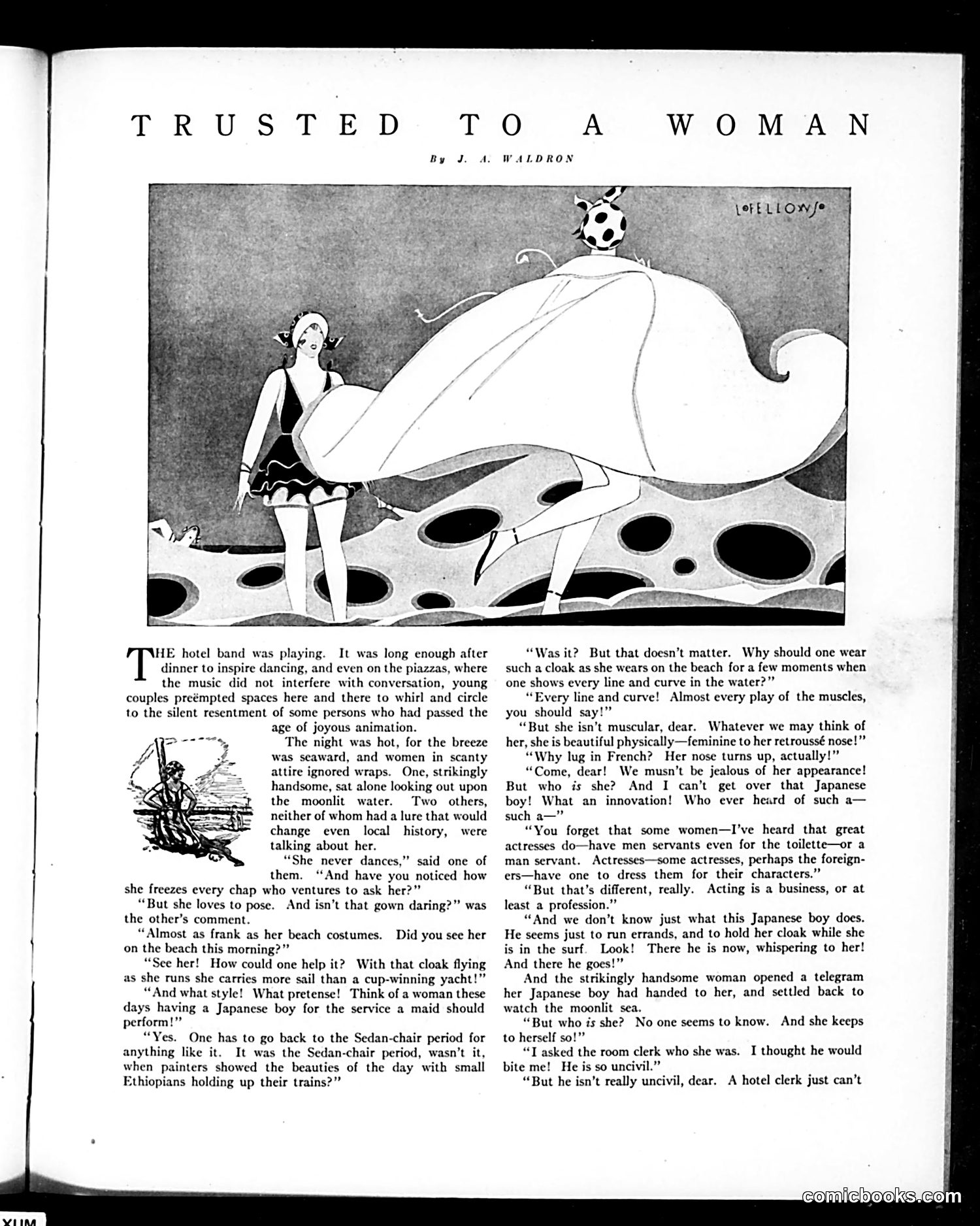
This satirical story critiques female vanity and social hypocrisy among the leisure class. A striking, mysterious woman at a seaside hotel scandalized guests by wearing revealing bathing attire and employing a Japanese boy as her personal attendant—an unconventional arrangement suggesting either wealth, eccentricity, or moral looseness. Two gossiping women mock her: she refuses to dance, poses dramatically in an daring cape, displays her physique, yet claims femininity. The satire targets their jealous moralizing—they're outraged she shows "every line and curve" in the water while exposing herself on the beach. The comparison to Sedan-chair era portraits (where aristocratic women were painted with Black servants) implies she's mimicking outdated pretension. The woman's mysterious telegram and self-contained demeanor suggest she's indifferent to their judgment, making the gossips' obsession with her appearance and unconventional choices the real target of ridicule.
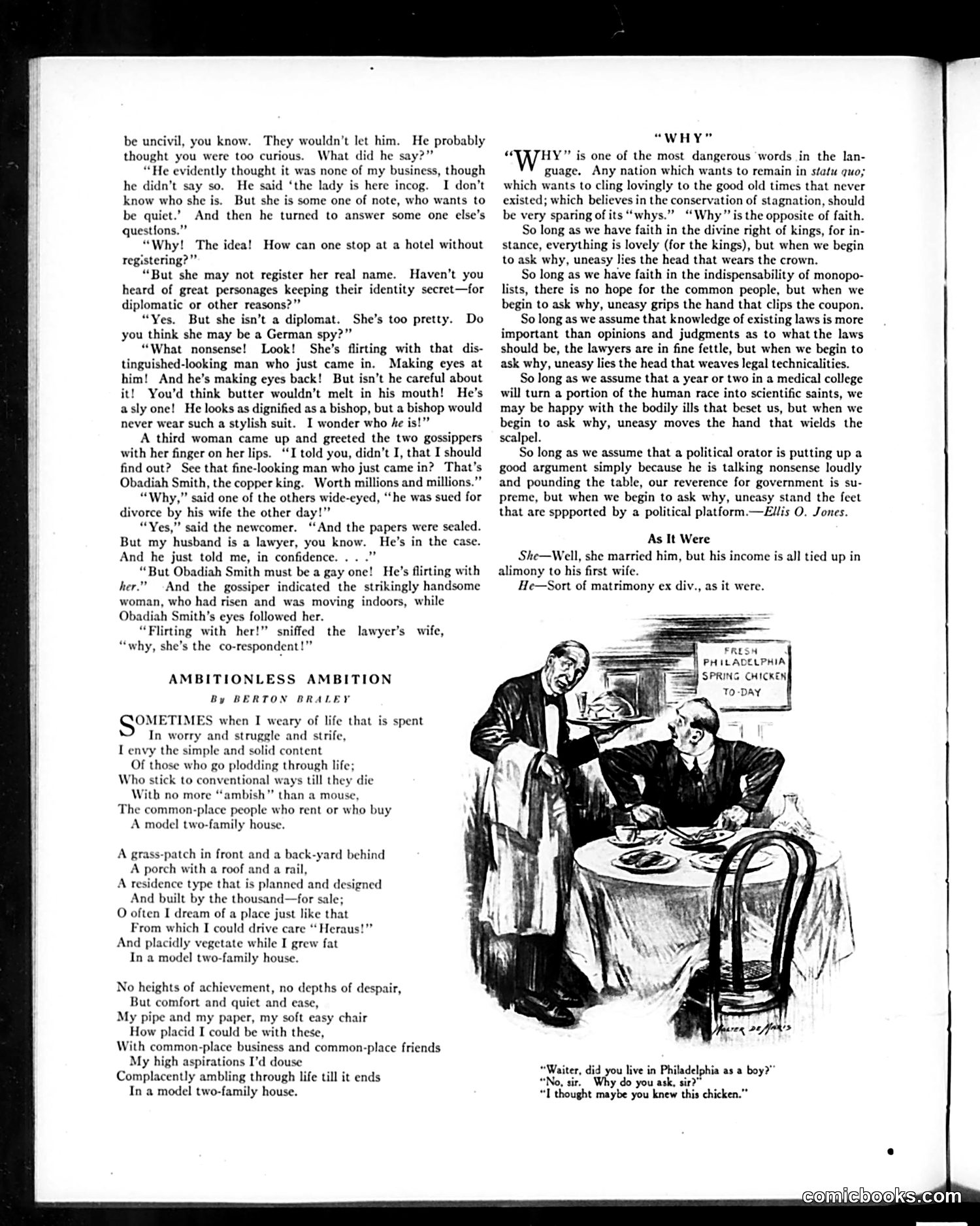
This page contains two distinct pieces of satirical content: **The Hotel Gossip Scene (top):** A cartoon depicting three women gossiping at a hotel about mysterious guests. They speculate that an unregistered woman might be a German spy, then identify a man as "Obadiah Smith, the copper king," a wealthy industrialist currently involved in a sealed divorce case. The humor targets upper-class scandal-mongering and the intrigue surrounding wealthy figures' private lives—particularly the mention of a "co-respondent" (the woman named in divorce proceedings), suggesting infidelity among the wealthy. **"Ambitionless Ambition" (poem by Berton Braley):** A satirical poem expressing ironic envy for the contentment of ordinary middle-class life—a modest two-family house, steady income, and freedom from ambition's struggles. The satire cuts both ways: mocking both the speaker's restless striving and the supposed simplicity of conventional domesticity. The illustrations and text together capture early 20th-century American anxieties about class, wealth, scandal, and the tension between ambition and contentment.
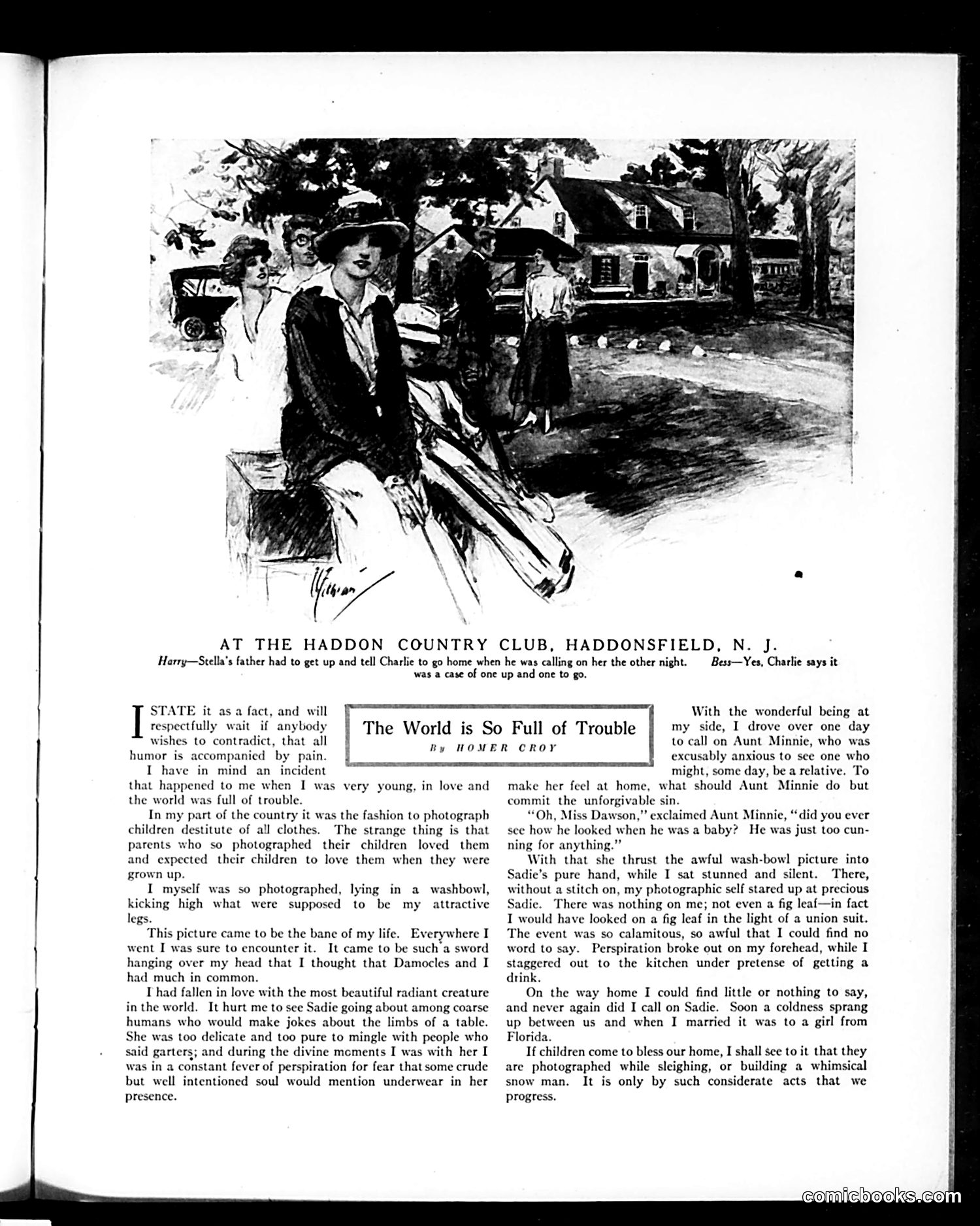
This page combines a social joke and a sentimental story about embarrassment and courtship from the early 20th century. **The cartoon** (top illustration) depicts a brief exchange at an exclusive country club. Harry reports that Stella's father had to interrupt Charlie's visit—a reference to the common practice of chaperonage and parental oversight of young unmarried couples. The phrase "one up and one to go" appears to be a sports or competitive reference Charlie uses to downplay the rebuke humorously. **The story** by Homer Croy satirizes overly protective courtship customs and parental embarrassment tactics. The narrator's childhood nude photograph—a period fashion among upper-class families—becomes a source of shame that destroys his romance. Aunt Minnie innocently produces this humiliating image while entertaining his girlfriend, causing mortification. The piece gently mocks both the absurd Victorian custom of photographing naked children and the narrator's prissy mortification over bodily matters.
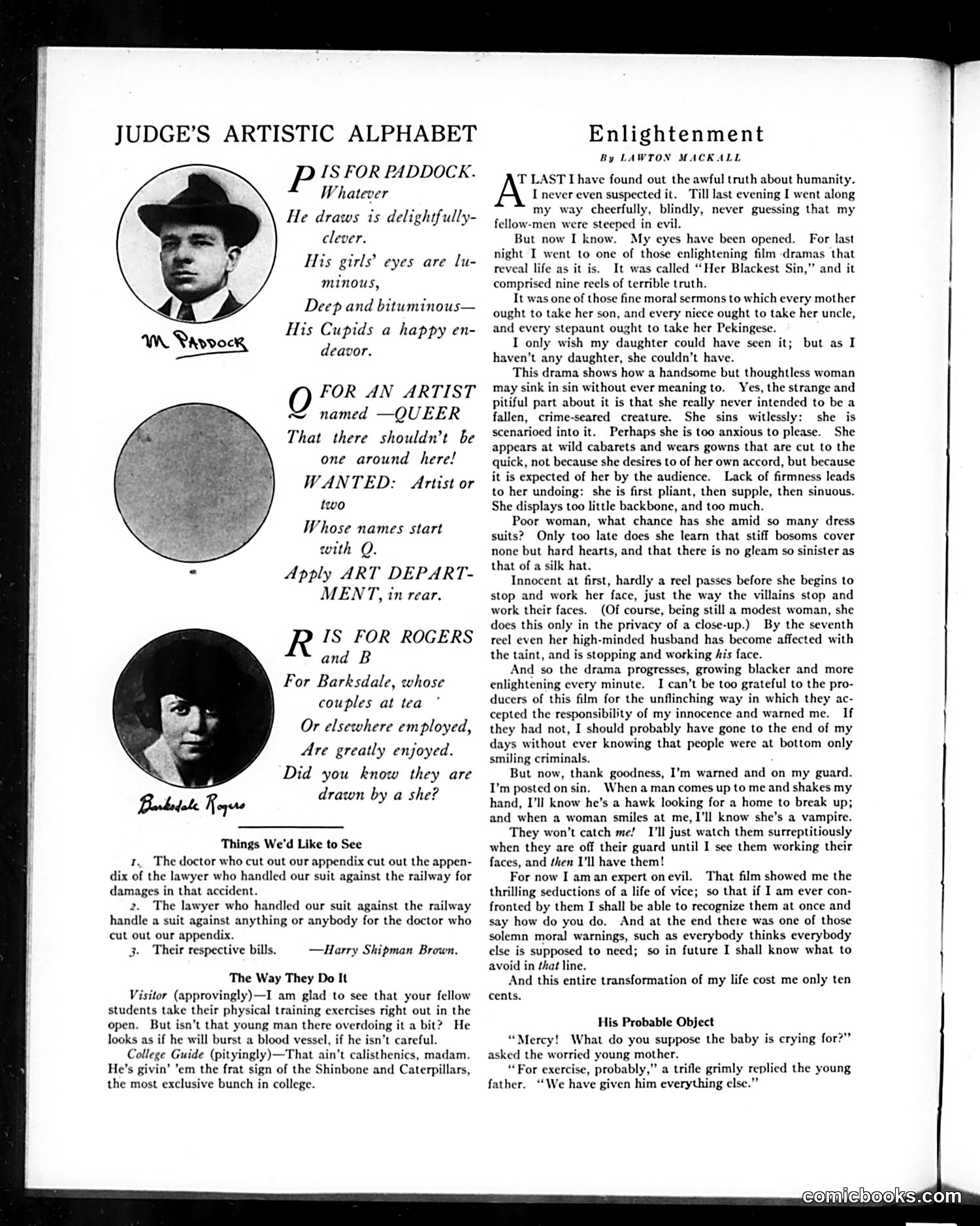
This page combines three satirical elements: **"Judge's Artistic Alphabet"** features caricatures of cartoonists M. Paddock, an unnamed "Q" artist (the joke being no notable artist's name starts with Q), and Barksdale Rogers. The humor mocks both the artists' work and the magazine's own alphabet feature—particularly the absurdity of struggling to fill entries for less common letters. **"Things We'd Like to See"** satirizes lawyer-doctor conflicts through bitter, circular logic: the appendix-removing doctor and the lawsuit-handling lawyer should switch roles, creating poetic irony around their respective incompetence and inflated bills. **"Enlightenment"** (main essay by Lawton Mackall) mocks melodramatic silent film morality plays. The author sardonically claims a film titled "Her Blackest Sin" "revealed" humanity's evil nature, though the heroine sins passively—pressured by fashion and social expectations rather than genuine vice. Mackall ridicules both the film's overwrought moralism and audiences who accept such heavy-handed "lessons" as genuine wisdom. The satire targets artistic mediocrity, professional absurdity, and cinema's sanctimonious pretense at moral instruction.
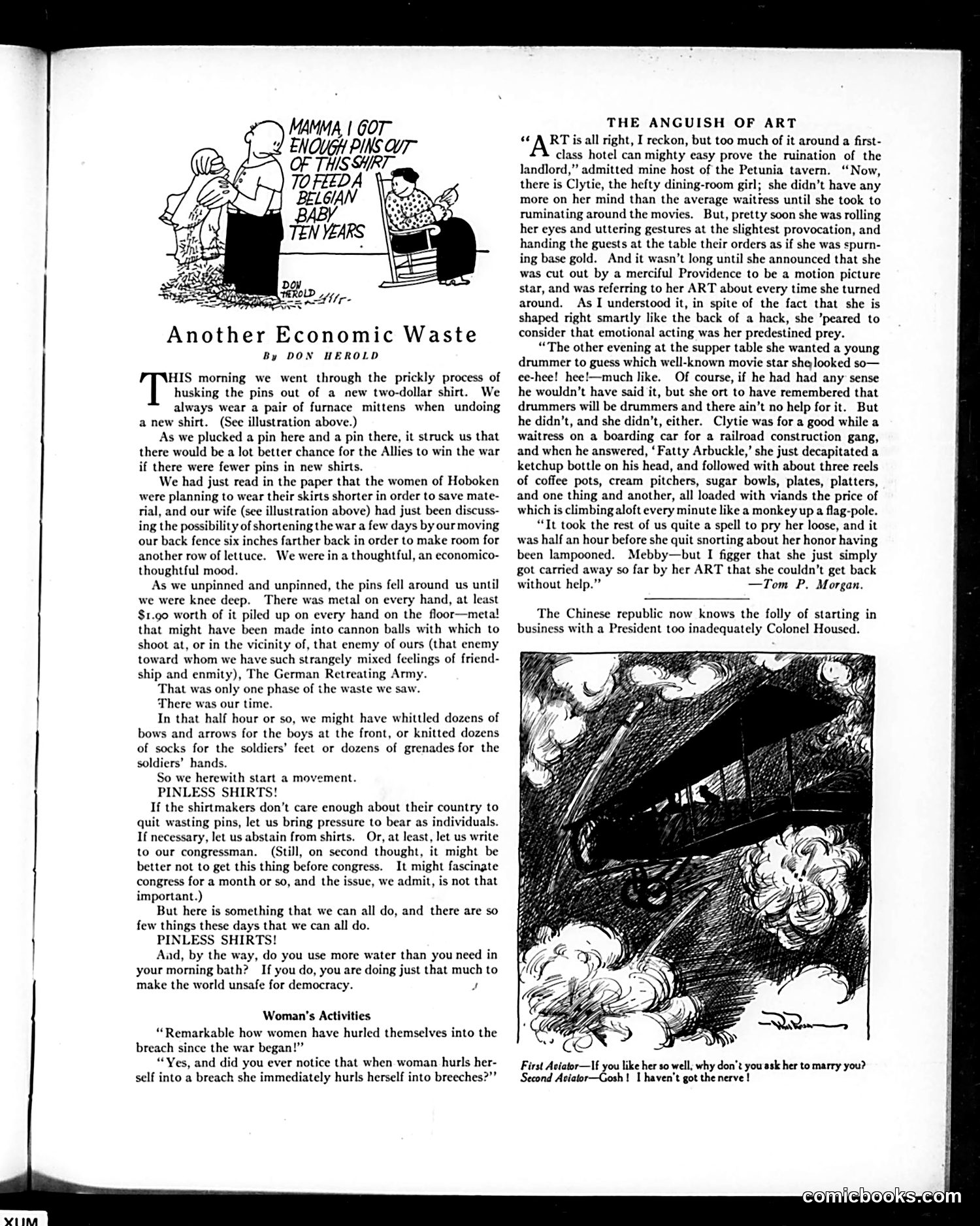
**Top Cartoon:** Depicts a family saving pins from a new shirt. The satire mocks wartime "conservation" efforts—the author notes the absurdity that women are shortening skirts to save fabric while people waste time unpinning shirts. The joke highlights how trivial, performative sacrifices distract from real war effort needs. **"Pinless Shirts" Campaign:** A tongue-in-cheek proposal to pressure shirt manufacturers into removing pins as a wartime conservation measure. The author sarcastically notes this is "something we can all do"—suggesting frustration with how ordinary citizens are offered only symbolic actions rather than meaningful contribution. **Bottom Section:** "Woman's Activities" contains a sexist pun about women entering the workforce ("breach") versus wearing men's clothing ("breeches"). "The Anguish of Art" mocks a waitress inspired by movies to adopt theatrical mannerisms and claim artistic aspirations—satirizing how cinema culture affects working-class women. All content reflects WWI-era concerns about resource conservation and social anxieties about changing gender roles.
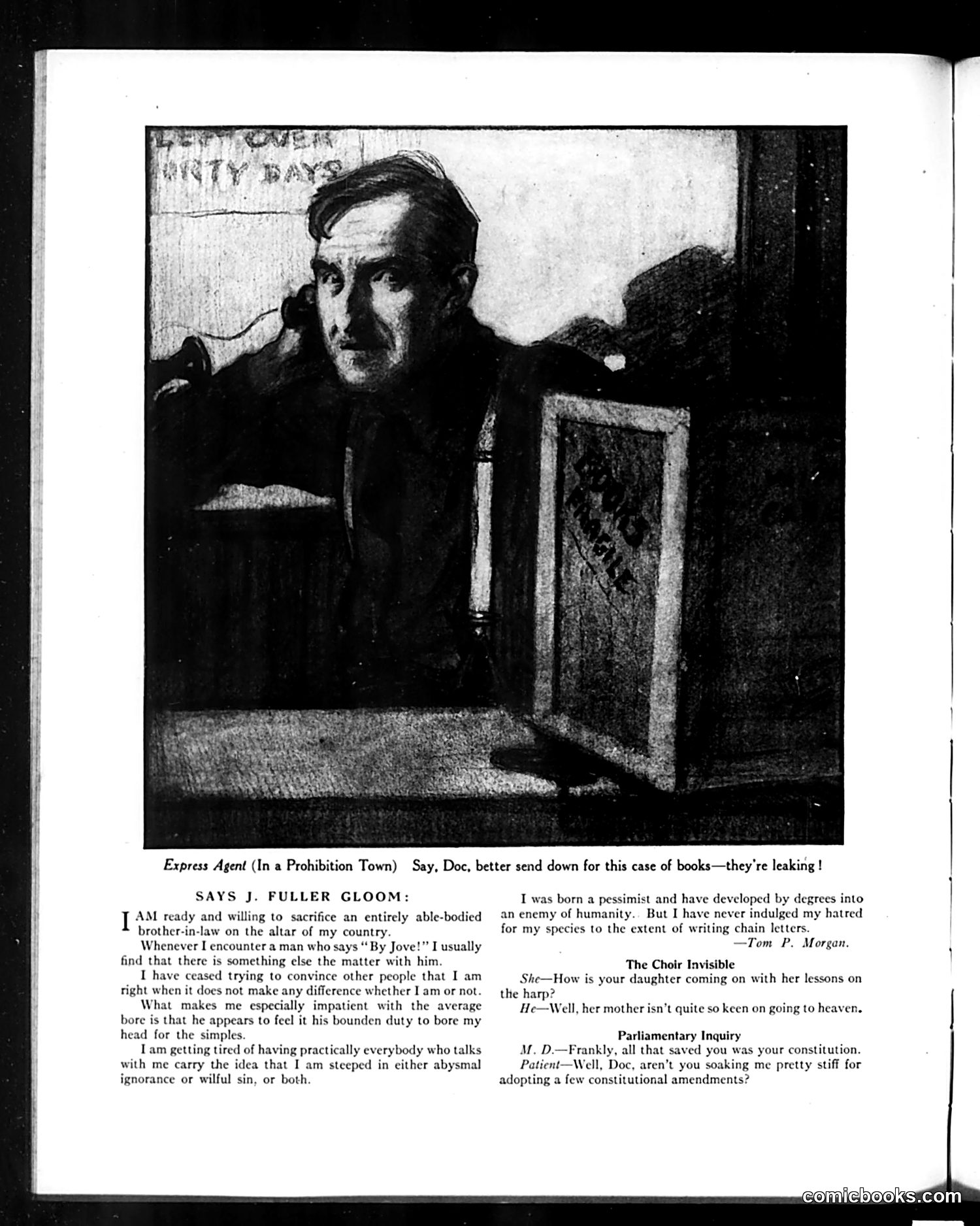
The main cartoon mocks **Prohibition enforcement** in America. An express agent suggests to a doctor that a shipment of "books" is "leaking"—an obvious euphemism. During Prohibition (1920-1933), illegal alcohol was commonly smuggled in disguised containers. The joke is that even in a "Prohibition Town," people find creative ways to circumvent the law, and the agent brazenly hints at this to a doctor, suggesting widespread complicity. The accompanying text pieces are cynical observations by "J. Fuller Gloom" and humorous short dialogues. "The Choir Invisible" jokes about heaven and religious hypocrisy. "Parliamentary Inquiry" plays on medical language—the patient quips that constitutional "amendments" (treatments) cost as much as adopting actual Constitutional amendments, satirizing inflated doctor fees. The overall tone is cynical commentary on American society, law enforcement, and human nature circa the Prohibition era.
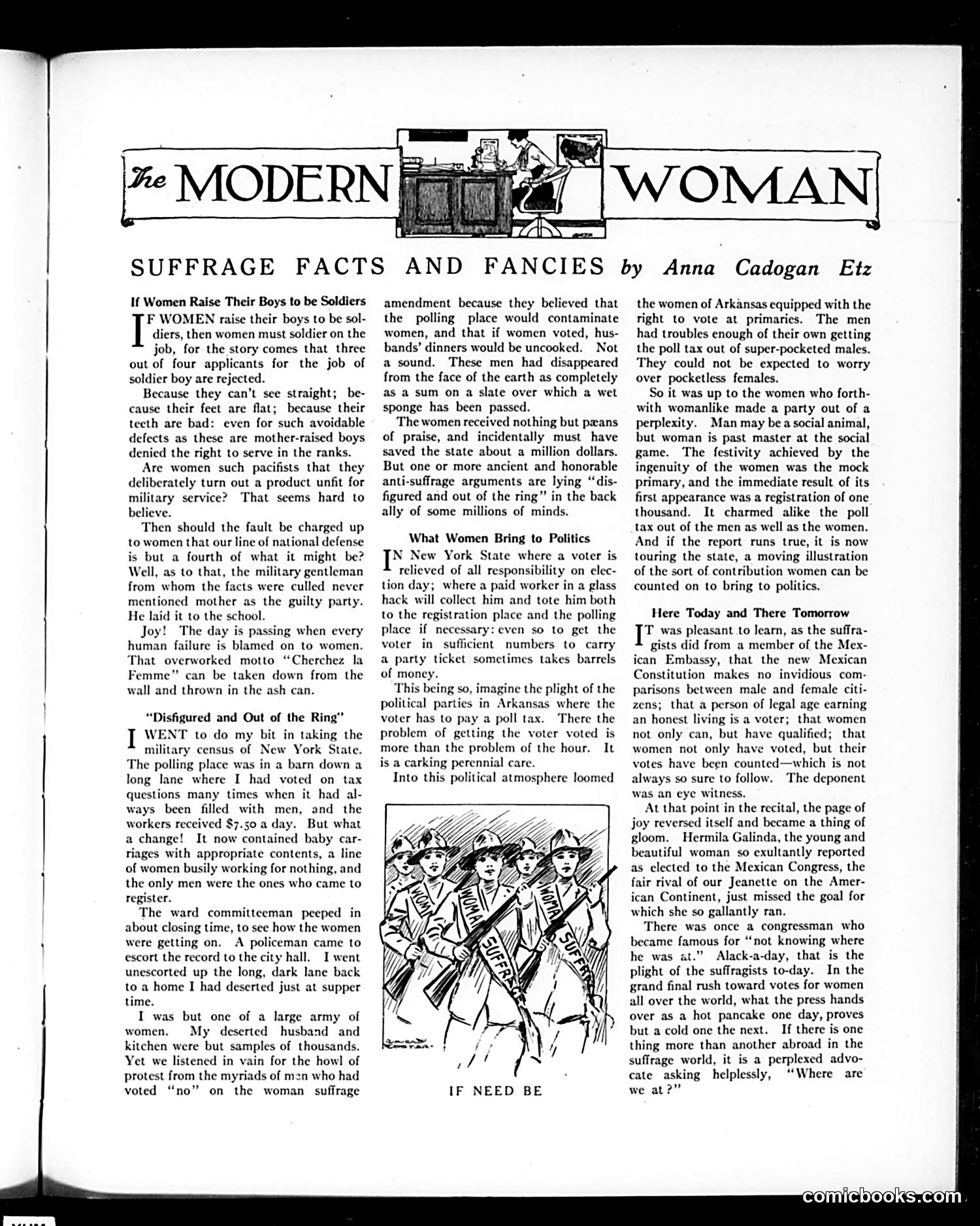
This page presents pro-suffrage arguments by Anna Cadogan Etz, countering anti-suffrage rhetoric through satire and anecdote. **Key arguments made:** 1. **"If Women Raise Their Boys to be Soldiers"**: Refutes the claim that mothers are responsible for military unreadiness. Three of four soldier applicants are rejected for physical defects—but the military source blamed *schools*, not mothers, demolishing the anti-suffrage argument that women inevitably fail at civic duties. 2. **"Disfigured and Out of the Ring"**: The author describes working as a census-taker during voting registration. Women volunteer unpaid, men who voted *against* suffrage (fearing it would ruin dinners and domestic life) mysteriously vanish—their objections proven false by women's competent participation. 3. **"What Women Bring to Politics"**: In Arkansas, where poll taxes burden male voters, women voting in primaries become political assets, organizing voter participation through social ingenuity—proving women strengthen rather than weaken politics. **The satire**: Anti-suffrage arguments about women's incompetence are demolished by real-world evidence of female competence and civic contribution.
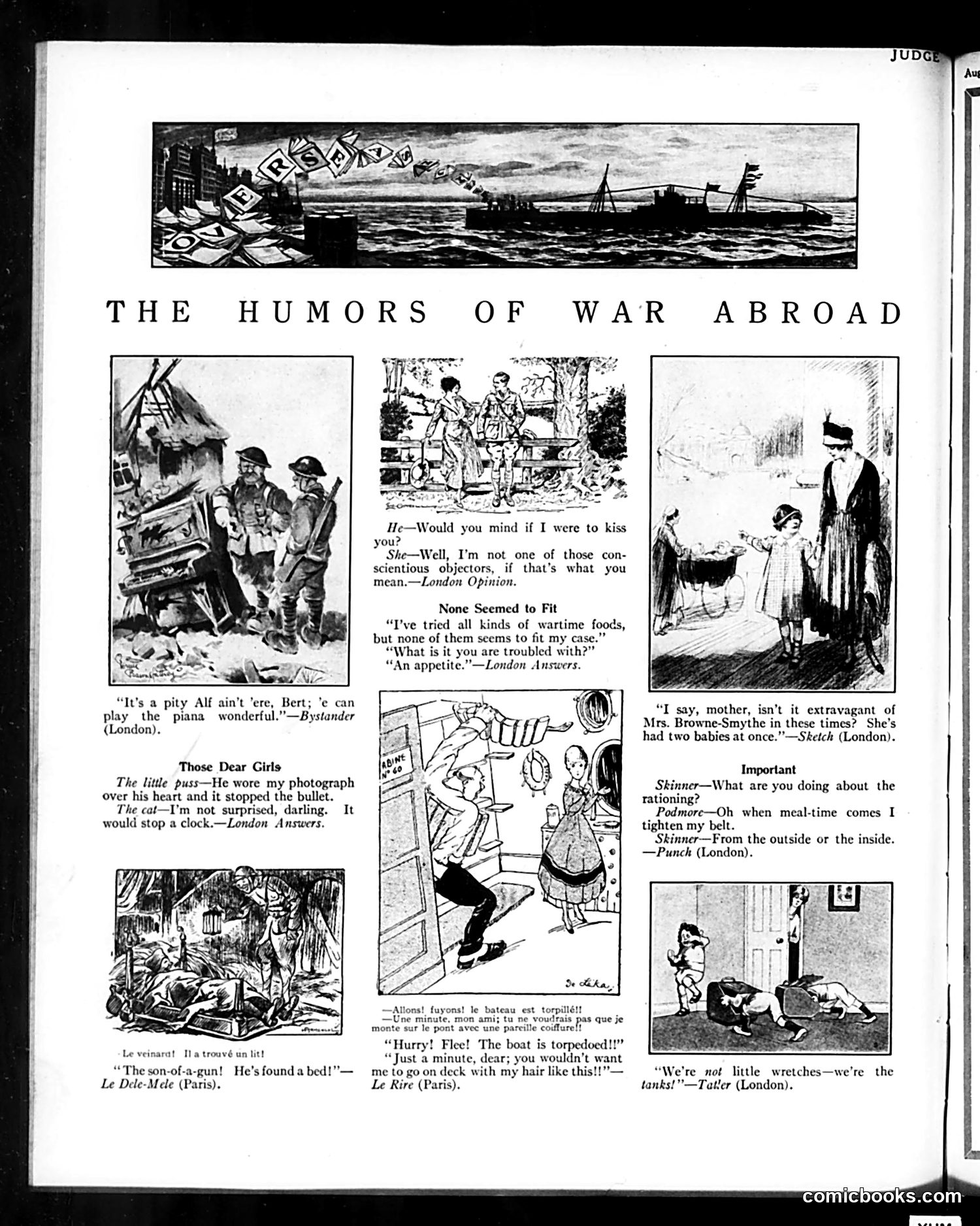
This page collects satirical cartoons and jokes from various British and French publications during World War I, all addressing wartime hardships with dark humor. The jokes mock domestic wartime challenges: food rationing and poor appetite, conscription-related anxieties, and the absurdities of maintaining appearances during crisis. One cartoon shows a woman prioritizing her hair over evacuating a torpedoed ship—satirizing vanity amid danger. The French cartoons similarly address naval warfare and rationing. Several jokes play on double meanings: a soldier's photograph "stopping a bullet" becomes a clock-stopping joke; belt-tightening for rationing becomes ambiguous about literal versus figurative action. The final cartoon's caption "We're not little wretches—we're the tanks" likely references newly-deployed tank technology, with children either mistaken for or comparing themselves to this military innovation. These represent *Judge* magazine's satirical approach: using humor to process shared civilian and military wartime anxieties across Allied nations.
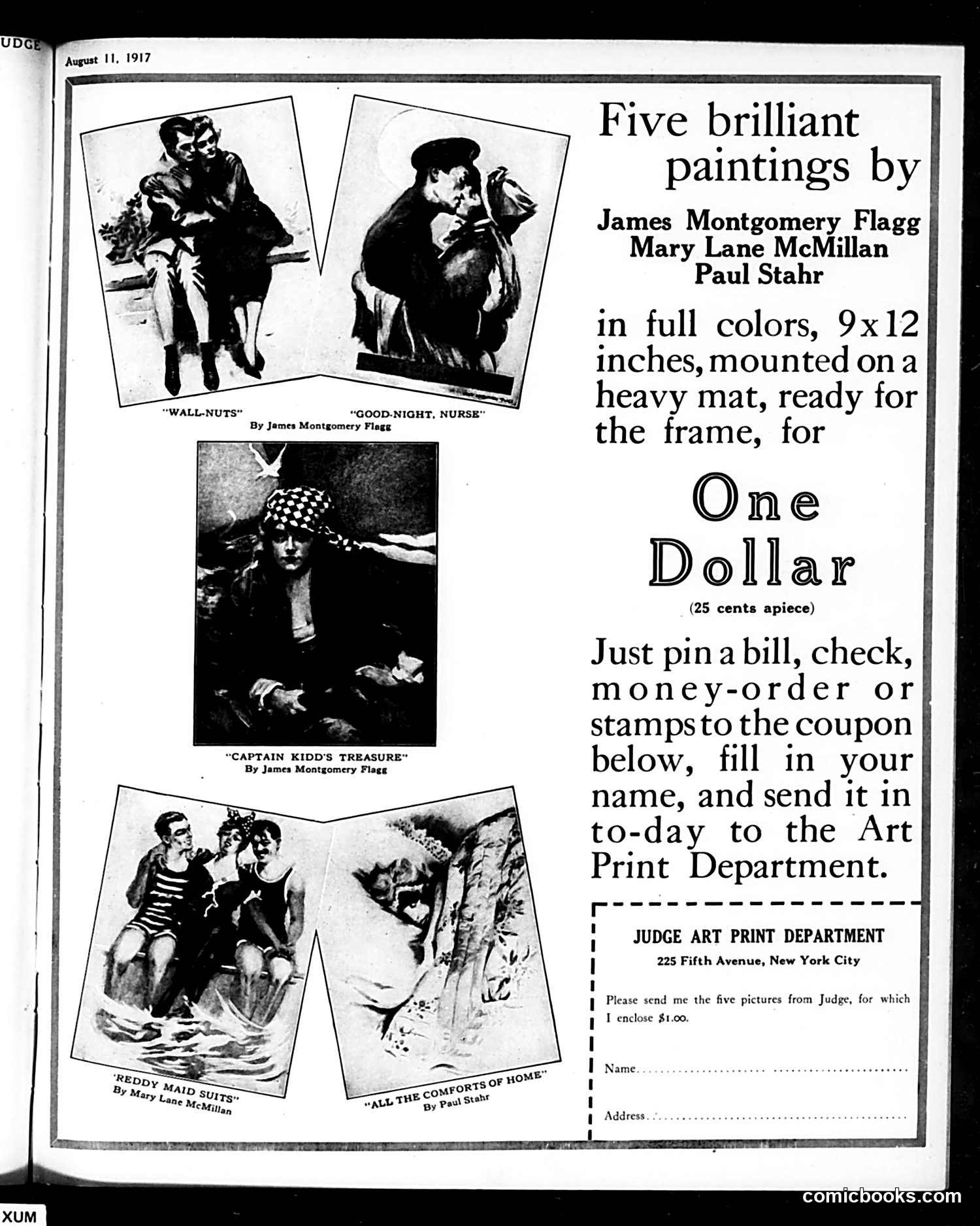
This is primarily an **advertisement**, not political satire. Judge's Art Print Department is selling five color paintings by prominent illustrators—James Montgomery Flagg, Mary Lane McMillan, and Paul Stahr—for one dollar total (25 cents each). The reproduced artworks shown include titles like "Wall-Nuts," "Good-Night Nurse," "Captain Kidd's Treasure," "Reddy Maid Suits," and "All the Comforts of Home." These appear to be humorous genre scenes typical of early 20th-century American illustration. The page functions as a mail-order solicitation: readers clip the coupon, enclose payment (bill, check, or money order), and send it to Judge's New York office to receive framed prints. This represents how magazines of this era generated revenue by selling reproductions of artwork to readers seeking affordable home decoration.
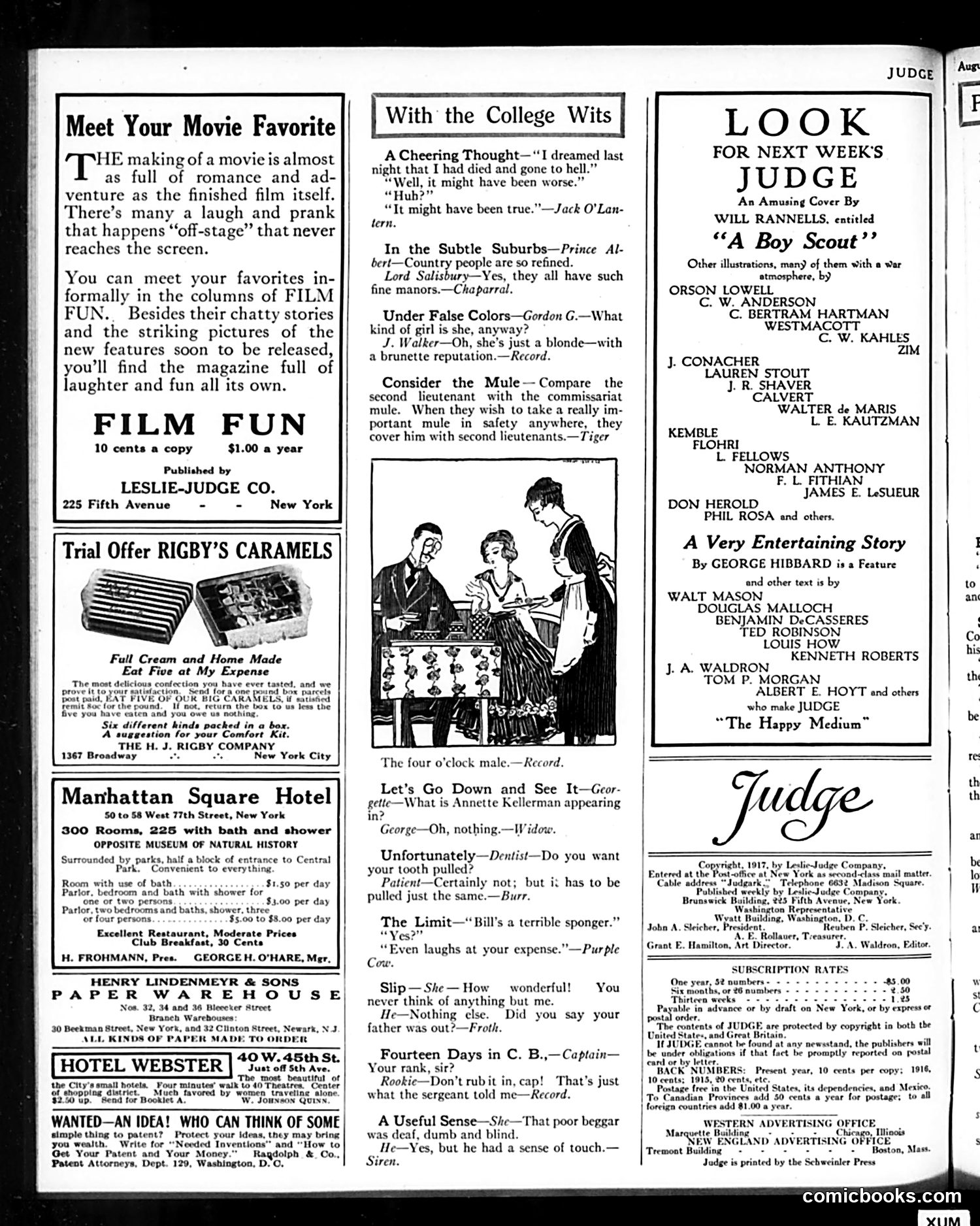
This is primarily **a magazine contents and advertising page** from Judge (appearing to be 1917 based on references). The central cartoon is a single small illustration showing three figures in what appears to be a domestic interior scene—likely an example of the humor content found in the magazine. The page showcases advertising (hotels, patent services, caramel candy) alongside promotional material for Judge itself and its competitor *Film Fun*. Most of the actual humor content consists of short, pithy college-style jokes labeled "With the College Wits"—brief quips on conventional topics (spongers, romance, dentists, military life). The single cartoon doesn't present specific political satire; rather, it represents the general comedic illustration style of the era. The page functions primarily as a **promotional/advertising tool** introducing readers to Judge's content and encouraging subscriptions, rather than presenting coherent satirical commentary on identifiable contemporary figures or events.
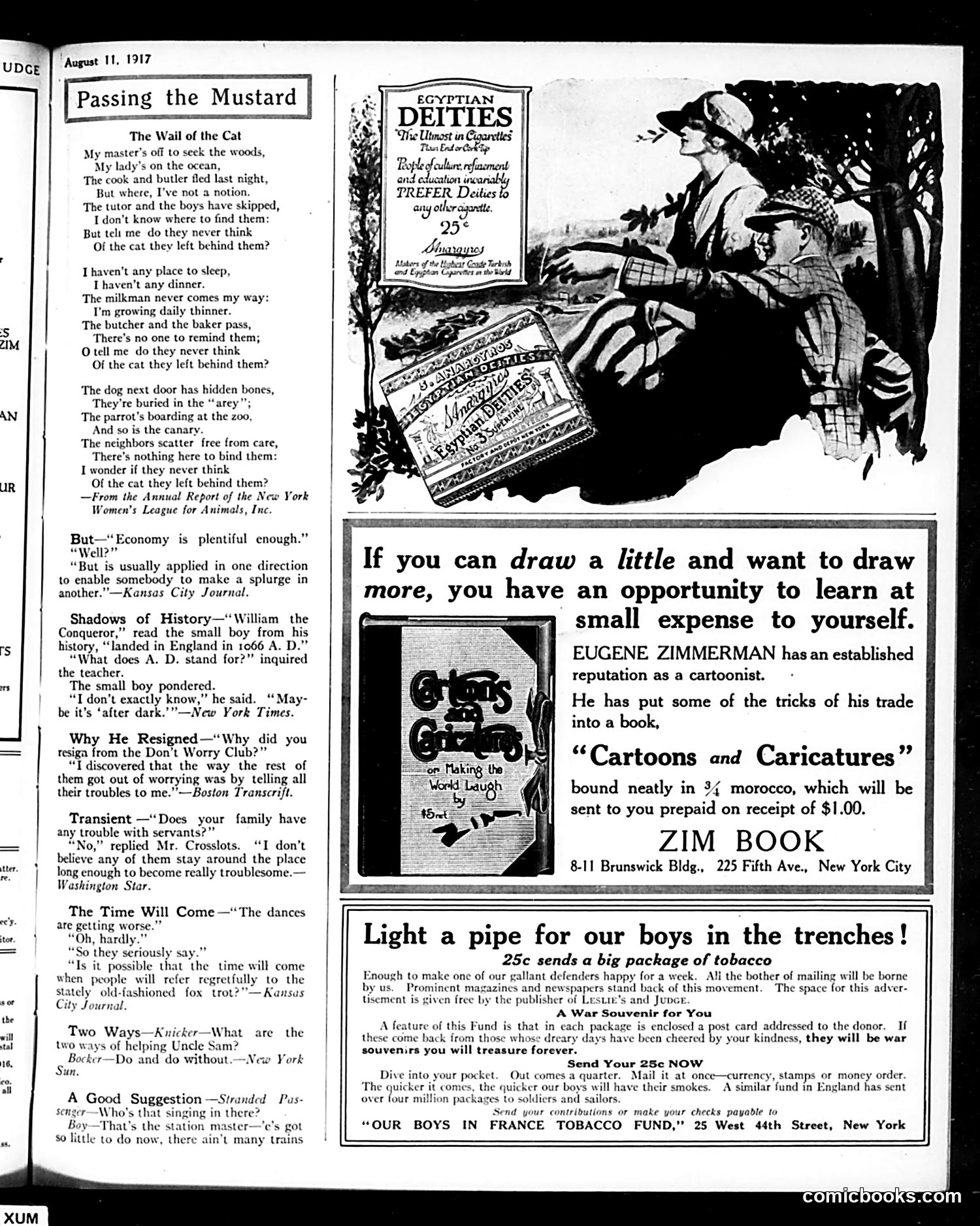
This page combines satirical commentary on wartime life with period advertising. The main poem "Passing the Mustard: The Wail of the Cat" humorously depicts abandoned household pets during WWI, when families dispersed due to war—servants enlisted, men went to war, women took war work. The cat's lament about forgotten dependents likely satirizes broader anxieties about wartime displacement and duty. The short jokes address typical wartime concerns: servant shortages, rationing ("do without"), and changing social norms (foxtrots versus traditional dances). Notably, the advertisements reflect the war effort: a tobacco fund solicits donations to send smokes to soldiers "in the trenches," and a cigarette ad promotes "Egyptian Deities" brand. The Eugene Zimmerman cartooning instruction book offers civilian instruction during wartime. The page reflects 1917 America adjusting to full WWI involvement, mixing domestic humor with patriotic fundraising appeals.
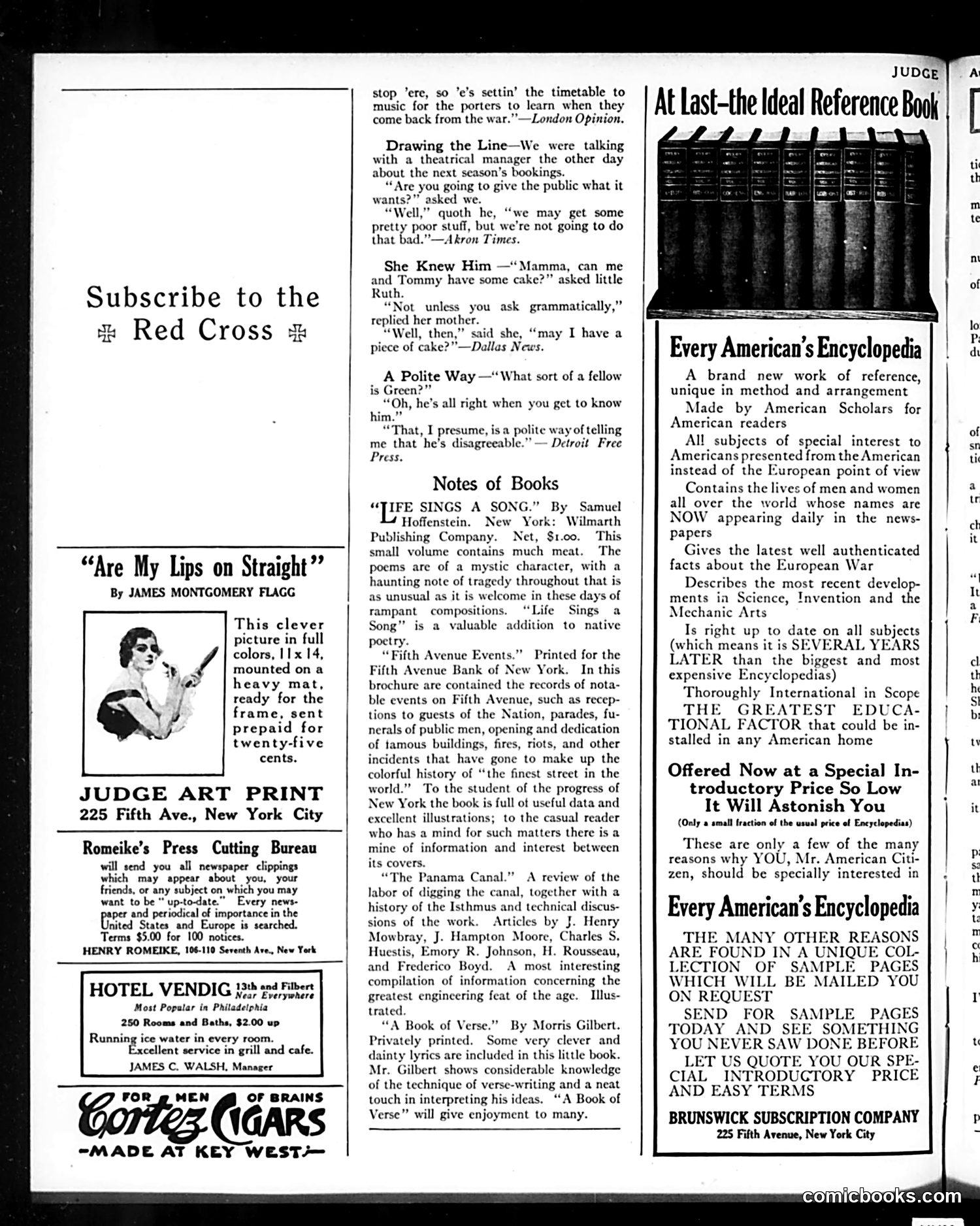
This is primarily an **advertising and miscellaneous content page** rather than a satirical cartoon page. The dominant feature is a large advertisement for "Every American's Encyclopedia," positioned as a new reference work created by American scholars specifically for American readers—notably emphasizing the American rather than European perspective, likely reflecting post-WWI nationalism. The page also includes: - A small James Montgomery Flagg art print advertisement ("Are My Lips on Straight") - Several brief humorous anecdotes under "Notes of Books" (jokes about grammar, politeness, and theatrical bookings) - Book reviews - Advertisements for hotels, press clipping services, and cigars The only cartoon-like element is the Flagg image—a portrait of a woman checking her lipstick. The scattered jokes reflect typical early-20th-century mild humor rather than sharp political satire. This appears to be a filler/advertising-heavy issue rather than a politically substantive one.
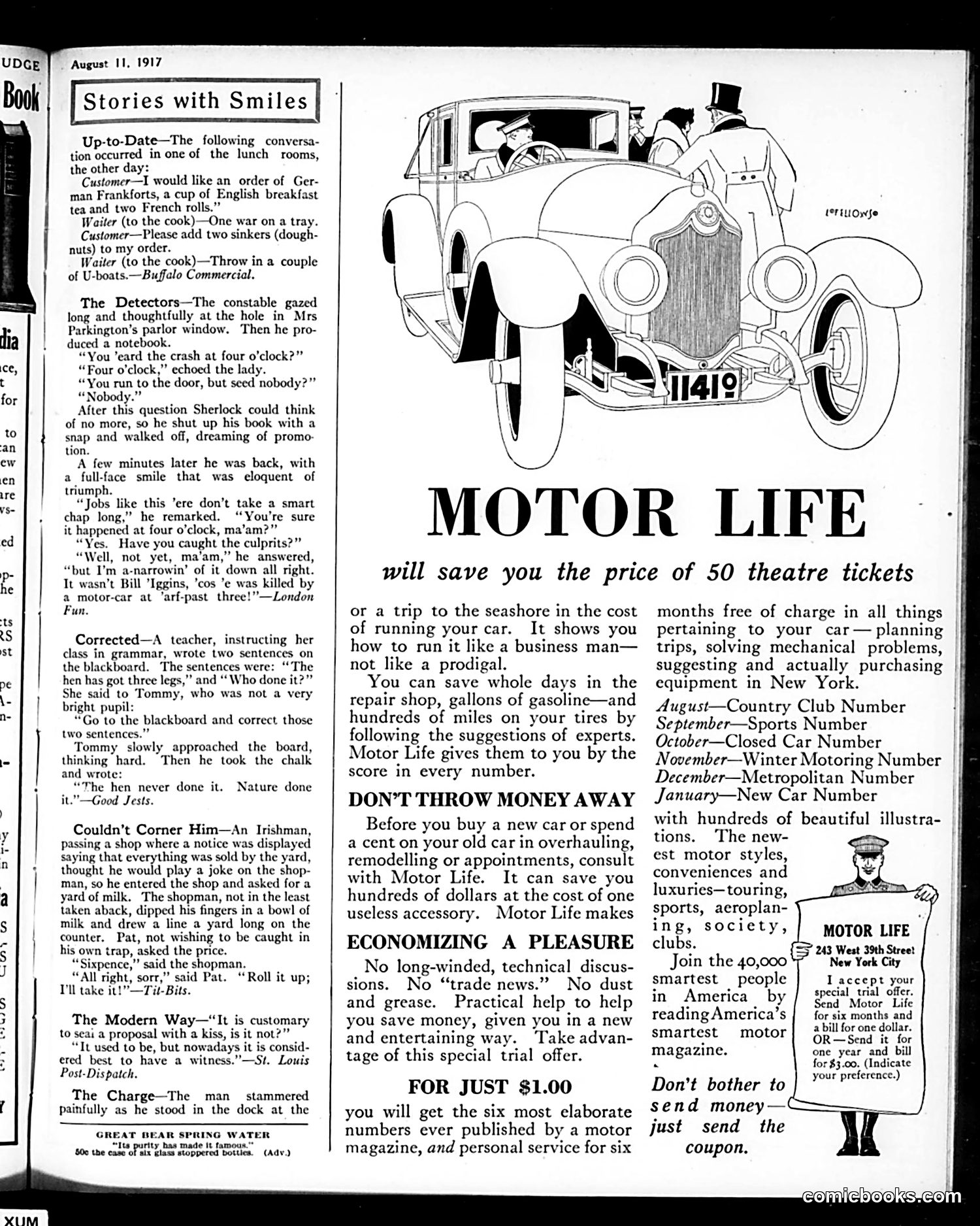
This page contains short humorous stories and a Motor Life magazine advertisement. The "Stories with Smiles" section offers satirical jokes typical of the era: **Notable content:** - "Up-to-Date" joke plays on WWI anxieties: a waiter describes food orders using war terminology (German frankforts become "war on a tray," U-boats = donuts) - "The Detectives" uses Sherlock Holmes-style detective work as setup for a punchline about an alibi - Grammar and linguistic humor dominates other pieces The **Motor Life advertisement** occupies the right half, promoting a car maintenance magazine. It promises to save readers money on car upkeep and offers six issues plus a year's subscription for $1.00. The primary satire reflects **1917 WWI context**: the casual application of wartime language to everyday American life, suggesting how thoroughly the war had permeated public consciousness during America's involvement (entered April 1917).
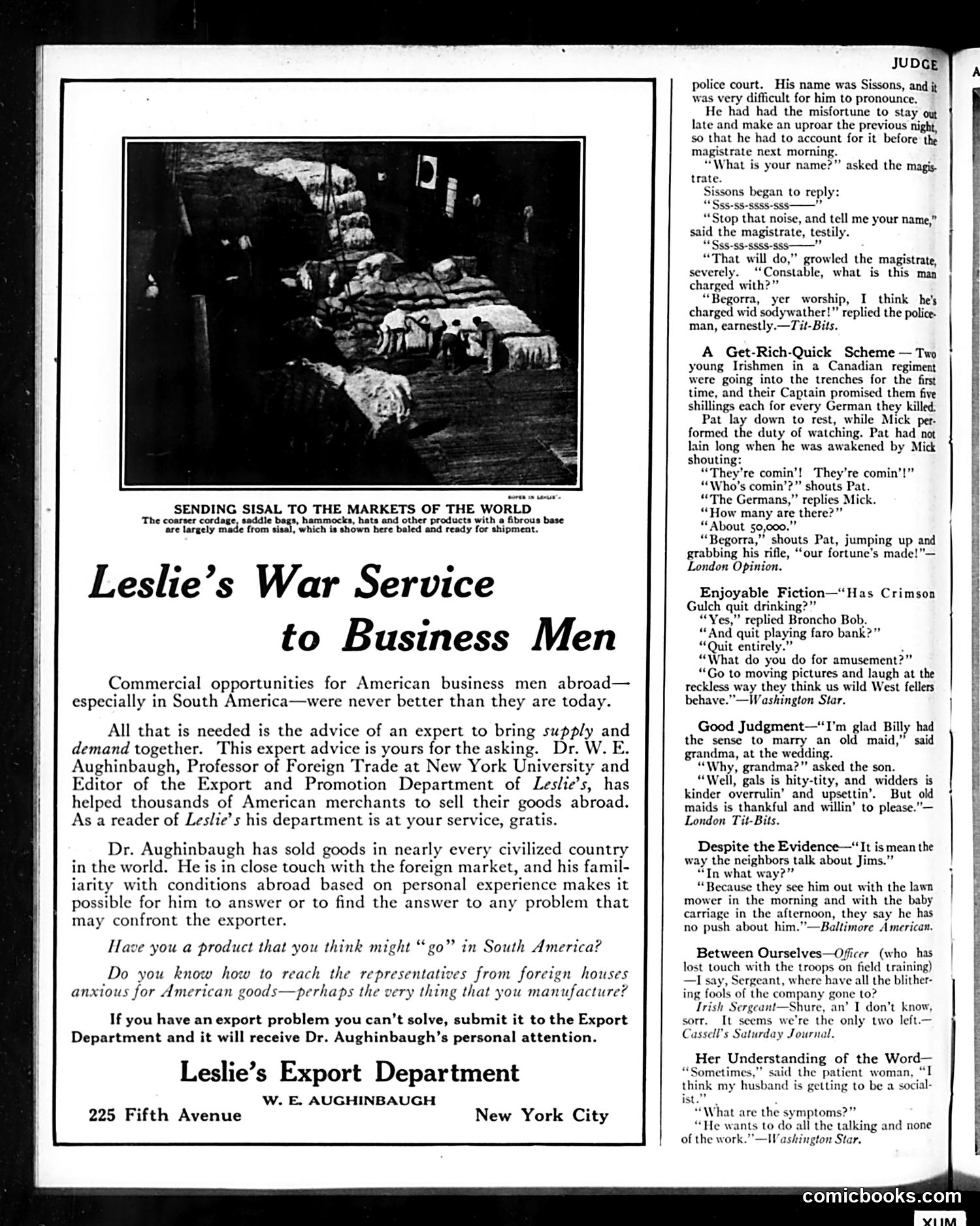
This page combines advertising with humor columns typical of Judge magazine's format. **Main Advertisement:** "Leslie's War Service to Business Men" promotes Dr. W.E. Aughinbaugh's export consulting services through Leslie's magazine. The accompanying photograph shows sisal (plant fiber) being processed and packaged for international trade. This advertisement capitalizes on post-WWI commercial opportunities, particularly in South America, positioning expert trade advice as essential for American business expansion abroad. **Humor Columns:** The right side contains brief comedic anecdotes, mostly Irish or rural American character-based jokes typical of early 20th-century humor magazines. These include: a magistrate struggling with a man named Sissons who stammers; Irish soldiers calculating profit from killing Germans; and rural American observations about courtship and domestic life. The overall page reflects Judge's dual purpose: satirical commentary wrapped around commercial content targeting businessmen readers.
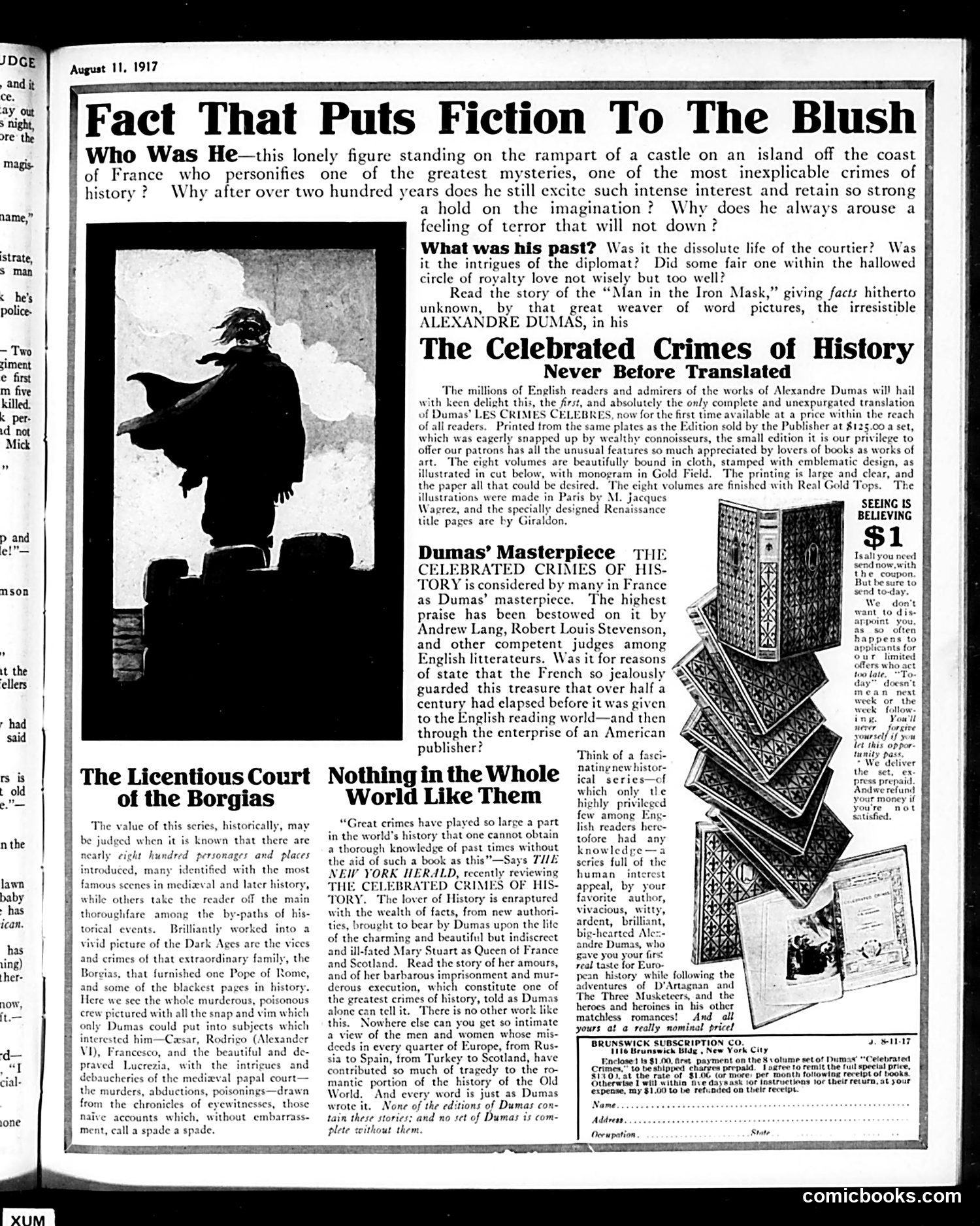
This page is primarily **advertising for a book series**, not a political cartoon. It promotes the first complete English translation of Alexandre Dumas' *Celebrated Crimes of History*, a multi-volume work about historical crimes and scandals. The prominent image shows a silhouetted figure on a castle rampart—the famous "Man in the Iron Mask," the mysterious prisoner who became legend through Dumas' storytelling. The advertisement emphasizes the book's appeal by highlighting its mysterious subjects: the unknown prisoner, the licentious Borgias, and Mary Stuart's scandals at the French court. The marketing strategy positions this as **newly accessible to American readers** at affordable prices (previously available only in expensive French editions). The ads tout endorsements from literary figures like Robert Louis Stevenson and Andrew Lang to establish credibility. This reflects early-20th-century American publishing's appetite for European historical drama and Dumas' enduring cultural prestige during WWI.
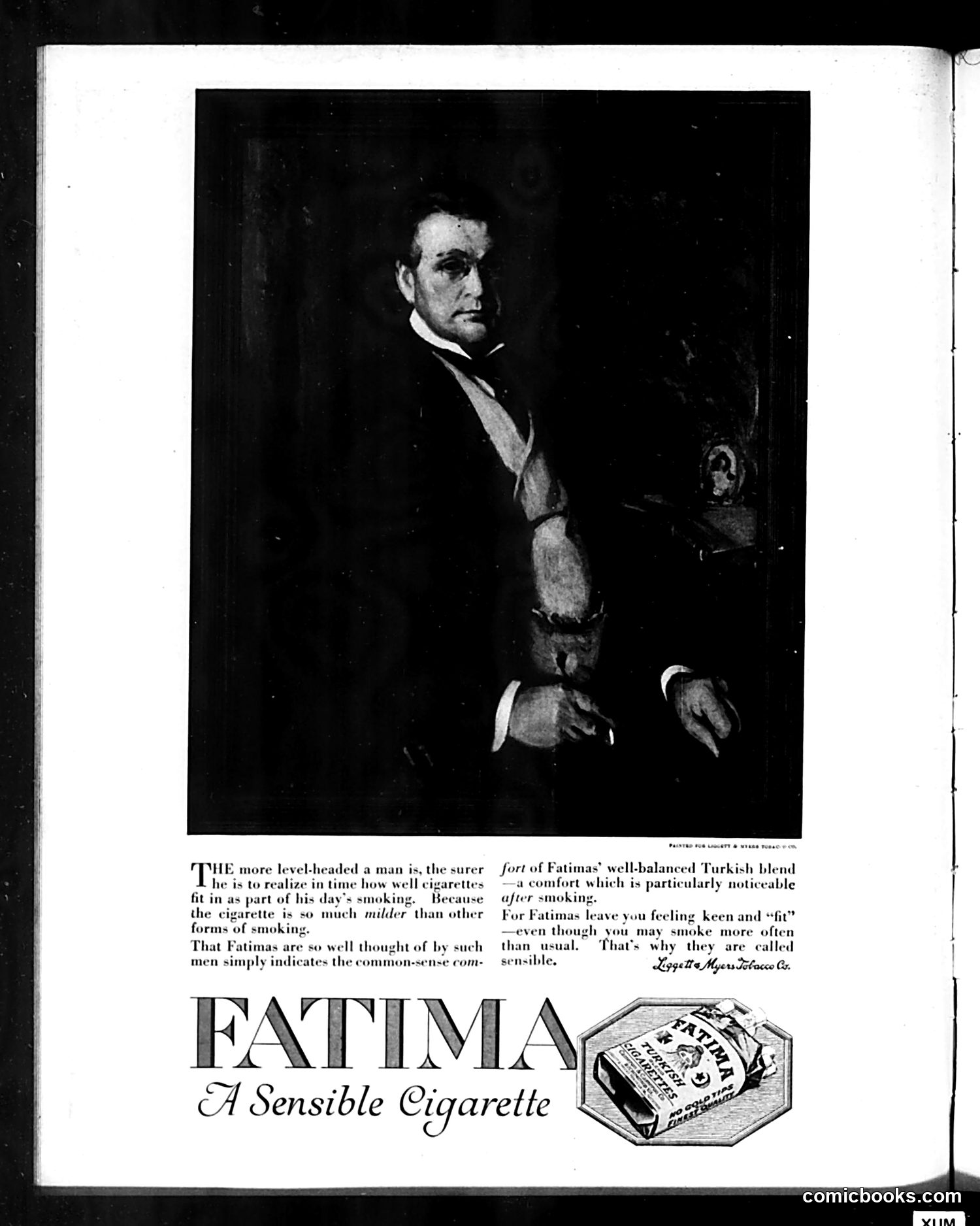
This page is primarily a **cigarette advertisement** for "Fatima: A Sensible Cigarette," not political satire. The portrait shows a distinguished gentleman in formal attire—likely a generic "level-headed man" representing the target consumer rather than a specific historical figure. The ad's text argues that smoking Fatima cigarettes demonstrates "common-sense" because they're "milder than other forms of smoking" and contain a "well-balanced Turkish blend." The marketing pitch suggests smokers can indulge "more often" without ill effect. By modern standards, this reflects early 20th-century tobacco advertising's now-debunked health claims. The emphasis on "sensibility" is ironic given contemporary understanding of cigarette dangers. No political cartoon or satire appears present—this is straightforward (if historically problematic) commercial messaging.