
Judge, 1917-08-11 · page 17 of 28
Judge — August 11, 1917 — page 17: what you’re looking at
What you’re looking at
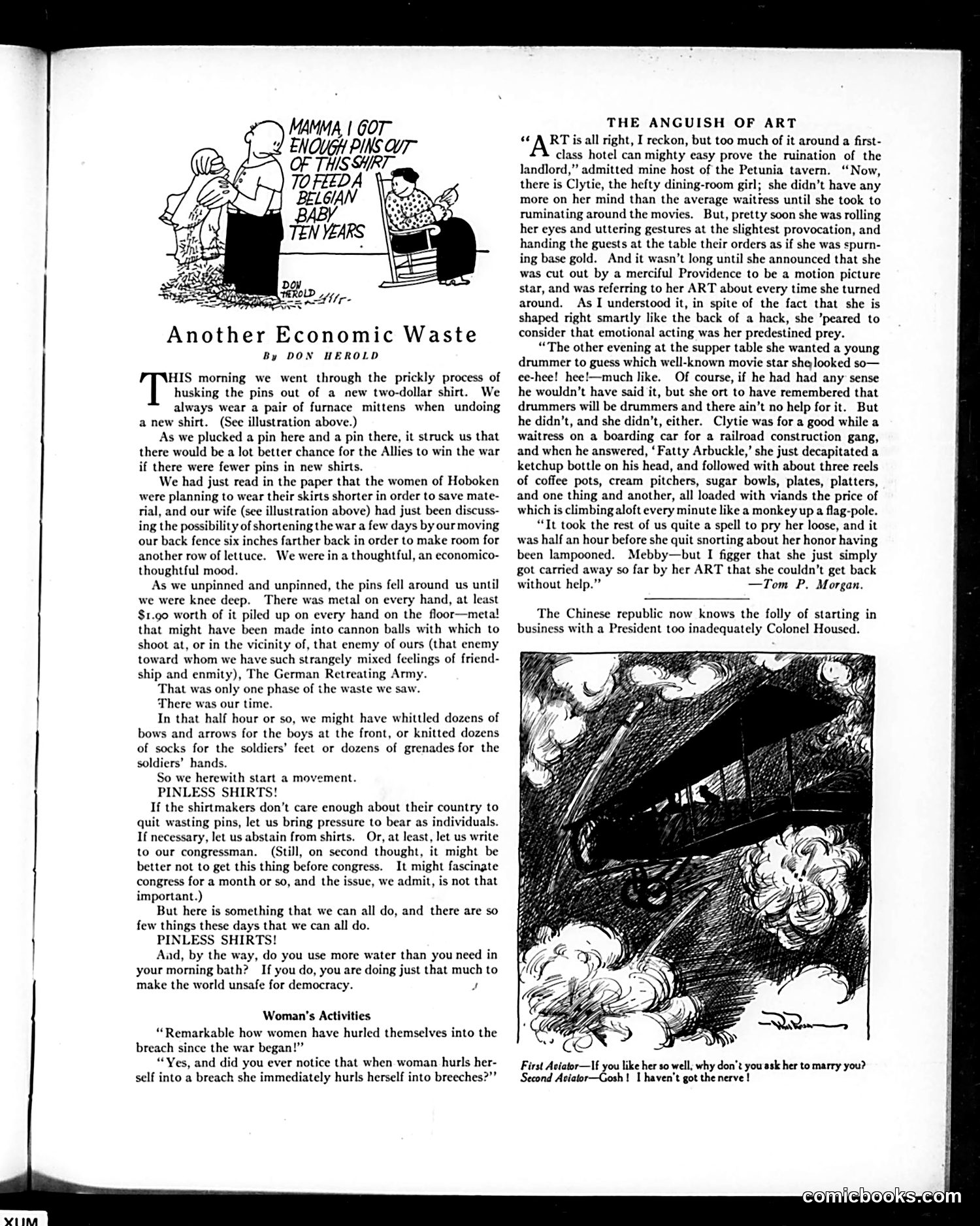
**Top Cartoon:** Depicts a family saving pins from a new shirt. The satire mocks wartime "conservation" efforts—the author notes the absurdity that women are shortening skirts to save fabric while people waste time unpinning shirts. The joke highlights how trivial, performative sacrifices distract from real war effort needs. **"Pinless Shirts" Campaign:** A tongue-in-cheek proposal to pressure shirt manufacturers into removing pins as a wartime conservation measure. The author sarcastically notes this is "something we can all do"—suggesting frustration with how ordinary citizens are offered only symbolic actions rather than meaningful contribution. **Bottom Section:** "Woman's Activities" contains a sexist pun about women entering the workforce ("breach") versus wearing men's clothing ("breeches"). "The Anguish of Art" mocks a waitress inspired by movies to adopt theatrical mannerisms and claim artistic aspirations—satirizing how cinema culture affects working-class women. All content reflects WWI-era concerns about resource conservation and social anxieties about changing gender roles.
📄 Transcribed text from this page (OCR, searchable)
Machine-transcribed from the original scan — historical spelling and the odd misread are preserved.
Another Economic Waste | | By DON HEROLD HIS morning we went through the prickly process of husking the pins out of a new two-dollar shirt. We always wear a pair of furnace mittens when undoing a new shirt. (See illustration above.) As we plucked a pin here and a pin there, it struck us that there would be a lot better chance for the Allies to win the war if there were fewer pins in new shirts. We had just read in the paper that the women of Hoboken were planning to wear their skirts shorter in order to save mate- rial, and our wife (see illustration above) had just been discuss- ing the possibility of shortening the war a few days by our moving our back fence six inches farther back in order to make room for another row of lettuce. We were in a thoughtful, an economico- thoughtful mood. As we unpinned and unpinned, the pins fell around us until we were knee deep. There was metal on every hand, at least $1.90 worth of it piled up on every hand on the floor—meta! that might have been made into cannon balls with which to shoot at, or in the vicinity of, that enemy of ours (that enemy toward whom we have such strangely mixed feelings of friend- ship and enmity), The German Retreating Army. That was only one phase of the waste we saw. There was our time. In that half hour or so, we might have whittled dozens of bows and arrows for the boys at the front, or knitted dozens of socks for the soldiers’ feet or dozens of grenades for the soldiers’ hands. So we herewith start a movement. PINLESS SHIRTS! | If the shirtmakers don’t care enough about their country to quit wasting pins, let us bring pressure to bear as individuals. in from shirts. Or, at least, let us write to our congressman. (Still, on second thought, it might be better not to get this thing before congress. It might fascinate congress for a month or so, and the issue, we admit, is not that important.) But here is something that we can all do, and there are so few things these days that we can all do. PINLESS SHIRTS! Aad, by the way, do you use more water than you need in your morning bath? If you do, you are doing just that much to make the world unsafe for democracy. Fi If necessary, let us abst Woman's Activities “Remarkable how women have hurled themselves into the breach since the war began!” “Yes, and did you ever notice that when woman hurls her- self into a breach she immediately hurls herself into breeches?”’ THE ANGUISH OF ART ¢¢ A RT is all right, I reckon, but too much of it around a first- class hotel can mighty easy prove the ruination of the landlord,” admitted mine host of the Petunia tavern. “Now, there is Clytie, the hefty dining-room girl; she didn’t have any more on her mind than the average waitress until she took to ruminating around the movies. But, pretty soon she was rolling her eyes and uttering gestures at the slightest provocation, and handing the guests at the table their orders as if she was spurn- ing base gold. And it wasn’t long until she announced that she was cut out by a merciful Providence to be a motion picture star, and was referring to her ART about every time she turned around. As I understood it, in spite of the fact that she is shaped right smartly like the back of a hack, she ’peared to consider that emotional acting was her predestined prey. “The other evening at the supper table she wanted a young drummer to guess which well-known movie star she looked so— ce-hee! hee!—much like. Of course, if he had had any sense he wouldn’t have said it, but she ort to have remembered that drummers will be drummers and there ain’t no help for it. But he didn’t, and she didn’t, either. Clytie was for a good while a waitress on a boarding car for a railroad construction gang, and when he answered, ‘Fatty Arbuckle,’ she just decapitated a ketchup bottle on his head, and followed with about three reels of coffee pots, cream pitchers, sugar bowls, plates, platters, and one thing and another, all loaded with viands the price of which is climbing aloft every minute like a monkey up a flag-pole. “Tt took the rest of us quite a spell to pry her loose, and it was half an hour before she quit snorting about her honor having been lampooned. Mebby—but I figger that she just simply got carried away so far by her ART that she couldn’t get back without help.” —Tom P. Morgan. The Chinese republic now knows the folly of starting in business with a President too inadequately Colonel Housed. First Aviator—If you like her so well, why don’t you ask her to marry you? Second Aviator—Gosh ! I haven't got the nerve !