
Judge, 1917-08-11 · page 19 of 28
Judge — August 11, 1917 — page 19: what you’re looking at
What you’re looking at
This page presents pro-suffrage arguments by Anna Cadogan Etz, countering anti-suffrage rhetoric through satire and anecdote. **Key arguments made:** 1. **"If Women Raise Their Boys to be Soldiers"**: Refutes the claim that mothers are responsible for military unreadiness. Three of four soldier applicants are rejected for physical defects—but the military source blamed *schools*, not mothers, demolishing the anti-suffrage argument that women inevitably fail at civic duties. 2. **"Disfigured and Out of the Ring"**: The author describes working as a census-taker during voting registration. Women volunteer unpaid, men who voted *against* suffrage (fearing it would ruin dinners and domestic life) mysteriously vanish—their objections proven false by women's competent participation. 3. **"What Women Bring to Politics"**: In Arkansas, where poll taxes burden male voters, women voting in primaries become political assets, organizing voter participation through social ingenuity—proving women strengthen rather than weaken politics. **The satire**: Anti-suffrage arguments about women's incompetence are demolished by real-world evidence of female competence and civic contribution.
📄 Transcribed text from this page (OCR, searchable)
Machine-transcribed from the original scan — historical spelling and the odd misread are preserved.
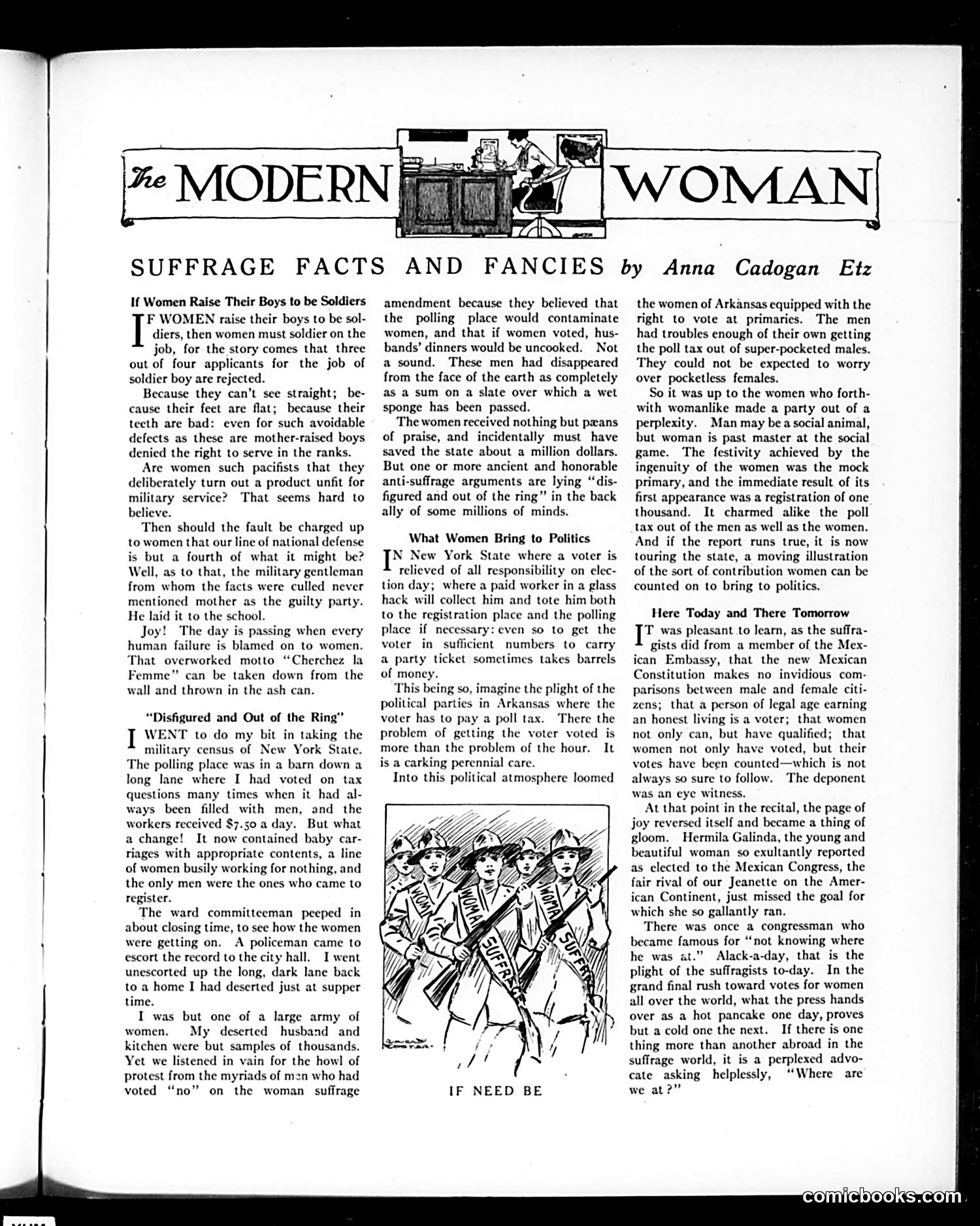
If Women Raise Their Boys to be Soldiers F WOMEN raise their boys to be sol- I diers, then women must soldier on the job, for the story comes that three out of four applicants for the job of soldier boy are rejected. Because they can’t see straight; be- cause their feet are flat; because their teeth are bad: even for such avoidable defects as these are mother-raised boys denied the right to serve in the ranks. Are women such pacifists that they deliberately turn out a product unfit for military service? That seems hard to believe. Then should the fault be charged up to women that our line of national defense is but a fourth of what it might be? Well, as to that, the military gentleman from whom the facts were culled never mentioned mother as the guilty party. He laid it to the school. Joy! The day is passing when every human failure is blamed on to women. That rworked motto “Cherchez la Femme” can be taken down from the wall and thrown in the ash can. “Disfigured and Out of the Ring” T to do my bit in taking the y census of New York State. The polling place was in a barn down a long lane where I had voted on tax stions many times when it had al- ways been filled with men, and the workers received $7.50 a day. But what a change! It now contained baby car- riages with appropriate contents, a line of women busily working for nothing, and the only men were the ones who came to register. The ward committeeman peeped in about closing time, to see how the women were getting on. A policeman came to escort the record to the city hall. I went unescorted up the long, dark lane back to a home I had deserted just at supper time. I was but one of a large army of women. My deserted husband and kitchen were but samples of thousands. Yet we listened in vain for the howl of protest from the myriads of men who had voted “no” on the woman suffrage amendment because they believed that the polling place would contaminate women, and that if women voted, hus- bands’ dinners would be uncooked. Not a sound. These men had disappeared from the face of the earth as completely as a sum on a slate over which a wet sponge has been passed. The women received nothing but prans of praise, and incidentally must have saved the state about a million dollars. But one or more ancient and honorable anti-suffrage arguments are lying “dis- figured and out of the ring” in the back ally of some millions of minds. What Women Bring to Politics N New York State where a voter is relieved of all responsibility on elec- tion day; where a paid worker in a glass hack will collect him and tote him both to the registration place and the polling place if necessary: even so to get the voter in sufficient numbers to carry a party ticket sometimes takes barrels of money. This being so, imagine the plight of the political parties in Arkansas where the voter has to pay a poll tax. There the problem of getting the voter voted is more than the problem of the hour. It is a carking perennial care. Into this political atmosphere loomed IF NEED BE SUFFRAGE FACTS AND FANCIES by Anna Cadogan Etz the women of Arkansas equipped with the right to vote at primaries. The men had troubles enough of their own getting the poll tax out of super-pocketed males. They could not be expected to worry over pocketless females. So it was up to the women who forth- with womanlike made a party out of a perplexity. Man may bea social animal, but woman is past master at the social game. The festivity achieved by the ingenuity of the women was the mock primary, and the immediate result of its first appearance was a registration of one thousand. It charmed alike the poll tax out of the men as well as the women. And if the report runs true, it is now touring the state, a moving illustration of the sort of contribution women can be counted on to bring to politics. Here Today and There Tomorrow T was pleasant to learn, as the suffra- gists did from a member of the Mex- ican Embassy, that the new Mexican Constitution makes no invidious com- parisons between male and female citi- zens; that a person of legal age earning an honest living is a voter; that women not only can, but have qualified; that women not only have voted, but their votes have been counted—which is not always so sure to follow. The deponent yas an eye witness. t that point in the recital, the page of joy reversed itself and became a thing of gloom. Hermila Galinda, the young and beautiful woman so exultantly reported as elected to the Mexican Congress, the fair rival of our Jeanette on the Amer- ican Continent, just missed the goal for which she so gallantly ran. There was once a congressman who became famous for ‘not knowing where he was at.” Alack-a-day, that is the plight of the suffragists to-day. In the grand final rush toward votes for women all over the world, what the press hands over as a hot pancake one day, proves but a cold one the next. If there is one thing more than another abroad in the suffrage world, it is a perplexed advo- cate asking helplessly, ‘Where are we at?”