
Judge, 1917-08-11 · page 15 of 28
Judge — August 11, 1917 — page 15: what you’re looking at
What you’re looking at
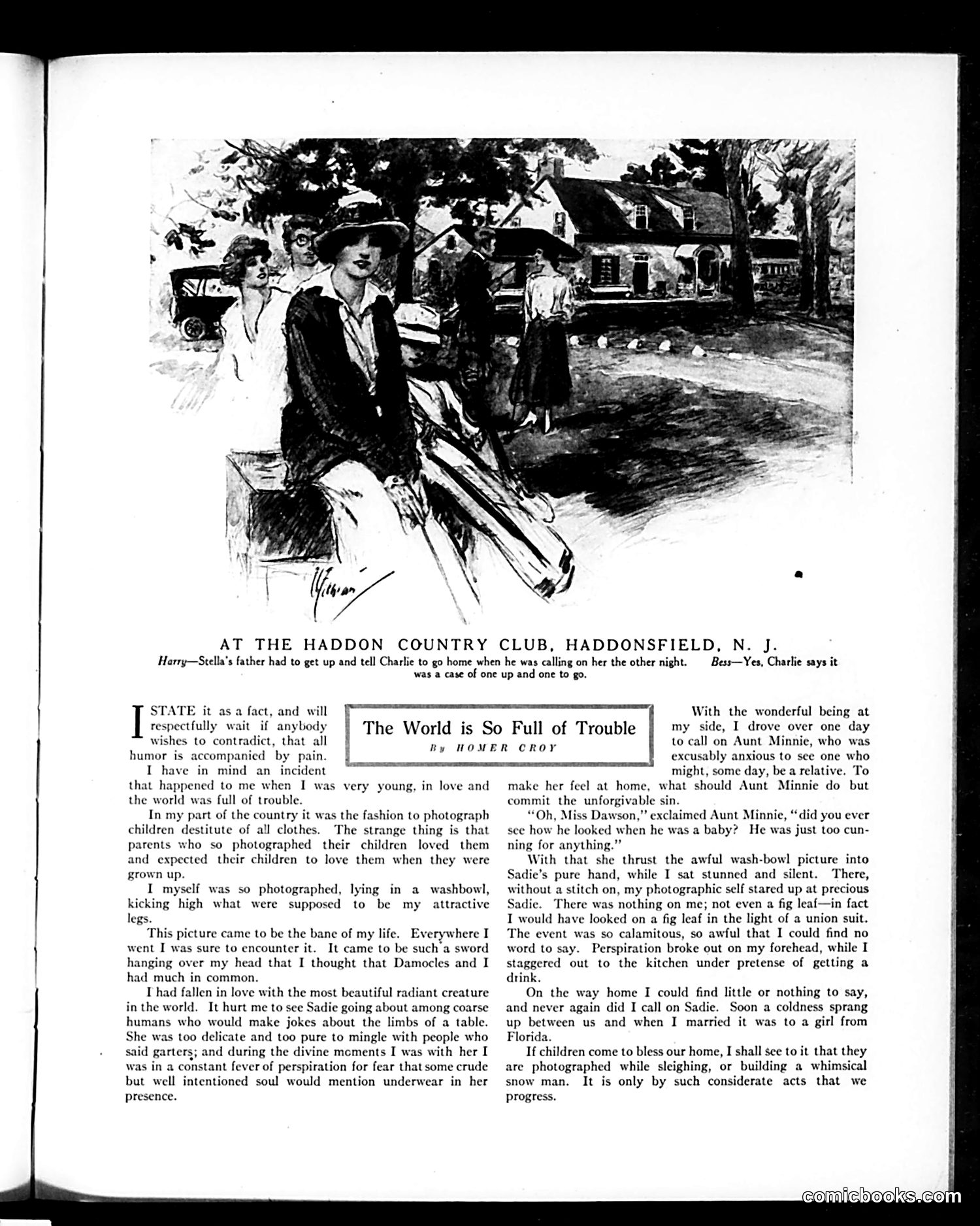
This page combines a social joke and a sentimental story about embarrassment and courtship from the early 20th century. **The cartoon** (top illustration) depicts a brief exchange at an exclusive country club. Harry reports that Stella's father had to interrupt Charlie's visit—a reference to the common practice of chaperonage and parental oversight of young unmarried couples. The phrase "one up and one to go" appears to be a sports or competitive reference Charlie uses to downplay the rebuke humorously. **The story** by Homer Croy satirizes overly protective courtship customs and parental embarrassment tactics. The narrator's childhood nude photograph—a period fashion among upper-class families—becomes a source of shame that destroys his romance. Aunt Minnie innocently produces this humiliating image while entertaining his girlfriend, causing mortification. The piece gently mocks both the absurd Victorian custom of photographing naked children and the narrator's prissy mortification over bodily matters.
📄 Transcribed text from this page (OCR, searchable)
Machine-transcribed from the original scan — historical spelling and the odd misread are preserved.
AT THE HADDON COUNTRY CLUB, HADDONSFIELD, N. J. Harry—Stella's father had to get up and tell Charlie to go home when he was calling on her the other night. Bess—Yes, Charlie says it was a case of one up and one to go, STATE it as a fact, and will respectfully wait if anybody | The World is So Full of Trouble By HOMER CROoY wishes to contradict, that all | humor is accompanied by pai I have in mind an incident that happened to me when I was very young, in love and the world was full of trouble. In my part of the country it was the fashion to photograph children destitute of all clothes. The strange thing is that parents who so photographed their children loved them and expected their children to love them when they were grown up. I myself was so photographed, lying in a washbowl, kicking high what were supposed to be my _ attractive legs. This picture came to be the bane of my life. Everywhere I went I was sure to encounter it. It came to be such a sword hanging over my head that I thought that Damocles and I had much in common. T had fallen in love with the most beautiful radiant creature in the world. It hurt me to see Sadie going about among coarse humans who would make jokes about the limbs of a table. She was too delicate and too pure to mingle with people who said garters; and during the divine moments I was with her I was in a constant fever of perspiration for fear that some crude but well intentioned soul would mention underwear in her presence. With the wonderful being at my side, I drove over one day to call on Aunt Minnie, who was excusably anxious to see one who might, some day, be a relative. To make her feel at home, what should Aunt Minnie do but commit the unforgivable sin. “Oh, Miss Dawson,” exclaimed Aunt Minnie, “did you ever sce how he looked when he was a baby? He was just too cun- ning for anything.” With that she thrust the awful wash-bowl picture into Sadie’s pure hand, while I sat stunned and silent. There, without a stitch on, my photographic self stared up at precious Sadie. There was nothing on me; not even a fig leaf—in fact I would have looked on a fig leaf in the light of a union suit. The event was so calamitous, so awful that I could find no word to say. Perspiration broke out on my forehead, while I staggered out to the kitchen under pretense of getting a drink. On the way home I could find little or nothing to say, and never again did I call on Sadie. Soon a coldness sprang up between us and when I married it was to a girl from Florida. If children come to bless our home, I shall see to it that they are photographed while sleighing, or building a whimsical snow man. It is only by such considerate acts that we progress.